What There Is
ontology
How many things are on a table, and who decides what counts as a thing?
Act V opens with Quine's 'On What There Is': Plato's beard, and ontological commitment read off the quantifiers of a regimented sentence. Meinong's golden mountain meets Russell's theory of descriptions, and the medieval dispute over universals is rerun on property tables, where Goodman's imperfect community and companionship defeat resemblance nominalism. Mereology is then built axiom by axiom: every partial order on up to six elements is tested, and the only finite models of the classical theory turn out to be Boolean algebras with the zero removed. The turn is van Inwagen's special composition question, counted on six blocks (6 objects, 40 or 63), and the Lewis-Sider argument that any answer between never and always makes existence vague: the Wall's twentieth brick. Metaontology, grounding and the question of a bottom level follow. The part ends with ontology as engineering: an ALC tableau reasoner, OntoClean on a taxonomy, and a knowledge-graph embedding that answers every question, nonsense included.
What you need. First-order quantifiers (Part 3) and the idea of a partial order. Nothing else.
- The calculation
- quantifiers, mereology, description logic
- The wall
- the special composition question
- Built toy
- Boolean-lattice mereology; an ALC reasoner
What you will be able to do
Introductory
- Regiment an English sentence in first-order logic and read off what it commits its speaker to.
- Count the objects among a few blocks on the nihilist, contact and universalist answers.
Advanced
- Evaluate 'the present King of France is not bald' on both scopes in a model.
- Check weak supplementation, strong supplementation and unrestricted fusion on a small partial order, and find Goodman's imperfect community in a property table.
Research
- Prove that a finite model of classical extensional mereology with k atoms has exactly 2^k - 1 elements.
- Reconstruct the Lewis-Sider argument from vagueness and say which premise each moderate answer to the composition question must give up.
- Verify that a grounding relation is a strict partial order and unfold Fine's rules of ground for a truth-functional sentence.
Applied
- Decide a subsumption in ALC by tableau, and read a counter-model off an open branch.
- Apply OntoClean's rigidity and identity constraints to a taxonomy and name the errors.
Contents
Each chapter has a home level. Choose a track to see what to read and watch: Introductory 19 min · Advanced 42 min · Research 50 min · Applied 28 min.
- 0What is there?Introductory2 min
- 1On what there isIntroductory4 min
- 2Meinong's jungle and Russell's escapeIntroductory4 min
- 3Universals and nominalismIntroductory3 min
- 4Resemblance and its troublesAdvanced3 min
- 5Abstract objectsAdvanced3 min
- 6Mereology, axiom by axiomAdvanced3 min
- 7The special composition questionIntroductory3 min
- 8Vagueness, and composition as identityResearch3 min
- 9The problem of the manyAdvanced2 min
- 10MetaontologyAdvanced2 min
- 11GroundingResearch3 min
- 12Is there a bottom level?Research2 min
- 13Description logicApplied4 min
- 14Ontologies in practiceApplied3 min
- 15Knowledge graphs and embeddingsApplied3 min
- Recap, problems, and where this comes backAll tracks2 min
Also on this page: Lecture · Key results · Try it · Lab · Problems · Notes and sources · Build the film.
Lecture
The text of each chapter is the film's narration, as it is spoken, so you can read along or revise without the film. The pictures are in the film.
What is there?Introductory2 min
Act Five of this series turns from how we know to what there is. Part 19 asked what life is; this part asks what anything is. Willard Van Orman Quine opened his most famous paper with a joke: the ontological question can be put in three words, what is there, and answered in one: everything. Everyone accepts that answer. The arguments begin when we ask what everything includes.
Here is a table. How many things are on it? A cup, a saucer and an apple; with the table, four. But the cup has a handle, the table has legs, the apple has a core. Parts are things too. Is the cup-and-saucer one more thing? What about the apple plus the Moon? The apple is red. Is its redness something it has, an entity of its own? There is one cup. Is the number one a thing? Or are there really only particles, some ten to the twenty-seven of them, arranged table-wise and cup-wise? Each answer is a serious position, and this part builds the tools to compare them.
The plan. Quine's criterion for what a theory says there is, and quantifiers that range over many things at once. Meinong's objects that do not exist, and Russell's escape. The ancient problem of universals, with resemblance nominalism tested on property tables. Abstract objects. The formal theory of parts and wholes, checked on every small model. When parts compose a whole: this part's brick in the Wall, and the problem of the many. Whether ontological disputes are substantive at all; grounding; and whether there is a bottom level. And ontology as engineering: description logic with a working reasoner, the ontologies of medicine and biology, and knowledge graphs.
What it establishes: Quine (1948); the table; the plan.
1On what there isIntroductory4 min
Quine begins with an old riddle, which he called Plato's beard, because it had dulled the edge of Ockham's razor. The sentence Pegasus does not exist seems to be about Pegasus. Then Pegasus must in some sense be, or there would be nothing for the sentence to deny. Quine's imaginary opponents offer homes: McX says Pegasus is an idea in our minds; Wyman says he is an unactualized possible. Quine's answer follows Russell: treat the name as a disguised predicate, being Pegasus, or pegasizing, and say that nothing pegasizes. Then denying that Pegasus exists commits you to nothing at all.
Quine's criterion: to be is to be the value of a variable. Translate a theory into first-order logic. Some dogs are white becomes: there is an x that is a dog and white. The theory is committed to dogs. There is a prime between ten and twenty commits us to numbers. Pegasus does not exist commits us to nothing. Some sentences can be paraphrased away: the average family has two point three children does not commit us to an average family. Others resist: some species are cross-fertile quantifies over species. The criterion does not tell us what there is. It tells us what a theory says there is, so that ontological disputes become disputes about which theory to accept.
Peter Geach offered a sentence that tests the criterion: some critics admire only one another. It says there is a group of critics such that whenever one of them admires someone, that someone is another member of the group. David Kaplan proved that no first-order sentence about critics expresses this: the quantifier ranges over groups. The Reasoner checks it on three admiration networks among five critics, trying all thirty-one nonempty groups. In the first, a closed circle of mutual admirers makes it true. In the second, everyone's admiration leads to a self-admirer, so it is false. In the third, a ring, only the whole community will do. So does the sentence commit us to groups, or sets, as entities? George Boolos argued no: plural quantification, some critics, is ontologically innocent; it commits us only to critics, taken many at a time.
Quine paired his criterion with a strict standard of admission. Ockham's razor: do not multiply entities beyond necessity. And: no entity without identity. Consider the possible fat man in that doorway, and the possible bald man in it. Are they the same possible man, or two? There is no fact of the matter, Quine said, so possibilia are not respectable entities. He confessed a taste for desert landscapes: physical objects and sets, and nothing else. Sets stay because science needs mathematics, the indispensability argument of Part 9. The criterion settles what a theory says there is. It does not settle which theory to believe, and the rest of this part is the argument.
Quine later found that his own criterion has a limit. A linguist in the field hears a speaker say gavagai whenever a rabbit runs past. Does gavagai mean rabbit? It might mean undetached rabbit part, since wherever there is a rabbit there are its parts. Or rabbit stage, a brief temporal slice of a rabbit. Or rabbithood, the universal manifested here. Every possible observation fits every one of these translations. Quine concluded that reference is inscrutable. And so ontology is relative: what a theory says there is can only be asked against a background language, a theme that returns in chapter ten.
What it establishes: Plato's beard; the criterion; Geach and Kaplan; Boolos (1984); Ockham; Quine (1968).; Computed on screen: the Geach–Kaplan sentence on three graphs
2Meinong's jungle and Russell's escapeIntroductory4 min
Alexius Meinong took the opposite route from Quine. Every thought, he held, is directed at an object, even when nothing in the world answers to it. An object can have being-so without being. The golden mountain really is golden and a mountain; it simply does not exist. There are even impossible objects: the round square is round and square. Russell objected: then the existent golden mountain must exist, since it has every property in its description. Meinong replied that it is existent, but does not exist, a distinction few found reassuring. Quine, mocking a similar view, spoke of a slum of possibles.
Russell's own escape came in 1905, in On Denoting. Take the sentence: the present King of France is bald. It looks like subject and predicate. Russell analysed it as three claims: there is a king of France; there is at most one; and he is bald. The definite description is not a name at all. It vanishes on analysis into quantifiers and predicates. Since France has no king, the first conjunct fails and the sentence is simply false. No object is needed for it to be about. And the golden mountain does not exist says only that nothing is uniquely golden and a mountain, which is true, and commits us to nothing.
Russell's analysis also explains an ambiguity. Take the negation: the present King of France is not bald. The Reasoner evaluates it in a model with three people, none of them King of France. Read with narrow scope, there is a unique king and he is not bald: false, since there is no king. Read with wide scope, it is not the case that there is a unique bald king: true. One sentence, two logical forms, two truth values, depending on whether the not sits inside the description or outside it. Peter Strawson objected that the sentence presupposes a king rather than asserting one, and so is neither true nor false. That dispute belongs to the philosophy of language, in Part 27.
Meinong did not stay dead. Terence Parsons divided properties into nuclear ones, like being golden or a mountain, which define an object, and extranuclear ones, like existing, which do not. The existent golden mountain then need not exist. Edward Zalta distinguished two ways of having a property: concrete objects exemplify properties, abstract ones encode them. Sherlock Holmes encodes being a detective without exemplifying it. Graham Priest's noneism separates the quantifier from existence: we can say there are things that do not exist, inside a paraconsistent logic like those of Part 5. The cost is a principle saying which non-existent objects there are, and the paradoxes that threaten it. The stakes include fiction, the intentionality of thought, and every true negative existential.
Fiction sharpens the question. Holmes is a detective seems true, and so does Holmes does not exist. Kendall Walton says fiction is a game of make-believe: there is no Holmes, only our pretending that there is. A Meinongian says Holmes is a non-existent object, who encodes being a detective. Creationists, including Peter van Inwagen, Saul Kripke and Amie Thomasson, say Holmes really exists: an abstract artifact, created by Arthur Conan Doyle in 1887, as real as a law or a symphony. The test case: Holmes is more famous than any real detective. That seems simply true, and it is hard to read as pretence.
What it establishes: Meinong (1904); Russell (1905); Strawson (1950); Parsons (1980); Zalta (1983); Priest (2005); Walton (1990); Thomasson (1999).; Computed on screen: both scopes in a kingless model
3Universals and nominalismIntroductory3 min
Three red things: a tomato, a postbox, a ruby. They differ in almost every way, yet they agree in colour. What is that agreement? The realist says there is one thing, redness, a universal, wholly present in each, so that one entity is in three places at once. For Plato the Form exists apart from its instances; for Aristotle the universal exists only in them. The trope theorist says each red thing has its own particular redness, this red and that red, and the three tropes exactly resemble one another. Donald Williams called tropes the alphabet of being. The nominalist says there are only the three red things. The word red is true of each, and there is nothing further to explain.
The problem shaped a thousand years of philosophy. Around 270, Porphyry raised three questions about genera and species, and declined to answer them: do they exist, or only in thought; are they bodies; are they separate from things? Boethius answered that universals exist in things but are understood apart from them. Peter Abelard held that a universal is a word, applied to many things because they share a status, such as being a man, which is not itself a thing. William of Ockham made universals concepts in the mind, natural signs of many things, and insisted that plurality must not be posited without necessity. That rule of economy became known as Ockham's razor, and it is where Quine began.
In the twentieth century, David Armstrong revived realism with a scientific temper. There is not a universal for every predicate, he argued; there are sparse universals, one for each genuine similarity among things. Which universals exist is for science to discover: mass, charge, spin, not being a grue emerald. And there are no uninstantiated universals: realism in things, after Aristotle. The world is a world of states of affairs, a particular's having a universal. Laws of nature are relations of necessitation between universals, a view we met in Part 18 and will test in Part 24. David Lewis, no realist about universals, agreed that some properties are natural and others gerrymandered, and found the distinction indispensable.
Realists face a regress, first pressed by F. H. Bradley. For a to be F, a and the universal F must somehow be related: call the relation instantiation. But instantiation is itself a universal, so a, F and the instantiation relation must be related, by a second instantiation, and so on without end. Is the regress vicious? If each link needs another link to hold it together, then nothing is ever F. Armstrong answered that a state of affairs is a unity, not a list of constituents waiting to be glued. Peter Strawson spoke of a non-relational tie. The nominalist says no tie is needed, because there was no universal to tie to.
What it establishes: Plato; Aristotle; Williams (1953); Porphyry; Boethius; Abelard; Ockham; Armstrong (1978, 1997); Lewis (1983); Bradley (1893).
4Resemblance and its troublesAdvanced3 min
The nominalist has to say something about agreement in colour. One answer takes resemblance as primitive. Two things resemble one another, and that is a basic fact, not to be explained by a shared universal. A property is then a maximal class of things that all resemble one another. Red things are red because they resemble each other, not because they share redness. Russell objected that resemblance is then itself a universal, and the nominalist has not escaped. Nelson Goodman found two deeper, structural troubles, which survive even if resemblance is granted. The Reasoner computes both.
The first trouble is the imperfect community. Three objects: a is F and G, b is G and H, c is F and H. Every pair shares a property, so every pair resembles. The Reasoner finds the maximal classes of pairwise resembling things. There is only one: all three. But no property is common to all three. And the real properties, F, G and H, each pick out a pair, which is not maximal, so the theory loses them all. Pairwise resemblance is not enough to make a community.
The second trouble is companionship. Suppose every F is also G, but not every G is F: here d and e are F and G, and f is only G. The Reasoner finds one maximal resemblance class, the three things together. The F things, d and e, always resemble f as well, since they share G with it, so the class of F things is never maximal. A property whose instances always come with a companion property cannot be distinguished from it by resemblance alone.
Nominalists have replies. Gonzalo Rodriguez-Pereyra makes resemblance hold between pairs of things, and requires that a property class be one whose pairs all resemble one another as pairs. The imperfect community fails that test. For companionship he appeals to merely possible objects: somewhere there is a possible F that is not G, so the classes differ. The price is primitive resemblance, and the possible worlds of Part 22. Trope theory avoids both troubles, since tropes resemble exactly or not at all, but it pays in tropes. The pattern recurs throughout ontology: every view buys economy in one place with a primitive somewhere else.
What it establishes: Russell (1912); Goodman (1951); Rodriguez-Pereyra (2002).; Computed on screen: maximal resemblance classes against extensions
5Abstract objectsAdvanced3 min
Numbers, sets and propositions are the usual examples of abstract objects. But what makes an object abstract? David Lewis surveyed four answers. The way of example just lists cases, which is not a criterion. The way of negation says abstract things are outside space and time, and causally inert. But is the set of these three cups located where the cups are? The way of conflation identifies the abstract with the universal, or with the set, and these come apart. The way of abstraction says abstract objects are what we reach by abstracting from concrete ones, as directions from lines. Lewis concluded that there is no clear line, and that abstract is not a well-defined term.
Frege showed how abstraction can be made precise. Here are seven lines. Parallelism sorts them into classes. Frege's principle: the direction of a equals the direction of b exactly when a is parallel to b. The direction is introduced by an equivalence relation among concrete lines. The Reasoner counts: seven lines, three directions. Numbers can be introduced the same way, by Hume's principle: the number of Fs equals the number of Gs exactly when the Fs and Gs correspond one to one. But the same form applied to extensions gives Basic Law V, which Russell's paradox showed inconsistent. Abstraction principles are powerful, and dangerous; which ones are acceptable is still debated.
The debate over abstract objects is lively. Platonists hold that they exist, necessarily and independently of us. Paul Benacerraf asked how we could then know anything about them, since they cannot affect us. Bob Hale and Crispin Wright reply that abstraction principles like Hume's introduce the numbers, so knowing such a principle is knowing arithmetic. Øystein Linnebo calls them thin objects, whose existence asks little of the world. Hartry Field's fictionalism says that two plus two is four is true only in the story of mathematics. And Amie Thomasson's easy ontology says that from there are two cups we may infer there is a number, so existence questions are easy, not deep. That last view returns in chapter ten.
David Lewis connected the two great formal ontologies, set theory and mereology. His main thesis: a class is the mereological sum of the singletons of its members. The class of three cats is the fusion of the three singletons, cat one, cat two and cat three. Then set theory is mereology plus a single new primitive, the function that takes each thing to its singleton. And subsets are just parts: a set of two cats is part of the set of three. But what is a singleton? An atom, with no parts in common with its member, related to it in a way nothing explains. Lewis confessed it a mystery. The structuralism of Part 9 offers relief: perhaps only the pattern of the singleton relation matters, not the nature of its relata.
What it establishes: Lewis (1986); Frege (1884); Hume's principle; Benacerraf (1973); Hale and Wright; Linnebo (2018); Field (1980); Thomasson (2015); Lewis (1991).; Computed on screen: directions as parallelism classes
6Mereology, axiom by axiomAdvanced3 min
Mereology, the formal theory of parts and wholes, was founded by Stanisław Leśniewski in 1916, as a nominalist rival to set theory. Its classical form starts with parthood as a partial order: everything is part of itself; two things that are parts of each other are identical; a part of a part is a part. Two things overlap if they share a part. Weak supplementation: if x is a proper part of y, then y has some other part that does not overlap x. A whole cannot have just one proper part. Strong supplementation: if y is not part of x, then y has a part that does not overlap x. And unrestricted fusion: any nonempty collection of things has a fusion, something that overlaps exactly what overlaps some member of the collection. These together make classical extensional mereology.
The Reasoner checks small models. On the left, a whole x with exactly one proper part, a. Weak supplementation fails: nothing in x is disjoint from a. Most people agree that nothing could be composed of a single smaller part. On the right, two wholes, x and y, each composed of the same two parts, a and b. Weak supplementation holds, but strong supplementation fails, and with it extensionality: x and y are distinct things with exactly the same parts. Is that possible? A statue and the clay it is made of seem to share all their parts. Classical mereology says they must be one thing. That is the puzzle of constitution, which returns in Part 21.
Now the Reasoner tests every possible structure. It generates every partial order on up to six elements, up to isomorphism: one, two, five, sixteen, sixty-three and three hundred and eighteen of them, matching the known counts. For each it checks weak and strong supplementation and unrestricted fusion. Each axiom alone is satisfied by many orders. All of them together, by exactly two: one with a single element, and one with three. No model of classical mereology has two, four, five or six elements.
Why one and three? Take k atoms. In classical mereology every nonempty collection of them has exactly one fusion, and there is nothing else. So a model with k atoms has two to the k, minus one, elements: one, three, seven, fifteen. Here are the seven of three atoms, ordered by parthood. The Reasoner checks each: both supplementation principles and fusion hold. Alfred Tarski showed the general result: classical extensional mereology is the theory of complete Boolean algebras with the zero removed. The atoms fix everything. Given the simples, the sums come for free, which is exactly what the next chapter questions.
What it establishes: Leśniewski (1916); CEM; Tarski (1935); constitution.; Computed on screen: every poset on ≤ 6 elements; Boolean algebras minus zero
7The special composition questionIntroductory3 min
Classical mereology says that any things whatever compose something. Peter van Inwagen asked whether that is true. His special composition question: when is it true that there is something the xs compose? Things compose y when each is part of y and every part of y overlaps one of them. One answer is never: only simples exist, the view called nihilism. Another is always: universalism, the classical theory. Between them lie moderate answers: when the things are in contact, or fastened together, or cohere, or fuse, or when their activity constitutes a life. What composition is, he left aside; the question is only when it happens.
The Reasoner counts. Six blocks in a grid, each a simple. On nihilism there are six objects: the blocks themselves, and nothing they compose. On the contact view, a group composes something when its blocks are connected, edge to edge. The Reasoner checks every group: forty are connected, from single blocks to the whole array. On universalism every nonempty group composes something, including scattered ones like these two separated blocks: sixty-three objects. The same six simples, arranged the same way, and three answers to how many things there are.
Van Inwagen defended an unusual moderate answer. Things compose something only when their activity constitutes a life. So there are organisms, as Part 19 described them, and there are simples, and nothing else. There are no tables, only simples arranged table-wise. Ordinary talk of tables is true when loosely spoken. Why organisms? Because I exist, and my thinking is not just the activity of my simples. Trenton Merricks argued for eliminating even more. A baseball shatters a window. The ball's atoms, acting together, shatter it too. If the ball also caused it, the effect would be overdetermined, as in Part 17; so there are no baseballs. The reply is that the ball's power just is its atoms' power, arranged, so there is no double counting.
The contact answer raises a question of its own: what is it for two things to touch? Mereology has no word for it; touching belongs to topology. The combined theory is called mereotopology. Alfred North Whitehead, and later Bowman Clarke, took a relation of connection as primitive. Now take two blocks that touch. Who owns the line where they meet? If both blocks include their boundaries, they overlap there, and do not merely touch. If neither does, there is a gap of nothing between them. Bernard Bolzano said one is closed and the other open, though nothing decides which. Franz Brentano said there are two boundaries, coinciding exactly. Roberto Casati and Achille Varzi built the formal theory in Parts and Places.
What it establishes: van Inwagen (1987, 1990); Merricks (2001); Whitehead; Clarke (1981); Bolzano; Brentano; Casati and Varzi (1999).; Computed on screen: objects among six blocks on three answers
8Vagueness, and composition as identityResearch3 min
Moderate answers face a challenge from vagueness. Line up cases. Two blocks glued together; touching; nearly touching; a little apart; a metre apart; a mile apart. At one end they clearly compose something; at the other, on any moderate view, they clearly do not. So composition must stop somewhere along the series. But any sharp cut-off between two neighbouring cases, differing by a hair, seems arbitrary.
David Lewis and Ted Sider turned this into an argument. If composition is restricted, there is a series of cases running from composition to its absence. No case in the series is a sharp cut-off. So composition is sometimes vague: it is indeterminate whether some things compose anything. But then it is indeterminate how many things exist. And how many things exist can be said in pure logic. There are exactly two things: there is an x and a y, distinct, and everything is one or the other. Quantifiers, identity and connectives are not vague. So composition is not restricted after all: it is unrestricted, or, for the nihilist, it never happens.
This is the twentieth brick in the Wall. The dream: a principled answer to when parts make a whole, one that counts tables and organisms but not the sum of my nose and the Eiffel Tower. The wall: van Inwagen's special composition question, sharpened by the argument from vagueness: every moderate answer seems to need a sharp cut-off, or vague existence. What it forces: a choice between nihilism, universalism, or accepting that it can be vague what exists.
Universalism seems profligate: every scattered collection is one more thing. Donald Baxter and David Lewis replied with composition as identity: a whole is nothing over and above its parts; it is the parts, taken together. Then the sums are no addition to being, and universalism comes for free. But count. Three atoms and their sums: are there three things here, or seven? And Leibniz's law: the parts are three, the whole is one, so how can they be identical? Ted Sider and Aaron Cotnoir have developed identity between one thing and many things, with its own logic, to make the view coherent.
What it establishes: Lewis (1986); Sider (2001); the Wall's twentieth brick; Baxter (1988); Lewis (1991); Sider (2007); Cotnoir (2013).
9The problem of the manyAdvanced2 min
Peter Unger and Peter Geach found a problem in every ordinary object. Look at a cloud. Its edge is not a line; the droplets simply thin out. So there are many aggregates of droplets that differ by a few droplets at the edge, and each is an equally good candidate to be the cloud. Each candidate is cloud-shaped, cloud-sized and made of water. Each seems to be a cloud. So either there are thousands of clouds where we see one, or, as Unger concluded, there are no clouds at all.
The problem of the many is a Price List. Each candidate in the crowd is a cloud, since they are equally good. The candidates are many, since they differ by droplets. And there is exactly one cloud in the sky. The three cannot all be true. Deny the first: Unger says no candidate is a cloud, because there are none; Timothy Williamson's epistemicism says exactly one is, though we can never know which. Deny the second: Geach says the candidates are different aggregates but the same cloud; Lewis says they are many but almost one, overlapping so much that we may count them as one. Or deny the third: there really are many clouds, and our counting is loose.
The problem does not stay in the sky. A cat, Tibbles, is about to lose a hair. Before it falls, Tibbles and Tibbles-minus-that-hair are both cat-shaped, both made of cat. Are there two cats on the mat? And you: there are many slightly different aggregates of your particles. Are there many of you, all thinking this thought? The supervaluationist says the word cloud, or cat, is vague. On each way of making it precise, exactly one candidate qualifies, so there is one cloud is true on every sharpening, though no candidate is determinately the cloud. What makes you the same person over time is the topic of Part 21.
What it establishes: Unger (1980); Geach (1980); the problem of the many as a Price List; Lewis (1993); Williamson; supervaluation.; Computed on screen: the conflict and its exits
10MetaontologyAdvanced2 min
Rudolf Carnap thought most of these debates were confused. Questions about existence asked within a linguistic framework, such as is there a prime above a hundred, are answered by the rules and evidence of the framework. Within the number framework, are there numbers is trivially yes. The metaphysician wants to step outside and ask whether there are really numbers. That external question, Carnap said, is only whether to adopt the framework. It is not true or false, but a practical choice of language, judged by how useful it is. Quine replied that there is no sharp line between choosing a framework and choosing a theory: ontology is part of science, and as serious as any of it.
Hilary Putnam gave the debate a famous example. Imagine a world with three individuals. How many objects are there? Carnap counts three. A Polish logician, a follower of Leśniewski who accepts every mereological sum, counts seven: the three, the three pairs, and the whole. The same world, two counts. Putnam concluded that the word object has no meaning fixed independently of a conceptual scheme. Ask how many objects there really are, and there is no answer to give.
Today's metaontology continues the argument. Eli Hirsch defends quantifier variance: the phrase there is can be given different meanings, and the nihilist and the universalist each speak truly in their own language. Their dispute is merely verbal, like an argument over whether a glass is half full. Amie Thomasson's easy ontology says existence questions are answered by trivial inferences from conceptual truths. Ted Sider replies with structure. Some meanings carve nature at its joints better than others, and ontology asks what exists in the most joint-carving sense of exists. Whether there is one such meaning, or many equally good ones, is now itself the question.
What it establishes: Carnap (1950); Quine (1951); Putnam (1987); Hirsch (2002, 2011); Thomasson (2015); Sider (2011).; Computed on screen: 3 objects or 7
11GroundingResearch3 min
Some facts hold in virtue of others. The set containing Socrates exists because Socrates exists, and not the other way round. The disjunction Socrates exists or Zeus exists is true because Socrates exists. Snow is white is true because snow is white, as Aristotle noted. The table exists because its particles are arranged table-wise. Perhaps a pain exists because of a brain state, the question of Part 30. None of these is causation. The relation is simultaneous and non-causal: metaphysical explanation. Kit Fine, Jonathan Schaffer and Gideon Rosen called it grounding.
Grounding is usually taken to be a strict partial order. The Reasoner builds a small graph of facts, with arrows from grounds to what they ground. Fundamental facts sit at the bottom. It checks the order: nothing grounds itself; no two facts ground each other; and grounds of grounds are grounds, once the relation is closed under chaining. Five facts are fundamental, grounded in nothing; every other fact sits at a level, the length of its longest chain down to them. Add one arrow, saying that the table grounds the arrangement of its own particles, and the order breaks: there is a cycle. Grounding is also hyperintensional: p and p-or-p are necessarily equivalent, yet p grounds p-or-p and not the reverse.
Kit Fine gave grounding a logic, starting with truth-functions. A true disjunct grounds a disjunction. Two true conjuncts together ground a conjunction. A truth grounds its double negation. A false conjunct grounds the negation of a conjunction, and two false disjuncts together ground the negation of a disjunction. The Reasoner applies the rules to a formula under a valuation: p and q true, r false. The disjunction has two alternative full grounds, p and q together, or not r. The conjunction in turn is grounded in p and q. The unfolding stops at the literals, which are fundamental. Notice that p or p is grounded in p, twice over, though the two are logically equivalent: grounding is finer than entailment.
What is grounding for? Kit Fine treats it as the central notion of metaphysical explanation, and reality as what is fundamental. Jonathan Schaffer's slogan reverses Quine: be permissive about what exists, since numbers, tables and sets may all exist, but strict about what is fundamental. Ontology asks what grounds what. Gideon Rosen compares grounding to entailment: a metaphysical analogue of logical consequence. Jessica Wilson objects that the specific relations, parthood, set membership, realization, do all the work, and a general relation of grounding adds nothing. One payoff is a clean statement of physicalism: every fact is grounded in the physical facts.
What it establishes: Fine (2001, 2012); Schaffer (2009); Rosen (2010); Wilson (2014).; Computed on screen: a grounding graph and a cycle; Fine's rules unfolded
12Is there a bottom level?Research2 min
Is there a bottom level of reality, made of things with no parts? Picture a stick, and divide it in half, and each half in half again. Stop at any depth and the smallest pieces are atoms of that stage: one, two, four, up to sixty-four. But each piece has a proper part one level further down, so in the limit there are no atoms at all. Philosophers call such stuff gunk. Chapter six showed why: every finite model of classical mereology has atoms, so gunk needs infinitely many parts. Alfred North Whitehead built a theory of space from gunky regions, and Ted Sider argued that gunk is at least possible, so that atomism, if true, is not necessary.
There are four shapes reality might take. Well-founded: every chain of grounds or parts ends in a bottom of fundamental facts, the standard view. Infinite descent: every level rests on a lower one, forever, as with gunk. No top: everything is part of something bigger, which Einar Bohn calls junk. Or a single top on which everything else depends. Jonathan Schaffer asked whether physics gives any evidence of a fundamental level, and found it open: the history of physics is a history of finding new levels. Metaphysical infinitists accept grounding without a bottom.
The last shape has a modern defender. Jonathan Schaffer's priority monism: there are many things, but only one is fundamental, the cosmos as a whole, and its parts depend on it. Terry Horgan and Matjaž Potrč go further, to existence monism: there is only one thing at all, which they call the blobject. Schaffer's main argument is quantum entanglement: the state of an entangled whole is not fixed by the states of its parts, as Part 26 will show. Against it stand common sense and the explanatory priority physics seems to give to particles. Either way, Spinoza's one substance with many modes, from Part 10, has returned, rebuilt with the tools of grounding.
What it establishes: Whitehead; Sider (1993); Schaffer (2003, 2010); Bohn; Horgan and Potrč.; Computed on screen: dyadic bisection
13Description logicApplied4 min
Ontology has an engineering branch, and its logic is description logic. The basic language, called ALC, has concept names, which denote sets of things, and roles, which denote relations. Concepts combine by negation, intersection and union, and by two quantifiers: the things with some r-successor in C, and the things all of whose r-successors are in C. It is a fragment of first-order logic, chosen so that reasoning is decidable. Deciding whether a concept can have instances is PSPACE-complete. The web ontology language, OWL 2, rests on a much larger description logic of the same family.
Here is the textbook example, a terminology for families, from the Description Logic Handbook. A woman is a female person; a man, a person who is not female. A parent is a person with some child who is a person. A mother is a woman who is a parent; a grandmother, a mother with some child who is a parent. A mother without a daughter is a mother all of whose children are not women. The Reasoner's tableau will answer four questions about these definitions, none of which is stated in them.
How does the Reasoner decide? To show that every mother is a parent, it tries to build something that is a mother but not a parent, and shows that this is impossible. Unfold the definitions and push the negation inwards. The individual x must be a female person with a child who is a person, and also either not a person, or such that all its children are not persons. Try the first option: x is not a person. But x is a person: a clash. Try the second: x has a child y who is a person, and every child of x is not a person. So y is a person and not a person: another clash. Every branch closes, so no such thing can exist: every mother is a parent. The Reasoner needed ten rule applications.
The other questions go the same way. Every grandmother is a parent: yes. Every parent a mother: no. Every father a woman: no. When a tableau stays open, it hands back a model: here, a person x who is not female, with a child y who is a person. A father, in other words, which shows that not every parent is a mother. And a mother without a daughter who has a daughter is impossible. One feature matters philosophically. Description logics make the open-world assumption: whatever the definitions do not entail is unknown, not false. A database would say false.
A terminology describes kinds. Facts about individuals go in an ABox. Mary is a woman, with a child Tom, who is a person, with a child Ann, who is a woman. The Reasoner rolls each individual up into the most specific concept that describes it, and asks the tableau. Is Mary a mother? Yes. A grandmother? Yes: her child Tom has a child. Is Tom a parent? Yes. Is Tom a father? Unknown: nothing says he is not female. Is Ann a parent? Unknown: nothing says she has no children. Is Ann a man? No: she is a woman, so female. Three values, not two. That is the open world: an ontology says what it entails, and is silent about the rest.
What it establishes: ALC; Schmidt-Schauß and Smolka (1991); Baader et al. (2003).; Computed on screen: the family tableau; a counter-model; ABox answers
14Ontologies in practiceApplied3 min
Formal ontology is now an industry. In 2001 Tim Berners-Lee, James Hendler and Ora Lassila proposed a semantic web of machine-readable meaning; its ontology language, OWL, became a web standard. The Gene Ontology, founded in 2000, provides tens of thousands of terms for what genes do, and is used to annotate millions of genes across species. SNOMED CT defines hundreds of thousands of clinical concepts in a description logic, and sits behind electronic health records. Wikidata and schema.org structure the data that search engines and assistants use. The daily work of these projects is ontology in the philosopher's sense: what the categories are, how they relate, and what counts as the same thing.
Many biomedical ontologies share a top level, Basic Formal Ontology, which reads like a page of Aristotle. Its first division is between continuants, which persist through time and are wholly present at each moment, like a heart, and occurrents, which unfold in time and have temporal parts, like a heartbeat. Some continuants depend on others: the heart's function, from Part 19, and its colour, the qualities of chapter three. It became an international standard in 2021, and hundreds of ontologies are built on it. Whether things persist by being wholly present or by having temporal parts is the question of Part 21.
Philosophy turns out to debug ontologies. Nicola Guarino and Christopher Welty's OntoClean marks each class with metaproperties. A class is rigid if it is essential to its instances: a person cannot stop being a person. It is anti-rigid if every instance could stop belonging to it: a student can graduate. The Reasoner checks a small taxonomy against two constraints. It flags three links. Person is a legal agent: but being a legal agent is a role, anti-rigid, and a rigid class cannot sit under an anti-rigid one. Apple is a food: the same mistake, since being food is a role an apple plays. And physical object is an amount of matter: a countable thing under a mass, with incompatible criteria of identity. The fixes come from the philosophy of this part: treat roles as roles, and say that objects are constituted by matter, not identical to it.
What it establishes: Berners-Lee, Hendler and Lassila (2001); OWL; Gene Ontology; SNOMED CT; BFO (ISO 2021); Guarino and Welty (2002).; Computed on screen: OntoClean on a taxonomy
15Knowledge graphs and embeddingsApplied3 min
Knowledge graphs store facts as triples: Paris, capital of, France; France, in, Europe. Wikidata holds more than a hundred million items; Google's Knowledge Graph was announced in 2012. Machine learning represents them geometrically. In TransE, from Antoine Bordes and colleagues, each entity is a point and each relation a displacement, so a triple is plausible when the head plus the relation lands near the tail. The Reasoner trains one in two dimensions on thirteen triples about capitals, countries and continents. Capital-of is roughly one arrow, the same from Paris and from Tokyo; in is another.
Now ask the embedding questions. Where is Tokyo? The graph never says, but Tokyo is the capital of Japan and Japan is in Asia, and the geometry gets it right: Asia. Which country has Lisbon as its capital? That triple was held out, and it was Lisbon's only fact, so the embedding has no evidence at all. It answers anyway, Germany, and ranks the truth near the bottom. Europe is the capital of what? A nonsense question; it answers Korea. An embedding assigns a score to every one of the five hundred and twelve possible triples. It never says unknown. It is right where structure supports it, confident where the data are silent, and answers even nonsense. A description logic, with its open world, would leave the unentailed open. In Quine's terms, the embedding's commitments are whatever its geometry ranks highest, which is far more than anyone told it.
Large language models raise the question again. A language model has no explicit terminology. Whatever categories it uses live implicitly in its weights. Probing can find some of them. A model trained only on sequences of Othello moves turned out to represent the board, in a form that can be read out and that the model actually uses. Is that a commitment to boards, or only a useful compression of the data? Quine's test asks what a theory's variables must range over for it to be true. For a neural network, we cannot yet read the variables off. Representation and meaning return in Parts 27 and 28, minds in Part 30, and the alignment of such systems in the finale.
What it establishes: Wikidata; the Knowledge Graph (2012); Bordes et al. (2013); Li et al. (2023).; Computed on screen: a TransE embedding and its answers
Recap, problems, and where this comes backAll tracks2 min
Let's gather what we built. Quine's criterion of ontological commitment, and a sentence that quantifies over pluralities, checked by brute force. Meinong's non-existent objects and Russell's theory of descriptions. Universals, tropes and resemblance, with Goodman's two troubles computed on property tables. Abstract objects and the way of abstraction. Mereology, with every small model tested and the theorem that its models are Boolean algebras without a bottom. The special composition question, counted on six blocks; the argument from vagueness, this part's brick in the Wall; and the problem of the many. Metaontology, grounding as a strict order, and the question of a bottom level. And ontology as engineering: a working description-logic reasoner, OntoClean, and an embedding that answers everything.
The Reasoner has two new modules. Mereo checks plural sentences and resemblance classes, tests the axioms of parthood on every small partial order, counts objects on rival answers to the composition question, checks that grounding is an order and unfolds Fine's logic of ground. Dl is a description-logic reasoner, with a tableau that returns proofs or counter-models and open-world answers about individuals, an OntoClean checker, and a small embedding. And the Wall has its twentieth brick.
Six problems, with full solutions in this part's notes. Regiment two sentences and read off their commitments; evaluate a description on both scopes; verify the imperfect community; show that no two-element model satisfies classical mereology; count objects among four blocks; and run a tableau by hand. Pause here, and try them.
Where this comes back. Persistence, and the statue and its clay, in Part 21. Possible worlds, in Part 22. Whether spacetime is a thing, in Part 25. Entanglement and monism, in Part 26. Descriptions and reference, in Part 27. Grounding the mental, in Parts 30 and 31. And what a model represents, in the finale. Next, Part 21: identity and persistence.
The books and papers this part follows are on screen, and in the notes. Thanks for watching.
Where it goes next. The statue and its clay, and persistence, return in Part 21; possible worlds and counterparts in Part 22; whether spacetime is a thing in Part 25; entanglement and monism in Part 26; descriptions and reference in Part 27; grounding the mental in Parts 30 and 31.
Key results
The part's results in one place, for revision.
Try it
Lab 20 · Parthood, axiom by axiom
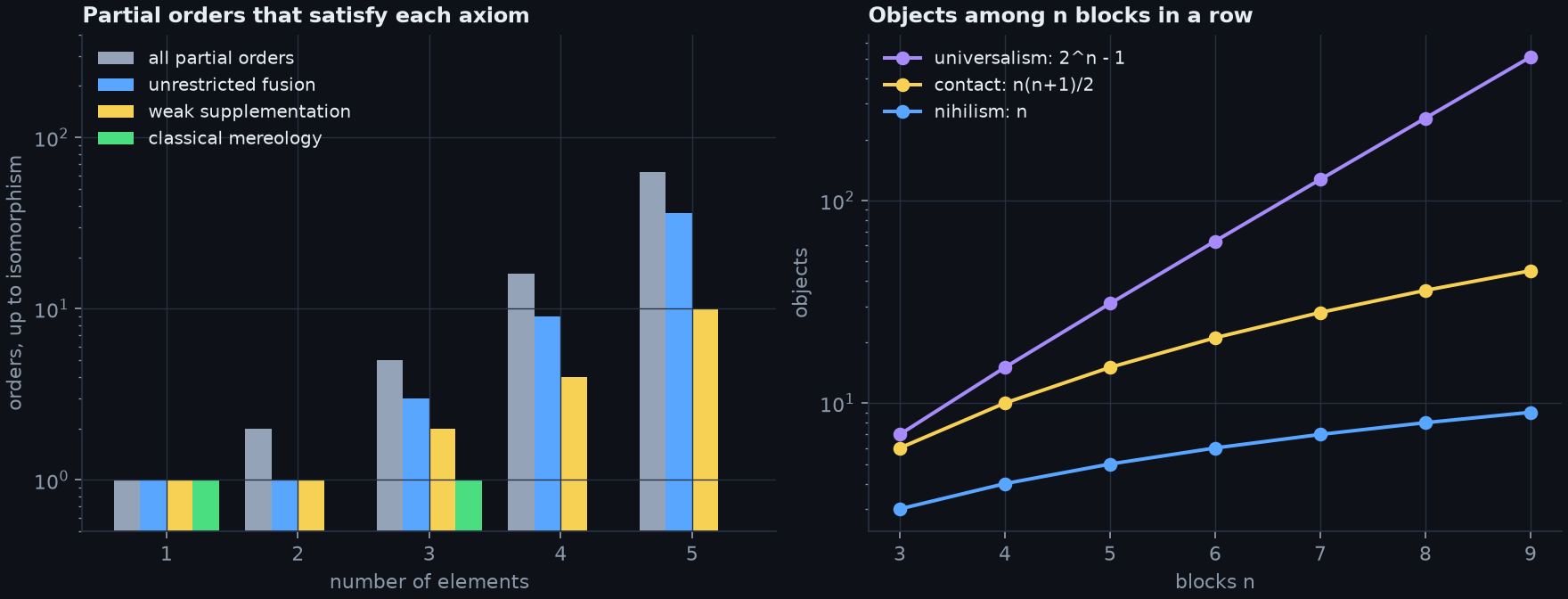
Enumerate every partial order on up to five elements, find which satisfy classical extensional mereology, check that removing any one element from a Boolean model breaks it, and count the objects among n blocks in a row on the nihilist, contact and universalist answers.
python -m videos.philosophy.labs 20
needs numpy, scipy, matplotlib · download lab20.py ·
source on GitHubpartial orders on 1..5 elements [1, 2, 5, 16, 63] (known: [1, 2, 5, 16, 63])
sizes with a model of classical mereology [1, 3] (theory: 2^k - 1, so 1 and 3)
Boolean models with one element removed 7 tried, 7 fail strong supplementation or fusion
six blocks, 2 x 3 nihilism 6, contact 40, universalism 63 (film: 6, 40, 63)
tableau: Mother within Parent True in 10 rule applications
tableau: Parent within Mother False, counter-model [['Person', '~Female'], ['Person']]
Classical mereology has finite models only at sizes 2^k - 1, the Boolean algebras without a zero; how many objects there are among n blocks depends entirely on the answer to the composition question.The code (82 lines; it asserts its own result)
"""Lab 20: test every small partial order against the axioms of mereology, and count objects on three answers."""

import numpy as np

from videos.coursekit import labs
from explainer.philosophy.reasoner import dl, mereo

TITLE = "Parthood, axiom by axiom"
GOAL = ("Enumerate every partial order on up to five elements, find which satisfy classical extensional mereology, "
        "check that removing any one element from a Boolean model breaks it, and count the objects among n blocks "
        "in a row on the nihilist, contact and universalist answers.")
TASKS = [
    "Raise the census to six elements (mereo.mereology_census(6), about eight seconds). Is there a model of size 6?",
    "Change the row of blocks to a 2 x 3 grid (mereo.composition_counts(2, 3)). Why does contact now give 40 "
    "rather than 21?",
    "Ask the tableau whether Grandmother is subsumed by Mother (dl.subsumes('Grandmother', 'Mother', dl.FAMILY)), "
    "then whether Mother is subsumed by Grandmother, and read the counter-model.",
]


def run(seed=0):
    rng = np.random.default_rng(seed)
    lab = labs.Lab()

    rows = mereo.mereology_census(5)["rows"]
    counts = [r["posets"] for r in rows]
    sizes = [r["n"] for r in rows if r["cem"]]
    lab.row("partial orders on 1..5 elements", f"{counts}   (known: [1, 2, 5, 16, 63])")
    lab.row("sizes with a model of classical mereology", f"{sizes}   (theory: 2^k - 1, so 1 and 3)")
    assert counts == [1, 2, 5, 16, 63]
    assert sizes == [1, 3] and all(r["cem"] <= 1 for r in rows), "one model at 1 and at 3, none at 2, 4, 5"

    # the Boolean algebras without their zero are models; take one element away and they are not
    broken = []
    for k in (2, 3):
        full = mereo.boolean_minus_bottom(k)
        prof = full.profile()
        assert full.n == 2 ** k - 1 and prof["ssp"] and prof["uf"], "nonempty subsets of k atoms model CEM"
        for gone in rng.permutation(full.n)[:4]:
            keep = [i for i in range(full.n) if i != gone]
            sub = mereo.Poset(len(keep), [[full.le[i][j] for j in keep] for i in keep])
            p = sub.profile()
            broken.append((k, int(gone), p["ssp"], p["uf"]))
            assert not (p["ssp"] and p["uf"]), "a model cannot have 2^k - 2 elements"
    lab.row("Boolean models with one element removed", f"{len(broken)} tried, "
            f"{sum(not (s and u) for _, _, s, u in broken)} fail strong supplementation or fusion")

    ns = list(range(3, 10))  # a row of one or two blocks has no scattered group for the library to show
    line = [mereo.composition_counts(1, n) for n in ns]
    for n, c in zip(ns, line):
        assert c["contact"] == n * (n + 1) // 2, "connected groups of n blocks in a row are its intervals"
        assert c["nihilism"] == n and c["universalism"] == 2 ** n - 1
    six = mereo.composition_counts(2, 3)
    lab.row("six blocks, 2 x 3", f"nihilism {six['nihilism']}, contact {six['contact']}, "
            f"universalism {six['universalism']}   (film: 6, 40, 63)")
    assert (six["nihilism"], six["contact"], six["universalism"]) == (6, 40, 63)

    yes = dl.subsumes("Mother", "Parent", dl.FAMILY)
    no = dl.subsumes("Parent", "Mother", dl.FAMILY)
    lab.row("tableau: Mother within Parent", f"{yes['subsumed']} in {yes['steps']} rule applications")
    lab.row("tableau: Parent within Mother", f"{no['subsumed']}, counter-model {no['model']['nodes']}")
    assert yes["subsumed"] and not no["subsumed"] and no["model"] is not None
    lab.note = ("Classical mereology has finite models only at sizes 2^k - 1, the Boolean algebras without a zero; "
                "how many objects there are among n blocks depends entirely on the answer to the composition question.")

    fig, ax = labs.figure(2, size=(11, 4.2))
    x = np.arange(1, 6)
    for key, color, name, off in (("posets", labs.GREY, "all partial orders", -0.3),
                                  ("uf", labs.BLUE, "unrestricted fusion", -0.1),
                                  ("wsp", labs.GOLD, "weak supplementation", 0.1),
                                  ("cem", labs.GREEN, "classical mereology", 0.3)):
        ax[0].bar(x + off, [r[key] for r in rows], 0.2, color=color, label=name)
    ax[0].set(title="Partial orders that satisfy each axiom", xlabel="number of elements",
              ylabel="orders, up to isomorphism", yscale="log", ylim=(0.5, 400))
    ax[0].legend(loc="upper left")
    ax[1].plot(ns, [c["universalism"] for c in line], "o-", color=labs.PURPLE, label="universalism: 2^n - 1")
    ax[1].plot(ns, [c["contact"] for c in line], "o-", color=labs.GOLD, label="contact: n(n+1)/2")
    ax[1].plot(ns, [c["nihilism"] for c in line], "o-", color=labs.BLUE, label="nihilism: n")
    ax[1].set(title="Objects among n blocks in a row", xlabel="blocks n", ylabel="objects", yscale="log")
    ax[1].legend(loc="upper left")
    lab.fig = fig
    return lab
Now change it
- Raise the census to six elements (mereo.mereology_census(6), about eight seconds). Is there a model of size 6?
- Change the row of blocks to a 2 x 3 grid (mereo.composition_counts(2, 3)). Why does contact now give 40 rather than 21?
- Ask the tableau whether Grandmother is subsumed by Mother (dl.subsumes('Grandmother', 'Mother', dl.FAMILY)), then whether Mother is subsumed by Grandmother, and read the counter-model.
Problems, with solutions
Try each problem before opening its solution.
-
Regiment 'every critic admires some novelist' and 'there is a novelist every critic admires'. What does each commit to?
Solution
"Every critic admires some novelist" is \(\forall x\,(Cx \to \exists y\,(Ny \land Axy))\): each critic has a novelist of their own. "There is a novelist every critic admires" is \(\exists y\,(Ny \land \forall x\,(Cx \to Axy))\): one novelist for all. By Quine's criterion, a theory is committed to what its bound variables must range over to make it true. The second commits outright to at least one novelist. The first commits to novelists only if there are critics; with no critics it is vacuously true. The second entails the first, not the reverse.
-
Evaluate 'the present King of France is not bald' in a model with one bald King, on both scopes.
Solution
Russell's analysis gives two forms. Narrow scope: \(\exists x\,(Kx \land \forall y\,(Ky \to y = x) \land \lnot Bx)\), "there is exactly one king and he is not bald". Wide scope: \(\lnot\exists x\,(Kx \land \forall y\,(Ky \to y = x) \land Bx)\), "it is not the case that exactly one king exists and is bald". In a model with one king who is bald, both are false: the unique king is bald, so the narrow reading fails, and there is a unique bald king, so the wide reading fails. Scope matters only when there is no unique king; then narrow is false and wide is true, as in the film.
-
Show that in the imperfect community, no property is shared by all three objects.
Solution
The objects are \(a\) (F and G), \(b\) (G and H) and \(c\) (F and H). F is not shared by all three, because \(b\) lacks it; G is missing from \(c\); H is missing from \(a\). No other property is assigned. So although every pair shares a property, nothing is common to the class of all three, and the one maximal class of pairwise resembling things corresponds to no property.
-
Show that a poset with exactly two elements cannot satisfy both supplementation and unrestricted fusion.
Solution
A two-element partial order is either a chain, \(a < b\), or two incomparable elements. In the chain, \(a\) is a proper part of \(b\), and weak supplementation needs another part of \(b\) that does not overlap \(a\); but \(b\)'s only parts are \(a\) and \(b\), and both overlap \(a\). With two incomparable elements, fusion fails: the fusion of \(a\) and \(b\) must overlap both, but the only candidates are \(a\) and \(b\) themselves, which share no part. So no two-element order satisfies both. (Classical models have \(2^k - 1\) elements: 1, 3, 7, ...)
-
Count the connected groups among four blocks in a row. How many objects exist on each answer?
Solution
Number the blocks 1 to 4. Nihilism: only the simples, 4 objects. Contact (a group composes something when it is connected): the runs of adjacent blocks, \(4 + 3 + 2 + 1 = 10\) objects. Universalism: every nonempty group, \(2^4 - 1 = 15\) objects. Van Inwagen's organicism: blocks have no life, so again 4. Same simples, same arrangement, and 4, 10 or 15 things.
-
Run the tableau by hand: is every Grandmother a Parent?
Solution
Unfold the definitions: Grandmother \(=\) Mother \(\sqcap \exists\)hasChild.Parent, Mother \(=\) Woman \(\sqcap\) Parent. To test whether every Grandmother is a Parent, try to build an individual \(x\) that is Grandmother \(\sqcap \lnot\)Parent. Unfolding gives \(x\): Mother and \(x\): \(\exists\)hasChild.Parent, then \(x\): Woman and \(x\): Parent. Now \(x\) is labelled both Parent and \(\lnot\)Parent: a clash, and the only branch closes. No such \(x\) can exist, so Grandmother \(\sqsubseteq\) Parent. The tableau never needed to build the child.
Notes and sources
Sources
Texts: Loux and Crisp, Metaphysics: A Contemporary Introduction (4th ed. 2017); van Inwagen, Material Beings (1990); Simons, Parts: A Study in Ontology (1987); Casati and Varzi, Parts and Places (1999); Armstrong, Universals and Scientific Realism (1978) and Universals: An Opinionated Introduction (1989); Lewis, On the Plurality of Worlds (1986) and Parts of Classes (1991); Rodriguez-Pereyra, Resemblance Nominalism (2002); Chalmers, Manley and Wasserman (eds.), Metametaphysics (2009); Sider, Writing the Book of the World (2011); Baader et al., The Description Logic Handbook (2003); Arp, Smith and Spear, Building Ontologies with Basic Formal Ontology (2015).
Papers: Meinong (1904); Russell (1905); Leśniewski (1916); Quine (1948, 1951, 1968); Carnap (1950); Strawson (1950); Goodman (1951); Williams (1953); van Inwagen (1977, 1987); Unger (1980); Geach (1980); Parsons (1980); Clarke (1981); Lewis (1983, 1993); Boolos (1984); Putnam (1987); Baxter (1988); Schmidt-Schauß and Smolka (1991); Sider (1993, 2001, 2007); Thomasson (1999); Fine (2001, 2012); Merricks (2001); Hirsch (2002); Guarino and Welty (2002); Schaffer (2003, 2009, 2010); Rosen (2010); Cotnoir (2013); Bordes et al. (2013); Wilson (2014); Li et al. (2023).
About this partfrom its README
Part 20 of Philosophy, Built (series plan, syllabus) opens Act V, The World, with ontology. How many things are on a table? Quine's "On What There Is": Plato's beard, the criterion of ontological commitment as quantification (sentences regimented and their commitments read off), the Geach–Kaplan sentence checked by brute force over all 31 groups of five critics on three admiration graphs (Boolos on plural innocence), Ockham's razor and "no entity without identity", and gavagai (inscrutability of reference). Meinong's golden mountain and round square, Russell's theory of descriptions with both scopes of "the present King of France is not bald" evaluated in a model, Strawson, the neo-Meinongians (Parsons, Zalta, Priest), and Sherlock Holmes (pretence, encoding, creationism). Universals: realism, tropes and nominalism drawn side by side; Porphyry, Boethius, Abelard, Ockham; Armstrong's sparse universals; Bradley's regress. Resemblance nominalism tested on property tables: Goodman's imperfect community (one spurious maximal class, every real property lost) and companionship (the F's never a maximal class), and Rodriguez-Pereyra's replies. Abstract objects: Lewis's four ways, Frege's directions (seven lines, three directions), Hume's principle and Basic Law V, Platonism and its rivals, and Lewis's classes as sums of singletons. Mereology axiom by axiom: every partial order on up to six elements, up to isomorphism (1, 2, 5, 16, 63, 318), tested for weak and strong supplementation and unrestricted fusion; only sizes 1 and 3 model classical extensional mereology; the Boolean algebras with zero removed (1, 3, 7, 15 elements) checked; the twin and lonely counterexamples. The special composition question counted on six blocks (nihilism 6, contact 40, universalism 63), organicism, Merricks's overdetermination argument, and mereotopology's boundary puzzle. The Lewis–Sider argument from vagueness (with "there are exactly two things" in pure logic) and the Wall's twentieth brick; composition as identity. The problem of the many as a Price List, and Tibbles. Metaontology: Carnap's internal and external questions, Putnam's three individuals (3 objects or 7), quantifier variance, easy ontology and Sider's structure. Grounding: examples, a grounding graph checked as a strict partial order (five fundamental facts, three levels, and a cycle), Fine's truth-functional logic of ground unfolded to the literals, and the debate (Fine, Schaffer, Rosen, Wilson). Fundamentality: gunk by dyadic bisection, four shapes for reality, priority monism. Description logic: ALC semantics, the family TBox, a tableau reasoner that proves Mother ⊑ Parent in ten rule applications and returns a counter-model for Parent ⊑ Mother, and an ABox with open-world answers (yes, no, unknown). Ontologies in practice: the semantic web, the Gene Ontology, SNOMED CT, Basic Formal Ontology, and OntoClean flagging three errors in a taxonomy. Knowledge graphs: a two-dimensional TransE embedding that infers Tokyo is in Asia, confidently misplaces Lisbon, and answers nonsense; and what a language model commits to.
The worked model results are computed by the Reasoner's new modules explainer/philosophy/reasoner/mereo.py and
explainer/philosophy/reasoner/dl.py, tested in tests/philosophy/test_mereo.py and tests/philosophy/test_dl.py,
and cached by compute.py.
Chapter notes
| # | Scene | What it establishes | Computed on screen |
|---|---|---|---|
| 0 | Hook |
Quine (1948); the table; the plan. | — |
| 1 | Quine |
Plato's beard; the criterion; Geach and Kaplan; Boolos (1984); Ockham; Quine (1968). | the Geach–Kaplan sentence on three graphs |
| 2 | Meinong |
Meinong (1904); Russell (1905); Strawson (1950); Parsons (1980); Zalta (1983); Priest (2005); Walton (1990); Thomasson (1999). | both scopes in a kingless model |
| 3 | Universals |
Plato; Aristotle; Williams (1953); Porphyry; Boethius; Abelard; Ockham; Armstrong (1978, 1997); Lewis (1983); Bradley (1893). | — |
| 4 | Resemblance |
Russell (1912); Goodman (1951); Rodriguez-Pereyra (2002). | maximal resemblance classes against extensions |
| 5 | Abstract |
Lewis (1986); Frege (1884); Hume's principle; Benacerraf (1973); Hale and Wright; Linnebo (2018); Field (1980); Thomasson (2015); Lewis (1991). | directions as parallelism classes |
| 6 | Mereology |
Leśniewski (1916); CEM; Tarski (1935); constitution. | every poset on ≤ 6 elements; Boolean algebras minus zero |
| 7 | Composition |
van Inwagen (1987, 1990); Merricks (2001); Whitehead; Clarke (1981); Bolzano; Brentano; Casati and Varzi (1999). | objects among six blocks on three answers |
| 8 | Vagueness |
Lewis (1986); Sider (2001); the Wall's twentieth brick; Baxter (1988); Lewis (1991); Sider (2007); Cotnoir (2013). | — |
| 9 | Many |
Unger (1980); Geach (1980); the problem of the many as a Price List; Lewis (1993); Williamson; supervaluation. | the conflict and its exits |
| 10 | Meta |
Carnap (1950); Quine (1951); Putnam (1987); Hirsch (2002, 2011); Thomasson (2015); Sider (2011). | 3 objects or 7 |
| 11 | Grounding |
Fine (2001, 2012); Schaffer (2009); Rosen (2010); Wilson (2014). | a grounding graph and a cycle; Fine's rules unfolded |
| 12 | Fundamental |
Whitehead; Sider (1993); Schaffer (2003, 2010); Bohn; Horgan and Potrč. | dyadic bisection |
| 13 | Logic |
ALC; Schmidt-Schauß and Smolka (1991); Baader et al. (2003). | the family tableau; a counter-model; ABox answers |
| 14 | Industry |
Berners-Lee, Hendler and Lassila (2001); OWL; Gene Ontology; SNOMED CT; BFO (ISO 2021); Guarino and Welty (2002). | OntoClean on a taxonomy |
| 15 | Graphs |
Wikidata; the Knowledge Graph (2012); Bordes et al. (2013); Li et al. (2023). | a TransE embedding and its answers |
| 16 | Outro |
recap; the Reasoner's modules; the Wall; problems; payoffs; references. | — |
Companion material in this repository
The syllabus's plan for this partfrom SYLLABUS.md, the plan of record
- Quine's "On What There Is" (1948): Plato's beard; ontological commitment as quantification.
- Meinong's jungle and Russell's escape (previews Part 27).
- Universals vs nominalism: Plato, Aristotle, the medieval debate (Ockham's razor), Armstrong's universals, tropes.
- Resemblance nominalism and Goodman's imperfect community and companionship problems, shown on toy property tables.
- Abstract objects: the way-of-abstraction criteria and their failure.
- Mereology: classical extensional mereology, axiom by axiom. Built: finite models are complete Boolean algebras with the bottom removed (proved and enumerated).
- The special composition question (van Inwagen 1990): nihilism, universalism, organicism.
- Composition as identity; the argument from vagueness for universalism (Lewis, Sider).
- Metaontology: Carnap's internal and external questions; quantifier variance (Hirsch); Sider's structure.
- Grounding (Fine, Schaffer, Rosen): a strict partial order; metaphysical explanation; priority monism.
- Fundamentality and the well-foundedness question (is there a bottom level?).
- Formal ontology as engineering: description logics. Built: an ALC tableau reasoner.
- Industry: OWL and the semantic web; the Gene Ontology, SNOMED CT, Basic Formal Ontology. Philosophical mistakes in real ontologies (OntoClean's rigidity and identity criteria; Guarino and Welty).
- Knowledge graphs and LLMs: what an embedding commits to.
- Recap and Problems.
Built: reasoner.mereo (finite mereology models); reasoner.dl (ALC with TBox and ABox; subsumption).
Wall: the special composition question; quantifier variance's challenge to "what really exists".
Price List: the problem of the many (Unger, Geach): many candidates for "the cloud"; one cloud; parity; clouds
exist.
Visuals: Hasse diagrams of mereological sums; nested description-logic concepts as regions; a grounding DAG.
References: Loux and Crisp; van Inwagen, Material Beings; Simons, Parts; Varzi (SEP), "Mereology"; Chalmers,
Manley and Wasserman (eds.), Metametaphysics; Baader et al., The Description Logic Handbook.
Build the film
python -m videos.philosophy.philosophy20.compute        # the part's numbers, into .cache/philosophy20
python tools/build.py philosophy20                  # render and assemble the film
EXPLAINER_TTS=silent python tools/qa_scene.py philosophy20 Hook   # one chapter, silent, with a contact sheet
Scenes: videos/philosophy/philosophy20. Setup: see the course page. Source of these notes: the README and the scenes' narration.
Build it
python -m videos.philosophy.philosophy20.compute       # every computed item (under a minute; .cache/philosophy20)
python tools/build.py philosophy20 -q l                # 480p preview
python tools/build.py philosophy20                     # 1080p30 -> renders/philosophy20.mp4
python tools/qa_scene.py philosophy20 Mereology        # one chapter, silent, with a contact sheet