Life
the philosophy of biology
What is it to be alive, and how can selection with no designer build an eye or an altruist?
The part opens with Paley's watch and Hume's objection, then reads Darwin's argument as a comparison of likelihoods: design predicts nothing until the designer is specified. Lewontin's recipe (variation, heredity, differential fitness) is run as a breeder's equation and against drift, and fitness is defended as a propensity. The Price equation is derived and checked on 500 simulated birds, and the rest of the film is read off it: Fisher's fundamental theorem, Hamilton's rule for kin, and the multilevel decomposition in which altruists lose inside every group while their share rises overall. That decomposition is the turn: the mathematics privileges no level of selection, which is the Wall's nineteenth brick. The later chapters take the concepts biology leans on (function, species, information, cooperation) and end with the definitions of life tested against seven cases and a Lenia creature the Reasoner found itself.
What you need. School algebra, means and covariances. The likelihood comparisons use Part 16's vocabulary.
- The calculation
- the Price equation
- The wall
- levels of selection
- Built toy
- replicator dynamics; a kin-selection lab
What you will be able to do
Introductory
- State Lewontin's three conditions for selection and say which one fails in a given example.
- Apply Hamilton's rule to siblings, half-siblings and cousins, and compute the hawk-dove equilibrium V/C.
Advanced
- Derive the Price equation and obtain Fisher's theorem and Hamilton's rule from it.
- Test a strategy for evolutionary stability and trace replicator dynamics on the simplex.
Research
- Decompose a change in a trait into between-group and within-group Price terms, and explain why the decomposition alone does not settle the levels-of-selection debate.
- Set out the etiological and causal-role accounts of function and what each says of Swampman.
Applied
- Simulate drift and selection in a Wright-Fisher population and compare fixation rates with Kimura's formula.
- Run a Lenia or Life pattern and say which definitions of life it meets and which it fails.
Contents
Each chapter has a home level. Choose a track to see what to read and watch: Introductory 23 min · Advanced 48 min · Research 51 min · Applied 28 min.
- 0What is it to be alive?Introductory2 min
- 1Design or selection?Introductory4 min
- 2The recipe for selectionIntroductory4 min
- 3Fitness and the Price equationAdvanced4 min
- 4Games on the simplexAdvanced4 min
- 5Kin selectionAdvanced4 min
- 6Levels of selectionResearch3 min
- 7Genes, organisms and adaptationAdvanced3 min
- 8Function and teleologyAdvanced3 min
- 9Species and treesIntroductory3 min
- 10Information in biologyAdvanced3 min
- 11Evolution and cooperationIntroductory3 min
- 12What is life?Introductory4 min
- 13Artificial lifeApplied5 min
- Recap, problems, and where this comes backAll tracks2 min
Also on this page: Lecture · Key results · Try it · Lab · Problems · Notes and sources · Build the film.
Lecture
The text of each chapter is the film's narration, as it is spoken, so you can read along or revise without the film. The pictures are in the film.
What is it to be alive?Introductory2 min
Part 18 asked what our theories tell us about reality, mostly through physics. This part turns to the science of living things, which raises its own philosophical questions. Theodosius Dobzhansky put the organizing idea in one line: nothing in biology makes sense except in the light of evolution. We will build that light, piece by piece, and test what it can and cannot explain.
Living things pose a puzzle that physics does not. Their parts seem made for something. The eye has a lens to focus, an iris to regulate light, and a retina to detect it: it is for seeing. William Paley concluded in 1802 that organisms, like watches, were made by a designer. Charles Darwin showed in 1859 how variation and natural selection could produce the appearance of design without a designer. But his answer raised new questions, which this part works through with the mathematics of evolution: what fitness is, at what level selection acts, what a biological function is, what a species is, and whether genes carry information. And finally: what is life, and can we build it?
The plan. Paley against Darwin, as a comparison of likelihoods. The recipe for natural selection, and the Price equation, which captures all of it in one line. Evolutionary game theory: replicator dynamics, hawks and doves, and evolutionarily stable strategies. Kin selection and the levels-of-selection debate: this part's brick in the Wall. Genes and organisms, function, and species. Information and cooperation. And what life is, with an artificial creature grown on screen.
What it establishes: Dobzhansky (1973); Paley and Darwin; the questions; the plan.
1Design or selection?Introductory4 min
William Paley's Natural Theology begins on a heath. If I strike my foot against a stone, I might suppose it had lain there forever. But if I find a watch, I notice that its parts are framed and put together for a purpose: to measure the hours. The inference, Paley wrote, is inevitable, that the watch must have had a maker. The eye is a far more intricate instrument than a telescope, so it too must have had a maker. David Hume had already objected, in Dialogues published in 1779, that the analogy between organisms and machines is weak, and that a designer would itself need explaining.
Darwin called the Origin one long argument. It offered a single explanation for many classes of fact. The same bones in a bat's wing, a whale's flipper and a human hand; similar embryos in different animals; rudimentary organs with no use; the distribution of species on islands; and the order of fossils in the rocks. All are explained by descent with modification, driven by natural selection. The form of the argument is inference to the best explanation, or what William Whewell called the consilience of inductions: many independent lines of evidence converging on one hypothesis. Its gap was heredity. Darwin had no workable theory of inheritance until Mendel's work was rediscovered in 1900 and fused with selection in the modern synthesis.
Paley's favourite example was the eye. Darwin admitted that to suppose the eye could be formed by natural selection seems absurd in the highest possible degree. But, he argued, if a series of gradations exists from a simple patch to a perfect eye, each one useful to its owner, the difficulty disappears. In 1994 Dan-Eric Nilsson and Susanne Pelger put numbers on the series: a flat patch of light-sensitive cells, a cup, a deeper cup, a pinhole, and a lens, each step sharpening the image. Measured in steps of one percent, the whole change amounts to a factor of about eighty million: eighteen hundred and twenty-nine steps. They then assumed modest values for heritability, the strength of selection and variation, which give a change of only five thousandths of a percent per generation. The Reasoner divides: about three hundred and sixty-four thousand generations. For small animals with one generation a year, that is less than half a million years, an instant in geological time.
Elliott Sober reframed the debate with Part 15's likelihoods. For each observation, ask how probable it is on the hypothesis of selection, and on the hypothesis of design. The vertebrate retina is wired backwards, with a blind spot where the nerve passes through it. The recurrent laryngeal nerve of a giraffe runs four and a half metres down and back up the neck to reach a larynx a few centimetres from its origin. Humans and chimpanzees share the same broken gene for making vitamin C. The probabilities here are illustrative; the structure is the point. Such historical traces are expected on descent with modification, and surprising on optimal design. The catch: design predicts nothing until we specify what the designer wanted and could do. And if we may specify anything at all, the design hypothesis fits every observation, and so is supported by none.
What it establishes: Paley (1802); Hume (1779); Darwin (1859); Whewell; Nilsson and Pelger (1994); Sober (likelihoods).; Computed on screen: the eye's generations; likelihood ratios
2The recipe for selectionIntroductory4 min
Richard Lewontin distilled natural selection into a recipe with three ingredients. Variation: individuals differ in some trait. Heredity: offspring resemble their parents in that trait. Differential fitness: the trait makes a difference to survival or reproduction. Whenever all three hold, the distribution of the trait changes from generation to generation. Nothing in the recipe mentions organisms. It applies to anything that meets the three conditions: genes, cells, groups, species, and even computer programs, a point that returns when we ask at what level selection acts.
The Reasoner shows why heredity matters. Four thousand individuals with a trait that is part genetic, part environmental. Each generation, only the top thirty percent breed. If none of the variation is inherited, selection is as strong as ever, and nothing changes: the offspring regress all the way back to the mean. If half of it is inherited, the mean climbs steadily; if nine tenths, faster still. The breeder's equation predicts the response: heritability times the selection differential. The simulation agrees with it closely. Selection is a sieve; heredity is what lets the sieve's results accumulate.
Elliott Sober's toy separates two ideas. A box of balls of different sizes and colours is shaken over a sieve. As it happens, all the small balls are pink and all the large ones orange. Only small balls fall through, so every ball that passes is pink. There is selection of pink balls. But there is selection for small size, not for colour: size is what causes a ball to pass. Correlations between traits and fitness cannot tell us which trait is selected for. That is a causal question, of exactly the kind Part 17 learned to ask.
Selection has a rival. In a finite population, which individuals happen to reproduce is partly a matter of chance, so allele frequencies wander even when no variant is fitter. The Reasoner runs twenty-four populations of fifty, each starting at one half, with no selection at all. After a hundred and twenty generations, twelve have lost the allele, ten have fixed it, and two are still drifting. This is random genetic drift. Now a single new mutant, in a population of a hundred. Motoo Kimura's diffusion theory gives its chance of taking over: one over N if it is neutral. The Reasoner checks the formula with forty thousand runs for each case. A neutral mutant fixes about one time in a hundred; a one percent advantage raises that to about one in forty-four; a five percent advantage to about one in eleven. A harmful mutant still sometimes wins. So even a beneficial mutation is usually lost by chance. Fitness raises the odds; it does not guarantee the outcome.
Drift raises a philosophical question. Motoo Kimura's neutral theory proposed that most evolutionary change at the molecular level is drift, not selection. John Beatty distinguished them as kinds of sampling: selection samples organisms discriminately, by their differences in fitness; drift samples them indiscriminately. The trouble is that any particular outcome could result from either, since a fitter type can lose by chance. Statisticalists, such as Denis Walsh, Tim Lewens and André Ariew, and Mohan Matthen with Ariew, conclude that selection and drift are not forces at all, but statistical summaries of what individual organisms do. Causalists, such as Roberta Millstein, reply that drift can be manipulated: shrink the population and drift grows stronger, which is just what makes something a cause. The dispute turns on what counts as a cause, and Part 17's interventions are the natural test.
What it establishes: Lewontin (1970); the breeder's equation; Sober's sieve (1984); Kimura (1968); Beatty (1984); Walsh, Lewens and Ariew; Matthen and Ariew; Millstein; Reisman and Forber.; Computed on screen: truncation selection at three heritabilities; neutral drift; fixation against Kimura
3Fitness and the Price equationAdvanced4 min
Herbert Spencer's phrase, survival of the fittest, invites an objection. Who are the fittest? Those who survive. Then the principle says only that the survivors survive, which is empty. Karl Popper called Darwinism a metaphysical research programme on these grounds, and later withdrew the charge. The standard answer, from Susan Mills and John Beatty, is the propensity interpretation: fitness is a disposition to survive and reproduce, as fragility is a disposition to break. A fragile glass may survive and a sturdy one shatter; the fitter of two identical twins can be struck by lightning first. Actual success is evidence of fitness, not its definition. And the expected number of offspring is not the whole story: variance in offspring number, and timing, change which type spreads.
In 1970 George Price, an American chemist who taught himself genetics in London, published an equation that captures all of selection in one line. On the left, the change in a trait's population average from one generation to the next, scaled by mean fitness. The first term on the right is the covariance between parents' fitness and their trait: if fitter individuals have more of the trait, the trait spreads. This is selection. The second term is the fitness-weighted average change from parent to offspring: transmission, including mutation and imperfect inheritance. The equation is an identity. It holds for any population that reproduces, with no assumptions about the biology. Because it can be applied to individuals within groups and to groups within a population at once, it will become the tool for the levels-of-selection debate.
The Reasoner checks the identity on a simulated population. Five hundred birds, each with a wing length and a number of offspring; longer wings mean more offspring on average. The tilt of this cloud is the covariance between trait and fitness: selection pushes the average up by about point four five. But offspring wings are a little shorter than their parents', so transmission pulls back by about point one. The observed change in the average is the sum of the two, to fifteen decimal places, as it must be.
The Price equation contains a famous theorem as a special case. Take the trait to be fitness itself. Then the covariance becomes the variance in fitness. If offspring inherit their parents' fitness faithfully, the change in mean fitness is the variance divided by the mean, and a variance is never negative. This is Ronald Fisher's fundamental theorem of natural selection, from 1930: the rate of increase in fitness equals the genetic variance in fitness. The Reasoner iterates three asexual types. Mean fitness climbs towards that of the best type, while the variance first rises, as the best type becomes common, and then collapses: selection uses up the very variation it feeds on. Fisher's own statement was long misread as saying that mean fitness always increases. George Price, and later Warren Ewens, showed that it concerns only the partial change due to selection: the rest of the world, including other evolving species, keeps making the environment worse.
What it establishes: the tautology objection; Popper; Mills and Beatty (1979); Price (1970); Fisher (1930); Price (1972); Ewens (1989).; Computed on screen: the Price terms on 500 birds; mean and variance of fitness under selection
4Games on the simplexAdvanced4 min
John Maynard Smith and George Price brought game theory into biology. Two animals contest a resource worth V. A hawk fights until injured or the opponent retreats; a dove displays and retreats if attacked. Two hawks share the value minus the cost of injury, C. A hawk beats a dove; two doves share. Here V is two and C is three. Strategies spread in proportion to their payoff above the average: the replicator dynamics of Peter Taylor and Leo Jonker. Start with almost all doves, or almost all hawks: the population converges to the same mix, two thirds hawks, which is V over C. Neither pure strategy survives, because each does best when it is rare.
Maynard Smith and Price defined the equilibrium concept that biology needed. A strategy x is evolutionarily stable if, for every mutant strategy, x does better against itself than the mutant does against x; or, if they tie there, x does better against the mutant than the mutant does against itself. A population playing x cannot be invaded by a small number of mutants. The Reasoner checks the hawk-dove mix. At two thirds hawks, both strategies earn the same against the population, so the second condition decides, and it holds against both pure mutant strategies. Nobody calculates anything. The stability is achieved by differential reproduction, with no foresight at all.
With three strategies the state is a point in a triangle, the simplex, whose corners are the pure populations. In rock-paper-scissors each strategy beats one and loses to another. If ties pay nothing, the replicator dynamics cycle forever around the centre. Penalize ties a little, and the cycles spiral in to an equal mix: a strategy does worse as its own kind becomes common. Reward ties, and they spiral out toward the edges, where each strategy in turn nearly disappears: encounters with its own kind now help the common strategy. In the zero-sum game there is no evolutionarily stable strategy at all. Nature plays this game. Male side-blotched lizards come in three throat colours, each beating one rival strategy and losing to the other, and Barry Sinervo and Curtis Lively found their frequencies cycling every few years.
Evolutionary game theory also explains a philosopher's question: how can signals come to mean anything? David Lewis's signalling game has a sender who sees the state of the world, and a receiver who sees only the sender's signal and must act. Both are rewarded when the act fits the state. A signalling system is a pairing of signals with states that lets them always succeed. Lewis thought such conventions needed common knowledge; Brian Skyrms showed they can evolve without any. The Reasoner runs the simplest learning rule: each player keeps an urn for each situation and adds a ball whenever a choice succeeds. Success climbs from a coin flip towards certainty. Ninety-four percent of runs reach a perfect signalling system within two thousand rounds, and they split almost evenly between the two possible conventions: which signal means which state is arbitrary. With three states, about a quarter of runs stall in partial pooling, using one signal for two states. Meaning, here, is made by the dynamics: a signal means what it has been reinforced to track. We return to this in Part 28.
What it establishes: Maynard Smith and Price (1973); Taylor and Jonker (1978); Sinervo and Lively (1996); Lewis (1969); Skyrms (2010).; Computed on screen: hawk–dove trajectories; ESS margins; three RPS flows; signalling learning curves
5Kin selectionAdvanced4 min
Self-sacrifice is the great puzzle for natural selection. Worker ants are sterile; ground squirrels give alarm calls that draw predators to themselves; vampire bats regurgitate blood for hungry roostmates. Darwin called the sterile castes of insects one special difficulty, which at first appeared to him insuperable and actually fatal to his whole theory. The naive answer, that animals act for the good of the species, fails: a cheat in a group of altruists takes the benefits, pays no costs, and out-breeds them. J. B. S. Haldane is said to have quipped that he would lay down his life for two brothers or eight cousins. In 1964 William Hamilton made the quip exact.
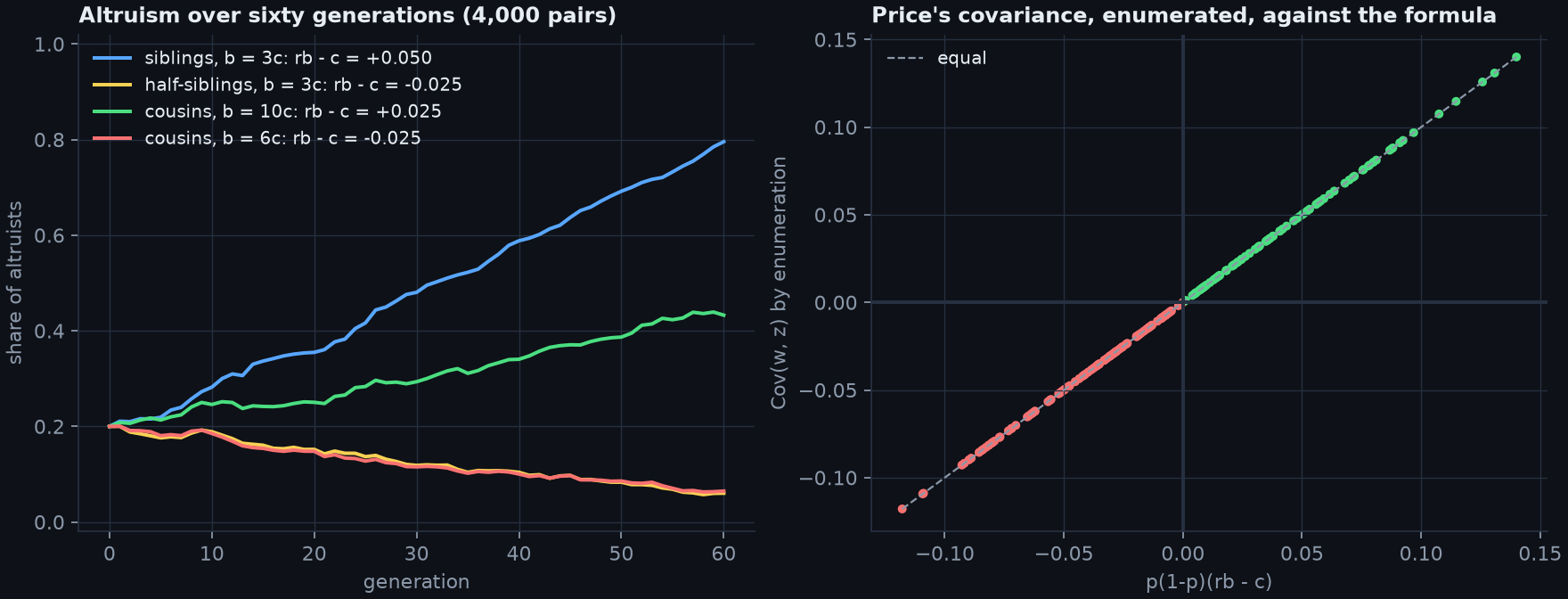
Hamilton's rule says that a gene for helping spreads when r b is greater than c. c is the cost to the helper in offspring; b is the benefit to the recipient; and r is their relatedness, the extra chance that the recipient carries the same gene: one half for siblings, one eighth for cousins. Two brothers or eight cousins, exactly. The rule falls out of the Price equation. For partners whose types are correlated with relatedness r, the covariance between carrying the gene and fitness is p times one minus p times r b minus c. The Reasoner enumerates the four kinds of pair and gets the same number both ways. Selection favours helping exactly when r b exceeds c.
Now run it. Four thousand pairs per generation, starting with a fifth of the population altruistic. Between siblings, with a benefit three times the cost, r b minus c is positive, and altruism sweeps to fixation. With the same benefit between half-siblings, at relatedness a quarter, r b minus c is negative, and altruism vanishes. Between cousins, at relatedness one eighth, the benefit must exceed eight times the cost: at ten times it spreads; at six times it dies out. The sign of r b minus c decides, as the algebra said.
Where does relatedness come from? The Reasoner computes it exactly, by enumerating Mendel's lotteries: the chance that a gene picked from the actor is identical by descent with one picked from the recipient, relative to the recipient's own. For full sisters in a species like ours, the answer is one half; for half-sisters, one quarter. In bees, ants and wasps, males develop from unfertilized eggs and carry a single set of genes. So sisters share their father's whole genome, and are related by three quarters, more than to their own daughters. Hamilton suggested that this is why sterile worker castes evolved so often in these insects. But a sister is related to her brother by only a quarter, which cancels the advantage, unless workers invest more in sisters than in brothers. Robert Trivers and Hope Hare predicted a three-to-one investment ratio in ant colonies, and found it. Yet termites, which are diploid, are eusocial too, and queens that mate many times dilute the three quarters: relatedness helps, but it is not the whole story.
What it establishes: Darwin's difficulty; Haldane; Hamilton (1964); Trivers and Hare (1976).; Computed on screen: the Price covariance; four kin simulations; exact relatedness
6Levels of selectionResearch3 min
Can selection act on groups? Take two groups of ten. The first has two altruists, the second eight. An altruist pays a small cost; every member gains in proportion to the share of altruists in its group. Within each group, altruists have lower fitness than their selfish neighbours. Yet the altruist-rich group grows faster, and across the whole population the share of altruists rises. It is Simpson's paradox from Part 16, inside evolution: the trend in every group reverses in the aggregate.
The Price equation explains the reversal. Apply it to groups, and then again to individuals within each group. The total change splits into two terms. The first is the covariance, across groups, between a group's share of altruists and its productivity: selection between groups. The second is the average covariance within groups: selection within them. The Reasoner computes both. Between groups, plus point zero three; within groups, minus point zero one three; and their sum is exactly the observed change. Altruism spreads when the first term outweighs the second. Price and Hamilton worked this out together in the early 1970s.
The levels-of-selection debate has run for sixty years. In 1962 V. C. Wynne-Edwards argued that animals restrain their breeding for the good of the group. George Williams replied in 1966 that adaptations for the group are rarely needed, and that the gene's-eye view explains more. Elliott Sober and David Sloan Wilson defended multilevel selection in Unto Others. In 2010 Martin Nowak, Corina Tarnita and Edward O. Wilson argued in Nature that Hamilton's inclusive fitness theory is unnecessary. A reply signed by one hundred and thirty-seven biologists defended it. Samir Okasha's diagnosis: the kin-selection and multilevel accounts are often two ways of keeping the same books. The live question is which bookkeeping matches the causal structure of a particular case.
This is the nineteenth brick in the Wall. The dream: a single level at which selection really acts, genes, organisms or groups. The wall: the Price equation splits any change into between- and within-level terms, at every level at once, so the mathematics alone never singles one out. What it forces: pluralism about units of selection, with the choice in each case settled by causal structure, not by algebra.
What it establishes: Simpson's reversal; the multilevel Price equation; Wynne-Edwards (1962); Williams (1966); Sober and Wilson (1998); Nowak, Tarnita and Wilson (2010); Abbot et al. (2011); Okasha (2006); the Wall's nineteenth brick.; Computed on screen: between- and within-group terms
7Genes, organisms and adaptationAdvanced3 min
Richard Dawkins popularized the gene's-eye view in 1976. Genes are the true replicators: copied with high fidelity, and potentially immortal through their copies. Organisms are vehicles that genes build in order to make more copies of themselves. The philosopher David Hull refined the distinction: replicators are what gets copied; interactors are what meets the environment and so determines which replicators get copied. Dawkins extended the idea outward: a beaver's dam is part of the phenotype of beaver genes, as much as its teeth. Critics and defenders agree on one point: the gene's-eye view is a perspective that keeps the same books in a different way, not a new empirical discovery.
Stephen Jay Gould and Richard Lewontin attacked what they called the adaptationist programme. Their image came from the cathedral of San Marco in Venice. Where a dome rests on arches, triangular spaces are left between them: spandrels, which were later filled with mosaics. The spandrels look as if they were designed to hold the paintings, but they are by-products of the architecture. Biologists, they argued, too often tell just-so stories in which every trait is an optimal adaptation. Traits can also be by-products, results of drift, or consequences of developmental constraint and history. Gould and Elisabeth Vrba added exaptation: a trait that evolved for one role and was co-opted for another, as feathers apparently evolved before flight.
Peter Godfrey-Smith untangled the debate by distinguishing three adaptationisms. Empirical adaptationism is a claim about nature: selection is powerful and ubiquitous, so most traits are adaptations. Explanatory adaptationism says that the deepest questions in biology, about apparent design and the fit of organisms to their environments, are answered by selection alone, however common other causes may be. Methodological adaptationism is advice: look for adaptation first, because that is the best way to discover what is going on. Gould and Lewontin's critique bites hardest on the first. And adaptationist hypotheses can be tested. Geoffrey Parker predicted, with an optimality model, how long male dung flies should stay on a cowpat waiting for females, and the flies stayed close to the predicted time.
Others push further against the gene's-eye view. Developmental systems theory, from Susan Oyama, holds that genes are one developmental resource among many, alongside cell structures, hormones and environments, with no privileged role as carriers of information. Niche construction emphasizes that organisms alter their own selective environments, as earthworms make the soil they live in. Paul Griffiths and Russell Gray urged parity: treat genetic and non-genetic causes evenly. The reply is that genes are special: copied with something like digital fidelity, and selected for their effects. Whether genes carry information in a special sense is the crux, and chapter ten takes it up with the genetic code itself.
What it establishes: Dawkins (1976, 1982); Hull (1980); Gould and Lewontin (1979); Gould and Vrba (1982); Godfrey-Smith (2001); Parker; Oyama (1985); Griffiths and Gray (1994).
8Function and teleologyAdvanced3 min
Talk of purposes in nature is ancient. Aristotle distinguished four kinds of cause, and held that the final cause of the eye, what it is for, is seeing: nature, he said, does nothing in vain. The scientific revolution banished final causes from physics. Francis Bacon compared them to virgins consecrated to God: they bear nothing. Kant saw that organisms resist the banishment. In an organism the parts are both cause and effect of the whole, so we must judge it as a natural purpose. And he predicted that there would never be a Newton who could explain even a blade of grass by laws of nature alone. Darwin is often called that Newton: his theory explains purpose-talk by history. Ernst Mayr, borrowing a word coined by Colin Pittendrigh, called goal-directedness that comes from a program shaped by selection teleonomy, as opposed to teleology from a conscious aim.
Biologists say the heart is for pumping blood. It also makes a thumping sound, which doctors use, but that is not what it is for. What is the difference? Larry Wright's etiological answer: the function of a trait is the effect that explains why it is there. Pumping explains why hearts exist; thumping does not. Ruth Millikan's proper functions make the history explicit: the effect for which ancestors' hearts were selected. That is why a diseased heart still has the function it fails to perform. Robert Cummins offered a different account: a function is a contribution to some capacity of a larger system that we are trying to explain, with no history required. Either way, teleology is tamed: the for lies in a selection history, or in an analysis, not in a designer's mind.
Donald Davidson's Swampman makes a Price List. Lightning strikes a swamp and, by a vast coincidence, assembles a molecule-for-molecule duplicate of a man. Its functions, on the etiological theory, are effects with a selection history. Swampman's heart has no such history. Yet surely it has the function of pumping blood. The three cannot all stand. Millikan bites the bullet: Swampman's organs have no functions, strictly speaking, until selection gets to work on them. Cummins's causal-role account drops the history: the heart has a role in the system's capacity to circulate blood, however it came to be. John Bigelow and Robert Pargetter look forward instead: a function is a disposition that would be favoured by selection, so the heart qualifies with or without a past.
What it establishes: Aristotle; Bacon; Kant (1790); Mayr (1974); Wright (1973); Millikan (1984); Cummins (1975); Swampman as a Price List; Bigelow and Pargetter (1987).; Computed on screen: the Swampman conflict and its exits
9Species and treesIntroductory3 min
What is a species? Ernst Mayr's biological species concept: groups of interbreeding populations, reproductively isolated from other such groups. The morphological concept, used in practice by museum taxonomists: organisms that look alike. The ecological concept: lineages that occupy the same adaptive zone. The phylogenetic concept: the smallest diagnosable cluster of organisms sharing a common ancestry. Richard Mayden counted twenty-two concepts in use. Michael Ghiselin and David Hull drew a metaphysical moral: species are not kinds, like gold, defined by an essence, but individuals: lineages with a beginning and an end, of which organisms are parts, not members.
Nature refuses to respect sharp boundaries. Greenish warblers form a ring around the Tibetan plateau. Each population interbreeds with its neighbours. But where the two ends of the ring meet, in Siberia, the birds do not interbreed: their songs no longer match. Interbreeding is not transitive, so the biological species concept gives no answer about where one species ends. Darren Irwin and colleagues described it as speciation laid out in space rather than time: the gradual divergence that usually happens over thousands of generations, visible all at once.
Willi Hennig's cladistics classifies organisms by their branching history. Here are eight animals, scored for eight characters: jaws, a bony skeleton, four limbs, the amniotic egg, a skull with two openings behind each eye, feathers, fur and opposable thumbs. Fitch's algorithm counts how many evolutionary changes a tree needs to explain the data. On this tree each character arises exactly once, on a single branch, so it needs eight changes, the minimum possible. Grouping lizards with mice and pigeons with chimps needs ten; grouping sharks with chimps needs twelve. Cladistics accepts only groups that contain an ancestor and all its descendants. On the best tree, birds sit with lizards: they are reptiles that took to the air. So reptiles, as traditionally defined to leave out the birds, are not a natural group at all.
If species are individuals, are there any biological kinds? On the traditional view, a natural kind has an essence: gold is whatever has seventy-nine protons. Ernst Mayr and David Hull argued that species have no essence. Variation within them is the reality; the type is an abstraction. Richard Boyd proposed a middle way: homeostatic property cluster kinds, whose properties tend to occur together because underlying mechanisms, such as interbreeding and shared development, keep them together. Kinds without sharp boundaries. Samir Okasha defended relational essentialism: what makes an organism a member of a species is its relations, such as descent, not its intrinsic traits. Philip Kitcher and Marc Ereshefsky drew the pluralist conclusion: several species concepts, each picking out real groupings, for different scientific purposes. What makes any kind natural is a question for Part 20.
What it establishes: Mayr (1942); Mayden (1997); Ghiselin (1974); Hull; Irwin et al. (2001); Hennig; Fitch; Boyd (1991); Okasha (2002); Kitcher (1984); Ereshefsky.; Computed on screen: Fitch parsimony on three trees; where each character arises
10Information in biologyAdvanced3 min
The genetic code maps three-letter words of DNA to amino acids. Sixty-four codons map to twenty amino acids and a stop signal, so most amino acids have several codons: leucine, serine and arginine have six each; methionine and tryptophan have one. A codon has a capacity of six bits. The amino-acid output, if codons were used equally, has an entropy of about four point two bits, so nearly two bits per codon are redundancy. The redundancy is structured. The Reasoner tries every single-letter mutation of every codon: about a quarter change nothing, and at the third letter two thirds are silent. Stephen Freeland and Laurence Hurst found the standard code better at buffering errors than nearly all of a million random alternatives.
Is the genetic code a code in the sense that language is? In Shannon's sense, any reliable correlation carries information: smoke carries information about fire. But then environments carry information about the organism as much as genes do, which undercuts the special status of genes. John Maynard Smith argued that genes carry semantic information: the mapping from codon to amino acid is arbitrary, like the link between a word and its meaning, and was shaped by selection to do its job. Teleosemantics, from Ruth Millikan and Nicholas Shea, makes information a matter of what a signal was selected to indicate. Peter Godfrey-Smith's verdict: there is a genuine code for the narrow step from codon to amino acid; beyond that, talk of genetic programs and blueprints is metaphor.
The Reasoner can make the parity problem exact. A toy organism grows tall only if it has a certain gene and a good diet. Mutual information measures, in bits, how much knowing a cause reduces uncertainty about the phenotype. If genes and diets both vary, each carries the same zero point three one bits: the two causes are perfectly symmetric. If everyone is well fed, all the variation in height comes from the gene, which now carries a full bit, and diet carries none. If everyone has the gene, the situation reverses. So which cause carries the information depends on what the background holds fixed, not on whether the cause is a gene. That is Paul Griffiths and Russell Gray's parity thesis: if genes are special, it must be in a semantic sense, like Maynard Smith's, not Shannon's.
What it establishes: the genetic code; Freeland and Hurst (1998); Shannon; Maynard Smith (2000); Millikan; Shea; Godfrey-Smith; Griffiths and Gray.; Computed on screen: degeneracy, entropy, silent mutations; mutual information under three backgrounds
11Evolution and cooperationIntroductory3 min
Cooperation between unrelated individuals is the next puzzle. In the prisoner's dilemma, each player does better by defecting whatever the other does: five instead of three if the other cooperates, one instead of nothing if the other defects. So both defect, and both get one, when they could have had three. Played once, mutual defection is the only equilibrium. But animals, like people, meet again, and the shadow of the future changes the game.
In 1980 Robert Axelrod invited game theorists to submit strategies for a repeated prisoner's dilemma, and played them against one another. The Reasoner runs a small version: six strategies, every pair playing two hundred rounds. In Axelrod's tournaments the winner, both times, was the simplest entry, Anatol Rapoport's tit for tat: cooperate first, then copy the opponent's last move. Successful strategies were nice, never defecting first; retaliatory; and forgiving. In this small field, grim trigger, which never forgives a defection, edges tit for tat: rankings depend on the population of opponents. And always defect comes last, although it never loses an individual game, because it denies itself the rewards of mutual cooperation.
Why does tit for tat do so well? Because the game goes on. Suppose that after each round, the players meet again with probability w, here three in four. Add up the expected payoffs of the whole relationship. Two tit-for-tat players cooperate for as long as they meet and earn twelve; tit for tat loses the first round to a defector, and then they both defect. Tit for tat resists invasion by defectors exactly when the shadow of the future is long enough: when w exceeds the temptation gain over the punishment gap, here one half. The Reasoner runs the replicator dynamics. There is a tipping point at one fifth. Start below it, and defectors take over; start above it, and tit for tat sweeps the population. The longer the shadow of the future, the lower the tipping point: at nine in ten it falls to one seventeenth. Robert Trivers had proposed reciprocal altruism in 1971; Axelrod and William Hamilton noted that always defecting is also stable, so cooperators need a foothold. Clusters of kin or neighbours can supply one. Vampire bats, which share blood meals with roost-mates who shared before, are the classic case.
Martin Nowak catalogued five mechanisms by which cooperation can evolve, each with its own threshold. Kin selection: Hamilton's rule. Direct reciprocity: cooperate if the probability of meeting again exceeds the cost-to-benefit ratio. Indirect reciprocity: help those with a good reputation, if reputations are known reliably enough. Network reciprocity: cooperators in clusters, when the benefit-to-cost ratio exceeds the number of neighbours. And group selection, as in chapter six. These results lead outward: to the social contract in Part 34, and to the worry, in Part 37, that if evolution shaped our moral sense, it may have shaped it for fitness rather than truth.
What it establishes: the prisoner's dilemma; Axelrod (1980, 1984); Axelrod and Hamilton (1981); Trivers (1971); Wilkinson (1984); Nowak (2006).; Computed on screen: a six-strategy round robin; TFT against ALLD over a long game
12What is life?Introductory4 min
In 1943 the physicist Erwin Schrödinger gave public lectures in Dublin, published the next year as What Is Life? He asked how heredity could be so stable when molecular motion is so disordered, and answered that the hereditary material must be a stable molecule. He called it an aperiodic crystal, whose arrangement is a code-script for the organism. And he asked how organisms keep themselves ordered when the second law says disorder grows. His answer: an organism feeds on negative entropy, taking in order and giving back disorder. Francis Crick, James Watson and Maurice Wilkins all said the book had drawn them to biology; the aperiodic crystal turned out to be the double helix.
Ilya Prigogine made Schrödinger's phrase precise. The entropy change of an open system has two parts: entropy exchanged with the outside, and entropy produced inside, which by the second law is never negative. A living thing can stay ordered only by exporting entropy faster than it makes it. The Reasoner counts. A resting body turns food into a hundred watts of heat. The heat leaves at body temperature, and the cooler room receives it, so the entropy of the world rises by about two hundredths of a watt per kelvin, every second the body is alive. The same holds for the planet. Sunlight arrives at the temperature of the Sun's surface, and the Earth radiates the same energy back at two hundred and fifty-five kelvin. For every visible photon that comes in, about twenty-three infrared photons go out. As Roger Penrose put it, the Earth does not live on the Sun's energy, which it gives back in full, but on its low entropy.
Suppose we try to define life. The Reasoner tabulates five definitions against seven cases, each definition a set of properties a case must have. The cases: a bacterium; a mule, which cannot breed; a virus, which has no metabolism of its own; a fire, which feeds, grows and spreads; a salt crystal, which seeds copies of itself; a Lenia glider, from the next chapter; and a self-copying program in Thomas Ray's Tierra. Reproduction counts fire and crystals as alive, and the mule as dead. Metabolism counts the fire. Autopoiesis, Humberto Maturana and Francisco Varela's self-producing, self-bounding system, counts the glider. Darwinian definitions count the virus and the program. NASA's working definition, from Gerald Joyce, a self-sustaining chemical system capable of Darwinian evolution, counts only the bacterium. Only the bacterium is alive on every definition. Every other case is contested.
Carol Cleland draws a lesson from the failure of definitions. Defining life today, she argues, is like defining water before molecular chemistry: we would list wetness and transparency, and miss the point. What we need is a theory of life, not a definition. And we cannot have one yet, because all known life descends from a single ancestor. With one example, we cannot tell which of its features are essential and which are accidents of history. Edouard Machery recommends that we stop worrying: biochemists, ecologists and astrobiologists each have a useful concept, and none of them needs to be the definition. Cluster views treat life as a family resemblance of metabolism, boundary, heredity and evolution. Mark Bedau puts evolution at the centre: life is supple, open-ended adaptation, and organisms count as alive by belonging to such a process. The decisive test would be a second example: life found on Mars or Enceladus, or made in a computer, which is the next chapter.
What it establishes: Schrödinger (1944); Prigogine; Penrose; Maturana and Varela; Joyce (1994); Cleland (2012); Machery (2012); Bedau (1996).; Computed on screen: entropy budgets; five definitions against seven cases
13Artificial lifeApplied5 min
Artificial life begins with John von Neumann, who asked in the late 1940s what logical organization a machine would need to build a copy of itself. His answer has three parts: a universal constructor A, which builds whatever a description tells it to; a copier B, which duplicates any description; and a controller C. Give the machine a tape describing A, B and C. A reads the tape and builds a new machine. B copies the tape and hands the copy to the offspring. The trick is that the description is used twice: once interpreted, as instructions, and once copied, uninterpreted, as inheritance. This is exactly how DNA is used, by transcription and by replication, and von Neumann worked it out years before the double helix. Because a change to the tape is copied along with the rest, the design can evolve. Arthur Burks completed and published the work in 1966, realized in a grid of cells with twenty-nine states each.
In 1970 John Horton Conway simplified von Neumann's world to two states and one rule, and Martin Gardner's column made it famous. A live cell survives if two or three of its eight neighbours are alive; a dead cell comes alive if exactly three are. The Reasoner runs the most famous pattern, the glider. Five cells change shape, step by step. After four steps the shape returns, moved one cell down and one across: a thing that moves, although nothing in the rule mentions motion. Elwyn Berlekamp, Conway and Richard Guy showed that Life can compute anything a Turing machine can, with gliders as signals. And Randall Beer asked, seriously, whether a glider is a self-maintaining unity in Maturana and Varela's sense: it constantly replaces its cells, yet stays the same thing.
Conway's world is digital. In 2019 Bert Chan made it continuous. In Lenia, each cell holds a number between zero and one, and the whole field updates by one equation. First, every cell takes a weighted average of its neighbourhood, using a smooth ring-shaped kernel K of radius R. Then a growth function G turns that average into a change: if the neighbourhood is too empty or too full, the cell fades; if it is just right, near mu, the cell grows. Chan searched the space of parameters and catalogued hundreds of creatures, which he named and classified like a naturalist.
Here is a creature the Reasoner found for itself, by random search over growth parameters and starting patterns. It begins as a disc of random noise, with a total mass of four hundred and thirty. Watch. Most of the noise dies away. What is left draws together into a single crescent. From then on the crescent keeps an almost constant mass, about forty-seven, varying by less than one percent. And it moves, at about half a cell per step, leaving one edge of the world and returning at the other, because the world is a torus. Nothing in the equation mentions a creature, a boundary or motion. They are patterns that maintain themselves, which is exactly what made the previous chapter's definitions argue about them.
Christopher Langton gave the field its name in 1987. Biology, he said, studies life-as-we-know-it; artificial life would study life-as-it-could-be. Thomas Ray's Tierra let self-copying programs compete for memory and processor time. Without being asked, they evolved parasites, which borrowed other programs' copying code, and then hosts that resisted them. In the Avida system, Richard Lenski, Charles Ofria, Robert Pennock and Christoph Adami watched a complex logical function evolve by building on simpler ones, some of which were harmful when they first appeared. Weak artificial life uses software to model living processes; strong artificial life claims that the right software would itself be alive. Howard Pattee warned that a simulation is not a realization. Elliott Sober replied that if life, like mind, is a matter of organization rather than stuff, the strong claim is at least coherent. The great open problem is open-ended evolution: no artificial world yet keeps producing new kinds of things the way the biosphere has for four billion years. The same question, whether organization is enough, returns for minds in Part 30.
What it establishes: von Neumann (1966); Conway (1970); Berlekamp, Conway and Guy (1982); Beer (2004); Chan (2019); Langton (1987); Ray (1991); Lenski et al. (2003); Pattee (1989); Sober (1991).; Computed on screen: Conway's glider; a Lenia creature, filmed; its mass over 1500 steps
Recap, problems, and where this comes backAll tracks2 min
Let's gather what we built. Paley's design argument and Darwin's reply, weighed as likelihoods, and the eye's clock. Lewontin's three conditions, the breeder's equation, and drift. The Price equation, derived and checked, with Fisher's theorem inside it. Evolutionary game theory on the simplex, and signals that come to mean something. Hamilton's rule, relatedness counted gene by gene, and the levels of selection: this part's brick in the Wall. Genes and organisms, spandrels and adaptationism, and functions, with Swampman's Price List. Species and kinds, trees, the genetic code, and parity in bits. Cooperation and the shadow of the future, the thermodynamics of life, the failure of its definitions, and artificial life, from von Neumann to a creature the Reasoner found for itself.
The Reasoner has a new module, evo. It weighs design against selection, times the eye, breeds with and without heredity, checks drift against Kimura, verifies the Price equation and Fisher's theorem, runs replicator dynamics and signalling games, counts relatedness and applies Hamilton's rule, splits selection into levels, counts the genetic code and its information, scores trees by parsimony, plays the repeated prisoner's dilemma in and out of the shadow of the future, balances entropy budgets, tests definitions of life, and runs Conway's Life and Lenia. And the Wall has its nineteenth brick.
Six problems, with full solutions in this part's notes. Derive the Price equation; find a mixed evolutionarily stable strategy; apply Hamilton's rule to cousins; build a Simpson reversal; explain silent mutations; and step the glider by hand. Pause here, and try them.
Where this comes back. Natural kinds, and species as individuals, in Part 20. Persistence, with gliders and ships, in Part 21. Design arguments and fine-tuning, in Part 23. Organization and minds, in Part 30. Evolutionary games and the social contract, in Part 34. Evolutionary debunking of morality, in Part 37. And open-endedness in artificial agents, in the finale. Next, Act Five begins, with the oldest question of all: what there is.
The books and papers this part follows are on screen, and in the notes. Thanks for watching.
Where it goes next. Natural kinds and species as individuals return in Part 20, gliders and ships as persisting things in Part 21, and the design argument as fine-tuning in Part 23. Organization and minds return in Part 30, evolutionary games as the social contract in Part 34, and evolved cooperation as the premise of the debunking arguments in Part 37.
Key results
The part's results in one place, for revision.
Try it
Lab 19 · Hamilton's rule, simulated and derived from Price
Simulate altruism between relatives for sixty generations and compare which way it goes with the sign of rb - c; then compute Price's covariance exactly for the same model and check it equals p(1-p)(rb - c).
python -m videos.philosophy.labs 19
needs numpy, scipy, matplotlib · download lab19.py ·
source on GitHubsiblings, b = 3c rb - c = +0.0500 altruists 0.20 -> 0.80
half-siblings, b = 3c rb - c = -0.0250 altruists 0.20 -> 0.06
cousins, b = 10c rb - c = +0.0250 altruists 0.20 -> 0.43
cousins, b = 6c rb - c = -0.0250 altruists 0.20 -> 0.06
Price covariance vs p(1-p)(rb - c) max gap 6.9e-17 on 200 random models
Price identity on 500 birds change +0.288 = selection +0.393 + transmission -0.105
haplodiploid sisters r = 0.75 (theory 3/4)
The direction of every run is the sign of rb - c, because Price's covariance between carrying the gene and fitness is p(1-p)(rb - c) exactly.The code (74 lines; it asserts its own result)
"""Lab 19: run Hamilton's rule on four kinds of kin and check it against the Price covariance."""

import numpy as np

from videos.coursekit import labs
from explainer.philosophy.reasoner import evo as Ev

TITLE = "Hamilton's rule, simulated and derived from Price"
GOAL = ("Simulate altruism between relatives for sixty generations and compare which way it goes with the sign of "
        "rb - c; then compute Price's covariance exactly for the same model and check it equals p(1-p)(rb - c).")
TASKS = [
    "Set the cousins' benefit to exactly eight times the cost (b = 0.8). What does the trajectory do, and why?",
    "Replace the relatedness values by Ev.relatedness('daughter', 'son', True): can a worker bee afford to raise "
    "brothers at b = 3c?",
    "Call Ev.multilevel() with groups ((10, 1), (10, 9)) and find a cost c at which the between-group term no "
    "longer outweighs the within-group term.",
]

CASES = [("siblings, b = 3c", 0.5, 0.3), ("half-siblings, b = 3c", 0.25, 0.3),
         ("cousins, b = 10c", 0.125, 1.0), ("cousins, b = 6c", 0.125, 0.6)]
COST = 0.1


def run(seed=0):
    lab = labs.Lab()
    sims = []
    for name, r, b in CASES:
        sim = Ev.hamilton_sim(r, b, COST, seed=seed)
        sims.append(sim)
        rose = sim["traj"][-1] > sim["traj"][0]
        lab.row(name, f"rb - c = {sim['rb_minus_c']:+.4f}   altruists 0.20 -> {sim['traj'][-1]:.2f}")
        assert rose == (sim["rb_minus_c"] > 0), f"{name}: the sign of rb - c decides the direction"

    # Price's covariance for the pairing model, by enumeration, against p(1-p)(rb - c) on a grid of (r, b, p)
    rng = np.random.default_rng(seed)
    xs, ys = [], []
    for _ in range(200):
        r, b, c, p = rng.uniform(0, 1), rng.uniform(0, 1), rng.uniform(0, 0.5), rng.uniform(0.05, 0.95)
        h = Ev.hamilton_from_price(r, b, c, p)
        xs.append(p * (1 - p) * (r * b - c))
        ys.append(h["cov"])
        assert abs(h["cov"] - h["formula"]) < 1e-12, "Cov(w, z) = p(1-p)(rb - c)"
        assert (h["cov"] > 0) == (r * b > c), "selection favours altruism iff rb > c"
    lab.row("Price covariance vs p(1-p)(rb - c)", f"max gap {max(abs(np.array(xs) - np.array(ys))):.1e} on 200 random models")

    birds = Ev.price_check(seed=seed)
    lab.row("Price identity on 500 birds", f"change {birds['delta']:+.3f} = selection {birds['selection']:+.3f} "
            f"+ transmission {birds['transmission']:+.3f}")
    assert birds["identity_error"] < 1e-12, "the Price equation is an identity"
    assert birds["selection"] > 0 > birds["transmission"]

    table = Ev.relatedness_table()["rows"]
    lab.row("haplodiploid sisters", f"r = {table['sister to sister (haplodiploid)']:.2f}   (theory 3/4)")
    assert abs(table["sister to sister (haplodiploid)"] - 0.75) < 1e-12
    lab.note = ("The direction of every run is the sign of rb - c, because Price's covariance between carrying the "
                "gene and fitness is p(1-p)(rb - c) exactly.")

    fig, ax = labs.figure(2, size=(11, 4.2))
    for (name, _, _), sim, color in zip(CASES, sims, labs.CYCLE):
        ax[0].plot(sim["traj"], color=color, label=f"{name}: rb - c = {sim['rb_minus_c']:+.3f}")
    ax[0].set(title="Altruism over sixty generations (4,000 pairs)", xlabel="generation",
              ylabel="share of altruists", ylim=(-0.02, 1.02))
    ax[0].legend(loc="upper left")
    xs, ys = np.array(xs), np.array(ys)
    ax[1].scatter(xs, ys, s=12, c=np.where(xs > 0, labs.GREEN, labs.RED))
    lim = [xs.min(), xs.max()]
    ax[1].plot(lim, lim, color=labs.MUTED, ls="--", lw=1, label="equal")
    ax[1].axvline(0, color=labs.GRID)
    ax[1].axhline(0, color=labs.GRID)
    ax[1].set(title="Price's covariance, enumerated, against the formula", xlabel="p(1-p)(rb - c)",
              ylabel="Cov(w, z) by enumeration")
    ax[1].legend(loc="upper left")
    lab.fig = fig
    return lab
Now change it
- Set the cousins' benefit to exactly eight times the cost (b = 0.8). What does the trajectory do, and why?
- Replace the relatedness values by Ev.relatedness('daughter', 'son', True): can a worker bee afford to raise brothers at b = 3c?
- Call Ev.multilevel() with groups ((10, 1), (10, 9)) and find a cost c at which the between-group term no longer outweighs the within-group term.
Problems, with solutions
Try each problem before opening its solution.
-
Derive the Price equation \(\bar w \, \Delta \bar z = \mathrm{Cov}(w, z) + \mathrm{E}(w \, \Delta z)\) for two types with no mutation.
Solution
Let type \(i\) have frequency \(q_i\), trait value \(z_i\) and fitness \(w_i\) (offspring per individual), with \(\bar w = \sum_i q_i w_i\). Next generation, type \(i\) has frequency \(q_i' = q_i w_i/\bar w\), and its offspring's trait is \(z_i' = z_i + \Delta z_i\). So \(\bar z' = \sum_i q_i w_i (z_i + \Delta z_i)/\bar w\), and \(\bar w\,\bar z' = \sum_i q_i w_i z_i + \sum_i q_i w_i \Delta z_i\). Subtract \(\bar w \bar z\) and note \(\sum_i q_i w_i z_i - \bar w \bar z = \mathrm{Cov}(w, z)\): \(\bar w\,\Delta\bar z = \mathrm{Cov}(w, z) + \mathrm{E}(w\,\Delta z)\). With faithful transmission and no mutation, \(\Delta z_i = 0\) and only the covariance, selection, is left.
-
In hawk–dove with \(V = 4\), \(C = 6\), find the mixed ESS, and show that it resists invasion by pure hawks.
Solution
With hawk share \(p\), a hawk earns \(p(V - C)/2 + (1 - p)V\) and a dove \((1 - p)V/2\). They are equal when \(p = V/C = 2/3\). Against a population at \(p = 2/3\) a pure hawk earns exactly what the residents earn, so the second ESS condition decides: the residents must do better against the invader than the invader does against itself. Residents against a hawk earn \(\tfrac23 \cdot \tfrac{V - C}{2} + \tfrac13 \cdot 0 = -\tfrac23\); a hawk against a hawk earns \((V - C)/2 = -1\). Since \(-\tfrac23 > -1\), the hawks cannot spread.
-
Show that with \(r = 1/8\) and \(c = 1\), altruism spreads only if \(b > 8\). Which relative has \(r = 1/8\)?
Solution
Hamilton's rule says an altruistic act spreads when \(rb > c\). With \(r = 1/8\) and \(c = 1\) that is \(b/8 > 1\), so \(b > 8\). First cousins are related by \(r = 1/8\): they share a pair of grandparents, and a gene passes from you to a grandparent and back down to a cousin with probability \((1/2)^3\) through each grandparent, \(2 \times 1/16\). Hence Haldane's quip about laying down his life for eight cousins.
-
Give two groups in which altruists lose within each group yet rise overall. Which Price term is positive?
Solution
Let fitness be \(1 + 5f\) for selfish individuals and \(5f\) for altruists, where \(f\) is the share of altruists in their group (benefit \(b = 5\), cost \(c = 1\)). Group A has 80 altruists and 20 selfish, group B 20 and 80. Within A the altruists fall from 80% to 76%, within B from 20% to 11%: they lose in each group. But group A, full of altruists, has far more offspring, and overall the altruists rise from 50% to 57%. In the multilevel Price equation the covariance between group fitness and group altruism is positive; the within-group term is negative and smaller.
-
A codon mutates at one letter. Why are third-position changes most often silent?
Solution
The genetic code is redundant mostly in the third position. Many amino acids are coded by all four codons that share the first two letters (alanine is GCU, GCC, GCA and GCG), and many others by pairs that differ only between U and C, or A and G, in the third. Crick's wobble hypothesis explains this: the third base pairs loosely with the transfer RNA's anticodon. So a change at the third letter usually leaves the amino acid, and the protein, unchanged, while a change at the first or second almost always alters it.
-
Check by hand that the glider returns to its shape after four steps, shifted by \((1, 1)\).
Solution
Write the glider's live cells as (row, column): \((0,1), (1,2), (2,0), (2,1), (2,2)\). The rules: a live cell with two or three live neighbours survives, a dead cell with exactly three is born, every other cell is dead next step. Counting neighbours by hand: generation 1 is \((1,0), (1,2), (2,1), (2,2), (3,1)\); generation 2 is \((1,2), (2,0), (2,2), (3,1), (3,2)\); generation 3 is \((1,1), (2,2), (2,3), (3,1), (3,2)\); generation 4 is \((1,2), (2,3), (3,1), (3,2), (3,3)\), which is the starting shape with one added to every row and every column. Every phase has five cells, and the shape recurs every four steps, one cell further along the diagonal.
Notes and sources
Sources
Texts: Sober, The Nature of Selection (1984) and Philosophy of Biology (1993; 2nd ed. 2000); Okasha, Evolution and the Levels of Selection (2006); Godfrey-Smith, Darwinian Populations and Natural Selection (2009) and Philosophy of Biology (2014); Sterelny and Griffiths, Sex and Death (1999); Maynard Smith, Evolution and the Theory of Games (1982); Dawkins, The Selfish Gene (1976) and The Extended Phenotype (1982); Sober and Wilson, Unto Others (1998); Skyrms, Signals (2010); Axelrod, The Evolution of Cooperation (1984); Nowak, Evolutionary Dynamics (2006); Schrödinger, What Is Life? (1944); Bedau and Cleland (eds.), The Nature of Life (2010); von Neumann, Theory of Self-Reproducing Automata (ed. Burks, 1966).
Papers: Hamilton (1964); Lewontin (1970); Price (1970, 1972); Trivers (1971); Maynard Smith and Price (1973); Wright (1973); Ghiselin (1974); Cummins (1975); Trivers and Hare (1976); Taylor and Jonker (1978); Mills and Beatty (1979); Gould and Lewontin (1979); Hull (1980); Axelrod and Hamilton (1981); Beatty (1984); Millikan (1984); Bigelow and Pargetter (1987); Ewens (1989); Pattee (1989); Boyd (1991); Ray (1991); Sober (1991); Nilsson and Pelger (1994); Griffiths and Gray (1994); Joyce (1994); Sinervo and Lively (1996); Freeland and Hurst (1998); Maynard Smith (2000); Godfrey-Smith (2001); Irwin et al. (2001); Walsh, Lewens and Ariew (2002); Matthen and Ariew (2002); Millstein (2002); Okasha (2002); Lenski et al. (2003); Beer (2004); Reisman and Forber (2005); Nowak (2006); Nowak, Tarnita and Wilson (2010); Abbot et al. (2011); Cleland (2012); Machery (2012); Chan (2019).
About this partfrom its README
Part 19 of Philosophy, Built (series plan, syllabus): the philosophy of biology. Paley's watch and Hume's objection; Darwin's one long argument as a consilience; the eye's clock (Nilsson and Pelger: 1829 one-percent steps, about 364,000 generations); design against selection as likelihoods (Sober), and why design predicts nothing until the designer is specified. Lewontin's recipe; the breeder's equation with and without heredity (simulated: response 0, 0.48 and 0.83 per generation against h²S); Sober's selection of and selection for; random drift (24 neutral populations; a single mutant's fixation against Kimura's formula, 40,000 runs per case) and the statisticalist–causalist debate. Fitness as a propensity; the Price equation derived and checked on 500 birds (selection +0.449, transmission −0.102, to 10⁻¹⁵); Fisher's fundamental theorem as its special case, with the variance selection uses up. Hawks and doves under replicator dynamics (p* = V/C = 2/3), evolutionarily stable strategies, rock–paper–scissors on the simplex and Sinervo's lizards; Lewis–Skyrms signalling games learned by urn reinforcement (94% of runs reach a signalling system, split evenly between the two conventions). Kin selection: Hamilton's rule from the Price equation, simulated for siblings, half-siblings and cousins; relatedness computed exactly by enumerating Mendel's lotteries (haplodiploid sisters r = 3/4, sister to brother 1/4; Trivers and Hare). Levels of selection: a Simpson reversal between two groups, the multilevel Price decomposition (+0.03 between, −0.013 within), the sixty-year debate, and the Wall's nineteenth brick. Dawkins and Hull; the spandrels; Godfrey-Smith's three adaptationisms; developmental systems and niche construction. Function: Aristotle to Kant to Mayr; Wright, Millikan and Cummins; Swampman's heart as a Price List. Species: twenty-two concepts, the greenish warbler's ring, cladistic parsimony on eight animals and eight characters (birds sit with lizards), and kinds after all (Boyd, Okasha, pluralism). Information: the genetic code counted (entropy 4.22 bits, 24% of point mutations silent), Maynard Smith against Godfrey-Smith, and the parity thesis in bits. Cooperation: the prisoner's dilemma, a round-robin tournament, the shadow of the future (TFT resists ALLD iff w > 1/2; tipping point 1/5 at w = 3/4), and Nowak's five rules. What is life: Schrödinger, entropy budgets for a body and a planet, five definitions against seven cases, and the problem of one example. Artificial life: von Neumann's constructor, Conway's glider, Lenia's equation, and a creature the Reasoner found itself and films on screen (mass 430 → 47.3, steady to 0.7%, gliding at 0.47 cells per step).
The worked model results are computed by the Reasoner's new module explainer/philosophy/reasoner/evo.py, tested in
tests/philosophy/test_evo.py and cached by compute.py.
Chapter notes
| # | Scene | What it establishes | Computed on screen |
|---|---|---|---|
| 0 | Hook |
Dobzhansky (1973); Paley and Darwin; the questions; the plan. | — |
| 1 | Design |
Paley (1802); Hume (1779); Darwin (1859); Whewell; Nilsson and Pelger (1994); Sober (likelihoods). | the eye's generations; likelihood ratios |
| 2 | Recipe |
Lewontin (1970); the breeder's equation; Sober's sieve (1984); Kimura (1968); Beatty (1984); Walsh, Lewens and Ariew; Matthen and Ariew; Millstein; Reisman and Forber. | truncation selection at three heritabilities; neutral drift; fixation against Kimura |
| 3 | Fitness |
the tautology objection; Popper; Mills and Beatty (1979); Price (1970); Fisher (1930); Price (1972); Ewens (1989). | the Price terms on 500 birds; mean and variance of fitness under selection |
| 4 | Games |
Maynard Smith and Price (1973); Taylor and Jonker (1978); Sinervo and Lively (1996); Lewis (1969); Skyrms (2010). | hawk–dove trajectories; ESS margins; three RPS flows; signalling learning curves |
| 5 | Kin |
Darwin's difficulty; Haldane; Hamilton (1964); Trivers and Hare (1976). | the Price covariance; four kin simulations; exact relatedness |
| 6 | Levels |
Simpson's reversal; the multilevel Price equation; Wynne-Edwards (1962); Williams (1966); Sober and Wilson (1998); Nowak, Tarnita and Wilson (2010); Abbot et al. (2011); Okasha (2006); the Wall's nineteenth brick. | between- and within-group terms |
| 7 | Genes |
Dawkins (1976, 1982); Hull (1980); Gould and Lewontin (1979); Gould and Vrba (1982); Godfrey-Smith (2001); Parker; Oyama (1985); Griffiths and Gray (1994). | — |
| 8 | Function |
Aristotle; Bacon; Kant (1790); Mayr (1974); Wright (1973); Millikan (1984); Cummins (1975); Swampman as a Price List; Bigelow and Pargetter (1987). | the Swampman conflict and its exits |
| 9 | Species |
Mayr (1942); Mayden (1997); Ghiselin (1974); Hull; Irwin et al. (2001); Hennig; Fitch; Boyd (1991); Okasha (2002); Kitcher (1984); Ereshefsky. | Fitch parsimony on three trees; where each character arises |
| 10 | Information |
the genetic code; Freeland and Hurst (1998); Shannon; Maynard Smith (2000); Millikan; Shea; Godfrey-Smith; Griffiths and Gray. | degeneracy, entropy, silent mutations; mutual information under three backgrounds |
| 11 | Cooperation |
the prisoner's dilemma; Axelrod (1980, 1984); Axelrod and Hamilton (1981); Trivers (1971); Wilkinson (1984); Nowak (2006). | a six-strategy round robin; TFT against ALLD over a long game |
| 12 | Life |
Schrödinger (1944); Prigogine; Penrose; Maturana and Varela; Joyce (1994); Cleland (2012); Machery (2012); Bedau (1996). | entropy budgets; five definitions against seven cases |
| 13 | Alife |
von Neumann (1966); Conway (1970); Berlekamp, Conway and Guy (1982); Beer (2004); Chan (2019); Langton (1987); Ray (1991); Lenski et al. (2003); Pattee (1989); Sober (1991). | Conway's glider; a Lenia creature, filmed; its mass over 1500 steps |
| 14 | Outro |
recap; the Reasoner's module; the Wall; problems; payoffs; references. | — |
Companion material in this repository
The syllabus's plan for this partfrom SYLLABUS.md, the plan of record
- Darwin's argument as an inference to the best explanation; Paley's watch.
- Natural selection's recipe: variation, heredity, differential fitness (Lewontin 1970).
- Fitness: the propensity interpretation; the tautology objection; the Price equation derived on screen.
- Replicator dynamics on the simplex; evolutionarily stable strategies (Maynard Smith and Price 1973), with the hawk–dove game.
- Kin selection: Hamilton's rule rb > c derived from the Price equation.
- Levels of selection: group selection, multilevel selection as a Price decomposition; Simpson's paradox again. The debate (Okasha; Nowak, Tarnita and Wilson 2010 vs 100+ authors 2011).
- Genes, organisms, extended phenotypes; Dawkins vs Gould; the replicator/interactor distinction (Hull).
- Function: etiological (Wright, Millikan) vs causal-role (Cummins); teleology without design.
- Species: the species problem and its many concepts; cladistics.
- Information in biology: the genetic code as a code? (Maynard Smith 2000; Godfrey-Smith's skepticism); Shannon vs teleosemantic information.
- Evolution and cooperation: the bridge to Part 34 (Axelrod) and Part 37 (debunking).
- What is life? Definitions and their failures; autopoiesis; Schrödinger's What Is Life?.
- Artificial life: Lenia (Chan 2019), with continuous creatures rendered live; open-ended evolution.
- Recap and Problems.
Built: reasoner.evo (the Price equation, replicator dynamics, Hamilton's rule simulations, Lenia).
Wall: the levels-of-selection question (no level is privileged by the mathematics alone).
Visuals: replicator flows on the simplex; the Price equation's covariance term as a tilted cloud; Lenia
creatures gliding.
References: Sober, The Nature of Selection and Philosophy of Biology; Okasha, Evolution and the Levels of
Selection; Godfrey-Smith, Darwinian Populations and Natural Selection; Sterelny and Griffiths, Sex and Death.
Build the film
python -m videos.philosophy.philosophy19.compute        # the part's numbers, into .cache/philosophy19
python tools/build.py philosophy19                  # render and assemble the film
EXPLAINER_TTS=silent python tools/qa_scene.py philosophy19 Hook   # one chapter, silent, with a contact sheet
Scenes: videos/philosophy/philosophy19. Setup: see the course page. Source of these notes: the README and the scenes' narration.
Build it
python -m videos.philosophy.philosophy19.compute       # every computed item (under a minute; .cache/philosophy19)
python tools/build.py philosophy19 -q l                # 480p preview
python tools/build.py philosophy19                     # 1080p30 -> renders/philosophy19.mp4
python tools/qa_scene.py philosophy19 Alife            # one chapter, silent, with a contact sheet