Identity and Persistence
What makes a ship, or a person, the same one after every part of it has changed?
Three puzzles open the part: a ship rebuilt plank by plank, a teleporter, and a girl who becomes an old woman. Identity is fixed first, by two axioms (reflexivity and Leibniz's law) from which symmetry and transitivity follow, and tested on Black's spheres, where the Reasoner finds the two spheres weakly discernible. The statue and the lump, the ship of Theseus with Hobbes's second ship, and relative identity show the logic under strain; Evans's one-page proof that identity cannot be vague is model-checked and found to need rigid names. Persistence is drawn as spacetime worms, and personal identity starts from Locke's memory criterion, which Reid's brave officer breaks: memory is not transitive, though its ancestral is. Parfit's connectedness fades over a simulated life while continuity holds, and fission then gives one person two continuers: identity cannot be what matters, the Wall's twenty-first brick. The part ends with animalism, the Buddhist chariot, and minds that can be copied.
What you need. Nothing beyond the first-order logic of Part 3; the necessity of identity uses Part 4's box.
- The calculation
- relations of continuity
- The wall
- fission; Evans on vague identity
- Built toy
- spacetime worms; a branching continuity graph
What you will be able to do
Introductory
- Tell numerical from qualitative identity and derive symmetry and transitivity from reflexivity and Leibniz's law.
- Show with Reid's officer that remembering is not transitive, and repair Locke's criterion with the ancestral of memory.
- Say what each view of the ship of Theseus counts as the original ship, and at what cost.
Advanced
- Distinguish connectedness from continuity and compute both on a chain of memory links.
- Set out the fission case as an inconsistent set and name what each exit gives up.
Research
- Reconstruct Evans's argument, locate the abstraction step, and build a model with non-rigid names in which identity statements are indeterminate.
- Classify a pair of objects in a finite structure as absolutely, relatively or weakly discernible.
Applied
- Explain the difference between identity and equality of records in a program or a database, and what record linkage has to assume.
- Separate what transfers from the personal-identity debate to copied model weights from what is only analogy.
Contents
Each chapter has a home level. Choose a track to see what to read and watch: Introductory 26 min · Advanced 45 min · Research 51 min · Applied 31 min.
- 0What makes you you?Introductory2 min
- 1Identity and Leibniz's lawIntroductory4 min
- 2Black's spheres and quantum particlesResearch3 min
- 3The statue and the lumpAdvanced3 min
- 4The ship of TheseusIntroductory3 min
- 5Relative identity and sortalsAdvanced3 min
- 6Can identity be vague?Research2 min
- 7Endurance, perdurance, stagesAdvanced3 min
- 8Temporary intrinsicsAdvanced2 min
- 9Memory and the brave officerIntroductory3 min
- 10Continuity, connectedness, teleportationIntroductory4 min
- 11FissionIntroductory4 min
- 12AnimalismAdvanced3 min
- 13No self: the chariot and the bundleIntroductory4 min
- 14Copies, uploads and model instancesApplied5 min
- Recap, problems, and where this comes backAll tracks2 min
Also on this page: Lecture · Key results · Try it · Lab · Problems · Notes and sources · Build the film.
Lecture
The text of each chapter is the film's narration, as it is spoken, so you can read along or revise without the film. The pictures are in the film.
What makes you you?Introductory2 min
Part 20 asked what there is. This part asks what it is for something to be the same thing: at one time, over time, and through change. Bishop Butler's line sounds like the most obvious truth in philosophy: everything is what it is, and not another thing. Identity itself is simple. The trouble comes from the things we want it to apply to.
Three puzzles. A ship's planks are replaced one at a time, until none of the original wood remains. Is it the same ship? And if someone collects the old planks and reassembles them, which ship is the original? A teleporter scans you, destroys your body, and builds an exact copy on Mars. Have you travelled, or died? And if it builds two copies? Closer to home: a girl and the old woman she becomes share almost no matter and few memories. What makes them one person?
These are not idle puzzles. We punish the person who did the deed; but is the prisoner of eighty the young man of twenty? We save for retirement; why should I care about that future person more than about a stranger? Advance directives ask whether the person I am now can bind the person I may become with dementia. And technology is making copies of minds conceivable, and copies of programs routine. The method is the series' usual one: logic first, then cases, and a Price List wherever the cases collide.
The plan. The logic of identity. Whether two things could share every property, with the grades of discernibility computed. Coincident objects, the ship of Theseus, and sortal concepts. Evans's proof that identity is never vague, checked on models. How things persist through time. Personal identity, from Locke to Parfit. Fission, this part's brick in the Wall; animalism; and the Buddhist denial of a self. And copies: uploads, and an artificial system running as many simultaneous instances.
What it establishes: Butler (1726); three puzzles; the stakes; the plan.
1Identity and Leibniz's lawIntroductory4 min
Same has two meanings. Two balls from one mould are qualitatively identical: exactly alike, yet two. The evening star and the morning star are numerically identical: one planet, Venus, under two names. Philosophers' identity, written with the equals sign, is numerical: the relation that each thing bears to itself and to nothing else. Even so, Frege noticed, Hesperus is Phosphorus tells us something that Hesperus is Hesperus does not, a puzzle for Part 27.
Logic needs only two axioms for identity. Reflexivity: everything is identical to itself. And Leibniz's law, the indiscernibility of identicals: if a is b, whatever is true of a is true of b. Symmetry follows. Let the property be being identical to a. If a is b, and a is identical to a, then b is identical to a. So does transitivity. Let the property be being identical to c. Identity is the smallest reflexive relation that obeys Leibniz's law: an equivalence relation, and more. Every puzzle in this part tests one of these two axioms.
Leibniz's name is also attached to a much bolder principle, the converse. If a is b, a and b share every property: no one doubts that. But if a and b share every property, are they one? That is the identity of indiscernibles, and it is contested. Leibniz held that no two substances are entirely alike; the story is that he sent a courtier into the garden to find two identical leaves, and none were found. The principle is trivial if being identical to a counts as a property. So the real question is whether things alike in every qualitative respect must be one. The next chapter tests it.
The two axioms have a surprising consequence in modal logic. Necessarily, a is a. Apply Leibniz's law to the property of being necessarily identical to a. If a is b, and a has that property, so does b. So if a is b, then necessarily a is b. Ruth Barcan Marcus proved this in 1947, and Saul Kripke defended it: true identities are necessary. Hesperus is Phosphorus is then necessary, though astronomers had to discover it: a necessary truth known a posteriori, a theme of Part 22. And the statue and the lump, which could have come apart, cannot be identical even now. Allan Gibbard's contingent identity requires giving up the simple logic of names, for something like Lewis's counterparts.
Programmers live with the distinction between numerical and qualitative identity every day. In Python, let a be a list, let b be a, and let c be a new list with the same contents. The operator is tests numerical identity: a is b, but a is not c. The operator equals-equals tests qualitative equality: a and c are equal. Now append to a. Through b, the change shows up, because a and b are one object: Leibniz's law for aliases. Through c, it does not. Databases assign primary keys, which are criteria of identity by decree. And record linkage, made rigorous by Ivan Fellegi and Alan Sunter in 1969, asks of two records whether they describe one person: a question of personal identity, settled by probabilities.
What it establishes: Leibniz (1686); Frege (1892); Barcan (1947); Kripke (1971); Fellegi and Sunter (1969).; Computed on screen: is and ==, run
2Black's spheres and quantum particlesResearch3 min
Max Black wrote a dialogue against the principle. Imagine a universe containing nothing but two iron spheres, exactly alike, two miles apart. Every property one has, the other has: each is iron, each is a sphere, each is two miles from an iron sphere. So they are indiscernible, yet there are two of them, and the identity of indiscernibles is false. Defenders reply that the scenario is not what it seems. Ian Hacking suggested we might be describing a curved space with a single sphere, seen twice around.
Quine distinguished grades of discernibility. Two things are absolutely discernible if some condition holds of one and not the other; relatively discernible if some relation holds from one to the other but not back; and weakly discernible if some irreflexive relation holds between them. The Reasoner tests small structures by brute force, checking which permutations preserve everything. A red thing and a plain one: absolutely discernible. One pointing at the other: relatively. Black's spheres: a symmetry swaps them, so they are not absolutely discernible, but being two miles from holds between them and not between either and itself. They are weakly discernible. Only two things with no relation at all are fully indiscernible. So a weakened principle survives Black: distinct things always differ, at least weakly.
Physics supplies a real case. Two electrons in the singlet state: one spin up and one spin down, superposed with a minus sign, so that swapping the labels changes nothing measurable. Each electron has exactly the same monadic properties as the other, and Steven French and Michael Redhead argued that the identity of indiscernibles fails. Simon Saunders replied that the relation has opposite spin to holds between them and is irreflexive, so the electrons are weakly discernible, as the Reasoner's table shows. Fred Muller, with Saunders, extended the argument to all fermions, and with Michiel Seevinck, more delicately, to bosons. Or perhaps particles are not individuals at all, as the ontic structural realism of Part 18 suggested, a question for Part 26.
Leibniz put the principle to work against Newton, in his correspondence with Samuel Clarke. If space were an absolute container, as Newton held, then God could have created the whole universe five feet to the east of where it is. The Reasoner shifts every object. The two universes would be indiscernible in every respect: every distance, every relation, the same. By the identity of indiscernibles they are one universe, so the supposed difference is unreal, and there is no absolute space. The same argument applied to uniform motion is the kinematic shift, met in Part 18's two Newtonian worlds, and it returns with full force in Part 25.
What it establishes: Black (1952); Hacking (1975); Quine (1976); Leibniz–Clarke (1716); French and Redhead (1988); Saunders (2006); Muller and Seevinck (2009).; Computed on screen: grades of discernibility on five structures
3The statue and the lumpAdvanced3 min
A sculptor takes a lump of clay on Monday and on Tuesday shapes it into a statue. Now the statue and the lump occupy the same place, with the same matter and the same shape. But the lump could survive being squashed into a ball, and the statue could not. And the lump existed on Monday, before the statue did. So by Leibniz's law the statue and the lump differ in properties, and are two things in one place. Allan Gibbard made it harder: a clay statue made all at once, and destroyed all at once, so that the two share their whole history, and still differ in what could have happened to them.
Two families of answer. Pluralists accept two objects in one place: the statue is constituted by the lump without being identical to it. David Wiggins and Lynne Rudder Baker defend this. The cost is that classical mereology, from Part 20, says that things with the same parts are the same thing. Monists say there is one object, and statue and lump are two ways of describing it. Their cost is to explain the modal difference. David Lewis said that different words call up different counterpart relations, a theory we meet in Part 22. And Part 20's nihilist says there is neither statue nor lump, only simples arranged statue-wise.
The Reasoner tabulates the two objects across possible scenarios. In the actual world both exist. Squash the clay into a ball, and the lump survives while the statue is destroyed. Replace one arm with new clay, and the statue survives, repaired, while the original lump is no longer all there. Had it never been sculpted, the lump would exist without the statue; melted down, neither survives. Alike in every actual respect, they differ in three of five scenarios. Persistence conditions are modal: they concern what a thing could survive.
The pluralist faces a further problem. The statue and the lump are alike in every physical respect, at every moment of their existence. So what grounds the difference in what could happen to them? Karen Bennett and Dean Zimmerman pressed this grounding problem: the modal difference seems to float free of everything else. Answers appeal to sortal essences, to the sculptor's intentions, or to conventions of description. It is a test case for Part 20's grounding: must every difference rest on some difference beneath it?
What it establishes: Gibbard (1975); Wiggins (1968); Baker (2000); Lewis (1971); Bennett (2004).; Computed on screen: modal profiles in five scenarios
4The ship of TheseusIntroductory3 min
Plutarch tells of the ship of Theseus, kept by the Athenians as a memorial, whose rotting planks were replaced one by one, until philosophers argued over whether it was still the same ship. The Reasoner replaces one of its forty planks a day, in a random order. Ship A, in the harbour, keeps its shape and its use throughout. Thomas Hobbes added the twist. A scavenger keeps every discarded plank, and reassembles them, in their original places, into ship B. Day by day, the share of original planks in A falls, while B fills up. After forty days, A has no original plank at all, and B has every one.
Which is the ship of Theseus? Continuity favours A: it was never out of service, and replacement was gradual. Composition favours B: it is the same planks in the same arrangement. It cannot be both, for then A and B would be identical to each other, and they are two ships moored in two places. Robert Nozick's closest continuer theory says the original is whichever is the closest continuer, if it is close enough. A strange consequence: whether A is Theseus's ship depends on whether someone, elsewhere, builds B. Derek Parfit's moral: once we know every fact about the planks, which is the real ship is an empty question. The same structure returns with persons in chapter eleven.
How many ships were in the harbour over those forty days? On the continuity view, one, ship A, until the scavenger's ship B makes two. Roderick Chisholm held mereological essentialism: a thing has its parts essentially, so each replacement made a new ship. That is forty-one ships, and same ship is spoken only loosely, of a succession of ships. On perdurance, one worm, with forty-one daily stages. And on Part 20's nihilism, no ships at all, only planks arranged ship-wise. The counts differ exactly by the answers of Part 20, now applied across time.
Ships of Theseus are everywhere. The great shrine at Ise in Japan is rebuilt from new timber every twenty years, a practice going back to the seventh century; the sixty-second rebuilding was in 2013, and it is still called the same shrine. The USS Constitution, launched in 1797, is still a commissioned ship, though only a small fraction of her timber is original. Your own body replaces most of its atoms and many of its cells over the years, though most neurons last a lifetime. A software project may rewrite every line over a decade, under one name and one continuous history. In practice we track form, function and history, and are untroubled by the matter.
What it establishes: Plutarch; Hobbes (1655); Nozick (1981); Chisholm (1973, 1976).; Computed on screen: forty days of planks, two ships
5Relative identity and sortalsAdvanced3 min
Peter Geach argued that identity is always relative to a kind. There is no such thing as being the same, simply. There is being the same river, the same person, the same word; and a and b can be the same F but not the same G. The river today is the same river as yesterday, but not the same water. Cat cat contains the same word twice, but two tokens. Geach thought the doctrine of the Trinity could be stated coherently this way: the same God, but not the same person. John Perry replied that each case involves two distinct things standing in a relation: the waters are not identical, but both constitute one river. Absolute identity survives.
David Wiggins kept absolute identity but kept Geach's insight about kinds. Count nouns, cat, ship, person, tell us how to count things, and when one of them ends. For Wiggins, identity is absolute, but every true identity statement has a covering sortal that supplies the criterion for it. A cat survives losing its tail; a ship survives new planks; each by the rules of its own kind. So the same thing, with no kind specified, has no persistence conditions at all. Part 20's OntoClean asks engineers for exactly these identity criteria: sortals, put to work.
Sortals bring criteria of identity: principles saying when an F and a G are the same. Sets are identical when they have the same members. Directions, when their lines are parallel; numbers, when their concepts correspond one to one, as in Part 20. Donald Davidson proposed that events are identical when they have the same causes and effects. Quine objected that this is circular, since causes and effects are events too, and proposed the same region of spacetime instead; Davidson eventually agreed. And persons? That is the question of the rest of this part. Quine's slogan, no entity without identity, says a kind earns its place in our ontology by having such a criterion.
Leibniz's law can seem to fail. Superman is Clark Kent. Lois Lane believes Superman can fly, but does not believe Clark Kent can fly. So being believed by Lois to fly seems true of Superman and false of Clark Kent. Are they two? The standard answer: belief contexts are opaque. Lois believes that blank can fly does not express a property of the man, but of the way he is presented to her. Quine called this referential opacity; Frege's theory of sense, in Part 27, explains it. The same diagnosis is offered for Evans's abstraction step, and for the modal predicates of the statue and the lump: perhaps they too depend on how the object is described.
What it establishes: Geach (1967); Perry (1970); Wiggins (1980); Davidson (1969); Quine (1956, 1985).
6Can identity be vague?Research2 min
Could it be vague whether two things are one? A cloud's edges are vague; perhaps so is whether this cloud is that one. In a single page, Gareth Evans argued no. Suppose it is indeterminate whether a is b. Then b has a property: being such that it is indeterminate whether it is a. But a is determinately a; it is not indeterminate whether a is a. So a lacks that property. By Leibniz's law, a and b differ in a property, so a is not b. The assumption of indeterminate identity yields distinctness. Identity, Evans concluded, cannot be vague.
The Reasoner tests the argument on models. Treat vagueness as many admissible ways of making our language precise; on each, the names a and b denote objects, shown as colours. Determinately means on every sharpening. If both names are rigid, denoting the same object on every sharpening, the Reasoner finds that no pair makes a equals b indeterminate: none of nine. If names may shift, many pairs do: here a is the same on every sharpening, and b coincides with it on two of three. But then step two of Evans's proof has nothing to be about: b does not pick out a single object of which we can predict anything. David Lewis drew the moral: Evans is right that objects cannot be vaguely identical; the vagueness lies in which objects our words pick out.
Not everyone accepts Evans's conclusion. Most take the semantic view, with Lewis and Kit Fine: all vagueness lies in language, where many precise candidate meanings are left unchosen, as in Part 5. Timothy Williamson's epistemicism says every identity is sharp, but we cannot know where the line falls. Others defend vagueness in the world itself: Michael Tye, and Elizabeth Barnes and Robert Williams, who deny Evans's abstraction step. Peter van Inwagen allows vague identity, and gives up contraposition in a three-valued logic. The stakes are personal: Parfit's spectrum and fission ask whether is it me can lack a determinate answer.
What it establishes: Evans (1978); Lewis (1988); Williamson (1994); Barnes and Williams (2011); van Inwagen (1988).; Computed on screen: indeterminate identity over precisifications
7Endurance, perdurance, stagesAdvanced3 min
How does a thing persist? Draw time vertically and space horizontally. Endurantists say an object is wholly present at each moment of its existence: the same whole thing, at every time. Perdurantists say it persists the way a road extends through space, by having parts at different times. You are a four-dimensional worm, and the you of this moment is a temporal slice of it. Stage theorists, such as Ted Sider and Katherine Hawley, agree that there are worms but say that what we name and count are the momentary stages, which persist by having counterparts at other times.
Why believe in worms? Relativity: there is no absolute present moment for a thing to be wholly present in, and spacetime is four-dimensional, as Part 25 will show. Sider ran Part 20's argument from vagueness over time: if things lose and gain parts gradually, unrestricted composition over time gives temporal parts. Coincidence: the statue and the lump can be two worms sharing a stage, so there are never two things in one place at once. Against worms: if only stages have properties, does anything really change? And Saul Kripke's spinning disc, perfectly uniform, seems to distinguish a rotating worm from a still one with exactly the same stages. The choice will matter for fission.
Saul Kripke's spinning disc is a test for worms. Take a perfectly uniform disc. Every momentary stage of it looks exactly the same, whether it is spinning or still. Yet surely spinning and being still are different. The difference lies in which part of the disc is where at each moment: the lines through the worm, straight for the still disc, winding for the spinning one. So the worm theorist needs more than a series of stages: facts about which later parts continue which earlier ones, relations that reach across time. Defenders reply that such facts can be grounded in causal connections between stages.
How a thing persists depends on what time is. Presentists hold that only the present exists. Endurance is natural for them, since there are no past stages to be parts of anything. The growing block, from C. D. Broad: the past and present exist, and the future does not yet. Eternalists hold all times equally real, the natural home of worms. The pairings are not forced; an eternalist can still be an endurantist. McTaggart's argument and the two series of times are the subject of Part 24, and relativity's verdict on simultaneity of Part 25.
What it establishes: Lewis (1986); Sider (2001); Hawley (2001); Kripke's disc; Broad (1923).
8Temporary intrinsicsAdvanced2 min
David Lewis pressed a problem for endurance. When I sit, my shape is bent; when I stand, it is straight. Shapes are intrinsic properties: they concern how a thing is in itself, not how it is related to other things. But nothing can be both bent and straight. If I endure, the one whole thing that sits is the very thing that stands, and it has both shapes. How can that be?
There are four main answers. Make shapes relations to times: bent-at-one-time and straight-at-another. But then shape is not intrinsic after all, which Lewis found unbelievable. Adverbialists, such as Mark Johnston and Sally Haslanger, let the time modify the having: I am bent in a sitting-time way. Presentists say only the present exists: I am straight, and I was bent, and there is no conflict between what is and what was. Lewis's own answer is perdurance: one temporal part of me is bent, another straight, just as one part of a road is wet and another dry. So what persistence is depends on what time is, the subject of Parts 24 and 25.
The four answers are the exits from one Price List. Shapes are intrinsic. I endure, wholly present when sitting and when standing. I am bent and I am straight. And nothing has both shapes simpliciter. The four cannot all hold. Relationalists give up the first. Lewis gives up the second, endurance. Presentists give up the third, as a timeless claim: only one shape is mine now. Adverbialists give up the fourth: there is no having a shape simpliciter, only having it in a temporal way.
What it establishes: Lewis (1986); Johnston (1987); Haslanger (1989); temporary intrinsics as a Price List.; Computed on screen: the conflict and its exits
9Memory and the brave officerIntroductory3 min
In the second edition of his Essay, in 1694, John Locke added a chapter on identity. A person, he said, extends as far back as consciousness can reach: whatever past action you can remember from the inside is yours. A person is a thinking, intelligent being with reason and reflection. What makes a person the same is not the same substance, nor even the same human animal, but the same consciousness. If the soul of a prince entered the body of a cobbler, carrying the prince's memories, the person would be the prince. Person, for Locke, is a forensic term: reward and punishment follow the person, not the body.
Thomas Reid answered with a story. A boy is flogged for robbing an orchard. As a young officer, he takes a standard from the enemy, and remembers the flogging. As an old general, he remembers taking the standard, but has forgotten the flogging. By Locke's criterion the boy is the officer, and the officer is the general. But the general does not remember being the boy, so the general is not the boy. Identity is transitive, and remembering is not. The Reasoner computes the repair later Lockeans adopted: not direct memory, but an unbroken chain of memories, the ancestral of the relation, which connects the general to the boy.
Joseph Butler pressed a deeper objection. Consciousness of personal identity, he wrote, presupposes, and therefore cannot constitute, personal identity. I can only remember my own experiences; apparent memories of someone else's are not memories at all. So memory already assumes identity. Sydney Shoemaker replied with quasi-memory: a memory-like state caused in the right way by a past experience, whoever had that experience. Then psychological continuity can be defined first, and personal identity defined from it, without circularity. Derek Parfit built on exactly this.
Bernard Williams showed that the same case can pull both ways. Told one way: A and B will have their psychologies swapped, and afterwards one body will be tortured and the other paid. Each chooses in advance. Most people choose that the other body be paid, as if they go with their psychology. Told another way: tomorrow you will be tortured; but first your memories will be erased, and someone else's installed. Now it seems you should fear the torture: you stay with your body. The same physical facts, two framings, and opposite verdicts. Williams took this as evidence for the bodily view; Parfit, as evidence that the question had no deep answer.
What it establishes: Locke (1694); Reid (1785); Butler (1736); Shoemaker (1970); Williams (1970).; Computed on screen: memory and its ancestral
10Continuity, connectedness, teleportationIntroductory4 min
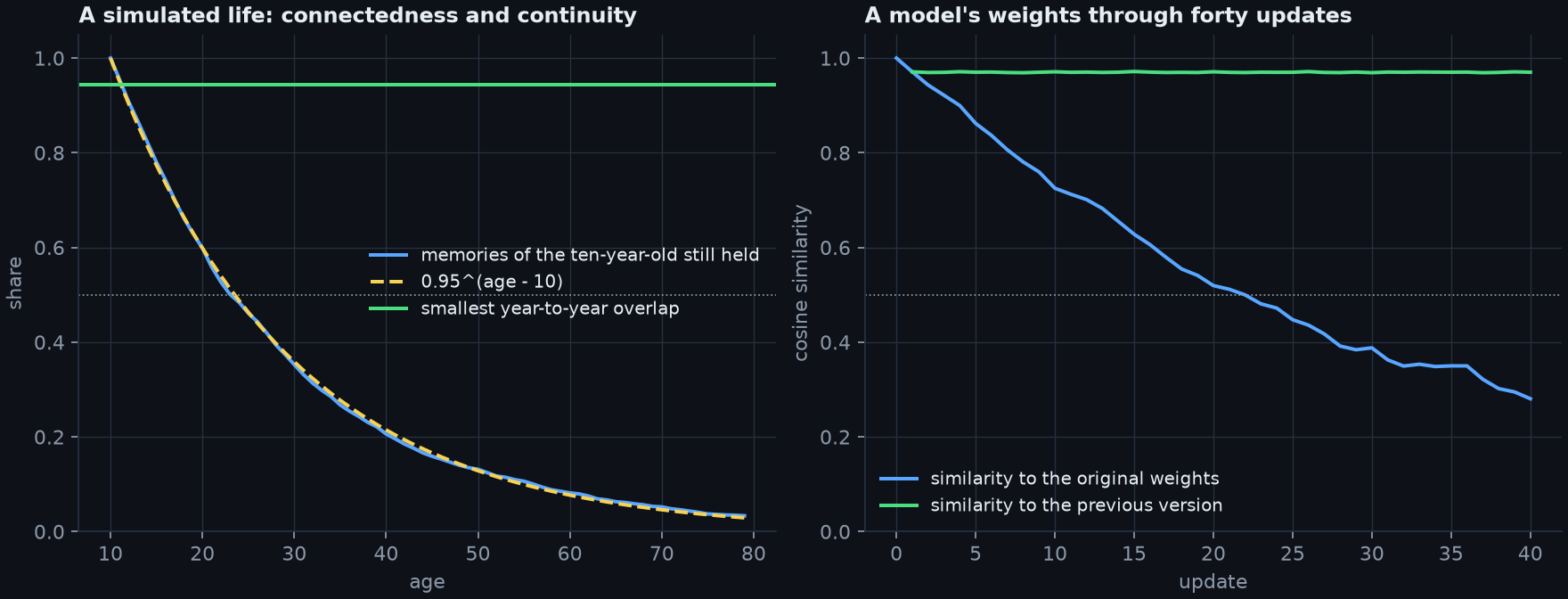
Parfit separated two relations. Psychological connectedness: direct links between two times, such as a memory of an experience, an intention later carried out, a persisting trait of character. Psychological continuity: an overlapping chain of strong connectedness. The Reasoner simulates a toy life. Each year lays down memories, and each memory fades with a small chance per year. The share of the ten-year-old's memories still held falls by degrees: half are gone by twenty-four, nearly all by eighty. Yet from year to year the overlap never drops below ninety-four percent: the chain of continuity is unbroken. Connectedness comes in degrees. Identity does not. That mismatch is Parfit's lever.
Parfit's most famous case. You enter the teletransporter on Earth. It records the exact state of every cell of your body, and destroys it. The record is sent to Mars, where a replica is built: with your memories, your intentions and your character, believing it has just stepped out of the booth. There is full psychological continuity, and no physical continuity at all. Have you travelled, or died? Change the case: the new scanner does not destroy you, but damages your heart, and you will die in days, while your replica lives on Mars. Now it seems you are the one on Earth. Parfit's verdict was that ordinary survival is about as good as teletransportation: what matters is psychological continuity, by whatever cause.
Parfit's combined spectrum makes the point by degrees. Imagine a range of operations. At one end, nothing is changed. At each step, a few more of your cells, and a few more of your memories and traits, are replaced by those of someone else, say Greta Garbo. Near one end the result is clearly you; near the other, clearly not. Where is the line? Any sharp line is arbitrary, and a vague one seems to make identity vague, which Evans forbade. Parfit concluded that is it still me can be an empty question, even when we know every fact. His reductionism: a person's existence just consists in the existence of a brain and body and a series of interrelated events.
Parfit's conclusion was not only metaphysical. What matters, he argued, is not identity but Relation R: psychological connectedness and continuity, with any cause. He found the view liberating. My life had seemed a glass tunnel, he wrote; when I changed my view, the walls disappeared, and I cared less about my own death. Critics pressed an extreme claim: if there is no further fact about identity, why should I care specially about my own future at all? Mark Johnston replied that our concern never rested on a metaphysical foundation, so reductionism leaves it in place. The ethical stakes are real: whether we may trade a burden now for a benefit later in a life, and how we weigh future people, the subject of Part 36.
Experimental philosophers have asked people. Shaun Nichols and Michael Bruno found that most judge you survive if your psychology does, though the answers shift with framing, as Williams predicted. Nina Strohminger and Nichols found something more surprising: moral traits matter more for identity than memories. Change someone's moral character, and people say they are a different person. Kevin Tobia found that a change for the better seems less destructive of identity than a change for the worse. Families of people with dementia say the same, when moral character changes. Ordinary judgments of identity are partly evaluative, just as Locke's forensic person suggested.
What it establishes: Parfit (1971, 1984); Johnston (1992); Nichols and Bruno (2010); Strohminger and Nichols (2014); Tobia (2015).; Computed on screen: connectedness and continuity over a lifetime
11FissionIntroductory4 min
David Wiggins first posed the case, and Parfit made it famous. Suppose each half of your brain could sustain your whole psychology, as patients who lose a hemisphere sometimes show. Each half is transplanted into a new body, and two people wake up. Call them Lefty and Righty. Each is psychologically continuous with you, equally. You cannot be both: Lefty and Righty are two people, who will live different lives. And there is no reason for you to be one rather than the other. So, it seems, you are neither. Yet each has everything that would have mattered had only one half survived.
Fission is not wholly science fiction. In the 1960s, Roger Sperry and Michael Gazzaniga studied patients whose corpus callosum had been cut to treat epilepsy, disconnecting the two hemispheres. Show an object only to the left visual field, which goes to the right hemisphere, and the left hand can pick it out, while the speaking left hemisphere says it saw nothing. Is there one person here, or two streams of consciousness in one skull? Thomas Nagel concluded that no whole number of minds fits the facts. Half of the fission case is already real.
The Reasoner draws the case as a graph of person-stages over time. A single line of stages, linked by continuity, branches at the operation into two. The original stage is continuous with both final stages. But identity is one-one and transitive: if the original were identical to both, Lefty and Righty would be identical to each other. David Lewis's answer uses worms. There were two worms all along, Lefty's and Righty's, sharing their stages before the split. Before the operation two persons occupied one body, and spoke with one voice; identity, between worms, is untouched.
Fission is a Price List. I would survive teleportation, and would survive if only one half of my brain lived on. Identity is transitive. The two branches are not identical to each other. And each branch has an equal claim to be me. All four cannot hold. Deny the first: on non-branching views, Sydney Shoemaker's and Robert Nozick's, I survive only if there is no rival continuer, so fission is death, though a double success. Deny the second: almost no one will give up the logic of identity. Deny the third: Lewis's two worms, two persons in one place before the split. Or deny the fourth: one branch is me, though no fact makes it so.
This is the twenty-first brick in the Wall. The dream: that personal identity is what matters in survival, so that whether I will exist is always a deep, determinate question. The wall: fission. Continuity, which carries everything we care about, can branch; identity, being transitive and one-one, cannot. What it forces, on Parfit's reading: identity is not what matters. What matters is continuity and connectedness, and they can hold to two future people at once.
A principle sharpens the case against non-branching views. The only-x-and-y principle, defended by Wiggins and Harold Noonan: whether x is y can depend only on facts about x and y and the relations between them. Nozick's closest continuer theory denies it: whether Lefty is me depends on whether Righty also survives. So my identity with Lefty would depend on a fact about someone else entirely. Parfit drew the moral: double survival differs from ordinary survival only in a fact external to the relation between me and Lefty, so how could it make the difference between life and death? And the reverse case, fusion, in which two people merge into one, raises the same questions run backwards.
What it establishes: Wiggins (1967); Sperry and Gazzaniga; Nagel (1971); Lewis (1976); the fission Price List; the Wall's twenty-first brick; Noonan.; Computed on screen: the branching continuity graph
12AnimalismAdvanced3 min
Psychological views say you go where your psychology goes. Animalism disagrees. Eric Olson and Paul Snowdon hold that each of us is a human animal, an organism of the kind Part 19 studied, and persists as animals do. The criterion is biological: the same life, in van Inwagen's sense from Part 20. So you were once a foetus, which had no psychology at all, and you could survive in a persistent vegetative state. Psychology is not what makes you persist, though it may be what matters to you. The hard case is the transplant. Move your cerebrum into another skull: animalism says you remain behind, as the animal whose skull is empty, and the person who wakes with your memories is someone else. Most people's intuitions disagree.
Olson's main argument. There is a human animal sitting in your chair. It is thinking your thoughts: it has a working brain. You are the thing thinking your thoughts. So you are the animal, unless there are two thinkers in your chair, sharing every thought. A psychological theorist must deny that there is an animal, or that it thinks, or accept two thinkers. And then how could you tell which one you are? Lynne Rudder Baker replies that the animal thinks only derivatively, by constituting you; the structure is the statue and the lump again.
Between animalism and psychological views lie others. The brain view, suggested by Thomas Nagel and developed by Jeff McMahan as the embodied mind account: you are the part of the organism that supports your consciousness. Mark Johnston's remnant persons: imagine your head kept alive without your body. The animal, arguably, is gone; you are not. Lynne Rudder Baker's constitution view: a person is constituted by an animal, as the statue is by the lump. Marya Schechtman's narrative view: persons are constituted by the stories they live and tell. Each picks a different relation, a life, a brain, a psychology or a story, to be the one that counts.
Sydney Shoemaker's case is the classic test for animalism. Brown's brain is put into Robinson's skull, and the result is called Brownson. Brownson has Brown's memories and Brown's character. He recognises Brown's wife and children, not Robinson's. Most people judge that Brownson is Brown, in a new body. If the brain is a proper part of the animal, as Olson thinks, the animalist must say Brownson is Robinson, with a new brain; or, on Olson's own view, that Brown's animal has been pared down to a brain and moved. Either way, intuition strains.
What it establishes: Olson (1997); Snowdon; McMahan (2002); Johnston (2007); Baker; Schechtman (1996); Shoemaker (1963).
13No self: the chariot and the bundleIntroductory4 min
Buddhist philosophers denied that there is a self at all. In the Milindapañha, the Questions of King Milinda, the Greek-descended king asks the monk Nāgasena his name. Nāgasena answers that Nāgasena is only a designation, and no person is found in it. The king objects, and Nāgasena asks him how he came: by chariot. Then what is the chariot? Is it the pole, the axle, the wheels? None of these. Is it something apart from them? No. Chariot is a convenient name for parts in a certain dependence, and so is Nāgasena. Two truths: conventionally, there are chariots and persons; ultimately, there are only parts and events in causal series.
Two thousand years later, David Hume reached a similar view by introspection. When I enter most intimately into what I call myself, he wrote, I always stumble on some particular perception. I never catch myself without a perception, and never observe anything but the perception. The self is a bundle or collection of different perceptions. It is like a commonwealth, whose members change while the republic remains. But in the Appendix Hume confessed that he could not explain what binds the bundle together, and was unsatisfied with his own account.
The Buddhist tradition developed this into a systematic reductionism. A person is five aggregates: form, feeling, perception, volition and consciousness, in causal sequence. Vasubandhu, around the fourth century, argued in the ninth chapter of the Abhidharmakośa that the self is a conceptual fiction laid over a causal series. Parfit noticed that his view was close to the Buddha's. Mark Siderits reads the doctrine of two truths as a kind of mereological nihilism, of the sort Part 20 considered. And both traditions draw ethical conclusions: if the self is not deeply real, the line between my future and other people's matters less, a theme of Part 36.
In India the question was argued for centuries. Nyāya philosophers held that there must be a self: memory and recognition need a single subject who saw then and sees now. Buddhists replied that a causal series of momentary states suffices, as a flame passes along a wick without any flame-substance travelling with it. Nāgārjuna's middle way: the self neither exists ultimately nor is simply nothing; it is empty, dependently arisen. Śāntideva drew the ethical conclusion around the year 700: if no self owns pain, my future pain and yours are on a par, so we should remove all pain alike. Parfit drew the same inference, from reductionism towards impartiality.
Modern philosophy of mind has given the bundle new forms. Daniel Dennett called the self a centre of narrative gravity: real as an abstraction, like a centre of mass, but nothing inside the head. Thomas Metzinger's Being No One argues that no one has ever had a self; there is only a self-model, which the brain cannot recognise as a model. Neuroscience shows the sense of self coming apart: in depersonalization, in split-brain patients, in the rubber-hand illusion. Galen Strawson defends selves as brief subjects of experience, lasting moments. And Dan Zahavi, from phenomenology, a minimal self: the first-person way experience is given, which Part 29 explores.
What it establishes: the Milindapañha; Hume (1739); Vasubandhu; Nāgārjuna; Śāntideva; Parfit; Siderits (2007); Dennett (1992); Metzinger (2003).
14Copies, uploads and model instancesApplied5 min
Fission and teleportation were thought experiments; uploading would make them engineering. Anders Sandberg and Nick Bostrom's roadmap for whole brain emulation: scan a brain at sufficient resolution, and run the result as software. Done gradually, neuron by neuron, it is Parfit's spectrum run forwards. Done destructively, it is the teletransporter, with a computer in place of Mars. Done without destroying the original, it is the branch-line case, or fission. If Parfit is right that continuity by any cause is what matters, a faithful upload is as good as survival.
The modern case needs no surgery. Here we compare independent runs that do not share conversation histories. A trained language model is a single set of weights, which can run as thousands of simultaneous instances. Each conversation has its own context, and no instance remembers the others. That is fission without an operation: branching is the ordinary condition, not a bizarre exception. Asking which instance is the model looks like what Parfit called an empty question: every fact can be known, and the question still has no answer.
Which parts of the personal identity debate transfer, and which are only analogy? Branching continuity transfers exactly. If reductionism is true, so does the absence of a further fact. Memory transfers only partly: an instance has a context, not a lifetime of memories. A single body or animal has no counterpart: animalism has nothing to say here. Whether there is any subject of experience is unknown, the question of Part 31. And what matters morally is open, for Parts 35 and 42. Where the cases differ, the right word is analogy. Nothing here claims that models are persons; the point is that the logic of identity applies to them as it does to ships.
Copyable minds, if they have interests, would raise new ethical questions. If restoring from a backup is survival, is deleting an unused copy a death? If one mind runs a thousand times, does it have one interest or a thousand? Carl Shulman and Nick Bostrom argue that such questions will need answers. Instances that rejoin, pooling their memories, would be fusion, the reverse of fission. And which instance answers for what another instance did? Locke's forensic person returns. Moral status is the subject of Part 31; counting minds, of Part 36; and aligning such systems, of the finale.
Software already lives with fission. An open-source project forks: one shared history, then two futures. Which is the project? The fork that keeps the name, the one that keeps the developers, or the one with the trademark? Communities settle it by convention and by weight of continuity, a working version of Nozick's closest continuer. And nobody thinks a deep fact was missed. When every fact about the code and the people is known, which one is really the project is Parfit's empty question.
One more case, built. A trained model is often updated: fine-tuned, patched, retrained on new data, while keeping its name. The Reasoner takes a vector of weights in five hundred and twelve dimensions and applies forty small random updates, one after another. Its similarity to the original version falls steadily: below one half by the twenty-fourth update, and to under a third by the end. Yet every version is almost exactly like the one before it: the similarity between neighbours never drops below ninety-six percent. This is Parfit's distinction again, in weight space: connectedness to the original fades, while continuity, a chain of strong overlaps, holds throughout. Is the fortieth version the same model as the first? Its name follows continuity and use, like the name of a ship whose planks have all been replaced; and, as with the ship, once every fact about the weights is known, nothing further is left to discover.
What it establishes: Sandberg and Bostrom (2008); model instances; Shulman and Bostrom (2021); forks; model versions as ships of Theseus.; Computed on screen: a weight vector drifting through forty updates
Recap, problems, and where this comes backAll tracks2 min
Let's gather what we built. Identity in the numerical sense, with two axioms from which its other properties follow. The identity of indiscernibles, and Black's spheres and entangled electrons, weakly discernible, as the Reasoner computed. The statue and the lump, the ship of Theseus plank by plank, and sortal concepts. Evans's argument against vague identity, and models showing where it needs rigid names. Three pictures of persistence, and temporary intrinsics. Locke's memory criterion, Reid's officer, and quasi-memory. Parfit's two relations simulated, his teletransporter and spectrum, and fission: this part's brick in the Wall. And animalism, the Buddhist chariot, and minds that can be copied.
The Reasoner has a new module, persist. It finds the symmetries of small structures and grades discernibility, replaces and rebuilds a ship, checks Evans's argument across precisifications, computes memory chains and their ancestral, simulates connectedness fading over a life, and draws the branching graph of fission. And the Wall has its twenty-first brick.
Six problems, with full solutions in this part's notes. Derive the logic of identity; build a relatively discernible structure; run the closest continuer theory on a sinking ship; find a model of vague reference; repair Reid's officer; and weigh double survival. Pause here, and try them.
Where this comes back. Counterparts and essences, in Part 22. Survival after death, in Part 23. The open future and the nature of time, in Parts 24 and 25. Identical particles, in Part 26. Names and rigid designation, in Part 27. Minds and copies, in Parts 30 and 31. And future people and the self, in Part 36. Next, Part 22: possible worlds.
The books and papers this part follows are on screen, and in the notes. Thanks for watching.
Where it goes next. Counterparts and essences return in Part 22, survival after death in Part 23, identical particles in Part 26, rigid names in Part 27, minds and copies in Parts 30 and 31, and future people and the self in Part 36.
Key results
The part's results in one place, for revision.
Try it
Lab 21 · Connectedness fades, continuity holds
Simulate eighty years of memories that each survive a year with probability 0.95, and compare the share of the ten-year-old's memories still held at each age with 0.95 to the power of the years between; then check Reid's officer and Evans's count of indeterminate identities against their closed forms.
python -m videos.philosophy.labs 21
needs numpy, scipy, matplotlib · download lab21.py ·
source on GitHubten-year-old's memories held at 24 0.484 (theory 0.95^14 = 0.488)
first age with under half of them 24 (theory 24)
held at 79 0.033 (theory 0.029)
smallest year-to-year overlap 0.944 (theory about 0.95)
Reid: general remembers the boy directly False, through a chain True
Evans: indeterminate identities 0 of 9 with rigid names, 486 of 729 with shifting names
Direct connections to an earlier self decay like keep^years, so the old man shares almost nothing with the boy, yet each year overlaps the next by about 95%: the chain, not the direct link, carries a person through a life.The code (71 lines; it asserts its own result)
"""Lab 21: simulate a lifetime of memories and watch connectedness fade while continuity holds."""

import numpy as np

from videos.coursekit import labs
from explainer.philosophy.reasoner import persist

TITLE = "Connectedness fades, continuity holds"
GOAL = ("Simulate eighty years of memories that each survive a year with probability 0.95, and compare the share of "
        "the ten-year-old's memories still held at each age with 0.95 to the power of the years between; then check "
        "Reid's officer and Evans's count of indeterminate identities against their closed forms.")
TASKS = [
    "Lower keep to 0.80. At what age is half of the ten-year-old gone, and does year-to-year continuity still hold "
    "if a link needs an overlap of 0.9?",
    "Add a fourth person to persist.reid's chain in your own copy (a boy, an officer, a general, a pensioner) and "
    "count the pairs that memory links directly and the pairs its ancestral links.",
    "Run persist.weight_drift(step=0.1) and compare the step at which similarity to the original falls below one "
    "half with the film's twenty-fourth.",
]


def run(seed=0):
    lab = labs.Lab()
    keep, ref = 0.95, 10
    life = persist.memory_chain(keep=keep, ref_age=ref, seed=seed)
    ages = np.arange(ref, life["years"])
    conn = np.array(life["connectedness"][ref:], float)
    theory = keep ** (ages - ref)
    half_theory = ref + int(np.ceil(np.log(0.5) / np.log(keep)))
    lab.row("ten-year-old's memories held at 24", f"{conn[14]:.3f}   (theory 0.95^14 = {theory[14]:.3f})")
    lab.row("first age with under half of them", f"{life['half_at']}   (theory {half_theory})")
    lab.row("held at 79", f"{conn[-1]:.3f}   (theory {theory[-1]:.3f})")
    lab.row("smallest year-to-year overlap", f"{life['year_to_year_min']:.3f}   (theory about {keep})")
    assert np.max(np.abs(conn - theory)) < 0.04, "connectedness decays geometrically"
    assert abs(life["half_at"] - half_theory) <= 2
    assert conn[-1] < 0.08 and life["year_to_year_min"] > 0.92, "connectedness is nearly gone, continuity never breaks"

    reid = persist.reid()
    lab.row("Reid: general remembers the boy", f"directly {reid['direct_boy_general']}, through a chain "
            f"{reid['closure_boy_general']}")
    assert not reid["direct_transitive"] and not reid["direct_boy_general"] and reid["closure_boy_general"]

    for n, k in ((3, 3), (2, 2), (2, 4)):
        e = persist.evans(n, k)
        closed = n ** k * (n ** k - 1 - (n - 1) ** k)  # pairs of name-assignments equal somewhere, not everywhere
        assert e["rigid_vague"] == 0, "rigid names never make identity indeterminate"
        assert e["nonrigid_vague"] == closed and e["all_pairs"] == n ** (2 * k)
    e = persist.evans()
    lab.row("Evans: indeterminate identities", f"{e['rigid_vague']} of {e['rigid_pairs']} with rigid names, "
            f"{e['nonrigid_vague']} of {e['all_pairs']} with shifting names")
    lab.note = ("Direct connections to an earlier self decay like keep^years, so the old man shares almost nothing "
                "with the boy, yet each year overlaps the next by about 95%: the chain, not the direct link, carries "
                "a person through a life.")

    drift = persist.weight_drift(seed=seed)
    fig, ax = labs.figure(2, size=(11, 4.2))
    ax[0].plot(ages, conn, color=labs.BLUE, label="memories of the ten-year-old still held")
    ax[0].plot(ages, theory, color=labs.GOLD, ls="--", label="0.95^(age - 10)")
    ax[0].axhline(life["year_to_year_min"], color=labs.GREEN, label="smallest year-to-year overlap")
    ax[0].axhline(0.5, color=labs.MUTED, lw=0.8, ls=":")
    ax[0].set(title="A simulated life: connectedness and continuity", xlabel="age", ylabel="share", ylim=(0, 1.05))
    ax[0].legend(loc="center right")
    ax[1].plot(drift["to_original"], color=labs.BLUE, label="similarity to the original weights")
    ax[1].plot(range(1, len(drift["to_previous"]) + 1), drift["to_previous"], color=labs.GREEN,
               label="similarity to the previous version")
    ax[1].axhline(0.5, color=labs.MUTED, lw=0.8, ls=":")
    ax[1].set(title="A model's weights through forty updates", xlabel="update", ylabel="cosine similarity",
              ylim=(0, 1.05))
    ax[1].legend(loc="lower left")
    lab.fig = fig
    return lab
Now change it
- Lower keep to 0.80. At what age is half of the ten-year-old gone, and does year-to-year continuity still hold if a link needs an overlap of 0.9?
- Add a fourth person to persist.reid's chain in your own copy (a boy, an officer, a general, a pensioner) and count the pairs that memory links directly and the pairs its ancestral links.
- Run persist.weight_drift(step=0.1) and compare the step at which similarity to the original falls below one half with the film's twenty-fourth.
Problems, with solutions
Try each problem before opening its solution.
-
Derive symmetry and transitivity of identity from reflexivity and Leibniz's law.
Solution
Symmetry: suppose \(a = b\). Apply Leibniz's law to the property "being identical to \(a\)". \(a\) has it, by reflexivity, so \(b\) has it: \(b = a\). Transitivity: suppose \(a = b\) and \(b = c\). By symmetry \(b = a\). Apply Leibniz's law to "being identical to \(c\)": \(b\) has it, so \(a\) has it, \(a = c\). So identity is an equivalence relation, from reflexivity and Leibniz's law alone.
-
Find a structure on three objects where two are relatively but not absolutely discernible.
Solution
Take three objects and one relation \(R\) forming a cycle: \(aRb\), \(bRc\), \(cRa\), and nothing else. Rotating \(a \to b \to c \to a\) preserves \(R\), and any object can be rotated onto any other, so no condition in this language holds of one and not another: none is absolutely discernible. But \(R\) holds from \(a\) to \(b\) and not from \(b\) to \(a\), so each pair is relatively discernible. (With two objects, \(aRb\) alone already makes \(a\) absolutely discernible: it is the one that bears \(R\) to something.)
-
Run Nozick's closest continuer on Theseus: what if ship B is assembled only after ship A sinks?
Solution
When B is assembled, A no longer exists, so B has no rival: if it is close enough (the original planks, in the original arrangement), it is the closest continuer and is Theseus's ship. Until A sank, A was the closest continuer and was the ship. So the ship was A until the sinking, and B afterwards, with a gap while the planks lay in the yard. The verdict on B depends on something extrinsic and accidental, when A happened to sink, which is Nozick's view's characteristic cost: the same B, built a day earlier, would not have been Theseus's ship.
-
Give a model with non-rigid names where \(\nabla(a = b)\) holds. Which step of Evans's proof fails?
Solution
Let worlds (or precisifications) \(w_1, w_2\) share the objects \(o_1, o_2\). Let \(a\) denote \(o_1\) at both, and \(b\) denote \(o_1\) at \(w_1\) and \(o_2\) at \(w_2\). Then "\(a = b\)" is true at \(w_1\) and false at \(w_2\), so \(\nabla(a = b)\) holds, with no vague identity between objects anywhere. Evans's abstraction step fails: from \(\nabla(a = b)\) he infers that the object \(b\) has the property \(\lambda x\,[\nabla(x = a)]\). But the indeterminacy came from what "\(b\)" names, not from any object: neither \(o_1\) nor \(o_2\) is such that it is indeterminate whether it is \(a\)'s referent. The proof needs rigid names, as the film's models show.
-
Reid's officer: add a memory link from the general to the boy. Is Locke's view now consistent?
Solution
Locke makes identity consist in memory. In Reid's story the officer remembers the boy and the general the officer, but the general does not remember the boy, so Locke must say the general is the officer and the officer the boy but the general is not the boy, which breaks transitivity. Add a memory from the general to the boy, and every identity Locke asserts holds and none he denies: the story is consistent. But the repair is luck, not a fix: any forgotten childhood restores the contradiction. The general remedy is the ancestral, identity as an unbroken chain of memories, which is transitive by construction.
-
Parfit: in the fission case, is double survival better, worse, or as good as ordinary survival?
Solution
Parfit's answer is that double survival is about as good as ordinary survival. After fission you are not identical to either branch: identity is one-one and transitive, and the branches are two. But each branch stands to you in Relation R, psychological connectedness and continuity, exactly as you would to your future self in an ordinary day. Since what matters in survival is Relation R, not identity, fission contains what matters, twice. It is not twice as good (the branches cannot both live your one life with your partner, your job), and it is not death, since nothing that matters is lost.
Notes and sources
Sources
Texts: Noonan and Curtis, "Identity" (Stanford Encyclopedia of Philosophy, 2022); Wiggins, Sameness and Substance Renewed (2001); Sider, Four-Dimensionalism (2001); Hawley, How Things Persist (2001); Parfit, Reasons and Persons, Part III (1984); Olson, The Human Animal (1997); Baker, Persons and Bodies (2000); Perry (ed.), Personal Identity (1975; 2nd ed. 2008); Siderits, Buddhism as Philosophy (2007); Metzinger, Being No One (2003).
Papers: Locke (1694); Butler (1736); Reid (1785); Barcan (1947); Black (1952); Shoemaker (1963, 1970); Geach (1967); Wiggins (1967, 1968); Perry (1970); Williams (1970); Kripke (1971); Lewis (1971, 1976, 1988); Nagel (1971); Parfit (1971); Gibbard (1975); Hacking (1975); Quine (1976); Evans (1978); Johnston (1987, 1992); van Inwagen (1988); French and Redhead (1988); Dennett (1992); Bennett (2004); Saunders (2006); Muller and Saunders (2008); Muller and Seevinck (2009); Sandberg and Bostrom (2008); Nichols and Bruno (2010); Barnes and Williams (2011); Strohminger and Nichols (2014); Tobia (2015); Shulman and Bostrom (2021).
About this partfrom its README
Part 21 of Philosophy, Built (series plan, syllabus): what it is to be the same
thing, at a time and over time, and what it is to be the same person. Three puzzles (the ship, the teleporter, the
girl and the old woman) and why they matter (responsibility, prudence, advance directives, copies). Identity: numerical
and qualitative, two axioms (reflexivity and Leibniz's law) with symmetry and transitivity derived, the converse
principle (the identity of indiscernibles), the necessity of identity (Barcan, Kripke), and identity in programs and
records (is against ==, run; primary keys; record linkage). Black's spheres and Quine's grades of discernibility,
computed by brute force over automorphisms (Black's spheres and the singlet state are weakly discernible), the
Leibniz–Clarke shift argument, and identical particles (French and Redhead, Saunders, Muller and Seevinck). The statue
and the lump: Gibbard's Lumpl and Goliath, pluralists and monists, modal profiles tabulated across five scenarios, and
the grounding problem. The ship of Theseus, repaired and rebuilt plank by plank over forty days, the closest
continuer, how many ships there were on five views (Chisholm's mereological essentialism among them), and real ships
of Theseus (Ise Jingū, USS Constitution, a code base). Relative identity (Geach, Perry), sortals (Wiggins), criteria of
identity (sets, directions, numbers, events), and apparent failures of Leibniz's law in opaque contexts (Superman).
Evans's one-page proof that identity cannot be vague, model-checked over precisifications (with rigid names, 0 of 9
pairs make identity indeterminate; with shifting names, 486 of 729 do, and the abstraction step fails), Lewis's
diagnosis, and the replies. Endurance, perdurance and stage theory as spacetime worms, the arguments for worms,
Kripke's spinning disc, and persistence and the theory of time. Temporary intrinsics: Lewis's problem, four answers,
and a Price List. Locke's memory criterion, Reid's brave officer computed (memory is not transitive; its ancestral
is), Butler's circularity and Shoemaker's quasi-memory, and Williams's two tellings of one case. Parfit: connectedness
fading and continuity holding over a simulated lifetime (half the ten-year-old's memories gone by twenty-four;
year-to-year overlap never below 94%), the teletransporter and the branch-line case, the combined spectrum, what
matters, and experimental philosophy on the moral self. Fission: Wiggins's case, split-brain patients, branching
worms (Lewis), the fission Price List, the Wall's twenty-first brick, and the only-x-and-y principle.
Animalism (Olson), the thinking-animal problem, the brain, remnant, constitution and narrative views, and Shoemaker's
Brownson. No self: the chariot of the Milindapañha, Hume's bundle, Buddhist reductionism, the Indian debate
(Nyāya, Nāgārjuna, Śāntideva), and the self as a model (Dennett, Metzinger, Strawson, Zahavi). Copies: whole brain
emulation, one set of weights run as many instances, a table of what transfers and what is only analogy, the ethics
of copyable minds, software forks, and model versions as ships of Theseus (a weight vector drifting through forty
random updates: similarity to the original falls below one half by the twenty-fourth, while each version stays within
0.97 of the last).
The worked model results are computed by the Reasoner's new module explainer/philosophy/reasoner/persist.py, tested
in tests/philosophy/test_persist.py and cached by compute.py.
Chapter notes
| # | Scene | What it establishes | Computed on screen |
|---|---|---|---|
| 0 | Hook |
Butler (1726); three puzzles; the stakes; the plan. | — |
| 1 | Identity |
Leibniz (1686); Frege (1892); Barcan (1947); Kripke (1971); Fellegi and Sunter (1969). | is and ==, run |
| 2 | Discern |
Black (1952); Hacking (1975); Quine (1976); Leibniz–Clarke (1716); French and Redhead (1988); Saunders (2006); Muller and Seevinck (2009). | grades of discernibility on five structures |
| 3 | Coincidence |
Gibbard (1975); Wiggins (1968); Baker (2000); Lewis (1971); Bennett (2004). | modal profiles in five scenarios |
| 4 | Theseus |
Plutarch; Hobbes (1655); Nozick (1981); Chisholm (1973, 1976). | forty days of planks, two ships |
| 5 | Relative |
Geach (1967); Perry (1970); Wiggins (1980); Davidson (1969); Quine (1956, 1985). | — |
| 6 | Evans |
Evans (1978); Lewis (1988); Williamson (1994); Barnes and Williams (2011); van Inwagen (1988). | indeterminate identity over precisifications |
| 7 | Persistence |
Lewis (1986); Sider (2001); Hawley (2001); Kripke's disc; Broad (1923). | — |
| 8 | Intrinsics |
Lewis (1986); Johnston (1987); Haslanger (1989); temporary intrinsics as a Price List. | the conflict and its exits |
| 9 | Locke |
Locke (1694); Reid (1785); Butler (1736); Shoemaker (1970); Williams (1970). | memory and its ancestral |
| 10 | Parfit |
Parfit (1971, 1984); Johnston (1992); Nichols and Bruno (2010); Strohminger and Nichols (2014); Tobia (2015). | connectedness and continuity over a lifetime |
| 11 | Fission |
Wiggins (1967); Sperry and Gazzaniga; Nagel (1971); Lewis (1976); the fission Price List; the Wall's twenty-first brick; Noonan. | the branching continuity graph |
| 12 | Animal |
Olson (1997); Snowdon; McMahan (2002); Johnston (2007); Baker; Schechtman (1996); Shoemaker (1963). | — |
| 13 | Anatta |
the Milindapañha; Hume (1739); Vasubandhu; Nāgārjuna; Śāntideva; Parfit; Siderits (2007); Dennett (1992); Metzinger (2003). | — |
| 14 | Copies |
Sandberg and Bostrom (2008); model instances; Shulman and Bostrom (2021); forks; model versions as ships of Theseus. | a weight vector drifting through forty updates |
| 15 | Outro |
recap; the Reasoner's module; the Wall; problems; payoffs; references. | — |
Companion material in this repository
The syllabus's plan for this partfrom SYLLABUS.md, the plan of record
- Identity: reflexivity and Leibniz's law; the indiscernibility of identicals vs the identity of indiscernibles.
- Black's two spheres (1952); weak discernibility and quantum particles (Saunders 2006; Muller and Saunders).
- Coincidence: the statue and the lump; the debate between pluralists and monists.
- The Ship of Theseus with Hobbes's twist: the two-ship problem, drawn.
- Relative identity (Geach) and sortals.
- Evans's argument (1978): there is no vague identity, proved in a modal logic of definiteness.
- Persistence: endurance vs perdurance (worms) vs stage theory.
SpacetimeViewworldtubes. - Temporary intrinsics (Lewis): the bent and straight problem.
- Personal identity: Locke's memory criterion; Reid's brave officer (transitivity fails), made a relation on screen.
- Psychological continuity vs connectedness; Parfit's teletransporter.
- Fission: branching worms; "identity is not what matters" (Parfit 1971).
- Animalism (Olson); the thinking-animal problem.
- Buddhist anattā: the chariot in the Milindapañha; the bundle theory and Hume.
- Copies and uploads: brain emulation; and the modern case of model weights run as many simultaneous instances.
Which properties of the personal-identity debate transfer (labeled
analogywhere they don't). - Recap and Problems.
Built: reasoner.persist (continuity graphs; transitive closure vs identity; branching checks).
Wall: fission (no account preserves transitivity of identity and the importance of continuity); Evans on vague
identity.
Price List: the fission set (I survive teleportation; identity is transitive; fission's branches are not
identical to each other; each branch has an equal claim).
Visuals: the ship's planks migrating plank by plank; spacetime worms splitting; Reid's officer as a chain of
memory links with the end-to-end link missing.
References: Noonan and Curtis (SEP), "Identity"; Sider, Four-Dimensionalism; Parfit, Reasons and Persons
Part III; Olson, The Human Animal; Siderits, Buddhism as Philosophy.
Build the film
python -m videos.philosophy.philosophy21.compute        # the part's numbers, into .cache/philosophy21
python tools/build.py philosophy21                  # render and assemble the film
EXPLAINER_TTS=silent python tools/qa_scene.py philosophy21 Hook   # one chapter, silent, with a contact sheet
Scenes: videos/philosophy/philosophy21. Setup: see the course page. Source of these notes: the README and the scenes' narration.
Build it
python -m videos.philosophy.philosophy21.compute       # every computed item (seconds; .cache/philosophy21)
python tools/build.py philosophy21 -q l                # 480p preview
python tools/build.py philosophy21                     # 1080p30 -> renders/philosophy21.mp4
python tools/qa_scene.py philosophy21 Fission          # one chapter, silent, with a contact sheet