The Romantic Century
How did the nineteenth century stretch music, and can the stretching be measured?
Between 1800 and 1870 the piano gained an iron frame, felt hammers and two more octaves, and the scores climbed with it: Clara Wieck's polonaises of 1831 reach E7, high above Mozart's F6. Schubert's Lieder made the piano a character; a key-finder hears Der Lindenbaum turn its stanza from E major to E minor, one semitone in the tune, while the piano plays seven notes for every one sung. The mazurka's uneven beat and the two kinds of rubato, a phrase arch and Mozart's stolen time, are modelled and heard. Berlioz made a theme a character and asked for 27 wind, brass and timpani players; Wagner made a chord a question that five keys can hold. Measured across a Library of 827 pieces from 1370 to 1924, instrumental music grew more chromatic by about 5.6 notes in a hundred per century from 1680 to 1900 (95% interval 2.4 to 8.2), while songs stayed plain; then Schoenberg and Webern jump to 25 to 30. The century also built national styles, the solo recital, the conductor, the canon and the first recordings. The Tune becomes a nocturne, a Lied and a transformed leitmotif.
What you need. Part 7 for the piano and the bowed string; Part 15 for key profiles; Part 17 for the synthetic voice; Part 21 for chroma and form; Parts 23 to 26 for the earlier collections. Linear regression and the bootstrap; time warping.
- Ideas, mathematics and history
- the iron piano, the Lied, programme music, the leitmotif, the growing orchestra, rubato, harmony stretched to its limit
- What we build, compute and hear
- a chromaticism index across two centuries; the Tune as a nocturne
What you will be able to do
Foundations
- Hear a Lied's piano as part of the meaning, and a stanza turned from major to minor.
- Hear a mazurka's uneven beat, a phrase arch and stolen time.
- Hear a theme transformed in character, and the Tristan chord's unresolved question.
Full course
- Read MusicXML and Humdrum scores whole, with chords, ties, transposing instruments and split spines.
- Measure chromaticism and tonal clarity window by window with key profiles.
- Fit a trend across a corpus with a bootstrap interval, and separate genre from date.
Research
- Design a corpus study of nineteenth-century harmony with composers as random effects.
- Use early recordings as evidence for performance style, and say what they cannot show.
Practice
- Turn a familiar historical claim into a measured trend with an interval, and report what the data cannot support.
Contents
Each chapter has a home level. Choose a track to see what to read and watch: Foundations 29 min · Full course 34 min · Research 36 min · Practice 34 min.
- 0A song under a linden treeFoundations2 min
- 1The piano growsFoundations3 min
- 2The song and its pianoFoundations3 min
- 3Small pieces, large feelingsFoundations3 min
- 4Stolen timeFoundations2 min
- 5Music that tells a storyFoundations3 min
- 6Wagner: the endless melodyFoundations5 min
- 7The stretching, measuredPractice5 min
- 8Nations and their songsFoundations3 min
- 9The concert becomes a museumFoundations3 min
- 10Frontier: harmony and performance as dataResearch2 min
- Variation 27, recap and problemsAll tracks3 min
Also on this page: Lecture · Key results · Try it · Lab · Problems · Notes and sources · Build the film.
Lecture
The text of each chapter is the film's narration, as it is spoken, so you can read along or revise without the film. The pictures are in the film. A dashed box stands for a number the film computes when it is rendered (hover over it to see what is computed); the README's figures for each chapter, where it lists them, follow the chapter's text.
A song under a linden treeFoundations2 min
Vienna, 1827. Franz Schubert is thirty, ill, and has a year to live. He is setting twenty-four poems by Wilhelm Müller about a man who leaves a town in winter: Winterreise, the winter journey. The fifth song is Der Lindenbaum, the linden tree that stands by the well at the town gate. It is music for a voice and a piano in a room, not for a theatre. And the piano is not accompanying. It is the rustling tree, the wind, and the memory. The century that began with songs like this ended with Wagner's theatre and Mahler's orchestra.
Listen to the opening. Eight bars of piano alone: quick triplets that rustle and swell, then horn-like calls in the left hand. Then the voice enters with a plain tune, almost a folk song, and the piano keeps rustling underneath. The film plays it from the encoding, on Part 7's piano, with Part 17's synthetic voice singing the vowel ah.
Here is the plan. First the instrument: the piano grows, and the scores grow with it. Then the song, where a key-finder hears Schubert turn a stanza to minor. Small pieces, and the stolen time of rubato, modelled and heard. Programme music and Wagner. Then the claim that harmony was stretched until the key could barely hold, tested on more than eight hundred pieces from six centuries. And the century's other inventions: national styles, the concert as a museum, and the first recordings.
1The piano growsFoundations3 min
What could the new piano do?
Between 1800 and 1870 the piano was rebuilt. In 1821 Sébastien Érard patented the double escapement, which lets a key strike again before it has fully risen, so that fast repeated notes became possible. In 1825 Alpheus Babcock in Boston patented a frame cast in one piece of iron. An iron frame can hold heavier strings at far higher tension: a louder, longer tone that stays in tune. Hammers were covered in felt instead of leather, for a rounder tone; in Part 7's terms, a softer hammer excites fewer high partials. By 1859 Steinway in New York was building a grand with an iron frame and crossed strings, which is essentially the modern piano.
The keyboard grew too. Each bar here runs from an instrument's lowest key to its highest, from the makers' own documented compasses. Cristofori's piano of about 1720 had four and a half octaves; the Viennese fortepiano that Mozart played, five. Beethoven's Broadwood of 1817 had six; a Viennese Graf of the 1820s, six and a half. By mid-century an Érard grand had seven, and by the 1880s Steinway had settled on eighty-eight keys, from A zero to C eight, the common modern standard, with instruments of wider or narrower compass also existing.
Hear what was added. First every C that a fortepiano of the 1780s could play, from C two to C six. Then the Cs the century added at either end: a deep C one, and C seven and C eight at the top, which on Part 7's piano model, as on a real one, are short and bright in this model, without implying that listeners cannot hear their pitches.
Did the music use the new keys? Here is every keyboard piece in the film's Library, the pieces the music21 corpus holds with a date, each as a line from its lowest note to its highest. C. P. E. Bach's sonata of 1765 stays inside the old compass. Clara Wieck's four polonaises, published in 1831 when she was eleven, climb to D seven and E seven, high above the top of Mozart's instrument, while Chopin's mazurka, a dance, needs no more than the old range. Joplin's rag of 1899 and Schoenberg's pieces of 1911 take the whole of the middle. Nine pieces prove nothing on their own, but they point the same way as the instruments: the music filled the space it was given.
The piano also moved into the home. By the middle of the century it stood in the parlour of almost every middle-class household that could afford one, and publishing sheet music became an industry: songs, dances, and whole operas arranged for piano four hands. Playing was an accomplishment expected of daughters, and these amateurs were the market: much of the century's piano music was written for them. After 1900 the gramophone would take that market away, as Part 60 will tell.
2The song and its pianoFoundations3 min
What can a piano say that the words do not?
The Romantic song began in rooms. A Lied is a German poem set for voice and piano, sung among friends; Schubert's circle called these evenings Schubertiads. Schubert wrote more than six hundred of them, and set Goethe's Erlkönig at eighteen, in 1815, where the piano's hammering octaves are the horse galloping through the night. A strophic song repeats one tune for every stanza; a through-composed song follows the poem wherever it goes. Schubert's favourite move lies between the two: the same tune again, but changed from major to minor, so that the music remembers and grieves at once.
Part 15's key-finder can hear that move. Here it reads Der Lindenbaum two bars at a time. The first stanza, the happy memory of the tree, sits in E major, with B major, its dominant, at the ends of phrases. Then the same tune returns, now in E minor: the traveller has to pass the tree in the dark. A cold wind blows, the piano storms, and the key wanders; and the last stanza brings back E major, as a memory heard from far away.
Count the notes, and the piano's part in the song is plain to see. Above, the voice's notes in every two bars; below, the piano's. The voice sings notes in the whole song. The piano plays , about for every one sung, and it plays alone where the voice is silent, in the prelude, between the stanzas, and in the storm. The tree, the wind and the memory are in the accompaniment.
Hear it for yourself. The same four bars of the song, twice: once from the first stanza, in E major, and once from the second, in E minor, in some order. Which is the minor, A or B? Listen to the third note of the tune.
A is the minor. The tune is the same, but where B sings G sharp, A sings G natural, and the piano's chords change with it. One semitone, and a memory becomes a loss.
Songs gathered into stories. Beethoven's An die ferne Geliebte, of 1816, is an influential early integrated song cycle, with earlier collections and related practices complicating a first-ever claim, songs that follow one another without a break. Schubert's two cycles on Müller's poems followed. In 1840, the year he married Clara Wieck, Robert Schumann wrote well over a hundred songs, among them Dichterliebe, whose last song ends with a long piano postlude: the piano has the last word. Clara Schumann, Fanny Hensel, Brahms and Hugo Wolf further developed an already substantial song tradition. Part 40 comes back to song in every tradition: words, breath and accompaniment.
3Small pieces, large feelingsFoundations3 min
Why does a mazurka limp?
Beside the song, the century loved the short piano piece. A character piece is a few minutes long, has a single mood, and often a title. The Irish pianist John Field published the first nocturnes from 1812: a singing melody over wide arpeggios held in the pedal. Mendelssohn wrote Songs without Words, and Schumann's Carnaval of 1835 is a masked ball in twenty-odd short scenes. Chopin wrote nocturnes, études and preludes, and about sixty mazurkas, the dance of his native Poland. The large feeling in a small form is one of the century's paradoxes.
Here is Chopin's Mazurka in C sharp minor, Opus 6 Number 2, published in 1832, its theme read from the encoding and played twice. In one performance the three beats of every bar are exactly equal, as the notation says. In the other they are not. Which one dances, A or B?
B uses this film’s illustrative unequal timing; both versions play the same mazurka. The notes are identical; only their timing differs. The first beat is a little short, the second a little long, and the bar begins to limp the way the dance does, the accent falling on the second or third beat rather than the first.
Drawn as lengths, the written bar has three equal beats, and the played bar here gives them 0.85, 1.2 and 0.95 of a beat. Those numbers are the film's illustration, not a measurement. When researchers measured the beats in thousands of recorded mazurkas, they found many patterns: pianists differ, and so do the dances. These examples illustrate a gap between a regular notation and an irregular performance. The score is not the music.
Chopin's dances carry a nation. He was born near Warsaw in 1810 and settled in Paris in 1831. After the Polish rising against Russia failed that year, he never went home. His mazurkas and polonaises turned Polish dances into a national voice in exile. This mazurka opens over open fifths held in the bass, like a village bagpipe's drone. Music written for Parisian salons was heard in Poland as the sound of the nation, a theme chapter eight takes further.
4Stolen timeFoundations2 min
What does a pianist do with the tempo?
The mazurka's limp is one kind of freedom with time; the century had a name for the general idea. Tempo rubato means stolen time: time taken from some notes and given to others. Mozart described it in a letter to his father in 1777: in an adagio, he wrote, his left hand kept strict time and knew nothing of what the right hand was doing. Chopin's pupils described the same thing in his playing, a steady accompaniment under a free melody. Another usage concerns, to the whole texture slowing and quickening together, slower at the ends of phrases and faster in their middles. Both kinds can be modelled, and heard.
The second kind has a simple model, the phrase arch, after the psychologist Neil Todd. Strict time is a flat line. Under the arch, each phrase begins a little slow, speeds into its middle, and slows again into its end, here a tenth faster in the middle and a fifth slower at the ends; final slowing can cue closure alongside other musical features. Measurements of many pianists playing the same piece, by Bruno Repp among others, find shapes like this, with every player bending a little differently.
Three performances of the Tune's first two phrases on Part 7's piano, with its accompaniment. Strict. Then under the phrase arch, both hands bending together. Then Mozart's stolen time: the left hand strict, the melody pushing ahead early in each bar and catching up at the bar line. Watch the notes shift.
Performance has become data. Researchers mark the onset of every beat in a recording and turn a performance into a tempo curve. Bruno Repp measured twenty-eight recordings of Schumann's Träumerei and found a shape they shared, each pianist bending it in their own way. The Mazurka Project in London measured beat timings and loudness in thousands of recordings of Chopin's mazurkas. A model such as the phrase arch is then a hypothesis about a style of playing, which those numbers can test. Part 43 builds a performer from them.
5Music that tells a storyFoundations3 min
How can a theme be a character?
Nineteenth-century programme music expanded much older traditions of instrumental storytelling. In 1830 Hector Berlioz performed his Symphonie fantastique in Paris, five movements with a printed programme. A young artist, desperately in love, dreams of his beloved in an opium haze, and she appears as a melody, the idée fixe, the obsession, which returns in every movement: at a ball, in the fields, at his own execution, at a witches' sabbath. The theme changes as the story does. It is a character, while still capable of motivic development.
Here is the idea with the Tune's first phrase standing in for Berlioz's melody. The theme, plainly. At the ball, as a waltz in three. In minor, the dream darkening. As the march to the scaffold, low and dotted. And augmented, twice as slow, remembered. Same notes, five characters; the transformations are ours, but each one follows a movement of Berlioz's plan.
The story needed a bigger orchestra. Count the wind, brass and timpani players each score calls for. Haydn's first symphony, about 1759: five. Mozart's fortieth, nine. Beethoven's fifth, of 1808, eighteen, with trombones in a symphony for the first time in his. Berlioz, in 1830: twenty-seven, with cornets, ophicleides and four timpanists, and harps and bells besides, which the count leaves out, as it leaves out the strings. Brahms in 1876 is more classical again, at nineteen; the century did not move in one direction.
Berlioz also wrote the book on it. His Treatise on Instrumentation, of 1844, describes each instrument's range, colour and character, and made orchestration a subject of its own: how a chord sounds depends on who plays it. Instruments changed too. Valves, added to horns and trumpets from the 1810s on, greatly expanded chromatic playing, while intonation still requires adjustment, and in the 1840s Adolphe Sax invented whole families of instruments in his Paris workshop. Part 41 builds orchestration from the instruments of Parts 7 and 8.
Franz Liszt took the idea further. His symphonic poems are single movements after a poem, a painting or a legend, held together by thematic transformation: one theme, changed in tempo, mode and character, as we just did to the Tune. Not everyone agreed that music should tell stories. The Viennese critic Eduard Hanslick argued in 1854 that music's content is forms moved in sound, and nothing else. Brahms was claimed by one side and Wagner and Liszt by the other, in the century's long quarrel about what music means. Part 44 comes back to music that tells a story, in film and games.
6Wagner: the endless melodyFoundations5 min
What happens when a chord never resolves?
Wagner was not the only answer. Italian opera ran from Rossini, Bellini and Donizetti to Giuseppe Verdi, born the same year as Wagner. Its ideal was bel canto, beautiful singing: the singer's line first, the orchestra often a large guitar beneath it. In Verdi's Rigoletto, of 1851, the Duke's song La donna è mobile is a tune the audience was meant to leave the theatre singing, and in the Library it is one of the plainest pieces of the century, two notes in a hundred outside its key. Verdi and Wagner developed distinct, internally varied approaches to one question: how music should serve drama.
If Schubert's songs are the century's smallest form, Wagner's dramas are its largest. Richard Wagner wrote his own words and called his works music dramas. The Ring of the Nibelung takes four evenings, about fifteen hours, and was finished in 1874. For it he built a theatre at Bayreuth, opened in 1876, with the orchestra hidden in a covered pit. Traditional aria-recitative divisions are often weakened in his mature dramas, though there are still recognizable numbers and formal articulations, what he called endless melody. He is also a toxic figure: his antisemitic writings are part of the record, and part of how his music was later used.
The most famous chord of the century opens Tristan und Isolde, first staged in Munich in 1865. Hear a plain cadence in A minor first, for comparison. Then the chord as textbooks give it, F, B, D sharp and G sharp, with the line above rising G sharp, A, A sharp, B, and the music landing on E seven, the dominant of A minor. And then nothing: the A minor chord it points to does not come.
Why is the chord so unsettling? Its four sounds are the same as F, A flat, C flat and E flat, an ordinary half-diminished seventh, but spelled as Wagner spells it, their spelling invites several functional interpretations in A minor, as Part 19 showed. Count the keys whose scales contain all four notes: , against for a plain A minor triad, counting the minor scale's raised notes as inside. And where it resolves, it resolves only to a dominant seventh, itself a question. Delayed closure is a dramatic motif, not the literal absence of local tonics throughout the opera. Its final B-major chord supplies a large-scale ending, rather than simply resolving the opening A-minor dominant.
Wagner built his dramas from motives. A leitmotif is a short musical idea tied to a person, an object or a feeling. The name comes from guides like Hans von Wolzogen's to the Ring, published for the first Bayreuth festival, not from Wagner himself. The motives transform as their meanings change, as Berlioz's obsession did, and the orchestra can tell the audience what a character does not say. Counts of the Ring's motives vary with the counter, from a few dozen to well over a hundred: a network, rather than a list.
The century ended large. Anton Bruckner's symphonies are cathedrals of brass, often over an hour long. Gustav Mahler is reported to have said that a symphony must be like the world, and embrace everything. His Eighth Symphony, first performed in Munich in 1910, was advertised as the Symphony of a Thousand, for the number of performers. Richard Strauss's Salome, of 1905, pushed the key nearly to its edge. Some works expanded both scale and chromatic resources; neither had one universal historical limit.
The effect was enormous. Wagnerism became a movement across Europe, in poetry and painting as well as music. Critics took sides in what is now called the War of the Romantics, Leipzig and Brahms against Weimar, Liszt and Wagner. After Tristan came Bruckner, Mahler, Richard Strauss and the young Schoenberg, for whom chromatic harmony was a language of longing: the key felt most strongly where it is withheld. Is the stretching visible in the notes themselves? Chapter seven measures it.
7The stretching, measuredPractice5 min
Did harmony really grow more chromatic?
The usual story says that through the century harmony was stretched until the key could barely hold. That is a claim about notes, so it can be measured. The Library is every piece the earlier parts read, plus every dated piece in the music21 corpus: eight hundred and twenty-seven pieces, from the fourteenth century to 1924. Each piece is cut into windows of sixteen beats, overlapping by half, and Part 15's key profiles find each window's key. Chromaticism is the share of sounding time spent on notes outside that key's scale, counting the raised sixth and seventh of minor as inside. Tonal clarity is how well the best key fits: the correlation between the window's notes and the key's profile.
Here is every group in the Library, one dot for each collection or piece, placed by its date and its chromaticism. Before 1680: the trecento, Palestrina, Monteverdi, between three and six in a hundred. Some of that is the method: a modal piece measured against major and minor profiles shows its modal notes as outside. From Corelli to 1900, the Baroque, the Classical quartets and the Romantic pieces spread between nearly zero and fifteen. And then three pieces from 1911 and 1924, by Schoenberg and Webern, at twenty-five to thirty: a different world.
Is there a trend between 1680 and 1900? Fit a straight line to those points. Over all of them, chromaticism rises by about points a century, but a bootstrap, which refits the line on resampled points four thousand times, gives an interval from to : it includes no change at all. Keep only the instrumental plotted points, of them, and the rise is points a century, with an interval from to , clear of zero. The association is positive in this instrumental subset under the stated bootstrap, without proving a repertoire-wide law, and gradual: a few notes in a hundred per century.
Why does including the songs blur the trend? Compare the nineteenth-century pieces by kind. The songs average about in a hundred. The instrumental pieces average about , more than twice as much. In this Library genre matters as much as date. These selected songs are relatively close to the inferred scales; song writing can also be highly chromatic; it is the accompaniments, developments and transitions that wander.
Can you hear the difference? Two string-quartet passages, about fifty years apart. Which was written later, A or B? Listen for notes outside the key.
A is later: Robert Schumann's first string quartet, of 1842, a passage the measure picked as its most chromatic, with notes in a hundred outside the key. B is Haydn, 1793, a typical passage, at . The comparison is loaded, extreme against typical, and that is the point: the averages move slowly, but the extremes moved a long way.
How far can this be trusted? The plotted units mix individual works with group averages at representative dates; the bootstrap resamples those points, not independent pieces. The Library is small and accidental: what the corpus happens to hold, not a sample of the century. The key comes from a profile, so modal music, and music that modulates quickly, both count as chromatic. Dates are of composition and some are approximate, and the groups average different numbers of pieces. In this selected Library, the instrumental subset shows a rising trend under this measure; three later examples do not establish an abrupt universal change after 1900. Chapter ten describes studies that do this with thousands of pieces, from recordings as well as scores.
8Nations and their songsFoundations3 min
Whose music was it?
The century of nations wanted national music. Mikhail Glinka's A Life for the Tsar, of 1836, is a landmark of Russian national opera, following earlier Russian operas and Russian-story settings, and in St Petersburg a group of five, Balakirev, Borodin, Cui, Mussorgsky and Rimsky-Korsakov, set out to write music that did not sound German. Smetana wrote a cycle of tone poems on Bohemia, Grieg drew on Norwegian dances, and Chopin, as chapter three heard, on Poland's. The signs were folk modes, drones and dance rhythms. Often they were a city composer's idea of the folk, made for a concert hall.
Two pieces from the Library, both from Black America at the century's turn. First the hymn written in 1900 by the brothers James Weldon and J. Rosamond Johnson for schoolchildren in Jacksonville, Florida, later adopted as an anthem; here Part 17's choir sings its first eight bars, without the words. Then sixteen bars of Scott Joplin's Maple Leaf Rag, of 1899: a march's steady left hand under a right hand that keeps landing between the beats.
The argument crossed the Atlantic. Antonín Dvořák, directing a conservatory in New York from 1892, said that American music should grow from Black and Native American song, and his New World symphony of 1893 has pentatonic tunes that audiences heard as American. The Fisk Jubilee Singers, from 1871, had already carried spirituals to concert halls in America and Europe. Joplin's rags were a published, notated art, and he wrote an opera, Treemonisha. And Liliuokalani, the last monarch of the Hawaiian Kingdom, wrote Aloha Oe in 1878; in the Library it is the piece with the clearest key of all.
Whose music was it? National music was often made from other people's music, and collecting folk songs was an act of love and also of selection and editing. Black American music, the spiritual, the rag and soon the blues and jazz, became the foundation of the next century's popular music, and its creators were rarely the ones paid for it. Act VI listens to other musics on their own terms, and Part 60 asks who gets paid.
9The concert becomes a museumFoundations3 min
When did old music become the repertoire?
The century made performers into stars. When Niccolò Paganini played in Vienna in 1828, he was a sensation, and rumours said he had sold his soul to the devil for his technique. Franz Liszt did the same for the piano; in London in 1840 his concerts were billed as recitals, one performer for a whole evening, eventually from memory. Chapter one's iron-framed piano made that possible: one instrument could fill a hall. Virtuosity was adored, and distrusted as mere spectacle.
The orchestra gained a leader who does not play. A Classical orchestra was led from the keyboard or the first violin's desk. By the 1830s conductors such as Louis Spohr, Carl Maria von Weber and Felix Mendelssohn stood in front with a baton. Mendelssohn made Leipzig's Gewandhaus orchestra, from 1835, a model of regular rehearsal and a planned season. Wagner's essay On Conducting, of 1869, argued that tempo should bend with the music, chapter four's rubato for a whole orchestra. The conductor became an interpreter.
And the concert became a museum. In 1829 Felix Mendelssohn, aged twenty, conducted Bach's St Matthew Passion in Berlin, a landmark public revival after a long period outside the regular concert repertory, and in a shortened form. In 1850 the Bach Society began a complete edition of his works, and editions of Handel, Mozart and Beethoven followed. Concert programmes, which in 1780 had been mostly new music, filled with the music of the dead: the classics, the canon. The historian William Weber calls this a great transformation of musical taste. From then on, a new piece had to compete with the museum, which is the problem the next act begins with.
Who made the canon? Clara Wieck Schumann gave concerts for more than sixty years, and as a performer she shaped what was played: Beethoven, Robert Schumann, Brahms. Her own works include the polonaises measured in chapters one and seven, a piano concerto and a piano trio of 1846. Fanny Hensel, Felix Mendelssohn's sister, wrote more than four hundred and fifty works, most of them unpublished in her lifetime. The Library's gaps are the century's: who was published, and who was kept.
The century ended with a machine. In 1877 Thomas Edison's phonograph recorded sound on tinfoil. In 1889 Brahms played part of his first Hungarian Dance into a wax cylinder in Vienna; the recording is barely audible through the noise. Sound recording allowed an audible trace of playing to survive, alongside older mechanical and notated records. And the earliest recordings show a style unlike today's: different patterns of rubato, tempo flexibility and sliding, varying by performer and repertory. The century that began with scores ended with music that could be kept as sound.
10Frontier: harmony and performance as dataResearch2 min
What can thousands of pieces, and of recordings, tell us?
Chapter seven was a small version of a real research programme. Symbolic corpora are scores encoded note by note, in formats like Humdrum and MusicXML, read by tools like music21. Some also carry expert harmonic analyses, Roman numerals for whole repertoires, checked by hand. With them one can ask how fast the chord vocabulary grew, and in which genres and places. The bottleneck is encoding: most of the century's music is still not in a machine-readable score. This part's Library was eight hundred accidental pieces; the frontier wants tens of thousands, chosen.
Another route starts from the sound. Chroma features, which Part 21 computed, can be taken from thousands of recordings. Christof Weiß and colleagues did this in 2019 for about two thousand recorded pieces composed between 1600 and 1910, and found their measures of tonal complexity rising across the eras, most steeply towards the end of the Romantic period: a related finding under different features and sampling, not an exact replication of this film’s index. Recordings bring performance into the measurement, and the biases of what gets recorded. Scores and audio together check each other's errors.
The early recordings are the other great archive. Made from about 1900, they preserve players who were trained in the middle of the nineteenth century. The historians Robert Philip and Daniel Leech-Wilkinson have shown how much playing style changed, more than anyone remembered: more rubato, freer tempos, less continuous vibrato, more sliding between notes. Measured beat by beat, those recordings test what the treatises claim. Part of the century's own sound can be recovered, and it surprises.
A concrete version. Take this part's two measures to a large corpus, chosen so that dates and genres are balanced. Model chromaticism by year and genre, with each composer as a random effect, as the statistics series does. Then ask whether the rise is steady, or concentrated in a few composers and a few decades. When, and in which genres, did nineteenth-century harmony change fastest? An answer with intervals rather than anecdotes would rewrite one of music history's most familiar stories.
Variation 27, recap and problemsAll tracks3 min
Every part ends by doing something to the Tune with what it built. This time, three Romantic ways. A nocturne: the melody ornamented with turns, over a left hand spread across two octaves, the whole bending under a phrase arch. A Lied: the synthetic voice sings the Tune over rustling triplets, as in Der Lindenbaum. And a leitmotif transformed: the Tune's head in minor, at half speed, over chords that darken chromatically before they settle.
Row twenty-seven of the ledger: seconds. The measurement: the nocturne puts melody notes over in the left hand, more than two to one, the accompaniment now busier than the tune it carries.
What did we find? The piano grew from five octaves to more than seven, and the scores climbed with it. A key-finder hears Schubert turn a stanza from major to minor. Rubato can be modelled two ways, both heard. A theme became a character, and a chord became a question. Across the Library, instrumental music grew more chromatic by about notes in a hundred per century, while the selected songs had lower averages. And just after the century's end, the measure jumps: these selected post-tonal examples fit the key-profile model less well.
Five problems. One to compute, one to prove, one for your ears, one to build, and a research problem, marked with a star. Solutions are in this part's notes. Pause here.
Where does this come back? Next, in what is left when the key goes. In the song, in every tradition. In orchestration, which Berlioz also wrote the first great treatise on. In performing, where rubato meets the evidence of recordings. In music that tells a story, for film and games. And in research that treats style and history as data.
And in practice. Pianists bend a phrase, either way. Singers listen to what the piano says. Composers transform a theme instead of repeating it. And analysts can turn a familiar story into a measured trend, with an interval.
The books and papers this part follows. The full list, with notes, is in the README.
Where it goes next. What is left when the key goes in Parts 28 and 29; the song in Part 40; orchestration in Part 41; performing and the evidence of recordings in Part 43; music that tells a story in Part 44; style and history as data in Parts 62 and 67.
Key results
The part's results in one place, for revision.
Try it
Lab 27 · The Romantic century, computed
Measure how far a piece strays from its key, window by window; fit the Library's trend with an honest interval; transform a theme; and hear the difference between strict time, a phrase arch and stolen time.
python -m videos.music.labs 27
needs numpy, scipy, matplotlib · download lab27.py ·
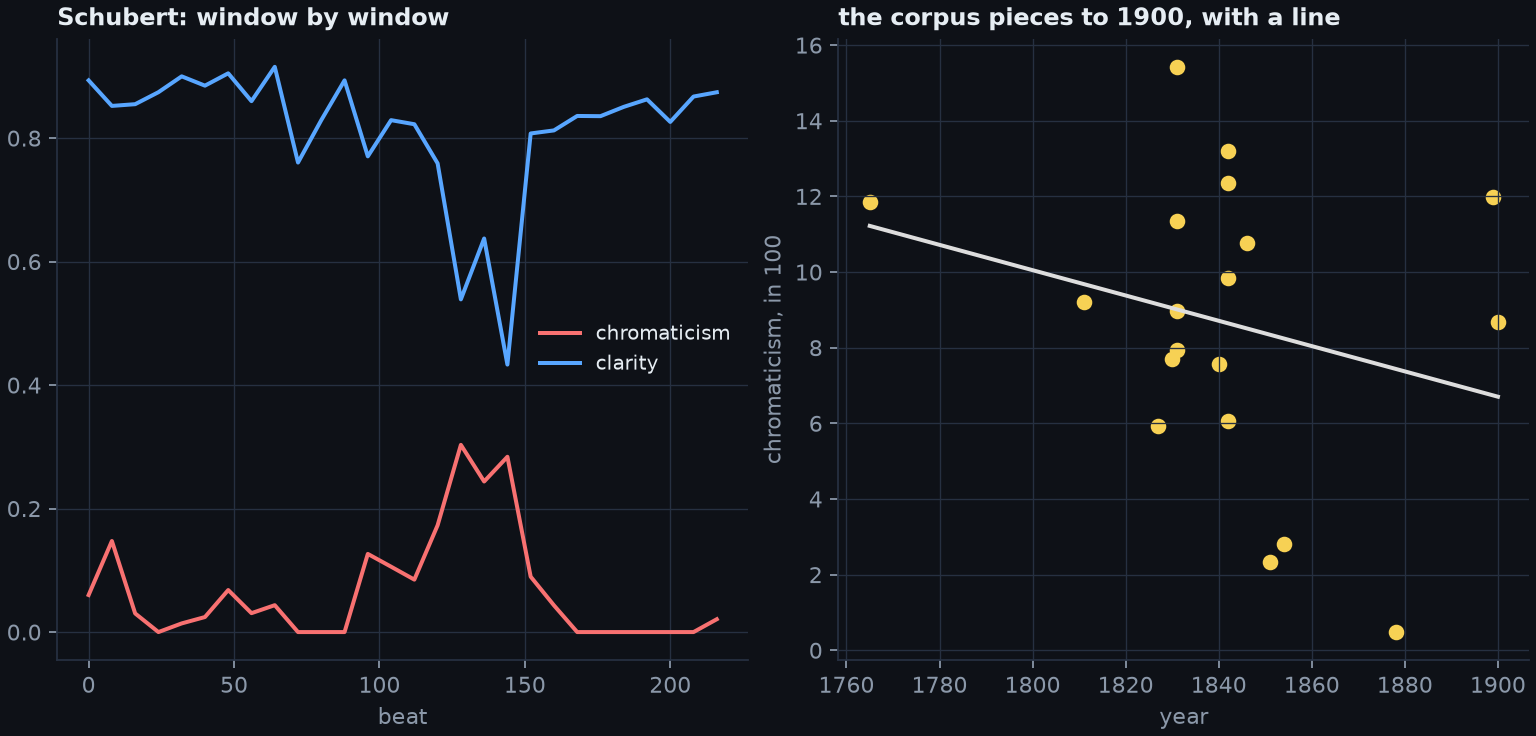
source on GitHubSchubert, Der Lindenbaum (Winterreise) (1827): windows of 16 beats 28
chromaticism, tonal clarity (time-weighted means) 0.059, 0.825
the three most chromatic windows (beat, key, share outside) 128 0 major 0.30; 144 11 minor 0.28; 136 0 major 0.24
the corpus pieces, 19 of them to 1900: chromaticism per century, 95% interval -3.3 points (-14.6 to +2.1)
the Tune's head, minor 72@0 72@1 79@2 79@3 80@4 80@5 79@6
the Tune's head, waltz 72@0 72@2 79@3 79@5 81@6 81@8 79@9
the Tune's head, march 60@0 60@0.75 60@1 60@1.75 67@2 67@2.75 67@3 67@3.75 69@4 69@4.75 69@5 69@5.75 67@6 67@7.5
the Tune's head, inverted 72@0 72@1 65@2 65@3 63@4 63@5 65@6
ear problem: the eight performances in the order played (listen first) arch, arch, strict, stolen, arch, stolen, stolen, strict
Chromaticism and clarity depend on the window as much as on the music; the corpus pieces alone are too few for a sure trend, which is why the film adds the earlier collections and splits songs from instruments; and a transformed theme is the same notes with a new character.The code (105 lines; it asserts its own result)
"""Lab 27: the Romantic century, computed: chromaticism and tonal clarity window by window in any piece of the Library,
the trend from 1680 to 1900 with a bootstrap interval, a theme transformed as Berlioz and Liszt transformed theirs, and
eight performances of a phrase, strict, arched or stolen, sorted by ear."""

import numpy as np

from videos.coursekit import labs
from explainer.music.monochord import SR, Clip, concat
from explainer.music.monochord import romantic as R
from explainer.music.monochord.partkit import organ_tone

TITLE = "The Romantic century, computed"
GOAL = ("Measure how far a piece strays from its key, window by window; fit the Library's trend with an honest interval; "
        "transform a theme; and hear the difference between strict time, a phrase arch and stolen time.")
TASKS = [
    "Choose a PIECE by a word of its corpus path ('Linden', 'opus19', 'maple', 'polonaise_op1n4'). Where are its most chromatic windows?",
    "Change WINDOW (in beats). How do chromaticism and clarity depend on it, and why does a short window find more 'keys'?",
    "Change DEPTH, the phrase arch's depth. At what depth does the rubato start to sound like a mistake?",
]
PIECE = "Linden"
WINDOW = 16.0
DEPTH = 0.3
TUNE = [(72, 0, 1), (72, 1, 1), (79, 2, 1), (79, 3, 1), (81, 4, 1), (81, 5, 1), (79, 6, 2),
        (77, 8, 1), (77, 9, 1), (76, 10, 1), (76, 11, 1), (74, 12, 1), (74, 13, 1), (72, 14, 2)]


def tone(m, seconds, gain=0.25):
    return organ_tone(440 * 2 ** ((m - 69) / 12), seconds, partials=6, rolloff=0.7, decay=2.0) * gain


def perform(kind: str, unit: float = 0.42) -> Clip:
    """The Tune's first two phrases over a bass, strict, under a phrase arch, or with the melody alone bending."""
    bass = [(48, 2 * k, 2) for k in range(8)]
    if kind == "strict":
        tm, tb = (lambda b: b), (lambda b: b)
    elif kind == "arch":
        tm = tb = lambda b: float(R.phrase_arch([b], 8.0, depth=DEPTH)[0])
    else:
        tm = lambda b: np.floor(b / 2) * 2 + 2 * ((b % 2) / 2 + 0.18 * np.sin(np.pi * (b % 2) / 2))
        tb = lambda b: b
    y = np.zeros(int(20 * unit * SR))
    for line, t_, g in ((TUNE, tm, 0.3), (bass, tb, 0.18)):
        for p, a, d in line:
            t0, t1 = t_(a) * unit, t_(a + d) * unit
            seg = tone(p, max(t1 - t0, 0.1), g)
            i = int(t0 * SR)
            y[i:i + len(seg)] += seg[: len(y) - i]
    return Clip(y, SR).fade(0.01, 0.2).at_level(-20.0)


def run(seed=0):
    rng = np.random.default_rng(seed)
    lab = labs.Lab()
    lib = R.load_library()

    # 1. one piece, window by window
    r = next(x for x in lib if PIECE.lower() in x["path"].lower())
    notes = R.all_notes(r["parts"])
    m = R.measure(notes, window=WINDOW, hop=WINDOW / 2)
    lab.row(f"{r['composer']}, {r['title']} ({r['year']}): windows of {WINDOW:g} beats", f"{m['windows']}")
    lab.row("chromaticism, tonal clarity (time-weighted means)", f"{m['chromaticism']:.3f}, {m['clarity']:.3f}")
    worst = sorted(zip(m["per_window"], m["keys"]), key=lambda z: -z[0][0])[:3]
    lab.row("the three most chromatic windows (beat, key, share outside)",
            "; ".join(f"{k['start']:.0f} {k['key'][0]} {k['key'][1]} {c:.2f}" for (c, _), k in worst))
    assert 0.0 <= m["chromaticism"] <= 1.0

    # 2. the Library's trend, pieces of 1680-1900 only (the lab's Library: the music21 pieces)
    x = np.array([p["year"] for p in lib if p["year"] <= 1900], float)
    y = np.array([R.measure(R.all_notes(p["parts"]), window=WINDOW, hop=WINDOW / 2)["chromaticism"] for p in lib if p["year"] <= 1900])
    slope = np.polyfit(x, y, 1)[0] * 100
    boots = []
    for _ in range(1000):
        i = rng.integers(0, len(x), len(x))
        if np.ptp(x[i]) > 0:
            boots.append(np.polyfit(x[i], y[i], 1)[0] * 100)
    lab.row(f"the corpus pieces, {len(x)} of them to 1900: chromaticism per century, 95% interval",
            f"{100 * slope:+.1f} points ({100 * np.percentile(boots, 2.5):+.1f} to {100 * np.percentile(boots, 97.5):+.1f})")

    # 3. a theme transformed
    for kind in ("minor", "waltz", "march", "inverted"):
        lab.row(f"the Tune's head, {kind}", " ".join(f"{p}@{a:g}" for p, a, _ in R.transform(TUNE[:7], kind)))

    # 4. Problem 3: eight performances, shuffled
    kinds = list(rng.permutation(["strict", "strict", "arch", "arch", "arch", "stolen", "stolen", "stolen"]))
    lab.audio = concat([perform(k) for k in kinds], gap=0.9)
    lab.row("ear problem: the eight performances in the order played (listen first)", ", ".join(kinds))

    fig, (a, b) = labs.figure(2)
    st = [k["start"] for k in m["keys"]]
    a.plot(st, [c for c, _ in m["per_window"]], color=labs.RED, label="chromaticism")
    a.plot(st, [k for _, k in m["per_window"]], color=labs.BLUE, label="clarity")
    a.set_xlabel("beat")
    a.set_title(f"{r['composer']}: window by window")
    a.legend(frameon=False)
    b.scatter(x, 100 * y, color=labs.GOLD)
    xx = np.array([x.min(), x.max()])
    b.plot(xx, 100 * np.polyval(np.polyfit(x, y, 1), xx), color="#ddd")
    b.set_xlabel("year")
    b.set_ylabel("chromaticism, in 100")
    b.set_title("the corpus pieces to 1900, with a line")
    lab.fig = fig
    lab.note = ("Chromaticism and clarity depend on the window as much as on the music; the corpus pieces alone are too few "
                "for a sure trend, which is why the film adds the earlier collections and splits songs from instruments; "
                "and a transformed theme is the same notes with a new character.")
    return lab
Now change it
- Choose a PIECE by a word of its corpus path ('Linden', 'opus19', 'maple', 'polonaise_op1n4'). Where are its most chromatic windows?
- Change WINDOW (in beats). How do chromaticism and clarity depend on it, and why does a short window find more 'keys'?
- Change DEPTH, the phrase arch's depth. At what depth does the rubato start to sound like a mistake?
Problems, with solutions
Try each problem before opening its solution.
-
Compute. A window holds C, E and G for 10 beats and F♯ and B♭ for 2 beats, and its key is C major. Compute its chromaticism.
Solution
F♯ and B♭ are outside C major's scale; the share of sounding time on them is 2/(10 + 2) = 1/6, about 0.17, or 17 in 100.
-
Prove. Show that a phrase arch whose tempo is symmetric about the middle of the phrase leaves the phrase's midpoint where strict time puts it, if the phrase's total length is unchanged.
Solution
Performance time is T(b) = ∫₀ᵇ du/v(u). If v(u) = v(L − u), then ∫₀^{L/2} du/v(u) = ∫_{L/2}^{L} du/v(u) (substitute u → L − u), so each half takes half the total. If the total equals L, as in strict time, the midpoint is reached at L/2.
-
Ear. The lab plays eight performances of the Tune's first two phrases, strict, arched or stolen. Sort them.
Solution
The lab prints the order. Strict performances have even notes against the bass; arched ones start and end slower with the bass bending too; stolen ones keep the bass even while the melody pushes ahead early in each bar and arrives with the bass on the bar line.
-
Build. Add a third measure to the Library: the share of sounding time on sonorities that are not triads or seventh chords, and plot it by year.
Where to look. At every onset, collect the sounding pitch classes (
romantic.all_notesand the sonority idea ofclassical.Movement.sonority), classify the set by its interval content (major, minor, diminished and augmented triads, the five seventh chords, any subset of them), weight by duration, and report the trend with the same bootstrap; expect the counterpoint of the earliest pieces to score high for a different reason. -
★ When did harmony change fastest? Answer with intervals, and by genre.
Where the frontier is. Assemble a corpus with balanced dates and genres (symbolic, from encodings with harmonic analyses where they exist, and from audio, as Weiß and colleagues did), measure each piece, and fit a model with year as a smooth function, genre as a factor and composer as a random effect; report where the derivative is largest and with what uncertainty, and whether the answer survives changing the measure.
Notes and sources
Sources
- R. Taruskin, The Oxford History of Western Music, vol. 3 (2005); C. Rosen, The Romantic Generation (1995); C. Dahlhaus, Nineteenth-Century Music (1980; trans. 1989).
- W. Weber, The Great Transformation of Musical Taste (2008); H. Berlioz, Grand traité d'instrumentation (1844); E. Hanslick, Vom Musikalisch-Schönen (1854); R. Wagner, Über das Dirigieren (1869).
- N. P. M. Todd, "The dynamics of dynamics: a model of musical expression", JASA (1992); B. H. Repp, "Diversity and commonality in music performance: an analysis of timing microstructure in Schumann's Träumerei", JASA (1992); the CHARM Mazurka Project (2006–2009); R. Philip, Early Recordings and Musical Style (1992); D. Leech-Wilkinson, The Changing Sound of Music (2009).
- C. Weiß, M. Mauch, S. Dixon and M. Müller, "Investigating style evolution of Western classical music: a computational approach", Musicae Scientiae (2019).
- C. L. Krumhansl, Cognitive Foundations of Musical Pitch (1990), for the key profiles.
- M. S. Cuthbert and C. Ariza, "music21" (ISMIR 2010), whose corpus holds the Library's encodings.
- Part 7 for the piano and the bowed string; Part 15 for keys; Part 17 for the voice and choir; Part 21 for chroma; Parts 23 to 26 for the earlier collections.
About this partfrom its README
Part 27 of a sixty-eight-part course in music (see the series plan and
the syllabus), the fifth and last part of Act IV. Part 26 ended with the Classical style's shared
expectations; this part follows the century that stretched them. It starts from Schubert's Der Lindenbaum and follows
the piano's growth, the Lied, the character piece and the mazurka, rubato, programme music, Wagner, national styles and
the concert as a museum, and tests the familiar claim that harmony was stretched until the key could barely hold on a
Library of 827 pieces from 1370 to 1924. The tools are Monochord's (explainer/music/monochord/romantic.py, with Part 15's
key profiles); the music is every dated piece in the music21 corpus from C. P. E. Bach to Webern, read whole, beside the
collections Parts 17 and 23 to 26 read. Published findings are the ones listed under Sources.
- A song under a linden tree. Schubert in 1827; Der Lindenbaum's prelude and first phrase, heard (Part 7's piano and Part 17's synthetic tenor); the plan.
- 1. The piano grows. Érard's double escapement, Babcock's iron frame, felt hammers, Steinway; documented compasses from 54 keys (Cristofori) to 88 (Steinway, 1880s); every C of a 1780s fortepiano and the Cs added since, heard; the Library's keyboard pieces by range (Clara Wieck's polonaises of 1831 reach E7, far above Mozart's F6); the piano in the parlour.
- 2. The song and its piano. The Lied and Schubert; Der Lindenbaum read two bars at a time (E major, its second stanza in E minor, a stormy middle, E major again); the piano plays 1,443 notes to the voice's 205; an ear question (the same four bars in major and minor: which is minor?); song cycles.
- 3. Small pieces, large feelings. The character piece; an ear question on Chopin's Mazurka Op. 6 No. 2 (equal beats or a mazurka's uneven ones: which dances?); what recordings show about mazurka timing; Chopin and Poland.
- 4. Stolen time. Mozart's letter of 1777; Todd's phrase arch drawn; the Tune strict, arched and with stolen time, heard; performances measured (Repp, the Mazurka Project).
- 5. Music that tells a story. Berlioz's programme; the Tune's head as an idée fixe in five guises, heard; wind, brass and timpani players called for by five symphonies (5, 9, 18, 27, 19); Berlioz's treatise, valves and Sax; Liszt and the symphonic poem, Hanslick's objection.
- 6. Wagner: the endless melody. Verdi and bel canto (La donna è mobile: 2 notes in 100 outside its key); the music drama; a plain cadence and the Tristan chord, heard; the chord held by 5 keys' scales against 8 for a plain triad; the leitmotif; Bruckner, Mahler, Strauss; after Tristan.
- 7. The stretching, measured. Chromaticism and tonal clarity defined; the Library plotted by year; from 1680 to 1900 the trend over all 31 points is not clear of zero (+2.6 points a century, 95% interval −0.8 to +4.9), over the 23 instrumental ones it is (+5.6, 2.4 to 8.2); songs (5 in 100) against instrumental music (10); an ear question (Schumann's most chromatic passage or a typical Haydn one: which is later?); what the measure cannot say.
- 8. Nations and their songs. Glinka, the Five, Smetana, Grieg; Lift Every Voice and Sing (1900) sung by the choir and sixteen bars of the Maple Leaf Rag (1899), heard; Dvořák in America, the Fisk Jubilee Singers, Liliʻuokalani; whose music?
- 9. The concert becomes a museum. Paganini and Liszt; the conductor; Mendelssohn's St Matthew Passion, the complete editions and the canon (Weber); Clara Schumann and Fanny Hensel; Edison and Brahms's cylinder.
- 10. Frontier: harmony and performance as data. Symbolic corpora; audio corpora (Weiß et al. 2019); early recordings; ★ research problem: when, and in which genres, did nineteenth-century harmony change fastest?
- Variation 27, recap and problems. The Tune as a nocturne (20 melody notes over 48 in the left hand, under a phrase arch), as a Lied (a synthetic tenor over rustling triplets) and as a leitmotif (minor, augmented, darkening chords); the ledger; what we found; five problems; where it comes back; in practice; Part 28.
What is computed and built
python -m videos.music.music27.compute (a few minutes) fills .cache/music27/.
| Item | What it computes | Checked against |
|---|---|---|
hook, lied |
Der Lindenbaum: bars 1–15; its keys two bars at a time; notes per two bars; the first and second stanzas' opening bars | the score's stanzas |
keyboards |
documented compasses; ranges of the Library's keyboard pieces; every C, then the new ones | the makers' compasses |
mazurka, rubato |
Chopin's Op. 6 No. 2 theme, strict and with uneven beats; the Tune strict, arched, stolen | the models (tests) |
idee, tristan |
the Tune's head in five guises; a cadence and the Tristan chord; keys whose scales hold each chord | — |
library |
chromaticism and clarity for 827 pieces; the 1680–1900 trend with a 4,000-resample bootstrap; songs against instruments; two quartet passages | Part 15's profiles |
nations, orchestra |
Lift Every Voice and Sing and the Maple Leaf Rag; the winds that five symphonies call for | the scores |
tune |
Variation 27 | — |
Monochord's tools are held in tests/music/test_romantic.py; this part's claims and clips in
tests/music/test_music27.py.
Sounds. Part 7's piano and bowed string (physical models); Part 17's synthetic voice and choir singing a vowel (synthesized). There are no recordings.
What the models are, and are not. The readers keep every note of a score (chords whole, ties merged, transposing instruments at sounding pitch, Humdrum's split spines followed), unlike the line readers of Parts 24–26. Chromaticism is measured against the best Krumhansl–Kessler key of each sixteen-beat window, with the natural, harmonic and melodic minor all counted as inside; modal music and quick modulations both register as chromatic, so the earliest points carry the method's bias. The Library is what the corpus happens to hold: a few dozen dated Romantic pieces, many songs, no symphonies; the trend is reported with its interval and split by genre for that reason. Dates are of composition (Clara Wieck's polonaises by their publication, 1831). The mazurka's beat lengths and the phrase arch's depth are illustrations, not measurements of any pianist. The Tristan chord is played as textbooks give it, not as Wagner scored it. The keyboard compasses are representative instruments' documented ranges, rounded to the key.
NotesLimits of the historical index
The Library is a convenience selection. Its scatter combines individual pieces with group averages at representative dates; the Palestrina set is subsampled, and bootstrap resampling treats plotted points as exchangeable. Collections with many pieces therefore do not enter the trend as independent individual observations. Composer, genre, edition and date remain confounded. A positive slope in the selected instrumental subset is not a repertoire-wide causal law. Three selected Schoenberg/Webern examples cannot establish that tonality disappeared after 1900.
The index compares windows with inferred major/minor profiles and includes the raised sixth/seventh in minor. It can mark modal or rapidly modulating music as chromatic, and correlation is model fit rather than measured listener certainty. Song and instrumental averages describe this selection. The contrasting passages are selected extreme-versus-typical examples, not a blinded test of date recognition.
The phrase arch and unequal mazurka beats are illustrative timing models, not measurements of the excerpts’ historical performances. Register, dynamics, touch and orchestral balance in the synthetic sounds remain model-dependent. Instrumental storytelling, Russian opera and song-cycle practices all have precedents; the cited landmarks are not first-ever inventions.
Companion material in this repository
The syllabus's plan for this partfrom SYLLABUS.md, the plan of record
- Hook: Schubert in 1827; Der Lindenbaum's prelude and first phrase heard; the plan.
- The piano grows: the double escapement, the iron frame, felt; documented compasses; every C heard, then the new ones; the Library's keyboard ranges; the parlour.
- The song and its piano: the Lied; Der Lindenbaum's keys; the piano's share of the notes; an ear question (major or minor?); song cycles.
- Small pieces, large feelings: the character piece; an ear question (which mazurka dances?); mazurka timing; Chopin and Poland.
- Stolen time: Mozart's letter; the phrase arch; strict, arched and stolen heard; performances measured.
- Music that tells a story: Berlioz's programme; the idée fixe in five guises heard; the winds counted; the treatise; Liszt and Hanslick.
- Wagner: Verdi and bel canto; the music drama; the Tristan chord heard; why it asks; the leitmotif; the century ends large; after Tristan.
- The stretching, measured: the measures; the Library by year; the trend with its interval; songs against instruments; an ear question (which is later?); caveats.
- Nations and their songs: national styles; Lift Every Voice and Sing and the Maple Leaf Rag heard; new worlds; whose music.
- The concert becomes a museum: the virtuoso, the conductor, the canon, who was heard, the first recordings.
- Frontier: symbolic and audio corpora; early recordings; the research problem.
- Variation 27: a nocturne, a Lied, a leitmotif. Outro: problems, payoffs.
Covers: the Lied; the character piece; programme music and the idée fixe; the leitmotif as a network; chromatic
expansion; nationalism and folk modes; virtuosity; the conductor; rubato; canon formation; the first recordings.
Built and computed: monochord/romantic.py: whole-score readers for MusicXML (chords, ties, transposing instruments)
and Humdrum (split spines), the Library (every dated piece in the music21 corpus from 1765 to 1924, beside the
collections of Parts 17 and 23 to 26: 827 pieces), chromaticism and tonal clarity window by window, the 1680–1900 trend
with a bootstrap interval and by genre, thematic transformation, Todd's phrase arch, the mazurka's beats; documented
keyboard compasses and the winds five symphonies call for (from the scores, in place of published rosters).
Variation 27: the Tune as a nocturne, as a Lied accompaniment, and as a transformed leitmotif.
Frontier: corpus studies of nineteenth-century harmony; performance style read from early recordings.
Reading: Taruskin vol. 3; Rosen, The Romantic Generation; Dahlhaus.
Build the film
python -m videos.music.music27.compute        # the part's numbers, into .cache/music27
python tools/build.py music27                  # render and assemble the film
EXPLAINER_TTS=silent python tools/qa_scene.py music27 Hook   # one chapter, silent, with a contact sheet
Scenes: videos/music/music27. Setup: see the course page. Source of these notes: the README and the scenes' narration.
Build it
python -m videos.music.music27.compute                          # numbers and sounds (a few minutes)
EXPLAINER_TTS=silent python tools/build.py music27 -q l --fps 15   # a silent-narration preview, with the sounds
python tools/qa_sound.py music27 --sync                         # the sound gates
python tools/dead_air.py renders/music27_480p.mp4 --sound music27  # no empty screen; no sound over a still one
python tools/lecture_length.py music27                          # 30 to 60 minutes, listening included
python tools/build.py music27                                   # 1080p30, narrated
python -m pytest -q tests/music                                 # Monochord against its references; this part's claims and clips
python -m videos.music.labs 27                                  # the lab (writes a figure and a short WAV)