The Baroque
How did the music of 1600 to 1750 come to rest on a bass line, a figured bass and two keys?
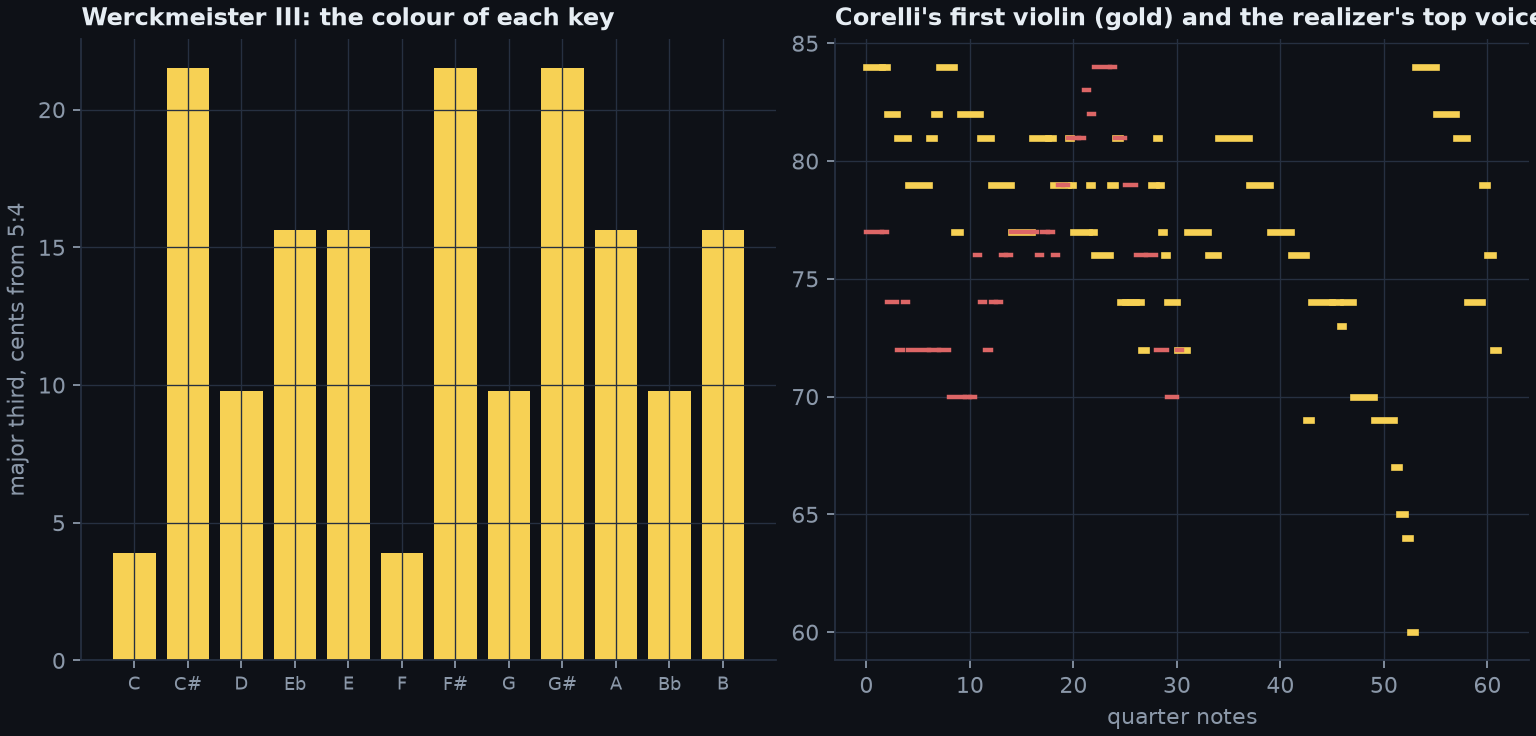
In 1589 Vincenzo Galilei hung weights on strings to test a legend two thousand years old and found that an octave needs four times the weight, not twice: the numbers belong to the strings, and music need not obey them. His circle in Florence wanted song that served the words, and monody, recitative and aria, and opera followed. The figured bass made every piece a top and a bottom: figuring the bass of Corelli's Grave from his violins and realizing it again recovers 80 in 100 of his notes and his first violin only 28 times in 100. Ornament and affect were the player's; the dances of the suite became characters; the concerto was built from a ritornello's returns, which a program matching intervals finds in any key but misses when the mode changes. Werckmeister's temperament gave keys colours, C's third 3.9 cents wide and F sharp's 21.5, and eight modes became two keys: Ionian and Aeolian label 35 in 100 of Palestrina's movements and all of Bach's chorales, 185 major and 178 minor. Bach, Handel and Rameau gathered the century up, and what the scores do not say, pitch and tempo, is still argued. The Tune becomes a French overture and a chaconne with an ornamented reprise.
What you need. Part 6 for temperaments; Part 10 for figures and the realizer; Part 15 for keys; Part 17 for the chorales; Part 18 for the rule of the octave; Part 21 for binary form; Part 24 for the second practice. Mersenne's law; dynamic programming; interval matching.
- Ideas, mathematics and history
- Monteverdi against Artusi, Vincenzo Galilei's strings, basso continuo, opera, the ritornello, the suite, temperament and key character
- What we build, compute and hear
- a figured-bass realizer; the Tune as a French overture and a chaconne
What you will be able to do
Foundations
- Hear recitative and aria, a ground bass, and the four dances of the suite.
- Read a figured bass and name the chord each figure asks for.
- Hear the difference between a smooth and a rough key in a well temperament.
Full course
- Figure a bass from upper parts and realize it by dynamic programming; measure what the realization keeps.
- Find a theme's returns at any transposition by matching intervals, and explain what that misses.
- Compute every key's third and fifth in meantone, Werckmeister III and equal temperament.
Research
- Weigh the evidence for historical pitch and tempo, and state an estimate with its uncertainty.
- Explain how the leading tone and musica ficta made the modes converge on major and minor.
Practice
- Realize a figured bass at the keyboard, choosing a top line.
- Choose a pitch standard and a temperament for a Baroque performance, and justify them.
Contents
Each chapter has a home level. Choose a track to see what to read and watch: Foundations 26 min · Full course 31 min · Research 35 min · Practice 29 min.
- 0Weights on stringsFoundations3 min
- 1A new kind of songFoundations3 min
- 2OperaFoundations3 min
- 3The figured bassFoundations4 min
- 4Affect and ornamentFoundations3 min
- 5The suiteFoundations2 min
- 6Ritornello and concertoPractice3 min
- 7Temperament and the colour of keysFoundations3 min
- 8From modes to keysFull course3 min
- 9Bach, Handel, RameauFoundations3 min
- 10Frontier: what pitch, what tempo?Research3 min
- Variation 25, recap and problemsAll tracks2 min
Also on this page: Lecture · Key results · Try it · Lab · Problems · Notes and sources · Build the film.
Lecture
The text of each chapter is the film's narration, as it is spoken, so you can read along or revise without the film. The pictures are in the film. A dashed box stands for a number the film computes when it is rendered (hover over it to see what is computed); the README's figures for each chapter, where it lists them, follow the chapter's text.
Weights on stringsFoundations3 min
Florence, 1589. Vincenzo Galilei, a lutenist and the father of the astronomer Galileo, is hanging weights on strings. An old story said that Pythagoras, passing a smithy, heard hammers ringing in harmony, weighed them, and found that a hammer twice as heavy sounded an octave lower. The story added that the same ratios hold for weights hung on strings: double the weight, and the string goes up an octave. Galilei, who distrusted the authority of the ancients, tried it.
Hear what he found. Two equal strings, one after the other, then together. In A, one string carries twice the weight of the other; in B, four times. Which pair sounds an octave, A or B?
B. Doubling the weight does not give an octave: it gives a ratio of the square root of two, six hundred cents, a tritone, the most dissonant interval of the old theory. To get an octave you need four times the weight. The legend was false, and had been repeated, despite earlier criticism and an unreliable historical attribution.
The law behind it was written down by Marin Mersenne in 1636: a string's pitch goes as the square root of its tension. One kilogram on a string sixty-five centimetres long, weighing six tenths of a gram a metre, gives hertz; four kilograms, an octave higher; nine, an octave and a fifth. Galilei drew a polemical conclusion: the simple ratios belong to strings of equal tension, not to the structure of heaven, and music need not obey them. In his Dialogue on ancient and modern music, from 1581, he had already argued that music should serve the words and move the listener, as the Greeks were said to have done, rather than display counterpoint. Out of that argument, and the one between Artusi and Monteverdi, helped shape monody and opera, alongside other developments behind continuo and major-minor tonality.
This part covers the century and a half from 1600 to Bach's death in 1750. The new song for one voice, and the opera built from it. The figured bass, tested on a real trio sonata by Corelli. Affect, ornament, and the dances of the suite. The concerto's ritornello, and a program that finds its returns. Temperament, the colour of keys, and how eight modes became two keys. Three great careers, and the question every modern performance has to answer: at what pitch, and how fast?
1A new kind of songFoundations3 min
How do you make one voice carry a drama?
In the 1570s and 1580s a group of scholars and musicians met in the Florentine house of Count Giovanni de' Bardi, and later historians called them the Camerata. Galilei was one of them. They read the Greek writers on music and concluded that ancient music had moved its listeners because it was one voice, with clear words and simple support. Polyphony, they complained, tore the poetry to pieces, every voice singing a different word at a different time. Their answer was monody: one voice over a bass line, with the harmony filled in by a player on a lute or harpsichord. In 1602 Giulio Caccini printed a collection of such songs and called it, simply, The New Music.
Monody soon split into two manners. In recitative, the voice follows the rhythm of speech, on repeated notes, over a bass that holds still, and the drama moves forward. In the aria, the voice sings a shaped tune in a regular rhythm over a bass that moves too, and the drama stops to feel. Here is a short example of each, computed for the film: first the recitative, then the aria.
Caccini's book is also a singing manual. Its preface explains how the new music should be sung. The esclamazione, a note begun softly and swelled, for a cry of feeling. The trillo, a single note repeated faster and faster in the throat, which is not our trill at all. And sprezzatura, a noble carelessness, letting the rhythm bend as speech does. The written notes were a skeleton, and the singer supplied the life: the same lesson as Part 22's reductions, from the other side.
The consequence went far beyond song. The bass and the chords above it became the frame of almost all music for a century and a half, the basso continuo, the continuous bass. What the composer wrote was the melody and the bass; the middle was filled in by the player. The texture of Palestrina, contrapuntal textures continued alongside a more prominent polarity, a top and a bottom. It is Monteverdi's second practice from Part 24 made into a system: the words govern the melody, and the bass governs the harmony. From 1600 to about 1750, a large share of ensemble music in these European traditions, sacred or secular, sung or played, has a continuo part.
2OperaFoundations3 min
What happens when a whole drama is sung?
The Florentines soon set whole dramas to music. In 1598 Jacopo Peri's Dafne, and in 1600 his Euridice, were sung from beginning to end, as entertainments for court celebrations, before a few hundred guests. The story they chose, again and again, was Orpheus, the singer whose song persuades the gods of the dead to give back his wife: a myth about the power of music itself. Recitative carried the story; choruses and strophic songs marked its stations. Euridice is the oldest opera whose music survives complete.
Seven years later Monteverdi, then at the court of Mantua, wrote his Orfeo. Its printed score names its instruments, unusually for the time: strings, recorders, cornetts, trombones and a variety of continuo instruments, harpsichords, organs, lutes. It opens with a fanfare-like toccata, and instrumental ritornellos return between the strophes of the songs, the first hint of the returning sections of chapter six. At its centre Orpheus pleads with the ferryman of the dead in a song that uses every resource of the new style and of the old art of ornament. With Orfeo, opera gained a particularly influential early example.
Opera also gave grief its own sound. A bass that falls by step through four notes, A, G, F, E, repeated over and over, with a voice lamenting above it, became one influential lament convention: Monteverdi's Lament of the Nymph uses it, and half a century later Dido's lament in Purcell's opera uses a chromatic form of it. Here is one built for the film: the ground three times, the voice rising and falling against it.
Then opera left the court. In 1637 the first public opera house opened in Venice, the Teatro San Cassiano, where anyone with a ticket could come. By the end of the century Venice had seen hundreds of new operas, with several houses competing each carnival season. Singers became stars, the arias grew, and the recitative shrank to the story's bare connective tissue. The standard aria became the da capo aria: a first section, a contrasting second, and the first again, which the singer was expected to ornament. Handel's London operas, in chapter nine, are its heirs.
3The figured bassFoundations4 min
How much of the music is in the bass?
A continuo player read a single line, the bass, with numbers written above it, the figures we met in Part 10. No number means a chord of a third and a fifth above the bass; a six, a third and a sixth; a seven, add the seventh. How to space the chord, which note to put on top, how to break it into rhythm: all that was the player's, an improviser following rules. The most common chamber texture of the age was the trio sonata: two violins and the continuo, usually four players reading three parts, the bass shared by a cello and a harpsichord or organ. The model for a generation was Arcangelo Corelli, working in Rome, whose trio sonatas began appearing in 1681; this chapter uses the Grave that opens his Opus 3, of 1689.
Before the test, see how much freedom the figures leave. Here are the first two bars of Corelli's bass, with the figures the violins imply, realized three times by the program, asked each time to start with its top voice in a different place. All three pass the realizer’s limited constraints; they differ at the start and then settle onto the same smoothest path. A real player would differ much more, breaking the chords and adding melody.
An experiment. Work out from Corelli's two violin parts which figures his bass would need, then throw the violins away and let Part 10's realizer fill in chords from the bass and the figures alone, as a continuo player might. Here is the same bass twice: once with Corelli's violins, once with the program's chords. Which is Corelli, A or B?
A is Corelli: two violins weaving in suspensions, one over the other, each a melody. B is the program: smooth, correct chords, and a deliberately plain upper line.
The numbers. Over the Grave's bass notes, the violins imply no figure most often, then six, then seven: a texture rich in suspensions. The realizer's chords contain in a hundred of the notes Corelli's violins actually play: these figures were inferred from the very violin notes being compared, so this measures reconstruction with supplied harmonic information, not independent prediction from bass alone. But the realizer's top note is the first violin's only times in a hundred. Its selected voicing path avoids the checked parallels; it does not reproduce Corelli’s melodic design. That is the Baroque division of labour: the bass and its figures carry the harmony, and the art of the composer, and of a good continuo player, is in the lines above it.
The figured bass was also a school of composition. In the conservatories of Naples, which grew from charitable institutions with differing histories, boys were trained as musicians, and their daily exercise was the partimento: a bass, often without figures, to be realized at the keyboard. They learned the rule of the octave from Part 18, a chord for every step of the scale in the bass, and a stock of patterns for every situation. Composition was taught as improvisation over a bass, and the conservatories' graduates staffed the courts and opera houses of eighteenth-century Europe.
4Affect and ornamentFoundations3 min
What did a Baroque performer add to the page?
Baroque writers explained music's power with a theory of the passions. A piece, or a movement, should portray one affect, joy or grief, anger or tenderness, each with its suitable keys, tempos, intervals and figures. The Hamburg critic Johann Mattheson catalogued them in his Complete Kapellmeister of 1739. The model was rhetoric: theorists named musical figures after figures of speech, a rising line for exaltation, a falling chromatic line for lament. One-affect descriptions are a teaching generalization; Baroque movements also contain internal contrasts. Part 26 examines later approaches to contrast.
The page also left the ornaments to the player. Here is a plain line, then the same line as a player might decorate it: a leaning note, an appoggiatura, on the first beat; a quick mordent; a trill from the upper note at the cadence. Then a run of even eighth notes, and the same run as a French player would have played it, long, short, long, short, the notes inégales, unequal notes, often left implicit in the relevant French performance conventions.
Ornament was also a matter of national taste. In 1702 a French priest, François Raguenet, published a comparison praising Italian music for its boldness and surprise. A Parisian critic, Le Cerf de la Viéville, replied that French music was more natural, tender and reasonable. Italians left ornaments to the singer's invention; the French wrote small ornaments into the score as signs. In 1724 Couperin published a set called The Tastes Reunited, and German composers, Bach among them, took freely from both.
Composers and teachers printed tables of the signs. Jean-Henri d'Anglebert in 1689, François Couperin in 1713, and Bach in the little book he wrote out for his son Wilhelm Friedemann in 1720. A trill, by these rules, begins on the note above, on the beat, so that it starts as a dissonance and resolves. In a common teaching convention, an appoggiatura takes half the value of the note it leans on, or two thirds of a dotted one. Inequality applied, in French music, to pairs of the shortest common notes moving by step. How much of this applied where, in Bach as against Couperin, in Italy as against France, is still argued over by performers today; chapter ten returns to that kind of evidence.
5The suiteFoundations2 min
What did the dances leave behind?
Instrumental music took its forms from the dance. A suite is a set of stylized dances in one key, each in two halves, each half repeated, Part 21's binary form. Its core, by Bach's time, was four dances from four countries: the allemande, moderate, in four, with a short upbeat; the courante, in three, wavering between three beats and two; the sarabande, slow and grave, its weight on the second beat of the bar; and the gigue, fast, in compound time, often beginning in imitation. Bach’s suites are primarily stylized instrumental works rather than straightforward dance accompaniments; the dances had become rhythms, and the rhythms had become characters.
Hear the characters on one melody: the Tune's first phrase as an allemande, a courante, a sarabande and a gigue, the pitches the same and only the rhythm and tempo changed. Listen especially for the sarabande's long second beat.
The same seven notes, four characters. That is what the doctrine of the affections meant in practice: a rhythm and a tempo carry a feeling, and familiar dance conventions could suggest character; that does not assign every listener one fixed emotion.
The dances share one plan. Each has two halves, and each half is repeated. The first half moves from the tonic to the dominant, or in a minor key to the relative major, and stops there. The second half travels back home, often through other keys on the way. And the end of the second half often repeats the end of the first, now in the home key, so that what was a cadence away from home becomes a cadence at home. Enlarge that plan, give the return a theme of its own, and you have the sonata form of Parts 21 and 26.
6Ritornello and concertoPractice3 min
How do you build a fast movement from returns?
One major instrumental genre of the age was the concerto. Corelli's concertos set a small group of soloists against the full string band; Antonio Vivaldi, a violinist-priest in Venice, used varied solo groupings in his set printed in 1711 as L'estro armonico, harmonic inspiration. Vivaldi's fast movements use ritornello form: the band's opening theme, the ritornello, returns again and again, in different keys, and between its returns the soloist's episodes travel from key to key. A typical plan: the ritornello in the home key, an episode, the ritornello in the dominant, an episode, the ritornello in a minor key, often only its head, an episode, and the ritornello at home. Bach copied out Vivaldi's concertos for keyboard, in his twenties, to learn how it was done.
Here is a short movement in that plan, computed for the film: the ritornello in C, a solo episode, the ritornello in G, an episode, its head in A minor, an episode, and the ritornello in C again. Listen for the theme each time it comes back, and for where it is.
Now a program finds the returns, as Part 21's novelty curve found sections. It takes the first six melodic intervals of the opening and slides them along the whole line, allowing one mismatch. Because it compares intervals, not pitches, a transposed return matches exactly: it finds the returns in C, in G, a fifth up, and in C again. But it misses the head in A minor, where the major third has become a minor one and two intervals have changed. A real ritornello finder must allow for mode, and for the fragments and variations that Vivaldi's returns usually are; in real concertos the band's harmony and scoring help as much as the melody.
Vivaldi also showed what the form could depict. In 1725 he printed four violin concertos, The Four Seasons, each with a sonnet, and the lines of the sonnet are written into the score where the music illustrates them: birdsong, a summer storm, a barking dog, a drunken peasant, walking on ice. In spring's first movement the ritornello is the season itself and the solo episodes are its events. It is program music, instruments telling a story without words, in exactly the same ritornello form that elsewhere carries nothing but notes.
7Temperament and the colour of keysFoundations3 min
Did keys really have characters?
Part 6 showed that no tuning makes every interval pure in every key. The Baroque lived with the choice. The chart shows the major third of each major key, going round the circle of fifths, in cents wider than pure. In quarter-comma meantone, the eight common keys have pure thirds, and four keys far from home have thirds forty-one cents wide, strongly compromised in this layout. In Andreas Werckmeister's third temperament, of 1691, every key is usable, with several different interval profiles; some keys share the same third sizes: C's third is cents wide, F sharp's , as wide as Pythagorean. In equal temperament every third is fourteen cents wide, and transposed interval ratios are the same, while register and instruments still matter.
Why were meantone's remote keys strongly compromised in this layout? Because the circle does not close. Eleven of its fifths are each narrowed by a quarter of a comma, and the twelfth, between G sharp and E flat, has to absorb the difference: it is more than a third of a semitone too wide. Players called it the wolf, for its howl. Here is a good meantone fifth, then the wolf.
Listen. A plain cadence, tonic, subdominant, dominant, tonic, played on organ tones tuned exactly to Werckmeister's temperament, first in C, then in F sharp. Which key's chords sound rougher?
F sharp is rougher: its thirds beat fast, while C's are nearly smooth. In Werckmeister's tuning the keys with few sharps and flats are sweet, and the remote ones are sharp-edged, and a composer could use the difference.
Theorists wrote about the character of each key. Mattheson, in 1713, called D major sharp and stubborn, and F minor deep and heavy, and others gave different lists. Part of it is tuning: in a well temperament the remote keys really are rougher, as you just heard. Part is instruments: string players' open strings favour some keys, and natural trumpets were often built or crooked for favored keys such as D and C. And part is convention, learned from the pieces in each key. In 1722 Bach compiled The Well-Tempered Clavier, a prelude and fugue in each of the twenty-four keys, playable on one instrument in one tuning: well-tempered, not necessarily equal, a question chapter ten returns to.
Equal temperament itself was not new. In 1584 Zhu Zaiyu, a prince of the Ming dynasty in China, computed the twelfth root of two to many digits and built pipes to it. Around 1605 the Flemish engineer Simon Stevin did the same, independently. Fretted instruments like the lute and viol, with each fret running under every string, were already close to equal. Keyboard players resisted it because its thirds are fourteen cents wide, and it became the standard only in the nineteenth century, as Part 27 will show.
8From modes to keysFull course3 min
How did eight modes become two keys? Count. The Humdrum encodings of Palestrina's Masses label each movement with its mode. Of movements, the Ionian and Aeolian, Glarean's new modes, our major and minor, make up in a hundred; the old Dorian and Mixolydian still lead. A century and a half later, Bach's chorales are labelled major and minor, and nothing else, even when the melody Bach harmonized was an old modal tune. One mechanism was the leading tone: once singers often raised a cadential leading note in relevant contexts, by the rules of musica ficta from Part 23, Dorian and Mixolydian cadences sounded like minor and major ones, and several interacting changes supported major-minor practice; modern editorial labels are not a direct historical census of listeners’ concepts.
The theory caught up in 1722, the year of the Well-Tempered Clavier. Jean-Philippe Rameau's Treatise on Harmony treated chords, not intervals, as the units of music: a chord and its inversions are one chord. Beneath the real bass he traced a fundamental bass of chord roots, moving mostly by fifths, as Part 18 counted in Bach's chorales. He named the tonic, the dominant and the subdominant, the functions of Part 15. And he grounded the whole system in the harmonic series of Part 3, where the major triad appears among the low partials of an ideal harmonic complex; many musical sounds are inharmonic: harmony given by nature, he argued, though the minor triad gave him more trouble.
With every key usable, theorists began to draw maps of them. In 1711 Johann David Heinichen, a Dresden composer, drew a musical circle of all twenty-four keys, the major keys round the circle of fifths, each next to its relative minor. It is a map for modulation: neighbouring keys share most of their notes, as Part 15 measured. A conceptual key map can also describe relationships beyond one instrument’s practical tuning, which is what the new temperaments allowed. Part 19's pathfinder walks the same map with chromatic doors added.
Here is Rameau's idea made audible. The first phrase of one of Bach's chorales, soprano and bass, and then the same with Rameau's fundamental bass added below, the root of every chord on the beat, played on a low organ. Listen to the added line: it leaps by fourths and fifths where Bach's real bass moves smoothly.
9Bach, Handel, RameauFoundations3 min
Three careers born in two years: what did each make of the inheritance?
Three composers born within two years of each other gathered the century up. Johann Sebastian Bach, born in 1685, was an organist and court musician before he became cantor of Saint Thomas's in Leipzig, where for years he produced a cantata almost every Sunday, as well as the Passions and, later, the Mass in B minor. His music is an influential example of the counterpoint of Parts 17 and 20, combining the French, Italian and German styles of his time. At his death he was old-fashioned, and the 1829 performance became a major revival landmark, alongside continuing earlier reception, when Felix Mendelssohn conducted the St Matthew Passion in Berlin.
George Frideric Handel was born a few weeks earlier, in the same part of Germany, but his career ran the other way. Trained in Germany and formed in Italy, he settled in London, where from Rinaldo in 1711 he wrote Italian operas for London audiences, made of da capo arias. When the fashion for Italian opera collapsed he developed an influential English-oratorio practice, drawing on earlier traditions, Messiah among them, first performed in Dublin in 1742. He was a businessman as well as a composer, running his own companies and his own seasons. Unlike Bach, he has never left the repertory.
This is the opening of one of Rinaldo's arias, Lascia ch'io pianga, let me weep, sung from the encoding by the synthetic choir's soprano, with the accompaniment on harpsichord. Listen for the slow triple time with its weight on the second beat: it is chapter five's sarabande, used for a lament.
The third, Jean-Philippe Rameau, born in 1683, was the theorist of the last chapter. He wrote his first opera at the age of fifty, Hippolyte et Aricie, in 1733, French tragedy in music, full of dances, choruses and orchestral storms. Critics accused him of too much harmony and too much noise, as Monteverdi had been accused of too much dissonance. By 1750 a younger, simpler style was arriving from Italy, built on tunes over plain accompaniments, and Part 26 follows it.
Three names leave out most of the century. Georg Philipp Telemann wrote thousands of works and was the most famous German composer of his day, far more famous than Bach. Domenico Scarlatti, at the courts of Lisbon and Madrid, wrote five hundred and fifty-five keyboard sonatas, each a binary dance turned into an experiment. Henry Purcell in London wrote Dido and Aeneas, and songs and grounds. Elisabeth Jacquet de La Guerre, in Paris, published harpsichord suites and, in 1694, an opera. Fame then and fame now are different lists, and a history that counts only the canon counts badly.
10Frontier: what pitch, what tempo?Research3 min
How do we know how this music sounded?
Every modern performance of this music must decide what the scores do not say. There was no standard pitch: the A above middle C ranged from about three hundred and ninety hertz to about four hundred and sixty-five, from place to place and from organ to orchestra. The evidence is in surviving organs, woodwind instruments and, later, tuning forks, gathered in Bruce Haynes's history of performing pitch. Musicians spoke of chamber pitch, choir pitch and French pitch, a whole tone and more apart. Today's players of Baroque music mostly use four hundred and fifteen, a semitone below the modern four hundred and forty, which is a convenient modern standard that also lies near some historical pitch levels.
Here is the range: one chord, A major, with its A tuned to three hundred and ninety-two, four hundred and fifteen, four hundred and forty, and four hundred and sixty-five hertz. From the lowest to the highest is about three semitones, a minor third. A singer whose part is comfortable at one is straining at the other.
The instruments are evidence too. Historical violins and bows varied; gut strings, setup and bow design affect response, and blanket claims of uniformly lower tension or softer sound are unreliable. Trumpets and horns had no valves and played only the notes of the harmonic series, as in Part 8. Flutes had one key, oboes few. Most surviving instruments were altered later to suit later music, so they must be read with care. Copies made today let players test what the treatises say against what the instruments can actually do.
Tempo is harder still. There was no metronome before 1815: composers wrote tempo words, dance names and time signatures, and players knew the rest. Johann Joachim Quantz, flautist to Frederick the Great, proposed in 1752 measuring tempo against the human pulse, about eighty beats a minute. Dance treatises describe steps, and a dance's tempo is the speed at which a body can do them. Yet recorded performances of the same Bach movement differ in speed by half or more. Historically informed performance is the art of combining this evidence with taste, and of arguing about it in public.
These are questions that numbers can sharpen. Treat every surviving instrument as a data point, with its pitch measured, and a history of pitch becomes a statistical model, by place, by decade and by kind of instrument. Some documents record how long services, operas or ballets took, which bounds their tempos. Here is this part's research problem: estimate the range of tempos for one dance type, the sarabande, say, from its treatises and from documented timings, and say how uncertain the answer is, as any honest history of evidence must.
Variation 25, recap and problemsAll tracks2 min
Every part ends by doing something to the Tune with what it has built. This part built the gestures of the Baroque. So the Tune becomes, first, the slow opening of a French overture, its long notes dotted and over-dotted, with a rushing scale before a strong note; and then a chaconne, a set of variations over a repeating bass, its melody heard plain and then again ornamented with trills and mordents.
Row twenty-five of the ledger. seconds. The measurement: a ground of eight bass notes heard twice, and a reprise that adds ornament notes to the Tune's fourteen. A Baroque player would have added them without being asked.
What did we find? Galilei's weights broke an ancient legend, and with it an unreliable numerical legend, without removing mathematics from musical acoustics. Monody put one voice on top of a bass, and opera grew from it. The figured bass holds most of the harmony and leaves the melodic realization underdetermined. Ritornello form is returns, which a program can find, if it allows for mode. Well temperament gave keys real colours. And eight modes became two keys, between Palestrina and Bach.
Five problems. One to compute, one to prove, one for your ears, one to build, and a research problem, marked with a star. Solutions are in this part's notes. Pause here.
Where does this come back? In the Classical style, which puts contrast inside a movement. In the sonata, the binary dance grown large. In equal temperament's victory. In opera and song. In orchestration, which began with instruments named in a score. And in performance, where evidence and taste still argue.
And in practice. Keyboard players still realize figured basses, and the good ones add a line on top. Singers ornament the return of a da capo aria. Ensembles choose a pitch and a temperament, and should say why. And programmers looking for repeats at any transposition match intervals, not pitches.
The books and papers this part follows. The full list, with notes, is in the README.
Where it goes next. The Classical style in Part 26; equal temperament's victory in Part 27; the song and opera in Part 40; orchestration in Part 41; performance practice in Part 43.
Key results
The part's results in one place, for revision.
Try it
Lab 25 · The Baroque, computed
Find the weights that make musical intervals on a string, figure Corelli's bass from his violins and realize it again, find a ritornello's returns at any transposition, measure the colour of every key in a temperament, apply ornaments and inequality, and rank twelve keys of Werckmeister III by ear.
python -m videos.music.labs 25
needs numpy, scipy, matplotlib · download lab25.py ·
source on GitHubfrequency ratio 1.5: weights needed / the legend's weights 2.250 / 1.5 (which makes 351 cents)
Corelli's Grave: bass notes, figures used 101: 5/3 61, 6 17, 7 15, 6/5 6, 4/2 1, 6/4 1
realized with the top voice near 77: Corelli's notes held, top voice = first violin, parallels 0.80, 0.30, 0
a theme, an episode, the theme a fourth higher: returns found (onset, transposition) 0, +0; 8, +5
Werckmeister III: purest and roughest major thirds (cents from 5:4) F +3.9, F# +21.5
a trill on C over one beat: notes 74 72 74 72 74 72 74 72 71 72
ear problem: the keys in the order played, with their thirds' error (listen first) A +15.6, D +9.8, G +9.8, E +15.6, F +3.9, B +15.6, C +3.9, Eb +15.6, F# +21.5, Bb +9.8, G# +21.5, C# +21.5
An octave needs four times the weight, as Galilei found; a figured bass carries most of the harmony and none of the melody; returns can be found at any transposition by matching intervals; and in a well temperament every key has its own colour, from nearly pure to Pythagorean.The code (114 lines; it asserts its own result)
"""Lab 25: the Baroque, computed: Galilei's weights, Corelli's bass figured from his violins and realized again, a
ritornello finder, the colours of keys in a temperament you choose, ornaments and inequality, and twelve cadences in
Werckmeister III ranked by ear."""

import numpy as np

from videos.coursekit import labs
from explainer.music.monochord import SR, Clip, concat
from explainer.music.monochord import baroque as B
from explainer.music.monochord import tuning as TU
from explainer.music.monochord.partkit import organ_tone
from explainer.music.monochord.score import Pitch
from explainer.music.monochord.score import figured as FIG

TITLE = "The Baroque, computed"
GOAL = ("Find the weights that make musical intervals on a string, figure Corelli's bass from his violins and realize it "
        "again, find a ritornello's returns at any transposition, measure the colour of every key in a temperament, "
        "apply ornaments and inequality, and rank twelve keys of Werckmeister III by ear.")
TASKS = [
    "Change RATIO. What weight ratio does it need on equal strings? What would the Pythagorean legend have predicted, and what interval would that make?",
    "Change TOP, where the realizer starts its top voice. How much do the realizations of Corelli's bass differ, and how close does any come to his first violin?",
    "Choose a TEMPERAMENT: 'meantone', 'werckmeister', 'equal' or a number of equal steps. Which keys have the purest and roughest major thirds?",
]
RATIO = 1.5
TOP = 77
TEMPERAMENT = "werckmeister"


def tuning():
    if TEMPERAMENT == "meantone":
        return TU.meantone()
    if TEMPERAMENT == "werckmeister":
        return TU.werckmeister3()
    if TEMPERAMENT == "equal":
        return TU.equal(12)
    return TU.equal(int(TEMPERAMENT))


def run(seed=0):
    rng = np.random.default_rng(seed)
    lab = labs.Lab()

    # 1. Galilei
    w = B.weights_for(RATIO)
    legend = 1200 * np.log2(np.sqrt(RATIO))
    lab.row(f"frequency ratio {RATIO}: weights needed / the legend's weights", f"{w:.3f} / {RATIO} (which makes {legend:.0f} cents)")

    # 2. Corelli figured and realized
    d = B.load()["corelli"]
    v1, v2, bass = d["Violino I."], d["Violino II."], d["Violone e Organo"]
    fl = B.figured_line(bass, [v1, v2])
    basses = [Pitch.from_midi(p, flats=True) for p, _, _, _ in fl]
    r = FIG.realize(basses, [f for *_, f in fl], key=-1, voices=3, low=55, high=84, top=TOP)
    ag = B.agreement(r["chords"], bass, [v1, v2])
    lab.row("Corelli's Grave: bass notes, figures used", f"{len(fl)}: " + ", ".join(f"{f or '5/3'} {n}" for f, n in sorted(__import__('collections').Counter(f for *_, f in fl).items(), key=lambda x: -x[1])))
    lab.row(f"realized with the top voice near {TOP}: Corelli's notes held, top voice = first violin, parallels",
            f"{ag['pitch_classes']:.2f}, {ag['top']:.2f}, {r['parallels']}")
    assert r["parallels"] == 0

    # 3. ritornello returns in a built line
    head = [(72, 0, 0.5), (76, 0.5, 0.5), (79, 1, 0.5), (76, 1.5, 0.5), (84, 2, 1), (83, 3, 0.5), (81, 3.5, 0.5)]
    line = head + [(74 + k % 3, 4 + 0.5 * k, 0.5) for k in range(8)] + [(p + 5, o + 8, d_) for p, o, d_ in head]
    found = B.ritornello_returns(line, head=6)
    lab.row("a theme, an episode, the theme a fourth higher: returns found (onset, transposition)", "; ".join(f"{f['onset']:g}, {f['transpose']:+d}" for f in found))

    # 4. keys in a temperament
    t = tuning()
    kc = B.key_colours(t)
    best = min(kc, key=lambda x: abs(x["third_error"]))
    worst = max(kc, key=lambda x: abs(x["third_error"]))
    lab.row(f"{t.name}: purest and roughest major thirds (cents from 5:4)", f"{best['key']} {best['third_error']:+.1f}, {worst['key']} {worst['third_error']:+.1f}")

    # 5. ornaments
    tr = B.trill(72, 0, 1, n=8, turn=True)
    lab.row("a trill on C over one beat: notes", " ".join(str(p) for p, _, _ in tr))

    # 6. Problem 3: twelve cadences in Werckmeister III, shuffled
    wm = TU.werckmeister3()
    order = rng.permutation(12)
    clips = []
    for k in order:
        chords = [(0, 4, 7), (5, 9, 0), (7, 11, 2), (0, 4, 7)]
        y = np.zeros(int(4.8 * SR))
        for j, ch in enumerate(chords):
            for x in ch:
                pc = (k + x) % 12
                m = 60 + wm.cents[pc] / 100.0 + (12 if pc < k else 0)
                tone = organ_tone(440 * 2 ** ((m - 69) / 12), 1.1, partials=6, rolloff=0.75)
                i = int(j * 1.1 * SR)
                y[i:i + len(tone)] += tone[: len(y) - i] * 0.2
        clips.append(Clip(y, SR).fade(0.02, 0.2).at_level(-20.0))
    lab.audio = concat(clips, gap=0.8)
    errs = {r_["key"]: r_["third_error"] for r_ in B.key_colours(wm)}
    lab.row("ear problem: the keys in the order played, with their thirds' error (listen first)",
            ", ".join(f"{B.KEY_NAMES[k]} {errs[B.KEY_NAMES[k]]:+.1f}" for k in order))

    fig, (a, b) = labs.figure(2)
    keys = [x["key"] for x in kc]
    a.bar(range(12), [x["third_error"] for x in kc], color=labs.GOLD)
    a.set_xticks(range(12))
    a.set_xticklabels(keys, fontsize=8)
    a.set_ylabel("major third, cents from 5:4")
    a.set_title(f"{t.name}: the colour of each key")
    for p, o, d_ in v1[:60]:
        b.plot([o / 24, (o + d_) / 24], [p, p], color=labs.GOLD, lw=3)
    for ch, (p, o, d_) in zip(r["chords"][:40], bass[:40]):
        b.plot([o / 24, (o + d_) / 24], [max(ch), max(ch)], color="#d66", lw=2)
    b.set_title("Corelli's first violin (gold) and the realizer's top voice (red)")
    b.set_xlabel("quarter notes")
    lab.fig = fig
    lab.note = ("An octave needs four times the weight, as Galilei found; a figured bass carries most of the harmony and none "
                "of the melody; returns can be found at any transposition by matching intervals; and in a well "
                "temperament every key has its own colour, from nearly pure to Pythagorean.")
    return lab
Now change it
- Change RATIO. What weight ratio does it need on equal strings? What would the Pythagorean legend have predicted, and what interval would that make?
- Change TOP, where the realizer starts its top voice. How much do the realizations of Corelli's bass differ, and how close does any come to his first violin?
- Choose a TEMPERAMENT: 'meantone', 'werckmeister', 'equal' or a number of equal steps. Which keys have the purest and roughest major thirds?
Problems, with solutions
Try each problem before opening its solution.
-
Compute. A string sounds 196 Hz under 4 kg. What weight makes it sound 294 Hz, a fifth higher? And what did the legend predict?
Solution
f ∝ √T, so T = 4 × (294/196)² = 4 × 2.25 = 9 kg. The legend, weights in proportion to the ratio, predicted 4 × 3/2 = 6 kg, which gives 196 × √1.5 = 240 Hz, about 351 cents: between a minor and a major third.
-
Prove. Show that a quarter-comma meantone fifth is 1200 log₂(5)/4 ≈ 696.6 cents, and that four of them, less two octaves, make a pure third.
Solution
The syntonic comma is 81/80. A pure fifth narrowed by a quarter of it is (3/2)(80/81)^(1/4) = (3⁴/2⁴ · 80/81)^(1/4) = (80/16)^(1/4) = 5^(1/4), which is 1200 log₂ 5 / 4 = 696.58 cents. Four of them make 5, and two octaves down, 5/4: the pure major third.
-
Ear. The lab plays a cadence in each of the twelve keys in Werckmeister III, shuffled. Rank them from smoothest to roughest.
Solution
The lab prints each key's major third error: C and F are smoothest (3.9 cents wide), then G, D and B♭ (9.8), then E♭, E, A and B (15.6), and C♯, F♯ and G♯ roughest (21.5, the Pythagorean third).
-
Build. Extend the ritornello finder so that it allows for mode, and test it on the film's concerto.
Where to look.
baroque.ritornello_returnscompares intervals exactly with one mismatch. Compare instead the scale-step intervals (map each pitch to its degree in the current key, found with Part 15's key finder), or allow a semitone difference on intervals of a third; the A minor head should then be found without false returns in the episodes. -
★ The sarabande's tempo. Estimate the tempo range of the sarabande from treatises and documented timings, with its uncertainty.
Where the frontier is. Collect statements of tempo for the dance (Quantz's pulse rule, dance treatises' step counts, any recorded durations of balls or operas), express each as a range in beats per minute with its own uncertainty, and combine them in a model that allows the tempo to differ by country and decade; report an interval, not a number.
Notes and sources
Sources
- M. Bukofzer, Music in the Baroque Era (1947); R. Taruskin, The Oxford History of Western Music, vol. 2 (2005); R. Donington, The Interpretation of Early Music (1963).
- V. Galilei, Dialogo della musica antica et della moderna (1581) and Discorso (1589); M. Mersenne, Harmonie universelle (1636); G. Caccini, Le nuove musiche (1602).
- J. Mattheson, Das neu-eröffnete Orchestre (1713) and Der vollkommene Capellmeister (1739); J.-P. Rameau, Traité de l'harmonie (1722); J. D. Heinichen, Neu erfundene und gründliche Anweisung (1711); J. J. Quantz, Versuch einer Anweisung die Flöte traversiere zu spielen (1752).
- B. Haynes, A History of Performing Pitch: The Story of "A" (2002); R. Gjerdingen, Music in the Galant Style (2007), for the partimento.
- M. S. Cuthbert and C. Ariza, "music21" (ISMIR 2010), whose corpus holds the Corelli and Handel encodings.
- Part 6 for temperaments; Part 10 for figures and the realizer; Part 15 for keys; Part 17 for the chorales and the choir; Part 18 for the rule of the octave; Part 21 for binary form; Part 24 for Palestrina's modes.
About this partfrom its README
Part 25 of a sixty-eight-part course in music (see the series plan and
the syllabus), the third part of Act IV. Part 24 ended with Monteverdi's second practice; this part
follows the century and a half from 1600 to Bach's death. It starts from Vincenzo Galilei's weights on strings and the
Florentine argument for a new kind of song, and follows monody into opera, the figured bass into Corelli's trio sonata,
ornament and affect, the suite, the concerto's ritornello, temperament and the colour of keys, the passage from eight
modes to two keys, and three careers, ending with what the scores do not tell us about pitch and tempo. The tools are
Monochord's (explainer/music/monochord/baroque.py, with Part 10's figured-bass realizer and Part 6's temperaments); the
pieces are the Grave of Corelli's Op. 3 No. 1 and the opening of Handel's Lascia ch'io pianga, from the music21 corpus's
encodings, with Part 24's Palestrina and Part 17's Bach for the census of modes and keys. Published findings are the ones
listed under Sources.
- Weights on strings. Galilei's test of the Pythagorean legend; an ear question (weights 2:1 or 4:1: which is an octave?); Mersenne's law; the plan.
- 1. A new kind of song. The Camerata; monody; a recitative and an aria, ours, heard; the singer's graces; a top and a bottom.
- 2. Opera. Peri's Euridice; Monteverdi's Orfeo; a lament over a falling ground, ours, heard; Venice's public opera and the da capo aria.
- 3. The figured bass. Figures and the trio sonata; Corelli's first two bars realized three ways; an ear question (Corelli's violins or the realizer's chords?); the realizer's chords hold 80 in 100 of Corelli's notes but its top voice is the first violin's only 28 times in 100; the Neapolitan partimento.
- 4. Affect and ornament. The doctrine of the affections; a line plain and ornamented, straight and inégale, heard; French and Italian taste; tables of ornaments.
- 5. The suite. Four dances; the Tune's first phrase in four dance rhythms, heard; the binary plan.
- 6. Ritornello and concerto. Corelli and Vivaldi; a concerto movement in ritornello form, ours, heard; a finder that matches intervals catches the returns in C, G and C and misses the head in A minor; The Four Seasons.
- 7. Temperament and the colour of keys. Major thirds of every key in meantone, Werckmeister III and equal temperament; the wolf, heard; an ear question (a cadence in C or F♯ in Werckmeister III: which is rougher?); Zhu Zaiyu and Stevin; Mattheson's key characters; The Well-Tempered Clavier.
- 8. From modes to keys. Palestrina's movements by mode (Ionian and Aeolian 35 in 100) against Bach's chorales (185 major, 178 minor); Heinichen's circle; Rameau's Traité; the fundamental bass under a Bach chorale, heard.
- 9. Bach, Handel, Rameau. Three careers; Lascia ch'io pianga, heard; Telemann, Scarlatti, Purcell, Jacquet de La Guerre.
- 10. Frontier: what pitch, what tempo? Pitch standards from 392 to 465 Hz, heard; the instruments; tempo from the pulse and the dance; ★ research problem: the sarabande's tempo, with its uncertainty.
- Variation 25, recap and problems. The Tune as a French overture and as a chaconne on a four-bar ground with an ornamented reprise (26 ornament notes added to 14); the ledger; what we found; five problems; where it comes back; in practice; references; Part 26.
What is computed and built
python -m videos.music.music25.compute (under a minute) fills .cache/music25/.
| Item | What it computes | Checked against |
|---|---|---|
hook |
two equal strings under weights 2:1 and 4:1; Mersenne's law | the law (tests) |
monody, lament |
a recitative, an aria and a lament, ours | — |
corelli, realize3 |
Corelli's Grave as written; its bass figured from the violins and realized; three realizations | Corelli's notes |
ornaments, dances |
ornaments and inequality; the Tune in four dance rhythms | — |
ritornello |
a concerto movement, ours, and the returns the finder finds | the movement's plan |
keys, wolf |
thirds and fifths of every key in three temperaments; the wolf; a cadence in two keys | Part 6's temperaments |
modes, fundamental |
mode labels in Palestrina against Bach; a chorale phrase's fundamental bass | — |
handel, pitch |
Lascia ch'io pianga's opening; one chord at four standards of pitch | — |
tune |
Variation 25 | — |
Monochord's tools are held in tests/music/test_baroque.py; this part's claims and clips in
tests/music/test_music25.py.
Sounds. Harpsichord: Part 1's string plucked near its end, on Part 7's soundboard; violins: Part 7's bowed string on its violin body (physical models); organ tones (additive) and Part 17's choir (synthesized). There are no recordings.
What the models are, and are not. Corelli's figures are worked out from what the violins sound at each bass onset, by semitone intervals, so they miss Corelli's chromatic inflections and passing figures; the realizer works in F major's signature and chooses the smoothest three-voice realization. The ritornello finder compares melodic intervals with one mismatch allowed; the film's concerto is ours, built so that one return changes mode. Key colours are the tuning's arithmetic; key character in the period also came from instruments and convention, as the film says. Mode labels are the Humdrum encoders' for Palestrina and the music21 encoders' for Bach. The excerpts are sung or played from the encodings at a chosen tempo; the Handel encoding is a voice and piano reduction. The pitch standards are representative values from Haynes's survey, not single documented instruments.
NotesInterpretation and model scope
The pitch demonstration spans 392–465 Hz, about 296 cents: approximately a minor third, not a fourth. A=415 is a modern convention near some historical levels, rather than the single Baroque standard. Instrument construction, string tension and response varied.
Corelli’s figures are inferred from the violin parts later compared with the realization. Pitch-class inclusion therefore measures reconstruction with supplied harmonic information, not independent prediction from an unfigured bass. The voicing realizer enforces selected constraints and does not recreate Corelli’s complete counterpoint.
Werckmeister III has repeated third sizes; not every key has a unique third. Equal temperament preserves transposed interval ratios, not instrument/register identity. Modern modal and key tags are editorial metadata, not a direct census of historical conceptual categories. Changes toward major-minor practice had multiple causes.
One affect per movement, fixed ornament lengths, national styles and continuo prevalence are teaching generalizations with contextual exceptions. Bach’s reception predates 1829, and Handel developed English oratorio from earlier practices. Galilei’s experiment refutes the proposed weight ratio for an ideal string; it does not remove mathematical relationships from acoustics.
Companion material in this repository
The syllabus's plan for this partfrom SYLLABUS.md, the plan of record
- Hook: Galilei's weights; an ear question (2:1 or 4:1?); Mersenne's law; the plan.
- A new kind of song: the Camerata; recitative and aria heard; the singer's graces; a top and a bottom.
- Opera: Euridice, Orfeo; a lament on a ground heard; Venice and the da capo aria.
- The figured bass: figures; three realizations heard; an ear question (Corelli or the realizer?); what the realization keeps; the partimento.
- Affect and ornament: the affections; ornaments and inequality heard; French and Italian taste; the tables.
- The suite: four dances; the Tune in four dance rhythms heard; the binary plan.
- Ritornello and concerto: Corelli, Vivaldi; a concerto movement heard; the ritornello finder; The Four Seasons.
- Temperament and the colour of keys: thirds of every key in three temperaments; the wolf heard; an ear question (C or F sharp?); equal temperament early; key characters; the Well-Tempered Clavier.
- From modes to keys: Palestrina's modes against Bach's keys; Heinichen's circle; Rameau; a fundamental bass heard.
- Bach, Handel, Rameau: three careers; Lascia ch'io pianga heard; others.
- Frontier: historical pitch heard; the instruments; tempo.
- Variation 25: the Tune as a French overture and a chaconne. Outro: problems, payoffs.
Covers: the two practices; monody, recitative and aria; basso continuo; the ritornello; the suite; affect;
ornament; the trio sonata and concerto; temperament and key character; Bach, Handel, Rameau.
Built and computed: monochord/baroque.py: Galilei's strings and Mersenne's law, figures worked out from upper parts
and re-realized by Part 10's realizer (on Corelli's Op. 3 No. 1 Grave, from the music21 corpus), a ritornello finder by
interval matching, key colours in any temperament, ornaments, inequality and overdotting; Palestrina's mode labels
against Bach's keys; a fundamental bass under a chorale.
Variation 25: the Tune as a French overture and as a chaconne with ornamented reprise.
Frontier: historical pitch and tempo: the evidence from instruments and treatises.
Reading: Bukofzer; Taruskin vol. 2; Donington.
Build the film
python -m videos.music.music25.compute        # the part's numbers, into .cache/music25
python tools/build.py music25                  # render and assemble the film
EXPLAINER_TTS=silent python tools/qa_scene.py music25 Hook   # one chapter, silent, with a contact sheet
Scenes: videos/music/music25. Setup: see the course page. Source of these notes: the README and the scenes' narration.
Build it
python -m videos.music.music25.compute                          # numbers and sounds (under a minute)
EXPLAINER_TTS=silent python tools/build.py music25 -q l --fps 15   # a silent-narration preview, with the sounds
python tools/qa_sound.py music25 --sync                         # the sound gates
python tools/dead_air.py renders/music25_480p.mp4 --sound music25  # no empty screen; no sound over a still one
python tools/lecture_length.py music25                          # 30 to 60 minutes, listening included
python tools/build.py music25                                   # 1080p30, narrated
python -m pytest -q tests/music                                 # Monochord against its references; this part's claims and clips
python -m videos.music.labs 25                                  # the lab (writes a figure and a short WAV)