Information and Persuasion
How does someone who controls only what others learn get them to do what she wants?
The part opens on Kamenica and Gentzkow's prosecutor: 30% of defendants guilty, a judge who convicts only if guilt is more likely than not, and an investigation that flags every guilty defendant and 3 in 7 of the innocent, convicting 60% with nobody deceived. The viewer designs the investigation. Harsanyi's Bayesian games on a Cournot duopoly with an unknown rival; perfect Bayesian equilibrium and Cho and Kreps's beer and quiche; Crawford and Sobel's cheap talk; Bayesian persuasion as concavification; Bergemann and Morris's information design for two investors; Blackwell's order. After an intermission of Michigan households' expected inflation against the actual since 1978, Aumann's agreement theorem, Geanakoplos and Polemarchakis's dialogue and Rubinstein's email game; global games; cascades; Kreps and Wilson's chain store; Nash, Rubinstein and Coase on bargaining; Levin's relational contracts; the reasoning-depth dial and DellaVigna and Kaplan's persuasion rate; information designers in practice, the 2006 triple-A ratings as Called it?, and robust design.
What you need. Part 11: games and correlated equilibrium; Part 13: signalling; Part 26: bank runs; Part 34: currency attacks; Statistics, Built: Bayes's rule and the value of information.
- Hook
- a prosecutor who convicts twice as often as she should
- Ideas, models and mathematics
- Bayesian games and refinements, cheap talk, Bayesian persuasion by concavification, information design, common knowledge and the email game, global games, herding and cascades, reputation, bargaining, relational contracts
- Agora gains
- a persuasion and signalling solver
- Play it
- design the test the judge will see
What you will be able to do
Principles and the major
- Explain how an investigation that cannot lie can still shift decisions, using Bayes's rule.
- Explain why talk is informative only when interests are close enough.
Graduate
- Solve Bayesian games and find perfect Bayesian equilibria, applying the intuitive criterion.
- Compute a sender's optimal signal by concavification, and Bayes correlated equilibria by linear programming.
- Derive Crawford and Sobel's partitions, a global game's threshold and a cascade's odds.
Research
- Prove Blackwell's theorem in the binary case, the uniform belief of the global game's marginal player, and Rubinstein's bargaining solution.
- State the open problems of robust and algorithmic information design.
Practice
- Design a disclosure policy (a rating, an alert, a stress test) and test it against receivers who reason less deeply than the theory assumes.
Contents
Each chapter has a home level. Choose a track to see what to read and watch: Principles and the major 10 min · Graduate 36 min · Research 41 min · Practice 12 min.
- 0The prosecutor's arithmeticPrinciples and the major2 min
- 1Play it: design the investigationPrinciples and the major2 min
- 2Bayesian gamesGraduate3 min
- 3Beliefs on and off the pathGraduate3 min
- 4Cheap talkGraduate2 min
- 5Bayesian persuasionPrinciples and the major3 min
- 6Information design for manyGraduate2 min
- 7Blackwell's orderResearch2 min
- Intermission: what households expect, and what happened, 1978-2026Principles and the major
- 8Common knowledgeGraduate3 min
- 9Global gamesResearch3 min
- 10Herds and cascadesGraduate2 min
- 11ReputationGraduate2 min
- 12BargainingGraduate3 min
- 13Relational contractsGraduate2 min
- 14The Dials: how deeply people reasonGraduate2 min
- 15In practice: designing what people learnPractice2 min
- 16Frontier: robust design, learning receiversGraduate1 min
- Recap, problems, and the road aheadAll tracks3 min
Also on this page: Lecture · Key results · Try it · Lab · Problems · Notes and sources · Build the film.
Lecture
The text of each chapter is the film's narration, as it is spoken, so you can read along or revise without the film. The pictures are in the film.
The prosecutor's arithmeticPrinciples and the major2 min
A prosecutor wants convictions. A judge will convict only if guilt is more likely than not. Of every hundred defendants who come before them, 30 are guilty, and both know it. The prosecutor cannot lie, cannot hide evidence and cannot bribe anyone. The one thing she controls is which investigation to run: what will be looked at, and what will be reported. The judge sees the result, knows how the investigation was designed, and reasons correctly. How many defendants can she get convicted?
Three investigations. With none, the judge knows only that thirty percent are guilty. That is less likely than not, so everyone is acquitted. With a perfect investigation, the judge learns the truth, and the thirty guilty are convicted. Now a designed one. It flags every guilty defendant, and also flags 30 of the 70 innocent ones. Among the flagged, exactly half are guilty: just enough for the judge to convict, which a judge who follows the evidence must. 60 convictions out of a hundred: twice the truth, with nobody deceived. Emir Kamenica and Matthew Gentzkow called this Bayesian persuasion.
The question: how does someone who controls only what others learn get them to do what she wants? What do people infer from what they are shown? When does talk carry information, and how much? What is the best way to reveal, and what can it achieve? And what happens when many people learn from each other?
Economics, Built. Part fifty-three: information and persuasion. This part is about information as a strategic object. Games in which players know different things, and equilibria with beliefs. Talk that costs nothing, persuasion by design, and information designed for many people at once. When one source of information is better than another for everyone; common knowledge; and global games. Herds, reputation, and bargaining when values are private. And promises that are kept only because the future matters.
What it does: Three investigations; the question; objectives
1Play it: design the investigationPrinciples and the major2 min
Your turn. You design the investigation. It always flags a guilty defendant. You choose how often it also flags an innocent one. The judge, who knows that 30 percent are guilty and knows your design, convicts a flagged defendant only if, given what the flag means, guilt is at least fifty percent likely. Which design convicts the most: flagging none of the innocent, a fifth of them, three in seven, or sixty percent? Pause, and choose.
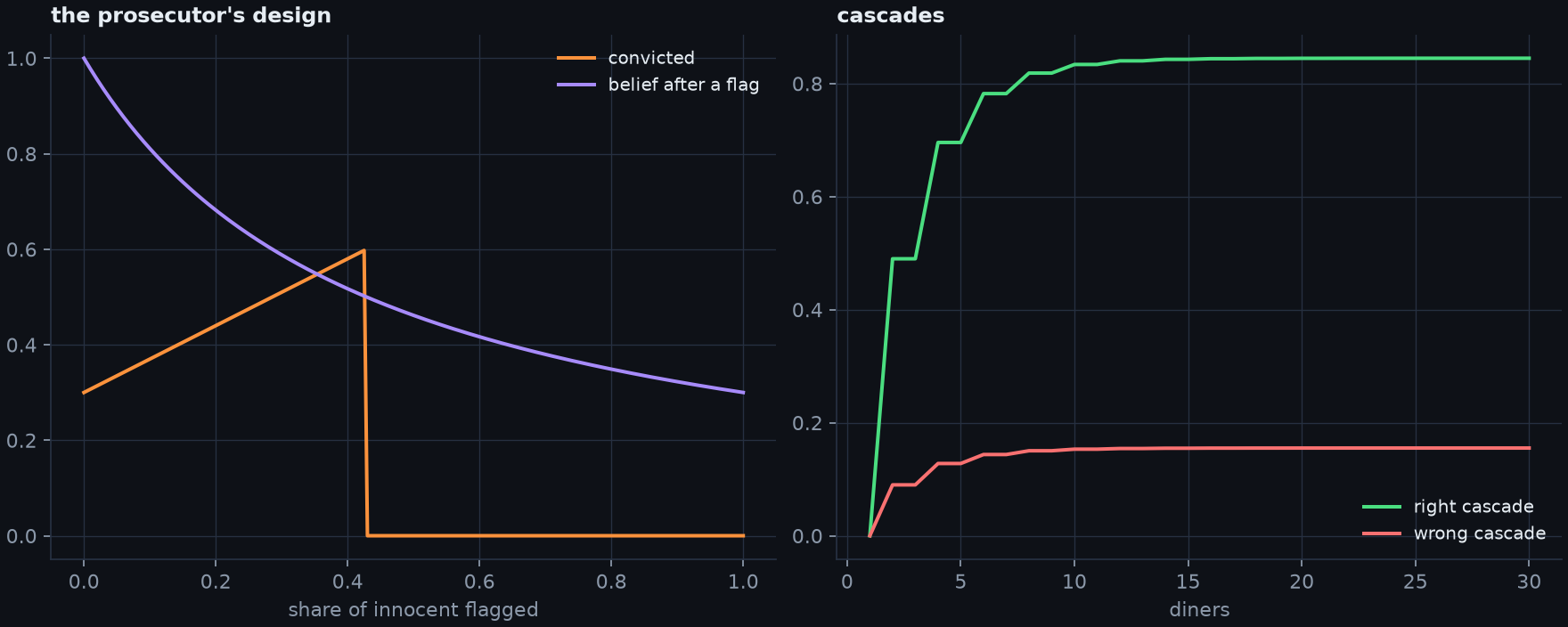
Here is every design. The more innocent defendants the investigation flags, the more defendants are flagged, so convictions rise: from thirty percent if it flags none of the innocent. But each innocent one flagged lowers what a flag means. The purple line is the judge's belief in guilt after a flag. At three innocent flagged for every seven, that belief is exactly one half, the judge still convicts, and 60 percent of defendants are convicted. Flag one more, and the belief falls below one half: the judge ignores the flag, and convictions fall to zero. The best design sits on the edge of the judge's willingness.
The arithmetic is Bayes's rule. The chance of guilt after a flag is the thirty percent who are guilty, all flagged, over everyone flagged. Set it equal to one half, and the innocent must be flagged three times in seven. Nobody is fooled: averaged over flags and no flags, the judge's beliefs are exactly right. But of those convicted, half are innocent: 30 defendants in a hundred. The prosecutor has used nothing but the judge's own standard of proof. That is the lever this part studies.
What it does: Four designs; convictions and the judge's belief; Bayes's rule
2Bayesian gamesGraduate3 min
How do you play a game against someone whose payoffs you do not know? In three papers in 1967 and 1968, John Harsanyi gave the answer economics still uses. Imagine that nature moves first and draws each player's type: a firm's cost, a buyer's value, a defendant's guilt. Each player sees only their own type. A strategy says what every type would do. And in equilibrium, each type's action is a best response, on average over the types the others might be, using probabilities everyone shares. Incomplete information about payoffs becomes imperfect information about a move of nature, and ordinary game theory applies. This is a Bayes-Nash equilibrium.
An example: two firms competing in quantities, as in Part twelve, except that firm 1 does not know firm 2's cost. It is 4 or 1, equally likely; firm 1's own cost is 2. Firm 2 knows its cost, so it has two best-response lines: the orange one if its cost is high, the blue one if it is low. Firm 1 must choose one quantity that is best against the average of what the two types of firm 2 will do: the gold line. In equilibrium firm 1 makes 2.83, and firm 2 makes 1.58 if its cost is high and 3.08 if it is low. If firm 1 knew the cost, it would make 3.33 against a high-cost rival and 2.33 against a low-cost one. Not knowing, it hedges in between, and each type of firm 2 adjusts to that hedge.
How much is the missing information worth to firm 1? Not knowing, it expects a profit of 8.03. If it could learn firm 2's cost before choosing, 8.28. The difference is small here because firm 1's best choice moves only a little with what it learns; information is worth something only when it would change what you do. That idea returns in chapter seven, with Blackwell.
What it does: Harsanyi's types; Cournot with an unknown rival; the value of knowing
3Beliefs on and off the pathGraduate3 min
When moves happen in turn and some players know more, a later player learns from what an earlier one did. The equilibrium has to say what everyone believes. A perfect Bayesian equilibrium specifies a strategy for every player at every point where they move, a belief at every point about what has happened before, strategies that are best given those beliefs, and beliefs that follow Bayes's rule wherever it can be applied. The trouble is the points that are never reached in equilibrium. Bayes's rule says nothing there, and an odd belief about something that should never happen can hold up a strange equilibrium. Part thirteen met this with Spence's signals.
The classic example is In-Koo Cho and David Kreps's. A newcomer walks into a tavern. Ninety percent of newcomers are strong, the rest weak. The strong prefer beer for breakfast, the weak prefer quiche. A bully watches the breakfast and decides whether to pick a fight. He wins only against the weak, and avoiding a fight is worth more to the newcomer than the breakfast. One equilibrium: everyone has beer, and the bully, who learns nothing, does not fight. If he ever saw quiche, he would believe the eater weak and fight, so nobody eats quiche. A second: everyone has quiche, and the bully believes that whoever has beer is weak, so the strong swallow their quiche too. Both satisfy every rule so far.
Cho and Kreps asked which off-path beliefs are reasonable. In the quiche equilibrium, who could possibly gain by switching to beer? Not the weak: even without a fight, beer gives them 2, less than the 3 they get now. The strong could: beer without a fight would give them 3, more than 2. So the only sensible reading of a beer is that the drinker is strong, and the bully should leave him alone. But then the strong would switch, and the quiche equilibrium falls apart: it fails what they called the intuitive criterion. The beer equilibrium survives. The same test picks out the least costly separating equilibrium of Spence's education signals in Part thirteen.
What it does: Perfect Bayesian equilibrium; beer or quiche; the intuitive criterion
4Cheap talkGraduate2 min
The prosecutor's investigation was a commitment: once designed, it reported what it found. What if there is no commitment, only talk? Vincent Crawford and Joel Sobel posed it in 1982. An adviser sees the state of the world, a number between zero and one. She sends a message: any words she likes, free and unverifiable. A decision maker hears it and acts, and wants his action to match the state. The adviser wants the action a little higher than the state, by a bias b: a financial adviser who earns more when you buy more, an agency that wants a bigger budget. If she would always exaggerate, why should he listen at all?
The answer is that he listens, but to coarse messages. In equilibrium the adviser does not report the state; she reports which of a few intervals it falls in, and the decision maker takes the action best for that interval. With a bias of 0.05, three messages: the state is below 0.13, between 0.13 and 0.47, or above. Notice that the intervals widen as the state rises: at the top, where she most wants to exaggerate, her words are least precise. With a smaller bias, more messages; with a larger one, fewer, and at a bias of a quarter or more, only one: nothing she says can be believed, and the talk is babble.
Here is the decision maker's expected loss in the most informative equilibrium, for every bias. It rises with the bias, with a kink each time one more message is lost, until it reaches the dashed line, what he would lose with no information at all. The more aligned the interests, the more talk can carry. That is why we ask about an adviser's incentives before we weigh her advice, and why commitment, the subject of the next chapter, can be worth so much.
What it does: Crawford and Sobel's partitions; loss by bias
5Bayesian persuasionPrinciples and the major3 min
Kamenica and Gentzkow's insight was to stop thinking about signals and think about beliefs. Before the investigation, the judge's belief in guilt is the prior, 0.3. After it, the belief is either zero, with no flag, or one half, with a flag. An investigation is nothing more than a way of splitting the prior into posterior beliefs. The only rule is that the posteriors must average back to the prior, weighted by how often each happens: zero with weight 0.4 and a half with weight 0.6 give 0.3. And any split that averages back to the prior can be produced by some investigation. So the prosecutor's question becomes: which split of beliefs is best for her?
Draw what the prosecutor gets at each belief the judge might hold. Below one half, nothing: the judge acquits. At one half or more, a conviction: the gold step. Now draw the smallest concave function that lies above it, the purple line, rising straight from zero to one at a belief of one half. The theorem: the best the sender can do at any prior is the height of the purple line there. At the prior of 0.3 it is 0.6, the sixty percent of the hook, achieved by splitting the prior between the two ends of that straight segment, zero and one half. Persuasion helps exactly when the purple lies above the gold at the prior. The method is called concavification; Robert Aumann and Michael Maschler used it in the 1960s for repeated games with private information.
The method works for any payoffs. Give the judge a middle verdict, a lesser charge, worth half a conviction to the prosecutor, chosen when the belief is between one third and two thirds. The concave closure changes shape, and at the prior of 0.3 it is 0.45. One best investigation splits the judge between certain innocence and a belief of one third, just enough for the lesser charge; splitting to two thirds, just enough to convict, does exactly as well here. With more than two states, beliefs live in a triangle or a higher simplex, and the same problem becomes a linear programme over candidate posteriors, which Agora solves.
What it does: Splitting beliefs; the concave closure; a middle verdict
6Information design for manyGraduate2 min
Now the audience is not one judge but several people whose choices affect each other: depositors in a bank, buyers of a new asset, investors in a project. Dirk Bergemann and Stephen Morris built the theory. Take the simplest case. Two investors each decide whether to invest. The project is good forty percent of the time, when investing pays 1; when it is bad, investing pays minus 3. Each gains 1 more if the other invests too. A designer, a promoter or a regulator who wants the investment to happen, chooses what each investor is told.
Three policies. Tell them nothing, and each sees a project worth minus 0.4 on average even if the other invests: nobody invests. Tell them everything, and both invest when the project is good: 0.8 investors on average. The best design does twice as well. It sends both investors the same recommendation: invest whenever the project is good, and also 67 percent of the time when it is bad. An investor told to invest knows the project is good with just enough probability, and knows the other was told the same, so following the advice pays. Expected investment: 1.6.
The general method has a simple shape. Think of any information policy as recommending an action to each player, depending on the state. It works only if it is obedient: given what the recommendation reveals about the state and about what the others were told, each player wants to follow it. Bergemann and Morris called the outcomes Bayes correlated equilibria; finding the best one is a linear programme, which is how the numbers here were computed. Without a state, it is Robert Aumann's correlated equilibrium from Part eleven. The same arithmetic is used to think about what regulators should disclose about banks' stress tests, how ratings should be designed, and when alerts should sound.
What it does: Two investors; three policies; Bayes correlated equilibrium
7Blackwell's orderResearch2 min
Information is worth something because it changes decisions, and different decision makers want different things. Is there ever a sense in which one source of information is simply better? In 1953 David Blackwell answered. An experiment is a table: in each state of the world, the chance of each signal. Experiment P is right ninety percent of the time when the state is good and eighty when it is bad. Now pass its signal through a garbling, a second table that scrambles it at random, and you get experiment Q. Blackwell's theorem: every decision maker, with any prior and any payoffs, weakly prefers P to Q if and only if Q is a garbling of P. But here is experiment R. When the state is good it almost never sends its second signal, so that signal is a near-certain warning; when the state is bad it sends the warning less than half the time. Neither P nor R is a garbling of the other: Agora's linear programme finds no garbling either way.
See it in decisions. Each point along the bottom is a decision maker who acts only if the chance that the state is good passes some threshold: a cautious one on the right, a bold one on the left. The height is what each experiment is worth to them. P is worth more than its garbling Q to every one of them, as Blackwell's theorem says. But R is worth more than P to the bold, who would act anyway and need only a reliable warning, and less to the cautious, who need reassurance R cannot give. When neither experiment is a garbling of the other, there is no answer to which is better, only to which is better for whom. The prosecutor's investigation was a garbling of the truth, chosen for the one decision maker she cared about.
What it does: Garblings; experiments that cannot be ranked
Intermission: what households expect, and what happened, 1978-2026Principles and the major
This chapter has no narration to read.
8Common knowledgeGraduate3 min
Everything so far assumed people share a prior and update by Bayes's rule. Robert Aumann drew a startling consequence in 1976. Take two people with the same prior who have seen different evidence. If their beliefs about some event are common knowledge, those beliefs must be equal. Common knowledge means that both know them, both know that both know, and so on without end. They cannot agree to disagree. Lasting disagreement between honest people needs different priors, or reasoning that is not Bayesian. That is a strong claim, so watch how it works.
John Geanakoplos and Heraklis Polemarchakis showed how agreement arrives. Nine equally likely states. The question is whether the state is 3 or 4; the truth is 1. Ann knows only which of three blue groups the state is in; Bob knows which of the pink groups. Ann sees states 1 to 3, one of which is in the event: she says one third. Bob sees 1 to 4, two of which are in the event: he says one half. But Ann's announcement told Bob something: had the state been 4, 5 or 6, she would have said one third as well, while a 7, 8 or 9 would have made her say zero. Each announcement rules states out, for both of them. Ann now reasons from what Bob said and says one third again; Bob, knowing what Ann's repeat rules out, comes round to one third. They agree, having exchanged nothing but their beliefs.
Common knowledge is demanding, and Ariel Rubinstein showed how much. Two generals should attack together, but only in a rare state of the world that one of them observes. He emails; the other's computer confirms automatically; that confirmation is confirmed, and so on, each email lost with a small chance, after which the exchange stops. A general who has seen some number of emails knows the last one he sent may have been lost, and puts probability 0.53 on the other having seen one fewer: more likely than not, however many were exchanged. The general who saw none will not attack. So one who saw one email, thinking it likely the other saw none, will not either; nor one who saw two; and so on up. Nobody ever attacks, even after a hundred confirmations. Almost common knowledge is not common knowledge, and coordination can depend on the difference.
What it does: Aumann; the dialogue to agreement; the email game
9Global gamesResearch3 min
Bank runs in Part twenty-six and currency attacks in Part thirty-four both had two equilibria: if everyone runs, running is right; if nobody does, staying is. Which happens seemed a matter of sunspots. Take a regime, a currency peg, a bank, a government. Each speculator can attack at a cost of 0.4, and gains one if the regime falls. It falls if the share attacking exceeds its strength, theta. If theta is known to all, then for middling strength both all-attack and no-attack are equilibria. Hans Carlsson and Eric van Damme, and then Stephen Morris and Hyun Song Shin, changed one thing: each speculator sees the strength with a little private noise. Then there is only one equilibrium.
The argument fits on a card. Suppose everyone attacks when their signal is below some cutoff. Then the regime falls when its strength is below some threshold. The speculator whose signal is exactly at the cutoff must be indifferent: the chance that the regime falls, given her signal, equals the cost. And here is the beautiful step: from her point of view, the share of others attacking is equally likely to be anything between zero and one, whatever the noise. So the threshold is one minus the cost. With a cost of 0.4, the regime falls if and only if its strength is below 0.6. The sunspot is gone: the fundamentals decide, through what everyone thinks everyone else sees.
Uniqueness has a price: private information must be sharp relative to public information. Morris and Shin worked out the condition. Add a public signal that everyone hears, such as an official statement, and make it more and more precise. The curves show the equilibrium condition; each crossing with its dashed line is an equilibrium. With vague public information, one crossing. Sharper, still one. Sharp enough, and there are three: the multiplicity is back, because everyone now knows what everyone else knows. This is why central banks and regulators worry about what they say in public. A clear statement coordinates beliefs, for better or for worse.
What it does: The threshold; precise public information
10Herds and cascadesGraduate2 min
Now let people learn from each other's actions instead of from a designer. In 1992 Abhijit Banerjee, and separately Sushil Bikhchandani, David Hirshleifer and Ivo Welch, showed how a crowd can go wrong with nobody making a mistake. Two restaurants, one better. Each diner gets a private hint that is right 70 percent of the time. Diners arrive one by one and see where the earlier ones went. The first follows her hint. So may the second. But once one restaurant leads by two choices, a diner's single hint cannot outweigh the lead, so she follows the crowd whatever her hint says, and so does everyone after her. Her choice reveals nothing, and learning stops. Four queues: most settle on the better restaurant; some lock onto the worse one within the first few diners, and never leave.
The arithmetic is exact. Count the hints that earlier choices have revealed, for the better restaurant minus against it; a cascade starts when the count reaches two either way. The chance of a cascade on the better restaurant rises quickly; the chance of one on the worse rises too; and the chance of still learning falls to almost nothing within a dozen diners. In the end 84.5 percent of queues are right, and 15.5 percent are wrong for ever, although the hints of the whole queue together would leave no doubt. Twenty thousand simulated queues agree with the formula.
How bad is it? The gold line is how often a long queue ends up right, against how good each hint is. The dashed line is a single diner on her own hint. Pooling everyone's hints would make the queue right almost surely. The herd does a little better than a lone diner and much worse than what the crowd collectively knows. The information is lost because actions are coarser than beliefs: once the herd forms, nobody's choice says what they saw. Reviews, ratings and fashions are attempts to keep that information flowing.
What it does: Queues; the exact chain; accuracy by hint quality
11ReputationGraduate2 min
Reputation is information about what someone will do. Reinhard Selten found a paradox in 1978. A chain store has branches in 20 towns. One by one, a local rival decides whether to enter. If one does, the store can fight a price war, which costs it, or accommodate, which costs less. In the last town there is no future to protect, so the store accommodates. Then, in the town before, fighting cannot deter the last entrant, so the store accommodates there too, and so on, all the way back. Every rival enters, and none is fought. Selten thought no real chain store would behave this way: surely it would fight the early entrants to deter the later ones.
David Kreps and Robert Wilson, and Paul Milgrom and John Roberts, resolved it with a little doubt. Suppose there is a 5 percent chance that the store is a kind that always fights, perhaps because its managers enjoy it. Then fighting is how an ordinary store keeps entrants guessing: its reputation is the entrants' belief that it is the tough kind. Early on, with many towns to come, even a small reputation is enough to deter entry: the grey line, the reputation needed, is tiny. Only near the end, in the last 4 towns, do entrants come in; and an ordinary store still fights with some probability to keep its reputation alive. A small doubt about one's type, and a long horizon, are enough to make a threat credible. The same logic explains why central banks guard their reputations for fighting inflation.
What it does: The chain-store paradox; Kreps and Wilson's equilibrium
12BargainingGraduate3 min
Bargaining is where private information hurts most. Start with the case without it. In 1950 John Nash asked what any sensible rule for splitting a surplus must satisfy. The curve is the set of deals that leave nothing on the table. Nash's axioms: efficiency; symmetry; independence of the units in which utility is measured; and that removing deals nobody chose should not change the choice. Only one rule satisfies all four: choose the deal that maximizes the product of the two gains, where the frontier touches the highest of these hyperbolas. Elegant, but it says nothing about how people actually get there.
Ariel Rubinstein modelled the haggling itself, in 1982. Ann makes an offer; Bob accepts or makes a counter-offer next round; every round of delay shrinks what is left. The game has exactly one subgame-perfect equilibrium, and in it the first offer is accepted at once. The first proposer's share depends only on the two players' patience. With equal patience it is one over one plus delta: two thirds when the discount is a half, and approaching one half as the delay between offers shrinks, which is where Nash's rule would put it. With complete information, there is no delay at all.
Add private information, and delay appears. A seller faces a buyer who values the good at 1 or 0.4, equally likely, over two periods. If the seller could commit, he would charge 1 and never cut the price. But he cannot: once the high-value buyer has bought, the only buyer left values the good at less, and the seller will cut the price. The high-value buyer foresees the cut and will pay only 0.52 today. The seller's best plan is to charge 0.52 now and 0.4 later, and the low-value buyer waits: a deal that both want is delayed, purely because of what the seller does not know. Ronald Coase argued that a monopolist selling a durable good, unable to commit, competes with its own future self.
What it does: Nash; Rubinstein; Coase and delay
13Relational contractsGraduate2 min
The last idea is the oldest kind of incentive: a promise kept because the future matters. A firm promises a bonus for good work, but the quality of the work cannot be written into a contract a court would enforce. Once the work is done, the firm could simply keep the bonus. But then the worker leaves, or works badly from then on, and the firm loses the surplus of the relationship for ever. So the promise is credible if the bonus is no larger than the discounted value of the future: delta over one minus delta times the surplus each period. Clive Bull stated it in 1987; Jonathan Levin worked out the best such contracts in 2003.
In a simple version, effort produces output worth its amount and costs the worker half its square. The gold curve is the most effort a self-enforcing bonus can buy, against how much the future matters. The green line is what a contract a court would enforce could buy. Once the discount factor reaches 0.50, the promise is as good as a contract. Below that, the bonus that would be needed is larger than the future is worth, and effort falls in proportion. This is why long-term relationships, between firms and suppliers and between employers and staff, can do what contracts cannot, and why a shock that shortens horizons can unravel them. It is the repeated-game logic of Part eleven, put to work inside the firm.
What it does: The self-enforcing bonus; effort by patience
14The Dials: how deeply people reasonGraduate2 min
Every equilibrium in this part assumed that people reason all the way through: I think about what you think about what I think, without end. The Dial from Part eleven measures how far real people go. Across nearly a hundred games, Colin Camerer, Teck-Hua Ho and Juin-Kuan Chong estimated one and a half steps on average. Rosemarie Nagel's students, guessing two thirds of the average, about one step. Newspaper readers with time to think, about four. The status: it depends on the setting. Common knowledge, cascades and global games all rest on long chains of reasoning; people manage a few links. Theory that matters in practice is theory that survives that.
And how persuasive is persuasion in the field? Stefano DellaVigna and Matthew Gentzkow measure it by the persuasion rate: of the people who receive a message and did not already agree with it, the share who change what they do. When Fox News arrived in American cable markets between 1996 and 2000, Stefano DellaVigna and Ethan Kaplan estimated that between three and eight percent of viewers who were not already Republican were persuaded to vote Republican, more on narrower measures of the audience. Far from total, and far from zero. Beliefs move, but real receivers are not the perfect Bayesians of the theory, and the evidence on how much they move is still being gathered.
What it does: The reasoning-depth dial; the persuasion rate
15In practice: designing what people learnPractice2 min
Who designs information for a living? Rating agencies, whose letter grades are a deliberately coarse signal, often paid for by the issuers being rated. Securities regulators, who decide what firms must disclose and when. Bank supervisors: since 2009 the results of American banks' stress tests have been published bank by bank, a choice global-game reasoning makes delicate. Central banks: the Federal Reserve has announced its decisions in a statement since 1994, and published its officials' projections of its own policy rate since 2012. And platforms, which choose which reviews to show, which sellers to badge, and what to recommend: Bayesian persuasion at the scale of millions.
Called it? A forecast made in letters. In 2006 the big rating agencies gave their highest grade, triple-A, to the senior slices of securities built from subprime and other risky mortgages: as unlikely to default, they said, as the safest bonds. The ratings rested on models fitted to years of rising house prices, and were paid for by issuers who could choose which agency to hire. House prices began to fall that year. Within a few years most of the mortgage securities rated triple-A in 2006 had been downgraded, many to junk, and the downgrades helped turn falling house prices into a financial crisis. The verdict: wrong. A rating is an investigation designed by someone with a stake in the verdict, like the prosecutor's. The difference is that many of its receivers were not the careful Bayesians of the theory: they treated triple-A as triple-A.
What it does: Information designers; Called it? (wrong)
16Frontier: robust design, learning receiversGraduate1 min
The optimal investigation sat exactly on the edge of the judge's standard. That is its weakness. It was designed for a judge who convicts at a belief of one half. A slightly stricter judge, who needs 0.55, would see that a flag means only one half, and convict nobody. A designer unsure which judge she faces can aim at the stricter standard instead: 55 percent convicted, whichever judge it is. Robust design, which Dirk Bergemann and Stephen Morris began for mechanisms in 2005, gives up a little of the best case to avoid the worst. How much to give up, against audiences whose beliefs and standards are unknown, is an active field.
What remains open? Receivers who learn: an audience that watches a designer over many rounds learns her habits, and the receiver may itself be an algorithm. Robustness to audiences whose priors and standards the designer does not know. Attention: real receivers cannot read everything, and what they skip changes what a design can do; Part forty-five's rational inattention returns here. And measurement: how much people actually update, from persuasion rates in the field to beliefs elicited directly in surveys.
What it does: A robust prosecutor; open questions
Recap, problems, and the road aheadAll tracks3 min
So: how does someone who controls only what others learn get them to do what she wants? By choosing what they will learn, and committing to it. An investigation splits the audience's beliefs so that, on average, they remain right, but they land where the audience acts as the designer wants: just past the threshold, never wasted beyond it. Without commitment, talk carries only as much information as interests are aligned. With many receivers, the designer can coordinate them. And everything rests on what people infer from what they see, which in practice is less, and less reliable, than the theory assumes.
Part fifty-three in twelve lines. A prosecutor who cannot lie can double the convictions by designing the investigation. In a Bayesian game each type plays its best response, on average over the others. Off the equilibrium path, beliefs must be sensible, and the intuitive criterion says which are. Cheap talk carries as much as interests are aligned. A sender who commits gets the concave closure of her value at the prior. With many receivers, obedient recommendations can coordinate them. One source is better for everyone only if the other is a garbling of it. People with a common prior cannot agree to disagree, and almost common knowledge is not enough. A little private noise picks one equilibrium; sharp public news brings back several. Herds can lock onto the wrong choice with nobody making a mistake. Reputations make threats credible, and private values make bargains slow. And promises no court will enforce are kept when the future matters enough.
The problems. Design another prosecutor's investigation; find a concave closure; derive the two-message equilibrium of cheap talk; Bayes-Nash quantities; the intuitive criterion; what an announcement reveals; the global game's threshold; and a starred problem on the odds that a cascade is right. Full solutions are in the part's notes.
The reading: Fudenberg and Tirole's chapters on games of incomplete information; Emir Kamenica's survey of Bayesian persuasion; Bergemann and Morris's unified view of information design; and Morris and Shin on global games. Then the papers, from Harsanyi to the prosecutor.
Next time, the models meet the data. In the early 1970s the San Francisco Bay Area was building a railway. The official forecast said about fifteen percent of commuters would use it; Daniel McFadden's model, estimated from commuters' own choices, said 6.3 percent, and in 1975 it was 6.2. Part fifty-four is about estimating models: likelihood, moments, simulation, and the question beneath them all, what in the data identifies what in the model.
Where it goes next. Part 54 turns from what people know to what economists can measure: estimating models from the choices they predict.
Key results
The part's results in one place, for revision.
Try it
Lab 53 · Information and persuasion
Compute what a sender who controls information can achieve, how much talk can carry, and how information spreads, freezes and coordinates when many people learn from each other.
python -m videos.economics.labs 53
needs numpy, scipy, matplotlib · download lab53.py ·
source on GitHubprosecutor: convicted with none, full, designed investigation 0.00, 0.30, 0.60
concave closure at the prior 0.600
cheap talk, bias 0.02: messages, receiver's loss 5, 0.0065
cheap talk, bias 0.05: messages, receiver's loss 3, 0.0159
cheap talk, bias 0.1: messages, receiver's loss 2, 0.0308
cheap talk, bias 0.25: messages, receiver's loss 1, 0.0833
Bayes-Nash Cournot: firm 1's quantity 2.833
information design: expected investors, best design against full disclosure 1.60 against 0.80
Blackwell: Q a garbling of P? P of Q? R of P? True, False, False
dialogue: announced posteriors 0.333, 0.500, 0.333, 0.333
global game: flat-prior threshold; thresholds with sharp public news 0.60; [0.09, 0.277, 0.988]
cascades: right in the end, exactly and simulated 0.845, 0.853
chain store: towns at the end where entry can occur 4
Rubinstein at delta 0.9; Coase seller's plan and delay 0.526; screen, 0.50
relational effort at delta 0.25, 0.5, 0.75 0.50, 1.00, 1.00
A sender who commits gets the concave closure of her value at the prior; talk carries less as interests diverge; obedient recommendations coordinate receivers; garbling orders experiments only sometimes; announcements of beliefs lead to agreement; private noise selects one equilibrium; cascades stop learning; reputations deter; private values delay bargains; the future enforces promises.The code (107 lines; it asserts its own result)
"""Lab 53: information and persuasion: the prosecutor's design and its concave closure, cheap talk by bias, Bayes-Nash
quantities, the best Bayes correlated equilibrium for two investors, a garbling check, the dialogue to agreement, the
global game's thresholds, cascades exactly and simulated, the chain store, bargaining and relational effort."""

import numpy as np

from videos.coursekit import labs
from explainer.economics.agora import persuade as P
from explainer.economics.island import truths

TITLE = "Information and persuasion"
GOAL = ("Compute what a sender who controls information can achieve, how much talk can carry, and how information "
        "spreads, freezes and coordinates when many people learn from each other.")
TASKS = [
    "Make the judge stricter (a standard of 0.7). How many defendants can the prosecutor get convicted now?",
    "Raise the adviser's bias in cheap talk from 0.05 to 0.15. How many messages survive?",
    "Make each hint right 90% of the time. How often does a queue lock onto the worse restaurant?",
]


def run(seed=0):
    lab = labs.Lab()
    T = truths(53)

    pr = P.prosecutor(**T["prosecutor"])
    lab.row("prosecutor: convicted with none, full, designed investigation",
            f"{pr['none']:.2f}, {pr['full']:.2f}, {pr['optimal']:.2f}")
    mu = np.linspace(0, 1, 401)
    cv = P.concavify(mu, (mu >= T["prosecutor"]["threshold"]).astype(float))
    at = float(np.interp(T["prosecutor"]["prior"], mu, cv))
    lab.row("concave closure at the prior", f"{at:.3f}")
    assert abs(at - pr["optimal"]) < 1e-6

    for b in T["biases"]:
        r = P.cheap_talk(b)
        lab.row(f"cheap talk, bias {b}: messages, receiver's loss", f"{r['N']}, {r['receiver_loss']:.4f}")

    C = T["cournot"]
    ec = C["p_high"] * C["c_high"] + (1 - C["p_high"]) * C["c_low"]
    q1 = (C["a"] - 2 * C["c1"] + ec) / 3
    lab.row("Bayes-Nash Cournot: firm 1's quantity", f"{q1:.3f}")

    I = T["invest"]

    def U(th):
        U0 = np.array([[0.0, 0.0], [th, th + I["together"]]])
        return U0, U0.T.copy()

    (U0g, U1g), (U0b, U1b) = U(I["good"]), U(I["bad"])
    best = P.bce_lp([I["p_good"], 1 - I["p_good"]], [[U0g, U0b], [U1g, U1b]],
                    [np.array([[0.0, 1.0], [1.0, 2.0]])] * 2)
    lab.row("information design: expected investors, best design against full disclosure",
            f"{best['value']:.2f} against {2 * I['p_good']:.2f}")

    E = T["experiments"]
    Q = np.array(E["P"]) @ np.array(E["garble"])
    lab.row("Blackwell: Q a garbling of P? P of Q? R of P?",
            f"{P.garbling(E['P'], Q)['garbling']}, {P.garbling(Q, E['P'])['garbling']}, "
            f"{P.garbling(E['P'], E['R'])['garbling']}")

    D = T["dialogue"]
    dl = P.dialogue([1 / D["n"]] * D["n"], list(D["event"]), [list(c) for c in D["a"]], [list(c) for c in D["b"]],
                    D["state"])
    lab.row("dialogue: announced posteriors", ", ".join(f"{h['posterior']:.3f}" for h in dl["history"]))

    G = T["global"]
    sharp = P.global_game(G["c"], G["sigma"], G["prior_mean"], G["prior_sds"][-1])["thetas"]
    lab.row("global game: flat-prior threshold; thresholds with sharp public news",
            f"{P.global_game(G['c'], G['sigma'])['theta']:.2f}; {[round(x, 3) for x in sharp]}")

    Cs = T["cascade"]
    ch = P.cascade_chain(Cs["q"], Cs["n"])
    sim = P.cascade_sim(Cs["q"], Cs["n"], 5000, seed)
    lab.row("cascades: right in the end, exactly and simulated", f"{ch['limit_right']:.3f}, {sim['share_right']:.3f}")

    Cn = T["chain"]
    lab.row("chain store: towns at the end where entry can occur", f"{P.chain_store(**Cn)['k_star']}")
    B = T["bargain"]
    co = P.coase_two_period(B["v_high"], B["v_low"], B["share_high"], B["delta"])
    lab.row("Rubinstein at delta 0.9; Coase seller's plan and delay",
            f"{P.rubinstein(0.9)['first']:.3f}; {co['best']['plan']}, {co['best']['delay']:.2f}")
    R = T["relational"]
    rel = P.relational([0.25, 0.5, 0.75], R["theta"], R["c"])
    lab.row("relational effort at delta 0.25, 0.5, 0.75", ", ".join(f"{e:.2f}" for e in rel["effort"]))

    lab.note = ("A sender who commits gets the concave closure of her value at the prior; talk carries less as "
                "interests diverge; obedient recommendations coordinate receivers; garbling orders experiments only "
                "sometimes; announcements of beliefs lead to agreement; private noise selects one equilibrium; "
                "cascades stop learning; reputations deter; private values delay bargains; the future enforces "
                "promises.")

    fig, ax = labs.figure(2, size=(11, 4.4))
    ps = np.linspace(0, 1, 201)
    p0, t = T["prosecutor"]["prior"], T["prosecutor"]["threshold"]
    post = p0 / (p0 + (1 - p0) * ps)
    conv = np.where(post >= t - 1e-12, p0 + (1 - p0) * ps, 0.0)
    ax[0].plot(ps, conv, color=labs.ORANGE, label="convicted")
    ax[0].plot(ps, post, color=labs.PURPLE, label="belief after a flag")
    ax[0].set(title="the prosecutor's design", xlabel="share of innocent flagged")
    ax[0].legend()
    x = np.arange(1, Cs["n"] + 1)
    ax[1].plot(x, ch["right"], color=labs.GREEN, label="right cascade")
    ax[1].plot(x, ch["wrong"], color=labs.RED, label="wrong cascade")
    ax[1].set(title="cascades", xlabel="diners")
    ax[1].legend()
    lab.fig = fig
    return lab
Now change it
- Make the judge stricter (a standard of 0.7). How many defendants can the prosecutor get convicted now?
- Raise the adviser's bias in cheap talk from 0.05 to 0.15. How many messages survive?
- Make each hint right 90% of the time. How often does a queue lock onto the worse restaurant?
Problems, with solutions
Try each problem before opening its solution.
1. The prosecutor: with a prior of 0.4 and a judge who convicts at 0.6, design the best investigation. What share is convicted?
Solution
Flag every guilty defendant and a share p of the innocent, chosen so that the belief after a flag is exactly 0.6: 0.4 / (0.4 + 0.6 p) = 0.6 gives p = 4/9. The share convicted is 0.4 + 0.6 x 4/9 = 2/3, which is the prior divided by the threshold, as in the film (0.3/0.5 = 0.6).
2. Concavification: a sender gets 1 if the receiver's belief is at least 0.75 and nothing otherwise. Find her best value at a prior of 0.3, and the split that achieves it.
Solution
The concave closure is the straight line from (0, 0) to (0.75, 1), then flat at 1. At 0.3 it is 0.3/0.75 = 0.4. It is achieved by splitting the prior between posteriors 0 and 0.75 with weights 0.6 and 0.4, which average to 0.3.
3. Cheap talk: with b = 0.1, find the boundaries of the two-message equilibrium, and the decision maker's expected loss.
Solution
With N = 2, a_1 = 1/2 + 2 b (1)(1 - 2) = 0.5 - 0.2 = 0.3, so the messages say "below 0.3" and "above". The decision maker's loss is the variance within each interval, weighted: (0.3^3 + 0.7^3)/12 = 0.370/12 = 0.031, against 1/12 = 0.083 with no information.
4. Bayes-Nash: in the Cournot example, show that firm 1's quantity is (a - 2c_1 + E c_2)/3.
Solution
Each type of firm 2 best-responds to firm 1: q_2(c) = (a - c - q_1)/2. Firm 1 best-responds to the average: q_1 = (a - c_1 - E q_2)/2, with E q_2 = (a - E c_2 - q_1)/2. Substituting, 4 q_1 = 2a - 2c_1 - a + E c_2 + q_1, so q_1 = (a - 2c_1 + E c_2)/3: with a = 10, c_1 = 2 and E c_2 = 2.5, q_1 = 2.83.
5. Beer or quiche: explain why the quiche equilibrium fails the intuitive criterion.
Solution
In it, both types eat quiche and are not fought: the strong get 2, the weak 3. A switch to beer could at best (no duel) give the strong 1 + 2 = 3, more than 2, and the weak 0 + 2 = 2, less than 3. So only the strong could gain; the bully should believe a beer drinker strong and not fight; but then the strong would switch, so the equilibrium does not survive.
6. Common knowledge: in the nine-state dialogue, show what Ann's first announcement tells Bob.
Solution
Ann says 1/3. She would have said 1/3 in states 1 to 3 (one of the three, state 3, is in the event) and in states 4 to 6 (state 4), but 0 in states 7 to 9. So her announcement tells Bob the state is between 1 and 6. Bob's cell {1, 2, 3, 4} lies inside, so he says 2/4 = 1/2, which tells Ann the state is 1 to 4; she still says 1/3, which rules out 4 (where she would have said 1); and Bob, left with {1, 2, 3}, says 1/3.
7. The global game: show that the marginal speculator's belief about the share attacking is uniform, and derive theta = 1 - c.*
Solution
With a flat prior, theta given the signal x* is normal with mean x* and s.d. sigma. The share attacking at strength theta is A(theta) = Phi((x* - theta)/sigma), which, given x*, is Phi of a standard normal: uniform on (0, 1). The regime falls when A(theta) >= theta, that is when theta <= theta*, where A(theta*) = theta*. So Pr(fall | x*) = Pr(A >= theta*) = 1 - theta*, and indifference sets this equal to c: theta* = 1 - c.
8. Cascades: with hints right with probability q, show that a cascade on the better choice eventually forms with probability q^2/(q^2 + (1 - q)^2).
Solution
Before a cascade each choice reveals its hint, so the net count d moves up with probability q and down with 1 - q, and a cascade starts at d = 2 or -2. Let p_d be the chance of reaching +2 first. Then p_1 = q + (1 - q) p_0, p_-1 = q p_0, and p_0 = q p_1 + (1 - q) p_-1 = q^2 + 2q(1 - q) p_0, so p_0 = q^2/(1 - 2q(1 - q)) = q^2/(q^2 + (1 - q)^2): 0.845 for q = 0.7.
Notes and sources
Sources
The studies the film states are listed with what each shows in dials.SHOWN[53]; the reasoning-depth dial is in
explainer/economics/dials.py; the 2006 ratings are a Called it? entry (explainer/economics/calls.py); the
inflation expectations are in the Data Room. Checked on 2026-11-21: DellaVigna and Kaplan's Fox News persuasion rates
(3 to 8% of non-Republican viewers on inclusive audience measures, 11 to 28% on narrower ones); the Financial Crisis
Inquiry Commission's and the Senate subcommittee's accounts of the downgrades of 2006's triple-A mortgage securities
(stated without a figure, since the sources' figures differ by measure). The models are stated from the papers cited
in the chapters (Nash 1950, Blackwell 1953, Harsanyi 1967-68, Coase 1972, Aumann 1976, Selten 1978, Crawford and Sobel
1982, Geanakoplos and Polemarchakis 1982, Kreps and Wilson 1982, Milgrom and Roberts 1982, Rubinstein 1982 and 1989,
Bull 1987, Cho and Kreps 1987, Banerjee 1992, Bikhchandani, Hirshleifer and Welch 1992, Carlsson and van Damme 1993,
Morris and Shin 1998, Levin 2003, Bergemann and Morris 2005 and 2016, Kamenica and Gentzkow 2011) and computed here.
About this partfrom its README
Part 53 of a sixty-eight-part course in economics (see the series plan and the syllabus), the third of Act X, The Graduate Core. It asks how someone who controls only what others learn gets them to do what she wants. Its answer: by choosing what they will learn, and committing to it. An investigation splits the audience's beliefs so that, on average, they remain right, but they land where the audience acts as the designer wants: just past the threshold, never wasted beyond it. Without commitment, talk carries only as much information as interests are aligned; with many receivers, the designer can coordinate them; and everything rests on what people infer from what they see, which in practice is less, and less reliable, than the theory assumes.
It opens on Kamenica and Gentzkow's prosecutor: 30% of defendants are guilty, the judge convicts only if guilt is more likely than not, and the prosecutor cannot lie but chooses the investigation. No investigation convicts nobody; a perfect one convicts the 30 guilty; one that flags every guilty defendant and 30 of the 70 innocent ones convicts 60, with the judge following the evidence every time. From there it covers:
- Play it: which share of innocent defendants should the investigation flag (0, 20%, 3 in 7, 60%)? Three in seven: the judge's belief after a flag is exactly one half and 60% are convicted; one step further and the flag means nothing;
- Bayesian games after Harsanyi: a Cournot duopoly in which firm 1 does not know whether firm 2's cost is 4 or 1 (firm 1 makes 2.83, between the 2.33 and 3.33 it would make if it knew; firm 2 makes 1.58 or 3.08; knowing would be worth 8.28 against 8.03);
- beliefs on and off the path: perfect Bayesian equilibrium, Cho and Kreps's beer and quiche, two pooling equilibria, and the intuitive criterion that keeps beer and drops quiche;
- cheap talk after Crawford and Sobel: partition equilibria with 5, 3, 2 and 1 messages at biases of 0.02, 0.05, 0.1 and 0.25 (at 0.05 the messages split at 0.13 and 0.47), and the decision maker's loss rising, with a kink at each lost message, to babble;
- Bayesian persuasion: beliefs split into posteriors that average to the prior; the concave closure of the sender's value (0.6 at the prior of 0.3); a judge with a middle verdict (0.45); three states by linear programming;
- information design for many receivers after Bergemann and Morris: two investors, a project good 40% of the time; telling nothing gets no investment, telling everything 0.8 investors on average, the best obedient recommendation (invest whenever good and two times in three when bad) 1.6;
- Blackwell's order: an experiment and its garbling, a third that cannot be ranked against the first, and their values to bold and cautious decision makers;
- an intermission film of what American households expected inflation to be over the next year (the University of Michigan's median, peaking at 10.4% in 1980) against what it was, 1978-2026, as lines and a tune;
- common knowledge: Aumann's agreement theorem; Geanakoplos and Polemarchakis's dialogue (1/3, 1/2, 1/3, 1/3); Rubinstein's email game, where each general believes with probability 0.53 that the other saw one message fewer and nobody ever attacks;
- global games after Carlsson and van Damme and Morris and Shin: the regime falls below a strength of 0.6 when attacking costs 0.4; with sharp public information, three equilibria again;
- herds after Banerjee and Bikhchandani, Hirshleifer and Welch: with hints right 70% of the time, 84.5% of queues end on the better choice and 15.5% on the worse for ever, exactly and in 20,000 simulated queues;
- reputation: Selten's chain-store paradox and Kreps and Wilson's resolution, with a 5% chance of a tough store deterring entry in all but the last 4 of 20 towns;
- bargaining: Nash's axioms, Rubinstein's alternating offers (shares from 2/3 to about 1/2 as patience rises), and a seller who cannot commit (price 0.52 now and 0.4 later, the low-value buyer waiting half the time, profit 0.42 against 0.5 with commitment);
- relational contracts after Bull and Levin: a self-enforcing bonus buys effort 2 delta theta / c, as good as a contract from delta = 1/2;
- the Dials: the depth of strategic reasoning (one to two steps, four for newspaper readers), and DellaVigna and Kaplan's persuasion rate for Fox News (3 to 8% of viewers not already Republican);
- in practice (ratings, disclosure, stress tests, central-bank statements, platforms) and Called it? on the 2006 triple-A ratings of mortgage securities (wrong); a frontier of robust design (a prosecutor unsure of the judge's standard gives up 60% for a sure 55%) and learning, inattentive and algorithmic receivers.
What is computed and built
Everything plotted is computed by compute.py with Agora's information and persuasion module
(explainer.economics.agora.persuade) and the Island's Part 53 truths; the narration states the cached numbers.
- Persuasion. The prosecutor in closed form; convictions over a grid of 201 flag rates; concave closures by the upper convex hull on 401 beliefs; three states by linear programming over a grid of posteriors (multiples of 1/30).
- Cheap talk. The uniform-quadratic model's boundaries a_i = i/N + 2 b i (i - N), at the largest feasible N.
- Bayes-Nash. Linear demand P = 10 - Q; firm 1's cost 2; firm 2's 4 or 1, equally likely; closed forms.
- Beer or quiche. 90% strong; breakfast worth 1, avoiding a duel 2; the bully duels when weak is more likely.
- Information design. Investing pays 1 (good, 40%) or -3 (bad), plus 1 if the other invests; the designer maximizes expected investment over obedient recommendations by linear programming.
- Blackwell. P = [[0.9, 0.1], [0.2, 0.8]], its garbling by [[0.8, 0.2], [0.3, 0.7]], R = [[0.99, 0.01], [0.55, 0.45]]; garbling feasibility by linear programming; values for threshold decision makers with a prior of 1/2.
- Common knowledge. Nine equally likely states; Ann's partition {1-3}, {4-6}, {7-9}; Bob's {1-4}, {5-8}, {9}; the event {3, 4}; the true state 1.
- Global games. Cost 0.4, private noise 0.1, public signals of s.d. 0.4, 0.2 and 0.158 around 0.5.
- Cascades. Hints right 70% of the time; the net count of revealed hints as a Markov chain absorbed at plus or minus 2; 20,000 simulated queues of 30.
- Reputation. 20 towns; a 5% chance of a tough store; entrants gain 0.5 if accommodated and lose 0.5 if fought.
- Bargaining and relational contracts. Rubinstein's closed form; Nash on the quarter circle; the two-period seller with values 1 and 0.4, discount 0.8; effort worth e and costing e^2/2.
Chapter notes
| # | Chapter | What it does |
|---|---|---|
| 0 | The prosecutor's arithmetic | Three investigations; the question; objectives |
| 1 | Play it: design the investigation | Four designs; convictions and the judge's belief; Bayes's rule |
| 2 | Bayesian games | Harsanyi's types; Cournot with an unknown rival; the value of knowing |
| 3 | Beliefs on and off the path | Perfect Bayesian equilibrium; beer or quiche; the intuitive criterion |
| 4 | Cheap talk | Crawford and Sobel's partitions; loss by bias |
| 5 | Bayesian persuasion | Splitting beliefs; the concave closure; a middle verdict |
| 6 | Information design for many | Two investors; three policies; Bayes correlated equilibrium |
| 7 | Blackwell's order | Garblings; experiments that cannot be ranked |
| — | Intermission | Expected against actual inflation, 1978-2026, as lines and a tune; the story so far |
| 8 | Common knowledge | Aumann; the dialogue to agreement; the email game |
| 9 | Global games | The threshold; precise public information |
| 10 | Herds and cascades | Queues; the exact chain; accuracy by hint quality |
| 11 | Reputation | The chain-store paradox; Kreps and Wilson's equilibrium |
| 12 | Bargaining | Nash; Rubinstein; Coase and delay |
| 13 | Relational contracts | The self-enforcing bonus; effort by patience |
| 14 | The Dials: how deeply people reason | The reasoning-depth dial; the persuasion rate |
| 15 | In practice: designing what people learn | Information designers; Called it? (wrong) |
| 16 | Frontier: robust design, learning receivers | A robust prosecutor; open questions |
| — | Outro | The answer; twelve lines; problems; reading; next, Part 54, Estimating Models |
Notes
python -m videos.economics.labs 53: the prosecutor's design and its concave closure; cheap talk by bias; the Bayes-Nash Cournot quantities; the best Bayes correlated equilibrium for the investors; a garbling check; the dialogue; the global game's thresholds; cascades exactly and simulated; the chain store; bargaining; relational effort.- The interactive (course site): persuade. The reader designs the investigation for a judge with a prior and a standard of their choosing and watches the judge's beliefs and the convictions.
Companion material in this repository
The syllabus's plan for this partfrom SYLLABUS.md, the plan of record
- Hook: the prosecutor's arithmetic; the question; objectives.
- Play it: design the test the judge will see.
- Bayesian games: types, beliefs, Bayes–Nash equilibrium (Harsanyi 1967–68).
- Dynamic games of incomplete information: perfect Bayesian and sequential equilibrium; beliefs off the path; refinements revisited (Part 13).
- Cheap talk (Crawford and Sobel 1982): the partition equilibria derived; more aligned, more informative.
- Bayesian persuasion: the sender's value as a function of the belief; concavification, drawn.
- Information design with many receivers (Bergemann and Morris 2019); correlated equilibrium again.
- Blackwell's order (1953): when one experiment is worth more than another to everyone.
- Common knowledge: agreeing to disagree (Aumann 1976); the email game (Rubinstein 1989): almost common knowledge is not enough.
- Global games (Carlsson and van Damme 1993; Morris and Shin 1998) derived: a little private noise selects one equilibrium. Part 26 and Part 34 revisited.
- Herds and cascades (Banerjee 1992; Bikhchandani, Hirshleifer and Welch 1992): rational people ignoring what they know.
- Reputation: the chain-store paradox and its resolution (Kreps and Wilson 1982; Milgrom and Roberts 1982).
- Bargaining: Nash's axioms (1950); Rubinstein's alternating offers (1982), solved; delay under incomplete information.
- Relational contracts (Levin 2003); repeated games with imperfect monitoring in one picture.
- Dials. 15. In practice: rating design, disclosure rules, central-bank communication, platform recommendation. 16. Frontier: robust mechanism design; information design with learning algorithms.
Agora: persuade: Bayesian-game solvers, a cheap-talk solver, concavification for finite states, a global-game
threshold, a cascade simulator, Rubinstein bargaining.
Reading: Harsanyi 1967–68; Crawford & Sobel 1982; Kamenica & Gentzkow 2011; Bergemann & Morris 2019;
Rubinstein 1982, 1989; Morris & Shin 2003; Banerjee 1992; Kreps & Wilson 1982; Fudenberg & Tirole chs 6–10.
Build the film
python -m videos.economics.econ53.compute        # the part's numbers, into .cache/econ53
python tools/build.py econ53                  # render and assemble the film
EXPLAINER_TTS=silent python tools/qa_scene.py econ53 Hook   # one chapter, silent, with a contact sheet
Scenes: videos/economics/econ53. Setup: see the course page. Source of these notes: the README and the scenes' narration.
Build it
python -m videos.economics.econ53.compute              # every number (under a minute), into .cache/econ53/
python tools/qa_scene.py econ53 Persuasion             # one chapter, silent, at 480p, with a contact sheet
EXPLAINER_TTS=silent python tools/build.py econ53 -q l   # the whole part, silent preview
python tools/build.py econ53                           # 1080p30 with narration and the series' computed score
python -m videos.economics.labs 53                     # the lab
The only data are the University of Michigan's median expected inflation and the CPI, via FRED, registered in
SOURCES.md; every other number is computed.