Banks and Runs
Why are banks fragile, and can they be made safe?
The part opens on thirty-six hours in March 2023, when the customers of Silicon Valley Bank withdrew 42 billion dollars in a day, mostly from their phones, and the bank was closed the next morning. It draws a bank's balance sheet, asks the viewer to stay or withdraw on a rumour, derives Diamond and Dybvig's deposit contract and its second equilibrium, the run, and runs a bank with sequential service. It shows the cures, suspension and deposit insurance, against America's bank suspensions before and after 1934; Bagehot's rule after Overend, Gurney, with a fire sale computed against a lender; deposit insurance as Merton's put and the moral hazard it brings; and capital, with the interest-rate risk that risk weights miss. After an intermission of small and large banks' deposits through 2023, it follows runs outside the banks, in repo and money funds, solves the global game that makes runs predictable, tests panics against fundamentals in the Depression and in 2023, explains banks as delegated monitors, reads two dials, scores the 2022 stress scenario, and ends with digital runs, the weekend of 12 March 2023, narrow banking and stablecoins.
What you need. Part 7: risk aversion and expected utility; Part 11: games and equilibria; Part 23: Modigliani and Miller and option pricing; Part 25: what money is. Chapter 3 is a constrained maximization with CRRA utility; chapter 7 uses Black and Scholes; chapter 10 a Bayesian game with private signals; chapter 12 a binomial tail.
- Hook
- forty-two billion dollars in a day, March 2023
- Ideas, models and mathematics
- maturity transformation, Diamond–Dybvig derived, two equilibria, Bagehot's rule, deposit insurance and moral hazard, repo and shadow banks, global games, capital and liquidity rules
- Agora gains
- a bank that can be run on
- Play it
- stay or withdraw?
What you will be able to do
Principles and the major
- Draw a bank's balance sheet and explain maturity transformation and why a bank cannot pay everyone at once.
- Explain the two equilibria of Diamond and Dybvig's model and how suspension, deposit insurance and a lender of last resort remove the run.
- Explain moral hazard from deposit insurance, and how capital and interest-rate risk interact.
Graduate
- Derive the optimal deposit contract and the share of withdrawals at which waiting stops paying.
- Price deposit insurance as a put, compute a repo squeeze, and solve the global game's threshold theta* = c/R.
Research
- Weigh the evidence on panics against fundamentals in the Depression and in 2023, and on deposit betas and the output cost of banking crises.
Practice
- Explain stress tests, duration and liquidity management at a bank's treasury desk, and deposit pricing.
Contents
Each chapter has a home level. Choose a track to see what to read and watch: Principles and the major 33 min · Graduate 36 min · Research 42 min · Practice 36 min.
- 0Why are banks fragile, and can they be made safe?Principles and the major2 min
- 1What a bank doesPrinciples and the major1 min
- 2Play it: stay or withdraw?Principles and the major1 min
- 3Diamond and DybvigPrinciples and the major2 min
- 4Two equilibria: the bank and the runPrinciples and the major2 min
- 5Suspension and deposit insurancePrinciples and the major2 min
- 6Bagehot's rule: the lender of last resortPrinciples and the major2 min
- 7The price: moral hazardPrinciples and the major2 min
- 8CapitalPrinciples and the major2 min
- Intermission: deposits at small and large banks, 2022-2024Principles and the major
- 9Runs without depositorsPrinciples and the major4 min
- 10One equilibrium after all: global gamesPrinciples and the major3 min
- 11Runs in the dataPrinciples and the major3 min
- 12Banks as monitorsPrinciples and the major2 min
- 13The Dials: deposit betas, and the cost of a crisisResearch2 min
- 14In practice: stress tests, the treasury desk, deposit pricingPractice3 min
- 15Frontier: digital runs, narrow banks, stablecoinsResearch3 min
- Recap, problems, and the road aheadAll tracks3 min
Also on this page: Lecture · Key results · Try it · Lab · Problems · Notes and sources · Build the film.
Lecture
The text of each chapter is the film's narration, as it is spoken, so you can read along or revise without the film. The pictures are in the film.
Why are banks fragile, and can they be made safe?Principles and the major2 min
In March 2023, Silicon Valley Bank was the sixteenth largest bank in America, banker to thousands of technology start-ups. On Wednesday the eighth it announced it had sold bonds at a loss and would raise new capital. On Thursday its customers withdrew forty-two billion dollars, in a single day, most of it from their phones. Overnight they asked for a hundred billion more, to be paid in the morning. On Friday morning the bank was closed by its regulator. About ninety-four percent of its deposits had been above the insured limit.
It did not stop at one bank. Here are deposits at America's small banks, week by week. In the week to the fifteenth of March they fell by about 149 billion dollars. Large banks gained about 54 billion. Depositors everywhere were asking which bank would be next. Two more failed that spring. The model that explains all of this was written forty years earlier, and it explains a run on a London bank in 1866 just as well.
This part's question: why are banks fragile, and can they be made safe? Why can a bank that has done nothing wrong fail when its depositors panic? What stops a run: suspending payments, insuring deposits, or a lender of last resort? And what does each of those cost?
Economics, Built. Part twenty-six: banks and runs. A note before we start: this part explains how banks work and why they fail. It is not advice about any bank or any deposit.
Here is the plan. What a bank does, and a choice for you: stay, or withdraw? Then the model of 1983 that explains it, with its two equilibria. The three cures, and the moral hazard each creates. Capital, runs without any depositors at all, and a refinement that picks one equilibrium. And the evidence, what is lost when banks fail, two dials, the supervisors, and runs at the speed of a phone.
What it does: Thirty-six hours at Silicon Valley Bank: 42 billion withdrawn in a day, 100 billion more asked for, 94% of deposits uninsured; small banks lose 149 billion in a week while large banks gain 54; not financial advice; objectives
1What a bank doesPrinciples and the major1 min
The Island has a bank now. Here is its balance sheet, as T-accounts. On the right, what it owes: ninety in deposits, which any depositor may withdraw at any moment, at full value. On the left, what it owns: ten in reserves, sixty in loans to the Island's bakers and boat-builders that will be repaid over years, and thirty in ten-year bonds. And ten of equity: the owners' stake, which absorbs losses first.
That is what a bank does. It borrows short and lends long. Depositors get money they can spend at once, and borrowers get loans they need not repay at once: both are better off than if each had to find the other. The bank earns the gap between the long rate it charges and the short rate it pays. It keeps only a fraction of deposits in cash, because on any normal day only a few depositors want their money. Which is exactly why it cannot pay everyone on the same day.
What it does: The balance sheet as T-accounts: deposits at par on demand, loans and bonds that pay over years, equity first to lose; maturity transformation
2Play it: stay or withdraw?Principles and the major1 min
Your turn. You have deposited one coconut at the Island's bank. If you withdraw tomorrow, the bank pays you 1.16. If you wait until its loans are repaid, it promises 1.42. You do not need the money tomorrow. But you hear a rumour: half of the other depositors will withdraw tomorrow. The bank will pay them in full, selling loans early if it has to. Do you stay, or withdraw? Pause, and choose.
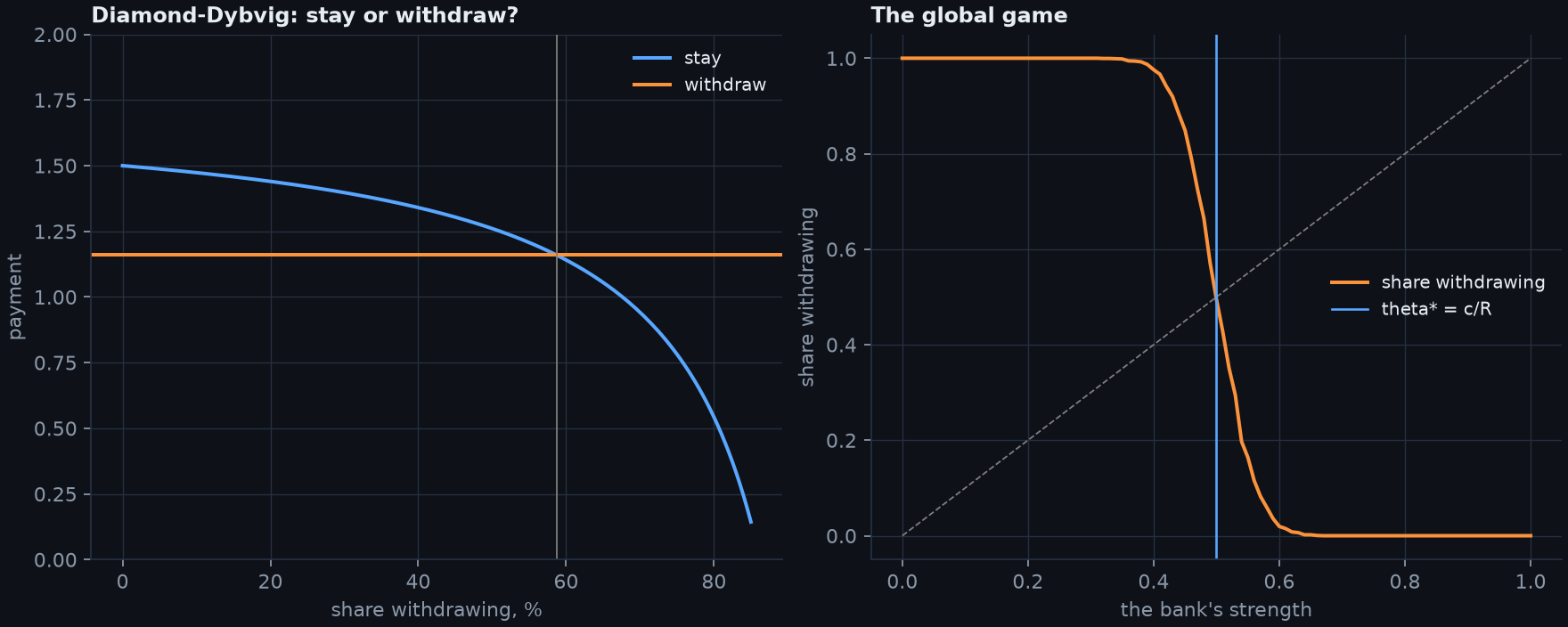
Here is the arithmetic. A withdrawer gets 1.16, as long as the bank has anything left. A depositor who stays gets whatever is left when the loans are repaid, shared among the stayers. The more people withdraw, the more loans the bank sells early, and the less is left. If half withdraw, staying still gets you 1.26: if you chose A, you were right. But if more than about 59 percent withdraw, staying pays less than running. And if everyone believes everyone else will run, each is right to run. Nothing about the bank's loans has changed.
What it does: One coconut deposited; 1.16 tomorrow or 1.42 later; a rumour that half will withdraw; staying still pays 1.26, but beyond 59% it pays less than running
3Diamond and DybvigPrinciples and the major2 min
Douglas Diamond and Philip Dybvig wrote the model in 1983; it won them a share of the Nobel prize in 2022. There are three dates, and each person starts with one unit. A share of them, here a quarter, will turn out to need their money early, at date one. The rest can wait. Nobody knows in advance which they will be, and nobody can prove their type to anyone else. The only investment pays 1.5 if it is held to date two, but only one if it is cut short. On their own, people get one if they turn out impatient, and one and a half if patient. That is a gamble on their own type, and people who dislike risk would pay to insure it.
A bank can provide that insurance. Choose what to pay at each date to maximize expected utility, given that whatever is paid early must come from investments cut short. The first-order condition says the marginal utility of early consumption equals R times that of late. With constant relative risk aversion, the solution is in closed form. With a risk aversion of two, the bank pays 1.16 to anyone who withdraws early and 1.42 to anyone who waits: more than one for the impatient, less than one and a half for the patient. That is a demand deposit. It makes everyone better off, provided only the impatient withdraw early. And that proviso is the whole problem.
What it does: Patient and impatient depositors (\(t = 1/4\)), \(R = 1.5\), \(\gamma = 2\); the optimal contract \(c_1 = 1.160\), \(c_2 = 1.420\); a demand deposit implements it if only the impatient withdraw
4Two equilibria: the bank and the runPrinciples and the major2 min
Write down what a patient depositor gets. If everyone else waits, waiting pays 1.42, and withdrawing only 1.16: so wait. That is the good equilibrium. If everyone else runs, the bank must sell every loan at one to pay 1.16 each, and it can pay only 86 percent of the queue. Those who wait get nothing. So run. Both are equilibria. The same bank, with the same loans, is sound if people believe it is, and fails if they believe it will.
The run is made worse by a rule of banking: first come, first served. In a run, the bank pays 1.16 to each depositor in the order they arrive, until the money runs out. On the Island, 862 of 1000 depositors are paid in full and the rest get nothing. So being early is everything, and waiting to see what happens is the worst thing you can do. That is why a run, once it starts, is fast.
What decides which one happens? In the model, nothing about the bank: any event people treat as a signal will do. Economists call it a sunspot. In life: a rumour, a queue outside a branch, a falling share price, a post that spreads. So runs can hit sound banks. But weak banks are more exposed, because less bad news is needed to tip them over. Chapter ten shows how a refinement of the model picks one equilibrium after all.
What it does: The payoff table; sequential service: 862 of 1,000 paid in full, the rest nothing; sunspots
5Suspension and deposit insurancePrinciples and the major2 min
Diamond and Dybvig also showed how to remove the bad equilibrium. The first cure is to suspend convertibility: announce that once a quarter of the depositors have withdrawn, the share who are truly impatient, the bank will pay nothing more until the loans come due. Then a patient depositor who waits is sure of 1.42, more than the 1.16 that running brings. So nobody runs, and the suspension never has to be used. But it works only if the bank knows how many people genuinely need their money. If that number is uncertain, suspending can lock out people who need cash, which is what happened in the American panics of the nineteenth century.
The second cure is deposit insurance. The government promises every insured depositor full payment, whatever happens to the bank. Then no depositor has any reason to run, so the bank is never run. And here is the remarkable part: in the model, insurance against runs is never paid out, so it costs nothing. The promise alone removes the bad equilibrium. As long as people believe it, which requires a government that could raise the money if it ever had to.
The cure has been tried. Here are American commercial banks suspended each year from 1921 to 1941. From 1930 to 1933, about 8,812 banks failed or closed their doors. In 1933 alone, 3,891. Federal deposit insurance began on the first of January 1934. That year, 44 banks were suspended. Other things changed in 1933 too, from the banking holiday to the end of the gold standard, but bank runs largely disappeared from America for the next seventy years.
What it does: Suspension at a quarter: a stayer is sure of 1.42; insurance that is never paid costs nothing; suspensions: 8,812 banks in 1930–33, 3,891 in 1933, 44 in 1934
6Bagehot's rule: the lender of last resortPrinciples and the major2 min
The third cure is older. In May 1866, Overend, Gurney and Company, the biggest discount house in London, failed. The next day, remembered as Black Friday, depositors ran on banks across the City. The Bank of England lent heavily to anyone who could offer good security, and the panic subsided. Walter Bagehot, the editor of The Economist, turned that into a rule in his book Lombard Street, in 1873.
Bagehot's rule has three parts, as it is usually summarized. In a panic, the central bank should lend freely, without limit, so that nobody needs to run for fear of being last. At a penalty rate, so that only banks that need the money borrow it, and repay as soon as they can. And against good collateral: to banks that are illiquid, short of cash but sound, not to banks that are insolvent. The hard part, every time, is telling the two apart in the middle of a panic.
Agora makes the point with numbers. A sound bank holds ten in reserves and ninety in loans, against ninety of deposits and ten of equity. In a panic, depositors withdraw 30, twenty more than its reserves. With no lender, it must sell loans in a hurry, at sixty percent of their value: 33 of loans to raise twenty, and its equity falls to -3.3. It is insolvent. With Bagehot's lender, it borrows twenty against its loans at a penalty rate of five percent, and its equity is 9. The fire sale is what kills it: it turns a shortage of cash into a hole in the balance sheet.
What it does: Overend, Gurney and Black Friday, 1866; lend freely, at a penalty rate, against good collateral; the Island's bank: a fire sale at 60% leaves equity \(-3.3\), Bagehot's lender 9
7The price: moral hazardPrinciples and the major2 min
Every cure has a price. Robert Merton showed in 1977 how to value deposit insurance. Take a bank with assets of 100 and insured deposits of 90, so the owners' own money, the dashed line, is 10. The insurer pays depositors whatever the assets fall short of a year from now. That is a put option on the bank's assets, and its value, in pink, rises steeply with how risky those assets are. In green, the value of the owners' stake. With assets as volatile as a quarter of their value in a year, the put is worth 5.3, and the owners' stake is worth 15.3, not 10. If the premium is flat, every dollar of the insurer's expected loss is a dollar for the owners. So insurance rewards the bank for taking risks, unless it is priced to the risk, capped, or matched by rules. Depositors who never run also never watch.
America learned this the expensive way. In the 1980s, the savings and loan associations held long, fixed-rate mortgages, funded by insured deposits. When interest rates jumped, many became insolvent. Allowed to keep operating, some gambled on risky loans: if the bets paid off, the owners recovered; if not, the insurer paid. The clean-up cost taxpayers as much as a hundred and twenty-four billion dollars. The same logic applies to banks so large that creditors expect a rescue: they can borrow more cheaply, and grow larger. Part thirty-three returns to too big to fail.
What it does: Merton's put: at 25% volatility it is worth 5.3 and the owners' stake 15.3, not 10; the savings and loans (up to about $124 billion); too big to fail
8CapitalPrinciples and the major2 min
The other answer to moral hazard is capital: make the owners put in money of their own, which is lost first. In 1988, American banks' equity was about 6 percent of their assets. By 2020 it was about 10. Equity absorbs losses before depositors or the insurer lose anything. Even so, about nine dollars in ten of what a bank owns is financed by borrowing.
Capital rules count risk. Each asset gets a weight, and capital is measured against the weighted total. Government bonds have no credit risk, so they get a weight of zero, and the Island's bank looks well capitalized: 17 percent of risk-weighted assets. But government bonds have interest-rate risk. If rates rise three points, its ten-year bonds lose 24 percent of their value. That is a loss of 7.1, leaving equity of 2.9: 3 percent of its assets. Silicon Valley Bank ended 2022 with 91 billion dollars of bonds it planned to hold to maturity, worth about 15 billion less than their book value, while its reported capital ratio was 12 percent. The loss was real only if it had to sell. A run makes you sell.
How much capital, then? Banks argue that equity is expensive, so requiring more of it means less lending. Anat Admati and Martin Hellwig argued in 2013 that equity is expensive for banks mainly because their debt is subsidized, by insurance and expected rescues, and proposed equity of twenty to thirty percent of total assets. Their argument is Modigliani and Miller's, from Part twenty-three: more equity makes each share safer, so the return shareholders require falls. Today's rules require much less than their number, and the argument continues.
What it does: Equity to assets 6.1% (1988), 10.3% (2020); risk weights: 17% of risk-weighted assets, but a three-point rise in yields costs 7.1 on 30 of bonds (duration 9.2), leaving 3.1% of assets; Silicon Valley Bank's \\(91 billion held to maturity, \\)15 billion under water; Admati and Hellwig's 20–30%
Intermission: deposits at small and large banks, 2022-2024Principles and the major
This chapter has no narration to read.
9Runs without depositorsPrinciples and the major4 min
By 2007, much of America's lending no longer ran through deposits at all. Here is a dealer bank holding 100 of securities, funded by 4 of its own money and 96 of repo. A repo is a sale of a bond today with a promise to buy it back tomorrow at a slightly higher price. In effect it is an overnight loan, secured by the bond, rolled over every day. The lender keeps a margin, called the haircut: it lends only 96 against a bond worth a hundred. And the lenders are money market funds, companies' treasurers and other banks, with no deposit insurance behind them. Gary Gorton and Andrew Metrick argued that this is where the run of 2007 and 2008 happened.
A run on repo does not look like a queue. It looks like a number. If lenders keep a haircut h, a dealer can hold at most its equity divided by h. At a haircut of 4 percent, that is 25 times its equity. In 2007 and 2008, lenders worried about what the bonds were worth and raised haircuts. At 20 percent, the most it can hold is 5 times its equity. So with the same 4 of equity, the dealer can now carry only 20 of securities, and must sell 80, into a market where everyone else is selling too. Raising the haircut is withdrawing the deposit. Gorton and Metrick's data covered only some kinds of collateral, and critics argue the run was smaller in the wider repo market; that it happened in securitized bonds is not in doubt.
Money market funds took deposits in all but name: shares meant to be worth exactly one dollar, which you could withdraw at any time. On the sixteenth of September 2008, the day after Lehman Brothers failed, the oldest of them, the Reserve Primary Fund, broke the buck. It held seven hundred and eighty-five million dollars of Lehman's short-term paper, about one percent of the fund, and its shares were marked down to ninety-seven cents. By that afternoon, investors had asked for about a quarter of the fund's money. On the nineteenth, the Treasury guaranteed money funds' shares. Here is the strange part: money funds' total assets rose that autumn, from 3.4 to 3.8 trillion dollars. The money did not leave the funds. It left the prime funds, which lend to companies, for funds that hold only government debt. The run was on companies' short-term borrowing. In March 2020, prime funds ran again, and the Federal Reserve set up a facility to lend against their assets.
The lesson. Shadow banking is maturity transformation outside the banks. It is funded short, by repo, commercial paper and money-fund shares, all of which can run. It holds long or illiquid assets: mortgage bonds and loans to companies. It had no deposit insurance, and in 2007 no lender of last resort. In 2008, the Federal Reserve lent to dealers and money funds directly, and in effect became one. Diamond and Dybvig's model fits wherever there is short funding and long assets.
What it does: Repo and its haircut: assets at most equity over the haircut, 25 times at 4%, 5 times at 20%: sell 80 of 100; the Reserve Primary Fund breaks the buck (16 September 2008); money funds' assets rose as money fled prime funds; shadow banking
10One equilibrium after all: global gamesPrinciples and the major3 min
Diamond and Dybvig leave a hole. With two equilibria, the model says a run can happen, but not when, or how likely it is. In 1998, Stephen Morris and Hyun Song Shin found a way to close it, first for currency attacks. Give each player a slightly different view of the fundamentals. Say the bank has a strength theta, and fails if the share of depositors withdrawing reaches theta. Each depositor sees theta plus a little private noise. Nobody knows exactly what the others see. Then, however small the noise, there is only one equilibrium: withdraw if and only if your signal is below a cutoff.
Here is the Island's version. Across the bottom, the bank's strength. Up the side, the share of depositors who withdraw. The dashed line is where the share withdrawing equals the strength: above it, the bank fails. A depositor who withdraws gets 1. One who stays gets 2 if the bank survives and nothing if it fails. In red, the share withdrawing in the unique equilibrium, simulated with 2,000 depositors. When the bank is weak, almost everyone runs; when it is strong, almost nobody does; the switch is sharp. And the bank fails exactly when its strength is below 0.5, the ratio of what withdrawing pays to what staying pays. A bank that would have survived if everyone stayed still fails, if it is weak enough: the run is real, but it is now predictable.
Why that ratio? Put yourself at the cutoff. You are indifferent: staying pays R times the chance the bank survives, and that must equal c. At the cutoff you cannot tell whether your signal is high or low compared with everyone else's, so every share of depositors below you is equally likely. Morris and Shin call this belief Laplacian. The bank survives if its strength exceeds the share withdrawing, so your chance of survival is theta star itself, and theta star is c over R. The noise only has to be there; how large it is drops out of the answer.
The unique equilibrium lets us ask a question the old model could not. With a deposit that pays 1 on demand, the bank fails when its strength is below 0.5. Make the deposit more generous to people who withdraw early, 1.2 instead of 1, and it fails below 0.6. The yellow band is the extra failures. Better insurance for the impatient makes running more attractive, so runs become more likely. Itay Goldstein and Ady Pauzner worked this out for Diamond and Dybvig's bank in 2005: the best deposit contract trades risk sharing against the probability of a run, and it offers less than the contract that ignores runs.
What it does: Private noise gives one equilibrium; 2,000 simulated depositors; failure exactly below \(\theta^* = c/R = 0.5\); the Laplacian belief; a deposit paying 1.2 fails below 0.6 (Goldstein and Pauzner)
11Runs in the dataPrinciples and the major3 min
Were the runs of the Great Depression panics, sunspots in Diamond and Dybvig's sense, or were bad banks simply found out? Here are American bank suspensions month by month, from 1929 to February 1933. Milton Friedman and Anna Schwartz picked out four banking crises. The first came at the end of 1930, when the Bank of United States, a large New York bank, closed in December. The second in the spring and summer of 1931. The third after Britain left the gold standard in September 1931: 522 banks were suspended in October alone. And the last in early 1933, which ended with every bank in the country closed by the banking holiday of March.
Charles Calomiris and Joseph Mason tested the question bank by bank. They built a model of each Federal Reserve member bank's risk of failing, from its own balance sheet and the state of its county's economy. Then they looked for failures the fundamentals could not explain. In the crises of 1930 and the spring of 1931, they found none: banks failed when their fundamentals said they would. In the autumn of 1931 the evidence is ambiguous, and the unexplained part is small. In early 1933 there was a large unexplained rise in failures: a panic. So, mostly, weak banks were found out, with some contagion between neighbouring banks, until the very end. Fundamentals and runs work together, as the global game says they should.
In 2023 the same question came back. Erica Jiang, Gregor Matvos, Tomasz Piskorski and Amit Seru valued the assets of every American bank at market prices. After the rate rises of 2022, those assets were worth about two trillion dollars less than their book value, about ten percent on average. A loss like that need not sink a bank whose depositors are insured, because they have no reason to run. It matters when uninsured depositors can leave. If only half of the uninsured withdrew, they estimated, about a hundred and ninety banks, with about three hundred billion dollars of assets, could be left unable to pay everyone. Silicon Valley Bank had large losses, and 94 percent of its deposits uninsured. Weak fundamentals made the run possible; the uninsured made it happen.
What it does: Monthly suspensions 1929–1933 and Friedman and Schwartz's four crises (522 banks in October 1931); Calomiris and Mason: fundamentals until early 1933; Jiang, Matvos, Piskorski and Seru: $2 trillion of unrealized losses, about 190 banks at risk if half the uninsured left
12Banks as monitorsPrinciples and the major2 min
Douglas Diamond asked a more basic question in 1984. Why lend through a bank at all? Suppose a firm needs money from a thousand savers, and checking on what the firm does with it costs each of them a little. If every saver checks, the checking is done a thousand times. If nobody checks, nobody is watching, and the firm can claim it did badly and pay little. Delegate the checking to a bank, and it is done once. But then the savers have a new problem: who watches the bank?
Diamond's answer is diversification. On the Island, each loan repays 1.3 with probability 0.9 and nothing otherwise, and the bank promises its depositors one for every loan. With a single loan, the bank fails to pay them one time in ten. With ten loans, about 7 percent of the time. With a hundred, about four times in a hundred thousand. A bank with many independent loans can promise a fixed payment and nearly always keep it, so its depositors hardly need to watch it. That is why a bank's liabilities are simple debts. The catch is the word independent: in a crisis, loans go bad together.
If banks exist to know their borrowers, a bank failure destroys something. That was Ben Bernanke's argument in 1983. What a bank knows about its borrowers is a kind of capital, built up over years of lending, and it dies with the bank. When thousands of banks failed from 1930 to 1933, farmers, households and small firms lost credit that no other lender knew them well enough to give. In his regressions, the failures help explain the collapse of output, beyond what the fall in the money supply explains. In 2022, Bernanke, Diamond and Dybvig shared the Nobel prize for their research on banks and financial crises.
What it does: Delegated monitoring: 1,000 checks or one; a bank's chance of failing: 10% with one loan, 7% with ten, 0.004% with a hundred; Bernanke (1983); the 2022 Nobel prize
13The Dials: deposit betas, and the cost of a crisisResearch2 min
Two dials open in this part. The first is the deposit beta: the share of a rise in the policy rate that banks pass on to their depositors. Economists at the New York Fed found that in the tightening of 2004 to 2006, the beta on interest-bearing deposits approached sixty percent by the end. In the cycle of 2015 to 2019 it never passed forty. In the much faster tightening of 2022 it reached almost forty percent by the end of the year. S&P Global's figure for all deposits, by the third quarter of 2023, was thirty-eight and a half. This film's own, from the FDIC's national rates: savings accounts passed on 8 percent of the rise, twelve-month certificates of deposit 33. The status: it depends on the setting, the product, and how long the rise has lasted. And a low beta is worth something to a bank only while its depositors stay.
The second dial: how much output a banking crisis costs. Carmen Reinhart and Kenneth Rogoff found that after systemic banking crises, real output per person fell by more than nine percent from peak to trough, on average. Valerie Cerra and Sweta Saxena, with data on a hundred and ninety countries, found that the loss after a banking crisis is about ten percent and does not go away. Christina and David Romer, measuring financial distress directly in twenty-four rich countries, found a peak decline nearer six percent, and only four in another specification, and very different from one crisis to the next. America in 2008: real GDP fell 3.8 percent from peak to trough. But by 2019 it was 18 percent below the trend of 1990 to 2007, which would be the biggest number here, if that trend was the right one to draw; growth had begun to slow before the crisis. The status: contested. The cost is large, but how large depends on what you compare it with.
What it does: The deposit beta (depends on the setting): about 0.6 in 2004–06, under 0.4 in 2015–19, 0.39 by 2022 Q4, 0.385 for all deposits by 2023 Q3, this film 0.08 (savings) and 0.33 (CDs); the output cost of a banking crisis (contested): Reinhart and Rogoff over 9%, Cerra and Saxena 10%, Romer and Romer 6%, America 3.8% peak to trough and 17.6% below its 1990–2007 trend by 2019
14In practice: stress tests, the treasury desk, deposit pricingPractice3 min
Since the first stress test, in 2009, America's largest banks have had to show regularly that they could survive a severe recession, described by the Federal Reserve in a scenario. The scenario published in February 2022 had the ten-year Treasury yield falling to three quarters of a percent, short-term rates near zero throughout, and unemployment rising to ten percent. That is what severe recessions had looked like before. What happened instead: the ten-year yield rose from 1.8 percent to about 4 percent by October. And the federal funds rate went from almost nothing to 4.1 percent within the year.
Called it? A stress scenario is not a forecast, and the Federal Reserve says so. But it is a judgment about which dangers matter, and in 2022 the danger it tested was a recession with falling rates. The danger that arrived was rising rates. The losses that sank Silicon Valley Bank came from long bonds losing value as yields rose, a risk the scenario did not test; and Silicon Valley Bank, grown large only recently, was not yet among the banks being tested. Wrong, as a judgment of where the danger was. Since 2023 the Federal Reserve has added exploratory analyses, with other kinds of shock, beside the main test.
Deposit pricing is a bank's daily decision. From February 2022 to December 2023, the federal funds rate rose from 0.08 to 5.33 percent. The national average rate on twelve-month certificates of deposit rose to 1.86 percent: a beta of a third. On savings accounts, to 0.46 percent: a beta under a tenth. The gap is what depositors pay the bank for convenience, and for not shopping around. Itamar Drechsler, Alexi Savov and Philipp Schnabl call it the deposit franchise, and showed that it works like a hedge: when rates rise, a bank's long assets lose value, but its sticky deposits become more valuable. That hedge holds only if the depositors stay.
And the treasury desk, which manages the whole balance sheet. Its first number is duration. A ten-year bond yielding one and a half percent has a duration of 9.2 years: each point on yields costs about 9 percent of its price. Against long assets it sets deposits, which may stay for years, or leave in a day. Since Basel III, large banks must hold enough liquid assets to cover thirty days of outflows in a stress. And a good desk knows in advance what it can pledge at the central bank's discount window, and has tested it. In March 2023, Silicon Valley Bank faced thirty days of stressed outflows in a single day.
What it does: The 2022 stress scenario (the ten-year at 0.75%) against 2022 (the ten-year to 4%, federal funds to 4.1%); Called it? (wrong); deposit pricing, February 2022 to December 2023: betas 0.08 and 0.33; the deposit franchise; duration, liquidity coverage, the discount window
15Frontier: digital runs, narrow banks, stablecoinsResearch3 min
The frontier begins with speed. Silicon Valley Bank lost 42 billion dollars in one day, and was asked for 100 billion more overnight. A run used to need a queue on the pavement. Now it needs a phone. And a crowd that talks: the bank's depositors were start-up founders and their investors, many of them connected on social media. Anthony Cookson and his coauthors found that banks that had been discussed most on Twitter before the run lost more of their stock-market value during it, beyond what their unrealized losses and uninsured deposits would predict. Diamond and Dybvig's depositors coordinate on a sunspot; these ones could watch each other do it.
The response came on Sunday the twelfth of March. The Treasury, the Federal Reserve and the FDIC announced that every depositor of Silicon Valley Bank and of Signature Bank, insured or not, would be paid in full. And the Federal Reserve opened a new programme lending to banks for up to a year against Treasury and agency bonds, valued not at their market price but at par. That goes beyond Bagehot. He asked for collateral that would be good in ordinary times, valued as it would be without the panic. These bonds had lost value because interest rates had risen, not because of the panic. The run stopped. What the weekend promised for the next run, every uninsured depositor could work out.
Could money be made unrunnable? That is the idea of narrow banking. In 1933 a group of Chicago economists proposed it, and in 1935 Irving Fisher made the case in a book called One Hundred Percent Money: back every deposit one for one with reserves at the central bank. Lending would then be financed by equity and long-term debt, which cannot run. The objection has always been that the maturity transformation would not disappear. It would move outside the banks, into the shadows of chapter nine. A stablecoin backed by Treasury bills is a narrow bank outside the law of banks, and it can still be run. On Friday the tenth of March 2023, Circle disclosed that three point three billion dollars of the reserves behind its coin, USDC, were at Silicon Valley Bank. Over the weekend the coin fell to about eighty-eight cents, and recovered its dollar only when the depositors were protected.
The questions still open. Should deposit insurance cover companies' payroll accounts in full, since in practice it did? If a run can take hours, must the lender of last resort be ready at any hour, with collateral already pledged? How much capital should banks hold, and should the bonds they plan to keep be counted at market prices? And can stablecoins and tokenized deposits be made safe without becoming banks, with everything that comes with that?
What it does: Digital runs and social media (Cookson and coauthors); the weekend of 12 March 2023 (every depositor protected, loans against bonds at par); narrow banking from the Chicago Plan and Fisher's 100% Money; USDC at 88 cents; four open questions
Recap, problems, and the road aheadAll tracks3 min
So: why are banks fragile, and can they be made safe? Banks are fragile because they do something valuable. They turn long, illiquid loans into deposits that anyone can take out at once, and so a bank that is sound if everyone stays can fail if enough people fear it will. Deposit insurance, a lender of last resort and capital make them much safer, at the price of watching them closely. But wherever short funding meets long assets, inside the banks or outside them, the run can come back.
Part twenty-six in twelve lines. Silicon Valley Bank lost forty-two billion dollars in a day. A bank turns illiquid loans into liquid deposits, and Diamond and Dybvig showed that this insures depositors against needing their money early. The same contract has a second equilibrium, the run, in which first come is first served. Suspension and deposit insurance remove it, and after 1934 American bank failures almost stopped. Bagehot's lender keeps a fire sale from turning illiquidity into insolvency. Insurance is a put that rewards risk, so banks must hold capital, and capital rules can miss the risk in safe bonds. Runs moved to repo and money funds. Global games turn two equilibria into one, and make runs predictable from fundamentals; the Depression's failures were mostly fundamentals, and 2023's run was the uninsured's. Banks exist to monitor, and their failures destroy what they knew. Then two dials, the stress tests, and the digital runs.
The problems. Diamond and Dybvig's contract; the share of withdrawals at which waiting stops paying; who is served in a run; Bagehot's arithmetic; deposit insurance as a put; a run on repo; the global game's threshold; and a starred problem on why diversified banks can promise fixed payments. Full solutions are in the part's notes.
The reading: Freixas and Rochet's Microeconomics of Banking, the graduate text this part follows; Gary Gorton's Misunderstanding Financial Crises; Bagehot's Lombard Street, which is still worth reading; and Admati and Hellwig's case for more capital. Then the papers, from Diamond and Dybvig to the digital runs of 2023.
This part was about the fragile institutions that create most of our money. The next is about what happens when nobody spends it. On Capitol Hill, a babysitting co-operative of young couples paid for sitting with coupons. Everyone wanted to save some coupons for later, so everyone stayed in and offered to sit, nobody went out, and nobody could earn any. Joan and Richard Sweeney wrote it up in 1977 as a recession in miniature. Part twenty-seven: the Keynesian revolution. How can a whole economy be short of buyers?
Where it goes next. Part 27 turns to the Keynesian revolution and a whole economy short of buyers; Part 31 to the central bank as lender of last resort and its operating framework; Part 33 to financial crises, credit booms and too big to fail; Quant, Built to bank stocks and credit.
Key results
The part's results in one place, for revision.
Try it
Lab 26 · Banks and runs: why a sound bank can fail, and what stops it
Solve the Diamond-Dybvig deposit contract and find the share of withdrawals at which waiting stops paying; run a bank with sequential service; compare a fire sale with Bagehot's lender; price deposit insurance as a put; compute the repo squeeze; check the global game's threshold by simulation; and see why a diversified bank can promise fixed payments.
python -m videos.economics.labs 26
needs numpy, scipy, matplotlib · download lab26.py ·
source on GitHubDiamond-Dybvig: c1, c2 (alone: 1, 1.5) 1.160, 1.420
stayers' payment if 25%, 50%, the threshold, 70% withdraw 1.420, 1.261, 1.160, 0.941 (threshold 58.7%)
a run with sequential service: share paid in full 862 of 1000
Bagehot: equity after a fire sale; with a lender -3.33; 9.00
Merton's put at 5%, 10%, ..., 25% volatility 0.03, 0.71, 2.02, 3.59, 5.27
a ten-year bond when yields rise 1.5% to 4.5%: change; duration -23.7%; 9.22 years
repo: haircut 4% to 20%: must sell 80 of 100
global game: theta* = c/R; the simulated edge of failure 0.50; 0.50
delegated monitoring: failure with 1, 10, 100, 1,000 loans 1.00e-01, 7.02e-02, 3.96e-05, 1.64e-33
US bank suspensions, 1933 and 1934 3891 and 44
A deposit contract that insures people against needing their money early pays more than the bank can pay everyone at once, so it has a second equilibrium: once enough people are expected to withdraw, everyone should. Insurance and a lender of last resort remove it; a fire sale turns illiquidity into insolvency. With a little private noise the run becomes predictable: the bank fails exactly when its strength is below c/R.The code (99 lines; it asserts its own result)
"""Lab 26: banks and runs: Diamond and Dybvig's contract and its run threshold, sequential service, Bagehot's lender
against a fire sale, deposit insurance as a put, the repo squeeze, the global game's threshold, and delegated
monitoring."""

import numpy as np

from videos.coursekit import labs
from explainer.economics import data
from explainer.economics.agora import bank as bk
from explainer.economics.island import truths

TITLE = "Banks and runs: why a sound bank can fail, and what stops it"
GOAL = ("Solve the Diamond-Dybvig deposit contract and find the share of withdrawals at which waiting stops paying; "
        "run a bank with sequential service; compare a fire sale with Bagehot's lender; price deposit insurance as a "
        "put; compute the repo squeeze; check the global game's threshold by simulation; and see why a diversified bank "
        "can promise fixed payments.")
TASKS = [
    "Diamond-Dybvig: raise risk aversion to 4. How do c1, c2 and the run threshold change, and why is a more "
    "insuring contract more fragile?",
    "Bagehot: at what fire-sale price does the Island's bank survive without a lender?",
    "Global game: with R = 2, what payment to withdrawers makes the bank fail below a strength of 0.75? Check it by "
    "simulation.",
]


def run(seed=0):
    lab = labs.Lab()
    T = truths(26)

    D = T["dd"]
    d = bk.dd_contract(R=D["R"], gamma=D["gamma"], t=D["t"])
    assert abs(D["t"] * d["c1"] + (1 - D["t"]) * d["c2"] / D["R"] - 1) < 1e-12 and d["eu"] > d["eu_autarky"]
    lab.row("Diamond-Dybvig: c1, c2 (alone: 1, 1.5)", f"{d['c1']:.3f}, {d['c2']:.3f}")
    stay = bk.dd_stayers([0.25, 0.5, d["threshold"], 0.7], d["c1"], D["R"])
    assert stay[1] > d["c1"] > stay[3]
    lab.row("stayers' payment if 25%, 50%, the threshold, 70% withdraw",
            ", ".join(f"{x:.3f}" for x in stay) + f"  (threshold {100 * d['threshold']:.1f}%)")

    r = bk.sequential_service(n=D["n"], c1=d["c1"], seed=D["seed"] + seed)
    assert abs(r["served"] / D["n"] - 1 / d["c1"]) < 0.002
    lab.row("a run with sequential service: share paid in full", f"{r['served']} of {D['n']}")

    L = bk.lender_of_last_resort(**T["llr"])
    assert not L["survives_fire"] and L["survives_llr"]
    lab.row("Bagehot: equity after a fire sale; with a lender", f"{L['equity_fire']:.2f}; {L['equity_llr']:.2f}")

    M = T["merton"]
    puts = [bk.merton_put(M["V"], M["D"], s) for s in M["sigmas"]]
    assert all(abs(p["equity"] - p["put"] - (M["V"] - M["D"])) < 1e-9 for p in puts)
    lab.row("Merton's put at 5%, 10%, ..., 25% volatility", ", ".join(f"{p['put']:.2f}" for p in puts))

    S = T["sheet"]
    b = bk.bond_loss(S["coupon"], S["years"], S["y0"], S["y1"])
    lab.row("a ten-year bond when yields rise 1.5% to 4.5%: change; duration",
            f"{100 * b['change']:.1f}%; {b['duration']:.2f} years")

    rp = T["repo"]
    q = bk.repo_leverage(rp["assets"], rp["equity"], rp["haircut_from"], rp["haircut_to"])
    assert abs(q["must_sell"] - 80) < 1e-9
    lab.row("repo: haircut 4% to 20%: must sell", f"{q['must_sell']:.0f} of {rp['assets']:.0f}")

    G = T["gg"]
    g = bk.global_game(c=G["c"], R=G["R"], sigma=G["sigma"], n=G["n"], seed=G["seed"] + seed)
    th, fail = np.array(g["theta"]), np.array(g["fail"])
    edge = float(th[~fail].min())
    assert abs(edge - g["theta_star"]) < 0.05
    lab.row("global game: theta* = c/R; the simulated edge of failure", f"{g['theta_star']:.2f}; {edge:.2f}")

    Mo = T["monitor"]
    pf = [bk.diversified_failure(n, Mo["p"], Mo["R"], Mo["D"]) for n in Mo["ns"]]
    assert pf[0] > pf[1] > pf[2] > pf[3]
    lab.row("delegated monitoring: failure with 1, 10, 100, 1,000 loans", ", ".join(f"{x:.2e}" for x in pf))

    sus = data.fred("X14AICBS")
    yrs = [int(x[:4]) for x in sus["date"]]
    v33, v34 = sus["value"][yrs.index(1933)], sus["value"][yrs.index(1934)]
    assert v33 > 50 * v34
    lab.row("US bank suspensions, 1933 and 1934", f"{v33:.0f} and {v34:.0f}")

    lab.note = ("A deposit contract that insures people against needing their money early pays more than the bank can "
                "pay everyone at once, so it has a second equilibrium: once enough people are expected to withdraw, "
                "everyone should. Insurance and a lender of last resort remove it; a fire sale turns illiquidity into "
                "insolvency. With a little private noise the run becomes predictable: the bank fails exactly when its "
                "strength is below c/R.")

    fig, ax = labs.figure(2, size=(11, 4.4))
    f = np.linspace(0, 0.85, 171)
    ax[0].plot(100 * f, bk.dd_stayers(f, d["c1"], D["R"]), color=labs.BLUE, label="stay")
    ax[0].axhline(d["c1"], color=labs.ORANGE, label="withdraw")
    ax[0].axvline(100 * d["threshold"], color="grey", lw=0.8)
    ax[0].set(title="Diamond-Dybvig: stay or withdraw?", xlabel="share withdrawing, %", ylabel="payment", ylim=(0, 2))
    ax[0].legend()
    ax[1].plot(th, g["share"], color=labs.ORANGE, label="share withdrawing")
    ax[1].plot([0, 1], [0, 1], color="grey", lw=0.8, ls="--")
    ax[1].axvline(g["theta_star"], color=labs.BLUE, lw=1.2, label="theta* = c/R")
    ax[1].set(title="The global game", xlabel="the bank's strength", ylabel="share withdrawing")
    ax[1].legend()
    lab.fig = fig
    return lab
Now change it
- Diamond-Dybvig: raise risk aversion to 4. How do c1, c2 and the run threshold change, and why is a more insuring contract more fragile?
- Bagehot: at what fire-sale price does the Island's bank survive without a lender?
- Global game: with R = 2, what payment to withdrawers makes the bank fail below a strength of 0.75? Check it by simulation.
Problems, with solutions
Try each problem before opening its solution.
1. Diamond–Dybvig: with \(u(c) = c^{1-\gamma}/(1-\gamma)\), derive \(c_1 = 1/(t + (1-t)R^{1/\gamma - 1})\); show \(c_1 > 1\) exactly when \(\gamma > 1\), and compute \(c_1, c_2\) for \(\gamma = 2\), \(R = 1.5\), \(t = 1/4\).
Solution
Maximize \(t\,u(c_1) + (1-t)\,u(c_2)\) subject to \(t c_1 + (1-t) c_2/R = 1\). The first-order condition is \(u'(c_1) = R\,u'(c_2)\), so \(c_1^{-\gamma} = R c_2^{-\gamma}\) and \(c_2 = R^{1/\gamma} c_1\). Substituting into the budget, \(c_1[t + (1-t)R^{1/\gamma - 1}] = 1\). Since \(R > 1\), \(R^{1/\gamma - 1} < 1\) exactly when \(\gamma > 1\), and then the bracket is below one and \(c_1 > 1\): the impatient get more than they could alone. With the numbers, \(R^{-1/2} = 0.8165\), the bracket is \(0.8624\), \(c_1 = 1.160\) and \(c_2 = 1.2247 \times 1.160 = 1.420\).
2. The run threshold: if a share \(f\) withdraws \(c_1\), stayers get \(R(1 - fc_1)/(1-f)\). Show that waiting stops paying once \(f > (R - c_1)/(c_1(R-1))\).
Solution
Waiting pays less than withdrawing when \(R(1 - fc_1)/(1 - f) < c_1\), that is \(R - Rfc_1 < c_1 - c_1 f\), or \(R - c_1 < f c_1 (R - 1)\). Dividing, \(f > (R - c_1)/(c_1(R - 1))\). With \(R = 1.5\) and \(c_1 = 1.160\) the threshold is \(0.340/0.580 = 0.587\): once 59% of depositors are expected to withdraw, everyone should.
3. Sequential service: if everyone runs and the bank can raise 1 per depositor, what share is paid? Who gets nothing?
Solution
The bank has 1 per depositor and pays \(c_1\) to each in turn, so it pays \(1/c_1 = 1/1.160 = 86.2\%\) of them in full. The last 13.8% to arrive get nothing, patient or impatient: what matters is the place in the queue, which is why everyone hurries.
4. Bagehot: reserves 10, loans 90, deposits 90, equity 10; 30 is withdrawn. Find equity after a fire sale at 60% and after borrowing at 5%.
Solution
The bank pays 10 from reserves and needs 20 more. Selling loans at 60% of their value, it must sell \(20/0.6 = 33.3\) of loans, a loss of \(13.3\), and equity falls from 10 to \(-3.3\): insolvent. Borrowing 20 against its loans at 5% costs 1 in interest, and equity is 9: it survives. The fire sale, not the withdrawal, made it insolvent.
5. Merton: with \(r = 0\), show that equity \(=\) put \(+ V - D\), so a flat premium hands the put to the owners.
Solution
Equity is a call on the assets with strike \(D\); the insurer's liability is a put with the same strike. A call minus a put pays \(V_T - D\) in every state, so with no discounting \(C - P = V - D\) (put–call parity), and \(C = P + (V - D)\). Anything that raises the put's value, such as riskier assets, raises equity one for one; if the premium does not rise with risk, the owners keep the whole gain.
6. Repo: a dealer with equity 4 holds 100 of bonds at a 4% haircut. The haircut rises to 20%. How much must it sell?
Solution
With haircut \(h\) it can borrow \((1-h)\) of what it holds, so its holdings are at most \(E/h\): 100 at 4% (with 96 of repo), 20 at 20%. It must sell 80, and its repo falls from 96 to 16. Its lenders have withdrawn 80 without anyone queueing at a door.
7. Global games: using the Laplacian belief at the cutoff, show \(\theta^* = c/R\); what happens to failures when \(c\) rises?
Solution
The depositor at the cutoff \(x^*\) is indifferent: \(R \cdot \Pr(\text{survive} \mid x^*) = c\). Since everyone uses the same cutoff, at the cutoff she cannot tell where her signal stands among the others', so the share of other depositors withdrawing is, to her, uniform on \([0, 1]\). As the noise vanishes, \(\theta \to x^* \to \theta^*\), and the bank survives when the share withdrawing is below \(\theta^*\), which happens with probability \(\theta^*\). Hence \(R\theta^* = c\) and \(\theta^* = c/R\). Raising \(c\) raises \(\theta^*\): with \(R = 2\), from 0.5 at \(c = 1\) to 0.6 at \(c = 1.2\). Banks with strength between the two now fail.
8. \(\bigstar\) Delegated monitoring: loans repay \(R\) with probability \(p\); show the bank's failure probability goes to 0 as \(n \to \infty\) when \(pR > D\), and compute it for \(n = 10\), \(p = 0.9\), \(R = 1.3\).
Solution
Let \(X\) be the number of loans that repay, binomial with \(n\) and \(p\). The bank fails when \(XR < nD\), that is \(X/n < D/R\). When \(pR > D\), \(D/R < p\), and by the law of large numbers \(X/n \to p\), so the probability goes to zero; Hoeffding's inequality bounds it by \(\exp(-2n(p - D/R)^2)\), which falls exponentially in \(n\). With \(n = 10\) and \(D = 1\), the bank needs \(\lceil 10/1.3 \rceil = 8\) repayments, and \(\Pr(X \le 7) = 0.070\). Ten loans already cut the failure rate from 10% to 7%, and a hundred loans to 0.004%.
Notes and sources
Sources
Silicon Valley Bank's numbers and the 2022 stress scenario are transcribed in tables.SVB_2023 and
tables.STRESS_2022; the studies the film states are listed with what each shows in dials.SHOWN[26]; the deposit
betas and crisis costs are dials (explainer/economics/dials.py), and the stress scenario is a Called it? entry
(explainer/economics/calls.py). FRED's series were retrieved on 2026-11-20. Figures stated from papers and reports
(the savings-and-loan cost, the Reserve Primary Fund's Lehman paper, the unrealized losses of 2023, the stock-price
effect of Twitter exposure, USDC's low) are quoted as the sources give them, and are not recomputed.
About this partfrom its README
Part 26 of a sixty-eight-part course in economics (see the series plan and the syllabus), the second of Act VI, Money and the Cycle. It asks why banks are fragile, and whether they can be made safe, and answers: banks are fragile because they do something valuable. They turn long, illiquid loans into deposits anyone can take out at once, and so a bank that is sound if everyone stays can fail if enough people fear it will. Deposit insurance, a lender of last resort and capital make them much safer, at the price of watching them closely; but wherever short funding meets long assets, inside the banks or outside them, the run can come back.
It opens on thirty-six hours in March 2023, when the customers of Silicon Valley Bank withdrew 42 billion dollars in a day, mostly from their phones, asked for 100 billion more overnight, and found the bank closed on Friday morning; in the same week, deposits at America's small banks fell by 149 billion dollars. From there it covers:
- what a bank does: its balance sheet as T-accounts, and maturity transformation;
- a game: you have a deposit and a rumour that half the other depositors will withdraw tomorrow; stay or withdraw? (stay: you get 1.26 against 1.16, but beyond 59% withdrawing, everyone should run);
- Diamond and Dybvig (1983) derived: the deposit contract insures depositors against their own impatience (\(c_1 = 1.160\), \(c_2 = 1.420\) against 1 and 1.5 alone);
- two equilibria, the bank and the run: the payoff table, sequential service (86% are paid, the rest get nothing), and sunspots;
- the cures: suspension of convertibility, deposit insurance (insurance never paid is free), and America's bank suspensions, from 3,891 in 1933 to 44 in 1934;
- Bagehot's rule (1873) after Overend, Gurney (1866): a fire sale turns illiquidity into insolvency (equity \(-3.3\)), a lender of last resort does not (equity 9);
- the price: deposit insurance as a put (Merton 1977); the savings and loans; too big to fail;
- capital: American banks' equity ratio since 1988; risk weights against interest-rate risk (a ten-year bond loses 24% when yields rise three points); Silicon Valley Bank's held-to-maturity portfolio; Admati and Hellwig;
- an intermission without narration: deposits at small and large banks, week by week, 2022–2024, as a tune;
- runs without depositors: repo haircuts (Gorton and Metrick 2012) and the money funds of 2008;
- global games (Morris and Shin 1998; Goldstein and Pauzner 2005): one equilibrium after all, failure exactly below \(\theta^* = c/R\), and why better insurance for the impatient means more runs;
- runs in the data: the Depression's four banking crises, mostly fundamentals until 1933 (Calomiris and Mason 2003); 2023's unrealized losses and uninsured depositors (Jiang, Matvos, Piskorski and Seru);
- banks as monitors (Diamond 1984) and what is lost when they fail (Bernanke 1983);
- two dials (the deposit beta and the output cost of a banking crisis, both new), stress tests, the treasury desk and deposit pricing with Called it? on the 2022 stress scenario (wrong), and a frontier chapter on digital runs, the weekend of 12 March 2023, narrow banking and stablecoins.
What is computed and built
Everything plotted is computed by compute.py from Agora's banks (explainer.economics.agora.bank) with the Island's
Part 26 truths, or from the Data Room; the narration states the cached numbers.
- Diamond and Dybvig. CRRA utility with \(\gamma = 2\), \(t = 1/4\), \(R = 1.5\), liquidation at 1. The stayers' payment when a share \(f\) withdraws is \(R(1 - fc_1)/(1 - f)\) while the bank lasts; the run is 1,000 depositors in random order, each paid \(c_1\) until the cash runs out.
- The balance sheet. Reserves 10, loans 60, ten-year bonds 30 with a 1.5% coupon bought at par, deposits 90, equity 10; risk weights 0, 1, 0; yields rise from 1.5% to 4.5%.
- Merton's put. Assets 100, insured deposits 90, one year, a zero interest rate; Black and Scholes.
- The global game. A withdrawer gets \(c\), a stayer \(R = 2\) if the bank survives; signals \(\theta + 0.05\varepsilon\); 2,000 depositors use the equilibrium cutoff \(x^* = \theta^* + \sigma\Phi^{-1}(\theta^*)\).
- Delegated monitoring. Loans repay 1.3 with probability 0.9, depositors are promised 1 a loan: the bank fails when fewer than \(\lceil n/1.3 \rceil\) loans repay, a binomial tail.
- Deposit betas. The change in the FDIC's national rate over the change in the federal funds rate, February 2022 to December 2023.
- The 2008 output loss. Real GDP (chained dollars), 2007 Q4 to 2009 Q2; the 2019 Q4 gap below a log-linear trend fitted to 1990–2007.
Chapter notes
| # | Chapter | What it does |
|---|---|---|
| 0 | Why are banks fragile, and can they be made safe? | Thirty-six hours at Silicon Valley Bank: 42 billion withdrawn in a day, 100 billion more asked for, 94% of deposits uninsured; small banks lose 149 billion in a week while large banks gain 54; not financial advice; objectives |
| 1 | What a bank does | The balance sheet as T-accounts: deposits at par on demand, loans and bonds that pay over years, equity first to lose; maturity transformation |
| 2 | Play it: stay or withdraw? | One coconut deposited; 1.16 tomorrow or 1.42 later; a rumour that half will withdraw; staying still pays 1.26, but beyond 59% it pays less than running |
| 3 | Diamond and Dybvig | Patient and impatient depositors (\(t = 1/4\)), \(R = 1.5\), \(\gamma = 2\); the optimal contract \(c_1 = 1.160\), \(c_2 = 1.420\); a demand deposit implements it if only the impatient withdraw |
| 4 | Two equilibria | The payoff table; sequential service: 862 of 1,000 paid in full, the rest nothing; sunspots |
| 5 | Suspension and deposit insurance | Suspension at a quarter: a stayer is sure of 1.42; insurance that is never paid costs nothing; suspensions: 8,812 banks in 1930–33, 3,891 in 1933, 44 in 1934 |
| 6 | Bagehot's rule | Overend, Gurney and Black Friday, 1866; lend freely, at a penalty rate, against good collateral; the Island's bank: a fire sale at 60% leaves equity \(-3.3\), Bagehot's lender 9 |
| 7 | The price: moral hazard | Merton's put: at 25% volatility it is worth 5.3 and the owners' stake 15.3, not 10; the savings and loans (up to about \\(124 billion); too big to fail | | 8 | Capital | Equity to assets 6.1% (1988), 10.3% (2020); risk weights: 17% of risk-weighted assets, but a three-point rise in yields costs 7.1 on 30 of bonds (duration 9.2), leaving 3.1% of assets; Silicon Valley Bank's \\)91 billion held to maturity, $15 billion under water; Admati and Hellwig's 20–30% |
| — | Intermission | Deposits at small and large banks, first week of 2022 = 100, to the end of 2024; small banks' deposits as a tune; the story so far |
| 9 | Runs without depositors | Repo and its haircut: assets at most equity over the haircut, 25 times at 4%, 5 times at 20%: sell 80 of 100; the Reserve Primary Fund breaks the buck (16 September 2008); money funds' assets rose as money fled prime funds; shadow banking |
| 10 | Global games | Private noise gives one equilibrium; 2,000 simulated depositors; failure exactly below \(\theta^* = c/R = 0.5\); the Laplacian belief; a deposit paying 1.2 fails below 0.6 (Goldstein and Pauzner) |
| 11 | Runs in the data | Monthly suspensions 1929–1933 and Friedman and Schwartz's four crises (522 banks in October 1931); Calomiris and Mason: fundamentals until early 1933; Jiang, Matvos, Piskorski and Seru: $2 trillion of unrealized losses, about 190 banks at risk if half the uninsured left |
| 12 | Banks as monitors | Delegated monitoring: 1,000 checks or one; a bank's chance of failing: 10% with one loan, 7% with ten, 0.004% with a hundred; Bernanke (1983); the 2022 Nobel prize |
| 13 | The Dials | The deposit beta (depends on the setting): about 0.6 in 2004–06, under 0.4 in 2015–19, 0.39 by 2022 Q4, 0.385 for all deposits by 2023 Q3, this film 0.08 (savings) and 0.33 (CDs); the output cost of a banking crisis (contested): Reinhart and Rogoff over 9%, Cerra and Saxena 10%, Romer and Romer 6%, America 3.8% peak to trough and 17.6% below its 1990–2007 trend by 2019 |
| 14 | In practice | The 2022 stress scenario (the ten-year at 0.75%) against 2022 (the ten-year to 4%, federal funds to 4.1%); Called it? (wrong); deposit pricing, February 2022 to December 2023: betas 0.08 and 0.33; the deposit franchise; duration, liquidity coverage, the discount window |
| 15 | Frontier | Digital runs and social media (Cookson and coauthors); the weekend of 12 March 2023 (every depositor protected, loans against bonds at par); narrow banking from the Chicago Plan and Fisher's 100% Money; USDC at 88 cents; four open questions |
| — | Outro | The answer; twelve lines; problems; reading; next, Part 27, The Keynesian Revolution |
Notes
python -m videos.economics.labs 26: solve Diamond and Dybvig's contract and its run threshold, run a bank with sequential service, price deposit insurance as a put, compute the repo squeeze, simulate the global game and check \(\theta^* = c/R\), and diversify a bank's loans.- The interactive (course site): run on the bank. The reader is a depositor among many, sees a noisy signal of the bank's strength and decides to stay or withdraw; the bank fails if too many leave. A slider sets how generous the deposit is, and the failure threshold moves.
Companion material in this repository
The syllabus's plan for this partfrom SYLLABUS.md, the plan of record
- Hook: thirty-six hours in March; the question; objectives. A card: not financial advice.
- What a bank does: liquid deposits, illiquid loans; the balance sheet as T-accounts.
- Play it: you have a deposit, and a rumour. Stay or withdraw?
- Diamond and Dybvig (1983) derived: patient and impatient depositors; the contract that insures them.
- Two equilibria: the same bank, sound and run. Sunspots.
- Suspension of convertibility; deposit insurance; why insurance that is never paid is cheap.
- Bagehot's rule (1873): lend freely, at a penalty rate, on good collateral. The Bank of England in 1866.
- The price: moral hazard; the savings-and-loan crisis; too big to fail.
- Capital: the buffer and the debate over how much (Admati and Hellwig 2013); risk weights.
- Runs without depositors: repo and the run of 2007–08 (Gorton and Metrick 2012); money-market funds.
- One equilibrium after all: global games (Morris and Shin 1998; Goldstein and Pauzner 2005).
- Runs in the data: the Depression's bank failures (Calomiris and Mason); uninsured deposits in 2023.
- Banks as monitors (Diamond 1984) and what is lost when they fail (Bernanke 1983).
- Dials. 14. In practice: supervision, treasury management, deposit pricing. 15. Frontier: digital runs, narrow banking, stablecoins.
Agora: bank: the Diamond–Dybvig economy, a run with sequential service, a global-games threshold, a bank
with a balance sheet and a capital rule. The Island gets a bank.
Dials: deposit betas; the output cost of a bank failure. Called it? the stress-test scenarios of 2022
against 2023's rate shock.
Reading: Diamond & Dybvig 1983; Bagehot, Lombard Street; Diamond 1984; Gorton & Metrick 2012; Morris &
Shin 1998; Admati & Hellwig; Freixas & Rochet; Mishkin; Gorton, Misunderstanding Financial Crises.
Build the film
python -m videos.economics.econ26.compute        # the part's numbers, into .cache/econ26
python tools/build.py econ26                  # render and assemble the film
EXPLAINER_TTS=silent python tools/qa_scene.py econ26 Hook   # one chapter, silent, with a contact sheet
Scenes: videos/economics/econ26. Setup: see the course page. Source of these notes: the README and the scenes' narration.
Build it
python -m videos.economics.econ26.compute              # every number (seconds), into .cache/econ26/
python tools/qa_scene.py econ26 Global                 # one chapter, silent, at 480p, with a contact sheet
EXPLAINER_TTS=silent python tools/build.py econ26 -q l   # the whole part, silent preview
python tools/build.py econ26                           # 1080p30 with narration and the series' computed score
python -m videos.economics.labs 26                     # the lab
The data are in explainer/economics/data/, registered in
SOURCES.md: from FRED, bank suspensions 1921–1941 and month by month
to 1933, deposits at small and large banks week by week, the federal funds rate, the FDIC's national savings and CD
rates, the two- and ten-year Treasury yields, banks' equity to assets, money market funds' assets and real GDP; Silicon
Valley Bank's numbers and the 2022 stress scenario, transcribed in tables.py.