Lemons and Signals
What happens to a market when one side knows more than the other?
The part opens with George Akerlof's paper on used cars, turned down by the American Economic Review and the Review of Economic Studies as trivial and by the Journal of Political Economy as wrong, then printed by the Quarterly Journal of Economics in 1970. The viewer makes a blind offer for Bo's used boat, then builds Akerlof's market (partial unravelling, and his own example in which nothing trades), with Called it? on the referees; meets guarantees that are cheap only for honest sellers, reputations and inspectors; Spence's signals and the intuitive criterion; whether school is a signal (the GED); and Rothschild and Stiglitz's screening, which may have no equilibrium. After an intermission of used and new car prices, the death of Harvard's generous health plan in 1995-97, the Einav-Finkelstein diagram rebuilt from Alcoa's estimates, the positive-correlation test and advantageous selection, credit rationing, mandates and risk adjustment (the Affordable Care Act, Massachusetts, inertia), online feedback, a new dial on the welfare cost of adverse selection, underwriting and Test-Achats in practice, and a frontier on selection on moral hazard and the end of pooling.
What you need. Part 7: expected utility and risk aversion; Part 10: monopoly pricing; Part 11: Nash, Bayesian and signalling-game equilibria. Chapter 6 uses log utility; chapter 8 the marginal cost of a pool, derived from its average cost.
- Hook
- Akerlof's paper, rejected three times, 1967–70
- Ideas, models and mathematics
- adverse selection and unravelling, signalling, screening and separating contracts, the death spiral in a real health plan, testing for asymmetric information, cost curves for selection markets
- Agora gains
- a lemons market; an insurance market
- Play it
- buy a used car you cannot inspect
What you will be able to do
Principles and the major
- Explain adverse selection with Akerlof's market, and solve for the price and the share traded with uniform quality.
- Explain how guarantees, reputations and certification counter asymmetric information, and what makes a signal credible.
- Describe a death spiral, and the trade-offs of mandates, subsidies and risk adjustment.
Graduate
- Solve Spence's signalling game for its separating and pooling equilibria, and apply the intuitive criterion.
- Solve the Rothschild-Stiglitz insurance market and its existence condition.
- Measure the welfare cost of adverse selection with the Einav-Finkelstein diagram, from demand and cost curves.
Research
- Design and interpret positive-correlation tests, distinguishing adverse selection, moral hazard and advantageous selection, and explain selection on moral hazard.
Practice
- Apply underwriting, risk adjustment and platform trust tools, and judge rating restrictions.
Contents
Each chapter has a home level. Choose a track to see what to read and watch: Principles and the major 29 min · Graduate 37 min · Research 41 min · Practice 31 min.
- 0What happens to a market when one side knows more than the other?Principles and the major3 min
- 1Play it: buy a boat you cannot inspectPrinciples and the major2 min
- 2Akerlof's marketPrinciples and the major3 min
- 3Guarantees, reputations and inspectorsPrinciples and the major2 min
- 4Signalling: education that teaches nothingPrinciples and the major3 min
- 5Is school a signal?Principles and the major3 min
- 6Screening: contracts that sortPrinciples and the major2 min
- Intermission: used cars and newPrinciples and the major
- 7The death spiral: Harvard, 1995-97Principles and the major3 min
- 8Selection in pictures: the Einav-Finkelstein diagramGraduate3 min
- 9Testing for private informationResearch2 min
- 10Credit rationingGraduate2 min
- 11Mandates, subsidies and risk adjustmentPrinciples and the major2 min
- 12Online markets: feedback as a fixPrinciples and the major2 min
- 13The Dials: how much does adverse selection cost?Graduate1 min
- 14In practice: insurance, underwriting and trustPractice2 min
- 15Frontier: selection on moral hazard, and the end of poolingResearch2 min
- Recap, problems, and the road aheadAll tracks3 min
Also on this page: Lecture · Key results · Try it · Lab · Problems · Notes and sources · Build the film.
Lecture
The text of each chapter is the film's narration, as it is spoken, so you can read along or revise without the film. The pictures are in the film.
What happens to a market when one side knows more than the other?Principles and the major3 min
In the late 1960s a young economist at Berkeley, George Akerlof, wrote a short paper about used cars. It asked why a market can shrink, or vanish altogether, when sellers know more than buyers. The American Economic Review turned it down: the journal, its editor explained, did not publish papers on subjects of such triviality. The Review of Economic Studies turned it down for the same reason. The Journal of Political Economy's referees argued that it was simply wrong: if the paper were correct, no goods could be traded. As Akerlof later recalled it, the editor's verdict came to this: if this is correct, economics would be different.
The Quarterly Journal of Economics published it in 1970, thirteen pages under the title The Market for Lemons. It was correct, and economics was different. It started the economics of information, which now explains much of how insurance, credit and hiring work. In 2001 Akerlof shared the Nobel prize with Michael Spence and Joseph Stiglitz, whose ideas fill the second half of this part. A lemon, in American slang, is a car that turns out to be bad once you have bought it.
Private information is everywhere once you look for it. The seller of a used car has driven it for years. You know your own health better than any insurer. A borrower knows the project far better than the bank. A job applicant knows how good they are. An online seller is a stranger with a photograph and a promise. And is that painting real? In every case one side knows something the other cannot see, and that changes what trades, at what price, and whether the market survives.
Act Four of this series is about markets that fail and markets that are designed. It opens with a question: what happens to a market when one side knows more than the other? Why can good goods be driven out of a market by bad ones? How do the informed prove what they know, and how do the uninformed find out? And how much does all this cost, and what, if anything, should policy do about it?
Economics, Built. Part thirteen: lemons and signals. This part opens Act Four, on failure and design. You'll buy a boat you cannot inspect, and we'll use it to build Akerlof's market and watch it unravel. Then the fixes: guarantees, reputations and inspectors; Spence's signals, and whether school is one. Rothschild and Stiglitz's screening; the death of Harvard's most generous health plan; and selection drawn as two curves, measured. How economists test for private information; why banks ration credit; and what mandates, subsidies and online feedback can do. And a dial for what adverse selection costs, with a frontier on selection on moral hazard and the end of pooling.
What it does: Akerlof's paper turned down by the AER and the RES as trivial and by the JPE as wrong; the QJE, 1970, pp. 488-500; the 2001 Nobel with Spence and Stiglitz; private information everywhere; the question; objectives
1Play it: buy a boat you cannot inspectPrinciples and the major2 min
Before the theory, a purchase. Bo is selling one of his old boats. He has sailed it for years and knows exactly how sound it is; you can only look at the paint. To Bo, the boat could be worth anything from nothing to a hundred dollars, every value equally likely as far as you can tell. To you it is worth whatever it is worth to Bo, plus thirty dollars, because you need a boat and he doesn't. You make one offer, and Bo sells if your offer beats what the boat is worth to him. You can offer eighty, sixty, forty, thirty or twenty dollars. Which do you choose? Pause, and choose.
Here is what each offer brings you. Offer eighty, and Bo sells whenever his boat is worth less than eighty to him: eight times in ten. But then the boat you get is worth forty to him on average, so seventy to you, and you lose ten dollars a boat. At sixty you break even: the boats that sell are worth thirty to Bo, sixty to you. At forty, thirty or twenty you gain on every boat you buy, but you buy less often. The best you can do is thirty dollars, which gains four dollars fifty on average. Every dollar you add to your offer brings in boats Bo values more, but also tells you nothing about which boat you are getting.
Draw your average gain against your offer. If you could inspect the boat, you would buy every one at what it is worth to Bo, and gain thirty dollars each time. Because you can't, your best offer is thirty dollars, and seven boats in ten stay with Bo. Yet every boat is worth more to you than to him, so each one that stays unsold is a trade that should have happened and didn't. And when many buyers bid against each other, where does the price settle? That is Akerlof's question.
What it does: Bo's boat worth $0-100 to him, $30 more to you; offers $80, $60, $40, $30, $20: Bo sells 80-20% of the time, the boats you get are worth $70-40 to you, average gains -$8.00, $0, $4.00, $4.50, $4.00; the best blind offer $30; seven boats in ten unsold
2Akerlof's marketPrinciples and the major3 min
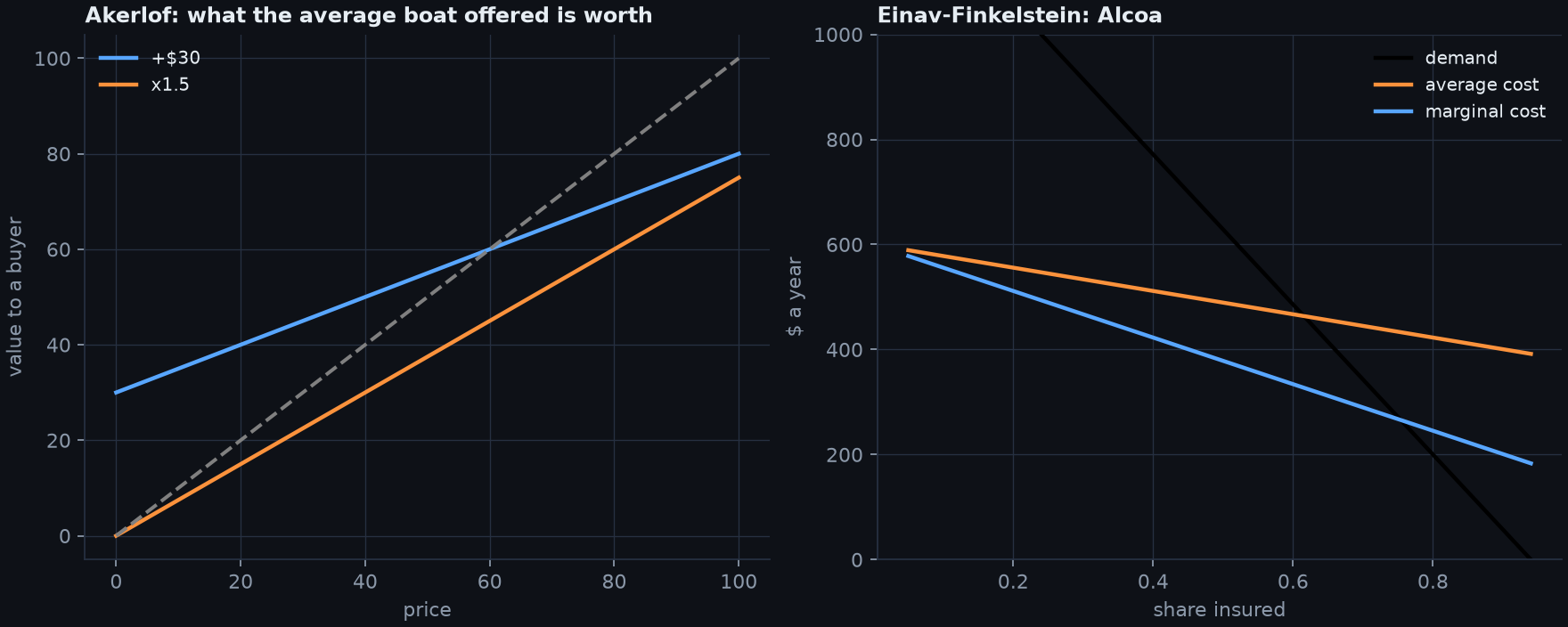
Now let many buyers bid for many boats, each buyer valuing a boat at its worth to its owner plus thirty dollars. At a market price of p, every owner whose boat is worth less than p puts it up for sale. The average boat for sale is then worth p over two to its owner, and p over two plus thirty to a buyer. Buyers compete, so the price rises until it equals what the average boat on sale is worth to them: p equals p over two plus thirty. The price settles at sixty dollars. Only boats worth less than sixty are sold, sixty percent of them. The best forty percent never come to market, though every one of them is worth thirty dollars more to a buyer than to its owner: twelve dollars of gains lost for every boat on the island.
Akerlof's own example is starker. Suppose buyers value a car at one and a half times its worth to the seller, rather than a fixed amount more. At any price p, the cars offered are worth p over two to their owners on average, and three quarters of p to a buyer: less than the price, whatever the price is. So no price works. The market vanishes, even though every car is worth more to a buyer than to its owner. Economists call it unravelling: at any price the best cars are withdrawn first, which lowers what buyers will pay, which withdraws the next best, and so on, down to nothing.
Akerlof saw an old idea in a new form. Gresham's law says that bad money drives out good: people spend their clipped and worn coins and hoard the full-weight ones. In the used-car market, bad cars drive out good ones, because the good ones are worth more kept than sold at a price that must allow for lemons. It explains a familiar puzzle: a new car loses much of its value the moment it is driven away, partly because a nearly new car offered for sale is suspect. Akerlof applied the idea to health insurance for people over sixty-five, to employers' treatment of minorities, to credit in India's villages, and to the cost of dishonesty. And he described the market's own remedies: guarantees, brand names, chains and licences, the subject of the next chapter.
Called it? The referees said the paper was trivial, or else wrong, since if it were right no goods could be traded. It became one of the most cited papers in economics, and won a share of the Nobel prize. Used goods do trade, every day, but through exactly the institutions the paper described as growing up to counter the problem. Wrong. Lemons markets don't vanish: they grow guarantees, brands and dealers, and those cost money, which is part of the price of not knowing.
What it does: With many buyers, \(p = p/2 + 30\): $60, 60% of boats trade, $12 of gains lost per boat; Akerlof's own example (buyers value 3/2): no price works; unravelling; Gresham's law; his applications; Called it?: the referees, wrong
3Guarantees, reputations and inspectorsPrinciples and the major2 min
The simplest fix is a promise. Suppose half the island's used boats are good, worth ninety dollars, and half are bad, worth thirty. If buyers can't tell them apart, every boat sells for sixty, and good boats are undersold. Now let a seller offer a guarantee: if the boat breaks within a season, the seller pays the hundred-dollar repair. A good boat breaks one time in ten, so the promise costs its seller ten dollars, against the thirty it gains by being believed. A bad boat breaks seven times in ten, so the same promise would cost its seller seventy dollars, more than the sixty it could gain by passing as good. Only good sellers offer the guarantee, so buyers are right to believe it. It works because it is cheap only for those telling the truth, an idea the next chapter makes general.
Akerlof listed the institutions that grow up around not knowing. Reputation: a seller who expects to sell again has a reason to be honest today. A brand name is a reputation with a great deal to lose. A chain promises the same meal in every town, which a traveller who will never return can rely on. Inspectors sell information: a mechanic's check, a vehicle history report, an auditor's signature. Licences certify doctors, lawyers and electricians. And the law punishes fraud, requires disclosure, and in many American states protects buyers of new cars that turn out to be lemons. Each of them costs something: the premium paid for a brand, the inspector's fee, the barrier a licence puts in front of newcomers. That cost is the price of not knowing.
What it does: Good boats $90, bad $30, half each, a pooled $60; a guarantee to pay a $100 repair costs a good seller $10 and a bad one $70, against a $30 premium (a bad seller would gain $60): it separates; reputation, brands, chains, inspectors, licences, the law; what they cost
4Signalling: education that teaches nothingPrinciples and the major3 min
Guarantees work because they are cheap only for the honest. In 1973 Michael Spence, in a thesis written at Harvard, turned that into a theory of signals: the informed side moves first, and spends money to be believed. On the Island, there are two kinds of fisher. Weak ones land one basket a day, strong ones two. A boat owner hiring a crew cannot tell them apart, so pays what the average crew member lands. The Island also has a school. A season there teaches nothing about fishing, but it costs a weak fisher a basket a day and a strong one half a basket, because studying comes harder to those who find the work harder. Can schooling sort the fishers, though it changes nothing about how they fish?
Suppose the boat owners pay two baskets a day to anyone with a season of school, and one to anyone without. For a weak fisher, a season costs one basket a day and gains one: not worth it, so they stay out. Their indifference line, in orange, passes above the owners' offer. For a strong fisher it costs half a basket and gains one, so they go. And then the owners' beliefs come true: everyone with schooling is strong, and everyone without is weak. This is a separating equilibrium. In fact any requirement from one to two seasons would separate them. But notice what it costs: the strong spend half a basket a day on something that adds nothing to the catch, purely to be believed. Signals can be privately rational and socially wasteful.
There are other equilibria. If the owners pay everyone the same whatever their schooling, nobody studies, and everyone earns the average, one and a half baskets. This is a pooling equilibrium. With so many equilibria, which one happens? It depends on what the owners would believe about someone who studies when nobody is supposed to. In 1987 In-Koo Cho and David Kreps proposed the intuitive criterion: a season of school could only pay off for a strong fisher, so an owner who saw one should believe the student is strong. That rules out pooling, and every separating equilibrium but the cheapest, a single season, the outcome John Riley had singled out in 1979. The result can be perverse. If nine fishers in ten were strong, pooling would pay the strong one point nine baskets, more than the one point five they keep after paying for school; yet the criterion still picks separation. Everyone could be better off if the signal were banned, a theme Part forty-five returns to.
What it does: Spence (1973): fishers landing 1 or 2 baskets; a season of school costs 1 or 0.5; separating requirements from 1 to 2 seasons; the social waste; pooling at 1.5; the intuitive criterion (Cho and Kreps 1987) and Riley's outcome; with 90% strong, pooling would pay 1.9 against 1.5
5Is school a signal?Principles and the major3 min
Is real school like the Island's? Two theories explain why the educated earn more. In the human capital theory of Gary Becker and Jacob Mincer, school teaches skills that employers pay for, so the return to a student is a return to society too. In Spence's theory, school shows who was able already, so the return is private, and society pays for an expensive sort. Both predict exactly what we see, that the educated earn more. The question is why. One clue is called the sheepskin effect, after the parchment diplomas were once printed on: in American data the year that completes a diploma seems to pay more than the years before it, as if the certificate itself were worth something.
A cleaner test came from a certificate. In America a dropout can sit the GED tests for a certificate meant to be equivalent to finishing high school. In 2000 John Tyler, Richard Murnane and John Willett noticed that states set different pass marks. A young dropout whose score falls between two states' marks gets the certificate in one state and not in the other. The skills are the same; only the certificate differs, so any difference in earnings is the signal alone. For young white dropouts on the margin of passing, the certificate raised annual earnings by ten to nineteen percent. For young nonwhite dropouts they found no effect they could detect, a reminder that a signal is only worth what employers believe it says.
So which is it? Against pure signalling: when compulsory schooling laws forced some students to stay longer, their earnings rose too, as Part four's quarter-of-birth estimates showed. An extra year that everyone is forced to take cannot signal much, so at least part of the return must be skill. For signalling: diplomas seem to pay for themselves, the GED's certificate pays without any extra skill, and much of what is taught is never used at work. Most economists conclude that both are at work. Some, like Bryan Caplan in 2018, argue that most of the return is the signal. The share matters for policy: subsidizing a skill raises output, but subsidizing a signal only buys a more expensive sort.
What it does: Human capital (Becker, Mincer) against signalling; sheepskin effects; the GED: 10-19% for young white dropouts at the margin, no detectable effect for nonwhite dropouts (Tyler, Murnane and Willett 2000); compulsory schooling and Part 4; Caplan (2018)
6Screening: contracts that sortPrinciples and the major2 min
Signals are sent by the informed. Screens are set by the uninformed. The Island's boat owners each have a hundred dollars, and a storm would cost them sixty. Careful owners lose a boat with a chance of one in ten, careless ones four in ten, and insurers cannot tell which is which. In 1976 Michael Rothschild and Joseph Stiglitz showed how competing insurers would respond: with a menu. One contract offers full cover at the price that is fair for the careless: sixty dollars of cover for twenty-four. The other offers a little cover at the price fair for the careful: about twelve dollars and fifty-seven cents of cover for a dollar twenty-six. It can't offer more, or the careless would take it too; the faint curve is the careless owners' indifference, which passes through both contracts. Each owner picks the contract meant for them, so the menu sorts them. The careless are fully insured. The careful pay for being believed by going nearly uninsured.
Rothschild and Stiglitz found a crack in their own result. An insurer could offer a single contract at the average price, nineteen cents for every dollar of cover, to everyone. That can tempt the careful away from their meagre cover. If careless owners are rare, the average price is close to the careful price, and it does. But a pooled contract can't last either, because a rival can always offer the careful a slightly different deal that the careless don't want, and take them away. So when careless owners make up less than about eleven percent, there is no equilibrium at all. Competitive insurance markets can be unstable, which is one argument for rules about what must be sold, and to whom.
What it does: Wealth $100, a $60 storm, risks 0.1 and 0.4, 30% careless: full cover for $24 and $12.57 of cover for $1.26; the careless indifferent between them; the pooled price 0.19; no equilibrium if fewer than about 11% are careless
Intermission: used cars and newPrinciples and the major
This chapter has no narration to read.
7The death spiral: Harvard, 1995-97Principles and the major3 min
Akerlof's unravelling has been watched happening. Harvard University offered its ten thousand or so employees a choice of health plans: from 1992, a generous preferred provider organization, the PPO, run by Blue Cross Blue Shield, beside several cheaper HMOs. Until 1994 the university paid most of the difference. A family that chose the PPO paid four to five hundred dollars a year more, and about a fifth of employees chose it. Then, facing a deficit, Harvard switched to contributing the same amount to every plan, for half its staff in 1995 and the rest in 1996. The extra charge for the PPO doubled, to about a thousand dollars, and enrollment fell from twenty percent to fifteen. Those who left were younger than those who stayed, forty-six years old on average against fifty-one. Losing its healthier members, the PPO lost money and raised its premium for 1996. The extra charge passed two thousand dollars, enrollment fell to about nine percent, and Blue Cross found that those who left that year were twenty percent healthier than average. By the 1997 negotiations, the PPO's price would have had to rise again dramatically. It was disbanded instead. In David Cutler and Richard Zeckhauser's words, the adverse selection death spiral twisted swiftly.
Agora can rebuild the mechanism. Each of twenty thousand employees has an expected extra cost of care in the generous plan, and these differ a great deal. Risk aversion makes the extra cover worth one and a half times that cost to them, plus a taste for the plan that varies. In year nought, the employer holds the extra charge at four hundred and fifty dollars, and about a fifth enroll. From then on, the plan charges the average extra cost of the people who enrolled the year before. Those who leave are the cheap ones: in the first year they cost about three hundred dollars on average, those who stay nearly twelve hundred. So the charge rises, the healthiest leave, the average cost rises, and the charge rises again. Within four years almost no one is left.
Was the reform a mistake? David Cutler and Sarah Reber estimated that the selection cost two to four percent of what Harvard had been spending on health insurance. But paying the same for every plan also made insurers compete for Harvard's employees, and premiums fell by five to eight percent. Those savings came largely out of the insurers' profits, which is a transfer to Harvard rather than a gain to society. It is the trade-off at the heart of every insurance market: price competition is good for prices, but it sorts people by their risk, and sorting can destroy the cover that the sick most need.
What it does: About 10,000 employees; the PPO's extra charge $400-500 and about 20% enrolled until 1994; an equal contribution from 1995: about $1,000 and 15% (leavers aged 46 against 51), more than $2,000 and about 9% in 1996 (leavers 20% healthier), disbanded in 1997; Agora's spiral (22.6% to 2.5% in four years); Cutler and Reber: a loss of 2-4% of spending against premiums 5-8% lower
8Selection in pictures: the Einav-Finkelstein diagramGraduate3 min
In 2010 Liran Einav, Amy Finkelstein and Mark Cullen showed how to measure all this with two curves. Plot the share of people buying generous insurance against its price. Demand is the familiar downward-sloping curve. Selection shows up in the other curve: the people who buy at a high price are those who expect to need it most, so as the price falls and more people buy, the average cost of the insured falls too. The marginal cost, the cost of the last buyer to join, lies below the average. Competitive insurers must cover their average cost, so the market settles at C, where demand meets average cost. Efficiency needs everyone to buy whose value exceeds their own cost: point E, where demand meets marginal cost. Between C and E are people who value the cover more than it would cost to give them, but less than the price. The shaded triangle is the waste.
The curves are the paper's own. At the aluminium company Alcoa, the extra premium an employee paid for the generous plan differed across the company's divisions, from three hundred and eighty-four to six hundred and fifty-nine dollars a year, in ways the authors show were unrelated to what the managers setting them could see about their employees. That variation traced out both curves: the share choosing the generous plan, and the average extra cost of those who did, which rose with the price, the signature of adverse selection. Agora rebuilds the diagram from their two estimated lines. The market settles at about four hundred and sixty-four dollars; the efficient price is about two hundred and sixty-six; and fourteen percentage points fewer employees buy than should. The triangle comes to nine dollars and forty-six cents a year per employee, against the nine fifty-five they report, about three percent of the surplus at stake. So adverse selection is real and measurable, and in this market its cost is small.
Could policy close the triangle? A subsidy that cut the price from C to E would get exactly the right people insured. But every dollar raised in tax costs society more than a dollar, because taxes distort; at the conventional thirty cents extra per dollar, that subsidy would cost about forty-five dollars a head, to save nine and a half: some five times the gain. A mandate to buy the generous plan could cost more still, since many employees value it below what it costs to cover them. The lesson of the diagram is to measure the triangle before reaching for a remedy.
What it does: Demand, average cost and marginal cost; C and E; Alcoa's prices $384-659; \(D = 0.940 - 0.00070p\), \(AC = 391.69 + 0.155p\); Agora's rebuild: $464 against $266, 14 points fewer insured, a triangle of $9.46 a head (the paper: $463, $264, $9.55, about 3% of the surplus at stake); a subsidy to reach E would cost about $45, five times the gain
9Testing for private informationResearch2 min
How would we know whether buyers really do know more? Private information leaves a trace. If the riskier people buy more cover, then those with more cover should claim more often, even among people the insurer treats alike: the same age, the same car, the same town. In 2000 Pierre-Andre Chiappori and Bernard Salanie looked for that correlation among young French drivers, licensed for less than three years. They found none: drivers with comprehensive cover had no more accidents than otherwise similar drivers with basic cover. The test has a second reading, too: a positive correlation could also come from insured drivers taking less care, which is moral hazard, the subject of Part fourteen.
Agora can show what the test can and cannot see. Simulate twenty thousand drivers, each with a private accident risk. If the riskier ones are more likely to buy full cover, the full-cover drivers claim more often, and the correlation is positive: the test sees it. If cover has nothing to do with risk, the correlation is indistinguishable from zero. But suppose a hidden trait, caution, makes people both safer drivers and keener to insure. Then the full-cover drivers claim less often, and the correlation turns negative, though everyone is using what they know about themselves.
This is not just a simulation. In 2006 Amy Finkelstein and Kathleen McGarry studied long-term care insurance in America. People's own forecasts of how likely they were to enter a nursing home predicted both whether they bought cover and whether they later used care: clear private information. Yet the insured were no more likely to use care than the uninsured, because more cautious people both buy more insurance and need less care. Two kinds of private information, pulling in opposite directions, cancelled out in the correlation. So a correlation of zero doesn't prove that buyers know nothing the insurer doesn't.
What it does: The positive-correlation test; young French drivers (Chiappori and Salanié 2000): no correlation; Agora's 20,000 drivers: 0.082 with adverse selection, 0.003 with none, -0.027 when caution drives both; long-term care (Finkelstein and McGarry 2006)
10Credit rationingGraduate2 min
Lenders face the same problem as insurers. On the Island, two kinds of borrower ask the bank for a hundred dollars each. Safe borrowers' projects succeed nine times in ten, risky ones' half the time, and the bank cannot tell them apart. A borrower whose project fails repays nothing, and chasing them costs the bank sixty dollars. As the bank raises the repayment it asks for, it earns more from each borrower who stays. But above about a hundred and seventy-eight dollars, the safe borrowers' projects no longer pay them enough, and they stop applying. The bank is left with the risky ones, and what it expects back drops sharply. So the bank does best by asking a hundred and seventy-eight dollars, and expects about a hundred and six dollars back for every hundred it lends.
Joseph Stiglitz and Andrew Weiss drew the conclusion in 1981. The interest rate is not just a price; it also sorts borrowers, and raising it drives away the safe ones first. If more people want loans at the bank's best rate than it can fund, it won't raise the rate to clear the market. It refuses some applicants instead. That is credit rationing: borrowers turned away who would gladly pay more, in a market that never clears. Lenders screen in other ways instead: collateral, credit records, and long relationships. Part twenty-six returns to banks, and Part forty-six to group lending among the poor.
What it does: Safe borrowers succeed 90% of the time, risky ones 50%; a $60 cost of chasing a default; the safe leave above $177.78; the bank's best rate $177.78 with $106.42 back per $100, against at most $99.99 from the risky alone; rationing (Stiglitz and Weiss 1981)
11Mandates, subsidies and risk adjustmentPrinciples and the major2 min
Policy has a short list of remedies, and each one costs something. A mandate requires everyone to buy, so the healthy stay in the pool. Subsidies lower the price, which keeps more people in. Community rating charges everyone the same price, which is fair to the sick but invites the healthy to leave. Guaranteed issue forbids insurers to refuse anyone. Risk adjustment pays insurers more for sicker members, so that none of them gains by courting the healthy. And default plans use inertia to keep people enrolled. The costs: a mandate makes some people buy cover worth less to them than it costs; a subsidy has to be paid for with taxes; and rating rules, by stopping insurers from pricing risk, create the selection that the mandate and subsidy then have to fight.
The Affordable Care Act of 2010 used nearly all of these at once. Insurers in its marketplaces had to accept everyone, and could vary prices only by age, place, family size and smoking; buyers got subsidies; and everyone had to have cover or pay a penalty. Its model was Massachusetts's reform of 2006. Studying Massachusetts, Martin Hackmann, Jonathan Kolstad and Amanda Kowalski estimated that the mandate's reduction in adverse selection gained about four percent per person, some fifty-one million dollars a year. From 2019 the federal mandate's penalty was set to zero, and the marketplaces carried on, cushioned by subsidies that rise with premiums. A last twist comes from Benjamin Handel. At a large employer, he estimated that helping employees overcome their inertia and choose better plans would have worsened selection, doubling its welfare loss to over eight percent of premiums. In a market with selection, even better choices by individuals can hurt the pool.
What it does: Six remedies and their costs; the Affordable Care Act and Massachusetts; Hackmann, Kolstad and Kowalski (2015): 4.1% per person, $51.1 million a year; the zero penalty from 2019; Handel (2013): curing inertia would double the loss, to 8.2% of premiums
12Online markets: feedback as a fixPrinciples and the major2 min
Online markets run on strangers. Reviews are their answer to Akerlof. Picture a new seller on the Island's market, who is honest with a chance of six in ten. An honest seller's sale goes well ninety-five times in a hundred, a cheat's only sixty. A boat from an honest seller is worth a hundred dollars, from a cheat forty, and buyers pay the expected value, given everything the reviews have told them. Three good reviews raise what buyers will pay from seventy-six dollars to about ninety-one, by Bayes's rule. Then one bad review, and the price drops to about sixty-six: a bad sale is far likelier from a cheat. It takes twelve more good reviews to climb back near a hundred. Reputations are slow to build and quick to lose, which is exactly what gives an honest seller a reason to stay honest.
Real platforms behave much like this. Luis Cabral and Ali Hortacsu followed sellers on eBay. After a seller's first negative feedback, the growth of their weekly sales turned sharply negative. And further negative feedback then arrived faster than the first, as if a damaged reputation were worth less effort to protect. The catch is that nearly all feedback is positive, so buyers learn less from it than they might, and reviews can be bought or faked. So platforms now screen as well: they verify purchases, offer their own guarantees, and hold the buyer's money until the buyer is satisfied. How platforms design trust is part of Part sixty-one.
What it does: A new seller honest with chance 0.6: three good reviews take the price from $76.00 to $91.37, one bad to $65.60, twelve more good to $99.68; eBay (Cabral and Hortaçsu 2010); inflated and fake reviews; escrow and guarantees
13The Dials: how much does adverse selection cost?Graduate1 min
This part opens a dial for what adverse selection costs. At Alcoa, Einav, Finkelstein and Cullen put it at about three percent of the surplus at stake. At Harvard, Cutler and Reber put it at two to four percent of what the university had been spending. In Massachusetts's individual market, Hackmann, Kolstad and Kowalski found that reducing selection with a mandate gained about four percent per person. Each study measures against its own yardstick, so the rows are not quite comparable; but they agree that the triangle is real, measurable, and in employer plans small. Handel's estimate, the dashed line, is what the cost would become if employees chose more actively: more than eight percent of premiums. So the dial depends on the setting. Selection costs little where inertia and employers' subsidies hold the pool together, and more where individuals shop freely, which is why the remedies of chapter eleven matter most in individual markets.
What it does: The new dial: Einav, Finkelstein and Cullen 3%, Cutler and Reber 2-4%, Hackmann, Kolstad and Kowalski 4.1%; Handel's 8.2% if inertia were cured: depends on the setting
14In practice: insurance, underwriting and trustPractice2 min
In practice, insurers' first response to hidden information is to observe more. Underwriting prices on everything that can be seen, so that less is left hidden. A car insurer prices on age, address, the car and the driving record, and in many places on a credit score, which turns out to predict claims. Telematics goes further: a box or an app records how you drive, and it is chosen mostly by careful drivers. Which is itself a signal: agreeing to be watched tells the insurer something. Selection shows up wherever people know their own risk. Amy Finkelstein and James Poterba found that in Britain, people who buy annuities, pensions paid for life, tend to live longer than those who don't.
Sometimes society forbids insurers to use what they can see. In the Test-Achats case of 2011, the European Court of Justice ruled that from December 2012 insurers in the European Union could no longer charge men and women different premiums. Bans like this, on sex, on genes, in some places on credit scores, turn an observable difference into a hidden one: pooling by law. Prices converged, so that insurance for young male drivers became cheaper relative to young women's. Whether that is fair, and what the selection it invites costs, is the kind of trade-off Part eighteen, on social choice, makes explicit.
Here is the kit an economist brings to these markets. The Einav-Finkelstein diagram, estimated from variation in prices. The positive-correlation test, given what the insurer prices on. Menus of deductibles that sort the careful from the rest, as Rothschild and Stiglitz predicted. Risk-adjustment formulas that pay insurers more for sicker members. Credit scores, which let lenders screen without raising the rate. And the machinery of platform trust: reviews, escrow and guarantees. Part forty-two takes up social insurance, Part sixty-one platforms, and the next part the incentives written into contracts.
What it does: Underwriting, credit scores and telematics; annuitants live longer (Finkelstein and Poterba 2004); Test-Achats (2011): one price for men and women; the kit; pointers to Parts 14, 42 and 61
15Frontier: selection on moral hazard, and the end of poolingResearch2 min
Two frontiers. The first joins this part to the next. In 2013 Liran Einav, Amy Finkelstein, Stephen Ryan, Paul Schrimpf and Mark Cullen studied one firm that changed the health plans it offered to some of its employees but not others. People differ not only in how sick they are, but in how much more care they use once insured. And they choose their cover partly on that: selection on moral hazard. In their estimates it mattered about as much as selection on health risk, and much more than differences in risk aversion. The consequence: a high-deductible plan saves less than it seems, because the people who would cut back most when they pay more are exactly those who avoid it.
The second frontier is the end of pooling. Insurance works by pooling: the lucky pay for the unlucky, because nobody knows in advance which they will be. More data lets insurers price each person's own risk: driving apps, health records, genetic tests. The asymmetry of this part can even reverse, so that the insurer, or its algorithm, knows more about your risk than you do. Taken to its limit, perfect prediction would end insurance against the risks you are born with: once they are known, they can no longer be pooled. Some societies have drawn a line. America's Genetic Information Nondiscrimination Act of 2008 bars health insurers and employers from using genetic information. Pricing risk by algorithm is Part ten's personalized pricing, applied to risk.
Open questions follow. When should a society forbid pricing on what can be seen, and who should pay for the pool that results? Do the remedies, with their taxes, mandates and lost choice, cost more than the triangles they close? Could information design, choosing what a platform reveals and to whom, work better than bans? That is Part fifty-three. And how should a contract be written when one side cannot see what the other does? That is the next part.
What it does: Einav, Finkelstein, Ryan, Schrimpf and Cullen (2013): selection on moral hazard as important as on health risk; data, algorithms and genes; the Genetic Information Nondiscrimination Act (2008); open questions
Recap, problems, and the road aheadAll tracks3 min
So: what happens to a market when one side knows more than the other? The good is driven out by the bad, and trades that would benefit both sides don't happen; in the extreme, the market vanishes. The informed respond with signals that are cheap only for those telling the truth, and the uninformed with screens that sort. Markets grow guarantees, reputations and inspectors. All of it costs something, and in the insurance markets where it has been measured, the cost is real but modest.
Part thirteen in twelve lines. Akerlof's paper was rejected three times, as trivial or as wrong, and won a Nobel prize. Your best blind offer for Bo's boat was thirty dollars, and most boats stayed unsold. With many buyers the market settles at sixty dollars, and the best boats never trade; with Akerlof's own numbers, nothing trades at all. Guarantees, brands, chains, inspectors and licences work because they are cheap only for the honest. Spence's schooling sorts the strong from the weak while teaching nothing, and the cheapest sort survives. The GED shows a certificate paying for the same skills, so school is both skill and signal. Rothschild and Stiglitz's menus sort the careful from the careless, and may have no equilibrium. Harvard's generous plan died in three years. At Alcoa, adverse selection cost under ten dollars a head. The positive-correlation test can come out positive, zero or negative. Banks ration credit; policy has mandates, subsidies and risk adjustment; platforms have reviews. And the dial says selection costs a few percent, while the frontier asks what happens when insurers know more than we do.
The problems. The lemons market's price; Akerlof's example; your best blind offer; the guarantee's separation; Spence's range; the careless owners' indifference; the Einav-Finkelstein prices; and a starred problem on credit rationing. Full solutions are in the part's notes.
The reading: Bolton and Dewatripont's Contract Theory and chapter thirteen of Mas-Colell, Whinston and Green; Laffont and Martimort's Theory of Incentives; Risky Business, by Einav, Finkelstein and Ray Fisman, and their paper of pictures; and, for the case against school, Bryan Caplan. Then the papers, from Akerlof to the Massachusetts mandate.
This part was about hidden information: what people know. The next is about hidden action: what people do. In the winter of 1978, eighteen farmers in the village of Xiaogang, in Anhui province, put their thumbprints on a secret contract to divide their commune's land, and to keep whatever each household grew above the quota. Part fourteen: incentives.
Where it goes next. Part 14 turns from hidden information to hidden action; Parts 16-17 to auctions with private values; Part 26 to banks; Part 42 to social insurance; Part 45 to inertia and choice; Part 46 to group lending; Part 53 to information design; Part 61 to reputation on platforms.
Key results
The part's results in one place, for revision.
Try it
Lab 13 · Lemons and signals: markets with private information
Solve Akerlof's market with an additive and a proportional premium; find a single buyer's best blind offer; check a guarantee's separation; solve Spence's signalling game and Rothschild and Stiglitz's screening market with its existence condition; rebuild the Einav-Finkelstein diagram from Alcoa's published estimates; simulate a death spiral and the positive-correlation test; find a bank's rationing rate; and update a seller's reputation review by review.
python -m videos.economics.labs 13
needs numpy, scipy, matplotlib · download lab13.py ·
source on GitHublemons: price and share traded (+$30); with Akerlof's x1.5 60, 0.60; 0.00
a single buyer's best blind offer and its expected gain 30, 4.50
guarantee: good sellers offer it; bad ones copy; it separates True, False, True
Spence: separating range; pooling wage [1.0, 2.0]; 1.50
Rothschild-Stiglitz: careful cover and premium; exists; threshold share 12.57, 1.257; True; 0.110
Einav-Finkelstein-Cullen: competitive and efficient prices; triangle (paper $9.55) 463.7, 265.7; 9.46
death spiral: share enrolled, year by year 0.226, 0.136, 0.085, 0.049, 0.025
positive-correlation test: adverse, none, advantageous 0.082, 0.003, -0.027
credit: the bank's best rate and expected repayment per $100 177.7, 106.42
reputation: price at the start, before and after the bad review, at the end 76.0, 91.4, 65.6, 99.7
Bad boats drive out good: with a $30 premium only the worst 60% trade, and with Akerlof's x1.5 nothing does; a guarantee separates because it is cheap only for good sellers; schooling can sort without teaching; insurers' menus sort but may have no equilibrium when the careless are rare; the Alcoa triangle is under ten dollars a head; generous plans can spiral away; the correlation test can come out zero or negative despite private information; banks ration credit at the rate the safe borrowers can bear; and one bad review costs a new seller dearly.The code (100 lines; it asserts its own result)
"""Lab 13: lemons and signals: unravelling, guarantees, signalling, screening, selection measured, testing for
private information, credit rationing and reputation."""

import numpy as np

from videos.coursekit import labs
from explainer.economics.agora import info
from explainer.economics.data import tables
from explainer.economics.island import truths

TITLE = "Lemons and signals: markets with private information"
GOAL = ("Solve Akerlof's market with an additive and a proportional premium; find a single buyer's best blind offer; "
        "check a guarantee's separation; solve Spence's signalling game and Rothschild and Stiglitz's screening "
        "market with its existence condition; rebuild the Einav-Finkelstein diagram from Alcoa's published estimates; "
        "simulate a death spiral and the positive-correlation test; find a bank's rationing rate; and update a "
        "seller's reputation review by review.")
TASKS = [
    "Lemons: make quality uniform on [20, 100] instead of [0, 100] with a $30 premium. Where does the price settle, "
    "and what share of boats trades? Why does raising the worst quality help the best boats?",
    "Rothschild and Stiglitz: lower the careless owners' loss probability from 0.4 to 0.25. Does the separating menu "
    "still exist with 30% careless, and how much cover do the careful now get?",
    "Einav-Finkelstein: double the cost curve's slope (0.155 to 0.31). How do the competitive price, the efficient "
    "price and the welfare triangle change?",
]


def run(seed=0):
    lab = labs.Lab()
    T = truths(13)
    b = T["boats"]

    add = info.lemons(b["lo"], b["hi"], b["premium"], "add")
    mult = info.lemons(b["lo"], b["hi"], 1.5, "mult")
    assert abs(add["p_eq"] - 2 * b["premium"]) < 1e-6 and mult["share_traded"] == 0
    lab.row("lemons: price and share traded (+$30); with Akerlof's x1.5", f"{add['p_eq']:.0f}, "
            f"{add['share_traded']:.2f}; {mult['share_traded']:.2f}")
    offers = info.lemons_offers(np.arange(0, 101), b["lo"], b["hi"], b["premium"])
    best = max(offers, key=lambda o: o["expected_gain"])
    lab.row("a single buyer's best blind offer and its expected gain", f"{best['p']:.0f}, {best['expected_gain']:.2f}")

    w = T["warranty"]
    g = info.warranty(w["good"], w["bad"], w["share_good"], w["fix"], w["break_good"], w["break_bad"])
    lab.row("guarantee: good sellers offer it; bad ones copy; it separates",
            f"{g['good_offers']}, {g['bad_mimics']}, {g['separates']}")

    sp = T["spence"]
    s = info.spence(sp["theta_low"], sp["theta_high"], sp["cost_low"], sp["cost_high"], sp["share_high"])
    lab.row("Spence: separating range; pooling wage", f"[{s['e_min']:.1f}, {s['e_max']:.1f}]; {s['pool_wage']:.2f}")

    sc = T["screen"]
    rs = info.rothschild_stiglitz(sc["W"], sc["d"], sc["p_low"], sc["p_high"], sc["share_high"])
    lab.row("Rothschild-Stiglitz: careful cover and premium; exists; threshold share",
            f"{rs['x_low']:.2f}, {rs['prem_low']:.3f}; {rs['exists']}; {rs['share_threshold']:.3f}")

    d = tables.EFC_2010.data
    e = info.einav_finkelstein(d["demand"][0], d["demand"][1], d["cost"][0], d["cost"][1])
    assert abs(e["loss"] - d["loss"]) < 0.3
    lab.row("Einav-Finkelstein-Cullen: competitive and efficient prices; triangle (paper $9.55)",
            f"{e['p_eq']:.1f}, {e['p_eff']:.1f}; {e['loss']:.2f}")

    rows = info.death_spiral(**{**T["spiral"], "seed": T["spiral"]["seed"] + seed})["rows"]
    lab.row("death spiral: share enrolled, year by year", ", ".join(f"{r['share']:.3f}" for r in rows))

    dr = T["drivers"]
    pc = {k: info.positive_correlation(dr["n"], k, dr["seed"] + seed)["corr"] for k in ("adverse", "none",
                                                                                         "advantageous")}
    lab.row("positive-correlation test: adverse, none, advantageous",
            ", ".join(f"{pc[k]:.3f}" for k in ("adverse", "none", "advantageous")))

    c = T["credit"]
    sw = info.stiglitz_weiss(c["s_safe"], c["y_safe"], c["s_risky"], c["y_risky"], c["share_safe"],
                             c["collection_cost"])
    lab.row("credit: the bank's best rate and expected repayment per $100", f"{sw['R_star']:.1f}, "
            f"{sw['return_star']:.2f}")

    rp = T["reputation"]
    rep = info.reputation(rp["prior"], rp["honest_good"], rp["cheat_good"], rp["feedback"], rp["value_honest"],
                          rp["value_cheat"])
    lab.row("reputation: price at the start, before and after the bad review, at the end",
            f"{rep['price'][0]:.1f}, {rep['price'][3]:.1f}, {rep['price'][4]:.1f}, {rep['price'][-1]:.1f}")
    lab.note = ("Bad boats drive out good: with a $30 premium only the worst 60% trade, and with Akerlof's x1.5 nothing "
                "does; a guarantee separates because it is cheap only for good sellers; schooling can sort without "
                "teaching; insurers' menus sort but may have no equilibrium when the careless are rare; the Alcoa "
                "triangle is under ten dollars a head; generous plans can spiral away; the correlation test can come "
                "out zero or negative despite private information; banks ration credit at the rate the safe borrowers "
                "can bear; and one bad review costs a new seller dearly.")

    fig, ax = labs.figure(2, size=(11, 4.4))
    ax[0].plot(add["prices"], add["value_offered"], color=labs.BLUE, lw=2, label="+$30")
    ax[0].plot(mult["prices"], mult["value_offered"], color=labs.ORANGE, lw=2, label="x1.5")
    ax[0].plot([0, 100], [0, 100], color="grey", ls="--")
    ax[0].set(title="Akerlof: what the average boat offered is worth", xlabel="price", ylabel="value to a buyer")
    ax[0].legend()
    ax[1].plot(e["D"], e["demand"], color="black", lw=2, label="demand")
    ax[1].plot(e["D"], e["ac"], color=labs.ORANGE, lw=2, label="average cost")
    ax[1].plot(e["D"], e["mc"], color=labs.BLUE, lw=2, label="marginal cost")
    ax[1].set(ylim=(0, 1000), title="Einav-Finkelstein: Alcoa", xlabel="share insured", ylabel="$ a year")
    ax[1].legend()
    lab.fig = fig
    return lab
Now change it
- Lemons: make quality uniform on [20, 100] instead of [0, 100] with a $30 premium. Where does the price settle, and what share of boats trades? Why does raising the worst quality help the best boats?
- Rothschild and Stiglitz: lower the careless owners' loss probability from 0.4 to 0.25. Does the separating menu still exist with 30% careless, and how much cover do the careful now get?
- Einav-Finkelstein: double the cost curve's slope (0.155 to 0.31). How do the competitive price, the efficient price and the welfare triangle change?
Problems, with solutions
Try each problem before opening its solution.
1. Lemons: quality uniform on \([0, H]\), worth \(q\) to sellers and \(q + a\) to buyers; show the price is \(2a\) (if \(2a \le H\)) and the share traded \(2a/H\); check $60 and 60%.
Solution
At a price \(p \le H\) every boat with \(q \le p\) is offered, so the average quality offered is \(p/2\) and a buyer values the average boat at \(p/2 + a\). Competing buyers bid the price up to that value, and no higher: $p = p/2
- a$, so \(p = 2a\). The boats offered are those with \(q \le 2a\), a share \(2a/H\). With \(a = 30\) and \(H = 100\): $60, and 60% of boats. (If \(2a > H\), every boat is offered at \(p = H/2 + a\) and all trade.)
2. Akerlof's example: buyers value a car at \(m\) times its worth to the seller; show nothing trades if \(m < 2\) and everything if \(m \ge 2\).
Solution
With quality uniform on \([0, H]\), at a price \(p \le H\) the cars offered are worth \(p/2\) to their owners on average and \(mp/2\) to a buyer. If \(m < 2\) then \(mp/2 < p\) for every \(p > 0\), so buyers will not pay any positive price for what is offered, and only \(p = 0\) (no trade) is consistent. If \(m \ge 2\) then at \(p = H\) every car is offered, worth \(mH/2 \ge H\) to a buyer on average, so the price can be \(H\) or more and everything trades.
3. Play it: show a single buyer's best offer is \(p = a\), with expected gain \(a^2/2H\); check $30 and $4.50.
Solution
An offer \(p\) is accepted with chance \(p/H\) and buys a boat worth \(p/2 + a\) to the buyer on average, so the expected gain is \(\frac{p}{H}(p/2 + a - p) = \frac{p}{H}(a - p/2)\). Its derivative, \((a - p)/H\), is zero at \(p = a\), where the gain is \(\frac{a}{H} \cdot \frac{a}{2} = \frac{a^2}{2H}\). With \(a = 30\) and \(H = 100\): $30 and $4.50.
4. The guarantee: with chapter 3's numbers, check that good sellers gain by offering it and bad sellers don't gain by copying.
Solution
Without guarantees every boat sells at \(0.5 \times 90 + 0.5 \times 30 = 60\). If buyers believe that guaranteed boats are good, a guaranteed boat sells at \(90\). A good seller gains \(90 - 60 = 30\) and expects to pay \(0.1 \times 100 = 10\) in repairs: net \(+20\). A bad seller who copied would gain \(90 - 30 = 60\) over being known as bad and expect to pay \(0.7 \times 100 = 70\): net \(-10\). So only good sellers offer the guarantee, and the buyers' belief is correct.
5. Spence: derive the separating range \([1, 2]\) for chapter 4's fishers, and show the strong prefer pooling when 90% are strong.
Solution
In a separating equilibrium the strong take \(e^*\) seasons and earn 2, the weak take none and earn 1. The weak must not copy: \(2 - 1 \cdot e^* \le 1\), so \(e^* \ge 1\). The strong must prefer to study: \(2 - 0.5\,e^* \ge 1\), so \(e^* \le 2\). Least-cost separation (\(e^* = 1\)) leaves the strong \(2 - 0.5 = 1.5\). If 90% are strong, pooling at no school pays everyone \(0.9 \times 2 + 0.1 \times 1 = 1.9 > 1.5\), so the strong would be better off pooling; the intuitive criterion still rules pooling out, because a fisher who studied one season could only be strong.
6. Rothschild and Stiglitz: verify that the careless are indifferent between full cover at 0.4 and $12.57 of cover at 0.1.
Solution
With wealth 100 and a loss of 60, full cover at the careless price costs \(0.4 \times 60 = 24\), leaving 76 in both states: utility \(\ln 76 = 4.3307\). Cover of 12.57 at the careful price costs 1.257, leaving 98.743 without a storm and \(100 - 60 + 12.57 - 1.257 = 51.313\) with one; to the careless that is worth \(0.6 \ln 98.743 + 0.4 \ln 51.313 = 0.6 \times 4.5925 + 0.4 \times 3.9380 = 4.3307\). Equal, to the precision shown; any more cover at that price would attract them.
7. Einav, Finkelstein and Cullen: from \(D = 0.94 - 0.0007p\) and \(AC = 391.69 + 0.155p\), derive the competitive and efficient prices.
Solution
Competition sets \(p = AC(p)\): \(p = 391.69 + 0.15524p\), so \(p = 391.69/0.84476 = 463.67\), where \(D = 0.615\). In the share insured, \(p(D) = (0.94 - D)/0.0007\) and \(AC(D) = 391.69 + 0.15524\,p(D) = 600.15 - 221.77D\), so total cost \(D \cdot AC(D)\) has marginal cost \(MC(D) = 600.15 - 443.54D\). Efficiency sets \(p(D) = MC(D)\): $1342.86 - 1428.57D = 600.15 - 443.54D$, so \(D = 0.754\) and \(p = 265.7\). The triangle between demand and marginal cost over \(D \in [0.615, 0.754]\) is \(\tfrac12 \times 0.139 \times (463.67 - 327.2) \approx 9.5\) dollars a head.
8. ★ Stiglitz and Weiss: show the bank's expected repayment falls when the safe borrowers leave at $177.78, and find its maximum.
Solution
A borrower applies while the project's expected profit \(y - sR\) is positive: the safe (\(s = 0.9\), \(y = 160\)) up to \(R = 160/0.9 = 177.78\), the risky (\(s = 0.5\), \(y = 130\)) up to \(R = 260\). With both applying, half each, the bank expects \(\bar s R - (1 - \bar s) \times 60\) with \(\bar s = 0.7\): \(0.7R - 18\), which reaches \(106.44\) at \(R = 177.78\). Just above, only the risky apply: \(0.5R - 30 = 58.9\). That rises with \(R\) but only to \(0.5 \times 260 - 30 = 100\) at the risky borrowers' limit. So the bank's best rate is just under \(177.78\), and at that rate it turns away applicants rather than raise the rate.
Notes and sources
Where it comes back
| Idea | Parts |
|---|---|
| Hidden action, contracts and incentives | 14 Incentives |
| Auctions with private values | 16 Auctions, 17 Markets by Design |
| Banks, runs and credit | 26 Banks and Runs |
| Social insurance and its design | 42 Social Insurance |
| Behaviour: inertia, overconfidence, signalling as waste | 45 Behavioural Economics |
| Microcredit and group lending | 46 Development |
| Information design | 53 Information and Persuasion |
| Reputation and trust on platforms | 61 Economics at the Platforms |
Sources
- George A. Akerlof, "The Market for 'Lemons': Quality Uncertainty and the Market Mechanism", Quarterly Journal of Economics 84(3) (1970): 488-500; "Writing 'The Market for Lemons': A Personal and Interpretive Essay" (Nobel Foundation, 2003), as excerpted.
- Michael Spence, "Job Market Signaling", Quarterly Journal of Economics 87(3) (1973): 355-374; John G. Riley, "Informational Equilibrium", Econometrica 47(2) (1979): 331-359; In-Koo Cho and David M. Kreps, "Signaling Games and Stable Equilibria", Quarterly Journal of Economics 102(2) (1987): 179-221.
- Michael Rothschild and Joseph Stiglitz, "Equilibrium in Competitive Insurance Markets", Quarterly Journal of Economics 90(4) (1976): 629-649; Joseph Stiglitz and Andrew Weiss, "Credit Rationing in Markets with Imperfect Information", American Economic Review 71(3) (1981): 393-410.
- Gary Becker, Human Capital (1964); Jacob Mincer, Schooling, Experience, and Earnings (1974); Thomas Hungerford and Gary Solon, "Sheepskin Effects in the Returns to Education", Review of Economics and Statistics 69(1) (1987): 175-177; John H. Tyler, Richard J. Murnane and John B. Willett, "Estimating the Labor Market Signaling Value of the GED", Quarterly Journal of Economics 115(2) (2000): 431-468; Joshua Angrist and Alan Krueger, Quarterly Journal of Economics 106(4) (1991): 979-1014; Bryan Caplan, The Case against Education (2018).
- David M. Cutler and Richard J. Zeckhauser, "Adverse Selection in Health Insurance", Frontiers in Health Policy Research 1 (1998): 1-31; David M. Cutler and Sarah J. Reber, "Paying for Health Insurance: The Trade-Off between Competition and Adverse Selection", Quarterly Journal of Economics 113(2) (1998): 433-466.
- Liran Einav, Amy Finkelstein and Mark R. Cullen, "Estimating Welfare in Insurance Markets Using Variation in Prices", Quarterly Journal of Economics 125(3) (2010): 877-921 (NBER Working Paper 14414, 2008, read for the numbers); Liran Einav and Amy Finkelstein, "Selection in Insurance Markets: Theory and Empirics in Pictures", Journal of Economic Perspectives 25(1) (2011): 115-138.
- Pierre-André Chiappori and Bernard Salanié, "Testing for Asymmetric Information in Insurance Markets", Journal of Political Economy 108(1) (2000): 56-78; Amy Finkelstein and Kathleen McGarry, "Multiple Dimensions of Private Information: Evidence from the Long-Term Care Insurance Market", American Economic Review 96(4) (2006): 938-958; Amy Finkelstein and James Poterba, "Adverse Selection in Insurance Markets: Policyholder Evidence from the U.K. Annuity Market", Journal of Political Economy 112(1) (2004): 183-208.
- Martin B. Hackmann, Jonathan T. Kolstad and Amanda E. Kowalski, "Adverse Selection and an Individual Mandate: When Theory Meets Practice", American Economic Review 105(3) (2015): 1030-1066; Benjamin R. Handel, "Adverse Selection and Inertia in Health Insurance Markets: When Nudging Hurts", American Economic Review 103(7) (2013): 2643-2682; Liran Einav, Amy Finkelstein, Stephen Ryan, Paul Schrimpf and Mark R. Cullen, "Selection on Moral Hazard in Health Insurance", American Economic Review 103(1) (2013): 178-219.
- Luís Cabral and Ali Hortaçsu, "The Dynamics of Seller Reputation: Evidence from eBay", Journal of Industrial Economics 58(1) (2010): 54-78.
- Association Belge des Consommateurs Test-Achats, C-236/09, Court of Justice of the European Union (1 March 2011); the Genetic Information Nondiscrimination Act, Pub. L. 110-233 (2008).
- Textbooks: Patrick Bolton and Mathias Dewatripont, Contract Theory (2005); Andreu Mas-Colell, Michael Whinston and Jerry Green, Microeconomic Theory (1995), ch. 13; Jean-Jacques Laffont and David Martimort, The Theory of Incentives (2002); Bernard Salanié, The Economics of Contracts; Liran Einav, Amy Finkelstein and Ray Fisman, Risky Business (2023).
About this partfrom its README
Part 13 of a sixty-eight-part course in economics (see the series plan and the syllabus), the first of Act IV, Failure and Design. It asks what happens to a market when one side knows more than the other, and answers: the good is driven out by the bad, and trades that would benefit both sides don't happen; in the extreme the market vanishes. The informed respond with signals that are cheap only for the truthful, the uninformed with screens that sort; markets grow guarantees, reputations and inspectors. All of it costs something, and in the insurance markets where it has been measured the cost is real but modest.
It opens in the late 1960s, when George Akerlof's short paper on used cars was turned down by the American Economic Review and the Review of Economic Studies as trivial, and by the Journal of Political Economy, whose referees held that if it were right no goods could be traded. The Quarterly Journal of Economics printed it in 1970, thirteen pages that started the economics of information and won a share of the 2001 Nobel prize. From there it covers:
- a game: buy a boat from Bo that you cannot inspect;
- Akerlof's market: the price at which the average boat offered is worth the price, partial unravelling, Akerlof's own example in which nothing trades, Gresham's law, and Called it?: the referees;
- guarantees that are cheap only for honest sellers, reputations, brands, chains, inspectors, licences;
- Spence's signals (1973): education that teaches nothing, the separating range, pooling, the intuitive criterion (Cho and Kreps 1987; Riley 1979);
- is school a signal? human capital against signalling, sheepskin effects, the GED (Tyler, Murnane and Willett 2000), compulsory schooling, and Caplan's case (2018);
- screening (Rothschild and Stiglitz 1976): the separating menu, and why there may be no equilibrium;
- an intermission without narration: the prices of used cars and of new vehicles against all consumer prices, 1953-2026;
- Harvard's death spiral, 1995-97 (Cutler and Zeckhauser 1998; Cutler and Reber 1998), and Agora's;
- the Einav-Finkelstein diagram, rebuilt from Einav, Finkelstein and Cullen's estimates for Alcoa (2010), and what a subsidy would cost;
- testing for private information (Chiappori and Salanié 2000) and advantageous selection (Finkelstein and McGarry 2006);
- credit rationing (after Stiglitz and Weiss 1981);
- mandates, subsidies and risk adjustment: the Affordable Care Act, Massachusetts (Hackmann, Kolstad and Kowalski 2015), and inertia (Handel 2013);
- online feedback: Bayes's rule for a new seller, and eBay (Cabral and Hortaçsu 2010);
- a new dial (the welfare cost of adverse selection); underwriting, telematics, annuities (Finkelstein and Poterba 2004) and Test-Achats (2011) in practice; and a frontier chapter on selection on moral hazard (Einav et al. 2013) and the end of pooling.
What is computed and built
Everything plotted is computed by compute.py from Agora's information module (explainer.economics.agora.info),
with the Island's Part 13 truths in explainer.economics.island, or from the Data Room or a transcribed table; the
narration states the cached numbers.
- Lemons. Uniform quality with an additive or proportional premium: the value of the average boat offered at each price, the highest price at which it covers the price (refined by Brent's method), the share traded and the gains lost; a single buyer's offers in closed form.
- Signals and screens. The guarantee's two separation conditions; Spence's separating range, the least-cost equilibrium and the pooling wage; Rothschild and Stiglitz with log utility: full cover for the high risks, the largest cover at the low risks' fair price that the high risks do not prefer (on a grid of 4,001 covers), the best pooled contract for the low risks, existence, and the share of high risks at which it fails (Brent); the indifference curves through both contracts (Brent at each cover).
- Selection. Einav, Finkelstein and Cullen's two published lines turned into demand, average and marginal cost in the share insured; the competitive price (\(p = AC\)), the efficient one (\(P = MC\), Brent), the triangle by the trapezoid rule, and the subsidy's social cost at a marginal cost of public funds of 0.3. Agora's death spiral: 20,000 employees with lognormal expected extra costs (sd 1.4), valuations 1.5 times that plus a normal taste, a $450 charge in year 0, then the previous year's average extra cost (seed 1995).
- The rest. The positive-correlation test on 20,000 simulated drivers with Beta(2, 18) risks, under adverse, advantageous and no selection (seed 2000); the two-type credit market's expected repayment on a grid of rates; Bayes's rule for a seller's reputation; the vehicle CPIs divided by the CPI for all items.
Chapter notes
| # | Chapter | What it does |
|---|---|---|
| 0 | What happens to a market when one side knows more than the other? | Akerlof's paper turned down by the AER and the RES as trivial and by the JPE as wrong; the QJE, 1970, pp. 488-500; the 2001 Nobel with Spence and Stiglitz; private information everywhere; the question; objectives |
| 1 | Play it: buy a boat you cannot inspect | Bo's boat worth $0-100 to him, $30 more to you; offers $80, $60, $40, $30, $20: Bo sells 80-20% of the time, the boats you get are worth $70-40 to you, average gains -$8.00, $0, $4.00, $4.50, $4.00; the best blind offer $30; seven boats in ten unsold |
| 2 | Akerlof's market | With many buyers, \(p = p/2 + 30\): $60, 60% of boats trade, $12 of gains lost per boat; Akerlof's own example (buyers value 3/2): no price works; unravelling; Gresham's law; his applications; Called it?: the referees, wrong |
| 3 | Guarantees, reputations and inspectors | Good boats $90, bad $30, half each, a pooled $60; a guarantee to pay a $100 repair costs a good seller $10 and a bad one $70, against a $30 premium (a bad seller would gain $60): it separates; reputation, brands, chains, inspectors, licences, the law; what they cost |
| 4 | Signalling: education that teaches nothing | Spence (1973): fishers landing 1 or 2 baskets; a season of school costs 1 or 0.5; separating requirements from 1 to 2 seasons; the social waste; pooling at 1.5; the intuitive criterion (Cho and Kreps 1987) and Riley's outcome; with 90% strong, pooling would pay 1.9 against 1.5 |
| 5 | Is school a signal? | Human capital (Becker, Mincer) against signalling; sheepskin effects; the GED: 10-19% for young white dropouts at the margin, no detectable effect for nonwhite dropouts (Tyler, Murnane and Willett 2000); compulsory schooling and Part 4; Caplan (2018) |
| 6 | Screening: contracts that sort | Wealth $100, a $60 storm, risks 0.1 and 0.4, 30% careless: full cover for $24 and $12.57 of cover for $1.26; the careless indifferent between them; the pooled price 0.19; no equilibrium if fewer than about 11% are careless |
| Intermission: used cars and new | No narration: the CPIs for used cars and trucks and for new vehicles over the CPI, 1953 = 100, to October 2026 (used cars at their low in June 2020, then up 30% by January 2022); the used-car line as a tune; the story so far | |
| 7 | The death spiral: Harvard, 1995-97 | About 10,000 employees; the PPO's extra charge $400-500 and about 20% enrolled until 1994; an equal contribution from 1995: about $1,000 and 15% (leavers aged 46 against 51), more than $2,000 and about 9% in 1996 (leavers 20% healthier), disbanded in 1997; Agora's spiral (22.6% to 2.5% in four years); Cutler and Reber: a loss of 2-4% of spending against premiums 5-8% lower |
| 8 | Selection in pictures | Demand, average cost and marginal cost; C and E; Alcoa's prices $384-659; \(D = 0.940 - 0.00070p\), \(AC = 391.69 + 0.155p\); Agora's rebuild: $464 against $266, 14 points fewer insured, a triangle of $9.46 a head (the paper: $463, $264, $9.55, about 3% of the surplus at stake); a subsidy to reach E would cost about $45, five times the gain |
| 9 | Testing for private information | The positive-correlation test; young French drivers (Chiappori and Salanié 2000): no correlation; Agora's 20,000 drivers: 0.082 with adverse selection, 0.003 with none, -0.027 when caution drives both; long-term care (Finkelstein and McGarry 2006) |
| 10 | Credit rationing | Safe borrowers succeed 90% of the time, risky ones 50%; a $60 cost of chasing a default; the safe leave above $177.78; the bank's best rate $177.78 with $106.42 back per $100, against at most $99.99 from the risky alone; rationing (Stiglitz and Weiss 1981) |
| 11 | Mandates, subsidies and risk adjustment | Six remedies and their costs; the Affordable Care Act and Massachusetts; Hackmann, Kolstad and Kowalski (2015): 4.1% per person, $51.1 million a year; the zero penalty from 2019; Handel (2013): curing inertia would double the loss, to 8.2% of premiums |
| 12 | Online markets: feedback as a fix | A new seller honest with chance 0.6: three good reviews take the price from $76.00 to $91.37, one bad to $65.60, twelve more good to $99.68; eBay (Cabral and Hortaçsu 2010); inflated and fake reviews; escrow and guarantees |
| 13 | The Dials: how much does adverse selection cost? | The new dial: Einav, Finkelstein and Cullen 3%, Cutler and Reber 2-4%, Hackmann, Kolstad and Kowalski 4.1%; Handel's 8.2% if inertia were cured: depends on the setting |
| 14 | In practice: insurance, underwriting and trust | Underwriting, credit scores and telematics; annuitants live longer (Finkelstein and Poterba 2004); Test-Achats (2011): one price for men and women; the kit; pointers to Parts 14, 42 and 61 |
| 15 | Frontier: selection on moral hazard, and the end of pooling | Einav, Finkelstein, Ryan, Schrimpf and Cullen (2013): selection on moral hazard as important as on health risk; data, algorithms and genes; the Genetic Information Nondiscrimination Act (2008); open questions |
| Recap, problems, and the road ahead | The answer; twelve lines; problems; reading; Xiaogang's secret contract, and Part 14 |
Companion material in this repository
The syllabus's plan for this partfrom SYLLABUS.md, the plan of record
- Hook: the rejections; the paper and the Nobel; private information everywhere; the question; objectives.
- Play it: buy a boat from Bo you cannot inspect (the best blind offer, and the boats left unsold).
- Akerlof's market (1970): the value of the average boat offered against the price; partial unravelling; Akerlof's own example, in which nothing trades; Gresham's law; Called it?
- Guarantees that are cheap only for honest sellers; reputations, brands, chains, inspectors, licences; their cost.
- Signalling (Spence 1973): schooling that teaches nothing; separating and pooling equilibria; the intuitive criterion (Cho and Kreps 1987; Riley 1979).
- Is school a signal? human capital against signals; sheepskin effects; the GED (Tyler, Murnane and Willett 2000); compulsory schooling (Part 4); Caplan (2018).
- Screening (Rothschild and Stiglitz 1976): the separating menu; why an equilibrium may not exist. Intermission: the prices of used cars and of new vehicles against all consumer prices, 1953-2026; the used-car line as a tune.
- The death spiral: Harvard's PPO, 1995-97 (Cutler and Zeckhauser 1998; Cutler and Reber 1998), and Agora's.
- The Einav-Finkelstein diagram, rebuilt from Einav, Finkelstein and Cullen's estimates for Alcoa (2010); what a subsidy would cost.
- Testing for asymmetric information: the positive-correlation test (Chiappori and Salanié 2000) on simulated drivers, and why it can fail (advantageous selection, Finkelstein and McGarry 2006).
- Credit rationing (after Stiglitz and Weiss 1981); a pointer to Parts 26 and 46.
- Mandates, subsidies and risk adjustment: the Affordable Care Act, Massachusetts (Hackmann, Kolstad and Kowalski 2015), inertia (Handel 2013).
- Online markets: Bayes's rule for a new seller's reviews; eBay (Cabral and Hortaçsu 2010).
- Dials (the welfare cost of adverse selection, new). 14. In practice: underwriting, telematics, annuities (Finkelstein and Poterba 2004), Test-Achats (2011). 15. Frontier: selection on moral hazard (Einav, Finkelstein, Ryan, Schrimpf and Cullen 2013); data, genes and the end of pooling (GINA 2008).
Agora: info: lemons with additive and proportional premiums and a single buyer's offers, a guarantee's
separation, Spence's equilibria, the Rothschild-Stiglitz market and its existence, the Einav-Finkelstein welfare
calculation, a death spiral, the positive-correlation test, credit rationing, reputation by Bayes's rule.
Play it: a blind offer for Bo's boat; on the site, forty boats to buy blind, a market to watch unravel, and an
inspection to pay for.
Dials: the welfare cost of adverse selection (new; depends on the setting). Called it? the referees who called
the paper trivial or wrong: wrong.
Reading: Akerlof 1970; Spence 1973; Rothschild & Stiglitz 1976; Stiglitz & Weiss 1981; Cho & Kreps 1987; Einav &
Finkelstein 2011; Einav, Finkelstein & Cullen 2010; Cutler & Reber 1998; Chiappori & Salanié 2000; Finkelstein &
McGarry 2006; Bolton & Dewatripont chs 2–3; MWG ch 13; Laffont & Martimort.
Build the film
python -m videos.economics.econ13.compute        # the part's numbers, into .cache/econ13
python tools/build.py econ13                  # render and assemble the film
EXPLAINER_TTS=silent python tools/qa_scene.py econ13 Hook   # one chapter, silent, with a contact sheet
Scenes: videos/economics/econ13. Setup: see the course page. Source of these notes: the README and the scenes' narration.
Build it
python -m videos.economics.econ13.compute              # every number (seconds), into .cache/econ13/
python tools/qa_scene.py econ13 Diagram                # one chapter, silent, at 480p, with a contact sheet
EXPLAINER_TTS=silent python tools/build.py econ13 -q l   # the whole part, silent preview
python tools/build.py econ13                           # 1080p30 with narration and the series' computed score
python -m videos.economics.labs 13                     # the lab
The data are frozen extracts in explainer/economics/data/, registered in
SOURCES.md: the BLS consumer price indexes for used cars and trucks
(CUSR0000SETA02), new vehicles (CUSR0000SETA01) and all items (CPIAUCSL), via FRED; and transcribed passages from
Akerlof (1970, 2003), Einav, Finkelstein and Cullen (2008, Table 4), Cutler and Zeckhauser (1998), Cutler and Reber
(1998), Tyler, Murnane and Willett (2000), Chiappori and Salanié (2000), Finkelstein and McGarry (2006), Cabral and
Hortaçsu (2010), Hackmann, Kolstad and Kowalski (2015) and Handel (2013), in explainer/economics/data/tables.py
with where they were read and the date they were checked.