Games
What happens when my best choice depends on yours, and yours on mine?
The part opens at RAND at the start of 1950: Merrill Flood and Melvin Dresher have Armen Alchian and John Williams play a new game a hundred times. Defecting pays whatever the other does, so John Nash's new equilibrium says defect every time; both cooperate in 60 rounds and both defect in 14, and Nash replies that the experiment is one large multimove game. The viewer guesses two-thirds of the average (an Island crowd, Nagel's 1995 students, the Financial Times' readers of 1997), then meets dominance and its iteration, Nash equilibrium with best responses crossing and existence by a fixed point, four games of social life, mixed strategies tested on penalty kicks (Chiappori, Levitt and Groseclose; Palacios-Huerta), and an entry game with an empty threat (Selten). After an intermission of the American and Soviet nuclear stockpiles, the centipede and the ultimatum game in fifteen societies, repeated games and the folk theorem, Axelrod's tournaments rerun with and without mistakes, focal points and Aumann's traffic light, hawks and doves and rock-paper-scissors cycles, fictitious play, levels of thinking fitted to the guessing game (with Called it?: the Nash prediction of 0), a Bayesian game, a new dial on the depth of reasoning with Keynes's beauty contest, bargaining, Sweden's switch to driving on the right and arms control, and a frontier on regret minimization and poker.
What you need. Parts 5 and 7: preferences and expected utility; Part 9: fixed points and the simplex. Chapter 3 states Kakutani's and Brouwer's theorems without proof; chapter 10 uses one linear programme.
- Hook
- RAND, January 1950: the first prisoner's dilemma
- Ideas, models and mathematics
- dominance, Nash equilibrium and existence, mixed strategies tested on penalty kicks, extensive forms and backward induction, repeated games and the folk theorem, Axelrod's tournaments, focal points, evolutionary stability, level-k
- Agora gains
- a game solver; a tournament
- Play it
- two-thirds of the average
What you will be able to do
Principles and the major
- Write a game in strategic form, find dominated strategies, and solve a game by iterated elimination; explain why the guessing game's equilibrium is 0.
- Find pure and mixed Nash equilibria of two-by-two games, and use backward induction on game trees.
- Explain when repetition sustains cooperation, and what Axelrod's tournaments showed.
Graduate
- Compute all equilibria of a bimatrix game by support enumeration; distinguish Nash from subgame-perfect equilibrium.
- Derive the discount factor that sustains grim trigger and tit for tat; state the folk theorem; compute a correlated equilibrium by linear programming.
- Define a Bayesian Nash equilibrium; derive Rubinstein's bargaining split; analyze the replicator dynamic and evolutionary stability.
Research
- Fit level-k and cognitive-hierarchy models to data, and explain regret minimization and its convergence to correlated equilibrium and, in zero-sum games, to Nash.
Practice
- Apply bargaining, coordination and repeated-game reasoning to negotiations, standards and arms control.
Contents
Each chapter has a home level. Choose a track to see what to read and watch: Principles and the major 33 min · Graduate 38 min · Research 43 min · Practice 35 min.
- 0What happens when my best choice depends on yours, and yours on mine?Principles and the major3 min
- 1Play it: guess two-thirds of the averagePrinciples and the major2 min
- 2Strategic form and dominance: how deep did you think?Principles and the major2 min
- 3Nash equilibriumPrinciples and the major3 min
- 4Coordination, the battle of the sexes, chicken and the stag huntPrinciples and the major2 min
- 5Mixed strategies: the penalty kickPrinciples and the major2 min
- 6Extensive form and subgame perfectionPrinciples and the major2 min
- Intermission: two stockpilesPrinciples and the major
- 7The centipede and the ultimatum gamePrinciples and the major2 min
- 8Repeated games and the folk theoremPrinciples and the major3 min
- 9Axelrod's tournamentsPrinciples and the major3 min
- 10Focal points and correlated equilibriumPrinciples and the major2 min
- 11Evolution and learningPrinciples and the major2 min
- 12Levels of thinking, fittedResearch2 min
- 13Games of incomplete informationGraduate2 min
- 14The Dials: how deeply do people think?Graduate2 min
- 15In practice: bargaining, standards and arms controlPractice3 min
- 16Frontier: learning to play at scaleResearch3 min
- Recap, problems, and the road aheadAll tracks3 min
Also on this page: Lecture · Key results · Try it · Lab · Problems · Notes and sources · Build the film.
Lecture
The text of each chapter is the film's narration, as it is spoken, so you can read along or revise without the film. The pictures are in the film.
What happens when my best choice depends on yours, and yours on mine?Principles and the major3 min
At the start of 1950, at the RAND Corporation in Santa Monica, two mathematicians, Merrill Flood and Melvin Dresher, invented a game to test a new idea. They had two colleagues, the economist Armen Alchian and RAND's John Williams, play it a hundred times in a row. In each round each player could cooperate or defect, and whatever the other did, defecting paid more. So the new theory said: defect, every time. They didn't. In sixty of the hundred rounds, both cooperated. Only fourteen times did both defect, the outcome the theory predicted.
The new idea was John Nash's. A Princeton graduate student, he had defined an equilibrium of a game as a choice for each player that is best for them, given what everyone else chooses. Shown the results, Nash replied that the flaw in the experiment as a test of his theory was that it really amounted to having the players play one large multimove game. A hundred rounds are not a hundred separate games: in one long game, today's move can reward or punish yesterday's. That spring Albert Tucker, Nash's thesis adviser, told the game as a story about two prisoners, and the name stuck: the prisoner's dilemma.
Situations like this are everywhere economics looks once a market has only a few players. A handful of firms setting prices, each watching the others. Bidders for a painting, a radio licence or an advertising slot. Two powers building weapons, and the treaties that slowed them. Which plug a country uses, or which side of the road it drives on. A union and a firm bargaining over wages. And climate: every country gains if the others cut their emissions. In each, what is best for me depends on what you do, and what is best for you depends on me.
Until now, every decision in this series was made against prices or nature, never against another mind. This part asks: what happens when my best choice depends on yours, and yours on mine? What will people do, when each is predicting what the others will do? When does selfishness leave everyone worse off, and when does cooperation survive? And how well does the theory predict what real people do?
Economics, Built. Part eleven: games. This part continues Act Three, on markets, with the tool for markets of a few. You'll play a guessing game, and we'll use it to meet dominance, the iterated elimination of bad choices, and Nash equilibrium. Four simple games that describe much of social life, and mixed strategies, tested on professional footballers. Games that unfold in time: credible threats, the centipede and the ultimatum game. Repetition: the folk theorem, Axelrod's tournaments, the traffic light, and evolution. And levels of thinking fitted to data, games with private information, bargaining, and how machines now learn to play.
What it does: Flood and Dresher at RAND, 1950: Alchian and Williams, a hundred rounds; 60 both cooperated, 26 split, 14 both defected; Nash's comment; Tucker's prisoners; games everywhere (oligopoly, bidding, arms races, standards, bargaining, climate); the question; objectives
1Play it: guess two-thirds of the averagePrinciples and the major2 min
Here is a game to play before we name any of its ideas. Everyone in a room writes down a whole number from nought to a hundred. The numbers are averaged, and the average is multiplied by two-thirds. Whoever is closest to that target wins. You are playing against a roomful of people who have heard the same rules. What number do you write? Pause, and choose.
Here is what an Island crowd of sixty-seven might write, simulated by Agora with a model of how people think that we'll meet in chapter twelve. Their numbers average about thirty-six, and two-thirds of that is about twenty-four. The winner wrote twenty-four. Where did your number fall? If you wrote fifty, you probably assumed the others would choose at random. If you wrote thirty-three, you thought one step ahead of them; twenty-two, two steps. And if you wrote nought, you assumed that everyone reasons all the way down, and that everyone knows that everyone does.
The game has been played for real many times. In 1995 Rosemarie Nagel reported the first careful experiments: sixty-seven students in four sessions, playing for twenty marks a round. In the first round their numbers averaged thirty-six point seven three, so the winning target was about twenty-four and a half. In 1997 Richard Thaler ran the game in the Financial Times. Its readers averaged eighteen point nine, and the winning number was thirteen. And the prediction of game theory, if everyone is rational and knows that everyone else is: nought. Nobody who wins writes nought. The next chapter explains where nought comes from, and why it is the wrong guess.
What it does: The rules and a countdown; an Island crowd of 67 from the cognitive hierarchy (average 35.8, target 23.8, winner 24); where your number fell (50, 33, 22, 0); Nagel (1995): 67 students, 20 DM a round, mean 36.73, median 33, target about 24.5; the Financial Times (1997): mean 18.9, winner 13; the equilibrium 0
2Strategic form and dominance: how deep did you think?Principles and the major2 min
Game theory writes such a situation down in a table, called the strategic form: who plays, what each can do, and what each gets. Here is the prisoner's dilemma with Ana and Bo. In each cell, the first number is Ana's payoff and the second is Bo's. If Bo cooperates, Ana does better by defecting: five against three. If Bo defects, she still does better by defecting: one against nought. Whatever Bo does, defecting is better. We say that defect dominates cooperate, and the same is true for Bo. So both defect, and each gets one, though if both had cooperated, each would have had three. Each player's sensible choice adds up to an outcome both dislike.
Dominance can be applied over and over. In this game, neither player has a strategy that is best whatever the other does. But for Bo, the middle column is better than the right one whatever Ana does, so a rational Bo never plays right. If Ana knows that, she can cross the right column out, and then up is better for her than down. If Bo knows that Ana knows, he crosses out down, and then middle beats left. One cell survives: up, middle. This is the iterated elimination of dominated strategies. Notice what each step needs: not just that the players are rational, but that each knows the other is, and knows that the other knows, one layer deeper each time.
The guessing game works the same way, with numbers. Two-thirds of any average is at most sixty-six point seven, so a number above that can never win: it is dominated. If nobody chooses above sixty-six point seven, the target can be at most forty-four point four, so higher numbers are out too. Then twenty-nine point six, then nineteen point eight, and so on. Every round of reasoning cuts the range by a third, and the only number that survives them all is nought. Real people stop much sooner. In Nagel's first rounds, only six to ten percent of the choices reflected three or more steps.
What it does: The prisoner's dilemma (3, 0, 5, 1): defect dominates, both get 1 instead of 3; Gibbons's game: right, then down, then left eliminated, leaving up, middle; each step one more layer of "I know that you know"; the guessing game's bounds 66.7, 44.4, 29.6, 19.8, ... to 0; Nagel: only 6-10% of first choices three steps or more
3Nash equilibriumPrinciples and the major3 min
John Nash's idea is simple to state. A Nash equilibrium is a choice for each player such that nobody can do better by changing their own choice, given what the others are doing. In symbols: each player's payoff at the equilibrium is at least what any other strategy would give them, holding the others fixed. In the prisoner's dilemma the only equilibrium is that both defect; in the game of the last chapter, up and middle. Two things are packed into it: everyone is playing a best response, and everyone is right about what the others will do. It is a theory of which outcomes are stable, not of how players find them. The guessing game showed how much that second part matters.
Equilibria are where best responses cross. Ana and Bo want to spend Saturday together, but Ana would rather go to the regatta and Bo to the market. Game theorists call this the battle of the sexes. Let each of them choose with some probability: p is the chance Ana goes to the regatta, q the chance Bo does. Ana's best response jumps from the market to the regatta once Bo is likely enough to be there; Bo's does the same. The two best-response curves cross three times. Two crossings are the pure equilibria: both at the regatta, or both at the market. The third is mixed: Ana goes to the regatta two times in three, Bo one time in three. Then they often miss each other, and each expects only two thirds, less than in either pure equilibrium.
Nash's paper of 1950 was one page long. It proved that every game with finitely many players and strategies has at least one equilibrium, once players are allowed to randomize. The proof is a fixed-point argument: the map from a profile of strategies to the players' best responses must have a point that maps to itself. It is the same kind of argument, on the same kind of simplex, that proved equilibrium prices exist in Part nine. John von Neumann had proved it in 1928 for two players whose gains are each other's losses. But existence is not prediction. Some games have many equilibria, and nothing guarantees that the players will find one, as the guessing game showed.
What it does: The definition and its inequality; best responses and correct beliefs; the battle of the sexes: pure equilibria and the mixed one (Ana 2/3, Bo 1/3, each 2/3); Nash (1950), Kakutani then Brouwer; von Neumann (1928); existence is not prediction
4Coordination, the battle of the sexes, chicken and the stag huntPrinciples and the major2 min
Four small games describe a surprising amount of social life. In a coordination game, both players simply want to match. The Island's boats can tie up at the east quay or the west, and it matters only that everyone uses the same one. Which side of the road to drive on is the same game. There are two equilibria, and history picks between them. The battle of the sexes adds a quarrel: both want to match, but each prefers a different meeting place. In chicken, two drivers race toward each other in one lane. Each wants the other to swerve; if neither does, both crash. The equilibria are the outcomes where exactly one swerves. And in Rousseau's stag hunt, two hunters can catch a stag only together, while either can catch a hare alone. Both hunting the stag is an equilibrium, and so is both settling for hares.
Each teaches something. Most games worth studying have more than one equilibrium, and the theory says which outcomes are stable, not which one people will reach. In the stag hunt, the better equilibrium is the riskier one: hunt the stag and your partner wanders off, and you go hungry. It needs trust. In chicken, the player who can commit wins, if the commitment is visible: the classic image is a driver who throws the steering wheel out of the window. And conventions, standards, even money, are equilibria of coordination games that someone, or history, chose. How people find one equilibrium among many is the subject of chapters ten and eleven.
What it does: Four 2x2 games with their pure equilibria framed; several equilibria; the stag hunt's trust; chicken's commitment; conventions as equilibria
5Mixed strategies: the penalty kickPrinciples and the major2 min
Some games have no equilibrium at all in which players simply choose. Take a penalty kick. The kicker aims left or right; the goalkeeper must dive before seeing the ball. If the keeper always dives left, the kicker should aim right; if the kicker always aims right, the keeper should dive right; and so round in a circle. Any predictable choice can be exploited. So each side randomizes, in proportions that leave the other side with nothing to exploit. This is the indifference principle, and its twist: each player's mixture is set to make the other player indifferent between their options, not to suit the player's own payoffs.
Here is a penalty in numbers. The table gives the kicker's chance of scoring for each combination of aim and dive. Aiming to the natural side is more accurate, so a goal is likelier when the keeper goes the wrong way there. Solving the indifference conditions, the kicker aims left thirty-eight percent of the time, and the keeper dives left forty-two percent of the time. At those mixtures the kicker scores seventy-nine and a half percent whichever way the ball goes, and the keeper concedes the same whichever way the dive goes. That is the prediction that can be tested on real football: if players are mixing as the theory says, success rates should be the same on both sides.
Economists have tested it. Pierre-André Chiappori, Steven Levitt and Timothy Groseclose studied penalties in the French and Italian first divisions in 2002, and found the theory's aggregate predictions held. A year later Ignacio Palacios-Huerta studied fourteen hundred and seventeen penalty kicks, and found that scoring rates were the same whichever way players went, and that a player's next choice could not be predicted from the last. Professionals, with careers at stake, mix as the theory says. So do tennis players serving at Wimbledon, Mark Walker and John Wooders found. Students in laboratories mostly don't: they switch too often, and become predictable. Mixed equilibrium may be a better description of experts than of beginners.
What it does: Exploitable predictability; the indifference principle; scoring chances 58, 95, 93, 70%: the kicker goes left 38%, the keeper 42%, scoring 79.6% either way; Chiappori, Levitt and Groseclose (2002); Palacios-Huerta (2003), 1,417 kicks; Walker and Wooders (2001); laboratory subjects alternate too much
6Extensive form and subgame perfectionPrinciples and the major2 min
Many games unfold in time, and are drawn as trees. Crusoe's boatyard has the Island's trade to itself. Dara is thinking of opening a rival yard: she can enter, or stay out. If she enters, Crusoe can start a price war that hurts them both, or share the trade. At the end of each branch are the payoffs, Dara's first. Solve it from the end. Once Dara has entered, sharing gives Crusoe one and fighting gives him minus one, so he shares. Dara can work that out too, so she enters, and each gets one. This is backward induction: solve the last decision first, and work back to the start.
Written as a table, the same game has a second equilibrium. In the strategic form Crusoe's strategy is a plan, made in advance: share if Dara enters, or fight if she does. There are two Nash equilibria. One is the outcome we found: Dara enters, and Crusoe shares. In the other, Crusoe threatens to fight, so Dara stays out, and the threat costs him nothing, because it is never put to the test. But it is not believable: if Dara did enter, fighting would hurt Crusoe, and he would share instead. It is an empty threat. In 1965 Reinhard Selten proposed ruling out such equilibria: a subgame-perfect equilibrium must be an equilibrium in every part of the tree, including the parts that are never reached.
So how does an incumbent make a threat believable? By changing its own payoffs before the entrant moves, so that fighting really would be its best reply. It can build capacity it would use anyway in a price war, or sign contracts that make backing down expensive. When the same incumbent faces many entrants, one after another, it may fight early to build a reputation, the puzzle Selten called the chain-store paradox in 1978. It is the lesson of the durable-goods monopolist in Part ten: power needs commitment. Having fewer options can be worth something, and Part twelve uses that idea to explain how firms compete.
What it does: Dara's yard against Crusoe's: payoffs (0, 4), (1, 1), (-1, -1); backward induction: Crusoe shares, Dara enters; the strategic form's second equilibrium on an empty threat; Selten (1965); capacity, contracts, reputation (the chain store, 1978)
Intermission: two stockpilesPrinciples and the major
This chapter has no narration to read.
7The centipede and the ultimatum gamePrinciples and the major2 min
Backward induction is powerful, and sometimes it goes too far. Robert Rosenthal's centipede game has a pot that doubles every time a player passes. On each turn, the mover can take the larger share of the pot and end the game, or pass it to the other. Work backward. At the last turn Bo takes, because three twenty beats the one sixty he would get by passing. Knowing that, Ana takes at the turn before, and so on, all the way back to the start. So the only subgame-perfect outcome is that Ana takes at once, and they split forty cents and ten, when passing to the end would have given them six forty and one sixty. When Richard McKelvey and Thomas Palfrey ran the game with real money in 1992, hardly anyone took at the first chance, and most players passed several times.
A two-move game shows the same gap. In the ultimatum game, Ana proposes how to split ten dollars, and Bo can accept, or reject so that neither gets anything. Any offer beats nothing, so a selfish Bo accepts anything, and Ana, knowing it, offers almost nothing. When Werner Güth, Rolf Schmittberger and Bernd Schwarze first ran the game in 1982, the most common offer was half, and low offers were often rejected. In 2001 a team of anthropologists and economists led by Joseph Henrich ran it in fifteen small-scale societies, from foragers to herders. Mean offers ranged from twenty-six to fifty-eight percent of the pie, against about forty-four in industrial societies, and the selfish prediction fitted none of them. Offers were higher where daily life depends more on markets, and on cooperating with others to produce. People bring fairness, and anger, to games, and Part forty-five takes them seriously.
What it does: McKelvey and Palfrey's four-move centipede (0.40/0.10 doubling to 6.40/1.60): take at once in theory; hardly anyone took at the first chance; the ultimatum game: offer almost nothing in theory; Güth et al. (1982); Henrich et al.: mean offers 26-58% in fifteen societies, about 44% in industrial ones
8Repeated games and the folk theoremPrinciples and the major3 min
Nash's reply to Flood and Dresher was that a hundred rounds make one long game. Here is why it matters. Let Ana and Bo play the prisoner's dilemma again and again, with next round's payoff counting a fraction delta of this round's: delta is their patience, or the chance the game goes on. Suppose each plays grim trigger: cooperate, until the other defects, and then defect for ever. Defecting gains two now, five instead of three, but loses two in every later round, one instead of three. Keeping faith is worth more once delta is at least two over four, one half. So in a long enough relationship, with patient enough players, cooperation is an equilibrium: no one wants to break it, because of what follows.
Repetition does more than rescue cooperation. This grey region is every average payoff Ana and Bo could get, by mixing the four outcomes or taking turns. Each can always guarantee one by defecting, whatever the other does: that is the minmax. The folk theorem says that with patient enough players, every point in the gold region, every average payoff that gives each player more than their minmax, is an equilibrium of the repeated game, held in place by the threat of punishment. James Friedman proved a version in 1971, and Drew Fudenberg and Eric Maskin the general one in 1986; it was called a folk theorem because game theorists believed it long before anyone wrote it down. The lesson cuts both ways. Repetition makes cooperation possible, but it makes almost anything possible, including outcomes that are good for neither.
There is a catch when the end is known. If both players know the game ends after round one hundred, round one hundred is an ordinary one-shot dilemma, and both defect. Then nothing done in round ninety-nine can be rewarded or punished later, so both defect there too; and so on back to the first round. Nash made the same point about Flood and Dresher's game: in equilibrium, the players defect throughout. Yet in experiments people cooperate until near the end, and only then defect, as Reinhard Selten and Rolf Stoecker found in 1986. In 1982 David Kreps, Paul Milgrom, John Roberts and Robert Wilson showed why that can be rational: if each thinks there is a small chance the other is the kind of player who always returns cooperation, it pays to cooperate until the last few rounds.
What it does: Grim trigger: cooperate forever \(R/(1-\delta)\) against deviate \(T + \delta P/(1-\delta)\); threshold \(\delta \ge 1/2\); the feasible region, the minmax (1, 1) and the folk theorem's region (Friedman 1971; Fudenberg and Maskin 1986); the finite horizon unravels in theory; Selten and Stoecker (1986); Kreps, Milgrom, Roberts and Wilson (1982)
9Axelrod's tournamentsPrinciples and the major3 min
If the game goes on, which strategy is best? It depends on what the others play, so in 1980 Robert Axelrod asked people to submit programs and let them fight it out. Fourteen programs met each other for two hundred rounds each. The winner was the shortest one entered: tit for tat, sent in by the psychologist Anatol Rapoport. It cooperates in the first round, and then does whatever the other did in the round before. Axelrod ran a second tournament, with more than sixty entries from people who knew the first result. Tit for tat won again. His reading: successful strategies are nice, never defecting first; they retaliate; they forgive; and they are clear enough that others learn how to deal with them. He also noted that a more forgiving rule, tit for two tats, would have won the first tournament if anyone had entered it. Who wins depends on who else plays.
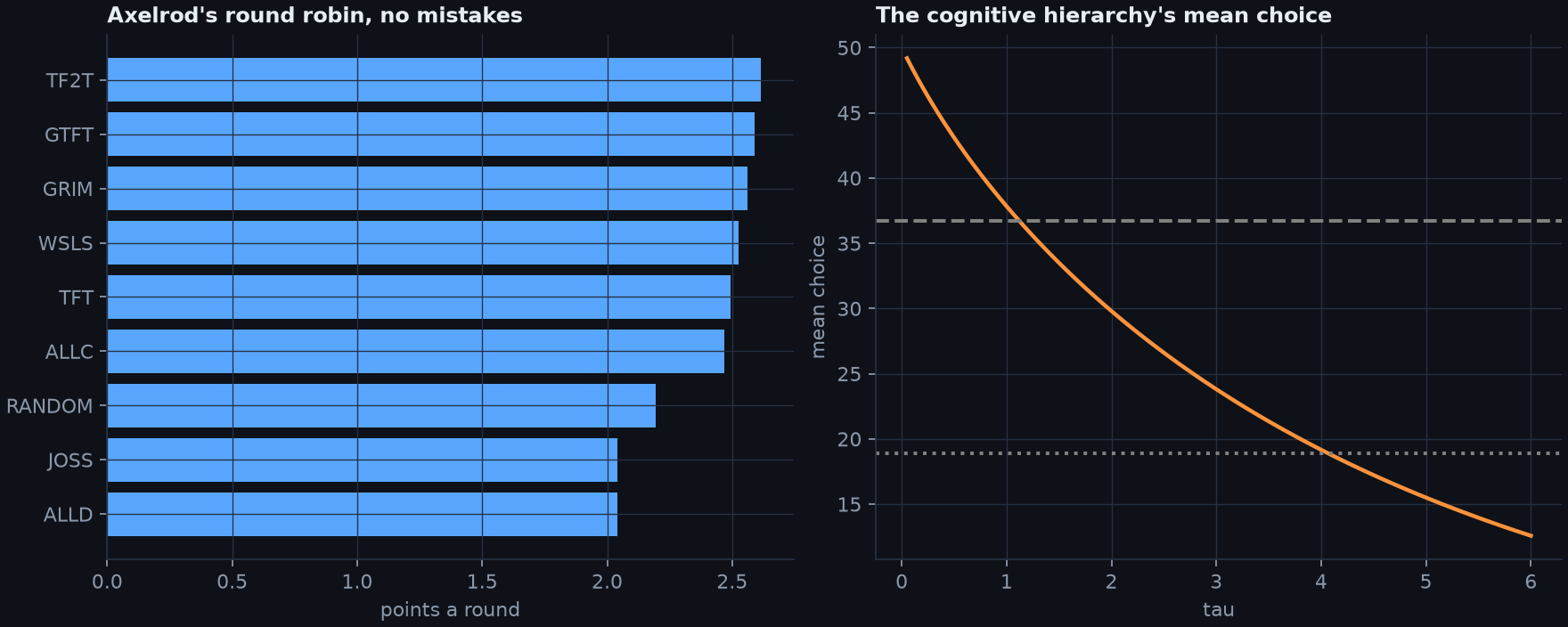
Agora reruns the idea with nine classic strategies, each meeting every other, and a copy of itself, for two hundred rounds. In this field tit for two tats comes first and tit for tat fifth, just as Axelrod warned: the ranking depends on the field. But look at the pattern. The nice strategies, in green, take the top six places; always defecting comes last. Axelrod also ran an ecological version: let each strategy's share of the population grow in proportion to its score, generation after generation. Generation after generation the exploiters shrink, because the strategies they feed on are outnumbered by ones that punish them, and the nice strategies take over.
Real relationships have accidents: a misunderstanding, a missed delivery. Here is tit for tat against itself, with one move in round five coming out wrong. One slip, and tit for tat echoes it: each punishes the other's punishment, round after round, for ever, unless another accident breaks the cycle. A different rule, win-stay, lose-shift, repeats its move if the last round went well and switches if it didn't. After the slip, both defect once, both switch back, and cooperation is repaired in two rounds. Run the whole round robin with five percent of moves mistaken, and win-stay, lose-shift comes first, with tit for tat fifth. Martin Nowak and Karl Sigmund showed in 1993 that in a noisy world, strategies that forgive and repair beat strict reciprocity.
What it does: Fourteen programs, 200 rounds; tit for tat (Rapoport) wins, and again among more than sixty; nice, retaliatory, forgiving, clear; tit for two tats would have won; Agora's nine strategies: tit for two tats first, tit for tat fifth, the nice ones on top; the ecology; one mistake in round 5: tit for tat echoes it, win-stay lose-shift repairs it in two rounds; with 5% mistakes win-stay lose-shift wins (Nowak and Sigmund 1993)
10Focal points and correlated equilibriumPrinciples and the major2 min
Thomas Schelling studied how people choose among equilibria, with questions that have many right answers, as long as two people give the same one. You must meet a stranger in New York tomorrow, and neither of you can contact the other. Where do you go, and when? The commonest answer among his students was noon, at the information booth in Grand Central Station. Heads or tails? Most say heads. Name a positive number: one. Divide a hundred dollars: in half. Schelling called such an outcome a focal point: an equilibrium that stands out because of what the players have in common. Theory says which outcomes are stable; culture, history and salience pick among them.
Sometimes something outside the game can coordinate the players better than they can alone. Two drivers reach a crossing at once. It is chicken again: each would like to go while the other stops, and if both go they crash. The pure equilibria have one driver always giving way: seven for one, two for the other. The mixed equilibrium is fair, but each goes a third of the time, crashes happen, and each expects four and two thirds. Now add a traffic light that picks one of three signals at random and tells each driver only their own colour: Ana go and Bo stop a quarter of the time, the reverse a quarter of the time, both stop half the time, and never both go. A driver told to stop knows the other is going one time in three, which makes stopping as good as going; a driver told to go knows the other has been told to stop. Obeying the light is an equilibrium, and each driver expects five and a quarter, better than the mixed equilibrium, and fair. Robert Aumann called it a correlated equilibrium in 1974. Traffic lights, conventions and even prices can play the role of the light.
What it does: Schelling (1960): noon at Grand Central, heads, one, half; chicken at a crossing: pure 7 and 2, mixed 4.67 each; a light with (0, 1/4, 1/4, 1/2): obedience is an equilibrium worth 5.25 each (Aumann 1974)
11Evolution and learningPrinciples and the major2 min
Equilibrium can also be reached without anyone reasoning at all. In 1973 John Maynard Smith and George Price applied game theory to animals contesting a prize worth two, where a fight costs four. Hawks always fight; doves share with other doves and back down before hawks. No animal thinks. Strategies that earn more just leave more offspring, and become more common. Follow that rule, the replicator dynamic, and from any starting mixture the population settles at half hawks and half doves, the share where both earn the same. Maynard Smith and Price called it an evolutionarily stable strategy: a population playing it cannot be invaded by a rare mutant. It is a Nash equilibrium, reached by selection instead of thought.
Selection doesn't always settle. In rock, paper, scissors each strategy beats one and loses to another. Its only equilibrium is a third of each. But under the replicator dynamic a population that starts anywhere else never gets there: rock spreads until paper is profitable, paper spreads until scissors is, and so round and round, a closed orbit about the equilibrium. Barry Sinervo and Curt Lively found male side-blotched lizards in California cycling like this, through three mating strategies, over the years. Evolution can find an equilibrium, or circle it for ever, as Scarf's prices did in Part nine.
People learn, too. In 1951 George Brown proposed fictitious play: in each round, each player plays the best response to how often the other has played each move so far. In matching pennies, where one player wants to match and the other to mismatch, the running frequencies swing back and forth, and narrow onto a half each, the mixed equilibrium. The same year Julia Robinson proved that in any two-player game of pure conflict, fictitious play converges. But in 1964 Lloyd Shapley found a game with three strategies where it cycles for ever. Which learning rules do reach equilibrium, and how quickly, turned out to matter far beyond economics, as the frontier chapter shows.
What it does: Hawk and dove (prize 2, cost 4): the replicator settles at half hawks, an ESS (Maynard Smith and Price 1973); rock-paper-scissors orbits; Sinervo and Lively's lizards (1996); fictitious play on matching pennies (Brown 1951; Robinson 1951; Shapley 1964)
12Levels of thinking, fittedResearch2 min
If equilibrium is the wrong guess for first-time play, what is the right one? A family of models assumes that people think a limited number of steps ahead. A level-nought player chooses at random, so level noughts average fifty. A level-one player best responds to level noughts, and chooses thirty-three. In Colin Camerer, Teck-Hua Ho and Juin-Kuan Chong's cognitive hierarchy, a level-two player responds to a mixture of level noughts and level ones, and so on up. How many players there are at each level follows a Poisson distribution, with an average number of steps called tau. With tau of one and a half, most players are at levels one and two, and the population averages about thirty-three and a half. Dale Stahl and Paul Wilson, and Nagel, proposed level models in the mid-nineties; the cognitive hierarchy is from 2004.
The model makes a prediction for every value of tau, so it can be fitted to data. The more steps people take, the lower the average choice. Nagel's students averaged thirty-six point seven three, which the model matches with tau of one point one two. The Financial Times' readers averaged eighteen point nine: tau of about four. Across nearly a hundred games, Camerer, Ho and Chong found that values between one and two fit well, and one and a half is typical. Readers who had days to think, and chose to enter a newspaper contest, went several steps further than students in a classroom.
Called it? Game theory's prediction for the guessing game is that everyone chooses nought, the only Nash equilibrium, reached by eliminating dominated choices round after round. In Nagel's first rounds the average was thirty-six point seven three, and the winning target about twenty-four; among the Financial Times' readers the average was eighteen point nine, and the winning number thirteen. Wrong, as a forecast of what people do the first time. But when Nagel's students played again, their choices fell round by round toward nought. Equilibrium describes where learning goes, not where it starts.
What it does: Level 0 at random, level 1 at 33, the cognitive hierarchy with Poisson \(\tau\); \(\tau = 1.5\) gives a mean of 33.5; fits: Nagel's 36.73 needs \(\tau = 1.12\), the FT's 18.9 \(\tau = 4.07\); Camerer, Ho and Chong: 1 to 2 across nearly 100 games; Called it?: everyone chooses 0, wrong the first time, right as the destination of learning
13Games of incomplete informationGraduate2 min
So far every player has known the others' payoffs. Often they don't. Bo is thinking of fishing Ana's grounds. If he enters, Ana can fight him or share. Only Ana knows whether she is the tough kind, for whom fighting pays, or the weak kind, who would rather share. Bo thinks she is tough with chance three in ten. John Harsanyi showed in 1967 how to analyze such games: treat what you don't know as a move by nature, which picks the other player's type with known chances. A strategy is then a plan for every type, and each player best-responds given their beliefs. Here the equilibrium is that a tough Ana fights, a weak Ana shares, and Bo, expecting a fight only three times in ten, enters.
What Bo does depends on what he believes. Entering gains two if Ana shares and loses two if she fights, so his expected gain falls as his belief that she is tough rises. He enters as long as that belief is below one half. Which means a weak Ana would like Bo to think she is tough, and a tough Ana would like to prove it: beliefs become something players compete to shape. Signalling and reputation are Part thirteen; bidding when you don't know the others' values, Part sixteen; and choosing what others get to know, Part fifty-three.
What it does: Bo and Ana's fishing grounds: Ana tough with chance 0.3; Harsanyi's types; the Bayesian Nash equilibrium (tough fights, weak shares, Bo enters); Bo enters while the chance is below 0.5; pointers to Parts 13, 16 and 53
14The Dials: how deeply do people think?Graduate2 min
How many steps people take matters well beyond the laboratory. John Maynard Keynes described the stock market in 1936 as a newspaper competition to pick, from a hundred photographs, the faces that the other competitors would find prettiest. We have reached the third degree, he wrote, where we devote our intelligences to anticipating what average opinion expects the average opinion to be; and some, he believed, practise the fourth, fifth and higher degrees. The guessing game is his contest with numbers, which is why economists call it a beauty contest. If traders reason only a step or two about each other, prices can drift from what anyone believes they are worth, a theme of Parts twenty-three and thirty-three.
This part opens a dial for how deeply people reason about each other. Across nearly a hundred experimental games, Camerer, Ho and Chong found that an average of between one and two steps of thinking fits best, typically one and a half. Agora's fits put Nagel's students at about one point one, and the Financial Times' readers at about four. Equilibrium assumes infinitely many steps. Real people take one or two, and more when they have time, stakes and practice. So the dial depends on the setting. For first-time play, levels of thinking predict better than equilibrium; for experienced players in a stable game, equilibrium does well. Part forty-five returns to it.
What it does: Keynes's beauty contest (1936, ch. 12); the new dial: Camerer, Ho and Chong 1.5 (1-2), Nagel's students 1.12, the FT's readers 4.07: depends on the setting
15In practice: bargaining, standards and arms controlPractice3 min
Game theory earns its keep in a few big applications. The first is bargaining. In Ariel Rubinstein's model of 1982, two parties split a pie by taking turns to make offers, and each round of delay shrinks the pie by a factor delta. The only subgame-perfect outcome is an immediate agreement, giving the first proposer one over one plus delta. With delta of nought point nine, that is fifty-two point six percent, agreed at once. Patience is power: the more costly delay is for you, the less you get. As delay costs vanish, the split tends to a half, the answer of the bargaining solution Nash proposed in 1950. Models like this frame wage negotiations, mergers and the terms of peace.
The second is standards. Which side of the road to drive on is a coordination game with two equilibria. No single driver gains by switching, so whichever equilibrium a country is in, it stays. Sweden drove on the left until the third of September 1967, when at five in the morning the whole country switched to the right, a move only possible because everyone made it at once. Plugs, railway gauges, file formats and currencies stick in the same way, because each user's best choice depends on what everyone else uses. Part forty-four takes that idea to networks and platforms.
The third is arms control, and it returns to the intermission. An arms race is a prisoner's dilemma played every year: each side builds, whatever the other does, and both end up less safe and poorer. In 1961 Thomas Schelling and Morton Halperin argued that arms control is a bargain between adversaries, kept only because keeping it serves each side. What makes such a bargain hold is what makes cooperation hold in a repeated game: each side can see what the other does, by satellite and inspection, and both have a future worth protecting. Signing the treaty on intermediate-range missiles in 1987, Ronald Reagan quoted a Russian proverb: trust, but verify. Together the two stockpiles peaked at about sixty-three thousand warheads in 1986. The estimate for 2026 is about eight thousand.
What it does: Rubinstein (1982): the first proposer's share \(1/(1+\delta)\), 52.6% at 0.9; Nash's bargaining solution (1950); Sweden's switch to the right, 3 September 1967; arms races as repeated dilemmas, Schelling and Halperin (1961), "trust, but verify" (1987); the stockpiles' total, 63,476 in 1986 and 8,100 in 2026
16Frontier: learning to play at scaleResearch3 min
The frontier of this part is computational: how to find equilibria of games far too large to solve by hand. Much of the answer is a learning rule. Your regret for a move is how much better you would have done, so far, by always playing it. In Sergiu Hart and Andreu Mas-Colell's regret matching, published in 2000, you play each move with probability proportional to its positive regret. Agora runs it on rock, paper, scissors against itself: the average strategy wanders and then settles at a third each, and after twenty thousand rounds the regret per round is under a hundredth. In any game, average play under regret matching approaches the set of correlated equilibria of chapter ten; in two-player zero-sum games, Nash equilibrium itself.
Scaled up, regret minimization has solved games no person could. Poker is a game of incomplete information, like chapter thirteen's: each player hides their cards. Its game tree is astronomically large, so no one can write its equilibrium down. In 2015 Michael Bowling, Neil Burch, Michael Johanson and Oskari Tammelin announced that heads-up limit Texas hold'em was essentially solved, by a regret-minimization algorithm called CFR plus. In January 2017 Noam Brown and Tuomas Sandholm's program Libratus beat four top professionals at the much larger no-limit game, over a hundred and twenty thousand hands. The strategies found by self-play bluff, and can't be exploited by much, which is what an equilibrium promises. In 2019 the same team's Pluribus beat professionals at six-player poker. How these algorithms work is told in AI, Built.
Open questions follow. Do people learn like this? Models of reinforcement, by Ido Erev and Alvin Roth, and Camerer and Ho's experience-weighted attraction, fit how laboratory subjects learn better than equilibrium predicts their play. When pricing algorithms play each other in real markets, which equilibrium do they find? Part ten met the worry, and Parts twelve and forty-four return to it. Computing a Nash equilibrium is hard in general, as Part nine's frontier showed, but learning finds coarser equilibria quickly. And designers can build markets and auctions that work even when nobody computes an equilibrium at all, the subject of Parts sixteen and seventeen.
What it does: Regret matching (Hart and Mas-Colell 2000) on rock-paper-scissors: a third each, regret 0.009 a round after 20,000 rounds; heads-up limit hold'em essentially solved by CFR+ (Bowling et al. 2015); Libratus (2017): four professionals, 120,000 hands; Pluribus (2019); open questions: Erev and Roth, Camerer and Ho, algorithms in markets, design
Recap, problems, and the road aheadAll tracks3 min
So: what happens when my best choice depends on yours, and yours on mine? Each of us predicts the other, and an equilibrium is where those predictions come true, so that nobody can do better alone. Selfishness can trap everyone, as in the prisoner's dilemma. But a future worth protecting, the ability to see what the other does, and a little forgiveness can sustain cooperation. And real people reason only a step or two ahead the first time, and learn their way toward equilibrium.
Part eleven in twelve lines. Flood and Dresher's players cooperated in sixty of a hundred rounds, against the theory. The guessing game's equilibrium is nought, but people average between about twenty and forty. Dominance rules out bad choices, one layer of knowledge at a time. A Nash equilibrium is where best responses cross, and one always exists. Coordination, the battle of the sexes, chicken and the stag hunt have several equilibria each, and the best may need trust. Mixed strategies leave the other side indifferent, and professional footballers play them. Backward induction rules out empty threats. In the centipede and the ultimatum game, people pass, and offer close to half. Repetition sustains cooperation when the future matters enough, and the folk theorem allows almost anything. Axelrod's winners were nice, retaliatory and forgiving, and with mistakes, win-stay, lose-shift did best. Focal points and traffic lights pick among equilibria; evolution and learning can find them, or circle them. And people think one to four steps ahead, while machines now solve poker.
The problems. Why nought is the guessing game's only equilibrium; the penalty kick's mixtures; the battle of the sexes; the entry game's two equilibria; when tit for tat is an equilibrium; the traffic light's obedience constraints; Rubinstein's split; and a starred problem on the cognitive hierarchy. Full solutions are in the part's notes.
The reading: Osborne's introduction, and Osborne and Rubinstein's course; the first five chapters of Fudenberg and Tirole, and Gibbons's primer; Schelling's Strategy of Conflict and Axelrod's Evolution of Cooperation; and Camerer's Behavioral Game Theory. Then the papers, from von Neumann to the poker programs.
Ana and Bo played for fish. Firms play for markets. Next time, a repeated game caught on tape: from 1992, with the help of an informant inside the company, the FBI secretly filmed executives of Archer Daniels Midland and their rivals from Japan and Korea agreeing on the world price of lysine, an additive for animal feed. Part twelve: competition among the few.
Where it goes next. Part 12 applies the tools to oligopoly and cartels; Parts 13-14 to signals, screening and incentives; Parts 16-17 to auctions and market design; Part 44 to networks and platforms; Part 45 to fairness and limited reasoning; Part 53 to information design.
Key results
The part's results in one place, for revision.
Try it
Lab 11 · Games: equilibrium, repetition, learning and levels of thinking
Find every equilibrium of the battle of the sexes by support enumeration; solve the penalty kick by indifference; solve the entry game and the centipede by backward induction; find grim trigger's threshold and the folk theorem's region; run Axelrod's tournament with and without mistakes; compute chicken's best correlated equilibrium; watch the replicator and regret matching; and fit the cognitive hierarchy to the guessing game's means.
python -m videos.economics.labs 11
needs numpy, scipy, matplotlib · download lab11.py ·
source on GitHubbattle of the sexes: equilibria (Pr Ana regatta, Pr Bo regatta) (1.000, 1.000); (0.000, 0.000); (0.667, 0.333)
penalty: kicker left, keeper left, scoring rate 0.383, 0.417, 0.796
entry game and centipede: subgame-perfect paths enter then accommodate; take at once
grim trigger's threshold; the minmax point 0.50; (1.0, 1.0)
tournament winners: without and with 5% mistakes TF2T, WSLS
tit for tat's rank: without and with mistakes 5, 5
chicken: mixed equilibrium against the best correlated one (each) 4.667 against 5.250
hawk and dove: share of hawks after the replicator 0.5000 (V/C = 0.50)
regret matching on rock-paper-scissors: average strategy; regret a round 0.331, 0.336, 0.333; 0.0087
cognitive hierarchy: tau for Nagel's 36.73 and the FT's 18.9 1.12, 4.07
Three equilibria in the battle of the sexes, one of them mixed; the penalty kick scores the same either way in equilibrium; backward induction rules out the empty threat and unravels the centipede; cooperation needs patience of one half; the forgiving strategies win the tournament, and repair beats reciprocity once there are mistakes; the traffic light beats mixing; the replicator finds the hawks' stable share; regret matching finds the rock-paper-scissors equilibrium; and people think one to four steps ahead.The code (107 lines; it asserts its own result)
"""Lab 11: games: dominance, Nash equilibria, mixing, backward induction, repetition, learning and levels of
thinking."""

import numpy as np

from videos.coursekit import labs
from explainer.economics.agora import games as gm
from explainer.economics.island import truths

TITLE = "Games: equilibrium, repetition, learning and levels of thinking"
GOAL = ("Find every equilibrium of the battle of the sexes by support enumeration; solve the penalty kick by "
        "indifference; solve the entry game and the centipede by backward induction; find grim trigger's threshold "
        "and the folk theorem's region; run Axelrod's tournament with and without mistakes; compute chicken's best "
        "correlated equilibrium; watch the replicator and regret matching; and fit the cognitive hierarchy to the "
        "guessing game's means.")
TASKS = [
    "Tournament: add a strategy to games.STRATEGIES that cooperates unless the other defected twice in the last three "
    "rounds. Where does it rank with and without 5% noise?",
    "The penalty: make the kicker's natural side more accurate (score 0.98 when the keeper guesses wrong). How do the "
    "kicker's and the keeper's mixtures move? Which one changes more, and why (the indifference principle)?",
    "The guessing game: refit tau when p = 1/2, using Nagel's first-round mean of 27.05. Is it deeper or shallower "
    "than the 2/3 sessions?",
]


def _bimatrix(cells):
    A = np.array([[cells[0][0], cells[1][0]], [cells[2][0], cells[3][0]]], float)
    B = np.array([[cells[0][1], cells[1][1]], [cells[2][1], cells[3][1]]], float)
    return A, B


def run(seed=0):
    lab = labs.Lab()
    T = truths(11)

    # Nash equilibria
    A, B = _bimatrix(T["grammar"]["battle"])
    eqs = gm.support_enumeration(A, B)
    assert len(eqs) == 3
    lab.row("battle of the sexes: equilibria (Pr Ana regatta, Pr Bo regatta)",
            "; ".join(f"({e['p'][0]:.3f}, {e['q'][0]:.3f})" for e in eqs))
    pd = T["pd"]
    P = np.array([[pd["R"], pd["S"]], [pd["T"], pd["P"]]])
    assert gm.pure_nash(P, P.T) == [(1, 1)]

    # mixing
    S = np.array(T["penalty"]["score"])
    m = gm.mixed_2x2(S, 1 - S)
    lab.row("penalty: kicker left, keeper left, scoring rate", f"{m['p']:.3f}, {m['q']:.3f}, {m['row_payoff']:.3f}")

    # trees
    e = T["entry"]
    bi = gm.backward_induction(gm.entry_game(e["fight"], e["accommodate"], e["stay_out"]))
    c = T["centipede"]
    ci = gm.backward_induction(gm.centipede(c["moves"], c["start"], c["grow"]))
    lab.row("entry game and centipede: subgame-perfect paths", f"{' then '.join(bi['path'])}; {ci['path'][0]} at once")

    # repetition
    thr = gm.grim_threshold(pd["T"], pd["R"], pd["P"], pd["S"])
    fr = gm.folk_region(P, P.T)
    lab.row("grim trigger's threshold; the minmax point", f"{thr:.2f}; {fr['minmax']}")
    t = T["tournament"]
    clean = gm.tournament(t["field"], t["rounds"], 0.0, t["repeats"], t["seed"])
    noisy = gm.tournament(t["field"], t["rounds"], t["noise"], t["repeats"], t["seed"])
    lab.row("tournament winners: without and with 5% mistakes", f"{clean['ranking'][0]}, {noisy['ranking'][0]}")
    lab.row("tit for tat's rank: without and with mistakes",
            f"{clean['ranking'].index('TFT') + 1}, {noisy['ranking'].index('TFT') + 1}")

    # coordination, evolution, learning
    A, B = _bimatrix(T["grammar"]["chicken"])
    ce = gm.correlated_equilibrium(A, B)
    mixed = gm.mixed_2x2(A, B)
    assert ce["row_payoff"] > mixed["row_payoff"]
    lab.row("chicken: mixed equilibrium against the best correlated one (each)",
            f"{mixed['row_payoff']:.3f} against {ce['row_payoff']:.3f}")
    h = T["hawkdove"]
    HD = np.array([[(h["V"] - h["C"]) / 2, h["V"]], [0, h["V"] / 2]])
    x = gm.replicator(HD, [0.1, 0.9], T=60)
    lab.row("hawk and dove: share of hawks after the replicator", f"{x[-1][0]:.4f} (V/C = {h['V'] / h['C']:.2f})")
    R = np.array([[0, -1, 1], [1, 0, -1], [-1, 1, 0]], float)
    rm = gm.regret_matching(R, -R, rounds=20000, seed=seed + 2000)
    lab.row("regret matching on rock-paper-scissors: average strategy; regret a round",
            ", ".join(f"{v:.3f}" for v in rm["row"][-1]) + f"; {rm['regret_row']:.4f}")

    # levels of thinking
    t_n, t_f = gm.fit_tau(36.73), gm.fit_tau(18.9)
    lab.row("cognitive hierarchy: tau for Nagel's 36.73 and the FT's 18.9", f"{t_n:.2f}, {t_f:.2f}")
    assert t_f > t_n
    lab.note = ("Three equilibria in the battle of the sexes, one of them mixed; the penalty kick scores the same "
                "either way in equilibrium; backward induction rules out the empty threat and unravels the centipede; "
                "cooperation needs patience of one half; the forgiving strategies win the tournament, and repair "
                "beats reciprocity once there are mistakes; the traffic light beats mixing; the replicator finds the "
                "hawks' stable share; regret matching finds the rock-paper-scissors equilibrium; and people think one "
                "to four steps ahead.")

    fig, ax = labs.figure(2, size=(11, 4.4))
    sc = np.array(clean["score"])
    order = np.argsort(-sc)
    ax[0].barh([clean["names"][i] for i in order][::-1], sc[order][::-1], color=labs.BLUE)
    ax[0].set(title="Axelrod's round robin, no mistakes", xlabel="points a round")
    taus = np.linspace(0.05, 6, 120)
    ax[1].plot(taus, [gm.cognitive_hierarchy(v)["mean"] for v in taus], color=labs.ORANGE, lw=2)
    ax[1].axhline(36.73, color="grey", ls="--")
    ax[1].axhline(18.9, color="grey", ls=":")
    ax[1].set(title="The cognitive hierarchy's mean choice", xlabel="tau", ylabel="mean choice")
    lab.fig = fig
    return lab
Now change it
- Tournament: add a strategy to games.STRATEGIES that cooperates unless the other defected twice in the last three rounds. Where does it rank with and without 5% noise?
- The penalty: make the kicker's natural side more accurate (score 0.98 when the keeper guesses wrong). How do the kicker's and the keeper's mixtures move? Which one changes more, and why (the indifference principle)?
- The guessing game: refit tau when p = 1/2, using Nagel's first-round mean of 27.05. Is it deeper or shallower than the 2/3 sessions?
Problems, with solutions
Try each problem before opening its solution.
1. The guessing game: with \(n \ge 2\) players choosing from \([0, 100]\) and \(p < 1\), show that everyone choosing 0 is the only Nash equilibrium.
Solution
Everyone at 0 is an equilibrium: a player who moves to \(x > 0\) moves the target to \(px/n\), and is then \(x - px/n\) from it while the others are only \(px/n\) away, so the deviator loses. Now take any equilibrium. A player who is not among the winners gets nothing, but can always move exactly onto the target the move creates: choosing $x' = p(S - x)/(n - p)$, where \(S\) is the old sum and \(x\) the old number, makes \(x'\) equal to \(p\) times the new mean, which wins or ties and gets something. So in an equilibrium everyone is a winner, all equally close to the target \(t\), so every choice is \(t - d\) or \(t + d\). If \(d > 0\), a player at \(t + d\) can do the same trick and win alone; so \(d = 0\) and everyone chooses the same \(x\). If \(x > 0\) the target is \(px < x\), and a player who moves slightly down is closest alone and takes the whole prize. Hence \(x = 0\).
2. The penalty: for scoring chances \(\begin{pmatrix} a & b \\ c & d \end{pmatrix}\) (rows: kick left, right; columns: dive left, right), find both mixtures by indifference, and check 0.383, 0.417 and 0.796.
Solution
The keeper dives left with probability \(q\) that makes the kicker indifferent: $aq + b(1 - q) = cq + d(1 - q)$, so \(q = \frac{d - b}{a - b - c + d}\). The kicker kicks left with probability \(p\) that makes the keeper indifferent: \(ap + c(1 - p) = bp + d(1 - p)\), so \(p = \frac{d - c}{a - b - c + d}\). With $a, b, c, d = 0.58, 0.95, 0.93, 0.70$: the denominator is \(-0.60\), so \(q = -0.25/-0.60 = 0.417\) and \(p = -0.23/-0.60 = 0.383\), and the scoring rate is \(0.58 \times 0.417 + 0.95 \times 0.583 = 0.796\).
3. The battle of the sexes: find all three equilibria, and show the mixed one gives each player less than either pure one.
Solution
With payoffs (2, 1) at the regatta, (1, 2) at the market and (0, 0) apart, both pure profiles where they meet are equilibria. In the mixed one, Bo goes to the regatta with \(q\) that makes Ana indifferent: \(2q = 1 - q\), \(q = 1/3\); Ana with \(p\) that makes Bo indifferent: \(p = 2(1 - p)\), \(p = 2/3\). Ana then expects \(2q = 2/3\) and Bo \(p = 2/3\), less than the 1 each gets in the pure equilibrium they like less.
4. Entry: find every Nash equilibrium of chapter 6's game in strategic form, and show that only one is subgame perfect.
Solution
Dara chooses enter or stay out; Crusoe chooses a plan, share or fight if Dara enters. The payoffs are (enter, share) = (1, 1), (enter, fight) = (-1, -1), and (stay out, either) = (0, 4). (Enter, share) is an equilibrium: Dara gets 1 > 0, and Crusoe 1 > -1. (Stay out, fight) is too: Dara gets 0 > -1, and Crusoe's plan is never tested, so he is indifferent. The remaining profiles fail: against share, staying out gives Dara 0 < 1; against fight, entering gives her -1 < 0. In the subgame after entry, Crusoe's only best move is to share, so only (enter, share) is subgame perfect.
5. Tit for tat: with Axelrod's payoffs, show that tit for tat against itself is an equilibrium only if \(\delta \ge \tfrac{T-R}{R-S} = \tfrac23\).
Solution
Against tit for tat, a player's future depends only on their last move, so two deviations need checking. Defecting for ever gives \(T + \delta P/(1 - \delta)\) against \(R/(1 - \delta)\) for cooperating: it does not pay if \(\delta \ge (T - R)/(T - P) = 1/2\). Alternating defect, cooperate, defect, ... gets \(T, S, T, S, \dots\), worth \((T + \delta S)/(1 - \delta^2)\); this does not pay if \(T + \delta S \le R(1 + \delta)\), that is \(\delta \ge (T - R)/(R - S) = 2/3\). Both conditions hold, and so tit for tat is an equilibrium, only for \(\delta \ge 2/3\).
6. The traffic light: check that the distribution \((0, \tfrac14, \tfrac14, \tfrac12)\) on (go, go), (go, stop), (stop, go), (stop, stop) in chicken satisfies every obedience constraint, and gives each driver 5.25.
Solution
With payoffs go/go 0, go/stop 7, stop/go 2, stop/stop 6 to the row driver: told go (probability 1/4), the other has been told stop, so going gives 7 and stopping 6: obey. Told stop (probability 3/4), the other was told go with chance \(\tfrac{1/4}{3/4} = 1/3\) and stop with chance \(2/3\): stopping gives \(\tfrac13 \cdot 2 + \tfrac23 \cdot 6 = 14/3\) and going \(\tfrac13 \cdot 0 + \tfrac23 \cdot 7 = 14/3\), so obeying is (weakly) best. Each expects \(\tfrac14 \cdot 7 + \tfrac14 \cdot 2 + \tfrac12 \cdot 6 = 5.25\).
7. Rubinstein: with patience \(\delta\) for both, derive the first proposer's share \(\frac{1}{1+\delta}\).
Solution
Look for a stationary equilibrium in which each proposer offers the other just what they would get by waiting to propose next round, and the offer is accepted. If a proposer keeps \(x\), the responder, who would keep \(x\) next round, accepts any share of at least \(\delta x\) now. So the proposer keeps \(x = 1 - \delta x\), giving \(x = 1/(1 + \delta)\). (Rubinstein shows this is the only subgame-perfect equilibrium.) At \(\delta = 0.9\), \(x = 0.526\).
8. ★ The cognitive hierarchy: find level 2's choice for \(\tau = 1.5\), and show that the population's mean falls as \(\tau\) rises.
Solution
With \(f_k = e^{-\tau}\tau^k/k!\), level 2 believes the others are level 0 or 1 in proportions \(f_0 : f_1 = 1 : \tau\), so it chooses \(\tfrac23 \cdot \frac{50 + 1.5 \times 33.3}{2.5} = 26.67\). Level 1 chooses 33.3, and every level \(k \ge 1\) chooses two-thirds of a mixture of lower levels' choices, so the choices fall with \(k\) (each is two-thirds of an average of larger numbers). Raising \(\tau\) moves weight from lower levels to higher ones (the Poisson family is ordered by stochastic dominance), and the choices of the levels themselves fall as more weight on higher levels enters each level's beliefs; both effects lower the mean. Agora finds 33.5 at \(\tau = 1.5\), and the fits of chapter 12 invert this falling curve.
Notes and sources
Where it comes back
| Idea | Parts |
|---|---|
| Oligopoly, cartels and collusion | 12 Competition among the Few |
| Signals, reputation, screening | 13 Lemons and Signals, 14 Incentives |
| Public goods and climate | 15 Spillovers, 48 Environment and Climate |
| Auctions and markets by design | 16 Auctions, 17 Markets by Design |
| Beauty contests and asset prices | 23 Capital and Asset Prices, 33 Crises |
| Networks and platforms | 44 Dynamics, Platforms and Antitrust |
| Fairness, anger and limited thinking | 45 Behavioural Economics |
| Information design | 53 Information and Persuasion |
Sources
- M. M. Flood, "Some Experimental Games", RAND RM-789-1 (1952), and Management Science 5(1) (1958); W. Poundstone, Prisoner's Dilemma (1992); the Stanford Encyclopedia of Philosophy, "Prisoner's Dilemma".
- J. von Neumann, "Zur Theorie der Gesellschaftsspiele", Mathematische Annalen 100 (1928); J. F. Nash, "Equilibrium Points in n-Person Games", PNAS 36(1) (1950) 48-49; "Non-Cooperative Games", Annals of Mathematics 54(2) (1951); "The Bargaining Problem", Econometrica 18(2) (1950).
- R. Nagel, "Unraveling in Guessing Games: An Experimental Study", American Economic Review 85(5) (1995) 1313-1326; R. Thaler's Financial Times contest (1997), as reported in Chicago Booth Review (2015).
- R. Gibbons, A Primer in Game Theory (1992); M. Osborne, An Introduction to Game Theory (2004); M. Osborne and A. Rubinstein, A Course in Game Theory (1994); D. Fudenberg and J. Tirole, Game Theory (1991).
- P.-A. Chiappori, S. Levitt and T. Groseclose, "Testing Mixed-Strategy Equilibria When Players Are Heterogeneous: The Case of Penalty Kicks in Soccer", American Economic Review 92(4) (2002); I. Palacios-Huerta, "Professionals Play Minimax", Review of Economic Studies 70(2) (2003); M. Walker and J. Wooders, "Minimax Play at Wimbledon", American Economic Review 91(5) (2001).
- R. Selten, "Spieltheoretische Behandlung eines Oligopolmodells mit Nachfrageträgheit", Zeitschrift für die gesamte Staatswissenschaft 121 (1965), and "The Chain Store Paradox", Theory and Decision 9 (1978); R. Rosenthal, "Games of Perfect Information, Predatory Pricing and the Chain-Store Paradox", Journal of Economic Theory 25 (1981); R. McKelvey and T. Palfrey, "An Experimental Study of the Centipede Game", Econometrica 60(4) (1992).
- W. Güth, R. Schmittberger and B. Schwarze, "An Experimental Analysis of Ultimatum Bargaining", Journal of Economic Behavior and Organization 3(4) (1982); J. Henrich et al., "In Search of Homo Economicus", American Economic Review 91(2) (2001).
- J. Friedman, "A Non-cooperative Equilibrium for Supergames", Review of Economic Studies 38(1) (1971); D. Fudenberg and E. Maskin, "The Folk Theorem in Repeated Games with Discounting or with Incomplete Information", Econometrica 54(3) (1986); D. Kreps, P. Milgrom, J. Roberts and R. Wilson, "Rational Cooperation in the Finitely Repeated Prisoners' Dilemma", Journal of Economic Theory 27(2) (1982); R. Selten and R. Stoecker, "End Behavior in Sequences of Finite Prisoner's Dilemma Supergames", Journal of Economic Behavior and Organization 7(1) (1986).
- R. Axelrod, "Effective Choice in the Prisoner's Dilemma" and "More Effective Choice in the Prisoner's Dilemma", Journal of Conflict Resolution 24 (1980), and The Evolution of Cooperation (1984); M. Nowak and K. Sigmund, "A Strategy of Win-Stay, Lose-Shift that Outperforms Tit-for-Tat", Nature 364 (1993).
- T. Schelling, The Strategy of Conflict (1960); T. Schelling and M. Halperin, Strategy and Arms Control (1961); R. Aumann, "Subjectivity and Correlation in Randomized Strategies", Journal of Mathematical Economics 1(1) (1974).
- J. Maynard Smith and G. Price, "The Logic of Animal Conflict", Nature 246 (1973); B. Sinervo and C. Lively, "The Rock-Paper-Scissors Game and the Evolution of Alternative Male Strategies", Nature 380 (1996); G. Brown, "Iterative Solution of Games by Fictitious Play" (1951); J. Robinson, "An Iterative Method of Solving a Game", Annals of Mathematics 54(2) (1951); L. Shapley, "Some Topics in Two-Person Games" (1964).
- D. Stahl and P. Wilson, "Experimental Evidence on Players' Models of Other Players", Journal of Economic Behavior and Organization 25(3) (1994); C. Camerer, T.-H. Ho and J.-K. Chong, "A Cognitive Hierarchy Model of Games", Quarterly Journal of Economics 119(3) (2004); C. Camerer, Behavioral Game Theory (2003); J. M. Keynes, The General Theory of Employment, Interest and Money (1936), ch. 12.
- J. Harsanyi, "Games with Incomplete Information Played by 'Bayesian' Players", Management Science 14 (1967-68); A. Rubinstein, "Perfect Equilibrium in a Bargaining Model", Econometrica 50(1) (1982).
- S. Hart and A. Mas-Colell, "A Simple Adaptive Procedure Leading to Correlated Equilibrium", Econometrica 68(5) (2000); M. Bowling, N. Burch, M. Johanson and O. Tammelin, "Heads-up Limit Hold'em Poker Is Solved", Science 347 (2015); N. Brown and T. Sandholm, "Superhuman AI for Heads-up No-limit Poker: Libratus Beats Top Professionals", Science 359 (2018), and "Superhuman AI for Multiplayer Poker", Science 365 (2019); I. Erev and A. Roth, "Predicting How People Play Games", American Economic Review 88(4) (1998); C. Camerer and T.-H. Ho, "Experience-Weighted Attraction Learning in Normal Form Games", Econometrica 67(4) (1999).
- Federation of American Scientists, "Estimated Global Nuclear Warhead Inventories" (2026), via Our World in Data.
About this partfrom its README
Part 11 of a sixty-eight-part course in economics (see the series plan and the syllabus), the third of Act III, Markets. It asks what happens when my best choice depends on yours, and yours on mine, and answers: each predicts the other, and an equilibrium is where those predictions come true, so that nobody can do better alone. Selfishness can trap everyone, as in the prisoner's dilemma, but a future worth protecting, the ability to see each other's moves, and forgiveness can sustain cooperation. Real people reason only a step or two ahead the first time, and learn their way toward equilibrium.
It opens at the RAND Corporation at the start of 1950, where Merrill Flood and Melvin Dresher had two colleagues, Armen Alchian and John Williams, play a new game a hundred times in a row. Defecting paid more whatever the other did, so John Nash's new equilibrium said: defect, every time. Both cooperated in 60 rounds and both defected in only 14 (Poundstone's count from Flood's 1952 report), and Nash replied that the experiment "really amounts to having the players play one large multimove game". That spring Albert Tucker told the game as a story about two prisoners. From there it covers:
- a game: guess two-thirds of the average (an Island crowd simulated by Agora; Nagel's students in 1995; the Financial Times' readers in 1997);
- the strategic form, dominance in the prisoner's dilemma, iterated elimination (Gibbons's example), and the guessing game's descent to 0;
- Nash equilibrium: the definition, best responses crossing three times in the battle of the sexes, and existence by a fixed point (Nash 1950, 1951; von Neumann 1928);
- coordination, the battle of the sexes, chicken and the stag hunt;
- mixed strategies and the indifference principle, tested on penalty kicks (Chiappori, Levitt and Groseclose 2002; Palacios-Huerta 2003) and Wimbledon serves (Walker and Wooders 2001);
- extensive form, backward induction and subgame perfection: an entry game with an empty threat (Selten 1965), and how threats are made credible;
- an intermission without narration: the American and Soviet (later Russian) nuclear stockpiles, 1945-2026, with the arms-control treaties;
- the centipede (Rosenthal 1981; McKelvey and Palfrey 1992) and the ultimatum game (Güth, Schmittberger and Schwarze 1982; Henrich et al. 2001);
- repeated games: grim trigger's threshold, the folk theorem's region (Friedman 1971; Fudenberg and Maskin 1986), and the finite horizon (Kreps, Milgrom, Roberts and Wilson 1982; Selten and Stoecker 1986);
- Axelrod's tournaments, Agora's rerun and ecology, and what one mistake does to tit for tat (Nowak and Sigmund 1993);
- focal points (Schelling 1960) and correlated equilibrium as a traffic light (Aumann 1974);
- evolution and learning: hawk and dove (Maynard Smith and Price 1973), rock-paper-scissors cycles (Sinervo and Lively 1996), fictitious play (Brown, Robinson 1951; Shapley 1964);
- levels of thinking: level-k and the cognitive hierarchy (Stahl and Wilson; Nagel; Camerer, Ho and Chong 2004) fitted to the guessing game, and Called it?: the Nash prediction of 0;
- a Bayesian game: is Ana tough? (Harsanyi 1967-68);
- a new dial (the depth of strategic reasoning) with Keynes's beauty contest; bargaining (Rubinstein 1982), Sweden's switch to driving on the right in 1967 and arms control in practice; and a frontier chapter on regret minimization, solved poker and Libratus.
What is computed and built
Everything plotted is computed by compute.py from Agora's games (explainer.economics.agora.games), with the
Island's Part 11 truths in explainer.economics.island, or from the Data Room or a transcribed table; the narration
states the cached numbers.
- Strategic form. Pure equilibria by checking best responses cell by cell; iterated elimination of strictly dominated pure strategies, recording the order; every equilibrium of a bimatrix game by support enumeration (the indifference equations solved on each pair of supports, then checked); 2x2 mixed equilibria in closed form.
- The guessing game. The cognitive hierarchy with Poisson(\(\tau\)) levels truncated at 30, level 0 uniform (mean 50), level \(k\) choosing two-thirds of the normalized mix of lower levels' choices; \(\tau\) fitted to a mean by Brent's method; the Island crowd: 67 draws of a level from the fitted \(\tau\), level 0 uniform on [0, 100], higher levels at the model's choice plus normal noise (sd 6), rounded and clipped.
- Trees. Backward induction on explicit trees (the entry game; McKelvey and Palfrey's four-move centipede).
- Repetition. Grim trigger's threshold in closed form; the feasible set as the convex hull of the four outcomes, clipped at the minmax; Axelrod's payoffs (5, 3, 1, 0); a round robin of nine strategies, each pair (and each with itself) five times for 200 rounds, with and without 5% of moves flipped; the ecology as the discrete replicator on the score matrix; the single-mistake picture by forcing one move in round 5.
- The rest. The best correlated equilibrium of chicken by linear programming over the obedience constraints (HiGHS); the replicator by Runge-Kutta; fictitious play on matching pennies for 1,500 rounds; regret matching for 20,000 rounds; Bayesian equilibria by checking every type-contingent plan; Rubinstein's share in closed form; the stockpiles from the Data Room, with the treaties' years.
Chapter notes
| # | Chapter | What it does |
|---|---|---|
| 0 | What happens when my best choice depends on yours, and yours on mine? | Flood and Dresher at RAND, 1950: Alchian and Williams, a hundred rounds; 60 both cooperated, 26 split, 14 both defected; Nash's comment; Tucker's prisoners; games everywhere (oligopoly, bidding, arms races, standards, bargaining, climate); the question; objectives |
| 1 | Play it: guess two-thirds of the average | The rules and a countdown; an Island crowd of 67 from the cognitive hierarchy (average 35.8, target 23.8, winner 24); where your number fell (50, 33, 22, 0); Nagel (1995): 67 students, 20 DM a round, mean 36.73, median 33, target about 24.5; the Financial Times (1997): mean 18.9, winner 13; the equilibrium 0 |
| 2 | Strategic form and dominance: how deep did you think? | The prisoner's dilemma (3, 0, 5, 1): defect dominates, both get 1 instead of 3; Gibbons's game: right, then down, then left eliminated, leaving up, middle; each step one more layer of "I know that you know"; the guessing game's bounds 66.7, 44.4, 29.6, 19.8, ... to 0; Nagel: only 6-10% of first choices three steps or more |
| 3 | Nash equilibrium | The definition and its inequality; best responses and correct beliefs; the battle of the sexes: pure equilibria and the mixed one (Ana 2/3, Bo 1/3, each 2/3); Nash (1950), Kakutani then Brouwer; von Neumann (1928); existence is not prediction |
| 4 | Coordination, the battle of the sexes, chicken and the stag hunt | Four 2x2 games with their pure equilibria framed; several equilibria; the stag hunt's trust; chicken's commitment; conventions as equilibria |
| 5 | Mixed strategies: the penalty kick | Exploitable predictability; the indifference principle; scoring chances 58, 95, 93, 70%: the kicker goes left 38%, the keeper 42%, scoring 79.6% either way; Chiappori, Levitt and Groseclose (2002); Palacios-Huerta (2003), 1,417 kicks; Walker and Wooders (2001); laboratory subjects alternate too much |
| 6 | Extensive form and subgame perfection | Dara's yard against Crusoe's: payoffs (0, 4), (1, 1), (-1, -1); backward induction: Crusoe shares, Dara enters; the strategic form's second equilibrium on an empty threat; Selten (1965); capacity, contracts, reputation (the chain store, 1978) |
| Intermission: two stockpiles | No narration: American and Soviet/Russian warheads, 1945-2026 (peaks 31,255 in 1967 and 40,159 in 1986), with the Partial Test Ban Treaty, SALT I, the INF Treaty, START I and New START marked; their total as a tune; the story so far | |
| 7 | The centipede and the ultimatum game | McKelvey and Palfrey's four-move centipede (0.40/0.10 doubling to 6.40/1.60): take at once in theory; hardly anyone took at the first chance; the ultimatum game: offer almost nothing in theory; Güth et al. (1982); Henrich et al.: mean offers 26-58% in fifteen societies, about 44% in industrial ones |
| 8 | Repeated games and the folk theorem | Grim trigger: cooperate forever \(R/(1-\delta)\) against deviate \(T + \delta P/(1-\delta)\); threshold \(\delta \ge 1/2\); the feasible region, the minmax (1, 1) and the folk theorem's region (Friedman 1971; Fudenberg and Maskin 1986); the finite horizon unravels in theory; Selten and Stoecker (1986); Kreps, Milgrom, Roberts and Wilson (1982) |
| 9 | Axelrod's tournaments | Fourteen programs, 200 rounds; tit for tat (Rapoport) wins, and again among more than sixty; nice, retaliatory, forgiving, clear; tit for two tats would have won; Agora's nine strategies: tit for two tats first, tit for tat fifth, the nice ones on top; the ecology; one mistake in round 5: tit for tat echoes it, win-stay lose-shift repairs it in two rounds; with 5% mistakes win-stay lose-shift wins (Nowak and Sigmund 1993) |
| 10 | Focal points and correlated equilibrium | Schelling (1960): noon at Grand Central, heads, one, half; chicken at a crossing: pure 7 and 2, mixed 4.67 each; a light with (0, 1/4, 1/4, 1/2): obedience is an equilibrium worth 5.25 each (Aumann 1974) |
| 11 | Evolution and learning | Hawk and dove (prize 2, cost 4): the replicator settles at half hawks, an ESS (Maynard Smith and Price 1973); rock-paper-scissors orbits; Sinervo and Lively's lizards (1996); fictitious play on matching pennies (Brown 1951; Robinson 1951; Shapley 1964) |
| 12 | Levels of thinking, fitted | Level 0 at random, level 1 at 33, the cognitive hierarchy with Poisson \(\tau\); \(\tau = 1.5\) gives a mean of 33.5; fits: Nagel's 36.73 needs \(\tau = 1.12\), the FT's 18.9 \(\tau = 4.07\); Camerer, Ho and Chong: 1 to 2 across nearly 100 games; Called it?: everyone chooses 0, wrong the first time, right as the destination of learning |
| 13 | Games of incomplete information | Bo and Ana's fishing grounds: Ana tough with chance 0.3; Harsanyi's types; the Bayesian Nash equilibrium (tough fights, weak shares, Bo enters); Bo enters while the chance is below 0.5; pointers to Parts 13, 16 and 53 |
| 14 | The Dials: how deeply do people think? | Keynes's beauty contest (1936, ch. 12); the new dial: Camerer, Ho and Chong 1.5 (1-2), Nagel's students 1.12, the FT's readers 4.07: depends on the setting |
| 15 | In practice: bargaining, standards and arms control | Rubinstein (1982): the first proposer's share \(1/(1+\delta)\), 52.6% at 0.9; Nash's bargaining solution (1950); Sweden's switch to the right, 3 September 1967; arms races as repeated dilemmas, Schelling and Halperin (1961), "trust, but verify" (1987); the stockpiles' total, 63,476 in 1986 and 8,100 in 2026 |
| 16 | Frontier: learning to play at scale | Regret matching (Hart and Mas-Colell 2000) on rock-paper-scissors: a third each, regret 0.009 a round after 20,000 rounds; heads-up limit hold'em essentially solved by CFR+ (Bowling et al. 2015); Libratus (2017): four professionals, 120,000 hands; Pluribus (2019); open questions: Erev and Roth, Camerer and Ho, algorithms in markets, design |
| Recap, problems, and the road ahead | The answer; twelve lines; problems; reading; the lysine tapes, and Part 12 |
Companion material in this repository
The syllabus's plan for this partfrom SYLLABUS.md, the plan of record
- Hook: the hundred rounds (the joint outcomes, as Poundstone counted them from Flood's report); Nash's comment; Tucker's prisoners; games everywhere; the question; objectives.
- Play it: guess two-thirds of the average (an Island crowd; Nagel 1995; the Financial Times, 1997).
- Strategic form; dominance in the prisoner's dilemma; iterated elimination (Gibbons's example); the guessing game's descent to 0, and how few take three steps.
- Nash equilibrium (1950); best responses crossing three times in the battle of the sexes; existence by a fixed point (the simplex of Part 9); von Neumann (1928).
- Coordination, battle of the sexes, chicken, stag hunt: one grammar of social life.
- Mixed strategies: indifference; the test on penalty kicks (Chiappori, Levitt and Groseclose 2002; Palacios-Huerta 2003) and Wimbledon serves (Walker and Wooders 2001).
- Extensive form; backward induction; subgame perfection (Selten 1965); an empty threat; credibility (the chain store, 1978). Intermission: the American and Soviet (later Russian) nuclear stockpiles, 1945-2026, with the treaties; their total as a tune.
- The centipede and the limits of induction (Rosenthal 1981; McKelvey and Palfrey 1992); the ultimatum game (Güth, Schmittberger and Schwarze 1982) in fifteen societies (Henrich et al. 2001).
- Repeated games: the discount factor that sustains grim trigger; the folk theorem drawn as a region (Friedman 1971; Fudenberg and Maskin 1986); the finite horizon (Kreps, Milgrom, Roberts and Wilson 1982; Selten and Stoecker 1986).
- Axelrod's tournaments (1980): tit for tat; Agora's round robin and ecology; one mistake, and win-stay, lose-shift (Nowak and Sigmund 1993).
- Focal points (Schelling 1960); correlated equilibrium (Aumann 1974) as a traffic light, by linear programming.
- Evolution and learning: hawk and dove, evolutionarily stable strategies (Maynard Smith and Price 1973), rock-paper-scissors cycles (Sinervo and Lively 1996), fictitious play (Brown, Robinson 1951; Shapley 1964).
- Level-k and cognitive hierarchy fitted to the guessing game (Stahl and Wilson 1994; Camerer, Ho and Chong 2004); Called it?
- Bayesian games in one example (Harsanyi 1967-68; pointers to Parts 13, 16 and 53).
- Dials (depth of reasoning, new), with Keynes's beauty contest. 15. In practice: bargaining (Rubinstein 1982), standards (Sweden, 1967), arms control (Schelling and Halperin 1961). 16. Frontier: regret matching (Hart and Mas-Colell 2000), solved poker (Bowling et al. 2015), Libratus and Pluribus (AI, Built).
Agora: games: pure and mixed equilibria (support enumeration), iterated elimination, the cognitive hierarchy and
its fit, game trees and backward induction (the entry game, the centipede), Rubinstein's split, grim trigger and the
folk region, a strategy library with matches, a noisy round robin and the ecology, correlated equilibrium by LP, the
replicator, ESS checks, fictitious play, regret matching, Bayesian equilibria.
Play it: the guessing game; on the site, an Axelrod tournament the reader enters with a strategy.
Dials: the depth of strategic reasoning (new; depends on the setting). Called it? the Nash prediction for the
guessing game (0) against the winning guess: wrong the first time.
Reading: Nash 1950, 1951; von Neumann 1928; Flood 1952; Schelling, The Strategy of Conflict; Selten 1965, 1978;
Harsanyi 1967-68; Aumann 1974; Axelrod 1980, 1984; Nowak & Sigmund 1993; Nagel 1995; Stahl & Wilson 1994; Camerer,
Ho & Chong 2004; Henrich et al. 2001; Palacios-Huerta 2003; Rubinstein 1982; Hart & Mas-Colell 2000; Osborne;
Osborne & Rubinstein; Fudenberg & Tirole chs 1–5; Gibbons; Camerer, Behavioral Game Theory.
Build the film
python -m videos.economics.econ11.compute        # the part's numbers, into .cache/econ11
python tools/build.py econ11                  # render and assemble the film
EXPLAINER_TTS=silent python tools/qa_scene.py econ11 Hook   # one chapter, silent, with a contact sheet
Scenes: videos/economics/econ11. Setup: see the course page. Source of these notes: the README and the scenes' narration.
Build it
python -m videos.economics.econ11.compute              # every number (seconds), into .cache/econ11/
python tools/qa_scene.py econ11 Axelrod                # one chapter, silent, at 480p, with a contact sheet
EXPLAINER_TTS=silent python tools/build.py econ11 -q l   # the whole part, silent preview
python tools/build.py econ11                           # 1080p30 with narration and the series' computed score
python -m videos.economics.labs 11                     # the lab
The data are frozen extracts in explainer/economics/data/, registered in
SOURCES.md: the Federation of American Scientists' estimates of
nuclear warhead stockpiles by country, 1945-2026, via Our World in Data; and transcribed results from Nagel (1995),
Thaler's Financial Times contest (1997), Flood (1952, via Poundstone), Henrich et al. (2001), Camerer, Ho and Chong
(2004) and Axelrod (1980), in explainer/economics/data/tables.py with where they were read and the date they were
checked.