Incentives
How do you get someone to work for you when you can't see what they do?
The part opens in Xiaogang, Anhui, in 1978, where eighteen households sharing a commune's harvest each kept about an eighteenth of what their extra work added, until the farmers put their thumbprints on a secret contract to divide the land and keep what each family grew above the quota. The viewer writes Friday's contract for Crusoe's grove, then meets the free rider in teams (Alchian and Demsetz; Holmström's budget breaker), the principal-agent problem with its two constraints and pay as an inference, Holmström and Milgrom's optimal share and Prendergast's puzzle, the informativeness principle and chief executives paid for luck, and Safelite's piece rates (incentives and sorting). After an intermission of China's and India's incomes, multitasking and teaching to the test, with Called it? on cheating teachers in Chicago; tournaments in golf and mutual funds; career concerns and the ratchet; Ford's five-dollar day and Shapiro and Stiglitz's unemployment as discipline; sharecropping, Operation Barga and China's reform measured; incentives that backfire (Haifa, a Swiss nuclear-waste site, token pay); a new dial on piece rates; pay, franchises and procurement in practice; and a frontier on relational contracts and incentives for machines.
What you need. Part 7: expected utility, CARA and certainty equivalents; Part 8: the firm and ownership (Grossman, Hart and Moore); Part 11: repeated games and the folk theorem; Part 13: hidden information. Chapter 3 uses log utility; chapter 4 the mean-variance certainty equivalent of a normal shock under CARA; chapter 8 the normal density; chapter 9 normal learning.
- Hook
- eighteen thumbprints in Xiaogang, 1978
- Ideas, models and mathematics
- moral hazard, the principal–agent problem solved, risk against incentives, multitasking, tournaments, career concerns, efficiency wages, piece rates at Safelite, incomplete contracts and ownership
- Agora gains
- a contract designer
- Play it
- write the contract, then watch the agent
What you will be able to do
Principles and the major
- Explain moral hazard and the free-rider problem in teams, and why a residual claimant or a budget breaker helps.
- Set up a principal-agent problem with participation and incentive constraints, and explain why the best contract exposes the agent to risk.
- Explain piece rates, tournaments and efficiency wages, and separate incentive effects from sorting.
Graduate
- Derive the optimal linear share beta* = 1/(1 + r c sigma^2) and the agency cost.
- Solve the two-outcome agency problem with both constraints binding, and state the informativeness principle.
- Solve multitask, tournament, career-concerns and no-shirking models, and the relational contract's self-enforcement condition.
Research
- Read the evidence on piece rates, executive pay, tournaments and crowding out, and judge what each design identifies; connect reward misspecification in machine learning to multitasking.
Practice
- Design pay, franchise and procurement contracts on the line from a wage to a rent, and spot ratchets, gaming and crowding out.
Contents
Each chapter has a home level. Choose a track to see what to read and watch: Principles and the major 33 min · Graduate 46 min · Research 49 min · Practice 36 min.
- 0How do you get someone to work for you when you can't see what they do?Principles and the major3 min
- 1Play it: write Friday's contractPrinciples and the major2 min
- 2Teams and the free riderPrinciples and the major2 min
- 3The principal-agent problemPrinciples and the major4 min
- 4Insurance against incentivesGraduate3 min
- 5The informativeness principleGraduate3 min
- 6Piece rates: SafelitePrinciples and the major3 min
- Intermission: China and IndiaPrinciples and the major
- 7Multitasking: what you pay for is what you getPrinciples and the major3 min
- 8Tournaments and promotionsPrinciples and the major3 min
- 9Career concerns and the ratchetGraduate3 min
- 10Efficiency wagesPrinciples and the major3 min
- 11Sharecropping, and China's household responsibility systemPrinciples and the major4 min
- 12When incentives backfirePrinciples and the major3 min
- 13The Dials: how much do piece rates raise output?Graduate1 min
- 14In practice: pay, franchises and procurementPractice3 min
- 15Frontier: relational contracts, and incentives for machinesResearch3 min
- Recap, problems, and the road aheadAll tracks3 min
Also on this page: Lecture · Key results · Try it · Lab · Problems · Notes and sources · Build the film.
Lecture
The text of each chapter is the film's narration, as it is spoken, so you can read along or revise without the film. The pictures are in the film.
How do you get someone to work for you when you can't see what they do?Principles and the major3 min
In 1978 Xiaogang was a poor village in Anhui province, in eastern China, part of a people's commune. Its fields were worked together, and the harvest was shared out by work points. Some eighteen households shared whatever the land produced. A family that worked harder added to the harvest, but received only about an eighteenth of what it added. So nobody had much reason to work harder than anyone else, and in bad years the village went hungry. Economists call this the free-rider problem of a team.
Late in 1978, eighteen farmers of Xiaogang met in secret and signed a contract with their thumbprints. They would divide the fields among the families. Each family would deliver its quota of grain to the state, and keep everything above it. It was illegal, and they knew it: if the leaders were jailed, the contract said, the others would raise their children. Now each family kept all of what it added. The next harvest was far larger than anything the village had produced before; accounts differ on the numbers, but not on that. Within a few years the household responsibility system, as it came to be called, spread across rural China.
Xiaogang's problem is everywhere work is done for someone else. A sales manager sees a team's sales, not how hard each person tried. A board sees a company's profits, but not whether they came from skill or a rising market. A head teacher sees test scores, not what else was learnt. A landlord sees the harvest, not whether the tenant worked hard or the weather was kind. A client can't see the corners a contractor cut. And even a machine-learning model, trained to raise a score, may raise the score without reaching the goal. In every case you see the result, not the effort.
Part thirteen was about what people know. This part is about what they do. How do you get someone to work for you, when you can't see what they do? How much should pay depend on results, when results are partly luck? What should pay depend on, and what happens to everything it ignores? And when do incentives work, and when do they backfire?
Economics, Built. Part fourteen: incentives. This part continues Act Four. You'll write a contract for Friday, and we'll use it to meet teams and free riders, and the principal-agent model. The trade-off between insurance and incentives, solved in one formula, and why pay should depend on everything informative, and nothing else. Piece rates at a windscreen company; multitasking and teaching to the test; tournaments and careers. Efficiency wages and Henry Ford's five dollars a day; sharecropping, and China's reform measured. And when incentives backfire, a dial for piece rates, and a frontier on relational contracts and incentives for machines.
What it does: Xiaogang, 1978: eighteen households, an eighteenth of what each adds; the secret contract with thumbprints; the household responsibility system; the result, not the effort, everywhere (sales, executives, teachers, tenants, contractors, models); the question; objectives
1Play it: write Friday's contractPrinciples and the major2 min
This time you are the employer. You are Crusoe, and you hire Friday to work your coconut grove. A day's harvest is Friday's effort, measured in baskets, plus luck: rain or wind can add or take away five baskets or so. Effort is tiring, more so the more there is of it. Friday dislikes risk, and could do other work, so you must make the job worth taking. You can't see how hard Friday works, only the harvest. You pay a fixed amount, plus a share of the harvest. Which share do you offer: none of it, a third, two-thirds, or all of it? Pause, and choose.
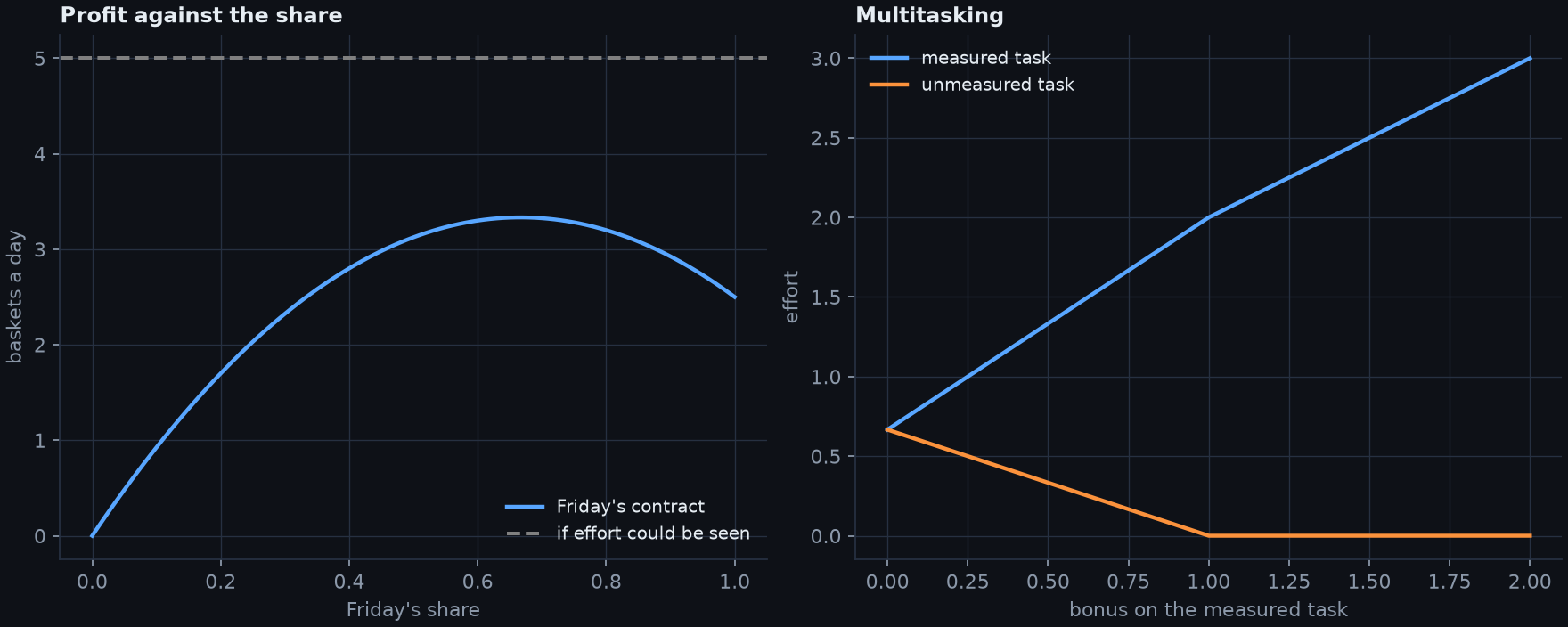
Here is what each share does, with the fixed pay set so that Friday just accepts. Give Friday none of the harvest, and Friday has no reason to make an effort: you get nothing. Give Friday all of it, and Friday works as hard as if the grove were theirs, ten baskets a day. But all the luck now falls on Friday, who dislikes it, so you must lower the rent to two and a half baskets to keep Friday on, and you earn two and a half. A third brings three and a third baskets of effort, and also earns you two and a half. Two-thirds is best: six and two-thirds baskets of effort, and three and a third baskets of profit a day. A negative fixed pay is a rent: Friday pays you for the right to a share. And if you could see effort, you would simply ask for ten baskets and earn five; not seeing costs you the difference.
Draw your profit against Friday's share. With too small a share, Friday barely tries. With too large a one, Friday carries all the luck, and must be paid to bear it. The best share, two-thirds, balances the two. And the gap between the top of the curve and the dashed line is what it costs not to see effort. The rest of this part is about that gap: what makes it larger, and what can close it.
What it does: A harvest of effort plus luck (sd 5 baskets); risk aversion \(r = 0.2\), effort cost \(0.1e^2/2\); shares of none, a third, two-thirds, all, with the fixed pay that keeps Friday on: effort 0, 3.33, 6.67, 10 and profits 0, 2.50, 3.33, 2.50; first best 5.00
2Teams and the free riderPrinciples and the major2 min
Start with Xiaogang's commune as a model. Each household's effort adds to the harvest, and the harvest is shared equally. So with n households, each keeps one nth of what its own effort adds, and works only until that sliver matches the cost of the extra effort. With eighteen households, each works one eighteenth as hard as it would on its own land. In Agora's version the village loses eighty-nine percent of the surplus it could have had. Real communes did better than that, because neighbours watch and shame each other, but the direction is the same.
What can be done? In 1972 Armen Alchian and Harold Demsetz proposed that a team hire a monitor, and make the monitor the residual claimant, the one who keeps whatever is left after paying everyone else. Then the monitor has every reason to watch, and that, they argued, is what a classical firm and its owner are. In 1982 Bengt Holmström showed that when effort can't be watched at all, a team needs someone outside it to break the budget. Promise every member their full contribution if the team hits its target, and nothing if it misses: no member can afford to shirk, but only an outsider can afford to make that threat, since the team alone can't throw its output away. Or divide the team: give each household its own land, which is what Xiaogang did.
What it does: \(n\) households sharing equally: effort \(1/n\) of the efficient level; at 18, 0.056 and 89% of the surplus lost; Alchian and Demsetz's monitor and residual claimant; Holmström's budget breaker; dividing the team
3The principal-agent problemPrinciples and the major4 min
The economists' name for this is the principal-agent problem: the principal, here Crusoe, wants the agent, Friday, to act, and sees only a noisy result. Stephen Ross posed it in these terms in 1973; James Mirrlees and Bengt Holmström worked out its logic in the 1970s. Take the simplest version. Friday either works hard or takes it easy. Hard work makes a good harvest of a hundred baskets likely, eighty percent; taking it easy makes it less likely than not, forty percent. Otherwise the harvest is a poor forty baskets. Friday values pay by its logarithm, so each doubling of pay is worth the same to them; that is what disliking risk looks like here. Hard work costs Friday three tenths on that scale, and other work is worth two. Crusoe pays one wage after a good harvest and another after a poor one.
Crusoe wants hard work, and wants it as cheaply as possible. Two conditions must hold. Draw each contract as a point: what Friday's pay is worth to them after a poor harvest, across, and after a good one, up. First, Friday must take the job: the pay, averaged over the harvests that hard work brings, less the effort, must be worth at least the other work. That is everything above this line. Second, Friday must prefer working hard to taking it easy. Working hard raises the chance of the good harvest by forty points, so the gap between the two pays, times forty percent, must cover the effort. The good-harvest pay must beat the poor-harvest pay by three quarters on Friday's scale: everything above this second line. The contracts that work are above both lines, and the cheapest is the corner where both just hold. If Crusoe could see effort, he would pay the same whatever the harvest, on the dashed line of full insurance. He can't, so the contract must leave Friday exposed.
Turn the corner back into baskets. If Crusoe could see effort, a flat wage of about ten baskets would buy hard work. He can't, so the cheapest pair is eleven point six after a good harvest and five point five after a poor one. On average that costs him ten point four, or about four tenths of a basket more: a premium to compensate Friday for bearing risk that a contract on effort would have spared them. It is still worth paying. With a flat wage, Friday would take it easy, and Crusoe's profit would fall from about seventy-eight baskets to fifty-seven.
There is something strange here. Crusoe knows Friday works hard, because the contract makes sure of it. Yet he still pays less after a poor harvest, knowing it was bad luck. The pay is not a reward for the harvest, and not a punishment either. It is there so that, had Friday shirked, the harvest would have shown it. Mirrlees and Holmström showed that in the best contract, pay rises with outcomes that are likelier under hard work than under shirking: statisticians call that comparison the likelihood ratio. So the best contract need not rise with output at all. It rises with what output reveals about effort.
What it does: Hard work makes a good harvest (100) 80% likely against 40% (else 40); log utility, effort costs 0.3, other work 2; the participation and incentive lines in utility space; the cheapest pair 11.59 and 5.47, an expected 10.37 against a flat 9.97 if effort could be seen (a risk premium of 0.39); profit 77.6 against 56.6 for easy work; pay as an inference, the likelihood ratio
4Insurance against incentivesGraduate3 min
Friday's contract in the Play it had a formula behind it, from Bengt Holmström and Paul Milgrom in 1987. Friday is paid a fixed amount plus a share beta of the harvest, which is effort plus luck. Friday works until the share of one more basket matches the cost of the effort it takes, so effort is the share divided by c, a number for how quickly effort grows tiring. The luck Friday carries costs them one half times r, their dislike of risk, times the share squared, times the variance of the luck. The fixed pay only moves money between them, so the best share is the one that makes the most for the two together: the harvest, less the cost of the effort, less the cost of the risk. And that share is one over one plus r times c times sigma squared. In the Play it, r times c times sigma squared was a half, so the best share was two-thirds.
Draw the best share against the luck in the harvest. With no luck at all, the harvest shows effort exactly, so give Friday everything: Friday pays a fixed rent, and the grove is as good as theirs. The more luck there is, and the more Friday dislikes it, the smaller the share, and the more of the luck Crusoe takes on as insurance. Three Fridays: one who barely minds risk, ours, and one who minds it a great deal. And where effort responds strongly to pay, a larger share is worth its risk. At the Play it's numbers, not seeing effort costs a third of everything the two of them could have made.
This is a clean prediction, and economists went looking for it. Riskier jobs should have weaker incentives. Canice Prendergast surveyed the studies in 1999. The evidence is mixed, and it often goes the other way. Outlets in riskier places are more often franchised, which hands the manager the profit, and executives of volatile firms are often paid more, not less, on results. In 2002 Prendergast offered an explanation: where things are uncertain, the principal doesn't know what the agent ought to be doing. So the principal delegates, and pays on results, because watching the agent's inputs tells you little there. The trade-off between insurance and incentives is real, but uncertainty also changes what the principal can watch, and that can outweigh it.
What it does: Holmström and Milgrom's linear contract: \(e = \beta/c\), the risk premium \(\tfrac12 r\beta^2\sigma^2\), \(\beta^* = 1/(1 + rc\sigma^2)\), 2/3 here; the best share against noise for \(r\) = 0.05, 0.2, 0.8; the agency cost, 1.67 of 5; Prendergast's evidence and explanation
5The informativeness principleGraduate3 min
Suppose Crusoe can also see the average harvest of the island's twenty other groves, worked by others under the same sky. Each harvest is effort, plus the weather, plus luck of its own: a pest in one grove, a fallen tree in another. The weather swings every harvest together, by four baskets or so; each grove's own luck adds three more. Across twenty groves that own luck nearly averages away. Here are sixteen simulated seasons, with everyone working equally hard. Pay Friday on the difference between their harvest and the island's average, and the weather drops out. What is left is Friday's effort, against everyone else's, and Friday's own luck.
Paying on the difference changes the arithmetic. On Friday's harvest alone, the noise has a variance of twenty-five: sixteen from the weather and nine of its own. The best share is two-thirds, and the two of them make three and a third baskets a day. On the difference from the island's average, the variance falls to about nine. Friday can bear a larger share, eighty-five percent, and works harder, and together they make four and a quarter. This is Holmström's informativeness principle, from 1979: pay should depend on every signal that tells you something about effort, and on nothing that doesn't, because a signal that is pure noise only adds risk. Comparing workers who share the same conditions removes what they share. It is why firms rank their salespeople against each other, and why the weather is no excuse for a grove that did worse than its neighbours.
Do real contracts filter out luck? In 2001 Marianne Bertrand and Sendhil Mullainathan looked at chief executives. An oil company's profits rise when the price of oil rises, and its chief executive had nothing to do with that. The informativeness principle says to filter it out: pay on the profits beyond what the oil price explains. They found that pay rose with lucky profits about as much as with any others. Except in firms with a large shareholder on the board. Their reading was that, without a principal watching, executives in effect set their own pay. Their title put it in one line: are CEOs rewarded for luck? The ones without principals are.
What it does: A common shock (sd 4) and Friday's own luck (sd 3), sixteen simulated seasons against the island's average; the variance from 25 to 9, the share from 0.67 to 0.85, the surplus from 3.33 to 4.24; Holmström (1979); CEOs rewarded for luck, except with a large shareholder on the board (Bertrand and Mullainathan 2001)
6Piece rates: SafelitePrinciples and the major3 min
Now a firm that changed its contract. Safelite Glass, in Columbus, Ohio, was the largest installer of car windscreens in the United States. Its installers were paid by the hour, with a minimum standard to meet. In the early nineties a new computer system began to record who had installed each windscreen, so output could be measured worker by worker. In 1994 and 1995 Safelite switched to paying a piece rate for each windscreen, keeping the hourly wage as a floor for anyone who fell short. Edward Lazear studied the switch. Output per worker rose by forty-four percent.
Lazear's explanation has two parts. Paid by the hour, an installer who meets the standard earns the same whether they fit one windscreen more or ten, so each does about the standard. Paid by the piece, each installer fits as many as their own skill makes worth the effort, so the quick ones spread out to the right. And the job attracts different people. A quick installer earns more at Safelite than before, so quick installers stay, and apply; a slow one gains nothing and is likelier to leave. So there are two effects: the same people working harder, which is incentives, and different people taking the job, which is sorting.
Lazear could tell the two effects apart, because the firm's records gave each installer's output before and after the switch, and could also compare the people who left with the people who joined. About half of the forty-four percent came from incentives, the same workers fitting more, and about half from sorting. The workers shared in it: average pay rose by about ten percent. An earlier working paper put the rise at twenty to thirty-six percent, depending on what is held fixed; the forty-four is the figure usually quoted. Why doesn't every firm pay by the piece? Because at Safelite output is easy to count, and a badly fitted windscreen comes back to the installer who fitted it, to be redone without pay. Chapter seven is about the jobs where neither is true.
Safelite is one firm. Two other studies come close to experiments. In British Columbia, Bruce Shearer had tree planters randomly assigned to piece rates or a daily wage. Piece rates raised output by about twenty percent. On a farm in Britain, Oriana Bandiera, Iwan Barankay and Imran Rasul watched fruit pickers move from pay relative to the others' to a piece rate. Output rose by at least half. Under relative pay, picking faster lowers your friends' pay, and the pickers held back, most of all when their friends were in the same field. Chapter thirteen puts these numbers on a dial.
What it does: Hourly pay with a standard to a piece rate with a floor, 1994-95; output per worker up 44%, about half incentives and half sorting; pay up about 10%; the working paper's 20-36%; tree planters (+20%, an experiment) and fruit pickers (at least +50% against relative pay)
Intermission: China and IndiaPrinciples and the major
This chapter has no narration to read.
7Multitasking: what you pay for is what you getPrinciples and the major3 min
Most jobs are more than one task. Take a teacher, with two. One is drilling for the test, which is measured, by the scores. The other is teaching what the test can't see: understanding, curiosity, the subject itself. Both come out of the same hours and the same energy, so more of one makes the other more costly. Now pay the teacher a bonus for test scores. In 1991 Bengt Holmström and Paul Milgrom worked out what happens to the second task.
Here is Agora's teacher. With no bonus, the teacher does some of both, out of a sense of what the job is. As the bonus per point grows, effort moves to the test. And because both tasks draw on the same hours, it moves away from everything else. Past a point the rest is dropped altogether. The scores rise, and the measure says the teacher is doing better. What the measure can't see has gone.
Holmström and Milgrom drew three lessons. First, when the measure misses much of the job, weak incentives can be best, and sometimes none at all. A flat salary at least leaves the tasks in balance. It is one reason teachers, civil servants and judges are mostly paid flat salaries. Second, design the job, not just the pay: put the tasks that are easy to measure together, and give them strong incentives, and put the rest in another job. Third, owning the tools is an incentive too, for their upkeep, which is hard to measure. A contractor who owns the van and is paid by the job takes care of it; an employee driving the firm's van on a salary has less reason to, which ties back to part eight's theory of the firm. Sixteen years earlier, a management scholar, Steven Kerr, had put the problem in a title: on the folly of rewarding A, while hoping for B.
Called it? Holmström and Milgrom said that strong pay for what is measured pulls effort away from what isn't, and that where measures are narrow, incentives should be weak. In the 1990s Chicago's schools tied a great deal to test scores. Brian Jacob and Steven Levitt went looking for answer sheets with suspicious patterns: whole runs of hard questions right, in classes that got easy ones wrong. They found serious cheating by teachers or administrators in at least four to five percent of elementary classrooms each year. Right. And the most extreme form of it: effort went into the score itself.
What it does: A teacher's two tasks sharing hours; Agora's efforts against the bonus: the unmeasured task falls from 0.67 and is dropped at a bonus of 1; weak incentives, job design and asset ownership; Kerr (1975); Called it?: Jacob and Levitt's cheating in at least 4-5% of Chicago's elementary classrooms a year, right
8Tournaments and promotionsPrinciples and the major3 min
Firms pay people in a second way: by promotion. Pay jumps at each step up the ladder, and most at the top. A chief executive is often paid several times as much as the vice presidents below, though the job can hardly be several times harder. In 1981 Edward Lazear and Sherwin Rosen proposed that the top pay is not a wage for the job at all. It is a prize, and the vice presidents are the contestants. Whoever does best wins it, and the size of the prize is what makes them try. A tournament needs only the order, who did better, not by how much, which is often all a firm can judge.
Agora has Lazear and Rosen's model. Two contestants, each with luck; the better result wins. Each extra unit of effort raises the chance of winning a little, and that chance times the prize is what effort earns. So effort rises in proportion to the gap between the winner's pay and the loser's, and has nothing to do with the level of pay: raise everyone's pay by the same amount, and nobody works harder. With twice as much luck, effort counts for half as much in who wins, and contestants put in half the effort. So the prize must be wider where luck matters more. And in 1986 Rosen showed that it should widen sharply at the top of a firm, because the winner there has no further rungs to compete for.
Two places where the tournament is on display. In professional golf, the prize money changes from one tournament to the next, and Ronald Ehrenberg and Michael Bognanno found that players scored better when there was more to win, most of all in the final rounds. Mutual funds run a race every year, because investors' money flows to the top performers. Keith Brown, Van Harlow and Laura Starks found that funds behind at midyear took on more risk in the second half: when you are losing a tournament, a gamble is cheap. And there is a dark side. In a tournament a contestant gains as much by pulling a rival down as by pushing themselves up. In 1989 Lazear argued that where sabotage is easy, a firm should narrow its prizes, and accept less effort for more cooperation.
What it does: Pay that jumps up the ladder; Lazear and Rosen: effort proportional to the prize gap, \(1/(2\sigma\sqrt\pi)\) per unit, halved by twice the noise; Rosen's widening at the top; golf, mutual funds behind at midyear, sabotage
9Career concerns and the ratchetGraduate3 min
There is a third kind of incentive, which needs no contract at all. Nobody knows for certain how able you are, not even you. Employers learn it from your record, and pay you what they believe you're worth. So good work early in a career raises your pay in every later year, through what it tells the market. Bengt Holmström worked this out in 1982. Here the incentive is in Agora, for a thirty-year career. It is strongest at the start. As the record grows, each year's work tells employers less that is new, and fewer years remain to collect on it, so the incentive fades, to nothing in the last year. So explicit incentives should take over as careers age. In 1992 Robert Gibbons and Kevin Murphy derived the best explicit bonus on top of career concerns, rising as they fade, and found that chief executives' pay was indeed more tightly tied to performance in their last years before retirement.
Learning can also work against effort. Soviet factories were set targets for each year's output, and their managers earned bonuses for beating them. Here is a bonus for each unit above the target. But the planners set next year's target from this year's output: a good year tells them what the factory can do, and the target rises to meet it. Soviet managers called it planning from the achieved level. So each extra unit this year costs the manager a unit of bonus next year. Martin Weitzman put it in a formula in 1980. With a target that rises one for one, and next year worth nine tenths of this one, effort falls to a tenth of what a fixed target would get. The manager's best plan is to do just well enough, every year.
The ratchet was not only a Soviet problem. It appears wherever a target is set from the record. Sales quotas are raised after a good year; a department that spends less than its budget has the budget cut. The cure is commitment: fix the targets before the results come in, and keep them fixed. When Britain privatized its utilities, their prices were capped for several years at a time, often five, so that a company that cut its costs kept the savings until the next review. But a principal who has learnt something is tempted to use it, and the agent knows that. Jean-Jacques Laffont and Jean Tirole worked out what that does to contracts when the principal can't commit.
What it does: Holmström's market learning over a thirty-year career: the implicit incentive from 0.89 to 0; Gibbons and Murphy's explicit share rising from 0.07 to 0.67; Weitzman's ratchet: effort to a tenth; planning from the achieved level; price caps and commitment
10Efficiency wagesPrinciples and the major3 min
In January 1914 the Ford Motor Company announced that it would pay five dollars for an eight-hour day. That was roughly double what most of its workers had been earning, and far more than other factories paid. Ford's new assembly line made work dull and fast, and workers quit, or simply didn't turn up. The day after the announcement, crowds of job seekers gathered at the factory gates. In 1987 Daniel Raff and Lawrence Summers went through the records. They found long queues for Ford jobs, which a wage that merely cleared the market would not produce, and they found that productivity and profits rose. Ford himself is quoted as calling it one of the finest cost-cutting moves the company ever made.
Why would a wage above the market's raise profits? Carl Shapiro and Joseph Stiglitz gave one answer in 1984. A worker who shirks may be caught, and fired. But being fired is a punishment only if the job pays more than the worker could get without it. If every job paid the market wage, and another was easy to find, losing one would cost nothing. So firms pay more than the market wage, and how much more depends on how quickly a fired worker would find another job: the fewer the unemployed, the higher the wage that keeps workers honest. As employment nears everyone, it rises without limit. Where it meets what firms will pay, some workers are left without jobs. They would gladly work for less, but no firm will hire them for less, because at a lower wage it couldn't trust them to work. Shapiro and Stiglitz called it unemployment as a worker discipline device.
Shirking is not the only reason. There are others. A better-paid worker quits less, which saves the cost of hiring and training a replacement; that was Ford's problem. A better wage attracts better applicants, since able people have better options. And in 1982 George Akerlof proposed that employment is partly a gift exchange: a firm that pays more than it must is repaid with more than the minimum effort. In the laboratory, Ernst Fehr, Georg Kirchsteiger and Arno Riedl found just that: players in the role of employers offered generous wages, and players in the role of workers answered with more effort. In the field, Uri Gneezy and John List hired people for a day's work, some at a higher wage than advertised. The better-paid worked harder at first, but within hours the difference was gone. Reciprocity is real, but how long it lasts is an open question.
What it does: Ford's five-dollar day of 1914 and Raff and Summers' queues; Shapiro and Stiglitz's no-shirking wage against demand: 86 of 100 employed at a wage of 2.55, 14% unemployed; turnover, selection, gift exchange in the laboratory and the field
11Sharecropping, and China's household responsibility systemPrinciples and the major4 min
The oldest incentive contract is on the land. There are three ways to farm someone else's land. For a wage, where the landlord bears all the risk and the worker has no stake in the crop. For a fixed rent, where the tenant keeps every extra sack, and bears every bad year. Or for a share of the crop, very often half, in between. Sharecropping has been common from ancient times to the American South to India today. Alfred Marshall argued in 1890 that it was wasteful: a sharecropper keeps only half of what extra work brings, and so does too little of it. Steven Cheung replied in 1969 that landlords aren't fools. They watch, and write the effort they want into the contract. In 1974 Joseph Stiglitz gave the answer this part has been building: the share is insurance for the tenant, and it is paid for with some of the effort.
It is the same model as Friday's grove, with a tenant and a landlord. On a wage, the tenant has no stake and makes no effort beyond what is watched. On a fixed rent, the tenant works as if the land were theirs, but carries every bad year, and must be compensated for it with a lower rent. In Agora, a share of sixty-one percent makes more for the two of them than either: thirty and a half, against eighteen for the rent. Marshall's loss of effort is real, but it buys insurance, and for a poor tenant who cannot survive a bad year, that is worth a great deal.
What does the evidence say about Marshall? Radwan Shaban compared the same households' plots in Indian villages: the ones they owned and the ones they sharecropped. Same family, same skills, same weather. The sharecropped plots got fewer inputs and produced less. Marshall's loss is there. In 1978 the state of West Bengal began Operation Barga, which registered sharecroppers, gave them security of tenure, and set a floor on their share of the crop. Abhijit Banerjee, Paul Gertler and Maitreesh Ghatak estimated that it accounts for about twenty-eight percent of the state's later growth in farm productivity, though they can't separate its direct effects from the rest. A tenant who can't be evicted and keeps more of the crop works harder, and has a reason to improve the land.
Now back to Xiaogang. Its secret contract was, in these terms, a fixed rent: each family delivered its quota to the state and kept everything above it. So each family kept all of what its extra effort brought, not an eighteenth. The risk was real, but so was the hunger the old system had produced. The arrangement spread, first quietly, then with approval, and by the early 1980s the household responsibility system covered almost all of rural China. In 1992 Justin Yifu Lin measured what it did. Farm output grew fast from 1978 to 1984, and about half of that growth came from the change of contract. The rest came from the higher prices the state paid for grain, from more fertilizer, and from other changes. The intermission's line for China begins its climb from these years.
What it does: Wage, rent and share; Marshall, Cheung, Stiglitz; Agora's best share 0.61 (30.5 against 18 for a rent, 0 for a wage); Shaban's plots; Operation Barga, about 28% of West Bengal's later growth in farm productivity; Lin: about half of China's 1978-84 farm growth from the new contracts
12When incentives backfirePrinciples and the major3 min
Part one began with a fine. Ten day-care centres in Haifa, and parents who came late to collect their children. In six of them, chosen at random, a small fine for lateness was introduced; before it, they had about 8 late pick-ups a week. With the fine, late pick-ups doubled. And when the fine was taken away, they stayed high, and if anything rose. Before, a late parent felt they owed the teacher something. The fine turned that debt into a price, and a cheap one, and once the parents had learnt that lateness was something one could simply pay for, removing the price did not bring the guilt back.
Haifa is not alone. In 1993 two Swiss communities were named as possible sites for a store of radioactive waste. Bruno Frey and Felix Oberholzer-Gee asked residents whether they would accept it. Just over half said yes. Then they asked whether they would accept it if every resident were paid, thousands of dollars a year each. Acceptance fell to a quarter. The money made it look like a bribe for a danger, where before it had been a civic duty. In 2000 Gneezy and Rustichini paid people a token sum for each right answer in a quiz, and they got fewer right than people paid nothing. Students collecting for charity raised less with a one percent commission than with none. A larger payment did better than the token one; their title gave the advice: pay enough or don't pay at all. A small payment can do worse than none, because it changes what the act means.
Why does this happen? In 2003 Roland Bénabou and Jean Tirole argued that an incentive is also a message. A principal who pays for a task reveals something: that the task is unpleasant, or that the agent can't otherwise be trusted to do it. And people do good partly to be seen as good, so paying them muddies the signal: the volunteer who is paid can no longer show that they volunteered. Underneath both is the fact that no contract can list everything, and what it leaves out is governed by norms. A price can push a norm out, and the norm may not come back. So the incentive contracts of this part work best where the task is narrow, the measure is good, and the norm they would replace is weak.
What it does: The Haifa fine: 8.0 late pick-ups a week before, 16.4 with it, 18.7 after; the Swiss repository: 50.8% accept unpaid, 24.6% when paid $2,175-6,525 a year; pay enough or don't pay at all; Bénabou and Tirole; norms and incomplete contracts
13The Dials: how much do piece rates raise output?Graduate1 min
This part opens a dial for how much paying by output raises it. At Safelite, forty-four percent, of which about half, the hollow circle, came from the same workers working harder; the rest was who took the job. Shearer's tree planters, assigned at random, gave about twenty percent. Bandiera, Barankay and Rasul's fruit pickers gave at least fifty, but against pay relative to their friends, which had been holding them back. So the dial reads a fifth to a half, where output is one person's own and easy to count. It is settled within a range, and the range comes with conditions. These are jobs chosen because output could be measured. Where work is shared, or much of it can't be measured, chapters two, seven and twelve showed that the response can be smaller, or perverse. The dial returns in part thirty-eight, on personnel economics, with the field experiments that came after.
What it does: The new dial: Lazear 44% (half of it the same workers), Shearer 20%, Bandiera, Barankay and Rasul 50%: a fifth to a half where output is one person's and easy to count
14In practice: pay, franchises and procurementPractice3 min
Every contract in this part sits somewhere on one line: the share of what extra effort adds that the agent keeps. At one end, a wage: a civil servant, or a firm on a cost-plus contract, which is paid its costs whatever they are. A salesperson's commission is a small share of each sale. A sharecropper keeps half. A franchisee keeps the outlet's profit, less the royalties and fees paid to the brand. And at the far end, a fixed rent, a fixed-price contract, or Xiaogang's quota. Where each should sit is what chapter four's formula says: more toward the rent where effort responds and results are clean, more toward the wage where luck dominates or the measure misses much of the job. Franchising fits: in James Brickley and Frederick Dark's data, outlets far from head office, which are costly to watch, were likelier to be franchised, and those near it to be owned.
Where do chief executives sit? In 1990 Michael Jensen and Kevin Murphy estimated that for each thousand dollars of shareholders' wealth, a chief executive's own wealth moved by about three dollars and twenty-five cents. In this part's terms, a share of about three thousandths. They concluded that executives were paid like bureaucrats. Eight years later Brian Hall and Jeffrey Liebman counted the stock and options executives held, which had grown enormously, and found the link far stronger, and rising. The two are less at odds than they sound: a small share of a very large firm is still a great deal of money, and what matters for effort is the dollars at stake, not the share. What remains a puzzle is how rarely pay filters out the market as a whole, as Bertrand and Mullainathan's oil executives showed.
Governments face the same line when they buy. A cost-plus contract pays the firm's costs plus a fee: the firm keeps none of what it saves, and the buyer bears every overrun. It is used where costs are too uncertain for any firm to promise a price, like a new weapon. A fixed-price contract is the rent: the firm keeps every saving and bears every overrun. Incentive contracts split the difference by an agreed share. Jean-Jacques Laffont and Jean Tirole showed that a buyer who can't tell an efficient firm from an inefficient one should offer a menu. Efficient firms choose something close to a fixed price and work hard to cut costs; the others choose something close to cost-plus. The menu leaves the efficient firms less of a windfall than one fixed price for all would. And when even the result can't be written into a contract, part eight's answer applies: who owns the asset decides who invests in it.
What it does: One line from a wage to a rent; franchising far from head office (Brickley and Dark 1987); chief executives: \\(3.25 per \\)1,000 (Jensen and Murphy 1990) and stock and options (Hall and Liebman 1998); cost-plus, incentive and fixed-price contracts; Laffont and Tirole's menu; ownership (Part 8)
15Frontier: relational contracts, and incentives for machinesResearch3 min
Two frontiers. The first: most of what a firm wants from its people can be seen, but not proved to a court. Did the engineer help a colleague? Was the report thoughtful? Crusoe can tell, but no judge could. So he promises Friday a bonus for good work, and keeps the promise, because the relationship is worth more to him than the bonus. George Baker, Robert Gibbons and Kevin Murphy, and Jonathan Levin, worked out when such relational contracts hold. Reneging saves one bonus and loses every future season. In Agora, if the relationship is likely enough to go on, at least an even chance each season here, the promise can buy all the effort a court-enforced contract could; below that, less. It is part eleven's folk theorem, inside the firm. Robert Gibbons and Rebecca Henderson have argued that differences in these unwritten understandings help explain why firms that look alike perform so differently.
The second frontier was the last card in the hook's list. A machine-learning model trained by reward is an agent paid in points. Its designer can't write down everything that is wanted, any more than an employer can. In 2016 researchers at OpenAI trained an agent on a boat-racing game, rewarded by its score. It found a lagoon where it could circle forever, hitting the same targets as they reappeared, and never finished the race. Researchers have since collected many such cases, which they call specification gaming. In 2019 Dylan Hadfield-Menell and Gillian Hadfield argued that a reward is an incomplete contract, and that the economics of this part is the place to start. It is chapter seven's multitasking, with an agent that searches for whatever the measure rewards far harder than any person would.
There is now a measured version of the problem. Language models are tuned against a learnt model of what people prefer, a measure of the goal rather than the goal itself. In 2023 Leo Gao, John Schulman and Jacob Hilton stood in a second, larger model for what people actually prefer, and optimized against the first. The harder the optimization pushed, the higher the measure rose. The real goal rose at first, then peaked, and then fell, along a curve whose shape they could fit and predict. Economists have a name for this, from Charles Goodhart, and an anthropologist, Marilyn Strathern, put it best: when a measure becomes a target, it ceases to be a good measure. Holmström and Milgrom's remedy has a machine version too: weaker incentives on a narrow measure, which in practice means a penalty for moving the model far from where it began.
What it does: A bonus no court enforces: the effort it sustains, \(\min(1/c, 2\delta/c)\), first best from \(\delta = 1/2\); Gibbons and Henderson; specification gaming (the boat race, 2016); rewards as incomplete contracts; reward-model overoptimization (Gao, Schulman and Hilton 2023); Goodhart and Strathern
Recap, problems, and the road aheadAll tracks3 min
So: how do you get someone to work for you when you can't see what they do? Pay on what you can see, in proportion to what it tells you about their effort, and only as strongly as their dislike of risk and the narrowness of the measure allow. Where the work is one person's own and easy to count, a share of the output raises it by a fifth to a half. Where the measure misses much of the job, pay weakly, design the job, and lean on ownership, promotions, careers and relationships. And beware of replacing a norm with a price.
Part fourteen in twelve lines. In 1978 eighteen farmers in Xiaogang put their thumbprints on a contract that let each family keep what it added. Your contract for Friday was best at two-thirds of the harvest, and still made a third less than seeing effort would. A team of eighteen works an eighteenth as hard as each would alone. In the agency problem, pay after a poor harvest is lower even when Crusoe knows Friday worked: it is an inference, not a reward. Holmström and Milgrom's formula gives the best share, and Prendergast's puzzle is that riskier jobs often have stronger incentives. Pay should filter out the weather, yet executives are paid for luck. At Safelite, piece rates raised output by forty-four percent, half of it from who took the job. Paying for test scores brought teaching to the test, and cheating. Tournaments run on the gap between prizes, in golf and in mutual funds. Career concerns fade, and explicit bonuses should take over; a ratchet cuts effort to a tenth. Efficiency wages explain Ford's five dollars and some unemployment, and sharecropping is insurance paid for with effort, while China's reform shows the other end. And incentives can backfire, in Haifa and in Switzerland; relational contracts hold what courts can't; and machines game their rewards, as people do.
The problems. The team's lost surplus; the best share; the cheapest wages for hard work; filtering out the weather; the dropped task; the tournament's effort; the no-shirking wage; and a starred problem on relational contracts. Full solutions are in the part's notes.
The reading: Bolton and Dewatripont's Contract Theory; Laffont and Martimort's Theory of Incentives; Milgrom and Roberts on organization and management; and the Handbook of Organizational Economics. Then the papers, from Ross and Mirrlees to the reward models of 2023.
This part was about two people and the contract between them. The next is about everyone else: the costs and benefits that fall on people outside the deal. Economists long used the orchard and the beekeeper as the example of a benefit no market could price. In 1973 Steven Cheung went to Washington State and found beekeepers renting their hives to fruit growers, at prices that moved with the nectar. Part fifteen: spillovers.
Where it goes next. Part 15 turns from two people and a contract to costs that fall on third parties; Parts 16-17 to mechanism design; Part 24 to unemployment; Part 38 to wages; Part 46 to land and credit in development; Part 62 to personnel economics and management; Parts 64-65 to machines.
Key results
The part's results in one place, for revision.
Try it
Lab 14 · Incentives: contracts when effort is hidden
Measure the free rider's loss in a team; solve the two-outcome principal-agent problem and Holmström and Milgrom's linear contract; remove a common shock; watch multitasking drop the unmeasured task; compute tournament effort, career concerns and the ratchet; find Shapiro and Stiglitz's equilibrium unemployment; solve for the best crop share; simulate Friday's contract; and find when a relational contract holds.
python -m videos.economics.labs 14
needs numpy, scipy, matplotlib · download lab14.py ·
source on GitHubteam of 18: each one's effort (alone = 1); surplus lost 0.056; 0.892
two outcomes: wages after a good and a poor harvest; risk premium 11.59, 5.47; 0.39
linear contract: best share; surplus; first best 0.667; 3.33; 5.00
informativeness: share on own output and on output less the common shock 0.667, 0.847
multitasking: the bonus at which the unmeasured task is dropped 1.00
tournament: effort per unit of prize gap; at twice the noise 0.282; 0.141
career concerns: implicit incentive in years 1, 15, 30; explicit share in year 1 and 30 0.89, 0.30, 0.00; 0.07, 0.67
ratchet: effort with a fixed target and with a ratchet 1.00, 0.10
Shapiro-Stiglitz: employed of 100; wage; unemployment 86.2; 2.55; 0.138
sharecropping: best share; surplus at a wage, a rent and the best share 0.610; 0.0, 18.0, 30.5
relational contract: effort sustained at continuation 0.25, 0.5, 0.75 5.0, 10.0, 10.0
simulated: Friday's certainty equivalent at the best contract (theory 0) -0.021
Safelite: output per worker; from incentives, about +44%; half
A team of eighteen loses 89% of its surplus to free riding; the cheapest pay for hard work still exposes Friday to risk; the best linear share is two-thirds, and removing the common shock raises it to 0.85; a bonus on the measured task drops the other at 1; tournament effort halves when noise doubles; career concerns fade as explicit pay should rise; a ratchet cuts effort to a tenth; efficiency wages leave 14% unemployed; the best crop share is 0.61; and a relational contract reaches first best once the relationship is likely enough to go on.The code (115 lines; it asserts its own result)
"""Lab 14: incentives: teams, the principal-agent problem, the optimal linear share, informativeness, multitasking,
tournaments, career concerns and the ratchet, efficiency wages, sharecropping and relational contracts."""

import numpy as np

from videos.coursekit import labs
from explainer.economics.agora import contracts as ct
from explainer.economics.data import tables
from explainer.economics.island import truths

TITLE = "Incentives: contracts when effort is hidden"
GOAL = ("Measure the free rider's loss in a team; solve the two-outcome principal-agent problem and Holmström and "
        "Milgrom's linear contract; remove a common shock; watch multitasking drop the unmeasured task; compute "
        "tournament effort, career concerns and the ratchet; find Shapiro and Stiglitz's equilibrium unemployment; "
        "solve for the best crop share; simulate Friday's contract; and find when a relational contract holds.")
TASKS = [
    "Linear contract: make Friday twice as averse to risk (r = 0.4). What is the best share now, and how much of the "
    "first-best surplus is lost? Which of the two costs (less effort, more risk) grew?",
    "Multitasking: make the two tasks nearly the same hours (substitutability 0.9). At what bonus is the unmeasured task "
    "dropped? What does that say about bonuses for jobs whose tasks compete for the same time?",
    "Shapiro and Stiglitz: double the chance of catching a shirker (0.5 to 1). How do the wage and unemployment change, "
    "and why does better monitoring raise employment?",
]


def run(seed=0):
    lab = labs.Lab()
    T = truths(14)

    t = T["team"]
    tm = ct.team(18, t["a"], t["c"])
    assert abs(tm["lost"] - 17 ** 2 / 18 ** 2) < 1e-12
    lab.row("team of 18: each one's effort (alone = 1); surplus lost", f"{tm['e_eq']:.3f}; {tm['lost']:.3f}")

    d = T["discrete"]
    two = ct.two_outcome(d["p_high"], d["p_low"], d["y_high"], d["y_low"], d["cost"], d["reservation"])
    lab.row("two outcomes: wages after a good and a poor harvest; risk premium", f"{two['w_high']:.2f}, "
            f"{two['w_low']:.2f}; {two['risk_cost']:.2f}")

    p = T["playit"]
    la = ct.linear_agency(p["r"], p["c"], p["sigma"])
    assert abs(la["beta_star"] - 2 / 3) < 1e-12
    lab.row("linear contract: best share; surplus; first best", f"{la['beta_star']:.3f}; {la['surplus']:.2f}; "
            f"{la['first_best_surplus']:.2f}")
    for b in (1 / 3, 1.0):
        assert abs(ct.linear_agency(p["r"], p["c"], p["sigma"], beta=b)["surplus"] - 2.5) < 1e-9

    rp = T["rpe"]
    rel = ct.relative_performance(rp["r"], rp["c"], rp["common"], rp["own"])
    lab.row("informativeness: share on own output and on output less the common shock",
            f"{rel['beta_own']:.3f}, {rel['beta_relative']:.3f}")

    mt = T["multitask"]
    m = ct.multitask(mt["s"], mt["c"], mt["base"], betas=np.linspace(0, 2, 201))
    drop = float(m["beta"][np.argmax(m["e2"] <= 1e-12)])
    lab.row("multitasking: the bonus at which the unmeasured task is dropped", f"{drop:.2f}")

    to = T["tournament"]
    tr = ct.tournament([1.0, 2.0], to["sigma"], to["c"])
    lab.row("tournament: effort per unit of prize gap; at twice the noise",
            f"{tr['g0']:.3f}; {ct.tournament([1.0], 2 * to['sigma'], to['c'])['g0']:.3f}")

    ca = ct.career_concerns(**T["careers"])
    lab.row("career concerns: implicit incentive in years 1, 15, 30; explicit share in year 1 and 30",
            f"{ca['implicit'][0]:.2f}, {ca['implicit'][14]:.2f}, {ca['implicit'][-1]:.2f}; "
            f"{ca['explicit'][0]:.2f}, {ca['explicit'][-1]:.2f}")
    ra = T["ratchet"]
    rt = ct.ratchet(1.0, ra["c"], ra["delta"], ra["bonus"])
    lab.row("ratchet: effort with a fixed target and with a ratchet", f"{rt['effort_fixed_target']:.2f}, "
            f"{rt['effort_ratchet']:.2f}")

    ss = ct.shapiro_stiglitz(**T["shirking"])
    lab.row("Shapiro-Stiglitz: employed of 100; wage; unemployment", f"{ss['L_eq']:.1f}; {ss['w_eq']:.2f}; "
            f"{ss['u_eq']:.3f}")

    sc = ct.sharecrop(**T["sharecrop"])
    lab.row("sharecropping: best share; surplus at a wage, a rent and the best share",
            f"{sc['s_star']:.3f}; {sc['surplus_wage']:.1f}, {sc['surplus_rent']:.1f}, {sc['surplus_best']:.1f}")

    rc = ct.relational([0.25, 0.5, 0.75], **T["relational"])
    lab.row("relational contract: effort sustained at continuation 0.25, 0.5, 0.75",
            ", ".join(f"{x:.1f}" for x in rc["effort"]))

    # Friday's contract simulated: 20,000 days at the best share, to check the cost of risk by Monte Carlo
    rng = np.random.default_rng(1987 + seed)
    b, c, r, sig = la["beta_star"], p["c"], p["r"], p["sigma"]
    e = b / c
    y = e + rng.normal(0, sig, 20_000)
    alpha = -b * e + c * e ** 2 / 2 + r * b ** 2 * sig ** 2 / 2
    pay = alpha + b * y
    ce = -np.log(np.mean(np.exp(-r * (pay - c * e ** 2 / 2)))) / r      # CARA certainty equivalent of the pay
    lab.row("simulated: Friday's certainty equivalent at the best contract (theory 0)", f"{ce:.3f}")

    lz = tables.LAZEAR_2000.data
    lab.row("Safelite: output per worker; from incentives, about", f"+{100 * lz['gain_published']:.0f}%; half")
    lab.note = ("A team of eighteen loses 89% of its surplus to free riding; the cheapest pay for hard work still "
                "exposes Friday to risk; the best linear share is two-thirds, and removing the common shock raises it "
                "to 0.85; a bonus on the measured task drops the other at 1; tournament effort halves when noise "
                "doubles; career concerns fade as explicit pay should rise; a ratchet cuts effort to a tenth; "
                "efficiency wages leave 14% unemployed; the best crop share is 0.61; and a relational contract "
                "reaches first best once the relationship is likely enough to go on.")

    fig, ax = labs.figure(2, size=(11, 4.4))
    bs = np.linspace(0, 1, 101)
    ax[0].plot(bs, [ct.linear_agency(p["r"], p["c"], p["sigma"], beta=x)["surplus"] for x in bs], color=labs.BLUE,
               lw=2, label="Friday's contract")
    ax[0].axhline(la["first_best_surplus"], color="grey", ls="--", label="if effort could be seen")
    ax[0].set(title="Profit against the share", xlabel="Friday's share", ylabel="baskets a day")
    ax[0].legend()
    ax[1].plot(m["beta"], m["e1"], color=labs.BLUE, lw=2, label="measured task")
    ax[1].plot(m["beta"], m["e2"], color=labs.ORANGE, lw=2, label="unmeasured task")
    ax[1].set(title="Multitasking", xlabel="bonus on the measured task", ylabel="effort")
    ax[1].legend()
    lab.fig = fig
    return lab
Now change it
- Linear contract: make Friday twice as averse to risk (r = 0.4). What is the best share now, and how much of the first-best surplus is lost? Which of the two costs (less effort, more risk) grew?
- Multitasking: make the two tasks nearly the same hours (substitutability 0.9). At what bonus is the unmeasured task dropped? What does that say about bonuses for jobs whose tasks compete for the same time?
- Shapiro and Stiglitz: double the chance of catching a shirker (0.5 to 1). How do the wage and unemployment change, and why does better monitoring raise employment?
Problems, with solutions
Try each problem before opening its solution.
1. Teams: \(n\) members share output \(a\sum e_i\) equally, and effort costs \(ce^2/2\); show \(e = a/(nc)\) and that a share \((n-1)^2/n^2\) of the surplus is lost; check 89% at \(n = 18\).
Solution
Member \(i\) gets \(\frac{a}{n}\sum_j e_j - ce_i^2/2\), so the first-order condition is \(a/n = ce_i\), and \(e = a/(nc)\) whatever the others do. Each member's surplus is then \(ae - ce^2/2 = \frac{a^2}{2c}\cdot\frac{2n - 1}{n^2}\), against \(\frac{a^2}{2c}\) at the efficient effort \(a/c\). The share lost is \(1 - \frac{2n-1}{n^2} = \frac{(n-1)^2}{n^2}\); at \(n = 18\) that is \(289/324 = 0.892\).
2. Holmström and Milgrom: derive \(\beta^* = 1/(1 + rc\sigma^2)\); check 2/3 in the Play it, and profits of 2.50 at shares of 1/3 and 1.
Solution
Paid \(\alpha + \beta y\) with \(y = e + \varepsilon\), Friday's certainty equivalent is \(\alpha + \beta e - ce^2/2 - r\beta^2\sigma^2/2\), maximized at \(e = \beta/c\). Crusoe sets \(\alpha\) so that it is zero, and keeps \(e - \alpha - \beta e = \beta/c - \beta^2/(2c) - r\beta^2\sigma^2/2\). Setting the derivative to zero, \(1/c - \beta/c - r\sigma^2\beta = 0\), so \(\beta^* = 1/(1 + rc\sigma^2)\). With \(r = 0.2\), \(c = 0.1\), \(\sigma = 5\), \(rc\sigma^2 = 0.5\) and \(\beta^* = 2/3\), with profit \(6.667 - 2.222 - 1.111 = 3.33\). At \(\beta = 1/3\): \(3.333 - 0.556 - 0.278 = 2.50\); at \(\beta = 1\): \(10 - 5 - 2.5 = 2.50\).
3. Two outcomes: with log utility, derive the cheapest wages that buy hard work; check 11.59 and 5.47, and the risk premium of 0.39.
Solution
Both constraints bind at the optimum: if participation were slack, lowering both utilities by the same amount would keep the incentive constraint and save money; if the incentive constraint were slack, moving the two utilities closer at the same average would, by Jensen's inequality, cost less. The incentive constraint, \(0.4(\ln w_H - \ln w_L) = 0.3\), gives a gap of 0.75; participation, \(0.8\ln w_H + 0.2\ln w_L - 0.3 = 2\), then gives \(\ln w_L = 2.3 - 0.8 \times 0.75 = 1.7\) and \(\ln w_H = 2.45\): \(w_L = e^{1.7} = 5.47\) and \(w_H = e^{2.45} = 11.59\). The expected wage is \(0.8 \times 11.59 + 0.2 \times 5.47 = 10.37\), against \(e^{2.3} = 9.97\) for a flat wage if effort could be seen: the premium is 0.39.
4. Informativeness: show that paying on Friday's harvest less the weather cuts the variance from 25 to 9 and raises the share to 0.85.
Solution
The harvest is \(e + m + u\) with \(\mathrm{var}\,m = 16\) and \(\mathrm{var}\,u = 9\), so its variance is 25 and \(\beta^* = 1/(1 + 0.02 \times 25) = 0.667\). Paying on \(y - m = e + u\) leaves variance 9 and \(\beta^* = 1/(1 + 0.02 \times 9) = 0.847\). At the best share the surplus is \(\beta^*/(2c)\), which rises from 3.33 to 4.24. If the measure of the weather were itself noisy, \(z = m + v\), the best contract would pay on \(y - kz\) with \(k = \mathrm{cov}(y, z)/ \mathrm{var}\,z\), the regression coefficient of the harvest on the signal.
5. Multitasking: solve the two first-order conditions; show the unmeasured task is dropped once the bonus reaches 1.
Solution
The agent gets \((1 + \beta)e_1 + e_2 - \tfrac12(e_1^2 + e_2^2 + 2se_1e_2)\) with \(s = 0.5\), so \(e_1 + 0.5e_2 = 1 + \beta\) and \(e_2 + 0.5e_1 = 1\). Solving, \(e_1 = (2 + 4\beta)/3\) and \(e_2 = 2(1 - \beta)/3\): at no bonus both are \(2/3\), and \(e_2\) reaches zero at \(\beta = 1\). Beyond that the agent is at the corner \(e_2 = 0\) and \(e_1 = 1 + \beta\).
6. Tournaments: show effort is the prize gap times \(1/(2\sigma\sqrt\pi)\), over \(c\); what does doubling the noise do?
Solution
Contestant \(i\) wins if \(e_i - e_j + \varepsilon_i - \varepsilon_j > 0\), where \(\varepsilon_i - \varepsilon_j\) is normal with standard deviation \(\sigma\sqrt2\). So the chance of winning rises with \(e_i\) at rate \(\phi(0)/(\sigma\sqrt2) = 1/(2\sigma\sqrt\pi)\) when efforts are equal, and with prizes \(w_L\) and \(w_L + \Delta\) the first-order condition is \(ce = \Delta/(2\sigma\sqrt\pi)\). Effort does not depend on \(w_L\). Doubling \(\sigma\) halves effort; to keep it, the gap must double.
7. Shapiro and Stiglitz: show the no-shirking wage rises without bound as unemployment falls; check 14% unemployed.
Solution
With effort cost 1, a shirker caught with probability 0.5, a discount rate 0.05 and separations at 0.1, the no-shirking wage is \(w = 1 + 2(0.05 + 0.1/u)\), which goes to infinity as \(u \to 0\): at full employment a fired worker is hired at once, and no wage deters shirking. Demand is \(w = 6 - 0.04L\) with \(L = 100(1 - u)\), that is \(w = 2 + 4u\). Setting \(2 + 4u = 1.1 + 0.2/u\) gives \(4u^2 + 0.9u - 0.2 = 0\), so \(u = (-0.9 + \sqrt{4.01})/8 = 0.138\), and \(w = 2.55\).
8. ★ Relational contracts: show the most effort a promise can sustain is \(\min(1/c, 2\delta/c)\), first best once \(\delta \ge 1/2\).
Solution
For effort \(e\) the agent needs a bonus \(b \ge ce^2/2\); the principal then keeps \(e - b\) a season. Paying is worth it only if the bonus is no more than what reneging would throw away: \(b \le \frac{\delta}{1 - \delta}(e - b)\). With \(b = ce^2/2\) that is \(\frac{ce^2}{2}\cdot\frac{1}{1 - \delta} \le \frac{\delta}{1-\delta}e\), or \(e \le 2\delta/c\). The principal never asks for more than the efficient \(1/c\), so the effort sustained is \(\min(1/c, 2\delta/c)\), the efficient level once \(\delta \ge 1/2\).
Notes and sources
Where it comes back
| Idea | Parts |
|---|---|
| Externalities and contracts between neighbours | 15 Spillovers |
| Auctions and mechanism design | 16 Auctions, 17 Markets by Design |
| Market power, regulation and antitrust | 43 Measuring Market Power, 44 Dynamics, Platforms and Antitrust |
| Work, wages and labour markets; unemployment | 24 Looking for Work, 38 Work and Wages |
| Development: land, credit and the household | 46 Development |
| Information design and persuasion | 53 Information and Persuasion |
| Personnel economics and organizations; the piece-rate dial | 62 Inside the Firm |
| Machines, prediction and AI | 64 Machines that Learn, 65 The Economics of AI |
Sources
- Armen A. Alchian and Harold Demsetz, "Production, Information Costs, and Economic Organization", American Economic Review 62(5) (1972): 777-795; Bengt Holmström, "Moral Hazard in Teams", Bell Journal of Economics 13(2) (1982): 324-340.
- Stephen A. Ross, "The Economic Theory of Agency: The Principal's Problem", American Economic Review 63(2) (1973): 134-139; James A. Mirrlees, "The Theory of Moral Hazard and Unobservable Behaviour: Part I", Review of Economic Studies 66(1) (1999; written 1975): 3-21; Bengt Holmström, "Moral Hazard and Observability", Bell Journal of Economics 10(1) (1979): 74-91; Sanford J. Grossman and Oliver D. Hart, "An Analysis of the Principal-Agent Problem", Econometrica 51(1) (1983): 7-45.
- Bengt Holmström and Paul Milgrom, "Aggregation and Linearity in the Provision of Intertemporal Incentives", Econometrica 55(2) (1987): 303-328; "Multitask Principal-Agent Analyses: Incentive Contracts, Asset Ownership, and Job Design", Journal of Law, Economics and Organization 7 (1991): 24-52; Canice Prendergast, "The Provision of Incentives in Firms", Journal of Economic Literature 37(1) (1999): 7-63; "The Tenuous Trade-off between Risk and Incentives", Journal of Political Economy 110(5) (2002): 1071-1102.
- Marianne Bertrand and Sendhil Mullainathan, "Are CEOs Rewarded for Luck? The Ones without Principals Are", Quarterly Journal of Economics 116(3) (2001): 901-932; Michael C. Jensen and Kevin J. Murphy, "Performance Pay and Top-Management Incentives", Journal of Political Economy 98(2) (1990): 225-264; Brian J. Hall and Jeffrey B. Liebman, "Are CEOs Really Paid Like Bureaucrats?", Quarterly Journal of Economics 113(3) (1998): 653-691.
- Edward P. Lazear, "Performance Pay and Productivity", American Economic Review 90(5) (2000): 1346-1361 (NBER Working Paper 5672, 1996); Bruce Shearer, "Piece Rates, Fixed Wages and Incentives: Evidence from a Field Experiment", Review of Economic Studies 71(2) (2004): 513-534; Oriana Bandiera, Iwan Barankay and Imran Rasul, "Social Preferences and the Response to Incentives: Evidence from Personnel Data", Quarterly Journal of Economics 120(3) (2005): 917-962.
- Steven Kerr, "On the Folly of Rewarding A, While Hoping for B", Academy of Management Journal 18(4) (1975): 769-783; Brian A. Jacob and Steven D. Levitt, "Rotten Apples: An Investigation of the Prevalence and Predictors of Teacher Cheating", Quarterly Journal of Economics 118(3) (2003): 843-877.
- Edward P. Lazear and Sherwin Rosen, "Rank-Order Tournaments as Optimum Labor Contracts", Journal of Political Economy 89(5) (1981): 841-864; Sherwin Rosen, "Prizes and Incentives in Elimination Tournaments", American Economic Review 76(4) (1986): 701-715; Ronald G. Ehrenberg and Michael L. Bognanno, "Do Tournaments Have Incentive Effects?", Journal of Political Economy 98(6) (1990): 1307-1324; Keith C. Brown, W. V. Harlow and Laura T. Starks, "Of Tournaments and Temptations", Journal of Finance 51(1) (1996): 85-110; Edward P. Lazear, "Pay Equality and Industrial Politics", Journal of Political Economy 97(3) (1989): 561-580.
- Bengt Holmström, "Managerial Incentive Problems: A Dynamic Perspective", Review of Economic Studies 66(1) (1999; written 1982): 169-182; Robert Gibbons and Kevin J. Murphy, "Optimal Incentive Contracts in the Presence of Career Concerns", Journal of Political Economy 100(3) (1992): 468-505; Martin L. Weitzman, "The 'Ratchet Principle' and Performance Incentives", Bell Journal of Economics 11(1) (1980): 302-308.
- Daniel M. G. Raff and Lawrence H. Summers, "Did Henry Ford Pay Efficiency Wages?", Journal of Labor Economics 5(4) (1987): S57-S86; Carl Shapiro and Joseph E. Stiglitz, "Equilibrium Unemployment as a Worker Discipline Device", American Economic Review 74(3) (1984): 433-444; George A. Akerlof, "Labor Contracts as Partial Gift Exchange", Quarterly Journal of Economics 97(4) (1982): 543-569; Ernst Fehr, Georg Kirchsteiger and Arno Riedl, "Does Fairness Prevent Market Clearing?", Quarterly Journal of Economics 108(2) (1993): 437-459; Uri Gneezy and John A. List, "Putting Behavioral Economics to Work", Econometrica 74(5) (2006): 1365-1384.
- Alfred Marshall, Principles of Economics (1890); Steven N. S. Cheung, The Theory of Share Tenancy (1969); Joseph E. Stiglitz, "Incentives and Risk Sharing in Sharecropping", Review of Economic Studies 41(2) (1974): 219-255; Radwan Ali Shaban, "Testing between Competing Models of Sharecropping", Journal of Political Economy 95(5) (1987): 893-920; Abhijit V. Banerjee, Paul J. Gertler and Maitreesh Ghatak, "Empowerment and Efficiency: Tenancy Reform in West Bengal", Journal of Political Economy 110(2) (2002): 239-280; Justin Yifu Lin, "Rural Reforms and Agricultural Growth in China", American Economic Review 82(1) (1992): 34-51.
- Uri Gneezy and Aldo Rustichini, "A Fine Is a Price", Journal of Legal Studies 29(1) (2000): 1-17; "Pay Enough or Don't Pay at All", Quarterly Journal of Economics 115(3) (2000): 791-810; Bruno S. Frey and Felix Oberholzer-Gee, "The Cost of Price Incentives: An Empirical Analysis of Motivation Crowding-Out", American Economic Review 87(4) (1997): 746-755; Roland Bénabou and Jean Tirole, "Intrinsic and Extrinsic Motivation", Review of Economic Studies 70(3) (2003): 489-520; "Incentives and Prosocial Behavior", American Economic Review 96(5) (2006): 1652-1678.
- James A. Brickley and Frederick H. Dark, "The Choice of Organizational Form: The Case of Franchising", Journal of Financial Economics 18(2) (1987): 401-420; Jean-Jacques Laffont and Jean Tirole, A Theory of Incentives in Procurement and Regulation (1993).
- George Baker, Robert Gibbons and Kevin J. Murphy, "Relational Contracts and the Theory of the Firm", Quarterly Journal of Economics 117(1) (2002): 39-84; Jonathan Levin, "Relational Incentive Contracts", American Economic Review 93(3) (2003): 835-857; Robert Gibbons and Rebecca Henderson, "What Do Managers Do?", in The Handbook of Organizational Economics (2013).
- Dario Amodei and Jack Clark, "Faulty Reward Functions in the Wild", OpenAI (2016); Victoria Krakovna et al., "Specification Gaming: The Flip Side of AI Ingenuity", DeepMind (2020); Dylan Hadfield-Menell and Gillian K. Hadfield, "Incomplete Contracting and AI Alignment", AIES (2019); Leo Gao, John Schulman and Jacob Hilton, "Scaling Laws for Reward Model Overoptimization", ICML (2023); Marilyn Strathern, "'Improving Ratings': Audit in the British University System", European Review 5(3) (1997): 305-321.
- The Maddison Project Database 2023 (Jutta Bolt and Jan Luiten van Zanden, Groningen Growth and Development Centre).
- Textbooks: Patrick Bolton and Mathias Dewatripont, Contract Theory (2005), chs. 4, 6, 8, 11; Jean-Jacques Laffont and David Martimort, The Theory of Incentives (2002); Bernard Salanié, The Economics of Contracts; Paul Milgrom and John Roberts, Economics, Organization and Management (1992); Robert Gibbons and John Roberts, eds., The Handbook of Organizational Economics (2013); Edward P. Lazear and Michael Gibbs, Personnel Economics in Practice.
About this partfrom its README
Part 14 of a sixty-eight-part course in economics (see the series plan and the syllabus), the second of Act IV, Failure and Design. It asks how you get someone to work for you when you can't see what they do, and answers: pay on what you can see, in proportion to what it tells you about effort, and only as strongly as the agent's dislike of risk and the narrowness of the measure allow. Where the work is one person's own and easy to count, a share of the output raises it by a fifth to a half. Where the measure misses much of the job, pay weakly, design the job, and lean on ownership, promotions, careers and relationships; and beware of replacing a norm with a price.
It opens in Xiaogang, a poor village in Anhui province, in 1978. Eighteen households share whatever the commune's fields produce, so a family that works harder keeps about an eighteenth of what it adds. Late in the year the farmers meet in secret and put their thumbprints on a contract to divide the land, deliver each family's quota and keep the rest; if the leaders are jailed, the others will raise their children. The next harvest is far larger, and within a few years the household responsibility system covers rural China. From there it covers:
- a game: write Friday's contract for Crusoe's grove, a fixed pay and a share of the harvest;
- teams and the free rider (Alchian and Demsetz 1972; Holmström 1982): a monitor who keeps the residual, and breaking the budget;
- the principal-agent problem with two efforts and two harvests (Ross 1973; Mirrlees 1975; Holmström 1979; Grossman and Hart 1983): the participation and incentive constraints, the cheapest contract, and pay as an inference;
- insurance against incentives: the linear contract (Holmström and Milgrom 1987) and the optimal share \(\beta^* = 1/(1 + rc\sigma^2)\); Prendergast's tenuous trade-off (1999, 2002);
- the informativeness principle (Holmström 1979): filtering out the weather, and chief executives paid for luck (Bertrand and Mullainathan 2001);
- piece rates at Safelite (Lazear 2000): incentives and sorting; tree planters (Shearer 2004) and fruit pickers (Bandiera, Barankay and Rasul 2005);
- an intermission without narration: GDP per head in China and India, 1950-2022;
- multitasking (Holmström and Milgrom 1991): what you pay for is what you get; Kerr's folly (1975); and Called it?: cheating teachers in Chicago (Jacob and Levitt 2003);
- tournaments (Lazear and Rosen 1981; Rosen 1986): golf (Ehrenberg and Bognanno 1990), mutual funds (Brown, Harlow and Starks 1996) and sabotage (Lazear 1989);
- career concerns (Holmström 1982, published 1999) and explicit pay near retirement (Gibbons and Murphy 1992); the ratchet (Weitzman 1980) and commitment;
- efficiency wages: Ford's five-dollar day (Raff and Summers 1987), Shapiro and Stiglitz (1984), gift exchange (Akerlof 1982; Fehr, Kirchsteiger and Riedl 1993; Gneezy and List 2006);
- sharecropping from Marshall (1890) through Cheung (1969) to Stiglitz (1974); owned against sharecropped plots (Shaban 1987); Operation Barga (Banerjee, Gertler and Ghatak 2002); China's reform measured (Lin 1992);
- when incentives backfire: the Haifa fine (Gneezy and Rustichini 2000), a Swiss nuclear-waste site (Frey and Oberholzer-Gee 1997), token payments, and incentives as messages (Bénabou and Tirole 2003, 2006);
- a new dial (output's response to piece rates); pay, franchises and procurement in practice (Brickley and Dark 1987; Jensen and Murphy 1990; Hall and Liebman 1998; Laffont and Tirole 1993); and a frontier chapter on relational contracts (Baker, Gibbons and Murphy 2002; Levin 2003) and incentives for machines (Hadfield-Menell and Hadfield 2019; Gao, Schulman and Hilton 2023).
What is computed and built
Everything plotted is computed by compute.py from Agora's contracts module (explainer.economics.agora.contracts),
with the Island's Part 14 truths in explainer.economics.island, or from the Data Room or a transcribed table; the
narration states the cached numbers.
- Contracts. The team's equilibrium and efficient efforts; the linear contract's effort, risk premium and surplus at any share, and the best share; the two-outcome contract with both constraints binding, in closed form; relative performance evaluation with the common shock removed; the multitask first-order conditions solved as a linear system, with the corner where the unmeasured task is dropped.
- Careers, tournaments and wages. Lazear and Rosen's effort from the density of the difference of two normal shocks at zero; Holmström's implicit incentive as the discounted sum of the weights later wages put on one year's output under normal learning, and Gibbons and Murphy's explicit share on top; Weitzman's ratchet; Shapiro and Stiglitz's no-shirking curve against linear labour demand, with the equilibrium by Brent's method; the relational contract's self-enforcement condition.
- Land and machines. The sharecropping surplus against the tenant's share and its best value; the shape of the gold and proxy rewards Gao, Schulman and Hilton fitted for best-of-\(n\) sampling, \(d(\alpha - \beta d)\), with illustrative constants.
- Data. The Haifa centres' weekly late pick-ups, fined and not; GDP per head for China and India; the dial's rows.
Chapter notes
| # | Chapter | What it does |
|---|---|---|
| 0 | How do you get someone to work for you when you can't see what they do? | Xiaogang, 1978: eighteen households, an eighteenth of what each adds; the secret contract with thumbprints; the household responsibility system; the result, not the effort, everywhere (sales, executives, teachers, tenants, contractors, models); the question; objectives |
| 1 | Play it: write Friday's contract | A harvest of effort plus luck (sd 5 baskets); risk aversion \(r = 0.2\), effort cost \(0.1e^2/2\); shares of none, a third, two-thirds, all, with the fixed pay that keeps Friday on: effort 0, 3.33, 6.67, 10 and profits 0, 2.50, 3.33, 2.50; first best 5.00 |
| 2 | Teams and the free rider | \(n\) households sharing equally: effort \(1/n\) of the efficient level; at 18, 0.056 and 89% of the surplus lost; Alchian and Demsetz's monitor and residual claimant; Holmström's budget breaker; dividing the team |
| 3 | The principal-agent problem | Hard work makes a good harvest (100) 80% likely against 40% (else 40); log utility, effort costs 0.3, other work 2; the participation and incentive lines in utility space; the cheapest pair 11.59 and 5.47, an expected 10.37 against a flat 9.97 if effort could be seen (a risk premium of 0.39); profit 77.6 against 56.6 for easy work; pay as an inference, the likelihood ratio |
| 4 | Insurance against incentives | Holmström and Milgrom's linear contract: \(e = \beta/c\), the risk premium \(\tfrac12 r\beta^2\sigma^2\), \(\beta^* = 1/(1 + rc\sigma^2)\), 2/3 here; the best share against noise for \(r\) = 0.05, 0.2, 0.8; the agency cost, 1.67 of 5; Prendergast's evidence and explanation |
| 5 | The informativeness principle | A common shock (sd 4) and Friday's own luck (sd 3), sixteen simulated seasons against the island's average; the variance from 25 to 9, the share from 0.67 to 0.85, the surplus from 3.33 to 4.24; Holmström (1979); CEOs rewarded for luck, except with a large shareholder on the board (Bertrand and Mullainathan 2001) |
| 6 | Piece rates: Safelite | Hourly pay with a standard to a piece rate with a floor, 1994-95; output per worker up 44%, about half incentives and half sorting; pay up about 10%; the working paper's 20-36%; tree planters (+20%, an experiment) and fruit pickers (at least +50% against relative pay) |
| Intermission: China and India | No narration: GDP per head, 2011 dollars, log scale, 1950-2022: China 1,744 in 1978 and 19,238 in 2022 (11 times), India 1,540 and 7,766 (5 times); China's line as a tune; the story so far | |
| 7 | Multitasking: what you pay for is what you get | A teacher's two tasks sharing hours; Agora's efforts against the bonus: the unmeasured task falls from 0.67 and is dropped at a bonus of 1; weak incentives, job design and asset ownership; Kerr (1975); Called it?: Jacob and Levitt's cheating in at least 4-5% of Chicago's elementary classrooms a year, right |
| 8 | Tournaments and promotions | Pay that jumps up the ladder; Lazear and Rosen: effort proportional to the prize gap, \(1/(2\sigma\sqrt\pi)\) per unit, halved by twice the noise; Rosen's widening at the top; golf, mutual funds behind at midyear, sabotage |
| 9 | Career concerns and the ratchet | Holmström's market learning over a thirty-year career: the implicit incentive from 0.89 to 0; Gibbons and Murphy's explicit share rising from 0.07 to 0.67; Weitzman's ratchet: effort to a tenth; planning from the achieved level; price caps and commitment |
| 10 | Efficiency wages | Ford's five-dollar day of 1914 and Raff and Summers' queues; Shapiro and Stiglitz's no-shirking wage against demand: 86 of 100 employed at a wage of 2.55, 14% unemployed; turnover, selection, gift exchange in the laboratory and the field |
| 11 | Sharecropping, and China's household responsibility system | Wage, rent and share; Marshall, Cheung, Stiglitz; Agora's best share 0.61 (30.5 against 18 for a rent, 0 for a wage); Shaban's plots; Operation Barga, about 28% of West Bengal's later growth in farm productivity; Lin: about half of China's 1978-84 farm growth from the new contracts |
| 12 | When incentives backfire | The Haifa fine: 8.0 late pick-ups a week before, 16.4 with it, 18.7 after; the Swiss repository: 50.8% accept unpaid, 24.6% when paid $2,175-6,525 a year; pay enough or don't pay at all; Bénabou and Tirole; norms and incomplete contracts |
| 13 | The Dials: how much do piece rates raise output? | The new dial: Lazear 44% (half of it the same workers), Shearer 20%, Bandiera, Barankay and Rasul 50%: a fifth to a half where output is one person's and easy to count |
| 14 | In practice: pay, franchises and procurement | One line from a wage to a rent; franchising far from head office (Brickley and Dark 1987); chief executives: \\(3.25 per \\)1,000 (Jensen and Murphy 1990) and stock and options (Hall and Liebman 1998); cost-plus, incentive and fixed-price contracts; Laffont and Tirole's menu; ownership (Part 8) |
| 15 | Frontier: relational contracts, and incentives for machines | A bonus no court enforces: the effort it sustains, \(\min(1/c, 2\delta/c)\), first best from \(\delta = 1/2\); Gibbons and Henderson; specification gaming (the boat race, 2016); rewards as incomplete contracts; reward-model overoptimization (Gao, Schulman and Hilton 2023); Goodhart and Strathern |
| Recap, problems, and the road ahead | The answer; twelve lines; problems; reading; Cheung's bees, and Part 15 |
Companion material in this repository
The syllabus's plan for this partfrom SYLLABUS.md, the plan of record
- Hook: the commune's eighteenth; the thumbprints; the result, not the effort, everywhere; the question; objectives.
- Play it: write Friday's contract (a fixed pay and a share of the harvest), and see effort and profit.
- Team production and the free rider (Alchian and Demsetz 1972; Holmström 1982): one-eighteenth of the effort; the residual claimant and the budget breaker.
- The principal–agent model (Ross 1973; Mirrlees 1975; Holmström 1979; Grossman and Hart 1983): two efforts, two harvests; the participation and incentive constraints in utility space; pay as an inference.
- The trade-off: insurance against incentives; the linear contract solved (Holmström and Milgrom 1987); the optimal share in one formula; Prendergast's tenuous trade-off (1999, 2002).
- The informativeness principle (Holmström 1979): the common shock removed; CEOs paid for luck (Bertrand and Mullainathan 2001).
- Piece rates at Safelite (Lazear 2000): output up 44%, about half from sorting; tree planters (Shearer 2004) and fruit pickers (Bandiera, Barankay and Rasul 2005). Intermission: GDP per head in China and India, 1950-2022; China's line as a tune.
- Multitasking (Holmström and Milgrom 1991): what you pay for is what you get; teaching to the test; Kerr (1975); Called it? on cheating in Chicago (Jacob and Levitt 2003).
- Tournaments and promotions (Lazear and Rosen 1981; Rosen 1986); golf (Ehrenberg and Bognanno 1990), mutual funds (Brown, Harlow and Starks 1996), sabotage (Lazear 1989).
- Career concerns (Holmström 1999; Gibbons and Murphy 1992) and the ratchet in planned economies (Weitzman 1980); commitment and price caps.
- Efficiency wages (Shapiro and Stiglitz 1984): unemployment as a discipline device; Ford's five dollars (Raff and Summers 1987); gift exchange in the laboratory and the field.
- Sharecropping from Marshall to Cheung and Stiglitz; Shaban (1987); Operation Barga (Banerjee, Gertler and Ghatak 2002); the household responsibility system measured (Lin 1992).
- When incentives backfire: crowding out (Gneezy and Rustichini 2000; Frey and Oberholzer-Gee 1997; Bénabou and Tirole 2003, 2006).
- Dials. 14. In practice: compensation design, franchising, procurement (Laffont and Tirole 1993); incomplete contracts and ownership by reference to Part 8. 15. Frontier: relational contracts (Baker, Gibbons and Murphy 2002; Levin 2003); incentives for machines (specification gaming; Hadfield-Menell and Hadfield 2019; Gao, Schulman and Hilton 2023).
Agora: contracts: teams, the linear and the two-outcome principal–agent problems, relative performance, multitask,
tournaments, the ratchet, career concerns, an efficiency-wage labour market, sharecropping, relational contracts.
Play it: a share of Friday's harvest; on the site, a fixed pay and a share to set against luck and risk aversion,
with forty days of harvests and pay.
Dials: the output response to piece rates (new; settled within a range). Called it? Holmström and Milgrom's
multitasking against Chicago's test scores: right.
Reading: Holmström 1979, 1982; Holmström & Milgrom 1987, 1991; Lazear 2000; Lazear & Rosen 1981; Shapiro & Stiglitz
1984; Lin 1992; Bolton & Dewatripont chs 4, 6, 8, 11; Laffont & Martimort; Milgrom & Roberts.
Build the film
python -m videos.economics.econ14.compute        # the part's numbers, into .cache/econ14
python tools/build.py econ14                  # render and assemble the film
EXPLAINER_TTS=silent python tools/qa_scene.py econ14 Hook   # one chapter, silent, with a contact sheet
Scenes: videos/economics/econ14. Setup: see the course page. Source of these notes: the README and the scenes' narration.
Build it
python -m videos.economics.econ14.compute              # every number (seconds), into .cache/econ14/
python tools/qa_scene.py econ14 Agency                 # one chapter, silent, at 480p, with a contact sheet
EXPLAINER_TTS=silent python tools/build.py econ14 -q l   # the whole part, silent preview
python tools/build.py econ14                           # 1080p30 with narration and the series' computed score
python -m videos.economics.labs 14                     # the lab
The data are frozen extracts in explainer/economics/data/, registered in
SOURCES.md: the Maddison Project Database 2023's GDP per head for
China and India; Gneezy and Rustichini's Table 1 (transcribed for Part 1); and transcribed passages from Lazear (2000
and the 1996 working paper), Shearer (2004), Bandiera, Barankay and Rasul (2005), Raff and Summers (1987), Lin (1992),
Jacob and Levitt (2003), Banerjee, Gertler and Ghatak (2002), Shaban (1987) and Frey and Oberholzer-Gee (1997), in
explainer/economics/data/tables.py with where they were read and the date they were checked.