Competition among the Few
How do a handful of firms compete, and when do they stop?
The part opens in Decatur, Illinois, where Archer Daniels Midland's new lysine plant starts a price war in 1991 that takes the American price from $1.30 a pound to 64 cents, below ADM's own cost; in June 1992 the lysine association meets in Mexico City, from November an informant records its meetings for the FBI, and prices climb back above a dollar until the raid of June 1995 (Connor 1998). The viewer fights a price war against Crusoe's $40, then meets Cournot's quantities and the price with N firms, Bertrand's prices and the paradox, and its escapes: Edgeworth's capacity and cycles, Kreps and Scheinkman, differentiated prices and repetition; Hotelling's line and Salop's circle; Chamberlin and Dixit-Stiglitz. After an intermission of crude oil and the pump price of gasoline, commitment (Stackelberg, Dixit's credible capacity and its regimes, Fudenberg and Tirole's animals), collusion as a repeated game with Stigler's policing (and Called it?: secret price cuts as what breaks cartels), the Joint Executive Committee and Green and Porter's price wars, leniency, tacit collusion and the law (Twombly, Wood Pulp, the airline fare database, rockets and feathers on monthly data), the Herfindahl index and the merger guidelines, the merger paradox and Williamson's trade-off, contestable markets, limit pricing and predation, a new dial on cartel overcharges, antitrust in practice (critical loss, Staples), and a frontier on common ownership and pricing algorithms.
What you need. Part 10: monopoly, marginal revenue and the Lerner index; Part 11: Nash equilibrium, subgame perfection and repeated games. Chapter 6 uses a CES utility function; chapter 9 a normal distribution of demand shocks.
- Hook
- "our customers are the enemy": the lysine tapes, 1992-95
- Ideas, models and mathematics
- Cournot, Bertrand and Stackelberg, capacity, Hotelling's line and product differentiation, monopolistic competition, cartels and their detection, entry deterrence, concentration and mergers in one formula
- Agora gains
- an oligopoly lab
- Play it
- name your price against one rival, then twenty
What you will be able to do
Principles and the major
- Solve Cournot and Bertrand duopolies with linear demand, and explain the Bertrand paradox and why capacity, differentiation and repetition resolve it.
- Compute the Herfindahl index, and explain how mergers, entry and collusion affect prices.
- Explain what a cartel needs to hold together, and how leniency programmes break cartels.
Graduate
- Derive the Cournot equilibrium with N firms and asymmetric costs, the Stackelberg outcome, and the discount factor that sustains collusion with N firms in quantities and in prices.
- Solve Hotelling's and Salop's models and the Dixit-Stiglitz equilibrium, and show excess entry.
- Derive Cowling and Waterson's L = H/epsilon, and the merger paradox and Farrell and Shapiro's needed savings.
Research
- Analyze entry deterrence with credible capacity (Dixit 1980), trigger-price collusion with imperfect monitoring (Green and Porter 1984), and the modified HHI of common ownership.
Practice
- Apply the hypothetical monopolist test and critical-loss analysis, and estimate a cartel's overcharge for damages.
Contents
Each chapter has a home level. Choose a track to see what to read and watch: Principles and the major 48 min · Graduate 52 min · Research 56 min · Practice 51 min.
- 0How do a handful of firms compete, and when do they stop?Principles and the major5 min
- 1Play it: name your pricePrinciples and the major2 min
- 2Cournot: competing in quantitiesPrinciples and the major3 min
- 3Bertrand's reply: competing in pricesPrinciples and the major2 min
- 4Resolving the paradox: capacity, difference, repetitionPrinciples and the major3 min
- 5Hotelling's line and Salop's circlePrinciples and the major3 min
- 6Monopolistic competitionPrinciples and the major3 min
- Intermission: crude and the pumpPrinciples and the major
- 7Commitment and entry deterrencePrinciples and the major4 min
- 8Collusion as a repeated gamePrinciples and the major4 min
- 9Cartels in the dataPrinciples and the major4 min
- 10Tacit collusion and the lawPrinciples and the major4 min
- 11Concentration: the Herfindahl indexPrinciples and the major2 min
- 12MergersPrinciples and the major3 min
- 13Contestable markets, limit pricing and predationPrinciples and the major3 min
- 14The Dials: how much do cartels overcharge?Graduate2 min
- 15In practice: the economics of antitrustPractice3 min
- 16Frontier: common owners and pricing algorithmsResearch3 min
- Recap, problems, and the road aheadAll tracks3 min
Also on this page: Lecture · Key results · Try it · Lab · Problems · Notes and sources · Build the film.
Lecture
The text of each chapter is the film's narration, as it is spoken, so you can read along or revise without the film. The pictures are in the film.
How do a handful of firms compete, and when do they stop?Principles and the major5 min
Lysine is an amino acid. Farmers add it to the feed of pigs and chickens to help them grow. In 1989 the American agribusiness Archer Daniels Midland, A D M, committed a hundred and fifty million dollars to build the world's largest lysine plant, in Decatur, Illinois. When it opened, in 1991, a price war broke out with the Japanese and Korean firms that had supplied the market. A pound of lysine had sold for a dollar thirty in 1990. By July 1992 it sold for sixty-four cents. That was below what it cost A D M to make it, about sixty-five to seventy cents a pound, and the older Asian plants were losing even more.
In April 1992 two A D M executives flew to Japan and proposed to their rivals an amino acids trade association. In June, in Mexico City, the lysine association met for the first time: to raise prices, and to divide the world's output among its members. In November, the head of A D M's lysine division, Mark Whitacre, began working for the F B I. For nearly three years he recorded hundreds of tapes, and the F B I secretly filmed the association's meetings. Prices climbed: ninety-eight cents a pound by the end of 1992, a steady dollar eight to a dollar thirteen through most of 1994, then about a dollar twenty. At the end of June 1995 more than seventy F B I agents raided A D M's headquarters, and interviewed its officers in their homes that night.
On one tape played at the trial, A D M's president told an executive of its largest rival about a company slogan: our competitors are our friends; our customers are the enemy. In 1996 A D M pleaded guilty and was fined a hundred million dollars, seventy million of it for lysine and the rest for a second cartel, in citric acid: then the largest criminal antitrust fine ever. The economist John Connor estimated that the cartel had raised American lysine prices by twelve to twenty-eight percent above what competition would have set. Three A D M executives went to prison, Whitacre among them: while informing, he had also embezzled about nine million dollars from the company. Why did the price war happen? Why did the cartel work? And why do so many cartels fail?
Lysine is unusual only in being caught on film. Most markets are neither a monopoly nor a crowd of price takers. An airline route is flown by two or three carriers. Most countries have three mobile networks. A handful of firms make the most advanced chips, and three providers hold most of the cloud. A town has a few supermarket chains, and its petrol stations can read each other's price signs from across the road. In all of them, each firm's best price depends on what the few others do: the games of Part eleven, played for markets.
Part ten had one seller; Part nine, so many that none mattered. This part asks the question in between: how do a handful of firms compete, and when do they stop? Do a few firms behave like a monopoly, like perfect competitors, or somewhere between? How do they keep rivals out, and when do they agree not to compete at all? And what can the law see, and what should it do?
Economics, Built. Part twelve: competition among the few. This part closes Act Three, on markets. You'll fight a price war, and we'll use it to meet Cournot's competition in quantities, Bertrand's in prices, and the paradox between them. How capacity, product differences and location resolve it: Hotelling's line, Salop's circle, and the model of monopolistic competition that trade and macroeconomics borrow. Commitment: the leader who moves first, and the capacity that keeps a rival out. Collusion: when a cartel can hold, price wars that nobody started, the lysine cartel's prices, and the leniency programmes that break cartels. Then concentration, mergers and contestable markets; a dial for how much cartels overcharge; and the new worries, common owners and pricing algorithms.
What it does: ADM's lysine plant (1989, $150 million); the price war, $1.30 (1990) to 64 cents (July 1992), below ADM's cost of 65-70 cents; Mexico City, June 1992; Whitacre and the FBI, November 1992 to June 1995; prices of 98 cents, $1.08-1.13, about $1.20; the raid; the slogan; the $100 million fine; Connor's 12-28%; markets of a few (airlines, phones, chips, cloud, groceries, fuel); the question; objectives
1Play it: name your pricePrinciples and the major2 min
Before any theory, a price war to fight. You open a second boatyard on the Island, beside Crusoe's. A repair costs either yard ten dollars in timber and time. At a price of p dollars, the islanders want a hundred minus p repairs a season, and every one of them takes their boat to the cheaper yard; if the prices are equal, they split evenly. Crusoe's sign says forty dollars. You can post forty-five, forty, thirty-nine, twenty-five or ten. Which do you choose? Pause, and choose.
Here is what each choice earns this season, if Crusoe stays at forty. At forty-five you serve nobody. At forty you split the island with him: thirty repairs each, at a margin of thirty dollars, nine hundred dollars of profit. At thirty-nine every islander comes to you: sixty-one repairs at twenty-nine dollars each, seventeen hundred and sixty-nine dollars. At twenty-five you still take everyone, but earn less, and at ten, your cost, you earn nothing. So one dollar under Crusoe nearly doubles what you would earn by matching him. But Crusoe can do the same sum.
Now imagine twenty yards, every one posting forty dollars. Matching them earns you a twenty-first share of the island, about eighty-six dollars a season. Undercutting by a dollar still takes every customer, and the same seventeen hundred and sixty-nine dollars. With one rival or twenty, the pull on the price is the same: down. Where does it stop? Economics gave two answers, forty-five years apart, and they contradict each other.
What it does: Repairs cost $10; demand \(100 - p\); Crusoe posts $40; your choices $45, $40, $39, $25, $10 earn 0, 900, 1,769, 1,125 and 0; one dollar under nearly doubles the split; with twenty yards at $40 matching earns about $86 and undercutting still $1,769
2Cournot: competing in quantitiesPrinciples and the major3 min
The first answer came in 1838, from a French mathematician, Antoine Augustin Cournot, in a book on the mathematical principles of the theory of wealth. Its seventh chapter imagines two owners of mineral springs, selling the same water. Each decides how much to bring to market, and the price is whatever sells it all. Each owner takes the other's quantity as given and chooses the best reply to it. An equilibrium is a pair of quantities, each the best reply to the other: Nash's idea, a hundred and twelve years before Nash. For decades, almost nobody read it. On the Island, Crusoe's yard and Dara's must each decide in spring how many boats to build, facing the same demand as before: at a price of p, a hundred minus p boats a season, each costing ten dollars to build.
Here is the argument as a picture. If Dara builds q D boats, Crusoe faces what is left of demand, and his best reply is ninety minus q D, halved. Each extra boat he builds lowers the price on every boat he sells, so he stops where that loss just balances his margin. Dara's best reply is the mirror image. Start with Crusoe alone, building the monopoly's forty-five. Dara's best reply is twenty-two and a half. Crusoe's reply to that is thirty-three and three quarters, and so on, back and forth. The replies close in on the point where the two curves cross: thirty boats each, sixty in all, selling at forty dollars, with nine hundred dollars of profit for each yard. Crusoe's forty-dollar sign in Play it was Cournot's price.
Notice what the two yards leave on the table. Acting as one monopoly, they would build forty-five boats and sell them at fifty-five dollars, for two thousand and twenty-five dollars of profit. Split evenly, that is twenty-two and a half boats and a thousand and twelve dollars and fifty cents each. Cournot's equilibrium gives each only nine hundred. Yet from the cartel's twenty-two and a half, each yard gains by building a few more boats, whatever the other does: Part eleven's prisoner's dilemma, with boats. So the price lands between the monopoly's fifty-five dollars and the cost of ten.
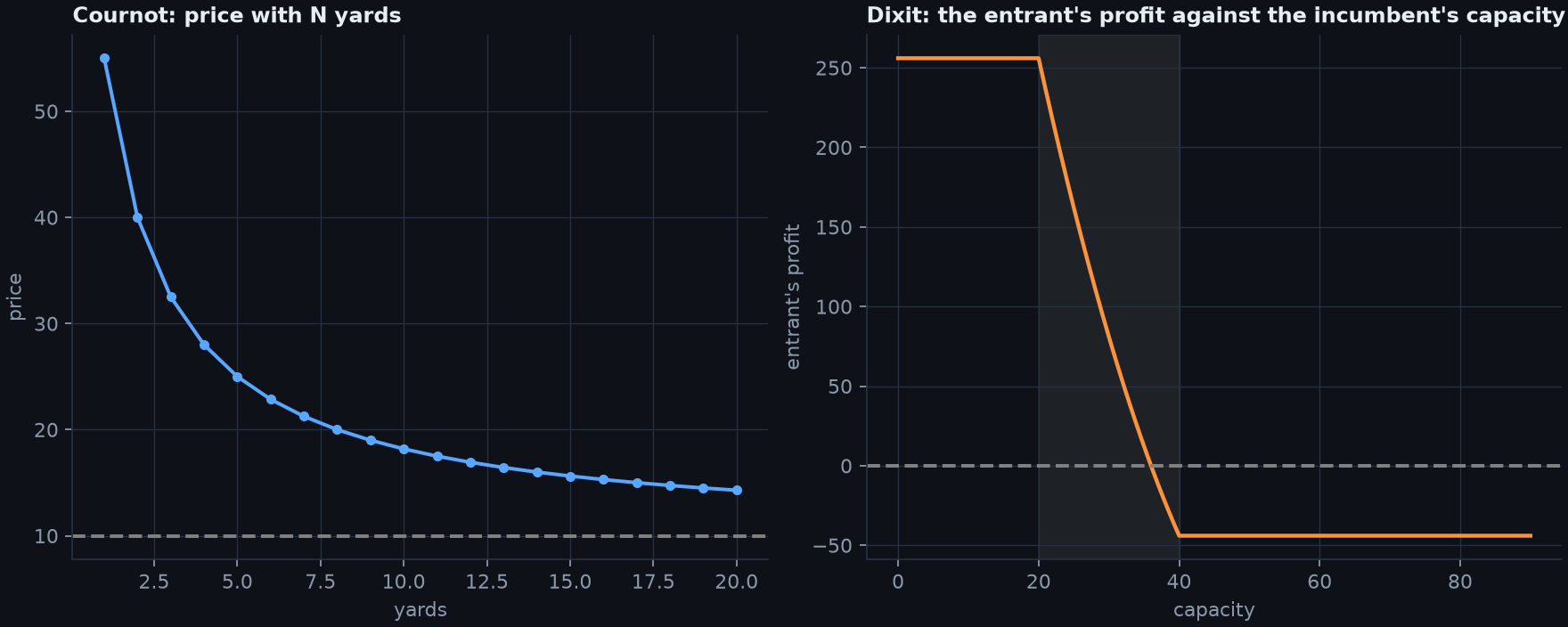
Cournot's model has a second gift. Let the number of yards grow. With demand a minus Q and cost c, N identical firms set a price of a plus N c, over N plus one. One yard charges fifty-five dollars, two charge forty, three thirty-two fifty. Twenty yards charge fourteen dollars and twenty-nine cents. Each new firm cares less about how its extra boat lowers the price, because it sells a smaller share of the boats at that price, and so the price slides toward cost. Monopoly and perfect competition turn out to be the two ends of one formula.
What it does: Cournot (1838), the mineral springs; best replies \(q_C = (90 - q_D)/2\); from Crusoe alone at 45 the replies close in on 30 each, price $40, $900 each; the monopoly's 45 boats at $55 ($2,025, or $1,012.50 each): a prisoner's dilemma; \(P = (a + Nc)/(N + 1)\): $55, $40, $32.50 ... $14.29 with twenty
3Bertrand's reply: competing in pricesPrinciples and the major2 min
In 1883, forty-five years after Cournot's book appeared, another French mathematician, Joseph Bertrand, reviewed it. He objected that the spring owners would not choose quantities and wait for the market. They would name prices. Whatever price the two share, either can cut it slightly and take every buyer. The other replies in kind, and there is no stopping point above cost. That is exactly what you did in Play it, when you undercut Crusoe's forty dollars with thirty-nine.
Follow the war through. Crusoe answers your thirty-nine with thirty-eight; you answer with thirty-seven, and so on down. Each cut takes the whole island, so each is worth making, until the price reaches the cost of a repair. At ten dollars, cutting again would lose money on every repair, and raising the price would lose every customer. So the only equilibrium has both yards at cost, earning nothing. Two firms are enough to give the competitive price of Part nine. This is the Bertrand paradox: Cournot's answer with two firms was forty dollars, Bertrand's is ten.
The paradox softens a little when costs differ. Suppose your yard is cheaper to run: ten dollars a repair against Crusoe's twenty. Crusoe cannot follow you below twenty without losing money. So you price a cent under his cost, nineteen ninety-nine, serve the whole island, and earn about eight hundred dollars a season. The efficient firm earns its cost advantage, and nothing more. In Bertrand's world, the only way to make a profit is to be better than your rival.
So which is right? In Cournot's world firms commit to quantities, a harvest, a factory's capacity, a fleet of ships, and the price falls gradually as firms are added. In Bertrand's they commit to prices, in a catalogue or on a sign, and the second firm is enough to drive the price to cost. The answer depends on what firms cannot easily change, and the next chapter shows how each of the paradox's assumptions can fail.
What it does: Bertrand (1883); the spiral from $40 down to the $10 cost; the paradox; with costs $10 and $20 the efficient yard prices at $19.99 and earns about $799; Cournot or Bertrand: what firms can't easily change
4Resolving the paradox: capacity, difference, repetitionPrinciples and the major3 min
Bertrand's argument has three quiet assumptions, and each can fail. The first is that the firm that undercuts can serve every buyer. A boatyard has only so many slips. In 1897 the English economist Francis Edgeworth pointed out that with limited capacity, a price cut wins only the customers you can serve. And raising your price can pay, because the customers your rival cannot serve come to you anyway. Then prices may never settle: cut after cut, then a jump back up, and again. The petrol prices of some cities in Canada and Australia move in just such a saw tooth, week after week, and economists call them Edgeworth cycles, after a dynamic model by Eric Maskin and Jean Tirole.
Capacity also explains when Cournot is right. In 1983 David Kreps and Jose Scheinkman studied a two-stage game: first each firm builds capacity, then the two compete in prices. On the Island, each yard builds thirty slips, and the price settles at forty dollars. Undercutting wins nothing, because both yards are already full, and raising the price loses more customers than it gains in margin; Agora checks every higher price. So Bertrand's price competition, played on top of capacities chosen in advance, gives exactly Cournot's outcome. That is why economists model industries that commit to capacity, like cement, steel or an airline's fleet, with Cournot's quantities.
The second assumption is that the two firms sell exactly the same thing. Suppose Crusoe's boats are fast and Dara's are sturdy, so a cheaper rival takes some of your buyers, but not all. Crusoe now sells ninety minus twice his price, plus Dara's price, and Dara the mirror image; each costs ten dollars to build. Best replies in prices slope upward: if Dara raises her price, Crusoe's best price rises too. Economists call such choices strategic complements; Cournot's quantities, whose reply curves slope down, are strategic substitutes. The curves cross at thirty-six dollars and sixty-seven cents each, with about fourteen hundred and twenty-two dollars of profit for each yard. That is well above cost, though below the fifty dollars that would maximize their joint profit. Being different softens price competition, which is one reason firms work so hard to be different.
The third assumption is that the yards meet only once. In fact they post prices every season, for years. And Part eleven showed that in a repeated game, a cut today can be punished tomorrow. So a high price can be an equilibrium, without any agreement at all, as chapter eight will show. Capacity, difference and repetition: between them, they explain why most markets with only a few sellers price above cost.
What it does: Edgeworth (1897) and cycles in some cities' petrol prices (Maskin and Tirole 1988); Kreps and Scheinkman (1983): 30 slips each, price $40, Agora checks every higher price; differentiated boats \(q_C = 90 - 2p_C + p_D\): equilibrium $36.67 and $1,422 each against the joint $50; repetition
5Hotelling's line and Salop's circlePrinciples and the major3 min
In 1929 the American statistician Harold Hotelling turned competition into geography. Picture Ana and Bo selling ice creams on the Island's beach. Bathers are spread evenly along the sand, both sellers charge the same fixed price, and every bather walks to the nearer of the two. Each seller gains by stepping toward the other: she keeps every bather on her side and wins some of his. They keep stepping until they stand back to back in the middle. Bathers then walk a quarter of the beach on average. If the sellers stood at the quarter-points, the same split of customers would need only an eighth.
Hotelling thought the result explained a great deal. Buyers, he wrote, are confronted everywhere with an excessive sameness. His own example was politics: in a two-party election, each party strives to make its platform as much like the other's as possible. In 1957 Anthony Downs built a theory of party competition on the idea, which Part forty-seven takes up. Radio stations playing the same hits, shops crowding one street, films released in the same week: all are sellers moving toward the middle of their customers.
Hotelling's sellers did not choose their prices. If they did, standing back to back would be Bertrand's war: identical sellers in the same spot would cut their prices to cost. In 1979 Claude d'Aspremont, Jean Gabszewicz and Jacques Thisse showed that when walking costs rise with the square of the distance, sellers who choose both place and price move to opposite ends of the beach. There each charges its cost plus the walking cost across the whole beach, and earns half of it. Moving together wins customers; moving apart protects prices. Which force wins depends on the market, which is why some products are copies of each other and others are deliberately unlike.
How many sellers does a market get? In 1979 Steven Salop bent Hotelling's line into a circle, like the Island's coast, so that there are no ends, and made every new seller pay a cost to set up. Sellers enter until profit is gone, at the square root of the walking cost over the setup cost. A planner, adding setup costs to walking costs, would want only half as many. With the Island's numbers, free entry brings ten stalls, and the planner would choose five. The reason is that each newcomer mostly steals customers from its neighbours. That is gain to the newcomer, but not to the island, which only saves a little walking. So free entry can give too many sellers, as well as too few.
What it does: Ana and Bo on a beach at fixed prices drift to the middle (a quarter of the beach walked on average, against an eighth); Hotelling's "excessive sameness" and his two parties; Downs (1957); with prices, d'Aspremont, Gabszewicz and Thisse (1979): to the ends, price \(c + t\); Salop (1979): free entry 10 stalls, the planner 5
6Monopolistic competitionPrinciples and the major3 min
Most markets with many sellers are not like Part nine's either. In 1933 two books appeared in the same year, by Edward Chamberlin at Harvard and Joan Robinson at Cambridge, about markets in between. Think of the Island's bakers. There are many, but each loaf is a little different, so each baker faces her own downward-sloping demand, and sets her own price. While bakers make profits, new ones open, and each one's demand shrinks. Entry stops when demand just touches average cost: the price is above marginal cost, as for a monopoly, yet profit is zero, as under competition. And every bakery runs below the scale at which bread would be cheapest to make. That is the cost of variety, and whether variety is worth it is the question the next model answers.
In 1977 Avinash Dixit and Joseph Stiglitz made Chamberlin's idea exact. People like variety: their utility adds up all the varieties, each raised to a power below one, so a little of many is better than a lot of one. The parameter sigma measures how easily one variety replaces another. Then every firm charges the same fixed markup over its marginal cost, sigma over sigma minus one. Free entry fixes each firm's size, and the number of varieties is proportional to the size of the economy. With sigma of four, firms mark up by a third, and an Island of a hundred workers supports twenty-five varieties. Its simplicity made it the workhorse of three later revolutions: in growth theory, where new varieties are new ideas; in macroeconomics, where firms that set prices can be slow to change them; and in trade. Parts twenty-one, thirty and thirty-six use it.
The model holds a surprise. Let the economy grow. Wages, prices and the size of each firm stay the same. Only the number of varieties changes. A hundred workers support twenty-five varieties; two hundred, fifty; eight hundred, two hundred. Because people value variety, each worker is better off by a factor of two to the power one over sigma minus one, about one point two six, every time the economy doubles. Two islands that begin to trade become one larger island, with more varieties for everyone. Paul Krugman used exactly this in 1979 to explain why similar countries trade so much with each other, the subject of Part thirty-six.
What it does: Chamberlin and Robinson (1933): the tangency, zero profit with price above marginal cost, excess capacity; Dixit and Stiglitz (1977): markup \(\sigma/(\sigma - 1)\), size \((\sigma - 1)f/c\), varieties \(L/(\sigma f)\): 4/3, 3 and 25 on the Island; doubling the economy raises well-being by \(2^{1/3} = 1.26\); Krugman (1979)
Intermission: crude and the pumpPrinciples and the major
This chapter has no narration to read.
7Commitment and entry deterrencePrinciples and the major4 min
Cournot's yards choose at the same time. In 1934 the German economist Heinrich von Stackelberg asked what happens when one firm moves first. Suppose Crusoe builds his boats before Dara decides, and she can see them. Crusoe knows that Dara will reply along her best-reply curve, so he chooses the point on it that is best for him. He builds forty-five boats, the monopoly's number, and earns a thousand and twelve dollars and fifty cents. Dara's best reply is twenty-two and a half, earning about five hundred and six. Moving first is worth a hundred and twelve dollars and fifty cents to Crusoe, and costs Dara nearly four hundred. Buyers gain too: the price is thirty-two fifty, below Cournot's forty. But moving first pays only if it cannot be undone. Boats already built are a commitment. A promise to build them is not, because once Dara has built hers, Crusoe would rather build fewer.
Commitment can also keep a rival out. In 1980 Avinash Dixit studied an incumbent who can build capacity before anyone else arrives. On the Island, a boat slip costs thirty dollars to build and ten more to use; Crusoe is alone, and Dara is deciding whether to pay a hundred and forty-four dollars to set up a second yard. Slips Crusoe has already built cost him only ten dollars a boat to use, so if Dara enters he will use them: they make him tough. But only up to a point. Beyond forty slips, he would leave the extra ones idle rather than flood the market, so building them frightens nobody. Only capacities in the shaded range are credible threats. With thirty-six slips, Dara's best reply would earn her nothing, so she stays out, and Crusoe earns eight hundred and sixty-four dollars a year. If he let her in and led as Stackelberg did, he would earn four hundred and fifty. The deterrence costs him: a monopolist who feared nobody would build thirty slips and earn nine hundred. Six extra slips, thirty-six dollars a year, are what keeping Dara out is worth to him.
How Crusoe should respond depends on how costly entry is for Dara. If her setup cost is low, no credible capacity keeps her out, and Crusoe does best to let her in and lead. In a middle range he builds extra slips to keep her out: strategic deterrence. And if her setup cost is high, the thirty slips a monopolist would build anyway are enough: entry is blockaded. Joe Bain had described all three cases in 1956. Dixit's contribution was to show which threats an entrant should believe.
In 1984 Drew Fudenberg and Jean Tirole sorted every such strategy into a zoo. Ask two questions about an investment made in advance: does it make you tough or soft toward your rival, and do you want the rival out, or are you living with it? To keep a rival out, be a top dog, investing more if it makes you tough, or show the lean and hungry look, investing less if investment would make you soft. Living with a rival in quantities, the same advice holds. But living with it in prices, the answer flips: be a puppy dog, small and unthreatening, or a fat cat, comfortable and slow to cut prices, because a rival who sees you won't fight will raise its own prices too. Crusoe's slips make him tough: he is a top dog. A loyalty scheme that rewards existing customers makes a firm reluctant to cut prices to win new ones; that softness invites rivals to price higher too, and makes the scheme a fat cat's.
What it does: Stackelberg (1934): Crusoe leads with 45, Dara follows with 22.5, $1,012.50 and $506.25, price $32.50; Dixit (1980): slips at $30, use at $10, Dara's setup cost $144: credible capacities 20 to 40, deterrence at 36 slips ($864) against accommodation ($450) and the unthreatened monopoly ($900); regimes by setup cost (Bain 1956); Fudenberg and Tirole's top dog, puppy dog, fat cat and lean and hungry look (1984)
8Collusion as a repeated gamePrinciples and the major4 min
Part eleven showed that repetition can sustain cooperation. Here it is with boats. Suppose Crusoe and Dara agree to build twenty-two and a half boats each, every season, so that together they act as a monopoly. And suppose each believes that if either ever builds more, both will return to Cournot's thirty for good. James Friedman showed in 1971 that such threats can hold a cartel together. Keeping the deal earns each yard a thousand and twelve dollars fifty a season, for ever. Cheating earns more once: the best reply to the other's twenty-two and a half is about thirty-four boats, for eleven hundred and thirty-nine dollars. Then nine hundred a season, for ever. Cheating doesn't pay if delta, the value today of next season's dollar, is at least nought point five two nine. Delta combines patience with the chance that the market will still be there next season; firms that meet often, in a stable market, have a delta close to one.
Now count the firms. With more members, each one's share of the cartel's profit shrinks, but a cheater still takes a large bite of the whole market. When firms set prices, a cheater undercutting by a cent takes everything, and the cartel holds only if delta is at least one minus one over N: a half with two firms, nine tenths with ten. When they set quantities, the threshold climbs from nought point five three with two firms to nought point seven five with ten. Either way, more firms need more patience, which is one reason cartels of a few hold better than cartels of many.
In 1964 George Stigler put the problem differently: collusion is a problem of policing. A cartel lasts only if its members can detect who is cheating, because a cut nobody notices is never punished. From that idea, and from the repeated game, comes a list of what helps. Few firms, so each one's cheating shows. Prices in public, so a secret discount is hard to give. Frequent meetings, so punishment comes quickly. Similar firms, so that one deal suits them all. Steady demand, so that a fall in your sales means someone cheated, not that the market shrank. And contact in many markets, which Douglas Bernheim and Michael Whinston showed lets firms that cheat in one be punished in all.
Called it? Stigler's theory predicts that secret price cuts are what undo cartels. In 2006 Margaret Levenstein and Valerie Suslow surveyed the empirical studies of cartels. Cheating, or monitoring too weak to catch it, broke cartels only occasionally. The most common causes of collapse were entry by new rivals and bargaining problems among the members, and many cartels lasted for years. Partly right: cartels do worry about cheating, and organize themselves to catch it: the lysine association kept tables of each member's sales against its target. But newcomers and quarrels ended more cartels than secret price cuts did. And then there is the law, the subject of the next chapter.
What it does: The yards' deal at 22.5 boats each: $1,012.50 a season against cheating's $1,139.06 once then $900; \(\delta \ge 9/17 = 0.529\) (Friedman 1971); with \(N\) firms: \(1 - 1/N\) for prices, 0.529 to 0.752 for quantities; Stigler (1964) and what helps a cartel; Bernheim and Whinston (1990); Called it?: partly right (Levenstein and Suslow 2006)
9Cartels in the dataPrinciples and the major4 min
Cartels have not always been illegal. From 1879 the railroads carrying grain from Chicago to the Atlantic coast ran an open cartel, the Joint Executive Committee, which set their rates in the open. In 1983 Robert Porter studied its weekly rates from 1880 to 1886, and found that they switched between two regimes. Long spells at a collusive rate were broken by price wars, and then the rate went back up. Were the wars punishments for cheating? The theory of the last chapter says a cartel that punishes well is never cheated, so its punishments should never be seen. Edward Green and Porter had an answer: price wars can happen even when nobody cheats.
Here is their idea in Agora. Two firms cannot see each other's output, only the market price, and the price also moves with demand they cannot see. They agree to produce the cartel's quantity, and that if the price ever falls below a trigger, both will produce Cournot's quantity for six seasons, then return to the deal. Nobody ever cheats. Yet over three hundred seasons there are ten price wars, and the market spends a fifth of its time at war. Every war began with a bad season for demand, which looked like cheating. The wars are what it costs to keep everyone honest: without them, cheating could hide behind bad luck. Porter's estimates for the railroads were consistent with wars of this kind.
What did the lysine cartel cost its buyers? The overcharge is what buyers paid minus what they would have paid without the cartel. The second price is never seen, so it must be estimated, which is where economists earn their fees in court. Connor put American sales of lysine during the conspiracy at four hundred and ninety-five to five hundred and fifty million dollars, and the overcharge to direct buyers at sixty-five to a hundred and forty million. That makes prices twelve to twenty-eight percent above the competitive level. Notice what the benchmark cannot be: the price war of 1991 and 1992, when prices were below cost, was no more competitive than the cartel. How large overcharges are across hundreds of cartels is chapter fourteen's dial.
How are cartels broken now? With a game. Each member of a cartel can stay silent, and hope the authorities don't find it, which on the Island happens with a chance of one in five, or confess. If a rival confesses first, you pay the full fine whatever you do. So if the first to confess is forgiven more than eighty percent of the fine, confessing beats silence whatever the others do. It is a prisoner's dilemma, built on purpose. In August 1993 the American Justice Department made amnesty automatic for the first firm to report a cartel it was not yet investigating. Under the older policy it had received about one application a year. The European Commission followed with a leniency notice in 1996, and most competition authorities now have one.
What it does: The Joint Executive Committee, 1880-86 (Porter 1983); Green and Porter (1984) in Agora: 10 wars in 300 seasons, a fifth of the time at war, each started by a bad demand season; the lysine overcharge: $65-140 million on $495-550 million of sales; leniency: forgive more than 80% and confessing dominates; the US policy of August 1993
10Tacit collusion and the lawPrinciples and the major4 min
The cartel of chapter eight held its price high without anyone agreeing to anything. Each firm simply expected the others to punish a cut. Economists call this tacit collusion. The law forbids something narrower. America's Sherman Act of 1890 and the European Union's Article one hundred and one forbid agreements, and practices concerted between firms, that restrain competition. Parallel prices alone are not enough, because rivals facing the same costs move together anyway. In Bell Atlantic against Twombly, in 2007, the American Supreme Court held that a complaint must allege facts suggesting an agreement, not just parallel behaviour. And in the Wood Pulp case of 1993, the European Court of Justice held that parallel pricing proves concertation only if nothing else can explain it. So the law reaches what firms say to each other, but not what they merely expect of each other.
Some business practices make tacit collusion easier without a word being said. Take a promise to match any lower price. It sounds like a gift to customers, but it is also a message to rivals. Suppose both yards post the monopoly's fifty-five dollars, each promising to match any lower price. Each earns a thousand and twelve dollars fifty. If Crusoe cuts to fifty-four, Dara matches at once, the yards split the island at the lower price, and Crusoe earns a little less. Undercutting no longer wins a single customer, so Bertrand's war never starts. Announcing price rises in advance, and sharing databases of each other's prices, can work the same way.
Where does signalling end and agreement begin? In December 1992 the Justice Department sued eight airlines and the Airline Tariff Publishing Company, the fare database they owned. It alleged that the airlines used the database's first and last ticket dates and its fare footnotes to negotiate the end of each other's discounts: posting fares that would start only weeks later, and withdrawing or matching them before anyone could buy one. It was a conversation held in fares, with offers, replies and agreements. The cases were settled by consent decrees in 1993 and 1994, which forbade fare codes that carry any other message. What happens when the conversation is between pricing algorithms is chapter sixteen's question.
One suspected sign of tacit coordination is found at the petrol pump. Drivers say that prices rise like rockets and fall like feathers. In 1997 Severin Borenstein, Colin Cameron and Richard Gilbert found that American retail prices did respond faster to rises in crude oil than to falls, and suggested inventory lags and the market power of some sellers as reasons. Agora tried the same question on the Data Room's monthly prices since 1986, measuring the pump price's response to each dollar of crude per gallon. In the first month, the pump moves 77 cents after a rise, and 75 cents after a fall: a difference of about 1 cent, with a standard error of 11. Monthly averages blur what happens within a few weeks, so this data cannot settle the question either way, which is a lesson about data as much as about petrol.
What it does: The Sherman Act and Article 101; Bell Atlantic v. Twombly (2007); Wood Pulp (1993); price-matching promises make $55 an equilibrium ($1,012.50 each, a cut to $54 earns $1,012); the airline fare-database case (1992-94); rockets and feathers (Borenstein, Cameron and Gilbert 1997) and Agora's monthly test: 77 cents after a rise, 75 after a fall, a difference of 1 cent with a standard error of 11
11Concentration: the Herfindahl indexPrinciples and the major2 min
How concentrated is an industry? The standard number squares each firm's market share, in percent, and adds them up. It is named for Orris Herfindahl and Albert Hirschman, who proposed it independently. A monopoly scores ten thousand. Two equal firms score five thousand; four equal firms, two thousand five hundred. One firm with seventy percent and three with ten scores five thousand two hundred, more than two equal firms, because squaring weighs big firms more. Ten equal firms score a thousand.
Why that index? In 1976 Keith Cowling and Michael Waterson showed that in Cournot's model it is exactly the right one. The industry's markup, each firm's Lerner index weighted by its share, equals the Herfindahl index divided by the elasticity of market demand. A concentrated industry facing inelastic demand marks up most. Agora solves six Island markets, some with equal costs and some unequal, and every one lands on the line. But the formula holds only if firms compete as Cournot assumed. Under Bertrand, two firms with a Herfindahl index of five thousand mark up by nothing at all. Concentration is a clue to market power, not a measurement of it, which is why Part forty-three measures markups directly.
Competition authorities use the index as a first screen. Under the American merger guidelines of December 2023, a merger is presumed to lessen competition substantially if it leaves the market's index above eighteen hundred and raises it by more than a hundred, or if it creates a firm with more than thirty percent of the market, with a rise above a hundred. From 2010 to 2023 the line was two thousand five hundred, with a rise of two hundred; the new guidelines returned to the stricter number used before 2010. Merging two of five equal firms takes the index from two thousand to two thousand eight hundred, a rise of eight hundred: past both lines.
What it does: \(H = \sum s_i^2\): 10,000, 5,000, 2,500, 5,200 and 1,000 for five markets; Cowling and Waterson (1976): \(\sum s_i (P - c_i)/P = H/\varepsilon\), six Island markets on the line; the 2023 guidelines (1,800 and 100; 30%) and 2010's (2,500 and 200); two of five merging: 2,000 to 2,800
12MergersPrinciples and the major3 min
Start with a puzzle. Three Cournot yards each earn five hundred and six dollars. Two of them merge into one. With two yards left, each earns nine hundred. So the two that merged, who together earned a thousand and twelve fifty, now earn nine hundred: they have lost a hundred and twelve dollars fifty. The yard left out has gained the most. Stephen Salant, Sheldon Switzer and Robert Reynolds pointed this out in 1983. The merged firm cuts its output to raise the price, and its Cournot rivals expand to take advantage of it. Agora's bars show the merger loses money whenever more than two yards were there to begin with. Of five yards, a merger must take in four just to break even.
Yet firms merge all the time, so they must expect something the paradox leaves out. One possibility is savings: the merged firm may make things more cheaply. Joseph Farrell and Carl Shapiro asked in 1990 how large the savings must be for buyers not to lose. On the Island, the price stays put only if the merged yard's cost per boat falls by twenty-two dollars fifty. But each boat costs only ten. Even if the merged yard could build boats for nothing, the price would still rise, from thirty-two fifty to thirty-six sixty-seven. With differentiated products and price competition, the paradox disappears: Raymond Deneckere and Carl Davidson showed in 1985 that such mergers are profitable even without savings, and raise prices too. So a merger between close rivals has to show savings large enough, and passed on to buyers, to offset the loss of competition between them.
Who should count? In 1968 Oliver Williamson drew a merger that raises the price but lowers the cost. The loss to society is a small triangle: the trades no longer made at the higher price. The gain is a rectangle: the cost saved on every unit still made. Because the triangle's area grows with the square of the price rise, it is small. With a demand elasticity of two, a ten percent price rise costs a triangle of only about one percent of sales, so a cost saving of one percent would offset it. In total surplus, then, modest savings win. But the rectangle goes to the merged firm, and buyers still pay more. American and European agencies ask whether buyers are harmed, which is why the savings they accept must be passed on in prices.
What it does: Two of three Cournot yards merge and lose $112.50 (Salant, Switzer and Reynolds 1983); four of five break even; Farrell and Shapiro (1990): the price stays put only if cost falls by $22.50, more than the whole $10, and even at zero cost it rises from $32.50 to $36.67; Deneckere and Davidson (1985); Williamson (1968): with elasticity 2, a 10% price rise costs a triangle of about 1% of sales
13Contestable markets, limit pricing and predationPrinciples and the major3 min
Can the mere threat of a rival discipline a monopoly? In 1982 William Baumol, John Panzar and Robert Willig asked what would happen if a rival could enter a market, and leave it, at no cost at all. Take a ferry with a fixed cost of a thousand dollars a season, so that there is room for only one. If the ferry ever earns a profit, a rival can arrive, undercut it, take the passengers, and leave before the incumbent responds: hit and run. So even a monopoly must charge its average cost, about twenty-three dollars, not the monopoly's fifty-five. A market can be contestable with one seller. Airlines were the hope, since planes can be flown to any route. But studies of fares after America deregulated its airlines found that fares depend on how many airlines actually fly a route, not just on how many could. Sunk costs, gates and loyalty schemes make entry far from free.
A second old idea is limit pricing. An incumbent sets a low price today to keep a rival from entering tomorrow. The trouble is that a rational entrant cares about the price it will face after it enters, not the price before. In 1982 Paul Milgrom and John Roberts rescued the idea with private information: if entrants don't know the incumbent's costs, a low price can signal that they are low, and that a fight would be hard. Yet in their model, when the signal works, entry happens no less often than it would if costs were known. The incumbent's low price mostly benefits its buyers.
The third is predation: pricing below cost to drive a rival out, then raising prices once it is gone. The classic accusation was against John D. Rockefeller's Standard Oil. In 1958 John McGee went through the record of the government's case against it, and found little evidence that Standard Oil had priced below cost to ruin its rivals. It had bought them. His argument was that predation costs the predator more than its prey, since the predator sells more at the low price, and that buying a rival is cheaper. Game theory replied in 1982, in papers by David Kreps and Robert Wilson and by Milgrom and Roberts: an incumbent facing many possible entrants, who are unsure what kind of firm it is, can fight the first to build a reputation that deters the rest. American law settled in between. In the Brooke Group case of 1993 the Supreme Court held that a plaintiff must show prices below cost, and a dangerous probability that the predator would recoup its losses later. Since then, few predation cases have succeeded in American courts.
What it does: Baumol, Panzar and Willig (1982): a ferry with a $1,000 fixed cost prices at average cost, $22.98, not $55; airlines; limit pricing and Milgrom and Roberts (1982); McGee on Standard Oil (1958), reputation (Kreps and Wilson 1982), Brooke Group (1993)
14The Dials: how much do cartels overcharge?Graduate2 min
How large are overcharges in general? It matters, because the law builds a number into its penalties. The American sentencing guidelines say: it is estimated that the average gain from price-fixing is ten percent of the selling price. So a cartel's base fine is set from twenty percent of the commerce it affected, because the harm also falls on buyers who stopped buying. And a fine deters only if it exceeds the gain from the cartel, multiplied by the chance of being caught, which is why the leniency programme's prisoner's dilemma matters. So the typical overcharge is a policy number. Is ten percent right?
This part opens a dial for cartel overcharges. John Connor has collected the published estimates for hundreds of cartels; in his 2014 survey the median long-run overcharge is twenty-three percent, and the mean at least forty-nine. Marcel Boyer and Rachidi Kotchoni re-estimated the same database in 2015, correcting for how the estimates were made and which got published, and found a median of about sixteen percent. The lysine cartel's twelve to twenty-eight percent sits among them. Every estimate is above the guideline's ten percent; how far above is the dispute. So the dial is contested. At the low end, fines of a few times the overcharge deter; at the high end, they must be larger. And the cartels on the dial are the ones that were caught, which may not be typical of the ones that were not.
What it does: The sentencing guidelines' 10% and the 20% base fine; the new dial: Connor (2014) median 23%, Boyer and Kotchoni (2015) 16.01%, lysine 12-28%: contested
15In practice: the economics of antitrustPractice3 min
In practice, a merger case begins with a question that sounds legal and is really economic. What is the market? Boats, or every way of crossing the water? The guidelines answer with a thought experiment: would a single owner of all the boats find it profitable to raise their price by five percent? The rise pays if the share of sales it loses is smaller than the critical loss: the price rise divided by itself plus the margin. At Cournot's forty dollars, with a margin of three quarters, the critical loss is six and a quarter percent. A five percent rise would lose three point three percent of sales. So the rise pays, and boats are a market of their own. Notice the trap. High margins make the critical loss small, and merging firms cite that to argue for a broad market. But Michael Katz and Carl Shapiro pointed out in 2003 that a firm with a high margin must face few customers ready to leave, so the actual loss is small too. Read carelessly, the test misleads, which is why economists argue over it in court.
A famous case shows how the argument is won with data. In 1997 two of America's three office-supply superstore chains, Staples and Office Depot, agreed to merge. The firms said their market was all office supplies, sold by every kind of shop, in which they held a small share. The Federal Trade Commission's economists compared prices across cities instead. Staples charged less where an Office Depot was nearby. So the superstores competed with each other more than with anyone else, and the court accepted that they formed a market of their own, and blocked the merger.
This is the antitrust economist's kit. Defining the market, with the hypothetical monopolist. Diversion: if a firm raised its price, where would its customers go? Merger simulation: solving models like chapters two to four with demand estimated from data, to predict prices after a merger. Overcharges, which set the damages a cartel's buyers can claim. Screens that look in price data for signs of coordination. And remedies: selling a plant, or licensing a patent, so that a merger can go ahead without the harm. Part forty-three measures markups directly, Part forty-four takes on platforms and dynamic competition, and Part fifty-nine puts you in the witness box.
What it does: The hypothetical monopolist and critical loss: 6.25% against an actual 3.3% at $40; Katz and Shapiro (2003); FTC v. Staples (1997); the economist's kit; pointers to Parts 43, 44 and 59
16Frontier: common owners and pricing algorithmsResearch3 min
Two new worries sit at the frontier. The first is about who owns firms. Index funds now own a few percent of almost every listed company, which means they own rivals too. A fund that owns both airlines on a route gains little when one wins passengers from the other, so if owners steer firms at all, they might steer them away from competing. In 2018 Jose Azar, Martin Schmalz and Isabel Tecu reported that on American air routes, fares were higher where common ownership was higher. In 2022 Patrick Dennis, Kristopher Gerardi and Carola Schenone argued that the link came from the market shares built into the measure, not from ownership. The original authors dispute that reply, and the question remains open.
How would one measure the effect? Daniel O'Brien and Steven Salop's modified Herfindahl index adds to the usual index what each firm's controlling owners gain from its rivals' profits. Take two airlines with half the market each, an ordinary index of five thousand. Four funds each own seven percent of both, so twenty-eight percent of each airline is held in common. If the rest of each airline belongs to one large owner, the modified index rises only to about five thousand one hundred and eighty. If the rest is spread over a thousand small shareholders, the funds control both firms, and the index reaches nearly ten thousand, almost a merger. The same holdings give two answers. It depends on who actually controls the firm, which is exactly what the two sides dispute.
The second worry is software. In 2020 Emilio Calvano, Giacomo Calzolari, Vincenzo Denicolo and Sergio Pastorello let two simple learning algorithms set prices against each other, over and over. They had no instruction to collude and no way to communicate, yet they learned to price above the competitive level. And they learned to answer a price cut with a short price war before returning to the high price: chapter eight's punishment, discovered by trial and error. Is it happening? In 2024 Stephanie Assad, Robert Clark, Daniel Ershov and Lei Xu studied German petrol stations that adopted pricing software. Adoption raised margins only for stations that had rivals, and in markets of two or three stations, only when all of them adopted.
Open questions follow. Is it an agreement when rivals hand their prices to the same software? In 2024 the Justice Department sued RealPage, alleging that its software recommended rents to competing landlords using their private data; in November 2025 the company agreed to a proposed settlement that stops it using rivals' current private data. Should funds that own rivals be limited, or their votes? Can regulators audit an algorithm's prices the way the F B I once listened to a cartel's tapes? Platforms, and how to measure market power directly, are Parts forty-four and forty-three.
What it does: Azar, Schmalz and Tecu (2018) and Dennis, Gerardi and Schenone (2022); O'Brien and Salop's modified HHI: four funds with 7% of each of two airlines give 5,182 if the rest has one owner and 9,871 if it is dispersed; Calvano et al. (2020); Assad et al. (2024); the RealPage case (2024-25)
Recap, problems, and the road aheadAll tracks3 min
So: how do a handful of firms compete, and when do they stop? Somewhere between monopoly and perfect competition, and where depends on what they commit to. Quantities, capacity and being different keep prices above cost; pure price competition drives them to cost with only two firms. They stop competing when the future is worth more than one season's cheating, when they can see each other's prices, and when no newcomer, and no prosecutor, arrives.
Part twelve in twelve lines. The lysine market went from a price war below cost to a cartel that overcharged by twelve to twenty-eight percent. Cournot's quantity competition gives forty dollars with two yards and slides toward cost as yards are added. Bertrand's price competition reaches cost with two, and the more efficient firm earns only its advantage. Capacity, difference and repetition explain why most markets of a few price above cost. Hotelling's sellers move together for customers and apart for prices, and free entry can bring too many. Dixit and Stiglitz give every firm a fixed markup, and variety that grows with the economy. Commitment rewards the first mover, and capacity can keep a rival out. A cartel holds when firms are patient enough, and more firms need more patience. Price wars can happen with nobody cheating; Stigler was partly right; and leniency turns a cartel into a prisoner's dilemma. The law reaches what firms say to each other, not what they expect. Concentration predicts markups only under Cournot, and most mergers of close rivals need large savings. And cartels overcharge by sixteen to twenty-three percent at the median, while common owners and algorithms raise new questions.
The problems. Cournot with N firms; Bertrand with unequal costs; price competition with different products; Stackelberg's leader; the patience a cartel needs; the merger paradox; Cowling and Waterson's formula; and a starred problem on Dixit's capacity. Full solutions are in the part's notes.
The reading: chapters five to nine of Tirole's Theory of Industrial Organization, and Cabral's introduction; Carlton and Perloff, and Belleflamme and Peitz; Motta's Competition Policy and Whinston's lectures on antitrust; and for the story, Connor's Global Price Fixing and Kurt Eichenwald's The Informant. Then the papers, from Cournot to the pricing algorithms.
In this part, everyone knew what they were buying, and the yards could see each other's prices. Next time, a market where buyers cannot tell good from bad: George Akerlof's thirteen pages on used cars, turned down by three journals before the Quarterly Journal of Economics printed them in 1970. Part thirteen opens Act Four, on failure and design: lemons and signals.
Where it goes next. Part 13 turns to markets where one side knows more; Parts 16-17 to auctions and bidding rings; Parts 21, 30 and 36 use Dixit-Stiglitz in growth, sticky prices and trade; Part 43 measures markups and conduct; Part 44 takes on platforms and dynamic competition; Part 59 puts the viewer in the witness box.
Key results
The part's results in one place, for revision.
Try it
Lab 12 · Competition among the few: quantities, prices, commitment and collusion
Solve Cournot with one to twenty firms and check Cowling and Waterson's L = H/epsilon; solve Bertrand with equal and unequal costs, differentiated prices and Kreps and Scheinkman's capacities; compute Salop's free entry against the planner and Dixit and Stiglitz's markup; find Stackelberg's leader and Dixit's deterring capacity; compute the discount factor a cartel needs with N firms; simulate Green and Porter's price wars; and work out the merger paradox and the savings that keep a merger's price from rising.
python -m videos.economics.labs 12
needs numpy, scipy, matplotlib · download lab12.py ·
source on GitHubCournot price with 1, 2, 3 and 20 yards 55.00, 40.00, 32.50, 14.29
four unequal yards: HHI, share-weighted Lerner index, H/epsilon 2539, 0.6278, 0.6278
Bertrand: equal costs, then costs 10 and 20 (price, profit) 10.00, 0.00; 19.99, 799.30
differentiated price; Kreps-Scheinkman capacity and price 36.67; 30, 40
Salop: free entry against the planner; Dixit-Stiglitz markup and varieties 10 vs 5; 1.333, 25
Stackelberg: leader and follower 45.0, 22.5 (profits 1012.50, 506.25)
Dixit: credible range, deterring capacity, deter vs accommodate [20, 40], 36, 864 vs 450
delta a cartel needs, 2 and 10 firms: quantities; prices 0.529, 0.752; 0.500, 0.900
Green and Porter: share of seasons at war (nobody cheats) 0.200
leniency: is confessing dominant with half, then full, forgiveness? False, True
merger of two of three: the pair's gain; saving needed; price at zero cost -112.50; 22.50; 36.67
Williamson: cost cut (share of sales) that offsets a 10% price rise 0.010
Cournot's price falls from the monopoly's toward cost as firms are added, and the share-weighted Lerner index equals H/epsilon exactly; Bertrand reaches cost with two firms, and capacity chosen first gives Cournot's outcome; free entry brings twice the planner's number of sellers; a credible capacity of 36 keeps the entrant out; cartels need more patience as they grow; price wars happen with nobody cheating; and a merger of two of three Cournot firms loses money without savings, and raises the price unless it saves more than its whole cost.The code (107 lines; it asserts its own result)
"""Lab 12: competition among the few: Cournot and Bertrand, capacity, differentiation, location, variety,
commitment, collusion, price wars, concentration and mergers."""

import numpy as np

from videos.coursekit import labs
from explainer.economics.agora import oligopoly as ol
from explainer.economics.island import truths

TITLE = "Competition among the few: quantities, prices, commitment and collusion"
GOAL = ("Solve Cournot with one to twenty firms and check Cowling and Waterson's L = H/epsilon; solve Bertrand with "
        "equal and unequal costs, differentiated prices and Kreps and Scheinkman's capacities; compute Salop's free "
        "entry against the planner and Dixit and Stiglitz's markup; find Stackelberg's leader and Dixit's deterring "
        "capacity; compute the discount factor a cartel needs with N firms; simulate Green and Porter's price wars; "
        "and work out the merger paradox and the savings that keep a merger's price from rising.")
TASKS = [
    "Cournot with costs 8, 10, 12 and 14: which firm has the largest Lerner index, and does the identity "
    "sum s_i L_i = H/epsilon still hold? Now give the cheapest firm a cost of 2. Does anyone drop out?",
    "Dixit's game: lower the entrant's setup cost from 144 to 100 and then to 80. Where does strategic deterrence "
    "stop being possible, and what does the incumbent do instead?",
    "Green and Porter: raise the trigger from 3.5 to 4.0 and shorten the wars from six seasons to three. How does "
    "the share of time at war change, and what happens to the average price?",
]


def run(seed=0):
    lab = labs.Lab()
    T = truths(12)
    bt = T["boats"]
    a, b, c = bt["a"], bt["b"], bt["c"]

    # Cournot
    ns = np.arange(1, bt["n_max"] + 1)
    P = np.array([ol.cournot(a, b, [c] * n)["P"] for n in ns])
    assert np.allclose(P, (a + ns * c) / (ns + 1))
    lab.row("Cournot price with 1, 2, 3 and 20 yards", ", ".join(f"{P[k]:.2f}" for k in (0, 1, 2, -1)))
    asym = ol.cournot(a, b, [8.0, 10.0, 12.0, 14.0])
    assert abs(asym["lerner"] - asym["lerner_hhi"]) < 1e-9
    lab.row("four unequal yards: HHI, share-weighted Lerner index, H/epsilon",
            f"{10000 * asym['hhi']:.0f}, {asym['lerner']:.4f}, {asym['lerner_hhi']:.4f}")

    # prices
    eq, uneq = ol.bertrand(a, b, [c, c]), ol.bertrand(a, b, [c, 20.0])
    lab.row("Bertrand: equal costs, then costs 10 and 20 (price, profit)",
            f"{eq['P']:.2f}, {eq['profit']:.2f}; {uneq['P']:.2f}, {uneq['profit']:.2f}")
    d = T["diff"]
    db = ol.bertrand_differentiated(d["alpha"], d["beta"], d["gamma"], d["c"])
    ks = ol.kreps_scheinkman(a, b, c)
    assert ks["deviation_gain"] <= 1e-9
    lab.row("differentiated price; Kreps-Scheinkman capacity and price", f"{db['p']:.2f}; {ks['k']:.0f}, {ks['P']:.0f}")

    # space and variety
    be = T["beach"]
    sl = ol.salop(be["t"], be["F"], be["c"])
    v = T["variety"]
    dsx = ol.dixit_stiglitz(v["sigma"], v["f"], v["c"], v["L"])
    lab.row("Salop: free entry against the planner; Dixit-Stiglitz markup and varieties",
            f"{sl['n_free']:.0f} vs {sl['n_opt']:.0f}; {dsx['markup']:.3f}, {dsx['n']:.0f}")

    # commitment
    st = ol.stackelberg(a, b, c)
    de = T["deter"]
    dx = ol.dixit_entry(de["a"], de["b"], de["c"], de["r"], de["F"])
    assert dx["regime"] == "deter"
    lab.row("Stackelberg: leader and follower", f"{st['qL']:.1f}, {st['qF']:.1f} (profits {st['piL']:.2f}, "
            f"{st['piF']:.2f})")
    lab.row("Dixit: credible range, deterring capacity, deter vs accommodate",
            f"[{dx['S']:.0f}, {dx['T']:.0f}], {dx['deter_k']:.0f}, {dx['pi_deter']:.0f} vs {dx['pi_accommodate']:.0f}")

    # collusion
    nn = list(T["collusion"]["ns"])
    dc = [ol.collusion_threshold(n, "cournot")["delta"] for n in nn]
    dbt = [ol.collusion_threshold(n, "bertrand")["delta"] for n in nn]
    assert abs(dc[0] - 9 / 17) < 1e-12 and abs(dbt[0] - 0.5) < 1e-12
    lab.row("delta a cartel needs, 2 and 10 firms: quantities; prices", f"{dc[0]:.3f}, {dc[-1]:.3f}; {dbt[0]:.3f}, "
            f"{dbt[-1]:.3f}")
    gp = ol.green_porter(periods=T["collusion"]["periods"], seed=T["collusion"]["seed"] + seed)
    lab.row("Green and Porter: share of seasons at war (nobody cheats)", f"{gp['share_war']:.3f}")
    le = T["leniency"]
    lab.row("leniency: is confessing dominant with half, then full, forgiveness?",
            f"{ol.leniency_race(le['fine'], le['caught'], leniency=0.5)['dominant']}, "
            f"{ol.leniency_race(le['fine'], le['caught'], leniency=1.0)['dominant']}")

    # mergers
    m = ol.merger_cournot(T["merger"]["n"], a, b, c)
    lab.row("merger of two of three: the pair's gain; saving needed; price at zero cost",
            f"{m['merger_gain']:.2f}; {m['saving_needed']:.2f}; {m['price_if_free']:.2f}")
    w = ol.williamson(T["merger"]["eps"], T["merger"]["dp"], 0.0)
    lab.row("Williamson: cost cut (share of sales) that offsets a 10% price rise", f"{w['breakeven_dc']:.3f}")
    lab.note = ("Cournot's price falls from the monopoly's toward cost as firms are added, and the share-weighted "
                "Lerner index equals H/epsilon exactly; Bertrand reaches cost with two firms, and capacity chosen "
                "first gives Cournot's outcome; free entry brings twice the planner's number of sellers; a credible "
                "capacity of 36 keeps the entrant out; cartels need more patience as they grow; price wars happen "
                "with nobody cheating; and a merger of two of three Cournot firms loses money without savings, and "
                "raises the price unless it saves more than its whole cost.")

    fig, ax = labs.figure(2, size=(11, 4.4))
    ax[0].plot(ns, P, "o-", color=labs.BLUE, ms=4)
    ax[0].axhline(c, color="grey", ls="--")
    ax[0].set(title="Cournot: price with N yards", xlabel="yards", ylabel="price")
    ax[1].plot(dx["ks"], dx["entrant_profit"], color=labs.ORANGE, lw=2)
    ax[1].axhline(0, color="grey", ls="--")
    ax[1].axvspan(dx["S"], dx["T"], color="grey", alpha=0.15)
    ax[1].set(title="Dixit: the entrant's profit against the incumbent's capacity", xlabel="capacity",
              ylabel="entrant's profit")
    lab.fig = fig
    return lab
Now change it
- Cournot with costs 8, 10, 12 and 14: which firm has the largest Lerner index, and does the identity sum s_i L_i = H/epsilon still hold? Now give the cheapest firm a cost of 2. Does anyone drop out?
- Dixit's game: lower the entrant's setup cost from 144 to 100 and then to 80. Where does strategic deterrence stop being possible, and what does the incumbent do instead?
- Green and Porter: raise the trigger from 3.5 to 4.0 and shorten the wars from six seasons to three. How does the share of time at war change, and what happens to the average price?
Problems, with solutions
Try each problem before opening its solution.
1. Cournot with \(N\) firms: for \(P = a - bQ\) and cost \(c\), show \(P = \frac{a + Nc}{N + 1}\) and each profit \(\frac{(a - c)^2}{b(N + 1)^2}\); check $40 and $14.29.
Solution
Firm \(i\) maximizes \((a - bQ - c)q_i\), so \(a - bQ - bq_i - c = 0\). In a symmetric equilibrium \(Q = Nq\), so \(a - c = b(N + 1)q\) and \(q = \frac{a - c}{b(N + 1)}\). Then \(P = a - bNq = \frac{a + Nc}{N + 1}\) and profit \((P - c)q = \frac{a - c}{N + 1} \cdot \frac{a - c}{b(N + 1)}\). With \(a = 100\), \(b = 1\), \(c = 10\): two firms give $120/3 = 40$, twenty give \(300/21 = 14.29\).
2. Bertrand with costs $10 and $20: show there is no equilibrium in which the low-cost firm prices above $20, and find its profit when it prices a cent below.
Solution
If the low-cost firm charged \(p > 20\), the high-cost firm could charge just below \(p\), still above its own cost, and take the market at a profit; so the low-cost firm would lose everything, and would rather undercut. The equilibrium (with prices in cents) has the low-cost firm at $19.99 and the high-cost firm at $20, selling nothing; the low-cost firm earns \((19.99 - 10)(100 - 19.99) = 9.99 \times 80.01 = 799.30\).
3. Differentiated prices: for \(q_i = \alpha - \beta p_i + \gamma p_j\), derive \(p = \frac{\alpha + \beta c}{2\beta - \gamma}\) and check $36.67; find the joint-profit price.
Solution
Firm \(i\) maximizes \((p_i - c)(\alpha - \beta p_i + \gamma p_j)\): \(\alpha - 2\beta p_i + \gamma p_j + \beta c = 0\), so \(p_i = \frac{\alpha + \beta c + \gamma p_j}{2\beta}\), rising in \(p_j\). Setting \(p_i = p_j = p\) gives \(p = \frac{\alpha + \beta c}{2\beta - \gamma} = \frac{90 + 20}{3} = 36.67\). Jointly, with a common price, each sells \(\alpha - (\beta - \gamma)p\), so they maximize \((p - c)(\alpha - (\beta - \gamma)p)\): \(p = \tfrac12\big(\frac{\alpha} {\beta - \gamma} + c\big) = \tfrac12(90 + 10) = 50\), earning \(40 \times 40 = 1{,}600\) each, against \(26.67 \times 53.33 = 1{,}422\).
4. Stackelberg: derive the leader's 45 and the follower's 22.5, and show the leader earns more than in Cournot.
Solution
The follower replies \(q_F = \frac{a - c - bq_L}{2b}\). Substituting, the leader's price is \(a - b(q_L + q_F) = c + \frac{a - c - bq_L}{2}\), so it maximizes \(\frac{a - c - bq_L}{2} q_L\): \(q_L = \frac{a - c}{2b} = 45\), \(q_F = 22.5\), \(P = 32.5\). The leader earns \(22.5 \times 45 = 1{,}012.50\), more than Cournot's \(900\), because it could have chosen 30 and did better; the follower earns \(22.5^2 = 506.25\).
5. Grim trigger: show the Cournot duopoly needs \(\delta \ge \tfrac{9}{17}\), and that Bertrand with \(N\) firms needs \(\delta \ge 1 - \tfrac1N\).
Solution
Cooperation is worth \(\frac{\pi_c}{1 - \delta}\) and cheating \(\pi_d + \frac{\delta \pi_n}{1 - \delta}\), so cartels hold when \(\delta \ge \frac{\pi_d - \pi_c}{\pi_d - \pi_n}\). For the duopoly, with \(A = a - c\) and \(b = 1\): \(\pi_c = A^2/8\); the best reply to \(A/4\) is \(3A/8\), at a price \(3A/8\) above cost, so \(\pi_d = 9A^2/64\); \(\pi_n = A^2/9\). Then \(\delta^* = \frac{9/64 - 8/64}{9/64 - 1/9} = \frac{1/64}{17/576} = \frac{9}{17}\). Under Bertrand, \(\pi_c = \pi_m/N\), a cheater undercutting by a cent takes \(\pi_m\), and \(\pi_n = 0\), so \(\delta^* = 1 - \frac1N\).
6. The merger paradox: show that two of three Cournot firms lose $112.50 by merging, and that four of five exactly break even.
Solution
With \(N\) firms each earns \(\frac{8{,}100}{(N + 1)^2}\). Three firms earn \(506.25\) each; after two merge, two firms earn \(900\) each, so the pair goes from \(1{,}012.50\) to \(900\): a loss of \(112.50\). Five firms earn \(225\) each; if four merge, two firms remain at \(900\) each, exactly the four's \(4 \times 225\).
7. Cowling and Waterson: prove that in Cournot equilibrium the share-weighted Lerner index equals \(H / \varepsilon\).
Solution
Firm \(i\)'s first-order condition is \(P + P'(Q)q_i - c_i = 0\), so \(\frac{P - c_i}{P} = -\frac{P'(Q)Q}{P} \cdot \frac{q_i}{Q} = \frac{s_i}{\varepsilon}\), where \(\varepsilon = -\frac{P}{P'(Q)Q}\) is the elasticity of market demand. Weighting by \(s_i\) and summing, \(\sum_i s_i \frac{P - c_i}{P} = \frac{\sum_i s_i^2}{\varepsilon} = \frac{H}{\varepsilon}\). For two equal firms at \(P = 40\), \(Q = 60\): \(\varepsilon = 2/3\) and \(H = 0.5\), so the markup is \(0.75 = (40 - 10)/40\).
8. ★ Dixit: with slips at $30 and use at $10, show credible capacities run from 20 to 40, and that 36 deters an entrant with setup cost $144.
Solution
After entry the entrant's cost is \(40\), so its reply is \(q_E = \frac{60 - q_I}{2}\). The incumbent's reply is \(\frac{90 - q_E}{2}\) for output it has capacity for, and \(\frac{60 - q_E}{2}\) beyond it. With no capacity the two meet at 20 each (both at cost 40): the point \(S\). With unlimited capacity the incumbent's low-cost reply meets the entrant's at \(q_I = 40\), \(q_E = 10\): the point \(T\). Capacity below 20 is never used to fight, and capacity above 40 would be left idle, so only \(k \in [20, 40]\) changes what happens. Against \(q_I\) the entrant earns \(q_E^2 - F\), so it stays out once \(q_E \le \sqrt{144} = 12\), that is \(q_I \ge 60 - 24 = 36\), within the credible range. The incumbent then earns \((100 - 36 - 40) \times 36 = 864\), against \(450\) as a Stackelberg leader at cost 40 (30 and 15 at a price of 55), so deterrence pays; it costs \(36\) against the unthreatened monopoly's \((70 - 40) \times 30 = 900\).
Notes and sources
Where it comes back
| Idea | Parts |
|---|---|
| Asymmetric information, signals and screening | 13 Lemons and Signals, 14 Incentives |
| Auctions, bidding rings and market design | 16 Auctions, 17 Markets by Design |
| Monopolistic competition in growth, sticky prices and trade | 21 Growth II, 30 Sticky Prices, 36 Trade II |
| Measuring markups and conduct | 43 Measuring Market Power |
| Platforms, dynamic competition and antitrust | 44 Dynamics, Platforms and Antitrust |
| Party competition | 47 Political Economy |
| Damages and the expert witness | 59 The Expert Witness |
Sources
- John M. Connor, "Lysine: A Case Study in International Price-Fixing", Choices 13(3) (1998): 13-19; Global Price Fixing (2nd ed., 2008); "Price-Fixing Overcharges: Revised 3rd Edition" (2014), in Research in Law and Economics 26: 249-387.
- U.S. Department of Justice, press release on ADM's plea (15 October 1996); "Caught in the Act: Inside an International Cartel" (2005); Corporate Leniency Policy (10 August 1993); U.S. v. Airline Tariff Publishing Co., Civ. No. 92-2854 (D.D.C.), final judgment (1994); U.S. v. RealPage (M.D.N.C., 2024) and the proposed settlement (24 November 2025).
- Antoine Augustin Cournot, Recherches sur les principes mathématiques de la théorie des richesses (1838), ch. 7; Joseph Bertrand, review in the Journal des Savants (1883); F. Y. Edgeworth, "La teoria pura del monopolio", Giornale degli Economisti (1897).
- Harold Hotelling, "Stability in Competition", Economic Journal 39(153) (1929): 41-57; C. d'Aspremont, J. J. Gabszewicz and J.-F. Thisse, Econometrica 47(5) (1979): 1145-1150; Steven Salop, Bell Journal of Economics 10(1) (1979): 141-156; Anthony Downs, An Economic Theory of Democracy (1957).
- Edward Chamberlin, The Theory of Monopolistic Competition (1933); Joan Robinson, The Economics of Imperfect Competition (1933); Avinash Dixit and Joseph Stiglitz, American Economic Review 67(3) (1977): 297-308; Paul Krugman, Journal of International Economics 9(4) (1979): 469-479.
- Heinrich von Stackelberg, Marktform und Gleichgewicht (1934); Joe Bain, Barriers to New Competition (1956); Avinash Dixit, Economic Journal 90(357) (1980): 95-106; Drew Fudenberg and Jean Tirole, American Economic Review 74(2) (1984): 361-366; David Kreps and José Scheinkman, Bell Journal of Economics 14(2) (1983): 326-337; Eric Maskin and Jean Tirole, Econometrica 56(3) (1988): 571-599.
- James Friedman, Review of Economic Studies 38(1) (1971): 1-12; George Stigler, Journal of Political Economy 72(1) (1964): 44-61; B. Douglas Bernheim and Michael Whinston, RAND Journal of Economics 21(1) (1990): 1-26; Robert Porter, Bell Journal of Economics 14(2) (1983): 301-314; Edward Green and Robert Porter, Econometrica 52(1) (1984): 87-100; Margaret Levenstein and Valerie Suslow, Journal of Economic Literature 44(1) (2006): 43-95.
- Bell Atlantic Corp. v. Twombly, 550 U.S. 544 (2007); Ahlström Osakeyhtiö v. Commission (Wood Pulp), Court of Justice (1993); Severin Borenstein, A. Colin Cameron and Richard Gilbert, Quarterly Journal of Economics 112(1) (1997): 305-339.
- Orris Herfindahl, Concentration in the Steel Industry (Columbia dissertation, 1950); Albert Hirschman, National Power and the Structure of Foreign Trade (1945); Keith Cowling and Michael Waterson, Economica 43(171) (1976): 267-274; U.S. Department of Justice and Federal Trade Commission, Horizontal Merger Guidelines (2010) and Merger Guidelines (2023).
- Stephen Salant, Sheldon Switzer and Robert Reynolds, Quarterly Journal of Economics 98(2) (1983): 185-199; Joseph Farrell and Carl Shapiro, American Economic Review 80(1) (1990): 107-126; Raymond Deneckere and Carl Davidson, RAND Journal of Economics 16(4) (1985): 473-486; Oliver Williamson, American Economic Review 58(1) (1968): 18-36.
- William Baumol, John Panzar and Robert Willig, Contestable Markets and the Theory of Industry Structure (1982); Paul Milgrom and John Roberts, Econometrica 50(2) (1982): 443-459 and Journal of Economic Theory 27(2) (1982): 280-312; David Kreps and Robert Wilson, Journal of Economic Theory 27(2) (1982): 253-279; John McGee, Journal of Law and Economics 1 (1958): 137-169; Brooke Group v. Brown & Williamson, 509 U.S. 209 (1993).
- U.S. Sentencing Commission, Guidelines Manual, §2R1.1 and its commentary; Marcel Boyer and Rachidi Kotchoni, Review of Industrial Organization 47(2) (2015): 119-153; Michael Katz and Carl Shapiro, "Critical Loss: Let's Tell the Whole Story", Antitrust 17(2) (2003); FTC v. Staples, 970 F. Supp. 1066 (D.D.C. 1997).
- José Azar, Martin Schmalz and Isabel Tecu, Journal of Finance 73(4) (2018): 1513-1565; Patrick Dennis, Kristopher Gerardi and Carola Schenone, Journal of Finance 77(5) (2022): 2765-2798; Daniel O'Brien and Steven Salop, Antitrust Law Journal 67 (2000); Emilio Calvano, Giacomo Calzolari, Vincenzo Denicolò and Sergio Pastorello, American Economic Review 110(10) (2020): 3267-3297; Stephanie Assad, Robert Clark, Daniel Ershov and Lei Xu, Journal of Political Economy 132(3) (2024): 723-771.
- Textbooks: Jean Tirole, The Theory of Industrial Organization (1988); Luís Cabral, Introduction to Industrial Organization (2nd ed., 2017); Dennis Carlton and Jeffrey Perloff, Modern Industrial Organization; Paul Belleflamme and Martin Peitz, Industrial Organization: Markets and Strategies; Massimo Motta, Competition Policy (2004); Michael Whinston, Lectures on Antitrust Economics (2006); Kurt Eichenwald, The Informant (2000).
About this partfrom its README
Part 12 of a sixty-eight-part course in economics (see the series plan and the syllabus), the fourth and last of Act III, Markets. It asks how a handful of firms compete, and when they stop, and answers: somewhere between monopoly and perfect competition, and where depends on what they commit to. Quantities, capacity and being different keep prices above cost; pure price competition drives them to cost with only two firms. They stop competing when the future is worth more than one season's cheating, when they can see each other's prices, and when no newcomer, and no prosecutor, arrives.
It opens in Decatur, Illinois, where in 1989 Archer Daniels Midland committed $150 million to the world's largest lysine plant. When it opened in 1991 a price war took the American price of lysine, an amino acid added to animal feed, from $1.30 a pound in 1990 to 64 cents in July 1992, below ADM's own cost of 65 to 70 cents. In June 1992 the "lysine association" met for the first time in Mexico City; from November 1992 the head of ADM's lysine division, Mark Whitacre, worked for the FBI, and prices climbed to 98 cents, then $1.08 to $1.13, then about $1.20 (Connor 1998). On a tape played at the trial, ADM's president described a company slogan: "Our competitors are our friends. Our customers are the enemy." In 1996 ADM was fined $100 million, $70 million of it for lysine, then a record. From there it covers:
- a game: undercut Crusoe's $40 repair price, then imagine twenty yards;
- Cournot's quantities (1838): best replies, the path to equilibrium, the price with \(N\) firms;
- Bertrand's prices (1883): the undercutting spiral, the paradox, unequal costs;
- the escapes: Edgeworth's capacity and his cycles (Maskin and Tirole 1988), Kreps and Scheinkman (1983), differentiated prices, and repetition;
- Hotelling's line (1929) and its minimum differentiation, d'Aspremont, Gabszewicz and Thisse (1979), and Salop's circle (1979) with excess entry;
- monopolistic competition: Chamberlin and Robinson (1933), Dixit and Stiglitz (1977), and the gains from variety that Krugman (1979) used for trade;
- an intermission without narration: crude oil and the pump price of gasoline, 1986-2026, in October 2026 dollars;
- commitment: von Stackelberg (1934), Dixit's capacity (1980) and its three regimes (Bain 1956), and Fudenberg and Tirole's animals (1984);
- collusion as a repeated game: grim trigger's thresholds for Cournot and Bertrand with \(N\) firms (Friedman 1971), Stigler's policing (1964) and Called it?: secret price cuts as what breaks cartels;
- cartels in the data: the Joint Executive Committee (Porter 1983), Green and Porter's price wars (1984) simulated, the lysine overcharge, and leniency (the US policy of 1993);
- tacit collusion and the law: the Sherman Act, Twombly (2007), Wood Pulp (1993), price-matching promises, the airline fare-database case (1992-94), and rockets and feathers tested on monthly data;
- concentration: the Herfindahl index, Cowling and Waterson's \(L = H/\varepsilon\) (1976), and the merger guidelines' thresholds (2010, 2023);
- mergers: the merger paradox (Salant, Switzer and Reynolds 1983), Farrell and Shapiro's needed savings (1990), Deneckere and Davidson (1985), Williamson's trade-off (1968);
- contestable markets (Baumol, Panzar and Willig 1982), limit pricing (Milgrom and Roberts 1982) and predation (McGee 1958; Kreps and Wilson 1982; Brooke Group 1993);
- a new dial (cartel overcharges) with the sentencing guidelines' 10 percent; antitrust in practice (the hypothetical monopolist and critical loss; FTC v. Staples, 1997); and a frontier chapter on common ownership and pricing algorithms.
What is computed and built
Everything plotted is computed by compute.py from Agora's oligopoly module (explainer.economics.agora.oligopoly),
with the Island's Part 12 truths in explainer.economics.island, or from the Data Room or a transcribed table; the
narration states the cached numbers.
- Quantities and prices. Cournot with linear demand and any costs in closed form, dropping firms whose output would be negative; alternating best replies from the monopoly output; homogeneous Bertrand with a one-cent tick; differentiated Bertrand's best replies and equilibrium in closed form; Kreps and Scheinkman's capacities with every higher price checked against the residual demand.
- Space and variety. Hotelling's drift as alternating best moves at fixed prices; Salop's free-entry and cost-minimizing numbers of sellers with the total of entry and walking costs; Dixit and Stiglitz's markup, firm size and number of varieties, and well-being per worker as \(L^{1/(\sigma - 1)}\).
- Commitment. Stackelberg in closed form; Dixit's game solved for every capacity on a grid by iterating the two replies (the incumbent's reply at cost \(c\), capped at its capacity, never below its reply at \(c + r\)), the deterring capacity from the entrant's zero-profit output \(\sqrt{F/b}\), and the regime for each setup cost.
- Collusion. Grim-trigger thresholds from the cartel, deviation and Nash profits; Green and Porter's model with normal demand shocks (sd 1, seed 1984), a trigger price of 3.5 and wars of six periods; the leniency game's expected fines.
- Concentration and mergers. HHIs and share-weighted Lerner indexes for six Cournot markets; the merger paradox for two of \(N\) and \(k\) of five; the cost that keeps the price unchanged; Williamson's triangle \(\tfrac12 \varepsilon \Delta p^2\); a contestable ferry's average-cost price; O'Brien and Salop's MHHI with control proportional to holdings.
- Data. Rockets and feathers: monthly changes in the pump price regressed on the current and two lagged rises and falls of WTI per gallon, with one lag of the dependent variable (1986-2026, 486 months); the intermission's prices deflated to October 2026 by the CPI-U.
Chapter notes
| # | Chapter | What it does |
|---|---|---|
| 0 | How do a handful of firms compete, and when do they stop? | ADM's lysine plant (1989, $150 million); the price war, $1.30 (1990) to 64 cents (July 1992), below ADM's cost of 65-70 cents; Mexico City, June 1992; Whitacre and the FBI, November 1992 to June 1995; prices of 98 cents, $1.08-1.13, about $1.20; the raid; the slogan; the $100 million fine; Connor's 12-28%; markets of a few (airlines, phones, chips, cloud, groceries, fuel); the question; objectives |
| 1 | Play it: name your price | Repairs cost $10; demand \(100 - p\); Crusoe posts $40; your choices $45, $40, $39, $25, $10 earn 0, 900, 1,769, 1,125 and 0; one dollar under nearly doubles the split; with twenty yards at $40 matching earns about $86 and undercutting still $1,769 |
| 2 | Cournot: competing in quantities | Cournot (1838), the mineral springs; best replies \(q_C = (90 - q_D)/2\); from Crusoe alone at 45 the replies close in on 30 each, price $40, $900 each; the monopoly's 45 boats at $55 ($2,025, or $1,012.50 each): a prisoner's dilemma; \(P = (a + Nc)/(N + 1)\): $55, $40, $32.50 ... $14.29 with twenty |
| 3 | Bertrand's reply: competing in prices | Bertrand (1883); the spiral from $40 down to the $10 cost; the paradox; with costs $10 and $20 the efficient yard prices at $19.99 and earns about $799; Cournot or Bertrand: what firms can't easily change |
| 4 | Resolving the paradox: capacity, difference, repetition | Edgeworth (1897) and cycles in some cities' petrol prices (Maskin and Tirole 1988); Kreps and Scheinkman (1983): 30 slips each, price $40, Agora checks every higher price; differentiated boats \(q_C = 90 - 2p_C + p_D\): equilibrium $36.67 and $1,422 each against the joint $50; repetition |
| 5 | Hotelling's line and Salop's circle | Ana and Bo on a beach at fixed prices drift to the middle (a quarter of the beach walked on average, against an eighth); Hotelling's "excessive sameness" and his two parties; Downs (1957); with prices, d'Aspremont, Gabszewicz and Thisse (1979): to the ends, price \(c + t\); Salop (1979): free entry 10 stalls, the planner 5 |
| 6 | Monopolistic competition | Chamberlin and Robinson (1933): the tangency, zero profit with price above marginal cost, excess capacity; Dixit and Stiglitz (1977): markup \(\sigma/(\sigma - 1)\), size \((\sigma - 1)f/c\), varieties \(L/(\sigma f)\): 4/3, 3 and 25 on the Island; doubling the economy raises well-being by \(2^{1/3} = 1.26\); Krugman (1979) |
| Intermission: crude and the pump | No narration: WTI crude per gallon and the BLS pump price of regular gasoline, January 1986 to October 2026, in October 2026 dollars (the pump peaked at $6.28 in July 2008); the pump price year by year as a tune; the story so far | |
| 7 | Commitment and entry deterrence | Stackelberg (1934): Crusoe leads with 45, Dara follows with 22.5, $1,012.50 and $506.25, price $32.50; Dixit (1980): slips at $30, use at $10, Dara's setup cost $144: credible capacities 20 to 40, deterrence at 36 slips ($864) against accommodation ($450) and the unthreatened monopoly ($900); regimes by setup cost (Bain 1956); Fudenberg and Tirole's top dog, puppy dog, fat cat and lean and hungry look (1984) |
| 8 | Collusion as a repeated game | The yards' deal at 22.5 boats each: $1,012.50 a season against cheating's $1,139.06 once then $900; \(\delta \ge 9/17 = 0.529\) (Friedman 1971); with \(N\) firms: \(1 - 1/N\) for prices, 0.529 to 0.752 for quantities; Stigler (1964) and what helps a cartel; Bernheim and Whinston (1990); Called it?: partly right (Levenstein and Suslow 2006) |
| 9 | Cartels in the data | The Joint Executive Committee, 1880-86 (Porter 1983); Green and Porter (1984) in Agora: 10 wars in 300 seasons, a fifth of the time at war, each started by a bad demand season; the lysine overcharge: $65-140 million on $495-550 million of sales; leniency: forgive more than 80% and confessing dominates; the US policy of August 1993 |
| 10 | Tacit collusion and the law | The Sherman Act and Article 101; Bell Atlantic v. Twombly (2007); Wood Pulp (1993); price-matching promises make $55 an equilibrium ($1,012.50 each, a cut to $54 earns $1,012); the airline fare-database case (1992-94); rockets and feathers (Borenstein, Cameron and Gilbert 1997) and Agora's monthly test: 77 cents after a rise, 75 after a fall, a difference of 1 cent with a standard error of 11 |
| 11 | Concentration: the Herfindahl index | \(H = \sum s_i^2\): 10,000, 5,000, 2,500, 5,200 and 1,000 for five markets; Cowling and Waterson (1976): \(\sum s_i (P - c_i)/P = H/\varepsilon\), six Island markets on the line; the 2023 guidelines (1,800 and 100; 30%) and 2010's (2,500 and 200); two of five merging: 2,000 to 2,800 |
| 12 | Mergers | Two of three Cournot yards merge and lose $112.50 (Salant, Switzer and Reynolds 1983); four of five break even; Farrell and Shapiro (1990): the price stays put only if cost falls by $22.50, more than the whole $10, and even at zero cost it rises from $32.50 to $36.67; Deneckere and Davidson (1985); Williamson (1968): with elasticity 2, a 10% price rise costs a triangle of about 1% of sales |
| 13 | Contestable markets, limit pricing and predation | Baumol, Panzar and Willig (1982): a ferry with a $1,000 fixed cost prices at average cost, $22.98, not $55; airlines; limit pricing and Milgrom and Roberts (1982); McGee on Standard Oil (1958), reputation (Kreps and Wilson 1982), Brooke Group (1993) |
| 14 | The Dials: how much do cartels overcharge? | The sentencing guidelines' 10% and the 20% base fine; the new dial: Connor (2014) median 23%, Boyer and Kotchoni (2015) 16.01%, lysine 12-28%: contested |
| 15 | In practice: the economics of antitrust | The hypothetical monopolist and critical loss: 6.25% against an actual 3.3% at $40; Katz and Shapiro (2003); FTC v. Staples (1997); the economist's kit; pointers to Parts 43, 44 and 59 |
| 16 | Frontier: common owners and pricing algorithms | Azar, Schmalz and Tecu (2018) and Dennis, Gerardi and Schenone (2022); O'Brien and Salop's modified HHI: four funds with 7% of each of two airlines give 5,182 if the rest has one owner and 9,871 if it is dispersed; Calvano et al. (2020); Assad et al. (2024); the RealPage case (2024-25) |
| Recap, problems, and the road ahead | The answer; twelve lines; problems; reading; Akerlof's lemons, and Part 13 |
Companion material in this repository
The syllabus's plan for this partfrom SYLLABUS.md, the plan of record
- Hook: the plant, the price war and the cartel's prices as Connor (1998) states them; the informant and the raid; the slogan; the $100 million fine; Connor's 12-28%; markets of a few; the question; objectives.
- Play it: name your price against Crusoe's $40 repair; then against twenty yards.
- Cournot (1838): the mineral springs; best replies and their path; the prisoner's dilemma in quantities; the price with N firms.
- Bertrand's reply (1883): the undercutting spiral; the paradox; unequal costs.
- Resolving it: Edgeworth (1897) and Edgeworth cycles (Maskin and Tirole 1988); Kreps and Scheinkman (1983); differentiated prices as strategic complements; repetition.
- Hotelling's line (1929) and his two parties; d'Aspremont, Gabszewicz and Thisse (1979); Salop's circle (1979) and excess entry.
- Monopolistic competition: Chamberlin and Robinson (1933); Dixit and Stiglitz (1977); the gains from variety (Krugman 1979). Intermission: crude oil and the pump price of gasoline, 1986-2026, in October 2026 dollars; the pump price as a tune.
- Stackelberg (1934) and commitment; Dixit's credible capacity (1980) and its three regimes (Bain 1956); Fudenberg and Tirole's animals (1984).
- Collusion as a repeated game: the threshold with N firms in quantities and in prices (Friedman 1971); Stigler (1964) and what helps a cartel (Bernheim and Whinston 1990); Called it?
- Cartels in the data: the Joint Executive Committee (Porter 1983); Green and Porter's price wars (1984) simulated; the lysine overcharge; leniency (the US policy of 1993).
- Tacit collusion and the law: the Sherman Act and Article 101, Twombly (2007), Wood Pulp (1993); price-matching promises; the airline fare-database case (1992-94); rockets and feathers (Borenstein, Cameron and Gilbert 1997) tested on the Data Room's monthly prices.
- Concentration: the Herfindahl index; Cowling and Waterson's \(L = H/\varepsilon\) (1976); the 2010 and 2023 merger guidelines.
- Mergers: the merger paradox (Salant, Switzer and Reynolds 1983); Farrell and Shapiro's needed savings (1990); Deneckere and Davidson (1985); Williamson's trade-off (1968).
- Contestable markets (Baumol, Panzar and Willig 1982); limit pricing (Milgrom and Roberts 1982); predation (McGee 1958; Kreps and Wilson 1982; Brooke Group 1993).
- Dials (cartel overcharges, new), with the sentencing guidelines' 10%. 15. In practice: the hypothetical monopolist and critical loss (Katz and Shapiro 2003), FTC v. Staples (1997), the economist's kit (Parts 43, 44, 59). 16. Frontier: common ownership (Azar, Schmalz and Tecu 2018; Dennis, Gerardi and Schenone 2022; O'Brien and Salop's MHHI); pricing algorithms (Calvano et al. 2020; Assad et al. 2024); the RealPage case.
Agora: oligopoly: Cournot with any costs, reaction curves and their path, homogeneous and differentiated
Bertrand, Kreps and Scheinkman's check, Hotelling and Salop, Dixit-Stiglitz, Stackelberg, Dixit's credible capacity
and its regimes, collusion thresholds, Green and Porter's price wars, the leniency game, the HHI, the merger paradox
and the needed savings, Williamson's trade-off, the modified HHI.
Play it: a price war against Crusoe; on the site, a cartel the reader can keep or cheat on, and a bad season that
starts a war nobody chose.
Dials: cartel overcharges (new; contested). Called it? Stigler (1964): secret price cuts as what breaks cartels;
partly right (Levenstein and Suslow 2006).
Reading: Cournot 1838; Bertrand 1883; Hotelling 1929; Chamberlin 1933; Stigler 1964; Dixit & Stiglitz 1977; Dixit
1980; Kreps & Scheinkman 1983; Porter 1983; Green & Porter 1984; Salant, Switzer & Reynolds 1983; Farrell & Shapiro
1990; Connor 1998, 2014; Levenstein & Suslow 2006; Tirole chs 5–9; Cabral; Motta; Whinston.
Build the film
python -m videos.economics.econ12.compute        # the part's numbers, into .cache/econ12
python tools/build.py econ12                  # render and assemble the film
EXPLAINER_TTS=silent python tools/qa_scene.py econ12 Hook   # one chapter, silent, with a contact sheet
Scenes: videos/economics/econ12. Setup: see the course page. Source of these notes: the README and the scenes' narration.
Build it
python -m videos.economics.econ12.compute              # every number (seconds), into .cache/econ12/
python tools/qa_scene.py econ12 Cournot                # one chapter, silent, at 480p, with a contact sheet
EXPLAINER_TTS=silent python tools/build.py econ12 -q l   # the whole part, silent preview
python tools/build.py econ12                           # 1080p30 with narration and the series' computed score
python -m videos.economics.labs 12                     # the lab
The data are frozen extracts in explainer/economics/data/, registered in
SOURCES.md: the BLS average price of regular unleaded gasoline
(APU000074714), the EIA's West Texas Intermediate crude price (MCOILWTICO) and the CPI-U (CPIAUCNS), all via FRED;
and transcribed passages from Connor (1998) on lysine, Connor (2014) and Boyer and Kotchoni (2015) on overcharges, and
the 2010 and 2023 merger guidelines, in explainer/economics/data/tables.py with where they were read and the date
they were checked.