Emotion
Do we run because we are afraid, or are we afraid because we run, and what is an emotion made of?
In 1884 William James says the second: the feeling is the body's reaction, perceived. Cannon objects that the body is too slow and too much alike across emotions, and Schachter and Singer's adrenaline adds a label, here written as Bayesian attribution of unexplained arousal; a swaying bridge in North Vancouver becomes the famous case. Then faces: Ekman's six basic emotions in New Guinea, strong with a list to choose from and weaker without one, and a map of feelings recovered by classical scaling from judgments of faces made in 1962, then from the viewer's own. Constructed emotion argues the categories are built. A pen held in the teeth made cartoons funnier in 1988; seventeen laboratories found almost nothing; the meta-analysis of 286 effects, recomputed here, finds a small effect. Appraisal is computed, LeDoux's two roads to the amygdala are simulated, and patient S.M. fears nothing outside her body. Regulation, forecasting and money and happiness follow, the last reconciled by an adversarial collaboration, and the part ends with a ratio from fluid dynamics that a graduate student and a physicist took apart.
What you need. Part 3's measurement, Part 4's meta-analysis, Part 10's hormone loops, Part 14's inference and Part 16's fear conditioning. Eigenvectors, the singular value decomposition, Bayes's rule and exponential decay.
- Hook
- James's bear
- Ideas, models and mathematics
- James–Lange to appraisal, basic emotions against construction, the facial-feedback saga, fear and the amygdala, stress, regulation, affective forecasting, happiness and income
- Psyche gains
- an appraisal model; an affect space
- On you
- place faces in the circumplex
What you will be able to do
Psych 101 and the major
- Compare the James-Lange, Cannon-Bard, two-factor, basic-emotion, appraisal and constructionist accounts of emotion.
- Describe the facial-feedback, bridge and universal-recognition findings and their replication records.
- Explain the impact bias, and how a plateau in emotional well-being can hold for some people only.
Graduate
- Derive classical scaling from a table of distances, and align two maps by Procrustes.
- Recompute a random-effects meta-analysis from its open table, with groups and the precision-effect test.
- Write unexplained arousal as a Bayesian attribution, and compute an appraisal model's labels.
Research
- Design a study that the basic-emotion and constructed-emotion accounts predict differently.
- Judge when a mathematical model in a psychology paper is fitted to data and when it is only borrowed.
Practice
- Evaluate an emotion-recognition product or a well-being survey against what the evidence supports.
Contents
Each chapter has a home level. Choose a track to see what to read and watch: Psych 101 and the major 38 min · Graduate 40 min · Research 51 min · Practice 40 min.
- 0James's bearPsych 101 and the major3 min
- 1Body first?Psych 101 and the major2 min
- 2Two factorsResearch4 min
- 3FacesPsych 101 and the major3 min
- 4On you: the map of feelingsResearch3 min
- 5Constructed emotionPsych 101 and the major2 min
- 6Facial feedbackPsych 101 and the major4 min
- 7AppraisalPsych 101 and the major2 min
- 8Fear in the brainPsych 101 and the major3 min
- 9Stress and regulationPsych 101 and the major2 min
- 10Affective forecastingPsych 101 and the major3 min
- 11Happiness and incomePsych 101 and the major4 min
- 12The critical positivity ratioPsych 101 and the major2 min
- 13The LedgerPsych 101 and the major3 min
- 14In practice: machines that read faces, well-being, therapyPractice2 min
- 15Frontier: the body, animals and machinesResearch3 min
- Recap, problems, and the road aheadAll tracks4 min
Also on this page: Lecture · Key results · Try it · Lab · Problems · Notes and sources · Build the film.
Lecture
The text of each chapter is the film's narration, as it is spoken, so you can read along or revise without the film. The pictures are in the film. A dashed box stands for a number the film computes when it is rendered (hover over it to see what is computed); the README's figures for each chapter, where it lists them, follow the chapter's text.
James's bearPsych 101 and the major3 min
You are walking in the woods, and a bear steps onto the path. In 1884 William James asked what happens next, and what an emotion is. Common sense says: you see the bear, you are afraid, and so you run. James said the order is wrong. You see the bear, your body reacts, the heart racing, the legs moving, and the feeling of fear is your perception of those bodily changes. In his words, we feel sorry because we cry, angry because we strike, afraid because we tremble, and not the other way round.
Here are the two orders. In common sense, the bear causes fear, and fear causes the body's reaction. In James's account, and in the Danish physician Carl Lange's a year later, the bear causes the body's reaction, and the felt emotion comes last: it is the body, perceived. Psychology has argued about the order ever since. Does the body come first, or a thought about the situation, or does the brain build both at once?
So: what is an emotion, and where does it come from? We'll start with the body and the label: James, his critic Walter Cannon, an injection of adrenaline, and a rickety bridge. Then faces: the claim of six universal emotions, and what happens when people aren't given a list to choose from. Then a map of feelings, recovered from data collected in 1962, and then from you. Then a pen held in the teeth, seventeen laboratories, and two hundred and eighty-six effect sizes. And then appraisal, fear in the brain, how badly we forecast our own feelings, what money does for happiness, and a magic number that was withdrawn.
This is Part 29 of Psychology, Built: emotion. We'll weigh James and Lange against Cannon's objections, and write the two-factor theory as inference. We'll test the basic emotions against their critics, and recover the circumplex by multidimensional scaling. We'll follow facial feedback from the original study to its null replication and recompute its meta-analysis from the open data. We'll compute an appraisal model and LeDoux's two roads to the amygdala. We'll cover regulation, forecasting, and money and happiness, reconciled. And we'll end with a famous ratio, and how a graduate student and a physicist took it apart.
What it does: James and Lange; two orders of events; the questions; objectives
1Body first?Psych 101 and the major2 min
The physiologist Walter Cannon, who named homeostasis in Part 28, attacked James's theory in 1927 with five objections. First: cut the nerves that carry signals from the viscera, and animals still show emotion, as Charles Sherrington's dogs and Cannon's own cats did. Second: the same bodily changes come with very different emotions, and with fever and cold. Third: the viscera are poorly supplied with sensory nerves, so we feel little of them. Fourth: the viscera are slow, taking seconds, while a feeling can arise faster. And fifth: produce the bodily changes artificially, with an injection of adrenaline, and people report feeling as if they were afraid, not afraid. The Spanish physician Gregorio Marañón had found that in 1924.
Cannon and his student Philip Bard proposed an alternative. A stimulus reaches the thalamus, which triggers the felt emotion in the cortex and the bodily response at the same time. Neither causes the other. The anatomy was wrong in its details; the hypothalamus and other structures matter more than the thalamus. What survived of both is this: James was right that signals from the body shape feeling, and Cannon was right that they cannot be all of it.
James's idea came back under a new name. Interoception is the sensing of the body's internal state: heartbeat, breathing, the gut, temperature. A region called the insula receives these signals, and is active when people report feelings. People differ in how accurately they can count their own heartbeats, though whether better counters feel more intensely is debated, partly because the counting tasks themselves are disputed. Antonio Damasio proposed that bodily signals act as somatic markers, a summary of past outcomes that guides choices; that idea is contested. And the modern form of James's theory treats feelings as the brain's reading of the body, which we'll meet again in chapter five and at the frontier.
What it does: Cannon's objections and Cannon–Bard; Marañón's injections; interoception and somatic markers
2Two factorsResearch4 min
In 1962 Stanley Schachter and Jerome Singer proposed a compromise between James and Cannon. Emotion has two factors: bodily arousal, which says how strongly you feel, and a cognitive label, which says what you feel. They told 185 men they were testing a vitamin compound called Suproxin on vision, and injected most of them with adrenaline. Some were told its real side effects: a racing heart, flushing, tremor. Some were told nothing. Some were told of side effects it doesn't have. A placebo group got salt water. Then each man waited with a stooge who acted euphoric, throwing paper planes and twirling a hula hoop, or angry, at an insulting questionnaire. The prediction: men with arousal and no explanation for it would take on the stooge's mood. The results were weak and mixed: some differences in the predicted direction, much smaller than the version told in textbooks.
The two-factor idea can be written as inference, which makes clear what it predicts. Arousal, a, is felt. It has two possible causes: the situation, s, and a cause the person already knows about, c, such as an injection they were told would race their heart. Psyche infers how much of the arousal belongs to the situation, and that share is what gets felt as emotion. With no explanation, of the arousal is put down to the situation. With the side effects explained, it falls to : the arousal has been explained away. That is the informed condition's prediction. And misattribution is the same inference with the wrong cause. The arousal really belongs to the drug, the bridge, or the coffee, and is credited to the situation, or to the person in front of you.
The strong version did not fare well. In 1979 Gary Marshall and Philip Zimbardo repeated the euphoria conditions, and adrenaline did not make people more euphoric. In the same year Christina Maslach produced arousal by hypnotic suggestion; unexplained arousal felt negative, whatever the stooge did. Rainer Reisenzein's 1983 review found little evidence that arousal is necessary for emotion, but good evidence that arousal from one source can intensify a feeling about another. So the strong claim failed, and the weaker one, that arousal can be misattributed, survived in many forms.
The most famous misattribution study was done on a bridge. In 1974 Donald Dutton and Arthur Aron had a woman stop men on one of two bridges in North Vancouver: the Capilano suspension bridge, narrow and swaying, about seventy metres above rocks, or a low, solid bridge over a stream. She asked them to fill in a short questionnaire, and gave them her phone number in case they wanted to know more. From the swaying bridge, nine of the eighteen men who took the number phoned her; from the solid one, two of sixteen. The reading: fear was misattributed to attraction. But the men who choose to cross a swaying bridge may differ from those who don't. The bridge study has never been directly replicated at scale. Laboratory studies of arousal and attraction, pooled by Craig Foster and colleagues in 1998, find an effect, by more than one route.
What it does: Schachter and Singer; attribution as inference, derived; the replications; the Capilano bridge
3FacesPsych 101 and the major3 min
If emotions are built into the body, perhaps they are built into the face. In 1872 Charles Darwin published The Expression of the Emotions in Man and Animals. He argued that expressions are inherited, shared in part with other animals, and once served a purpose: widened eyes take in more, a wrinkled nose shuts out a smell. He even showed photographs of faces to guests at dinner and asked what they saw, one of the first recognition tests. A century later Paul Ekman made the claim precise: six basic emotions, happiness, sadness, anger, fear, surprise and disgust, each with its own facial configuration, recognized everywhere. The faces drawn here are schematic, built from two numbers each; Ekman used photographs of posed faces.
The strongest evidence came from people who had never seen Western faces on screen. Ekman and Wallace Friesen worked with the Fore people of New Guinea, who had little contact with outsiders or their media. A short story was told through an interpreter: his friend has come, and he is happy. The listener chose the face that fitted from two or three photographs. Matching was far above chance for most emotions, though fear and surprise were often confused. And when Fore people posed expressions, Americans recognized them above chance too.
Then critics looked at the method. Most studies used forced choice: one face, six words, which is it? The alternative is free response: what is this person feeling? Or sort the faces into piles, with no words given. James Russell argued in 1994 that forced choice inflates agreement, partly by elimination: a face that is obviously not happy has only five words left. In 2014 Maria Gendron and colleagues asked Himba villagers in Namibia to sort thirty-six faces freely. They did not make the six piles; given emotion words, they came closer. The agreement is real, and above chance. How much of it is in the face, and how much in the task, is the question.
In 2019 a review settled what can be settled. Lisa Feldman Barrett, Ralph Adolphs, Stacy Marsella, Aleix Martinez and Seth Pollak set four tests for a face that signals an emotion: reliability, specificity, generalizability, and validity. On reliability: in studies of people actually feeling anger, they scowl about a quarter of the time. On specificity: people also scowl when concentrating, confused, or squinting in bright sun. Their conclusion: facial movements are not reliable or specific readouts of emotion, whatever role they play in communication. That conclusion matters for software that claims to read emotions from faces, in chapter fourteen.
What it does: Darwin; Ekman and Friesen in New Guinea; forced choice and free sorting; the 2019 review
4On you: the map of feelingsResearch3 min
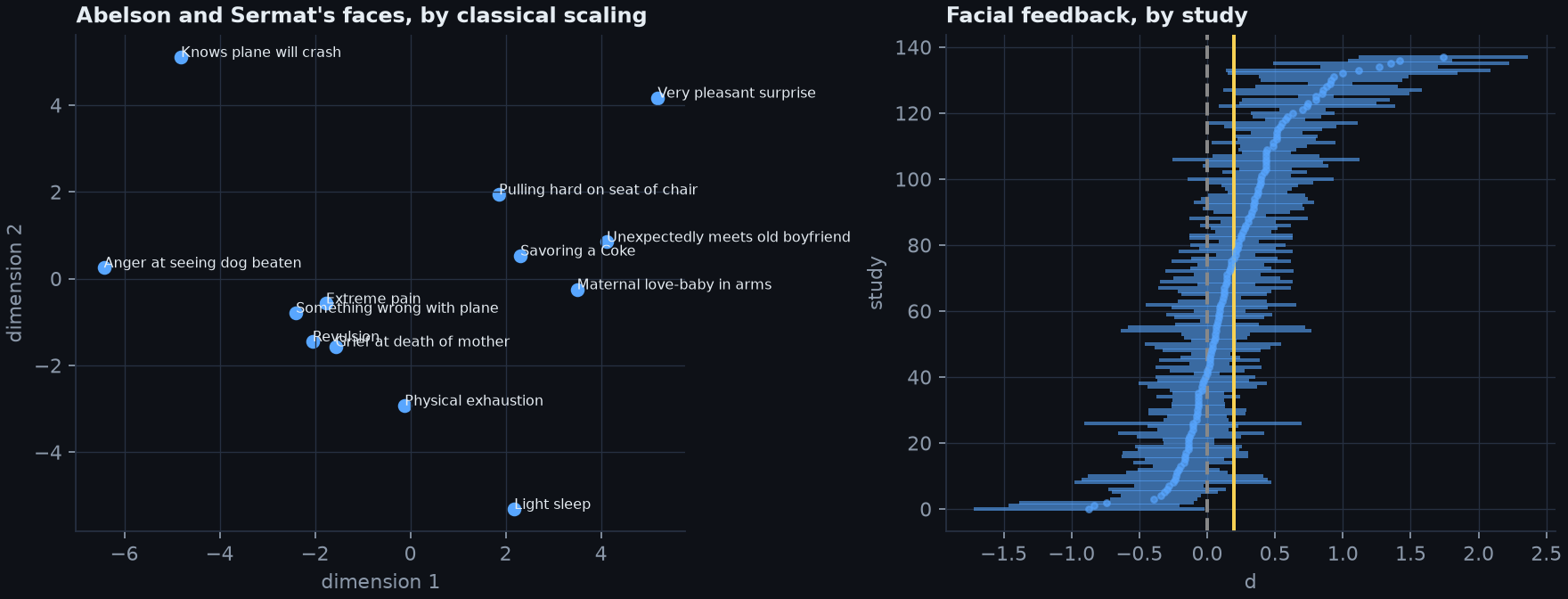
Here is a way to ask how many dimensions feeling has without deciding in advance. In the 1950s Trygg Engen, Nissim Levy and Harold Schlosberg photographed one actress posing thirteen situations: grief at a mother's death, savouring a Coke, a very pleasant surprise, anger at seeing a dog beaten, and so on. In 1962 Robert Abelson and Vello Sermat asked people to judge how different each pair of faces looked. That gives seventy-eight pairs and one table of dissimilarities, with no theory put in. Separately, each face had been rated on three scales: pleasant against unpleasant, attention against rejection, and tension against sleep. The table is still distributed with a statistics package, and Psyche reads it directly.
Torgerson's classical scaling turns such a table into a map. If the dissimilarities were distances between points on a plane, then squaring them and double-centring, subtracting row and column means, gives back the matrix of the points' inner products, whose top eigenvectors are the coordinates, up to a rotation. Apply it to any table, and the eigenvalues say how many dimensions it needs. Here the first two dimensions carry percent of the variance, and the rest is small. The faces ask for two dimensions, not six.
Here is the map, with the thirteen faces in place. Now bring in the ratings. For each scale, regress the faces' ratings on their positions: the direction in which the rating rises fastest, and how well the map predicts it. Pleasantness: R of . Tension against sleep: R of , at nearly a right angle to pleasantness. The two dimensions in nobody's theory are pleasantness and arousal. In 1980 James Russell found the same with emotion words: they arrange themselves around a circle on these two axes, valence and arousal. He called it the circumplex.
Now you can make the map yourself. This part's interactive shows you pairs of ten schematic faces, all forty-five pairs, and asks: same feeling, or different? The share of 'different' answers for each pair is a dissimilarity, and scaling turns the table into your map. Here is Psyche doing it, judging each pair from its distance on the plane plus noise. Grey dots are the faces' true places; coloured dots are the recovered ones. Judging each pair once, the map already correlates with the truth; ten times, . Even one coarse yes or no per pair recovers most of the plane. Your own map will tell you whether you see two dimensions, or something else.
What it does: Abelson and Sermat's faces; classical scaling derived; the map and its scales; the face-pair task on you and Psyche
5Constructed emotionPsych 101 and the major2 min
The strongest alternative to basic emotions is that they are built. On James Russell's and Lisa Feldman Barrett's account, the brain is always producing core affect, a continuous feeling of pleasantness and arousal: the map of chapter four. On top of it, the brain uses concepts learned in a culture to categorize that affect in context, the way it categorizes colours and shapes. Anger, then, is not one circuit or one face, but a population of varied instances, grouped by what they are for, like the category of things to take on a picnic. Barrett set this out in 2017 in How Emotions Are Made.
The evidence for construction is variation. Within one emotion category, faces, bodily changes and brain activity vary widely. A 2018 meta-analysis of the autonomic nervous system, by Erika Siegel and colleagues, found patterns of heart rate and skin conductance that overlap between emotions more than they separate them. A 2012 meta-analysis of brain imaging by Kristen Lindquist and colleagues found no region specific to one emotion; the amygdala, for instance, responds to many things that are novel or relevant, not only to threats. Pattern classifiers can tell emotions apart above chance within a given study, but with patterns spread across the brain that change from study to study.
Here is the best case for each side. For basic emotions: some expressions are recognized above chance across very different cultures; some responses are fast, automatic and shared with other mammals, like the startle, freezing, and the gape of disgust; and infants show distinct facial movements early. For construction: variation within a category is the rule, not noise; agreement falls when the method stops supplying the categories; and words and culture change what people perceive and report. Many researchers now hold a middle view: evolved families of responses, with large variation, categorized by learned concepts. The argument is over how much of each.
What it does: Core affect; variation within categories; the best case for each side
6Facial feedbackPsych 101 and the major4 min
If the body shapes feeling, then the face should too. In 1988 Fritz Strack, Leonard Martin and Sabine Stepper gave people a cover story about learning to write without hands. Holding a pen in the teeth forces the muscles of a smile; holding it in the lips prevents them. Nobody is told to smile. While holding the pen, people rated how funny cartoons from The Far Side were. With the pen in the teeth, the cartoons were rated 0.82 points funnier on a ten-point scale. It became one of the most cited demonstrations in psychology.
In 2016 it was tested by seventeen laboratories at once. Eric-Jan Wagenmakers led a Registered Replication Report: the same procedure, agreed with Strack beforehand, in seventeen laboratories. Nine found a difference in the original direction and eight in the other. Pooled, the difference was 0.03 points, with an interval from minus 0.11 to 0.16: essentially zero, against the original 0.82. Strack objected that the replications had filmed participants, which the original had not, and used cartoons that had aged. In 2018 Tom Noah, Yaacov Schul and Ruth Mayo tested exactly that. The effect appeared without a camera, and vanished when people knew they were being filmed. That needs its own replication, but it is a lesson in how small details can carry an effect.
One replication tests one procedure. A meta-analysis tests the idea. In 2019 Nicholas Coles, Jeff Larsen and Heather Lench gathered effect sizes from studies of facial feedback, published and unpublished, and released their table. Psyche reads it, pools each study's effects, and then pools the studies; each line here is one study. The pooled effect is a d of , with an interval from to : small, and real. And variable: percent of the spread is between studies rather than chance. Where it comes from is the next question.
Split the effects by how the face was moved. Posing an expression on purpose has the largest effect, about . Suppressing or exaggerating one, and unobtrusive manipulations like the pen, are smaller. And the published studies show a larger effect than the unpublished ones, against , the file drawer of Part 4. A contrast can belong to two groups here, suppressing one face against posing another, so the groups overlap.
Then a large collaboration tested three versions at once. The Many Smiles Collaboration, led by Coles, ran a preregistered study with 3,878 people in nineteen countries, with three ways of moving the face: mimicking a smiling face, pulling the corners of the mouth toward the ears, and holding a pen in the teeth. Mimicking smiles and posing them on instruction raised reported happiness. The pen gave inconclusive results. So the Ledger records facial feedback as replicated, smaller. It depends on how the face is moved, and the famous unobtrusive version is the weakest of all.
What it does: The pen; seventeen laboratories; the camera; the meta-analysis recomputed; Many Smiles
7AppraisalPsych 101 and the major2 min
The third family of theories puts thought first. For Magda Arnold and Richard Lazarus, an emotion follows an appraisal: an evaluation of what an event means for one's goals and well-being. In Lazarus's laboratory in the 1960s, the same distressing film was less upsetting when a narrator framed it in a detached, intellectual way. In 1985 Craig Smith and Phoebe Ellsworth asked people to recall emotional events and rate them on dimensions such as pleasantness, certainty, who was responsible, and how much control they had. A handful of dimensions separated the emotions well. The same event, appraised differently, gives a different emotion: a delay is infuriating if someone caused it, and merely sad if nobody did.
Psyche can make an appraisal theory compute. Each emotion is a prototype on six appraisal dimensions: how pleasant, how certain, whether I caused it, whether someone else did, how much control I have, and how sudden it was. Green is positive, red negative. The directions follow Smith and Ellsworth and Klaus Scherer; the exact values are illustrative. A scenario is coded on the same six dimensions, and the nearer it lies to a prototype, the likelier that label, by a softmax over distances.
Here are six situations, coded and appraised. A colleague takes credit for your work: unpleasant, certain, someone else's doing. Anger. A noise downstairs at three in the morning: unpleasant, uncertain, sudden, out of your control. Fear. Passing an exam you trained months for: pride. Your old dog dying: sadness. Waiting to hear about a job you want: hope. Forgetting a friend's birthday party: guilt. A model like this gets right what a list of situations would also get right. The real test of appraisal theory is whether changing one appraisal, such as who caused the event, changes the emotion, and experiments that manipulate appraisals find that it does.
What it does: Lazarus; Smith and Ellsworth's dimensions; an appraisal model on six scenarios
8Fear in the brainPsych 101 and the major3 min
Fear is the emotion whose circuits are best known, mostly from rats. Joseph LeDoux studied the fear conditioning of Part 16: a tone paired with a shock comes to make a rat freeze. He traced how the tone reaches the amygdala, a small structure deep in the temporal lobe. It arrives two ways: directly from the thalamus, a low road, and through the cortex, a high road. Remove the auditory cortex, and a rat still learns to fear a simple tone: the low road is enough. LeDoux's interpretation: better safe than sorry. Start the defensive response on a rough guess, and let the slower cortex confirm or cancel it.
Psyche's version of the two roads. A long, curved object appears on the path. The thalamic route drives the amygdala on coarse shape, quickly; the cortical route identifies the object later. The timings here are illustrative. A stick and a snake start exactly the same response, before the cortex has said which it is. For the snake, the cortex adds drive and the response grows. For the stick, it inhibits, and the response dies away: the jump, and then the relief. And with no amygdala, there is no response at all, whatever the cortex knows.
In people, the clearest evidence is one woman. The patient known as S.M. has damage to both amygdalae, from a rare genetic disease called Urbach-Wiethe disease. In 2011 Justin Feinstein, Ralph Adolphs, Antonio Damasio and Daniel Tranel had her handle live snakes and spiders, walk through a haunted house, and watch horror films. She reported no fear. In daily life she had walked into dangerous situations, including being held at knifepoint, without feeling afraid. But in 2013 the same group had her breathe air rich in carbon dioxide, which signals suffocation from inside the body, and she felt panic. So the amygdala is needed for fear of things outside the body, not for every fear.
LeDoux himself later drew a sharper line. In 2015 he argued that the amygdala circuit detects threat and triggers defensive responses, while the conscious feeling of fear is assembled elsewhere, by the cortex. On that view a freezing rat shows a defensive survival circuit at work; whether it feels afraid is a separate question, taken up at the frontier. It matters in practice: drugs that calm a freezing rat may not ease human anxiety, which is a feeling as well as a response, as Part 40 will discuss. The same distinction runs through this whole part: the body's response and the felt experience are related, but they are not the same thing.
What it does: LeDoux's two roads; a stick or a snake; S.M.; defence or fear
9Stress and regulationPsych 101 and the major2 min
Stress is where emotion meets the hormone loops of Part 10. Hans Selye described the body's general response to demands: the hypothalamus signals the pituitary, the pituitary the adrenal cortex, which releases cortisol, which in turn damps the loop. Short bursts mobilize energy and help. Cortisol raised for months is linked to worse sleep, memory and health. Richard Lazarus and Susan Folkman added in 1984 that stress is itself an appraisal: of a demand, weighed against one's resources to meet it. And coping comes in two kinds: changing the problem, or changing how one feels about it. The second is emotion regulation.
James Gross organized regulation by when it acts. An emotion unfolds over time, and each step can be changed: choosing the situation, changing it, looking elsewhere, rethinking what it means, or holding back the response once it has begun. The early strategies act before the response; reappraisal, rethinking the meaning, is the best studied. Suppression acts after, on the expression alone.
Gross compared the two directly in 1998. A hundred and twenty people watched a disgusting film of a medical procedure. Some were told to watch it with the detachment of a doctor, some to hide their feelings so that nobody could tell, and some just to watch. Reappraisal lowered the disgust people felt and showed. Suppression hid the face, but left the feeling where it was, and raised the body's sympathetic arousal. In later correlational work by Gross and Oliver John, people who habitually reappraise report more positive emotion and better well-being, and habitual suppressors less. Reappraisal is now a core skill taught in cognitive behavioural therapy, in Part 42.
What it does: Selye's loop and Lazarus and Folkman's appraisal; Gross's process model; reappraisal against suppression
10Affective forecastingPsych 101 and the major3 min
Before the research, a question for you. Picture something you are hoping for this year: a job, a result, a move. If it happens, how much happier will you be a month later? And a year later? Hold your answer. We'll come back to it at the end of this part.
Most people's answer is too large. In 1998 Daniel Gilbert, Timothy Wilson and their colleagues ran six studies comparing predicted feelings with experienced ones. Assistant professors predicted that the decision on their tenure would affect their happiness for years. Former assistant professors who had received tenure and those who had not were about equally happy. The pattern recurs in voters after elections, people after breakups, and many other cases. We predict the direction of our feelings well, and their intensity and duration badly. Gilbert and Wilson called it the impact bias. Two reasons: immune neglect, forgetting how quickly we make sense of events and recover, and focalism, forgetting everything else that will happen in the same months.
The simplest model of adaptation makes the error visible. After an event, happiness jumps by an impact I, and fades back exponentially with a time constant tau. The forecaster here gets the impact right and the time constant wrong. The experience fades with tau of twenty days; the forecast assumes a hundred and fifty. Both numbers are illustrative. Two months on, the forecast says points happier; the experience is . The error is in the duration, which is what immune neglect predicts.
The most famous illustration is older. In 1978 Philip Brickman, Dan Coates and Ronnie Janoff-Bulman interviewed twenty-two people who had won large prizes in the Illinois lottery, twenty-nine people paralysed in accidents, and twenty-two controls. On a scale from zero to five, the winners rated their present happiness at 4.00, the controls at 3.82, and the accident victims at 2.96: less happy, but by less than most people would guess. These are small samples, one interview, and a scale with a ceiling: a striking picture, not a law. Later studies that follow the same people over years, reviewed by Richard Lucas, find that people adapt to many events, but not completely to all of them. Disability and long unemployment leave lasting marks for many people.
What it does: A forecast on you; the impact bias; adaptation derived; lottery winners and accident victims
11Happiness and incomePsych 101 and the major4 min
Does money buy happiness? Two careful studies gave different answers. In 2010 Daniel Kahneman and Angus Deaton analysed about four hundred and fifty thousand answers to a daily Gallup survey. People's evaluation of their lives rose with the logarithm of income all the way up. But yesterday's emotional well-being, whether they had felt enjoyment, stress or sadness, stopped rising at about seventy-five thousand dollars a year. In 2021 Matthew Killingsworth used a smartphone app that asked people how they felt right now, at random moments: 1,725,994 reports from 33,391 employed adults in the United States. Happiness rose with log income, with no plateau above seventy-five thousand. Different measures, different samples, both careful, both widely reported.
How can both be right? Psyche can build a world where they are. In this simulated population, happiness rises steadily with the logarithm of income for most people. But for a fifth of people, unhappiness has sources that money does not touch, such as illness, grief or loneliness, and money helps them only up to about a hundred thousand dollars. The average keeps rising. The least happy tenth flattens. A measure driven by the unhappiest people, such as whether you felt sad or stressed yesterday, will show a plateau. A measure of everyone's average will not.
That is close to what the authors themselves found. In 2023 Killingsworth and Kahneman, with Barbara Mellers as an arbiter, reanalysed Killingsworth's data together, having agreed in advance what would count. For the least happy fifth of people, happiness rose with income up to about a hundred thousand dollars, and then stopped. For everyone else it kept rising, and for the happiest it rose faster above a hundred thousand. The 2010 plateau was real for the unhappiest people, and the measure it used was sensitive mainly to them. It's a lesson in method as well: two rival findings, settled by their authors working together, like the test of theories of consciousness in Part 27.
The question is older than these studies, and it began with nations. In 1974 the economist Richard Easterlin gathered surveys that asked people how happy they were. Within a country, in any one year, richer people said they were happier. But in the United States, from 1946 to 1970, income per head rose a long way, and reported happiness did not rise with it. If money buys happiness for each person, why not for a nation? It became known as the Easterlin paradox. His answer had two parts. People judge their income against other people's, so when everyone grows richer together, nobody moves up. And people adapt, like the lottery winners of chapter ten: last year's raise becomes this year's normal. In 2008 came replies from larger data. Angus Deaton, with the Gallup World Poll, and Betsey Stevenson and Justin Wolfers, with many surveys, found that across countries life satisfaction rises steadily with the logarithm of income, with no point where it stops, and they argued that the short, noisy series over time were consistent with the same slope. Easterlin and his colleagues replied in 2010 that over ten years or more, countries whose incomes grew faster did not become happier faster, even where income doubled within twenty years. So the slope across people and across countries is settled. Whether growth makes a nation happier is still argued, and the answer turns on which surveys, which countries, and how long a run.
What it does: The 2010 plateau and the 2021 no-plateau; one world with both; the adversarial collaboration
12The critical positivity ratioPsych 101 and the major2 min
The last story of this part is about a number. In 2005 Barbara Fredrickson and Marcial Losada published a paper in American Psychologist claiming that people flourish when the ratio of their positive to negative emotions exceeds 2.9013, and stop flourishing above about 11.6. The number came from Losada's earlier model of business teams, which was built on the Lorenz equations, a model of fluid convection. The paper was widely cited, and three to one became advice in a popular book and in workshops.
Here are those equations. Edward Lorenz wrote them in 1963 as a three-variable model of air rising and falling in convection. For some parameters, the solution never settles and never repeats: chaos, and the butterfly-shaped curve that became its emblem. Psyche draws it here. Losada took the equations, set their parameters, renamed the variables connectivity, emotion and inquiry, and read the ratio off the point where the model's behaviour changes. No data were fitted to the equations, and nothing about teams or people determines their constants.
The number lasted eight years. Nicholas Brown, a graduate student in applied positive psychology at the University of East London, found the mathematics strange and wrote to Alan Sokal, a physicist, who brought in the psychologist Harris Friedman. Their 2013 paper, The Complex Dynamics of Wishful Thinking, showed that the equations were used without justification, and that the threshold of 2.9013 has no basis at all. Losada declined to defend the work, and American Psychologist formally withdrew the modelling and the predictions drawn from it. Fredrickson's reply kept the broader claim: within limits, more positive emotion goes with better mental health. That part was not withdrawn. The lesson for reviewers: mathematics in a psychology paper has to be checked like any other method, which is what the derivations in this series are for.
What it does: 2.9013; the Lorenz equations; the 2013 critique and withdrawal
13The LedgerPsych 101 and the major3 min
Six new rows today. The first: unexplained arousal is felt as whatever emotion the situation suggests. The original: Schachter and Singer's adrenaline study, 1962. The record: Marshall and Zimbardo's repeat of the euphoria conditions in 1979, Maslach's unexplained arousal felt as unpleasant the same year, and Reisenzein's review in 1983. Arousal can be misattributed; the strong claim, that emotion is arousal plus a label, did not survive. Contested.
The second: men who met a woman on a frightening bridge were more attracted to her. The original: Dutton and Aron, 1974. The record: Foster and colleagues' meta-analysis of laboratory experiments on arousal and attraction, in 1998. Arousal does raise attraction in the laboratory, though perhaps not by misattribution; the bridge itself has never been repeated at scale. Not directly tested.
The third: people in every culture recognize the same six emotions from the same faces. The original: Ekman and Friesen in New Guinea, 1971. The record: Russell's review of the method in 1994, Gendron and colleagues' free sorting with the Himba in 2014, and Barrett and colleagues' review in 2019. With a forced choice among a few labels, the classic pattern replicates widely. With free responses, and in small-scale societies, it weakens, and what faces signal is argued. Contested.
The fourth: moving the face into an expression changes the emotion felt. The original: Strack, Martin and Stepper's pens, 1988. The record: seventeen laboratories finding nearly nothing in 2016, Noah and colleagues' camera in 2018, the meta-analysis of two hundred and eighty-six effects in 2019, and the Many Smiles Collaboration in 2022. Deliberate expressions change feelings a little; the unobtrusive pen is unreliable. Replicated, smaller.
The fifth: emotional well-being rises with income, but stops rising above a moderate income. The original: Kahneman and Deaton, 2010. The record: Killingsworth's smartphone samples in 2021, and the adversarial collaboration in 2023. Well-being rises with log income for most people; the plateau described the unhappiest, and the authors themselves reconciled the two findings. Replicated, with its scope now known.
And the sixth: people flourish when their ratio of positive to negative emotions exceeds 2.9013. The original: Fredrickson and Losada, 2005. The record: Brown, Sokal and Friedman's analysis of the mathematics, and the journal's withdrawal of the modelling, both in 2013. The number went; the broader idea that positive emotion goes with better mental health stayed. Retracted.
The tally. What holds: the body's state shapes what we feel, and expressions and arousal change it, a little. What fell were the strong versions: emotion as arousal plus a label, six fixed faces read the same everywhere, a pen that makes cartoons funnier, and a magic ratio. And the finding with the hardest fight, money and happiness, was settled by its rivals working together.
What it does: Two factors; the bridge; six faces; facial feedback; money; the ratio
14In practice: machines that read faces, well-being, therapyPractice2 min
The basic-emotion view became a product. Companies have sold software that claims to read emotion from faces, for job interviews, classrooms, call centres and cars. A camera can measure facial movements reliably. The weak step is the inference from a movement to a feeling, the step that chapter three's review found unreliable. The hiring company HireVue removed facial analysis from its assessments in 2020, saying that what candidates said predicted as well without it. And since February 2025 the European Union's AI Act has prohibited emotion recognition in workplaces and schools, except for medical or safety reasons. What remains defensible is detecting movements, or physical states like drowsiness in a driver, and calling them that.
Governments now measure feelings. Since April 2011 the United Kingdom's Office for National Statistics has asked four questions in its large household survey, each answered from zero to ten. Two evaluate a life: how satisfied you are with it, and whether what you do is worthwhile. Two report feelings: how happy, and how anxious, you felt yesterday. They are chapter eleven's two kinds of measure, kept apart. They take about a minute and a half to ask. And people answering by phone give higher ratings than people interviewed at home, so the way a question is asked is part of the measure, as Part 3 warned. The data are used to compare places and groups, and to value policies by what they do to people's lives.
And regulation is taught. Cognitive therapies teach chapter nine's reappraisal: notice the thought behind a feeling, test it against the evidence, and try another reading of the event. Chapter seven's appraisal model is the theory underneath it: change the appraisal, and the emotion follows. Suppression, holding the feeling in, is often what people reach for first, and chapter nine found it costly. Whether teaching reappraisal makes people better, compared with what, and for how long, is a question for clinical trials, and Part 42 asks it.
What it does: Emotion recognition by machine; well-being statistics; reappraisal taught
15Frontier: the body, animals and machinesResearch3 min
Three frontiers. The first joins this part's two halves. In 2013 Anil Seth, and in 2015 Lisa Feldman Barrett and Kyle Simmons, proposed that the brain predicts the body's internal signals, the way Part 14's vision predicts the world. A feeling, on this view, is the brain's best guess at the causes of those signals: James's body and chapter two's attribution in a single model. Testing it needs a measure of how well people sense their own bodies. The standard one asks you to count your heartbeats without touching your pulse, and compares your count with the true one. In 2018 Zamariola and her colleagues showed that the scores track people's heart rate and their beliefs about it, not only perception, and the debate about the measure continues.
The second: do animals have emotions? Jaak Panksepp argued for seven primary emotional systems, in circuits below the cortex shared by all mammals: seeking, rage, fear, lust, care, panic and grief, and play. In 2003 he and Jeffrey Burgdorf reported that young rats chirp ultrasonically, at about fifty kilohertz, when they are tickled, and seek out the tickling hand. LeDoux's reply, from chapter eight: those are survival circuits, and whether they come with feelings is a separate question. David Anderson and Ralph Adolphs proposed a way forward in 2014: study the measurable properties of an emotional state, such as persistence, scalability, valence and generalization, in any animal. In 2015 William Gibson, in Anderson's laboratory, passed a shadow repeatedly over fruit flies. They entered a graded, lasting state of defensive arousal. Whether the flies feel anything, the authors said, their experiments cannot tell.
And the third: machines. In her 1997 book, Affective Computing, Rosalind Picard set out a field: machines that recognize, express and model emotion. Today's language models, trained on text written by people, describe emotions fluently, and can apply appraisal rules like the ones in chapter seven. So the questions of this part return in a new form: an emotion word without a body, a label with no arousal to explain. Whether such a system feels anything is Part 27's question, and its tests don't yet apply. What can be asked now is whether its descriptions of feelings are accurate, and whether it is used to manipulate ours. Part 60 returns to both.
Four open problems. Are fear, anger and joy natural kinds with their own circuits, or categories the brain builds? And what result would settle it? How good are people at sensing their own bodies, and how would we measure it well? Does the appraisal come before the feeling, or are both built at once? And which regulation strategies help which people, in daily life rather than in the laboratory?
What it does: Interoceptive inference; emotion in animals; affect in machines; open problems
Recap, problems, and the road aheadAll tracks4 min
First, your forecast. In chapter ten you guessed how much happier something you are hoping for would make you, a month later and a year later. If your year-later number was close to your month-later number, you forecast like most people, with the impact bias. The evidence says the event will matter, in the direction you expect, and for less long than you expect. Write the forecast down, and check it next year. It's the cheapest experiment in this series.
Part twenty-nine in ten lines. James said the feeling is the body, perceived, and Cannon answered that the body is too slow and too much alike across emotions. The two-factor theory, read as inference, gives unexplained arousal a cause, and its strong version failed. Six faces are recognized around the world when people have a list to choose from, and less without one. A map of feelings, with two dimensions, came out of data from 1962, and out of your own judgments. Constructed emotion builds the categories from core affect and concepts. A pen in the teeth made cartoons 0.82 points funnier, then 0.03 in seventeen laboratories, and about 0.2 standard deviations across two hundred and eighty-six effects. Appraisal treats an emotion as an evaluation of an event, and we computed one. There are two roads to the amygdala, and a woman without amygdalae who feared nothing in the world, but panicked at suffocation. Reappraise early; we misjudge how long our feelings last; and money stops helping only the unhappiest. And a ratio borrowed from fluid dynamics was withdrawn after a student checked the mathematics.
Kant's wager. The first objection, that mathematics can't apply to the mind, met multidimensional scaling, Bayes's rule and an appraisal model: a map of feelings recovered from judgments, and an emotion computed from an event. The second, that the mind can't be experimented on, met injections of adrenaline, seventeen laboratories testing one pen, and rivals who reanalysed the same data together. The third, that introspection disturbs what it observes, struck closest here, because feelings are known mainly by report. The reports are consistent, but people's forecasts of their own feelings fail, and the way a question is asked moves the answer. Amber.
Where this comes back. Fear and sadness as disorders are Part 40. Reappraisal as therapy is tested in Part 42. Scaling judgments into maps returns in Part 46. Emotion as the brain's prediction of the body is part of Part 58, and machines that read and describe feelings are Part 60.
Seven problems, with full solutions in this part's README. One derives classical scaling. One finds the best rotation for comparing two maps. One solves the attribution model. One measures the forecaster's error. One recomputes the facial-feedback meta-analysis from the open data. One shows why a plateau for some people can hide in an average. And the last, with the star, asks you to design a study that the constructed and basic accounts of emotion would predict differently. Pause here if you'd like to try them.
The books and papers behind this part are listed here and in the README. James's essay of 1884 is short and still lively; Barrett's How Emotions Are Made is the case for construction, from its author; and LeDoux's The Emotional Brain is the case for circuits, from his.
That completes Act Six, on feeling and wanting. Act Seven asks where a mind comes from. Jean Piaget watched his own three children and concluded that a baby does not know that a hidden toy still exists. Checking him meant solving a problem this part never had: his subjects could not answer questions. The answer was to time how long they look. It's Part 30: the infant mind.
Where it goes next. Act VII begins with the infant mind in Part 30; fear and sadness as disorders are Part 40; reappraisal as therapy is tested in Part 42; scaling returns in Part 46; emotion as prediction of the body in Part 58; machines that read feelings in Part 60.
Key results
The part's results in one place, for revision.
Try it
Lab 29 · Emotion
Recover a two-dimensional map of feelings from judged similarities of faces, and check it against rated scales; align a simulated observer's map to the truth; recompute the facial-feedback meta-analysis and its precision-effect test; read the two-factor theory as Bayesian attribution; label scenarios by appraisal; and see how a plateau for some people hides in the average.
python -m videos.psychology.labs 29
needs numpy, scipy, matplotlib · download lab29.py ·
source on GitHub1962 faces: share in two dimensions; R for pleasantness, tension, attention-rejection 0.84; 0.94, 0.94, 0.81
ten schematic faces, 45 pairs: map against the truth after 1, 3, 10 judgments per pair 0.68, 0.82, 0.98
facial feedback: studies; pooled d [95% CI]; I^2; PET intercept 138; 0.199 [0.143, 0.254]; 81%; 0.196
arousal attributed to the situation: unexplained, explained, placebo 0.56, 0.24, 0.25
appraisal of 'a colleague takes credit for your work' anger 0.95, sadness 0.01
appraisal of 'a noise downstairs at three in the morning' fear 0.81, surprise 0.14
above $120,000: slope per doubling of the mean, of the 10th percentile 0.24, 0.04
Judged similarities of faces fall on two dimensions that match rated pleasantness and tension; a coarse yes-or-no per pair recovers the map; facial feedback pools to about d = 0.2 with large heterogeneity; an explanation takes arousal away from the situation; and a plateau for a fifth of people shows in the low percentiles, not in the mean.The code (98 lines; it asserts its own result)
"""Lab 29: a map of feelings by classical scaling of Abelson and Sermat's 1962 faces, a simulated observer's map
aligned by Procrustes, the facial-feedback meta-analysis recomputed from its open table, arousal attribution, an
appraisal model, and a plateau hidden in an average."""

import numpy as np

from videos.coursekit import labs
from explainer.psychology import opendata
from explainer.psychology.psyche import drive as D
from explainer.psychology.psyche import emotion as E

TITLE = "Emotion"
GOAL = ("Recover a two-dimensional map of feelings from judged similarities of faces, and check it against rated "
        "scales; align a simulated observer's map to the truth; recompute the facial-feedback meta-analysis and "
        "its precision-effect test; read the two-factor theory as Bayesian attribution; label scenarios by "
        "appraisal; and see how a plateau for some people hides in the average.")
TASKS = [
    "Run classical scaling of the 1962 faces in three dimensions. Does the third dimension match the "
    "attention-rejection scale better than the first two do?",
    "Recompute the facial-feedback pool with each effect weighted separately rather than pooled within study "
    "first. How much do the estimate and its interval change, and why is the within-study pooling safer?",
    "Change the income world's unhappy share from 0.2 to 0.05. Which percentiles still flatten, and what does "
    "a measure of 'felt bad yesterday' show?",
]


def run(seed=0):
    out = labs.Lab()

    # 1. the 1962 faces
    f = opendata.faces_1962()
    m = E.classical_mds(f["D"])
    fits = {k: E.fit_scale(m["X"], f[k])["R"] for k in ("PU", "TS", "AR")}
    out.row("1962 faces: share in two dimensions; R for pleasantness, tension, attention-rejection",
            f"{m['share']:.2f}; {fits['PU']:.2f}, {fits['TS']:.2f}, {fits['AR']:.2f}")
    assert m["share"] > 0.8 and fits["PU"] > 0.9 and fits["TS"] > 0.9

    # 2. a simulated observer's map
    rs = {k: E.pairs_map(n_reps=k, seed=29)["r"] for k in (1, 3, 10)}
    out.row("ten schematic faces, 45 pairs: map against the truth after 1, 3, 10 judgments per pair",
            ", ".join(f"{rs[k]:.2f}" for k in (1, 3, 10)))
    assert rs[10] > rs[1]

    # 3. facial feedback
    c = opendata.coles_2019()
    y, v, sid = c["yi"], c["vi"], c["study_id"]
    ys, vs = [], []
    for i in sorted(set(sid.tolist())):
        w = 1 / v[sid == i]
        ys.append(float((w * y[sid == i]).sum() / w.sum()))
        vs.append(float(1 / w.sum()))
    re = D.random_effects(ys, vs)
    pe = D.pet(ys, np.sqrt(vs))
    out.row("facial feedback: studies; pooled d [95% CI]; I^2; PET intercept",
            f"{re['k']}; {re['estimate']:.3f} [{re['lo']:.3f}, {re['hi']:.3f}]; {100 * re['I2']:.0f}%; "
            f"{pe['intercept']:.3f}")
    assert re["k"] == 138 and abs(re["estimate"] - 0.20) < 0.01

    # 4. attribution
    a = {k: E.attribution(*args)["mean"] for k, args in
         (("no explanation", (1.2, 0.0)), ("explained injection", (1.2, 1.0)), ("placebo", (0.3, 0.0)))}
    out.row("arousal attributed to the situation: unexplained, explained, placebo",
            ", ".join(f"{v_:.2f}" for v_ in a.values()))
    assert a["explained injection"] < a["no explanation"]

    # 5. appraisal
    for text, code in (("a colleague takes credit for your work", (-0.8, 0.7, -0.3, 0.9, 0.3, 0.4)),
                       ("a noise downstairs at three in the morning", (-0.7, -0.8, 0.0, 0.1, -0.7, 0.8))):
        r = E.appraise(code)
        out.row(f"appraisal of '{text}'", f"{r['labels'][0]} {r['p'][0]:.2f}, {r['labels'][1]} {r['p'][1]:.2f}")

    # 6. the hidden plateau
    w = E.income_world()
    x = np.log2(w["income"])
    hi = w["income"] > 120_000
    s_mean, s_p10 = np.polyfit(x[hi], w["mean"][hi], 1)[0], np.polyfit(x[hi], w["p10"][hi], 1)[0]
    out.row("above $120,000: slope per doubling of the mean, of the 10th percentile", f"{s_mean:.2f}, {s_p10:.2f}")
    assert s_mean > 0.2 and abs(s_p10) < 0.08

    out.note = ("Judged similarities of faces fall on two dimensions that match rated pleasantness and tension; a "
                "coarse yes-or-no per pair recovers the map; facial feedback pools to about d = 0.2 with large "
                "heterogeneity; an explanation takes arousal away from the situation; and a plateau for a fifth of "
                "people shows in the low percentiles, not in the mean.")

    fig, ax = labs.figure(2, size=(11, 4.2))
    X = m["X"]
    ax[0].scatter(X[:, 0], X[:, 1], color=labs.BLUE)
    for (px, py), name in zip(X, f["labels"]):
        ax[0].annotate(name, (px, py), fontsize=7)
    ax[0].set(title="Abelson and Sermat's faces, by classical scaling", xlabel="dimension 1", ylabel="dimension 2")
    order = np.argsort(ys)
    ax[1].errorbar(np.array(ys)[order], np.arange(len(ys)), xerr=1.96 * np.sqrt(np.array(vs))[order], fmt=".",
                   color=labs.BLUE, alpha=0.6)
    ax[1].axvline(re["estimate"], color=labs.GOLD)
    ax[1].axvline(0, ls="--", color="#888888")
    ax[1].set(title="Facial feedback, by study", xlabel="d", ylabel="study")
    out.fig = fig
    return out
Now change it
- Run classical scaling of the 1962 faces in three dimensions. Does the third dimension match the attention-rejection scale better than the first two do?
- Recompute the facial-feedback pool with each effect weighted separately rather than pooled within study first. How much do the estimate and its interval change, and why is the within-study pooling safer?
- Change the income world's unhappy share from 0.2 to 0.05. Which percentiles still flatten, and what does a measure of 'felt bad yesterday' show?
Problems, with solutions
Try each problem before opening its solution.
-
Classical scaling. Show that double-centring the squared distances, \(B = -\tfrac12 J D^{(2)} J\) with \(J = I - \tfrac1n \mathbf{1}\mathbf{1}^\top\), gives \(B = X X^\top\) for centred points \(X\). Why are its top eigenvectors the best \(k\)-dimensional map?
Solution
With centred points, D⁽²⁾ᵢⱼ = |xᵢ|² + |xⱼ|² − 2xᵢ·xⱼ. The first two terms are constant along a column or a row, so double-centring removes them, and the mean of xᵢ·xⱼ over i or j is zero because X is centred. So −½ J D⁽²⁾ J = X Xᵀ. The best rank-k approximation of B in squared error (Eckart–Young) keeps its top k eigenpairs, and the map is V_k Λ_k^(1/2).
-
Procrustes. Show that the rotation \(R\) maximizing \(\mathrm{tr}(R^\top X^\top Y)\) is \(U V^\top\), where \(X^\top Y = U \Sigma V^\top\).
Solution
tr(RᵀXᵀY) = tr(RᵀUΣVᵀ) = tr(ΣVᵀRᵀU) = Σᵢ σᵢ zᵢᵢ, with Z = VᵀRᵀU orthogonal, so |zᵢᵢ| ≤ 1. The sum is largest when Z = I, that is R = UVᵀ.
-
Attribution. In the attribution model, arousal \(a \sim N(s + c, \sigma^2)\) with an exponential prior of mean \(m\) on \(s \geq 0\). Show that the posterior of \(s\) is a normal with mean \(a - c - \sigma^2/m\), truncated at 0.
Solution
The posterior is proportional to exp(−s/m) exp(−(a − c − s)²/2σ²). Completing the square, −(a − c − s)²/2σ² − s/m = −(s − (a − c − σ²/m))²/2σ² + const, so on s ≥ 0 it is a normal with mean a − c − σ²/m truncated at 0. An explanation c moves arousal away from the situation one for one, until the truncation takes over: the informed subjects feel little.
-
The forecaster. For \(h(t) = I e^{-t/\tau}\), show that a forecaster with time constant \(\tau_p\) overstates the total extra happiness by the factor \(\tau_p / \tau\), and find when the forecast is twice the experience.
Solution
The total extra happiness is ∫₀^∞ I e^(−t/τ) dt = Iτ, and the forecast's is Iτ_p, so the forecast overstates it by τ_p/τ. The ratio at time t is e^(t(1/τ − 1/τ_p)), which is 2 at t = ln 2 · ττ_p/(τ_p − τ): 16 days for τ = 20 and τ_p = 150.
-
The meta-analysis. With the meta-analysis table (
opendata.coles\_2019), recompute \(\hat\tau^2\), \(I^2\) and the PET intercept. What does PET assume about small studies?Solution
Pooled within study first, τ² = 0.078, I² = 81% and the precision-effect intercept 0.196 (SE 0.059), against a random-effects 0.199. PET regresses effects on their standard errors and reads the intercept as the effect of an infinitely precise study; it assumes that any small-study asymmetry comes from selection and is linear in the standard error. Here the intercept matches the pool, so the funnel shows little asymmetry at the study level, although unpublished effects (0.14) are smaller than published ones (0.25).
-
The hidden plateau. In a world where a share \(q\) of people stop gaining above \(x^*\) (and sit below the rest), show that the mean's slope above \(x^*\) falls to \((1 - q)\) of its value, and that the 10th percentile flattens only if \(q > 0.1\).
Solution
Above x*, the mean is (1 − q)(b log x + c₁) + q c₂, with slope (1 − q)b. If the capped group sits below everyone else, the p-th percentile lies inside it whenever p < q, so the 10th percentile goes flat above x* only if q > 0.1; for q = 0.2 the 10th flattens and the mean keeps rising.
-
★ Construction against basic emotions. Design a study that the constructed-emotion account and the basic-emotion account predict differently, and say what each predicts.
Solution
The basic-emotion account predicts a pattern (in the face, the body or the brain) for each emotion that holds across situations and cultures; the constructed account predicts patterns that classify within a situation and fail to transfer, and perception that depends on emotion concepts. For example: induce fear, anger and sadness in several different situations each, measure autonomic and facial responses, train a classifier on some situations and test it on new ones; and, separately, make emotion words temporarily less available (by repetition) before people judge faces. Transfer across situations, unaffected by the words, favours basic emotions; classification that holds only within a situation, and judgments that shift with the words, favour construction.
Notes and sources
Sources
Body and label: W. James, What is an emotion?, Mind 9 (1884) 188-205; C. Lange, Om Sindsbevægelser (1885); W. B. Cannon, The James-Lange theory of emotions: a critical examination and an alternative theory, American Journal of Psychology 39 (1927) 106-124; P. Bard, A diencephalic mechanism for the expression of rage, American Journal of Physiology 84 (1928) 490-515; G. Marañón, Contribution à l'étude de l'action émotive de l'adrénaline, Revue Française d'Endocrinologie 2 (1924) 301-325; A. D. Craig, How do you feel -- now? The anterior insula and human awareness, Nature Reviews Neuroscience 10 (2009) 59-70; A. R. Damasio, Descartes' Error (1994); the two-factor and bridge rows' references in the Ledger.
Faces and construction: C. Darwin, The Expression of the Emotions in Man and Animals (1872); P. Ekman, An argument for basic emotions, Cognition and Emotion 6 (1992) 169-200; J. A. Russell, A circumplex model of affect, Journal of Personality and Social Psychology 39 (1980) 1161-1178; J. A. Russell, Core affect and the psychological construction of emotion, Psychological Review 110 (2003) 145-172; L. F. Barrett, How Emotions Are Made (2017); E. H. Siegel et al., Emotion fingerprints or emotion populations? A meta-analytic investigation of autonomic features of emotion categories, Psychological Bulletin 144 (2018) 343-393; K. A. Lindquist, T. D. Wager, H. Kober, E. Bliss-Moreau and L. F. Barrett, The brain basis of emotion: a meta-analytic review, Behavioral and Brain Sciences 35 (2012) 121-143; the universal-expressions row's references in the Ledger.
Scaling: R. P. Abelson and V. Sermat, Multidimensional scaling of facial expressions, Journal of Experimental Psychology 63 (1962) 546-554; W. S. Torgerson, Multidimensional scaling: I. Theory and method, Psychometrika 17 (1952) 401-419; P. H. Schönemann, A generalized solution of the orthogonal Procrustes problem, Psychometrika 31 (1966) 1-10.
Facial feedback: the facial-feedback row's references in the Ledger.
Appraisal, fear and regulation: R. S. Lazarus, Psychological Stress and the Coping Process (1966); C. A. Smith and P. C. Ellsworth, Patterns of cognitive appraisal in emotion, Journal of Personality and Social Psychology 48 (1985) 813-838; K. R. Scherer, Appraisal considered as a process of multilevel sequential checking, in Appraisal Processes in Emotion (2001); J. E. LeDoux, The Emotional Brain (1996); J. E. LeDoux, Anxious (2015); J. S. Feinstein, R. Adolphs, A. Damasio and D. Tranel, The human amygdala and the induction and experience of fear, Current Biology 21 (2011) 34-38; J. S. Feinstein et al., Fear and panic in humans with bilateral amygdala damage, Nature Neuroscience 16 (2013) 270-272; H. Selye, The Stress of Life (1956); R. S. Lazarus and S. Folkman, Stress, Appraisal, and Coping (1984); J. J. Gross, Antecedent- and response-focused emotion regulation, Journal of Personality and Social Psychology 74 (1998) 224-237; J. J. Gross and O. P. John, Individual differences in two emotion regulation processes, Journal of Personality and Social Psychology 85 (2003) 348-362.
Forecasting and well-being: D. T. Gilbert, E. C. Pinel, T. D. Wilson, S. J. Blumberg and T. P. Wheatley, Immune neglect: a source of durability bias in affective forecasting, Journal of Personality and Social Psychology 75 (1998) 617-638; T. D. Wilson and D. T. Gilbert, Affective forecasting: knowing what to want, Current Directions in Psychological Science 14 (2005) 131-134; P. Brickman, D. Coates and R. Janoff-Bulman, Lottery winners and accident victims: is happiness relative?, Journal of Personality and Social Psychology 36 (1978) 917-927; R. E. Lucas, Adaptation and the set-point model of subjective well-being, Current Directions in Psychological Science 16 (2007) 75-79; the money and positivity-ratio rows' references in the Ledger; E. N. Lorenz, Deterministic nonperiodic flow, Journal of the Atmospheric Sciences 20 (1963) 130-141.
Practice and frontier: Regulation (EU) 2024/1689 (the AI Act), Article 5(1)(f); Office for National Statistics, Personal well-being user guidance; A. K. Seth, Interoceptive inference, emotion, and the embodied self, Trends in Cognitive Sciences 17 (2013) 565-573; L. F. Barrett and W. K. Simmons, Interoceptive predictions in the brain, Nature Reviews Neuroscience 16 (2015) 419-429; R. Schandry, Heart beat perception and emotional experience, Psychophysiology 18 (1981) 483-488; G. Zamariola, P. Maurage, O. Luminet and O. Corneille, Interoceptive accuracy scores from the heartbeat counting task are problematic: evidence from simple bivariate correlations, Biological Psychology 137 (2018) 12-17; J. Panksepp and J. Burgdorf, "Laughing" rats and the evolutionary antecedents of human joy?, Physiology and Behavior 79 (2003) 533-547; D. J. Anderson and R. Adolphs, A framework for studying emotions across species, Cell 157 (2014) 187-200; W. T. Gibson et al., Behavioral responses to a repetitive visual threat stimulus express a persistent state of defensive arousal in Drosophila, Current Biology 25 (2015); R. W. Picard, Affective Computing (1997).
Data: smacof 2.1-7 (FaceExp, FaceScale, GPL-3) and psymetadata 1.0.1 (coles2019, GPL-3), from CRAN, fetched
and never redistributed.
About this partfrom its README
In 1884 William James asked whether we run from a bear because we are afraid, or are afraid because we run, and answered: the second. This part follows the argument about the order of events, from the body and the label to faces, appraisals and fear circuits, and on to forecasting, money and a famous number. It recomputes a map of feelings from data collected in 1962, and a facial-feedback meta-analysis from its open table.
James and Lange's body first, and Cannon's objections with Cannon–Bard; Marañón's "as if" emotions and Schachter and Singer's adrenaline, written as Bayesian attribution of unexplained arousal; the Capilano bridge; Darwin, Ekman and Friesen in New Guinea, forced choice and free sorting; Abelson and Sermat's thirteen faces rescaled by classical MDS into a pleasantness–tension map, then a simulated observer's same-or-different judgments of ten schematic faces recovered by MDS and Procrustes; constructed emotion and core affect; the pen in the teeth, seventeen laboratories, the camera, and 286 effects pooled from the open data, with groups by manipulation and publication and the precision-effect test; an appraisal model that labels six scenarios; LeDoux's two roads and a stick-or-snake circuit; S.M.; stress, the process model, reappraisal against suppression; the impact bias, an adaptation model and lottery winners; the 2010 plateau and the 2021 no-plateau reconciled in a simulated world and by the 2023 adversarial collaboration, and the Easterlin paradox across people, countries and years, with Deaton's and Stevenson and Wolfers's replies and Easterlin's; and the critical positivity ratio, the Lorenz equations and how they were taken apart. The practice chapter is emotion-recognition software, well-being statistics and reappraisal in therapy; the frontier is interoceptive inference, emotion in animals, and affect in machines.
What is computed and built
explainer/psychology/psyche/emotion.py: classical (Torgerson) scaling, scale fitting and Procrustes; ten schematic faces on a valence–arousal plane and a same-or-different observer; arousal attribution on a grid; an appraisal model with nine emotion prototypes on six dimensions; LeDoux's two roads as a leaky integrator; hedonic adaptation and a forecaster; a simulated population for income and happiness; the Lorenz system by RK4. Tested intests/psychology/test_emotion.py.explainer/psychology/rdata.pyreads ALTREP objects (compact sequences, wrappers, deferred strings), which newer R versions write into package data; any other ALTREP class is refused, and nothing is evaluated.explainer/psychology/opendata.pyfetches smacof 2.1-7 (FaceExp,FaceScale) and psymetadata 1.0.1 (coles2019) from CRAN and checks both the archives and the data members by SHA-256 (faces_1962,coles_2019); the Archive registers them (FACES_1962,COLES_2019).- The Ledger gains six rows.
- The course's interactive is the face-pair task on you: 45 pairs of ten schematic faces, same feeling or different, then the map your judgments make, rotated onto the true plane, with its correlation.
Chapter notes
| # | Chapter | What it does |
|---|---|---|
| 0 | James's bear | James and Lange; two orders of events; the questions; objectives |
| 1 | Body first? | Cannon's objections and Cannon–Bard; Marañón's injections; interoception and somatic markers |
| 2 | Two factors | Schachter and Singer; attribution as inference, derived; the replications; the Capilano bridge |
| 3 | Faces | Darwin; Ekman and Friesen in New Guinea; forced choice and free sorting; the 2019 review |
| 4 | On you: the map of feelings | Abelson and Sermat's faces; classical scaling derived; the map and its scales; the face-pair task on you and Psyche |
| 5 | Constructed emotion | Core affect; variation within categories; the best case for each side |
| 6 | Facial feedback | The pen; seventeen laboratories; the camera; the meta-analysis recomputed; Many Smiles |
| 7 | Appraisal | Lazarus; Smith and Ellsworth's dimensions; an appraisal model on six scenarios |
| 8 | Fear in the brain | LeDoux's two roads; a stick or a snake; S.M.; defence or fear |
| 9 | Stress and regulation | Selye's loop and Lazarus and Folkman's appraisal; Gross's process model; reappraisal against suppression |
| 10 | Affective forecasting | A forecast on you; the impact bias; adaptation derived; lottery winners and accident victims |
| 11 | Happiness and income | The 2010 plateau and the 2021 no-plateau; one world with both; the adversarial collaboration |
| 12 | The critical positivity ratio | 2.9013; the Lorenz equations; the 2013 critique and withdrawal |
| 13 | The Ledger | Two factors; the bridge; six faces; facial feedback; money; the ratio |
| 14 | In practice: machines that read faces, well-being, therapy | Emotion recognition by machine; well-being statistics; reappraisal taught |
| 15 | Frontier: the body, animals and machines | Interoceptive inference; emotion in animals; affect in machines; open problems |
| Recap, problems, and the road ahead | Your forecast checked; ten lines; Kant's three objections; payoffs; problems; references; Part 30 |
NotesWhere the numbers come from
| What | Source |
|---|---|
| Attribution: arousal 1.2 (σ = 0.5, exponential prior of mean 0.3 on the situation's share); attributed to the situation 0.56 with no explanation, 0.24 when an injection of size 1 is explained, 0.25 for a placebo's arousal 0.3 | Psyche (emotion.attribution), item attribution |
| Abelson and Sermat's 13 faces: classical MDS of the 13 × 13 dissimilarities; two dimensions carry 84% of the positive eigenvalues (the first 52%); the rated scales fit the map with R = 0.94 (pleasantness), 0.94 (tension) and 0.81 (attention–rejection) | opendata.faces_1962 (smacof's FaceExp and FaceScale), item faces |
| Ten schematic faces, 45 pairs judged "different" with probability logistic((distance − 0.9)/0.35): the MDS map matches the true plane with r = 0.68 (each pair once), 0.82 (three times), 0.98 (ten times) | Psyche (emotion.pairs_map, seed 29), item pairs |
| Facial feedback: 286 effects from 138 studies, pooled within study first; random-effects d = 0.199 [0.143, 0.254], τ² = 0.078, I² = 81%; precision-effect intercept 0.196 (SE 0.059); posing an expression 0.45 (58 effects), suppressing one 0.15 (151), exaggerating one 0.05 (36), unobtrusive manipulations 0.19 (88); published 0.25 (229), unpublished 0.14 (57) | Coles, Larsen and Lench (2019) (opendata.coles_2019, psymetadata 1.0.1), item feedback |
| Strack, Martin and Stepper: 0.82 points; the Registered Replication Report: 17 laboratories, 0.03 [−0.11, 0.16] | Wagenmakers et al. (2016) |
| Many Smiles: 3,878 people in 19 countries | Coles et al. (2022) |
| Appraisal: six scenarios on six dimensions; labels anger 0.95, fear 0.81, pride 0.86, sadness 0.95, hope 0.87, guilt 0.91 (prototypes after Smith and Ellsworth and Scherer, values illustrative) | Psyche (emotion.appraise, β = 3), item appraisal |
| Two roads: thalamic drive at 15 ms, cortical identification at 60 ms (illustrative); stick and snake both reach 0.54 before the cortex reports; the snake settles at 1.4, the stick at 0, no amygdala gives nothing | Psyche (emotion.two_roads), item fear |
| Forecasting: impact 3, experienced τ = 20 days, forecast τ = 150 days (illustrative); at day 60 the experience is 0.15 and the forecast 2.01 | Psyche (emotion.forecast), item forecast |
| Brickman, Coates and Janoff-Bulman: present happiness 4.00 (22 lottery winners), 3.82 (22 controls), 2.96 (29 people paralysed in accidents) | Brickman, Coates and Janoff-Bulman (1978) |
| Income: 200,000 simulated people, log income normal around $60,000; happiness rises 0.35 per doubling for most; a fifth gain only up to $100,000 and sit 1.8 lower; the mean keeps rising while the 10th percentile flattens above about $118,000 | Psyche (emotion.income_world), item income |
| Kahneman and Deaton: about 450,000 Gallup responses, a plateau near $75,000; Killingsworth: 1,725,994 reports from 33,391 employed adults; the 2023 reanalysis: a plateau above about $100,000 for the least happy 20% only | Kahneman and Deaton (2010); Killingsworth (2021); Killingsworth, Kahneman and Mellers (2023) |
| The Lorenz attractor: σ = 10, ρ = 28, β = 8/3, 30 time units by RK4 | Psyche (emotion.lorenz), item lorenz |
| The positivity ratio: 2.9013 and about 11.6; 188 people's daily reports over 28 days | Fredrickson and Losada (2005) |
Notes
| Finding | Original | Status |
|---|---|---|
| Unexplained arousal is felt as whatever emotion the situation suggests | Schachter and Singer 1962 | contested |
| Men who met a woman on a frightening bridge were more attracted to her | Dutton and Aron 1974 | not directly tested |
| People in every culture recognize the same six emotions from the same faces | Ekman and Friesen 1971 | contested (replicated with forced choice) |
| Moving the face into an expression changes the emotion felt | Strack, Martin and Stepper 1988 | replicated, smaller |
| Emotional well-being rises with income, but stops rising above a moderate income | Kahneman and Deaton 2010 | replicated (its scope resolved) |
| People flourish when their ratio of positive to negative emotions exceeds 2.9013 | Fredrickson and Losada 2005 | retracted (the modelling) |
Shown without a row, with the reason recorded in explainer/psychology/ledger.py: the history of emotion theory
(James, Lange, Cannon, Bard, Marañón, Darwin), interoception theories (Craig, Damasio), basic-emotion and
construction theories (Ekman, Russell, Barrett), the meta-analyses of physiology and brain imaging (Siegel et al.,
Lindquist et al.), appraisal theory, LeDoux's anatomy and later argument, the S.M. case study, stress and coping,
Gross's regulation studies, the impact bias, the lottery study (with its limits stated) and Lucas's review, the
1962 face data (a method demonstration), and the frontier's theories and studies.
Notes
Checked against the articles, their abstracts or official pages (2026-11-15): Brickman et al.'s 4.00, 3.82 and 2.96 (73 people); Killingsworth's 1,725,994 reports from 33,391 adults; the 2023 plateau for the least happy 20%; Schachter and Singer's 185 men and Suproxin; Wagenmakers et al.'s 17 laboratories and 0.03 [−0.11, 0.16] against 0.82; Many Smiles' 3,878 people in 19 countries; Coles et al.'s 286 effects from 138 studies; Barrett et al.'s scowling in about a quarter of anger; Gendron et al.'s Himba and 36 photographs; S.M. in 2011 and the carbon dioxide study in 2013; Gross's 120 people and the disgust film; Gilbert et al.'s tenure study; Dutton and Aron's 50% and 12.5% (9 of 18 and 2 of 16) of the men who took the number; Fredrickson and Losada's 188 people over 28 days and the 2.9013 and 11.6 thresholds; Nick Brown as a graduate student at the University of East London; the journal's withdrawal of the modelling; Siegel et al.'s 202 studies and no one-to-one autonomic mapping; Lindquist et al.'s "little evidence" for localization; HireVue's removal of facial analysis in 2020, announced in January 2021; the AI Act's prohibition of emotion recognition in workplaces and schools from 2 February 2025, with medical and safety exceptions (law-firm summaries; the Official Journal text not read); the ONS's four questions on a 0 to 10 scale since April 2011, about a minute and a half to ask, and higher ratings by phone; Panksepp and Burgdorf's 50 kHz chirps; Gibson et al.'s persistent, scalable state in flies; Zamariola et al.'s critique of the heartbeat counting task and the 2020 replies.
Still to recheck against the full texts before the final cut:
- The Capilano bridge's height, "about seventy metres" (230 feet in secondary sources; the paper gives 450 feet long and five feet wide).
- Lindquist et al. (2012): the amygdala's responses to novel or relevant stimuli, as summarized on screen.
- Marañón (1924): the "as if" reports and the article's citation, from secondary sources.
- Lucas (2007): disability and long unemployment as lasting changes; Gross and John (2003): habitual reappraisers' and suppressors' well-being.
- Craig (2009) and Damasio (1994) are summarized, not quoted; Panksepp's seven systems are named as in his later books.
- Kahneman and Deaton's "about 450,000" responses, quoted from the abstract.
Companion material in this repository
The syllabus's plan for this partfrom SYLLABUS.md, the plan of record
- Hook: James's bear. The James–Lange theory; Cannon's five objections; Cannon–Bard.
- Two factors: Schachter and Singer's adrenaline study (1962) and its replication record; misattribution on the bridge (Dutton and Aron 1974).
- Faces: Darwin (1872); Ekman and Friesen in New Guinea; six basic emotions; the forced-choice method and what happens without it.
- On you: sort twenty schematic faces. The solution has two dimensions: valence and arousal (Russell's circumplex 1980).
- Constructed emotion (Barrett): variability within a category, the 2019 review of faces, core affect and interoception. The best case for each side.
- Facial feedback: the pen-in-mouth study (Strack et al. 1988), the seventeen-laboratory null (2016), and the Many Smiles collaboration (2022): a small effect, depending on the task.
- Appraisal: Lazarus; emotions as evaluations of events against goals; an appraisal model that outputs emotion labels from scenarios (computed).
- Fear in the brain: LeDoux's two roads, fear conditioning (Part 16) and the amygdala; patient S.M.; what "fear circuit" does and does not mean.
- Stress and coping (Part 10's loop); emotion regulation: reappraisal against suppression (Gross).
- Affective forecasting: we mispredict how long feelings last (Gilbert and Wilson); hedonic adaptation; lottery winners and accident victims (Brickman et al. 1978), as measured.
- Happiness and income: the 2010 plateau, the 2021 no-plateau, and the 2023 adversarial collaboration that reconciled them.
- The critical positivity ratio: a chaos-theory formula for flourishing, cited thousands of times, taken apart by a part-time graduate student and a physicist (2013).
Psyche: emotion: MDS of open emotion-rating data recovering the circumplex; an appraisal model; a fear-
learning circuit built from Parts 6 and 16.
On you: the face-sorting task; a forecast of your own reaction, checked at the end of the part.
Ledger: facial feedback (replicated, smaller, conditional); Schachter–Singer (contested); universal
recognition of six expressions (replicated with forced choice, contested without); the bridge study (not directly tested at scale); the positivity ratio (retracted in part); money and well-being (replicated; shape
resolved by adversarial collaboration).
In practice: emotion-recognition software and why its premise is disputed; well-being measurement in policy;
emotion regulation in therapy.
Frontier: emotion as inference about the body; whether animals' defensive states are "emotions"; affect in
language models.
Reading: James 1884; Schachter & Singer 1962; Ekman 1992; Russell 1980; Barrett 2017; Barrett et al. 2019; Coles
et al. 2022; LeDoux 1996; Gross 2015; Killingsworth, Kahneman & Mellers 2023; Brown, Sokal & Friedman 2013.
Build the film
python -m videos.psychology.psych29.compute        # the part's numbers, into .cache/psych29
python tools/build.py psych29                  # render and assemble the film
EXPLAINER_TTS=silent python tools/qa_scene.py psych29 Hook   # one chapter, silent, with a contact sheet
Scenes: videos/psychology/psych29. Setup: see the course page. Source of these notes: the README and the scenes' narration.
Build it
python -m videos.psychology.psych29.compute            # every number (under a minute; fetches two CRAN packages once)
python tools/qa_scene.py psych29 Feedback              # one chapter, silent, at 480p, with a contact sheet
EXPLAINER_TTS=silent python tools/build.py psych29 -q l   # the whole part, silent preview
python tools/build.py psych29                          # 1080p30 with narration
python tools/qa_scene.py psych29 Map --lang zh         # the Chinese edition of one chapter
python tools/make.py psych29                           # both editions, with the checks a long build needs
python -m videos.psychology.labs 29                    # the lab: scaling, Procrustes, the meta-analysis, appraisal
python tools/check_ledger.py psych29                   # every study shown has its Ledger row, or a reason
python -m pytest tests/psychology                      # Psyche's emotion module, rdata, the Ledger, the Archive
The Chinese edition is zh_lines.py (the narration, line by line) and the series table
videos/psychology/psychology_text_zh.json (the text on screen); the terms are in
PSYCHOLOGY_ZH_GUIDE.md.