The Infant Mind
What does a baby know, and how can anyone find out when the baby cannot answer?
A ten-month-old finds a toy under cup A, again and again; then she watches it hidden under cup B, and reaches for A. Piaget saw his own children do it and concluded that infants do not yet know objects exist on their own. Checking him needed an instrument: Fantz noticed that infants can look, and looking can be timed. Habituation, violation of expectation and the Goldilocks effect follow, and then the instrument tested at scale: ManyBabies' sixty-five laboratories, recomputed here, find the preference for infant-directed speech real, smaller than believed, and dependent on age, method and language. The viewer predicts six famous infant results; then objects, arithmetic, number by ratio and infants as statisticians are weighed, core knowledge against construction. The A-not-B error is rebuilt as a dynamic neural field that makes and outgrows it. False belief at four is robust and at fifteen months contested; newborn imitation is contested; attachment, temperament and copying make modest predictions.
What you need. Part 3's measurement, Part 4's meta-analysis, Part 6's circuits, Part 11's Weber's law and Part 14's inference. Probability, differential equations and weighted regression.
- Hook
- how do you ask a baby?
- Ideas, models and mathematics
- looking-time and habituation, Piaget, object permanence, core knowledge, number sense, the A-not-B error as dynamics, theory of mind, attachment
- Psyche gains
- a habituating infant; a dynamic field
- On you
- predict the infant
What you will be able to do
Psych 101 and the major
- Describe Piaget's stages and the A-not-B error, and what looking-time methods can and cannot show.
- Describe the findings on objects, number, false belief, imitation and attachment, with their replication records.
- Explain why multi-laboratory studies changed infancy research.
Graduate
- Recompute a multi-laboratory meta-analysis and its meta-regression on age and method.
- Derive the approximate number system's accuracy from Weber's law, and an ideal learner's surprisal.
- Simulate a dynamic neural field and explain the A-not-B error's dependence on delay.
Research
- Design a study that core knowledge and rational constructivism predict differently.
- Judge what a surprise signal shows, in an infant or a machine.
Practice
- Evaluate a developmental screen, an early-childhood programme or a product for babies against the evidence.
Contents
Each chapter has a home level. Choose a track to see what to read and watch: Psych 101 and the major 32 min · Graduate 35 min · Research 42 min · Practice 35 min.
- 0The toy under the clothPsych 101 and the major2 min
- 1Piaget's infantPsych 101 and the major2 min
- 2Looking as an instrumentPsych 101 and the major3 min
- 3One effect, sixty-five laboratoriesPsych 101 and the major3 min
- 4On you: predict the infantPsych 101 and the major2 min
- 5ObjectsPsych 101 and the major2 min
- 6NumberPsych 101 and the major3 min
- 7Born knowing, or built?Research2 min
- 8A-not-B as dynamicsResearch3 min
- 9Other mindsPsych 101 and the major3 min
- 10AttachmentPsych 101 and the major2 min
- 11Temperament and learning from othersPsych 101 and the major2 min
- 12The LedgerPsych 101 and the major3 min
- 13In practice: screening, programmes and mediaPractice2 min
- 14Frontier: many babies, head cameras and machinesResearch3 min
- Recap, problems, and the road aheadAll tracks4 min
Also on this page: Lecture · Key results · Try it · Lab · Problems · Notes and sources · Build the film.
Lecture
The text of each chapter is the film's narration, as it is spoken, so you can read along or revise without the film. The pictures are in the film. A dashed box stands for a number the film computes when it is rendered (hover over it to see what is computed); the README's figures for each chapter, where it lists them, follow the chapter's text.
The toy under the clothPsych 101 and the major2 min
A ten-month-old sits at a table with two cups in front of her. You show her a toy and hide it under the left cup, A. She reaches, lifts the cup, and finds it. You do it again, and again: hidden at A, found at A. Now, while she watches, you hide the toy under the right cup, B. She saw it go there. And she reaches for A.
This is the A-not-B error. Jean Piaget saw it in his own three children, and described it in 1937. Infants of about eight to twelve months search where they found the toy before, not where they saw it go. Piaget's reading was that for the infant the toy is not yet an object that exists on its own, but part of the action that found it. There's a deeper problem underneath. An infant can't tell you what she thinks. How could anyone find out what she knows?
So this part asks what a baby knows, and how you can find out. We'll start with Piaget's theory, built from watching. Then the instrument that replaced it: how long a baby looks. Then that instrument tested in sixty-five laboratories at once, and recomputed here from the open data. Then objects, number and statistics in the first year, and the A-not-B error explained as dynamics. And then other minds, attachment, temperament, and how children learn from other people.
This is Part 30 of Psychology, Built: the infant mind, and the first part of Act Seven. We'll set out Piaget's stages and what his method could and could not show. We'll treat looking time as an instrument, with habituation, surprise and the Goldilocks effect. We'll recompute ManyBabies, one effect measured in sixty-five laboratories, with its moderators. We'll weigh core knowledge against construction for objects, number and statistics. We'll simulate the A-not-B error as a dynamic field. And we'll end with other minds, attachment and learning from others, each with its replication record.
What it does: The A-not-B error; the problem of a subject who cannot answer; the questions; objectives
1Piaget's infantPsych 101 and the major2 min
Jean Piaget began as a biologist, and he studied children the way a naturalist studies a species, starting with his own. He watched his three children closely through their infancy and published his observations in the 1930s. His central idea was that knowledge is built from action. An infant has schemes, such as grasping or sucking. A new rattle is grasped the same way, which Piaget called assimilation. A ball too big to grasp forces the scheme to change, which he called accommodation. Development, for Piaget, is a series of reorganizations: each stage a new kind of thinking, not just more knowledge. His evidence was what children did and said in tasks he invented.
Piaget described four stages. The sensorimotor stage, from birth to about two, is thinking by acting; during it, objects come to exist even when out of sight. The preoperational stage, from about two to seven, brings symbols and language, but judgments are tied to how things look. The concrete operational stage, from about seven to eleven, brings logical operations on real things, such as conservation and classification. And the formal operational stage, from about eleven, brings reasoning about the hypothetical and the abstract. The ages are rough. Later work found children doing many things earlier than Piaget's tasks suggested, and adults often failing at formal reasoning, as Part 24 showed. The A-not-B error belongs to the sensorimotor period, around eight to twelve months.
The most famous of Piaget's tasks is conservation. A child sees two equal glasses of water. One is poured into a tall, thin glass while she watches. A typical five-year-old says the tall glass has more. She judges by height, attending to one dimension at a time. A typical eight-year-old says they are the same, because you could pour it back. Piaget called this reversibility. The task replicates easily. What it measures, logic, language, or how the child reads the experimenter's question, has been argued ever since. And in infancy the problem is worse: the infant can't answer at all.
What it does: Schemes, assimilation and accommodation; four stages; conservation
2Looking as an instrumentPsych 101 and the major3 min
The way in came from a simple observation: infants can't answer, but they can look, and looking can be timed. In the late 1950s Robert Fantz built a looking chamber. An infant lay inside, two pictures hung above, and an observer watched through a peephole for the reflection of a picture in the infant's eyes. Time each look. If the infant looks longer at one picture, it can tell them apart, and prefers one. Newborns and young infants looked longer at patterns, such as a face, a bull's-eye or stripes, than at plain fields. Later studies disagree on whether faces beat other patterns so early. But the method survived the argument, and became developmental psychology's main instrument.
The most useful version of looking is habituation. Show the same display again and again, and the looks get shorter as the infant learns it. Laboratories use a criterion: three looks in a row shorter than half the first three. Here it's met after trial . Then comes the test: the same display again, or a new one. A longer look at the new one means the infant noticed the difference. Psyche's version: interest falls as a memory of the display builds, and a new display restores part of it.
Looking also powers the most used design in infant cognition, violation of expectation. Show an event that is possible, and one that would be impossible if the infant knew some fact about the world. If the infant looks longer at the impossible one, perhaps it expected otherwise. The trouble is that a longer look can mean surprise, but also novelty, a preference for the familiar, or simply that there is more to look at. And which way a preference points depends on how long the infant was familiarized beforehand. So looking studies need controls for every low-level difference, and reading a long look as knowledge is always an inference. This is Part 3's question, what does an instrument measure, in its hardest form.
Looking is not only a measure. It's a choice the infant makes about what to learn from. In 2012 Celeste Kidd, Steven Piantadosi and Richard Aslin showed seven- and eight-month-olds objects popping out of three boxes, in sequences of varied predictability. An ideal learner model gave each event a surprisal, how unexpected it was. Infants were most likely to look away from events that were very predictable, or very surprising. Attention seeks the middle: things neither too simple nor too complex, where there is most to learn. They called it the Goldilocks effect. Psyche's observer here is built with that U-shaped rule. It's an assumption shaped after the result, not a fit to the data; what Psyche adds is the learner that measures surprisal.
What it does: Fantz's chamber; habituation simulated; violation of expectation; the Goldilocks effect
3One effect, sixty-five laboratoriesPsych 101 and the major3 min
Before trusting looking times, ask how well they replicate. Infants are hard to recruit, and many fuss out before the end. A typical study has a few dozen. So one study's estimate is noisy, and the published ones are a filtered sample, the problem of Part 4. The response was ManyBabies, a consortium of laboratories that agree a protocol in advance and all run it. Its first target: do infants prefer infant-directed speech, the sing-song way adults talk to babies, to adult-directed speech? It was chosen because it was thought robust. This was a test of the method, not of a fragile claim.
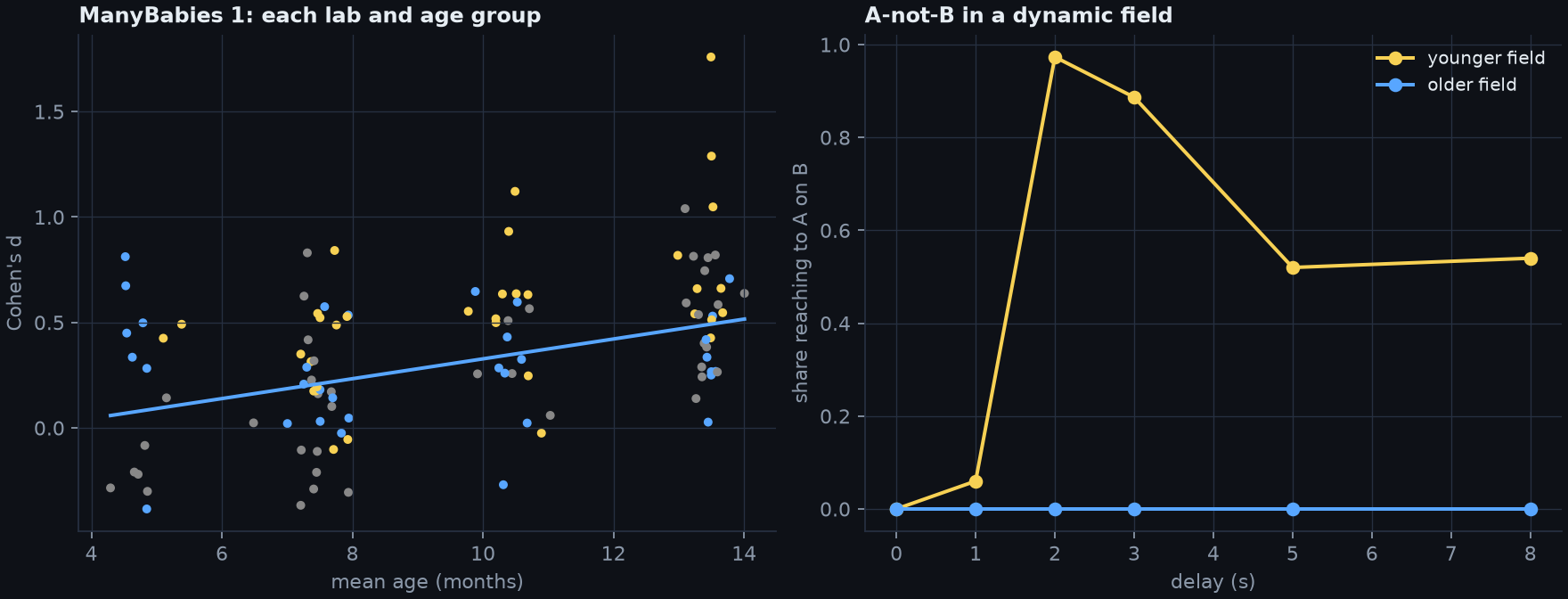
The consortium released its data, and Psyche reads the table. There are estimates, one for each laboratory and age group, from laboratories and infants between three and fifteen months old, tested by three methods. Each line here is one estimate. Pooled, the preference is a d of , with an interval from to , which is the published value. That is smaller than the earlier literature suggested, and clearly not zero: the preference is real. And the heterogeneity is low: I squared of percent, so most of the spread between laboratories is the noise you'd expect from small samples.
With a hundred and eight estimates, the moderators can be measured. Age: in a meta-regression with method held fixed, the preference grows by about in d per month of age. Method: the head-turn preference procedure gives the largest effect, about more than central fixation. And language: the effect is larger when the speech was the infants' own North American English, against . These match what the consortium reported. The lesson for the rest of this part: an infant effect is a property of a method, an age and a stimulus, not only of the infant.
What it does: Why infant studies are fragile; ManyBabies 1 recomputed; age, method and language
4On you: predict the infantPsych 101 and the major2 min
Your turn. Here are six experiments, each with two outcomes. For each, guess which outcome infants looked at longer. One: a screen rotates back toward a box, and either stops, or seems to pass right through it. Two: one doll plus one doll go behind a screen, which drops to show one doll or two. Three: from a box of mostly white balls, someone draws four red and one white, or four white and one red. Four: a voice speaks in infant-directed or adult-directed speech. Five: a character's ball was moved while she was away, and she searches where it is now, or where she left it. Six: a pattern of eight dots changes to sixteen, or eight changes to twelve. This part's interactive asks you the same, one at a time. Pause here and make your six guesses.
Here's what the studies reported. Five-month-olds looked longer when the screen seemed to pass through the box. Five-month-olds looked longer at one doll after one plus one. Eight-month-olds looked longer at four red balls from a mostly white box. Infants from three to fifteen months preferred infant-directed speech. Fifteen-month-olds looked longer when the character searched where the ball really was, as if they expected her to act on a false belief. And six-month-olds noticed eight changing to sixteen, but not to twelve. Each is a published result. The rest of this part asks which of them replicated, and what a longer look actually shows.
What it does: Six experiments, six guesses, and what was reported
5ObjectsPsych 101 and the major2 min
If Piaget was right, a young infant shouldn't know that a hidden object still exists. In 1985 Renée Baillargeon, Elizabeth Spelke and Stanley Wasserman habituated infants to a screen rotating through a hundred and eighty degrees, like a drawbridge. Then a box was placed behind it. In the possible event, the screen stopped where it would meet the box. In the impossible event, it rotated the full hundred and eighty degrees, through the space the box occupied. Five-month-olds looked longer at the impossible event. In 1987 Baillargeon found the same in four-and-a-half-month-olds, and in three-and-a-half-month-olds who habituated quickly. The reading: young infants know the box still exists behind the screen, and that solid objects don't pass through each other. Months before Piaget's infants searched for hidden toys.
Then the lean readings arrived. The impossible event has more motion in it: the screen sweeps a hundred and eighty degrees, instead of stopping short. And infants had just been habituated to a hundred-and-eighty-degree sweep, so a longer look at it could be a preference for the familiar, not surprise. In 2000 Richard Bogartz, Jeanne Shinskey and Thomas Schilling ran the design with five-and-a-half-month-olds, and found that the number of familiarization trials changed which event infants preferred. They concluded that the study did not show object permanence. Baillargeon and others went on to use many controls, and found infants reasoning about hidden objects in other designs. The looking pattern replicates; its meaning is still argued.
Elizabeth Spelke turned results like these into a theory. For objects she proposed three principles. Cohesion: objects move as connected, bounded wholes. Continuity: they move on connected paths, and don't pass through each other. Contact: they don't act on each other at a distance. Infants start, on this view, with a few systems of core knowledge, for objects, number, agents and places, each with a few principles, and shared with other animals. Learning builds on them; it doesn't have to create them from sensation alone. The alternative is that the principles are learned very fast, from early experience. The next chapters weigh both.
What it does: The drawbridge; the lean reading; core knowledge
6NumberPsych 101 and the major3 min
The most famous number study is an addition. In 1992 Karen Wynn placed a doll on a small stage while a five-month-old watched. A screen rose to hide it, and a hand placed a second doll behind the screen. Then the screen dropped, to show two dolls, which is possible, or only one, which is not. Infants looked longer at one. Two minus one, and one plus one equals three, gave the same pattern. The reading: infants compute the results of adding and subtracting small numbers of objects.
The record is mixed. In 2000 Wakeley, Rivera and Langer repeated the study carefully and found no reliable effect, and argued that results across studies were inconsistent. Wynn replied that most repetitions had succeeded. Critics showed that a preference for familiar displays could produce the same looking pattern without any arithmetic. In 2017 Christodoulou, Lac and Moore pooled twelve studies, with twenty-six samples and five hundred and fifty infants. The pooled effect was a d of 0.34, with signs of publication bias in some tests and not in others. So the pattern is more likely real than not, and smaller than first reported. Whether it is arithmetic is contested.
For larger numbers the evidence is cleaner. In 2000 Fei Xu and Elizabeth Spelke habituated six-month-olds to displays of eight dots, with size and brightness controlled. Infants noticed a change to sixteen, but not to twelve. It's Weber's law again, from Part 11. Numbers are represented with noise that grows with the number, so what matters is the ratio. In Psyche's version, the ratio told apart three times in four is at six months, at nine, and in adults. The Weber fractions here are illustrative, chosen to match those infant results. At nine months, two to three is told apart, as Jennifer Lipton and Spelke found in 2003, and the system keeps sharpening into adulthood.
Does this number sense matter later? In 2008 Justin Halberda, Michèle Mazzocco and Lisa Feigenson found that fourteen-year-olds' acuity at comparing dot arrays correlated with their mathematics scores going back to kindergarten. Meta-analyses since find a real but small correlation, around 0.2, weaker beyond about age six, and partly shared with general ability. Training the approximate number system to improve school mathematics has not shown reliable benefits. The approximate system is a foundation. Exact number words and counting are learned, slowly, between about two and four, which Part 31 takes up.
What it does: One plus one; its record; number by ratio; number sense and mathematics
7Born knowing, or built?Research2 min
A third view says infants are neither born with the answers nor blank. They are learners with good statistical tools. In 2008 Fei Xu and Vashti Garcia showed eight-month-olds a box of mostly white balls. An experimenter, eyes closed, drew five. Infants looked longer when the sample was four red and one white than when it was four white and one red. With nine white balls in ten, which is an illustrative share, the first sample is about times less probable than the second: bits of surprise against . Infants seem to reason from a population to a sample, and, in other experiments in the same paper, from a sample back to the population: intuitive statistics.
So there are three views. Core knowledge: a few innate systems, for objects, number, agents and places, shown early, across cultures, and in other animals. Constructivism, Piaget's view and its modern forms: knowledge is built from action and experience, and looking studies read too much into a long look. And rational constructivism, from Fei Xu, Alison Gopnik and others: infants come with powerful learning mechanisms, Bayesian in spirit, and a few starting concepts, and they behave like small scientists. Each view predicts something the others don't, and that's where the tests are.
What it does: The box of balls; three views of development
8A-not-B as dynamicsResearch3 min
Back to the error from the start of this part. The A-not-B error is one of the most reliable findings in infancy research: around eight to twelve months, infants reach back to A. But it depends on details that a missing concept can't explain: the delay between hiding and reaching, the number of A trials, how different the two lids look, even whether the infant's posture changes between trials. Adele Diamond showed that the delay an infant can bridge without erring grows with age, month by month. And with no delay at all, infants who make the error usually reach correctly. A concept you either have or don't would not behave like this.
Esther Thelen, Gregor Schöner, Christian Scheier and Linda Smith proposed in 2001 that the error is dynamics, and wrote it as a neural field. u of x is the activation for reaching in direction x. The reach goes wherever it peaks when the lids come off. The input S is the two lids, always there, plus the cue where the toy was hidden, for a second or so. The interaction w makes near neighbours excite each other and distant ones inhibit; h is the field's resting level. And m is a memory trace that grows wherever the infant reached. Six reaches to A build it up at A. With a low resting level, a peak cannot sustain itself once the cue is gone. A more cooperative field, as with age, holds it.
Here is one simulated infant of each kind on the B trial, after six reaches to A, with three seconds of delay. The cue at B raises a peak in both fields. In the younger field the peak fades once the cue is gone, and the memory trace at A takes over: it reaches to . The older field holds its peak at B through the delay, and reaches to . Nothing in either field is a concept of the object. The error comes from how fast activation fades and how strong the habit is.
Now run three hundred simulated infants at each delay. With no delay, no younger field errs. With a delay of two or three seconds, almost all of them do. At longer delays the error falls back toward chance, because even the A trials become guesses: the model predicts an inverted U. More A trials build more habit: at three seconds, percent err after one A trial, and percent after six. And the older field never errs. Development here is a change in a parameter, the field's ability to hold a peak, not the arrival of a concept. Knowing where the toy is, it turns out, is not a yes-or-no possession.
What it does: What the error depends on; the field derived; one infant's field; error against delay and A trials
9Other mindsPsych 101 and the major3 min
Infants live among other minds. When do they understand them? In 1983 Heinz Wimmer and Josef Perner told children a story. Maxi puts his chocolate in a cupboard and goes out to play. While he's away, his mother moves it. Where will Maxi look for it? Most three-year-olds say: where it is now. By about four or five, most children say: where he left it. In 2001 Henry Wellman, David Cross and Julanne Watson pooled a hundred and seventy-eight studies. The shift is consistent across countries and versions of the task, and age is the main predictor. This is a theory of mind: knowing that other people act on what they believe, even when it's false.
Then the instrument of this part seemed to move the age far down. In 2005 Kristine Onishi and Renée Baillargeon had an actor hide a toy in a green box. While she couldn't see, it moved to the yellow one. Fifteen-month-olds looked longer when she searched the yellow box, where the toy really was, as if they expected her to act on her false belief. Studies of anticipatory looking, where infants look ahead to where an agent will search, seemed to agree. In 2018 Louisa Kulke, Hannes Rakoczy and colleagues ran a preregistered replication of four such tasks. One replicated, and not once its confounds were removed. Other replications of looking-time versions also failed, and multi-laboratory tests are under way. The claim is contested.
One more claim about other people starts at birth. In 1977 Andrew Meltzoff and Keith Moore reported that infants between twelve and twenty-one days old copied an adult's tongue protrusion, mouth opening and lip protrusion. If so, there's a link between seeing and doing, between self and other, from birth. In 2016 Janine Oostenbroek and colleagues followed a hundred and six infants at one, three, six and nine weeks, with eleven gestures each. Infants produced each gesture as often after control models as after matching ones. Meltzoff's reanalysis of their data found tongue protrusion matched. But tongue protrusion is also what infants do when aroused by anything interesting. Contested.
What it does: False belief at four; at fifteen months; newborn imitation
10AttachmentPsych 101 and the major2 min
The infant mind is also a social one, and its first relationship has been studied hard. In 1958 Harry Harlow raised infant rhesus monkeys with two surrogate mothers, one of bare wire and one covered in cloth. For some infants, only the wire mother gave milk. They fed from the wire mother, and spent most of the day clinging to the cloth one. Frightened, they ran to the cloth. It went against the drive theories of Part 28: comfort, not food, made the bond. These experiments, and Harlow's later isolation studies, caused lasting harm to the animals, and are one of the reasons for today's rules on animal research.
John Bowlby turned bonds like these into a theory. Attachment, for Bowlby, is an evolved system that keeps an infant near a protector, and gives it a secure base from which to explore. Mary Ainsworth made it measurable with the Strange Situation, about twenty minutes of separations and reunions in a playroom. The key moments are the reunions. A secure infant is upset, is comforted, and goes back to play. An avoidant infant ignores the parent's return. A resistant infant is upset and hard to comfort. A fourth pattern, disorganized, was added later by Mary Main and Judith Solomon. In 1988 Marinus van IJzendoorn and Pieter Kroonenberg pooled thirty-two samples from eight countries, nearly two thousand infants. Secure was the most common pattern everywhere, and variation within countries was larger than variation between them.
What does it predict? Popular accounts say the first year sets a child's relationships for life. In 2010 Pasco Fearon and colleagues pooled sixty-nine samples, nearly six thousand children. Insecure attachment went with later behaviour problems, with a d of 0.31. That is real, and modest. Most insecurely attached infants do not develop problems, and attachment can change as circumstances change. And the measure is a short observation of one relationship at one age, so Part 3's limits on reliability apply.
What it does: Cloth and wire; the Strange Situation; what attachment predicts
11Temperament and learning from othersPsych 101 and the major2 min
Babies differ from the start. From 1956 Alexander Thomas and Stella Chess followed children in the New York Longitudinal Study, using parents' reports of activity, regularity, mood and reaction to new things. About forty percent of the children were easy, ten percent difficult, fifteen percent slow to warm up, and the rest a mix. Temperament is partly heritable and moderately stable, and it's only one input. What matters is how well it fits the family around the child. And children shape their own environments: a fussy baby evokes different care from a calm one, Part 9's gene-environment correlation in action.
Much of what children learn comes from other people. In the 1930s Lev Vygotsky wrote that what a child can do with help today, it can do alone tomorrow. He called the space between what a child can do alone and what it can do with a more skilled partner the zone of proximal development. Teaching works best in that zone: the Goldilocks rule again, now for learning from others. Gergely Csibra and György Gergely proposed that infants are built for this. They treat eye contact, their own name and infant-directed speech as signals that something worth learning is coming, which may be why ManyBabies found the preference it did.
Children learn from others more faithfully than they need to. In 2005 Victoria Horner and Andrew Whiten showed young chimpanzees and three- to four-year-old children a person opening a puzzle box, with some steps that were needed and some that were not. With an opaque box, both chimpanzees and children copied everything. With a transparent box, where the useless steps were visibly useless, chimpanzees skipped them. Children still copied them. It's called overimitation. Children copy the method, not just the goal. It looks irrational, and it may be how cultures pass on ways of doing things whose reasons nobody can see, a theme of Part 38.
What it does: Temperament; the zone of proximal development and natural pedagogy; overimitation
12The LedgerPsych 101 and the major3 min
Eight new rows today. The first: infants of about eight to twelve months, having found a toy at A, search at A after seeing it hidden at B. The original: Piaget's observations of his own children, published in 1937. The record: Diamond's delays in 1985, Wellman, Cross and Bartsch's meta-analysis in 1987, and Smith and Thelen's manipulations of the task and posture in 1999. One of the most reliable findings in infancy; what it shows is argued. Replicated.
The second: infants of three to five months know that a hidden object still exists. The original: the drawbridge, 1985. The record: Baillargeon's younger infants in 1987, and Bogartz, Shinskey and Schilling's familiarization study in 2000. The looking pattern replicates in its laboratory; reading it as knowledge of hidden objects is argued. Contested.
The third: five-month-olds expect one plus one to make two. The original: Wynn, 1992. The record: a careful failure in 2000, and a meta-analysis of five hundred and fifty infants in 2017, with d of 0.34. Probably real and smaller; whether it's arithmetic is argued. Contested.
The fourth: the acuity of the approximate number system predicts mathematics. The original: Halberda, Mazzocco and Feigenson, 2008. The record: two meta-analyses, in 2014 and 2017. A real correlation of about 0.2, partly shared with general ability. Replicated, smaller.
The fifth: children begin to pass explicit false-belief tasks at about four. The original: Wimmer and Perner, 1983. The record: the Sally-Anne task in 1985, and the meta-analysis of a hundred and seventy-eight studies in 2001. One of the field's most robust findings. Replicated.
The sixth: fifteen-month-olds expect people to act on false beliefs. The original: Onishi and Baillargeon, 2005. The record: two sets of replications in 2018 that mostly failed. Multi-laboratory tests are under way. Contested.
The seventh: newborns imitate facial gestures. The original: Meltzoff and Moore, 1977. The record: a hundred and six infants followed in 2016, and Meltzoff's reanalysis. The largest study found no imitation; one gesture is still disputed. Contested.
And the eighth: infants prefer infant-directed speech. The original: Anne Fernald, 1985. The record: ManyBabies, in sixty-five laboratories, recomputed here. Real, smaller than earlier estimates, and dependent on method, age and language. Replicated.
The tally. What holds is behaviour anyone can see: reaching to A, answering about Maxi, turning toward infant-directed speech. What's contested is the rich reading of a few seconds of looking: knowledge of objects, arithmetic, false belief, imitation at birth. The instrument itself is sound when it's used at scale and preregistered. It's the inference from a look to a concept where findings fail.
What it does: Eight rows: A-not-B, object permanence, arithmetic, number sense, false belief twice, imitation, infant-directed speech
13In practice: screening, programmes and mediaPractice2 min
The first place infancy research meets practice is the doctor's office. The American Academy of Pediatrics recommends watching development at every visit, and a standardized questionnaire at set ages, around nine, eighteen, and twenty-four or thirty months, with an autism-specific screen at eighteen and twenty-four months. A screen is a test with a threshold, so Part 12's hits, misses and false alarms apply. A positive screen leads to a full assessment, not a diagnosis. And the milestones behind them are population norms. The spread between healthy children is wide, so being late on one milestone means little, and being late on many means more.
The second is early education, where the stakes and the claims are large. The Perry Preschool Project in Michigan began in 1962 with a hundred and twenty-three children from poor families, assigned at random. The gains in IQ faded within a few years, while gains in schooling and adult outcomes persisted. The Head Start Impact Study, a national randomized trial, found small early effects, largely gone by third grade. And a randomized study of Tennessee's statewide pre-kindergarten, reported by Kelley Durkin and colleagues in 2022, found that by sixth grade the children who attended were doing slightly worse than those who didn't. Small, intensive programmes and large public ones are different things. Fade-out of test scores is common, and what lasts, if anything, is often not what was measured first.
The third is a market: media for babies. In 2010 Judy DeLoache and colleagues gave families of twelve- to eighteen-month-olds a popular word-learning DVD to watch at home for four weeks. The children learned no more of its words than children who never saw it. The most learning came when parents taught the words during everyday activities. And parents who liked the DVD overestimated what their children had learned. Infants learn words from people who respond to them, natural pedagogy again, and it's one reason designers of children's toys and media now test with children, not only with parents.
What it does: Developmental screening; early childhood programmes; media for babies
14Frontier: many babies, head cameras and machinesResearch3 min
Three frontiers. The first is scale. ManyBabies has gone on to test other classic findings across many laboratories, including infants' understanding of false belief. These are the design questions of Part 43's capstone: a preregistered protocol, every laboratory's data shared, moderators planned in advance. Online testing at home, with webcam eye tracking, widens samples beyond the families who can visit a university. The open question is which of the field's famous effects survive at scale, and what a typical infant effect size really is.
The second frontier is the infant's own view. Head-mounted cameras record what infants actually see and hear, for months: faces close up, hands, and a few objects again and again. In 2024 Wai Keen Vong, Wentao Wang, Emin Orhan and Brenden Lake trained a network on sixty-one hours of one child's head-camera video, from six to twenty-five months, and it learned many word-to-object mappings. That's a small fraction of one child's waking hours, with no built-in knowledge of objects or words beyond a general learner. It doesn't show that children learn this way. It shows how much is learnable from the input a child really gets, which is where Part 14's frontier left off.
The third frontier turns the method around. In 2022 Luis Piloto, Ari Weinstein, Peter Battaglia and Matthew Botvinick trained a model on synthetic videos and tested it with violation-of-expectation probes adapted from infant studies. There were five concepts: solidity, object persistence, continuity, unchangeableness and directional inertia. The model that represented scenes as objects showed surprise at the impossible events, after as little as twenty-eight hours of video. Models without objects did not pass all the tests. So the infant's looking paradigm has become a test for machine common sense, with the same question attached: what does a surprise signal show? Part 60 returns to it.
Four open problems. What does a longer look measure: surprise, novelty, familiarity, or interest? Can models of looking decide? Which infant findings survive preregistered, multi-laboratory tests? How much knowledge is in the starting state, and how much comes from a few months of very structured input? And which early experiences matter for later life, and through what?
What it does: Infancy research at scale; one child's view; infants as a benchmark for machines; open problems
Recap, problems, and the road aheadAll tracks4 min
First, your six guesses. Most people guess all six reported results, because each makes a good story. Of the six, the evidence is strongest for infant-directed speech and for the large-ratio number result, and the drawbridge's looking pattern repeats in its laboratory. Arithmetic, and false belief at fifteen months, are contested. And a good guess about where a baby looks is not the same as knowing what the baby knows.
Part thirty in ten lines. Infants of eight to twelve months reach back to where a toy was found, not where they saw it go. Piaget saw a mind built by acting, in stages. Looking time replaced asking, through habituation, surprise, and attention to the Goldilocks middle. ManyBabies measured one effect in sixty-five laboratories, a d of 0.35, with age, method and language as moderators, and we recomputed it. Knowledge of objects and arithmetic by looking gives patterns that repeat and readings that are argued. Number is judged by ratio, under Weber's law, sharpening with age. Infants judge samples against populations, like small statisticians. The A-not-B error falls out of a dynamic field, and is outgrown by a change in one parameter. False belief at four is robust; at fifteen months it's contested. And attachment, temperament and copying make modest predictions about faithful learners.
Kant's wager. The first objection, that mathematics can't apply to the mind, met Weber's law, Bayes's rule and a neural field: number, samples and an error, written as mathematics. The second, that the mind can't be experimented on, met looking times, habituation, and one effect tested in sixty-five laboratories at once. The third, about introspection, takes a new form here: infants can't report anything, so every finding is an inference from behaviour, and the rich inferences are where findings fail. Amber.
Where this comes back. Development across the whole life is next, in Part 31. Temperament grown up is personality, in Part 33. Autism and development are in Part 41. A replication run end to end is Part 43's capstone. Learning in schools is Part 54, and machines tested like infants are Part 60.
Seven problems, with full solutions in this part's README. One derives the ideal learner's surprisal. One derives the number system's accuracy and shows it depends only on the ratio. One works out the box of balls. One refits the ManyBabies meta-regression from the open data. One finds when the field's memory wins. One shows how a preference for the familiar could fake knowledge of objects. And the last, with the star, asks you to design a study that core knowledge and rational constructivism would predict differently. Pause here if you'd like to try them.
The books and papers behind this part are listed here and in the README. Piaget's The Construction of Reality in the Child is where the A-not-B error begins; The Scientist in the Crib, by Alison Gopnik, Andrew Meltzoff and Patricia Kuhl, is the case for infants as learners; and Spelke and Kinzler's short review sets out core knowledge.
That's the first part of Act Seven, on growing. The next part follows the whole life. In 2000 in Bucharest, with too few foster homes for the children in the city's institutions, placement was decided by lottery. It made a randomized experiment on early care, and the children have been followed ever since. It's Part 31: the lifespan.
Where it goes next. Development across the life is Part 31; temperament grown up is personality, Part 33; autism and development are Part 41; the replication capstone is Part 43; learning in schools is Part 54; machines tested like infants are Part 60.
Key results
The part's results in one place, for revision.
Try it
Lab 30 · The Infant Mind
Compute an ideal learner's surprisal and see attention favour the middle; recompute ManyBabies 1 from its open table, with age and method as moderators; derive number discrimination from Weber's law; work out the infant statistician's box of balls; and simulate the A-not-B error as a dynamic field.
python -m videos.psychology.labs 30
needs numpy, scipy, matplotlib · download lab30.py ·
source on GitHubevents watched before looking away: predictable, intermediate, random 6.4, 6.8, 5.5
surprisal with the lowest look-away rate (bits) 1.12
ManyBabies: estimates; pooled d [95% CI]; I^2 108; 0.35 [0.29, 0.42]; 12%
meta-regression: age slope per month (SE); head-turn preference over central fixation (SE) 0.047 (0.010); 0.18 (0.08)
6 months (w = 0.66): ratio told apart 75% of the time; P(8 v 12) 1.99; 0.66
9 months (w = 0.41): ratio told apart 75% of the time; P(8 v 12) 1.50; 0.75
3 years (w = 0.29): ratio told apart 75% of the time; P(8 v 12) 1.32; 0.83
adult (w = 0.15): ratio told apart 75% of the time; P(8 v 12) 1.15; 0.97
box 90% white: P(4 red, 1 white), P(1 red, 4 white), ratio 0.00045, 0.328, 729
A-not-B errors by delay 0, 1, 2, 3, 5, 8 s: younger field 0.00, 0.06, 0.97, 0.89, 0.52, 0.54
the same: older field 0.00, 0.00, 0.00, 0.00, 0.00, 0.00
Attention favours events of middling surprisal; ManyBabies pools to d = 0.35 and grows with age; number is judged by ratio, more finely with age; a sample of four red from a mostly white box is 729 times less likely than the reverse; and a field that cannot hold a peak through a delay falls back on its memory of A.The code (82 lines; it asserts its own result)
"""Lab 30: an ideal learner's surprisal and the Goldilocks effect, ManyBabies recomputed with its meta-regression,
number by ratio, the infant statistician, and the A-not-B error made and outgrown by a dynamic neural field."""

import numpy as np

from videos.coursekit import labs
from explainer.psychology import opendata
from explainer.psychology.psyche import develop as D
from explainer.psychology.psyche import drive as Dr

TITLE = "The Infant Mind"
GOAL = ("Compute an ideal learner's surprisal and see attention favour the middle; recompute ManyBabies 1 from its "
        "open table, with age and method as moderators; derive number discrimination from Weber's law; work out "
        "the infant statistician's box of balls; and simulate the A-not-B error as a dynamic field.")
TASKS = [
    "Refit the ManyBabies meta-regression with an interaction between age and method. Does the age slope differ "
    "for the head-turn preference procedure?",
    "Give the dynamic field a memory trace that decays between trials (multiply it by 0.8 before each trial). "
    "How does the error change with the number of A trials?",
    "Change the Goldilocks observer's best surprisal from 1.1 to 0.5 bits. Which kind of sequence is now watched "
    "longest, and why?",
]


def run(seed=0):
    out = labs.Lab()

    # 1. surprisal and Goldilocks
    g = D.goldilocks(seed=seed)
    out.row("events watched before looking away: predictable, intermediate, random",
            ", ".join(f"{g['mean_length'][k]:.1f}" for k in ("predictable", "intermediate", "random")))
    i = int(np.nanargmin(g["rate"]))
    out.row("surprisal with the lowest look-away rate (bits)", f"{g['surprisal'][i]:.2f}")

    # 2. ManyBabies
    d = opendata.manybabies_2020()
    y, v, age, meth = d["yi"], d["vi"], d["age_mo"], np.array(d["method"])
    re = Dr.random_effects(y, v)
    out.row("ManyBabies: estimates; pooled d [95% CI]; I^2",
            f"{re['k']}; {re['estimate']:.2f} [{re['lo']:.2f}, {re['hi']:.2f}]; {100 * re['I2']:.0f}%")
    assert re["k"] == 108 and abs(re["estimate"] - 0.35) < 0.01
    X = np.column_stack([np.ones_like(y), age - age.mean(), (meth == "HPP").astype(float),
                         (meth == "Eye tracking").astype(float)])
    mr = D.meta_regression(y, v, X)
    out.row("meta-regression: age slope per month (SE); head-turn preference over central fixation (SE)",
            f"{mr['b'][1]:.3f} ({mr['se'][1]:.3f}); {mr['b'][2]:.2f} ({mr['se'][2]:.2f})")
    assert mr["b"][1] > 0 and mr["b"][2] > 0

    # 3. number
    for age_, w in D.WEBER.items():
        out.row(f"{age_} (w = {w}): ratio told apart 75% of the time; P(8 v 12)",
                f"{D.ratio_threshold(w):.2f}; {float(D.ans_correct(12, 8, w)):.2f}")

    # 4. the statistician
    a, b = D.sample_surprise(0.1, 4, 5), D.sample_surprise(0.1, 1, 5)
    out.row("box 90% white: P(4 red, 1 white), P(1 red, 4 white), ratio",
            f"{a['p']:.5f}, {b['p']:.3f}, {b['p'] / a['p']:.0f}")

    # 5. A not B
    delays = [0.0, 1.0, 2.0, 3.0, 5.0, 8.0]
    young = [D.a_not_b(-6.0, dl, n=150, seed=seed)["error"] for dl in delays]
    old = [D.a_not_b(-3.0, dl, n=150, seed=seed)["error"] for dl in delays]
    out.row("A-not-B errors by delay 0, 1, 2, 3, 5, 8 s: younger field", ", ".join(f"{e:.2f}" for e in young))
    out.row("the same: older field", ", ".join(f"{e:.2f}" for e in old))
    assert young[0] < 0.1 and max(young) > 0.8 and max(old) < 0.05

    out.note = ("Attention favours events of middling surprisal; ManyBabies pools to d = 0.35 and grows with age; "
                "number is judged by ratio, more finely with age; a sample of four red from a mostly white box is "
                "729 times less likely than the reverse; and a field that cannot hold a peak through a delay falls "
                "back on its memory of A.")

    fig, ax = labs.figure(2, size=(11, 4.2))
    ax[0].scatter(age, y, s=12, c=[{"HPP": labs.GOLD, "Central fixation": labs.BLUE}.get(m, "#888888") for m in meth])
    xs = np.linspace(age.min(), age.max(), 50)
    ax[0].plot(xs, mr["b"][0] + mr["b"][1] * (xs - age.mean()), color=labs.BLUE)
    ax[0].set(title="ManyBabies 1: each lab and age group", xlabel="mean age (months)", ylabel="Cohen's d")
    ax[1].plot(delays, young, "o-", color=labs.GOLD, label="younger field")
    ax[1].plot(delays, old, "o-", color=labs.BLUE, label="older field")
    ax[1].set(title="A-not-B in a dynamic field", xlabel="delay (s)", ylabel="share reaching to A on B")
    ax[1].legend()
    out.fig = fig
    return out
Now change it
- Refit the ManyBabies meta-regression with an interaction between age and method. Does the age slope differ for the head-turn preference procedure?
- Give the dynamic field a memory trace that decays between trials (multiply it by 0.8 before each trial). How does the error change with the number of A trials?
- Change the Goldilocks observer's best surprisal from 1.1 to 0.5 bits. Which kind of sequence is now watched longest, and why?
Problems, with solutions
Try each problem before opening its solution.
-
The ideal learner. For a Dirichlet\((\alpha)\)-multinomial learner with \(k\) outcomes, show that the predictive probability of an outcome seen \(c\) times in \(n\) events is \((c + \alpha)/(n + k\alpha)\), and give its surprisal in bits.
Solution
With a Dirichlet(α) prior over k outcomes and counts c₁…c_k after n events, the posterior is Dirichlet(α + c), whose mean for outcome j is (c_j + α)/(n + kα): the predictive probability of the next event. Its surprisal is −log₂((c_j + α)/(n + kα)) bits. With α = 1 and k = 3 the first event always carries log₂ 3 = 1.58 bits.
-
Number by ratio. If a number \(n\) is represented as a normal with mean \(n\) and standard deviation \(w n\), show that \(P(\text{correct}) = \Phi\big(|n_1 - n_2| / (w\sqrt{n_1^2 + n_2^2})\big)\), and that it depends only on the ratio.
Solution
The difference of the two representations is normal with mean n₁ − n₂ and variance w²(n₁² + n₂²). The judgment is right when the difference has the sign of n₁ − n₂, with probability Φ(|n₁ − n₂| / (w√(n₁² + n₂²))). Replacing (n₁, n₂) by (λn₁, λn₂) cancels λ, so with r = n₁/n₂ it is Φ(|r − 1| / (w√(r² + 1))): a function of the ratio only.
-
The box of balls. From a box with a share \(p\) of white balls, show that four red and one white is \(\big(p/(1 - p)\big)^3\) times less probable than four white and one red.
Solution
P(4 red, 1 white) = 5(1 − p)⁴p and P(1 red, 4 white) = 5(1 − p)p⁴; their ratio is (p/(1 − p))³, which is 729 for p = 0.9.
-
ManyBabies with age alone. With the ManyBabies table (
opendata.manybabies\_2020), refit the meta-regression with age alone. How much does the age slope change, and why?Solution
The age slope is 0.050 per month (SE 0.010), against 0.047 with method held fixed, because age and method are nearly uncorrelated across laboratories (r = 0.10). Age alone also takes τ² from 0.014 to zero: the little heterogeneity there was is mostly age.
-
When memory wins. In a field with no interactions, a cue of strength \(A\) at B decays as \(A e^{-t/\tau}\) while a memory trace \(c\,m\) sits at A. Show that the reach goes to A after \(t^* = \tau \ln(A / c\,m)\).
Solution
Without interactions the field at B after the cue is h + s + A e^(−t/τ) and at A is h + s + c m. The reach goes to A once A e^(−t/τ) < c m, that is t > τ ln(A/(c m)). Stronger memories (more A trials) and faster decay (smaller τ, a less cooperative field) make the error come sooner.
-
Familiarity. Infants who have seen too little of a display prefer the familiar one. Show how a familiarity preference could produce longer looks at the 180-degree drawbridge without any knowledge of the box.
Solution
Infants who have had little exposure to a display prefer it; with more, they prefer novelty. After a short habituation to a 180-degree rotation, the impossible event, which repeats that rotation, can win a familiarity preference with no knowledge of the box. The test: vary familiarization and see whether the preference flips, as Bogartz, Shinskey and Schilling did.
-
★ Core knowledge against rational constructivism.
Solution
Core knowledge predicts expectations that appear without relevant experience and resist short exposure to contrary evidence; rational constructivism predicts expectations calibrated to the statistics of experience and updated by them. For example: give infants a short, controlled exposure to a display world in which some regularity is reversed (objects that pass through barriers on a screen), then test with violation of expectation. Unchanged surprise favours core knowledge; surprise that shifts with the exposure, in proportion to its amount, favours rational constructivism. Controlled-rearing studies in animals test the other half.
Notes and sources
Sources
Piaget and looking: J. Piaget, La naissance de l'intelligence chez l'enfant (1936) and La construction du réel chez l'enfant (1937; The Construction of Reality in the Child, 1954); J. Piaget and A. Szeminska, La genèse du nombre chez l'enfant (1941); R. L. Fantz, The origin of form perception, Scientific American 204 (May 1961) 66-72; C. Kidd, S. T. Piantadosi and R. N. Aslin, The Goldilocks effect: human infants allocate attention to visual sequences that are neither too simple nor too complex, PLoS ONE 7 (2012) e36399; the infant-directed speech row's references in the Ledger.
Objects, number and statistics: the object-permanence, arithmetic and number-sense rows' references in the Ledger; F. Xu and E. S. Spelke, Large number discrimination in 6-month-old infants, Cognition 74 (2000) B1-B11; J. S. Lipton and E. S. Spelke, Origins of number sense: large-number discrimination in human infants, Psychological Science 14 (2003) 396-401; F. Xu and V. Garcia, Intuitive statistics by 8-month-old infants, Proceedings of the National Academy of Sciences 105 (2008) 5012-5015; E. S. Spelke and K. D. Kinzler, Core knowledge, Developmental Science 10 (2007) 89-96; F. Xu and T. Kushnir, eds., Rational Constructivism in Cognitive Development (2012).
The field: E. Thelen, G. Schöner, C. Scheier and L. B. Smith, The dynamics of embodiment: a field theory of infant perseverative reaching, Behavioral and Brain Sciences 24 (2001) 1-86; the A-not-B row's references in the Ledger.
Minds, attachment and others: the false-belief and imitation rows' references in the Ledger; H. F. Harlow, The nature of love, American Psychologist 13 (1958) 673-685; J. Bowlby, Attachment (1969); M. D. S. Ainsworth, M. C. Blehar, E. Waters and S. Wall, Patterns of Attachment (1978); M. H. van IJzendoorn and P. M. Kroonenberg, Cross-cultural patterns of attachment: a meta-analysis of the Strange Situation, Child Development 59 (1988) 147-156; R. M. P. Fearon et al., The significance of insecure attachment and disorganization in the development of children's externalizing behavior, Child Development 81 (2010) 435-456; A. Thomas and S. Chess, Temperament and Development (1977); L. S. Vygotsky, Thinking and Speech (1934); G. Csibra and G. Gergely, Natural pedagogy, Trends in Cognitive Sciences 13 (2009) 148-153; V. Horner and A. Whiten, Causal knowledge and imitation/emulation switching in chimpanzees and children, Animal Cognition 8 (2005) 164-181; D. E. Lyons, A. G. Young and F. C. Keil, The hidden structure of overimitation, Proceedings of the National Academy of Sciences 104 (2007) 19751-19756.
Practice and frontier: American Academy of Pediatrics guidance on developmental surveillance and screening; L. J. Schweinhart et al., Lifetime Effects: The High/Scope Perry Preschool Study Through Age 40 (2005); M. Puma et al., Third Grade Follow-up to the Head Start Impact Study (2012); K. Durkin, M. W. Lipsey, D. C. Farran and S. E. Wiesen, Effects of a statewide pre-kindergarten program on children's achievement and behavior through sixth grade, Developmental Psychology 58 (2022) 470-484; J. S. DeLoache et al., Do babies learn from baby media?, Psychological Science 21 (2010) 1570-1574; W. K. Vong, W. Wang, A. E. Orhan and B. M. Lake, Grounded language acquisition through the eyes and ears of a single child, Science 383 (2024) 504-511; L. S. Piloto, A. Weinstein, P. Battaglia and M. Botvinick, Intuitive physics learning in a deep-learning model inspired by developmental psychology, Nature Human Behaviour 6 (2022) 1257-1267.
Data: ManyBabies 1's lab-level table, github.com/manybabies/mb1-analysis-public, as manybabies2020 in psymetadata 1.0.1 (GPL >= 2), fetched from CRAN and never redistributed.
About this partfrom its README
A ten-month-old finds a toy under cup A, again and again; then she watches it hidden under cup B, and reaches for A. This part asks what a baby knows and how anyone can find out, when the baby cannot answer. It builds the instrument that replaced asking, looking time, then tests it at scale by recomputing ManyBabies 1 from its open table, and ends by rebuilding Piaget's error as a dynamic neural field.
The A-not-B error and Piaget's theory: schemes, assimilation and accommodation, four stages, conservation; Fantz's looking chamber; habituation with the laboratory criterion, simulated; violation of expectation and what a long look can mean; the Goldilocks effect with an ideal learner's surprisal; ManyBabies 1, 108 lab-by-age estimates from 65 laboratories, pooled and meta-regressed on age, method and language; the viewer predicts six infant results; the drawbridge and its lean reading, and Spelke's core knowledge; Wynn's one plus one and its record, number by ratio with Weber fractions by age, and number sense and mathematics; Xu and Garcia's box of balls and three views of development; the A-not-B error as a dynamic field, with error against delay and number of A trials; false belief at four and at fifteen months, and newborn imitation; Harlow, the Strange Situation and what attachment predicts; temperament, Vygotsky, natural pedagogy and overimitation. The practice chapter is developmental screening, early childhood programmes and media for babies; the frontier is infancy research at scale, head cameras, and infants as a benchmark for machines.
What is computed and built
explainer/psychology/psyche/develop.py: habituation with the laboratory criterion; a Dirichlet-multinomial ideal learner's surprisal and an observer with a U-shaped look-away rule; the approximate number system's accuracy and ratio thresholds, with illustrative Weber fractions by age; the box-of-balls probabilities; a one-dimensional dynamic neural field with a memory trace, run for many simulated infants at once, that makes and outgrows the A-not-B error; random-effects meta-regression. Tested intests/psychology/test_develop.py.explainer/psychology/opendata.pyreads ManyBabies 1's lab-level table from psymetadata 1.0.1, checked by SHA-256 (manybabies_2020); the Archive registers it (MANYBABIES_2020).- The Ledger gains eight rows, and four earlier declarations that pointed here are settled.
- The course's interactive is the prediction game on you: six published infant results, where did infants look longer, and what happened to each when it was checked.
Chapter notes
| # | Chapter | What it does |
|---|---|---|
| 0 | The toy under the cloth | The A-not-B error; the problem of a subject who cannot answer; the questions; objectives |
| 1 | Piaget's infant | Schemes, assimilation and accommodation; four stages; conservation |
| 2 | Looking as an instrument | Fantz's chamber; habituation simulated; violation of expectation; the Goldilocks effect |
| 3 | One effect, sixty-five laboratories | Why infant studies are fragile; ManyBabies 1 recomputed; age, method and language |
| 4 | On you: predict the infant | Six experiments, six guesses, and what was reported |
| 5 | Objects | The drawbridge; the lean reading; core knowledge |
| 6 | Number | One plus one; its record; number by ratio; number sense and mathematics |
| 7 | Born knowing, or built? | The box of balls; three views of development |
| 8 | A-not-B as dynamics | What the error depends on; the field derived; one infant's field; error against delay and A trials |
| 9 | Other minds | False belief at four; at fifteen months; newborn imitation |
| 10 | Attachment | Cloth and wire; the Strange Situation; what attachment predicts |
| 11 | Temperament and learning from others | Temperament; the zone of proximal development and natural pedagogy; overimitation |
| 12 | The Ledger | Eight rows: A-not-B, object permanence, arithmetic, number sense, false belief twice, imitation, infant-directed speech |
| 13 | In practice: screening, programmes and media | Developmental screening; early childhood programmes; media for babies |
| 14 | Frontier: many babies, head cameras and machines | Infancy research at scale; one child's view; infants as a benchmark for machines; open problems |
| Recap, problems, and the road ahead | Your guesses; ten lines; Kant's three objections; payoffs; problems; references; Part 31 |
NotesWhere the numbers come from
| What | Source |
|---|---|
| Habituation: looks fall from about 12 s (mean of the first three) to the criterion (three looks under half that) at trial 7; a familiar test display 4.3 s, a new one 12.1 s | Psyche (develop.habituation, seed 3), item habituation |
| Goldilocks: look-away lowest near 1.1 bits of surprisal (by construction, after Kidd et al.); events watched before looking away: predictable 6.4, intermediate 6.8, random 5.5 | Psyche (develop.goldilocks, surprisal_trace), item goldilocks |
| ManyBabies 1: 108 estimates, 65 laboratories, 2,179 infants in the shared table; random-effects d = 0.35 [0.29, 0.42], I² = 12%; central fixation 0.29 (33), eye tracking 0.24 (41), head-turn preference 0.51 (34); by age group 0.17, 0.21, 0.42, 0.55; meta-regression age slope 0.047 per month (SE 0.010), head-turn preference +0.18 (SE 0.08); North American English stimuli 0.43 against 0.28 | ManyBabies Consortium (2020) (opendata.manybabies_2020, psymetadata 1.0.1), item manybabies |
| Number: Weber fractions 0.66 (6 months), 0.41 (9 months), 0.29 (3 years), 0.15 (adults), illustrative, chosen so that 2:1 and 3:2 are told apart three times in four at six and nine months; thresholds 1.99, 1.50, 1.32, 1.15 | Psyche (develop.ans_correct, ratio_threshold), item number |
| The box of balls: with 90% white (illustrative), four red and one white has probability 0.00045 (11.1 bits), four white and one red 0.33 (1.6 bits): 729 times less likely | Psyche (develop.sample_surprise), item statistics |
| The dynamic field: 300 simulated infants per point; younger field (h = −6) errs 0%, 9%, 96%, 87%, 67% at 0 to 4 s and returns to about 50% by 6 s; the older field (h = −3) never errs; at 3 s, error 52% after one A trial and 90% after six | Psyche (develop.a_not_b, field_snapshot), item anotb |
| Wynn's meta-analysis: 12 studies, 26 samples, 550 infants, d = 0.34 | Christodoulou, Lac and Moore (2017) |
| Wellman, Cross and Watson: 178 studies | Wellman, Cross and Watson (2001) |
| Oostenbroek et al.: 106 infants at 1, 3, 6 and 9 weeks, 11 models | Oostenbroek et al. (2016) |
| van IJzendoorn and Kroonenberg: 32 samples, 8 countries, 1,990 infants; Fearon et al.: 69 samples, nearly 6,000 children, d = 0.31 | van IJzendoorn and Kroonenberg (1988); Fearon et al. (2010) |
| Thomas and Chess: 40% easy, 10% difficult, 15% slow to warm up | Thomas and Chess (1977) |
| Vong et al.: 61 hours of one child's head-camera video, 6 to 25 months; Piloto et al.: as little as 28 hours of video, five concepts | Vong et al. (2024); Piloto et al. (2022) |
Notes
| Finding | Original | Status |
|---|---|---|
| Infants of about eight to twelve months search at A after seeing a toy hidden at B | Piaget 1937 | replicated |
| Infants of three to five months know that a hidden object still exists | Baillargeon, Spelke and Wasserman 1985 | contested |
| Five-month-olds expect one plus one to make two | Wynn 1992 | contested |
| The acuity of the approximate number system predicts mathematics | Halberda, Mazzocco and Feigenson 2008 | replicated, smaller |
| Children begin to pass explicit false-belief tasks at about four | Wimmer and Perner 1983 | replicated |
| Infants of about fifteen months expect people to act on false beliefs | Onishi and Baillargeon 2005 | contested |
| Newborns imitate facial gestures | Meltzoff and Moore 1977 | contested |
| Infants prefer infant-directed speech | Fernald 1985 | replicated |
Shown without a row, with the reason recorded in explainer/psychology/ledger.py: Piaget's theory and the
conservation task, Fantz's method, core knowledge and the three theoretical positions, Xu and Garcia's study,
the dynamic field model, Harlow's experiments, the Strange Situation and its cross-cultural pooling, the
attachment meta-analysis quoted for its size, temperament, Vygotsky and natural pedagogy, overimitation (due a
row with culture in Part 38), the programme evaluations (due with education in Part 54), the baby-media trial,
and the frontier's models (machines are Part 60's).
Notes
Checked against the articles, their abstracts or official pages (2026-11-15): ManyBabies 1's 67 laboratories, 2,329 infants (65 laboratories and 2,179 infants in the shared lab-level table) and its moderators (age, the head-turn procedure, native-language stimuli); the pooled d = 0.35 recomputed; Kidd et al.'s 7- and 8-month-olds and U-shaped look-away; Wynn's 5-month-olds, Wakeley et al.'s failure and Christodoulou et al.'s 12 studies, 26 samples, 550 infants and d = 0.34; Oostenbroek et al.'s 106 infants at 1, 3, 6 and 9 weeks and 11 models; Wellman et al.'s 178 studies; Baillargeon (1987) with 3.5- and 4.5-month-olds and Bogartz et al. (2000) with 5.5-month-olds; Xu and Spelke's 8 against 16 and 12; Xu and Garcia's 8-month-olds; Onishi and Baillargeon's green and yellow boxes; Kulke et al.'s four tasks; Meltzoff and Moore's 12- to 21-day-olds; van IJzendoorn and Kroonenberg's 32 samples, 8 countries and 1,990 infants; Fearon et al.'s d = 0.31; Harlow's cloth and wire surrogates; Thomas and Chess's 40, 10 and 15 percent; Horner and Whiten's opaque and transparent boxes; DeLoache et al.'s 12- to 18-month-olds; Perry Preschool's 123 children; the AAP's screening ages; Vong et al.'s 61 hours from 6 to 25 months; Piloto et al.'s five concepts and 28 hours.
Still to recheck against the full texts before the final cut:
- Baillargeon, Spelke and Wasserman: the screen stopping at about 112 degrees.
- Tennessee pre-kindergarten: children who attended doing slightly worse by sixth grade (Durkin et al. 2022; the abstract was not read in full).
- Diamond (1985): the delay effect "month by month", described qualitatively.
- Meltzoff et al.'s reanalysis: its year (2017 online, 2018 in print) and journal.
- Kulke et al.: the Psychological Science paper's page numbers; and the companion paper in Cognitive Development.
- Halberda, Mazzocco and Feigenson (2008): the size of the 14-year-old sample, not quoted.
- Wimmer and Perner's age bands, described as "most three-year-olds" and "by about four or five".
Companion material in this repository
The syllabus's plan for this partfrom SYLLABUS.md, the plan of record
- Hook: Piaget's A-not-B error. The infant watches the toy go under B and reaches to A.
- Piaget's theory: schemes, assimilation and accommodation, four stages; conservation tasks.
- The method: Fantz's looking chamber (1961); habituation and dishabituation; violation of expectation. A trial strip, and a model of looking as information seeking (the Goldilocks effect, Kidd et al. 2012).
- On you: six infant experiments. Predict where the baby looks longer.
- Objects: Baillargeon's drawbridge (1985, 1987); Spelke's core principles (cohesion, continuity, contact).
- Number: Wynn's 1 + 1 (1992); the approximate number system and its Weber fraction sharpening with age (Part 11).
- Core knowledge against constructivism against rational constructivism (infants as statisticians, Xu and Garcia 2008). The best case for each.
- A-not-B as dynamics: a neural field with memory and input (Thelen, Smith and colleagues 2001) reproduces the error and its dependence on delay (computed). Knowledge is not a yes-or-no possession.
- Other minds: the false-belief task (Wimmer and Perner 1983); passing at four; implicit tests at fifteen months (Onishi and Baillargeon 2005) and their troubled replications.
- Attachment: Harlow's cloth and wire mothers (1958); Bowlby; Ainsworth's Strange Situation; what early attachment predicts (modestly).
- Temperament, and the first look at how children shape their own environments (Part 9's gene–environment correlation).
- Vygotsky: the zone of proximal development; learning from others (natural pedagogy; overimitation).
Psyche: develop: a habituation model whose looking times follow surprise non-monotonically; a dynamic neural
field that makes and then outgrows the A-not-B error; an approximate-number observer with age-dependent Weber
fraction.
On you: the predict-the-infant quiz.
Ledger: A-not-B (replicated); violation-of-expectation object knowledge (replicated; rich interpretation
contested); Wynn's arithmetic (replicated; interpretation contested); explicit false belief near four
(replicated); implicit false belief in infants (contested, multi-laboratory failures); neonatal imitation
(contested: a large longitudinal study found none); infant-directed speech preference (replicated,
ManyBabies).
In practice: developmental screening, early-childhood programmes, design of children's media and toys.
Frontier: large-scale infant science (ManyBabies) and what replicates; head-camera corpora; infants as a
benchmark for machine common sense.
Reading: Piaget 1954; Fantz 1961; Baillargeon 1987; Spelke & Kinzler 2007; Wynn 1992; Thelen et al. 2001;
Wimmer & Perner 1983; Ainsworth et al. 1978; Gopnik, Meltzoff & Kuhl, The Scientist in the Crib; ManyBabies
Consortium 2020.
Build the film
python -m videos.psychology.psych30.compute        # the part's numbers, into .cache/psych30
python tools/build.py psych30                  # render and assemble the film
EXPLAINER_TTS=silent python tools/qa_scene.py psych30 Hook   # one chapter, silent, with a contact sheet
Scenes: videos/psychology/psych30. Setup: see the course page. Source of these notes: the README and the scenes' narration.
Build it
python -m videos.psychology.psych30.compute            # every number (a few minutes: the field runs 7,000 infants)
python tools/qa_scene.py psych30 Field                 # one chapter, silent, at 480p, with a contact sheet
EXPLAINER_TTS=silent python tools/build.py psych30 -q l   # the whole part, silent preview
python tools/build.py psych30                          # 1080p30 with narration
python tools/qa_scene.py psych30 ManyBabies --lang zh  # the Chinese edition of one chapter
python tools/make.py psych30                           # both editions, with the checks a long build needs
python -m videos.psychology.labs 30                    # the lab: surprisal, ManyBabies, number, the field
python tools/check_ledger.py psych30                   # every study shown has its Ledger row, or a reason
python -m pytest tests/psychology                      # Psyche's develop module, the Ledger, the Archive
The Chinese edition is zh_lines.py (the narration, line by line) and the series table
videos/psychology/psychology_text_zh.json (the text on screen); the terms are in
PSYCHOLOGY_ZH_GUIDE.md.