Consciousness
What is the difference between information the brain uses and information you experience?
A man with a damaged visual cortex insists he sees nothing in half his visual field, and when forced to guess, points to objects there almost perfectly. The contrastive method makes the question experimental: hold the stimulus fixed and vary awareness. A model of masking shows the trap in it, since a strict criterion for saying 'seen' manufactures unconscious perception from one representation. Rivalry alternates by inhibition and adaptation; no-report designs strip away activity that belongs to reporting; the workspace ignites all or none; integrated information can be computed for small networks; and the two theories, tested on terms their authors agreed in advance, each lost something. Libet's readiness potential can be accumulated noise, and some unresponsive patients follow commands with their brains.
What you need. Part 12's signal detection and meta-d', Part 18's attention, and Part 25's accumulators. Probability, mutual information and simple differential equations.
- Hook
- the patient who saw without seeing
- Ideas, models and mathematics
- blindsight, neglect, rivalry and masking, the search for correlates, the global workspace, integrated information, adversarial collaborations, volition, sleep and anaesthesia
- Psyche gains
- a workspace that ignites
- On you
- masking: what did you see?
What you will be able to do
Psych 101 and the major
- Describe the contrastive method, blindsight and inattentional blindness.
- Explain the global workspace and integrated information theories and one prediction of each.
- Describe Libet's experiment and the accumulator reading of it.
Graduate
- Compute accuracy on unseen trials in a signal-detection model of masking, and its dependence on the criterion.
- Simulate binocular rivalry and an ignition network, and read off their signatures.
- Compute effective information and phi for a small Boolean network.
Research
- Explain why above-chance guessing on unseen trials does not by itself show unconscious perception.
- Design a no-report test that separates the theories' predictions.
Practice
- Explain what anaesthesia monitors and brain-based tests in disorders of consciousness can and cannot show.
Contents
Each chapter has a home level. Choose a track to see what to read and watch: Psych 101 and the major 30 min · Graduate 32 min · Research 45 min · Practice 32 min.
- 0Seeing without knowing itPsych 101 and the major3 min
- 1The contrastive methodPsych 101 and the major2 min
- 2Masking and the criterion problemPsych 101 and the major3 min
- 3BlindsightPsych 101 and the major3 min
- 4The easy problems and the hard onePsych 101 and the major2 min
- 5Correlates: rivalry, report and no-reportPsych 101 and the major4 min
- 6The global workspacePsych 101 and the major3 min
- 7Integrated informationResearch4 min
- 8Recurrence and higher orderResearch2 min
- 9An adversarial collaborationResearch2 min
- 10Volition: Libet's clockResearch3 min
- 11Losing consciousnessPsych 101 and the major3 min
- 12Attention, metacognition and progressPsych 101 and the major2 min
- 13The LedgerPsych 101 and the major2 min
- 14In practice: anaesthesia, injury and machinesPractice2 min
- 15Frontier: the scorecardResearch2 min
- Recap, problems, and the road aheadAll tracks3 min
Also on this page: Lecture · Key results · Try it · Lab · Problems · Notes and sources · Build the film.
Lecture
The text of each chapter is the film's narration, as it is spoken, so you can read along or revise without the film. The pictures are in the film. A dashed box stands for a number the film computes when it is rendered (hover over it to see what is computed); the README's figures for each chapter, where it lists them, follow the chapter's text.
Seeing without knowing itPsych 101 and the major3 min
Let's start on you. In a moment a digit will flash in the middle of the screen, for a single frame of this video, about a thirtieth of a second, and then a jumble of lines will cover it. Watch the cross. Then say which digit it was, and whether you saw it.
Did you see it? Many people see nothing but the lines, and when pressed to guess, say seven more often than chance. Now the same digit, for ten frames.
A seven, both times. The second time you saw it. The first time, perhaps nothing, though your guess may still have been right. Same digit, same eyes, same brain. What changed is whether it reached awareness, and that difference is what this part is about.
The question became an experiment because of one man. D.B. had surgery in 1973 to remove a malformation at the back of his brain, which took part of his right visual cortex. Afterwards he was blind in the left half of his field of view. Shown something there, he said he saw nothing. Lawrence Weiskrantz, Elizabeth Warrington and their colleagues asked him to guess anyway: where was the light, was the line vertical or horizontal? He guessed far above chance, and when they showed him his results, he was astonished. Weiskrantz called it blindsight, and in 1986 wrote a book about D.B.: information the brain uses, without the experience of seeing.
So what is the difference between information the brain uses and information you experience? We'll start with the method that made the question scientific: hold the stimulus fixed, vary awareness, and look for what changes. Then masking, the measurement problem it raises, and blindsight. Then binocular rivalry, and the global workspace's ignition, computed. Then integrated information, computed for small networks, and the day the theories agreed in advance on experiments that could embarrass them. And finally free will on a clock face, and what happens when consciousness is lost.
This is Part 27 of Psychology, Built, the last part of Act Five, on thinking: consciousness. We'll compute the criterion problem that haunts every claim of unconscious perception, and ask whether blindsight is really blind. We'll build binocular rivalry from adaptation and inhibition, and see how experiments learned to do without reports. We'll compute the workspace's ignition and a measure of integrated information. We'll look at the adversarial test of the two leading theories, and read Libet's clock as accumulated noise. And we'll finish with consciousness lost and found: sleep, anaesthesia, patients who cannot respond, and an index of complexity.
What it does: A masked digit on you; D.B.; the questions; objectives
1The contrastive methodPsych 101 and the major2 min
For most of the twentieth century, consciousness was thought too private to study. The way in was a simple design. Keep the stimulus the same and vary whether it's experienced. Masking does it with timing; binocular rivalry, by showing each eye a different image, so the input is constant while the percept alternates; inattention, by drawing attention elsewhere; and some patients with damage to the right parietal lobe ignore the left side of space, though their brains still process it. Bernard Baars called this the contrastive method, in 1988: whatever differs between conscious and unconscious processing of the same thing is what consciousness adds. Two years later Francis Crick and Christof Koch proposed looking for its neural correlates: the minimal activity in the brain sufficient for a particular experience.
The most famous demonstration of inattention is a video. In 1999 Daniel Simons and Christopher Chabris asked people to count the passes made by a team in white while another team in black passed a second ball. Partway through, a person in a gorilla suit walks into the middle of the game, faces the camera, thumps its chest, and walks off. About half the watchers never noticed it. The gorilla was in plain view, on their retinas for several seconds, and it wasn't experienced. Attention and consciousness are close, but chapter twelve will show they're not the same.
What can an unseen stimulus do? In 1998 Stanislas Dehaene and colleagues showed a number for about forty milliseconds, sandwiched between masks, then a second, visible number, and asked whether the visible one was larger or smaller than five. When the hidden prime fell on the same side of five as the target, answers were faster, though people couldn't report the prime, and brain imaging showed it had prepared a response in motor cortex. Meaning, it seemed, without awareness. Later work found masked priming real but smaller than the first reports, and showed that whether a prime was truly invisible depends on how awareness was measured, which is the subject of the next chapter.
What it does: Masking, rivalry, inattention, neglect; the gorilla; masked priming
2Masking and the criterion problemPsych 101 and the major3 min
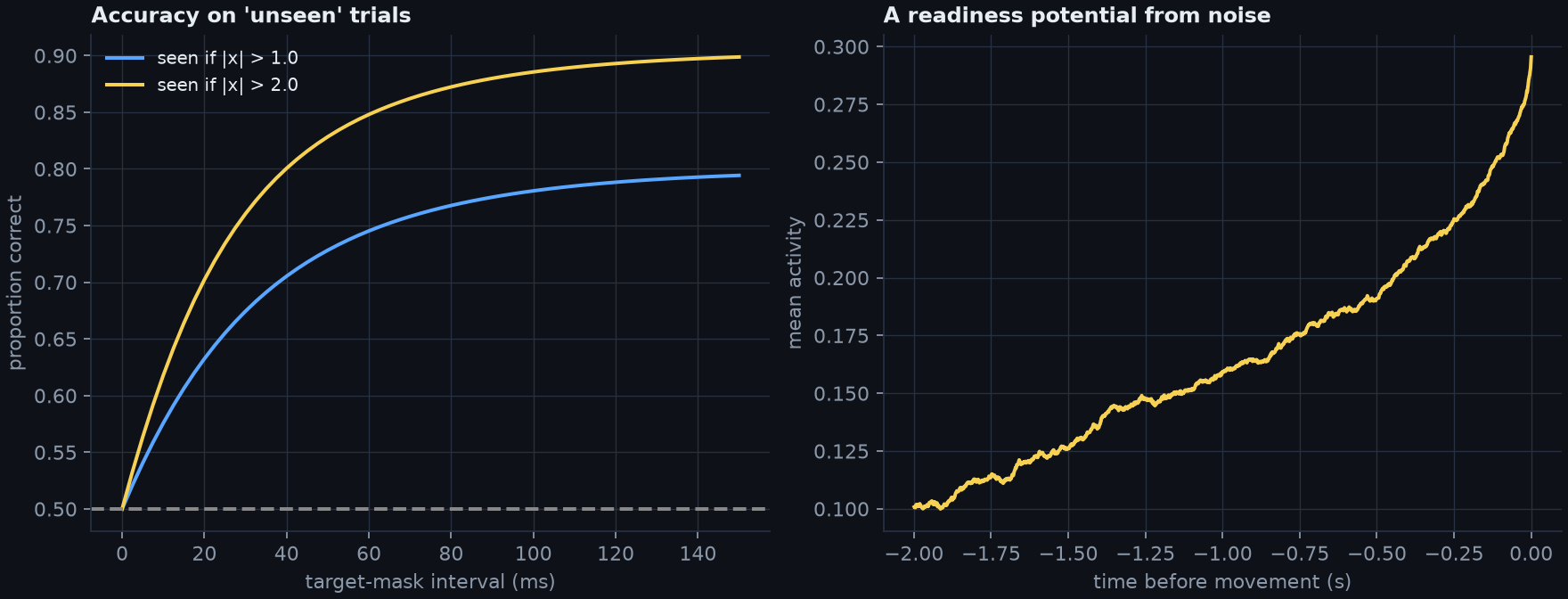
Here is the logic of most masking experiments, run on Psyche. A masked arrow points left or right, and leaves one noisy signal; the longer the interval before the mask, the stronger it is. Asked to guess the direction, Psyche reads the signal's sign. Asked whether it saw anything, it says yes only when the signal's size passes a criterion. In white, accuracy rises with the interval; in blue, reports of seeing rise more slowly. At milliseconds, the arrow is reported seen on only percent of trials, but on the trials called unseen, guesses are percent correct. That looks like perception without awareness. But there is only one representation here, and no unconscious system at all: just a strict standard for saying yes.
So the size of the effect depends on how people decide to say they saw something. Here's the same signal with three standards for saying seen. At milliseconds, accuracy on the unseen trials ranges from to percent, depending only on the criterion. A cautious person, who calls anything faint unseen, will produce plenty of unconscious perception. It's Part 12's lesson again: a report mixes sensitivity with a criterion. Above-chance guessing on unseen trials can be a strict criterion, not a second system. This is the criterion problem, and every claim of perception without awareness has to answer it.
There are three ways to measure awareness, and they disagree. Objective measures ask whether you can discriminate the stimulus. If sensitivity is at chance, there's no information there at all, conscious or not, so nothing unconscious is left to explain. Subjective measures ask what you saw, ideally on a graded scale. And metacognitive measures ask whether your confidence tracks your accuracy, with Part 12's meta d prime. Charles Eriksen made the sceptic's case in 1960: if people can discriminate a stimulus, it hasn't been shown to be unperceived. Graded scales help. With Morten Overgaard's Perceptual Awareness Scale, people report brief glimpses that a yes-or-no question would have counted as unseen. And when Antoine Del Cul, Sylvain Baillet and Dehaene varied the masking interval finely in 2007, visibility rose steeply around fifty milliseconds, like a threshold, which brings us to blindsight.
What it does: One signal read twice; unseen accuracy under three criteria; objective, subjective and metacognitive measures
3BlindsightPsych 101 and the major3 min
Here's what the tests with D.B. looked like. He fixates the centre. A light appears somewhere in his blind half, and he is asked to point to where it was. He protests that he saw nothing, then points, and is accurate. Asked whether a line there is vertical or horizontal, or whether a shape is an X or an O, he guesses far above chance. Some later patients, like G.Y., report a feeling that something has moved, but no visual experience of it. And when D.B. was shown his scores, he asked whether he'd really got them right.
How can information get through? The main route from the eye runs through the lateral geniculate nucleus to V1, the primary visual cortex, and that's what was damaged. But there are older routes: from the eye to the superior colliculus in the midbrain, then through the pulvinar to visual areas like MT, which handles motion. And some cells of the geniculate project straight to MT. In 2010 Michael Schmid and colleagues showed, in monkeys with V1 lesions, that silencing the geniculate abolishes blindsight. Alan Cowey and Petra Stoerig had shown in 1995 that such monkeys also have blindsight: they locate targets they will otherwise classify as blank.
Is blindsight really unconscious? There have been three kinds of doubt. In 1983 John Campion, Richard Latto and Yvonne Smith asked whether light scattered into the seeing half of the field could explain it. Controls using the eye's natural blind spot, and the monkey studies, suggest scatter can't explain all of it. In 2008 Morten Overgaard and colleagues gave a blindsight patient the graded awareness scale, and the patient reported faint glimpses on trials that a yes or no would have counted as unseen: degraded vision, perhaps, rather than none. On the other side, in 2007 Navindra Persaud, Peter McLeod and Cowey had G.Y. bet on his answers. In his blind field he wouldn't bet on his correct answers; his wagers didn't track his accuracy, which is what you'd expect with no awareness at all. So the effect replicates, in patients and in monkeys. Whether it's a weak form of conscious vision is still argued, and the criterion problem of the last chapter is the reason it's so hard to settle.
What it does: The tests; the routes around V1; scattered light, graded awareness and wagers
4The easy problems and the hard onePsych 101 and the major2 min
Before the theories, two minutes on what they're trying to explain. David Chalmers, in 1995, separated the easy problems of consciousness, how the brain discriminates, integrates information, reports and controls behaviour, which are hard enough but are explained by mechanisms, like everything else in this series, from the hard problem: why any of that is accompanied by experience at all. Why there is something it is like to see red, as Thomas Nagel put it in asking what it is like to be a bat. In the same year Ned Block distinguished access consciousness, information available for report and reasoning, from phenomenal consciousness, the experience itself. Experiments can only ever measure the first directly. Science works on the correlates and on access. Whether that will ever reach the hard problem is a question for philosophy, and it's Part 31 of Philosophy, Built.
The state of the field can be summed up by a bet. In 1998 the neuroscientist Christof Koch bet the philosopher David Chalmers that within twenty-five years the neural correlates of consciousness would be clearly described. Chalmers bet they wouldn't. The stake was a case of fine wine. In June 2023, at the annual meeting of the field, Koch conceded and paid up. The adversarial test of chapter nine had just reported its first results, and neither leading theory had won.
What it does: Chalmers, Nagel and Block; the Koch–Chalmers wager
5Correlates: rivalry, report and no-reportPsych 101 and the major4 min
This one is on you, if your eyes cooperate. Here are two gratings, one tilted each way. Cross your eyes slowly, as if looking at a point in front of the screen, until the two squares become three, and watch the middle one. If you have red and cyan glasses, you can look through them instead. In the middle, each eye sees a different grating. You don't see a mesh. You see one tilt for a few seconds, then the other, then a patchwork in transition, then the first again, though nothing on the screen changes. That alternation is binocular rivalry.
A simple circuit produces rivalry. Give each eye's image a population of neurons that inhibits the other's. Whichever is ahead suppresses its rival, but it slowly tires, and slow noise does the rest, so control passes back and forth. Over ten simulated minutes, Psyche's percept switched times. Periods of dominance averaged seconds and were skewed, close to a gamma distribution with shape , which is what people's durations look like. Raise the contrast in one eye, and the durations change: that eye's periods lengthen from to seconds, the other's shorten from to . Willem Levelt mapped such laws in 1965, and later work refined them. The point for us is that the stimulus is fixed while the experience alternates, so we can ask which neurons alternate with it.
Monkeys can be trained to report rivalry with a lever. When David Leopold and Nikos Logothetis, and then David Sheinberg and Logothetis, recorded from them in the 1990s, few cells in early visual cortex changed their firing with the reported percept, more did in V4, and most did in inferotemporal cortex, near the end of the visual stream. In people, Frank Tong and colleagues showed a face to one eye and a house to the other, and found the brain's face area and place area rising and falling with whichever was seen. Activity follows experience more and more closely the further along the visual stream you go.
But there's a confound in every one of these studies. People, and monkeys, report what they see, and reporting is itself something the brain does. When people press a key at every switch of rivalry, frontal and parietal areas light up with the switches. In 2014 Stefan Frässle and colleagues used rivalry between gratings moving in opposite directions, so that the eyes' reflexive following movements revealed each switch without anyone pressing anything. Much of the frontal activity disappeared. Naotsugu Tsuchiya and colleagues called this the no-report paradigm: separating the experience from what's done to report it. And it sharpens the central dispute of the field: is the front of the brain needed for experience, or only for reporting it? The two leading theories answer differently.
What it does: Rivalry on you; the rivalry oscillator; neurons that follow the percept; no-report designs
6The global workspacePsych 101 and the major3 min
The first of the leading theories is the global workspace. Bernard Baars proposed it in 1988: the brain has many specialist processors working in parallel and unconsciously, and a limited stage. Whatever wins the stage is broadcast to all the specialists at once, and that broadcast is what it is to be conscious of something. Stanislas Dehaene and Jean-Pierre Changeux made it neural: the stage is a network of neurons with long-range connections, dense in prefrontal and parietal cortex, that can lock into a self-sustaining state. Its central prediction is that access is all or none. A stimulus either ignites the network, or fades away.
Psyche can show what all or none means. A sensory population follows its input linearly, and feeds a workspace population with strong self-excitation. A brief stimulus, fifty milliseconds long, arrives at many strengths, four hundred trials each. Sixty milliseconds in, the sensory activity grows smoothly with the strength of the stimulus. Six hundred milliseconds in, long after the stimulus is gone, the workspace is either silent or fully active, and the switch happens near strength . That's a bifurcation. Below the threshold every input fades; above it, the network sustains itself. Graded early, all or none late: the workspace's signature.
Look closely at the threshold. At strength , percent of trials ignite. The same stimulus produces two outcomes, and the late activity is bimodal: off or on, almost never in between. Averaged over trials, the mean activity looks graded, rising smoothly with strength. Only trial by trial is it all or none, which is why averaging can hide the very thing a theory predicts. In people, Claire Sergent, Sylvain Baillet and Dehaene showed in 2005 that during the attentional blink, the same word, seen on some trials and missed on others, produced a late brain response that was either there or not.
From such experiments, Dehaene and Changeux listed four signatures of conscious access in 2011. A late, large wave over the scalp, called the P3b, from about three hundred milliseconds. A sudden rise in prefrontal and parietal activity: ignition. Synchrony between distant areas. And information about the stimulus that can be decoded across much of the cortex. Each has been challenged. The P3b in particular tracks the task and the report as much as the experience, and shrinks or vanishes in some no-report designs, which is exactly where the rival theory pushes.
What it does: The broadcast; ignition computed; bimodal late activity; four signatures
7Integrated informationResearch4 min
The second leading theory starts from the other end. Giulio Tononi's integrated information theory begins with what any experience is like: it exists for itself, it is structured, it is specific, it is unified, and it is definite. Then it asks what a physical system must be like to have those properties. The answer is that it must have cause-and-effect power over itself, as a whole, that can't be reduced to the power of its parts. A quantity called phi measures how much. On this view consciousness is a property of a system's causal structure, not of what it computes or reports. A system could be conscious while doing nothing at all, and a system that behaves just like us might not be.
Here is phi, in the simplest of its versions, from Tononi's 2004 paper, computed by Psyche. Take a part A of a system and set it to random states, every state equally likely. Measure how much the next state of the rest, B, reveals about what A was. That's the effective information from A to B. Now try every way of cutting the system in two, thirty-one ways for six nodes, and find the cut across which the least information flows, relative to the size of the smaller part. Phi is the information that crosses that weakest cut, in both directions. For a ring of six nodes, each copying its neighbour, the weakest cut crosses two links, one bit flows each way, and phi is two bits. However you cut it, the ring is more than its halves.
Here's the same measure for six small networks. Loops that aren't connected to each other have zero phi, however much each loop does: there's no single system there, just two. Rings have two bits; five nodes that each compute the OR of the others have less. But notice two oddities. This early measure gives a feed-forward chain some phi, and a ring of XOR gates none at all. The theory's later versions, from 2014 and 2023, measure differently, and in them a purely feed-forward system has zero phi by construction. The numbers depend on which version you compute. And for a real brain the number of cuts to try is astronomical, so phi can't be computed at all, only approximated.
Integrated information makes bold predictions. The seat of experience should be a posterior hot zone of cortex, rich in recurrent connections; the prefrontal cortex isn't needed. A well-connected cortex could be conscious while almost silent, and a perfect simulation of a brain on an ordinary computer would not be conscious, because its causal structure is the computer's, not the brain's. Critics find some consequences absurd. The computer scientist Scott Aaronson showed in 2014 that a large grid of simple logic gates, doing nothing interesting, would have enormous phi, and so on the theory a rich inner life. In 2023 an open letter signed by a hundred and twenty-four researchers called the theory pseudoscience. Many others replied that the label was unwarranted. What everyone agrees on is that it makes risky predictions, and that some of them have now been tested against the workspace's.
What it does: The axioms; Φ derived and computed; six networks; predictions and the open letter
8Recurrence and higher orderResearch2 min
Two more theories, each with one diagram and one prediction. Victor Lamme's recurrent processing theory starts from timing. A first sweep of activity passes through the visual areas in about a hundred milliseconds, extracting features, and on its own it is unconscious. Experience arises when later areas feed back to earlier ones, and the areas reverberate. So interrupt the feedback, as a mask arriving at the right moment does, and awareness should vanish while the first sweep survives, which is roughly what masking studies find. For Lamme, local recurrence within the visual areas is enough for seeing; the wide, workspace-like recurrence is needed only for reporting, which puts him on the side of the back of the brain.
The other family is the higher-order theories. On David Rosenthal's account, developed with Hakwan Lau, a mental state is conscious when the mind represents itself as being in it. Seeing red is unconscious until there is also a state to the effect that I am seeing red. The higher-order state is thought to live in prefrontal cortex, and it's close kin to the metacognition of Part 12. In 2006 Lau and Richard Passingham found two masking conditions in which people were equally accurate but reported different visibility, and the difference showed up in dorsolateral prefrontal cortex. The prediction that sets these theories apart: awareness can change while performance stays the same, and when it does, look to the front of the brain.
Put the four side by side, as Anil Seth and Tim Bayne did in a 2022 review, and one question divides them. The workspace needs the prefrontal and parietal network; higher-order theories need prefrontal re-representation. Integrated information and recurrent processing put experience in the back of the brain. No-report designs, lesions and stimulation are the tests: does experience survive when the front of the brain is silent, or damaged? That's the question an adversarial collaboration set out to settle.
What it does: Lamme's recurrence; higher-order theories; front or back
9An adversarial collaborationResearch2 min
In 2019 the Templeton World Charity Foundation funded something unusual. The authors of the workspace and integrated information theories agreed, in advance and in writing, on a set of experiments and on which results would count against each theory. Lucia Melloni and colleagues published the plan in 2021. People watched faces, objects, letters and meaningless symbols, shown for half a second up to a second and a half, some relevant to their task and some not. Several laboratories recorded them with fMRI, with MEG, and with electrodes implanted in patients being treated for epilepsy. The workspace predicted ignition in prefrontal cortex when a stimulus appeared and again when it disappeared, with its content readable there. Integrated information predicted activity in the back of the brain sustained for as long as the stimulus was seen, and sustained synchrony within it.
The first results were announced in 2023, and the full paper appeared in Nature in 2025. For the workspace, there was no burst of ignition in prefrontal cortex when the stimulus went off, and while some of its content, like its category, could be read out there, some, like its orientation, could not. For integrated information, content was sustained in the back of the brain, as predicted, but the sustained synchrony within it was not found. So neither theory won, and each lost something it had staked in advance. The lasting result may be the method itself: theories made to risk being wrong, on terms they set themselves. More such collaborations are under way.
What it does: The agreed design; what each theory got wrong
10Volition: Libet's clockResearch3 min
Consciousness also seems to be where we decide. One experiment made that doubtful. In 1965 Hans Kornhuber and Lüder Deecke found a slow negative ramp in the EEG over motor areas, starting a second or more before a voluntary movement. They called it the readiness potential. In 1983 Benjamin Libet and colleagues asked people to flex their wrist whenever they felt like it, while watching a spot circle a clock face every two and a half seconds, and to report where the spot was when they first felt the urge to move. The felt urge came about two hundred milliseconds before the movement. The ramp began about five hundred and fifty milliseconds before, or earlier. The brain, it seemed, had started before the person decided.
In 2012 Aaron Schurger, Jacobo Sitt and Stanislas Dehaene offered another reading. When there's no reason to move at one moment rather than another, they proposed, the timing is decided by spontaneous fluctuations in neural activity, accumulated slowly, like the evidence of Part 25 but without any evidence. Here is Psyche's version: a leaky accumulator of noise, with a small drift. Whenever it crosses the threshold, a movement starts and the accumulator resets. The waits between movements are irregular, with a median of about seconds, much like people told to move whenever they like.
Now do what an EEG lab does. Line up all movements and average the activity in the seconds before each. The grey lines are single epochs, all noise. Their average is a slow ramp, beginning about seconds before the movement: a readiness potential. But nothing was decided early. Any crossing is preceded, on average, by a climb, so lining up the moments of crossing creates the ramp. The idea makes a prediction: interrupt people at random while they wait, and those whose activity happens to be high should respond fastest. Schurger and colleagues found that in 2012. The readiness potential may reflect when a movement is about to happen, not a decision taken behind the person's back.
Where does the debate stand? The timing replicates: the ramp does begin before the reported urge. But Judy Trevena and Jeff Miller found in 2010 that a similar ramp appears when people wait for a cue and then decide not to move, so it isn't a commitment to act. In 2008 Chun Siong Soon, John-Dylan Haynes and colleagues decoded which hand people would choose from brain activity seconds before they knew, but only about sixty percent of the time, barely better than a coin. What any of this means for free will is a question for Part 32 of Philosophy, Built. What the experiments do show is that the felt moment of deciding is a report, with a time that can be measured and misjudged like any other.
What it does: Libet's experiment; Schurger's accumulator; the ramp from averaging; where the debate stands
11Losing consciousnessPsych 101 and the major3 min
Consciousness can also be lost. It helps to separate two dimensions: how awake the brain is, and whether there is any experience. Awake, both are high; in deep sleep and anaesthesia, both fall. But they come apart. In dreaming sleep, from Part 10, there is experience with little wakefulness. In the vegetative state, now often called unresponsive wakefulness, patients open their eyes and cycle between sleep and waking, yet show no sign of awareness. No sign is not the same as no awareness. The signs are behavioural, and some patients can't move.
In 2006 Adrian Owen and colleagues found a way past the body. In the scanner, they asked a young woman diagnosed as vegetative after a road accident to imagine playing tennis, and then to imagine walking through her house. Her brain activated the same areas as healthy volunteers': the supplementary motor area for tennis, a place area for the house. In 2010 Martin Monti, Owen and colleagues tested fifty-four patients. Five could do it, and one answered yes-or-no questions by choosing which to imagine. In 2024 Yelena Bodien and colleagues tested three hundred and fifty-three patients with brain injury in several countries. About a quarter of those who couldn't follow commands at the bedside did so, by this kind of test, in the scanner or the EEG. It's called cognitive-motor dissociation: awareness hidden behind an inability to move.
Can awareness be measured without any task at all? Marcello Massimini, Adenauer Casali and colleagues zap the cortex with a magnetic pulse and record the echo in the EEG, marking, channel by channel, where the response is significant. Then they zip it: the perturbational complexity index is how hard the response is to compress. It is high when the echo spreads widely and stays varied, both integrated and differentiated. Psyche's illustrative patterns show the idea: an awake-like response that spreads and varies scores high; deep sleep's single stereotyped wave and anaesthesia's local blip score low. In 2016 Silvia Casarotto and colleagues found a threshold, , above which every benchmark case was conscious, and some unresponsive patients scored above it. And the noise cell scores highest of all, which is why only significant responses to the pulse are kept. Complexity alone is not consciousness.
What it does: Wakefulness and awareness; covert awareness; the complexity index
12Attention, metacognition and progressPsych 101 and the major2 min
Two neighbouring ideas are often confused with consciousness. The first is attention. Most of ordinary seeing is attended and conscious. But an invisible stimulus can still draw attention, or be used by it, as masked cues do. You can be conscious of the gist of a scene you barely attended to while busy with something else. And the gorilla was neither. Christof Koch and Naotsugu Tsuchiya argued in 2007 that the two dissociate in both directions, so a theory of attention, like Part 18's, is not yet a theory of consciousness.
The second neighbour is metacognition. It's how well your confidence tracks your accuracy, measured by Part 12's meta d prime, and modelled in Part 25 as the balance of evidence. People differ in it at the same level of accuracy, and in 2010 Stephen Fleming and colleagues linked those differences to the anterior prefrontal cortex. For higher-order theories, metacognition is close to what makes a state conscious; for the workspace and integrated information, it's a separate, later step. Blindsight is the test case: accurate guesses, with wagers that don't follow them.
So what would count as progress? Theories that make risky predictions, agreed in advance, some of which then fail: chapter nine was a start. Measures that don't depend on report, like no-report designs and the complexity index. Interventions, not just correlations: lesions, stimulation, anaesthetics. The same answer from different methods, laboratories and species. And in the end, a principled way to judge the hard cases: infants, unresponsive patients, other animals, and machines, the subject of Part 60.
What it does: Two dissociations; metacognition; what would count as progress
13The LedgerPsych 101 and the major2 min
Four new rows today; the gorilla already has its row, from Part 18. The first: after damage to the primary visual cortex, people can locate and discriminate what they say they don't see. The original: Weiskrantz and colleagues with D.B., 1974. The record: the scattered-light critique of 1983, Cowey and Stoerig's monkeys, G.Y.'s wagers, the graded awareness scale in 2008, and Schmid and colleagues' silenced geniculate in 2010. The effect replicates in patients and monkeys. Whether it's degraded conscious vision is contested. Replicated.
The second: a masked word or number that can't be reported still speeds responses to a related one. The original: Dehaene and colleagues, 1998. The record: a meta-analysis by Eva Van den Bussche and colleagues in 2009, and a 2016 review by Miguel Vadillo, Emmanouil Konstantinidis and David Shanks showing that the tests of awareness were often too weak to prove the primes unseen. The priming is real, and smaller, and less certainly unconscious, than first claimed. Replicated, smaller.
The third: the readiness potential begins several hundred milliseconds before people report the urge to move. The original: Libet and colleagues, 1983. The record: Patrick Haggard and Martin Eimer in 1999, Soon and colleagues' decoding in 2008, Trevena and Miller's ramp before not moving in 2010, and Schurger's accumulator in 2012. The timing replicates. That it reveals an unconscious decision is contested, and the accumulator explains the ramp without one. Replicated.
And the fourth: some patients who show no sign of awareness at the bedside follow commands with their brain activity. The original: Owen and colleagues, 2006. The record: Monti and colleagues' fifty-four patients in 2010, and Bodien and colleagues' three hundred and fifty-three in 2024. Found again in larger, multicentre samples, though how often depends on the method. Replicated.
The tally. The phenomena replicate: blindsight, the readiness potential's timing, and awareness hidden in unresponsive patients. What they mean is another matter: degraded vision or none, a decision or a fluctuation. And unconscious processing is real but smaller than first claimed, because proving that a stimulus was unseen is so hard.
What it does: Blindsight; masked priming; Libet's timing; covert awareness
14In practice: anaesthesia, injury and machinesPractice2 min
General anaesthesia is the one setting where consciousness is switched off on purpose, millions of times a day. Occasionally it isn't fully off. Accidental awareness is rare, but a patient may be paralysed by the muscle relaxant and in pain, unable to signal. A large UK audit in 2014, counting what patients reported, found about one case in twenty thousand anaesthetics, and prospective interviews find more. Monitors that turn the EEG into a single number were meant to prevent it. In one large trial in 2004 they reduced awareness in high-risk patients; in another in 2008 they did no better than simply monitoring the anaesthetic gas. And with the isolated forearm technique, a cuff keeps one arm free of the muscle relaxant, and some patients who seemed unconscious will squeeze a hand when asked, the operating theatre's own version of covert awareness.
After brain injury, the questions of this part decide treatment. In 2009 Caroline Schnakers and colleagues found that about four in ten patients diagnosed as vegetative were in fact minimally conscious when examined with a standardized scale. That scale, the Coma Recovery Scale, repeated over days, is the bedside standard. American guidelines in 2018 and European guidelines in 2020 now recommend brain-based tests like those of chapter eleven for patients who can't follow commands. The stakes are pain relief, rehabilitation, prognosis, and decisions about life support.
The newest practical question is about machines. In 2023 Patrick Butlin, Robert Long and colleagues proposed deriving indicator properties from the scientific theories, such as a global workspace, recurrent processing, metacognition and agency, and checking artificial systems for them. On the workspace and higher-order theories, the right architecture would be enough. On integrated information, no conventional computer is conscious, whatever it computes. So the answer depends on which theory is right, which is why the adversarial tests matter outside the laboratory. Part 60 returns to it.
What it does: Awareness under anaesthesia; diagnosis after injury; indicator properties for machines
15Frontier: the scorecardResearch2 min
Here is a scorecard, a judgement rather than a measurement, built from this part's chapters. All-or-none access, the attentional blink and ignition, favour the workspace. No-report designs, which strip away frontal activity tied to reporting, favour the theories that put experience at the back. The adversarial test cost both of the theories it tested something. Blindsight fits everyone, which is why it can't decide between them, though higher-order theories fit the wagering best. And for patients, the most useful measure so far, the complexity index, was inspired by integrated information but doesn't depend on it being true. Each theory's authors would fill in these cells differently, and that disagreement is the frontier.
What comes next? More adversarial collaborations, pitting other pairs of theories against each other under the same rules, with predictions registered before any data. Causal tests in people: stimulating or silencing prefrontal cortex while experience is measured without report. Consciousness in infants and animals, judged by markers that don't need language. Predictive accounts, in which experience is the brain's best guess about the world and the body, which return in Part 58. And underneath it all, the measurement problem from chapter two: every one of these tests still has to decide what counts as unseen.
What it does: The theories scored; what comes next
Recap, problems, and the road aheadAll tracks3 min
Part twenty-seven in ten lines. A digit shown for a single frame showed the question: the same stimulus, seen or not. The contrastive method holds the stimulus fixed and varies awareness. Above-chance guessing on unseen trials can come from a strict criterion, not a second system. Blindsight is real and replicated, and maybe not entirely blind. Rivalry comes from inhibition and adaptation, and neurons follow the percept more closely further along the visual stream. No-report designs show that some frontal activity belongs to reporting, not to seeing. The workspace predicts graded early activity and all-or-none late activity. Integrated information can be computed for small networks, makes bold predictions, and has fierce critics. The adversarial test cost each theory something it had staked. And Libet's ramp can be accumulated noise, hidden awareness in unresponsive patients is real, and the complexity of the brain's echo can measure it.
Kant's wager. The first objection, that mathematics can't apply to the mind, met signal detection, a bifurcation and integrated information, each computed. The second, that the mind can't be experimented on, met the contrastive method, no-report designs, and two rival theories agreeing in advance on how they could be proved wrong. But here the third objection, that looking inward disturbs what you look at, bites hardest. Every measure of awareness is a report, or stands in for one, and the criterion problem never quite goes away. Amber.
Where this comes back. Act Six begins next, with motivation. Awareness before language is in Part 30, on the infant mind. Experience as the brain's best guess is Part 58. And whether a machine could be conscious is Part 60.
Seven problems, with full solutions in this part's README. Two work through the criterion problem in the masking model. Two compute integrated information for rings and for disconnected loops. One shows why averaging before threshold crossings produces a ramp. One explores the rivalry model. And the last, with the star, asks you to design a no-report experiment that could settle whether the front of the brain is needed to see a face. Pause here if you'd like to try them.
The books and papers behind this part are listed here and in the README. Weiskrantz's Blindsight is still the best account of D.B., Dehaene's Consciousness and the Brain makes the case for the workspace, and Anil Seth and Tim Bayne's review is the fairest short map of all the theories.
That completes Act Five, on thinking. Act Six is feeling and wanting, and it begins with a question so basic it's easy to skip: why do anything at all? In 1954 James Olds and Peter Milner noticed that a rat with a misplaced electrode kept returning to the corner of its box where the current had come on. Given a lever, rats pressed it thousands of times an hour and ignored food. What had they found? It's Part 28: motivation.
Where it goes next. Motivation begins Act VI in Part 28; awareness before language is Part 30; experience as the brain's best guess is Part 58; and machine consciousness is Part 60.
Key results
The part's results in one place, for revision.
Try it
Lab 27 · Consciousness
Show that 'unseen' trials can be above chance with one representation and a strict criterion; build rivalry from two inhibiting populations; find the workspace's ignition threshold; compute phi for small networks; and make a readiness potential out of noise.
python -m videos.psychology.labs 27
needs numpy, scipy, matplotlib · download lab27.py ·
source on GitHubd = 1.7, seen if |x| > 1.0: P(seen), accuracy when unseen 0.47, 0.686
d = 1.7, seen if |x| > 1.5: P(seen), accuracy when unseen 0.27, 0.743
d = 1.7, seen if |x| > 2.0: P(seen), accuracy when unseen 0.13, 0.776
rivalry: dominance periods, mean (s), gamma shape 86, 3.38, 3.7
P(ignite) by strength 0.00, 0.00, 0.00, 0.01, 0.01, 0.06, 0.21, 0.47, 0.61, 0.90, 0.98, 1.00, 1.00, 1.00, 1.00
threshold strength; late activity halfway (0.2-0.6) there 0.85; 0.000
phi: pairs (6 nodes); weakest cut 0.00; ((0, 1), (2, 3, 4, 5))
phi: chain (6 nodes); weakest cut 1.00; ((0, 1, 2), (3, 4, 5))
phi: ring_copy (6 nodes); weakest cut 2.00; ((0, 1, 2), (3, 4, 5))
phi: all_or (5 nodes); weakest cut 0.64; ((0, 1), (2, 3, 4))
movements; median wait (s); averaged activity 2 s and 0 s before 108; 4.3; 0.101, 0.296
A strict criterion alone produces 'unconscious perception'; inhibition and adaptation make rivalry's skewed durations; a recurrent network ignites all or none; phi is zero for parts that do not talk and two bits for a ring; and a ramp appears whenever you average backward from threshold crossings.The code (74 lines; it asserts its own result)
"""Lab 27: the criterion problem in masking, binocular rivalry from inhibition and adaptation, the workspace's
ignition, integrated information for small networks, and the readiness potential from accumulated noise."""

import numpy as np

from videos.coursekit import labs
from explainer.psychology.psyche import workspace as W

TITLE = "Consciousness"
GOAL = ("Show that 'unseen' trials can be above chance with one representation and a strict criterion; build "
        "rivalry from two inhibiting populations; find the workspace's ignition threshold; compute phi for small "
        "networks; and make a readiness potential out of noise.")
TASKS = [
    "Let the criterion for 'seen' fall as the masking interval grows (people become more liberal when stimuli are "
    "clearer). Can accuracy on unseen trials then fall as the interval grows?",
    "Compute phi for one ring of eight copying nodes and for two separate rings of four (W.network('ring_copy', 4) "
    "twice, joined into one list with indices shifted). Which is more integrated, and why?",
    "Lower the workspace's self-excitation w from 6 to 4 in W.ignition. Is late activity still all or none?",
]


def run(seed=0):
    out = labs.Lab()

    # 1. masking
    for c in (1.0, 1.5, 2.0):
        r = W.masking(1.7, c)
        out.row(f"d = 1.7, seen if |x| > {c}: P(seen), accuracy when unseen",
                f"{r['p_seen']:.2f}, {r['acc_unseen']:.3f}")
    assert W.masking(1.7, 2.0)["acc_unseen"] > W.masking(1.7, 1.0)["acc_unseen"] > 0.5

    # 2. rivalry
    r = W.rivalry(T=300.0, seed=seed)
    d = W.dominance_durations(r["u"], r["dt"])
    out.row("rivalry: dominance periods, mean (s), gamma shape", f"{len(d['all'])}, {d['mean1'] / 2 + d['mean2'] / 2:.2f}, "
            f"{d['shape']:.1f}")
    assert 1.5 < d["shape"] < 10

    # 3. ignition
    s = np.round(np.arange(0.5, 1.25, 0.05), 2)
    g = W.ignition(s, n_trials=200, seed=seed)
    k = int(np.argmin(np.abs(g["p_ignite"] - 0.5)))
    out.row("P(ignite) by strength", ", ".join(f"{x:.2f}" for x in g["p_ignite"]))
    out.row("threshold strength; late activity halfway (0.2-0.6) there",
            f"{s[k]:.2f}; {np.mean((g['late'][k] > 0.2) & (g['late'][k] < 0.6)):.3f}")

    # 4. phi
    for kind, n in (("pairs", 6), ("chain", 6), ("ring_copy", 6), ("all_or", 5)):
        p = W.phi(W.network(kind, n))
        out.row(f"phi: {kind} ({n} nodes); weakest cut", f"{p['phi']:.2f}; {p['mib']}")
    assert W.phi(W.network("ring_copy", 6))["phi"] == 2.0

    # 5. the readiness potential
    sc = W.schurger(T=600.0, seed=seed)
    b = W.back_average(sc["x"], sc["hits"], sc["dt"], 2.0)
    out.row("movements; median wait (s); averaged activity 2 s and 0 s before",
            f"{len(sc['hits'])}; {np.median(sc['waits']):.1f}; {b['mean'][0]:.3f}, {b['mean'][-1]:.3f}")

    out.note = ("A strict criterion alone produces 'unconscious perception'; inhibition and adaptation make rivalry's "
                "skewed durations; a recurrent network ignites all or none; phi is zero for parts that do not talk "
                "and two bits for a ring; and a ramp appears whenever you average backward from threshold crossings.")

    fig, ax = labs.figure(2, size=(11, 4.2))
    soas = np.linspace(0, 150, 61)
    for c, col in ((1.0, labs.BLUE), (2.0, labs.GOLD)):
        v = W.visibility_curve(soas, c_seen=c)
        ax[0].plot(soas, v["acc_unseen"], color=col, label=f"seen if |x| > {c}")
    ax[0].axhline(0.5, ls="--", color="#888888")
    ax[0].set(title="Accuracy on 'unseen' trials", xlabel="target-mask interval (ms)", ylabel="proportion correct")
    ax[0].legend()
    ax[1].plot(b["t"], b["mean"], color=labs.GOLD)
    ax[1].set(title="A readiness potential from noise", xlabel="time before movement (s)", ylabel="mean activity")
    out.fig = fig
    return out
Now change it
- Let the criterion for 'seen' fall as the masking interval grows (people become more liberal when stimuli are clearer). Can accuracy on unseen trials then fall as the interval grows?
- Compute phi for one ring of eight copying nodes and for two separate rings of four (W.network('ring_copy', 4) twice, joined into one list with indices shifted). Which is more integrated, and why?
- Lower the workspace's self-excitation w from 6 to 4 in W.ignition. Is late activity still all or none?
Problems, with solutions
Try each problem before opening its solution.
-
Unseen accuracy. With evidence \(x \sim N(\pm d/2, 1)\) and "seen" when \(|x| > c\), derive accuracy on unseen trials, and show that it exceeds one half whenever \(d > 0\).
Solution
With μ = d/2, unseen trials are those with |x| < c. Accuracy among them is [Φ(c − μ) − Φ(−μ)] / [Φ(c − μ) − Φ(−c − μ)]. The numerator is the mass of N(μ, 1) on (0, c), the rest of the denominator its mass on (−c, 0); for μ > 0 the density is larger at every point of (0, c) than at its mirror image in (−c, 0), so the ratio exceeds one half.
-
Strict criteria. Show that the same model's unseen accuracy rises toward the overall accuracy as \(c\) grows. What does that imply for claims of unconscious perception?
Solution
As c grows, nearly every trial is called unseen, so accuracy on unseen trials tends to the overall accuracy Φ(μ). A strict criterion therefore turns all of performance into "unconscious perception"; showing a second system needs more than above-chance guessing, for instance zero objective sensitivity on the same trials, or metacognition that fails while discrimination succeeds.
-
The copy ring. For a ring of \(n\) nodes that each copy their neighbour, show that every bipartition into two arcs has effective information 1 bit each way, so \(\Phi = 2\).
Solution
Cut the ring into two arcs. Only two links cross the cut, one each way; across each, the node on the far side copies the near node's (uniformly random) state, carrying exactly 1 bit, and every other node of the receiving arc depends only on its own arc. So EI(A→B) = EI(B→A) = 1 and Φ = 2. A cut that interleaves the nodes crosses more links and carries more, so the minimum is at two arcs.
-
Two loops. Why does a network of two unconnected loops have \(\Phi = 0\), however much information each loop carries?
Solution
Separate the loops. Each loop's next state depends only on itself, so neither part's state tells anything about the other's next state: EI = 0 both ways, this cut is the minimum, and Φ = 0, however much each loop carries. Integration, not information, is what Φ measures.
-
The ramp. In Schurger's accumulator, show that the expected activity just before a crossing is higher than its long-run mean, whatever the drift.
Solution
Activity is reset at each crossing, so it is always below the threshold and its long-run average is lower still; just before a crossing it is, by definition, at the threshold. Averaging backward from crossings must therefore climb toward the threshold, whatever the drift.
-
Rivalry's shape. With
workspace.rivalry: raise the noise and lower the adaptation. What happens to the shape of the dominance distribution?Solution
With noise 0.15 and adaptation 0.15 the simulated durations become more irregular (gamma shape near 2), because switches are driven more by noise than by fatigue; with little noise and strong adaptation they become regular (shape well above 10).
-
★ A no-report test. Design a no-report experiment that could tell whether prefrontal cortex is needed for seeing a face, and say what each theory predicts.
Solution
Present faces and houses in rivalry, read the percept from eye movements or pupil size rather than a key press, and silence or stimulate dorsolateral prefrontal cortex (or test patients with prefrontal lesions). The workspace and higher-order theories predict that experience, read from the reflexes and from later memory, is disrupted; integrated information and recurrent processing predict it is not, if posterior cortex is intact.
Notes and sources
Sources
- L. Weiskrantz, E. K. Warrington, M. D. Sanders and J. Marshall, Visual capacity in the hemianopic field following a restricted occipital ablation, Brain 97 (1974) 709-728; L. Weiskrantz, Blindsight: A Case Study and Implications (1986).
- J. Campion, R. Latto and Y. M. Smith, Behavioral and Brain Sciences 6 (1983) 423-448; A. Cowey and P. Stoerig, Blindsight in monkeys, Nature 373 (1995) 247-249; N. Persaud, P. McLeod and A. Cowey, Nature Neuroscience 10 (2007) 257-261; M. Overgaard et al., PLoS ONE 3 (2008) e3028; M. C. Schmid et al., Nature 466 (2010) 373-377.
- B. J. Baars, A Cognitive Theory of Consciousness (1988); F. Crick and C. Koch, Towards a neurobiological theory of consciousness, Seminars in the Neurosciences 2 (1990) 263-275.
- D. J. Simons and C. F. Chabris, Perception 28 (1999) 1059-1074; S. Dehaene et al., Imaging unconscious semantic priming, Nature 395 (1998) 597-600; E. Van den Bussche et al., Psychological Bulletin 135 (2009) 452-477; M. A. Vadillo et al., Psychonomic Bulletin & Review 23 (2016) 87-102.
- C. W. Eriksen, Discrimination and learning without awareness, Psychological Review 67 (1960) 279-300; T. Z. Ramsøy and M. Overgaard, Introspection and subliminal perception, Phenomenology and the Cognitive Sciences 3 (2004) 1-23; A. Del Cul, S. Baillet and S. Dehaene, Brain dynamics underlying the nonlinear threshold for access to consciousness, PLoS Biology 5 (2007) e260.
- T. Nagel, What is it like to be a bat?, Philosophical Review 83 (1974) 435-450; D. J. Chalmers, Facing up to the problem of consciousness, Journal of Consciousness Studies 2 (1995) 200-219; N. Block, On a confusion about a function of consciousness, Behavioral and Brain Sciences 18 (1995) 227-247.
- W. J. M. Levelt, On Binocular Rivalry (1965); D. A. Leopold and N. K. Logothetis, Nature 379 (1996) 549-553; D. L. Sheinberg and N. K. Logothetis, PNAS 94 (1997) 3408-3413; F. Tong et al., Neuron 21 (1998) 753-759; S. Frässle et al., Journal of Neuroscience 34 (2014) 1738-1747; N. Tsuchiya et al., Trends in Cognitive Sciences 19 (2015) 757-770.
- S. Dehaene, M. Kerszberg and J.-P. Changeux, PNAS 95 (1998) 14529-14534; C. Sergent, S. Baillet and S. Dehaene, Nature Neuroscience 8 (2005) 1391-1400; S. Dehaene and J.-P. Changeux, Neuron 70 (2011) 200-227.
- G. Tononi, An information integration theory of consciousness, BMC Neuroscience 5 (2004) 42; M. Oizumi, L. Albantakis and G. Tononi, PLoS Computational Biology 10 (2014) e1003588; G. Tononi, M. Boly, M. Massimini and C. Koch, Nature Reviews Neuroscience 17 (2016) 450-461; S. Fleming et al., The integrated information theory of consciousness as pseudoscience, PsyArXiv (2023).
- V. A. F. Lamme, Towards a true neural stance on consciousness, Trends in Cognitive Sciences 10 (2006) 494-501; H. Lau and R. E. Passingham, PNAS 103 (2006) 18763-18768; H. Lau and D. Rosenthal, Trends in Cognitive Sciences 15 (2011) 365-373; A. K. Seth and T. Bayne, Theories of consciousness, Nature Reviews Neuroscience 23 (2022) 439-452.
- L. Melloni et al., Making the hard problem of consciousness easier, Science 372 (2021) 911-912; Cogitate Consortium, Adversarial testing of global neuronal workspace and integrated information theories of consciousness, Nature (2025).
- H. H. Kornhuber and L. Deecke (1965); B. Libet, C. A. Gleason, E. W. Wright and D. K. Pearl, Brain 106 (1983) 623-642; C. S. Soon et al., Nature Neuroscience 11 (2008) 543-545; J. Trevena and J. Miller, Consciousness and Cognition 19 (2010) 447-456; A. Schurger, J. D. Sitt and S. Dehaene, PNAS 109 (2012) E2904-E2913.
- S. Laureys, Trends in Cognitive Sciences 9 (2005) 556-559; A. M. Owen et al., Science 313 (2006) 1402; M. M. Monti et al., New England Journal of Medicine 362 (2010) 579-589; Y. G. Bodien et al., New England Journal of Medicine 391 (2024); A. G. Casali et al., Science Translational Medicine 5 (2013) 198ra105; S. Casarotto et al., Annals of Neurology 80 (2016) 718-729.
- C. Koch and N. Tsuchiya, Trends in Cognitive Sciences 11 (2007) 16-22; S. M. Fleming et al., Science 329 (2010) 1541-1543.
- P. S. Myles et al., Lancet 363 (2004) 1757-1763; M. S. Avidan et al., New England Journal of Medicine 358 (2008) 1097-1108; J. J. Pandit et al., the 5th National Audit Project (2014); C. Schnakers et al., BMC Neurology 9 (2009) 35; J. T. Giacino et al., Neurology 91 (2018) 450-460; D. Kondziella et al., European Journal of Neurology 27 (2020) 741-756; P. Butlin, R. Long et al., Consciousness in artificial intelligence (2023).
About this partfrom its README
A man with a damaged visual cortex insists he sees nothing in half his visual field, and when forced to guess, points to objects there almost perfectly. Blindsight makes the question experimental: hold the stimulus constant, vary awareness, and look for what changes. This part follows that method from masking and rivalry to the rival theories, computes what they claim, and ends with the first test their authors agreed on in advance, Libet's clock read as accumulated noise, and consciousness lost and found in unresponsive patients.
A digit flashed for one frame and then for ten, on you; D.B. and the history of blindsight; the contrastive method, inattentional blindness and masked priming; the criterion problem computed with a signal-detection model of masking, and three ways to measure awareness; blindsight's tests, routes and doubts; the easy and hard problems and the Koch–Chalmers wager; binocular rivalry on you, Psyche's rivalry oscillator, rivalry neurons and no-report designs; the global workspace with ignition computed (graded early, all-or-none late); integrated information in Tononi's 2004 form computed for six small networks, its predictions and critics; recurrent processing and higher-order theories; the Cogitate adversarial collaboration; Libet's experiment and Schurger's accumulator; losing consciousness: the wakefulness–awareness plane, covert awareness and the perturbational complexity index; attention, metacognition and what would count as progress. The practice chapter is anaesthesia, diagnosis after brain injury and machines; the frontier is a scorecard of the theories.
What is computed and built
explainer/psychology/psyche/workspace.py: masking as one signal read twice (forced choice and a criterion for "seen"), with visibility curves; a rivalry oscillator with mutual inhibition, adaptation and slow noise, and dominance durations with a gamma fit; a two-stage ignition network (a linear sensory stage, a bistable workspace); Boolean networks, effective information and Φ over all bipartitions (Tononi 2004); Schurger, Sitt and Dehaene's leaky stochastic accumulator with back-averaging; Lempel–Ziv complexity (LZ76) and the perturbational complexity index, with illustrative response patterns. Tested intests/psychology/test_workspace.py.- The Ledger gains four rows (inattentional blindness keeps its row from Part 18).
- The course's interactive is masking on you: an arrow for a few frames, a mask, a guess and a visibility report, and your accuracy on the trials you called unseen.
Chapter notes
| # | Chapter | What it does |
|---|---|---|
| 0 | Seeing without knowing it | A masked digit on you; D.B.; the questions; objectives |
| 1 | The contrastive method | Masking, rivalry, inattention, neglect; the gorilla; masked priming |
| 2 | Masking and the criterion problem | One signal read twice; unseen accuracy under three criteria; objective, subjective and metacognitive measures |
| 3 | Blindsight | The tests; the routes around V1; scattered light, graded awareness and wagers |
| 4 | The easy problems and the hard one | Chalmers, Nagel and Block; the Koch–Chalmers wager |
| 5 | Correlates: rivalry, report and no-report | Rivalry on you; the rivalry oscillator; neurons that follow the percept; no-report designs |
| 6 | The global workspace | The broadcast; ignition computed; bimodal late activity; four signatures |
| 7 | Integrated information | The axioms; Φ derived and computed; six networks; predictions and the open letter |
| 8 | Recurrence and higher order | Lamme's recurrence; higher-order theories; front or back |
| 9 | An adversarial collaboration | The agreed design; what each theory got wrong |
| 10 | Volition: Libet's clock | Libet's experiment; Schurger's accumulator; the ramp from averaging; where the debate stands |
| 11 | Losing consciousness | Wakefulness and awareness; covert awareness; the complexity index |
| 12 | Attention, metacognition and progress | Two dissociations; metacognition; what would count as progress |
| 13 | The Ledger | Blindsight; masked priming; Libet's timing; covert awareness |
| 14 | In practice: anaesthesia, injury and machines | Awareness under anaesthesia; diagnosis after injury; indicator properties for machines |
| 15 | Frontier: the scorecard | The theories scored; what comes next |
| Recap, problems, and the road ahead | Ten lines; Kant's three objections; payoffs; problems; references; Part 28 |
NotesWhere the numbers come from
| What | Source |
|---|---|
| Masking: evidence x ~ N(±d/2, 1) with d = 3 (1 − e^(−SOA/40 ms)); at 33 ms, d = 1.69, "seen" ( | x |
| Rivalry: 600 s simulated, 174 dominance periods, mean 3.4 s, gamma shape 3.5; raising one eye's input from 0.60 to 0.65 lengthens its periods from 3.4 to 4.5 s and shortens the other eye's from 3.3 to 2.6 s | Psyche (workspace.rivalry, dominance_durations), item rivalry |
| Ignition: 400 trials at each of 31 strengths; sensory activity at 60 ms graded; workspace activity at 600 ms off or on, with ignition near strength 0.85 (42% of trials there) | Psyche (workspace.ignition), item ignition |
| Φ (Tononi 2004): unconnected two-node loops 0; a feed-forward chain of six 1 bit; copy rings of four and six 2 bits; five nodes each the OR of the rest 0.64; a ring of six XOR gates 0; 31 bipartitions for six nodes | Psyche (workspace.ei, phi, network), item phi |
| Schurger's accumulator over 1,200 s: 151 movements with a clean 3-s window, median wait 5.1 s, back-averaged ramp from about 2 s before | Psyche (workspace.schurger, back_average), item libet |
| Illustrative responses: PCI 0.85 (wake-like), 0.11 (sleep-like), 0.08 (local), 1.02 (noise, not a response); the clinical threshold 0.31 | Psyche (workspace.lz76, pci, responses), item pci; Casarotto et al. (2016) |
| D.B.: surgery in 1973, forced-choice localization and discrimination far above chance | Weiskrantz, Warrington, Sanders and Marshall (1974) |
| About half of observers missed the gorilla | Simons and Chabris (1999) (Part 18's row: 46% of 192) |
| Masked primes of 43 ms speed congruent responses and prepare a motor response | Dehaene et al. (1998) |
| The urge reported about 200 ms before movement; the readiness potential from about 550 ms (spontaneous acts) | Libet, Gleason, Wright and Pearl (1983) |
| Choice decoded seconds early at about 60% accuracy | Soon, Brass, Heinze and Haynes (2008) |
| 5 of 54 patients modulated activity; about a quarter of 353 patients without bedside command following did so by fMRI or EEG | Monti et al. (2010); Bodien et al. (2024) |
| About four in ten patients diagnosed vegetative were minimally conscious | Schnakers et al. (2009) |
| An open letter signed by 124 researchers | Fleming et al. (2023) |
Notes
| Finding | Original | Status |
|---|---|---|
| After damage to primary visual cortex, people locate and discriminate stimuli they say they do not see | Weiskrantz, Warrington, Sanders and Marshall 1974 | replicated |
| A masked word or number that cannot be reported speeds responses to a related target | Dehaene et al. 1998 | replicated, smaller |
| The readiness potential begins several hundred milliseconds before the reported urge to move | Libet, Gleason, Wright and Pearl 1983 | replicated |
| Some patients without bedside signs of awareness follow commands with their brain activity | Owen et al. 2006 | replicated |
Shown without a row, with the reason recorded in explainer/psychology/ledger.py: the founding programmes (Baars,
Crick and Koch), the theories and their reviews (the workspace, integrated information, recurrent processing,
higher-order theories, Seth and Bayne), methods (Eriksen, the awareness scale, no-report designs), philosophical
distinctions (Nagel, Chalmers, Block), the Cogitate study (a single preregistered study, too recent for a record),
rivalry's neural correlates, and the practice chapter's clinical studies; machines are due a row in Part 60.
Notes
- The Cogitate results (no prefrontal ignition at offset; orientation not decodable in prefrontal cortex; no sustained posterior synchrony) are summarized from the published paper and should be rechecked against it, with its volume and pages.
- Del Cul et al.'s visibility threshold near 50 ms, the Simons and Chabris rate (Part 18's row: 46%), the NAP5 rate of about one in twenty thousand, Schnakers et al.'s four in ten, and Bodien et al.'s quarter are quoted from the papers as widely reported; recheck before the final cut.
- The rivalry neurons' shares are drawn schematically (few in V1, more in V4, most in inferotemporal cortex), not to the papers' exact percentages.
- Φ here is Tononi's 2004 measure; IIT 3.0 and 4.0 compute it differently, and the film says so.
Companion material in this repository
The syllabus's plan for this partfrom SYLLABUS.md, the plan of record
- Hook: patient D.B. (Weiskrantz 1974). Seeing without knowing it.
- On you: masking. The same word, seen and unseen, by changing forty milliseconds.
- The contrastive method: masking, binocular rivalry, inattention, neglect and extinction. What unconscious processing can do (priming) and the measurement problem (Part 12: is it a criterion effect?).
- The easy problems and the hard one, in two minutes (the philosophy is Philosophy, Built Part 31).
- Correlates: front or back of the brain? Report against experience; no-report paradigms.
- The global workspace (Baars; Dehaene): ignition, the P3b, the all-or-none signature (a network that ignites, computed).
- Integrated information theory: Φ in outline, its predictions and the 2023 open letter calling it pseudoscience.
- Recurrent processing and higher-order theories, each in one diagram with one prediction.
- Adversarial collaboration: preregistered tests of workspace against integrated-information predictions (the Cogitate results (verify)): what each theory got wrong.
- Volition: Libet's clock (1983); the readiness potential as accumulated noise (Schurger et al. 2012; Part 25's model).
- Losing consciousness: sleep (Part 10), anaesthesia, disorders of consciousness; detecting awareness in unresponsive patients (Owen et al. 2006) and the perturbational complexity index.
- Attention is not consciousness; metacognition; what would count as progress.
Psyche: workspace: an ignition network with a bifurcation between subliminal and conscious regimes; a rivalry
oscillator (adaptation plus inhibition) with its dominance-time distribution.
On you: masking; binocular rivalry with red–cyan glasses or free fusion.
Ledger: blindsight (replicated; whether it is degraded conscious vision, contested); unconscious semantic
priming (replicated, smaller); Libet's timing (replicated; interpretation contested); covert awareness in
unresponsive patients (replicated).
In practice: anaesthesia monitoring, diagnosis after brain injury, the question of machine consciousness (Part
60).
Frontier: the whole part is a frontier; the chapter gives the current scorecard of theories and the next
adversarial collaborations.
Reading: Weiskrantz 1986; Dehaene, Consciousness and the Brain; Tononi et al. 2016; Lamme 2006; Seth & Bayne
2022; Libet et al. 1983; Schurger, Sitt & Dehaene 2012; Owen et al. 2006; Cogitate Consortium (verify).
Build the film
python -m videos.psychology.psych27.compute        # the part's numbers, into .cache/psych27
python tools/build.py psych27                  # render and assemble the film
EXPLAINER_TTS=silent python tools/qa_scene.py psych27 Hook   # one chapter, silent, with a contact sheet
Scenes: videos/psychology/psych27. Setup: see the course page. Source of these notes: the README and the scenes' narration.
Build it
python -m videos.psychology.psych27.compute            # every number (about a minute)
python tools/qa_scene.py psych27 Workspace             # one chapter, silent, at 480p, with a contact sheet
EXPLAINER_TTS=silent python tools/build.py psych27 -q l   # the whole part, silent preview
python tools/build.py psych27                          # 1080p30 with narration
python tools/qa_scene.py psych27 Integration --lang zh # the Chinese edition of one chapter
python tools/make.py psych27                           # both editions, with the checks a long build needs
python -m videos.psychology.labs 27                    # the lab: masking, rivalry, ignition and phi
python tools/check_ledger.py psych27                   # every study shown has its Ledger row, or a reason
python -m pytest tests/psychology                      # Psyche's workspace module, the Ledger, the Archive
The Chinese edition is zh_lines.py (the narration, line by line) and the series table
videos/psychology/psychology_text_zh.json (the text on screen); the terms are in
PSYCHOLOGY_ZH_GUIDE.md.