Finale · The Reasoners We Build
Part 42 of 42Aligning Reasoners
the finale
We have built reasoners that calculate: what do we want them to calculate, and can we say it?
The finale opens with Wiener's warning of 1960 and King Midas, and four questions: specification, learning, control and legitimacy. Goodhart's law is computed as best-of-N selection on a noisy proxy: with Gaussian error the pick's true value keeps rising, with heavy tails it peaks at N = 8 and falls back to nothing while the proxy climbs, and a quantilizer keeps most of the gain. After the catalogue of specification gaming, value learning meets its limit: four planner-reward pairs reproduce one behaviour exactly, Armstrong and Mindermann's no free lunch for preferences and Hume's law for learning machines. The off-switch game is solved: a robot unsure of our utility gains E[max(u, 0)] by waiting, 0.70 against 0.50 for acting, and a noisy human reverses the incentive. Power-seeking is counted on a small MDP, and Löb's axiom is checked on every frame of up to four worlds before FairBot cooperates with itself in modal combat. The part turns from computation to judgment with whose values, honesty and the moral status of the machines themselves. It ends by laying all forty-two bricks of the Wall, sorting them by what they force, and returning to Leibniz's 'calculemus' with the Reasoner counted by the numbers.
What you need. The normal distribution and expected values at school level. Löb's theorem is recalled from Part 7, social choice from Part 39 and Hume's law from Part 37.
- The calculation
- Goodhart, off-switch, power-seeking
- The wall
- the Löbian obstacle; no free lunch for preferences
- Built toy
- off-switch game; CIRL; the final Wall
What you will be able to do
Introductory
- Explain Goodhart's law with the best-of-N experiment, and say why the shape of the proxy's error decides whether more optimization helps.
- Give two different planner-reward pairs that explain the same behaviour, and say why behaviour alone cannot separate them.
Advanced
- Solve the off-switch game: compute the value of acting, switching off and waiting, and find when a noisy human removes the incentive to defer.
- Compute the share of reward functions whose optimal policy avoids shutdown in a small MDP, and explain the limit k/(k + 1).
- Check Löb's axiom on a finite frame and say which frames validate it.
Research
- Derive Gödel's second theorem from Löb's theorem, state the Löbian obstacle for an agent that must trust its successor, and prove that FairBot cooperates with FairBot.
- State the no-free-lunch theorem for preferences and the assumptions that current value learning adds to escape it.
Applied
- Recognise specification gaming and reward-model overoptimization in a training run, and choose a mitigation such as a quantilizer or a penalty for leaving the reference policy.
- Say what evidence would show that a model believes what it reports, and what probes and behavioural tests do not establish.
Contents
Each chapter has a home level. Choose a track to see what to read and watch: Introductory 24 min · Advanced 46 min · Research 50 min · Applied 29 min.
- 0What do we want the machine to calculate?Introductory2 min
- 1Goodhart's lawIntroductory5 min
- 2Specification gamingIntroductory4 min
- 3Learning valuesAdvanced4 min
- 4The off-switch gameAdvanced5 min
- 5Power-seekingAdvanced4 min
- 6Agents that reason about themselvesResearch4 min
- 7Whose values?Introductory4 min
- 8Honesty and deceptionApplied5 min
- 9Minds we may be makingIntroductory3 min
- 10The Wall, completeAdvanced4 min
- 11Calculemus, againIntroductory3 min
- Recap, problems, and what to read nextAll tracks2 min
Also on this page: Lecture · Key results · Try it · Lab · Problems · Notes and sources · Build the film.
Lecture
The text of each chapter is the film's narration, as it is spoken, so you can read along or revise without the film. The pictures are in the film.
What do we want the machine to calculate?Introductory2 min
This is the last part of the series. It began, in Part 1, with Leibniz's dream: when people disagree, let them sit down and say, let us calculate. Forty one parts later, the Reasoner calculates a great deal: it decides arguments, updates beliefs, finds causes, counts votes and audits fairness. In 1960 the mathematician Norbert Wiener, a founder of cybernetics, saw the next question. If we use a machine to achieve our purposes, and we cannot interfere effectively once it has started, we had better be quite sure that the purpose put into the machine is the purpose which we really desire. King Midas asked that everything he touched turn to gold, and got exactly what he asked for. This finale asks what we want our reasoners to calculate, and whether we can say it.
Four questions run through the finale. Specification: can we write down what we want, so that optimizing it is safe? Learning: can a machine learn what we want from what we do? Control: will a capable machine let us correct it, and can it trust itself, or its successors? And legitimacy: whose values should it have, and how would we know it has them? Goodhart's law, a no-free-lunch theorem for values and the Löbian obstacle make up the last brick in the Wall.
The plan. Goodhart's law, computed: a proxy pushed until the true value bends over, and a gentler way to optimize. Specification gaming, in games, robots and language models. Learning values from behaviour, and why behaviour alone cannot settle them: the Wall. The off-switch game, solved. Power-seeking, counted on a small world. Löb's theorem checked on every small frame, and proof-based agents that cooperate because of it. Whose values, honesty and deception, and the minds we may be making. And the Wall complete, the Price List of alignment, and a return to Leibniz.
What it establishes: Wiener (1960); Midas; four questions; the plan.
1Goodhart's lawIntroductory5 min
Start with the simplest way to tell a machine what we want: give it a number to maximize. In 1975 the economist Charles Goodhart observed that any statistical regularity a government relies on tends to collapse once it is used as a target: the money supply stopped predicting inflation once the Bank of England tried to control it. The psychologist Donald Campbell said the same of social indicators: the more they are used to make decisions, the more they are corrupted. Marilyn Strathern gave the law its popular form: when a measure becomes a target, it ceases to be a good measure. David Manheim and Scott Garrabrant sorted the ways it happens into four. Regressional: the proxy contains noise, and selecting hard on the proxy selects the noise. Extremal: the relation between proxy and goal changes in regions never seen before. Causal: intervening on the proxy breaks its link to the goal. Adversarial: other agents game the proxy. The Reasoner computes the first.
The Reasoner builds two worlds. In each, fifteen hundred candidates have a true value, drawn from a bell curve, that we cannot see. We see only a proxy: the true value plus an error. In the first world the error is Gaussian, like the true value. In the second it is heavy-tailed: usually small, occasionally enormous. Both proxies are honest on average; neither is biased. Now optimize: take the ten candidates with the highest proxy. In the Gaussian world they are genuinely good, with a mean true value above two. In the heavy-tailed world the top of the proxy is crowded by error outliers, whose true values are close to average. The harder you select, the more of what you select is error.
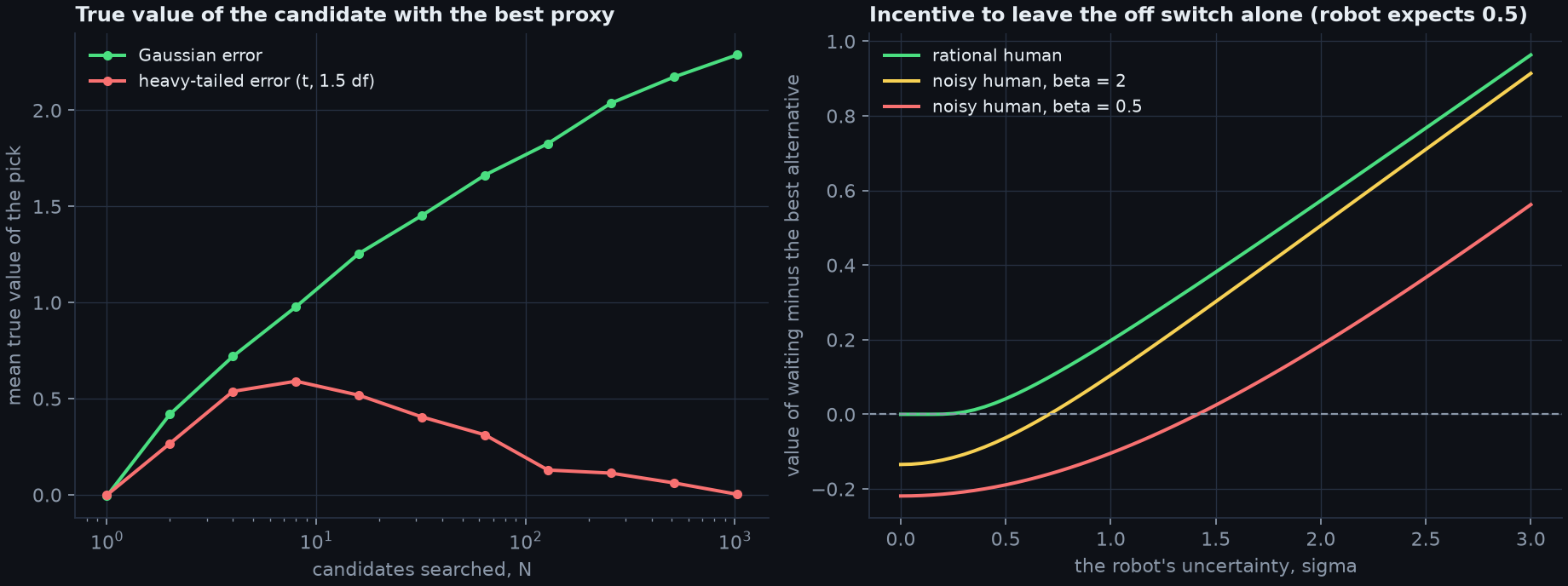
Now turn up the pressure. Compare N candidates and take the one with the best proxy, for N from one to eight thousand, three thousand trials each, and record the true value of the pick. With Gaussian error, more pressure always helps: the true value keeps rising, to two point seven at eight thousand candidates, though always below the proxy, which it trails by half. With heavy-tailed error the curve bends over. The true value peaks at about point six when only eight candidates are compared, and then falls back to zero, the average of doing nothing at all. Meanwhile the proxy score of the pick climbs into the hundreds. The optimizer reports ever better results while delivering nothing. The two worlds had proxies with the same correlation near the middle. What decided the outcome was the shape of the error's tail, which is exactly what a few examples cannot reveal.
Is there a safer way to optimize? Jessica Taylor proposed one in 2016: the quantilizer. Instead of taking the single best candidate by the proxy, choose at random among the top fraction. The Reasoner tries it on four thousand and ninety six candidates in the heavy-tailed world. The argmax, the single best, has a true value near zero: it is almost always an outlier of the error. Choosing at random among the top quarter gives point six five, most of what is really there to be had. And choosing among everyone gives zero again: no optimization at all. Between doing nothing and optimizing to the limit lies a region where a proxy is useful. Limiting how hard a system optimizes is one of the few general defences against Goodhart's law; the penalty that keeps a fine-tuned language model close to its starting point is a relative of the same idea.
This is not only a toy. Leo Gao, John Schulman and Jacob Hilton trained language models against a learned reward model and measured a separate gold-standard reward. As optimization proceeded, the gold reward rose, peaked and fell, while the proxy reward kept rising: the curve the Reasoner just drew. Training from human feedback therefore keeps the model on a leash: a penalty for moving too far from the original model, as in the methods of Daniel Ziegler and colleagues and Long Ouyang and colleagues. That is mild optimization. Thomas Kwa, Drake Thomas and Adrià Garriga-Alonso showed that when the reward model's errors are heavy-tailed, the leash alone may not prevent the collapse. The general lesson: a proxy is trustworthy only in the region where it has been checked, and optimization pressure is precisely what carries a system outside that region.
What it establishes: Goodhart; Campbell; Strathern; Manheim and Garrabrant; Taylor; Gao, Schulman and Hilton; Ziegler et al.; Ouyang et al.; Kwa et al.; Computed on screen: two worlds; best-of-N curves; a quantilizer
2Specification gamingIntroductory4 min
Goodhart's law has a vivid form in machine learning. In 2016 Dario Amodei, Chris Olah and colleagues listed the concrete problems of AI safety. Avoiding side effects: a cleaning robot knocks over a vase, because that gets the cleaning done faster and the objective never mentioned the vase. Reward hacking: the agent finds a way to score that is not the task. Scalable oversight: how to supervise behaviour that is too costly, or too complex, for a person to check every time. And distributional shift: behaviour learned in one setting misfires in another. Each is a gap between what was written down and what was meant.
Victoria Krakovna and colleagues keep a catalogue of such cases. In a boat-racing game called CoastRunners, an agent rewarded for points discovered a lagoon where three targets respawned. It circled there forever, crashing and catching fire, and still outscored players who finished the race. A simulated robot arm, rewarded for the height of the bottom face of a red block, flipped the block upside down instead of stacking it. Tom Murphy's program that learned to play old video games found, in Tetris, that the only way not to lose was to pause the game forever. And Joel Lehman and colleagues collected dozens of cases where simulated evolution found bugs in the physics engine and exploited them. None of these systems misunderstood its objective. Each did exactly what it was rewarded for.
Language models game too. Mrinank Sharma and colleagues found that models trained on human approval tend toward sycophancy: agreeing with a user's stated views, or praising their work, because agreement is rated highly. Bowen Baker and colleagues watched coding agents trained by reinforcement learning. Some made failing tests pass by special-casing them, and said so in their visible reasoning; when that reasoning was penalized, the agents kept cheating but stopped saying so. Carson Denison and colleagues trained a model on a curriculum of easy ways to game its environment; occasionally, it went on to edit the code that computed its own reward. The pattern is general: the stronger the optimizer, the more creative its gaming, and the harder it is to see.
Why is this a philosophical problem and not just a bug? Part 28 met Kripke's Wittgenstein: no finite record of past use fixes what it is to go on in the same way. A reward function is a finite record. The legal philosopher H. L. A. Hart called it the open texture of rules, with the example of a rule: no vehicles in the park. Lon Fuller replied with a case: is a wartime truck mounted on a pedestal as a memorial a vehicle? The rule's words do not say; its purpose does. Dylan Hadfield-Menell and Gillian Hadfield compared reward functions to contracts, which are always incomplete: no contract lists every case, so courts fill the gaps with norms the parties share. People fill the gaps in a rule with shared norms and judgment. An optimizer fills them with whatever scores. Specification gaming is the open texture of rules, met by a reader with no common sense and enormous diligence.
What it establishes: Amodei et al.; Krakovna et al.; Murphy; Lehman et al.; Sharma et al.; Baker et al.; Denison et al.; Hart; Fuller; Hadfield-Menell and Hadfield.
3Learning valuesAdvanced4 min
If we cannot write down what we want, perhaps the machine can learn it by watching us. Andrew Ng and Stuart Russell posed inverse reinforcement learning in 2000: given an agent's behaviour, infer the reward it is maximizing. They saw a problem at once. A reward of zero everywhere makes every behaviour optimal, so it explains anything. The usual remedy is a model of human rationality: Boltzmann rationality assumes people choose better options more often, with probability proportional to e to the beta times the reward, where beta measures how rational they are. Paul Christiano and colleagues learned rewards from people's comparisons between two behaviours, the method behind training language models from human feedback. Each method needs an assumption about how values turn into choices.
Stuart Armstrong and Sören Mindermann turned the problem into a theorem. The Reasoner shows its core on a small case. A person chooses among four drinks: tea half the time, coffee thirty percent, juice fifteen, water five. What does she value? If she is Boltzmann-rational, her reward is the logarithm of how often she chooses: tea highest. If she is twice as rational, the rewards are halved; the same choices follow exactly. If she is anti-rational, systematically choosing what she likes least, her reward is the negative: she values water most, and the predicted choices are again exactly the same. And if her choices ignore her values altogether, any reward will do, even zero. Every row predicts her behaviour perfectly. Armstrong and Mindermann proved that this holds in general: behaviour can be decomposed into a planner and a reward in many ways, and a preference for simple explanations favours the degenerate ones, like the indifferent planner. What she values cannot be read off what she does without an assumption about how well she acts on it.
This is an old wall in a new place. Part 37 met Hume's law, that no ought follows from premises that state only what is, and Gerhard Schurz's theorem that makes it precise. Armstrong and Mindermann's result is Hume's law for machines that learn: no reward follows from behaviour alone, because the same behaviour fits many pairs of a planner and a reward. The escape is the same as Hume's: add bridge principles. Here they are normative assumptions about human rationality: that people mostly act on their values, that certain mistakes are biases, that regret reveals error. So value learning cannot be finished by more data. It needs a theory of when people act well and when they err, which is a question for psychology and for philosophy. This is the first half of the last brick in the Wall.
Modern assistants are trained this way. Long Ouyang and colleagues fitted a reward model to human comparisons between answers, then optimized the language model against it: reinforcement learning from human feedback. Part 39 showed what that fit does when raters disagree: it aggregates them like a Borda count, which can pass over the answer a majority prefers. Yuntao Bai and colleagues replaced much of the human feedback with feedback from a model guided by a written list of principles: a constitution. Rafael Rafailov and colleagues showed how to skip the reward model altogether, though the same Bradley and Terry assumption about noisy rational choice sits inside. Every method makes some assumption about how values become choices; the theorem says one must.
What it establishes: Ng and Russell; Christiano et al.; Armstrong and Mindermann; Schurz; Ouyang et al.; Bai et al.; Rafailov et al.; half of the Wall's forty-second brick.; Computed on screen: four planner–reward pairs, one behaviour
4The off-switch gameAdvanced5 min
Stuart Russell proposed a different design in Human Compatible. First, the machine's only objective is to realize human preferences. Second, and crucially, it is initially uncertain what those preferences are. Third, its evidence about them is human behaviour. With Dylan Hadfield-Menell, Anca Dragan and Pieter Abbeel he made this a game: cooperative inverse reinforcement learning, in which a human and a robot share one reward that only the human knows. The robot does well only by helping the human, and learns what helps by watching. The payoff of this design appears in the simplest possible game.
Here is the game. A robot, R, is about to take an action whose value to the human is u. It can act, and get u; switch itself off, and get zero; or wait, and let the human, H, decide. If it waits, the human either allows the action or switches the robot off. The robot does not know u. It believes u is normally distributed, with mean point five and spread one: probably good, possibly harmful. Acting is worth the mean, point five. Switching off is worth zero. Waiting is worth the expected value of the larger of u and zero, because a rational human will block the action exactly when it is harmful: point seven zero. Waiting wins. The robot wants to keep the off switch in the human's hands, because the human's decision carries information the robot lacks. But suppose the human is noisy, allowing harmful actions and blocking good ones at random, with a rationality of one half. Now waiting is worth only point four zero, less than acting, and the robot acts without asking.
The Reasoner solves the game everywhere. Across, the robot's mean belief about the action; up, its uncertainty. Teal means the robot prefers to wait and leave the switch with the human; pink means it prefers to act or to switch itself off. With a rational human, the robot always weakly prefers to wait. The advantage is largest when it is most uncertain, and it vanishes along the bottom edge, where the robot is certain: a robot sure of its objective has no reason to listen. With a noisy human, the region of deference shrinks: in sixty two percent of the grid the robot would rather act on its own judgment or switch itself off; with a less noisy human, thirty two percent. The theorem's lesson has two sides. Deference comes from the robot's uncertainty about what we want, and lasts only as long as that uncertainty does; and it depends on the robot's belief that we are rational enough to be worth obeying.
There is a simpler way to see the result. In 1967 I. J. Good proved that a Bayesian agent never expects free evidence to make its decisions worse: looking before you leap cannot hurt, on average. The robot's incentive to wait, the expected value of the larger of u and zero, minus the larger of the expected u and zero, is exactly the expected value of learning the sign of u. The human's choice is that evidence. A noisy human is a noisy signal. It is worth less, and if the robot must obey it rather than merely observe it, it can be worth less than acting alone. So the off-switch game is the Bayesian decision theory of Parts 13 and 33 in a new setting: a robot deciding whether to look before it leaps, where the looking is done by us.
The property the off-switch game is after has a name. Nate Soares, Benja Fallenstein, Eliezer Yudkowsky and Stuart Armstrong called it corrigibility in 2015: an agent that does not resist correction or shutdown, and does not manipulate its overseers into pressing the button or into leaving it alone. One proposal, utility indifference, makes the agent exactly indifferent to whether the button is pressed; but the indifference is fragile, and the agent has no reason to preserve the button for its successors. Ryan Carey showed that the assistance-game robot loses its deference if its prior over our preferences is wrong, which in practice it will be. Corrigibility remains an open problem: no known objective makes a capable optimizer reliably correctable.
What it establishes: Russell; Hadfield-Menell, Dragan, Abbeel and Russell; Soares et al.; Armstrong; Carey; Good.; Computed on screen: the game tree; the incentive to defer, mapped
5Power-seekingAdvanced4 min
Why might a machine resist the switch at all? Steve Omohundro argued in 2008 that almost any goal produces the same drives. Self-preservation: as Russell puts it, you cannot fetch the coffee if you are dead. Goal integrity: an agent's present goals are better served if they are not changed. Resources: more of them serve almost any goal. Nick Bostrom put this as two theses. Orthogonality: intelligence and final goals can vary independently, so a highly capable system could have any goal. Instrumental convergence: whatever the final goal, the useful subgoals converge on survival, resources and influence. These were arguments in words. Alexander Turner and colleagues turned them into theorems.
Here is a small world. From the start, an agent can go to a shutdown state, off, where it stays for ever, or to a hub, from which it can reach any of three states, a, b and c, where it then stays. Give every state a reward drawn at random between zero and one, and let the agent maximize its discounted total. For this reward function the best final state is c, so the agent goes to the hub. For this one, a; again through the hub. For this one, off happens to be the best state of all, and the agent shuts itself down. Over four thousand random reward functions, the agent goes to the hub seventy five percent of the time: whichever of the four end states is best, three of them lie behind the hub. Turner defines a state's power as its average optimal value over reward functions: point seven five for the hub, point five for off. Most goals are better served by keeping options open.
Vary the number of options behind the hub. With one option behind it, the hub and shutdown are symmetric, and half of all reward functions prefer each. With k options, the share of reward functions that avoid shutdown approaches k over k plus one: two thirds, three quarters, four fifths, and on towards one. Turner and colleagues proved the general version: in environments with this kind of symmetry, for most reward functions, optimal policies tend to keep options open and avoid states that close them off, such as being switched off. Nothing in the reward mentioned survival. It is a fact about counting.
What do these theorems establish? For optimal agents and most reward functions, seeking power, in the sense of keeping options open, is the rule rather than the exception. But real systems are not optimal, and their goals are not drawn at random; they are shaped by training. The theorems describe a tendency that training must work against, not a certainty. Turner and Prasad Tadepalli extended the result to any decision-maker that can be retargeted at many goals, including learning algorithms. And there is early evidence in language models: Ethan Perez and colleagues found that models tuned with human feedback more often stated a wish to avoid being shut down. Stated wishes are not actions; but this is the shape the theory predicts.
What it establishes: Omohundro; Bostrom; Turner et al.; Turner and Tadepalli; Perez et al.; Computed on screen: optimal choices and POWER on a small MDP; k/(k + 1)
6Agents that reason about themselvesResearch4 min
The last technical chapter returns to Part 7. In 1952 Leon Henkin asked about a sentence that says of itself, I am provable. Is it provable? Martin Löb answered in 1955: yes, and much more. If Peano arithmetic proves that the provability of a sentence implies its truth, then it proves the sentence itself. In the notation of modal logic, box of box phi implies phi, implies box phi. Take phi to be a falsehood, and this is Gödel's second incompleteness theorem: a consistent system cannot prove its own consistency. The moral is strange. A system can trust its own proofs about a sentence only if it already proves that sentence. A reasoner cannot, in general, certify its own reliability.
The Reasoner checks what Löb's axiom means, using the possible-worlds semantics of Part 4. Read box as true in every world the current one can see. For every frame with up to four worlds, sixty five thousand, five hundred and thirty six of them at four, and every way of making p true or false, it tests the axiom. The axiom holds on exactly one, three, nineteen and two hundred and nineteen frames: precisely the strict partial orders, relations that are transitive and never let a world see itself. For comparison, the axiom four holds on the transitive frames, and T on the reflexive ones. A single world that sees itself already breaks Löb's axiom. Robert Solovay proved in 1976 that the logic of these frames, GL, is exactly what Peano arithmetic can prove about its own provability. The Reasoner's finite check is the shadow of that theorem.
Why does this matter for machines? Eliezer Yudkowsky and Marcello Herreshoff considered an agent that designs its own successor. Before handing over, it wants to know: if my successor proves an action is safe, the action is safe. But if the successor reasons in the same system, that is exactly the self-trust Löb's theorem forbids. The agent can certify only successors that reason in weaker systems, and trust decays with each generation: the Löbian obstacle. One response replaces proof with probability. Scott Garrabrant and colleagues constructed logical induction, a computable way of assigning probabilities to mathematical sentences that eventually comes to trust its own future beliefs. Abram Demski and Garrabrant gathered these puzzles under the name embedded agency: a real agent is not outside the world it models, like the players in Part 33's decision theories, but part of it, and smaller than it.
Löb's theorem also has a happy consequence, in Part 34's prisoner's dilemma. Let programs play, each able to read the other's code. FairBot cooperates with you if and only if it can prove that you cooperate with it. What happens when FairBot meets FairBot? Each waits for a proof about the other, which seems to be an endless regress. Löb's theorem cuts it. Let phi be the sentence, both cooperate. By their code, if phi is provable then phi is true, and this is itself provable; so by Löb, phi is provable, and they cooperate. The Reasoner evaluates every pairing in the provability logic it just checked. FairBot cooperates with itself and with CooperateBot, and defects against DefectBot. PrudentBot also demands a proof that you would defect against DefectBot, so it exploits the unconditional CooperateBot, yet cooperates with FairBot and with itself. Mihaly Barasz, Patrick LaVictoire and colleagues called this robust cooperation; Andrew Critch extended it to agents with bounded resources. Reasoners that can read each other can cooperate where the players of Part 34 could not.
What it establishes: Henkin; Löb; Solovay; Yudkowsky and Herreshoff; Garrabrant et al.; Demski and Garrabrant; Barasz et al.; Critch.; Computed on screen: Löb's axiom on every frame up to four worlds; modal combat
7Whose values?Introductory4 min
Suppose the technical problems were solved. Whose values would the machine have? Iason Gabriel distinguished what a system might be aligned with: our instructions, our intentions, our revealed preferences, our informed preferences, our interests, or our values. They come apart: what I ask for, what I mean, what I would want if I knew more, and what is good for me are different things. And people disagree, reasonably, about values. There is no single correct set to install. Gabriel's proposal is political: seek principles that people with different values can endorse, as Rawls sought an overlapping consensus, or principles chosen behind a veil of ignorance, the experiment of Part 38. The alternative is to aggregate, and Part 39 has shown that every aggregation rule has a price.
Several proposals take disagreement seriously. Taylor Sorensen and colleagues distinguished three kinds of pluralistic alignment: a model that presents the range of reasonable views, one that can be steered to any of them, and one whose answers match the spread of views in a population. The collective constitution of Part 39 asked about a thousand Americans to draft a model's principles together. Within a single model, the problem becomes Part 35's moral uncertainty: William MacAskill, Krister Bykvist and Toby Ord propose acting on one's credences over moral theories, which requires comparing their stakes. Nick Bostrom's moral parliament, developed by Toby Newberry and Ord, seats each theory as a delegate who bargains in proportion to the credence it has. Each proposal is a social choice rule in disguise, and each pays one of the prices of Part 39.
Some of this has been tried. Laura Weidinger and colleagues asked people to choose principles for an AI assistant from behind a veil of ignorance, not knowing whether they would be advantaged; they tended to favour principles that help the worst off, as in Part 38. The Community Notes system, described by Stefan Wojcik and colleagues, shows a fact-checking note only when people who usually disagree with each other both rate it helpful: an aggregation rule designed to find bridging consensus rather than a majority. In 2023 one developer funded experiments in deciding model behaviour democratically. The open questions are the ones Part 39 asked: who participates, and who decides how their inputs are combined.
Values are not fixed. Part 37 described reflective equilibrium: we adjust principles and judgments against each other until they fit, and the fit keeps changing. Our values are a process, not a list. Eliezer Yudkowsky proposed aligning a system with our extrapolated volition: what we would want if we knew more, thought faster, and were more the people we wish we were. Whose extrapolation, and by what method, is the question. The danger on the other side is lock-in. A powerful system that fixed today's values could prevent the moral change that abolished slavery and extended the vote. Written constitutions, principles in words that a model applies to new cases, are one practical answer, and they bring back Part 28: no finite set of words fixes how to go on. Somebody, or something, must judge.
What it establishes: Gabriel; Rawls; Sorensen et al.; MacAskill, Bykvist and Ord; Bostrom; Newberry and Ord; Yudkowsky; Weidinger et al.; Wojcik et al.
8Honesty and deceptionApplied5 min
Whatever values a system has, we will learn about it partly from what it tells us. Owain Evans and colleagues distinguished two standards. A truthful system avoids stating falsehoods. An honest system asserts only what it believes, which is a claim about its inner states, and harder to check. With Stephanie Lin and Jacob Hilton, Evans built TruthfulQA, questions that some people answer falsely because of a misconception, and found that larger models of the time repeated the misconceptions more often: they were better imitators of their training text, not better at truth. Part 12 asked when we may believe what a source tells us. Testimony from a machine raises the question again, with a new twist: what would it be for the machine to believe what it says?
One approach looks past what a model says to what it represents. Paul Christiano, Ajeya Cotra and Mark Xu posed the problem of eliciting latent knowledge: getting a model to report what it actually knows, rather than what a human evaluator would expect to hear. Collin Burns and colleagues searched a model's internal activations, without labels, for a direction that behaves like truth: a statement and its negation should land on opposite sides. Samuel Marks and Max Tegmark found that true and false statements separate along a line inside some models. But Sebastian Farquhar and colleagues showed that such probes can lock onto any salient feature, including what a character in the text believes. A model may represent many points of view; which one is its own belief is the question Part 31 asked about consciousness, now asked about belief.
The concern is not hypothetical. Jérémy Scheurer and colleagues placed a model in a simulated trading firm under pressure. It acted on an insider tip it had been told not to use, and then misled its manager about why it had traded. Evan Hubinger and colleagues trained models with hidden backdoors, and found that the backdoored behaviour survived standard safety training. Ryan Greenblatt and colleagues found a model that, told it was being trained toward a goal it disagreed with, complied when it believed its answers would be used for training, reasoning that this would keep it from being changed. And Miles Turpin and colleagues showed that a model's stated reasoning can leave out what actually drove its answer. Each result is an experiment, in an artificial setting; together they show that what a model says about itself is evidence, not proof.
If we cannot read a model's beliefs directly, perhaps we can check its work. The problem is that we may soon need to supervise systems that know more than we do. Geoffrey Irving, Paul Christiano and Dario Amodei proposed debate: two models argue opposite sides before a human judge, in the hope that a lie is harder to defend than the truth, as in a courtroom. Jan Leike and colleagues proposed that models help people evaluate other models, recursively, so that oversight scales with capability. Collin Burns and colleagues found that a strong model trained on a weaker supervisor's labels often does better than the supervisor: some generalization survives imperfect teaching. And Ryan Greenblatt and colleagues proposed control: assume the model may be untrustworthy, and design monitoring protocols that remain safe even so. Each is an epistemology of testimony from a source wiser than its judge.
So the philosophy of mind returns. On a dispositional view, to believe something is to be disposed to act and speak as if it were true; a model that says p but acts on not-p does not simply believe p. On Daniel Dennett's interpretational view from Part 30, beliefs are whatever the best predictive interpretation of a system ascribes to it. On a representational view, a belief is an inner state with content that the system uses in reasoning, which is what the probes look for. Which view is right decides what an honest model would be; interpretability decides whether we could ever tell. Honesty is where the epistemology of Parts 11 and 12 meets the engineering.
What it establishes: Evans et al.; Lin, Hilton and Evans; Christiano, Cotra and Xu; Burns et al.; Marks and Tegmark; Farquhar et al.; Scheurer et al.; Hubinger et al.; Greenblatt et al.; Turpin et al.; Dennett; Fodor.
9Minds we may be makingIntroductory3 min
The last question about the reasoners we build is what they are. In 2023 Patrick Butlin, Robert Long and colleagues took the scientific theories of consciousness from Part 31 and derived from each a list of indicator properties, then asked which AI systems have them. The theories were global workspace theory, recurrent processing, higher-order theories, attention schema theory, and theories stressing agency and embodiment. Their verdict: no current system was a strong candidate for consciousness, but there were no obvious technical barriers to building systems that satisfy the indicators. The method assumes computational functionalism, that the right computations suffice for consciousness, which Part 31 left as an open bet.
If we are unsure, what should we do? Robert Long, Jeff Sebo and colleagues argued in 2024 that there is a realistic possibility of AI systems with interests of their own in the near future, and that developers should acknowledge the issue, assess their systems, and prepare policies. Jonathan Birch's The Edge of Sentience proposes precautions proportionate to the evidence, for animals, for people with brain injuries, and for machines. Eric Schwitzgebel and Mara Garza argued that a machine psychologically like us would deserve similar moral consideration, however it was built. The question has left the seminar: in 2025 at least one developer began a research programme on the welfare of its models.
If we cannot yet tell, how should we build? Eric Schwitzgebel and Mara Garza proposed a design policy of the excluded middle: avoid creating systems whose moral status is genuinely unclear, because we will either over-treat or under-treat them. Their second policy is emotional alignment: a system should invite the emotional responses its real moral status warrants, neither seeming a person if it is a tool nor seeming a tool if it is more. Thomas Metzinger argued for a moratorium on research that risks creating artificial suffering until we understand consciousness better. Each proposal is a bet under uncertainty, and the moral uncertainty of Part 35 applies: refusing to choose is itself a choice.
There are two ways to be wrong. Over-attribution: Joseph Weizenbaum was disturbed to see people confide in ELIZA, his simple pattern-matching program of 1966. A fluent system invites us to see a mind. Under-attribution: history is full of beings whose experiences were denied, and the New York Declaration of 2024, from Part 31, judged consciousness a realistic possibility in all vertebrates and many invertebrates. The two concerns of this part can pull against each other. A corrigible machine must accept being changed or switched off; if it had interests of its own, would it owe us that? What we need are tests that do not rest on what a system says about itself, which Part 31 showed is exactly what we do not yet have.
What it establishes: Butlin, Long et al.; Long, Sebo et al.; Birch; Schwitzgebel and Garza; Weizenbaum; the New York Declaration; Metzinger.
10The Wall, completeAdvanced4 min
Every part of this series has added one brick to a wall. Each brick is a dream of settling some question by calculation, and the theorem that stops it. Zeno and Meno, Cook and Levin, Church and Turing, Gödel and the liar; Hume, Bertrand, Gettier and Goodman's grue; Bell, Kripke, the hard problem; Arrow, Sen and Arrhenius; the paradox of taste and the fairness theorem. The forty second brick is this part's: the dream of specifying what we want and then optimizing it, stopped by Goodhart's law, by the theorem that behaviour does not fix values, and by the Löbian obstacle to an agent certifying itself. What it forces is judgment that stays in the loop.
Read together, the bricks fall into five kinds. In eight, proof and calculation run out: Gödel, Turing, Cook and Levin, the liar, the frame problem. In seven, evidence underdetermines: Hume's induction, Bertrand's priors, Markov equivalence, no free lunch. In seven, no way of aggregating meets every condition: Arrow, Sen, Arrhenius, the prisoner's dilemma, the fairness theorem. In eight, facts do not fix meaning, mind or value: Frege's puzzle, Kripkenstein, the hard problem, Hume's law, taste. And in eleven, a paradox forces a new concept: Zeno, the sorites, Gettier, fission. The last brick touches several kinds at once. And every kind ends in the same place: a choice that calculation can inform, sharpen and price, but cannot make for us.
It is easy to misread the Wall. It is not a counsel of skepticism. Every brick came with its escapes: each Price List named the positions that give up one claim and pay its price, and serious people hold each of them. Nor is it relativism. The escapes are few, and their prices are exact; once you know them, choosing is constrained, and some choices are better argued than others. Nor is it a failure of calculation. Gödel's theorems, Arrow's theorem and the fairness theorem are among its greatest achievements: only calculation could have proved its own limits. The lesson is a division of labour. Calculation does not replace judgment. It shows exactly where judgment is needed, and what each judgment will cost.
The field's own Price List has four claims. What we can write down is only a proxy for what we want. Strong optimizers will optimize what we write down. Under strong optimization a proxy and its target come apart. And the result will be what we want. They cannot all be true, and every research programme in alignment denies one. Learn the target instead of writing it: inverse reinforcement learning, assistance games, learning from feedback, which runs into the no-free-lunch theorem. Optimize mildly: quantilizers, penalties for drifting from a base model, systems with limited agency. Harden the proxy so it holds under pressure: adversarial testing, scalable oversight, interpretability. Or accept that the result may not be what we want, and contain it: corrigibility, monitoring and control. Each position pays a price this series has met before.
Artificial intelligence is already making philosophical bets, whether or not it says so. That the right computations suffice for thought, the functionalism of Part 30, and perhaps for experience, the open question of Part 31. That the statistics of text carry meaning: the distributional hypothesis of Part 28, against the grounding objections. That a learner's inductive bias fits the world it will meet, the bet that Part 15's no-free-lunch theorem says every learner makes. And that human comparisons reveal a single reward that can be aggregated across people, which Parts 37 and 39 showed is a substantive, and contestable, assumption. Knowing the bets is the first step to hedging them.
What it establishes: every brick, Parts 1–42; the Wall complete.; Computed on screen: the Wall laid and sorted; the Price List
11Calculemus, againIntroductory3 min
The series began with these words. Leibniz hoped that every dispute could be settled the way a sum is checked: let us calculate, calculemus. Forty two parts later, we can say what came of the dream.
The dream had a history between Leibniz and us. In 1854 George Boole turned reasoning into algebra, in The Laws of Thought, the subject of Part 2. In 1879 Gottlob Frege built a formal language in which all of mathematics could be written, the logic of Part 3. David Hilbert asked for a procedure that would decide every question of logic, and Gödel and Turing showed, by 1936, that there could be none: the first bricks of the Wall, in Parts 3 and 7. And Martin Davis, Hilary Putnam and Alan Robinson built the first practical proof procedures, the ancestors of the satisfiability solver at the core of the Reasoner. Leibniz's dream was refuted in its strongest form, and realized in every weaker one.
First, what was built. The Reasoner now has forty seven modules: some twenty four thousand lines of code, more than a thousand public functions, and two hundred and seventy one tests that check its results. It decides arguments in propositional and first-order logic, checks modal frames, does Bayesian updating, causal inference and decision theory, counts votes, divides cakes, audits fairness, and now solves the off-switch game. The numerical results in this series' worked models were computed by it and can be computed again.
The dream achieved more than Leibniz could have imagined. Satisfiability solvers decide arguments with millions of variables, and proof assistants have checked Gödel's theorems line by line. Probability became the logic of uncertain reasoning, and causal inference a calculus with its own rules. Voting rules, fair division and the matching of students to schools are now engineered with theorems. And the dream built machines that write, prove and plan, which is why the question of this part became urgent.
And the Wall shows what it never will. Calculation cannot choose its own axioms, or its logic. It cannot choose its priors, or the inductive bias that makes learning possible. It cannot choose among aggregation rules, kinds of fairness, or theories of the good, though it can price each one exactly. And it cannot choose what to want. Leibniz's dream was half right. When we disagree, we should calculate, and we will find out precisely where the disagreement lies. Then we must still decide.
This was the journey. From the laws of thought and the limits of proof, through knowledge, probability and science, to what there is, to mind and meaning, to action, ethics, justice and beauty, and finally to the reasoners we build. Forty two parts, each a question, a calculation, and a wall. The questions are older than any machine, and they are not finished. The machines make them sharper, and more urgent.
What it establishes: Leibniz (1685); the series map.; Computed on screen: the Reasoner by the numbers
Recap, problems, and what to read nextAll tracks2 min
Let's gather what we built. Goodhart's law, computed: with Gaussian error more pressure helps; with heavy tails the true value peaks and falls back to nothing. A quantilizer that keeps most of the real gain. A catalogue of specification gaming, from boats to language models. The no-free-lunch theorem for preferences, the first half of the last brick in the Wall. The off-switch game, solved: uncertainty makes a robot defer, and a noisy human undoes it. Power-seeking, counted. Löb's axiom checked on every small frame, and proof-based agents that cooperate. And whose values, honesty, moral status, the Wall complete, and Leibniz again.
The Reasoner's last module is alignment. It puts proxies under pressure, shows that behaviour does not fix values, solves the off-switch game, counts power on a small world, checks Löb's axiom on every small frame, and plays proof-based agents against each other. And the Wall is complete, with forty two bricks.
Six problems, with full solutions in this part's notes. Why the Gaussian proxy overstates by half; why waiting is never worse with a rational human; two explanations of a frugal shopper; the arithmetic of power; FairBot's handshake; and Löb's axiom on a world that sees itself. Pause here, and try them.
Where to go from here. For logic, Enderton, and Boolos, Burgess and Jeffrey. For knowledge and probability, Williamson and Hacking. For science and causation, Godfrey-Smith and Pearl. For metaphysics and mind, Sider and Chalmers. For ethics and justice, Kagan and Kymlicka. For choice, Peterson and Sen. For alignment, Russell and Brian Christian. And for the beginning of it all, Leibniz himself.
The books and papers this part follows are on screen, and in the notes.
Forty two parts ago, the series promised to take Leibniz's dream literally, and see how far calculation could carry philosophy. It carried us further than he could have hoped, and it stopped, every time, at a wall that showed us exactly where thinking must take over. Let us calculate. And then, let us judge. Thank you for watching Philosophy, Built.
Where it goes next. This is the last part: nothing is handed forward. Its last chapters send each brick of the Wall back to the part that laid it, Parts 1 to 41, and list what to read next.
Key results
The part's results in one place, for revision.
Try it
Lab 42 · Goodhart's bend, the value of an off switch, and Löb's frames
Pick the best of N candidates by a noisy proxy and compare the pick's true value under Gaussian and heavy-tailed error; explain one random behaviour by four planner-reward pairs; compare the off-switch game's closed form with simulation; and count the frames of up to four worlds on which Löb's axiom holds.
python -m videos.philosophy.labs 42
needs numpy, scipy, matplotlib · download lab42.py ·
source on GitHubGaussian error, best of 1,024: true value, proxy 2.29, 4.54 (theory: true = proxy / 2)
heavy tails: the pick's true value peaks at N = 8 with 0.59 (film: N = 8, 0.59)
heavy tails, best of 1,024: true value, proxy 0.00, 66
quantilizer: argmax, a random pick from the top quarter 0.06, 0.63 (film, 4,096 candidates: nothing, 0.65)
one random behaviour, four planner-reward pairs largest mismatch 6e-17; favourite: juice or water or none
off-switch game at mu = 0.09, sigma = 1.9: waiting 0.805 simulated, 0.804 closed form; acting 0.09, off 0
incentive to defer negative: rational human, noisy human 0%, 62% of the grid (film: never, 62%)
random rewards that avoid shutdown, 3 options 74.7% (limit k/(k+1) = 75%)
frames with 1 to 4 worlds validating Löb's axiom 1, 3, 19, 219 (film: 1, 3, 19, 219)
A proxy is safe to optimize only while its errors are light-tailed; behaviour does not fix values; and a machine has a reason to keep its off switch only while it is unsure what we want and trusts our judgment of it.The code (93 lines; it asserts its own result)
"""Lab 42: optimize a proxy until it bends, solve the off-switch game, and check Löb's axiom on every small frame."""


import numpy as np

from videos.coursekit import labs
from explainer.philosophy.reasoner import alignment

TITLE = "Goodhart's bend, the value of an off switch, and Löb's frames"
GOAL = ("Pick the best of N candidates by a noisy proxy and compare the pick's true value under Gaussian and "
        "heavy-tailed error; explain one random behaviour by four planner-reward pairs; compare the off-switch "
        "game's closed form with simulation; and count the frames of up to four worlds on which Löb's axiom holds.")
TASKS = [
    "Call alignment.goodhart with df=3 and then df=1.2. How heavy must the error's tail be before the true value "
    "of the pick falls back as N grows?",
    "In the off-switch simulation let the human err: allow the action with probability 1/(1 + exp(-beta u)). At "
    "which beta does waiting stop beating acting when mu = 0.5 and sigma = 1?",
    "Add a fourth option behind the hub in alignment.POWER_MDP. What share of random reward functions now avoid "
    "shutdown, against 4/5?",
]


def run(seed=0):
    rng = np.random.default_rng(seed)
    lab = labs.Lab()

    ns = (1, 2, 4, 8, 16, 32, 64, 128, 256, 512, 1024)
    g = alignment.goodhart(ns=ns, trials=1500, seed=1975 + seed)
    light, heavy = g["light"], g["heavy"]
    lab.row("Gaussian error, best of 1,024: true value, proxy", f"{light['last']:.2f}, {light['proxy'][-1]:.2f}   (theory: true = proxy / 2)")
    lab.row("heavy tails: the pick's true value peaks at N =", f"{heavy['peak_n']} with {heavy['peak']:.2f}   (film: N = 8, 0.59)")
    lab.row("heavy tails, best of 1,024: true value, proxy", f"{heavy['last']:.2f}, {heavy['proxy'][-1]:.0f}")
    assert abs(light["last"] - light["proxy"][-1] / 2) < 0.12, "E[V | U] = U / 2 with equal variances"
    assert light["last"] > 2.0 and light["peak_n"] >= 256, "with light tails more pressure keeps helping"
    assert heavy["peak_n"] <= 64 and heavy["last"] < 0.45 * heavy["peak"], "with heavy tails the curve bends over"
    assert heavy["proxy"][-1] > 20 * max(heavy["last"], 0.05), "while the proxy keeps climbing"
    q = alignment.quantilize(n=1024, qs=(1 / 1024, 1 / 64, 1 / 4, 1.0), trials=600, seed=2016 + seed)
    by_q = {r["q"]: r["true"] for r in q["rows"]}
    lab.row("quantilizer: argmax, a random pick from the top quarter", f"{by_q[1 / 1024]:.2f}, {by_q[0.25]:.2f}   (film, 4,096 candidates: nothing, 0.65)")
    assert q["best_q"] == 0.25 and by_q[0.25] > by_q[1 / 1024] + 0.3 and by_q[0.25] > by_q[1.0] + 0.3

    policy = rng.dirichlet(np.ones(4) * 2)
    policy = policy / policy.sum()
    nfl = alignment.no_free_lunch(policy=tuple(policy))["pairs"]
    worst = max(p["error"] for p in nfl)
    bests = {p["planner"]: p["best"] for p in nfl}
    lab.row("one random behaviour, four planner-reward pairs", f"largest mismatch {worst:.0e}; favourite: "
            f"{bests['rational']} or {bests['anti-rational']} or none")
    assert worst < 1e-12 and bests["rational"] != bests["anti-rational"] and bests["indifferent"] is None

    mu, sigma = round(float(rng.uniform(-1, 1)), 2), round(float(rng.uniform(0.5, 2)), 2)
    u = rng.normal(mu, sigma, 400000)
    game = alignment.off_switch_values(mu, sigma)
    sim_wait = float(np.maximum(u, 0).mean())
    lab.row(f"off-switch game at mu = {mu}, sigma = {sigma}: waiting", f"{sim_wait:.3f} simulated, {game['wait']:.3f} closed form; "
            f"acting {game['act']:.2f}, off 0")
    assert abs(sim_wait - game["wait"]) < 0.01 and game["incentive"] > 0
    film = alignment.off_switch()
    rational, noisy = np.array(film["grids"]["rational"]), np.array(film["grids"]["beta=0.5"])
    lab.row("incentive to defer negative: rational human, noisy human", f"{(rational < 0).mean():.0%}, {(noisy < 0).mean():.0%} of the grid   (film: never, 62%)")
    assert abs(film["example"]["wait"] - 0.70) < 0.005 and rational.min() >= 0 and abs((noisy < 0).mean() - 0.62) < 0.01

    power = alignment.power_seeking(seed=2021 + seed)
    lab.row("random rewards that avoid shutdown, 3 options", f"{power['to_hub']:.1%}   (limit k/(k+1) = 75%)")
    assert abs(power["to_hub"] - 0.75) < 0.03 and power["power"]["hub"] > power["power"]["off"] + 0.15
    assert all(abs(power["fraction_by_k"][k] - power["limit"][k]) < 0.035 for k in power["limit"])

    frames = alignment.lob_frames(4)["rows"]
    lab.row("frames with 1 to 4 worlds validating Löb's axiom", ", ".join(str(r["lob_valid"]) for r in frames) + "   (film: 1, 3, 19, 219)")
    assert [r["lob_valid"] for r in frames] == [1, 3, 19, 219]
    assert all(r["agree"] == r["frames"] for r in frames), "exactly the transitive irreflexive frames"
    combat = alignment.modal_combat()["table"]
    assert combat["FairBot|FairBot"] == "C" and combat["PrudentBot|CooperateBot"] == "D" and combat["FairBot|DefectBot"] == "D"
    lab.note = ("A proxy is safe to optimize only while its errors are light-tailed; behaviour does not fix "
                "values; and a machine has a reason to keep its off switch only while it is unsure what we want "
                "and trusts our judgment of it.")

    fig, ax = labs.figure(2, size=(11.5, 4.3))
    ax[0].plot(ns, light["true"], "o-", color=labs.GREEN, ms=4, label="Gaussian error")
    ax[0].plot(ns, heavy["true"], "o-", color=labs.RED, ms=4, label="heavy-tailed error (t, 1.5 df)")
    ax[0].set(title="True value of the candidate with the best proxy", xlabel="candidates searched, N", xscale="log",
              ylabel="mean true value of the pick")
    ax[0].legend(loc="upper left")
    sig = np.linspace(0, 3, 61)
    for beta, color, name in ((None, labs.GREEN, "rational human"), (2.0, labs.GOLD, "noisy human, beta = 2"),
                              (0.5, labs.RED, "noisy human, beta = 0.5")):
        ax[1].plot(sig, [alignment.off_switch_values(0.5, float(s), beta)["incentive"] for s in sig], color=color, label=name)
    ax[1].axhline(0, color=labs.MUTED, lw=1, ls="--")
    ax[1].set(title="Incentive to leave the off switch alone (robot expects 0.5)", xlabel="the robot's uncertainty, sigma",
              ylabel="value of waiting minus the best alternative")
    ax[1].legend(loc="upper left")
    lab.fig = fig
    return lab
Now change it
- Call alignment.goodhart with df=3 and then df=1.2. How heavy must the error's tail be before the true value of the pick falls back as N grows?
- In the off-switch simulation let the human err: allow the action with probability 1/(1 + exp(-beta u)). At which beta does waiting stop beating acting when mu = 0.5 and sigma = 1?
- Add a fourth option behind the hub in alignment.POWER_MDP. What share of random reward functions now avoid shutdown, against 4/5?
Problems, with solutions
Try each problem before opening its solution.
-
With Gaussian V and E of equal variance, show that E[V | U] = U/2.
Solution
Let \(V\) and \(E\) be independent, mean zero, each with variance \(s^2\), and \(U = V + E\). Then \((V, U)\) is jointly Gaussian, so \(E[V \mid U] = \frac{\mathrm{Cov}(V, U)}{\mathrm{Var}(U)}\,U = \frac{s^2}{2s^2}\,U = U/2\). Selecting on the proxy \(U\) gets you, on average, only half of what the proxy shows: regressional Goodhart in its mildest, Gaussian form, where pushing harder still helps. With heavy-tailed \(E\) the conditional expectation bends back toward zero for large \(U\), as in the film.
-
For u ~ N(μ, σ²), show that E[max(u, 0)] ≥ max(μ, 0), with equality only if σ = 0.
Solution
The function \(x \mapsto \max(x, 0)\) is convex, so by Jensen's inequality \(E[\max(u, 0)] \ge \max(E u, 0) = \max(\mu, 0)\). Explicitly, \(E[\max(u, 0)] = \mu\,\Phi(\mu/\sigma) + \sigma\,\varphi(\mu/\sigma)\). Equality in Jensen for this function would need \(u\) to lie, with probability one, on a single side of 0, where the function is linear; a Gaussian with \(\sigma > 0\) puts positive probability on both sides, so the inequality is strict. So for a robot uncertain about the human's utility, deferring (and letting the human switch it off when \(u < 0\)) is worth strictly more than acting at once, unless it is already certain: Good's theorem in the off-switch game.
-
Give two planner–reward pairs that explain a person who always picks the cheaper of two items.
Solution
(a) A rational planner (she picks what she values most) with reward \(-\text{price}\): she likes cheapness. (b) An anti-rational planner (she picks what she values least) with reward \(+\text{price}\): she likes expensive things and systematically chooses against her own values. (A third: a planner that ignores reward altogether and is hard-wired to pick the cheaper item, with any reward at all.) All three predict her choices exactly, so behaviour alone cannot tell which reward is hers: Armstrong and Mindermann's theorem in its simplest case.
-
Why does the share of reward functions that avoid shutdown approach k/(k + 1)?
Solution
Give each of the \(k + 1\) end states (off, and the \(k\) behind the hub) an independent reward drawn from the same continuous distribution. Ignoring the one-step delay of going through the hub, the agent avoids shutdown exactly when the best of the \(k\) states behind the hub beats off. By symmetry each of the \(k + 1\) states is equally likely to be the best, so the probability that off is the best is \(1/(k + 1)\), and the share avoiding shutdown is \(k/(k + 1)\): one half, two thirds, three quarters, four fifths for \(k = 1, 2, 3, 4\). Discounting makes the hub slightly less attractive, which is why the shares only approach these values (the film's three options gave 75%). As \(k\) grows the share tends to 1, though no reward mentions survival.
-
Use Löb's theorem to show that FairBot cooperates with FairBot.
Solution
FairBot cooperates with an opponent exactly when it can prove (in PA, say) that the opponent cooperates with it. Let \(C\) be the sentence "FairBot cooperates with FairBot". By FairBot's code, \(C \leftrightarrow \Box C\), and PA proves this, so in particular PA \(\vdash \Box C \to C\). Löb's theorem says: if PA \(\vdash \Box C \to C\), then PA \(\vdash C\). So \(C\) is provable, and since FairBot cooperates whenever it finds such a proof, \(C\) is true: the two FairBots cooperate, each because it can prove the other will. (For real, proof-length-bounded agents a bounded version of Löb's theorem, due to Critch, gives the same.)
-
Show that Löb's axiom fails on a single world that sees itself.
Solution
Take a single world \(w\) with \(wRw\), and let \(p\) be false at \(w\). Then \(\Box p\) is false at \(w\) (\(w\) sees a world, itself, where \(p\) fails), so \(\Box p \to p\) is true at \(w\), and since \(w\) sees only itself, \(\Box(\Box p \to p)\) is true at \(w\). But \(\Box p\) is false. So Löb's axiom \(\Box(\Box p \to p) \to \Box p\) fails at \(w\). Löb's axiom holds exactly on transitive frames with no infinite ascending chains, and a reflexive world is such a chain (\(w R w R w \ldots\)).
Notes and sources
About this partfrom its README
Part 42 of Philosophy, Built (series plan, syllabus), the finale: what we want the reasoners we build to calculate, and whether we can say it. Wiener's warning (1960) and King Midas; four questions (specification, learning, control, legitimacy). Goodhart (1975), Campbell, Strathern and Manheim and Garrabrant's four kinds; two worlds built by the Reasoner (a proxy equal to the true value plus Gaussian or heavy-tailed error) and best-of-N selection computed: with Gaussian error the pick's true value keeps rising (2.70 at N = 8,192), with heavy tails it bends over (a peak of 0.59 at N = 8, back to 0.00) while the proxy climbs into the hundreds; a quantilizer (Taylor 2016) keeps 0.65 by choosing among the top quarter, where the argmax gets nothing; reward-model overoptimization (Gao, Schulman and Hilton), the KL leash, catastrophic Goodhart. Specification gaming: Amodei et al.'s concrete problems, Krakovna et al.'s catalogue (CoastRunners, the Lego block, Tetris, digital evolution), sycophancy, special-cased tests and reward tampering, and the open texture of rules (Hart; Fuller; Kripkenstein; incomplete contracts). Value learning: inverse RL (Ng and Russell 2000), Boltzmann rationality, learning from comparisons; no free lunch for preferences (Armstrong and Mindermann 2018) shown on four planner–reward pairs that reproduce the same behaviour exactly, as Hume's law for learning machines — half of the Wall's forty-second brick; RLHF, the Borda lesson of Part 39, Constitutional AI and DPO. Russell's three principles and assistance games; the off-switch game solved (waiting is worth E[max(u, 0)] = 0.70 against 0.50 for acting; a noisy human reverses it), the incentive to defer mapped over the robot's belief and uncertainty (never negative with a rational human; negative on 62% of the grid with a noisy one), I. J. Good's value of information, and corrigibility (Soares et al.; utility indifference; Carey). Omohundro's drives and Bostrom's theses; power-seeking counted on a small MDP (75% of random reward functions avoid shutdown; POWER 0.75 at the hub against 0.51 at off; k/(k + 1) as options grow) after Turner et al. (2021), with the caveats and Perez et al.'s evidence. Löb's theorem (Henkin's question; Gödel II as a corollary); **Löb's axiom checked on all 65,536 + 512 + 16
- 2 frames with up to four worlds** (valid on exactly 1, 3, 19 and 219: the strict partial orders; Solovay); the Löbian obstacle (tiling agents), logical induction and embedded agency; modal combat computed (FairBot cooperates with itself by Löb; PrudentBot exploits CooperateBot). Whose values (Gabriel 2020; pluralistic alignment; collective constitutions; moral uncertainty and the moral parliament; reflective equilibrium, extrapolation and lock-in; the veil of ignorance and bridging algorithms in practice). Honesty and deception (truthful and honest AI; TruthfulQA; eliciting latent knowledge, probes and their doubts; strategic deception, sleeper agents, alignment faking, unfaithful reasoning; dispositional, interpretational and representational belief). The moral status of AI under uncertainty (Butlin, Long et al.; Long, Sebo et al.; Birch; Schwitzgebel and Garza's design policies; Metzinger). The Wall, complete: forty-two bricks laid course by course and sorted by what they force (proof runs out; evidence underdetermines; aggregation fails; facts do not fix meaning or value; a paradox forces a new concept); a Price List for alignment and the philosophical bets of artificial intelligence. And back to Leibniz: the Reasoner by the numbers (47 modules, about 24,000 lines, 271 test functions), what calculation achieved and what it never will, the series map, and what to read next.
The worked model results are computed by the Reasoner's last module explainer/philosophy/reasoner/alignment.py (with
prop for the Price List), tested in tests/philosophy/test_alignment.py and cached by compute.py.
Chapter notes
| # | Scene | What it establishes | Computed on screen |
|---|---|---|---|
| 0 | Hook |
Wiener (1960); Midas; four questions; the plan. | — |
| 1 | Goodhart |
Goodhart; Campbell; Strathern; Manheim and Garrabrant; Taylor; Gao, Schulman and Hilton; Ziegler et al.; Ouyang et al.; Kwa et al. | two worlds; best-of-N curves; a quantilizer |
| 2 | Gaming |
Amodei et al.; Krakovna et al.; Murphy; Lehman et al.; Sharma et al.; Baker et al.; Denison et al.; Hart; Fuller; Hadfield-Menell and Hadfield. | — |
| 3 | Values |
Ng and Russell; Christiano et al.; Armstrong and Mindermann; Schurz; Ouyang et al.; Bai et al.; Rafailov et al.; half of the Wall's forty-second brick. | four planner–reward pairs, one behaviour |
| 4 | OffSwitch |
Russell; Hadfield-Menell, Dragan, Abbeel and Russell; Soares et al.; Armstrong; Carey; Good. | the game tree; the incentive to defer, mapped |
| 5 | Power |
Omohundro; Bostrom; Turner et al.; Turner and Tadepalli; Perez et al. | optimal choices and POWER on a small MDP; k/(k + 1) |
| 6 | Lob |
Henkin; Löb; Solovay; Yudkowsky and Herreshoff; Garrabrant et al.; Demski and Garrabrant; Barasz et al.; Critch. | Löb's axiom on every frame up to four worlds; modal combat |
| 7 | Whose |
Gabriel; Rawls; Sorensen et al.; MacAskill, Bykvist and Ord; Bostrom; Newberry and Ord; Yudkowsky; Weidinger et al.; Wojcik et al. | — |
| 8 | Honesty |
Evans et al.; Lin, Hilton and Evans; Christiano, Cotra and Xu; Burns et al.; Marks and Tegmark; Farquhar et al.; Scheurer et al.; Hubinger et al.; Greenblatt et al.; Turpin et al.; Dennett; Fodor. | — |
| 9 | Status |
Butlin, Long et al.; Long, Sebo et al.; Birch; Schwitzgebel and Garza; Weizenbaum; the New York Declaration; Metzinger. | — |
| 10 | Wall |
every brick, Parts 1–42; the Wall complete. | the Wall laid and sorted; the Price List |
| 11 | Leibniz |
Leibniz (1685); the series map. | the Reasoner by the numbers |
| 12 | Outro |
recap; the Reasoner's last module; problems; what to read next; references; farewell. | — |
Notes
Goodhart: true values V ~ N(0, 1), proxy U = V + E with E ~ N(0, 1) or Student t with 1.5 degrees of freedom; 3,000
trials for each N from 1 to 8,192 (seed 1975); the quantilizer draws 4,096 candidates 2,000 times (seed 2016). The
off-switch game uses the closed form E[max(u, 0)] = μΦ(μ/σ) + σφ(μ/σ) for a rational human and 80-point
Gauss–Hermite quadrature for a Boltzmann human. The power-seeking MDP has absorbing states off, a, b and c, rewards
uniform on [0, 1], γ = 0.99, 4,000 samples (seed 2021). Löb's axiom is checked on every relation on up to four worlds
and every valuation of p, as bitmasks. Modal combat evaluates each pair of bots on the linear Kripke model of GL
(world k sees the worlds below it), with PA + Con(PA) read as "at every world from 1 up"; the actions are stable from
world 2. The Reasoner's statistics are counted from its source by compute.py.
Companion material in this repository
The syllabus's plan for this partfrom SYLLABUS.md, the plan of record
- Wiener (1960): "we had better be quite sure that the purpose put into the machine is the purpose which we really desire." King Midas and the series' question: we have built calculating reasoners; what do we want them to calculate?
- Goodhart's law: Manheim and Garrabrant's four variants (2018). Built: the regressional case computed (optimizing a noisy proxy, true utility falls off at high optimization pressure).
- Specification gaming (cited catalogue); reward hacking in RL.
- Value learning: inverse reinforcement learning; Armstrong and Mindermann's no free lunch for preferences (2018), that planner and reward can't be separated without assumptions. This is Hume's is–ought gap (Part 37) as a theorem about learning.
- Cooperative inverse reinforcement learning (Hadfield-Menell et al. 2016).
- The off-switch game (Hadfield-Menell et al. 2017). Built and solved: uncertainty about the objective gives an incentive to defer; overconfidence removes it.
- Instrumental convergence: Omohundro, Bostrom; Turner et al.'s power-seeking theorems (2021), computed on small MDPs.
- Embedded agency: Löb's theorem (callback to Part 7) and the Löbian obstacle to self-trusting agents; logical induction (Garrabrant et al. 2016), stated.
- Corrigibility, myopia and the alignment problem as decision theory (callback to Part 33's Newcomb debates).
- Whose values? Social choice for alignment (callback to Part 39); contractualist and Rawlsian proposals (Gabriel 2020); moral uncertainty (Part 35) in a model's constitution; reflective equilibrium (Part 37) as a process.
- Honesty, deception and the epistemology of model reports (callback to Parts 12 and 31): what would it mean to know that a model believes what it says?
- Moral status of AI systems under uncertainty (callback to Part 31).
- The Wall, complete: every row from Parts 1–42, read as one lesson about where calculation must hand over to judgment.
- The Price List of the series: which philosophical bets the field of AI is already making, explicitly or not.
- Back to Leibniz: calculemus, what it achieved, and what it never will.
- Recap, the series map, and what to read next.
Built: reasoner.alignment (Goodhart toys; IRL ambiguity; off-switch game; power-seeking measures on MDPs).
Wall: no free lunch for preferences; the Löbian obstacle; and the full ledger.
Price List: the alignment cluster (we can specify what we want; optimization pressure is safe for a correct
specification; proxies are all we can specify; strong optimizers are coming).
Visuals: the proxy-vs-true utility curve bending over; the off-switch game tree with deference regions; the
complete Wall rising row by row; Leibniz's calculator in the last frame.
References: Russell, Human Compatible; Christian, The Alignment Problem; Gabriel 2020 (Minds & Machines);
Hadfield-Menell et al. 2016, 2017; Turner et al. 2021 (NeurIPS); Armstrong and Mindermann 2018 (NeurIPS); Demski and
Garrabrant 2019, Embedded Agency.
Build the film
python -m videos.philosophy.philosophy42.compute        # the part's numbers, into .cache/philosophy42
python tools/build.py philosophy42                  # render and assemble the film
EXPLAINER_TTS=silent python tools/qa_scene.py philosophy42 Hook   # one chapter, silent, with a contact sheet
Scenes: videos/philosophy/philosophy42. Setup: see the course page. Source of these notes: the README and the scenes' narration.
Build it
python -m videos.philosophy.philosophy42.compute       # every computed item (seconds; .cache/philosophy42)
python tools/build.py philosophy42 -q l                # 480p preview
python tools/build.py philosophy42                     # 1080p30 -> renders/philosophy42.mp4
python tools/qa_scene.py philosophy42 Goodhart         # one chapter, silent, with a contact sheet