Beauty
aesthetics
Is beauty in the eye of the beholder, or is there something in the object to be right about?
The part opens with Hume's remark of 1757 that beauty exists 'in the mind which contemplates', and asks how far a calculation can go against it. After Plato's ladder and Aristotle's mimesis, the Pythagorean ratios are stacked into a spiral of fifths that misses by the comma 531441/524288, and equal temperament is measured against the just intervals. Plomp and Levelt's roughness is then built into a dissonance curve whose dips fall exactly on 6:5, 5:4, 4:3, 3:2, 5:3 and 2:1, and move when the timbre's partials are stretched: consonance belongs to the sound, not to the numbers alone. All seventeen wallpaper groups are generated and classified, and order is measured by Birkhoff's ratio and by compression, which shrinks rule 90 and cannot touch rule 30. The golden ratio fails a look-elsewhere test. The part turns on Hume's standard of taste: no formula settles beauty, yet some judgments are better, which is the Wall's fortieth brick, and a simulated panel of true judges converges where a shared prejudice stalls. Kant, the definitions of art, forgery and machine-made images follow, and it ends with mathematical beauty and the Chinese tradition from Xie He to Cook Ding.
What you need. School arithmetic with ratios and logarithms. No music theory is assumed.
- The calculation
- aesthetic measures, tuning, symmetry
- The wall
- Hume's standard of taste
- Built toy
- Birkhoff's measure; the roughness curve; the 17 wallpaper groups
What you will be able to do
Introductory
- Compute the Pythagorean comma and say why no stack of pure fifths closes on an octave.
- State the paradox of taste as three claims that cannot all hold, and say which one Hume and Kant each give up.
Advanced
- Compute the roughness of two complex tones from their partials and predict where the dissonance curve dips.
- Classify a wallpaper pattern by the flowchart: smallest rotation, mirrors, glides, centres on mirrors.
- Run a look-elsewhere test on a claimed golden ratio.
Research
- Explain why Kolmogorov complexity is uncomputable and why it ranks noise highest, and what logical depth and effective complexity change.
- Assess compression progress as a theory of interest against Berlyne's inverted U and the evidence for it.
Applied
- Tune a scale to a timbre with non-harmonic partials using the dissonance curve.
- Set out what current guidance and case law say about authorship of machine-made images, and what a trained aesthetic predictor does and does not measure.
Contents
Each chapter has a home level. Choose a track to see what to read and watch: Introductory 24 min · Advanced 46 min · Research 50 min · Applied 28 min.
- 0Is beauty in the eye of the beholder?Introductory2 min
- 1Beauty and imitationIntroductory3 min
- 2The arithmetic of harmonyIntroductory4 min
- 3Why some intervals sound smoothAdvanced5 min
- 4Seventeen ways to tile a planeAdvanced5 min
- 5Measuring orderResearch5 min
- 6The golden ratio, testedIntroductory4 min
- 7The standard of tasteIntroductory5 min
- 8Disinterested pleasureAdvanced4 min
- 9What is art?Introductory4 min
- 10Forgeries and machinesApplied4 min
- 11Proofs, poems and Cook DingAdvanced5 min
- Recap, problems, and where this comes backAll tracks2 min
Also on this page: Lecture · Key results · Try it · Lab · Problems · Notes and sources · Build the film.
Lecture
The text of each chapter is the film's narration, as it is spoken, so you can read along or revise without the film. The pictures are in the film.
Is beauty in the eye of the beholder?Introductory2 min
Parts 35 to 39 asked about the right, the good and the just. This part asks about the beautiful, and whether judgments of beauty can be right or wrong. David Hume wrote, in 1757, that beauty is no quality in things themselves: it exists merely in the mind which contemplates them. He then spent the rest of the essay arguing that some judgments of beauty are nevertheless better than others. This part asks how both can be true, and tests every theory that says beauty is something you can measure.
Two promises of this part, in preview. The consonant intervals of music will appear as the dips of a curve computed from the physics of hearing. And the possible symmetries of a patterned wall will be generated, all seventeen of them, and named by machine. And yet, by the end, the hardest questions will be ones no computation settles: why a copy of a soap-pad carton can be a work of art, and who decides what is beautiful.
Four questions run through the part. Measure: is beauty mathematical order, in ratios, symmetries or compressibility? Taste: if beauty is felt, can anyone be wrong about it? Art: what makes something a work of art, and does it matter who, or what, made it? And elsewhere: how do mathematicians, craftsmen and the Chinese tradition see beauty? The answer to the second question, Hume's paradox of taste, is this part's brick in the Wall.
The plan. Plato's ladder of love and his critique of art, Aristotle's Poetics, and the sublime. The Pythagorean ratios, the comma that stops the circle of fifths from closing, and equal temperament, measured. The dissonance curve, built, with the consonances appearing as its dips. All seventeen wallpaper groups, generated and classified by the Reasoner. Birkhoff's measure of beauty, and compression as a measure of interest. The golden ratio, and a test of what finding it is worth. Hume's true judges, simulated, Kant's four moments and the sublime. And Danto's Brillo boxes, forgery, AI art before the courts, mathematical beauty, Xie He's principles of painting and Zhuangzi's Cook Ding.
What it establishes: Hume (1757); a preview; four questions; the plan.; Computed on screen: the curve and a wallpaper pattern, previewed
1Beauty and imitationIntroductory3 min
Western aesthetics begins with Plato's ambivalence. In the Symposium, Diotima teaches Socrates a ladder of love: from one beautiful body to all bodies, then to beautiful souls, laws, kinds of knowledge, and finally to Beauty itself, eternal and unchanging. But in the tenth book of the Republic, art is imitation: a painter copies a bed, which a carpenter copied from the Form of the bed, so the painting is twice removed from truth. Poetry feeds the passions it should tame, and the poets are banished from the ideal city. And the Hippias Major tests one definition of beauty after another, the appropriate, the useful, the pleasant to sight and hearing, and ends: the beautiful is difficult.
Aristotle answered Plato's charge. Imitation is natural to human beings, and we learn and take pleasure in it: we enjoy exact images even of things painful to see, such as corpses. A tragedy imitates a single action with a beginning, a middle and an end, whose parts follow by necessity or probability. Through pity and fear it accomplishes the catharsis of such emotions, a word read as purgation, purification or clarification. And beauty, in the Metaphysics and the Poetics, is order, symmetry and definiteness, in something of a size that can be taken in at once.
The tradition developed in two directions. Plotinus, in the third century, objected that if beauty were symmetry, a simple colour or a single note could not be beautiful; beauty is form shining through matter. Thomas Aquinas named three conditions: integrity, proportion and clarity; the beautiful is what pleases when it is seen. Francis Hutcheson, in 1725, posited an inner sense of beauty that responds to uniformity amidst variety. And Edmund Burke's Enquiry, of 1757, set against the beautiful, small and smooth, the sublime: the delight of terror felt at a safe distance.
India developed an aesthetics of its own. The Natyashastra, Bharata's ancient treatise on drama, holds that a play produces rasa, an aesthetic flavour savoured by the audience. It lists eight: the erotic, comic, pathetic, furious, heroic, terrible, odious and marvellous; later writers added peace as a ninth. The philosopher Abhinavagupta, around the year one thousand, argued that rasa is neither the character's emotion nor the spectator's own, but a universalized savouring of emotion. That is close to Kant's disinterested pleasure: emotion freed from personal stake.
What it establishes: Plato; Aristotle; Plotinus; Aquinas; Hutcheson; Burke; Bharata; Abhinavagupta.
2The arithmetic of harmonyIntroductory4 min
The Pythagoreans, in the sixth century before the common era, made the first theory of beauty mathematical. Consonant intervals, they found, come from simple ratios of string lengths: two to one, three to two, four to three. The numbers one, two, three and four, which add up to ten, formed the tetractys, which they held sacred. They heard the same ratios in the heavens, the music of the spheres, an idea that runs through Plato's Timaeus to Johannes Kepler's Harmony of the World, of 1619. The claim is that beauty is mathematical order. This part tests it.
Pythagoras, legend says, heard harmony in a smithy and found it in numbers. Strings whose lengths are in ratio two to one sound an octave; three to two, a fifth; four to three, a fourth. Build a scale from fifths alone. Start on C and go up a fifth, a ratio of three to two, again and again, folding each note back into one octave. The notes walk round the circle: G, D, A, E, B, and on. After twelve fifths you expect to be back on C, seven octaves up. You are not. Three halves to the twelfth, divided by two to the seventh, is three to the twelfth over two to the nineteenth, about one point zero one three six. The overshoot is the Pythagorean comma, twenty three and a half cents, almost a quarter of a semitone. No positive integer power of three halves equals a positive integer power of two. Clearing denominators would give three to the n equal to two to the n plus m: an odd number equal to an even number. The circle of fifths cannot close exactly. Every tuning system is a compromise with this fact.
The modern compromise spreads the comma evenly. In equal temperament every semitone multiplies the frequency by the twelfth root of two, about one point zero five nine. Every key is equally in tune, and no interval except the octave is exactly in tune. The Reasoner measures the damage in cents. Fifths and fourths are off by only two cents. Major thirds are fourteen cents sharp, minor thirds sixteen flat. The Chinese prince Zhu Zaiyu calculated the twelfth root of two to great accuracy in 1584, and Simon Stevin in the Netherlands around the same time; the system spread in Europe with keyboard music.
Before equal temperament, musicians chose where to put the comma. The Reasoner compares three systems in cents. Pythagorean tuning keeps every fifth pure, but its major third, four fifths up, is twenty one and a half cents sharp, and the last fifth, the wolf, is badly flat. Quarter-comma meantone, the Renaissance favourite, narrows each fifth by a quarter of the syntonic comma, eighty one to eighty, so that four fifths make a perfectly pure major third; the price is a wolf fifth thirty seven cents too wide, and keys that cannot be used. Equal temperament has no wolf and every key is usable, and every major third is fourteen cents rough. Each system is a different answer to the same impossibility.
Western scales are one answer among several. The pentatonic scale, five notes built from four fifths, appears in Chinese, Scottish and West African music. Indian theory divides the octave into twenty two shrutis, from which the notes of each raga are chosen. The Arabic maqam system uses intervals between the Western semitone and whole tone. Simple ratios such as the octave and the fifth recur almost everywhere; how the rest are tempered is a matter of culture.
What it establishes: the Pythagoreans; Kepler; Zhu Zaiyu; Stevin; meantone; scales.; Computed on screen: the comma; the spiral of fifths; equal and meantone temperaments
3Why some intervals sound smoothAdvanced5 min
Roughness comes from beats. Two tones of nearly the same frequency, drawn here slowed down, drift in and out of step. Added together, they reinforce and cancel by turns, and the loudness swells and fades. A trigonometric identity shows why: the sum is a tone at the average frequency, multiplied by a slow envelope whose rate is the difference of the two. A few beats a second are heard as beating, a familiar sound when tuning a guitar; twenty or thirty a second are heard as roughness; and when the tones are far apart, the ear resolves them as separate pitches, and the roughness fades. That is the shape Plomp and Levelt measured.
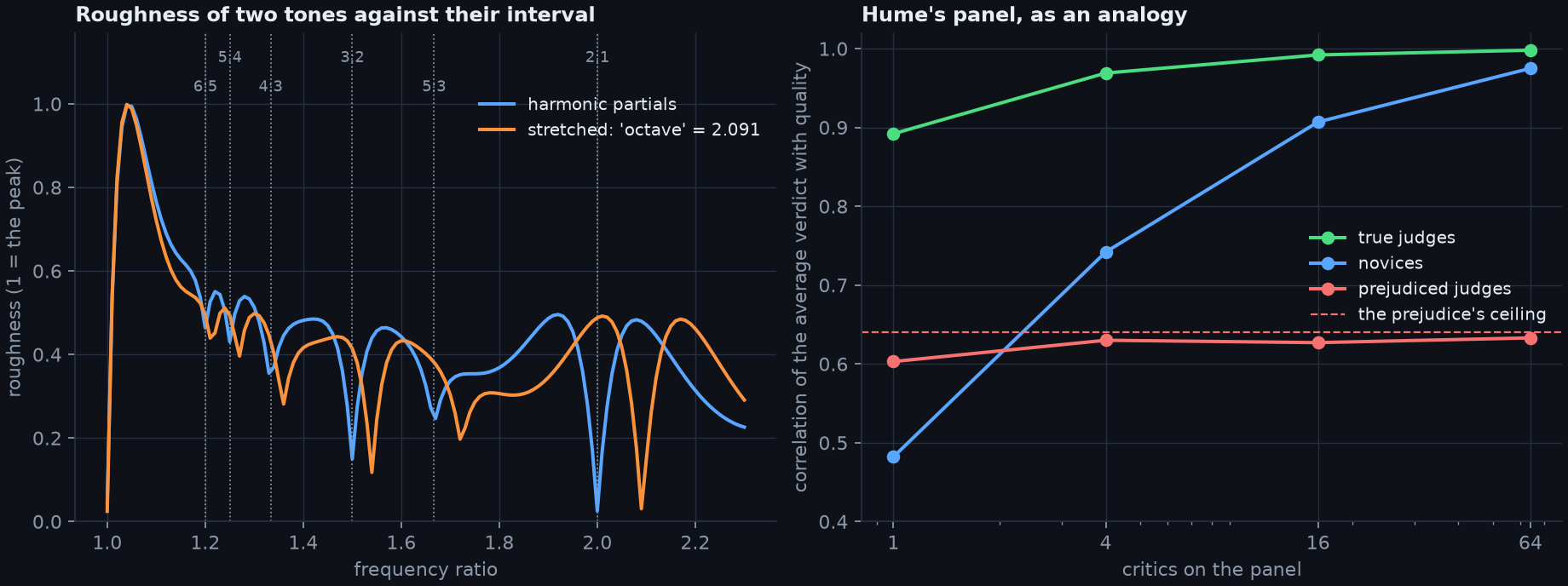
Why should simple ratios sound smooth? Hermann von Helmholtz answered in 1863: roughness. When two pure tones are close in pitch they beat, and at certain separations the beating is heard as roughness. Reinier Plomp and Willem Levelt measured how roughness depends on the separation in 1965. A real tone is not pure; it has partials at two, three, four times its frequency. The Reasoner adds up the roughness of every pair of partials for two tones with six harmonic partials each, as the interval between them slides from a unison to beyond an octave. The curve dips exactly at six to five, five to four, four to three, three to two, five to three and two to one: the consonances of Pythagoras, found without any number mysticism, because at those ratios the partials of the two tones coincide. Now stretch the partials, as William Sethares did, so that the second partial sits at two point one times the fundamental. The dips move: the smoothest octave is now two point one, and the old consonances sound rough. Consonance depends on timbre.
The shape of the curve comes from the ear itself. Each place along the basilar membrane of the cochlea responds to a band of frequencies, as Georg von Békésy showed, for which he won the Nobel prize in 1961. Two tones within a critical band, roughly a minor third in the middle range, interact; beyond it, they are heard apart, as Harvey Fletcher found in 1940. Roughness peaks when tones are about a quarter of a critical band apart, which is why the curve rises steeply from a unison and then falls. Jean-Philippe Rameau's Treatise on Harmony, of 1722, had already derived harmony from a fundamental bass, a theory of music older than the physics that would explain it.
The Reasoner tabulates the moved dips. Each sits between twenty and eighty five cents away from the just ratio it replaces, and the further up, the larger the shift. William Sethares's Tuning, Timbre, Spectrum, Scale argued from this that timbre and scale belong together: choose the spectrum of your instruments, and you have chosen which intervals sound consonant. The metallophones of the Javanese gamelan have strongly inharmonic partials, and their tunings differ from Western ones.
Is the preference natural or cultural? Helmholtz's On the Sensations of Tone made consonance the absence of roughness, a fact about the ear. Josh McDermott and colleagues found in 2010 that listeners' liking for consonance tracks harmonicity, how well the partials fit a single harmonic series, more than roughness. And in 2016 they found that the Tsimane', an Amazonian people with little exposure to Western music, rated consonant and dissonant chords as equally pleasant, though, like Americans, they disliked rough sounds. Roughness is a universal fact of hearing; the pleasure taken in consonance is partly learned. The first test of beauty as number already needs a listener.
Single intervals are only the start. Carol Krumhansl measured in 1990 how well listeners judge each note to fit a key, and found stable profiles that track how often notes occur in music. Leonard Meyer's Emotion and Meaning in Music, of 1956, and David Huron's Sweet Anticipation, of 2006, located musical pleasure in expectation, delayed and then fulfilled or surprised. No roughness curve explains a symphony; physics sets the stage, and culture writes the play.
What it establishes: Helmholtz; Plomp and Levelt; Sethares; von Békésy; Fletcher; Rameau; McDermott et al.; Krumhansl; Meyer; Huron.; Computed on screen: beats; the dissonance curve; stretched partials
4Seventeen ways to tile a planeAdvanced5 min
A wallpaper pattern repeats in two independent directions. Its symmetry group is every rigid motion of the plane that leaves the pattern unchanged. The Reasoner builds each group from its list of symmetry operations, and copies one small asymmetric motif by every one of them. In teal, the copies made by rotations and translations; in pink, the mirror images made by reflections and glides. First, the groups with no rotations, or only half turns. Then those with quarter turns, and those with thirds and sixths of a turn. There are exactly seventeen. Evgraf Fedorov proved it in 1891, and George Pólya found them again in 1924. Under each pattern are its name in the crystallographers' notation, and in the orbifold notation of John Conway, where a star marks a mirror and a cross marks a glide.
How can you tell which group a pattern has? The Reasoner uses the flowchart that crystallographers teach. First find the smallest rotation that maps the pattern to itself. Then look for mirrors, and count their directions. Then look for glide reflections whose axes are not mirrors. Then ask whether the rotation centres lie on mirrors. For each built group, the classifier works these out from the group's own operations, without being told the answer. Two groups with three-fold turns and mirrors are built the same way, and only the last question tells them apart. All seventeen receive different names: the classifier finds every group, exactly once.
Here is one pattern with its symmetries drawn in, all computed from the group's operations. The pattern belongs to the group p4m, the symmetry of a square tiled floor. Its mirror lines run horizontally, vertically and diagonally. Between the diagonal mirrors run glide axes: reflect, then slide. Quarter turns about the corners and centres of the squares map it to itself, and half turns about the midpoints of the edges. Every one of these was found by the Reasoner, not drawn by hand.
Order need not be periodic. In three dimensions there are two hundred and thirty space groups, found by Fedorov and Arthur Schoenflies in 1891: the possible symmetries of crystals. In 1974 Roger Penrose found tiles that cover the plane with five-fold symmetry but never repeat. In 1982 Dan Shechtman found an alloy whose diffraction pattern had five-fold symmetry, which crystallography said was impossible: quasicrystals, for which he won the Nobel prize in chemistry in 2011. And Peter Lu and Paul Steinhardt showed in 2007 that fifteenth-century Islamic girih tilings, on the Darb-i Imam shrine in Isfahan, are nearly perfect quasi-periodic patterns.
Symmetry joins art and science. The fourteenth-century tilings of the Alhambra in Granada are often said to contain all seventeen groups; Branko Grünbaum's careful count of 2006 found thirteen. Maurits Escher studied them in 1936 and spent his life filling the plane with birds, fish and lizards. Hermann Weyl's Symmetry, of 1952, traced the idea from ornament to crystals to the laws of physics. And John Conway, Heidi Burgiel and Chaim Goodman-Strauss's The Symmetries of Things, of 2008, proved that there are seventeen by a simple count of the costs of the symbols in the orbifold notation. Symmetry is the strongest case for beauty as order; whether it is enough is the next chapter's question.
Is more symmetry always more beautiful? Ernst Gombrich's The Sense of Order, of 1979, argued that we enjoy order, and the small breaks in it that hold attention; perfect repetition soon bores. Japanese design often prefers asymmetry deliberately, as in the arrangement of stones in a Zen garden. And in physics, the structure of the world, from crystals to the masses of particles, comes from symmetries that were broken. Beauty may lie between order and its breaking, as Berlyne's inverted U suggests.
What it establishes: Fedorov; Pólya; Conway; Penrose; Shechtman; Lu and Steinhardt; Grünbaum; Escher; Weyl; Gombrich.; Computed on screen: 17 groups generated and classified; p4m's elements
5Measuring orderResearch5 min
In 1933 the mathematician George David Birkhoff published Aesthetic Measure, an attempt to compute beauty. His measure is order divided by complexity. For polygons, order earns points for vertical symmetry, balance, rotational symmetry and fit to a grid of horizontals and verticals, minus points for faults. Complexity counts the distinct straight lines on which the sides lie. The square comes out on top. Hans Eysenck tested the formula against people's preferences in 1941 and found it a poor predictor; he suggested that order and complexity should be multiplied, not divided. The deeper problem is that symmetry and simplicity are not all we value.
A modern way to measure order is compression: an image is orderly if a short description reproduces it. Here are five black and white pictures, sixty four cells square: a blank, stripes, two patterns grown by the cellular automata called rule 90 and rule 30 from a random first row, and pure noise. A standard compressor, zlib, shrinks the blank and the stripes to under three percent of their size, and rule 90 to forty two percent. Rule 30 and the noise do not shrink at all. Yet rule 30 is completely determined by a rule with eight cases, applied row after row. Order is not simply in the picture: it depends on what model the observer brings.
Jürgen Schmidhuber proposed that what we find interesting, and beautiful, is what lets us improve our compression: the moment a pattern becomes predictable. The Reasoner builds a toy version. An observer reads each picture row by row, predicting each cell from the three cells above it and learning from every cell it sees. The curves show how many bits it needs per cell. Noise always costs about one bit per cell: nothing to learn. The blank costs almost nothing from the start: nothing left to learn. Rule 30 costs four tenths of a bit at first and then almost nothing, once the observer has found the rule: the largest progress. On this view, the interesting lies between the boring and the random: learnable, but not yet learned. It is a version of Daniel Berlyne's inverted U, in which pleasure peaks at intermediate complexity.
Mathematics offers better measures of complexity. Andrey Kolmogorov defined the complexity of a string, in 1965, as the length of the shortest program that prints it; by the limits of proof met in Part 7, it cannot be computed. For beauty it points the wrong way: noise is the most complex thing there is. Charles Bennett's logical depth, of 1988, measures instead how long the shortest program takes to run: shallow for noise and blanks alike, deep for things that, like organisms and artworks, could only have come from a long process. And Murray Gell-Mann and Seth Lloyd's effective complexity measures the length of a description of the regularities alone, setting the random parts aside.
Information theory offered new tools. In the 1950s and 1960s Max Bense and Abraham Moles tried to measure aesthetic information with Claude Shannon's entropy. The psychologist Daniel Berlyne's Aesthetics and Psychobiology, of 1971, proposed that pleasure peaks at intermediate complexity, an inverted U. Later studies found such curves in some experiments on music and pictures, but not reliably in all. Today computational aesthetics trains models to predict how people rate photographs and paintings, which predicts taste without explaining it.
Fractals offered a new kind of order. Richard Taylor and colleagues reported in Nature in 1999 that Jackson Pollock's drip paintings have fractal structure, with a dimension that rose over his career. Taylor's later studies found that people tend to prefer fractal dimensions of about one point three to one point five, as in many natural scenes. But Katherine Jones-Smith and Harsh Mathur replied in 2006 that the analysis could not reliably tell Pollocks from imitations. A statistic of a picture is not its value; order, again, needs an observer.
What it establishes: Birkhoff; Eysenck; Bense; Moles; Berlyne; Schmidhuber; Kolmogorov; Bennett; Gell-Mann and Lloyd; Taylor; Jones-Smith and Mathur.; Computed on screen: compression of five images; compression progress
6The golden ratio, testedIntroductory4 min
The golden ratio is said to be the secret of beauty. Divide a line so that the whole is to the larger part as the larger part is to the smaller: the ratio is phi, one plus root five over two, about one point six one eight, the number whose square is itself plus one. A golden rectangle has these proportions; cut off a square and the rest is golden again, without end. And the ratios of successive Fibonacci numbers, two, one and a half, five thirds, and so on, close in on phi from both sides.
Is the golden ratio really in the Parthenon, the pyramids and the Mona Lisa? The Reasoner runs a test of what such claims are worth. Measure eight lengths on an imaginary building, chosen at random between one and ten. That gives twenty eight ratios of one length to another. In seventy percent of twenty thousand trials, at least one of those ratios is within three percent of phi. On average, each random building contains one and a quarter golden ratios. So finding phi in a famous building, among many possible measurements, is no evidence that anyone put it there: the look-elsewhere effect of Part 16.
What survives of the legend? Gustav Fechner's Vorschule der Ästhetik, of 1876, reported that people shown rectangles chose the golden one most often: the first experiment in aesthetics. Later work, from Chris McManus in 1980 to Christopher Green's review of 1995, found at most a weak preference near one point six, and one sensitive to how the question is asked. George Markowsky's Misconceptions about the Golden Ratio, of 1992, showed that the famous architectural cases rest on measurements chosen to fit. What is real is in botany: many plants place successive leaves and seeds at the golden angle, a hundred and thirty seven and a half degrees, which packs them efficiently.
Here is where the golden ratio really lives. Helmut Vogel's model of a sunflower head, from 1979: put seed number k at an angle of k times the divergence angle, and at a distance from the centre proportional to the square root of k. At the golden angle, a hundred and thirty seven point five degrees, which divides the circle in the golden ratio, the seeds fill the disc evenly, in the interlocking spirals of a real sunflower. Half a degree less, or a tenth of a degree more, and the seeds line up in spokes with gaps between: the closest pair of seeds is a third nearer. Because phi is the hardest number to approximate by fractions, no two seeds ever line up. This is beauty as efficiency, found by selection rather than chosen by taste.
Psychology finds some regularities in what people find beautiful. Judith Langlois and Lori Roggman found in 1990 that faces averaged together by computer were rated more attractive than most of the faces they were made from. Symmetric faces are preferred, though, as Gillian Rhodes's review of 2006 found, less strongly than once claimed. Denis Dutton's The Art Instinct, of 2009, argued that tastes for skill, display and open, watered landscapes were shaped by evolution. The artists Vitaly Komar and Alexander Melamid commissioned opinion polls in many countries in the 1990s and painted each nation's most wanted picture: almost all were blue landscapes with water, trees and people.
What it establishes: Fechner; McManus; Green; Markowsky; Vogel; Langlois and Roggman; Rhodes; Dutton; Komar and Melamid.; Computed on screen: Fibonacci ratios; the look-elsewhere test; the sunflower
7The standard of tasteIntroductory5 min
David Hume's essay Of the Standard of Taste, of 1757, is the classic attempt. Beauty, he says, is no quality in things themselves; it exists in the mind that contemplates them. Yet some judgments are plainly better than others. Is there a standard? He tells a story from Don Quixote: two of Sancho's kinsmen taste a hogshead of wine. One detects a taste of leather, the other of iron, and they are mocked, until the barrel is emptied and an old key on a leathern thong is found at the bottom. The true judge has strong sense, delicate sentiment, practice, the habit of comparison, and freedom from prejudice. The standard of taste is the joint verdict of such judges, and what has pleased across ages and nations: the same Homer who pleased at Athens and Rome two thousand years ago is still admired at Paris and London.
Hume's claim can be modelled, as an analogy. Thirty works have a hidden quality. Each critic's verdict is the quality, plus her own idiosyncratic taste, plus noise. Novices are noisy and idiosyncratic: one novice's verdicts correlate with quality only point four eight, though a panel of sixty four reaches point nine seven. Hume's true judges are practised and delicate: even alone they reach point eight nine, and a small panel almost perfect agreement with quality. But give skilled judges a shared prejudice, a taste for what is fashionable that has nothing to do with quality, and no panel, however large, gets much past point six. Averaging removes individual noise, not shared bias. That is why Hume required his judges to be free from prejudice, and why he trusted the test of time: the verdicts of many ages and nations, whose prejudices differ.
Hume's essay begins from a paradox. There is no disputing about taste. Some works are better than others: whoever ranks a minor poet with Milton, Hume says, is as absurd as one who calls a molehill as high as a mountain. And judgments of beauty rest on feeling, not proof. If feeling settles beauty and no feeling is better than another, no work is better. Hume and Kant deny that all tastes are equal, keeping feeling as the ground of judgment. The subjectivist denies that any work is better. And aesthetic realists, such as Frank Sibley and Nick Zangwill, hold that beauty and grace are properties of the work, which feeling detects rather than constitutes.
Hume's standard has its problems. It threatens a circle: true judges are those who judge correctly, and correct judgments are whatever true judges say, as Jerrold Levinson put it in 2002. Robert Zajonc showed in 1968 that we come to like what we merely see often. James Cutting found in 2003 that the canon of French Impressionism tracks how often the paintings were reproduced in books, and that exposure alone could shift students' preferences among them. Hume's reply is the test of time: fashions pass, and what survives across ages and nations, whose prejudices differ, is the best evidence we have.
Hume's wine story can be tested. Frédéric Brochet found in 2001 that when a white wine was dyed red, students of oenology described it in the vocabulary of red wines. Robert Hodgson found in 2008 that judges at a California state fair, given the same wine three times without knowing it, often scored it very differently. Yet trained tasters do detect faults and flavours that novices miss: delicacy of taste is real, if rarer than its owners claim. The lesson for Hume's true judges is that freedom from prejudice must be engineered, by tasting blind, as the jury theorem of Part 39 needed independence.
This is the fortieth brick in the Wall. The dream was a rule for beauty: a formula, like Birkhoff's, or a ratio, like the golden one, that would settle which works are beautiful. Hume's paradox shows why none can: beauty is felt, and no rule replaces the feeling. Yet some judgments are better than others. What it forces is trust in trained judges rather than rules: Hume's joint verdict of the true judges, and the test of time.
What it establishes: Hume (1757); Levinson; Zajonc; Cutting; Brochet; Hodgson; Sibley; Zangwill; the Wall's fortieth brick.; Computed on screen: the critics panel (analogy); the Price List
8Disinterested pleasureAdvanced4 min
Immanuel Kant's Critique of the Power of Judgment, of 1790, gave the judgment of taste four moments. First, the pleasure is disinterested: it does not depend on wanting the object to exist, to own it or eat it. Second, it is universal without a concept: we speak as if beauty were a property of the thing, and demand everyone's agreement, though no argument can prove a rose beautiful. Third, the beautiful has the form of purposiveness without a purpose: it looks designed, though we can name nothing it is for. Fourth, the judgment is necessary, resting on a common sense, a capacity of feeling we presuppose all people share.
The faculties explain the pleasure. In judging beauty, imagination and understanding fall into free play, a harmony that no concept fixes, and that harmony is what we feel. Free beauty, as in flowers, birds, ornamental patterns and music without words, is judged without any concept of what the thing should be. Dependent beauty, of a horse, a church or a human being, is judged against what the thing is for. And Kant states the paradox of taste as an antinomy: taste is not based on concepts, or we could dispute it by proof; and it is, or we could not even argue about it. His resolution is that it rests on an indeterminate concept, the supersensible ground of nature and of ourselves.
Kant also gave the sublime its classic analysis. The mathematical sublime is magnitude, the starry sky or the ocean, that imagination cannot take in, while reason thinks it as a whole. The dynamical sublime is might, storms, volcanoes and waterfalls, that could crush us, seen from safety. In both, what we finally admire is our own vocation as rational beings, superior to nature. And fine art is the art of genius, a talent that gives the rule to art, which no rule can teach: the Wall of this part, stated by Kant himself.
Kant's successors made art the centre of philosophy. Friedrich Schiller's Letters on the Aesthetic Education of Man, of 1795, held that in the play drive, sense and reason are reconciled, and that people are fully human only when they play. Hegel called art the sensuous appearance of the Idea, and argued that in modern times it has been surpassed by philosophy, the thesis of the end of art. Arthur Schopenhauer, in 1819, held that music copies not the appearances of the world but the will itself. And Friedrich Nietzsche's The Birth of Tragedy, of 1872, found in Greek tragedy the union of two forces: the Apollonian, of form and dream, and the Dionysian, of intoxication.
The sociology of taste challenged Kant's universality. Pierre Bourdieu's Distinction, of 1979, argued that the disinterested gaze Kant describes is a habit of the educated classes, and that taste marks social position. His surveys of 1960s France found taste in music and art following education and class closely. Carolyn Korsmeyer's Gender and Aesthetics, of 2004, traced how the sublime was gendered male and the beautiful female. The reply is that showing that a taste has social causes does not show that no taste is better than another; to think so is the genetic fallacy.
What it establishes: Kant (1790); Schiller; Hegel; Schopenhauer; Nietzsche; Bourdieu; Korsmeyer.
9What is art?Introductory4 min
What is art? Each answer of the early twentieth century was soon refuted by the art that followed it. Leo Tolstoy's What Is Art?, of 1897, held that art infects others with feelings the artist has lived through. Clive Bell, in 1914, called the essential quality significant form: lines and colours combined to move us aesthetically. R. G. Collingwood's The Principles of Art, of 1938, made art proper the expression of emotion, discovered in the making. Then Morris Weitz argued in 1956, with Wittgenstein's family resemblance from Part 28, that art is an open concept with no definition, because artists keep making new kinds of it.
Two objects forced the question into a new form. In 1917 Marcel Duchamp submitted Fountain, a urinal signed R. Mutt, to an exhibition. In 1964 Andy Warhol exhibited Brillo Box, indistinguishable to the eye from the cartons in a supermarket stockroom. Arthur Danto's essay The Artworld, of the same year, argued that what makes one box art and the other not is no visible property, but an atmosphere of artistic theory and a knowledge of the history of art. His Transfiguration of the Commonplace, of 1981, added that artworks are about something and embody their meaning, which a carton does not.
Definitions came back, built on Danto's insight. George Dickie's institutional theory, of 1974, says an artwork is an artefact on which someone acting on behalf of the artworld has conferred the status of candidate for appreciation. Critics called it circular, and asked why the artworld's choices should be reasons for anyone. Jerrold Levinson's historical definition, of 1979, says a work is art if it is intended for regard in some way that earlier art was correctly regarded. And Berys Gaut's cluster account of 2000 lists ten criteria, among them expressing emotion, being skilful and belonging to an established art form, none necessary and enough of them sufficient: the open concept, tamed.
Aesthetics also looks beyond art. Ronald Hepburn argued in 1966 that nature has no frame and invites a different kind of appreciation, in which we are part of what we appreciate. Allen Carlson held in 1979 that we should appreciate a landscape through scientific knowledge of what it is, as we appreciate art through knowledge of its kind. Yuriko Saito's Everyday Aesthetics, of 2007, turned to the look of laundry on a line, the feel of tools and the taste of food. And Frank Sibley argued in 1959 that aesthetic concepts, such as graceful, garish and balanced, are applied by taste and never by rule: no list of features ever logically suffices for grace. That is the Wall again.
Why does art matter? Aesthetic hedonism says its value is the pleasure of experiencing it. Cognitivists say art yields knowledge: Martha Nussbaum's Love's Knowledge, of 1990, read novels as moral philosophy. Dominic McIver Lopes's Being for Beauty, of 2018, ties aesthetic reasons to the practices of people expert in a domain, such as dancers or potters, rather than to pleasure. Each theory fits some art, and some art seems designed to defy each.
What it establishes: Tolstoy; Bell; Collingwood; Weitz; Duchamp; Warhol; Danto; Dickie; Levinson; Gaut; Hepburn; Carlson; Saito; Sibley; Nussbaum; Lopes.
10Forgeries and machinesApplied4 min
If you cannot tell a forgery from the original, is it any less valuable? The question tests whether beauty is in what we see. Nelson Goodman's Languages of Art, of 1968, argued that knowing a picture is a forgery matters even now, because it trains the eye to look for differences it may later learn to see. He distinguished autographic arts, like painting, where the history of production matters and forgery is possible, from allographic arts, like music, where any correct performance of the score is the work. Han van Meegeren sold paintings as Vermeers that fooled the experts of the 1930s; accused in 1945 of selling a national treasure to Hermann Göring, he painted another under supervision to prove he was a forger, not a collaborator.
Why should provenance matter, if the surface is the same? Denis Dutton argued in 1979 that art is a kind of performance, and a forgery misrepresents the achievement we admire. George Newman and Paul Bloom found in 2012 that people value an original partly as a physical trace of the artist, a kind of contagion. Kendall Walton's Categories of Art, of 1970, argued that how a work looks depends on the category in which we see it, so the same canvas looks different as a Picasso and as a copy. Aesthetic value is not in the visible surface alone.
Authenticity also governs restoration. The cleaning of Michelangelo's Sistine Chapel ceiling, from 1980 to 1994, revealed brilliant colours; critics feared that the artist's final layers had been removed with the grime. Is the work what the artist made, or what the centuries made of it? Cesare Brandi's Theory of Restoration, of 1963, answered: restore the potential unity of the work, without faking history, and leave every intervention recognizable.
Machines now make images that win prizes. In 2022 an image made with Midjourney, Théâtre D'opéra Spatial, won the digital art prize at the Colorado State Fair. The United States Copyright Office ruled in 2023 that copyright requires human authorship, and that material generated by AI must be excluded from a registration. In Thaler versus Perlmutter, a federal court agreed in 2023 that a work made autonomously by a machine cannot be copyrighted, and the appeals court affirmed in 2025. Philosophically, the answer depends on the theories of the last chapter: if art requires intention and expression, a model's image is not art, though its user's choices may be; if art needs only significant form, it may be.
Machines now also judge beauty. Aesthetic predictors are models trained on people's ratings of images, such as the predictor released with the LAION image collection in 2022. They have been used to filter the training images of image generators toward those rated prettier. The risk is a narrowing of taste: the averageness that makes composite faces attractive, applied to all images. And Hume's question returns: whose ratings? A large panel of the many, not of true judges, and with no test of time.
What it establishes: Goodman; van Meegeren; Dutton; Newman and Bloom; Walton; Brandi; the US Copyright Office; Thaler v. Perlmutter; LAION.
11Proofs, poems and Cook DingAdvanced5 min
Mathematicians speak of beauty constantly. G. H. Hardy's A Mathematician's Apology, of 1940, said that there is no permanent place in the world for ugly mathematics. He found beauty in surprise, inevitability and economy, as in Euclid's proof that there are infinitely many primes, and the proof that the square root of two is irrational. Paul Erdős spoke of a Book in which God keeps the perfect proofs; Martin Aigner and Günter Ziegler collected candidates in Proofs from THE BOOK. And Semir Zeki and colleagues found in 2014 that when mathematicians viewed formulas they rated beautiful, with Euler's identity rated highest, the same region of the brain responded as when people experience beauty in art or music.
Hardy's two favourite examples can be shown in full. Euclid's: suppose there were only finitely many primes. Multiply them all together and add one. That number leaves remainder one when divided by every prime on the list, so its prime factors are not on the list. The list was never complete. The Pythagoreans': if the square root of two were a fraction in lowest terms, a over b, then a squared would be twice b squared, so a is even, so b squared is twice a square, so b is even too, and the fraction was not in lowest terms after all. Each is short, surprising and inevitable, and neither has dated in more than two thousand years. A mathematician, Hardy wrote, like a painter or a poet, is a maker of patterns.
Chinese aesthetics developed its own vocabulary. Xie He, in the sixth century, set out six principles of painting. The first, spirit resonance and life-motion, asks that a painting carry the living energy of its subject. The others concern the bone method of the brush, fidelity to the object, colour, composition, and copying the masters. Later criticism prized the yijing of a poem or painting, its realm, in which scene and feeling fuse and meaning lies beyond the words. Wang Guowei's Remarks on Song Lyrics, of 1908, made jingjie, a world of its own, the mark of the highest poetry, bringing Kant and Schopenhauer into conversation with the Chinese tradition.
In the Chinese tradition, music was ethics. Confucius, the Analects say, heard the Shao music in the state of Qi, and for three months did not notice the taste of meat. Xunzi's Discourse on Music held that music shapes feeling and binds people in harmony, as ritual orders them. Against this, Ji Kang argued in the third century that music has in it neither grief nor joy: the feelings are the listener's, Hume's view fourteen centuries early. And the Japanese aesthetic of wabi-sabi finds beauty in the imperfect, impermanent and incomplete, a long way from the symmetry groups.
The Zhuangzi offers a different picture of beauty, in action. Cook Ding carves an ox for Lord Wenhui, and every movement falls into rhythm, like a dance to ancient music. Asked how, he says he no longer sees the ox with his eyes; he follows its natural pattern, sliding his blade through the hollows, and after nineteen years it is as sharp as if new from the whetstone. Beauty here is effortless mastery, attuned to the way of things. Modern echoes include Mihály Csíkszentmihályi's flow, of 1990, and Li Zehou's The Path of Beauty, of 1981, a history of Chinese aesthetic sensibility.
Modern Chinese aesthetics joined these traditions. Cai Yuanpei, president of Peking University, argued in 1917 that aesthetic education should replace religion as a source of moral formation. Zhu Guangqian wrote a psychology of aesthetics and translated Hegel's lectures on aesthetics into Chinese. Zong Baihua wrote on the rhythm of space in Chinese painting, where empty paper is part of the form. And Li Zehou proposed that the forms we find beautiful carry, sedimented in them, the history of human practice.
What it establishes: Hardy; Erdős; Aigner and Ziegler; Zeki et al.; Xie He; Wang Guowei; Zhuangzi; Confucius; Xunzi; Ji Kang; Cai Yuanpei; Zhu Guangqian; Zong Baihua; Li Zehou.
Recap, problems, and where this comes backAll tracks2 min
Let's gather what we built. Plato's ladder and his case against art, Aristotle's reply, and Burke's sublime. The Pythagorean comma, twenty three and a half cents, and equal temperament's thirds, fourteen to sixteen cents off. The dissonance curve, with the consonances as its dips, moving when the timbre changes. All seventeen wallpaper groups, built and named. A pattern that a compressor cannot shrink but a learner masters, and interest as compression progress. The golden ratio found in seventy percent of random buildings. Hume's true judges converging, prejudice that does not average out, this part's brick in the Wall, and Kant. Brillo boxes, forgeries, AI art before the courts, and beauty in proofs, poems and skill.
The Reasoner has a new module, aesthetics. It tunes scales, computes roughness, generates and classifies the wallpaper groups, measures compression and the progress of a learner, tests the golden ratio, and simulates a panel of critics. And the Wall has its fortieth brick.
Six problems, with full solutions in this part's notes. Why the circle of fifths cannot close; the size of another comma; why a fifth sounds smooth; the groups with no reflections at all; why averaging cannot cure prejudice; and the paradox of taste as a Price List. Pause here, and try them.
Where this comes back. Machines now judge images, essays and applicants, and Part 41 asks by whose standard, and whether they can be fair. Part 42 asks how a reasoner can be aligned with human taste and values that, as Hume saw, no rule captures. Next, Part 41: fair machines.
The books and papers this part follows are on screen, and in the notes. Thanks for watching.
Where it goes next. Act VII ends here. The independence that Hume's judges need, like Condorcet's jurors in Part 39, returns as the question of whose judgments a machine is trained on in Parts 41 and 42, and Part 42's Wall files this brick with the others where a rule gives way to trained judgment.
Key results
The part's results in one place, for revision.
Try it
Lab 40 · Where consonance comes from, and when a panel of critics converges
Compute the Pythagorean comma, build the dissonance curve of two harmonic tones and check that its dips sit on 6:5, 5:4, 4:3, 3:2, 5:3 and 2:1, then stretch the partials by a random amount and check that every dip moves to the stretched ratio. Then average panels of simulated critics with and without a shared prejudice.
python -m videos.philosophy.labs 40
needs numpy, scipy, matplotlib · download lab40.py ·
source on GitHubtwelve fifths against seven octaves 531441/524288 = 23.46 cents (film: 23.46)
equal temperament's fifth -1.96 cents from 3:2
harmonic tones: dips found between 1 and 2 6, each within 0.4 cents of a just ratio (film: exactly six)
partials stretched to an 'octave' of 2.091 6 dips, each within 0.5 cents of (p/q)^1.064
... its deepest dip after the unison 2.091 (theory: 2.091)
wallpaper groups built and told apart 17 built, 17 distinct names (Fedorov: 17)
random 'buildings' with a golden ratio within 3% 70% (film: 70%)
64 true judges: correlation with quality 0.998 (film: 0.998)
64 judges with a shared prejudice 0.633 (theory: about 1/sqrt(1 + 1.2^2) = 0.640)
Consonance sits where partials coincide, so it belongs to the timbre as much as to the ratio. And a panel's average converges on quality only when its members' errors are independent.The code (93 lines; it asserts its own result)
"""Lab 40: find the consonant intervals as dips in a roughness curve, then stretch the timbre and watch them move."""

import math

import numpy as np

from videos.coursekit import labs
from explainer.philosophy.reasoner import aesthetics

TITLE = "Where consonance comes from, and when a panel of critics converges"
GOAL = ("Compute the Pythagorean comma, build the dissonance curve of two harmonic tones and check that its dips sit "
        "on 6:5, 5:4, 4:3, 3:2, 5:3 and 2:1, then stretch the partials by a random amount and check that every dip "
        "moves to the stretched ratio. Then average panels of simulated critics with and without a shared prejudice.")
TASKS = [
    "Call aesthetics.dissonance_curve with n_partials=1 (pure tones). Which of the six dips survive, and what does "
    "that say about consonance as a property of ratios?",
    "Raise the look-elsewhere tolerance in aesthetics.golden from 3% to 5% and the number of lengths from 8 to 12. "
    "How often does a random building now contain the golden ratio?",
    "Give the prejudiced judges a shared bias of 0.5 instead of 1.2 (edit the kinds in aesthetics.critics). What "
    "does their panel's correlation with quality converge to, against 1 / sqrt(1 + 0.25)?",
]
JUST = {"6:5": 6 / 5, "5:4": 5 / 4, "4:3": 4 / 3, "3:2": 3 / 2, "5:3": 5 / 3, "2:1": 2.0}


def _worst_gap(minima, exponent, top):
    """The largest distance, in cents, from a predicted dip (a just ratio raised to the exponent) to a dip found."""
    found = [m["ratio"] for m in minima if 1.05 < m["ratio"] < top]
    return max(min(abs(aesthetics.cents(f / r ** exponent)) for f in found) for r in JUST.values()), len(found)


def run(seed=0):
    rng = np.random.default_rng(seed)
    lab = labs.Lab()

    t = aesthetics.tuning()
    fifth = next(e for e in t["equal"] if e["interval"] == "fifth")
    lab.row("twelve fifths against seven octaves", f"{t['comma_num']}/{t['comma_den']} = {t['comma_cents']:.2f} cents   (film: 23.46)")
    lab.row("equal temperament's fifth", f"{fifth['error']:+.2f} cents from 3:2")
    assert (t["comma_num"], t["comma_den"]) == (3 ** 12, 2 ** 19) and t["comma_num"] != t["comma_den"]
    assert abs(t["comma_cents"] - 1200 * math.log2(1.5 ** 12 / 2 ** 7)) < 0.01 and abs(fifth["error"] + 1.96) < 0.01

    harmonic = aesthetics.dissonance_curve()
    gap, n_found = _worst_gap(harmonic["minima"], 1.0, 2.05)
    lab.row("harmonic tones: dips found between 1 and 2", f"{n_found}, each within {gap:.1f} cents of a just ratio   (film: exactly six)")
    assert n_found == 6 and gap < 2.0 and harmonic["lowest_after_unison"] == 2.0

    stretch = round(float(rng.uniform(1.9, 2.2)), 3)
    stretched = aesthetics.dissonance_curve(stretch=stretch)
    exponent = math.log2(stretch)
    gap_s, n_s = _worst_gap(stretched["minima"], exponent, stretch * 1.02)
    lab.row(f"partials stretched to an 'octave' of {stretch}", f"{n_s} dips, each within {gap_s:.1f} cents of (p/q)^{exponent:.3f}")
    lab.row("... its deepest dip after the unison", f"{stretched['lowest_after_unison']:.3f}   (theory: {stretch})")
    assert n_s == 6 and gap_s < 4.0, "the dips follow the partials, not the whole-number ratios"
    assert abs(stretched["lowest_after_unison"] - stretch) < 0.003
    if abs(stretch - 2) > 0.03:
        assert all(abs(aesthetics.cents(m["ratio"] / 2.0)) > 10 for m in stretched["minima"]), "2:1 is no longer a dip"

    w = aesthetics.wallpaper()
    lab.row("wallpaper groups built and told apart", f"{len(w['groups'])} built, {w['distinct']} distinct names   (Fedorov: 17)")
    assert len(w["groups"]) == 17 and w["distinct"] == 17 and w["all_seventeen"]

    gold = aesthetics.golden(trials=6000, seed=1876 + seed)
    lab.row("random 'buildings' with a golden ratio within 3%", f"{gold['p_some_hit']:.0%}   (film: 70%)")
    assert abs(gold["p_some_hit"] - 0.70) < 0.04

    panel = aesthetics.critics(panels=(1, 4, 16, 64), trials=80, seed=1757 + seed)["correlation"]
    limit = 1 / math.sqrt(1 + 1.2 ** 2)
    lab.row("64 true judges: correlation with quality", f"{panel['true judges'][-1]:.3f}   (film: 0.998)")
    lab.row("64 judges with a shared prejudice", f"{panel['prejudiced judges'][-1]:.3f}   (theory: about 1/sqrt(1 + 1.2^2) = {limit:.3f})")
    assert panel["true judges"][-1] > 0.99 and panel["novices"][-1] > panel["novices"][0] + 0.3
    assert abs(panel["prejudiced judges"][-1] - limit) < 0.05, "averaging removes noise, not a shared bias"
    assert panel["prejudiced judges"][-1] - panel["prejudiced judges"][0] < 0.08
    lab.note = ("Consonance sits where partials coincide, so it belongs to the timbre as much as to the ratio. And "
                "a panel's average converges on quality only when its members' errors are independent.")

    fig, ax = labs.figure(2, size=(11.5, 4.3))
    ax[0].plot(harmonic["r"], harmonic["d"], color=labs.BLUE, label="harmonic partials")
    ax[0].plot(stretched["r"], stretched["d"], color=labs.ORANGE, label=f"stretched: 'octave' = {stretch}")
    for k, (name, r) in enumerate(JUST.items()):
        ax[0].axvline(r, color=labs.MUTED, lw=0.8, ls=":")
        ax[0].text(r, 1.03 + 0.07 * (k % 2), name, ha="center", fontsize=8, color=labs.MUTED)
    ax[0].set(title="Roughness of two tones against their interval", xlabel="frequency ratio", ylabel="roughness (1 = the peak)",
              ylim=(0, 1.17))
    ax[0].legend(loc="upper right", bbox_to_anchor=(1, 0.9))
    sizes = [1, 4, 16, 64]
    for kind, color in (("true judges", labs.GREEN), ("novices", labs.BLUE), ("prejudiced judges", labs.RED)):
        ax[1].plot(sizes, panel[kind], "o-", color=color, label=kind)
    ax[1].axhline(limit, color=labs.RED, ls="--", lw=1, label="the prejudice's ceiling")
    ax[1].set(title="Hume's panel, as an analogy", xlabel="critics on the panel", xscale="log", xticks=sizes,
              xticklabels=[str(s) for s in sizes], ylabel="correlation of the average verdict with quality", ylim=(0.4, 1.02))
    ax[1].legend(loc="center right")
    lab.fig = fig
    return lab
Now change it
- Call aesthetics.dissonance_curve with n_partials=1 (pure tones). Which of the six dips survive, and what does that say about consonance as a property of ratios?
- Raise the look-elsewhere tolerance in aesthetics.golden from 3% to 5% and the number of lengths from 8 to 12. How often does a random building now contain the golden ratio?
- Give the prejudiced judges a shared bias of 0.5 instead of 1.2 (edit the kinds in aesthetics.critics). What does their panel's correlation with quality converge to, against 1 / sqrt(1 + 0.25)?
Problems, with solutions
Try each problem before opening its solution.
-
Show that no positive integer power of 3/2 equals a positive integer power of 2.
Solution
Suppose \((3/2)^m = 2^n\) with \(m, n \ge 1\). Multiplying by \(2^m\) gives \(3^m = 2^{m + n}\). The left side is odd and the right side even, so they cannot be equal (by unique factorization, a power of 3 is never a power of 2). So no stack of pure fifths ever lands exactly on a stack of octaves, which is why the circle of fifths does not close: twelve fifths overshoot seven octaves by the Pythagorean comma, \(3^{12}/2^{19}\).
-
How many cents is the syntonic comma 81/80?
Solution
In cents, a ratio \(r\) is \(1200\log_2 r\). For \(81/80\): \(1200\log_2 1.0125 = 1200 \times 0.01792 = 21.5\) cents, about a fifth of a semitone: the gap between four pure fifths (less two octaves), \(81/64\), and the pure major third, \(5/4\).
-
For two harmonic tones with f₂/f₁ = 3/2, find all positive integer pairs (n, m) with nf₁ = mf₂. (n = 3k, m = 2k: every third partial of the lower tone matches every second partial of the higher.)
Solution
The \(n\)-th partial of the lower tone is at \(nf_1\), the \(m\)-th of the higher at \(mf_2 = \tfrac32 m f_1\). They coincide when \(n = \tfrac32 m\), that is \(2n = 3m\). Since 2 and 3 share no factor, \(m\) must be even and \(n\) a multiple of 3: \(m = 2k\), \(n = 3k\) for \(k = 1, 2, \ldots\). Every third partial of the lower tone meets every second partial of the higher, which is why the fifth sounds smooth.
-
Which wallpaper groups have no mirrors and no glides?
Solution
The five groups whose only symmetries are translations and rotations: p1 (translations only), p2 (half-turns), p3 (third-turns), p4 (quarter-turns) and p6 (sixth-turns). Each of the other twelve has a mirror or a glide reflection. These five are exactly the groups that preserve orientation: a pattern of one of them, and its mirror image, are different patterns.
-
Why does averaging remove a critic's noise but not a shared prejudice?
Solution
In the film's model each critic's verdict is quality, plus a personal taste, plus noise. Averaging \(n\) critics divides the variance of the independent parts by \(n\), so they vanish as the panel grows. A shared prejudice is the same term \(b\) in every critic's verdict, so the average contains all of it: \(\bar v = q + b + (\text{terms that shrink})\). No panel size removes \(b\), which is why the skilled but prejudiced panel stalls near a correlation of 0.6. Only judges whose prejudices differ, Hume's "many ages and nations", let biases average out like noise.
-
State the paradox of taste as an inconsistent triad, and say which claim Kant denies.
Solution
As a triad: (1) judgments of taste are not based on concepts, otherwise taste could be settled by proof; (2) judgments of taste are based on concepts, otherwise we could not even dispute them, with a claim on others' agreement; (3) a judgment is either based on a determinate concept or on none. Together they are inconsistent. Kant denies (3): the judgment of taste rests on an indeterminate concept, the supersensible ground of nature and of our faculties, which cannot be used to prove anything (so (1) holds of determinate concepts) but grounds a claim on everyone's agreement (so (2) holds of the indeterminate one).
Notes and sources
About this partfrom its README
Part 40 of Philosophy, Built (series plan, syllabus), in Act VII, Value: aesthetics. Hume's beauty "in the mind which contemplates" (1757), a preview of the dissonance curve and the wallpaper groups, and four questions. Plato's ladder (Symposium), Republic X and the Hippias Major; Aristotle's mimesis, catharsis and order; Plotinus, Aquinas, Hutcheson (1725), Burke's sublime (1757); rasa in the Natyashastra and Abhinavagupta. The Pythagorean comma computed (3¹²/2¹⁹ = 531441/524288, 23.46 cents) on the spiral of fifths that does not close; equal temperament measured (fifths 1.96 cents off, thirds 13.69 to 15.64); Pythagorean, quarter-comma meantone and equal temperament compared (thirds and wolf fifths); Zhu Zaiyu (1584); other scales. Beats drawn; the dissonance curve built (Plomp and Levelt 1965, in Sethares's form): minima exactly at 6:5, 5:4, 4:3, 3:2, 5:3 and 2:1, and moving with stretched timbres (an "octave" of 2.1); Helmholtz (1863), von Békésy, the critical band, Rameau, McDermott et al. (2010; the Tsimane', 2016), Krumhansl, Meyer, Huron. All seventeen wallpaper groups generated from their operations and classified by flowchart (17 built, 17 distinct names), drawn as a gallery and with p4m's mirrors, glides and rotation centres computed; Fedorov (1891), Pólya, the Alhambra (Grünbaum 2006), Escher, Weyl, Conway's orbifolds; space groups, Penrose, Shechtman, girih; Gombrich's broken symmetry. Birkhoff's Aesthetic Measure (1933) and Eysenck; Bense, Moles and Berlyne's inverted U; compression (zlib shrinks rule 90 to 42% but cannot touch rule 30) and compression progress as a toy of Schmidhuber's interestingness; Kolmogorov, logical depth, effective complexity; Pollock's fractals and their critics. The golden ratio and Fibonacci; a look-elsewhere test (70% of random eight-length "buildings" contain φ within 3%); Fechner (1876), McManus, Green, Markowsky; Vogel's sunflower at the golden angle and near it; faces (Langlois and Roggman), Dutton, Komar and Melamid. Hume's standard of taste (Sancho's kinsmen; the true judge), a panel of critics simulated as an analogy (true judges converge to 0.998; a shared prejudice stalls at about 0.62), a Price List for the paradox of taste — the Wall's fortieth brick; Levinson's circle, mere exposure (Zajonc; Cutting), blind tasting (Brochet; Hodgson). Kant's four moments, free play, free and dependent beauty, the antinomy of taste, the sublime and genius; Schiller, Hegel, Schopenhauer, Nietzsche; Bourdieu and Korsmeyer. What is art? Tolstoy, Bell, Collingwood, Weitz (1956), Duchamp, Warhol's Brillo boxes, Danto (1964, 1981), Dickie (1974), Levinson (1979), Gaut (2000), environmental and everyday aesthetics, Sibley (1959), theories of art's value. Forgery (Goodman 1968; van Meegeren), Dutton, Newman and Bloom, Walton, restoration (Brandi); AI art (the 2022 Colorado prize; the US Copyright Office, 2023; Thaler v. Perlmutter, 2023 and 2025) and aesthetic predictors. Mathematical beauty (Hardy 1940; Erdős's Book; Zeki et al. 2014) with Euclid's and the √2 proofs shown; Xie He's six principles, yijing, Wang Guowei (1908), Cook Ding, Confucius and Xunzi on music, Ji Kang, wabi-sabi, and modern Chinese aesthetics (Cai Yuanpei, Zhu Guangqian, Zong Baihua, Li Zehou).
The worked model results are computed by the Reasoner's new module explainer/philosophy/reasoner/aesthetics.py (with
prop for the Price List), tested in tests/philosophy/test_aesthetics.py and cached by compute.py.
Chapter notes
| # | Scene | What it establishes | Computed on screen |
|---|---|---|---|
| 0 | Hook |
Hume (1757); a preview; four questions; the plan. | the curve and a wallpaper pattern, previewed |
| 1 | Greeks |
Plato; Aristotle; Plotinus; Aquinas; Hutcheson; Burke; Bharata; Abhinavagupta. | — |
| 2 | Harmony |
the Pythagoreans; Kepler; Zhu Zaiyu; Stevin; meantone; scales. | the comma; the spiral of fifths; equal and meantone temperaments |
| 3 | Roughness |
Helmholtz; Plomp and Levelt; Sethares; von Békésy; Fletcher; Rameau; McDermott et al.; Krumhansl; Meyer; Huron. | beats; the dissonance curve; stretched partials |
| 4 | Symmetry |
Fedorov; Pólya; Conway; Penrose; Shechtman; Lu and Steinhardt; Grünbaum; Escher; Weyl; Gombrich. | 17 groups generated and classified; p4m's elements |
| 5 | Order |
Birkhoff; Eysenck; Bense; Moles; Berlyne; Schmidhuber; Kolmogorov; Bennett; Gell-Mann and Lloyd; Taylor; Jones-Smith and Mathur. | compression of five images; compression progress |
| 6 | Golden |
Fechner; McManus; Green; Markowsky; Vogel; Langlois and Roggman; Rhodes; Dutton; Komar and Melamid. | Fibonacci ratios; the look-elsewhere test; the sunflower |
| 7 | Hume |
Hume (1757); Levinson; Zajonc; Cutting; Brochet; Hodgson; Sibley; Zangwill; the Wall's fortieth brick. | the critics panel (analogy); the Price List |
| 8 | Kant |
Kant (1790); Schiller; Hegel; Schopenhauer; Nietzsche; Bourdieu; Korsmeyer. | — |
| 9 | Art |
Tolstoy; Bell; Collingwood; Weitz; Duchamp; Warhol; Danto; Dickie; Levinson; Gaut; Hepburn; Carlson; Saito; Sibley; Nussbaum; Lopes. | — |
| 10 | Authentic |
Goodman; van Meegeren; Dutton; Newman and Bloom; Walton; Brandi; the US Copyright Office; Thaler v. Perlmutter; LAION. | — |
| 11 | East |
Hardy; Erdős; Aigner and Ziegler; Zeki et al.; Xie He; Wang Guowei; Zhuangzi; Confucius; Xunzi; Ji Kang; Cai Yuanpei; Zhu Guangqian; Zong Baihua; Li Zehou. | — |
| 12 | Outro |
recap; the Reasoner's module; the Wall; problems; payoffs; references. | — |
Notes
The dissonance model is Sethares's parametrization of Plomp and Levelt's curve, with six partials of amplitude 0.88^k at middle C; "stretched" partials sit at k^log2(2.1). The wallpaper groups are built from standard coset representatives on oblique, rectangular, centred, square and hexagonal lattices; p3m1 and p31m are built the same way with mirrors in two orientations and named by the classifier. The compression-progress observer predicts each cell from the three above it with Laplace-smoothed counts. The golden-ratio test draws eight lengths uniformly from 1 to 10, 20,000 times (seed 1876). The critics panel is labelled an analogy: thirty works, novices (noise 1.5, idiosyncrasy 1.0), true judges (0.4, 0.3), prejudiced judges with a shared bias of weight 1.2, 400 trials per panel size.
Companion material in this repository
The syllabus's plan for this partfrom SYLLABUS.md, the plan of record
- Plato's beauty and Aristotle's Poetics (mimesis, catharsis).
- Hume's "Of the Standard of Taste" (1757): the true judges; read as a convergence claim and simulated as the
wisdom of a crowd of critics (labeled
analogy). - Kant's Critique of Judgment: disinterested pleasure; subjective universality; purposiveness without purpose; the sublime.
- Pythagorean consonance: ratios 2:1, 3:2, 4:3; the Pythagorean comma 3¹²/2¹⁹ computed; equal temperament.
- Helmholtz and Plomp–Levelt: sensory roughness. Built: the dissonance curve of harmonic timbres, with consonant intervals at its minima; Sethares's tuned timbres.
- Symmetry: the 17 wallpaper groups, generated and classified (Fedorov 1891; the Alhambra).
- Birkhoff's Aesthetic Measure (1933): M = O/C, computed on polygons; why it fails.
- Information aesthetics: Bense, Moles; Berlyne's inverted U; Schmidhuber's compression-progress theory.
- The golden ratio: the claims, tested (computed and cited); what survives.
- What is art? Family resemblance (Weitz), the institutional theory (Dickie), Danto's artworld and Warhol's Brillo boxes.
- Forgery and authenticity (Goodman; van Meegeren).
- Mathematical beauty: Hardy's Apology; proofs as beautiful; the fMRI study (Zeki et al. 2014, cited).
- Chinese aesthetics: Xie He's six principles of painting; 意境; Zhuangzi's Cook Ding as skill and flow.
- AI art: authorship, copyright (US Copyright Office guidance; Thaler v. Perlmutter, cited), and whether a model's image can be art.
- Recap and Problems.
Built: reasoner.aesthetics (tuning and roughness; wallpaper group generator and classifier; Birkhoff's measure;
compression-based "interestingness").
Wall: Hume's problem of taste (no rule settles disagreement, yet some judgments are better).
Price List: the paradox of taste (de gustibus non est disputandum; some art is better than other art; judgments
of beauty are based on feeling).
Visuals: the dissonance curve with consonant dips lighting up; wallpaper patterns tiling and their symmetry
elements flashing; the Pythagorean spiral of fifths not closing.
References: Gaut and Lopes (eds.); Kant, Critique of the Power of Judgment; Hume, Of the Standard of Taste;
Sethares, Tuning, Timbre, Spectrum, Scale; Conway, Burgiel and Goodman-Strauss, The Symmetries of Things; Danto,
The Transfiguration of the Commonplace; 李泽厚,《美的历程》.
Build the film
python -m videos.philosophy.philosophy40.compute        # the part's numbers, into .cache/philosophy40
python tools/build.py philosophy40                  # render and assemble the film
EXPLAINER_TTS=silent python tools/qa_scene.py philosophy40 Hook   # one chapter, silent, with a contact sheet
Scenes: videos/philosophy/philosophy40. Setup: see the course page. Source of these notes: the README and the scenes' narration.
Build it
python -m videos.philosophy.philosophy40.compute       # every computed item (seconds; .cache/philosophy40)
python tools/build.py philosophy40 -q l                # 480p preview
python tools/build.py philosophy40                     # 1080p30 -> renders/philosophy40.mp4
python tools/qa_scene.py philosophy40 Symmetry         # one chapter, silent, with a contact sheet