Theories and Reality
explanation, change and realism
Does evidence fix theory, and do our best theories tell us what the world is really like?
In 1897 Thomson watches a glowing beam bend and infers the electron, which no one has ever seen; Putnam says realism is the only philosophy that does not make the success of science a miracle. The part tests that sentence. It starts with what makes a statement scientific and what makes it explain: the Vienna Circle's verification principle, trivialized by Church in one paragraph, Hempel's laws and Bromberger's flagpole, unification with Newton's moon test, and mechanisms. Then how science changes: Kuhn's revolutions, with the Copernican one computed, Lakatos, Feyerabend and Laudan. The turn is the realism debate. Two Newtonian worlds and a loose cable at OPERA show that evidence underdetermines theory; the no-miracles argument depends on a base rate nobody knows; and Laudan's list of successful, rejected theories turns history against the inference from success to truth: the Wall's eighteenth brick. Structural realism, with Fresnel's equations surviving the aether, and constructive empiricism are the two middle ways. The part ends with reduction and emergence, where an Ising model is coarse-grained to its fixed point, and with models, demarcation, values in science and machines that discover.
What you need. Bayes' rule with base rates (Parts 13 and 16). School physics helps for the moon test, the pendulum and Fresnel's equations, which are computed on screen.
- The calculation
- explanation, confirmation of theories
- The wall
- underdetermination; meta-induction
- Built toy
- renormalization of an Ising model
What you will be able to do
Introductory
- State the deductive-nomological model and use the flagpole to show that derivation from a law is not sufficient for explanation.
- Compute the probability that a successful theory is true for a given base rate, and say what the no-miracles argument leaves out.
- Set out the realism trilemma and say which claim the anti-realist, the selective realist and Fahrbach each give up.
Advanced
- Reproduce Church's trivialization of Ayer's 1946 criterion and check each entailment.
- Show that two Newtonian worlds differing by a uniform velocity agree on every relative quantity, and say what follows for underdetermination.
- Explain what Fresnel's equations carry from the elastic aether into Maxwell's theory, and state Newman's objection to structural realism.
Research
- Coarse-grain a sampled Ising lattice by block spins and identify from the flow of the neighbour correlation whether it is below, at or above the critical temperature.
- Assess Batterman's claim that universality needs an explanation that discards detail, against Butterfield's reply that emergence and reduction are compatible.
Applied
- Choose a decision threshold under stated costs of false positives and false negatives, and say where the value judgment enters (inductive risk).
- Evaluate a claim of automated discovery: what was searched, what was given, and what would count as an explanation.
Contents
Each chapter has a home level. Choose a track to see what to read and watch: Introductory 20 min · Advanced 48 min · Research 51 min · Applied 26 min.
- 0Is the electron real?Introductory2 min
- 1Meaning and verificationIntroductory4 min
- 2Explanation by lawsIntroductory4 min
- 3Unification and mechanismAdvanced3 min
- 4Paradigms and revolutionsIntroductory4 min
- 5Programmes, anarchy and problemsAdvanced2 min
- 6UnderdeterminationAdvanced3 min
- 7No miraclesIntroductory2 min
- 8The pessimistic meta-inductionIntroductory2 min
- 9Structural realismAdvanced3 min
- 10Constructive empiricismAdvanced3 min
- 11ReductionAdvanced3 min
- 12Emergence and universalityResearch3 min
- 13Models and idealizationAdvanced2 min
- 14Demarcation revisitedAdvanced3 min
- 15Values in scienceApplied3 min
- 16AI scientistsApplied3 min
- Recap, problems, and where this comes backAll tracks2 min
Also on this page: Lecture · Key results · Try it · Lab · Problems · Notes and sources · Build the film.
Lecture
The text of each chapter is the film's narration, as it is spoken, so you can read along or revise without the film. The pictures are in the film.
Is the electron real?Introductory2 min
Part 17 built a mathematics of causes, and found that data alone often leave the causal structure open. This part asks the same question of science as a whole. Does evidence fix theory, and do our best theories tell us what the world is really like? Hilary Putnam put the case for yes in one sentence: realism is the only philosophy that does not make the success of science a miracle. This part tests that sentence.
Take the electron. In 1897 J. J. Thomson watched a glowing beam bend between charged plates, and inferred a particle two thousand times lighter than hydrogen. No one has ever seen an electron. We see glows, tracks in cloud chambers, and meter readings. Yet physics predicts the electron's magnetic moment to about twelve significant figures, and industry builds billions of transistors on its behaviour. The realist says electrons exist, and our theory is approximately true of them. The anti-realist says the theory is a superb instrument for prediction, and its unobservable entities need not be believed. And history weighs in: the aether, caloric and phlogiston were once just as well confirmed, and are gone.
The plan. First, what makes a statement scientific, and what makes it explain: the Vienna Circle, Hempel's laws, and their successors. Then how science changes: Kuhn's revolutions, with a toy model of one, and his critics. Underdetermination: why evidence never quite fixes theory. The great debate over realism: the no-miracles argument, its base rate, and the history of failed theories, this part's brick in the Wall. Two middle ways: structural realism and constructive empiricism. Reduction and emergence, with the Ising model coarse-grained on screen. And models, demarcation, values, and machines that do science.
What it establishes: Thomson (1897); Putnam (1975); realism against anti-realism; the plan.
1Meaning and verificationIntroductory4 min
Philosophy of science as a discipline began in a Viennese seminar. Moritz Schlick, Rudolf Carnap, Otto Neurath, Hans Hahn and Herbert Feigl met weekly; the young Kurt Gödel attended; Wittgenstein and Popper stood at the edge. Their programme was to unify the sciences on two foundations, logic and experience, and to eliminate metaphysics. Their weapon was the verification principle: the meaning of a statement is its method of verification. A sentence that no observation could ever bear on is not false, but meaningless. Ayer's example was F. H. Bradley's claim that the Absolute enters into, but is itself incapable of, evolution and progress; Carnap's target was Heidegger's sentence, the nothing itself nothings. A. J. Ayer brought the principle to English readers in 1936.
The trouble was in the details. Demand conclusive verification, and every universal law dies: no finite set of observations proves that all electrons are charged. Demand conclusive falsifiability instead, and every existential claim dies, along with mixed claims like everyone has a mother. So Ayer, in 1946, settled for relevance: a statement is meaningful if observations bear on it, and he made bearing exact using logical entailment. And critics asked whether the principle itself is verifiable. If not, by its own standard it is meaningless; if it is a definition, why accept it?
Alonzo Church needed one paragraph to destroy Ayer's 1946 criterion. Ayer defined a sentence as directly verifiable if, together with some observation sentences, it entails an observation they do not entail alone; and indirectly verifiable if, with directly verifiable premises, it entails a directly verifiable sentence they do not entail alone. Church took three independent observation sentences and any sentence S whatever, and formed this disjunction, D. With the first observation, D entails the third, which the first does not entail alone; so D is directly verifiable. And S together with D entails the second observation, which D does not entail alone. So S is indirectly verifiable. S was arbitrary. Every sentence passes, Bradley's Absolute included. The Reasoner checks all four entailments by truth table.
Inside the Circle, a quieter argument mattered more. What are the observation sentences that verify everything else? Otto Neurath wrote them in a deliberately clumsy form: Otto's protocol at three seventeen: Otto saw a table. Moritz Schlick held that such reports are certain, the foundation on which knowledge rests. Neurath denied it. Every sentence, protocols included, can be revised when it conflicts with the rest. His image became famous: we are like sailors who must rebuild their ship on the open sea, plank by plank, never able to take it into dry dock and start from the bottom. It is the root of coherentism, from Part 11, and of Quine's web.
Verificationism did not survive as a theory of meaning, but its question did. Carnap retreated from verification to degrees of confirmation, the programme of Part 15. Quine argued that sentences do not meet experience one by one, but as a corporate body, a theme of chapter six. Carl Hempel surveyed the attempts in 1950 and concluded that every criterion either admits metaphysics or excludes science. What remained was a demand, not a criterion: theories must answer to observation somewhere. The rest of this part is about how.
What it establishes: the Vienna Circle (1929); Ayer (1936, 1946); Church (1949); Neurath (1932); Carnap, Quine, Hempel.; Computed on screen: Church's four entailments
2Explanation by lawsIntroductory4 min
Logical empiricism's most influential product was a theory of explanation. Carl Hempel and Paul Oppenheim proposed that to explain an event is to deduce it: from general laws, and particular conditions, to the event to be explained. The deduction must be valid, its premises true, and a law must be essential to it. One consequence is the symmetry thesis: an explanation is a prediction made after the fact, and a prediction is an explanation in advance. Why did the radiator crack? Because water expands when it freezes, and the night fell to ten below.
Sylvain Bromberger's flagpole broke the symmetry. A pole ten metres tall, the sun at thirty-seven degrees. From the law of rectilinear light and some trigonometry, the height and the angle entail the shadow: thirteen point three metres. That explains the shadow. But the shadow and the angle entail the height just as validly, from the same law. By Hempel's lights, that is an explanation too. Yet no one thinks the shadow explains why the pole is ten metres tall. The missing ingredient is the direction of causation: the pole makes the shadow, not the reverse, which is the subject of Part 17.
Two more counterexamples, one from Wesley Salmon and one from Henry Kyburg. John Jones took his wife's birth-control pills regularly, and did not become pregnant. Men who take the pill do not become pregnant; so we have a valid deduction from a true law. And a sample of salt, hexed by a wizard, dissolved in water; hexed salt dissolves. Salmon's diagnosis: explanations must cite factors that make a difference to the probability of what they explain. Among women the pill changes the probability of pregnancy greatly; among men it changes nothing, and the hex changes nothing for anyone. Statistical relevance, not deducibility, is what matters.
Hempel extended the model to probabilistic laws. An inductive-statistical explanation shows that the event was highly probable, given the laws and conditions. Michael Scriven's reply: only about a quarter of people with untreated syphilis go on to develop paresis, yet syphilis is the explanation of paresis, because no one gets paresis without it. An explanation can raise the probability of an event without making it probable. Since the 1970s the field has moved to causal processes, unification, mechanisms, and interventions, the subjects of the next chapter and of Part 17.
Hempel's model needs laws, and so needs to say what a law is. No sphere of gold is a mile wide, and no sphere of uranium is a mile wide. Both generalizations are true. But the first is an accident of history, while the second holds by law: a uranium sphere would reach critical mass and explode long before. Laws, unlike accidents, support counterfactuals: no uranium sphere could be built that big. On the regularity view of Mill, Ramsey and Lewis, laws are the theorems of the best system: the axioms that best balance simplicity and strength in describing everything that happens. On David Armstrong's view, a law is a relation between universals that necessitates the regularity. Part 24 returns to the debate, and computes a best system.
What it establishes: Hempel and Oppenheim (1948); Bromberger's flagpole; Salmon (1971); Scriven (1959); laws (Lewis; Armstrong).; Computed on screen: the shadow from the height, and the height from the shadow
3Unification and mechanismAdvanced3 min
The deepest explanations unify. Newton asked whether the force that pulls an apple to the ground also holds the Moon in its orbit. Near the Earth's surface things fall with an acceleration of nine point eight one metres per second squared. The Moon is sixty Earth radii away. If gravity weakens as the inverse square, the Moon should fall toward us with that acceleration divided by sixty squared: about two point seven thousandths. From the Moon's distance and its period of twenty-seven days, its actual acceleration toward the Earth is almost exactly that. Two phenomena that looked unrelated, falling and orbiting, became one.
Michael Friedman and Philip Kitcher made unification a theory of explanation. Friedman: science explains by reducing the number of independent phenomena we must accept as brute facts. Kitcher: an explanation is an instance of an argument pattern, and the best set of patterns derives the most conclusions from the fewest patterns. Darwin's single pattern, variation, inheritance and selection, explains biogeography, homology and vestigial organs at once. The flagpole returns as an objection: a pattern that derives heights from shadows unifies just as well. Michael Strevens's kairetic account answers by keeping, from a unifying derivation, only the factors that make a difference to the outcome.
Biologists rarely cite laws. They describe mechanisms. Here is chemical transmission at a synapse: a voltage change opens calcium channels, calcium triggers vesicles to fuse with the membrane, transmitter crosses the gap, and receptors on the far side open. Peter Machamer, Lindley Darden and Carl Craver defined a mechanism as entities and activities organized so as to produce regular changes. Wesley Salmon's causal-mechanical account had already said that explanation traces the causal processes that lead to an event. Most explanation in biology and neuroscience has this form. Which parts belong in the explanation? Craver's answer is Woodward's: a part is relevant if intervening on it changes the whole, and intervening on the whole changes it.
Wesley Salmon needed a way to say which processes are causal. A lamp sweeps its beam across a distant wall. The light travelling from lamp to wall is a causal process: put a red filter in the beam, and the light stays red all the way to the wall. The spot moving across the wall is a pseudo-process. Paint the wall red at one point, and the spot turns red there, but not at the next point: the mark is not carried along. On a far enough wall, the spot can move faster than light, and relativity is not violated, because nothing is transmitted from one spot to the next. Salmon's criterion: causal processes are those that can transmit a mark, and explanation traces them.
What it establishes: Newton's moon test; Friedman (1974); Kitcher (1981); Strevens (2008); Machamer, Darden and Craver (2000); Salmon (1984).; Computed on screen: g/60² against the Moon's acceleration
4Paradigms and revolutionsIntroductory4 min
In 1962 Thomas Kuhn, a physicist turned historian, argued that science does not grow by steady accumulation. Most of the time scientists do normal science within a paradigm: a set of exemplary solutions, methods and values that define which problems matter. Normal science is puzzle-solving. When an experiment fails, the scientist is blamed, not the paradigm. But anomalies accumulate: the advance of Mercury's perihelion, the spectrum of black-body radiation. Eventually they produce a crisis. A revolution replaces the paradigm, as with Copernicus, Lavoisier and Einstein, and a new period of normal science begins.
Kuhn's first book was about the Copernican revolution, and the Reasoner can show what was, and was not, at stake. In Ptolemy's system, Mars rides on a small circle, the epicycle, whose centre rides on a large circle around the Earth. In Copernicus's, the Earth and Mars both circle the Sun. Track Mars's direction as seen from Earth in each. The two curves are identical, retrograde loops and all: the geometries are equivalent, and no observation of direction could tell them apart. But Ptolemy must stipulate that the epicycle of every outer planet turns in exactly one year. Copernicus explains the coincidence: the epicycle is the Earth's own orbit, seen from the moving Earth. And yet, as Kuhn showed, for decades the new system was no more accurate than the old. Its advantages were harmony and unification, values, not data.
Here is a toy that captures one feature of Kuhn's picture. It is an analogy, not a model of real history. Two hundred scientists work in paradigm A, and anomalies arrive at random over the years. Each scientist will tolerate a certain number of anomalies, and will switch only when enough colleagues have already switched: Mark Granovetter's threshold model of collective behaviour. The anomalies grow steadily. But conversion comes as a cascade: in a single year, more than forty percent of the community switches. Then holdouts linger for decades, as in Max Planck's remark that science advances one funeral at a time.
Kuhn's most controversial claim was incommensurability. Look at this cube. The same lines can be seen with either face in front, and the switch is sudden and complete. Kuhn argued that rival paradigms differ in the same way. Newton's mass is conserved; Einstein's varies with speed. Are they even the same concept? There is no neutral observation language in which to compare them: observation is theory-laden, as Norwood Russell Hanson put it, imagining Tycho and Kepler watching the same dawn. One sees the sun rise, the other sees the horizon fall. So paradigm choice has no algorithm. It resembles a gestalt switch, or a conversion. Imre Lakatos's response was blunt: on this view, theory choice becomes a matter for mob psychology.
Kuhn answered the charge in 1977. Theory choice is guided by five values that scientists share: accuracy, consistency, scope, simplicity and fruitfulness. These are reasons, but not an algorithm. They can conflict: Copernicus's system was simpler, but not at first more accurate than Ptolemy's. And individual scientists weigh them differently. The result is rational but not rule-governed. Samir Okasha later showed that combining such criteria into one ranking runs into Arrow's impossibility theorem, which Part 39 proves.
What it establishes: Kuhn (1957, 1962, 1977); Granovetter (1978); Hanson (1958); Okasha (2011).; Computed on screen: Mars seen from Earth in both systems; the threshold cascade
5Programmes, anarchy and problemsAdvanced2 min
Imre Lakatos tried to reconcile Popper's falsificationism with Kuhn's history. The unit of appraisal is not a theory but a research programme. At its centre is a hard core that scientists decide never to give up, such as Newton's laws of motion and gravitation. Around it is a protective belt of auxiliary hypotheses, which absorb the impact of anomalies. A programme is progressive if its adjustments predict novel facts, and some of the predictions are confirmed. It is degenerating if its adjustments only accommodate facts already known. There is no instant rationality: a degenerating programme can recover, so judgements are made in hindsight.
The history of Newtonian astronomy shows both kinds of move. In the 1840s Uranus wandered from its predicted orbit. Urbain Le Verrier and John Couch Adams posited an unseen outer planet, and in 1846 Johann Galle found Neptune within about a degree of Le Verrier's position. An auxiliary hypothesis predicted a novel fact: progress. In 1859 Le Verrier found that Mercury's perihelion advances faster than Newton allows, by thirty-eight arcseconds a century, later refined to forty-three, and proposed another planet, Vulcan, inside Mercury's orbit. Vulcan was never found. In 1915 Einstein's general relativity explained the forty-three seconds exactly. The same methodological move had two fates, and only hindsight distinguished them.
Two more voices completed the debate. Paul Feyerabend, Lakatos's friend, argued in Against Method that every methodological rule has been broken by some great advance, and that the only universal principle is: anything goes. His case study was Galileo, who defended Copernicus with rhetoric, propaganda, and a telescope whose images few trusted. Larry Laudan proposed that science aims at solving problems, empirical and conceptual, and that a research tradition progresses when it solves more problems, and more important ones. On this view progress does not require approaching the truth, a theme the realism debate takes up next. And Feyerabend's real point was not that method is useless, but that no single method is mandatory.
What it establishes: Lakatos (1970); Le Verrier, Neptune and Vulcan; Feyerabend (1975); Laudan (1977).
6UnderdeterminationAdvanced3 min
Underdetermination is the thesis that evidence cannot settle which of several rival theories is true. Newton supplied the cleanest example himself. He believed in absolute space. Here is a pair of bodies in orbit, their centre of mass at absolute rest. And here is the same system moving through absolute space at a constant velocity. The Reasoner integrates both. Everything an observer inside could measure, such as the distance between the bodies, is the same in both worlds, step for step. So there is a family of theories, one for each absolute velocity, all making the same predictions, and incompatible with one another. Bas van Fraassen made this his central example: empirically equivalent, yet they cannot all be true.
Pierre Duhem saw in 1906 that experiments never test a hypothesis alone. In 2011 the OPERA experiment timed neutrinos travelling seven hundred and thirty kilometres from CERN to Gran Sasso, and found them arriving sixty nanoseconds early: faster than light. The prediction followed from relativity only together with auxiliary assumptions: that the clocks agree, that the timing cable is sound, that the distance is right. The five claims are inconsistent, and the Reasoner finds that dropping any one of them restores consistency. Logic alone cannot say which. Some theorists rejected relativity, at least for neutrinos. The ICARUS detector measured the same beam and found no anomaly. And in 2012 OPERA found the culprit: a loose fibre-optic connector in its timing system. An auxiliary assumption had failed, not relativity.
W. V. Quine generalized Duhem's point. Our statements about the world face the tribunal of experience not one by one, but as a corporate body: a web whose centre is logic and mathematics and whose edge touches observation. A recalcitrant experience can be accommodated by adjusting anything, and any statement can be held true come what may, if we make drastic enough changes elsewhere. Larry Laudan and Jarrett Leplin replied that genuinely equivalent rivals are rare, and that evidence can bear on a theory indirectly, through the larger theories it belongs to. Kyle Stanford gave the worry a historical form: again and again, the rival that replaced a theory was one that no one had yet conceived.
What it establishes: van Fraassen's Newtonian worlds; Duhem (1906); OPERA (2011–12) as a Price List; Quine (1951); Laudan and Leplin (1991); Stanford (2006).; Computed on screen: two orbits, at rest and moving; the Duhem conflict and its exits
7No miraclesIntroductory2 min
The main argument for scientific realism is the no-miracles argument. The datum: our best theories predict new phenomena, which no one had seen, with astonishing accuracy. The best explanation of this success is that the theories are approximately true, and the entities they posit exist. Otherwise the success is a cosmic coincidence: a miracle. The argument is an inference to the best explanation, the pattern of Part fifteen, applied to science as a whole. Which is its first problem: an anti-realist already doubts inferences to the best explanation about unobservables, and so will not be moved by one about realism.
P. D. Magnus and Craig Callender pointed out that the no-miracles argument has the structure of Part 16's medical test. We want the probability that a theory is true, given that it is successful. Grant that true theories usually succeed, and false theories rarely do. The answer still depends on the base rate: what fraction of the candidate theories scientists consider are true. If half are, success is strong evidence: ninety-five percent. If one in a hundred is, success leaves the theory more likely false than true: sixteen percent. Realists ignore the base rate; anti-realists assume it is low; and no one knows what it is. Magnus and Callender concluded that wholesale arguments about all of science are hopeless, and that the debate must go retail, theory by theory.
Retail arguments look at particular episodes. Augustin Fresnel's wave theory of light implied, as Siméon Poisson pointed out in order to refute it, that a bright spot should appear at the centre of a disc's shadow. François Arago looked, and saw it. Jean Perrin, in 1913, listed thirteen independent ways of measuring Avogadro's number, from Brownian motion to the blue of the sky, all agreeing. Either atoms are real, or the agreement is a coincidence. Ian Hacking added an argument from practice: if you can spray electrons at a target to change its charge, they are real. The opponent's reply is historical: how often have such successes come from theories that were false? The next chapter counts.
What it establishes: Putnam (1975); Magnus and Callender (2004); Arago; Perrin (1913); Hacking (1983).; Computed on screen: P(true | successful) against the base rate
8The pessimistic meta-inductionIntroductory2 min
Larry Laudan answered the no-miracles argument with history. Here are twelve of the theories on his list, each drawn across the years it was accepted: the crystalline spheres of ancient astronomy, humoral medicine, phlogiston, caloric, the vital force, the optical and electromagnetic aethers, and more. Each was empirically successful in its day; each is now rejected; and their central terms, phlogiston, caloric, the aether, refer to nothing. The pessimistic meta-induction draws the inference: most successful theories of the past were false, so ours probably are too. Henri Poincaré had already noticed, in 1902, the ephemeral nature of scientific theories, and called it the bankruptcy of science that the man of the world sees.
The debate is a Price List. Predictive success is good evidence of approximate truth. Many past theories were successful, and are false. And our best theories are in no better position than theirs were. Together the three are inconsistent; any two can stand. Anti-realists give up the first: success is evidence only that a theory gets the observable phenomena right. Selective realists, like Philip Kitcher and Stathis Psillos, give up the second in its strong form: the parts of past theories that actually did the predictive work were retained, and only idle posits like the aether died. And Ludwig Fahrbach gives up the third: the number of scientists and papers has doubled every fifteen to twenty years, so most science ever done is recent, and our best theories have survived far more testing than any before them.
This is the eighteenth brick in the Wall. The dream: evidence fixes theory, and success certifies truth. The wall: underdetermination, empirically equivalent rivals and the auxiliaries of every test, joined to the pessimistic meta-induction, which turns history against the inference from success to truth. What it forces: realism has a price. Either settle for empirical adequacy, or say precisely which parts of a theory success vindicates. The next two chapters take each option.
What it establishes: Laudan (1981); Poincaré (1902); the realism trilemma (Price List); Kitcher, Psillos, Fahrbach; the Wall's eighteenth brick.; Computed on screen: Laudan's list as a timeline
9Structural realismAdvanced3 min
Augustin Fresnel's theory of light was one of Laudan's casualties: it described light as vibrations of an elastic aether, and there is no aether. Yet from that theory Fresnel derived these equations, giving the fraction of light reflected at a surface, for each polarization. The Reasoner computes them for light passing from air into glass. One polarization's reflectance falls to zero at a particular angle, which the equations fix at fifty-six point three degrees: Brewster's angle, where reflected light is perfectly polarized. Fresnel derived this from the aether in 1823. Maxwell's electromagnetic theory, forty years later, rederived exactly the same equations from fields with no aether at all. The ontology was discarded. The mathematical structure was kept.
John Worrall turned the example into a position. Structural realism says: believe what successful theories say about the structure of the world, the equations relating its parts, but not what they say about the nature of the things that have that structure. It promises the best of both worlds: success is no miracle, because the structure was right; and the meta-induction is disarmed, because only the natures were wrong. Henri Poincaré had said the same: the true relations between real objects are the only reality we can attain. But the mathematician Max Newman found a problem in 1928: if we know only that the world has a certain abstract structure, we know almost nothing, since any collection of the right size can be given any structure. The structure structural realists believe in must be tied to observation, not merely to counting.
Structural realism comes in two strengths. Epistemic structural realism, Worrall's, says that the world has natures, but we can know only their structure. Ontic structural realism, proposed by James Ladyman in 1998, says that there is nothing but structure. Its motivation comes from physics: quantum particles of the same kind lack individuality, so swapping two electrons changes nothing, a theme of Part twenty-six. Ladyman and Don Ross's Every Thing Must Go argued that metaphysics should be naturalized, and that ordinary objects are a useful fiction. The standing objection: can there be relations with nothing to relate?
What it establishes: Fresnel (1823) and Maxwell; Worrall (1989); Poincaré; Newman (1928); Ladyman (1998); Ladyman and Ross (2007).; Computed on screen: reflectances and Brewster's angle
10Constructive empiricismAdvanced3 min
Bas van Fraassen gave anti-realism its modern form. Science aims at theories that are empirically adequate: true about what is observable, whatever they say about the rest. To accept a theory is to believe that it is empirically adequate, not that it is true. Unlike the logical empiricists, he reads theories literally: electron talk is about electrons, and is true or false, but we need not believe it. The virtue is epistemic caution, and success needs no miracle: theories survive because they were selected for fitting the phenomena, as species fit their niches. The cost: why should a line drawn by human eyesight carry so much epistemic weight?
Grover Maxwell had already attacked the line in 1962. We look at things with the naked eye, through a window, through spectacles, through binoculars, a light microscope, an electron microscope, and at tracks in a bubble chamber. Where does seeing end and inferring begin? Maxwell said there is no principled place, and any cut is arbitrary. Van Fraassen replied that a vague line is still a line. The moons of Jupiter are observable, because an astronaut could fly there and look; an electron never is. Observable means observable by us, a fact about human physiology. Paul Churchland pressed the consequence: a species with electron microscopes for eyes would then be entitled to believe more of the same theory.
Ian Hacking moved the debate from theory to practice. Entity realism: believe in the entities we can manipulate, even if our theories of them are false. Of an experiment that sprayed electrons onto a niobium ball to change its charge, he wrote: so far as I'm concerned, if you can spray them, then they are real. He also gave an argument from coincidence. A tiny grid seen through a light microscope, a fluorescence microscope and an electron microscope looks the same, though the three use entirely different physical processes. It would be a miracle if the grid were an artefact of each. Experiment, Hacking said, has a life of its own, and its knowledge outlives the theories of its day.
Van Fraassen had a second argument, against the inference that powers the no-miracles argument. Inference to the best explanation ranks the hypotheses that someone has thought of, and picks the best. But it cannot tell us that the truth is among them. The best of a bad lot is still bad. The probability that the best candidate is true can be no higher than the probability that the truth was a candidate. So the realist needs a privilege: that scientists tend to think of the truth. Stanford's history of unconceived alternatives argues that the privilege fails. Peter Lipton replied that the comparative skill that ranks hypotheses is the same skill that generates good ones, so the two cannot be separated.
What it establishes: van Fraassen (1980, 1989); Maxwell (1962); Churchland (1985); Hacking (1983); Lipton (2004).
11ReductionAdvanced3 min
What is it for one science to reduce to another? Ernest Nagel's answer: a theory reduces to another when its laws can be derived from the other's. Since the two use different vocabularies, the derivation needs bridge laws. The textbook case links temperature in thermodynamics to the mean kinetic energy of molecules. But a bridge law is itself an empirical discovery that needs justifying. And what is derived is usually only an approximation to the old law, as Kenneth Schaffner pointed out: reduction corrects as it explains.
The Reasoner can run the bridge law in reverse. It draws the velocities of a hundred thousand nitrogen molecules at three hundred kelvin. Their speeds follow the Maxwell–Boltzmann distribution, with a root-mean-square speed of about five hundred and eighteen metres per second. Apply the bridge law to the sample's average kinetic energy, and out comes the temperature: three hundred and one kelvin, within sampling error. In a gas, temperature is mean molecular kinetic energy. But in solids, plasmas and magnetic spin systems, temperature is realized in other ways. Even this showcase reduction is local.
Reduction faces a deeper obstacle in the special sciences. Hilary Putnam argued in 1967 that a mental kind like pain can be realized in very different physical systems: human C-fibres, the ganglia of an octopus, perhaps silicon. Then there is no single physical kind for a bridge law to name. Jerry Fodor generalized: economics has laws about money, but money can be shells, coins, or bits in a database, with nothing physical in common. Reductionists, including Kim and David Lewis, replied with local reductions: pain-in-humans to one state, pain-in-octopuses to another. The question left over is whether higher-level sciences are autonomous, and whether their kinds cause anything, which was Part seventeen's exclusion problem.
Putnam gave an example that cuts against the idea that the lowest level always explains best. A board has a round hole one inch across. A square peg has sides of one inch. Why won't the peg go through? Because its diagonal, the square root of two inches, exceeds the hole's diameter. A derivation from the positions of every particle in board and peg would also entail that it won't go through. But it would bury the explanation in detail that does not matter: any rigid peg of that shape, made of anything, would fail. Higher-level explanations can be better, not just shorter, which is the lesson of universality in chapter twelve and of proportionality in Part 17.
What it establishes: Nagel (1961); Schaffner (1967); Putnam (1967, 1975); Fodor (1974).; Computed on screen: temperature from 100,000 molecules
12Emergence and universalityResearch3 min
Some of the deepest emergence in physics happens at phase transitions. The Ising model is a grid of spins, each up or down. Neighbouring spins prefer to align, and temperature shakes them. The Reasoner samples the model at three temperatures. At low temperature, spins align into one great domain: a magnet. At high temperature they are a random speckle. And at one critical temperature, which Lars Onsager computed exactly in 1944 to be about two point two six nine, there are domains of every size, nested inside one another.
The magnetization, the average alignment, measures the order. Onsager, and then Chen Ning Yang, found it exactly: one minus the inverse fourth power of a hyperbolic sine, raised to the power one eighth. The Reasoner's simulation of a forty-eight by forty-eight lattice tracks the exact curve. Near the critical temperature, the order vanishes as a power law, with exponent beta equal to one eighth. Exponents like this are the key. They do not depend on the details of the model, and that is what needs explaining.
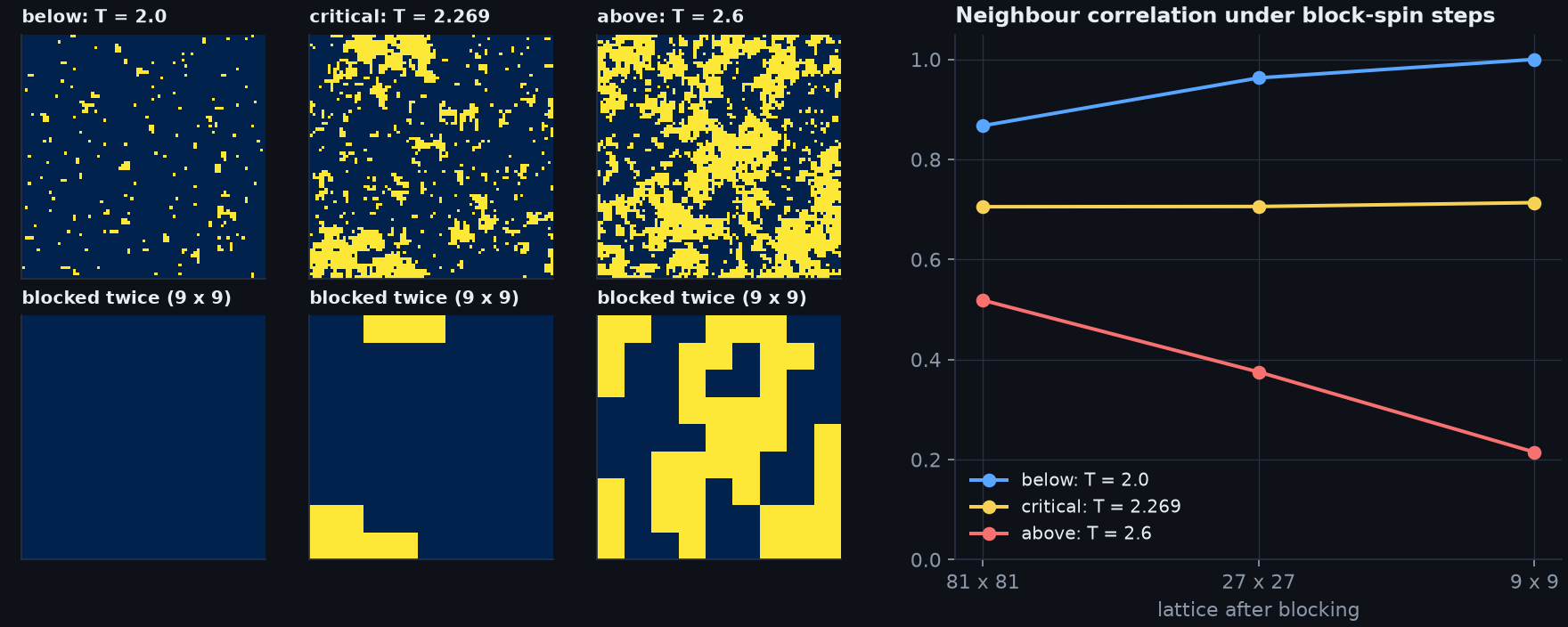
Leo Kadanoff's idea explains it. Replace each three by three block of spins by a single spin, chosen by majority vote, and look again. Then do it again. Below the critical temperature, each coarse-graining makes the picture more ordered: the correlation between neighbours flows to one. Above it, each step makes the picture more random: the correlation flows to zero. At the critical temperature, the coarse-grained picture looks statistically the same as the original, at every scale. The neighbour correlation stays near point seven. This is a fixed point of the coarse-graining. Kenneth Wilson turned the idea into the renormalization group, and a Nobel Prize.
Now the surprise. Systems with completely different microphysics have the same critical exponents: the two-dimensional Ising model and a layered crystal of rubidium cobalt fluoride; a three-dimensional magnet, and carbon dioxide at its liquid-gas critical point. They form a universality class. The renormalization group explains why: under coarse-graining, all of them flow to the same fixed point, and the microscopic details are irrelevant to where they end up. Robert Batterman argued that this kind of explanation requires discarding detail, by taking a limit, rather than deriving the behaviour from the details, and that it is a genuine case of emergence. Jeremy Butterfield replied that emergence and reduction are compatible here: the behaviour is novel and robust, and still deducible in the limit.
What it establishes: the Ising model; Onsager (1944); Yang (1952); Kadanoff (1966); Wilson; universality; Batterman (2002); Butterfield (2011).; Computed on screen: three lattices;
13Models and idealizationAdvanced2 min
Science runs on models that are known to be false. The textbook pendulum replaces the sine of the angle by the angle itself. Then its period is the same at every amplitude: Galileo's isochronism, and the principle of the pendulum clock. The exact period divides that by the arithmetic-geometric mean of one and the cosine of half the amplitude. The Reasoner computes how false the idealization is. At ten degrees the error is a fifth of a percent. At ninety degrees it is eighteen percent, and near the top it diverges. The idealized model is false at every amplitude, and yet it explains why pendulum clocks keep time. Why do false models explain?
Michael Weisberg distinguishes three kinds of idealization. Galilean idealization distorts to make a problem tractable, and expects to remove the distortion later: the frictionless plane. Minimalist idealization keeps only the factors that make a difference. The Ising model is a minimal model: it is false about every real magnet, and explains their critical behaviour because the falsehoods are irrelevant, as the last chapter showed. And multiple-models idealization keeps incompatible models side by side, like the liquid-drop and shell models of the atomic nucleus. Nancy Cartwright went further: the fundamental laws of physics are true only of models, never of the messy world. The statistician George Box's summary: all models are wrong, but some are useful.
Models increasingly come as computer simulations. Climate, galaxy formation and protein folding are studied largely by computation. Wendy Parker and Margaret Morrison argue that a simulation can be an experiment, performed on a model rather than on the world. The worry is that an experiment can surprise us about nature, while a simulation can only surprise us about our own equations. Eric Winsberg answers that simulations need their own epistemology: verifying the code, validating against data, and checking that the result is robust across different models. The question applies to this series: every number on screen comes from a simulation the Reasoner ran. What, exactly, has each one shown?
What it establishes: idealization; Weisberg (2013); Batterman and Rice (2014); Cartwright (1983); Box (1976); Parker, Morrison, Winsberg.; Computed on screen: the exact pendulum period against the idealized one
14Demarcation revisitedAdvanced3 min
Where does science end? The Vienna Circle answered with verifiability, which Church's argument emptied. Karl Popper answered with falsifiability: a theory is scientific if it forbids something, so that some observation could refute it. The trouble is that astrology does make falsifiable predictions, and they fail. By Popper's test it is science, only bad science. Kuhn proposed instead that science is marked by normal puzzle-solving, and astrology never had puzzles to solve. Lakatos called pseudosciences degenerating research programmes, and so classed Freudian and Marxist theory as he saw them. In 1983 Larry Laudan declared the problem dead: there are no necessary and sufficient conditions for being science, and we should ask of each claim whether it is well supported.
The problem did not stay dead. Massimo Pigliucci and Maarten Boudry revived it in 2013 with a different logic: being scientific is a cluster concept, like Wittgenstein's game. There are many marks: testability, a track record, self-correction, criticism by peers, coherence with other sciences, transparency of method, progress over time. None is necessary, but enough of them together make the difference. The stakes are practical. Courts must decide what counts as scientific evidence, as the United States Supreme Court did in Daubert in 1993, and whether creationism may be taught as science, as a federal court decided in McLean versus Arkansas. And new cases keep arriving: whether string theory is testable, and whether a machine-learned model that predicts well but that no one understands is a scientific theory.
The demarcation question became urgent in fundamental physics. String theory has made no prediction testable at energies we can reach, after fifty years of work. Richard Dawid argued that it can still be confirmed, without new data, by three arguments. No alternatives: despite great effort, nothing else unifies gravity with quantum fields as well. Unexpected explanatory coherence: it explains things it was not designed for, like the entropy of black holes. And a meta-inductive argument: theories supported in these ways have tended to be confirmed later. George Ellis and Joseph Silk replied in Nature with a call to defend the integrity of physics: without testability, it is not science. Read in Bayesian terms, as Part 13 would, Dawid's arguments are evidence about the space of alternatives, and evidence of that kind can raise a probability. Whether it is enough is the old question in a new place.
What it establishes: Popper (1934); Kuhn; Lakatos; Laudan (1983); Pigliucci and Boudry (2013); Dawid (2013); Ellis and Silk (2014).
15Values in scienceApplied3 min
The ideal of value-free science holds that ethical and political values may choose which questions science asks, but must not touch its answers. Richard Rudner argued in 1953 that this is impossible. Scientists accept and reject hypotheses. No evidence makes a hypothesis certain, so accepting one means deciding that the evidence is enough. How much evidence is enough depends on how bad it would be to be wrong. His example: before declaring that a drug contains no toxic ingredient, we need far stronger evidence than before declaring a batch of belt buckles free of defects. So the scientist, as a scientist, makes value judgements.
The Reasoner turns Rudner's point into a calculation. A test statistic is distributed one way if a chemical is safe, and shifted if it is toxic. We declare it toxic above some threshold. If both errors cost the same, the threshold that minimizes expected loss sits at one point three, with a false-alarm rate of nearly ten percent. If missing a toxin is ten times worse than a false alarm, the best threshold drops below zero, and we call the chemical toxic more than half the time it is safe. If false alarms are ten times worse, the threshold rises to nearly three, and we catch fewer than one toxin in ten. Same data, same statistics, different conclusions. The difference is in the costs, and the costs are value judgements.
Two replies shaped the debate. Richard Jeffrey answered Rudner in 1956: scientists should not accept hypotheses at all, but report probabilities, the programme of Part 13, and leave decisions to those who must make them. The rejoinder is that choosing models, priors and which results to report involves the same kind of judgement. Heather Douglas distinguished two roles: values may play an indirect role, deciding how much evidence is enough, but never a direct role, standing in for evidence that is missing. The ideal that results is not value-free science, but science whose values are explicit and kept in their place.
If values cannot be removed from individual scientists, perhaps objectivity lives elsewhere. Robert Merton described the norms of science as an institution in 1942: results are shared, claims are judged by impersonal criteria, scientists are disinterested, and scepticism is organized. Ernan McMullin separated epistemic values, like accuracy, scope and simplicity, from non-epistemic ones. Helen Longino argued that objectivity belongs to communities, not to individuals. A community is objective to the degree that it has public venues for criticism, responds to criticism, shares standards, and gives its members equal authority. Her examples came from research on sex differences, where background assumptions went unexamined until critics who did not share them took part. Diversity becomes an epistemic resource, a theme of Part twelve's models of scientific networks.
What it establishes: Rudner (1953); Jeffrey (1956); Douglas (2009); Merton (1942); McMullin (1982); Longino (1990).; Computed on screen: the best threshold under three costs of error
16AI scientistsApplied3 min
Can a machine make a scientific discovery? In 1978 Pat Langley and Herbert Simon's program BACON was given planetary data: each planet's distance from the Sun and its period. The Reasoner runs a miniature version. It forms products of small powers of distance and period, forty-eight in all, and looks for one that stays constant across the planets. It finds the cube of the distance over the square of the period, constant to a tenth of a percent, while every other term varies by half its size or more. That is Kepler's third law, which Kepler found in 1618 after years of searching. Critics noted that the hard part had been done for the machine: someone chose the variables, cleaned the data, and decided that a constant was worth looking for.
Machine discovery is no longer a toy. DeepMind's AlphaFold predicts the three-dimensional structures of proteins close to experimental accuracy; Demis Hassabis and John Jumper shared the 2024 Nobel Prize in Chemistry for it, with David Baker. FunSearch paired a language model that proposes programs with an evaluator that scores them, and found new constructions in a problem of combinatorics. AlphaEvolve extended the approach to algorithms, including a way of multiplying four by four complex matrices with forty-eight multiplications. Systems now propose, run and write up experiments of their own, with contested quality. Hans Reichenbach distinguished the context of discovery from the context of justification. Machines have entered the first; evidence still governs the second.
Does a model that predicts explain? Paul Humphreys called the problem epistemic opacity: no human can survey the steps by which a large computation reached its output. Henk de Regt argued that understanding requires an intelligible theory, one we can use to reason about consequences without calculating. Emily Sullivan replied that opacity matters less than link uncertainty: whether we know how the model's features connect to the phenomena. The accounts of this part become tests. Does the model unify? Does it track causes? Do its relations survive intervention? Are they invariant across environments? A model that passes them explains, whoever, or whatever, built it.
What it establishes: BACON (Langley 1978); AlphaFold; FunSearch; AlphaEvolve; Reichenbach (1938); Humphreys; de Regt; Sullivan.; Computed on screen: 48 power products of the planets' data
Recap, problems, and where this comes backAll tracks2 min
Let's gather what we built. Verificationism and its collapse under Church's argument; Hempel's laws and the counterexamples to them. Unification, with Newton's moon test, and mechanisms. Kuhn's revolutions, with a toy cascade, and the methodologies of his critics. Underdetermination, from Newton's absolute space to a loose cable at OPERA. The no-miracles argument, its base rate, and the history of failed theories: this part's brick in the Wall. Structural realism and constructive empiricism. Reduction and emergence, with the Ising model renormalized. And models, demarcation, values, and machines that discover.
The Reasoner has a new module, science. It checks Church's entailments, derives flagpoles and moons, runs the toy revolution and two Newtonian worlds, computes no-miracles posteriors and Fresnel's equations, samples and coarse-grains the Ising model against Onsager's exact answer, recovers temperature from molecules, measures how false the pendulum is, sets thresholds under inductive risk, and rediscovers Kepler's law. And the Wall has its eighteenth brick.
Six problems, with full solutions in this part's notes. Church's sentence; the flagpole as an intervention; the base rate that makes success a coin flip; Galilean invariance; a checkerboard coarse-grained; and a threshold under inductive risk. Pause here, and try them.
Where this comes back. Mechanisms and explanation in biology, in Part 19. Laws of nature and chance, in Part 24. Absolute space and symmetry, in Part 25. Realism about quantum theory, in Part 26. Multiple realizability, in Part 30. Inductive risk and fair algorithms, in Part 41. And machines that do science, in the finale. Next, Part 19: life.
The books and papers this part follows are on screen, and in the notes. Thanks for watching.
Where it goes next. Mechanisms and explanation in biology follow in Part 19; laws of nature and chance in Part 24; absolute space and symmetry in Part 25; realism about quantum theory in Part 26; multiple realizability in Part 30; inductive risk and fair algorithms in Part 41; machines that do science in the finale.
Key results
The part's results in one place, for revision.
Try it
Lab 18 · Block spins: the flow to order, to disorder, and the fixed point
Sample an 81 by 81 Ising lattice with the Reasoner's Swendsen-Wang sampler at T = 2.0, at Onsager's critical temperature and at T = 2.6, then replace each 3 by 3 block by its majority, twice. The neighbour correlation must rise below the critical temperature, fall above it, and barely move at it; the magnetization at T = 2.0 is checked against Onsager's exact value.
python -m videos.philosophy.labs 18
needs numpy, scipy, matplotlib · download lab18.py ·
source on GitHubbelow: T = 2.0: neighbour correlation at 81, 27, 9 0.867 0.963 1.000
critical: T = 2.269: neighbour correlation at 81, 27, 9 0.705 0.706 0.714
above: T = 2.6: neighbour correlation at 81, 27, 9 0.518 0.375 0.215
|m| at T = 2.0: sampled, Onsager's exact value 0.906 0.911
P(true | successful) at base rates 0.5, 0.05, 0.01 0.95 0.50 0.16
Coarse-graining throws detail away, and what survives depends only on which side of the critical temperature the lattice is on: that insensitivity to microscopic detail is what universality means, and why Batterman calls the explanation emergent.The code (77 lines; it asserts its own result)
"""Lab 18: sample a 2D Ising model below, at and above the critical temperature and coarse-grain it by block spins."""

import numpy as np

from videos.coursekit import labs
from explainer.philosophy.reasoner import science as Sc

TITLE = "Block spins: the flow to order, to disorder, and the fixed point"
GOAL = ("Sample an 81 by 81 Ising lattice with the Reasoner's Swendsen-Wang sampler at T = 2.0, at Onsager's "
        "critical temperature and at T = 2.6, then replace each 3 by 3 block by its majority, twice. The "
        "neighbour correlation must rise below the critical temperature, fall above it, and barely move at it; "
        "the magnetization at T = 2.0 is checked against Onsager's exact value.")
TASKS = [
    "Move the two outer temperatures towards the critical one (2.2 and 2.35). How many blocking steps does it now "
    "take to tell them from the fixed point, and what would a larger lattice change?",
    "Replace the majority rule by decimation (keep the centre spin of each block). Does the flow still separate "
    "the three temperatures?",
    "Use Sc.no_miracles to find the base rate at which a successful theory is as likely false as true, then make "
    "false theories succeed 20% of the time and find it again.",
]


def flow(T, seed, L=81, burn=100, samples=10, gap=15):
    """Mean neighbour correlation at each blocking level (81, 27, 9), and mean |m|, over several samples."""
    s = Sc.ising_sw(L, T, burn, seed, np.ones((L, L), int) if T < Sc.TC else None)
    corr, mags = [], []
    for k in range(samples):
        s = Sc.ising_sw(L, T, gap, seed + 1000 + k, s)
        levels = [s, Sc.block_spin(s)]
        levels.append(Sc.block_spin(levels[1]))
        corr.append([Sc.nn_corr(x) for x in levels])
        mags.append(abs(s.mean()))
    return np.mean(corr, axis=0), float(np.mean(mags)), levels


def run(seed=0):
    lab = labs.Lab()
    temps = [("below: T = 2.0", 2.0), ("critical: T = 2.269", Sc.TC), ("above: T = 2.6", 2.6)]
    out = {}
    for i, (name, T) in enumerate(temps):
        out[name] = flow(T, 100 * seed + i)
        c = out[name][0]
        lab.row(f"{name}: neighbour correlation at 81, 27, 9", "   ".join(f"{x:.3f}" for x in c))
    lo, mid, hi = (out[name][0] for name, _ in temps)
    assert lo[0] < lo[1] < lo[2] and lo[2] > 0.97, "below T_c the blocked lattice flows to order"
    assert hi[0] > hi[1] > hi[2] and hi[2] < 0.4, "above T_c it flows to disorder"
    assert abs(mid[1] - mid[0]) < 0.7 * min(lo[1] - lo[0], hi[0] - hi[1]), "at T_c one blocking barely moves it"
    assert hi[2] < mid[2] < lo[2]
    m, exact = out[temps[0][0]][1], Sc.onsager_m(2.0)
    assert abs(m - exact) < 0.03, "Onsager's magnetization"
    lab.row("|m| at T = 2.0: sampled, Onsager's exact value", f"{m:.3f}   {exact:.3f}")
    nm = [Sc.no_miracles(b) for b in (0.5, 0.05, 0.01)]
    assert abs(nm[0] - 0.95) < 1e-9 and abs(nm[1] - 0.5) < 1e-9 and nm[2] < 0.2
    lab.row("P(true | successful) at base rates 0.5, 0.05, 0.01", "   ".join(f"{x:.2f}" for x in nm))
    lab.note = ("Coarse-graining throws detail away, and what survives depends only on which side of the critical "
                "temperature the lattice is on: that insensitivity to microscopic detail is what universality "
                "means, and why Batterman calls the explanation emergent.")

    fig = labs.figure(1, size=(11, 4.4))[0]
    fig.clear()
    grid = fig.add_gridspec(2, 5, width_ratios=[1, 1, 1, 0.15, 2.2])
    for i, (name, T) in enumerate(temps):
        for j, lv in enumerate((out[name][2][0], out[name][2][2])):
            a = fig.add_subplot(grid[j, i])
            a.imshow(lv, cmap="cividis", vmin=-1, vmax=1, interpolation="nearest")
            a.set_xticks([])
            a.set_yticks([])
            a.grid(False)
            a.set_title(name if j == 0 else "blocked twice (9 x 9)", fontsize=9)
    a = fig.add_subplot(grid[:, 4])
    for (name, T), color in zip(temps, (labs.BLUE, labs.GOLD, labs.RED)):
        a.plot([0, 1, 2], out[name][0], marker="o", color=color, label=name)
    a.set_xticks([0, 1, 2], ["81 x 81", "27 x 27", "9 x 9"])
    a.set(title="Neighbour correlation under block-spin steps", xlabel="lattice after blocking", ylim=(0, 1.05))
    a.legend(loc="lower left")
    lab.fig = fig
    return lab
Now change it
- Move the two outer temperatures towards the critical one (2.2 and 2.35). How many blocking steps does it now take to tell them from the fixed point, and what would a larger lattice change?
- Replace the majority rule by decimation (keep the centre spin of each block). Does the flow still separate the three temperatures?
- Use Sc.no_miracles to find the base rate at which a successful theory is as likely false as true, then make false theories succeed 20% of the time and find it again.
Problems, with solutions
Try each problem before opening its solution.
-
Show that Church's \(D\) is not entailed by \(O_1, O_2, O_3\) alone, so it is not itself an observation.
Solution
Church's sentence is \(D = (\lnot O_1 \land O_2) \lor (O_3 \land \lnot S)\). Make all three observations true: the first disjunct is false, and \(D\) reduces to \(\lnot S\). So whether \(D\) holds is not settled by \(O_1, O_2, O_3\); it depends on the arbitrary \(S\). \(D\) is not entailed by the observations (nor is its negation), so it is not itself an observation report. It is a theoretical sentence that Ayer's criterion counts as directly verifiable, which is how every \(S\) slips in.
-
State the flagpole as a Woodward intervention. Which variable can be set, and which follows?
Solution
The variables are the pole's height \(H\), the sun's elevation \(\theta\) and the shadow's length \(L\), with \(L = H/\tan\theta\). On Woodward's account an explanation cites a relation that stays true under interventions. Set the height (cut the pole, or lengthen it) with \(\theta\) fixed, and the shadow changes as the equation says: \(H\) can be set and \(L\) follows. Set the shadow by some other means (cover the ground, cast another shadow over it) and the pole's height does not change. The relation is invariant under interventions on \(H\) but not on \(L\), so the height explains the shadow and not the reverse.
-
With \(P(S \mid T) = 0.9\) and \(P(S \mid \lnot T) = 0.1\), what base rate makes \(P(T \mid S) = 1/2\)?
Solution
Let \(\pi\) be the base rate of true theories. \(P(T \mid S) = 0.9\pi / (0.9\pi + 0.1(1 - \pi))\). Setting this to \(1/2\) gives \(0.9\pi = 0.1(1 - \pi)\), so \(\pi = 0.1\). If one candidate theory in ten is true, success makes a theory exactly as likely true as false; below that, a successful theory is more likely false. The no-miracles argument is only as strong as the unknown base rate.
-
Show that a Galilean boost leaves Newton's equations for two bodies unchanged.
Solution
A boost is \(x' = x - vt\), \(t' = t\). Differentiating twice, \(\ddot x' = \ddot x\): accelerations are the same in both frames. Newtonian forces between two bodies depend on their separation, and \(x_1' - x_2' = x_1 - x_2\), so the forces are unchanged, and masses are unchanged. So \(m_1 \ddot x_1 = F(x_1 - x_2)\) and \(m_2 \ddot x_2 = -F(x_1 - x_2)\) hold in the boosted frame in the same form. Velocities change by \(v\), so no experiment on the pair reveals absolute velocity: Galileo's ship.
-
Coarse-grain a \(9 \times 9\) checkerboard by \(3 \times 3\) majority. What do you get, and why?
Solution
Every \(3 \times 3\) block of a checkerboard has five squares of one colour and four of the other, and the majority colour is the colour of its corners. The corner of block \((i, j)\) sits at \((3i, 3j)\), whose colour has the parity of \(3i + 3j\), that is, of \(i + j\). So the coarse-grained picture is a \(3 \times 3\) checkerboard: the pattern is a fixed point of the coarse-graining, as perfect alternation looks the same at every scale. (With an even block size the blocks would tie.) Coarse-graining once more leaves a single square.
-
In the inductive-risk model, find the threshold when the two costs are equal and \(P(\text{toxic}) = 1/2\).
Solution
In the Reasoner's model the statistic is \(N(0, 1)\) for a safe chemical and \(N(1.5, 1)\) for a toxic one. With equal costs and equal priors, expected loss is smallest where the two densities cross, halfway: threshold 0.75. Both error rates are then 22.7%. The film's threshold of about 1.3, with equal costs, came from its prior of 0.3 on toxicity; with the prior at one half the threshold falls, and the same data are called toxic more often.
Notes and sources
Sources
Texts: Godfrey-Smith, Theory and Reality (2003; 2nd ed. 2021); Salmon, Four Decades of Scientific Explanation (1989); Kuhn, The Structure of Scientific Revolutions (1962) and The Copernican Revolution (1957); van Fraassen, The Scientific Image (1980) and Laws and Symmetry (1989); Psillos, Scientific Realism: How Science Tracks Truth (1999); Batterman, The Devil in the Details (2002); Douglas, Science, Policy, and the Value-Free Ideal (2009); Weisberg, Simulation and Similarity (2013); Hacking, Representing and Intervening (1983); Ladyman and Ross, Every Thing Must Go (2007); Longino, Science as Social Knowledge (1990); Dawid, String Theory and the Scientific Method (2013).
Papers: Duhem (1906); Neurath (1932); Hempel and Oppenheim (1948); Church (1949); Hempel (1950); Quine (1951); Rudner (1953); Jeffrey (1956); Scriven (1959); Nagel (1961); Maxwell (1962); Putnam (1967, 1975); Schaffner (1967); Lakatos (1970); Salmon (1971, 1984); Friedman (1974); Fodor (1974); Laudan (1977, 1981, 1983); Granovetter (1978); Langley (1978); Kitcher (1981); McMullin (1982); Armstrong (1983); Churchland (1985); Worrall (1989); Laudan and Leplin (1991); Ladyman (1998); Machamer, Darden and Craver (2000); Magnus and Callender (2004); Stanford (2006); Strevens (2008); Humphreys (2009); Fahrbach (2011); Okasha (2011); Butterfield (2011); Pigliucci and Boudry (2013); Batterman and Rice (2014); Ellis and Silk (2014); de Regt (2017); Sullivan (2022).
About this partfrom its README
Part 18 of Philosophy, Built (series plan, syllabus): explanation, theory change and scientific realism. Is the electron real? (Thomson's beam; Putnam's no-miracles sentence.) The Vienna Circle and the verification principle, falsifiability's mirror-image trouble, Ayer's 1946 criterion and Church's one-paragraph trivialization (each entailment checked by truth table), Neurath's boat, and what survived; Hempel and Oppenheim's deductive-nomological model, Bromberger's flagpole (computed both ways), the birth-control pills and hexed salt against Salmon's statistical relevance, Scriven's paresis, and what makes a law (gold and uranium spheres; best systems; Armstrong); Newton's moon test (one law, apple and Moon, agreeing within 1%), Friedman and Kitcher's unification, Strevens, mechanisms (Machamer, Darden and Craver), and Salmon's causal processes against the faster-than- light spot; Kuhn's cycle, the Copernican revolution computed (Ptolemy's epicycle and Copernicus's orbits give Mars the same sky, retrograde loops and all), a toy of revolution as a threshold cascade (an analogy: 42% convert in one year), incommensurability and the Necker cube, and Kuhn's five values; Lakatos's research programmes with Neptune and Vulcan, Feyerabend and Laudan; underdetermination with two Newtonian worlds (at rest and moving: every relative quantity the same), the Duhem problem at OPERA (faster-than-light neutrinos and a loose cable, as a Price List), and Quine's web; the no-miracles argument, its base-rate fallacy (Magnus and Callender, computed), and retail arguments (the Arago spot, Perrin's thirteen methods, Hacking's spray); Laudan's list as a timeline, the realism trilemma (Price List) and the Wall's eighteenth brick; structural realism with Fresnel's equations (Brewster's angle, 56.3°) surviving into Maxwell's theory, Newman's objection, and ontic structural realism; constructive empiricism, Maxwell's continuum, Hacking's entity realism, and the best of a bad lot; Nagel's reduction with temperature recovered from 100,000 simulated molecules, multiple realizability, and Putnam's peg; emergence and universality with the 2D Ising model sampled by Swendsen–Wang, Onsager's exact magnetization, Kadanoff block spins flowing to order, disorder or the fixed point, and Batterman's argument; idealization (how false the small-angle pendulum is), Weisberg's three kinds, and simulation; demarcation (Popper, Kuhn, Lakatos, Laudan's obituary, the cluster view) and string theory's non-empirical confirmation; inductive risk (Rudner) as a decision whose threshold moves with the costs of error, Jeffrey and Douglas, and Longino's social objectivity; and AI scientists (a miniature BACON rediscovers Kepler's third law; AlphaFold, FunSearch, AlphaEvolve) and explanation from black boxes.
The worked model results are computed by the Reasoner's new module explainer/philosophy/reasoner/science.py, tested in
tests/philosophy/test_science.py and cached by compute.py.
Chapter notes
| # | Scene | What it establishes | Computed on screen |
|---|---|---|---|
| 0 | Hook |
Thomson (1897); Putnam (1975); realism against anti-realism; the plan. | — |
| 1 | Vienna |
the Vienna Circle (1929); Ayer (1936, 1946); Church (1949); Neurath (1932); Carnap, Quine, Hempel. | Church's four entailments |
| 2 | Laws |
Hempel and Oppenheim (1948); Bromberger's flagpole; Salmon (1971); Scriven (1959); laws (Lewis; Armstrong). | the shadow from the height, and the height from the shadow |
| 3 | Unify |
Newton's moon test; Friedman (1974); Kitcher (1981); Strevens (2008); Machamer, Darden and Craver (2000); Salmon (1984). | g/60² against the Moon's acceleration |
| 4 | Kuhn |
Kuhn (1957, 1962, 1977); Granovetter (1978); Hanson (1958); Okasha (2011). | Mars seen from Earth in both systems; the threshold cascade |
| 5 | Programmes |
Lakatos (1970); Le Verrier, Neptune and Vulcan; Feyerabend (1975); Laudan (1977). | — |
| 6 | Under |
van Fraassen's Newtonian worlds; Duhem (1906); OPERA (2011–12) as a Price List; Quine (1951); Laudan and Leplin (1991); Stanford (2006). | two orbits, at rest and moving; the Duhem conflict and its exits |
| 7 | Miracles |
Putnam (1975); Magnus and Callender (2004); Arago; Perrin (1913); Hacking (1983). | P(true | successful) against the base rate |
| 8 | Meta |
Laudan (1981); Poincaré (1902); the realism trilemma (Price List); Kitcher, Psillos, Fahrbach; the Wall's eighteenth brick. | Laudan's list as a timeline |
| 9 | Structure |
Fresnel (1823) and Maxwell; Worrall (1989); Poincaré; Newman (1928); Ladyman (1998); Ladyman and Ross (2007). | reflectances and Brewster's angle |
| 10 | Empiricism |
van Fraassen (1980, 1989); Maxwell (1962); Churchland (1985); Hacking (1983); Lipton (2004). | — |
| 11 | Reduction |
Nagel (1961); Schaffner (1967); Putnam (1967, 1975); Fodor (1974). | temperature from 100,000 molecules |
| 12 | Emergence |
the Ising model; Onsager (1944); Yang (1952); Kadanoff (1966); Wilson; universality; Batterman (2002); Butterfield (2011). | three lattices; |
| 13 | Models |
idealization; Weisberg (2013); Batterman and Rice (2014); Cartwright (1983); Box (1976); Parker, Morrison, Winsberg. | the exact pendulum period against the idealized one |
| 14 | Demarcation |
Popper (1934); Kuhn; Lakatos; Laudan (1983); Pigliucci and Boudry (2013); Dawid (2013); Ellis and Silk (2014). | — |
| 15 | Values |
Rudner (1953); Jeffrey (1956); Douglas (2009); Merton (1942); McMullin (1982); Longino (1990). | the best threshold under three costs of error |
| 16 | Machines |
BACON (Langley 1978); AlphaFold; FunSearch; AlphaEvolve; Reichenbach (1938); Humphreys; de Regt; Sullivan. | 48 power products of the planets' data |
| 17 | Outro |
recap; the Reasoner's module; the Wall; problems; payoffs; references. | — |
Companion material in this repository
The syllabus's plan for this partfrom SYLLABUS.md, the plan of record
- The Vienna Circle; verificationism and its self-refutation problem.
- Hempel's deductive-nomological model (1948); its counterexamples (the flagpole, the hexed salt); statistical relevance (Salmon).
- Unification (Friedman, Kitcher); mechanisms (Machamer, Darden and Craver); the causal-mechanical view.
- Kuhn (1962): paradigms, normal science, revolutions, incommensurability; a toy model of anomaly accumulation.
- Lakatos's research programmes; Feyerabend's anarchism; Laudan's problem solving.
- Underdetermination: empirically equivalent theories (Newton's absolute velocity); Duhem–Quine revisited.
- The no-miracles argument (Putnam 1975) and the base-rate fallacy objection (Magnus and Callender 2004), computed with Part 13's credence lab.
- The pessimistic meta-induction (Laudan 1981): the list of successful false theories.
- Structural realism (Worrall 1989): Fresnel's equations survive into Maxwell's. Epistemic vs ontic (Ladyman).
- Constructive empiricism (van Fraassen 1980); the observable/unobservable line.
- Reduction: Nagel's bridge laws; multiple realizability.
- Emergence and universality: why the Ising model and the liquid–gas critical point share exponents. Built: block- spin renormalization of a 2D Ising model on screen, with the flow to the fixed point (Batterman's argument).
- Models and idealization: the frictionless plane; minimal models; simulations as experiments.
- The demarcation problem revisited (Popper, Laudan's obituary, the new demarcation literature).
- Values in science: the argument from inductive risk (Rudner 1953; Douglas).
- AI scientists: automated discovery (BACON, 1978; modern AI-driven discovery claims, cited). What counts as explanation from a black box.
- Recap and Problems.
Built: reasoner.science (the Ising coarse-graining; no-miracles Bayes; Kuhnian anomaly toy, labeled analogy).
Wall: underdetermination; the pessimistic meta-induction.
Price List: the realism trilemma (success is evidence of truth; past successful theories were false; we have no
privileged position).
Visuals: the flagpole and its shadow swapped; Ising spins coarse-graining in blocks; the theory family tree from
Fresnel to Maxwell with structure preserved.
References: Godfrey-Smith; Salmon, Four Decades of Scientific Explanation; Kuhn, Structure; van Fraassen, The
Scientific Image; Psillos, Scientific Realism; Batterman, The Devil in the Details; Douglas, Science, Policy,
and the Value-Free Ideal.
Build the film
python -m videos.philosophy.philosophy18.compute        # the part's numbers, into .cache/philosophy18
python tools/build.py philosophy18                  # render and assemble the film
EXPLAINER_TTS=silent python tools/qa_scene.py philosophy18 Hook   # one chapter, silent, with a contact sheet
Scenes: videos/philosophy/philosophy18. Setup: see the course page. Source of these notes: the README and the scenes' narration.
Build it
python -m videos.philosophy.philosophy18.compute       # every computed item (under a minute; .cache/philosophy18)
python tools/build.py philosophy18 -q l                # 480p preview
python tools/build.py philosophy18                     # 1080p30 -> renders/philosophy18.mp4
python tools/qa_scene.py philosophy18 Emergence        # one chapter, silent, with a contact sheet