Knowledge Among Many
epistemic logic, common knowledge, social epistemology
What changes when everyone knows something, and everyone knows that everyone knows it?
Three children have been playing and two have mud on their foreheads; each sees the others and not herself. Their father says what all of them can already see, that at least one is muddy, and only then can the muddy ones work it out. The part builds the tools to explain why: Hintikka's knowledge as a box, many agents in one model with a line for each agent's ignorance, and public announcements that delete worlds, run on three cards, Cheryl's birthday and the muddy children up to eight. What the father adds is common knowledge, defined as a tower of 'everyone knows' and computed as reachability. The turn is the coordinated attack: over a channel that can lose messages each delivered messenger adds one storey to the tower and common knowledge never arrives, a theorem that distributed systems live with through quorums, timeouts and probabilistic finality. Rubinstein's email game, Aumann's agreement theorem as a dialogue, private announcements, the Russian cards and Fitch's unknowable truths follow. The part ends with knowledge from others: testimony, peer disagreement, the diversity prediction theorem behind Galton's ox, and Zollman's scientists, who find the truth more often when they talk less.
What you need. Kripke models from Part 4. The last chapters use a mean, a variance and Bayes's rule.
- The calculation
- dynamic epistemic logic
- The wall
- coordinated attack; Fitch
- Built toy
- muddy children; Zollman networks
What you will be able to do
Introductory
- Solve the muddy children puzzle for any number of muddy children, and say exactly what the father's announcement adds to what each child already knew.
- Tell 'everyone knows' from common knowledge with an example where the first holds and the second fails.
- State the equal weight and steadfast views of peer disagreement and apply each to a case.
Advanced
- Evaluate K, E and C formulas in a multi-agent S5 model and update the model by a public announcement.
- Prove that n delivered messages give n - 1 levels of mutual knowledge of the plan and never common knowledge.
- Derive Fitch's result that if every truth is knowable then every truth is known.
Research
- Compute a product update with an action model for a private announcement, and state the reduction axioms of public announcement logic.
- Show by iterated best responses that almost common knowledge does not support coordination in Rubinstein's email game, and state Monderer and Samet's common p-belief.
Applied
- Explain how quorum protocols and probabilistic finality reach agreement without common knowledge, and what FLP says they cannot guarantee.
- Use the diversity prediction theorem to say when averaging forecasts helps and when a shared bias defeats it.
- Describe the Zollman effect and what it suggests about how densely a research community should share early results.
Contents
Each chapter has a home level. Choose a track to see what to read and watch: Introductory 19 min · Advanced 44 min · Research 49 min · Applied 29 min.
- 0Who knows what everyone knows?Introductory2 min
- 1Knowledge as a boxAdvanced4 min
- 2Many minds, one modelIntroductory3 min
- 3The muddy childrenIntroductory3 min
- 4Common knowledgeIntroductory4 min
- 5The coordinated attackAdvanced3 min
- 6Machines that must agreeApplied4 min
- 7Almost common knowledgeResearch3 min
- 8Agreeing to disagreeAdvanced3 min
- 9Announcements, secrets and liesResearch3 min
- 10A secret told in publicAdvanced2 min
- 11Unknowable truthsAdvanced3 min
- 12Taking someone's wordIntroductory3 min
- 13When peers disagreeIntroductory3 min
- 14The wisdom of crowdsApplied3 min
- 15Networks of inquiryApplied3 min
- Recap, problems, and where this comes backAll tracks2 min
Also on this page: Lecture · Key results · Try it · Lab · Problems · Notes and sources · 中文 · Build the film.
Lecture
The text of each chapter is the film's narration, as it is spoken, so you can read along or revise without the film. The pictures are in the film.
Who knows what everyone knows?Introductory2 min
Part 11 asked what it is for one person to know something. Part 12 asks what happens when there are many of us: when I know what you know, and you know that I know it, and so on. Some of the oldest puzzles in logic, and some of the newest theorems in computer science, live here.
Here is the puzzle that runs through this part. Three children have been playing; two of them, Ann and Bob, have mud on their foreheads. Each can see the others' foreheads but not her own. Their father says: at least one of you has mud on your forehead. Every child already knew that: each could see a muddy face. Yet after the father says it aloud, and asks a few times who knows whether they are muddy, the muddy children can work it out, and without his sentence they never could. What did the sentence change? Not what anyone knew. It changed what everyone knew that everyone knew, all the way up. That is common knowledge, and it turns out to be the hinge of conventions, of contracts, of markets, and of every computer network that has to agree on anything.
The plan. Knowledge as a box, Hintikka's logic of knowledge. Many agents in one model, and the muddy children solved. Common knowledge, and the theorem that no exchange of messages over an unreliable channel can create it: this part's brick in the Wall. The engineers who build systems that must agree anyway. Aumann's theorem that rational people cannot agree to disagree; private messages and lies; and Fitch's proof that some truths cannot be known. Then knowledge from other people: testimony, disagreement and crowds. And communities of scientists, where, the Reasoner finds, less communication can find more truth.
What it establishes: the tower of "knows that"; the muddy children as the running puzzle; the plan.
1Knowledge as a boxAdvanced4 min
The logic of knowledge begins with a short book by Jaakko Hintikka, in 1962. Its idea is the possible-worlds semantics of Part 4. Four ways the day could be: rain or sun, warm or cold. In fact it is raining and warm. Ann looks out of the window. She sees the rain, but not the temperature. So she cannot tell the warm rainy world from the cold rainy one; a line joins them. Ann knows it is raining: rain holds in every world she cannot rule out. She does not know it is warm: a cold world is still open. To know phi is for phi to hold in every world compatible with what one knows. Knowledge is a box.
Which laws does knowledge obey? Each axiom corresponds, as we proved in Part 4, to a property of the relation between worlds. K: if you know p implies q, and know p, you know q. It holds on every frame. T: what is known is true. Reflexive frames: the actual world is always among those you cannot rule out. Four: if you know, you know that you know. Transitive frames. Five: if you don't know, you know that you don't. Euclidean frames. All four together give the system S5, whose relation is an equivalence. Then each agent's knowledge is a partition of the worlds into cells, and what she knows is which cell she is in. This is the standard model in economics and computer science.
Belief obeys different laws. A belief can be false, so the axiom T goes. In its place, consistency: if you believe phi, you do not believe its negation. That is the axiom D, true on frames where every world sees at least one world. The introspection axioms, four and five, are usually kept. The result is the system KD45. G. E. Moore noticed a paradox here. The sentence 'it's raining, but I don't believe it' can perfectly well be true. Yet nobody can consistently believe it: in KD45, believing it would mean believing that it rains, and, by introspection, believing that one does not believe it. Robert Stalnaker, combining the two logics in 2006, showed that on natural assumptions, to believe something is to believe that you know it.
S5 is an idealization, and philosophers have pressed on both ends of it. Negative introspection is too strong. You believe you know where your keys are; someone moved them. You do not know where they are, and you do not know that you do not know. And Part 11 showed that even positive introspection fails when knowledge has margins for error. The other problem is logical omniscience. By axiom K, knowledge is closed under logical consequence, so anyone who knew the axioms of arithmetic would know whether Goldbach's conjecture is true. Repairs include models of awareness, impossible worlds, and reasoners with bounded resources. So S5 describes a perfect reasoner with perfect access to herself. Its power is that it lets us reason exactly about many such reasoners at once, which is where we go next.
What it establishes: knowledge as a box (1962); K, T, 4, 5 and their frames; belief as KD45, Moore's paradox, Stalnaker (2006); the critics.
2Many minds, one modelIntroductory3 min
Hintikka's logic comes into its own with several agents. Deal three cards, zero, one and two, to Ann, Bob and Cath. There are six possible deals, six worlds; world zero one two means Ann holds zero, Bob one, Cath two. Each person sees only her own card, so she cannot tell apart two deals that give her the same card. Draw one coloured line for each such pair: blue for Ann, orange for Bob, purple for Cath. Now the Reasoner evaluates, in the actual deal, zero one two. Ann knows she holds zero. She does not know that Bob holds one: Cath might. She does know that Bob does not hold zero, and that card one is with Bob or Cath. And the logic nests. Bob knows that Ann knows she lacks card one. But Bob does not know whether Ann knows his card; in fact she doesn't, and every world Bob considers possible agrees.
Now someone speaks. Ann announces, truthfully and to everyone: I hold card zero. A public announcement deletes every world in which it is false. Four deals vanish, with their lines. In what is left, Bob knows that Cath holds two, and Cath knows that Bob holds one. And because everyone heard it, and everyone saw that everyone heard it, it is common knowledge that Ann holds zero. Speech changes the model. Jan Plaza wrote down the logic of public announcements in 1989; it is the start of dynamic epistemic logic, which we will use all through this part.
A puzzle that went round the world in 2015 is pure public announcement logic. Cheryl gives Albert and Bernard ten possible dates for her birthday. She tells Albert only the month, and Bernard only the day. Albert says: I don't know when it is, but I know that Bernard doesn't know either. For Albert to be sure of that, his month must contain no day that appears only once; May and June each contain one, nineteen and eighteen. Those months are deleted. Bernard says: now I know. So his day is not fourteen, which appears in both July and August. Albert says: then I know too. Only July has a single date left. The Reasoner runs the three announcements on the model and is left with one world: July the sixteenth.
What it establishes: three cards, six worlds, one colour per agent; a public announcement (Plaza 1989); Cheryl's birthday.; Computed on screen: six nested knowledge claims; who knows what after "I hold 0"; July 16 after three announcements
3The muddy childrenIntroductory3 min
Now the puzzle from the start. With three children there are eight worlds, one for each way the mud could lie: one means muddy, zero clean. They form a cube. The actual world is one one zero: Ann and Bob are muddy, Cy is clean. Each child sees every forehead but her own, so she cannot tell apart two worlds that differ only at her own place: the cube's edges, one colour per child. The father announces that at least one child is muddy. That deletes world zero zero zero. He asks: does anyone know whether you are muddy? Nobody does, and they say so. That public fact deletes every world where some child would have known: the three worlds with exactly one muddy child, since that child would have seen only clean faces. In our world, one one zero, that is already enough: Ann and Bob can now tell where they are, as we will see. Had all three been muddy, a second round of 'nobody knows' would delete the worlds with two muddy children, leaving only one one one.
Here is the same thing from inside Ann's head. She sees that Bob is muddy and Cy is clean. So the world is one one zero, if she is muddy, or zero one zero, if she is not. If it were zero one zero, Bob would see two clean faces, and, told that someone is muddy, he would know at once that it was him. But in the first round, Bob says he does not know. So the world is not zero one zero. It is one one zero, and Ann is muddy. Bob reasons the same way about Ann. The Reasoner, running the announcements on the model, confirms it: the two muddy children know in round two, and Cy, hearing them, in round three.
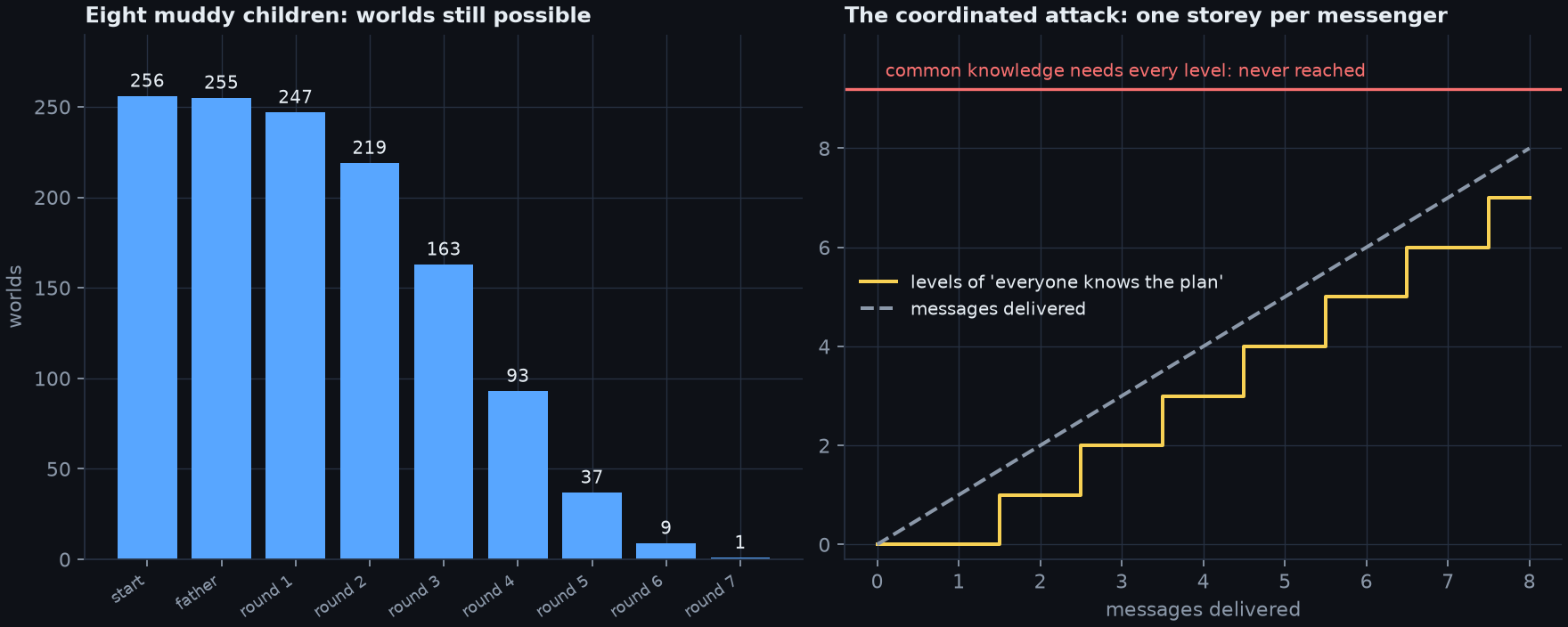
The Reasoner does not need to stop at three. With eight children there are two hundred and fifty-six worlds, and in the actual one, five children are muddy. The father's sentence removes one world. Then each 'nobody knows' removes every world with one fewer muddy child than the last: from two hundred and fifty-five, to two hundred and forty-seven, two hundred and nineteen, one hundred and sixty-three, ninety-three, and then the muddy children know. With k muddy children, they all know in round k. And the Reasoner checks the counterfactual: without the father's sentence, the children can say 'nobody knows' forever, and not one world is removed.
What it establishes: the cube of worlds; the children's reasoning; eight children.; Computed on screen: 8 → 7 → 4 worlds; round 2 for the muddy two; 256 → 255 → 247 → 219 → 163 → 93; nothing without the father
4Common knowledgeIntroductory4 min
So what did the father's sentence add? Say that everyone knows phi when each child knows it. Everyone knows that everyone knows is E twice, and so on. Common knowledge is the whole infinite tower at once: everyone knows, and everyone knows that everyone knows, and so on for ever. The Reasoner measures how high the tower stood before the father spoke. With one muddy child, not even everyone knew that someone was muddy: the muddy child saw only clean faces. With two, everyone knew it, but not that everyone knew it. With three, E squared held, but not E cubed. In no case was it common knowledge. With k muddy children, the tower already stood k minus one storeys high. The father's sentence added every storey above.
There is a picture of common knowledge. Phi is common knowledge at a world when phi holds at every world you can reach from it, by any chain of steps, along anyone's lines. Each step is one more storey of 'knows that'. From one one zero, Ann's line leads to zero one zero, and from there Bob's line leads to zero zero zero. At zero zero zero, nobody is muddy. So before the father spoke, 'someone is muddy' was not common knowledge: Ann thinks Bob might think that nobody is muddy. The father's announcement deletes zero zero zero, and with it every chain that reached it. Robert Aumann gave the definition its exact form in 1976, in terms of partitions: an event is common knowledge when it contains the whole cell of the actual world in the finest partition coarser than everyone's, the meet.
The idea first came from philosophy. David Lewis, in his book Convention of 1969, asked why everyone in Britain drives on the left. Not because a law makes each driver want to; because each expects the others to, and expects them to expect her to, and so on up. A convention, Lewis argued, is a regularity sustained by common knowledge of such expectations. Money, language, meeting times, and the power of saying something in public all work the same way. And anything that needs common knowledge must find a way to create it. The next chapter shows that, in one important setting, no way exists.
Common knowledge also explains some puzzling social behaviour. Michael Chwe, in Rational Ritual, argued that rituals, rallies and town meetings exist to make things common knowledge. People often gather in a circle, facing inward, so that each can see that everyone else sees. You hear the message, and you see everyone hear it. Chwe found that products people buy because others buy them tend to be advertised on the most-watched broadcasts, where the audience knows that it is an audience. And a revolt needs common knowledge: everyone may privately hate the ruler, but nobody wants to be the first to move, until something public makes the shared hatred common knowledge.
What it establishes: E, E², …, C; common knowledge as reachability; Aumann's meet; Lewis (1969); Chwe (2001).; Computed on screen: the height of the tower before the father spoke: none, E, E²
5The coordinated attackAdvanced3 min
The coordinated attack problem was told by Jim Gray in 1978 and analysed by Joseph Halpern and Yoram Moses. Two generals camp on hills on either side of a valley. In the valley is the enemy. If both attack together, they win. If one attacks alone, his army is destroyed. They can communicate only by messengers, who must cross the valley and may be caught. A sends a messenger: attack at dawn. The messenger gets through. Will B attack? Only if he can be sure that A will. But A does not know the messenger arrived, so A cannot be sure that B knows the plan, and will not attack unless he hears back.
So they acknowledge. B sends back: got it. A sends back: got your got it. And so on, each messenger crossing the valley at risk. The Reasoner builds the model: a world for each number of messengers who got through. A cannot tell apart the worlds where his last messenger did or did not arrive; nor can B. Then it measures, after each number of delivered messages, the height of the tower of 'everyone knows' about the plan. After one message, B knows the plan, but A does not know that B knows. After two, everyone knows it. After three, everyone knows that everyone knows. Each delivered message adds exactly one storey. And the last column never changes. However many messengers get through, the plan is never common knowledge.
The theorem behind this is due to Halpern and Moses. Over a channel that can lose messages, no protocol, however clever, ever makes anything new common knowledge. The proof is an induction. Suppose some run of a protocol attains common knowledge, and take the run that does it with the fewest messages, n. The sender of the last message cannot tell whether it arrived. So the run where it was lost looks exactly the same to him, and whatever he knows in one he knows in the other. Then common knowledge already held after n minus one messages, which contradicts our choice of n. And since attacking together requires common knowledge that both will attack, the generals, if they are cautious, never attack.
This is the twelfth brick in the Wall. The dream: to create common knowledge by sending messages. The wall: Halpern and Moses's theorem, that over an unreliable channel it cannot be done. What it forces: act without certainty. Settle for probabilities, deadlines and timeouts, and for agreement that is very likely rather than guaranteed. That is exactly what the engineers of the next chapter do.
What it establishes: the coordinated attack (Gray 1978; Halpern and Moses 1990); the proof; the Wall's twelfth brick.; Computed on screen: after n delivered messages, Eⁿ⁻¹ and never C
6Machines that must agreeApplied4 min
Computers face the generals' problem every second, and engineers have learned to live with it. In 1982 Leslie Lamport, Robert Shostak and Marshall Pease made it harder. Some of the generals may be traitors, who send different orders to different peers. The loyal generals must still agree on one plan, and if the commander is loyal, on his. They proved that, with oral messages, this is possible exactly when more than two thirds of the generals are loyal: with f traitors you need at least three f plus one generals. Four generals can tolerate one traitor; three cannot. With unforgeable signatures, any number of traitors can be tolerated. Byzantine agreement now runs inside aircraft control systems, replicated databases and blockchains.
In 1985 Michael Fischer, Nancy Lynch and Michael Paterson proved the most famous impossibility result in distributed computing. Suppose there is no shared clock, so a message may take any finite time to arrive. Then a slow machine looks exactly like a crashed one. FLP: no deterministic protocol is guaranteed to reach consensus if even one machine may crash. The proof finds a state from which either decision is still possible, and shows that a hostile scheduler, delaying the right message at the right time, can keep the system in such states forever. Every practical system escapes the same way. It gives up the guarantee that it will finish, and never gives up the guarantee that, when it finishes, everyone agrees.
How do real systems agree, then? Leslie Lamport's Paxos algorithm, and Raft, its more teachable descendant, rest on one combinatorial fact. A value counts as chosen once a majority of machines has accepted it. Any later leader must hear from a majority before proposing anything. And any two majorities share a member. The Reasoner checks it for five machines: ten possible majorities, forty-five pairs of them, and all forty-five overlap. So a new leader always learns what an old majority chose, and nothing chosen is ever contradicted. That is safety, guaranteed. Progress, liveness, is guaranteed only when the network behaves for long enough, using timeouts and elections, just as FLP said it must be. Your bank, your search engine and your cloud storage all run on this compromise.
Bitcoin, in 2008, took the compromise to its limit. Nobody knows who the participants are, so there is no majority to count; instead the longest chain of blocks wins. A payment buried under z later blocks can still be reversed, if an attacker builds a longer chain in secret. The Reasoner computes Nakamoto's formula for the chance that an attacker ever catches up. With a tenth of the computing power, the chance falls from about one in five, one block deep, to about one in four thousand, six blocks deep; with three tenths, it falls much more slowly. These are the numbers printed in Nakamoto's paper. The chance is never zero. Finality is only probable, which is all the Wall allows.
What it establishes: Byzantine generals (1982), FLP (1985), Paxos and Raft; Nakamoto (2008).; Computed on screen: all 45 pairs of the 10 majorities of five overlap; Nakamoto's catch-up probabilities
7Almost common knowledgeResearch3 min
Perhaps certainty is too much to ask. Surely a very high tower of mutual knowledge is enough? Ariel Rubinstein showed, in 1989, that it is not. Usually the enemy is strong, and neither general should attack. Sometimes it is weak, and only A learns which. Then attacking together wins M for each. Attacking alone, or attacking a strong enemy, loses L, which is worse than M is good. If the enemy is weak, A's computer emails B's computer, and every email that arrives is confirmed automatically, back and forth. Each email is lost with some small chance epsilon, and then the exchange stops. When it stops, each general sees only how many emails his own computer sent.
Suppose both generals start from the obvious plan: attack whenever you know the enemy is weak. The Reasoner computes each type's best reply and repeats. Green squares are types that attack. A general whose computer sent nothing has received nothing, and does not attack. Then A of type one, who sent one email and heard nothing back, thinks it more likely that his own email was lost than that B's reply was; so he expects B not to attack, and stops. Then B of type one reasons the same way about A, and so on up the line. Step by step, the attack sets shrink to nothing. The only equilibrium is never to attack, even after a thousand emails have been exchanged, when each general knows that the other knows, a thousand levels deep. Almost common knowledge is not enough.
Dov Monderer and Dov Samet found the right diagnosis in the same year. Coordination does not need full common knowledge; it needs common p-belief, with p close to one: everyone believes the fact with probability at least p, believes that everyone believes it with that probability, and so on. The Reasoner computes what a general believes in the email game. Whatever his type, he gives probability just over a half, one over two minus epsilon, to his own last email having been lost, however many emails were sent. So the weak enemy is never common p-belief for p above about forty-seven percent. Many messages build a very high tower of knowledge, but its top storey always wobbles, and in strategic settings, the top storey is what matters.
What it establishes: Rubinstein's email game (1989); Monderer and Samet's common p-belief (1989).; Computed on screen: best responses unravel, type by type, to "never attack"; every informed general's belief 0.526 that his last email was lost
8Agreeing to disagreeAdvanced3 min
Common knowledge also constrains disagreement. Robert Aumann, in 1976, considered two agents with the same prior probabilities but different information. Suppose their posterior probabilities for some event are common knowledge between them. Then those posteriors must be equal. The proof is a few lines. Each agent's posterior is the same in every one of her cells within the common-knowledge cell, so it equals the probability of the event given that whole cell. And that is one number, the same for both. So two honest Bayesians, starting from the same prior, who come to know each other's opinions, cannot agree to disagree.
John Geanakoplos and Heraklis Polemarchakis turned Aumann's theorem into a conversation. Nine equally likely states, and an event: the state is three or four. A learns which row the state is in. B learns whether it is one to four, five to eight, or nine. In fact it is one. A's row holds one, two and three, one of which is in the event, so A says: my probability is a third. That tells B that the state is not seven, eight or nine, where A would have said zero. B's own cell, one to four, is untouched; two of its four states are in the event, so B says a half. B's half tells A that the state is one to four, since in five to eight B would now have said zero. A's row is untouched, so A says a third again. But this repeated third tells B something new: in state four, A, knowing from B's half that the state was one to four, would have known it was four, and said one. So the state is not four. B's cell shrinks to one, two, three, and B says a third. They have agreed, as Geanakoplos and Polemarchakis proved they always must, on any finite space.
The same reasoning gives a startling result in economics. Paul Milgrom and Nancy Stokey proved in 1982 that if it is common knowledge that both sides accept a trade, and both are rational with a common prior, then neither can expect to gain from it. If you are willing to sell me that share at that price, what do you know that I don't? Yet markets trade billions every day. So real traders must differ in their priors, or trade for reasons like needing cash, or be less than perfectly rational. The theorems do not describe us. They tell us what real disagreement must involve. We return to disagreement between peers in chapter thirteen.
What it establishes: Aumann (1976); Geanakoplos and Polemarchakis (1982); Milgrom and Stokey (1982).; Computed on screen: 1/3, 1/2, 1/3, then agreement at 1/3
9Announcements, secrets and liesResearch3 min
Every announcement so far has deleted worlds. Public announcement logic makes this a modality: after the announcement of psi, phi holds, if phi is true in the model with every not-psi world deleted. Plaza showed that the new operator can always be rewritten away. After psi, a knows phi, just when, if psi is true, a knows that after psi, phi. So the logic is no stronger than epistemic logic itself, yet it describes how knowledge changes. Common knowledge is the exception: to rewrite it away one needs a richer operator, relativized common knowledge, found by van Benthem, van Eijck and Kooi in 2006.
Private information needs more than deletion. Alexandru Baltag, Lawrence Moss and Sławomir Solecki modelled it as a product. Start with what Ann and Bob know: p, or not p, and neither can tell. Then an action model: the events that might happen, and who can tell them apart. Ann reads a letter saying p; that event can only happen where p is true. Or nothing happens. Bob sees nothing, so as far as he can tell, nothing happened. The product pairs every world with every event that can happen there, and an agent confuses two pairs when she confuses both the worlds and the events. The Reasoner computes it. In the actual pair, p and read, Ann knows p. Bob does not. Bob, wrongly but rationally, believes Ann still does not know. And p is not common knowledge. Strictly, Bob's new state is belief rather than knowledge, since the world he thinks actual is not: product updates naturally produce belief, and this is where the logics of belief take over.
And what about lies? A lie announces psi where psi is false. Deletion cannot model it: the actual world itself would be deleted. So the dynamic logics of belief revise instead of deleting: the listener comes to believe psi, and the actual world survives, now ranked as implausible. Hans van Ditmarsch has worked out the logic of lies, bluffs, and liars who are believed. Knowledge can only shrink the space of possibilities. Belief can move to the wrong part of it. Part 14 is about how rational belief changes.
What it establishes: public announcement logic and its reduction axioms; Baltag, Moss and Solecki (1998); lies.; Computed on screen: the product update of a private reading
10A secret told in publicAdvanced2 min
Here is a puzzle that looks impossible after the last chapters, set at a Moscow mathematical olympiad in 2000 and analysed by Hans van Ditmarsch. Seven cards, numbered zero to six. Ann and Bob draw three each; Cath gets the last one. Everyone knows the procedure, and each sees only her own hand. There are a hundred and forty possible deals. Ann and Bob want to learn each other's hands, but they can only speak in public, and Cath, who hears everything, must not learn, of any single card, who holds it. Ann cannot just say her hand: Cath would learn everything. Is there anything Ann can say that tells Bob all, and Cath nothing?
There is. Ann announces: my hand is one of these seven. Her real hand is among them, and the seven are the lines of the Fano plane, the smallest projective plane: any two of them share exactly one card. Bob, holding three, four, five, looks for the hands that avoid all his cards, and finds exactly one: zero one two. The Reasoner checks every one of the twenty-eight deals consistent with Ann's announcement: in all of them, Bob learns Ann's hand. Cath, holding six, can rule out the three hands containing six, and is left with four. Every card other than six appears in some of those and is missing from others, so for no card does she learn who holds it; again the Reasoner checks every deal. Then Bob announces Cath's card, which Cath already knew. Now Ann knows Bob's hand, and Cath has learned nothing. A secret has been shared in public, by reasoning exactly about what the eavesdropper can and cannot infer. Epistemic logic has become a tool for designing protocols.
What it establishes: the Russian cards problem (2000; van Ditmarsch 2003).; Computed on screen: the Fano-plane announcement: Bob learns in all 28 consistent deals; Cath learns nothing
11Unknowable truthsAdvanced3 min
Some truths destroy themselves when spoken. Take the sentence: p, and you don't know p. It's raining, and you don't know it. G. E. Moore noticed that one cannot sensibly assert such a thing about oneself. Here it is in a model. Bob cannot tell whether p. At the world where p holds, the sentence is true. Now announce it to Bob. The not-p world is deleted, Bob knows p, and the sentence, which was true, has become false. The Reasoner confirms both values. A Moore sentence can be true, but it can never be known by the person it is about, nor learned by being told. That small fact has a large consequence.
Frederic Fitch published it in 1963; the idea came from an anonymous referee report written by Alonzo Church in 1945. Suppose every truth is knowable: if p is true, it is possible to know p. Suppose too that we are not omniscient: some truth q is not known by anyone. Then the conjunction, q and nobody knows q, is itself true, so by the first assumption it is knowable. But to know a conjunction is to know both parts: to know q, and to know that q is not known. And since knowledge is factive, knowing that q is not known means q is not known, contradicting the knowing of q. So that conjunction can never be known: the Moore sentence again. The Reasoner's tableau confirms that knowing it is impossible on every reflexive frame, though not without reflexivity: factivity is doing the work. So, if every truth is knowable, every truth is already known. The paradox of knowability.
As a Price List: every truth can be known; some truth is not known by anyone; knowledge is factive and distributes over conjunction, in classical logic. The Reasoner confirms that the three are inconsistent, and that dropping any one restores consistency. The realist gives up the first: there are truths no one could know, which is just what it is for the world to outrun our minds. This is the usual verdict, and why the paradox is aimed at anti-realists, who define truth in terms of what can be known. Giving up the second means that every truth is known by someone, which few accept unless that someone is God. The intuitionist rejects the classical logic of the last step: the argument then shows only that every truth is not unknown, which, without double negation elimination, is weaker than saying that it is known. And anti-realists such as Neil Tennant and Michael Dummett restrict knowability to certain kinds of truth, to avoid the Moore-type conjunctions.
What it establishes: Moore sentences; Fitch (1963; Church 1945); Price List: Fitch's triad.; Computed on screen: an announcement that falsifies itself; K(q ∧ ¬Kq) unsatisfiable with T, satisfiable without
12Taking someone's wordIntroductory3 min
Most of what we know, we were told. David Hume thought that our trust in testimony is justified the same way as any other belief about the world: by experience, which shows that what people tell us usually turns out to be true. This view is called reductionism. Thomas Reid replied that we are made to believe what we are told, by a principle of credulity, matched in speakers by a principle of veracity, a disposition to tell the truth. Testimony is a basic source of knowledge, like perception. In 1992 C. A. J. Coady pressed the decisive objection to Hume's global version. The experience Hume appeals to is itself mostly learned from testimony. Few of us have checked that the Earth is round, or even the date of our own birth.
Hume's most famous use of the reductionist view is his essay on miracles. No testimony is sufficient to establish a miracle, he wrote, unless its falsehood would be more miraculous than the fact it tries to establish. Bayes's theorem makes the maxim exact. Let the miracle have prior probability P, and the witness be right with probability r. The Reasoner computes three cases. A miracle with a prior of one in a million, and a witness who is right ninety-nine times in a hundred: after the report, the miracle is still less than one chance in ten thousand. A witness wrong only once in a million: now it is even odds. And only a witness more reliable than the miracle is improbable makes belief reasonable. That is exactly Hume's line: the testimony's falsehood must be more miraculous than the miracle.
Testimony is also a matter of justice. Miranda Fricker named testimonial injustice: a speaker is given less credibility than she deserves because of prejudice about who she is. Her central example is Tom Robinson in To Kill a Mockingbird, whose true testimony a jury will not believe. Hermeneutical injustice is subtler: a group lacks the shared concepts to make sense of its own experience. Before the term sexual harassment was coined, in the 1970s, its victims had no ready way to say what was being done to them. Both wrong someone in her capacity as a knower. And both are losses for everyone else, who could have learned from her.
What it establishes: Hume, Reid, Coady (1992); miracles by Bayes; Fricker's epistemic injustice (2007).; Computed on screen: the posterior of a one-in-a-million miracle for witnesses of three reliabilities
13When peers disagreeIntroductory3 min
Now take two people who disagree. David Christensen's example. After dinner, my friend and I each work out our share of the bill in our heads. I get forty-three dollars; she gets forty-five. We are equally good at this, and each of us gets such sums right nine times in ten. The Reasoner treats it as a Bayesian problem. Before we compare, there is a nine in a hundred chance that I am right and she is wrong; the same chance that she is right and I am wrong; and a one in a hundred chance that we are both wrong, in which case our answers almost certainly differ. Given that we disagree, the chance that I am the one who is right is nine out of nineteen: just under a half. My confidence should fall from ninety percent to below fifty, which is what the equal weight view says: treat your peer's verdict as you treat your own.
Three views have emerged. Adam Elga's equal weight view: give your peer's opinion the same weight as your own. Its difficulty is that, applied to philosophy, politics and religion, where peers disagree about everything, it seems to require suspending judgment almost everywhere. The steadfast view: if you reasoned well, you may keep your conclusion. But from the inside, you cannot tell which of you reasoned well. Thomas Kelly's total evidence view weighs the original evidence and the fact of disagreement together; the difficulty is that how much each should count is exactly what is in dispute. All agree on one case. If my friend says her share is four hundred and fifty dollars, on a two hundred dollar bill, I may stay confident that she is wrong. Her answer is itself independent evidence that something went wrong with her, not with me.
The deepest question here concerns evidence about yourself. A pilot checks her fuel and calculates, correctly, that she has enough to reach the airport. Then she learns that at her altitude most pilots suffer hypoxia, which impairs reasoning without any feeling of impairment. Her calculation was in fact right. Should she now trust it less? Most say yes: evidence about the reliability of your own thinking is evidence, even when your thinking was fine. A peer's disagreement is evidence of the same kind, and philosophers still dispute how much such higher-order evidence should count.
What it establishes: Christensen's restaurant (2007); equal weight, steadfast, total evidence; higher-order evidence.; Computed on screen: 9/19 = 0.47 after disagreement
14The wisdom of crowdsApplied3 min
Sometimes, many fallible minds together know more than any of them. In 1906 Francis Galton went to a livestock fair in Plymouth, where 787 people paid sixpence each to guess the weight of an ox. The middlemost guess was one thousand two hundred and seven pounds. The ox, dressed, weighed one thousand one hundred and ninety-eight. The crowd was within one percent, closer than almost every individual guess. Galton's tickets do not survive, so the Reasoner builds a toy fair, each guesser with her own bias and noise. Their guesses spread widely; their average lands within a few pounds of the truth.
Why does it work? Scott Page's diversity prediction theorem is an identity. The crowd's squared error equals the average squared error of its members, minus their diversity, the average squared distance of each guess from the crowd's. The proof is two lines: expand each member's error around the crowd's average, and average; the cross term vanishes because the deviations from the average sum to zero. On the toy fair, the Reasoner checks it: the crowd's error of about five square pounds is the average error, over five thousand, minus a diversity of almost the same size. So a crowd is as wise as its members are accurate, plus however diverse they are. Diversity is not a bonus. It is the whole effect.
The theorem also says when crowds fail. The Reasoner adds sixty pounds to every guess at the toy fair, as if everyone had seen the same misleading sign. The diversity is exactly what it was. But the crowd's error is now nearly four thousand square pounds: the average error went up, and diversity cannot cancel an error that everyone shares. So crowds fail when their members copy one another, or share a single source, or a common prejudice. Condorcet's jury theorem, which we meet in Part 39, has the same moral: the wisdom of many depends on their independence.
Markets are crowds of another kind. Friedrich Hayek argued in 1945 that the knowledge an economy needs is scattered among millions of people, and no planner could ever collect it. A price sums it up. If a tin mine closes, tin becomes dearer, and every user of tin economizes, without anyone needing to know why. Prediction markets apply the idea directly: trade contracts that pay a dollar if some event happens, and the price can be read as the crowd's probability. The Iowa Electronic Markets have forecast elections this way since 1988. Like any crowd, they aggregate well when the traders are diverse and independent, and fail when everyone is following everyone else.
What it establishes: Galton's ox (1907); the diversity prediction theorem; a shared bias; Hayek (1945) and prediction markets.; Computed on screen: the identity on a toy fair of 800 guesses, with and without a shared bias
15Networks of inquiryApplied3 min
Last, communities of scientists. Kevin Zollman, in 2007, asked whether scientists can share too much information. Ten scientists choose between an old method, which works half the time, as everyone knows, and a new one, which in fact works fifty-one percent of the time, though nobody knows it. Each scientist has a belief about the new method's rate, starting from a random prior. Each round, every scientist who expects the new method to be better tries it a hundred times. Everyone updates on her own results and on those of the colleagues she is connected to: in a cycle, two neighbours; in a complete network, everyone. The run ends when nobody tries the new method any more, or when everyone is ninety-nine percent sure that it is better.
To see why, the Reasoner records one run on each network, starting from the very same priors. Each line is one scientist's expectation for the new method, round by round; below the dashed line, she stops testing it. In the complete network, an unlucky early batch of results is shared by everyone at once. Every expectation falls below the line together, nobody tests the new method again, and the community is stuck with the worse one for good. In the cycle, the same bad news spreads slowly. Some scientists keep testing, their good results spread back, and the whole community climbs above the line.
The Reasoner runs the model five hundred times on each of three networks: a cycle, a wheel with a central hub, and the complete network where everyone hears everything. On the cycle, the community settles on the better method in nearly nine runs out of ten. On the complete network, only about half the time. But the complete network decides ten times faster. Why? When everyone hears everything, a short run of bad luck with the new method convinces the whole community at once, and since nobody tries it again, the error is never corrected. In a sparse network, some scientists keep experimenting long enough for the truth to come back. Less communication buys more truth, at the cost of time: the Zollman effect. Later work has shown that it depends on the parameters, but it is real in a wide range of them.
Communication structure matters outside science too. C. Thi Nguyen distinguishes two failures. In an epistemic bubble, other voices are simply missing; the cure is exposure. In an echo chamber, other voices are heard, but have been discredited in advance, so that every contrary report confirms the members' view of outsiders. More information does not help; what is needed is the slow rebuilding of trust. The lesson of this whole part: what a community can know depends not only on what each member knows, but on the structure of who hears, and who trusts, whom.
What it establishes: Zollman (2007); belief trajectories; Nguyen (2020).; Computed on screen: 500 runs per network: cycle 89% right in ~123 rounds, complete 53% in ~11
Recap, problems, and where this comes backAll tracks2 min
Let's gather what we built. Knowledge as a box, and the logic S5. Many agents in one model, and the muddy children, solved for eight. Common knowledge, as a tower and as reachability. The coordinated attack, this part's brick in the Wall, and the engineering that lives with it. Aumann's theorem, as a conversation. Private messages, lies, and the truths that cannot be known. And knowledge from others: testimony, disagreement, crowds and networks.
The Reasoner has a module for knowledge among many. Multi-agent models with knowledge, everyone-knows and common knowledge; public and private updates; the muddy children for any number of children; the generals and the email game; the agreement dialogue; Fitch's paradox, by tableau; the diversity theorem; and the Zollman simulator. And the Wall has its twelfth brick.
Six problems, with full solutions in this part's notes. The cards; the muddy children with four; common knowledge for one agent; a new agreement dialogue; Hume's witness; and an essay on disagreement. Pause here, and try them.
Where this comes back. Degrees of belief and Bayes, in Part 13. Belief revision, in Part 14. Evidence from many sources, in Part 16. Conventions and the social contract, in Part 34. Juries and democracy, in Part 39. And agreement among machines that reason, in Part 42. Next, Part 13: degrees of belief.
The books and papers this part follows are on screen, and in the notes. Thanks for watching.
Where it goes next. Degrees of belief and Bayes are Part 13, belief revision Part 14, evidence from many sources Part 16. Conventions and the social contract return in Part 34, juries and democracy in Part 39, and agreement among machines that reason in Part 42.
Key results
The part's results in one place, for revision.
Try it
Lab 12 · Common knowledge: made by an announcement, never by messengers
Check that with k muddy children the muddy ones know in round k and the clean ones a round later, that nothing happens without the father, that each delivered message adds one level of mutual knowledge and never common knowledge, and that Zollman's sparse network finds the truth more often than the complete one.
python -m videos.philosophy.labs 12
needs numpy, scipy, matplotlib · download lab12.py ·
source on GitHub8 random groups of 3 to 6 children with k muddy, the muddy know in round k, the clean in round k + 1: all 8
eight muddy children worlds left [256, 255, 247, 219, 163, 93, 37, 9, 1]; all know in round 8
three muddy, before the father speaks everyone knows 'someone is muddy': True; common knowledge: False; after: True
coordinated attack, 0 to 8 messages levels of 'everyone knows' [0, 1, 2, 3, 4, 5, 6, 7]; common knowledge: never
agreement dialogue 1/3 → 1/2 → 1/3 → 1/3
800 guesses at the ox crowd error 0.0 = average error 5434 − diversity 5434
the same crowd with a shared bias of 60 crowd error 3584; diversity unchanged
Zollman, 100 runs each cycle right 84% in 137 rounds; complete right 53% in 11 rounds
A public announcement makes common knowledge at once, and the children's reasoning runs on it; messengers who may be lost add one level of 'everyone knows' each and never get there. Among scientists, hearing everything spreads early bad luck to everyone: the sparse network is slower and more often right.The code (98 lines; it asserts its own result)
"""Lab 12: run the muddy children, the coordinated attack and Zollman's scientists, and check each against its theorem."""

import numpy as np

from videos.coursekit import labs
from explainer.philosophy.reasoner import epistemic as ep

TITLE = "Common knowledge: made by an announcement, never by messengers"
GOAL = ("Check that with k muddy children the muddy ones know in round k and the clean ones a round later, that "
        "nothing happens without the father, that each delivered message adds one level of mutual knowledge and "
        "never common knowledge, and that Zollman's sparse network finds the truth more often than the complete one.")
TASKS = [
    "Run ep.muddy_rounds(4, (1, 1, 0, 0)) and compare its sizes with Problem 2: 16, 15, 11, then one world.",
    "Raise eps in ep.zollman_run from 0.01 to 0.05. Does the cycle still beat the complete network, and why?",
    "Add 60 to every guess before calling ep.diversity. Which of the three terms changes, and which cannot?",
]


def run(seed=0):
    rng = np.random.default_rng(seed)
    lab = labs.Lab()

    # the muddy children: random groups, against the theorem
    checked = []
    for _ in range(8):
        n = int(rng.integers(3, 7))
        actual = tuple(int(x) for x in rng.integers(0, 2, n))
        if sum(actual) == 0:
            actual = (1,) + actual[1:]
        r = ep.muddy_rounds(n, actual)
        k = sum(actual)
        assert r["knows_at"] == [k if m else k + 1 for m in actual], (actual, r["knows_at"])
        checked.append((n, k))
    eight = ep.muddy_rounds(8)
    assert eight["sizes"][:6] == [256, 255, 247, 219, 163, 93] and set(eight["knows_at"]) == {8}
    before = ep.everyone_knew_already(3)
    assert ep.without_father(3) and before == {"everyone_knows": True, "common": False, "after": True}
    lab.row("8 random groups of 3 to 6 children", "with k muddy, the muddy know in round k, the clean in round k + 1: all 8")
    lab.row("eight muddy children", f"worlds left {eight['sizes']}; all know in round {eight['knows_at'][0]}")
    lab.row("three muddy, before the father speaks", f"everyone knows 'someone is muddy': {before['everyone_knows']}; "
                                                     f"common knowledge: {before['common']}; after: {before['after']}")

    # the coordinated attack
    tower = ep.attack_depth(8)
    assert all(t["depth"] == t["delivered"] - 1 and not t["common"] for t in tower)
    lab.row("coordinated attack, 0 to 8 messages", f"levels of 'everyone knows' {[t['depth'] for t in tower[1:]]}; common knowledge: never")

    # Fitch and Aumann
    fitch = ep.fitch_check()
    assert fitch["valid_in_T"] and not fitch["valid_in_K"]
    g = ep.GP_EXAMPLE
    talk = ep.agreement_dialogue(g["states"], g["prior"], g["A"], g["B"], g["event"], g["actual"])
    assert talk[0]["A"] != talk[0]["B"] and talk[-1]["A"] == talk[-1]["B"], "they start apart and end agreed"
    lab.row("agreement dialogue", " → ".join(str(t["says"]) for t in talk))

    # the diversity prediction theorem on a random crowd
    truth = 1198.0
    guesses = list(truth + rng.normal(0, 40, 800) + rng.normal(0, 60, 800))
    d = ep.diversity(guesses, truth)
    assert abs(d["crowd_error"] - (d["average_error"] - d["diversity"])) < 1e-6 * d["average_error"]
    assert d["crowd_error"] < 0.05 * d["average_error"]
    shared = ep.diversity([x + 60 for x in guesses], truth)
    assert abs(shared["diversity"] - d["diversity"]) < 1e-6 * d["diversity"] and shared["crowd_error"] > 2000
    lab.row("800 guesses at the ox", f"crowd error {d['crowd_error']:.1f} = average error {d['average_error']:.0f} − diversity {d['diversity']:.0f}")
    lab.row("the same crowd with a shared bias of 60", f"crowd error {shared['crowd_error']:.0f}; diversity unchanged")

    # Zollman's networks
    runs, out = 100, {}
    for kind in ("cycle", "complete"):
        res = [ep.zollman_run(kind, rng=rng) for _ in range(runs)]
        out[kind] = (sum(ok for ok, _ in res) / runs, float(np.mean([t for ok, t in res if ok])))
    assert out["cycle"][0] > out["complete"][0] + 0.1 and out["cycle"][1] > 3 * out["complete"][1]
    lab.row(f"Zollman, {runs} runs each", f"cycle right {out['cycle'][0]:.0%} in {out['cycle'][1]:.0f} rounds; "
                                         f"complete right {out['complete'][0]:.0%} in {out['complete'][1]:.0f} rounds")
    lab.note = ("A public announcement makes common knowledge at once, and the children's reasoning runs on it; "
                "messengers who may be lost add one level of 'everyone knows' each and never get there. Among "
                "scientists, hearing everything spreads early bad luck to everyone: the sparse network is slower "
                "and more often right.")

    fig, ax = labs.figure(2, size=(11, 4.4))
    sizes = eight["sizes"]
    labels = ["start", "father"] + [f"round {i}" for i in range(1, len(sizes) - 1)]
    ax[0].bar(range(len(sizes)), sizes, color=labs.BLUE)
    for i, v in enumerate(sizes):
        ax[0].text(i, v + 5, str(v), ha="center", color=labs.INK, fontsize=9)
    ax[0].set_xticks(range(len(sizes)), labels, rotation=35, ha="right", fontsize=8)
    ax[0].set(title="Eight muddy children: worlds still possible", ylabel="worlds", ylim=(0, 290))
    ax[0].set_axisbelow(True)
    n = [t["delivered"] for t in tower]
    ax[1].step(n, [max(t["depth"], 0) for t in tower], where="mid", color=labs.GOLD, label="levels of 'everyone knows the plan'")
    ax[1].plot(n, n, color=labs.MUTED, ls="--", label="messages delivered")
    ax[1].axhline(9.2, color=labs.RED, lw=1.5)
    ax[1].text(0.1, 9.45, "common knowledge needs every level: never reached", color=labs.RED, fontsize=9)
    ax[1].set(title="The coordinated attack: one storey per messenger", xlabel="messages delivered", ylim=(-0.3, 10.3),
              yticks=range(0, 9, 2))
    ax[1].legend(loc="center left")
    lab.fig = fig
    return lab
Now change it
- Run ep.muddy_rounds(4, (1, 1, 0, 0)) and compare its sizes with Problem 2: 16, 15, 11, then one world.
- Raise eps in ep.zollman_run from 0.01 to 0.05. Does the cycle still beat the complete network, and why?
- Add 60 to every guess before calling ep.diversity. Which of the three terms changes, and which cannot?
Problems, with solutions
Try each problem before opening its solution.
-
The cards. Three cards: after Ann announces 'I hold 0', what does Ann know about Bob's card? Why?
Solution
After Ann announces "I hold 0", two worlds remain, 012 and 021, and Ann cannot tell them apart: she still does not know whether Bob holds 1 or 2. Her announcement told the others about her card; it told her nothing new.
-
Four children, two muddy. Muddy children with \(n = 4\) and \(k = 2\) muddy: list the worlds left after each announcement.
Solution
Start: 16 worlds. The father's announcement removes 0000: 15. The first "nobody knows" removes the four worlds with exactly one muddy child: 11 (0011, 0101, 0110, 0111, 1001, 1010, 1011, 1100, 1101, 1110, 1111). In the actual world 1100, the two muddy children now know (round 2); when they say so, the two clean ones learn that the world is 1100 (round 3).
-
One agent. Show that if E\(^2\varphi\) holds at every world, so does \(C\varphi\), in a model with one agent.
Solution
With one agent, Eφ is Kφ, so E²φ is KKφ, which in S5 is equivalent to Kφ, and every Eᵏφ (k ≥ 1) is Kφ. So Cφ, the conjunction of all of them, is just Kφ = E²φ: for a single S5 agent, common knowledge is knowledge.
-
A new dialogue. In the agreement dialogue, change the event to \(\{1, 5\}\) and run the conversation.
Solution
With the event {1, 5} and actual state 1: A says 1/3; B says 1/4; this tells A the state is in {1, 2, 3, 4}, which leaves A's cell {1, 2, 3} and A says 1/3 again; that tells B the state is not 4 (where A would now say 0), and B's cell becomes {1, 2, 3}: both say 1/3.
-
Hume's witness. A witness is right 999 times in 1000. How rare must an event be before her report leaves it under even odds?
Solution
With reliability r = 0.999, the posterior P·r / (P·r + (1 − P)(1 − r)) is below a half exactly when P < (1 − r) = 0.001: any event rarer than one in a thousand stays more likely false than true after her report.
-
(Essay) Disagreement. (Essay) Equal weight or steadfast? Take a real disagreement, and defend a policy for it.
Solution
A strong answer applies Chapter 13's computation to a real case, says who counts as a peer and why, and meets the strongest objection to its policy: spinelessness for equal weight, arrogance for steadfastness, and indeterminacy for total evidence.
Notes and sources
Sources
Texts: Hintikka, Knowledge and Belief (1962); Lewis, Convention (1969); Hume, Enquiry §10 (1748); Reid, Inquiry (1764); Hayek, "The Use of Knowledge in Society" (1945); Galton, "Vox Populi", Nature (1907); Fagin, Halpern, Moses and Vardi, Reasoning About Knowledge (1995); van Ditmarsch, van der Hoek and Kooi, Dynamic Epistemic Logic (2007); Coady, Testimony (1992); Fricker, Epistemic Injustice (2007); Page, The Difference (2007); Chwe, Rational Ritual (2001); Lackey and Christensen (eds.), The Epistemology of Disagreement (2013).
Papers: Fitch (1963); Aumann (1976); Gray (1978); Lamport, Shostak and Pease (1982); Geanakoplos and Polemarchakis (1982); Milgrom and Stokey (1982); Fischer, Lynch and Paterson (1985); Plaza (1989); Rubinstein (1989); Monderer and Samet (1989); Halpern and Moses (1990); Lamport (1998); Baltag, Moss and Solecki (1998); van Ditmarsch (2003, 2014); Stalnaker (2006); van Benthem, van Eijck and Kooi (2006); Christensen (2007, 2010); Elga (2007); Zollman (2007); Nakamoto (2008); Kelly (2010); Ongaro and Ousterhout (2014); Lasonen-Aarnio (2014); Nguyen (2020).
About this partfrom its README
Part 12 of Philosophy, Built (series plan, syllabus): epistemic logic, common knowledge and social epistemology. Hintikka's knowledge as a box, the axioms of S5 and their frames, belief as KD45 with Moore's paradox and Stalnaker's combination, negative introspection and logical omniscience; three agents with three cards, public announcements, and Cheryl's birthday; the muddy children, solved to n = 8; common knowledge as a tower and as reachability, Aumann's partitions, Lewis's conventions and Chwe's rituals; the coordinated attack and Halpern and Moses's theorem (the Wall's twelfth brick); Byzantine generals, FLP, Paxos and Raft, and Bitcoin's probabilistic finality; Rubinstein's email game and Monderer and Samet's common p-belief; Aumann's agreement theorem, the Geanakoplos–Polemarchakis dialogue and the no-trade theorem; public announcement logic, product updates and lies; the Russian cards problem; Moore sentences and Fitch's paradox, with a Price List; testimony (Hume, Reid, Coady), miracles by Bayes, and epistemic injustice (Fricker); peer disagreement and higher-order evidence; Galton's ox, the diversity prediction theorem, Hayek and prediction markets; and Zollman's networks of scientists, with Nguyen's bubbles and echo chambers.
Every model, count and verdict on screen is computed by the Reasoner's module for knowledge among many
(explainer/philosophy/reasoner/epistemic.py): multi-agent S5 models with K, E and C; public announcements and a
product update; the muddy children for any n; Cheryl's birthday; the coordinated attack's tower of mutual knowledge;
the email game's best-response iteration and its p-beliefs; the agreement dialogue; the Russian cards check over all
consistent deals; Fitch's conjunction by tableau; Nakamoto's catch-up probabilities; the diversity identity; and the
Zollman simulator with recorded belief trajectories. It is tested in tests/philosophy/test_epistemic.py and cached
by compute.py.
Chapter notes
| # | Scene | What it establishes | Computed on screen |
|---|---|---|---|
| 0 | Hook |
the tower of "knows that"; the muddy children as the running puzzle; the plan. | — |
| 1 | Hintikka |
knowledge as a box (1962); K, T, 4, 5 and their frames; belief as KD45, Moore's paradox, Stalnaker (2006); the critics. | — |
| 2 | Cards |
three cards, six worlds, one colour per agent; a public announcement (Plaza 1989); Cheryl's birthday. | six nested knowledge claims; who knows what after "I hold 0"; July 16 after three announcements |
| 3 | Muddy |
the cube of worlds; the children's reasoning; eight children. | 8 → 7 → 4 worlds; round 2 for the muddy two; 256 → 255 → 247 → 219 → 163 → 93; nothing without the father |
| 4 | Common |
E, E², …, C; common knowledge as reachability; Aumann's meet; Lewis (1969); Chwe (2001). | the height of the tower before the father spoke: none, E, E² |
| 5 | Attack |
the coordinated attack (Gray 1978; Halpern and Moses 1990); the proof; the Wall's twelfth brick. | after n delivered messages, Eⁿ⁻¹ and never C |
| 6 | Systems |
Byzantine generals (1982), FLP (1985), Paxos and Raft; Nakamoto (2008). | all 45 pairs of the 10 majorities of five overlap; Nakamoto's catch-up probabilities |
| 7 | Email |
Rubinstein's email game (1989); Monderer and Samet's common p-belief (1989). | best responses unravel, type by type, to "never attack"; every informed general's belief 0.526 that his last email was lost |
| 8 | Agree |
Aumann (1976); Geanakoplos and Polemarchakis (1982); Milgrom and Stokey (1982). | 1/3, 1/2, 1/3, then agreement at 1/3 |
| 9 | Actions |
public announcement logic and its reduction axioms; Baltag, Moss and Solecki (1998); lies. | the product update of a private reading |
| 10 | Russian |
the Russian cards problem (2000; van Ditmarsch 2003). | the Fano-plane announcement: Bob learns in all 28 consistent deals; Cath learns nothing |
| 11 | Fitch |
Moore sentences; Fitch (1963; Church 1945); Price List: Fitch's triad. | an announcement that falsifies itself; K(q ∧ ¬Kq) unsatisfiable with T, satisfiable without |
| 12 | Testimony |
Hume, Reid, Coady (1992); miracles by Bayes; Fricker's epistemic injustice (2007). | the posterior of a one-in-a-million miracle for witnesses of three reliabilities |
| 13 | Peers |
Christensen's restaurant (2007); equal weight, steadfast, total evidence; higher-order evidence. | 9/19 = 0.47 after disagreement |
| 14 | Crowds |
Galton's ox (1907); the diversity prediction theorem; a shared bias; Hayek (1945) and prediction markets. | the identity on a toy fair of 800 guesses, with and without a shared bias |
| 15 | Networks |
Zollman (2007); belief trajectories; Nguyen (2020). | 500 runs per network: cycle 89% right in ~123 rounds, complete 53% in ~11 |
| 16 | Outro |
recap; the Reasoner's module; the Wall; problems; payoffs; references. | — |
Companion material in this repository
The syllabus's plan for this partfrom SYLLABUS.md, the plan of record
- Hintikka's Knowledge and Belief (1962): K as □ over epistemic alternatives; S5 and its critics (negative introspection).
- Multi-agent Kripke models.
WorldGraphwith one colour per agent. - Muddy children: public announcement logic; the n-cube of worlds cut down round by round. Built and run to n = 8.
- Common knowledge: Lewis (1969), Aumann (1976); defined as the transitive closure; why "everyone knows" ≠ common knowledge.
- The coordinated-attack problem: common knowledge is unattainable over unreliable channels (Halpern and Moses 1990; the proof drawn as an induction over messages).
- Industry: distributed systems; the two generals; Byzantine agreement; FLP impossibility (1985); how Paxos and Raft live with it.
- Rubinstein's email game (1989): almost-common knowledge doesn't coordinate.
- Aumann's agreement theorem: rational agents with common priors cannot agree to disagree (proof on a finite partition model, computed). The no-trade theorem (Milgrom–Stokey).
- Dynamic epistemic logic: action models (Baltag, Moss and Solecki); private announcements; lies.
- Moore sentences and unsuccessful updates; Fitch's paradox of knowability (if all truths are knowable, all truths are known), derived in KT plus a knowability modality.
- Testimony: reductionism (Hume) vs anti-reductionism (Reid, Coady).
- Peer disagreement: equal weight (Elga), steadfastness, total evidence (Kelly); the Bayesian treatment.
- The wisdom of crowds: Galton's ox (1907), the diversity prediction theorem (proved: crowd error = average error − diversity).
- Networks of inquiry: the Zollman effect (2007). Built: bandit-playing scientists on networks; less connected networks converge on the truth more reliably but more slowly (computed with seeds and spreads). Echo chambers vs epistemic bubbles (Nguyen).
- Recap and Problems.
Built: reasoner.del (multi-agent S5 models, public and private announcements, action-model products, common
knowledge); the Zollman simulator.
Wall: coordinated attack (no common knowledge over lossy channels); Fitch.
Visuals: the muddy-children cube losing vertices each round; message chains that never reach common knowledge;
belief rivers on networks.
References: Fagin, Halpern, Moses and Vardi; van Ditmarsch, van der Hoek and Kooi; Aumann 1976; Zollman 2007
(Phil Sci); Lackey and Christensen (eds.), The Epistemology of Disagreement; Goldman, Knowledge in a Social World.
中文讲义
本讲的中文部分(与英文版对应)。
习题与解答
-
纸牌。 三张牌: 安宣告"我拿着 0"之后, 安对鲍勃的牌知道什么? 为什么?
解答
安宣布“我拿着0”之后,剩下两个世界012和021,而安分不清它们:她仍然不知道鲍勃拿的是1还是2。她的宣告告诉了别人她的牌,却没有 告诉她自己任何新东西。
-
四个孩子,两个脸上有泥。 \(n = 4\)、有 \(k = 2\) 个泥孩子: 列出每次宣告后剩下的世界。
解答
开始:16个世界。父亲的宣告去掉0000:剩15个。第一次“没人知道”去掉恰有一个孩子有泥的四个世界:剩11个(0011、 0101、0110、0111、1001、1010、1011、1100、1101、1110、1111)。在实际世界1100中,两个有泥的孩子此时知道了(第2轮);他们说出来以后,两个 干净的孩子得知世界是1100(第3轮)。
-
一个主体。 证明:在只有一个主体的模型中, 如果 E\(^2\varphi\) 在每个世界都成立, 那么 \(C\varphi\) 也是。
解答
只有一个主体时,\(E\varphi\)就是\(K\varphi\),所以\(E^2\varphi\)是\(KK\varphi\),在S5中它等价于\(K\varphi\),每个\(E^k\varphi\)(\(k \geq 1\)) 都是\(K\varphi\)。所以\(C\varphi\),即它们全体的合取,就是\(K\varphi = E^2\varphi\):对单个S5主体而言,共同知识就是知识。
-
一段新的对话。 在一致对话中, 把事件改为 \(\{1, 5\}\), 再进行这场对话。
解答
事件为\(\{1, 5\}\)、实际状态为1时:A说1/3;B说1/4;这告诉A状态在\(\{1, 2, 3, 4\}\)中,A的格子仍是\(\{1, 2, 3\}\),A再说1/3; 这又告诉B状态不是4(在那里A此时会说0),于是B的格子变成\(\{1, 2, 3\}\):两人都说1/3。
-
休谟的证人。 一位证人 1000 次里对 999 次。 一个事件要多罕见, 她的报告才会让它仍低于对半的机会?
解答
可靠度\(r = 0.999\)时,后验\(P r / (P r + (1 - P)(1 - r))\)小于一半,恰当\(P < 1 - r = 0.001\):任何比千分之一更罕见的事件, 在她报告之后仍然更可能为假。
-
(论述题)分歧。 (论述)同等权重还是坚持己见? 选一个真实的分歧, 为一种应对策略辩护。
解答
好的回答把第13章的计算用于一个真实案例,说明谁算同行以及为什么,并回应其策略所面对的最强反驳:对平等权重,是没有主见; 对坚持己见,是傲慢;对全部证据,是不确定。
Build the film
python -m videos.philosophy.philosophy12.compute        # the part's numbers, into .cache/philosophy12
python tools/build.py philosophy12                  # render and assemble the film
EXPLAINER_TTS=silent python tools/qa_scene.py philosophy12 Hook   # one chapter, silent, with a contact sheet
Scenes: videos/philosophy/philosophy12. Setup: see the course page. Source of these notes: the README and the scenes' narration.
Build it
python -m videos.philosophy.philosophy12.compute       # every computed item (about ten seconds; .cache/philosophy12)
python tools/build.py philosophy12 -q l                # 480p preview
python tools/build.py philosophy12                     # 1080p30 -> renders/philosophy12.mp4
python tools/qa_scene.py philosophy12 Muddy            # one chapter, silent, with a contact sheet