What Is Knowledge?
What must be added to a true belief to make it knowledge?
Ann reads the time from a working clock and Ben from one that stopped long ago at the same hour; both are right, and only one knows. Plato's Theaetetus tries three answers and the tradition settles on justified true belief, until Gettier's three pages of 1963, whose two cases the Reasoner builds as first-order models: a valid inference from a justified falsehood to a truth. Older cases (Dharmottara's mirage, Russell's clock) and the repairs follow, and Zagzebski's recipe shows that any condition short of truth can be Gettiered. Four theories are then run as checkers on the same cases: reliabilism, Nozick's tracking, safety, and Sosa's archer. The turn is Williamson: put knowledge first, and a margin for error shows that feeling cold is not luminous and that knowing does not bring knowing that you know. The part then meets the skeptic's brain in a vat with four answers and Zhuangzi's butterfly, and ends with the structure of justification, Quine's web of belief, and what experimental philosophy found when it asked people.
What you need. Nothing beyond Parts 3 and 4: a first-order model, and the box of modal logic read as 'knows'.
- The calculation
- safety and sensitivity in world models
- The wall
- Gettier; anti-luminosity
- Built toy
- possible-worlds knowledge checker
What you will be able to do
Introductory
- State the justified-true-belief analysis and build a Gettier case against it in two steps: a justified false belief, then luck that makes it true.
- State the skeptic's three claims about the brain in a vat and say which one Moore, Dretske and the contextualist each give up.
Advanced
- Evaluate sensitivity and safety for a belief in a model of worlds ordered by similarity, and find a case where they disagree.
- Run the anti-luminosity argument on a gradual series and locate the moments that are cold but not knowably cold.
- State the generality problem for reliabilism with one belief and several process types.
Research
- Prove that in a margin-for-error model each iteration of K strips one margin, so that KK fails at the boundary, and say which frame condition KK corresponds to.
- State the Bovens-Hartmann impossibility result for coherence measures and what it leaves of coherentism.
Applied
- Read a cross-cultural survey of Gettier intuitions critically: the original effect, the replications, and what either would show about the method of cases.
Contents
Each chapter has a home level. Choose a track to see what to read and watch: Introductory 17 min · Advanced 48 min · Research 53 min · Applied 20 min.
- 0What is knowledge?Introductory3 min
- 1Three answers in the TheaetetusIntroductory3 min
- 2Three pagesIntroductory3 min
- 3Older than GettierIntroductory2 min
- 4Justified true belief, plus XAdvanced3 min
- 5Reliable processesAdvanced3 min
- 6Tracking the truthAdvanced3 min
- 7SafetyAdvanced3 min
- 8The archerAdvanced3 min
- 9Knowledge firstAdvanced3 min
- 10Knowing that you knowResearch2 min
- 11The brain in a vatIntroductory2 min
- 12Four answers to the skepticAdvanced5 min
- 13The butterfly and the spongeIntroductory2 min
- 14The structure of justificationResearch3 min
- 15Inside or outside the headAdvanced2 min
- 16Two dogmasAdvanced3 min
- 17Asking peopleApplied3 min
- Recap, problems, and where this comes backAll tracks2 min
Also on this page: Lecture · Key results · Try it · Lab · Problems · Notes and sources · 中文 · Build the film.
Lecture
The text of each chapter is the film's narration, as it is spoken, so you can read along or revise without the film. The pictures are in the film.
What is knowledge?Introductory3 min
Part 10 asked where knowledge comes from. Part 11 asks what it is. Socrates put the question to a young mathematician, Theaetetus, about twenty-four centuries ago, and admitted that he could not answer it himself. This part follows the question from that conversation to the present, and the Reasoner builds the cases that drove it.
Here is the problem in one picture. Ann glances at a working clock. It says eight o'clock, and it is eight o'clock. Ben glances at a clock that stopped, long ago, at eight. By chance he looks at exactly eight o'clock. Both believe the same thing. Both are right. Both have good evidence: clocks are usually reliable. Yet Ann knows the time, and Ben does not. He is merely lucky. What is the difference? Bertrand Russell described this case in 1948; a philosopher in eighth-century India had a case like it; and in 1963 three pages by Edmund Gettier turned it into the central problem of the theory of knowledge.
So the question of this part is what must be added to true belief to make knowledge. Plato proposed an account; the twentieth century proposed justification, until Gettier. Then came a parade of candidates: reliability, tracking the truth, safety, intellectual virtue. The Reasoner builds a checker for each, and runs them on the same cases. Or perhaps knowledge cannot be analysed at all, and should be the starting point. And behind all of this stands the skeptic, who asks whether we know anything. On the way we lay this part's brick in the Wall: Gettier's cases, and Timothy Williamson's proof that no interesting condition is luminous.
The plan. Plato, and the definition the twentieth century took from him. Gettier's cases, built as models the Reasoner can check, their older cousins, and the repairs that failed. Four theories, each a checker run on the same cases. Knowledge first, with two theorems about margins for error. The skeptic and the answers to her, and two older ways of living with doubt. The structure of justification, and whether it lies inside the head. And Quine's web of belief, and what happens when you ask ordinary people about Gettier's cases.
What it establishes: Socrates's question; Ann's working clock and Ben's stopped one; the plan.
1Three answers in the TheaetetusIntroductory3 min
Socrates asks Theaetetus what knowledge is, and gets three answers. First: knowledge is perception. Socrates links this to Protagoras, who said that man is the measure of all things, and then attacks it. When we hear a language we do not speak, we perceive the sounds and do not know what they say. And when we shut our eyes, we still know what we saw a moment ago. Second: knowledge is true judgment. Socrates answers with a jury. A skilful orator persuades the jurors of what only an eyewitness could know. If the verdict is true, they judged truly, yet they did not know. Third: knowledge is true judgment with an account, a logos. But what is an account? Listing a thing's parts is not enough. Giving the mark that distinguishes it from everything else requires knowing how it differs, which is knowledge again: the definition goes round in a circle. The dialogue ends without an answer.
In an earlier dialogue, the Meno, Plato had already said what true opinion lacks. Two travellers want the road to Larissa. One has walked it and knows the way; the other has never been there but guesses right. Both arrive. As a guide to action, Socrates says, a true opinion is no worse than knowledge. So why do we value knowledge more? Because true opinions are like the statues of Daedalus, which were said to be so lifelike that they ran away unless they were tied down. True opinions do not stay long in the mind, until one ties them down by reasoning out the cause. Once tied down, they become knowledge, and they stay. The account, the tether, is what turns a lucky guess into knowledge.
From Plato's third answer the twentieth century took a definition. S knows that p if and only if p is true, S believes p, and S is justified in believing p. Draw the true propositions, and the ones S believes. True beliefs lie where they overlap, but a lucky guess lies there too. So add justification: good evidence, good reasons, Plato's tether. Knowledge, on this analysis, is the region where all three overlap. Versions of it appear in Alfred Ayer, who in 1956 required the right to be sure, and Roderick Chisholm, who in 1957 required adequate evidence. It is usually called the traditional analysis, though few philosophers before them stated it so plainly. In 1963 it was refuted in three pages.
What it establishes: Theaetetus: perception, true judgment (the jury), true judgment with an account; Meno's statues; JTB.
2Three pagesIntroductory3 min
Edmund Gettier was a young philosopher at Wayne State University who needed a publication. In 1963 the journal Analysis printed his paper: three pages, two counterexamples, and almost no other writing in his career. He makes two assumptions, both widely accepted. First, justification is fallible: one can be justified in believing something false. Second, justification passes along deduction: if you are justified in believing P, and you correctly deduce Q from P and believe Q as a result, you are justified in believing Q. Put them together. Start from a justified falsehood, and deduce from it something that happens to be true.
Case one. Smith and Jones have applied for the same job. The company president has assured Smith that Jones will get it, and Smith has counted the coins in Jones's pocket: ten. So Smith infers: the man who will get the job has ten coins in his pocket. The Reasoner checks the inference: from Jones gets the job, and Jones has ten coins, it follows that someone gets the job and has ten coins. Valid. But unknown to Smith, he himself will get the job, and, also unknown to him, he too has ten coins in his pocket. The Reasoner evaluates the belief in the actual world. It is true: Smith is the man. Smith believes it. Smith is justified, by valid deduction from justified premises. Every condition of the analysis holds. But a premise is false. Does Smith know that the man who will get the job has ten coins in his pocket? Almost everyone says no.
Case two. Smith has strong evidence that Jones owns a Ford: Jones has always owned one, and just gave Smith a ride in one. Smith picks a city at random and infers: either Jones owns a Ford, or Brown is in Barcelona. That follows by disjunction introduction, so he is justified in believing it. In fact Jones does not own a Ford: he is driving a rented car. But by sheer chance, Brown is in Barcelona. The belief is true, believed and justified. Now the Reasoner moves to a nearby world, where Brown went to Boston instead. Smith's evidence is exactly the same, so is his inference, so is his belief; and there it is false. What made the belief true had nothing to do with why Smith believed it. Justified true belief is not sufficient for knowledge.
What it establishes: Gettier's two assumptions and two cases.; Computed on screen: each inference valid (a closed tableau); each belief true in the actual model and false in a nearby one; the false lemma
3Older than GettierIntroductory2 min
Gettier did not know it, but his cases had ancestors. In eighth-century India, the Buddhist philosopher Dharmottara gave this one. A traveller in the desert is looking for water. Ahead he sees a shimmering blue expanse: a mirage. But when he reaches the spot, there really is water there, hidden under a rock. He believed there was water there, the belief was true, and he had the evidence of his eyes. But what he saw was not the water that made his belief true. Dharmottara used cases like this to argue about what a genuine source of knowledge, a pramāṇa, must be.
Once you see the shape, you find it everywhere. Dharmottara's mirage. Bertrand Russell's stopped clock, from 1948. Gettier's coins. And Roderick Chisholm's sheep: a man in a field sees what he takes to be a sheep. It is a dog, disguised by distance; but a real sheep is grazing out of sight, behind a hill. Every case has two steps. First, evidence that points the wrong way. Then luck, which makes the belief true anyway.
Here is the shape as a picture, which we will use again. An archer aims well at the target. A gust of wind blows the arrow off course; a second gust blows it back, and it lands in the centre. The shot is accurate. It was skilfully aimed. But it did not hit because it was skilfully aimed. Belief is the arrow, truth the target, justification the aim; and a Gettier case is a lucky arrow. Whatever knowledge is, it is not a lucky arrow.
What it establishes: Dharmottara's mirage (c. 770); Russell (1948); Chisholm (1966); the lucky arrow.
4Justified true belief, plus XAdvanced3 min
The first repair came at once. Michael Clark, in 1963, noticed that in both of Gettier's cases the belief is inferred from a falsehood: Jones will get the job; Jones owns a Ford. So add a fourth condition: knowledge must not rest on any false lemma. Alvin Goldman, crediting Carl Ginet, answered with Barn County. Henry is driving through the countryside. Unknown to him, the locals have put up papier-mâché barn facades, which from the road look exactly like barns. Henry happens to look at the one real barn, and thinks: that's a barn. His belief is true and justified, and it is not inferred from anything false. It is a plain perceptual belief. But had he looked at any of the facades, he would have believed the same thing. Most people judge that he does not know.
The second repair looks at evidence you lack. Keith Lehrer and Thomas Paxson, in 1969, and Peter Klein: you know only if there is no truth which, added to your evidence, would defeat your justification. This handles Gettier's cases. The truth that Smith himself will get the job would destroy Smith's reason for his belief. But consider Tom Grabit. I see Tom steal a book from the library, clearly, in good light. Unknown to me, his mother has told the police that Tom has an identical twin, who was in the library that day. She is deluded: there is no twin. Still, the truth that she said so would defeat my justification, if I learned it. Yet surely I know that Tom took the book. Her claim is a misleading defeater. And telling misleading defeaters from genuine ones turned out to require something very like knowledge itself.
Dozens of repairs followed, each met by a new case. In 1994 Linda Zagzebski explained why. Take any proposed condition X that does not guarantee truth. Step one: find a case where a belief satisfies X and is false. Dr Jones, a careful physician, diagnoses virus X from the textbook symptoms; in fact virus Y is causing them. Step two: add a piece of luck, independent of the evidence, that makes the belief true. The patient also caught virus X yesterday, too recently to show any symptom. The Reasoner runs both steps. She believes it in both; she is justified in both; her method is reliable in both; in step two the belief is true. Every condition short of truth survives the luck. And in the nearby world of step one, the same belief is false: it is not safe. So the dilemma: if X leaves any gap between justification and truth, the recipe produces a Gettier case. If X closes the gap, then justification guarantees truth, and we know almost nothing.
What it establishes: Clark's no false lemmas and Barn County; Lehrer–Paxson defeasibility and Tom Grabit; Zagzebski (1994).; Computed on screen: the recipe run on the doctor: every condition short of truth survives; safety fails
5Reliable processesAdvanced3 min
A different idea came from Alvin Goldman. In his 1979 paper, What Is Justified Belief?, justification is a matter of where a belief comes from. A belief is justified if and only if it is produced by a reliable belief-forming process. Perception, memory and sound reasoning are reliable. Wishful thinking, guessing and hasty generalization are not. Think of a process as a machine that takes in stimuli and puts out beliefs. Its reliability is the proportion of true beliefs it puts out. This is externalism: what makes the belief justified may lie outside the believer's view. A child who trusts her eyes does not need a theory of vision. Animals, on this view, know things too.
But reliabilism has a problem as old as the theory. Reliability belongs to a type of process, while a belief is produced by a single token. And every token belongs to many types. The Reasoner builds a toy population of barn-judgments made from a car, in farmland and in Barn County, by day and at dusk, and computes the reliability of each type that Henry's look belongs to. Vision in general: about ninety-four percent. Vision in daylight: ninety-six. Vision from the road in Barn County: ten percent. In daylight in Barn County: still ten. And the narrowest type, this very look at this very barn: one for one, a hundred percent. So is Henry's belief justified? It depends on which type is the process, and the theory does not say. Earl Conee and Richard Feldman argued in 1998 that there is no principled way to choose. That is the generality problem.
The other objection comes from cases of reliability without reasons. Laurence BonJour imagined Norman, who is in fact a perfectly reliable clairvoyant about certain matters, but has no evidence for or against the existence of such a power. One day he finds himself believing that the President is in New York. The belief is true and reliably produced. But Norman holding it, against all he knows, seems irresponsible. Keith Lehrer's Mr Truetemp has a device implanted in his head, without his knowledge, which makes him believe the exact temperature. His beliefs are reliably true, but he has no idea why he holds them. To many, these show that reliability is not enough: justification needs reasons the believer can see. We return to this quarrel in chapter fifteen.
What it establishes: Goldman (1979); the generality problem (Conee and Feldman 1998); Norman (BonJour 1980), Truetemp (Lehrer 1990).; Computed on screen: one look, five process types: 94%, 96%, 10%, 10%, 100%
6Tracking the truthAdvanced3 min
In 1981 Robert Nozick proposed that knowledge is belief that tracks the truth. S knows p when p is true, S believes it, and two counterfactuals hold. The third condition, now called sensitivity: if p were false, S would not believe p. The fourth: if p were true, S would believe it. To evaluate a counterfactual we look at the closest worlds where its antecedent holds. Here are Gettier's coins as the Reasoner models them. The actual world is at the centre, with nearby alternatives on the first ring: green where the belief is true, red where it is false, circled in white where Smith believes it. The closest world where the belief is false is the one where Smith has nine coins in his pocket. There Smith still believes it, for exactly the same reasons. So the belief is insensitive, and Nozick's analysis says, correctly, that Smith does not know.
Sensitivity also gets Barn County right: had Henry been looking at a facade, he would still have believed there was a barn, so he does not know. But Saul Kripke, in lectures that circulated for decades, added a twist. Suppose every facade in the county is green, and the one real barn Henry looks at is red. Henry believes two things: there is a barn, and there is a red barn. The Reasoner checks the first. The closest world where there is no barn is one where he looks at a green facade, and there he still believes there is a barn. Insensitive. Now the second. The closest worlds where there is no red barn show a green facade or a green barn, and in neither does he believe he sees a red barn. A red facade would fool him, but no one has ever made one: that world is far away. Sensitive. So, on Nozick's analysis, Henry knows that there is a red barn, but does not know that there is a barn. Keith DeRose called sentences like this abominable conjunctions.
The deepest consequence concerns skepticism. Take two of my beliefs: I have hands, and I am not a brain in a vat. The first is sensitive: if I had lost my hands, I would see that I had none. The second is not. If I were a brain in a vat, fed the same experiences, I would believe I was not one. So on Nozick's view I know that I have hands, but not that I am not a brain in a vat, even though the first obviously implies the second. Knowledge is not closed under known implication. Nozick accepted this, and thought it was the truth in skepticism. We return to it in chapter eleven.
What it establishes: Nozick's four conditions; Kripke's red barn; sensitivity and closure.; Computed on screen: the closest not-p worlds in the coins, barns and vat models
7SafetyAdvanced3 min
A rival condition turns Nozick's counterfactual around. Ernest Sosa, in 1999, and Timothy Williamson and Duncan Pritchard after him, proposed safety: your belief is safe if, in every nearby world where you believe it, it is true. You could not easily have been wrong. Run it on Russell's stopped clock. In the actual world you glance at eight. The nearby worlds are those where you glanced a little earlier or later. There you still believe it is eight o'clock, and you are wrong. The belief is unsafe, and is not knowledge. Notice the difference in what the two conditions examine. Sensitivity looks at the closest world where p is false, however far away that is. Safety looks only at nearby worlds, but at every one in which you believe p.
The two conditions come apart, and the Reasoner finds where. Sosa's own example: on my way to the elevator I drop a bag of rubbish down the chute of my high-rise. A moment later I believe it is in the basement. It is. Is the belief sensitive? The closest world where the bag is not in the basement is one where it snagged on the way down, which has never happened, and there I would still believe it reached the bottom. Insensitive. But in every nearby world where I believe it, it is true. Safe. Surely I know where my rubbish is. And the vat: I would believe I was not a brain in a vat even if I were one, so the belief is insensitive. But the vat world is far away. In every nearby world where I believe I am not envatted, I am not. Safe. So safety, unlike sensitivity, lets me know that I am not a brain in a vat. The anti-skeptical premise becomes knowledge, and closure survives.
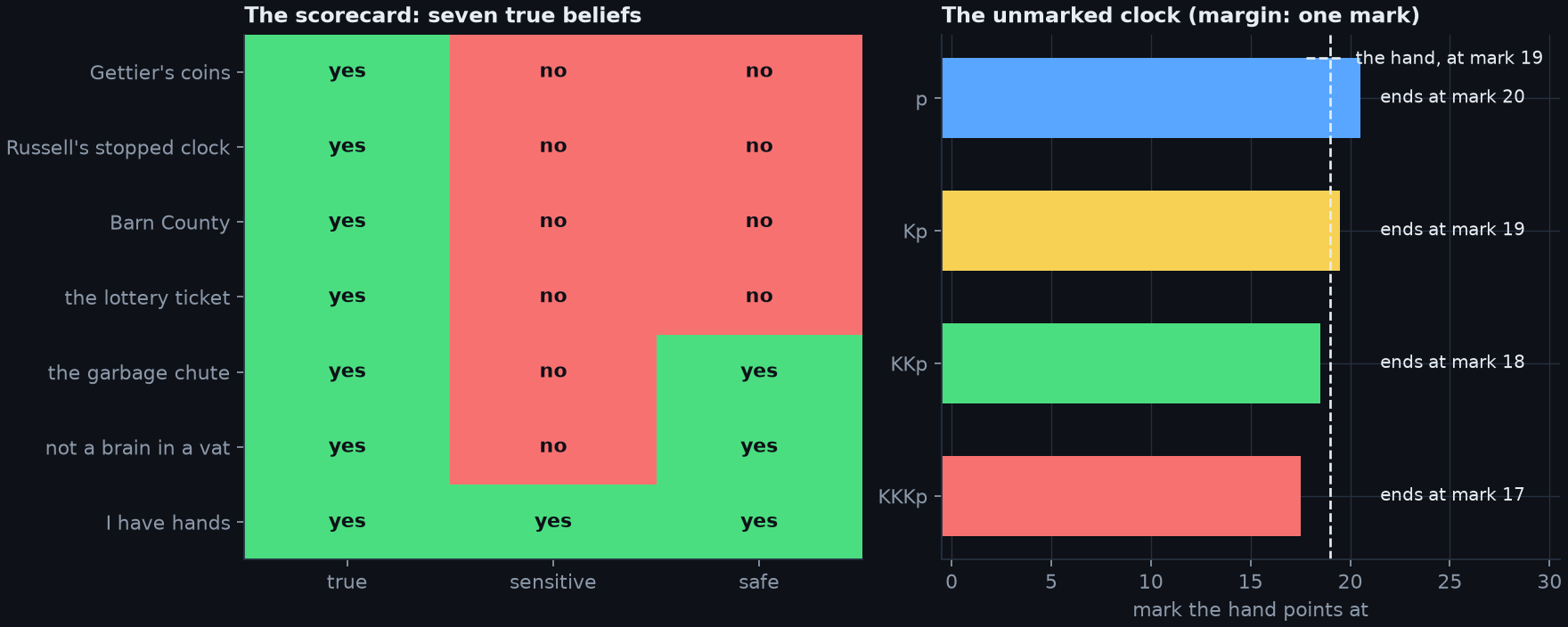
Here is the scorecard, every entry computed from the models. Gettier's coins, the stopped clock and Barn County: true beliefs, neither sensitive nor safe, and both conditions agree with the verdict that they are not knowledge. The lottery: you hold one ticket in a million and believe it will lose. You are almost certainly right, yet it seems you do not know it, and both conditions agree: a different ball dropping is a very small change to the world. Knowledge is not just high probability. The garbage chute and the vat are where they part: sensitivity says no, safety says yes, and intuition, at least about the rubbish, sides with safety. Neither checker is the final word. But safety has become the most widely accepted anti-luck condition, usually as a necessary condition on knowledge, not a definition of it.
What it establishes: Sosa (1999), Williamson (2000), Pritchard (2005); the chute; the lottery.; Computed on screen: a scorecard: true, sensitive, safe for seven beliefs
8The archerAdvanced3 min
Another family of theories borrows from the ethics of virtue. Ernest Sosa's model is the archer. A shot can be assessed in three ways. Accurate: did it hit the target? Adroit: did it show skill? Apt: was it accurate because it was adroit? A skilled archer looses a good shot, and it flies true to the centre. Accurate, adroit, and apt. The same skilled shot meets a gust that blows it off course, and a second gust that blows it back. It hits. Accurate and adroit, but not apt: it hit by luck, not by skill. That is a Gettier case. A novice's wild shot that happens to land in the centre is accurate, but neither adroit nor apt. A belief is like a shot. Its aim is truth. Knowledge, for Sosa, is apt belief: belief that is true because it is competent.
Sosa adds a second level. Animal knowledge is apt belief: belief that is true because it is competent, like a hunter's shot that hits through skill. Reflective knowledge is apt belief aptly endorsed: the believer also judges, competently and correctly, that her first-order belief is apt, like a hunter who also judged rightly that the shot was worth taking. This is a second-order competence, but it is not the KK principle. Reflective knowledge is rarer than animal knowledge, and can be missing when animal knowledge is present, as chapter ten will show it must be, for some knowledge, near any boundary.
Virtue theories make knowledge an achievement. John Greco: to know is to succeed in believing the truth through one's own cognitive ability, so that one deserves credit for getting it right, as an archer deserves credit for an apt shot. But Barn County is hard for this view. Henry sees a real barn with his own working eyes. His success seems to come from his ability, yet most people judge that he does not know. Testimony is hard in the other direction. Jennifer Lackey's example: I arrive in Chicago and ask a stranger the way to the Sears Tower. She tells me, and I know the way. But the credit for my true belief belongs mostly to her. Duncan Pritchard concluded that knowledge needs two things: the ability, and safety, the anti-luck condition of the last chapter. Neither alone is enough.
What it establishes: Sosa's AAA; Greco's credit; Lackey's Chicago visitor; Pritchard's anti-luck virtue epistemology.
9Knowledge firstAdvanced3 min
After forty years of counterexamples, Timothy Williamson proposed in 2000 to stop. The project assumed that knowledge is belief plus truth plus justification plus something, to be found. Williamson argued that knowledge has no such analysis, and that this is no embarrassment: most important concepts have none. Instead, put knowledge first, and explain the rest by it. Your evidence is exactly what you know: E equals K. Belief is the state that aims at knowledge, and falls short when it misses. And the rule of assertion is: say only what you know. Knowledge, on this view, is a mental state in its own right: the most general factive one, of which seeing that, remembering that and realizing that are special cases.
Williamson's most famous argument is about what we can know of our own minds. Call a condition luminous if, whenever it obtains, you are in a position to know that it does. Surely feeling cold is luminous? Take a morning that warms very slowly, from freezing at dawn to warm at noon. The Reasoner divides it into twenty-five moments. At each, the feeling of cold is a little weaker than at the one before; above the line, you feel cold. Now, knowledge needs a margin for error. If at some moment you know that you feel cold, then you must feel cold at the next moment too, since your feelings then are almost exactly the same, and a belief that would have been false in a case so similar is not safe. The Reasoner applies the margin to every moment. Most cold moments are knowably cold. But the last two cold moments before the line are not: you feel cold, and you are in no position to know it. And luminosity must fail somewhere. If it held, then feeling cold at dawn would give knowledge of it, the margin would give feeling cold at the next moment, then knowledge of that, and so on, step by step, to feeling cold at noon. Which you do not. So no condition that can change gradually is luminous: not even your own sensations.
Two results like these go into the Wall. The eleventh brick. The dream: an analysis of knowledge, justified true belief plus X. The wall: Gettier's cases, with Zagzebski's recipe for making more whenever X falls short of truth; and Williamson's anti-luminosity argument, which shows that even our access to our own minds has margins. What it forces: perhaps knowledge cannot be analysed, and must be taken as basic; or, if it can, some condition must close the gap between justification and truth without making knowledge impossible.
What it establishes: Williamson: knowledge first, E = K; anti-luminosity; the Wall's eleventh brick.; Computed on screen: 25 moments of a cold morning: the two that are cold but not knowably cold
10Knowing that you knowResearch2 min
A margin for error has a second consequence. The KK principle says: if you know p, you know that you know p. Jaakko Hintikka, who founded epistemic logic in 1962, treated knowledge as a box: S knows p when p holds in every world S cannot rule out. Then KK is the modal axiom four, which we met in Part 4, and which holds on exactly the frames whose relation is transitive. KK is attractive: knowing seems transparent, so if you know, reflection ought to reveal it. But with a margin for error, the relation of being unable to tell two situations apart is not transitive. I cannot tell twenty from twenty-one, nor twenty-one from twenty-two, but I can tell twenty from twenty-two.
Williamson's example is a clock with no numbers on its face. Its hand can point to any of thirty-one marks, and from where I stand I can see where it points only to within one mark either way. Let p be: the hand points at mark twenty or below. I know p at a position just when p is true at every position I cannot rule out: one mark either side. So I know p when the hand is at nineteen or below. Knowing that I know p requires knowing p at every position I cannot rule out, so the hand must be at eighteen or below. And knowing that I know that I know, at seventeen or below. The hand is really at nineteen. I know that it points at twenty or below. But I do not know that I know it. Each K strips one mark from the edge, and near any boundary, knowledge comes without knowledge of itself. KK fails.
What it establishes: Hintikka (1962) and axiom 4; margins break transitivity; the unmarked clock.; Computed on screen: p, Kp, KKp, KKKp end at 20, 19, 18, 17
11The brain in a vatIntroductory2 min
The skeptic's question returns, in its modern form. Imagine your brain removed and kept alive in a vat of nutrients. Its nerve endings are wired to a computer, which feeds it exactly the experiences you are having now: this screen, your hands, the room around you. Nothing in your experience could tell the two situations apart. This is Descartes's evil demon, rebuilt with a laboratory; Gilbert Harman described it in 1973, and Hilary Putnam gave it its name in 1981. Do you know that you are not a brain in a vat?
The skeptic needs only one principle. Closure: if you know p, and you know that p implies q, then you are in a position to know q. Knowledge extends by known implication. Now the argument. One: I do not know that I am not a brain in a vat; nothing in my experience could tell me. Two: having hands implies not being a handless brain in a vat, and I know it does. So by closure, if I know I have hands, I know I am not a brain in a vat. Three: so I do not know that I have hands. And the argument generalizes to almost everything I believe about the world around me.
Here is the skeptic's argument as a Price List. Three claims, each plausible on its own: I don't know I'm not a brain in a vat; if I know I have hands, I know I'm not one; I know I have hands. The Reasoner confirms that the three together are inconsistent, and that giving up any one of them restores consistency. So there are exactly three positions. G. E. Moore gives up the first: since I know I have hands, I can know I am not envatted. Fred Dretske and Robert Nozick give up the second: closure fails, as sensitivity predicted. The skeptic gives up the third. And a fourth answer, contextualism, says that each claim is true in some context, though never all three in one. The next chapter weighs them.
What it establishes: the brain in a vat; closure; Price List: the skeptic's triad.; Computed on screen: the MUS {S1, S2, S3} and its three corrections
12Four answers to the skepticAdvanced5 min
First, the answer of G. E. Moore. In a lecture of 1939 he held up his hands and said: here is one hand, and here is another. So there are at least two external things, and so an external world. This sounds like cheating, but Moore's point was about certainty. He is more certain that he has hands than he could ever be of any premise in a skeptical argument. One person's modus ponens is another's modus tollens: run the skeptic's argument backwards. I know I have hands; so, by closure, I know I am not a brain in a vat. Ludwig Wittgenstein, in notes written in the last eighteen months of his life and published as On Certainty, gave this a deeper form. Propositions like here is a hand are not known on evidence. They are hinges: the questions we raise and our doubts depend on some propositions being exempt from doubt.
The second answer gives up closure. Fred Dretske's example, from 1970: at the zoo I see a striped animal in the zebra pen, and I know that it is a zebra. Being a zebra implies not being a mule cleverly painted to look like one. But I have not checked for paint, and I would believe it was a zebra even if it were a painted mule. So I do not know that it is not a painted mule. Knowledge, Dretske concluded, does not pass along every known implication, and Nozick's sensitivity gave the same verdict, as the Reasoner found in chapter six. The price is sentences like: I know it's a zebra, but I don't know it isn't a painted mule. To most ears, that sounds absurd.
The third answer is contextualism. David Lewis put it in one sentence: S knows that P if and only if P holds in every possibility left uneliminated by S's evidence, psst, except for those possibilities that we are properly ignoring. Keith DeRose's bank case. On a Friday afternoon I want to deposit a cheque, but the queues are long. I was at the bank two Saturdays ago, so I say: I know it's open on Saturday. The Reasoner applies Lewis's rule. My evidence eliminates nothing beyond what I saw. In the relaxed context, the possibilities that the bank has changed its hours, or that a pipe will burst, are properly ignored. Every not-P possibility is accounted for: I know. Now the rent is due on Monday, and my partner asks: banks do change their hours; do you know? Once mentioned, those possibilities cannot be properly ignored, and my evidence does not eliminate them. Now it is false to say I know. For the contextualist, the skeptic does not refute ordinary knowledge; she changes the context, by making the vat a live possibility. A related view, subject-sensitive invariantism, lets the subject's own stakes, not the speaker's context, set the standard.
The last answer is Hilary Putnam's, and it is the strangest. Putnam held that our words refer to what we are causally connected with in the right way. A brain that has always been in a vat has never been in contact with real brains or vats. So in its language, vat refers to vat-images, or to features of the program that produces them. Then when it thinks, I am a brain in a vat, it says something false: it is not in an image of a vat. And when I think it, in my language, where vat means vat, it is false if I am not envatted, and false if I am. Either way it is false, so I am not a brain in a vat. The argument works only against a brain that has always been in a vat. It says nothing against one that was envatted last night, whose words still refer to real vats.
What it establishes: Moore (1939) and Wittgenstein's hinges; Dretske's zebra (1970); Lewis (1996) and DeRose's bank; Putnam (1981).; Computed on screen: Lewis's rule in the careless and careful contexts
13The butterfly and the spongeIntroductory2 min
There is another way to respond to doubt: not to refute it, but to live with it. Around 300 BCE, the Chinese philosopher Zhuang Zhou wrote of a dream. Once he dreamt he was a butterfly, flitting about, happy, not knowing he was Zhou. Suddenly he woke, and there he was, solidly Zhou. But he did not know whether he was Zhou who had dreamt he was a butterfly, or a butterfly dreaming that he was Zhou. Between Zhou and a butterfly there must be some distinction, he adds. This is called the transformation of things. Zhuangzi does not argue that we know nothing. He loosens our need to settle which perspective is the real one. Descartes used the dream to seek a certainty that no dream could shake. Zhuangzi uses it to let that search go.
In the West, the ancient skeptics made the same turn. Sextus Empiricus, writing around the year 200, describes the Pyrrhonist's practice. For every argument he finds an equal argument against: equipollence. With the scales level, he suspends judgment: epochē. And then tranquillity follows, Sextus says, as a shadow follows a body. He tells a story about it. The painter Apelles was painting a horse and could not get the foam at its mouth right. In despair he threw his sponge at the picture, and the mark it left was the foam. The skeptics had hoped to find tranquillity by deciding what is true. When they gave up deciding, tranquillity came by itself. For the ancient skeptic, doubt was a way of life, not a problem to be solved.
What it establishes: Zhuangzi's dream; Sextus: equipollence, epochē, ataraxia; Apelles's sponge.
14The structure of justificationResearch3 min
Agrippa's trilemma, from the start of Part 10, returns as a Price List. Four claims. Every justified belief is justified by another belief. No belief is justified by a circle of reasons. No infinite chain of reasons justifies. And some of our beliefs are justified. The Reasoner confirms they cannot all be true, and that each one alone can be given up. Four positions. Foundationalism gives up the first: some beliefs are basic, justified without resting on others. Coherentism gives up the second: beliefs support one another, as a web. Infinitism, defended by Peter Klein, gives up the third: the chain of reasons is endless, and that is fine. And the skeptic gives up the last.
Picture the three answers that keep justification. Foundationalism is a pyramid: most beliefs rest on others, but at the bottom lie basic beliefs, justified by experience or by being self-evident. Descartes was one kind of foundationalist; most empiricists were another. Coherentism is a web. Otto Neurath compared us to sailors who must rebuild their ship on the open sea, plank by plank, never able to put it in dry dock and start from the bottom. Infinitism is an endless chain, each reason backed by another, receding forever. Each has its classic problem. Foundations: how can an experience, which is not itself a belief, justify one? Coherence: a consistent fairy tale coheres as well as the truth. Why should coherence be a guide to truth at all? The Reasoner can test that last question.
Bayesians have tried to make coherence precise. Two measures. Tomoji Shogenji's: the probability that all the propositions are true together, divided by the product of their separate probabilities. Erik Olsson's overlap measure: the probability that all are true, divided by the probability that at least one is. The Reasoner builds two sets of three reports, each from an independent witness, with the same prior chance of all being true. Set A is more coherent than set B on both measures. Now it computes how likely each set is to be true, given the reports, for witnesses of every quality. On the left the witnesses are good; on the right, barely better than chance. The curves cross. With good witnesses, the less coherent set B is more likely true; with poor ones, A. Which set is more likely true depends on the witnesses, and no measure of the sets' coherence alone can see that. Luc Bovens and Stephan Hartmann, in 2003, and Olsson, in 2005, proved that no measure of coherence is truth-conducive in this sense.
What it establishes: Price List: Agrippa's regress; foundations, Neurath's boat, Klein's infinitism; Bayesian coherence.; Computed on screen: the more coherent of two report sets is less likely true when witnesses are good; the curves cross at x = 1/2
15Inside or outside the headAdvanced2 min
Behind many of these disputes lies one division. Internalists hold that whatever justifies a belief must be accessible to the believer, by reflection: her experiences, her reasons, what she could cite if asked. Descartes was an internalist, and so were Chisholm and BonJour; Earl Conee and Richard Feldman's version, mentalism, says that justification depends only on the believer's mental states. Externalists hold that what justifies may lie outside the believer's view: the reliability of the process, the causal history of the belief. That is why, for them, animals and infants can know. The two sides sort the cases in opposite ways. BonJour's clairvoyant, reliable without reasons. The professional chicken sexers who can tell male chicks from female with high accuracy, while unable to say how. And a third case, which the internalist uses in return.
The internalist's counterexample is the new evil demon problem, from Keith Lehrer and Stewart Cohen. Take yourself, with your reliable perception. Now imagine a twin, deceived from birth by Descartes's demon. She has exactly your experiences, and reasons from them exactly as carefully as you do. But her perception is always wrong. Is she as justified as you are? It seems she is: she does everything right. Yet simple reliabilism says her beliefs are unjustified, since the processes that produce them are unreliable in her world. Externalists have replies. Goldman proposed measuring reliability in our world, not hers. Williamson distinguishes being justified from being blameless: the twin is blameless, but her beliefs are not justified, since they are not knowledge. The quarrel continues.
What it establishes: internalism and externalism; the chicken sexer; the new evil demon (Lehrer and Cohen 1983).
16Two dogmasAdvanced3 min
In 1951 W. V. O. Quine published the most influential paper of postwar philosophy. He attacked two dogmas of empiricism. The first: that there is a sharp line between analytic truths, true by meaning alone, and synthetic truths, true by the facts. The second: that each statement, taken by itself, has its own range of experiences that would confirm or refute it. Against the first, Quine tried every way of explaining analyticity, and found a circle. A statement is analytic if it comes from a logical truth by putting synonyms for synonyms. Two expressions are synonymous if they are interchangeable in every sentence without changing its truth. But that works only in a language that contains an adverb like necessarily, and necessarily, in the sense required, is explained by analyticity. We are back where we started.
Against the second dogma, Quine offered a picture. Our beliefs form a single web. At its edge, experience; then observation reports; then the sciences; and at the centre, mathematics and logic. The totality of our so-called knowledge, he wrote, is a man-made fabric which impinges on experience only along the edges. When an experience conflicts with the web, the conflict does not single out one belief to blame. We have a choice about where to revise, and we choose to disturb the system as little as possible, which is why logic and mathematics, at the centre, are hardly ever touched. But hardly ever is not never. No statement is immune to revision. Quine noted that revising even the law of excluded middle had been proposed, to simplify quantum mechanics; and in 1968 Hilary Putnam argued that quantum mechanics is a reason to give up the distributive law of logic.
The Reasoner can make Quine's point exact, with a story from astronomy. Five beliefs: Newton's laws; that the known planets are all the planets; that the telescopes and tables are right; the mathematics that derives the predicted orbit from those three; and the observation that the orbit is not as predicted. Together they are inconsistent. The Reasoner searches for every minimal revision, every smallest set of beliefs whose removal restores consistency, and finds exactly five: drop any one. Logic alone does not say which. History chose differently each time. When Uranus strayed, in the 1840s, Urbain Le Verrier dropped the belief that the known planets were all of them, computed where another must be, and in 1846 Neptune was found there. When Mercury strayed, Le Verrier tried the same move and proposed a planet, Vulcan, inside Mercury's orbit. It was never found. In 1915 the belief that went was Newton's law itself, replaced by general relativity. Same logical structure, different revisions: that is the Duhem-Quine thesis. And the other revisions are always there to be chosen: blame the instruments, reject the observation, or, in Quine's extreme case, revise the logic.
What it establishes: "Two Dogmas" (1951): the analyticity circle; the web; Putnam's quantum logic (1968).; Computed on screen: the five minimal revisions of the Uranus–Mercury web; Neptune (1846), Vulcan, general relativity (1915)
17Asking peopleApplied3 min
Almost everything in this part has rested on intuitions about cases: Smith does not know; Henry does not know. Whose intuitions are these? In 2001 Jonathan Weinberg, Shaun Nichols and Stephen Stich asked students. Their vignette: Jill has driven a Buick for years, so her friend Bob believes she drives an American car. Unknown to him, her Buick was stolen and replaced by a Pontiac, also an American car. Does Bob really know that Jill drives an American car, or does he only believe it? They reported that about a quarter of Western students said he really knows, but more than half of East Asian and South Asian students did. If Gettier intuitions vary by culture, they concluded, then the method of cases tells us about our own group, not about knowledge.
Experimental philosophy then did what science is supposed to do: it checked. Jennifer Nagel and colleagues, in 2013, found that ordinary people deny knowledge in Gettier cases much as philosophers do. Minsun Kim and Yuan Yuan ran the car case again with larger samples, and found no cultural difference. Hamid Seyedsayamdost's paper had a blunt title: failure of replication. And Edouard Machery and an international team tested Gettier cases in Brazil, India, Japan and the United States, and found the Gettier intuition in all four. A large project led by Florian Cova replicated forty experimental-philosophy studies, and about seventy percent held up: a better record than in parts of psychology. So the Gettier intuition, it now seems, is robust, perhaps universal. That is itself a discovery about human minds, of the kind Dharmottara's case already hinted at.
The episode left a methodological question. If intuitions about cases had varied, the method of cases would have been in trouble: so-called restrictionists still urge caution. Timothy Williamson replied that a judgment about a thought experiment is not a mysterious faculty. It is an ordinary counterfactual judgment, the kind we make all the time, and fallible in the same ways. Herman Cappelen went further. Read philosophers closely, he argued, and you find that they argue for their verdicts about cases; they do not simply report a feeling. That is the Reasoner's approach in this series. A case is a model, and each theory a checker run on it. The checkers make explicit what each verdict rests on, so we can see exactly where the theories disagree.
What it establishes: Weinberg, Nichols and Stich (2001); Nagel et al. (2013), Kim and Yuan (2015), Seyedsayamdost (2015), Machery et al. (2017), Cova et al. (2021); Williamson and Cappelen on the method of cases.
Recap, problems, and where this comes backAll tracks2 min
Let's gather what we built. Plato's three answers, and the definition the twentieth century took from them. Gettier's cases, as models the Reasoner checks, and their older cousins. The repairs, and the recipe that defeats them. Four theories, each a checker on the same cases. Knowledge first, and two theorems about margins. The skeptic, and the ways to answer her or live with her. And the shape of justification, the web, and what ordinary people say.
The Reasoner has a module for knowledge. It builds Gettier's cases as first-order models and checks the proofs inside them; evaluates sensitivity and safety over spheres of worlds; runs Zagzebski's recipe; computes the reliability of every process type a belief belongs to; applies margins for error, to a cold morning and an unmarked clock; pits coherence against truth; and finds every minimal revision of Quine's web. And the Wall has its eleventh brick.
Six problems, with full solutions in this part's notes. Gettier's lemma; Zagzebski's recipe; Kripke's barns under safety; the clock with a wider margin; why KK and margins cannot live together; and an essay on the skeptic. Pause here, and try them.
Where this comes back. Knowledge in groups, common knowledge and testimony, in Part 12. Degrees of belief, and the lottery, in Part 13. Revising beliefs, in Part 14. Induction and Quine's web in science, in Parts 15 and 18. Reference, and Putnam's externalism, in Part 27. And what it would mean for a machine to know, in Part 30. Next, Part 12: knowledge among many.
The books and papers this part follows are on screen, and in the notes. Thanks for watching.
Where it goes next. Knowledge in groups, common knowledge and testimony are Part 12. The lottery returns with degrees of belief in Part 13 and belief revision in Part 14; Quine's web in Parts 15 and 18; Putnam's externalism in Part 27; and what it would mean for a machine to know in Part 30.
Key results
The part's results in one place, for revision.
Try it
Lab 11 · Sensitivity, safety and margins for error
Run Nozick's and Sosa's conditions on the film's cases and find where they part; then check on the unmarked clock, and on random margin models, that each further 'I know that' strips one margin, so that knowing does not bring knowing that you know.
python -m videos.philosophy.labs 11
needs numpy, scipy, matplotlib · download lab11.py ·
source on GitHubseven true beliefs 1 sensitive, 3 safe
sensitivity and safety disagree on the garbage chute; not a brain in a vat
Zagzebski's doctor after step two believed, justified, 95% reliable, true; safe: False
unmarked clock, p = 'at most 20' p, Kp, KKp, KKKp end at marks [20, 19, 18, 17]
20 random margin models after n iterations the edge is c − n·m in every one; KK fails at the edge
cold morning, 25 moments cold but not knowably cold at moments [10, 11]
a morning of 173 moments, margin 0.09 15 such moments: luminosity fails again
Sensitivity and safety agree that Gettier's beliefs are not knowledge and part on the chute and the vat. With any margin for error, knowledge stops one margin short of the truth, and each further 'I know that' stops one margin shorter.The code (97 lines; it asserts its own result)
"""Lab 11: score seven beliefs for sensitivity and safety, and strip margins off knowledge on the unmarked clock."""

import numpy as np

from videos.coursekit import labs
from explainer.philosophy.reasoner import knowledge as kn

TITLE = "Sensitivity, safety and margins for error"
GOAL = ("Run Nozick's and Sosa's conditions on the film's cases and find where they part; then check on the "
        "unmarked clock, and on random margin models, that each further 'I know that' strips one margin, so that "
        "knowing does not bring knowing that you know.")
TASKS = [
    "In kn.safe, change radius from 2 to 9 for the vat model. Which verdict flips, and what is the skeptic claiming?",
    "Call kn.luminosity_series(n=100, margin=0.02). How many moments are cold but not knowably cold?",
    "Use kn.iterate_k with margin=0. Which principle now holds, and what would such a knower be like?",
]
CASES = [("coins", "p", "Gettier's coins"), ("clock", "eight", "Russell's stopped clock"), ("barns", "barn", "Barn County"),
         ("lottery", "lose", "the lottery ticket"), ("chute", "basement", "the garbage chute"),
         ("biv", "not_biv", "not a brain in a vat"), ("biv", "hands", "I have hands")]


def run(seed=0):
    rng = np.random.default_rng(seed)
    lab = labs.Lab()

    # the scorecard
    card = []
    for model, prop, name in CASES:
        v = kn.verdicts(kn.SCENARIOS[model], [prop])[0]
        assert v["true"] and v["believed"], name
        card.append((name, v["sensitive"], v["safe"]))
    table = {name: (s, f) for name, s, f in card}
    for name in ("Gettier's coins", "Russell's stopped clock", "Barn County", "the lottery ticket"):
        assert table[name] == (False, False), f"{name}: a true belief that is neither sensitive nor safe"
    assert table["the garbage chute"] == (False, True) and table["not a brain in a vat"] == (False, True)
    assert table["I have hands"] == (True, True)
    apart = [name for name, s, f in card if s != f]
    lab.row("seven true beliefs", f"{sum(s for _, s, _ in card)} sensitive, {sum(f for _, _, f in card)} safe")
    lab.row("sensitivity and safety disagree on", "; ".join(apart))

    # Zagzebski's recipe
    z = kn.zagzebski()
    assert not z["step1"]["true"] and z["step2"] == {"believes": True, "justified": True, "reliable": True, "true": True}
    assert not z["safe"]
    lab.row("Zagzebski's doctor after step two", f"believed, justified, {z['reliability']:.0%} reliable, true; safe: {z['safe']}")

    # the unmarked clock: p, Kp, KKp, KKKp
    levels = kn.iterate_k(range(31), lambda w: w <= 20, margin=1, depth=3)
    edges = [max(s) for s in levels]
    assert edges == [20, 19, 18, 17]
    assert 19 in levels[1] and 19 not in levels[2], "at 19 the hand's position is known, but not known to be known"
    lab.row("unmarked clock, p = 'at most 20'", f"p, Kp, KKp, KKKp end at marks {edges}")

    # random margin models: the edge after n iterations is c - n m, against the definition by brute force
    for _ in range(20):
        size, m = int(rng.integers(30, 60)), int(rng.integers(1, 4))
        c = int(rng.integers(15, size - 5))
        got = kn.iterate_k(range(size), lambda w, c=c: w <= c, margin=m, depth=4)
        for n, s in enumerate(got):
            brute = {w for w in range(size) if all(v <= c for v in range(size) if abs(v - w) <= n * m)}
            assert s == brute and max(s) == c - n * m, (size, m, c, n)
    lab.row("20 random margin models", "after n iterations the edge is c − n·m in every one; KK fails at the edge")

    # anti-luminosity on a cold morning
    lum = kn.luminosity_series()
    assert lum["gap"] == [10, 11] and lum["first_warm"] == 12 == lum["chain_breaks_at"]
    n, margin = int(rng.integers(30, 200)), float(rng.uniform(0.02, 0.2))
    other = kn.luminosity_series(n=n, margin=margin)
    assert other["gap"] and all(other["cold"][t] and not other["known"][t] for t in other["gap"])
    lab.row("cold morning, 25 moments", f"cold but not knowably cold at moments {lum['gap']}")
    lab.row(f"a morning of {n + 1} moments, margin {margin:.2f}", f"{len(other['gap'])} such moments: luminosity fails again")
    lab.note = ("Sensitivity and safety agree that Gettier's beliefs are not knowledge and part on the chute and the "
                "vat. With any margin for error, knowledge stops one margin short of the truth, and each further "
                "'I know that' stops one margin shorter.")

    from matplotlib.colors import ListedColormap
    fig, ax = labs.figure(2, size=(11, 4.4))
    grid = np.array([[1, s, f] for _, s, f in card], dtype=float)
    ax[0].imshow(grid, cmap=ListedColormap([labs.RED, labs.GREEN]), vmin=0, vmax=1, aspect="auto")
    for i, row in enumerate(grid):
        for j, v in enumerate(row):
            ax[0].text(j, i, "yes" if v else "no", ha="center", va="center", color=labs.BG, fontweight="bold")
    ax[0].set_xticks(range(3), ["true", "sensitive", "safe"])
    ax[0].set_yticks(range(len(card)), [name for name, _, _ in card])
    ax[0].set(title="The scorecard: seven true beliefs")
    ax[0].grid(False)
    names = ["p", "Kp", "KKp", "KKKp"]
    for i, s in enumerate(levels):
        ax[1].barh(len(levels) - 1 - i, max(s) + 1, left=-0.5, color=labs.CYCLE[i], height=0.6)
        ax[1].text(21.5, len(levels) - 1 - i, f"ends at mark {max(s)}", va="center", color=labs.INK, fontsize=9)
    ax[1].axvline(19, color=labs.INK, ls="--", lw=1.2, label="the hand, at mark 19")
    ax[1].set_yticks(range(len(levels)), names[::-1])
    ax[1].set(title="The unmarked clock (margin: one mark)", xlabel="mark the hand points at", xlim=(-0.5, 30.5))
    ax[1].set_axisbelow(True)
    ax[1].legend(loc="upper right")
    lab.fig = fig
    return lab
Now change it
- In kn.safe, change radius from 2 to 9 for the vat model. Which verdict flips, and what is the skeptic claiming?
- Call kn.luminosity_series(n=100, margin=0.02). How many moments are cold but not knowably cold?
- Use kn.iterate_k with margin=0. Which principle now holds, and what would such a knower be like?
Problems, with solutions
Try each problem before opening its solution.
-
Gettier's lemma. In Gettier's Case II, which of Smith's beliefs is the false lemma? Build a variant with no false lemma that is still not knowledge.
Solution
In Case II the false lemma is "Jones owns a Ford". A case with no false lemma: Barn County, where Henry's perceptual belief is not inferred from anything. A case with inference but no false lemma (after Feldman 1974): Smith reasons from true premises only, "Nogot, who works in my office, has shown me papers saying he owns a Ford", to "someone in my office owns a Ford"; Nogot was lying, but Havit, also in the office, owns one.
-
The recipe for 99% reliability. Apply Zagzebski's recipe to 'X = the belief comes from a process that is 99% reliable'.
Solution
Step one: a 99%-reliable thermometer, on one of its rare bad days, reads 20° when the room is 17°; the belief "it is 20°" is reliably formed and false. Step two: the heating has just pushed the room to exactly 20°, independently of the fault. The belief is true, believed, and from a 99%-reliable process, but a nearby world (the heating a minute later) has the same belief false: not safe, not knowledge.
-
Kripke's barns under safety. Kripke's barns: is 'there is a red barn' safe? Is 'there is a barn' safe, if believed by deduction from it?
Solution
"There is a red barn" is safe: in every nearby world where Henry believes it, it is true (the only world that would fool him, a red facade, is far away). "There is a barn" formed by looking is unsafe (a green facade is nearby). Formed by deduction from "there is a red barn", it is safe: in the nearby worlds where Henry believes it on that basis, there is a red barn. Safety is relative to the basis of the belief, and closure under competent deduction survives.
-
A wider margin. On the unmarked clock with a margin of 2 marks, for \(p\) = 'at most 20', where do \(Kp\) and \(KKp\) end?
Solution
With a margin of two marks, Kp holds where the hand is at 18 or below and KKp at 16 or below: each K strips two marks.
-
KK and margins. Show that if KK held in a margin model, \(p\) = 'at most 20' could be known nowhere.
Solution
In a margin model, Kp at w requires p at w + 1, KKp requires Kp at w + 1 and so p at w + 2, and in general Kⁿp requires p at w + n. If KK held, Kp would give Kⁿp for every n, so p would hold at every position from w on; but p ("at most 20") is false at 21. So Kp could hold nowhere: margins and KK together make knowledge of p impossible.
-
(Essay) The skeptic. (Essay) Moore, Dretske, or the contextualist: which answer to the skeptic, and at what price?
Solution
A strong answer uses Chapter 11's Price List and states the price of each exit: for Moore, an argument that seems to beg the question; for Dretske and Nozick, abominable conjunctions; for the contextualist, that "knows" shifts as conversations do, and that the skeptic wins whenever she is listened to.
Notes and sources
Sources
Texts: Plato, Theaetetus (Fowler and Levett trans.), Meno; Sextus Empiricus, Outlines of Pyrrhonism; Zhuangzi, ch. 2 (Watson trans.); Descartes, Meditations (1641); Moore, "Proof of an External World" (1939); Wittgenstein, On Certainty (1969); Quine, "Two Dogmas of Empiricism" (1951); Gettier, "Is Justified True Belief Knowledge?" (1963); Hintikka, Knowledge and Belief (1962); Nozick, Philosophical Explanations (1981), ch. 3; Putnam, Reason, Truth and History (1981), ch. 1; Lewis, "Elusive Knowledge" (1996); Williamson, Knowledge and Its Limits (2000) and The Philosophy of Philosophy (2007); Sosa, A Virtue Epistemology (2007).
Papers: Clark (1963); Lehrer and Paxson (1969); Dretske, "Epistemic Operators" (1970); Klein (1971); Goldman, "Discrimination and Perceptual Knowledge" (1976) and "What Is Justified Belief?" (1979); BonJour (1980); Lehrer and Cohen (1983); Cohen (1984); Lehrer, Theory of Knowledge (1990); DeRose (1992); Zagzebski, "The Inescapability of Gettier Problems" (1994); Conee and Feldman, "The Generality Problem for Reliabilism" (1998); Sosa, "How to Defeat Opposition to Moore" (1999); Shogenji (1999); Weinberg, Nichols and Stich (2001); Bovens and Hartmann, Bayesian Epistemology (2003); Hawthorne, Knowledge and Lotteries (2004); Olsson, Against Coherence (2005); Stanley, Knowledge and Practical Interests (2005); Lackey (2007); Greco, Achieving Knowledge (2010); Kripke, "Nozick on Knowledge" (2011); Pritchard, "Anti-Luck Virtue Epistemology" (2012); Cappelen, Philosophy without Intuitions (2012); Nagel, San Juan and Mar (2013); Kim and Yuan (2015); Seyedsayamdost (2015); Machery et al., "Gettier Across Cultures" (2017); Cova et al. (2021). Textbooks: Pritchard, What Is This Thing Called Knowledge?; Nagel, Knowledge: A Very Short Introduction (2014).
About this partfrom its README
Part 11 of Philosophy, Built (series plan, syllabus), the second part of Act III. Plato's three answers in the Theaetetus and the tether of the Meno; justified true belief; Gettier's two cases (1963), built as first-order models; the older cases (Dharmottara's mirage, Russell's clock, Chisholm's sheep) and the lucky arrow; the repairs (no false lemmas and Barn County, defeasibility and Tom Grabit) and Zagzebski's recipe; Goldman's reliabilism and the generality problem, Norman and Truetemp; Nozick's tracking and Kripke's red barn; safety, the garbage chute and the lottery; Sosa's archer, credit and Pritchard's anti-luck virtue epistemology; Williamson's knowledge first, anti-luminosity and the failure of KK on the unmarked clock; the brain in a vat and the closure argument as a Price List; Moore and Wittgenstein's hinges, Dretske's zebra, Lewis's contextualism and DeRose's bank, Putnam's semantic argument; Zhuangzi's butterfly and the Pyrrhonists; foundations, coherence and infinite chains, with Bayesian coherence and the Bovens–Hartmann impossibility; internalism, externalism and the new evil demon; Quine's two dogmas and the web of belief; and experimental philosophy's Gettier studies and their replications. Its brick in the Wall is "Gettier": no fallibilist analysis escapes Gettier cases, and no condition that can change gradually is luminous.
Every case and verdict on screen is computed by the Reasoner's module for knowledge
(explainer/philosophy/reasoner/knowledge.py): Gettier's cases as first-order structures, with the inference
checked by the tableau prover and the belief evaluated in the actual and a nearby world; scenarios of worlds ordered
by similarity, with sensitivity (Nozick), adherence and safety (Sosa, Williamson) computed for each belief;
Zagzebski's recipe; reliability of process types over a toy population, and the generality problem; margins for
error on a cold morning and an unmarked clock (K without KK); Lewis's rule of relevant alternatives; Shogenji's and
Olsson's coherence measures and the posterior given independent reports; and every minimal revision of a Quinean web,
by SAT. It is tested in tests/philosophy/test_knowledge.py and cached by compute.py.
Chapter notes
| # | Scene | What it establishes | Computed on screen |
|---|---|---|---|
| 0 | Hook |
Socrates's question; Ann's working clock and Ben's stopped one; the plan. | — |
| 1 | Plato |
Theaetetus: perception, true judgment (the jury), true judgment with an account; Meno's statues; JTB. | — |
| 2 | Gettier |
Gettier's two assumptions and two cases. | each inference valid (a closed tableau); each belief true in the actual model and false in a nearby one; the false lemma |
| 3 | Older |
Dharmottara's mirage (c. 770); Russell (1948); Chisholm (1966); the lucky arrow. | — |
| 4 | Repairs |
Clark's no false lemmas and Barn County; Lehrer–Paxson defeasibility and Tom Grabit; Zagzebski (1994). | the recipe run on the doctor: every condition short of truth survives; safety fails |
| 5 | Reliable |
Goldman (1979); the generality problem (Conee and Feldman 1998); Norman (BonJour 1980), Truetemp (Lehrer 1990). | one look, five process types: 94%, 96%, 10%, 10%, 100% |
| 6 | Tracking |
Nozick's four conditions; Kripke's red barn; sensitivity and closure. | the closest not-p worlds in the coins, barns and vat models |
| 7 | Safety |
Sosa (1999), Williamson (2000), Pritchard (2005); the chute; the lottery. | a scorecard: true, sensitive, safe for seven beliefs |
| 8 | Virtue |
Sosa's AAA; Greco's credit; Lackey's Chicago visitor; Pritchard's anti-luck virtue epistemology. | — |
| 9 | First |
Williamson: knowledge first, E = K; anti-luminosity; the Wall's eleventh brick. | 25 moments of a cold morning: the two that are cold but not knowably cold |
| 10 | KK |
Hintikka (1962) and axiom 4; margins break transitivity; the unmarked clock. | p, Kp, KKp, KKKp end at 20, 19, 18, 17 |
| 11 | Skeptic |
the brain in a vat; closure; Price List: the skeptic's triad. | the MUS {S1, S2, S3} and its three corrections |
| 12 | Answers |
Moore (1939) and Wittgenstein's hinges; Dretske's zebra (1970); Lewis (1996) and DeRose's bank; Putnam (1981). | Lewis's rule in the careless and careful contexts |
| 13 | Butterfly |
Zhuangzi's dream; Sextus: equipollence, epochē, ataraxia; Apelles's sponge. | — |
| 14 | Structure |
Price List: Agrippa's regress; foundations, Neurath's boat, Klein's infinitism; Bayesian coherence. | the more coherent of two report sets is less likely true when witnesses are good; the curves cross at x = 1/2 |
| 15 | Internal |
internalism and externalism; the chicken sexer; the new evil demon (Lehrer and Cohen 1983). | — |
| 16 | Quine |
"Two Dogmas" (1951): the analyticity circle; the web; Putnam's quantum logic (1968). | the five minimal revisions of the Uranus–Mercury web; Neptune (1846), Vulcan, general relativity (1915) |
| 17 | XPhi |
Weinberg, Nichols and Stich (2001); Nagel et al. (2013), Kim and Yuan (2015), Seyedsayamdost (2015), Machery et al. (2017), Cova et al. (2021); Williamson and Cappelen on the method of cases. | — |
| 18 | Outro |
recap; the Reasoner's module; the Wall; problems; payoffs; references. | — |
Companion material in this repository
The syllabus's plan for this partfrom SYLLABUS.md, the plan of record
- Plato's Theaetetus: knowledge as justified true belief.
- Gettier (1963): Smith's coins and the Ford case. Built as a world model; the Reasoner checks that every JTB condition holds and that the subject still lacks knowledge.
- Repairs: no false lemmas; defeasibility; Zagzebski's recipe showing that Gettier cases are inescapable for any "JTB + X" with fallible X.
- Reliabilism (Goldman 1979): process reliability; the generality problem.
- Sensitivity (Nozick 1981): if p were false, S wouldn't believe p. Evaluated in a
SpheresViewof nearby worlds. - Safety (Sosa, Williamson): in nearby worlds where S believes p, p. Built: the safety and sensitivity checkers disagree on a computed case (the "I am not a brain in a vat" belief).
- Virtue epistemology (Sosa's archer: accurate, adroit, apt).
- Knowledge-first (Williamson 2000): E = K; the anti-luminosity argument with its margin-for-error principle, formalized and computed on a gradual series (cold to warm).
- The KK principle and its failure under margin-for-error (computed).
- Skepticism: the brain in a vat; the closure argument; the Price List (I don't know I'm not a BIV; if I know I have hands, I know I'm not a BIV; I know I have hands).
- Answers: Moore's proof; Dretske's denial of closure; contextualism (DeRose, Lewis's "Elusive Knowledge"); subject-sensitive invariantism; Putnam's semantic externalism argument against the BIV.
- Zhuangzi's butterfly dream and the Pyrrhonists: skepticism as tranquility.
- The structure of justification: Agrippa's trilemma; foundationalism, coherentism (with Bayesian coherence measures and Olsson's impossibility result), and infinitism (Klein).
- Internalism vs externalism; the new evil demon problem.
- The a priori and Quine's "Two Dogmas" (1951): the web of belief, holism, and revision even of logic.
- Experimental philosophy: Gettier intuitions across cultures (Weinberg, Nichols and Stich 2001; the large replications of Machery et al. 2017; cited).
- Recap and Problems.
Built: reasoner.knowledge (world models with similarity, sensitivity and safety checkers, margin-for-error
series).
Wall: Gettier (no fallibilist analysis escapes); anti-luminosity.
Price List: skepticism's closure triad; the regress trilemma.
Visuals: the Gettier world with a lucky arrow hitting the target; nested spheres sliding outward for sensitivity
and inward for safety; the margin-for-error ladder.
References: Pritchard; Williamson, Knowledge and Its Limits; Nozick, Philosophical Explanations ch. 3;
Sosa, A Virtue Epistemology; DeRose, The Case for Contextualism; Olsson, Against Coherence.
中文讲义
本讲的中文部分(与英文版对应)。
习题与解答
-
盖蒂尔的引理。 在盖蒂尔的案例二中, 史密斯的哪个信念是假引理? 构造一个没有假引理却仍然不是知识的变体。
解答
在案例二中,假的引理是“琼斯有一辆福特”。没有假引理的案例:谷仓县,亨利的知觉信念不是从任何东西推出来的。有推理但 没有假引理的案例(仿费尔德曼1974):史密斯只从真前提推理,“我办公室的诺格特给我看过他有一辆福特的文件”,推出“我办公室里有人有一辆福特”; 诺格特在撒谎,但同在办公室的哈维特确实有一辆。
-
对99%可靠性运用配方。 把扎格泽博斯基的配方用于"X = 信念来自一个99%可靠的过程"。
解答
第一步:一支99%可靠的温度计,在它少有的坏日子里,房间是17°时显示20°;“现在是20°”这一信念由可靠过程形成, 却是假的。第二步:暖气恰好把房间加热到正好20°,与故障无关。这个信念为真、被相信、来自99%可靠的过程,但在一个邻近世界里(暖气晚开一分钟) 同样的信念是假的:不安全,不是知识。
-
安全性下的克里普克谷仓。
解答
“那里有一座红谷仓”是安全的:在亨利相信它的每个邻近世界里它都为真(唯一能骗过他的红色假门面离得很远)。 靠观看形成的“那里有一座谷仓”不安全(附近有绿色的假门面)。如果它是从“那里有一座红谷仓”演绎出来的,它就是安全的:在亨利基于这一根据相信它的 邻近世界里,都有一座红谷仓。安全性相对于信念的根据,在有能力的演绎下封闭性得以保留。
-
更宽的误差余量。 在误差余量为2格的无刻度钟上, 对\(p\) = "至多20", \(Kp\)和\(KKp\)分别在哪里结束?
解答
误差余量为两格时,指针在18或以下时\(Kp\)成立,在16或以下时\(KKp\)成立:每个\(K\)剥掉两格。
-
KK与误差余量。 证明:如果KK在误差余量模型中成立, \(p\) = "至多20"就在哪里都不能被知道。
解答
在误差余量模型中,\(w\)处的\(Kp\)要求\(w+1\)处有\(p\),\(KKp\)要求\(w+1\)处有\(Kp\),从而\(w+2\)处有\(p\);一般地,\(K^np\)要求 \(w+n\)处有\(p\)。如果KK成立,\(Kp\)就会给出对每个\(n\)的\(K^np\),于是从\(w\)起每个位置都有\(p\);但\(p\)(“至多20”)在21处为假。所以\(Kp\)在哪里都 不能成立:误差余量与KK合在一起,使对\(p\)的知识成为不可能。
-
(论述题)怀疑论者。 (论述题)摩尔、 德雷斯克, 还是语境主义者: 你选择哪种对怀疑论者的回答, 代价是什么?
解答
好的回答利用第11章的代价清单,并说明每个出路的代价:对摩尔,是一个看似窃取论题的论证;对德雷斯克和诺齐克,是 “可憎的合取”;对语境主义者,是“知道”随对话而移动,而且怀疑论者只要有人听她讲就会获胜。
Build the film
python -m videos.philosophy.philosophy11.compute        # the part's numbers, into .cache/philosophy11
python tools/build.py philosophy11                  # render and assemble the film
EXPLAINER_TTS=silent python tools/qa_scene.py philosophy11 Hook   # one chapter, silent, with a contact sheet
Scenes: videos/philosophy/philosophy11. Setup: see the course page. Source of these notes: the README and the scenes' narration.
Build it
python -m videos.philosophy.philosophy11.compute       # every computed item (a second; .cache/philosophy11)
python tools/build.py philosophy11 -q l                # 480p preview
python tools/build.py philosophy11                     # 1080p30 -> renders/philosophy11.mp4
python tools/qa_scene.py philosophy11 Tracking         # one chapter, silent, with a contact sheet