Act X · The Studio and the Stage
Part 60 of 68The Business of Music
Where does a stream's money go, why are hits so unequal, and how often do two melodies coincide by chance?
An ear question hears two melodies with the same eight-note opening and asks whether one copied the other: neither did; both were drawn independently from Part 14's model, and the 396th draw repeated an opening. The plan, with everything dated, mostly American, illustrative and not legal or financial advice. Two copyrights (the composition and the recording, their terms and history, from the Statute of Anne and Bach v. Longman to the Music Modernization Act); one composition in two recordings, heard; the Tune's own rights; Happy Birthday; each machine that broke the arrangement. Four licences; SACEM's café and ASCAP; the flow of a stream's money; US radio's gap, unmatched royalties and the MLC. One stream, heard past its 30 seconds; a month's subscription divided (11.99 dollars: 30 per cent to the service, 55 to the recording, 15 to the composition; 40 cents to each of three songwriters); a million streams at the simulated rate of 0.47 cents (4,655 dollars to rights holders; the artist credited 658 dollars on a label deal, 3,016 self-released; 224 to each songwriter). A record deal: a 150,000-dollar account recouped only after 228 million streams while the label breaks even at 50 million; 360 and distribution deals; how musicians are paid. A simulated service's month divided pro rata and user by user (niche artists +108 per cent, the stars -25, a bot farm taking 7.8 times what it paid in pro rata and only its own fees user by user); reforms of 2021 to 2024. Rosen's superstars, Krueger's concert shares, and Salganik, Dodds and Watts's MusicLab simulated (Gini 0.43 independent against 0.61 social; unpredictability 1.7 times higher; winners ranked 1st to 11th in quality), two worlds' hits heard. Charts from 1958 to streaming; a long and a short introduction heard (Lamere's skips, Léveillé Gauvin's shrinking intros); the attention economy. Baumol's cost disease with a quartet heard (x3.3 since 1966); one tour date's tickets sold at face value, one price and dynamic prices; the ticket market. How many melodies: exact collision probabilities from Part 14's model (52,206 effective eight-note openings against 2.6e10), a 5.2 per cent chance that two 60-note songs share an eight-note window, the birthday problem among 100 million songs; the Tune transposed (no note shared, every interval) against re-contoured, heard; US cases from My Sweet Lord to Thinking Out Loud. Sampling: an ear question (sample or replay?), the cases from Grand Upright to Pelham; an ear question on a model's melody against a folk song (1.9 against 2.7 bits a note); training-data lawsuits and settlements, human authorship, voices. Frontier: payout reform; licensing, attribution, memorization and detection; a research problem on calibrated probabilities of chance. Variation 60: the Tune's family of copyrights (our recording, a quartet's cover, a remix) and their statements after a million streams each.
What you need. Part 14 for the n-gram model of melody; Part 56 for the session and the recording; Parts 57 to 59 for mastering, codecs and live sound. Fractions and percentages, expected values, the birthday problem, Gini coefficients, exponential growth, simple simulation. Nothing here is legal or financial advice.
- Ideas, mathematics and history
- two copyrights, where a stream's money goes, deals and recoupment, superstars and power laws, cost disease, similarity lawsuits, AI and rights
- What we build, compute and hear
- a royalty waterfall; pro-rata against user-centric payout; the odds two melodies collide
What you will be able to do
Foundations
- Hear two independently drawn melodies share an opening, one composition in two recordings, and a stream's 30 seconds.
- Hear two worlds' hits, a long and a short introduction, a quartet, and the Tune transposed and re-contoured.
- Hear a sample against an interpolation, a model's melody against a folk song, and the Tune's family of copyrights.
Full course
- Divide a subscription and a million streams among their claimants, and find the streams that repay an advance.
- Divide a simulated month pro rata and user by user, and show why fraud pays only in a pool.
- Compute a melody model's collision probabilities exactly, and the birthday odds of a shared phrase.
Research
- Give courts a calibrated probability that a shared phrase arose by chance, from dated melody models.
Practice
- Register, read and clear: complete credits, recoupment and reversion terms, both licences for every sample.
Contents
Each chapter has a home level. Choose a track to see what to read and watch: Foundations 27 min · Full course 36 min · Research 37 min · Practice 36 min.
- 0Two melodies, one openingFoundations2 min
- 1Two copyrightsFoundations4 min
- 2Licences and collecting societiesPractice3 min
- 3Where a stream's money goesFoundations2 min
- 4Deals and recoupmentPractice3 min
- 5Dividing the poolPractice3 min
- 6Superstars and cumulative advantageFoundations3 min
- 7Charts and attentionFoundations2 min
- 8Live music: the cost disease and ticketsFoundations2 min
- 9How many melodies are there?Foundations4 min
- 10Sampling and machinesFoundations4 min
- 11Frontier: payout reform and training dataResearch2 min
- Variation 60, recap and problemsAll tracks4 min
Also on this page: Lecture · Key results · Try it · Lab · Problems · Notes and sources · Build the film.
Lecture
The text of each chapter is the film's narration, as it is spoken, so you can read along or revise without the film. The pictures are in the film. A dashed box stands for a number the film computes when it is rendered (hover over it to see what is computed); the README's figures for each chapter, where it lists them, follow the chapter's text.
Two melodies, one openingFoundations2 min
This part follows one stream's fraction of a cent from a phone to a songwriter. First, a case for your ears and for a jury. Two melodies. They open with the same eight notes. Did one composer copy the other, or could it be chance?
Chance. Neither copied the other: both were drawn, independently, from Part 14's model of folk melody. We drew melodies until two shared an eight-note opening, and it took only . Melodies are not spread evenly over everything twelve notes could do; they crowd into steps, the tonic and the scale, and our model makes only about fifty thousand effectively different eight-note openings. And courts have decided cases like this one, for millions of dollars, in both directions. Chapter 9 counts the melodies.
This part is about money. We will follow one stream's fraction of a cent from a phone to a songwriter. On the way it passes two copyrights, four kinds of licence, and half a dozen intermediaries. Each arrangement was made when a new machine broke the last one: the player piano, radio, the sampler, the file, and now the model. Everything here is dated, mostly American, on illustrative terms, and it is not legal or financial advice. The arithmetic, though, is general: shares, pools, power laws, and the odds of coincidence.
Here is the plan. Two copyrights, four licences, and who collects. Where a stream's money goes, and how deals and advances work. Two ways of dividing a streaming service's pool. Superstars, social influence and the charts. Live music: the cost disease and the price of a ticket. And how many melodies there are, sampling, and machines that learn from music.
1Two copyrightsFoundations4 min
When you play a recording, how many works are you hearing?
A recorded song can involve two distinct rights layers, composition and recording; their ownership may overlap or be split. The composition: the notes and the words, owned by the songwriters and their publishers, and often protected for life plus seventy years in these jurisdictions, with important exceptions for older works, corporate authorship and national rules. Its mark is the c in a circle. And the sound recording: this performance, fixed, owned by the label or the artist. In Europe and Britain it lasts seventy years from release; in America, recordings had no federal copyright at all until 1972. Its mark is the p in a circle, for phonogram. The precise bundle differs by jurisdiction and rights layer; US sound-recording public-performance rights are narrower than composition rights, and to license others to do so. Every payment in this part is for one of those permissions.
Hear the difference. Our session's recording of the Tune, then a pianist's cover of the same composition.
One composition, two sound recordings with two owners. US compulsory mechanical licensing can permit qualifying audio covers after authorized release, subject to notice, payment and arrangement restrictions; it does not automatically cover video or all territories; nobody may copy the recording itself without its owner's permission.
These rights are younger than the music. Britain's Statute of Anne protected books from 1710; in 1777 Johann Christian Bach won a case that brought printed music under it. America protected musical compositions from 1831, and their public performance from 1897. Sound recordings came later: Britain from 1911, the United States, federally, only from the fifteenth of February 1972. Older American recordings were brought in by the Music Modernization Act of 2018, on a schedule that frees them all by 2067. And terms are national: a work can be free in one country and owned in the next.
And the Tune? A French song first printed in 1761, its composer unknown: generally public domain in the jurisdictions discussed here; editions, arrangements and recordings must be considered separately. Mozart's twelve variations on it, from about 1781: public domain. Jane Taylor's words, Twinkle, twinkle, little star, from 1806: public domain. But a new arrangement of it, and every new recording, is a new work with a new owner, including the session you have heard all series. Ownership can also be claimed wrongly: Happy Birthday's melody was printed in 1893, and a publisher collected royalties on the song until a court in California found its claim invalid in 2015.
And every new machine broke the arrangement before it. In 1908 the Supreme Court ruled that a piano roll was not a copy of the song it played; the next year Congress created the mechanical licence, at two cents a copy, a rate that stood until 1978. In 1914 composers formed ASCAP to license public performance, and then radio arrived and fought over what it should pay. In the 1980s, the sampler; in 1991 a prominent US sampling infringement decision, not the first possible application of copyright to sampling. In 1999, Napster: the file broke the album, and streaming later replaced the file. And now, models trained on recordings: the arrangement still being written.
2Licences and collecting societiesPractice3 min
Who has to ask whom, and who collects?
Using music means asking permission, and there are four main kinds. A mechanical licence, to copy the composition: a CD, a download, an on-demand stream. A performance licence, to play it in public: on the radio, in a bar, at a concert, in a stream; in many countries the recording earns from performance too. A synchronization licence, to put music to pictures, negotiated with both owners. And a master use licence, to use the recording itself: a sample, or the original recording in a film. An on-demand stream needs permissions for both rights layers, including composition reproduction and performance and use of the recording; these four labels are not an exhaustive one-to-one checklist.
Performance is licensed by collecting societies, and the story of the first is a good one. In 1847 three songwriters in Paris refused to pay for their drinks at a café whose orchestra played their songs without paying them. They won in court, and in 1851 the society SACEM was founded to collect for performance. In 1914 came ASCAP in New York and the Performing Right Society in London, and in 1917 the Supreme Court ruled that a restaurant with an orchestra must pay for its music even though it charged nothing to hear it. A society sells one blanket licence for its whole catalogue, samples or counts what is played, and divides the money. The reason is arithmetic: no venue could ask every songwriter, and no songwriter could watch every venue.
So a stream's money flows like this. You pay the service. The recording's share, about four fifths of what reaches the rights holders, goes to the label or the distributor, and from them, on the terms of a contract, to the artist and producer. The composition's share goes two ways: the mechanical part to publishers and, in America since 2021, through the Mechanical Licensing Collective; the performance part through the societies; and from both, to the songwriters.
The pipes leak. American AM and FM radio pays songwriters for performance, but nothing to the performers or owners of the recording, a rare exception among large countries. Satellite and internet radio do pay for recordings, through SoundExchange. And when a stream cannot be matched to its writers, its money is held, and if nobody claims it, shared out by market share, mostly to the largest publishers. In 2021 the Mechanical Licensing Collective received more than four hundred million dollars of such unmatched money from the services. Metadata is money: missing ownership metadata can delay, misdirect or prevent payments until corrected.
3Where a stream's money goesFoundations2 min
What does one stream pay a songwriter?
Start with one stream: our session playing the whole Tune. On the largest service, a thirty-second listening rule is one counting condition on Spotify; payment also depends on eligibility, territory, policy and contracts, so it is not an unconditional per-play payout.
Now follow the money, on illustrative terms. A subscriber pays dollars a month. The service keeps about thirty percent. Of the seventy that go to rights holders, about fifty-five points go to the recording: the label keeps most, and credits the artist with a royalty, here eighteen percent of its receipts, and the producer with three. About fifteen points go to the composition: the societies take their costs, the publisher its share, and the songwriters split the rest. Each of three writers gets about cents of the month.
Scale it up to a million streams, at the rate our simulated service of Chapter 5 pays: about cents a stream to all the rights holders together, dollars in all. On a label deal the artist is credited about dollars, and credited is the word: it is set against the advance, and normally paid out only after the contractual recoupment balance is cleared. Self-released through a distributor taking fifteen percent, the artist keeps about , but paid for the recording themselves. Either way, each of three songwriters gets about dollars per million streams.
Is that a lot? A CD in 1999 cost about fifteen dollars; at the rights holders' rate, the same money is about three thousand streams. Comparisons depend on listening concentration, deal terms and costs; retail album price and rights-holder streaming receipts are not directly equivalent. Yet recorded music's revenue has grown again: worldwide, it passed its 1999 peak, in money of the day, in the early 2020s. The money is real, and large; it is divided among far more music, and far more musicians, than ever before.
4Deals and recoupmentPractice3 min
Why can an artist with a hundred million streams still owe the label?
A record deal, in its classic form, has a few moving parts. An advance: money paid up front to live on and to record with. It is not a loan, since ordinary nonreturnable advances are generally recouped from specified earnings rather than personally repayable, subject to contractual exceptions, but it is repaid from royalties. A royalty: the artist's share of what the label receives, often fifteen to twenty-five percent for a new artist. Recoupment: the advance and the recording costs are charged to the artist's account, and royalties fill it before any are paid out. Cross-collateralization: one album's debt is repaid from the next album's royalties. And the label owns the recordings, often for the whole of the copyright's term.
Here is that arithmetic, stream by stream, at our simulated rate. A new artist gets a hundred-thousand-dollar advance, and the album costs fifty thousand to make; the royalty is eighteen percent. The artist's account starts a hundred and fifty thousand dollars down, and every stream credits eighteen percent of the label's share. It reaches zero only after million streams. The label, keeping eighty-two percent, has its money back after about million. Between those two numbers, this simplified label cash-flow model has recovered its stated costs while the artist royalty account remains unrecouped; other label costs and contractual terms are omitted, which is the answer to this chapter's question. Self-released, with a distributor taking fifteen percent, the artist earns from the first stream, but paid for the recording, the promotion and the risk themselves.
There are other shapes. The 360 deal, common since the 2000s, gives the label a share of touring, merchandise and sponsorship as well. Licence and distribution deals leave the artist owning the recordings, for a smaller advance and a larger share. And distributors now serve anyone, for a flat fee or a percentage, with no advance, and the artist may retain the master, subject to contracts and the rights of collaborators. Meanwhile catalogues of old songs are bought and sold as assets, valued at many years of their royalties. Every deal is a bet on uncertain success, and the question is always who bears the risk and who keeps the upside.
Step back, and a musician's income has many sources. Recordings: streams, downloads and vinyl; for most musicians, a small part. Live performance: a major source for many working musicians; income composition varies strongly by occupation, country and survey. Songwriting and publishing: royalties, and synchronization fees for film, television and advertising. Teaching, session work, composing to order, merchandise, and fans who subscribe. Surveys of musicians find most combine several, and many hold other jobs too: a portfolio, not a salary.
5Dividing the poolPractice3 min
Does your subscription pay for the music you play?
How should a service divide its money among artists? To see what is at stake, Monochord simulates a month. Heavy listeners stream for hours a day, mostly the charts. Light listeners pay the same fee, play far less, and mostly niche artists: jazz, classical, local scenes. Free listeners are paid for by advertising, which brings in little. And twenty bot accounts pay full price and stream one fake artist all month, a track every three minutes. Twenty artists are stars, two hundred are niche.
Now divide the month two ways. Pro rata, as the services do: all the fees go into one pool, and each artist gets their share of all the streams. User-centric: each listener's fee is divided among the artists that listener played. Pro rata, the heavy listeners' hours decide where the light listeners' money goes. User by user, the niche artists' payout here more than doubles, percent, and the stars' falls by . Our population was built so that the two kinds of listener differ sharply; studies of real services' data have found smaller shifts, with results varying across genres, listener groups and pool designs.
The bots show the pool's weakness. The farm pays in dollars. Pro rata, its fake artist takes out , almost eight times what it paid, because its streams claim a share of everyone's fees. User by user, it gets back exactly its own fees, and this particular self-funded bot strategy has no positive gross return in our user-centric model; stolen accounts, subsidies and other fraud remain possible. In a pool, every fake stream is paid for by every real listener.
The services have begun to change the rules, and each change is dated and disputed. In 2021 SoundCloud began paying some independent artists user by user. In 2023 Deezer, with Universal, introduced an artist-centric pool that weights artists with real audiences, and streams listeners actively chose. In 2024 Spotify stopped paying tracks with fewer than a thousand streams a year, penalized artificial streams, and set minimum lengths for noise tracks. Each change moves money between kinds of artist; none is neutral. The division of a pool is a choice, not a law of nature.
6Superstars and cumulative advantageFoundations3 min
Are hits better songs, or luckier ones?
Music's markets are famously unequal. The economist Sherwin Rosen explained why in 1981: when one performance can reach everyone, a little more talent earns far more money. Recording, radio and streaming let the best-liked singer be heard in every home at once. Alan Krueger found that the top one percent of acts took about a quarter of American concert revenue in 1982, and more than half by 2003. On the services, most tracks are played rarely, and a small share of artists collects most of the money. But is the top of the market there because it is better?
A famous experiment asked. In 2006 Matthew Salganik, Peter Dodds and Duncan Watts put forty-eight songs by unknown bands online, and 14,341 people came. Each could listen, rate, and download. One group saw nothing of what anyone else did. Eight other groups, eight separate worlds, saw how often each song had been downloaded in their own world. Same songs, same kinds of people: random assignment helps identify social-influence effects across comparable groups, alongside ordinary sampling variation. They found that influence made the hits bigger, and which songs became hits less predictable.
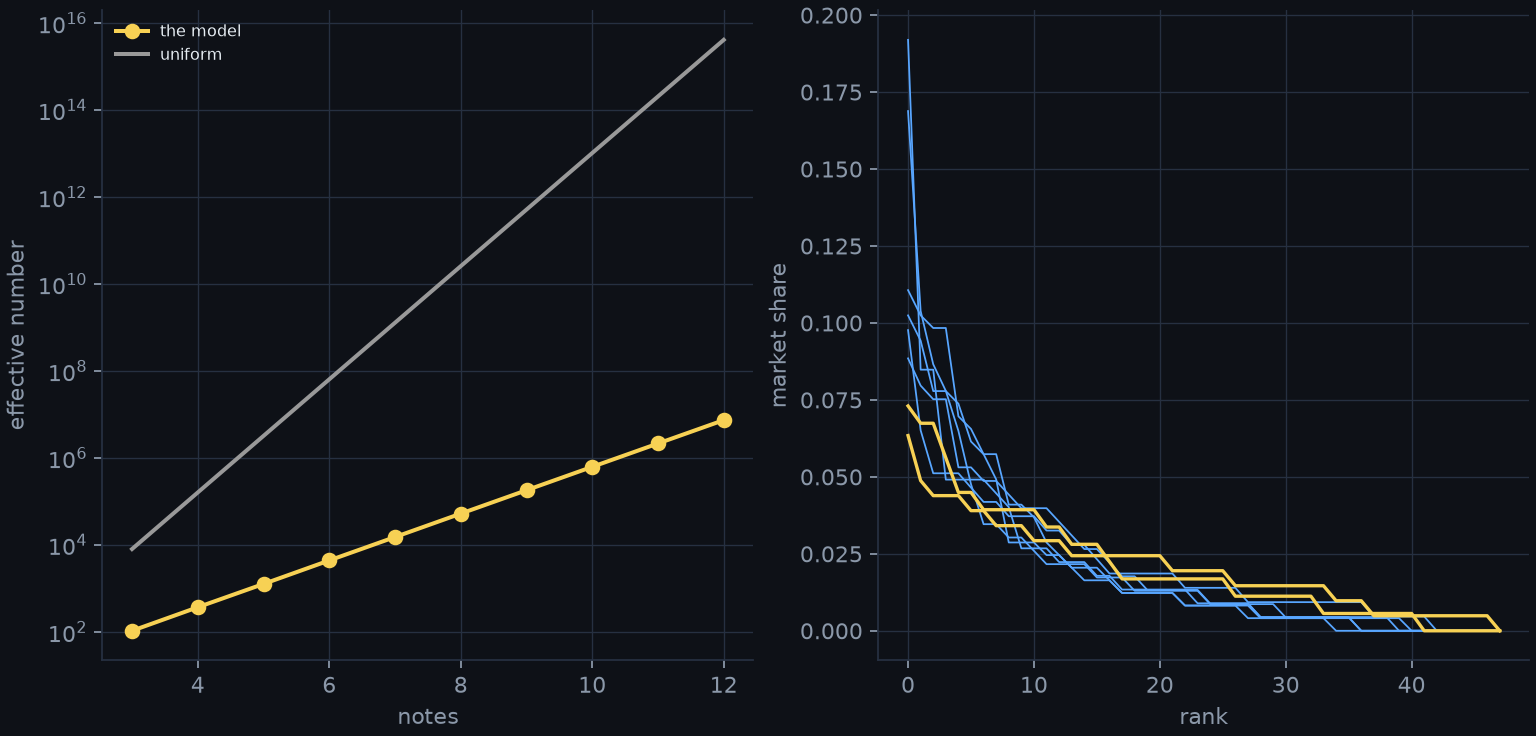
Monochord simulates the experiment. Forty-eight songs, each with a hidden quality, the chance that a listener downloads it; seven hundred listeners in each world. In the independent world, listeners choose by each song's appeal alone; the market shares fall off gently. In the social worlds, they choose partly by what others downloaded, and the leaders run away. The Gini coefficient, nought for equality and one for a single winner, rises from to . And the worlds disagree: a song's share differs between social worlds almost twice as much as between independent ones. Quality matters, but not alone: the eight worlds' winners were the first, second, fourth and even the eleventh best song.
Here are two worlds' hits: the most downloaded song in world one, and in world two. Same forty-eight songs, two different winners.
Both are good songs in our model, among its best two; which of them won depended on who happened to arrive first.
What does it mean? Cumulative advantage: success makes success, through charts, playlists, radio and friends. In the experiment the best songs rarely failed completely, and the worst rarely succeeded; in between, almost anything could happen. So a hit tells you less about a song than it seems to, and the history we have is a sample of one world. And a recommendation system is a social-influence world built by engineers, which Part 63 takes apart.
7Charts and attentionFoundations2 min
How does the way plays are counted change the music?
Charts are measurements, and measurement changes music. Billboard's Hot 100 began in 1958, built from sales reported by shops and plays reported by radio stations. In 1991 SoundScan began counting sales at the till, and overnight country and hip-hop rose up the charts: they had been selling all along. In 2012 and 2013 on-demand streams and then YouTube views joined the Hot 100, and from 2014 albums were counted in equivalent units. What is counted is rewarded, and what is rewarded is made. Goodhart's law, in music: a measure that becomes a target changes what it measured.
Hear the same song opened two ways: after a long instrumental introduction, and with the voice from the first beat.
On a service early skips can strongly affect engagement; they are not the only factor in success. The commonly cited thirty-second count threshold is one condition, not a guaranteed payment, and in 2014 Paul Lamere found that about a quarter of plays were skipped within five. Hugues Léveillé Gauvin measured hits' introductions: about twenty seconds in the mid-1980s, about five by 2015.
And the rest of the system leans the same way. A simplified per-count allocation model, subject to eligibility rules, rewards shorter tracks and more of them. Playlists became the new radio: a place on a large one can make a career. Background listening grew, chill and sleep playlists, and tracks made to fill them. On short-video platforms, a song's fifteen seconds can matter more than the song. It was always so: the seventy-eight's three minutes, the LP's forty, radio's single, and now the stream's thirty seconds all shaped the music made for them.
8Live music: the cost disease and ticketsFoundations2 min
Why do concert tickets keep getting dearer?
Hear a string quartet play the Tune. It took four players and the same half minute when Mozart was alive, and it still does.
That is the cost disease, named by William Baumol and William Bowen in 1966. Elsewhere, our illustrative model assumes two-percent annual productivity growth elsewhere, and wages grow with it, musicians' included, or they would leave for other work. But a quartet's output per hour does not grow at all. So the price of a performance, relative to manufactured goods, rises exponentially: these multiples follow the assumed two-percent path; they are not measured historical ticket-price increases. Recording was the cure for listening: one performance, sold millions of times. But a concert cannot be copied, which creates cost pressure under these assumptions; subsidies, wages, capacity and technology also affect actual prices.
And a tour date has more fans than seats. Monochord models one: twenty thousand seats, sixty thousand fans, each willing to pay a different amount. Sold at a face value well under the market, the artist's side takes 1.8 million dollars; resellers who buy a quarter of the seats take another 0.8, and the seats go to whoever was lucky, not to whoever wanted them most. At one price that just fills the house, the artist takes about twice as much and resellers nothing. And selling each seat at the most its buyer would pay, perfect first-degree price discrimination, which is stronger than ordinary dynamic pricing, takes everything fans would have kept.
So pricing a ticket is a choice about who keeps what. Artists often price under the market on purpose, for fairness, loyalty and full rooms, as the economist Alan Krueger documented in Rockonomics. The gap becomes the resale market: bots buy seats in seconds, and laws against them are hard to enforce. In 2010 Ticketmaster and Live Nation merged; in 2024 the Department of Justice sued to break them up. Crashed presales in 2022 and surging dynamic prices in 2024 made the largest tours national arguments. For most working bands the problem is the opposite: costs rise, rooms are small, and fees take a share.
9How many melodies are there?Foundations4 min
How often do two songs share a phrase by chance?
How many melodies are there? The naive answer is astronomical: twenty notes in eight places is twenty to the eighth, twenty-five billion. But melodies are not drawn evenly. The right count is the collision probability: the chance that two melodies drawn independently from a model of real melodies open with the same k notes, the sum of each melody's probability squared. Its reciprocal is the effective number: how many equally likely melodies would collide as often. Monochord computes it exactly from Part 14's model of folk melody, by summing over the model's contexts, not by sampling.
Here are the two counts, on a logarithmic scale. Every sequence of the model's twenty notes, equally likely: twenty times more for every note added. The model's effective number grows far more slowly: about eight-note openings, and some seven million at twelve. Steps, the tonic and the scale crowd melodies together. Our model is crude, and real songwriters are freer than its corpus of folk tunes, but the gap, of nearly six orders of magnitude at eight notes, is the point.
Now the odds. Take two songs of sixty notes each: each has fifty-three windows of eight notes. If the windows were independent draws from our model, the chance that some window is shared is about percent: one pair in twenty. Among a hundred million songs, about as many as the services hold, some ninety-six billion pairs share their eight-note opening. This is the birthday problem: rare for any one pair, certain somewhere. So a shared phrase, alone, is weak evidence of copying. What else is shared matters: rhythm, harmony, words, and whether the writer could have heard the other song.
Which similarity counts? Hear two pairs: the Tune and the Tune a fourth higher; then the Tune and a melody that keeps its every rise and fall but changes the sizes of its steps.
The transposed Tune shares not one note with the original, yet every interval, and many listeners recognize it as the same melody. The second shares every rise and fall, and is a different tune. Intervals and rhythm support transposition-invariant similarity, while absolute pitches, harmony, timbre and context can also matter, and contour alone is not enough.
Courts have answered differently over the years. In 1976 George Harrison's My Sweet Lord was found to have copied He's So Fine, subconsciously. In 2015 a jury found that Blurred Lines infringed Marvin Gaye's Got to Give It Up, though what they shared was more a feel than a melody, and the verdict was upheld in 2018. Then the tide turned: Stairway to Heaven was cleared by the Ninth Circuit in 2020, and in 2022 an appeals court held that an ostinato in Katy Perry's Dark Horse was too common to own. In 2023 a jury cleared Ed Sheeran's Thinking Out Loud of copying Let's Get It On, and separate related litigation also produced appellate rulings; distinct cases and procedural histories should not be conflated. The courts keep asking chance's question: is what is shared common property, or this writer's own expression?
10Sampling and machinesFoundations4 min
Who owns a sound, and who owns what a machine learned from it?
Your turn. A new beat, twice. Under one, a slice of our session's recording, looped. Under the other, the same harmony and melody re-played by other hands. Which is the sample?
The first: the recording itself, voice and room and all, which can require permissions for both composition and master when they are protected; here the underlying melody is public domain and the examples are ours. The second re-plays the same notes; an interpolation avoids using the original master, but composition permissions may still be needed if protected material is used.
Sampling law was made case by case. In the 1980s hip-hop was built on samples, mostly uncleared. In 1991, in Grand Upright against Warner, an American court ruled an unlicensed sample an infringement. In 2005 the Sixth Circuit went further: get a license or do not sample, however short the sample. In 2016 the Ninth Circuit allowed a trivial sample, so the American circuits now disagree. And in 2019 the European Court of Justice, in a case over two seconds of Kraftwerk, addressed phonogram reproduction, recognizability and exceptions including quotation; an unrecognizable sample was treated differently, not as a universal exemption from all rights.
Another question. One of these two melodies is an old Viennese folk song. The other was made a moment ago by Part 14's model, trained on the series' folk tunes, but not on that one. Which is the machine's?
The first was the machine's. By the model's own measure it is the less surprising of the two, bits a note against for the folk song: this particular generated example has lower surprise under its own model; that does not establish a universal tendency across music generators. Which raises the questions of the next minutes: whose music did it learn from, and who owns what it makes?
Models that make music are the latest machine to break the arrangement, and the story is moving fast, so take these dates as a snapshot. In June 2024 the major labels sued two music-generation companies, Suno and Udio, in American courts, over training on their recordings. Litigation, settlements and catalogue-licensing agreements must be checked case by case; an agreement between parties does not settle training law generally. Disputes over training and reproduction also arise under European law; current procedural status requires the relevant court record. In America a work needs a human author to be protected; a machine's output alone is not. Whether training itself is fair use, or needs a licence, is still being decided, country by country.
And voices. Copyright does not generally grant ownership of a voice or style alone; recordings, protected expression, publicity rights and other laws can restrict particular uses. But it can be part of a person's likeness, and in 2024 Tennessee's ELVIS Act protected voices from unauthorized cloning. Style is free: every composer learned from others, and a model learns from millions. The open question is scale: when imitation is free and endless, what does the original earn?
11Frontier: payout reform and training dataResearch2 min
Can a court be told the odds?
Two frontiers. The first is how the pool is divided. Which division is fair? Economists model it, and the services test it on their own data, which they rarely publish. And listeners and musicians respond: change how a stream pays, and what is made, and how it is played, changes. Fraud is an arms race, now with generated tracks uploaded by the thousand. The proposals: a floor per listener, extra weight for active listening, minimum thresholds, public data. The measurement problems are Part 67's: what is fair, to whom, and how would we know?
The second is training data. If models are licensed, who is paid, how much, and for which songs a model actually used? Attribution: can we measure how much one recording influenced one output? Influence functions try; it is an open problem. Memorization: how often does a model reproduce its training data, phrase for phrase? Part 65's plagiarism tests ask exactly that. Detection: watermarks and classifiers to tell generated audio from recorded. Every one of these is a statistics problem with money attached.
A research problem to end on, from Chapter 9. Train melody models on large corpora of songs, with their dates, holding out the songs at issue. For a disputed phrase, compute the chance it would arise independently, given everything written before it. Check the models' calibration on pairs known to be independent and pairs known to be copied. The question: can a model give a court a calibrated probability that a shared phrase arose by chance? An answer would add testable statistical evidence alongside musicological analysis; a collision probability is not the posterior probability of copying.
Variation 60, recap and problemsAll tracks4 min
Every part ends by doing something to the Tune with what it built. Here is its family of copyrights: our session's recording; a string quartet's cover; and a remix that samples our recording under a new beat. One melody, free since long before copyright; three recordings, each a new work with its own owners.
And here is each version's statement after a million simulated streams, at our service's rate. Each pays its rights holders about dollars, four fifths to the recording, one fifth to the composition. Our recording pays us all of it, as owners of the recording and the arrangement. The quartet's cover pays us nothing: the melody is free, and the recording is theirs. The remix pays us half, under an illustrative sample agreement. And the composer of the melody that all three are built on, unknown since 1761, is paid nothing at all.
Row sixty of the ledger, the last of Act Ten: the Tune's family of copyrights, and what a million streams of each would pay. The ledger itself has been an account all along: of what was done to one melody, and what it cost.
What did we find? A song is two works, the composition and the recording, with their own owners and terms. There are four main licences, and collecting societies exist because nobody could ask everyone. Our simulated service distributes about half a cent per counted stream; there is no universal fixed streaming rate, and an advance is repaid out of the artist's royalties. Divided pro rata, heavy listeners and bots decide where light listeners' money goes. Social influence makes hits bigger and less predictable, and the cost disease raises the price of a concert. And melodies are fewer than they look: shared phrases are common, by chance alone.
Five problems. One to compute, one to prove, one for your ears, one to build, and a research problem, marked with a star. Solutions are in this part's notes. Pause here.
Where does this come back? In finding music, where recommendation is a social-influence world. In machines that compose, with tests for memorization and plagiarism. In generative audio, with voices, training data and rights. In research, measuring fairness. And in the series' own Variations, performed at the end.
And in practice, for anyone who writes or records. Register every song, with complete credits. Read what is recoupable, how long the label owns the masters, and what reverts. Clear every sample, both licences, before release. And keep dated drafts and session files, the evidence of independent creation.
The books and papers this part follows. The full list, with notes, is in the README.
Act Eleven turns the chain around. 1975: a program at Stanford writes down a duet it has heard, as long as its two voices keep out of each other's way. Can a machine hear a recording and write down its notes? Next time. Part 61: Pitch, Onsets and Transcription.
Where it goes next. Recommendation as a social-influence world in Part 63; memorization and plagiarism tests for machines that compose in Part 65; voices, training data and rights in Part 66; measuring fairness and listening in Part 67; the series' own Variations performed in Part 68.
Key results
The part's results in one place, for revision.
Try it
Lab 60 · The business of music, computed
Divide a million streams among the service, the label, the artist, the publisher and the songwriters; find how many streams repay an advance; divide a simulated month two ways and see who gains; run a social-influence market; and count how many distinct melodies a model of folk melody makes, and how often two songs share a phrase.
python -m videos.music.labs 60
needs numpy, scipy, matplotlib · download lab60.py ·
source on GitHubsimulated rate to all rights holders, cents a stream 0.452
a million streams: service, label, artist, each songwriter $1,936, $2,805, $639, $218
streams to recoup $150,000 at 18%; the label's break-even 235M; 52M
chart: pro rata, user-centric $10,237, $7,898 (-23%)
niche: pro rata, user-centric $3,097, $6,534 (+111%)
fraud: pro rata, user-centric $1,265, $168 (-87%)
market (influence 0.8): Gini social / independent 0.61 / 0.43
unpredictability social / independent 0.0177 / 0.0101
8-note openings: effective number, against 20^8 52,206 against 2.56e+10
two 60-note songs share some 8-note window 5.2%
ear problem: four pairs; which share their opening? (listen first) no, yes, yes, no
A song is two works with two owners; a stream pays its rights holders about half a cent, divided by contract; a pool divided pro rata lets heavy listeners and bots decide where everyone's fees go; social influence makes hits larger and less predictable; and melodies are far fewer than their notes suggest.The code (94 lines; it asserts its own result)
"""Lab 60: the business of music, computed: a million streams divided among their claimants, an advance recouped,
a service's month divided pro rata and user by user, a social-influence market, and how many melodies a model of
folk melody really makes.  Every term is illustrative (2026); none of it is legal or financial advice."""

import numpy as np

from videos.coursekit import labs
from explainer.music.monochord import SR, Clip, concat
from explainer.music.monochord import business as B
from explainer.music.monochord import melody as M
from explainer.music.monochord.partkit import organ_tone

TITLE = "The business of music, computed"
GOAL = ("Divide a million streams among the service, the label, the artist, the publisher and the songwriters; find how "
        "many streams repay an advance; divide a simulated month two ways and see who gains; run a social-influence market; "
        "and count how many distinct melodies a model of folk melody makes, and how often two songs share a phrase.")
TASKS = [
    "Change ROYALTY and ADVANCE. How many streams does the artist need, and how many does the label need, to break even?",
    "Change INFLUENCE (0 is the independent world). How do the Gini coefficient and the unpredictability move?",
    "Change K. At how many notes does a shared phrase become rare between two songs of 60 notes?",
]
ROYALTY, ADVANCE = 0.18, 150_000.0
INFLUENCE = 0.8
K = 8


def tone_line(pitches, beat=0.32):
    parts = [organ_tone(261.63 * 2 ** (p / 12), beat * 0.95, partials=5) for p in pitches]
    return np.concatenate(parts)


def run(seed=0):
    rng = np.random.default_rng(seed)
    lab = labs.Lab()
    p = B.population(n_users=3000, seed=seed)
    rate = float(p.fees.sum() / p.plays.sum())
    t = B.Terms(artist_royalty=ROYALTY)
    pm = B.per_million(rate, t)
    lab.row("simulated rate to all rights holders, cents a stream", f"{100 * rate:.3f}")
    lab.row("a million streams: service, label, artist, each songwriter",
            f"${pm['the service']:,.0f}, ${pm['the label']:,.0f}, ${pm['the artist (credited, against the advance)']:,.0f}, ${pm['each songwriter']:,.0f}")
    label_rate = rate * t.recording() / (1 - t.service)
    r = B.recoup(ADVANCE, [0], label_rate, royalty=ROYALTY)
    lab.row(f"streams to recoup ${ADVANCE:,.0f} at {100 * ROYALTY:.0f}%; the label's break-even", f"{r['need'] / 1e6:.0f}M; {ADVANCE / (label_rate * (1 - ROYALTY)) / 1e6:.0f}M")
    a, b = B.by_group(p, B.pro_rata(p)), B.by_group(p, B.user_centric(p))
    for g in ("chart", "niche", "fraud"):
        lab.row(f"{g}: pro rata, user-centric", f"${a[g]:,.0f}, ${b[g]:,.0f} ({100 * (b[g] / a[g] - 1):+.0f}%)")
    assert b["niche"] > a["niche"] and b["fraud"] < a["fraud"]
    ml = B.musiclab(influence=INFLUENCE, seed=seed, worlds=6)
    lab.row(f"market (influence {INFLUENCE}): Gini social / independent", f"{ml['gini_social']:.2f} / {ml['gini_independent']:.2f}")
    lab.row("unpredictability social / independent", f"{ml['U_social']:.4f} / {ml['U_independent']:.4f}")
    mdl = M.NGram(2).fit(M.corpus())
    q = B.collision(mdl, K)
    lab.row(f"{K}-note openings: effective number, against {len(mdl.alphabet)}^{K}", f"{1 / q:,.0f} against {len(mdl.alphabet) ** K:.2e}")
    lab.row(f"two 60-note songs share some {K}-note window", f"{100 * B.shared_window_prob(q, 61 - K, 61 - K):.1f}%")

    # the ear problem: four pairs of melodies; some pairs share their first six notes
    pool, seen, shared = {}, [], []
    for s in range(6000):
        mel = mdl.generate(12, start=(), seed=s)
        key = tuple(mel[:6])
        if key in pool and pool[key][6:] != mel[6:] and len(set(key)) >= 3:
            shared.append((pool[key], mel))
        pool.setdefault(key, mel)
        if len(shared) >= 2:
            break
    others = [(mdl.generate(12, start=(), seed=9000 + 2 * i), mdl.generate(12, start=(), seed=9001 + 2 * i)) for i in range(2)]
    pairs = [(x, True) for x in shared] + [(x, False) for x in others]
    order = list(rng.permutation(len(pairs)))
    clips = []
    for i in order:
        (m1, m2), _ = pairs[i]
        clips += [Clip(tone_line(m1), SR), Clip(tone_line(m2), SR)]
    lab.audio = concat(clips, gap=0.5)
    lab.row("ear problem: four pairs; which share their opening? (listen first)", ", ".join("yes" if pairs[i][1] else "no" for i in order))

    fig, (ax1, ax2) = labs.figure(2)
    ks = list(range(3, 13))
    ax1.semilogy(ks, [1 / B.collision(mdl, k) for k in ks], "o-", color=labs.GOLD, label="the model")
    ax1.semilogy(ks, [len(mdl.alphabet) ** k for k in ks], color="0.6", label="uniform")
    ax1.set_xlabel("notes")
    ax1.set_ylabel("effective number")
    ax1.legend(fontsize=7)
    for sh in ml["social"]:
        ax2.plot(np.sort(sh)[::-1], color="C0", lw=0.8)
    for sh in ml["independent"]:
        ax2.plot(np.sort(sh)[::-1], color=labs.GOLD, lw=1.5)
    ax2.set_xlabel("rank")
    ax2.set_ylabel("market share")
    lab.fig = fig
    lab.note = ("A song is two works with two owners; a stream pays its rights holders about half a cent, divided by "
                "contract; a pool divided pro rata lets heavy listeners and bots decide where everyone's fees go; social "
                "influence makes hits larger and less predictable; and melodies are far fewer than their notes suggest.")
    return lab
Now change it
- Change ROYALTY and ADVANCE. How many streams does the artist need, and how many does the label need, to break even?
- Change INFLUENCE (0 is the independent world). How do the Gini coefficient and the unpredictability move?
- Change K. At how many notes does a shared phrase become rare between two songs of 60 notes?
Problems, with solutions
Try each problem before opening its solution.
-
Compute. A service pays rights holders 0.47 cents a stream; the label's royalty is 18 % of 55/70 of it. How many streams repay a 150,000-dollar account?
Solution
The label receives 0.47 × 55/70 = 0.369 cents a stream; the artist is credited 18 % of that, 0.0665 cents. 150,000 / 0.000665 ≈ 226 million streams. (The film's 228 million uses the unrounded simulated rate.)
-
Prove. Show that under user-centric division no account can be paid more in all than its owner's own fee.
Solution
User u's fee f_u is divided among the artists u played in proportions s_ua / Σ_b s_ub, which are non-negative and sum to one; so the total any set of artists receives from u is at most f_u, and an artist played only by accounts A receives at most Σ_{u∈A} f_u. A bot farm is paid back at most its own fees. Pro rata, by contrast, an artist receives (Σ_u f_u) × (its share of all streams), which grows with its streams whatever its listeners paid.
-
Ear. The lab plays melodies from Part 14's model in pairs; say which pairs share an opening, then check.
Solution
The lab prints the answers. Listen to the first six notes only; pairs that share them diverge at the seventh.
-
Build. Add a fourth social world with a ranking that ignores downloads; measure its Gini and unpredictability.
Where to look. In
business.musiclab, give each world its own influence (a list); a world with influence 0 is an independent world. Compare the Gini and the unpredictability of the influence-0 world with the others, over many seeds, and report intervals. -
★ Can a model give a court a calibrated probability that a shared phrase arose by chance?
Where the frontier is. Train melody (and rhythm) models on large dated corpora, hold out the songs at issue, compute the probability of the shared material under independence, and test calibration on pairs known to be independent and pairs known to be copied (for example, documented covers and quotations).
Notes and sources
Sources
- D. S. Passman, All You Need to Know About the Music Business (11th ed., 2023); A. B. Krueger, Rockonomics (2019); D. Hesmondhalgh, "Is music streaming bad for musicians? Problems of evidence and argument", New Media & Society (2021).
- S. Rosen, "The economics of superstars", American Economic Review (1981); A. B. Krueger, "The economics of real superstars: the market for rock concerts in the material world", Journal of Labor Economics (2005).
- M. J. Salganik, P. S. Dodds and D. J. Watts, "Experimental study of inequality and unpredictability in an artificial cultural market", Science (2006).
- W. J. Baumol and W. G. Bowen, Performing Arts: The Economic Dilemma (1966).
- P. Lamere, "The skip" (Music Machinery, 2014); H. Léveillé Gauvin, "Drawing listener attention in popular music", Musicae Scientiae (2018).
- Cases (US unless noted): White-Smith Music v. Apollo (1908); Herbert v. Shanley (1917); Bright Tunes Music v. Harrisongs Music (1976); Grand Upright Music v. Warner Bros. Records (1991); Bridgeport Music v. Dimension Films (2005); Marya v. Warner/Chappell Music (2015); VMG Salsoul v. Ciccone (2016); Williams v. Gaye (2018); Pelham v. Hütter (CJEU, 2019); Skidmore v. Led Zeppelin (2020); Gray v. Hudson (2022); Structured Asset Sales v. Sheeran (2024); GEMA v. OpenAI (Munich Regional Court, 2025; under appeal). Dates of filings, settlements and statutes after 2023 should be checked against current sources.
Scope: separate composition and recording rights do not imply two distinct owners or identical rights/terms. Streaming rates, recoupment and market simulations are hypothetical. Probability of coincidental similarity is not probability of copying; case-specific rights, eligibility and litigation status require their applicable records.
- J. Attali, Noise: The Political Economy of Music (1977; tr. B. Massumi, 1985).
About this partfrom its README
Part 60 of a sixty-eight-part course in music (see the series plan and
the syllabus), the last part of Act X, The Studio and the Stage. It follows one stream's fraction
of a cent from a phone to a songwriter. On the way the money passes two copyrights, four kinds of licence and half a dozen
intermediaries, each created when a new machine (the player piano, radio, the sampler, the file, the model) broke the old
arrangement. The tools are Monochord's (explainer/music/monochord/business.py, with Part 14's melody model). Every
term, price, population and market here is illustrative and dated (2026, mostly American); none of it is legal or
financial advice. No third-party recording is played; the songs in the lawsuits are named, not heard.
- Two melodies, one opening. An ear question (two melodies with the same eight-note opening: did one copy the other? neither; both were drawn independently from Part 14's model, and the 396th draw repeated an opening); chance; the business of music; the plan.
- 1. Two copyrights. One song, two works (the composition and the sound recording, their owners and terms); one composition in two recordings, heard; how long and where (the Statute of Anne, Bach v. Longman, 1831, 1897, 1911, 1972, the Music Modernization Act); the Tune's own rights; Happy Birthday; each machine broke the last arrangement.
- 2. Licences and collecting societies. Four licences (mechanical, performance, synchronization, master use); collecting societies (SACEM's café, ASCAP, Herbert v. Shanley); where a stream's money flows; gaps (US radio, unmatched royalties, the MLC's 2021 receipts).
- 3. Where a stream's money goes. One stream, heard past its 30 seconds; one month's subscription divided (11.99 dollars: 3.60 to the service, 5.21 to the label, 1.19 credited to the artist, 0.41 to each of three songwriters); one million streams at 0.47 cents (4,655 dollars to rights holders: the artist credited 658 on a label deal, 3,016 self-released; 224 to each songwriter); is that a lot?
- 4. Deals and recoupment. A record deal; a 100,000-dollar advance and 50,000 of costs at an 18 % royalty (the artist recoups after 228 million streams, the label breaks even at 50 million); other deals; how musicians are paid.
- 5. Dividing the pool. A simulated service (4,020 accounts, 4.2 million streams); the same month divided two ways (user by user, the niche artists +108 %, the chart stars −25 %); why fraud pays (a bot farm paying 168 dollars takes 1,303 pro rata); reforms (dated).
- 6. Superstars and cumulative advantage. The economics of superstars (Rosen; Krueger's concert shares); MusicLab (Salganik, Dodds and Watts, 2006); the experiment simulated (Gini 0.43 independent, 0.61 social; unpredictability 0.010 against 0.018; winners ranked 1st to 11th in quality); two worlds' hits, heard; what it means.
- 7. Charts and attention. How the charts count (1958, SoundScan in 1991, streams in 2012–13, equivalent units in 2014); a long and a short introduction, heard (Lamere's skips; Léveillé Gauvin's shrinking intros); the attention economy.
- 8. Live music: the cost disease and tickets. A string quartet, heard; Baumol's cost disease (×3.3 since 1966 at 2 % a year); one night's tickets sold three ways (face value 1.8 million dollars to the artist's side and 0.8 to resellers; one clearing price 3.4 million; seat-by-seat dynamic prices 6.4 million); the ticket market (dated).
- 9. How many melodies are there? Counting melodies (collision probabilities, effective numbers); the curve (52,206 effective eight-note openings against 20⁸ ≈ 2.6 × 10¹⁰); the birthday problem for melodies (5.2 % for two 60-note songs; about 10¹¹ pairs among 100 million songs share an eight-note opening); what makes two melodies the same (the Tune a fourth higher against a re-contoured Tune, heard); in court (US, dated).
- 10. Sampling and machines. An ear question (a sample or a replay? the first was the sample); sampling in court (Grand Upright, Bridgeport, VMG Salsoul, Pelham); an ear question (an old folk song or the model's melody? the first was the model's, 1.9 bits a note against 2.7); models and rights (dated); voices and styles.
- 11. Frontier: payout reform and training data. Payout reform; training data (licensing, attribution, memorization, detection); ★ research problem: can a model give a court a calibrated probability that a shared phrase arose by chance?
- Variation 60, recap and problems. The Tune's family of copyrights: our recording, a quartet's cover, a remix that samples it; the statement after a million streams each (4,655 dollars to rights holders; all of it to us, none, half; to the melody's unknown composer of 1761, nothing); the ledger; what we found; five problems; where it comes back; in practice; references; Part 61.
What is computed and built
python -m videos.music.music60.compute (under a minute) fills .cache/music60/.
| Item | What it computes | Checked against |
|---|---|---|
hook, melodies, similar, ai |
melodies from Part 14's model; exact collision probabilities; similarity counts; surprise | the DP against sampled pairs; a uniform model's A⁻ᵏ (tests) |
waterfall, deals |
a subscription and a million streams divided; recoupment | the shares add up; hand-worked accounts (tests) |
pool |
a simulated month divided pro rata and user by user | a two-user case by hand; bots repaid exactly (tests) |
market |
Salganik, Dodds and Watts's experiment simulated | Gini of known vectors (tests) |
live |
the cost disease; three ways to sell tickets | the revenue ordering (tests) |
rights, stream, intro, sample, tune60 |
the sounds | the series' clip rules (tests) |
Monochord's tools are held in tests/music/test_business.py; this part's claims and clips in tests/music/test_music60.py.
Sounds. Part 56's session, Part 38's piano, Part 40's kit, Part 9's bowed strings as a quartet, Part 8's voice, and melodies by Part 14's model.
What the models are, and are not. The terms (a 30 % service share, 55 and 15 points to recording and composition, an 18 % royalty, a 25 % publisher share, 10 % society costs, three writers) are round illustrative numbers in the range reported for 2020s US deals; real contracts vary widely. The service is a population built so that heavy listeners play the charts and light listeners play niche artists; real services' data show the same direction with smaller shifts. The market follows the design of the MusicLab experiment with a simple choice rule; its numbers are not the experiment's. The melody model is an order-2 model of 54 folk tunes' pitches, without rhythm; real songwriting is freer, so its effective numbers are a lower bound in spirit, not a measurement of popular music.
Companion material in this repository
The syllabus's plan for this partfrom SYLLABUS.md, the plan of record
- Hook: an ear question (did one copy the other?); chance; the business of music; the plan.
- Two copyrights: one song, two works; one composition in two recordings, heard; how long and where; the Tune's own rights; each machine broke the last arrangement.
- Licences and collecting societies: four licences; collecting societies; where a stream's money flows; gaps.
- Where a stream's money goes: one stream, heard; one month divided; a million streams; is that a lot?
- Deals and recoupment: a record deal; recoupment stream by stream; other deals; how musicians are paid.
- Dividing the pool: a simulated service; pro rata against user-centric; why fraud pays; reforms.
- Superstars and cumulative advantage: Rosen and Krueger; MusicLab; the experiment simulated; two worlds' hits, heard; what it means.
- Charts and attention: how the charts count; a long and a short introduction, heard; the attention economy.
- Live music: a quartet, heard; the cost disease; one night's tickets three ways; the ticket market.
- How many melodies are there?: counting melodies; effective numbers; the birthday problem; what makes two melodies the same, heard; in court.
- Sampling and machines: an ear question (sample or replay?); sampling in court; an ear question (folk song or model?); models and rights; voices and styles.
- Frontier: payout reform; training data; the research problem.
- Variation 60: the Tune's family of copyrights and their statements. Outro: problems, payoffs.
Covers: the two copyrights and their rights; collecting societies; deals, advances and recoupment; the
streaming pool and how to divide it; superstars and power laws; social influence and unpredictability; charts;
the cost disease of live performance; ticket pricing; similarity lawsuits and how many melodies there are;
sampling; AI and rights; the map of careers. Everything dated, with jurisdiction, and labelled as not legal
advice.
Built and computed: monochord/business.py: a royalty waterfall on illustrative terms (a million streams at 0.47
cents: 4,655 dollars to rights holders, 224 to each of three songwriters); recoupment (228 million streams for a
150,000-dollar account, the label even at 50 million); pro-rata against user-centric division on a simulated
population (niche artists +108 %, a bot farm paid 7.8 times its fees pro rata); a cumulative-advantage market (Gini
0.43 to 0.61); Baumol's cost disease; three ways to sell a night's tickets; exact collision probabilities of Part 14's
model (52,206 effective eight-note openings against 2.6 × 10¹⁰) and the birthday odds of a shared phrase.
Variation 60: the Tune's own family of copyrights (our recording, a quartet's cover, a remix that samples it), and
each version's statement after a million simulated streams.
Frontier: payout reform; training-data litigation and licensing (verify, dated); a research problem on
calibrated probabilities that a shared phrase arose by chance.
Reading: Passman; Krueger, Rockonomics; Salganik, Dodds & Watts (2006); Baumol & Bowen (1966); Rosen (1981).
Build the film
python -m videos.music.music60.compute        # the part's numbers, into .cache/music60
python tools/build.py music60                  # render and assemble the film
EXPLAINER_TTS=silent python tools/qa_scene.py music60 Hook   # one chapter, silent, with a contact sheet
Scenes: videos/music/music60. Setup: see the course page. Source of these notes: the README and the scenes' narration.
Build it
python -m videos.music.music60.compute                          # numbers and sounds (under a minute)
EXPLAINER_TTS=silent python tools/build.py music60 -q l --fps 15   # a silent-narration preview, with the sounds
python tools/qa_sound.py music60 --sync                         # the sound gates
python tools/dead_air.py renders/music60_480p.mp4 --sound music60  # no empty screen; no sound over a still one
python tools/lecture_length.py music60                          # 30 to 60 minutes, listening included
python tools/build.py music60                                   # 1080p30, narrated
python -m pytest -q tests/music                                 # Monochord against its references; this part's claims and clips
python -m videos.music.labs 60                                  # the lab (writes a figure and a short WAV)