Act X · The Studio and the Stage
Part 59 of 68Live Sound
Why does a microphone howl, why are loudspeakers hung in curves, and how is a stadium made to hear a band?
In August 1965 the Beatles played Shea Stadium through the baseball announcement system and nobody, the band included, could hear them; an ear question hears our session from the stands over a crowd through a 1965-style horn system (6 dB under the crowd) and a modern one (8 dB over). Why a microphone howls: the loop, Nyquist's criterion (the real part of G H reaching one, not its magnitude), and a simulated hall in which Monochord predicts the gain before feedback (-17.9 dB) and the howl note (358 Hz), then hears it build at 358; an ear question hears a clap at 6, 0.5 and 2 dB below the edge. Ringing out with six narrow notches (+3.3 dB), heard; placement, nulls and in-ear monitors; Davis's PAG and NAG (24.5 against 26.0 dB). Point and line sources: 6 dB per doubling against about 3 near a line (2.7 at 1 kHz), and the transition distance growing with frequency (26, 103, 411 m at 250 Hz, 1 kHz, 4 kHz for an 8.4 m line). Three fields of an arena at 1 kHz: a point, a straight line and a J-shaped array (splays 0.3 to 4.2 degrees); the array heard at 10, 40 and 80 m (6.4 and 7.3 dB down). Steering. Subwoofers: a cardioid pair (0.9 m, 2.6 ms, inverted) that cancels behind at every frequency, heard from the stage; end-fire and arc delays. A delay tower (90 and 30 m: 184.7 ms), an ear question on alignment; the speed of sound and temperature (3 ms drift over 10 degrees), refraction and wind; ISO 9613-1's air absorption (0.5, 3, 11 and 36 dB over 100 m at 1, 4, 8, 16 kHz), heard. Dual-channel measurement with the music: transfer function, coherence and the delay found exactly; pitfalls and system tuning. Wireless: third-order intermodulation, an even 24-carrier grid with every carrier hit against Monochord's planner's 20 clean carriers around three TV channels; in-ear monitors; Dante, AES67, PTP and the latency budget. Speech: Houtgast and Steeneken's modulation transfer and the STI over reverberation and noise (0.74 dry and clean to 0.23 at 6 s); an ear question hears one announcement in a studio (0.64), a hall (0.37) and a station (0.15); remedies. Hearing health: hair cells, hidden hearing loss, the equal-energy rule, a night's doses (2016 per cent at the barrier, 16 with earplugs mid-arena), the EU directive and the WHO's 2022 venue standard. Frontier: immersive object-based live systems, sound zones and off-site noise. Variation 59: the Tune at the mixing desk, the back row and the car park.
What you need. Part 4 for the cochlea, loudness and hearing damage; Part 49 for impulse responses, the image method and measurement by sweeps; Part 50 for intermodulation; Part 54 for microphone patterns and arrays; Part 55 for rooms, precedence and wave fields; Part 56 for the mix. Complex numbers and phase, decibels, the FFT, interference of waves.
- Ideas, mathematics and history
- Shea Stadium, gain before feedback, line arrays and interference, subwoofer arrays, delay towers, system tuning, hearing health
- What we build, compute and hear
- array and feedback simulators; the Tune from the front row and the car park
What you will be able to do
Foundations
- Hear a 1965 stadium system against a modern one, a clap at three margins below feedback, and a howl building.
- Hear a voice before and after ringing out, a line array at three distances, and subwoofers from behind the stage.
- Hear a delay tower aligned and not, the air over 10 and 100 m, and one announcement in three rooms.
Full course
- Derive the gain before feedback by Nyquist's criterion, and the potential and needed acoustic gain.
- Compute point and line sources' fields, a cardioid subwoofer pair, delay-tower times and air absorption.
- Measure a transfer function with music, plan carriers free of third-order products, and compute STI and dose.
Research
- Find array settings that hold a festival's off-site noise limit with 95 per cent confidence over the weather.
Practice
- Design, align and tune a system: gain before feedback, coverage, delays, a frequency plan, intelligibility, safe levels.
Contents
Each chapter has a home level. Choose a track to see what to read and watch: Foundations 22 min · Full course 34 min · Research 36 min · Practice 34 min.
- 0Fifty-five thousand people and no soundFoundations2 min
- 1Why a microphone howlsFoundations3 min
- 2Ringing out, and monitorsFoundations3 min
- 3Point and line sourcesPractice3 min
- 4Arrays and curvatureFoundations2 min
- 5Subwoofer arraysFoundations2 min
- 6Delay towers, air and weatherFoundations3 min
- 7Measuring a systemPractice3 min
- 8Wireless and networksPractice3 min
- 9Speech in big roomsFoundations3 min
- 10Hearing healthPractice3 min
- 11Frontier: immersive stages and quiet neighboursResearch2 min
- Variation 59, recap and problemsAll tracks3 min
Also on this page: Lecture · Key results · Try it · Lab · Problems · Notes and sources · Build the film.
Lecture
The text of each chapter is the film's narration, as it is spoken, so you can read along or revise without the film. The pictures are in the film. A dashed box stands for a number the film computes when it is rendered (hover over it to see what is computed); the README's figures for each chapter, where it lists them, follow the chapter's text.
Fifty-five thousand people and no soundFoundations2 min
In August 1965 the Beatles played Shea Stadium in New York. Put on headphones and judge first. A band heard from the stands of a stadium, over a screaming crowd, twice: once through our simplified historical-system model, once through a modern-system model; neither is an archival recording. Which was 1965?
The first. A system built for announcing baseball scores, horns with no bass and no treble, driven into distortion, and still six decibels under the crowd. The second puts the band clearly above it, full range.
That first system is a fair picture of a night in 1965. On the fifteenth of August the Beatles played Shea Stadium in New York to some fifty-five thousand people, then a record for a concert. The band's amplifiers were hundred-watt Vox stacks; the voices went through the stadium's announcement horns. The screaming crowd was louder than all of it; the band could not hear itself play. They stopped touring a year later. Modern concert sound developed through many events and innovations to address these problems: power, coverage, monitors for the musicians, and control.
The answer was built in steps. At Woodstock in 1969, a purpose-built system of stacked horns and bass bins, hung on towers. In 1974 the Grateful Dead's Wall of Sound: hundreds of loudspeakers behind the band, a separate system for each instrument, and no monitors needed. In the 1980s, standard boxes flown in clusters; and in 1992 L-Acoustics' V-DOSC made the line array a product. Today: curved line arrays, subwoofer arrays, delay towers, in-ear monitors, all on a network.
Here is the plan. Why a microphone howls, and how to predict the note. Ringing a system out, and monitors. Point and line sources, arrays, and why they are hung in curves. Subwoofer arrays, delay towers, and what air and weather do. Measuring a system, and wireless microphones and networks. And intelligibility, and how loud is too loud.
1Why a microphone howlsFoundations3 min
Can you predict the note a system will howl at?
On a stage the microphone hears the loudspeaker. A voice goes into the microphone, through the amplifier's gain G, out of the loudspeaker, round the hall, whose response H includes every reflection, and back into the microphone, where it joins the voice and goes round again. The microphone's signal is the voice divided by one minus G H. When G H approaches one, the denominator approaches nothing, and the system rings; when it passes one, every trip round the loop is louder than the last, and the system howls.
When exactly does it run away? G H is complex: a gain and a phase at every frequency. The loop runs away where the returning sound arrives in step with what is already there, its phase a whole number of cycles, and louder than it: together, G H reaches plus one on the real axis. Harry Nyquist's criterion of 1932 follows: as the gain grows, for this stable acoustic-path model, candidate boundaries occur where H crosses the positive real axis, with zero imaginary part. So the gain before feedback is the reciprocal of the largest positive real-axis crossing in the search band; our dense-grid interpolation estimates its gain and frequency.
Here is a real-sized case: a hall twenty by fourteen by eight metres, simulated by Part 49's image method, with the loudspeaker five metres from the microphone. The hall's response from loudspeaker to microphone, shown here between two hundred and fifty and five hundred hertz, is a forest of peaks, one every few hertz, from all the reflections; across the whole range there are thousands. Its real part alone is insufficient: we require the imaginary part to cross zero too. The estimated critical positive-real-axis crossing is at hertz: a candidate feedback frequency within the scanned band for this linear model.
Your turn. A clap into this microphone, three times, at three gains below the edge of feedback, in some order. Which was closest to howling?
The second, half a decibel from the edge: after the clap it rings on, a tone at hertz that dies only slowly. Engineers call it a system ready to feed back. Six decibels down, the clap simply stops.
Now a voice into the same loop with the gain six tenths of a decibel past the edge.
The voice is swallowed by a rising whistle. Measured from the last second of the recording, it is at hertz, the frequency predicted from the loop's positive-real-axis crossings before the simulation.
2Ringing out, and monitorsFoundations3 min
How do engineers buy a few more decibels before the howl?
Before a show, engineers ring out the system. Raise the gain until it starts to ring, find the frequency, cut it with a narrow notch, and raise the gain again until the next one rings. Here is Monochord doing that with the loop's response: the first notch goes at the predicted frequency, and each notch exposes the next peak. Six notches buy decibels. A hall with thousands of nearly equal peaks gives up only a few; more than that, and the notches start to colour the voice.
Hear the same voice at the same gain, half a decibel under the original edge: before ringing out, and after the six notches.
Before, every note leaves a ringing tail; after, the voice is clean, with nearly four decibels in hand.
The cheaper decibels come from geometry. Move the microphone closer to the source: every halving of the distance is six decibels more voice for the same loop. Aim the microphone's null at the loudspeaker, a cardioid's rear or a supercardioid's side nulls, from Part 54. Keep loudspeakers in front of the microphones and aimed away from them. And keep few microphones open, since each adds its own loop. Geometry first, notches last.
System designers put the geometry into one formula. Don and Carolyn Davis's potential acoustic gain, from the 1970s, uses only the inverse-square law. Take a talker twenty metres from the listener, the microphone six metres from the loudspeaker, the talker thirty centimetres from the microphone, the loudspeaker twelve metres from the listener, one open microphone and six decibels of safety. The potential gain is decibels; to sound as if the talker were a metre away the listener needs : not quite enough. Bring the microphone to fifteen centimetres, six decibels more, and there are four and a half to spare.
And the musicians need to hear themselves, the problem of Shea Stadium. Wedges on the floor, aimed up at each player, give each a mix of their own. They are loudspeakers aimed at the backs of the microphones, so microphone pattern and monitor position must be chosen together; supercardioids have rear lobes and different null angles. And a loud stage leaks into every microphone and into the front-of-house mix. From the 1990s, in-ear monitors put each musician's mix in earphones: much less loudspeaker-to-microphone acoustic coupling; earpiece leakage and ambient feeds can still matter, and a quieter stage. Their cost is isolation from the room and the audience, which engineers restore with ambient microphones.
3Point and line sourcesPractice3 min
Why does a line of loudspeakers carry further than one?
The trouble in a stadium is distance. A point source spreads its power over a sphere whose area grows as r squared, so its intensity falls six decibels for every doubling of distance. From ten metres to eighty is three doublings, eighteen decibels: the front row deafened, or the back row starved. An ideal infinite line has cylindrical spreading; a finite coherent line only approximates this over suitable frequencies and distances, whose area grows only as r: three decibels per doubling.
Here it is computed: sources in a vertical line metres long, against one, on a logarithmic scale of distance, each a third-octave average. The point source falls six decibels at every doubling. The line at one kilohertz falls under three, all the way out past a hundred metres. At two hundred and fifty hertz the line falls at three decibels at first, then bends to six beyond about twenty-six metres: far enough away, every line looks like a point.
How far does a line act as a line? Roughly to the transition distance, its length squared times the frequency over twice the speed of sound. For our eight-metre line: about metres at two hundred and fifty hertz, about at a kilohertz, and four hundred at four kilohertz. So a line array throws its treble much further than its bass, which is one reason arenas need subwoofers of their own and why the mix changes along the room.
There is a condition. The elements must be close: less than half a wavelength apart to act as one line. Our boxes are centimetres apart, which strictly holds only to about five hundred hertz, the departure at higher frequencies depends on geometry, element directivity and averaging. At four kilohertz our line of separate sources falls decibels per doubling: no better than a point. The cure is a waveguide in each box that turns its tweeter into a flat, continuous strip of sound, edge to edge with the next box's. Christian Heil and Marcel Urban set out these rules as wavefront sculpture in 1992, and they made the modern line array.
4Arrays and curvatureFoundations2 min
Why are line arrays hung in curves?
Here are the sound fields, side views of an arena from the stage to ninety metres, at one kilohertz, bright where it is loud. One point source: loud near it, falling away in every direction. A straight vertical line: a horizontal beam, level for a long way, but narrow: the people below it, close to the stage, are under the beam. Curve the lower part of the line, each box tilted a little more than the one above, and the beam fans downwards: the top boxes throw to the back, the bottom ones cover the front.
That is the logic of the curve. The far seats are reached by the straight top of the array, whose boxes couple into a long, narrow, far-reaching beam. The near seats are reached by the curved bottom, each box splayed further than the one above: here three tenths of a degree apart at the top, degrees at the bottom. That is the J shape. And prediction software computes fields like these for the real room, box by box, before the rig is ever hung. The goal is the same level and the same tone in every seat, within a few decibels.
Hear our mix from the line array at ten, forty and eighty metres, with the arena's reverberation and the air's absorption at each seat.
The level falls only decibels over eight times the distance, where a single box would lose eighteen; what changes is the treble, taken by the air, and the share of reverberation.
And the curve need not be mechanical. Give each box its own amplifier and processor, and the beam can be bent by delays, Part 55's wave fields in miniature. Steerable columns serve speech in churches and stations; beam-steered arrays serve concerts. Optimizers set each box's filters to match a target coverage, seat by seat. It is the arithmetic of Part 54's microphone array, run backwards.
5Subwoofer arraysFoundations2 min
How do you aim a sound whose wavelength is longer than the truck?
Bass is the hardest part to aim. At fifty hertz the wavelength is seven metres; a subwoofer box is far too small to be directional. So subwoofers radiate everywhere: onto the stage, into the microphones, and out of the back of the venue to the neighbours. And a row of them across the stage interferes with itself, leaving loud and quiet stripes across the audience. At low frequencies, practical compact directional bass systems use multiple radiating paths or sources with suitable spacing, delay and polarity.
The simplest aimed bass is a cardioid pair. Put a second subwoofer ninety centimetres behind the first, delay it by the time sound takes to cross that gap, milliseconds, and invert its polarity. Behind, the front box's sound arrives exactly when the rear box's inverted copy leaves, and they cancel, at every frequency: in this ideal model completely, in a real one by fifteen to twenty-five decibels. In front they arrive a little apart and mostly add; the sum is strongest where the gap is a quarter of a wavelength, near ninety-five hertz, and weaker towards the deepest bass. Part 54's gradient microphone, built out of loudspeakers.
Hear our mix from behind the stage, where the band stands: ordinary subwoofers, then a cardioid pair. You will need headphones or loudspeakers with real bass.
Behind a cardioid pair the bass all but disappears, leaving only what the main loudspeakers spill backwards: a quieter stage, and cleaner microphones.
There are other shapes. End-fire arrays: a row of subwoofers pointing at the audience, each delayed so its sound travels with the one behind it, making a forward beam. Arc delays: a straight row across the stage, delayed as if it were curved, to spread the bass evenly. Flown subwoofers beside the arrays, so that the front row is not shaken while the back row hears nothing. All of it is the delays and polarities of Part 54's microphone arrays.
6Delay towers, air and weatherFoundations3 min
Why does a festival's back field hear the stage twice?
At a festival the back field may be a hundred metres from the stage, too far for the main system. So a delay tower stands in the field. You are ninety metres from the stage and thirty from the tower: the stage's sound takes two hundred and sixty milliseconds to reach you, the tower's eighty-seven. Played at the same moment, the tower would be heard first, a sixth of a second ahead, and the stage would arrive as an echo. So the tower is delayed by the difference, plus ten milliseconds: in all. Its sound now reaches you just after the stage's, and by Part 55's precedence effect this can help retain stage localization when delay and relative levels are chosen appropriately.
Your turn. A voice heard ninety metres from the stage and thirty from the tower, twice: once with the tower delayed correctly, once not at all. Which was aligned?
The first: a single, clear voice. In the second every note is followed a sixth of a second later by its echo from the stage.
Outdoors, the air itself moves the sound. Sound travels faster in warm air, three hundred and thirty-one metres a second plus nought point six for each degree. So a tower aligned in the afternoon heat drifts by milliseconds when the night cools by ten degrees, and engineers re-measure. Temperature gradients bend sound: warm ground under cooler air, on a sunny afternoon, bends it upwards, over the heads at the back. A cool ground at night bends it down again, which can increase downwind or nighttime off-site sound under suitable weather conditions. And wind adds to the speed of sound downwind and subtracts upwind: the same bending, and a gusting, shifting sound far away.
The air also absorbs, and not evenly. Here is the international standard's formula, ISO 9613-1, for three kinds of weather, on a logarithmic scale of decibels per metre. Molecules of oxygen and nitrogen soak up sound, most of all at high frequencies, and how much depends on temperature and humidity. Over a hundred metres on a mild day, half a decibel at one kilohertz, at four, at eight, at sixteen. The back of a festival hears a darker band, and engineers lift the treble of distant zones to match.
Hear only the air: our mix after ten metres and after a hundred, matched in loudness.
At a hundred metres the hi-hat has lost its sparkle and the snare its crack: the same band, further away.
7Measuring a systemPractice3 min
How do you measure a loudspeaker while the band is playing?
Part 49 measured a room with a sweep. A live system cannot stop for a sweep, so engineers measure with the music itself. Take the signal going into the system and what a measurement microphone hears in the audience. Average their cross-spectrum and the input's auto-spectrum over many blocks; their ratio is the transfer function, in bands where the input has sufficient excitation and the linear, stationary and noise assumptions are adequate. The coherence says how much of the microphone's signal is explained by the input: near one where the music had energy and the room is quiet, lower where uncorrelated noise, time variation, inadequate averaging or windowing intrude; a stable linear reverberant path does not inherently reduce coherence. And the inverse transform's peak is the delay, which tells the engineer how far the microphone is from the loudspeaker.
Here is that measurement made with our session playing the Tune, through a simulated hall and a little noise. The measured transfer function follows the true one where the music has energy. The coherence shows where to trust it: high in the bands the band filled, falling where the music was thin and the room's reverberation and noise dominate. And the delay is found to the sample. Programs like Smaart and SysTune show exactly these three traces at every mixing desk.
The method has pitfalls, and every engineer learns them. To the measurement, the crowd is noise: the coherence falls when they sing along, so the averages run longer. The microphone's signal must first be delayed by the delay found, or the two blocks hold different music and the coherence collapses. A long block resolves the bass but smears in the room's reflections, so analysers shorten the block as frequency rises, keeping a constant number of cycles in each. One microphone describes one seat; engineers average several, and never equalize a notch that only one seat hears. And wind and temperature change the delay through the night, so the measurement runs all show.
With these traces a system is tuned. Its parts are aligned in time: subwoofers to arrays, arrays to fills, towers to the stage. Each zone is equalized to a target curve, but only where the coherence says the measurement is real. Cut, don't boost: boosting a deep spatial cancellation is generally ineffective and can waste headroom. And then the engineer walks the room and listens: the measurement says what is there, the ear whether it is right.
8Wireless and networksPractice3 min
How do forty radio microphones share a stage without hearing each other?
Large shows use dozens of radio microphones and in-ear transmitters. Many conventional systems use separate UHF carriers of a few hundred kilohertz bandwidth; other bands and digital architectures also exist. But any nonlinearity, a receiver's amplifier, two transmitters worn side by side, mixes carriers into new frequencies. The worst are the third-order products, two f one minus f two, and f one plus f two minus f three, which land inside the band. If one lands on another microphone's carrier, that microphone hisses or drops out. So the frequencies are chosen so that no product falls near any carrier: Part 50's intermodulation, now in radio.
Here is a plan for a band from four hundred and seventy to five hundred and forty-two megahertz, around three occupied television channels. Spacing carriers evenly is the worst thing to do: on an even grid every product lands on another carrier, and all are hit. Monochord's planner walks up the band and accepts a frequency only if, with those already chosen, no third-order product falls within a hundred kilohertz of any carrier: carriers fit, irregularly spaced, with every product falling in the gaps. Real planning software adds fifth-order products, receiver limits and a scan of the local spectrum.
Radio also changed what musicians hear. Wedges on the floor point loudspeakers at microphones: Chapter 1's loop, on every stage. In-ear monitors send each musician a custom mix by radio to sealed earpieces, and direct monitor-speaker coupling is greatly reduced. The stage is quieter, the microphones cleaner, and the mix the same wherever the singer walks. The cost is isolation from the room and the crowd, so engineers mix ambient microphones back in. And suitable monitor systems should use configured limiting and controlled levels; features vary, because a sealed earpiece can deliver a dangerous level, the subject of Chapter 10.
And the cables have become a network. Dante from 2006, and the open standard AES67 from 2013, carry hundreds of channels on one Ethernet cable. Every device must sample at the same instant, so they share a clock by the Precision Time Protocol, IEEE 1588, good to well under a microsecond. The latency budget: about a millisecond of network, a few of converters and processing, under ten from microphone to loudspeaker. A musician hears ten milliseconds as standing three and a half metres further away: tolerable on a stage, not in in-ear monitors, where it combs against the sound of their own skull. Some professional systems support dual-network redundancy; it is a configured capability, not inherent in every network.
9Speech in big roomsFoundations3 min
Why can't you understand the announcement at the station?
Music forgives a reverberant room; speech does not. Houtgast and Steeneken, in the 1970s, found a way to measure why. Speech is a carrier whose loudness swings with the syllables, between about half a time and twelve times a second. Understanding depends on hearing those swings. Reverberation fills in the quiet between syllables, more for faster swings and longer reverberation times; noise lifts the floor under all of them. Their product is how much of each swing survives. Each surviving depth is turned into an apparent signal-to-noise ratio, clipped to fifteen decibels either way, and averaged onto a scale from nought to one. The full IEC speech transmission index uses fourteen modulation rates and seven octave bands with additional corrections. Our illustration uses one decay and SNR in all bands and omits those details, so it is not a compliance measurement.
Here is the index computed by Monochord for every pair of reverberation time and signal-to-noise ratio. A dry room with the voice well above the noise, top right, scores over seven tenths. Down the columns, reverberation takes its share: at six seconds, a stone station hall, even a voice with no noise at all scores under a quarter. Along the rows, noise takes its share. Neither can be fixed by turning the voice up: louder speech raises the reverberation with it, and only beats the noise. Required intelligibility thresholds depend on the applicable standard, jurisdiction, coverage statistic and project; this illustration is not a compliance test.
Your turn. The same announcement in three rooms. Count how many words you catch in each.
The first was the studio, index : every word. The second the hall, : the words smear into each other. The third the station, : a voice, but hardly a word of it.
What helps? Put the loudspeaker near the listener: more direct sound and less of the room. Aim it at the audience and away from the hard walls, which is what steerable columns are for. Use many small loudspeakers, each quiet and close, delayed to the talker. Absorb the room where you can, and speak slower where you cannot. And measure the noise with a microphone, so announcements grow louder only when the train arrives.
10Hearing healthPractice3 min
How long can you stand at the barrier?
All of this is loud, and loudness has a cost. Loud sound damages the outer hair cells of the cochlea, Part 4's amplifier, first in the region tuned to three to six kilohertz. They do not grow back: the loss is permanent, and so, often, is the ringing called tinnitus. The muffled ears and ringing after a concert, a temporary threshold shift, are the warning. And Kujawa and Liberman showed in 2009, in mice, that even when the threshold recovers, the synapses behind the hair cells may not: synaptic loss in mice; the relationship to everyday human speech-in-noise difficulties remains an active research question. What counts is the dose: level and time together.
The rule is equal energy. Eighty-five decibels, A-weighted, for eight hours is the reference daily occupational dose in this recommendation, not a guarantee of risk-free exposure, in the American occupational recommendation of 1998; each three decibels doubles the energy and halves the time. So eighty-eight allows four hours, ninety-four one hour, a hundred fifteen minutes, and a hundred and six, a level many front rows reach, under four minutes. Doses add up through the day, as fractions of the allowance.
So, one night. A fan at the barrier, two hours at a hundred and four: percent of a day's dose, twenty times over. Mid-arena at ninety-eight: percent. Under an ideal assumed fifteen-decibel effective attenuation, the same fan: percent, actual protection and spectral balance depend on fit, insertion and the device. The engineer at the desk, five hours of soundcheck and show at ninety-six: percent. And a drummer whose kit is a hundred and five, if the in-ear monitors seal well enough to hear it at eighty-eight: percent.
There are rules. Workers are protected by law: under EU daily-exposure rules with action values at eighty and eighty-five dBA and a separate exposure limit, with specific hearing-protection provisions under the noise directive of 2003, and in Britain the music and entertainment industry has been covered since 2008. Audience requirements vary by jurisdiction; WHO also publishes venue guidance: the World Health Organization's standard of 2022 for venues and events asks for no more than a hundred decibels averaged over any fifteen minutes, measured and displayed. So systems are tuned to a level as well as a curve, with a meter at the desk and a log of the night. For musicians: custom earplugs, in-ear monitors at modest levels, quieter stages. And the trend runs the right way: modern arrays put the level where the audience is, evenly, not on the stage or in the front row.
11Frontier: immersive stages and quiet neighboursResearch2 min
Can a festival be loud inside and quiet outside?
Two frontiers. The first is space. Left-right stereo works only for a strip of seats down the middle of a venue; everyone else hears the nearer side. Object-based live systems hang five or more arrays across the stage and place each source among them by delays and levels. The voice then comes from the singer for most of the audience, not only those in the centre. It is Part 55's precedence effect and wave fields, scaled up to an arena. And the questions are open: how many arrays, how far across the audience the image holds, and what the room's reflections do to it.
The second is silence. Outdoor events carry noise limits at the nearest houses, usually hardest on the bass, which ordinary small barriers attenuate less effectively than higher frequencies. Bass carries kilometres, and Chapter 6's weather bends it down at night. Cardioid and end-fire subwoofers aim it, and optimized arrays can trade a little level in the audience for much less off site. Sound zones push the idea further: arrays driven so that one region is loud and another quiet, by Chapter 5's arithmetic, in a car or a living room as well as a field. And active control puts loudspeakers at the edge of the field to cancel the bass beyond it, so far in trials rather than routine use.
A research problem to end on. Model a festival: its arrays and subwoofers, the field, and houses a kilometre away. Let the weather vary, with wind and temperature profiles drawn from a year of measurements. Choose every delay and filter to keep the audience even and the houses under their limit. The question: what settings hold the limit with ninety-five percent confidence over the weather, and what do they cost the audience? An answer would turn a night of guessing at the desk into a plan.
Variation 59, recap and problemsAll tracks3 min
Every part ends by doing something to the Tune with what it built. Here our session plays it through a simulated arena system, and you hear it from three places: the mixing desk; the back row, a hundred metres from the stage; and the car park outside, through a concrete wall. Levels are as heard.
Row fifty-nine of the ledger. The back row hears the show only decibels down from the desk, as Chapter 4's line array promised, with the treble a little dulled by the air; the car park hears it decibels down, and mostly bass, the part this simplified wall model attenuates least and the neighbours complain about.
What did we find? A microphone howls where the loop's gain first reaches one in phase, and Nyquist's criterion predicts the note. Notches and placement buy a few decibels, and the budget of potential and needed acoustic gain says how many are needed. A line source loses three decibels per doubling of distance near it and six far away, and a J-shaped array evens the field. Subwoofer pairs cancel behind by delay and polarity, and delay towers rely on the precedence effect. Systems are measured with the music itself: transfer function, coherence and delay. Radio plans dodge intermodulation, the speech transmission index predicts what words survive, and a hearing dose is level and time together.
Five problems. One to compute, one to prove, one for your ears, one to build, and a research problem, marked with a star. Solutions are in this part's notes. Pause here.
Where does this come back? In the business of music, and why concert tickets cost what they do. In score following, with machines that play along on stage. In source separation, pulling one voice out of a room. In research, measuring what audiences hear. And in the concert that closes the series.
And in practice. Against feedback: microphone close, loudspeaker far, nulls aimed, and only then notches. For coverage: predict the field before the rig is hung, and measure it afterwards with the music. Delay towers to the stage plus about ten milliseconds, re-checked as the night cools. And for ears: earplugs for audience and crew, and a meter and a log at the desk.
The books and papers this part follows. The full list, with notes, is in the README.
1908: the Supreme Court of the United States rules that a piano roll is not a copy of the song it plays, and the next year Congress writes a new right to cover it. So who is paid when a song is played, and how much of a stream's fraction of a cent reaches them? Next time. Part 60: The Business of Music.
Where it goes next. Ticket prices and the cost disease of live performance in Part 60; machines that follow a score on stage in Part 62; one voice pulled out of a room in Part 64; measuring what audiences hear in Part 67; the concert that closes the series in Part 68.
Key results
The part's results in one place, for revision.
Try it
Lab 59 · Live sound, computed
Find the gain at which a microphone and loudspeaker in a room will howl and the note they will howl at, buy gain back with notches, compare how a point source and a line array fall off with distance, cancel a subwoofer's sound behind the stage, time a delay tower, plan radio frequencies free of intermodulation, and predict how much of an announcement survives a reverberant, noisy hall.
python -m videos.music.labs 59
needs numpy, scipy, matplotlib · download lab59.py ·
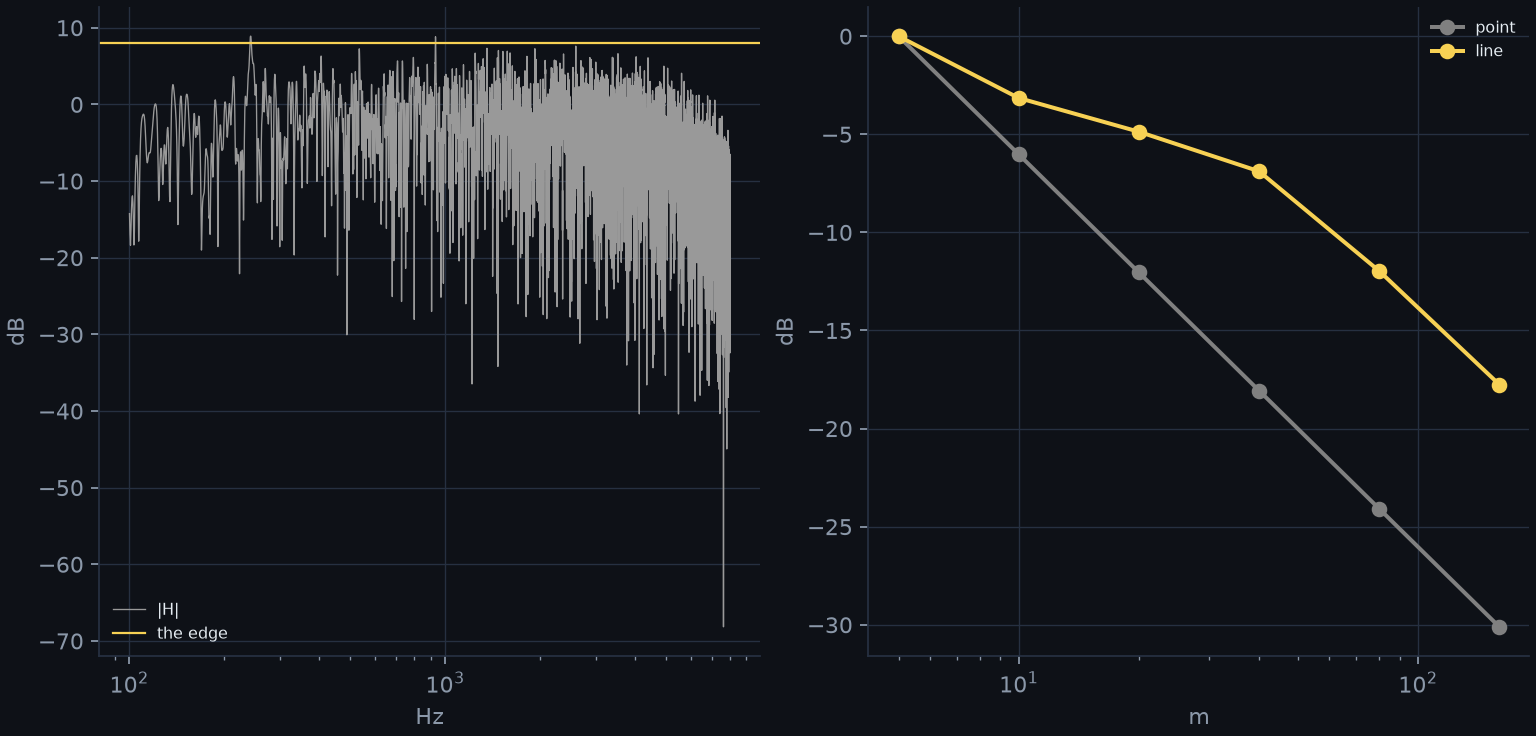
source on GitHubgain before feedback (Nyquist), and the note it howls at -8.0 dB, 241 Hz
the quick estimate from |H| alone (ignores phase) -8.9 dB, 242 Hz
after six notches: gain before feedback -4.0 dB (+4.1)
a clap: its ring one second on, 6 dB and 0.5 dB under the edge -95 dB, -42 dB
per doubling 5 to 160 m at 1 kHz: point source 6.0 6.0 6.0 6.0 6.0
the same: a line of 16 boxes 0.35 m apart 3.1 1.7 2.0 5.1 5.8
cardioid pair at 40, 63, 100 Hz: in front, behind (dB) -4.3/-99, -1.3/-99, -0.0/-99
a delay tower 30 m from you, the stage 90 m: delay at 20 and 5 C 184.7 ms, 189.5 ms
wireless: carriers planned in 470-500 MHz, closest product to any carrier 14, 125 kHz
STI at T = 2.5 s, SNR = 10.0 dB; halve T; 10 dB less noise 0.37, 0.49, 0.39
dose: 2 h at 104 dBA; with 15 dB earplugs 2016 %, 63 %
ear problem: two claps; which was nearer the edge? (listen first) the second
A loop howls where its gain first reaches one in phase; notches buy a few decibels; a line source holds its level near it and falls like a point far away; and delays and polarity aim sound that is too long to aim with a box.The code (102 lines; it asserts its own result)
"""Lab 59: live sound, computed: the gain before feedback by Nyquist's criterion and by ringing out, a point source
against a line array, a cardioid subwoofer pair, a delay tower, a wireless frequency plan, the speech transmission
index and a night's noise dose."""

import numpy as np
from scipy.signal import butter, sosfilt

from videos.coursekit import labs
from explainer.music.monochord import SR, Clip, concat
from explainer.music.monochord import live as LV

TITLE = "Live sound, computed"
GOAL = ("Find the gain at which a microphone and loudspeaker in a room will howl and the note they will howl at, buy "
        "gain back with notches, compare how a point source and a line array fall off with distance, cancel a "
        "subwoofer's sound behind the stage, time a delay tower, plan radio frequencies free of intermodulation, and "
        "predict how much of an announcement survives a reverberant, noisy hall.")
TASKS = [
    "Change ECHOES (the room between loudspeaker and microphone). Does the howl frequency move? Does ringing out still help?",
    "Change N_BOXES and SPACING. At what distance does the line array start falling 6 dB per doubling, like a point?",
    "Change T and SNR. Which matters more for speech in a station: halving the reverberation, or 10 dB less noise?",
]
ECHOES = [(0.006, 0.45), (0.0137, 0.3), (0.021, 0.25), (0.034, 0.2)]     # (delay s, gain) of the room's paths
N_BOXES, SPACING = 16, 0.35
T, SNR = 2.5, 10.0


def room_ir(seed=0):
    rng = np.random.default_rng(seed)
    h = np.zeros(int(0.5 * SR))
    for d, g in ECHOES:
        h[int(d * SR)] += g
    tail = rng.standard_normal(len(h)) * np.exp(-np.arange(len(h)) / (0.12 * SR)) * 0.02
    tail[: int(0.04 * SR)] = 0
    band = butter(2, [150, 5000], btype="band", fs=SR, output="sos")        # the loudspeaker and the microphone
    return sosfilt(band, h + tail)


def run(seed=0):
    rng = np.random.default_rng(seed)
    lab = labs.Lab()
    ir = room_ir(seed)
    fb = LV.feedback(ir)
    lab.row("gain before feedback (Nyquist), and the note it howls at", f"{fb['max_gain_db']:+.1f} dB, {fb['howl_hz']:.0f} Hz")
    lab.row("the quick estimate from |H| alone (ignores phase)", f"{fb['peak_gain_db']:+.1f} dB, {fb['peak_hz']:.0f} Hz")
    ro = LV.ring_out(ir, 6)
    lab.row("after six notches: gain before feedback", f"{ro[-1]['max_gain_db']:+.1f} dB ({ro[-1]['max_gain_db'] - ro[0]['max_gain_db']:+.1f})")
    assert ro[-1]["max_gain_db"] > ro[0]["max_gain_db"]

    clap = np.zeros(int(2.0 * SR))
    clap[:2880] = rng.standard_normal(2880) * np.hanning(2880) * 0.3
    rings = {}
    for m in (-6.0, -0.5):
        y = LV.closed_loop(clap, ir, fb["max_gain_db"] + m, 2.0)
        rings[m] = y / np.max(np.abs(y))
    late = {m: 10 * np.log10(np.mean(y[SR:] ** 2) / np.mean(y[: SR // 5] ** 2)) for m, y in rings.items()}
    lab.row("a clap: its ring one second on, 6 dB and 0.5 dB under the edge", f"{late[-6.0]:.0f} dB, {late[-0.5]:.0f} dB")
    assert late[-0.5] > late[-6.0]

    dists = np.array([5.0, 10.0, 20.0, 40.0, 80.0, 160.0])
    pos, _ = LV.line_array(N_BOXES, SPACING, top=(0.0, 1.5 + (N_BOXES - 1) * SPACING / 2))
    line = LV.field(pos, 1000.0, dists, [1.5], air=False)[0]
    point = LV.field([(0.0, 1.5)], 1000.0, dists, [1.5], air=False)[0]
    lab.row("per doubling 5 to 160 m at 1 kHz: point source", " ".join(f"{a - b:.1f}" for a, b in zip(point, point[1:])))
    lab.row(f"the same: a line of {N_BOXES} boxes {SPACING} m apart", " ".join(f"{a - b:.1f}" for a, b in zip(line, line[1:])))

    f = np.array([40.0, 63.0, 100.0])
    cs = LV.cardioid_sub(f)
    lab.row("cardioid pair at 40, 63, 100 Hz: in front, behind (dB)", ", ".join(f"{a:.1f}/{b:.0f}" for a, b in zip(cs["front_db"], np.maximum(cs["back_db"], -99))))
    lab.row("a delay tower 30 m from you, the stage 90 m: delay at 20 and 5 C",
            f"{1000 * LV.delay_time(90, 30, 20):.1f} ms, {1000 * LV.delay_time(90, 30, 5):.1f} ms")

    plan = LV.plan_channels(470.0, 500.0, 16, exclude=[(482.0, 488.0)])
    prods = LV.imd3(plan)
    worst = min(min(abs(p - c) for p in prods) for c in plan)
    lab.row("wireless: carriers planned in 470-500 MHz, closest product to any carrier", f"{len(plan)}, {1000 * worst:.0f} kHz")
    assert worst >= 0.1 - 1e-9

    lab.row(f"STI at T = {T} s, SNR = {SNR} dB; halve T; 10 dB less noise",
            f"{LV.sti(T, SNR):.2f}, {LV.sti(T / 2, SNR):.2f}, {LV.sti(T, SNR + 10):.2f}")
    lab.row("dose: 2 h at 104 dBA; with 15 dB earplugs", f"{LV.dose([104], [2]):.0f} %, {LV.dose([89], [2]):.0f} %")

    order = [-6.0, -0.5]
    lab.audio = concat([Clip(0.5 * rings[m], SR) for m in order], gap=0.6)
    lab.row("ear problem: two claps; which was nearer the edge? (listen first)", "the second")

    fig, (ax1, ax2) = labs.figure(2)
    ax1.plot(fb["f"], fb["mag_db"], color="0.6", lw=0.6, label="|H|")
    ax1.axhline(-fb["max_gain_db"], color=labs.GOLD, lw=1, label="the edge")
    ax1.set_xscale("log")
    ax1.set_xlabel("Hz")
    ax1.set_ylabel("dB")
    ax1.legend(fontsize=7)
    ax2.semilogx(dists, point - point[0], "o-", color="0.5", label="point")
    ax2.semilogx(dists, line - line[0], "o-", color=labs.GOLD, label="line")
    ax2.set_xlabel("m")
    ax2.set_ylabel("dB")
    ax2.legend(fontsize=7)
    lab.fig = fig
    lab.note = ("A loop howls where its gain first reaches one in phase; notches buy a few decibels; a line source holds "
                "its level near it and falls like a point far away; and delays and polarity aim sound that is too long to "
                "aim with a box.")
    return lab
Now change it
- Change ECHOES (the room between loudspeaker and microphone). Does the howl frequency move? Does ringing out still help?
- Change N_BOXES and SPACING. At what distance does the line array start falling 6 dB per doubling, like a point?
- Change T and SNR. Which matters more for speech in a station: halving the reverberation, or 10 dB less noise?
Problems, with solutions
Try each problem before opening its solution.
-
Compute. A tower stands 40 m from you; the stage is 120 m away. At 20 °C, what delay should the tower have? And at 5 °C?
Solution
c = 331.3 + 0.606 T: 343.4 m/s at 20 °C, 334.3 at 5 °C. The path difference is 80 m: 233.0 ms + 10 ms = 243 ms at 20 °C; 239.3 ms + 10 = 249 ms at 5 °C. A tower aligned in the warm afternoon is 6 ms early on a cold night.
-
Prove. Show that a cardioid pair, the rear box d behind the front, delayed by d/c and inverted, cancels exactly behind at every frequency, and find where it is strongest in front.
Solution
Behind, the front box's sound reaches the rear box's position d/c after leaving, exactly when the rear box, delayed by d/c, emits its inverted copy; from there on the two travel together and sum to zero, for every frequency. In front, the rear box's sound travels d further and is delayed by d/c, so it arrives 2d/c late and inverted: the sum is 1 − e^(−iω2d/c), of magnitude 2|sin(ωd/c)|, largest where ωd/c = π/2, that is where d is a quarter wavelength (f = c/4d: 95 Hz for d = 0.9 m), and falling towards the deepest bass.
-
Ear. The lab plays a clap into a loop at two margins below the edge; which was nearer the edge?
Solution
The lab prints the order. Listen for a tone that rings on after the clap: half a decibel from the edge it lasts for a second or more, at the frequency the lab's plot marks; six decibels down it stops with the room.
-
Build. Extend the frequency planner to fifth-order products, and count how many carriers still fit.
Where to look. Add 3f₁ − 2f₂, 2f₁ + f₂ − 2f₃ and the like to
imd3(asimd5), weight them less (they are about 20 dB weaker), keep the 100 kHz guard for third order and a smaller one for fifth, and compare the count with the third-order plan. -
★ What settings hold a festival's off-site limit with 95 % confidence over the weather, and at what cost to the audience?
Where the frontier is. Model arrays, subwoofers, the field and houses a kilometre away with a propagation model that includes wind and temperature profiles (parabolic-equation or ray methods); draw profiles from a year of measurements; optimize delays and filters for a chance constraint at the houses and an evenness objective in the field.
Notes and sources
Sources
- B. McCarthy, Sound Systems: Design and Optimization (3rd ed., 2016); D. Davis, E. Patronis and P. Brown, Sound System Engineering (4th ed., 2013); G. Ballou (ed.), Handbook for Sound Engineers (5th ed., 2015).
- H. Nyquist, "Regeneration theory", Bell System Technical Journal (1932); C. P. Boner and C. R. Boner, "Minimizing feedback in sound systems and room-ring modes with passive networks", JASA (1965).
- M. Urban, C. Heil and P. Bauman, "Wavefront sculpture technology", JAES (2003); D. G. Meyer, "Digital control of loudspeaker array directivity", JAES (1984).
- ISO 9613-1, Acoustics: attenuation of sound during propagation outdoors, part 1: calculation of the absorption of sound by the atmosphere (1993).
- T. Houtgast and H. J. M. Steeneken, "The modulation transfer function in room acoustics as a predictor of speech intelligibility", Acustica (1973), and later papers; IEC 60268-16 (5th ed., 2020).
- NIOSH, Criteria for a recommended standard: occupational noise exposure (1998); Directive 2003/10/EC; WHO, Global standard for safe listening venues and events (2022); S. G. Kujawa and M. C. Liberman, "Adding insult to injury: cochlear nerve degeneration after 'temporary' noise-induced hearing loss", J. Neuroscience (2009).
- AES67-2013, High-performance streaming audio-over-IP interoperability; IEEE 1588 (Precision Time Protocol).
Feedback stability uses interpolated zero-imaginary, positive-real crossings within a finite frequency band. The simplified STI and occupational dose illustrations are not compliance measurements or guarantees of safe exposure.
About this partfrom its README
Part 59 of a sixty-eight-part course in music (see the series plan and
the syllabus), the sixth part of Act X, The Studio and the Stage. In August 1965 fifty-five thousand
people filled a baseball stadium in New York, and the band struggled to be heard over the crowd with the available sound reinforcement. The event exposed limits that later concert systems addressed through developments across many decades. This part works out
why a microphone howls and how to predict the note, why loudspeakers are hung in curved lines, how bass is aimed, why a
festival's back field hears the stage twice, how a system is measured while the band plays, how forty radio microphones
share a stage, why the station announcement is unintelligible, and how loud is too loud. The tools are Monochord's
(explainer/music/monochord/live.py, with Part 49's image-source room); every stadium, loudspeaker, crowd and car park
is simulated.
- Fifty-five thousand people and no sound. An ear question (the band from the stands over a crowd through a 1965-style horn system, 6 dB under the crowd, and a modern one, 8 dB over: which was 1965? the first); Shea Stadium; what came after; the plan.
- 1. Why a microphone howls. The loop; when a loop runs away (candidate instability requires G H = 1: zero imaginary part and positive real part, with open-loop stability assumptions); the loop's response in a simulated 20 × 14 × 8 m hall (the gain before feedback −17.5 dB, the howl at 358 Hz; the magnitude alone says −18.4 dB); an ear question (a clap at 6, 0.5 and 2 dB below the edge: which was closest? the second); over the edge (the howl builds at 358 Hz, as predicted).
- 2. Ringing out, and monitors. Six narrow notches at the frequencies that would howl (+3.1 dB); heard; the cheaper decibels (distance, nulls, fewer open microphones); potential and needed acoustic gain (24.5 against 26.0 dB); monitors and in-ears.
- 3. Point and line sources. Spheres and cylinders; level against distance (6 dB per doubling from a point, 2.7 near a 24-box line at 1 kHz); the transition distance (26, 103 and 411 m at 250 Hz, 1 kHz and 4 kHz for an 8.4 m line); a line, or a row of points.
- 4. Arrays and curvature. Three fields of an arena at 1 kHz (a point, a straight line, a J); the J (splays from 0.3° to 4.2°); three seats heard (10, 40 and 80 m: 6.4 and 7.3 dB down); steering.
- 5. Subwoofer arrays. Bass goes everywhere; a cardioid pair (0.9 m, 2.6 ms, inverted: it cancels behind at every frequency); heard from behind the stage; end-fire, arc delays and flown subwoofers.
- 6. Delay towers, air and weather. A delay tower (90 and 30 m: 184.7 ms); an ear question (which was aligned? the first); weather (3 ms of drift over 10 °C; refraction; wind); what the air takes (ISO 9613-1: 0.5, 3, 11 and 36 dB over 100 m at 1, 4, 8 and 16 kHz); heard.
- 7. Measuring a system. Dual-channel measurement; measured with the Tune (transfer function, coherence, the delay found to the sample, 37.8 ms); what can go wrong; tuning a system.
- 8. Wireless and networks. Intermodulation; a frequency plan (24 evenly spaced carriers, every one hit by a third-order product, against Monochord's planner's 20 clean carriers around three TV channels); in-ear monitors; networks and clocks.
- 9. Speech in big rooms. The speech transmission index; STI over reverberation and noise (0.74 dry and clean, 0.23 at 6 s); an ear question (one announcement in a studio, a hall and a station: STI 0.64, 0.37 and 0.15); what helps.
- 10. Hearing health. What loud sound does; the equal-energy rule; one night's doses (2016 % at the barrier, 504 % mid-arena, 16 % with earplugs, 794 % for the engineer, 50 % for a drummer in in-ears); rules and remedies.
- 11. Frontier: immersive stages and quiet neighbours. Immersive live sound; quiet neighbours (sound zones, active control); ★ research problem: what settings hold a festival's off-site limit with 95 % confidence over the weather, and what do they cost the audience?
- Variation 59, recap and problems. The Tune by our session at the mixing desk, the back row (7 dB down) and the car park (29 dB down, and mostly bass); the ledger; what we found; five problems; where it comes back; in practice; references; Part 60.
What is computed and built
python -m videos.music.music59.compute (a few minutes; the closed loops and the array fields take the longest) fills
.cache/music59/.
| Item | What it computes | Checked against |
|---|---|---|
hook |
the band over a crowd through two systems | the levels set (tests) |
feedback |
Nyquist's gain before feedback, the howl note, ringing out, PAG/NAG, the loop run in time | a pure delay's edge (+6 dB at gain ½); the howl found in the closed loop (tests) |
arrays |
fields of a point, a straight and a curved line; levels with distance | 6.02 dB per doubling from a point (tests) |
subs |
a cardioid pair, in front and behind | exact cancellation; |sin(2πfd/c)| in front (tests) |
delay, air |
delay-tower times by temperature; ISO 9613-1 absorption | the standard's tabulated values (tests) |
measure |
a transfer function, coherence and delay measured with music | the true response and delay (tests) |
wireless |
third-order products; an even grid; a greedy plan | no product within 100 kHz of any carrier (tests) |
sti, dose |
the STI over reverberation and noise; doses | ordering; 85 dBA for 8 h = 100 % (tests) |
tune59 |
Variation 59 | the levels ordered (tests) |
Monochord's tools are held in tests/music/test_live.py; this part's claims and clips in tests/music/test_music59.py.
Sounds. Part 8's voice and Part 56's session, through simulated halls, loops, arrays, air and walls.
What the models are, and are not. The hall is Part 49's image-source room (shoebox, one absorption coefficient), with loudspeaker and microphone taken as omnidirectional; a real system's gain before feedback also depends on their patterns. The arrays are rows of omnidirectional point sources in a free field (no floor reflection), averaged over a third of an octave; real boxes are directional and the waveguides of real line arrays couple them more tightly. The air is ISO 9613-1's formula for pure-tone absorption. The wireless planner checks only third-order products, without receiver selectivity, transmitter power or fifth-order products. The STI uses Houtgast and Steeneken's formula for an exponential decay and steady noise, the same in every octave, without the masking and threshold corrections of IEC 60268-16. The doses follow NIOSH's recommendation (85 dBA, a 3 dB exchange rate); laws differ by country and these numbers are not health advice.
Companion material in this repository
The syllabus's plan for this partfrom SYLLABUS.md, the plan of record
- Hook: an ear question (which was 1965?); Shea Stadium; after Shea; the plan.
- Why a microphone howls: the loop; Nyquist's criterion; the loop's response in a hall; an ear question (which clap was nearest the edge?); over the edge.
- Ringing out, and monitors: six notches; heard; the cheaper decibels; potential and needed acoustic gain; monitors.
- Point and line sources: spheres and cylinders; level against distance; the transition distance; a line or a row of points.
- Arrays and curvature: three fields; the J; three seats heard; steering.
- Subwoofer arrays: bass goes everywhere; a cardioid pair; heard behind the stage; more ways to aim bass.
- Delay towers, air and weather: a tower; an ear question (which was aligned?); weather; what the air takes; heard.
- Measuring a system: dual-channel measurement; measured with the Tune; what can go wrong; tuning a system.
- Wireless and networks: intermodulation; a frequency plan; in-ear monitors; networks and clocks.
- Speech in big rooms: the STI; STI over reverberation and noise; an ear question (three rooms); what helps.
- Hearing health: what loud sound does; the equal-energy rule; one night's doses; rules and remedies.
- Frontier: immersive live sound; quiet neighbours; the research problem.
- Variation 59: the Tune at the mixing desk, the back row and the car park. Outro: problems, payoffs.
Covers: gain before feedback and the stability criterion; ringing out; monitors; point and line sources;
arrays, lobes and curvature; subwoofer arrays; delay towers; wind and temperature; measurement with transfer
functions; wireless planning; networks and clocks; intelligibility; noise dose and protecting hearing.
Built and computed: monochord/live.py: the gain before feedback by Nyquist's criterion in a simulated hall
(−17.9 dB, the howl at 358 Hz, found at 358 in the closed loop run in time); ringing out (+3.3 dB in six notches);
PAG and NAG; fields of a point, a straight and a J-shaped line (2.7 dB per doubling near the line at 1 kHz, transition
at 26/103/411 m); a cardioid subwoofer pair cancelling exactly behind; delay towers (184.7 ms, 3 ms drift over 10 °C);
ISO 9613-1 air absorption; dual-channel measurement with music (the delay found to the sample); an
intermodulation-free channel planner (20 clean carriers against an even grid's 24 hits); the STI (0.64/0.37/0.15 in
three rooms); a dose calculator (2016 % at the barrier).
Variation 59: the Tune at an arena: front of house, the back row (7 dB down), the car park (29 dB down, mostly bass).
Frontier: immersive live systems; sound zones and festival noise control; a research problem on weather-robust
array settings.
Reading: McCarthy, Sound Systems: Design and Optimization; Davis & Patronis; Ballou; Houtgast and Steeneken;
IEC 60268-16; ISO 9613-1.
Build the film
python -m videos.music.music59.compute        # the part's numbers, into .cache/music59
python tools/build.py music59                  # render and assemble the film
EXPLAINER_TTS=silent python tools/qa_scene.py music59 Hook   # one chapter, silent, with a contact sheet
Scenes: videos/music/music59. Setup: see the course page. Source of these notes: the README and the scenes' narration.
Build it
python -m videos.music.music59.compute                          # numbers and sounds (a few minutes)
EXPLAINER_TTS=silent python tools/build.py music59 -q l --fps 15   # a silent-narration preview, with the sounds
python tools/qa_sound.py music59 --sync                         # the sound gates
python tools/dead_air.py renders/music59_480p.mp4 --sound music59  # no empty screen; no sound over a still one
python tools/lecture_length.py music59                          # 30 to 60 minutes, listening included
python tools/build.py music59                                   # 1080p30, narrated
python -m pytest -q tests/music                                 # Monochord against its references; this part's claims and clips
python -m videos.music.labs 59                                  # the lab (writes a figure and a short WAV)