Act X · The Studio and the Stage
Part 56 of 68Recording and Mixing
How does one multitrack recording become three different pieces of music, and what does a mix engineer actually control?
Take one multitrack and mix it three ways: an ear question hears close and dry, a wall of sound (crest factor 11 dB against 18) and a dub; Les Paul, Spector, King Tubby and Eno made the studio an instrument. Our session band: Part 8's voice, Part 38's piano, guitar and bass, Part 40's drums, nine tracks. From the horn to the workstation: tracks against years, tape and the razor blade, bouncing, the DAW. Stereo pairs computed: XY, Blumlein, ORTF, NOS and AB turn direction into level and time differences; a trading rule (15 dB or 1.1 ms) gives image positions and recording angles (Blumlein 70 degrees, AB 78, ORTF 109, XY beyond 180); three pairs on one stage heard. Two microphones comb (5.8 ms: notches from 86 Hz); the 3 : 1 rule (+2.5, -3.5 dB); an ear question on a snare's microphones out of polarity (its body 6 dB down). Gain staging from the air to the converter (too low: 54 dB of range; right: 73; too hot: 8 dB past full scale), heard; 24 bits and floating point; reference levels. Editing: comps, a butt splice's click against a crossfade (heard), crossfade laws for related and unrelated takes, timing and pitch. The console: the channel strip, faders, four pan laws in stereo and mono (the -3 dB law's centre +3 dB in mono), our faders. Masking mapped band by band in the manner of an ideal binary mask, carved (the guitar from 49 to 35 per cent masked), heard. A vocal compressor (13 dB of wander to 5), parallel compression (heard), buses and automation. Depth by level, treble, reverberation and pre-delay (heard); mid-side and the Haas trick, wide and then combing in mono (heard). Monitoring: the room, listening level, a phone (the bass's fundamentals 40 dB down, its harmonics carry it, heard), references. Frontier: automatic mixing from Dugan to differentiable consoles; an ear question pits our mix against Monochord's rule-based mixer, whose hi-hat is 8 dB too loud though its masking numbers look fine. The session's first three phrases mixed three ways.
What you need. Part 4 for masking, loudness and the missing fundamental; Part 43 for expressive timing; Part 49 for filters, combs and reverberators; Part 50 for compressors; Part 54 for microphones and the phone's loudspeaker; Part 55 for stereo and depth. Decibels, sums of delayed signals, a little statistics.
- Ideas, mathematics and history
- from the horn to the workstation, stereo microphone arrays, phase, gain staging, balance, panning laws, masking, depth, automatic mixing
- What we build, compute and hear
- the session: our instruments recorded and mixed three ways
What you will be able to do
Foundations
- Hear one session mixed as close and dry, as a wall of sound and as a dub, and three stereo pairs on one stage.
- Hear a snare's microphones in and out of polarity, three gain settings, a splice and a crossfade.
- Hear a rough and a carved mix, parallel compression, three depths, width in mono, and a mix on a phone.
Full course
- Compute a stereo pair's level and time differences, its image positions and its recording angle.
- Derive the comb filter of two microphones, the 3 : 1 rule, the four pan laws in stereo and mono, and fades.
- Build a console with sends and buses, a masking map, width measures and a rule-based automatic mixer.
Research
- Find an objective, other than imitating a mix, that predicts which mix listeners prefer.
Practice
- Record with pairs and close microphones, stage gain, edit, balance, carve, compress and check a mix.
Contents
Each chapter has a home level. Choose a track to see what to read and watch: Foundations 26 min · Full course 37 min · Research 41 min · Practice 37 min.
- 0Three mixes of one recordingFoundations3 min
- 1From the horn to the workstationPractice2 min
- 2Stereo microphone pairsFoundations4 min
- 3Phase between microphonesFoundations4 min
- 4Gain stagingFoundations3 min
- 5EditingPractice3 min
- 6Balance and panningPractice3 min
- 7Masking between tracksFoundations4 min
- 8Dynamics and busesPractice3 min
- 9Depth and widthFoundations3 min
- 10MonitoringFoundations3 min
- 11Frontier: automatic mixingResearch4 min
- Variation 56, recap and problemsAll tracks2 min
Also on this page: Lecture · Key results · Try it · Lab · Problems · Notes and sources · Build the film.
Lecture
The text of each chapter is the film's narration, as it is spoken, so you can read along or revise without the film. The pictures are in the film. A dashed box stands for a number the film computes when it is rendered (hover over it to see what is computed); the README's figures for each chapter, where it lists them, follow the chapter's text.
Three mixes of one recordingFoundations3 min
In Jamaica in the 1970s, King Tubby and Lee Perry remixed songs live at the mixing desk. Headphones on, and listen. One recording of the Tune, by a small band, mixed three times: close and dry, a wall of sound, and a dub, in some order. Which was the dub?
The second. The first was a wall of sound: every part doubled or tripled, an echo chamber, the whole mix squeezed through a compressor, and everything in the centre; its crest factor, the peaks over the average, is only decibels. The second, the dub: drums and bass pushed forward, the voice let through only in fragments, into a tape echo, a spring reverb on the snare, and the drums dropped out near the end. The third, close and dry: the simulated close pickups, panned, carved, with a little of the room. The same simulated performances become three different presentations of the Tune.
This is the story of the last seventy years of popular music. Many early records emphasized capturing a performance, although editing, overdubbing and studio construction had earlier precedents. Then came tape, and many tracks: Les Paul layering his own guitar on itself, and from 1962 Phil Spector's wall of sound, a dozen musicians in a small room, doubled and drenched in echo. In Jamaica in the 1970s, King Tubby and Lee Perry remixed songs into dubs at the mixing desk, live, muting and echoing as a performance in itself. In 1979 Brian Eno lectured on the recording studio as a compositional tool. The studio had become an instrument, and this part learns to play it.
The band is ours, built in earlier parts. Part 8's soprano sings the Tune, twice, so that it can be doubled. Part 38's piano plays a chord every two beats, its guitar arpeggios, its bass the root and the fifth. Part 40's drums have a close microphone each. And a pair of room microphones hears the whole band in a room that rings for one point two seconds. Nine tracks, a hundred beats a minute.
Here is the plan. Stereo microphone pairs, and where their images fall. Phase between microphones, gain staging and editing. The console: balance, pan laws, equalization and buses. Masking between tracks, mapped and carved. Dynamics, depth and width, and monitoring. And an automatic mixer, against ours.
1From the horn to the workstationPractice2 min
How did a record stop being a performance?
Count the tracks a studio could record separately, year by year. This simplified timeline emphasizes commercial mono recording; electrical mixing, multiple microphones and experimental multitracking complicate a literal one-track history. Magnetic tape arrived after the war, and Les Paul had an eight-track machine by 1957. The Beatles made Sergeant Pepper in 1967 on four tracks, bouncing them together to free more; by 1974 machines had twenty-four. Then digital tape, and in 1991 a computer with four tracks, Pro Tools, whose descendants hold as many as the computer can. A record stopped being a performance and became an object built in layers.
Tape changed everything. Magnetic tape came to America from captured German Magnetophons, and in 1947 and 1948 Bing Crosby began recording his radio shows on it. Tape can be cut with a razor blade and spliced, so the best parts of several takes can be joined, at a forty-five degree angle to soften the join. Les Paul played along with himself, layer on layer, sound on sound. Then multitrack: several parallel tracks on one tape, each recorded and re-recorded on its own. From then on a performance could be assembled, not just captured.
Four tracks are not many. To get more, record three, mix them onto the fourth, and erase the three for new parts: bouncing. But each bounce commits a balance for good, and adds a generation of tape hiss and loss. So engineers mixed as they went, making decisions early and living with them. More tracks moved the decisions later, to the end, to the mix, which became a craft of its own.
Then the computer. In the workstation of Part 53 every track is a file, many edits are nondestructive and undoable, provided the source and project history are preserved, every setting is saved. The console became software, its faders, equalizers, compressors and reverberators plug-ins. Nothing need be decided until the end, and many decisions never are. What stayed the same is what this part is about: microphones, gain, balance, masking, space, and the ear.
2Stereo microphone pairsFoundations4 min
Where on the loudspeakers does a pair put each instrument?
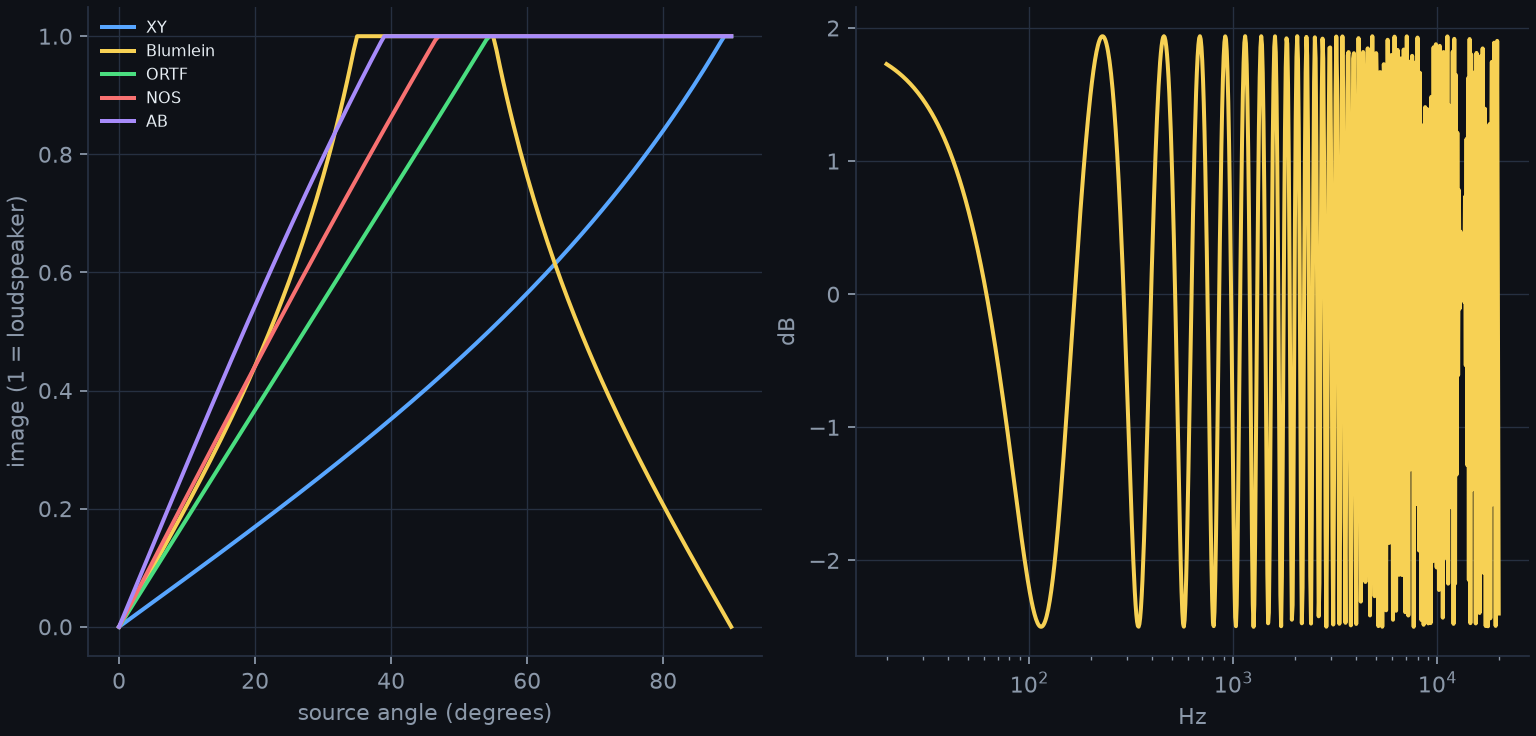
Part 55 named the stereo pairs; here they are computed. XY: two cardioids at the same point, ninety degrees apart. Blumlein's pair: two figure-8s, also ninety degrees apart. ORTF, French radio's choice: two cardioids a hundred and ten degrees apart and seventeen centimetres apart, about the width of a head. NOS, Dutch radio's: ninety degrees and thirty centimetres. And AB: two omnis sixty centimetres apart. Coincident pairs make only level differences; our far-field spaced-omni model only time differences; real distance and microphone responses can also change levels; near-coincident pairs both.
What does each pair turn a direction into? On the left, the level difference between its channels as a source moves from the centre to ninety degrees to one side. The coincident cardioids of XY reach only about fifteen decibels at the side; Blumlein's figure-8s shoot up, because at forty-five degrees the source sits in one capsule's null. On the right, the time difference: zero for coincident pairs; half a millisecond for ORTF, nearly one for NOS, and one point seven five for AB's sixty centimetres.
Where does a listener hear each source? Listening tests, by Simonsen and others, collected by Michael Williams, found that about fifteen decibels of level difference, or about one point one milliseconds of time difference, puts an image fully in one loudspeaker, and that the two trade roughly in proportion. Apply the rule to each pair: the image's position against the source's angle. The angle at which a source reaches the loudspeaker, doubled, is the pair's recording angle: the width of stage it spreads between the loudspeakers. Blumlein's pair, degrees; AB, ; ORTF, , though more careful charts say about a hundred; and this simplified localization rule does not quite reach the loudspeakers for the tested XY configuration. A pair is chosen for the width of what it has to record.
Hear it, with headphones. Our piano forty degrees to the left, the voice in the centre, the guitar forty degrees to the right, recorded by an XY pair, an ORTF pair and an AB pair, and played on two loudspeakers. The dots show this rule’s predictions, not measured listener positions.
XY keeps the instruments close together, a narrow stage, but sharply placed. ORTF spreads them most of the way. AB throws piano and guitar into the loudspeakers, and its images are wide and a little vague, because time differences are heard less precisely than level differences.
So how do engineers choose? Coincident pairs give sharp images, and sum to mono cleanly, because there are no time differences to comb. Spaced pairs give spaciousness and envelopment, but vaguer images, and they comb when summed. Decca's engineers in the 1950s hung three omnis in a triangle over the orchestra, the centre one filling the middle: the Decca tree. Spot microphones may be delayed to match a main pair; alignment is an artistic and technical choice and mixed in a little. And in pop, the pair is usually the room: each instrument gets a close microphone, and is placed by the mix.
3Phase between microphonesFoundations4 min
Why can two good microphones sound worse than one?
The commonest problem in a multitrack recording is the simplest physics. Put two microphones on one source, and the far one hears it later, by the extra distance over the speed of sound. Sum them, and the two copies add where they are in step and cancel where they are half a cycle apart. For a delay tau the cancellations fall at one over two tau, three over two tau, and so on, evenly spaced: a comb filter, as in Part 49. One microphone a metre from a guitar and another three metres away are five point eight milliseconds apart, and the first notch is at eighty-six hertz.
Here is that comb, from twenty hertz to twenty kilohertz. If the two microphones are at the same level, the peaks are six decibels high and the notches bottomless: whole bands of the guitar disappear, and the sound turns hollow. But a microphone three times as far away hears the source nine and a half decibels quieter, by the inverse square law, and then the comb shrinks to plus and minus decibels: still there, but mild.
Engineers turned that into a rule. The three to one rule: a second microphone should be at least three times as far from a source as the source's own microphone. For an ideal inverse-distance source at a three-to-one ratio, the coherent sum ranges about plus two point five to minus three point five decibels; real rooms and gain settings change this. It is a rule for spot microphones spread over a band; it is broken on purpose when two microphones share one instrument. And the worst case is two microphones on one drum, facing each other.
Like this. A snare drum is often recorded from both sides: a microphone over the top head, for the crack, and one under the bottom, for the rattle of the wires. The stick pushes the top head down. To the top microphone the air is pulled away; to the bottom one, the air is pushed towards it: approximately opposite polarity in a simplified low-frequency model; real heads and snare wires give different waveforms. Summed as recorded, some body energy can cancel; a polarity flip may improve the sum, which should be checked with the actual placement.
Your turn. Our snare, its top and bottom microphones summed, twice: once with the bottom microphone's polarity flipped back, and once left as recorded. Which was left as recorded?
The second. Its body, from a hundred and twenty to four hundred hertz, is decibels weaker: the drum turns thin and papery, all wires. One button on the console puts it back.
Putting it right. Polarity inversion may improve summation when signals oppose, but orientation alone does not determine whether to invert. Time: slide the close microphone's track later by the extra distance, so the two copies line up. Workstations find the delay by cross-correlation and align the tracks automatically. But aligning is a choice, not a correction: the delay between a close and a room microphone is the sound of the room. And phase can be rotated a little, band by band, with Part 49's all-passes, as a tone control of its own.
4Gain stagingFoundations3 min
How loud should a signal be on its way in?
Every recording passes through a chain of gains. A voice peaking at a hundred and four decibels into a condenser microphone of twelve millivolts per pascal gives about minus twenty-six dBu, a few dozen millivolts. The preamplifier adds gain, and its own hiss, as in Part 54's noise budget, and the room's hiss rides along. Our example converter maps plus eighteen dBu to full scale; calibration varies; above that there is nothing, and the waveform is cut flat. Below is the floor: the hiss carried along, and a simplified sixteen-bit noise floor; the familiar ninety-eight-decibel figure is full-scale sine SNR under ideal assumptions. Gain staging is setting each stage so that peaks remain below the ceiling and the quiet passages clear the floor.
Here is the chain at three gain settings, in decibels relative to full scale. With no gain, the voice peaks at minus forty-four, and its floor is the converter's own: only fifty-four decibels of range. With twenty-eight decibels, the peaks reach minus sixteen, leaving sixteen decibels of headroom, and the floor is now the room and the preamplifier: seventy-three decibels of range, all the room allows. With fifty-two, the peaks would reach plus eight, eight decibels past the ceiling, and the range is no better, because the hiss was turned up with the voice.
Hear all three through a sixteen-bit converter, each turned up or down afterwards to the same loudness. Listen for hiss in the first, and for the third's peaks.
The first carries a grainy hiss once it is turned up. The third is clipped on every loud note, a buzz that no later stage can remove. Too low can be lived with; too hot cannot.
Modern equipment changes the balance. A twenty-four-bit converter's floor is set by its analogue parts, near minus a hundred and fifteen dBFS, so recording low costs almost nothing. A practical tracking approach leaves substantial headroom; suitable peak targets depend on source, calibration and workflow. Inside the workstation, signals are thirty-two-bit floating point, with very large representable headroom; finite arithmetic, fixed-point stages and nonlinear plug-ins still have limits. But plug-ins modelled on analogue gear react to level, as the gear did in Part 50, so drive them as their originals were driven. The ceiling comes back at the end: the converter on the way out, and the file.
And the names of the levels. A microphone gives from minus sixty to minus twenty dBu, a millivolt to eighty. Consumer gear runs at minus ten dBV, a third of a volt; professional gear at plus four dBu, a volt and a quarter, which is nought on a VU meter; and a converter reaches full scale at plus eighteen to plus twenty-four dBu. Nought dBu is nought point seven seven five volts, a milliwatt into six hundred ohms, a relic of telephone lines.
5EditingPractice3 min
How do you join two takes so that nobody can hear the join?
Few records are single takes. Singers record several, and the producer builds one from the best phrases of each: a comp. Where to cut? In a silence, or just before a consonant or a drum hit, where the ear expects a change anyway. Where not to: in the middle of a held note, unless the join is smoothed. The tool is the crossfade: one take fading out as the other fades in, over a few milliseconds.
Why does a cut click? Two takes can have different instantaneous waveform values at a splice. Join them with a butt splice and the waveform jumps, and a jump contains every frequency at once: a click. In our edit, in the middle of a note, the voice jumps by of its full swing in a single sample. A crossfade spreads the jump over a few milliseconds, and the click becomes a smooth change of timbre the ear accepts.
Hear both joins: two takes of the Tune's first phrase, cut in the middle of a note. Listen for the moment of the cut.
The butt splice ticks at the cut; the crossfade hides it, and leaves only the change from one take's vibrato to the other's.
Which fade shape? It depends on what is being joined. If the two sides are nearly the same sound, say two pieces of one sustained take, their waves add in amplitude, and a linear fade, one gain falling as the other rises, keeps the level flat; but the same fade between unrelated sounds dips by three decibels in the middle, because unrelated sounds add in power. The equal-power fade, a cosine and a sine, fixes that, and bulges by three decibels on coherent, in-phase material. It is Part 55's pan law again, in time instead of space.
Editing reaches inside performances too. Timing: cut a drum track at every hit and slide the pieces onto the grid, crossfading every gap. Or stretch the audio between the hits instead, with Part 50's phase vocoder. Pitch: Part 50's correction, note by note, as Melodyne has done since 2001. Every one of these can remove intended expression when applied indiscriminately: the expressive timing of Part 43 is exactly what gets edited out. The craft is to fix what distracts, and keep what moves.
6Balance and panningPractice3 min
What does a mixing console actually do?
A mixing console is many copies of one channel. The input sets the gain; a high-pass filter removes rumble below the instrument; the equalizer shapes its spectrum with Part 49's biquads; a compressor, Part 50's, tames its level. Then the fader sets how loud it is in the mix, and the pan where. Sends tap the signal after the fader to shared buses, a reverb or an echo, so that many channels share one room. And everything meets on the stereo bus, the master. Monochord's console does exactly this, channel by channel.
The faders come first. A fader is calibrated in decibels: nought is unity, minus ten can sound roughly half as loud under suitable conditions; loudness depends on spectrum and level, by Part 4's sones, and minus infinity is off. Balance is the first act of a mix: which part leads, which supports, which is felt rather than heard. One common way is to set the voice first, then the kick and bass that carry the groove, then the rest around them. A balance is a ranking, and every ranking is a choice: the hook's three mixes were three rankings of the same parts.
Part 55 compared two pan laws; consoles offer four. They differ in how much a centred sound is turned down in each channel: nought decibels, a plain balance control; minus three, constant power; minus six, constant amplitude; and minus four and a half, between the two. For the squared-gain sum, only the minus three law is constant power as a sound moves; the others bulge or sag by up to three decibels in the middle.
But mixes are also heard in mono, on phones, radios and shop speakers, where the two channels are added. Then a centred sound under the minus three law comes out three decibels louder than the same sound panned to one side, while under the minus six law it comes out the same. No law is right both ways: minus three preserves squared gains, minus six preserves the coherent mono sum, and minus four and a half splits the difference. Broadcast consoles often use minus six; music consoles minus three or four and a half.
Here are our own faders and pans for the close-and-dry mix. The voice a decibel up and in the centre; the piano half left and the guitar half right, so that they flank the voice; bass, kick and snare in the centre, a common low-end choice, though stereo bass is not universally prohibited, because it must survive mono and both loudspeakers share the work; the hi-hat a little right, as a drummer would see it from the audience. The equalizers come next, because they are about masking.
7Masking between tracksFoundations4 min
Why does a part that sounds fine alone vanish in the mix?
Every engineer has met this. In Part 4 a louder sound hid a quieter one in the same critical band, and a little way above it. In a mix every track sits in every other's way: the guitar alone is bright and clear; in the band it becomes a blur. So a mix is not only a balance of levels but of spectra, band by band and moment by moment. To see it, map it: for each track and each band, how much of the track is covered by the rest of the mix.
Here is Monochord's map. Split each track into twenty-four bands, equally spaced on the ear's ERB scale from fifty hertz to twelve kilohertz, and into forty-three-millisecond analysis windows at twenty-one-millisecond steps. In each cell compare the track with everything else in the mix, left and right channels separately, so that panning counts. Where the rest is stronger, the cell is given away; it is the ideal binary mask that Part 64 will use to pull sources apart. The masked fraction is the share of the track's energy in cells it gives away. It is a stand-in for the ear's partial loudness, simple and explicit.
Here is our session's map, a row for each track, low bands on the left, red where the track is buried. In the rough mix, every fader at nought, every pan in the centre, no equalization: the voice is mostly clear, but the binary energy-overlap proxy marks per cent of its energy as overlapped, not removed or proven inaudible, the bass , the piano . Carved, panned and high-passed and cut where the tracks collide, the reds thin out: the guitar down to per cent, the voice to .
Here is the carving. The voice high-passed and given a little presence near three kilohertz. The piano panned left, high-passed at a hundred and eighty hertz, and cut at nine hundred, where the guitar's arpeggios live; the guitar panned right, high-passed, and lifted at two kilohertz. The kick and the bass divide the bottom between them: this example cuts the bass around sixty hertz to favor its kick, the kick gives up a hundred and thirty and three hundred to the bass's notes. The snare loses some box, and the hi-hat keeps only its sizzle. Every cut gives a band to someone else.
Hear both, with headphones: the rough mix, then the carved one. Listen for the guitar's arpeggios and the bass's notes.
In the rough mix everything is there and nothing is clear; carved, each part has a place, in the spectrum and between the loudspeakers, and the arpeggios and bass notes can be followed.
What does the map teach? Carving is a trade: every band given to one track is taken from another, and the map shows both sides of the bargain. Cutting and boosting are both useful; choose them for the target sound and available headroom. Pan to unmask: two parts in the same band, on opposite sides, hide each other less. And the first equalizer is the arrangement: parts written in different registers, as Part 41's orchestrators knew, may need less spectral adjustment.
8Dynamics and busesPractice3 min
How does a mix keep a voice in front and the drums hitting?
Part 50 built the compressor; many mixes use it on selected tracks. A singer's level wanders: ours by decibels between its quiet and loud moments. Over a band, the quiet words are masked and the loud ones jump out. A compressor at four to one, starting at minus twenty-six, narrows that to , turning the loudest notes down by up to decibels, and the fader can then sit the whole voice in front of the band.
Drums are treated differently. Parallel compression, called New York compression after the studios that made it famous, keeps the dry drums and adds underneath a copy crushed flat: ten to one from minus forty, with an attack of a twentieth of a millisecond, mixed six decibels down. Here are the two levels, ten-millisecond by ten-millisecond. The hits keep their peaks, because the dry signal still has them; but between the hits, where the drums ring and decay, the crushed copy lifts the level, and the spread from peak to decay shrinks from to decibels: drums that hit hard and sound full.
Hear our drums dry, then with the crushed copy underneath, matched in loudness. Listen between the hits.
The second sounds thicker and closer: the snare's ring and the hi-hat's wash fill in, and the kit seems to be in a smaller, louder room.
Mixes are built in groups. The drums, the backing voices, the strings: each group is summed to a bus with its own fader and its own compressor. A gentle compressor on the whole mix, two decibels of reduction, makes the parts rise and fall together; engineers call it glue. Side-chains, from Part 50, let the kick duck the bass and the voice duck the guitars, so that each gets out of the other's way: masking handled in time rather than frequency. Our wall-of-sound illustration combines doubling, reverberation and strong compression; historical productions used varied recording chains.
And a mix moves. A fader need not stay still: automation records its moves and plays them back. Rides: the voice up a decibel on a quiet word, the guitar up for its solo. Mutes and sends become gestures: the dub's drop-outs and echo throws are automation, performed, as King Tubby performed them by hand. Consoles automated their faders from the 1970s; in a workstation every knob can move.
9Depth and widthFoundations3 min
How do two loudspeakers make a stage with a front and a back?
Panning gives left and right. Depth comes from the distance cues of Part 55. Level: further is quieter, about six decibels per doubling for a free-field point source, before room contributions. Treble: air and obstacles take the highs first. The ratio of direct sound to reverberation, the strongest cue of all. And pre-delay, the gap before the reverberation starts: a long one keeps a source close even in a big room, a short one pushes it back.
Here is our voice placed at three depths against the same band. Near: full level, full treble, barely any reverberation, the direct sound decibels above its echo. In the middle: five decibels down, the treble shelved four decibels, a send to the reverb and twelve milliseconds of pre-delay; direct over reverberant, decibels. Far: ten decibels down, nine decibels of treble gone, the reverb at full send: decibels. Each step pushes the voice behind the band's line.
Hear the three, with headphones; the band stays where it is. The voice steps back each time: from in your face, to on the stage, to somewhere behind the band in a larger room.
Width has tools of its own. Mid-side, Blumlein's again: the mid is the sum, the side the difference; turn the side up to widen a stereo track, down to narrow it, to nothing for mono. And the Haas trick: put the same mono track in both channels with one twelve milliseconds late. Depending on delay, signal and playback, precedence can bias localization toward the earlier channel while the sound may seem wider. Its cost: the two channels are nearly unrelated, a correlation of , and summed to mono they comb, with notches from hertz and every hertz above. So a correlation meter sits on the master: positive correlation generally supports mono compatibility, while negative correlation warns of cancellation; one broadband number does not determine width or reveal all frequency-specific problems.
Hear our guitar widened by twelve milliseconds, then the same thing summed to mono.
Wide and lush in stereo; in mono, hollow and phasey, as if played down a tube. Width bought with delay is paid for in mono.
10MonitoringFoundations3 min
How can a mix sound right everywhere if you can hear it in only one place?
A mix is only as good as what the engineer hears. Nearfield monitors are small loudspeakers a metre or two away, so that their direct sound outweighs the room's. They make the stereo triangle of Part 55, with the listener at the apex, and the seat is kept off the room's halfway planes, where its modes come and go. Absorbers at the first reflection points, bass traps in the corners, diffusers behind. Headphones remove the room entirely, and with it the crosstalk that makes stereo images. Every monitor lies a little; the craft is to know how yours lies.
How loud should the engineer listen? As Part 4 showed, the ear's sensitivity depends on level: quiet sounds lose their bass and extreme treble first, as Fletcher and Munson measured in 1933. Mix loud and the bass seems ample, and the same mix played quietly sounds thin. Mix quietly and the bass gets turned up, and played loud it booms. Film and broadcast mix at calibrated levels, around seventy-nine to eighty-five decibels; music studios check at several. And long sessions at high level tire the ear, and then damage it: Part 4's safe hours apply to engineers too.
And most listeners will not hear the mix on studio monitors. Here is Part 54's phone loudspeaker, whose simulated minus-three-decibel point is near eight hundred hertz; real phones vary. Our bass line's fundamentals, sixty-five to ninety-eight hertz, are forty decibels and more down. But per cent of the bass track's energy lies in its harmonics above eight hundred and forty-four hertz, where the phone works, and Part 4's missing fundamental does the rest: the ear hears the line's pitch from its harmonics.
Hear our close-and-dry mix on monitors, then on the phone. Can you still follow the bass line?
On the phone the mix is small and the kick has almost vanished, but the bass line is still there, as a bright, plucky tone: its harmonics carry it. Engineers add harmonics on purpose, by saturation, so that the bass survives small loudspeakers.
So engineers check. Against reference tracks: finished records in the same style, at the same loudness, switched in and out. On small speakers: the Auratone cube of 1958 and Yamaha's NS-10 of 1978 sat on consoles for decades as familiar reference checks, not simply because they were bad. In mono, in the car, on earbuds and laptops: a mix that works on all of them is said to translate. With meters, for what ears miss: loudness, which is Part 57, correlation, and a spectrum against the references. And with rest: ears adapt within minutes, and a mix heard fresh the next morning is often a different mix.
11Frontier: automatic mixingResearch4 min
Can a machine mix?
The frontier is a machine that mixes. It began with speech: in 1975 Dan Dugan built an automatic microphone mixer for panels and conferences, sharing gain among many microphones so that the total stayed constant and only the talker was heard. From 2009 Enrique Perez-Gonzalez and Joshua Reiss automated gain, panning and equalization from measurements of the signals. Brecht De Man and Reiss collected the rules engineers state, and tested them: some hold, many are matters of taste. From 2016 commercial assistants suggested settings for each track, and in 2021 Christian Steinmetz and colleagues trained a differentiable mixing console end to end. The field calls itself intelligent music production: the machine as an assistant, or as the engineer.
Monochord's automatic mixer uses four rules from that literature. Loudness: every track to the same integrated loudness, measured as Part 57 will measure it, with the lead three decibels above. Panning: the lead, and every track with a tenth of its energy below a hundred and fifty hertz, in the centre. The rest spread alternately left and right, further out the brighter they are. And a high-pass at eighty hertz and a small cut at two hundred and fifty on every bright track. Four rules, and no ears.
Your turn, with headphones. Our session mixed twice: once by hand, once by the automatic mixer. Which was the machine?
The second. Its hi-hat is far too loud, and its bass is thin: the rules gave every track the same loudness, which we judge too prominent for this example; preferences depend on production goals.
Compare the settings. The machine raised the hi-hat by eight decibels, because it was the quietest track, and centred the bass and kick by their low energy, as we did; its pans are not unlike ours. And the masking map tells a mixed story: the machine's hi-hat and piano are freer than ours, but its bass is per cent buried, against our . By these numbers the machine's mix is not worse. For our intended balance, we prefer the hand mix; this is not a blind listener study. Measures of a mix are not yet measures of a good one.
The newest work makes the console itself learnable. Write every equalizer, compressor and fader so that the output can be differentiated with respect to its settings, and the settings can be learned by gradient descent to match a target mix. Trained on many multitracks with their engineers' mixes, a network proposes settings for a new session. But the hard part is not the console; it is the target. What makes a mix good, for this song and these listeners?
A research problem to end on. Collect multitracks, several engineers' mixes of each, and listeners' blind preferences among them. Fit a model of preference from the mix itself: its loudness, masking, space and dynamics, and whatever those leave out. Use it as the target for a differentiable console, and test the results blind against engineers. The question: is there an objective, other than imitating a mix, that predicts which mix listeners prefer? An answer would turn automatic mixing from imitation into design.
Variation 56, recap and problemsAll tracks2 min
Every part ends by doing something to the Tune with what it built. Here our band plays its first three phrases, and the session is mixed three ways: close and dry, a wall of sound, and a dub.
Row fifty-six of the ledger. One session, three mixes: a crest factor of decibels dry and in the wall; the dub's echo every seconds.
What did we find? A stereo pair turns direction into level and time differences, and its recording angle sets the width of the stage. Two microphones on one source comb, and distance, polarity and alignment tame it. Gain staging keeps the peaks under the ceiling and the quiet passages above the floor. Crossfades hide joins, and pan laws trade stereo against mono. Masking can be mapped band by band and carved, and every cut gives a band away. And compression, depth cues and width shape the stage, while rules alone do not make a mix.
Five problems. One to compute, one to prove, one for your ears, one to build, and a research problem, marked with a star. Solutions are in this part's notes. Pause here.
Where does this come back? In mastering, which takes the stereo bus from here, with meters and the loudness war. In live sound, with the console on stage. In source separation, which unmixes with masks like our masking map's. In generative audio, with learned effects and mixes. And in research, with listening tests and their statistics.
And in practice. When recording: close microphones by three to one, polarity checked, peaks near minus eighteen. When editing: cut before a hit, crossfade everything, and keep the feel. When mixing: balance first, cut before boosting, pan to unmask, and check in mono. And when listening: a treated room, references, small speakers and rested ears.
The books and papers this part follows. The full list, with notes, is in the README.
Where it goes next. The stereo bus, meters and the loudness war in Part 57; the console on stage in Part 59; unmixing with masks in Part 64; learned effects and mixes in Part 66; listening tests and their statistics in Part 67.
Key results
The part's results in one place, for revision.
Try it
Lab 56 · Recording and mixing, computed
Compute where a stereo pair puts a source and its recording angle, the comb two microphones make, the pan laws in stereo and in mono, and a masking map of a small mix before and after panning.
python -m videos.music.labs 56
needs numpy, scipy, matplotlib · download lab56.py ·
source on GitHubORTF: a source 30 degrees left: level, time, image 4.9 dB, 0.25 ms, 0.55 of the way to the loudspeaker
ORTF: recording angle 109 degrees
microphones at 0.5 m and 2 m: delay, first notch, comb 4.37 ms, 114 Hz, +1.9 / -2.5 dB
pan law -3 dB: centre in stereo / in mono (re a hard pan) +0.00 / +3.01 dB
pan law -4.5 dB: centre in stereo / in mono (re a hard pan) -1.51 / +1.51 dB
pan law -6 dB: centre in stereo / in mono (re a hard pan) -3.01 / +0.00 dB
a quiet tone beside a loud one: masked, both centred / panned apart 100 % / 2 %
ear problem: how far is each of the last three? (listen first) far, middle, middle
A pair turns direction into level and time differences, which listeners trade against each other; two microphones on one source comb, mildly if the far one is three times as far; no pan law is right in both stereo and mono; and panning two sounds apart stops one masking the other.The code (82 lines; it asserts its own result)
"""Lab 56: recording and mixing, computed: where a stereo pair puts a source, two microphones' comb, the pan laws in
stereo and in mono, and a masking map of a small mix."""

import math

import numpy as np
from scipy.signal import fftconvolve

from videos.coursekit import labs
from explainer.music.monochord import SR, Clip, concat
from explainer.music.monochord import space as SP
from explainer.music.monochord import studio as S

TITLE = "Recording and mixing, computed"
GOAL = ("Compute where a stereo pair puts a source and its recording angle, the comb two microphones make, the pan laws "
        "in stereo and in mono, and a masking map of a small mix before and after panning.")
TASKS = [
    "Change PAIR, or add your own pair to S.PAIRS. Where does a source at 30 degrees land, and what is the recording angle?",
    "Change NEAR and FAR (the two microphones' distances). How do the delay, the first notch and the comb's depth move?",
    "Change PAN_B. How far apart must the two tones be panned before neither masks the other?",
]
PAIR = "ORTF"
NEAR, FAR = 0.5, 2.0
PAN_B = 0.8


def run(seed=0):
    rng = np.random.default_rng(seed)
    lab = labs.Lab()
    c = S.pair_cues(PAIR, 30.0)
    lab.row(f"{PAIR}: a source 30 degrees left: level, time, image", f"{float(c['dL']):.1f} dB, {float(c['dt']):.2f} ms, {float(S.image_position(c['dL'], c['dt'])):.2f} of the way to the loudspeaker")
    lab.row(f"{PAIR}: recording angle", f"{S.recording_angle(PAIR):.0f} degrees")
    tau = (FAR - NEAR) / S.C
    g = NEAR / FAR
    hi, lo = S.comb_extremes(g)
    lab.row(f"microphones at {NEAR:g} m and {FAR:g} m: delay, first notch, comb", f"{1000 * tau:.2f} ms, {1 / (2 * tau):.0f} Hz, +{hi:.1f} / {lo:.1f} dB")
    for law in (-3.0, -4.5, -6.0):
        gL, gR = S.pan_gains(np.array([0.0]), law)
        lab.row(f"pan law {law:g} dB: centre in stereo / in mono (re a hard pan)", f"{10 * math.log10(gL[0] ** 2 + gR[0] ** 2):+.2f} / {20 * math.log10((gL[0] + gR[0])):+.2f} dB")
    t = np.arange(2 * SR) / SR
    a = 0.3 * np.sin(2 * np.pi * 500 * t)
    b = 0.05 * np.sin(2 * np.pi * 530 * t + 1)
    centre = S.masking_map({"a": S.place(a, 0.0), "b": S.place(b, 0.0)})["overall"]
    apart = S.masking_map({"a": S.place(a, -PAN_B), "b": S.place(b, PAN_B)})["overall"]
    lab.row("a quiet tone beside a loud one: masked, both centred / panned apart", f"{100 * centre['b']:.0f} % / {100 * apart['b']:.0f} %")
    assert abs(10 * math.log10(float(sum(x[0] ** 2 for x in S.pan_gains(np.array([0.3]), -3.0))))) < 1e-9

    # sound: the two microphones summed; ear problem: a voice-like tone at random depths (level, treble, reverberation)
    n = int(1.6 * SR)
    tt = np.arange(n) / SR
    tone = sum(np.sin(2 * np.pi * k * 220 * tt) / k for k in range(1, 15)) * np.exp(-tt * 1.5)
    clips = [Clip(0.2 * (tone + g * S.frac_delay(tone, tau * SR)) / 2.5, SR)]
    tail = SP.noise_tail(1.4, 1.8, seed=3)
    answers = []
    for i in range(3):
        k = int(rng.integers(0, 3))
        gain, send = [(1.0, 0.02), (0.5, 0.2), (0.25, 0.6)][k]
        dry = gain * tone
        wet = send * fftconvolve(tone, tail)[: n] * 0.2
        y = dry + wet
        clips.append(Clip(0.15 * y / np.sqrt(np.mean(y ** 2)) * 0.3, SR))
        answers.append(["near", "middle", "far"][k])
    lab.audio = concat(clips, gap=0.6)
    lab.row("ear problem: how far is each of the last three? (listen first)", ", ".join(answers))

    fig, (ax1, ax2) = labs.figure(2)
    th = np.linspace(0, 90, 181)
    for k in S.PAIRS:
        cc = S.pair_cues(k, th)
        ax1.plot(th, S.image_position(cc["dL"], cc["dt"]), label=k)
    ax1.set_xlabel("source angle (degrees)")
    ax1.set_ylabel("image (1 = loudspeaker)")
    ax1.legend(fontsize=7)
    f = np.geomspace(20, 20000, 800)
    ax2.semilogx(f, S.comb_db(f, tau, g), color=labs.GOLD)
    ax2.set_xlabel("Hz")
    ax2.set_ylabel("dB")
    lab.fig = fig
    lab.note = ("A pair turns direction into level and time differences, which listeners trade against each other; two "
                "microphones on one source comb, mildly if the far one is three times as far; no pan law is right in both "
                "stereo and mono; and panning two sounds apart stops one masking the other.")
    return lab
Now change it
- Change PAIR, or add your own pair to S.PAIRS. Where does a source at 30 degrees land, and what is the recording angle?
- Change NEAR and FAR (the two microphones' distances). How do the delay, the first notch and the comb's depth move?
- Change PAN_B. How far apart must the two tones be panned before neither masks the other?
Problems, with solutions
Try each problem before opening its solution.
-
Compute. Two microphones hear a source from 0.5 m and 2 m. Find the delay, the first notch of their sum, and the comb's peak and dip.
Solution
The delay is 1.5 / 343 = 4.37 ms, so the first notch is at 1 / (2 × 4.37 ms) = 114 Hz, and the others every 229 Hz. The far microphone is four times as far, so by the inverse square law it hears g = 1/4 of the pressure: the peaks are 20 log₁₀(1.25) = +1.9 dB and the dips 20 log₁₀(0.75) = −2.5 dB.
-
Prove. Prove that the −3 dB pan law keeps stereo power constant, and that its centre is 3 dB louder in mono than a hard pan.
Solution
g_L = cos φ and g_R = sin φ with φ = π(p + 1)/4, so g_L² + g_R² = 1 for every p. In mono the channels add: (g_L + g_R)/2 is 1/2 for a hard pan (φ = 0) and (√2/2 + √2/2)/2 = √2/2 at the centre (φ = π/4); their ratio is √2, +3.01 dB.
-
Ear. The lab mixes a voice-like tone at random depths in front of a band; order them, near to far.
Solution
The lab prints them. Listen for the reverberation's share first, then the level: the far ones are wetter and quieter, and their attacks are softened by the tail.
-
Build. Give the automatic mixer a rule that reads the masking map, and see whether the bass comes back.
Where to look. After the loudness and panning rules, compute
studio.masking_mapon the stems; for the most masked track, find its most masked band and cut that band by a few decibels on whichever other track contributes most energy there; repeat until no track is more than, say, 30 per cent masked, or the cuts stop helping. Then listen: a mix can satisfy the map and still sound wrong, which is the point of problem 5. -
★ Is there an objective, other than imitating a mix, that predicts which mix listeners prefer?
Where the frontier is. Collect multitracks with several engineers' mixes of each and listeners' blind preferences; fit a model of preference from measurable properties (loudness, masking, space, dynamics) and from learned features; optimize a differentiable console against it; and test the results blind against engineers.
Notes and sources
Sources
- R. Izhaki, Mixing Audio (3rd ed., 2018); M. Senior, Mixing Secrets for the Small Studio (2nd ed., 2018); B. Owsinski, The Mixing Engineer's Handbook (5th ed., 2022); G. Milner, Perfecting Sound Forever (2009).
- A. D. Blumlein, British patent 394,325 (1931); M. Williams, Microphone Arrays for Stereo and Multichannel Sound Recording (2004), with G. Simonsen's localization data (1984); H. Wittek and G. Theile, "The recording angle: based on localisation curves", AES Convention (2002).
- B. Eno, "The recording studio as a compositional tool" (lecture, 1979; Down Beat, 1983); M. Veal, Dub: Soundscapes and Shattered Songs in Jamaican Reggae (2007).
- H. Fletcher and W. A. Munson, "Loudness, its definition, measurement and calculation", JASA (1933).
- D. Dugan, "Automatic microphone mixing", JAES (1975); E. Perez-Gonzalez and J. D. Reiss, "Automatic gain and fader control for live mixing", IEEE WASPAA (2009); B. De Man, J. D. Reiss and R. Stables, "Ten years of automatic mixing", Workshop on Intelligent Music Production (2017); C. J. Steinmetz, J. Pons, S. Pascual and J. Serrà, "Automatic multitrack mixing with a differentiable mixing console of neural audio effects", ICASSP (2021).
- D. Wang, "On ideal binary mask as the computational goal of auditory scene analysis" (2005).
- W. Moylan, Understanding and Crafting the Mix (3rd ed., 2015); D. M. Huber and R. E. Runstein, Modern Recording Techniques (9th ed., 2017).
About this partfrom its README
Part 56 of a sixty-eight-part course in music (see the series plan and
the syllabus), the third part of Act X, The Studio and the Stage. Take one multitrack recording and mix
it three times: close and dry, a wall of sound, a dub. The same simulated performances receive three different presentations. Since the 1960s the studio
has been an instrument, and this part learns to play it, with a session band built from earlier parts: Part 8's voice,
Part 38's piano, guitar and bass, and Part 40's drums, nine tracks of the Tune. The tools are Monochord's
(explainer/music/monochord/studio.py); every microphone, room, console and loudspeaker is simulated. Several sounds are
rendered for headphones.
- Three mixes of one recording. An ear question (the session mixed as a wall of sound, a dub and close and dry: which was the dub? the second); what each did (crest factor 11 dB in the wall against 18 dry); Les Paul, Spector, King Tubby and Eno; the session; the plan.
- 1. From the horn to the workstation. Tracks against years (one in 1877, eight in 1957, 24 by 1974, hundreds now); tape and the razor blade; bouncing; the workstation.
- 2. Stereo microphone pairs. Five pairs (XY, Blumlein, ORTF, NOS, AB); the level and time differences each makes; where the images fall, by a trading rule (15 dB or 1.1 ms to a loudspeaker), and the recording angles (Blumlein 70°, AB 78°, ORTF 109°, XY beyond 180°); one stage through three pairs, heard; choosing a pair.
- 3. Phase between microphones. One source, two microphones; the comb (5.8 ms apart: notches from 86 Hz); the 3 : 1 rule (+2.5 and −3.5 dB); a snare from both sides; an ear question (which snare was left as recorded? the second, its body 6 dB weaker); putting it right.
- 4. Gain staging. From the air to the converter; three gains in dBFS (too low: 54 dB of range; right: 73 dB with 16 dB of headroom; too hot: 8 dB past full scale); heard; twenty-four bits and floating point; reference levels.
- 5. Editing. Takes and comps; why a cut clicks (our splice jumps by half the voice's swing in one sample); a splice and a crossfade, heard; crossfade laws for related and unrelated material; time and pitch.
- 6. Balance and panning. One channel of a console; faders; four pan laws; stereo against mono (the −3 dB law's centre 3 dB louder in mono, the −6 dB law's 3 dB quieter in stereo); our faders and pans.
- 7. Masking between tracks. One track hides another; a masking map (an ideal binary mask, band by band, left and right apart); our session's map, rough and carved (the guitar from 49 to 35 per cent masked, the voice from 9 to 4); the carving; heard; what the map teaches.
- 8. Dynamics and buses. A compressor on the voice (its level's wander from 12.7 to 4.8 dB); parallel compression (the drums' spread from 37 to 32 dB); heard; buses and side-chains; automation.
- 9. Depth and width. Cues for depth; one voice at three distances (direct-to-reverberant +36, +14 and +6 dB); heard; mid-side and the Haas trick (correlation 0.09; notches from 42 Hz every 83 Hz in mono); a widened guitar in stereo and in mono, heard.
- 10. Monitoring. The mixing room; how loud to listen; a phone's loudspeaker (the bass's fundamentals 40 dB and more down, 29 per cent of its energy above 844 Hz); one mix, two playbacks, heard; checking a mix.
- 11. Frontier: automatic mixing. Machines that mix, from Dugan's automixer to differentiable consoles; Monochord's four rules; an ear question (which was the machine? the second, its hi-hat 8 dB too loud); the two mixes setting by setting (the machine's masking numbers look fine; its bass is buried); differentiable consoles; ★ research problem: is there an objective, other than imitation, that predicts which mix listeners prefer?
- Variation 56, recap and problems. The session's first three phrases mixed close and dry, as a wall of sound and as a dub; the ledger (crest factor 18 dB dry, 11 in the wall; the dub's echo every 0.45 s); what we found; five problems; where it comes back; in practice; references; Part 57.
What is computed and built
python -m videos.music.music56.compute (under a minute) fills .cache/music56/.
| Item | What it computes | Checked against |
|---|---|---|
hook, tune56 |
the session (nine tracks) and three mixes through Monochord's console | crest factors and correlations (tests) |
history |
tracks against years | — |
arrays |
five stereo pairs' cues, image positions and recording angles; one stage through three pairs | symmetry; the delays (tests) |
phase |
the comb of two microphones; a snare's two microphones in and out of polarity | the comb's closed form (tests) |
gain |
levels and noise from the air to a 16-bit converter at three gains | dBu arithmetic (tests) |
edit |
a butt splice and a crossfade; crossfade laws | constant amplitude and power (tests) |
pan |
four pan laws in stereo and in mono | −3.01 and +3.01 dB (tests) |
masking |
the masking map, rough and carved | a masked tone; panning unmasks (tests) |
dynamics, depth, monitor |
a vocal compressor, parallel compression; depth and width; Part 54's phone | correlation and mono loss (tests) |
automix |
a rule-based automatic mix against ours | the rules (tests) |
Monochord's tools are held in tests/music/test_studio.py; this part's claims and clips in tests/music/test_music56.py.
Sounds. Part 8's voice, Part 38's piano, guitar and bass, Part 40's kick, snare and hi-hat, recorded by simulated close microphones and an ORTF room pair, and mixed on Monochord's console.
What the models are, and are not. The session is played by models, not musicians; the close microphones hear only their own instrument (no spill) except in the snare's two microphones. The image rule is a linear trading of level and time differences, a rule of thumb from Simonsen's and Williams's work; more careful charts differ by up to about ten degrees. The masking map is an ideal binary mask on 24 ERB-spaced bands, a stand-in for partial loudness, not a model of it. The converter adds white noise at its floor and rounds to 16 bits. The automatic mixer is four stated rules, not a learned model.
Companion material in this repository
The syllabus's plan for this partfrom SYLLABUS.md, the plan of record
- Hook: an ear question (which was the dub?); what each mix did; Les Paul, Spector, King Tubby, Eno; the session; the plan.
- From the horn to the workstation: tracks against years; tape and the razor blade; bouncing; the workstation.
- Stereo microphone pairs: five pairs; their level and time differences; images and recording angles; one stage through three pairs, heard; choosing.
- Phase between microphones: one source, two microphones; the comb; the 3 : 1 rule; a snare from both sides; an ear question (which snare was left as recorded?); putting it right.
- Gain staging: from the air to the converter; three gains in dBFS; heard; 24 bits and floating point; reference levels.
- Editing: takes and comps; why a cut clicks; a splice and a crossfade, heard; crossfade laws; time and pitch.
- Balance and panning: the channel strip; faders; four pan laws; stereo against mono; our faders.
- Masking between tracks: one track hides another; the masking map; rough and carved; the carving; heard; lessons.
- Dynamics and buses: a vocal compressor; parallel compression; heard; buses and side-chains; automation.
- Depth and width: depth cues; three distances; heard; mid-side and the Haas trick; width in mono, heard.
- Monitoring: the room; listening level; a phone; one mix, two playbacks, heard; checking a mix.
- Frontier: machines that mix; Monochord's rules; an ear question (which was the machine?); the settings compared; differentiable consoles; the research problem.
- Variation 56: the session mixed three ways. Outro: problems, payoffs.
Covers: the history from the horn to the workstation; stereo microphone arrays and their arithmetic; phase
between microphones; gain staging; editing; balance; panning; masking between tracks; dynamics and buses; depth
and width; monitoring; automatic mixing.
Built and computed: monochord/studio.py: stereo pairs' cues, image positions and recording angles (Blumlein 70°,
AB 78°, ORTF 109°, XY beyond 180°); combs and the 3 : 1 rule; a gain chain to a 16-bit converter; crossfade laws;
a console with strips, sends, buses and four pan laws checked in stereo and mono; a masking map, rough and carved;
parallel compression; mid-side and Haas width with its mono comb; a rule-based automatic mixer against ours.
Variation 56: the session: our instruments recorded with virtual microphones and mixed three ways (crest factor
18 dB dry, 11 in the wall; the dub's echo every 0.45 s).
Frontier: intelligent music production; differentiable consoles (open: what objective predicts which mix
listeners prefer?).
Reading: Izhaki, Mixing Audio; Senior; Milner, Perfecting Sound Forever; De Man, Stables & Reiss.
Build the film
python -m videos.music.music56.compute        # the part's numbers, into .cache/music56
python tools/build.py music56                  # render and assemble the film
EXPLAINER_TTS=silent python tools/qa_scene.py music56 Hook   # one chapter, silent, with a contact sheet
Scenes: videos/music/music56. Setup: see the course page. Source of these notes: the README and the scenes' narration.
Build it
python -m videos.music.music56.compute                          # numbers and sounds (under a minute)
EXPLAINER_TTS=silent python tools/build.py music56 -q l --fps 15   # a silent-narration preview, with the sounds
python tools/qa_sound.py music56 --sync                         # the sound gates
python tools/dead_air.py renders/music56_480p.mp4 --sound music56  # no empty screen; no sound over a still one
python tools/lecture_length.py music56                          # 30 to 60 minutes, listening included
python tools/build.py music56                                   # 1080p30, narrated
python -m pytest -q tests/music                                 # Monochord against its references; this part's claims and clips
python -m videos.music.labs 56                                  # the lab (writes a figure and a short WAV)