Origins and Universals
What is shared by all the world's music, what is learned, and how much can transmission alone explain?
A vulture's wing bone with five holes lay in Hohle Fels cave for at least 35,000 years; a pipe its size, by Part 8's flute model, sounds about 766 Hz, and evenly spaced holes give uneven steps. Every society studied sings (Mehr's 315 ethnographies); lullabies and dance songs are recognized across cultures (an ear question in one melody sung both ways). Savage's statistical universals are checked on the series' 54 tunes, and the check's limits stated; the Tsimane' are indifferent to dissonance, so that taste is learned. Iterated reproduction reveals priors: 400 random three-interval rhythms tapped back by a simulated Bayesian listener go from 28 to 68 per cent near small-integer ratios, in its prior's proportions, and a 7/8 listener's chains end on 2:2:3. Twenty random melodies passed through forty simulated singers lose half their pitch levels, halve their steps and settle on simple lengths, and copying error falls from 0.31 to 0.08 a note; samplers forget the Tune, likeliest-value singers keep it. Tune families are drawn by Needleman-Wunsch alignment and UPGMA (the Tune, the Alphabet Song and Baa, Baa cluster apart; a simulated family's branching recovered 4.8 of 6 times on average). It covers birds, whales and Snowball with Rayleigh's test, infants, nPVI by language (French folk tunes 24.7, English 35.8, permutation p = 0.16), amusia, the Mozart effect and publication bias, transfer and therapy, the theories of origin, and the genetics of rhythm.
What you need. Part 1 and Part 8 for pipes; Part 5 for roughness; Part 11 for meter; Part 12 for scales; Part 14 for the corpus; Part 43 for phase correction; Part 46 for statistical learning. Bayesian inference, Markov chains, sequence alignment, hierarchical clustering, circular statistics, meta-analysis.
- Ideas, mathematics and history
- the oldest flutes, what is and is not universal, theories of origin, birds and whales, infants, music and language, the Mozart effect
- What we build, compute and hear
- cultural transmission simulated; the Tune's family tree
What you will be able to do
Foundations
- Tell a lullaby from a dance song, and a consonant chord from a dissonant one, and say which preference is learned.
- Hear a random rhythm become a simple one under iterated reproduction, and a random melody become singable.
- Judge which of two dancers is on the beat, and hear a one-note change in the style of the Montreal battery.
Full course
- Simulate iterated reproduction with a Bayesian listener and show the chains converge to its prior.
- Build a transmission chain of singers and measure pitch levels, step size, simple lengths and copying error.
- Align and cluster melodies into a family tree; compute nPVI by group with a permutation test; apply Rayleigh's test.
Research
- Design chains with each bias switched off, to find which universals need which biases.
Practice
- Read claims about music and the mind by sample, control, effect size and replication.
Contents
Each chapter has a home level. Choose a track to see what to read and watch: Foundations 23 min · Full course 45 min · Research 48 min · Practice 45 min.
- 0A flute in a caveFoundations2 min
- 1The oldest instrumentsFoundations3 min
- 2Every society singsFoundations3 min
- 3Statistical universalsFoundations2 min
- 4What is learnedFoundations3 min
- 5Priors revealed by iterationPractice4 min
- 6A tune in simulated mouthsPractice4 min
- 7Tune familiesPractice4 min
- 8Birds, whales and a cockatooFoundations4 min
- 9Music and languagePractice5 min
- 10Amusia, Mozart and transferPractice4 min
- 11Why music?Foundations3 min
- 12Frontier: data at the scale of the speciesResearch2 min
- Variation 47, recap and problemsAll tracks3 min
Also on this page: Lecture · Key results · Try it · Lab · Problems · Notes and sources · Build the film.
Lecture
The text of each chapter is the film's narration, as it is spoken, so you can read along or revise without the film. The pictures are in the film. A dashed box stands for a number the film computes when it is rendered (hover over it to see what is computed); the README's figures for each chapter, where it lists them, follow the chapter's text.
A flute in a caveFoundations2 min
In 2008, in a cave called Hohle Fels in south-west Germany, archaeologists pieced together twelve fragments of a griffon vulture's wing bone. Someone had cut five finger holes in it, and a notch at one end to blow across. It is at least thirty-five thousand years old, and among the oldest instruments anyone has found. Here is a pipe of the same size, centimetres and eight millimetres across, played by Part 8's flute model, with five holes cut evenly, two centimetres apart. This demonstration uses evenly spaced holes rather than a reconstruction of the archaeological instrument's fingering and pitches; listen for what even spacing gives.
With every hole closed the pipe sounds about hertz. Opening the holes one by one climbs in steps of , , , and cents: even holes do not give even steps, so whoever made a flute like this chose where the notes would be. Discrete pitch categories are widespread, without exhausting the glides and flexible intonation found in many traditions.
Every society that has been studied makes music, and no one agrees why. What is shared by all of it, and what only by some? How do tunes travel, change and form families as people pass them on? What do animals, infants and languages tell us? And which popular claims about music and the mind survive a careful test?
Here is the plan. The oldest instruments, and what every society does. Statistical universals, and what is learned instead. Priors revealed by passing rhythms from ear to hand. A tune in simulated mouths, and tune families. Birds, whales, a dancing cockatoo, infants and language. And amusia, the Mozart effect, and why there is music at all.
1The oldest instrumentsFoundations3 min
How old is music, and how could we know?
Put the oldest surviving instruments on a line, with time on a logarithmic scale. At Divje Babe in Slovenia, a cave bear's thigh bone with holes, perhaps fifty to sixty thousand years old and linked to Neanderthals; many think the holes are a carnivore's bites. At Geissenklösterle, flutes of swan bone and of mammoth ivory, dated in 2012 to about forty-two or forty-three thousand years. The vulture flute of Hohle Fels, a few kilometres away. At Jiahu in China, flutes of red-crowned crane bone, some nine thousand years old, with five to eight holes; one could still be played. Lyres buried in the royal graves of Ur, about forty-five hundred years ago. And at Ugarit, about thirty-four hundred years ago, a hymn written on clay in a notation scholars still argue over.
A pipe open at both ends sounds when a pressure wave fits twice its length, as Part 8 showed, plus a little at each end, where the air keeps moving past the opening. The surviving fragment is centimetres long: as a pipe it would sound about hertz with its holes closed. If the whole flute was nearer thirty-four centimetres, as one estimate has it, about hertz, the top of a soprano's range. The physics fixes the region; the lost end and the player's breath decide the rest.
What do these bones tell us? Nicholas Conard and colleagues published the Hohle Fels flute in 2009: twelve pieces, five holes and a notched end. Fine marks near the holes look like measurements, as if the maker planned where each hole would go. Ivory flutes from nearby caves are harder still to make: split a tusk, hollow both halves, and fit them back together airtight. Several flutes from neighbouring caves suggest a tradition, not a single inventor. And the same caves hold some of the oldest figurative carvings: music arrives in the record with art.
Bones are not the beginning. A voice, a clap, a drum of wood and skin leave nothing behind. A flute that took planning implies music already worth the trouble. So music is older than the oldest instrument, by a margin nobody knows. To look further back we need other evidence: what all living peoples share, and what other animals do. Chapter two: every society sings.
2Every society singsFoundations3 min
Is there anything all music does?
First, what would count as music? In 1964 the anthropologist Alan Merriam proposed studying three things at once: what people think about music, what they do with it, and the sound itself. In 1973 John Blacking defined music as humanly organized sound, and from his years with the Venda in South Africa argued that musicality is a capacity everyone has, not a rare gift. Many languages have no single word for music: song, dance and drumming can be one practice. So a count across the world has to say what it counts.
In 2019 Samuel Mehr and a large team counted song, in the Natural History of Song. They read ethnographies of 315 societies and found music described in every one. They also gathered field recordings of four kinds of song from around the world: dance songs, healing songs, love songs and lullabies. Songs made for the same purpose turned out to share features across societies. And within a typical society, the songs varied more among themselves than societies differed from one another.
Try it yourself. One melody, the opening of Au clair de la lune, sung two ways. One version is meant for dancing; the other for a baby. Which is the lullaby?
The lullaby was the second: beats a minute against , every note held to its full length, one soft voice, no drum. These are the very differences Mehr's team measured in real songs: lullabies are slower, smoother, quieter and simpler; dance songs faster, more accented and more rhythmic, and often with more performers. Here we chose them on purpose, so the question was easy. The surprise is that it is nearly as easy with songs from societies you have never heard of.
In 2018 Mehr's team asked listeners in sixty countries to hear short excerpts of songs from eighty-six mostly small-scale societies. Rating each for dancing, soothing a baby, healing or expressing love, they guessed the purpose better than chance. Dance songs and lullabies were recognized best, and their features are near opposites. In 2021 Constance Bainbridge and colleagues played unfamiliar foreign lullabies to American infants, and their heart rates, pupil sizes and skin conductance all fell, more than for other foreign songs.
Across the ethnographies, song goes with the same occasions. With infant care, healing, dance and love, and with mourning, war, processions and religious ritual. It is often performed in groups, and by specialists as well as by everyone. The purposes repeat; the sounds that serve them are partly shared and partly local. Chapter three asks which features of the sound itself are shared.
3Statistical universalsFoundations2 min
Which features of musical sound are shared?
The most careful survey of the sound itself is by Patrick Savage and colleagues, in 2015. They took 304 recordings sampled across nine regions of the world, and coded each for thirty-two features: of pitch, rhythm, form, instruments, voice, and who performs. No feature turned up in every recording: there were no absolute universals. But many were common in every region: statistical universals. To count, a feature had to hold up after allowing for the fact that related societies share descent, the way related species share traits.
We can check six of Savage's features on the series' own corpus of tunes. At most seven notes to the octave: per cent; only tunes, Greensleeves and Deck the Halls, add a chromatic note. Mostly small intervals: every tune. Phrases that fall or arch: per cent. Two note lengths covering three notes in four: per cent. A beat: every tune, but only because written music assumes one; Savage's coders had to listen for it. And motifs that come back: per cent.
But be careful what that shows. These tunes come mostly from one tradition, Europe and the Americas, with a few from elsewhere. A feature common here says nothing about the world; that is why Savage sampled every region. And our tests are written for notation, which already assumes discrete pitches and a beat. What the check does show is that each feature can be stated precisely enough to count. A universal is a claim about a sample: say which sample, and how the features were coded.
Savage's common features include discrete pitches, scales of seven or fewer notes, small intervals, and phrases that fall or arch. A steady beat, divided in two or three, few note lengths, short phrases and repeated motifs. And features of use: singing, instruments, dancing, and performing in groups. Many of them travel together, in a cluster around a beat and group performance. Savage's reading was that shared music may exist for coordinating people; chapter eleven returns to this.
4What is learnedFoundations3 min
Is the liking for consonance in our nature?
Take the most famous candidate for a universal of taste: that consonance pleases and dissonance does not. The Tsimane' live in the Bolivian Amazon, and in 2016 many had heard little Western music. Josh McDermott and colleagues played them chords and sung harmonies, consonant and dissonant. They rated the two as equally pleasant. Yet they could hear the difference, they disliked rough sounds, and they preferred laughter to gasps, just as Americans did. Acoustic beating and auditory filtering contribute to roughness, while pleasantness and harmonic consonance depend on exposure, task and musical context.
Hear chords of the kind they rated: a major triad, a cluster of three neighbouring semitones, an open fifth with its octave, and a tritone stacked with a minor ninth. To most of us the second and fourth sound harsh. The study found no group preference for its consonant over dissonant examples; that does not imply these exact sketches sound equally harsh or that roughness is irrelevant.
The study's most telling result is a gradient. No preference among the Tsimane'. A small but real one among Bolivians in a nearby town, and in the capital. A larger one among Americans, and the largest among American musicians. The more Western music a group had heard, the more it preferred consonance. The bars here sketch that order; they are not the study's measured sizes.
Even the octave has been questioned. In 2019 Nori Jacoby and colleagues asked people to sing back tones, some of them outside their vocal range. Americans moved the out-of-range tones by an octave; the Tsimane' moved them too, but not by an octave. Both kept the intervals of a short melody, so relative pitch looked shared and octave equivalence less so. Scales differ as well: the maqam's neutral seconds in Part 35, gamelan tunings in Part 36. What may be shared is a few discrete steps within a range; which steps, a culture decides.
Infants show how the learning happens. In 1990 Michael Lynch and colleagues found that six-month-olds noticed mistuned notes in Western and Javanese scales alike, while American adults noticed them mainly in the Western scale. In 2005 Erin Hannon and Sandra Trehub found that six-month-olds noticed broken Balkan meters as well as Western ones. By twelve months they responded like their parents; and a week or two of Balkan music at home restored the infants' ear, but not the adults'. We start open and narrow to the music around us, much as we do for the sounds of speech.
5Priors revealed by iterationPractice4 min
How do you see what a listener expects?
How can you see what a listener expects, when the expectation is in their head? Nori Jacoby and Josh McDermott, in 2017, played people a loop of three intervals chosen at random. The listener tapped it back; the tapping was played to the same listener, who tapped again, and so on. After a few rounds the rhythm no longer depends on where it started. It settles where the listener's expectations, the prior, put it. It is a game of telephone: the message drifts toward what the players expect.
Listen. A random rhythm, looped four times. Then what a simulated listener tapped after five rounds of hearing its own tapping. Which could you clap along to?
The second. The first loop's intervals stood in the ratio : no simple pattern. After five rounds the listener tapped , close to . Our model explicitly supplies a prior favoring simple ratios; the iterations reveal and amplify that assumption.
Here is the whole experiment, run on a simulated listener. Every three-interval rhythm is a point in this triangle: each corner is a rhythm whose whole cycle is one interval, and the centre is three equal intervals. The rings mark rhythms of small whole-number ratios: one to one to one, one to one to two in its three orders, and so on. Start four hundred chains at random. Our listener hears each rhythm with timing noise, then taps back a rhythm drawn from what it believes it heard: its posterior, which blends the noisy evidence with its prior. Round by round, the cloud gathers on the rings.
In numbers: at the start, per cent of rhythms lay near a ratio of small integers, which is about how much of the triangle the rings cover. After one round, per cent; after three, ; and there it stays, held back only by the noise of the listener's hand. Three or four rounds are enough, which is why the real experiment could be run in an afternoon.
Now give two simulated listeners different priors. Listener A expects what music in four four is full of: one to one to two most of all, then even beats. Listener B grew up on seven eight grouped two plus two plus three, as in much Balkan dance music. Grey bars are each prior; coloured bars are where the chains ended. Listener A's chains ended on one to one to two per cent of the time, against a prior of ; listener B's on two to two to three per cent, against . The same random starts came out as two different musics.
Why does this work? Thomas Griffiths and Michael Kalish proved in 2007 that if each learner in a chain samples its posterior, under matched generative and sampling assumptions, the prior is a stationary distribution; convergence and forgetting require additional conditions: the data wash out, and what is left is what the learners bring. Jacoby and McDermott found that Americans' and Tsimane' chains both settled on ratios of small integers, but on different ones. In 2024 Jacoby and colleagues ran thirty-nine groups in fifteen countries: every group favoured small-integer ratios, each in its own proportions. That is a candidate universal of the mind: rhythm is heard in categories of simple ratios, and which ones, culture decides.
6A tune in simulated mouthsPractice4 min
What happens to a melody passed from singer to singer?
Now let a whole melody travel. Each simulated singer hears the melody once and sings it to the next. Memory first: what is new is what slips. A note with a pitch, an interval or a length not heard earlier in the tune is the likeliest to be lost, and a lost note is left out, doubled, or replaced by whatever followed the same pitch earlier in the tune. Hearing blurs every pitch and every length a little. The singer sorts pitches into categories, hears each length as the likeliest simple value, and lands wide leaps a little short. Then it sings, with a little motor noise and a pull toward a comfortable register. The model explicitly includes pitch categories, simple-duration candidates, familiar continuations and a leap penalty; the resulting structure depends on those choices.
Start from a random melody: sixteen pitches anywhere in a range of seventeen semitones, lengths anywhere between a third of a beat and two and a half beats. After one singer, the lengths have snapped to simple values and the closest pitches have merged. After five, the tune has drifted, but it is the same tune. After ten, a few odd notes have been replaced by continuations heard elsewhere in it; after twenty, five pitch levels carry it, repeated, and the steps between them have halved. After forty, it circles a handful of levels with a beat you could tap.
Hear the two ends of the chain. The random melody, then what it became after forty singers. Which could you sing back after one hearing?
Almost certainly the second. Its forty simulated singers implement biases we designed; this is a demonstration of their consequences, not independent evidence for an origin theory. It is not a good tune, but it is a singable one: its pitches repeat, its steps are small, and its lengths are simple. Those are three of the statistical universals of chapter three.
Run twenty random melodies through forty singers each and measure. Distinct pitch levels fall from about to about . The average step shrinks from semitones to . Lengths that are simple ratios of the beat go from per cent to . And the copying error, how much each singer changes, falls from to per note: the melodies became easier to learn. That is the signature of cultural evolution in the lab: structure appears, and with it, learnability.
One choice in the singer matters more than any other. Our singers take the likeliest length for each note. Chapter five's listener instead drew its answer from its posterior. Pass the Tune itself through thirty singers of each kind, twelve times. The likeliest-value singers keep it: after thirty, it is per note from the original. The sampling singers lose it faster: . The theorem motivates a comparison but does not directly prove this richer singer model's limiting distribution; the displayed finite simulations show how quickly its versions diverge. Traditions last because singers hold on to what they heard.
Real people do this too. In 2008 Simon Kirby, Hannah Cornish and Kenny Smith passed an invented language along chains of learners. It became easier to learn and gained structure: words built from reusable parts. In 2016 Andrea Ravignani, Tania Delgado and Kirby did the same with random drumming. It became more regular, grew a beat and reused patterns; six features common in the world's rhythms appeared. The lesson: a universal need not be built in. Weak biases, amplified by transmission, can produce it.
7Tune familiesPractice4 min
Can we draw a tune's family tree?
Tunes that travel this way form families. In 1950 the folklorist Samuel Bayard defined a tune family as a set of melodies descended from one ancestor by singing and copying. The Tune is one: Ah! vous dirai-je, maman; Twinkle, Twinkle, Little Star; the Alphabet Song; Baa, Baa, Black Sheep. Morgen kommt der Weihnachtsmann in German, Altijd is Kortjakje ziek in Dutch, and Mozart's variations, from Part 26. Members share an outline but differ in rhythm, ornament and words. To measure kinship, we need a distance between melodies.
Hear the first phrase of three of them: the Tune, the Alphabet Song, and Baa, Baa, Black Sheep.
The first phrase of the Alphabet Song is the Tune's, note for note; it is the second phrase where the letters L, M, N, O come in quick notes. Baa, Baa, Black Sheep splits the Tune's two A's into four quick ones, for have you any. Same outline, different rhythms: a family resemblance.
Biologists measure kinship between genes by aligning them, and melodies can be aligned the same way. Write two melodies one above the other, and line the notes up so the total cost is least: a matching note costs nothing, a gap costs one. A substituted note costs by how far it moved: a whole tone half a point, a doubled length half a point. Saul Needleman and Christian Wunsch's dynamic programming, invented in 1970 for proteins, finds the cheapest alignment. For the Tune's first two phrases against Baa, Baa's, it costs , or a note: the four quick notes on have you any meet the Tune's two A's as two halved lengths and two gaps.
Align every pair among eleven tunes: the Tune, its two relatives, and eight unrelated children's songs from the series' corpus. Then cluster: join the two closest, treat them as one, and repeat. The Tune's family comes out as a branch of its own: the Alphabet Song a note from the Tune, Baa, Baa ; every other tune is at least away. The clustering recovers known similarity in this selected set, without independently proving ancestry or excluding borrowing and convergence.
Does the method find history when we know the answer? Hand the Tune down a branching family: it splits in two, each branch splits again, and again, with singers along every branch, giving eight descendants, A to H. On the left, how the family really branched. On the right, the tree rebuilt from alignment distances alone. Over twenty such families it recovers of the six branchings on average, where a random tree would get . When it fails, it is usually because the same simplification happened independently in two branches, which biologists call convergence.
The same tools have now been used at scale. In 2022 Savage and colleagues aligned 10,062 folk melodies, from English-language and Japanese traditions, like genes, and found 328 pairs close enough to be relatives. Notes on strong beats, and above all final notes, changed least; ornamental notes changed most. Notes were added and dropped more often than replaced, the reverse of DNA, and replacements were mostly to a neighbouring note. The same held in both traditions: regularities of musical evolution, not of one culture. Our simulated singers know nothing of strong beats; real ones protect the notes that matter.
8Birds, whales and a cockatooFoundations4 min
Which parts of music do other animals share?
Song is not only human. Songbirds learn their song from a tutor during a sensitive period, much as children learn speech. A zebra finch raised alone sings an abnormal song, with notes held too long and an odd rhythm. In 2009 Olga Fehér and colleagues let young birds learn from such isolates, then let their pupils tutor the next generation, and so on. Within three or four generations the song drifted back toward the wild type. It is chapter six's experiment, in birds: the species' song behaves like a prior, rebuilt by transmission.
Whales sing too. In 1971 Roger Payne and Scott McVay described the songs of humpback whales: long sequences of repeated themes. All the males of a population sing nearly the same song, and it changes gradually through a season. In 2000 Michael Noad and colleagues reported that humpbacks off eastern Australia had abandoned their song for the one sung off the west coast. Within two years every singer had switched: a revolution, not an evolution. Such revolutions recur, and new songs spread eastward across the South Pacific from one population to the next.
Keeping a beat is rarer. Beat synchronization has been demonstrated in relatively few tested species; lack of a demonstration is not proof of inability, but in 2007 a video spread of Snowball, a sulphur-crested cockatoo, bobbing his head to the Backstreet Boys. Aniruddh Patel and colleagues played him the song at tempos up to twenty per cent faster or slower. In bouts, he adjusted his bobbing to the new tempo, between stretches out of time. So the question became statistical: is a dancer on the beat more often than chance would allow?
Your turn to judge. A rock beat, twice, with a high tap for every head-bob of a simulated dancer. Both dancers bob at nearly the beat's tempo. Which one is on the beat?
The second. The first dancer keeps its own tempo, a little faster than the beat, so it slides through every phase of the bar: sometimes on, mostly not. The second corrects toward each beat, as Part 43's players did, and stays close. By eye the two lanes can look alike; a little statistics tells them apart.
Turn each bob into an angle: where in the beat it fell, with the top of the circle exactly on the beat. Average the bobs as arrows of length one; the length of the average, R, is near zero if they scatter round the circle and near one if they cluster. Rayleigh's test asks how likely so long an average would be by chance: roughly e to the minus n R squared. The first dancer: R of , a p-value of : no evidence of a beat. The second: R of , and a p-value below one in a trillion. Patel's team used tests of this kind on Snowball's bouts, and found more synchrony than chance at several of the tempos.
Why a parrot, and not a dog or a chimpanzee? Patel proposed in 2006 that keeping a beat may need the brain circuits of vocal learning, which tie hearing tightly to movement. The vocal learners are humans, parrots, songbirds, whales and dolphins, seals, bats and elephants. Parrots and elephants have been seen moving in time; chimpanzees, our closest relatives, rarely if ever. But Ronan, a California sea lion and no vocal learner, learned to bob in time to music, as Peter Cook and colleagues showed in 2013. Perhaps vocal learning helps rather than being required; the test cases are still coming in.
9Music and languagePractice5 min
Does a composer's language leave a trace in the music?
Music and language are the two great sound systems of our species. Both are sequences built from a small set of units: phonemes, notes. Both have rhythm, phrasing and pitch contour, and both are learned in infancy by exposure. Both have structure that a listener tracks: syntax, harmony. Aniruddh Patel's question is which mental resources they share, and which are separate. One link can be tested with a ruler: the rhythm of a language and the rhythm of its music.
The ruler is the normalized pairwise variability index, nPVI, which phoneticians invented for speech. Take each pair of neighbouring durations, their difference divided by their average, and average over the sequence, times a hundred. An even rhythm scores zero. Two short notes and a long one, repeated, score . Long, short, long, short, in a three-to-one ratio, scores . In speech, English, where stressed syllables are long and unstressed ones squeezed, scores high; French, whose syllables are more even, scores lower.
Hear the two ends of the series' corpus. Sur le pont d'Avignon, from France, scores : nearly every note the same length. Oh My Darling, Clementine, from the United States, scores : long and short notes alternating, like stressed and unstressed syllables.
In 2002 Esther Grabe and Ee Ling Low showed that the nPVI of vowel durations separates English and German from French and Spanish. In 2003 Patel and Joseph Daniele measured instrumental themes by English and French composers who worked around 1900: Elgar, Holst, Vaughan Williams and others against Debussy, Fauré, Ravel and others. The English themes had a higher nPVI than the French, as their languages do. And notice the design: one era, one genre, one kind of melody, reducing some confounds without isolating language as the only difference.
We can try it on the series' own corpus: the folk and traditional tunes, grouped by the language of the country they come from. Five French-language tunes average ; thirty-five English-language ones ; eight German ones . The direction is Patel's. But is it real? English minus French is . Resampling each group gives an interval from to , which excludes zero; but shuffling the labels, a permutation test, gives a p-value of . With only five French tunes the bootstrap is overconfident, and the honest answer is that we cannot tell.
Now the Library, the twenty-three pieces of Part 27 and after, with the melody line of each: the voice, the first violin, the solo clarinet, or the top note of the piano. Songs average , keyboard pieces . The German composers average and the English ; but within the German group alone the melody lines run from , in , to , in , and the English group is mostly songs. What a piece is for, a sung text or running piano figuration, moves the number far more than the composer's language. That is why Patel and Daniele compared like with like.
The largest direct comparison of song and speech is recent. In 2024 Yuto Ozaki and colleagues, seventy-five researchers in all, each sang, recited and spoke in their own language, fifty-five languages in all, as a Registered Report, with the predictions reviewed and fixed before the data were collected. Songs were higher, slower and used more stable pitches than speech, almost everywhere. The sizes of pitch intervals, and the brightness of the voice, were about the same. Song looks like speech made regular in time and pitch: easier to sing together.
10Amusia, Mozart and transferPractice4 min
What does careful testing say about music and the mind?
Some people never get music's pitch at all. Congenital amusia is lifelong trouble with musical pitch, in people with normal hearing and intelligence. Isabelle Peretz and colleagues built a test for it, the Montreal Battery of Evaluation of Amusia, made of same-or-different questions. Many amusics cannot hear which way a small pitch change went, or notice a wrong note in a tune. In 2017 Peretz and Dominique Vuvan estimated it in about one and a half per cent of people, not the four per cent long quoted. It runs in families, and speech is mostly spared, since its pitch movements are larger.
A question in the battery's style. Two pairs of short melodies. In one pair, the two melodies differ by a single note. Which pair?
The first pair. In its second melody the fourth note, F, became F sharp: one semitone, and out of the key. Most listeners hear it at once, as a sour note. Many amusics hear nothing; the Montreal battery asks thirty such questions, and the battery uses normative cutoffs and several subtests; one informal trial cannot diagnose amusia.
Now a claim that went around the world. In 1993 Frances Rauscher, Gordon Shaw and Katherine Ky played students ten minutes of a Mozart sonata, then gave them a spatial reasoning test. Thirty-six students scored the equivalent of eight or nine IQ points higher, for about a quarter of an hour. The Mozart effect became a business, and a US governor proposed giving every newborn a classical CD. In 2010 Jakob Pietschnig and colleagues pooled about forty studies and three thousand people. Against silence the effect was a standardized difference of 0.37; against other music, 0.15. There were signs of publication bias; and William Thompson and colleagues had found in 2001 that mood and arousal explain it: any music you enjoy will do.
How does an effect appear from nothing? Simulate it. Three hundred small experiments, each with ten to sixty people per group, of a treatment whose true effect is exactly zero. Each grey dot is one study: its estimated effect across, its size up the page. They scatter around zero in a funnel, wide for small studies, narrow for large ones. Now publish every study that found a significant positive effect, and only fifteen per cent of the rest. studies are published, and their average effect is : an effect, built from nothing but which studies were seen. Funnel asymmetry can flag selective reporting, but heterogeneity and other biases can also produce it; it is not proof by itself.
A broader claim is that music lessons make children better at other things. In 2004 Glenn Schellenberg gave children a year of keyboard or singing lessons and found about 2.7 IQ points over drama lessons or none. In 2013 Samuel Mehr and colleagues ran two randomized trials of preschool music classes and found no consistent cognitive benefit. In 2020 Giovanni Sala and Fernand Gobet pooled fifty-four studies: the better the design, the smaller the effect, down to about zero. Random assignment and an active control group were the two features that made it vanish. Music is worth learning for itself.
What about music as treatment? In 2015 Jenny Hole and colleagues pooled seventy-three randomized trials: music around surgery reduced pain, anxiety and the use of painkillers. A Cochrane review in 2017 found that music therapy added to usual care eased depression in the short term. Rhythmic cueing helps people with Parkinson's disease walk more steadily. But the TIME-A trial of 2017, with 364 autistic children, found no benefit of improvisational music therapy on its main measure. The evidence is mixed and specific: ask what was compared, with whom, and how it was measured.
11Why music?Foundations3 min
Did music evolve for something, or come along with something else?
Why do humans make music at all? The theories are old. Charles Darwin, in 1871, thought song began as courtship display, as in birds, before there was language. Herbert Spencer, in 1857, thought music grew out of the cadences of emotional speech. Darwin puts music first and speech after; Spencer the reverse. Steven Mithen, in 2005, proposed a shared ancestor of both, musical and wordless. Each tells a story; the work is to find what each predicts.
The sharpest sceptic is Steven Pinker. In 1997 he called music auditory cheesecake: a confection made for faculties that evolved for other jobs. Language, hearing the scene, emotional calls, motor control: music tickles them all. On this view nothing in us was selected for music itself, so every musical skill should be a borrowed one. Amusia, infants' early tuning, and beat-keeping are the evidence each side argues over.
Two current answers appeared side by side in 2021. Savage and colleagues argued that music and the capacities behind it coevolved to bond groups together: singing and moving in time build trust and cooperation, in groups far larger than grooming can hold. Mehr, Max Krasnow, Gregory Bryant and Edward Hagen argued that music began as credible signals. A coordinated display shows a coalition's strength to outsiders; a lullaby shows an infant its carer's attention. Both appeared in the same journal, answered by dozens of commentaries. The debate is open.
Set them side by side by what they predict. Courtship predicts that music is mostly made by one sex, for display; but lullabies and group song are everywhere. The by-product view predicts no abilities special to music; that is contested, since amusia can spare speech and beat-keeping is rare among animals. Bonding predicts that moving in time builds cooperation, and in the lab, people who have moved in synchrony help each other more. Signalling predicts that musical forms fit their audiences, which is what the lullaby and the dance song do. The theories are not exclusive: music may serve several of these at once.
This part's computations add one caution. Our simulated singers had no musical genes, noise, memory and explicit pitch-category, duration and leap biases. Those assumptions shape the discrete levels, small steps, simple lengths and repetition that emerge in simulation. So shared features need not mean a shared evolved design. But the biases themselves must come from somewhere: hearing, memory, the body. Origins are a question about both: what we bring, and what passing it on does.
12Frontier: data at the scale of the speciesResearch2 min
What would settle the questions?
The frontier is data at the scale of the species. The Global Jukebox, published in 2022, makes Alan Lomax's coded recordings public: about fifty-eight hundred songs from about a thousand societies. The Natural History of Song is open too, with the code to analyse it. Studies like Jacoby's and Ozaki's run the same experiment with researchers in dozens of places. And Registered Reports fix the hypotheses before the data, so that a null result is published too. The old weakness was samples from one culture; the new risk is coding the world's music in one culture's categories.
Genetics has arrived too. In 2022 Maria Niarchou and colleagues analysed 606,825 people who had answered one question: can you clap in time with a musical beat? The answer was checked against measured tapping in separate experiments. Sixty-nine places in the genome were linked to it, and common variants together explained thirteen to sixteen per cent of the differences. The genes are active in the brain, with links to breathing, motor function, processing speed and the timing of sleep. It is highly polygenic: no gene for rhythm, but thousands of small nudges, and much left to experience.
Some open questions. Is the beat a human specialization, a vocal learner's, or a mammal's? Which universals come from perception, which from memory, and which from transmission? Do small-integer rhythm priors appear before any musical experience? And what did music do for the people who carved the first flutes? Answers need the same experiment everywhere, and models that say what each answer predicts.
A research problem to end on. Run simulated transmission chains with each bias switched off in turn: the noise, the categories, the memory, the cost of leaps. For each, measure which of Savage's universals still emerge, and how fast. Then fit the biases to real transmission chains, in the lab or in tune families. The question: which universals need which biases, and are those biases themselves universal? An answer would separate what the mind supplies from what history adds.
Variation 47, recap and problemsAll tracks3 min
Every part ends by doing something to the Tune with what it built. Here, the Tune passed through thirty simulated singers. You will hear it as written, then as the fifteenth singer sang it, then the thirtieth.
Row forty-seven of the ledger. notes went in and came out; of them are still exactly where they were, and the alignment cost is a note. The Tune survives thirty careless singers; it is a tune that was made to be passed on.
What did we find? Music is older than the oldest flutes, and every society studied makes it. Songs made for the same purpose sound alike across cultures. The coded features in the cited recording sample had no exceptionless universal, but many statistical regularities; this is not proof that every possible universal is false. Some tastes, like the taste for consonance, are learned, and rhythm priors favour simple ratios everywhere. Transmission with the chosen biases turns these random sketches into structured melodies, and tunes into families. And careful tests shrink the Mozart effect, and the transfer of music lessons, to about nothing.
Five problems. One to compute, one to prove, one for your ears, one to build, and a research problem, marked with a star. Solutions are in this part's notes. Pause here.
Where does this come back? In digital audio, where any sound, the oldest instrument's included, becomes numbers. In finding music, where similarity between melodies is computed at scale. In machines that compose, which learn from a corpus and inherit its biases. In doing research in music: samples, preregistration and replication. And in the Variations, the Tune's whole family.
And in practice. Music teachers start from what every child can do: a pulse, small steps, songs. Ethnomusicologists sample widely, and code music in the culture's own terms. Music therapists choose treatments with trial evidence, and say which. And anyone citing a study asks how big it was, how it was controlled, and whether it replicated.
The books and papers this part follows. The full list, with notes, is in the README.
Where it goes next. Digital audio in Part 48; melodic similarity at scale in Part 63; machines that compose in Part 65; research practice in Part 67; the Tune's whole family in Part 68.
Key results
The part's results in one place, for revision.
Try it
Lab 47 · Origins, computed
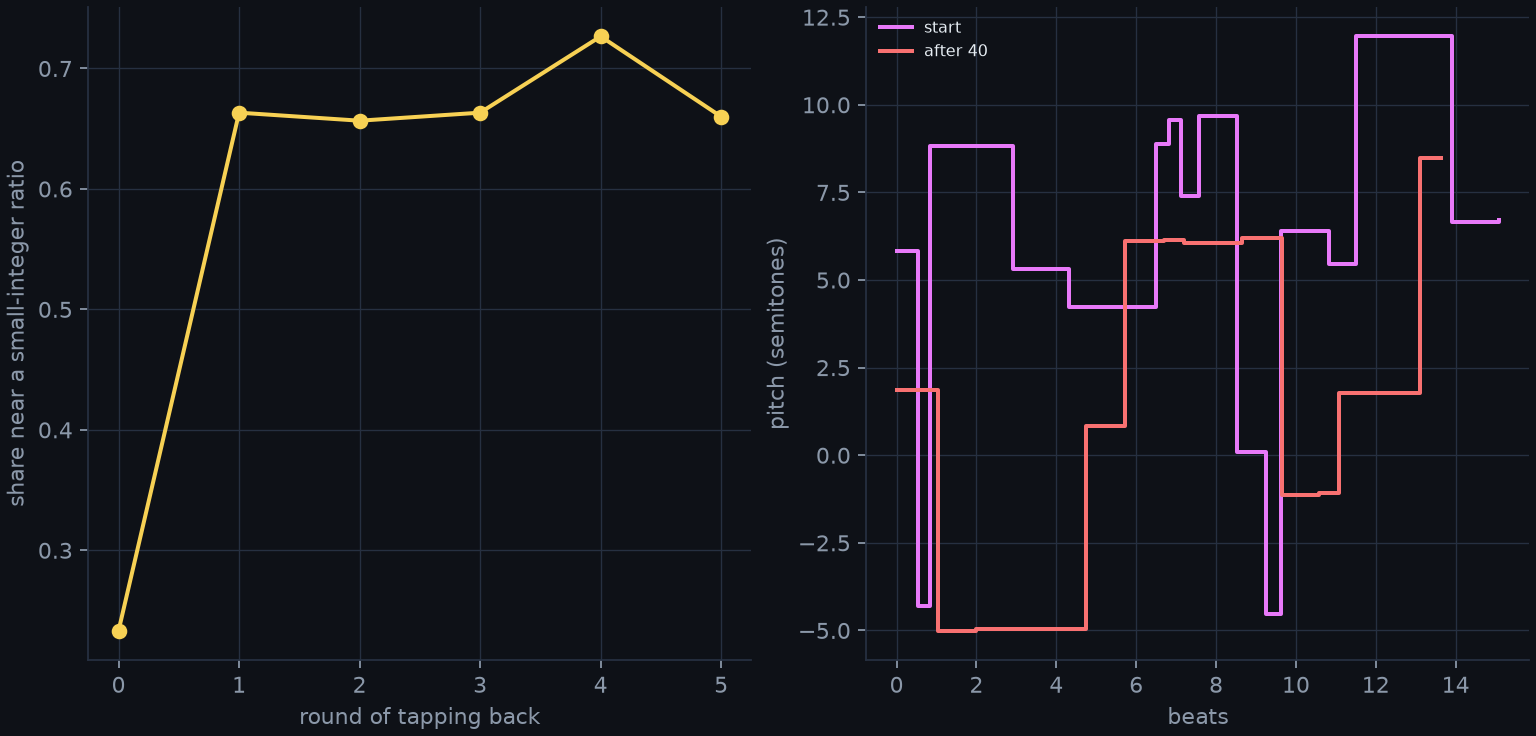
Reveal a simulated listener's rhythm prior by iterated reproduction; pass a melody through a chain of simulated singers and watch structure appear; and measure the rhythm of tunes by language.
python -m videos.music.labs 47
needs numpy, scipy, matplotlib · download lab47.py ·
source on GitHubshare of rhythms near a small-integer ratio, rounds 0 to 5 0.23, 0.66, 0.66, 0.66, 0.73, 0.66
where chains ended / the prior's share 1:1:2 0.44 / 0.51; 1:1:1 0.20 / 0.26; 1:2:2 0.23 / 0.15; 1:2:3 0.13 / 0.08
a random melody before and after 40 singers: pitch levels 10 -> 6
average step (semitones) 5.03 -> 2.71
lengths that are simple ratios 0.50 -> 1.00
copying error per note, first five and last five singers 0.16 -> 0.05
nPVI: French (5) / English (26) tunes 24.7 / 34.8
English minus French: bootstrap interval; permutation p 10.1 [1.2, 19.1]; p = 0.267
ear problem: the last three loops are each a random start or a chain's end (listen first) random start, after five rounds, random start
A chain of learners who sample their posterior drifts to their prior (Griffiths and Kalish 2007): that is why tapping back reveals expectations, and why transmission alone can build musical structure.The code (87 lines; it asserts its own result)
"""Lab 47: origins, computed: rhythm priors revealed by tapping back, a melody passed through simulated singers, and
the nPVI of tunes by language."""

import numpy as np

from videos.coursekit import labs
from explainer.music.monochord import SR, Clip, concat, mix
from explainer.music.monochord import origins as O
from videos.music.music47 import compute as C

TITLE = "Origins, computed"
GOAL = ("Reveal a simulated listener's rhythm prior by iterated reproduction; pass a melody through a chain of "
        "simulated singers and watch structure appear; and measure the rhythm of tunes by language.")
TASKS = [
    "Edit PRIOR (integer patterns and weights). Do the chains end in the same proportions as the prior? Why not exactly?",
    "Change SINGER (try novel 0, or category 0.05). Which universals still appear after GENERATIONS singers?",
    "Add tunes to FRENCH or ENGLISH by origin and re-run the permutation test. How many tunes would settle it?",
]
PRIOR = {(1, 1, 2): 2.0, (1, 1, 1): 1.0, (1, 2, 2): 0.6, (1, 2, 3): 0.3}
SINGER = {}
GENERATIONS = 40
FRENCH = {"France", "Canada"}
ENGLISH = {"England", "United States", "Scotland", "Wales", "Britain"}


def run(seed=0):
    rng = np.random.default_rng(seed)
    lab = labs.Lab()
    pr = O.RhythmPrior(PRIOR)
    ch = O.rhythm_chains(pr, 300, 5, seed=seed)
    mass = [pr.mass_near(ch[:, i]) for i in range(6)]
    lab.row("share of rhythms near a small-integer ratio, rounds 0 to 5", ", ".join(f"{m:.2f}" for m in mass))
    ends = {}
    for y in ch[:, -1]:
        k = O.nearest_pattern(pr, y)
        if k:
            ends[k] = ends.get(k, 0) + 1
    tot = sum(ends.values())
    share = {k: ends.get(k, 0) / tot for k in PRIOR}
    wsum = sum(PRIOR.values())
    lab.row("where chains ended / the prior's share", "; ".join(f"{':'.join(map(str, k))} {share[k]:.2f} / {PRIOR[k] / wsum:.2f}" for k in PRIOR))
    assert mass[-1] > mass[0]

    mel = O.random_melody(rng)
    chain = O.transmission_chain(mel, GENERATIONS, rng, SINGER)
    s0, s1 = O.structure(chain[0]), O.structure(chain[-1])
    lab.row(f"a random melody before and after {GENERATIONS} singers: pitch levels", f"{s0['levels']} -> {s1['levels']}")
    lab.row("average step (semitones)", f"{s0['step']:.2f} -> {s1['step']:.2f}")
    lab.row("lengths that are simple ratios", f"{s0['simple']:.2f} -> {s1['simple']:.2f}")
    err = [O.align(chain[g], chain[g + 1])["per_note"] for g in range(GENERATIONS)]
    lab.row("copying error per note, first five and last five singers", f"{np.mean(err[:5]):.2f} -> {np.mean(err[-5:]):.2f}")

    fr = [O.npvi(t.beats[:-1]) for t in C.TUNES if t.origin in FRENCH]
    en = [O.npvi(t.beats[:-1]) for t in C.TUNES if t.origin in ENGLISH]
    t = O.bootstrap_diff(fr, en, n=4000, seed=seed)
    lab.row(f"nPVI: French ({len(fr)}) / English ({len(en)}) tunes", f"{np.mean(fr):.1f} / {np.mean(en):.1f}")
    lab.row("English minus French: bootstrap interval; permutation p", f"{t['diff']:.1f} [{t['lo']:.1f}, {t['hi']:.1f}]; p = {t['p']:.3f}")

    # sound: the melody before and after; ear problem: three rhythms, each a random start or a chain's end
    clips = [C.voice_clip(chain[0], seed=1), C.voice_clip(chain[-1], seed=2)]
    answers = []
    for i in range(3):
        c = int(rng.integers(len(ch)))
        if rng.random() < 0.5:
            x, kind = ch[c, 0], "random start"
        else:
            x, kind = ch[c, -1], "after five rounds"
        clips.append(C.rhythm_clip(x[:2], loops=3))
        answers.append(kind)
    lab.audio = concat(clips, gap=0.9)
    lab.row("ear problem: the last three loops are each a random start or a chain's end (listen first)", ", ".join(answers))

    fig, (ax1, ax2) = labs.figure(2)
    ax1.plot(range(6), mass, "o-", color=labs.GOLD)
    ax1.set_xlabel("round of tapping back")
    ax1.set_ylabel("share near a small-integer ratio")
    p0 = [x[0] for x in chain[0]]
    p1 = [x[0] for x in chain[-1]]
    ax2.step(np.cumsum([0] + [x[1] for x in chain[0]])[:-1], p0, where="post", color="C7", label="start")
    ax2.step(np.cumsum([0] + [x[1] for x in chain[-1]])[:-1], p1, where="post", color="C3", label=f"after {GENERATIONS}")
    ax2.set_xlabel("beats")
    ax2.set_ylabel("pitch (semitones)")
    ax2.legend(fontsize=7)
    lab.fig = fig
    lab.note = ("A chain of learners who sample their posterior drifts to their prior (Griffiths and Kalish 2007): that is "
                "why tapping back reveals expectations, and why transmission alone can build musical structure.")
    return lab
Now change it
- Edit PRIOR (integer patterns and weights). Do the chains end in the same proportions as the prior? Why not exactly?
- Change SINGER (try novel 0, or category 0.05). Which universals still appear after GENERATIONS singers?
- Add tunes to FRENCH or ENGLISH by origin and re-run the permutation test. How many tunes would settle it?
Problems, with solutions
Try each problem before opening its solution.
-
Compute. Compute the nPVI of the durations 1, 1, 2, 1, 1, 2. What does doubling every duration do to it?
Solution
The five neighbouring pairs give |1−1|/1 = 0, |1−2|/1.5 = 2/3, 2/3, 0, 2/3; their mean is 2/5, so the nPVI is 40. Doubling every duration doubles each difference and each average, so nothing changes: the index depends only on ratios, which is why it can compare a slow tune with a fast one.
-
Prove. Prove that a chain of learners who sample their posterior has the prior as a stationary distribution.
Solution
Let a learner's hypothesis θ be drawn from the prior p(θ), let it produce data d ~ p(d | θ), and let the next learner draw θ′ ~ p(θ′ | d). Then the distribution of θ′ is ∫∫ p(θ′ | d) p(d | θ) p(θ) dθ dd = ∫ p(θ′ | d) p(d) dd = p(θ′), by Bayes's rule. So the prior is stationary; if the chain is irreducible and aperiodic it converges to it from any start (Griffiths and Kalish 2007). Learners who take the most probable hypothesis instead do not have this property, and preserve what they hear far longer, as chapter 6's two kinds of singer show.
-
Ear. The lab plays rhythms before and after five tap-backs; say which is which.
Solution
The lab prints them. A chain's end lies near a ratio of small integers, so it sounds like a pattern you could clap (long, short, long; or short, short, long); a random start sounds lopsided and keeps slipping.
-
Build. Switch off the singer's categories and run the chains: which universals still appear?
Where to look.
transmit(mel, rng, {"category": 0.0})keeps every heard pitch; setnovelto 0 to make memory indifferent to novelty, orleap_costto 0. Measurestructureafter forty singers for twenty chains each way: lengths still settle on simple ratios (the timing prior does that), while pitch levels merge less: in twenty chains, about 7.6 levels remain instead of 5.5, and what merging is left comes from memory refilling lost notes with familiar ones. -
★ Which universals need which biases, and are the biases themselves universal?
Where the frontier is. Switch biases off one at a time in simulated chains to see which universals each produces; then estimate the biases from real transmission chains, in the lab across many cultures (as Jacoby's rhythm studies do) and from tune families (as Savage's alignments do), and ask whether they vary as the music does.
Notes and sources
Sources
- N. J. Conard, M. Malina and S. C. Münzel, "New flutes document the earliest musical tradition in southwestern Germany", Nature (2009); T. Higham and others, Journal of Human Evolution (2012), on Geißenklösterle; J. Zhang and others, "Oldest playable musical instruments found at Jiahu early Neolithic site in China", Nature (1999).
- S. A. Mehr and others, "Universality and diversity in human song", Science (2019); S. A. Mehr and others, "Form and function in human song", Current Biology (2018); C. M. Bainbridge and others, "Infants relax in response to unfamiliar foreign lullabies", Nature Human Behaviour (2021).
- P. E. Savage, S. Brown, E. Sakai and T. E. Currie, "Statistical universals reveal the structures and functions of human music", PNAS (2015); P. E. Savage and others, "Sequence alignment of folk song melodies reveals cross-cultural regularities of musical evolution", Current Biology (2022); S. P. Bayard, "Prolegomena to a study of the principal melodic families of British-American folk song", Journal of American Folklore (1950).
- J. H. McDermott, A. F. Schultz, E. A. Undurraga and R. A. Godoy, "Indifference to dissonance in native Amazonians reveals cultural variation in music perception", Nature (2016); N. Jacoby and others, Current Biology (2019), on octaves; M. P. Lynch and others, Psychological Science (1990); E. E. Hannon and S. E. Trehub, Psychological Science and PNAS (2005).
- N. Jacoby and J. H. McDermott, "Integer ratio priors on musical rhythm revealed cross-culturally by iterated reproduction", Current Biology (2017); N. Jacoby and others, Nature Human Behaviour (2024); T. L. Griffiths and M. L. Kalish, "Language evolution by iterated learning with Bayesian agents", Cognitive Science (2007).
- S. Kirby, H. Cornish and K. Smith, PNAS (2008); A. Ravignani, T. Delgado and S. Kirby, "Musical evolution in the lab exhibits rhythmic universals", Nature Human Behaviour (2016); O. Fehér and others, "De novo establishment of wild-type song culture in the zebra finch", Nature (2009).
- R. S. Payne and S. McVay, "Songs of humpback whales", Science (1971); M. J. Noad and others, "Cultural revolution in whale songs", Nature (2000); A. D. Patel, J. R. Iversen, M. R. Bregman and I. Schulz, "Experimental evidence for synchronization to a musical beat in a nonhuman animal", Current Biology (2009); A. D. Patel, Music Perception (2006); P. Cook and others, Journal of Comparative Psychology (2013).
- A. D. Patel, Music, Language, and the Brain (2008); E. Grabe and E. L. Low (2002); A. D. Patel and J. R. Daniele, "An empirical comparison of rhythm in language and music", Cognition (2003); Y. Ozaki and others, "Globally, songs and instrumental melodies are slower and higher and use more stable pitches than speech", Science Advances (2024).
- I. Peretz and D. T. Vuvan, "Prevalence of congenital amusia", European Journal of Human Genetics (2017); F. H. Rauscher, G. L. Shaw and K. N. Ky, Nature (1993); J. Pietschnig, M. Voracek and A. K. Formann, "Mozart effect–Shmozart effect: a meta-analysis", Intelligence (2010); W. F. Thompson, E. G. Schellenberg and G. Husain, Psychological Science (2001).
- E. G. Schellenberg, Psychological Science (2004); S. A. Mehr and others, PLoS ONE (2013); G. Sala and F. Gobet, Memory & Cognition (2020); J. Hole and others, The Lancet (2015); the Cochrane review of music therapy for depression (2017); Ł. Bieleninik and others, JAMA (2017).
- C. Darwin, The Descent of Man (1871); H. Spencer, "The origin and function of music" (1857); S. Mithen, The Singing Neanderthals (2005); S. Pinker, How the Mind Works (1997); P. E. Savage and others, "Music as a coevolved system for social bonding", and S. A. Mehr, M. M. Krasnow, G. A. Bryant and E. H. Hagen, "Origins of music in credible signaling", Behavioral and Brain Sciences (2021); H. Honing (ed.), The Origins of Musicality (2018).
- A. L. C. Wood and others, "The Global Jukebox", PLOS ONE (2022); M. Niarchou and others, "Genome-wide association study of musical beat synchronization demonstrates high polygenicity", Nature Human Behaviour (2022); B. Nettl, The Study of Ethnomusicology (3rd ed., 2015).
- J. Blacking, How Musical Is Man? (1973); A. P. Merriam, The Anthropology of Music (1964): the definitions chapter 2 starts from.
About this partfrom its README
Part 47 of a sixty-eight-part course in music (see the series plan and
the syllabus), the last part of Act VIII, The Mind. A flute cut from a vulture's wing bone lay in
Hohle Fels cave for at least 35,000 years. Every society that has been studied makes music, and nobody agrees why. This
part sorts what is shared (a few discrete pitches, a beat, simple rhythms, the lullaby) from what is learned (a taste
for consonance), reveals rhythm priors by tapping back, passes melodies through chains of simulated singers, and draws
the Tune's family tree. The tools are Monochord's (explainer/music/monochord/origins.py). Every listener, singer and
dancer in it is simulated, and says so; published findings (Conard, Mehr, Savage, Jacoby and McDermott, Patel,
Pietschnig, Sala and Gobet, Niarchou and others) are quoted, not reproduced, and are listed under Sources.
- A flute in a cave. The Hohle Fels flute; a pipe its size (21.8 cm, 8 mm bore) with five evenly spaced holes, heard on Part 8's flute model (766 Hz with every hole closed; steps of 364, 202, 229, 264 and 312 cents: even holes, uneven steps); the questions; the plan.
- 1. The oldest instruments. A logarithmic timeline from Divje Babe (disputed) to Geißenklösterle, Hohle Fels, Jiahu, Ur and Ugarit; what a pipe's length says (766 Hz for the fragment, 496 Hz for one estimate of the whole); what the bones say; older than any flute.
- 2. Every society sings. Mehr's Natural History of Song (315 societies); an ear question (one melody sung as a dance song and as a lullaby: which is which?), with the features that tell them apart; form follows function (listeners in 60 countries; infants relaxing to foreign lullabies); what song is for.
- 3. Statistical universals. Savage's 304 recordings; six of his features checked on the series' 54 tunes (at most seven pitch classes 96 per cent, small intervals 100, falling or arched phrases 65, two lengths covering three notes in four 81, a beat 100, recurring motifs 91); what such a check cannot show; features that travel together.
- 4. What is learned. The Tsimane's indifference to dissonance; four chords of the kind they rated, heard; the gradient with exposure; is the octave universal?; infants born open and tuned by exposure.
- 5. Priors revealed by iteration. Jacoby and McDermott's method; an ear question (a random rhythm and what it became after five rounds: 2.8 : 1 : 1.3 became 1.8 : 1 : 1.9, near 2 : 1 : 2); 400 chains in the rhythm triangle, gathering on small-integer ratios (28 per cent near one at the start, 71 after three rounds); two listeners, two priors (a 4/4 listener's chains end on 1:1:2 51 per cent of the time against a prior of 51; a 7/8 listener's on 2:2:3); Griffiths and Kalish's theorem; 39 groups in 15 countries.
- 6. A tune in simulated mouths. One simulated singer; a random melody after 0, 1, 5, 10, 20 and 40 singers; an ear question (which end of the chain could you sing back?); twenty chains measured (pitch levels 11.7 → 5.6, average step 5.6 → 2.7 semitones, simple lengths 47 → 97 per cent, copying error 0.31 → 0.08 a note); two kinds of learner (the Tune after thirty likeliest-value singers 0.25 a note from the original, after thirty samplers 0.38); cultural evolution in the lab (Kirby; Ravignani).
- 7. Tune families. Bayard; the Tune, the Alphabet Song and Baa, Baa, Black Sheep, heard; aligning melodies as genes (Needleman–Wunsch: the Tune's first two phrases against Baa, Baa's cost 3.0, two halved lengths and two gaps); eleven tunes clustered (the Tune's family a branch of its own: the Alphabet Song 0.15 a note away, Baa, Baa 0.29, every other tune at least 0.60); a simulated family rebuilt exactly, and 4.8 of 6 branchings on average over twenty families, against 0.5 for a random tree; Savage's 10,062 folk melodies.
- 8. Birds, whales and a cockatoo. Zebra finch isolates' song restored in three or four tutored generations; humpback song revolutions; Snowball; an ear question (two simulated dancers: which is on the beat?); Rayleigh's test (R 0.95 and p below 10⁻¹³, against R 0.15 and p 0.57); vocal learning and beat-keeping, and a sea lion.
- 9. Music and language. Two sound systems; the nPVI (an even rhythm 0, two short and a long 40, long-short at three to one 100); the two ends of the corpus, heard (Sur le pont d'Avignon 21, Clementine 74); Grabe and Low, Patel and Daniele; the series' folk tunes by language (French 24.7, English 35.8, German 39.1; English minus French 11.1, bootstrap interval 3.4 to 19.0, permutation p = 0.16: with five French tunes, we cannot tell); the Library by kind (songs 47.9, keyboard 29.2: what a piece is for moves the number more than the composer's language); song against speech (Ozaki).
- 10. Amusia, Mozart and transfer. Congenital amusia (about 1.5 per cent); an ear question in the Montreal battery's style (which pair differed?); the Mozart effect and its meta-analysis; 300 simulated studies of a zero effect, of which the 46 published average 0.14; music lessons and transfer (Schellenberg; Mehr; Sala and Gobet); music as treatment.
- 11. Why music? Darwin, Spencer and Mithen; Pinker's cheesecake; bonding and credible signalling; what each theory predicts; what our chains add.
- 12. Frontier: data at the scale of the species. The Global Jukebox, the Natural History of Song, many-site studies and Registered Reports; the genetics of beat synchronization (69 loci, 13–16 per cent); open questions; ★ research problem: which universals need which biases, and are those biases universal?
- Variation 47, recap and problems. The Tune as written, after fifteen singers and after thirty; the ledger (42 notes in, 41 out, 29 kept exactly, 0.28 a note); what we found; five problems; where it comes back; in practice; references; Part 48.
What is computed and built
python -m videos.music.music47.compute (about a minute) fills .cache/music47/.
| Item | What it computes | Checked against |
|---|---|---|
hook |
a five-hole pipe's notes; open-pipe fundamentals | rising notes, uneven steps (tests) |
lullaby, chords |
one melody as dance song and lullaby; four chords | — |
universals |
six statistical universals on the corpus | the shares (tests) |
rhythm |
iterated reproduction by two simulated listeners | chains end in each prior's mode (tests) |
chains, sampling, tune47 |
transmission chains; samplers against likeliest-value singers; Variation 47 | structure appears, error falls (tests) |
family, relatives |
alignment, UPGMA, Robinson–Foulds against a known tree | better than random (tests) |
npvi, rhythms |
nPVI of the corpus by language and of the Library by kind | bootstrap and permutation (tests) |
beat, amusia, mozart |
Rayleigh's test; a Montreal-style pair; publication bias | the p-values; inflation (tests) |
Monochord's tools are held in tests/music/test_origins.py (including alignment against hand-built cases and the
chains finding their prior); this part's claims and clips in tests/music/test_music47.py.
Sounds. Part 8's flute model and voice, Part 7's piano, Part 40's drums, a struck-wood tap. There are no recordings: the songs of Mehr's and Savage's collections, the whale recordings and Snowball's video are described, not played.
What the models are, and are not. The pipe has holes we placed; the Hohle Fels flute's tuning is not known. The rhythm listeners are Bayesian observers with priors we chose (a 4/4 listener and a 7/8 listener); they illustrate the method and the theorem, not any culture's measured prior. The singers are a deliberately simple model of transmission: blurred hearing, pitch categories, a pull toward simple lengths, a cost on wide leaps, and slips that fall on whatever is new; real singers protect strong beats and final notes (Savage 2022), which ours do not. The dancers are simulated head-bobs. The consonance gradient in chapter 4 sketches McDermott's ordering, not his measured sizes. The nPVI comparison uses tunes grouped by country, written out from memory, with five French tunes: it is a lesson in what a small sample cannot show.
Notes
The evenly spaced-hole pipe is not an archaeological fingering reconstruction. Statistical universals describe coded samples, not all possible music. The synthetic transmission model explicitly builds in pitch categories, simple-duration candidates, familiar continuations and a leap penalty; its structure is not independent evidence for those assumptions. Iterated-learning stationarity requires matched generative and sampling conditions and does not establish this richer singer model’s asymptotic distribution. Similarity trees do not prove ancestry. Nominal Rayleigh p-values assume independent phases; correlated bobbing needs a matched null. Matched language/genre samples reduce confounds without proving causation. No informal melody trial diagnoses amusia.
The rhythm before/after comparison uses distinct concatenation event names; its second four-cycle example starts at 9.6 seconds. The global end event remains the end of the file.
Companion material in this repository
The syllabus's plan for this partfrom SYLLABUS.md, the plan of record
- Hook: the Hohle Fels flute; a pipe its size with five even holes, heard (uneven steps); the questions; the plan.
- The oldest instruments: a logarithmic timeline; what a pipe's length says; what the bones say; older than any flute.
- Every society sings: the Natural History of Song; an ear question (dance song or lullaby?); form and function; contexts.
- Statistical universals: Savage's 304 recordings; six features checked on the corpus; what that cannot show; clusters.
- What is learned: the Tsimane'; four chords heard; the gradient with exposure; the octave; infants tuned by exposure.
- Priors revealed by iteration: the method; an ear question (before and after five tap-backs); 400 chains; two priors; the theorem.
- A tune in simulated mouths: one singer; a melody over forty singers; an ear question; the measures; two kinds of learner; the lab.
- Tune families: Bayard; three relatives heard; alignment; eleven tunes clustered; a simulated family rebuilt; Savage 2022.
- Birds, whales and a cockatoo: zebra finches; humpbacks; Snowball; an ear question (which dancer?); Rayleigh's test; vocal learning.
- Music and language: two sound systems; the nPVI; two tunes heard; Patel and Daniele; the corpus by language; the Library by kind; song and speech.
- Amusia, Mozart and transfer: amusia; an ear question (which pair differed?); the Mozart effect; publication bias simulated; transfer; therapy.
- Why music? Darwin, Spencer, Mithen; Pinker; bonding and signalling; predictions; what the chains add.
- Frontier: datasets of the world's music; the genetics of rhythm; open questions; the research problem.
- Variation 47: the Tune through thirty singers. Outro: problems, payoffs.
Covers: the cross-cultural evidence; theories of origin; birdsong, whales and a dancing cockatoo; infants and
enculturation; music and language; amusia; the Mozart effect and what transfer studies show; therapy evidence;
cultural evolution and tune families.
Built and computed: monochord/origins.py: iterated reproduction by simulated Bayesian listeners (400 random
rhythms, 28 per cent near small-integer ratios at the start, about 70 after three rounds, in the prior's proportions); a
transmission chain of simulated singers (twenty random melodies over forty singers: pitch levels 11.7 to 5.6, steps 5.6
to 2.7 semitones, copying error 0.31 to 0.08 a note; samplers forget the Tune, likeliest-value singers keep it);
Needleman–Wunsch alignment under the best transposition, UPGMA and Robinson–Foulds (the Tune's relatives cluster; a
simulated family's branchings recovered 4.8 of 6 on average); six statistical universals on the corpus; nPVI by
language on the corpus (French 24.7, English 35.8, permutation p = 0.16) and by kind on the Library (songs 47.9,
keyboard 29.2); Rayleigh's test for simulated dancers; a publication-bias simulation (a zero effect published at 0.14).
Variation 47: the Tune after thirty simulated singers: 42 notes in, 41 out, 29 kept exactly, 0.28 a note.
Frontier: large cross-cultural datasets; the genetics of beat synchronization (Niarchou et al. 2022: 69 loci, SNP
heritability 13–16 per cent); the origins debate (open: which universals need which biases).
Reading: Patel, Music, Language, and the Brain; Savage et al. (2015); Mehr et al. (2019); Honing (ed.), The
Origins of Musicality.
Build the film
python -m videos.music.music47.compute        # the part's numbers, into .cache/music47
python tools/build.py music47                  # render and assemble the film
EXPLAINER_TTS=silent python tools/qa_scene.py music47 Hook   # one chapter, silent, with a contact sheet
Scenes: videos/music/music47. Setup: see the course page. Source of these notes: the README and the scenes' narration.
Build it
python -m videos.music.music47.compute                          # numbers and sounds (about a minute)
EXPLAINER_TTS=silent python tools/build.py music47 -q l --fps 15   # a silent-narration preview, with the sounds
python tools/qa_sound.py music47 --sync                         # the sound gates
python tools/dead_air.py renders/music47_480p.mp4 --sound music47  # no empty screen; no sound over a still one
python tools/lecture_length.py music47                          # 30 to 60 minutes, listening included
python tools/build.py music47                                   # 1080p30, narrated
python -m pytest -q tests/music                                 # Monochord against its references; this part's claims and clips
python -m videos.music.labs 47                                  # the lab (writes a figure and a short WAV)