The Renaissance
What made sixteenth-century polyphony sound as it does, and can its style be measured well enough to say who wrote a piece?
In 1540 a Nuremberg publisher remembered a remark: now that Josquin is dead, he is putting out more works than when he was alive. Printing had made Josquin a brand and his works a puzzle, and the part learns the century's style well enough to ask a statistical question: who wrote this? Thirds and sixths become the sound of the music, in 84 sonorities in 100 of Palestrina's 1,318 Mass movements against 51 in Part 23's fourteenth century, and a place to end, in 90 of his final chords against 1 in 89. Equal voices build pieces from points of imitation: 70 in 100 of his movements open with one, at the octave, fourth or fifth. Of his 102,279 dissonances against the bass, a program finds 55 in 100 passing, 31 suspensions, 10 neighbours and 2.6 free: the rules Jeppesen wrote down are habits followed ninety-seven times in a hundred. A nearest-centroid test on twelve features recognizes Palestrina from Monteverdi 95 times in 100, which is the wrong question (genre, date and encoding differ), and Monteverdi's 1592 madrigals from his 1603 and 1605 ones 73 times in 100. The second practice that Artusi attacked in Cruda Amarilli is there in the numbers: free dissonance rises from 23 in 100 in Book 3 to 45 and 49. Zarlino's 4:5:6 triad, meantone and Vicentino's thirty-one tones answer what tuning a world of triads wants; Gesualdo pushes the modes to breaking. The Tune becomes a four-voice point of imitation.
What you need. Part 6 for tuning; Part 14 for gap fill; Part 16 for species counterpoint; Part 17 for the choir; Part 20 for imitation and the counterpoint search; Part 23 for the fourteenth-century corpus and musica ficta. Standardization, nearest-centroid classification, leave-one-out validation.
- Ideas, mathematics and history
- thirds become consonant, imitation, Josquin and the attribution problem, Palestrina's rules, Petrucci's press, Zarlino, Vicentino's 31 tones
- What we build, compute and hear
- a stylometric attribution test; the Tune as a point of imitation
What you will be able to do
Foundations
- Hear the difference between a fourteenth-century and a sixteenth-century ending, and a point of imitation.
- Recognize passing notes, neighbours, suspensions and cambiatas, and a prepared from a struck dissonance.
- Explain the three kinds of Mass and what a madrigal sets to music.
Full course
- Classify every dissonance in a piece by its treatment, and measure sonorities, imitation and melodic leaps in a corpus.
- Build a stylometric test with standardized features and leave-one-out, and say what it confounds.
- Compute the third and fifth of just, Pythagorean, meantone and equal tunings in cents.
Research
- Design an attribution test held out by source, and interpret its failure modes.
- Model editorial accidentals as uncertain data and propose how to measure editors' disagreement.
Practice
- Tune thirds pure in a choir and explain why they differ from the piano's.
- Write a point of imitation and complete it in free counterpoint.
Contents
Each chapter has a home level. Choose a track to see what to read and watch: Foundations 23 min · Full course 35 min · Research 37 min · Practice 26 min.
- 0Who wrote this?Foundations2 min
- 1Thirds and sixths become consonantFoundations3 min
- 2Imitation as structureFoundations2 min
- 3The Mass, three waysFoundations2 min
- 4Palestrina's style as rulesFoundations3 min
- 5The lineFull course2 min
- 6Printing, and Josquin's nameFoundations3 min
- 7Who wrote this? A statistical answerFull course4 min
- 8The madrigal and word paintingFoundations2 min
- 9The second practiceFoundations3 min
- 10Zarlino's triad, Vicentino's thirty-one tonesPractice4 min
- 11Chromaticism and fictaFull course2 min
- 12Frontier: attribution and ficta by machineResearch2 min
- Variation 24, recap and problemsAll tracks3 min
Also on this page: Lecture · Key results · Try it · Lab · Problems · Notes and sources · Build the film.
Lecture
The text of each chapter is the film's narration, as it is spoken, so you can read along or revise without the film. The pictures are in the film. A dashed box stands for a number the film computes when it is rendered (hover over it to see what is computed); the README's figures for each chapter, where it lists them, follow the chapter's text.
Who wrote this?Foundations2 min
Nuremberg, 1540. A music publisher, Georg Forster, writes in a preface that he remembers a distinguished man saying that Josquin, now that he is dead, is putting out more works than when he was alive. Josquin des Prez, who died in 1521, was an early composer whose posthumous fame was strongly amplified by music printing. Printers knew his name sold copies, and put it on music he had not written. Modern scholars have doubted a large share of the works that once carried his name. Which raises the question this part ends on: can the style of a piece, measured, say who wrote it?
First, the sound of the century. This is the opening of the Kyrie of Palestrina's most famous Mass, the Missa Papae Marcelli, in voices, sung by the film's synthetic choir from a modern encoding. Listen to the shared imitative material across voices, whose registers and roles still differ: each takes up the same idea in turn, one note sung three times and then a leap up a fourth, and the sound is full of thirds and sixths, smooth and continuous, with almost every dissonance slipped in on a weak beat and taken away by step.
This part covers the fifteenth and sixteenth centuries. How thirds and sixths became increasingly prominent and cadentially accepted in these traditions, and imitation became the way a piece is built. The Mass in three kinds, and Palestrina's style written as rules and measured on more than thirteen hundred of his Mass movements. Printing, Josquin's name, and a statistical test of who wrote what. The madrigal, and Monteverdi's second practice, which a critic attacked and the numbers confirm. Tuning and chromaticism at the edge of the system. And what machines can now say about authorship and about the accidentals no one wrote down.
1Thirds and sixths become consonantFoundations3 min
When did the third become a resting place?
Part 23 ended with fourteenth-century music that keeps its perfect intervals on the beat and never ends on a third. Around 1440 the French poet Martin le Franc praised a new sound that composers had learned from the English, a contenance angloise. The English, John Dunstable above all, wrote full sonorities of thirds and sixths, and few bare fifths. Guillaume Du Fay and Gilles Binchois brought it into continental music. In theory the third stayed imperfect for another century: practice moved first. And, as Part 6 showed, a third tuned pure, five to four, is smooth, while the Pythagorean third of the old theory, eighty-one to sixty-four, is rough; singers tuning by ear could make the difference.
One continental technique of the 1430s made the new sound almost mechanically. In fauxbourdon, false bass, a melody is sung with a voice a sixth below it and another a fourth below it, so that every chord in between is a third and a sixth above the bass, and only the first and last open out to an octave and a fifth. Du Fay used it in hymns and psalms. Here is the Tune's opening sung that way.
Measure it. Sample every piece at each quarter note and ask whether the sonority holds a third or a sixth above its bass. In Part 23's eighty-nine fourteenth-century pieces, in a hundred do; in Palestrina's thirteen hundred Mass movements, . Full triads, a third and a fifth together, rise from in a hundred to . And the last chord, which in the fourteenth century had a third once in eighty-nine pieces, has one in in a hundred of Palestrina's movements. A century and a half turned the third from a passing colour into the sound of the music itself, and finally into a place to end.
Hear the difference in two endings. First the close of de Vitry's motet from Part 23, landing on a bare octave and fifth. Then the close of a movement of Palestrina's, landing on a full chord with its third. Listen to the last sound of each.
2Imitation as structureFoundations2 min
How do equal voices make a form?
The second change was in how voices relate. In Machaut's time a piece was built on a tenor, usually borrowed from chant, with voices above it moving in their own rhythms. By about 1500, in Josquin's generation, all the voices are equal, and each enters in turn with the same short idea. That unit is called a point of imitation: a phrase of the text gets a motive, the voices take it up one after another, and the passage closes with a cadence. A whole piece is a chain of points, one for each phrase of the words, overlapping at the joins. The fugue of Part 20 grew out of this habit, two centuries later.
Here is a point of imitation found by a program in Palestrina's Masses: a movement in four voices where all four enter with exactly the same intervals. The numbers mark the order of the entries. Listen to the idea pass from voice to voice, each entry starting while the others continue.
How common is it? The program reads the first four melodic intervals of every voice and asks whether later voices begin with the same ones. in a hundred of Palestrina's Mass movements open with imitation, and of the later entries, out of copy the intervals exactly; the other matched entries allow each interval to differ by up to one semitone with the same direction; that does not establish a tonal-answer function. They enter at the octave, the fourth or the fifth, common imitation intervals, often requiring modal adjustments rather than preserving every scale interval: a motive that steps E to F in one voice steps B to C a fifth higher, and the half step is still a half step. At the second it would not be, which is one of this part's problems. Monteverdi's madrigals open imitatively only times in a hundred: this difference may reflect genre, text setting, date and the detector’s restricted opening template.
3The Mass, three waysFoundations2 min
How do you build a half-hour piece from borrowed music?
The largest form of the century was the Mass: the five Ordinary sections commonly set in a polyphonic Mass cycle, Kyrie, Gloria, Credo, Sanctus and Agnus Dei, set as one cycle on shared material. Three important techniques were. In a cantus firmus Mass, a borrowed tune runs in long notes through one voice of every movement, and the others are built round it; a popular song, L'homme armé, the armed man, served for more than forty. In a paraphrase Mass, a chant is ornamented and passed through all the voices, as in Josquin's Missa Pange lingua. And in an imitation Mass, later called a parody Mass, a whole polyphonic piece, a motet or a chanson, is reworked: its points of imitation, its cadences, its textures, rearranged into a new work. Most of Palestrina's later Masses are of that kind.
Giovanni Pierluigi da Palestrina, whose career centered on Roman church institutions, with an earlier post in Palestrina, wrote over a hundred Masses. This part's corpus holds of them, movements in all, encoded in the Humdrum format and kept in the music21 library's corpus. Most are for four, five or six voices. A whole career of one composer, in a single style, is rare data: it lets us ask what the style is, as a set of habits, and count how often each habit is broken.
The Missa Papae Marcelli carries a legend. Between 1545 and 1563 the Council of Trent met to reform the Catholic Church, and some of its members complained that elaborate polyphony made the sacred words impossible to hear. A story told in the next century says that Palestrina's Mass, sung before the cardinals, persuaded them not to ban polyphony. The story appears long after the event, and the Council's decree only asks that the words be understood and the music be free of anything lascivious. Still, the Mass is unusually clear: long passages are declaimed by all the voices together, so the text can be heard. Legends attach to music that fits them.
4Palestrina's style as rulesFoundations3 min
When may two voices clash?
Palestrina's music became a textbook. In 1725 Johann Joseph Fux built his Gradus ad Parnassum, Part 16's species, on it, and in the 1920s the Danish scholar Knud Jeppesen showed exactly how it treats dissonance. A dissonance is allowed in only a few ways. A passing note, on a weak beat, stepping through; a neighbour, stepping away and back. A suspension: a note consonant when it is struck, held while the bass moves under it into a dissonance, then falling by step to a consonance. And a stock figure called the cambiata, down a step to a dissonance and then down a third. Here are the four, two voices each.
Now count. A program finds every dissonance against the bass in all movements, of them, and classifies each with a simplified motion-based heuristic; it does not enforce every metrical, preparation-duration or resolution condition. in a hundred are passing notes, suspensions, neighbours, and a handful cambiatas and anticipations. Only in a hundred fit none of these implemented categories, and in half the movements the share is below in a hundred. Some of those few are not Palestrina's at all but the program's: figures it was not told about, and slips in the encoding. A style can be a set of rules followed ninety-seven times in a hundred, a descriptive result of this implementation, not a reproduction of every Jeppesen rule.
Your turn. The same small cadence twice: a seventh against the bass, falling to a sixth. In one the seventh is prepared, held over from a consonance; in the other it is struck, arrived at by a leap. Which one is prepared, A or B?
B is prepared. The upper voice sings C over A, a consonance, and simply stays while the bass moves to D beneath it: now it is a seventh, and it falls to B, a sixth. In A the same seventh arrives by a leap, with no preparation. In Palestrina, B happens tens of thousands of times; A almost never. Keep A in mind for chapter nine.
5The lineFull course2 min
What makes a line singable?
The style has rules for each line, too, set out by Jeppesen and taught ever since. Mostly steps; leaps of a third, a fourth, a fifth or an octave, and the minor sixth only upwards. Never a seventh, never an augmented or diminished interval, never more than an octave. After a leap, turn back by step, the gap fill that Part 14 measured in folk tunes. One high point, reached and left gently. The point of all this: every voice is a good melody on its own, and the texture is four or five of them at once.
Here is one line of Palestrina on its own: the top voice of the second Agnus Dei of the Missa Papae Marcelli, twelve bars, sung by one synthetic voice. Almost every move is a step; the one large leap, marked, is followed at once by a step back the other way; and the line rises to a single high point and settles. Listen to how little it needs the other voices.
Count those too. Intervals flagged by this simplified style filter, sevenths, tritones, augmented and diminished steps and leaps beyond the octave: in Palestrina, in every thousand moves, less than one; in the fourteenth century about ; in Monteverdi's madrigals about . Leaps turned back by step: in a hundred in Palestrina, against in Monteverdi. And Monteverdi leaps more often. The madrigal bends the line to the words, and expressive text setting can motivate intervals outside the stricter teaching style: a sigh, a cry, a sudden drop. The rules describe one composer's habits better than they describe music.
6Printing, and Josquin's nameFoundations3 min
What happens to a composer's name when music is sold?
In 1501, in Venice, Ottaviano Petrucci printed a book of polyphonic music from movable type, the Harmonice musices odhecaton, the hundred songs of its title, ninety-six in fact. Most were French chansons, and each page went through the press three times, for the staves, the notes and the words. A year later he printed a book of Masses all by one composer, and the composer was Josquin. A name on a title page sells copies, and Josquin's name became a brand. A name in a print also travels much further than the manuscript a printer copied from, with whatever mistakes that manuscript held.
Josquin worked in Milan, in the papal chapel in Rome, at the court of Ferrara, and ended his life at Condé in the north of France. He was admired as no composer before him: Martin Luther said that Josquin was the master of the notes, which must do as he wills, while other composers must do as the notes will. After his death, German printers in particular published more and more under his name. Some of those pieces carry other composers' names in earlier sources; some are in the style of a younger generation. Modern scholars have shrunk the list, and some once-famous motets are no longer thought to be his. How do you decide?
Fame did something else new. In 1547 the theorist Heinrich Glarean printed Josquin's music in his treatise as models of perfection, one of the first times a composer's works were held up as classics after his death. A generation later Palestrina became the model of church style, and remained so for three centuries; Fux's textbook of Part 16 is one result. A canon of great works makes attribution matter: the same piece is worth more under a great name. And it makes attribution harder, because a great name attracts the doubtful pieces.
There are two kinds of evidence. The sources: how early a copy is, how close to the composer, whether other sources give another name, which scribe or printer made it. And the style: how a piece treats dissonance, cadences, texture, and the small habits a composer has without thinking, which an imitator would not copy. Style evidence has a danger built in: the works we are sure of define the style that is then used to judge the rest, so a mistaken attribution can teach the test the wrong style. The next chapter builds such a test, and asks what it can and cannot show.
7Who wrote this? A statistical answerFull course4 min
Can twelve numbers recognize a composer?
Here is the simplest statistical test of authorship. Describe each piece by twelve numbers: the shares of its dissonances treated each way, how often it leaps and how it recovers, how many of its sonorities have thirds, how long its notes are. Put the numbers on a common scale and average each composer's pieces into a single point, a centroid. Give a new piece to the composer whose centroid is nearest. And test it honestly: hide each piece in turn, fit both feature scaling and centroids using only the other pieces, and see whether the hidden one is recognized. The accuracy on pieces the method has not seen is the only number worth reporting.
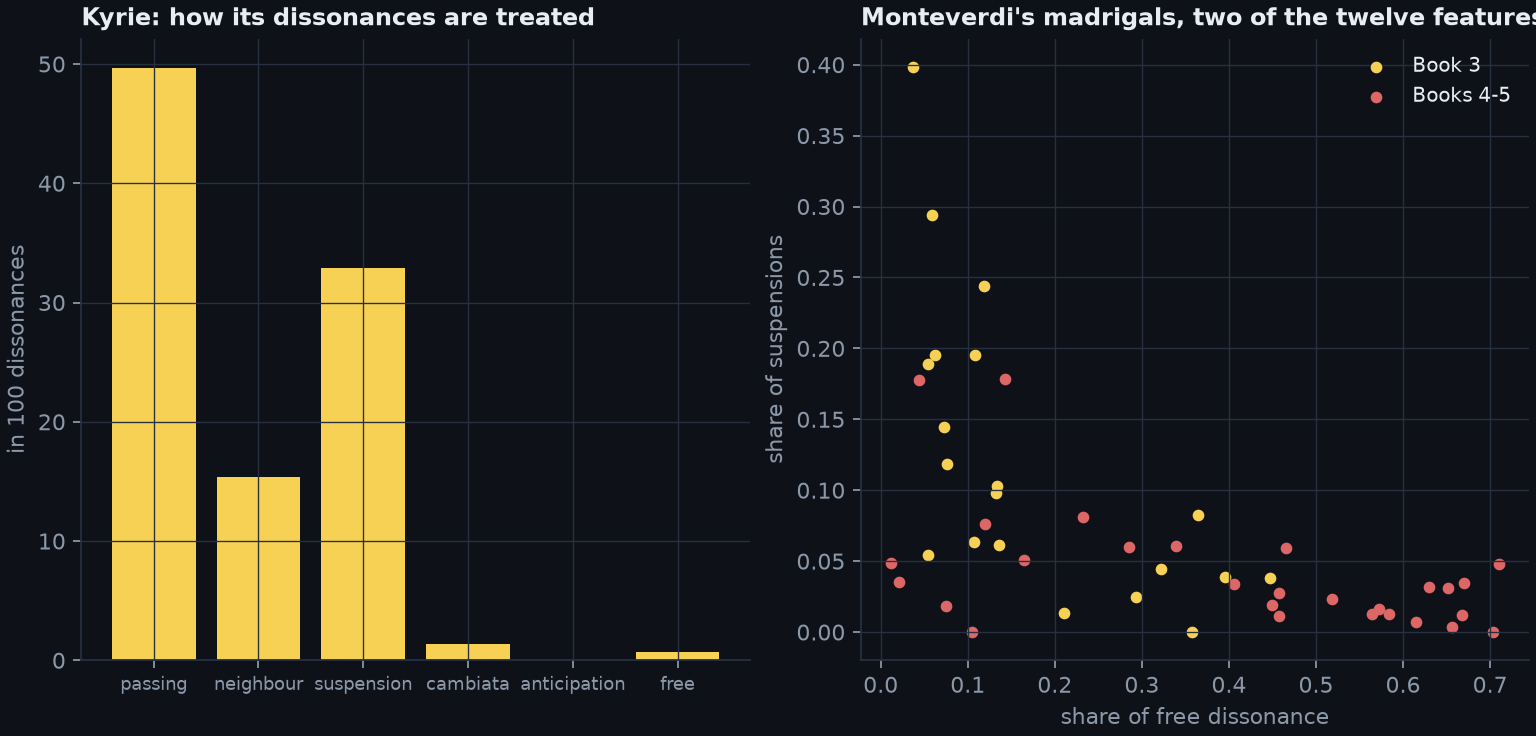
Two of the twelve numbers can be drawn. Each dot is one piece: across, its share of free dissonance; up, its share of suspensions. Palestrina's movements, in gold, sit in a tight cloud at the upper left: many suspensions, almost no free dissonance. Monteverdi's madrigals, in pink, spread out to the right and down. The crosses are the two centroids. With all twelve numbers the picture has twelve dimensions, but the rule is the same: a hidden piece goes to the nearest cross. Each number is first rescaled to a common spread, so that a feature measured in large units cannot outvote the others.
First, Palestrina against Monteverdi: of Palestrina's movements chosen at random, and all of Monteverdi's madrigals in the corpus. Hidden one at a time, the pieces are recognized times in a hundred: every Palestrina movement, and of the madrigals. What decides it: Monteverdi's note values are shorter, he uses fewer suspensions and more free dissonance, more forbidden intervals, and fewer leaps turned back. Do not be impressed yet. This compares Latin Masses with Italian madrigals, from two different encodings, half a century apart in style. A test this easy may be recognizing the genre, or the encoder, not the composer.
A harder and fairer test keeps the composer, the genre and the encoding fixed and asks about time. Can the numbers tell Monteverdi's third book of madrigals, from 1592, from his fourth and fifth, from 1603 and 1605? With all twelve numbers, times in a hundred: better than a coin, far from certain. One number alone, the share of free dissonance, gets . And the madrigal that started a famous quarrel, Cruda Amarilli, when hidden, is placed with the later books. With forty-eight pieces, a few pieces either way is noise; these are rough numbers, and an attribution built on them alone would be irresponsible.
Now be the classifier yourself. Two excerpts: one from a Palestrina Mass, one from a Monteverdi madrigal. Which is Palestrina, A or B? Listen for the dissonances, and how they arrive.
B is Palestrina: in its four bars the program finds free dissonances. A is Monteverdi's fourth book: in four bars, marked in red, chosen as the densest four bars the program could find. The selected examples illustrate the detector’s contrast, without a listener experiment; but notice that the excerpt was chosen to make the point, which is exactly a useful teaching contrast that cannot serve as unbiased evaluation evidence.
8The madrigal and word paintingFoundations2 min
Can music say what the words say?
While the church perfected the Mass, the courts of Italy invented a secular form. From the 1530s composers set serious Italian poetry, Petrarch above all, as madrigals: pieces for four, five or six voices, one singer to a part, sung by amateurs and by professional singers at court. Jacques Arcadelt and Adrian Willaert, Cipriano de Rore, Luca Marenzio, Carlo Gesualdo and Claudio Monteverdi made it the laboratory of the century. In 1588 a printed anthology, Musica transalpina, carried it to England, where Thomas Morley, Thomas Weelkes and John Wilbye wrote in English. Its principle was the opposite of the Mass's: the words come first, and the music follows every image of the poem.
This is how a madrigal begins: the opening of the first piece in Monteverdi's third book, printed in 1592, for five voices, sung here on vowels by the synthetic choir. Compare it with the Mass: the voices pair off and answer each other, the rhythm follows the stresses of the Italian words, and the texture changes with every line of the poem.
The habit is called word painting. When the poem rises to heaven, the line rises; when it falls or dies, the line falls and ends low; a sigh is a note broken by a rest; a word meaning alone is sung by one voice; and pain, cruelty or bitterness are sung on a harsh dissonance or a chromatic step. Some later critics dismissed the devices as naive and called them madrigalisms. But Thomas Morley's handbook of 1597 states the principle plainly: a composer must fit the music to the matter of the words. And the harsh dissonance for a word of pain is where the rules of the last chapters began to break.
9The second practiceFoundations3 min
Who decides what a dissonance may do?
In 1600 a canon of Bologna, Giovanni Maria Artusi, published a dialogue on the imperfections of modern music. In it he quoted passages from madrigals that had been sung but not yet printed, without naming their composer. The composer was Monteverdi, and one of the madrigals was Cruda Amarilli, cruel Amaryllis. The charge was precise: dissonances struck without preparation and left by leap, against every rule of Zarlino, the great theorist of the age. And about the facts, as the numbers will show, Artusi was right.
Here is the opening of Cruda Amarilli, sung from the encoding. The red marks are where the program finds a dissonance it cannot explain by any of this simplified classifier’s treatment categories. The passage Artusi quoted comes near the end of this excerpt, where the top voice, on the words ahi lasso, alas, strikes a ninth and a seventh against the bass without preparation and leaves them by leap.
The program marks unexplained dissonances in these sixteen bars, all in the top voice. The two near the end fall in the passage Artusi quoted: the soprano arrives on notes that clash with the bass, with nothing held over to prepare them. To Artusi this was simply wrong, a schoolboy's error in a famous composer. To Monteverdi it was the word alas, sung as a cry.
Count the whole of the three books against Palestrina. In Palestrina's Masses, dissonances in a hundred are free. In Monteverdi's third book, from 1592, . In the fourth, ; in the fifth, . And the suspension, nearly a third of Palestrina's dissonances, almost disappears. These aggregate differences do not by themselves establish a complete compositional rule system. Monteverdi's dissonances follow other rules, of the words and of the bass line, and the next generation made those rules into the harmony of the Baroque.
Monteverdi answered in the preface to his fifth book, in 1605, promising a treatise to be called The second practice. He never wrote it, but in 1607 his brother Giulio Cesare explained: the first practice is the style of Zarlino's rules and Palestrina's Masses, in which the harmony governs the words; in the second, the words are the mistress of the harmony, not its servant. Both are legitimate; a composer chooses one for a purpose. The next part follows the second practice into the Baroque, where it became the norm.
10Zarlino's triad, Vicentino's thirty-one tonesPractice4 min
What tuning does a world of triads want?
Theory caught up with the thirds in 1558, when the Venetian Gioseffo Zarlino published his Istitutioni harmoniche. Zarlino's senario, the numbers one to six, generates every consonance: the octave two to one, the fifth three to two, the fourth four to three, the major third five to four, the minor third six to five. And the major triad becomes four to five to six, the sound of the whole century in three whole numbers. Part 6 showed the price: tuning that is pure in one key goes sour in others. Singers could adjust by ear; keyboards had to choose, and chose meantone, which sacrifices the fifths a little to keep the thirds sweet.
Hear the difference on one chord, C, E and G, held, in three tunings. In which one does the third beat fastest, and can you tell the other two apart?
The table gives the third and the fifth in cents above the root. The Pythagorean third, built from fifths, is twenty-one and a half cents wider than the pure third of five to four; today's equal third is fourteen cents wide; and a third tuned in thirty-one equal steps to the octave is less than a cent from pure.
The first, Pythagorean, beats fastest: its third is the wide one, and the upper partials of C and E beat against each other about sixteen times a second, which can contribute to roughness; perceived beating depends on register, spectrum and listener. The just and thirty-one-step chords are less than a cent apart, can sound quite similar in this voicing; their fifths and full chord tuning still differ.
How did keyboards get sweet thirds? Stack four pure fifths and come down two octaves, and you overshoot the pure major third by the syntonic comma, eighty-one to eighty, about twenty-one and a half cents. Quarter-comma meantone narrows every fifth by a quarter of that comma, about five and a half cents, so that four of the narrowed fifths land exactly on a pure third, three hundred and eighty-six cents, with fifths of about six hundred and ninety-seven. The price is the circle: eleven good fifths and one wolf, and keys far from home unplayable. It was the keyboard tuning of the late Renaissance and early Baroque, as Part 6 described.
One theorist went much further. In 1555 Nicola Vicentino published a book whose title promised ancient music adapted to modern practice: he wanted to revive the chromatic and enharmonic kinds of scale the Greeks had described, with steps smaller than a semitone. He built a harpsichord to play them, the archicembalo, with thirty-one notes to the octave spread over several keyboards. Four years earlier he had lost a public debate on exactly these questions in Rome, against the Portuguese theorist Vicente Lusitano. The arithmetic was sound: thirty-one equal steps are almost exactly meantone, closed into a circle, as Christiaan Huygens later pointed out, which is why the third in the last chord was so nearly pure.
11Chromaticism and fictaFull course2 min
How far could the modes bend?
The modes themselves were being rebuilt. In 1547 the Swiss humanist Heinrich Glarean published the Dodecachordon, arguing for twelve modes instead of eight. The four new ones ended on A and on C: the Aeolian and the Ionian, which we call minor and major. Glarean argued that composers had been using them all along without a name. Zarlino later renumbered the twelve to begin from C. And by 1700 two of the twelve had swallowed all the rest, as the major and minor keys of Part 15.
The most extreme chromatic music of the century came from a prince. Carlo Gesualdo, Prince of Venosa, born in 1566, is remembered first for a crime: in 1590 he killed his wife and her lover, and the story has shadowed his music ever since. His last books of madrigals, printed in 1611, move from chord to chord by roots a third or a semitone apart, so that no key holds for more than a moment, with chromatic steps in every voice. They sound like Part 19's chromatic harmony three centuries early, but without its grammar of keys.
Here is the idea, computed for the film rather than taken from Gesualdo: seven chords, A minor, F major, D flat major, B flat minor, G flat major, E major and A major, each voice moving to the nearest note of the next chord. Every chord is an ordinary triad; it is the succession that no mode can hold.
Even in print, much was left unwritten. Singers still added sharps and flats by rule, the musica ficta of Part 23: raise the leading tone at a cadence, avoid a tritone between mi and fa. But the rules can conflict, and the singers of different voices decided at the same moment, each reading only his own part. Modern editors print their best guess as small accidentals above the staff, and every count in this part includes those guesses. The last chapter asks whether a machine can make them better.
12Frontier: attribution and ficta by machineResearch2 min
What would a trustworthy attribution test look like?
Attribution by computer is now a research field. The Josquin Research Project at Stanford has encoded hundreds of works by Josquin and his contemporaries, searchable note by note, with each work tagged by how secure its attribution is. Researchers train classifiers on the secure works and ask them about the doubtful ones, with features drawn from counterpoint: how cadences are approached, which dissonance figures appear, how the voices are spaced, which rhythms recur. The answers are evidence to be weighed with the manuscripts and prints, not a ruling.
Such tests fail in predictable ways. Genre, date, the number of voices, the editor and the encoder all leave fingerprints, and a classifier will happily learn them instead of the composer. Chapter seven's ninety-five in a hundred compared Masses with madrigals, which is the easy and wrong question. Training on a work that is wrongly attributed teaches the test the wrong style. And with a few dozen pieces, a few pieces either way change the verdict. A fair test holds everything fixed except the composer, which for this repertory is hard: the same genre, the same decade, the same kind of source, and enough pieces to measure the error.
Two open problems. The first is Part 23's: learn where editors add accidentals, and predict them in music nobody has edited. The target is not a single right answer, because editors disagree, and their disagreement is itself data. The second is this part's research problem: build an attribution test held out by source. Train on pieces from some manuscripts and prints and test on pieces from others. If the accuracy collapses, source effects are a candidate explanation, alongside repertoire shift and other confounds.
Variation 24, recap and problemsAll tracks3 min
Every part ends by doing something to the Tune with what it has built. This part built the habits of sixteenth-century polyphony. So the Tune's first phrase becomes a point of imitation: the soprano begins, the tenor enters four beats later an octave below, the alto at the fifth, then the bass, and as each voice finishes the phrase it continues in free counterpoint, found by Part 20's search, consonant on every beat once all four have entered.
Row twenty-four of the ledger. seconds. The measurement: after the last entry, of beats consonant above the bass. The Tune, which was a melody with chords, is now four equal melodies.
What did we find? The third became the sound of the century, and then a place to end. Equal voices built pieces from points of imitation. Palestrina's dissonance rules are real habits, unclassified by this simplified treatment detector about three times in a hundred. Printing made Josquin's name a brand, and his works a puzzle. A statistical test can tell styles apart, and is easily fooled by the wrong comparison. And Monteverdi's second practice is visible in the numbers, book by book, consistent with broader stylistic changes, without treating detector labels as a complete adjudication of Artusi’s critique.
Five problems. One to compute, one to prove, one for your ears, one to build, and a research problem, marked with a star. Solutions are in this part's notes. Pause here.
Where does this come back? In the Baroque, which makes the second practice its norm and the bass its foundation. In tuning, from meantone to well temperament. In the fugue, imitation's heir. In nineteenth-century chromaticism. In the statistics of style, in the parts on music research. And in the song, where the words come first again.
And in practice. Choirs can tune their thirds pure, as Zarlino's numbers say, rather than as a piano does. Composers still write points of imitation. Editors mark which accidentals are theirs. And scholars can test attributions fairly, with held-out sources.
The books and papers this part follows. The full list, with notes, is in the README.
Where it goes next. The Baroque, figured bass and the second practice as the norm in Part 25; meantone and well temperament in Parts 6 and 25; nineteenth-century chromaticism in Part 27; the song in Part 40; style by statistics in Parts 62 and 67.
Key results
The part's results in one place, for revision.
Try it
Lab 24 · The Renaissance, measured
Classify every dissonance in a piece by how it is treated, find its opening point of imitation, measure its thirds and its lines, test whether twelve style features can tell Monteverdi's early madrigals from his later ones, tune a triad in any equal division of the octave, and sort prepared from struck dissonances by ear.
python -m videos.music.labs 24
needs numpy, scipy, matplotlib · download lab24.py ·
source on GitHubMissa Papae Marcelli Kyrie: dissonances against the bass 143: passing 49.7%, neighbour 15.4%, suspension 32.9%, cambiata 1.4%, anticipation 0.0%, free 0.7%
opening imitation: entries, delays (quarters), intervals (semitones) 5 of 6 voices; 4/12, 8/-7, 32/0, 36/-7
sonorities with a third, full triads; last chord with a third? 0.89, 0.78; True
leaps, turned back by step, forbidden intervals per 1000 moves 172, 67, 1.1
Book 3 against Books 4-5, leave-one-out, features ['free', 'suspension', 'note_len'] 0.75 (all twelve: 0.73)
the best single features suspension 0.75, passing 0.71, triad 0.67
in 31 equal steps: the third and fifth (cents) and their errors 387.1 (+0.8), 696.8 (-5.2)
N from 12 to 60 with a third within 2 cents and a fifth within 3 53
ear problem, the ten cadences in order (listen first) struck, prepared, prepared, struck, struck, struck, struck, prepared, struck, struck
Palestrina's dissonances are passing notes, suspensions and neighbours almost without exception; his movements open with imitation at the octave, fourth or fifth; Monteverdi's later madrigals leave dissonance free far more often, enough for a crude test to tell his books apart some of the time; and 31 equal steps give an almost pure third.The code (114 lines; it asserts its own result)
"""Lab 24: the Renaissance, computed: a Mass movement's dissonances classified, its opening imitation found, its
sonorities and lines measured, a stylometric test with leave-one-out on features you choose, a triad in any equal
tuning, and prepared and struck dissonances sorted by ear."""

import numpy as np

from videos.coursekit import labs
from explainer.music.monochord import SR, Clip, concat
from explainer.music.monochord import palestrina as PS
from explainer.music.monochord import renaissance as R
from explainer.music.monochord.instruments import choir as CH

TITLE = "The Renaissance, measured"
GOAL = ("Classify every dissonance in a piece by how it is treated, find its opening point of imitation, measure its "
        "thirds and its lines, test whether twelve style features can tell Monteverdi's early madrigals from his later "
        "ones, tune a triad in any equal division of the octave, and sort prepared from struck dissonances by ear.")
TASKS = [
    "Choose a PIECE (part of a Mass's name and a movement, or a madrigal like 'madrigal.5.1'). How many of its dissonances are free? Where are they?",
    "Choose which FEATURES the stylometric test uses. Which single feature separates Book 3 from Books 4-5 best? Does using all twelve help?",
    "Change N, the number of equal steps to the octave. Which N between 12 and 60 give a major third within 2 cents of 5:4 and a fifth within 3 cents of 3:2?",
]
PIECE = ("Papae Marcelli", "Kyrie")
FEATURES = ["free", "suspension", "note_len"]
N = 31


def sing(voices, unit=0.3):
    outs = []
    for j, v in enumerate(voices):
        y = CH.sing([(p, a * unit, d * unit) for p, a, d in v], ["alto", "bass"][j], "a", seed=j)
        outs.append(y)
    n = max(len(y) for y in outs) + SR // 2
    out = np.zeros(n)
    for y in outs:
        out[: len(y)] += y
    return Clip(out / max(np.abs(out).max(), 1e-9) * 0.4, SR).fade(0.02, 0.2).at_level(-20.0)


def run(seed=0):
    rng = np.random.default_rng(seed)
    lab = labs.Lab()
    book = R.load()

    # 1. one piece: its dissonances, its imitation, its sonorities, its lines
    if isinstance(PIECE, tuple):
        pc = [p for p in book if PIECE[0].lower() in p.work.lower() and p.title.lower().startswith(PIECE[1].lower())][0]
    else:
        pc = [p for p in book if p.name == PIECE][0]
    c = PS.dissonances(pc)
    sh = PS.shares(c)
    lab.row(f"{pc.work} {pc.title}: dissonances against the bass", f"{sum(c.values())}: " + ", ".join(f"{k} {100 * sh[k]:.1f}%" for k in PS.KINDS))
    im = PS.imitation(pc)
    lab.row("opening imitation: entries, delays (quarters), intervals (semitones)",
            f"{im['entries']} of {im['voices']} voices; " + ", ".join(f"{f['delay'] / 24:g}/{f['interval']}" for f in im["followers"]))
    so = PS.sonorities(pc)
    me = PS.melodic(pc)
    lab.row("sonorities with a third, full triads; last chord with a third?", f"{so['third'] / so['n']:.2f}, {so['triad'] / so['n']:.2f}; {so['final_third']}")
    lab.row("leaps, turned back by step, forbidden intervals per 1000 moves",
            f"{me['leaps']}, {me['recovered']}, {1000 * me['forbidden'] / max(me['moves'], 1):.1f}")

    # 2. stylometry on Monteverdi's books, with the features you choose
    mon = [p for p in book if p.book]
    X = np.array([PS.features(p) for p in mon])
    y = ["Book 3" if p.book == 3 else "Books 4-5" for p in mon]
    cols = [PS.FEATURES.index(f) for f in FEATURES]
    res = PS.loo_centroid(X[:, cols], y)
    full = PS.loo_centroid(X, y)
    lab.row(f"Book 3 against Books 4-5, leave-one-out, features {FEATURES}", f"{res['accuracy']:.2f} (all twelve: {full['accuracy']:.2f})")
    singles = sorted(((PS.loo_centroid(X[:, [k]], y)["accuracy"], f) for k, f in enumerate(PS.FEATURES)), reverse=True)[:3]
    lab.row("the best single features", ", ".join(f"{f} {a:.2f}" for a, f in singles))
    assert 0.0 <= res["accuracy"] <= 1.0

    # 3. a triad in N equal steps
    third = round(N * np.log2(5 / 4))
    fifth = round(N * np.log2(3 / 2))
    lab.row(f"in {N} equal steps: the third and fifth (cents) and their errors",
            f"{1200 * third / N:.1f} ({1200 * third / N - 1200 * np.log2(5 / 4):+.1f}), {1200 * fifth / N:.1f} ({1200 * fifth / N - 1200 * np.log2(1.5):+.1f})")
    good = [n for n in range(12, 61) if abs(1200 * round(n * np.log2(1.25)) / n - 386.31) < 2 and abs(1200 * round(n * np.log2(1.5)) / n - 701.96) < 3]
    lab.row("N from 12 to 60 with a third within 2 cents and a fifth within 3", ", ".join(map(str, good)))
    assert 31 not in good or abs(1200 * 10 / 31 - 386.31) < 2

    # 4. Problem 3: ten cadences, prepared or struck
    clips, answers = [], []
    for k in range(10):
        prepared = bool(rng.random() < 0.5)
        tr = int(rng.integers(-3, 4))
        up = [(72 + tr, 0, 6), (71 + tr, 6, 2), (72 + tr, 8, 4)] if prepared else [(69 + tr, 0, 4), (72 + tr, 4, 2), (71 + tr, 6, 2), (72 + tr, 8, 4)]
        lo = [(57 + tr, 0, 4), (62 + tr, 4, 4), (60 + tr, 8, 4)]
        clips.append(sing([up, lo], 0.28))
        answers.append("prepared" if prepared else "struck")
    lab.audio = concat(clips, gap=0.9)
    lab.row("ear problem, the ten cadences in order (listen first)", ", ".join(answers))

    fig, (a, b) = labs.figure(2)
    ks = list(PS.KINDS)
    a.bar(range(len(ks)), [100 * sh[k] for k in ks], color=labs.GOLD)
    a.set_xticks(range(len(ks)))
    a.set_xticklabels(ks, fontsize=8)
    a.set_ylabel("in 100 dissonances")
    a.set_title(f"{pc.title}: how its dissonances are treated")
    fi, si = PS.FEATURES.index("free"), PS.FEATURES.index("suspension")
    for lab_, col in (("Book 3", labs.GOLD), ("Books 4-5", "#d66")):
        m = [i for i, v in enumerate(y) if v == lab_]
        b.scatter(X[m, fi], X[m, si], color=col, label=lab_, s=18)
    b.set_xlabel("share of free dissonance")
    b.set_ylabel("share of suspensions")
    b.legend()
    b.set_title("Monteverdi's madrigals, two of the twelve features")
    lab.fig = fig
    lab.note = ("Palestrina's dissonances are passing notes, suspensions and neighbours almost without exception; his "
                "movements open with imitation at the octave, fourth or fifth; Monteverdi's later madrigals leave "
                "dissonance free far more often, enough for a crude test to tell his books apart some of the time; and "
                "31 equal steps give an almost pure third.")
    return lab
Now change it
- Choose a PIECE (part of a Mass's name and a movement, or a madrigal like 'madrigal.5.1'). How many of its dissonances are free? Where are they?
- Choose which FEATURES the stylometric test uses. Which single feature separates Book 3 from Books 4-5 best? Does using all twelve help?
- Change N, the number of equal steps to the octave. Which N between 12 and 60 give a major third within 2 cents of 5:4 and a fifth within 3 cents of 3:2?
Problems, with solutions
Try each problem before opening its solution.
-
Compute. Zarlino's triad is 4:5:6. Compute its third and fifth in cents, and the error of each in 12 and in 31 equal steps.
Solution
1200 log₂(5/4) = 386.31 cents and 1200 log₂(3/2) = 701.96. In 12 steps: 400 and 700, errors +13.69 and −1.96. In 31 steps the nearest are 10 steps, 387.10 (+0.78), and 18 steps, 696.77 (−5.18): the thirds of 31 are nearly pure and its fifths are those of quarter-comma meantone (
palestrina.triad_cents). -
Prove. Prove that two voices entering at the octave or the fifth keep the half steps of a mode in corresponding places, and that at the second they do not.
Solution
The white-note scale's half steps are E–F and B–C. A transposition by an octave maps every note to the same letter, so the pattern of tones (T) and semitones (S) is unchanged. A fifth up maps C D E F G (T T S T) to G A B C D (T T S T), and D E F G A (T S T T) to A B C D E (T S T T): within the scale, a motive and its image a fifth higher have the same pattern unless the motive contains B, whose fifth, F, makes a tritone the singers corrected (F♯ or B♭), which is why answers are sometimes adjusted. A second up maps C D E F G (T T S T) to D E F G A (T S T T): the semitone moves, and the imitation is no longer exact.
-
Ear. The lab plays ten cadences, some with prepared and some with struck dissonances. Sort them.
Solution
The lab prints the answers. A prepared seventh is heard first as a consonance that the bass then moves under; a struck one arrives at the moment of the clash.
-
Build. Add three features to the stylometric test, and measure whether the accuracy on Monteverdi's books improves under leave-one-out.
Where to look.
palestrina.featuresreturns twelve numbers; candidates are the share of sonorities without a third, the rate of cadences (Part 23'smedieval.cadences), and the share of notes on syllables of new words (not in this encoding). With 48 pieces, report the accuracy with its spread over resamples; a gain of a few points is within noise. -
★ Attribution held out by source. Design an attribution test held out by source, and say what result would show it is recognizing scribes, not composers.
Where the frontier is. Group the pieces by the manuscript or print they come from; train on some sources and test on others, for two composers whose works survive in the same sources. If accuracy within sources is high and across sources falls toward chance, the features are measuring the source. The Josquin Research Project's tags of attribution security are the place to start.
Notes and sources
Sources
- A. W. Atlas, Renaissance Music (1998); R. Taruskin, The Oxford History of Western Music, vol. 1 (2005).
- K. Jeppesen, The Style of Palestrina and the Dissonance (1927); Counterpoint (1931); J. J. Fux, Gradus ad Parnassum (1725).
- G. Zarlino, Le istitutioni harmoniche (1558); N. Vicentino, L'antica musica ridotta alla moderna prattica (1555); H. Glarean, Dodecachordon (1547); T. Morley, A Plaine and Easie Introduction to Practicall Musicke (1597).
- G. M. Artusi, L'Artusi, overo delle imperfettioni della moderna musica (1600); C. Monteverdi, preface to the fifth book of madrigals (1605); G. C. Monteverdi, Dichiaratione (1607); C. V. Palisca, "The Artusi–Monteverdi controversy", in The Monteverdi Companion (1968).
- The Josquin Research Project, J. Rodin, C. S. Sapp and others (Stanford); M. S. Cuthbert and C. Ariza, "music21" (ISMIR 2010), whose corpus holds the encodings.
- Part 6 for tuning and meantone; Part 14 for gap fill; Part 16 for species counterpoint; Part 17 for the choir; Part 20 for the counterpoint search; Part 23 for the fourteenth-century corpus and musica ficta.
About this partfrom its README
Part 24 of a sixty-eight-part course in music (see the series plan and
the syllabus), the second part of Act IV. Part 23 followed Western music from one line to the
fourteenth century; this part covers the fifteenth and sixteenth. It measures how thirds and sixths became the sound of
the music, how imitation became its structure, and how strictly Palestrina followed the rules later written from his
music; it follows printing and Josquin's name to a statistical test of authorship; and it counts Monteverdi's second
practice where Artusi said it was. The measures are Monochord's (explainer/music/monochord/palestrina.py); the
pieces are 1,318 Mass movements by Palestrina (101 Masses, Humdrum encodings) and 48 madrigals by Monteverdi
(Books 3 to 5), from the music21 corpus (explainer/music/monochord/renaissance.py), with Part 23's 89
fourteenth-century pieces for comparison; everything heard is sung by Part 17's synthetic choir. Published findings are
the ones listed under Sources.
- Who wrote this? Forster's remark of 1540 about Josquin; the opening of the Kyrie of the Missa Papae Marcelli, sung from the encoding; the plan.
- 1. Thirds and sixths become consonant. The contenance angloise; fauxbourdon on the Tune, heard; sonorities with a third, 51 in 100 in the fourteenth century against 84 in Palestrina; full triads 24 against 63; last chords with a third 1 in 89 pieces against 90 in 100 movements; two endings heard.
- 2. Imitation as structure. Points of imitation; one found by a program and heard; 70 in 100 of Palestrina's movements open imitatively, 1,669 of 2,062 later entries exact, at the octave, fourth or fifth; Monteverdi 46 in 100.
- 3. The Mass, three ways. Cantus firmus, paraphrase and imitation Masses; the corpus; Trent and the legend of the Missa Papae Marcelli.
- 4. Palestrina's style as rules. Passing, neighbour, suspension and cambiata, heard; all 102,279 dissonances against the bass classified: passing 55 in 100, suspension 31, neighbour 10, free 2.6; an ear question (a seventh prepared or struck?).
- 5. The line. Jeppesen's melodic rules; one voice of Palestrina heard alone; forbidden intervals 0.9 per thousand moves in Palestrina, 5 in the fourteenth century, 13 in Monteverdi; leaps turned back by step 38 against 23 in 100.
- 6. Printing, and Josquin's name. Petrucci's Odhecaton (1501); Josquin; Glarean and the first classics; the two kinds of evidence.
- 7. Who wrote this? A statistical answer. Twelve features and a nearest-centroid test with leave-one-out; the picture in two dimensions; Palestrina against Monteverdi, 95 in 100, and why that is the wrong question; Monteverdi's Book 3 against Books 4–5, 73 in 100 (free dissonance alone 67); an ear question (which is Palestrina?).
- 8. The madrigal and word painting. The madrigal from Arcadelt to Monteverdi; the opening of Book 3's first madrigal, heard; madrigalisms; Morley's rule.
- 9. The second practice. Artusi's attack (1600); Cruda Amarilli, heard, its free dissonances marked; free dissonance 2.6 in 100 in Palestrina, 23 in Book 3, 45 in Book 4, 49 in Book 5; the reply of 1605 and 1607.
- 10. Zarlino's triad, Vicentino's thirty-one tones. The senario; an ear question (one chord in Pythagorean, just and 31-tone tuning); quarter-comma meantone; Vicentino's archicembalo and the debate with Lusitano.
- 11. Chromaticism and ficta. Glarean's twelve modes; Gesualdo; seven chords by thirds and semitones, ours, heard; the accidentals no one wrote.
- 12. Frontier: attribution and ficta by machine. The Josquin Research Project; how attribution tests fail; ★ research problem: an attribution test held out by source.
- Variation 24, recap and problems. The Tune as a four-voice point of imitation (entries four beats apart, then free counterpoint by Part 20's search; 12 of 12 beats consonant after the last entry); the ledger; what we found; five problems; where it comes back; in practice; references; Part 25.
What is computed and built
python -m videos.music.music24.compute (a minute or two) fills .cache/music24/.
| Item | What it computes | Checked against |
|---|---|---|
hook |
the opening of the Kyrie of the Missa Papae Marcelli, sung from the encoding | — |
thirds, fauxbourdon |
sonorities with a third, triads, final chords, three repertories; two endings heard; fauxbourdon on the Tune | Part 23's census |
imitation |
opening points of imitation in every movement; one heard | hand-built cases (tests) |
masses |
the corpus by Mass and number of voices | — |
dissonance, kinds |
every dissonance against the bass classified; the treatments heard; the ear question | hand-built cases (tests) |
melody, line |
leaps, recovery, forbidden intervals; one line heard | — |
style, quiz |
twelve features per piece; nearest-centroid leave-one-out; the ear question | — |
madrigal, cruda |
Monteverdi's openings, Cruda Amarilli's free dissonances marked | — |
tuning, chromatic |
one triad in three tunings; a chromatic progression, ours | Part 6's cents |
tune |
Variation 24 | consonance after the last entry |
Monochord's tools are held in tests/music/test_palestrina.py; this part's claims and clips in
tests/music/test_music24.py.
Sounds. Part 17's choir (Part 8's source-filter voice), labelled synthesized, singing on vowels. There are no
recordings.
What the models are, and are not. The corpus is one composer's Masses against another's madrigals, from two encodings, with editorial accidentals included and Monteverdi's continuo parts where the encoding has them; it is not a sample of the century. The dissonance classifier compares every voice with the lowest sounding voice at every onset and knows passing notes, neighbours, suspensions (prepared, held over a moving bass, falling by step), cambiatas and anticipations; everything else is "free", including figures it was not told about and slips in the encodings. Imitation is judged on the first four melodic intervals of each voice. The stylometric test is nearest-centroid on twelve standardized features with leave-one-out; its first comparison confounds composer with genre, encoding and date, as chapter 7 says, and its second has only 48 pieces. The pieces "ours" (fauxbourdon on the Tune, the chromatic progression, the dissonance demonstrations, Variation 24) are computed for the film. The excerpts are sung by synthetic voices on vowels from the encodings' pitches and lengths, at a chosen tempo.
Companion material in this repository
- Monochord's sixteenth-century toolkit: dissonance treatment, melody, sonority, imitation, stylometry, tuning
- The sixteenth-century corpus: Palestrina's Masses and Monteverdi's madrigals
The syllabus's plan for this partfrom SYLLABUS.md, the plan of record
- Hook: Forster's remark; the Kyrie of the Missa Papae Marcelli, heard; the plan.
- Thirds and sixths become consonant: the contenance angloise; fauxbourdon on the Tune; thirds, triads and final chords counted; two endings heard.
- Imitation as structure: points of imitation, one heard; how many movements open imitatively, at what interval.
- The Mass, three ways: cantus firmus, paraphrase, imitation; the corpus; Trent and the legend.
- Palestrina's style as rules: the dissonance treatments heard; 102,279 dissonances classified; an ear question (prepared or struck?).
- The line: melodic rules; one line heard; forbidden intervals and recovered leaps counted.
- Printing, and Josquin's name: Petrucci; Josquin; the first classics; two kinds of evidence.
- Who wrote this: features, centroids, leave-one-out; Palestrina against Monteverdi, and Monteverdi's books; an ear question (which is Palestrina?).
- The madrigal and word painting: a Monteverdi opening heard; madrigalisms.
- The second practice: Artusi; Cruda Amarilli heard with its free dissonances; the books counted; the reply.
- Zarlino's triad, Vicentino's thirty-one tones: an ear question (one chord, three tunings); meantone; the archicembalo.
- Chromaticism and ficta: Glarean's twelve modes; Gesualdo; a chromatic progression heard; unwritten accidentals.
- Frontier: attribution and ficta by machine.
- Variation 24: the Tune as a point of imitation. Outro: problems, payoffs.
Covers: thirds and sixths become consonant; imitation as structure; mass types; the madrigal and word painting;
Palestrina's style as rules; Petrucci (1501); Zarlino's just triad; musica ficta; Gesualdo; Vicentino's
thirty-one tones.
Built and computed: monochord/palestrina.py: a dissonance classifier (passing, neighbour, suspension, cambiata,
anticipation, free), melodic and sonority censuses, an imitation detector, twelve stylometric features with a
nearest-centroid leave-one-out test, triads in cents; monochord/renaissance.py: a Humdrum reader and the corpus
(Palestrina's 1,318 Mass movements, Monteverdi's 48 madrigals from Books 3 to 5, from the music21 corpus). The
attribution test is run on secure works of two composers and on one composer's books, not on Josquin (no Josquin corpus
was available offline), and the film says why the first comparison is the wrong one.
Variation 24: the Tune as a four-voice point of imitation.
Frontier: computational attribution; modelling ficta.
Reading: Atlas, Renaissance Music; Jeppesen; Rodin (ed.), the Josquin Research Project.
Build the film
python -m videos.music.music24.compute        # the part's numbers, into .cache/music24
python tools/build.py music24                  # render and assemble the film
EXPLAINER_TTS=silent python tools/qa_scene.py music24 Hook   # one chapter, silent, with a contact sheet
Scenes: videos/music/music24. Setup: see the course page. Source of these notes: the README and the scenes' narration.
Build it
python -m videos.music.music24.compute                          # numbers and sounds (a minute or two)
EXPLAINER_TTS=silent python tools/build.py music24 -q l --fps 15   # a silent-narration preview, with the sounds
python tools/qa_sound.py music24 --sync                         # the sound gates
python tools/dead_air.py renders/music24_480p.mp4 --sound music24  # no empty screen; no sound over a still one
python tools/lecture_length.py music24                          # 30 to 60 minutes, listening included
python tools/build.py music24                                   # 1080p30, narrated
python -m pytest -q tests/music                                 # Monochord against its references; this part's claims and clips
python -m videos.music.labs 24                                  # the lab (writes a figure and a short WAV)