Chant to Polyphony
How did Western music go from one line of chant to many voices, and how did it learn to write rhythm down?
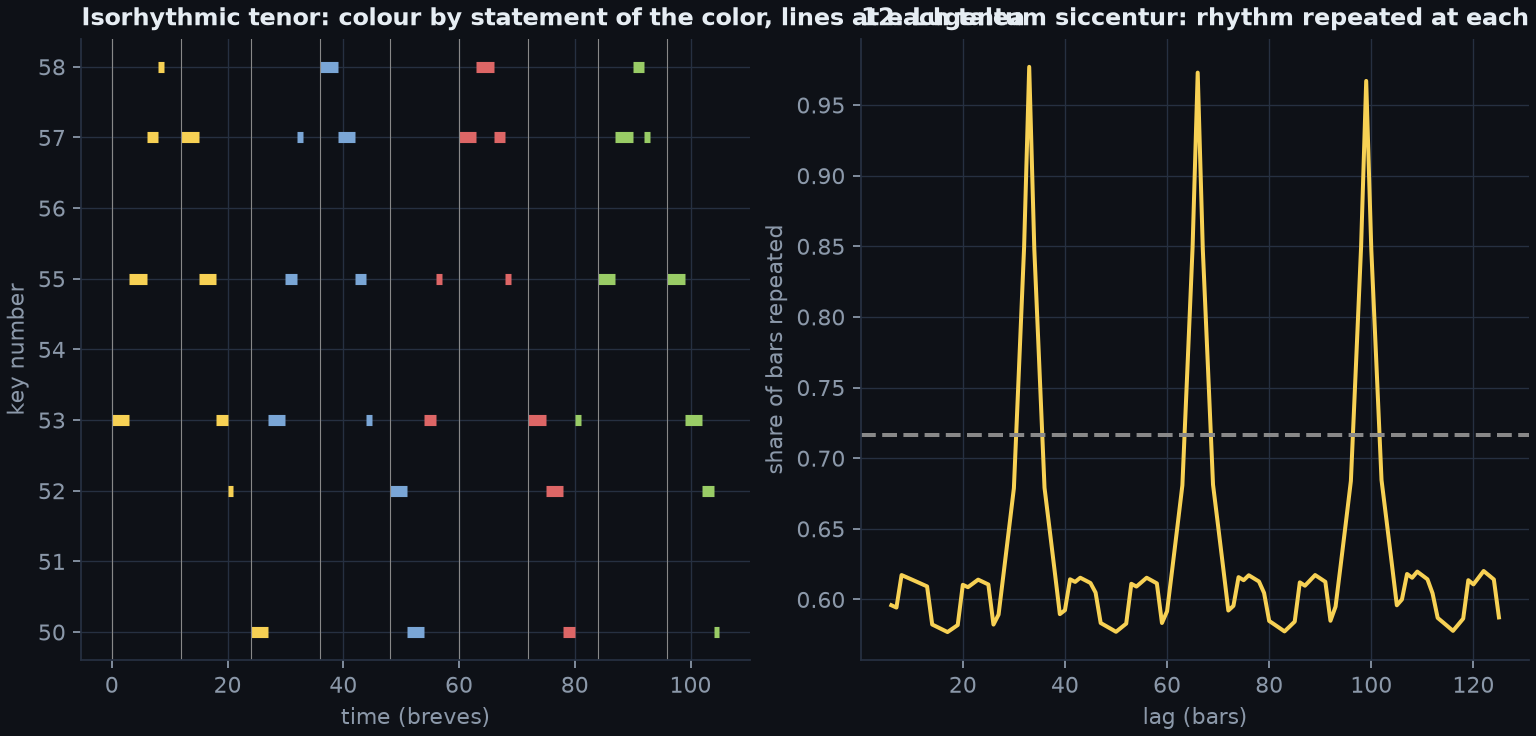
Paris, about 1200: under the half-built vault of Notre Dame, Pérotin stretches one syllable of chant under a minute of music in three dancing voices, and four singers need what no one has had, a way to write rhythm. The part goes back to the chant: eight modes fixed by a final, a range and a reciting tone, and the theorists' rule for finding a mode, which is already an algorithm. Guido's hexachords name the notes by ut re mi fa sol la, and choosing the syllables is a shortest path through the hexachords. Organum begins in parallel fifths and fourths, walks into tritones (9 in one psalm verse), and escapes by a boundary rule that makes the voices move differently for the first time; then it turns free and florid. Rhythm is first a menu of six patterns read from ligatures, then Franco's note shapes, then the Ars nova's two levels of measure, whose rules of imperfection and alteration need lookahead to read. Isorhythm lays a color of pitches through a talea of rhythm until they realign at their least common multiple; a scan of the rhythm alone finds the taleae of de Vitry's motets (33 bars in Lugentium siccentur, repeated 98 bars in 100 against 72 by chance). Eighty-nine fourteenth-century pieces, counted, keep perfect intervals on the beat (59 in 100, against 34 elsewhere), write parallel fifths and octaves about sixty times as often as Bach, end 88 times in 89 on a bare fifth and octave, and use the Landini cadence most in Landini's and Ciconia's generation. The Ars subtilior pushes written rhythm to proportions; and much of what we count, the sharps of musica ficta above all, was added by editors. The Tune is sung as chant, organum and an isorhythmic motet.
What you need. Part 10 for neumes, Guido's staff and Franco's shapes; Part 11 for metre and polyrhythm; Part 12 for modes; Part 16 for the rules of counterpoint; Part 17 for the chorales and the choir; Part 20 for the crab canon. Least common multiples, shortest paths, dynamic programming.
- Ideas, mathematics and history
- the modes, Guido's hexachord, organum at Notre Dame, the rhythmic modes, the Ars Nova, isorhythm, Machaut
- What we build, compute and hear
- an isorhythm engine; the Tune as chant, organum and motet
What you will be able to do
Foundations
- Name the eight modes by final and range, and hear the difference between an authentic and a plagal mode.
- Sing a line in hexachord syllables, and say where a mutation is needed.
- Recognize parallel, free and florid organum, a motet, and an isorhythmic tenor by ear and on the page.
Full course
- Implement the theorists' mode rule, solmization by fewest mutations, and Franco's imperfection and alteration.
- Build an isorhythmic tenor and compute when color and talea realign; find a talea in a real tenor by a scan against shuffled bars.
- Count intervals on and off the beat, parallels, cadences and final sonorities in a corpus, and compare them with Bach's.
Research
- Explain what an edition adds to a medieval source (musica ficta, rhythm, text underlay) and how that biases corpus counts.
- Design a model that learns the rules of musica ficta from editions and measures where editors disagree.
Practice
- Read a modern edition of medieval music knowing which accidentals are editorial.
- Use two cycles of different lengths, as color and talea, to make long music that never quite repeats.
Contents
Each chapter has a home level. Choose a track to see what to read and watch: Foundations 31 min · Full course 43 min · Research 46 min · Practice 34 min.
- 0Paris, about 1200Foundations3 min
- 1Chant and the eight modesFoundations5 min
- 2Guido's hexachordsFoundations4 min
- 3Parallel organumFoundations3 min
- 4Free and florid organumFoundations2 min
- 5The rhythmic modesFoundations2 min
- 6Notre DameFoundations3 min
- 7The motetFoundations3 min
- 8The Ars nova and mensurationFull course3 min
- 9IsorhythmPractice3 min
- 10Machaut and the cadenceFoundations3 min
- 11A century, countedFull course4 min
- 12The Ars subtiliorFull course2 min
- 13Frontier: what the notation does not settleResearch3 min
- Variation 23, recap and problemsAll tracks3 min
Also on this page: Lecture · Key results · Try it · Lab · Problems · Notes and sources · Build the film.
Lecture
The text of each chapter is the film's narration, as it is spoken, so you can read along or revise without the film. The pictures are in the film. A dashed box stands for a number the film computes when it is rendered (hover over it to see what is computed); the README's figures for each chapter, where it lists them, follow the chapter's text.
Paris, about 1200Foundations3 min
Paris, about the year twelve hundred. The new cathedral of Notre Dame is half built; its choir is roofed, its nave is not. In 1198 and again in 1199 the bishop of Paris, Odo of Sully, decrees how the feasts after Christmas are to be sung, and among the things he allows is organum in three or four voices. Organum of that kind takes a single syllable of the old chant and stretches it, one note held for a minute or more, while above it three voices dance in a pattern of long and short. Two such pieces survive under the name of a singer called Pérotin: Viderunt omnes and Sederunt principes, among the earliest substantial surviving four-voice works.
Here is what that sounds like, in a version computed for this film rather than Pérotin's own. The lowest voice holds one note of the chant, F. The three voices above it move in a fixed rhythm, long then short, and at the start of every long they meet the held note in a fifth or an octave. Listen to the held note under everything, and to the upper voices trading phrases.
There was a problem in this. The chant had never needed written rhythm: one singer, or a choir in unison, follows the words, and the notes last as long as the words want. Four singers on four different lines must agree, beat by beat, on where every note ends, or the fifths and octaves fall apart. So the singers of Notre Dame needed a developing system for coordinating polyphonic rhythm; earlier traditions already had ways of describing or notating duration. And once rhythm could be written, it could be designed. The two centuries after Pérotin did exactly that, until by the end of the fourteenth century the rhythms on the page were strikingly intricate by the standards of many later teaching repertoires.
This part follows Western music from one line to many, from the ninth century to about 1400. It starts with the chant itself and its eight modes, and Guido's system for learning it. Then the first harmony, organum, in three stages. Then rhythm written down: the rhythmic modes, Notre Dame, and the motet. Then the new art of the fourteenth century, mensuration and isorhythm, built as programs and then found, by a program, in real motets. Then Machaut, and a century of music counted from eighty-nine edited pieces. And last the subtlest art of all, and what the notation still does not tell us.
1Chant and the eight modesFoundations5 min
How was one line of melody organized?
Western polyphony grew out of a repertory of single-line song: the chant of the Latin church, called Gregorian after a pope, Gregory the Great, who almost certainly had nothing to do with it. It took its form in the Frankish kingdoms of the eighth and ninth centuries, and was first written down in neumes, signs that show the shape of a melody but not its exact pitches. One voice, or many in unison; no independently composed accompanying voices in this monophonic model; early notation leaves many rhythmic details open. Here is a hymn whose tune will matter in the next chapter, Ut queant laxis, sung by one synthetic voice.
By about 800, the singers had sorted their chants into eight modes, listed in books called tonaries. A mode is fixed by three things. Its final, the note the chant ends on: D, E, F or G, the four maneriae, protus, deuterus, tritus and tetrardus. Its range: an authentic mode runs from the final up an octave; its plagal partner, from a fourth below the final to a fifth or sixth above. So each final has two modes, odd and even. And its reciting tone, the note on which psalm verses are chanted: usually a fifth above the final in the authentic modes, with historical exceptions such as the Phrygian reciting tone, a third or fourth in the plagal ones, moved up to C wherever it would have fallen on the unstable B. The Greek names, Dorian, Phrygian and the rest, were borrowed in the Middle Ages and used differently from ancient Greek theory; the ancient Greeks meant something else by them.
Why did the singers need a system at all? Because a monastery sang all hundred and fifty psalms every week, each verse to a short melodic formula called a psalm tone. A tone rises from the intonation to the reciting tone, recites as many syllables as the verse has, dips at the half-verse in a mediant cadence, recites again, and falls in a termination. Each psalm was framed by an antiphon, a short chant sung before and after it, and the antiphon's mode decided which of the eight tones the psalm was sung to, and even which of several endings, the differentiae, so that the last verse led smoothly back into the antiphon. So the modes were not an abstraction: a singer had to know which formula to use, at every service, eight times a day.
A question for your ears. Two psalm verses, both ending on D. One is in the first mode, authentic, living above its final; the other in the second, plagal, living around it. Which is the first mode, A or B?
B is the first mode. It climbs a fifth from D and recites on A, high above its final; A recites on F, only a third up, and stays close to home. Same final, same scale, a different centre of gravity. That is most of what a mode is.
The medieval rule for finding a mode is already an algorithm. Read the last note: that is the final, and it fixes the pair. Read the range: if the chant goes well below its final it is plagal; if it climbs a sixth or more above it, authentic. Where the range does not decide, count which of the two reciting tones the chant leans on. Ut queant laxis ends on D and dips to the C below it: mode . The eight psalm tones of this film all come out right. But be careful what that proves. Many chants are older than the system, and singers sometimes bent them to fit their assigned mode. The modes were a theory laid over a repertory, which is why some chants sit awkwardly in any of them; chapter thirteen returns to classifiers trained on thousands of chants.
2Guido's hexachordsFoundations4 min
How do you learn a melody you have never heard?
In the 1030s a monk and teacher called Guido, working at Arezzo in Tuscany, wrote a letter to a fellow monk, Brother Michael, describing a way to teach boys to sing a chant they had never heard, in a matter of days instead of years. His tool was the hymn you just heard. Each of its first six lines begins one step higher than the last, C, D, E, F, G, A, and the syllables that begin them, ut, re, mi, fa, sol, la, became the names of the six notes. Learn how the hymn sounds at each line's start, and you know how each step of the scale sounds in its place. Six centuries later, ut became do.
The whole range of notes the singers used, the gamut, ran notes, from a low G called gamma-ut, the Greek letter gamma, which gave us the word gamut, up to a high E. Six syllables cannot name twenty-two notes, so later medieval hexachordal teaching laid the six-note pattern, tone, tone, semitone, tone, tone, over the gamut seven times: starting on G, the hard hexachord, with B natural; starting on C, the natural hexachord; and starting on F, the soft hexachord, which needs a B flat. In every one of them the semitone is mi to fa. Wherever you are, mi to fa is the half step, and a singer who knows which syllable a note is knows where the half steps lie.
A melody that wanders out of one hexachord must change to another, a mutation. This line starts on F and uses B flat, so it begins in the soft hexachord: ut, re, mi, fa. Later it climbs through B natural to C, which the soft hexachord cannot name, so the singer re-names a note on the way, G becomes ut of the hard hexachord, and carries on. Listen for the B flat early on and the B natural near the end.
The mutation falls at note , the G. Choosing the syllables is a small optimization problem: among all the ways to name the notes, pick the one with the fewest changes of hexachord. It is a shortest path through a graph of hexachords, solved here by dynamic programming and checked against brute force; medieval singers solved it in their heads, with rules of thumb for where to mutate.
Guido's other gift is in front of every musician today. Earlier neumes showed the shape of a melody but not its exact steps. Guido helped systematize and promote staff lines a third apart, building on earlier lined notation, so that every note sits on a line or in a space, and its pitch can be read without having heard it. He coloured the F line red and the C line yellow, and wrote the letters at the start; those letters, worn by centuries of copying, are our F and C clefs. Teachers later mapped the whole gamut onto the joints of the left hand, pointing at a joint to call for a note, and named it after Guido, though it appears nowhere in what he wrote.
3Parallel organumFoundations3 min
What was the first harmony?
The first written account of singing in harmony in the West comes from the late ninth century, in an anonymous handbook called Musica enchiriadis and a dialogue that goes with it. The chant, the principal voice, is sung as usual, and a second singer, the organal voice, sings the same melody a fifth or a fourth lower. Either line may be doubled at the octave, so that four singers sing one melody at four pitches. It is the first harmony we can describe exactly. Part 16 met it as the first stage of counterpoint. Here is the trouble it ran into at once.
Listen. Two organa at the fifth below the same psalm verse, which recites on F. In one, the lower voice sings B flat under every F, a true fifth. In the other it sings B natural, the note a strict parallel fifth gives in the white-note scale, and the interval is a tritone. Which one has the tritone, A or B?
B has the tritone, times, every time the chant sits on its reciting tone. The tritone, mi against fa in the singers' terms, was the interval later theorists nicknamed the devil in music, and strict parallel motion walks straight into it whenever the chant touches F with a fifth below or B with a fourth below. Singers either flattened the B, as in A, or changed the rule.
The handbook's answer was a boundary. At the fourth, the organal voice follows the chant down but may not go below a fixed note, here C. When the chant is too low for a fourth below to stay above the boundary, the organal voice simply holds the boundary note, and at the end of the phrase the two voices come together on one note, which the theorists called the occursus, the running together. Listen to the lower voice sitting still.
That sitting still is the important thing. While the chant moves and the organal voice holds, the two lines move differently, oblique motion, and they arrive together at the end, like a cadence. A rule invented to avoid one bad interval had, supports distinct voice motion in these early surviving theoretical examples; it does not establish the first historical independent polyphony.
4Free and florid organumFoundations2 min
How did the second voice break free?
Within a century the rules loosened. Around the year 1000 the cathedral at Winchester in England copied about a hundred and seventy organa for two voices into a book now called the Winchester Troper, the largest early collection. They are written in neumes without staff lines, so we know the shape of each line but not its exact notes, and every modern performance is a reconstruction. Guido, in his Micrologus of about 1026, lets the organal voice cross above the chant and approach the final from below. And a treatise of about 1100, Ad organum faciendum, prefers contrary motion and puts the added voice above the chant. Still one note against one note, but the two lines can now go in opposite directions, which parallel organum never allowed.
In the twelfth century, in the monasteries of Aquitaine in southern France and at the pilgrimage church of Santiago de Compostela, singers went further. The chant was slowed down to long held notes, and over each one the upper voice sang a whole flourish, a melisma of many notes, starting and ending on a perfect consonance. This is a short one, computed for the film: six chant notes, each under a flourish of four to eight notes.
So by about 1150 there were two ways to add a voice to chant. In discant, the voices move note against note, or a few notes against one, and since both move they must agree on a beat. In organum purum, pure organum, the chant holds and only the upper voice moves, allowing freer rhythm within stylistic and notational constraints. A book of music for the pilgrims at Santiago, the Codex Calixtinus, copied around 1160, contains a piece called Congaudeant catholici that is often discussed among the earliest three-voice examples, though how its voices were intended to combine is debated. Three voices moving at once is discant three times over, and it makes the question unavoidable: how do several moving voices keep together?
5The rhythmic modesFoundations2 min
How do you write down long and short?
The answer of the Notre Dame singers was not to write every length, but to choose from a menu. A piece, or a passage, moves in one fixed pattern of long and short notes, repeated, and everyone knows which. The short note is the breve; a long is worth two breves or three; and the unit of the pattern is a group of three breves, which they called a perfection. There were six patterns, and theorists named them after the feet of Latin poetry: trochee, iamb, dactyl, anapaest, spondee and tribrach. They are described by Johannes de Garlandia around 1250, decades after the music that used them. Rhythm, for these singers, was a choice from a short menu, not a string of independent lengths.
Here are the six, each applied to the same rising and falling line. The first mode is long, short; the second short, long; the third a perfect long and two breves, the second of them doubled; the fourth the third reversed; the fifth all perfect longs, the slow pattern the chant itself was given; and the sixth all breves. Listen to each one, and notice that the first mode is the one you hear most: it was by far the most common.
How did a singer know which mode to sing? Not from the shape of any one note. Notes were written bound together in groups called ligatures, and the pattern of group sizes signalled the mode: a group of three followed by twos meant the first mode; twos ending in a three, the second; a single note then threes, the third; threes throughout, the fifth; a four then threes, the sixth. So reading this music is parsing: the same sign means a long in one context and a short in another, and only the pattern decides. The film's program does exactly that, reading a row of ligature sizes and naming the mode, or refusing when no pattern fits. It is an important early system for notating coordinated rhythm in this polyphonic repertory, and it was written as a grammar.
6Notre DameFoundations3 min
What did Léonin and Pérotin build?
The names of the Notre Dame composers come to us almost by accident. Around 1280 an English student in Paris, whom scholars call Anonymous the Fourth because he was the fourth anonymous treatise in a nineteenth-century edition, looked back about a century and named two singers. Leoninus, he says, was the best maker of organum, and wrote a great book of organa for the whole church year, the Magnus liber organi. Perotinus, the best maker of discant, revised that book and wrote organa in three and four voices, Viderunt and Sederunt among them. The Magnus liber survives only in later copies, and almost everything we know about the two men is in a few sentences of that one student's notes.
A Notre Dame organum for two voices alternates the two styles. Where the chant has few notes to a syllable, the chant is held and the upper voice flourishes freely, organum purum. Where the chant has many notes to a syllable, both voices move in rhythmic modes, the chant in steady fifth-mode longs and the upper voice in the first mode, a passage called a clausula. This one is computed for the film. At the start of every perfection the voices meet on a fifth or an octave; in between, the short note goes where the line wants.
Back to the four-voice organum of the opening, to see how it holds together. At the start of every perfection, every upper voice is a unison, fifth or octave from the held note: times in a hundred, by construction in our simplified model, inspired by Notre Dame practice. The short notes in between are free, and in this version in a hundred are dissonant, without a matched Pérotin count here, since our short notes are always a step away. Consonance is a rule about where the beat falls, not about every note. And Pérotin's voices trade phrases, a device called voice exchange: one voice sings what another just sang, so the same sounds return, rearranged. It is how a long piece on one held note stays coherent. His quadrupla run ten minutes or more on a handful of chant notes, using these and other melodic, textual and formal resources: the menu of rhythms, consonance on the beat, and exchange.
7The motetFoundations3 min
What happens when a clausula is given words?
The clausulae of Notre Dame had a second life. The upper voice of a clausula is a long melisma, many notes on one syllable. Someone put a new poem under it, one syllable to each note, and the result was called a motet, probably from the French mot, a word. Then a third voice was added with a third poem, so that two different texts are sung at once, often in two different languages. Below, a fragment of Latin chant; above, French poems about love, or politics, or the street cries of Paris. Sacred and secular in one piece, and nobody could follow all the words. The Montpellier Codex, copied around 1300, holds more than three hundred of them.
Here is the texture, computed for the film and sung on vowels instead of poems. Three layers at three speeds: the chant at the bottom in slow longs, grouped three at a time with a rest, a pattern called an ordo; the motetus in the first mode; and the triplum on top, quicker still. Each voice keeps its own rhythm, and they coincide on perfect consonances at the start of each perfection.
Motets needed a new notation, because a poem with one syllable per note cannot be written in ligatures. Around 1280 a theorist called Franco of Cologne set out the answer in his Art of Measurable Song: the shape of each single note gives its length. A long, a breve and a semibreve, with context-sensitive long and breve relationships; Franco’s semibreve subdivision should not simply be equated with later minim-based prolation. Which of the two depends on the neighbouring notes, by rules that the next chapter turns into a program. With Franco, rhythm is no longer a choice among six patterns. A much wider range of durations can be represented within the system’s rules, note by note, which is the principle of every Western notation since.
Freed from the patterns, the top voice began to speed up. In the motets of Petrus de Cruce, around 1290, a single breve of the slow voices can hold four, five or even seven semibreves in the triplum, which turns into rapid declamation of its poem above a slow motetus and tenor. Another device of the time is the hocket, from a word for a hiccup: two voices share one line, one singing while the other rests, note by note. The shortest written note kept getting shorter, and the next generation would have to give the smaller values names of their own.
8The Ars nova and mensurationFull course3 min
Why was duple time new?
Around 1320 a group of Paris musicians described what they called a new art, the Ars nova. The treatises, one based on the teaching of the poet, composer and later bishop Philippe de Vitry, another by the astronomer Johannes de Muris, added a smaller note, the minim, and said that dividing a note into two was as proper as dividing it into three. Not everyone approved. In 1324 or 1325 Pope John the Twenty-second issued a decree complaining that the new singers chopped melodies into hockets, ran in quick notes, and drowned the chant. An old theorist, Jacques de Liège, wrote a vast encyclopedia whose last book defends the old art against the new. It was the first quarrel of ancients and moderns in music, and its names stuck: historians still say ars antiqua and ars nova.
The new art measured time on two levels. Tempus says how many semibreves make a breve: three, perfect, or two, imperfect. Prolation says how many minims make a semibreve: three, major, or two, minor. That gives four mensurations, written with signs at the start of the music: a circle for perfect time, a broken circle for imperfect, and a dot inside for major prolation. They correspond, roughly, to our nine-eight, three-four, six-eight and two-four. Here is one row of note shapes read in all four. The notes on the page do not change; their lengths do.
In perfect time, reading even the simplest rhythm takes rules, Franco's rules, which the new art kept. A breve is worth three semibreves, unless a single semibreve stands next to it, which takes a third of its value: imperfection. So breve, semibreve, breve reads two, one, three. Two semibreves between breves would leave a perfection one short, so the second is doubled: alteration. Breve, two semibreves, breve reads three, one, two, three. Three semibreves fill a perfection by themselves; with four, the first imperfects the breve before it. The program that reads these rows needs to look ahead: the length of a note depends on the notes after it. Our selected examples and simplified parser produce whole perfections; that is not a complete test of historical notation, and how the tests check them.
9IsorhythmPractice3 min
What happens when a rhythm and a melody have different lengths?
Many fourteenth-century motet tenors use this cyclic procedure. Take a fragment of chant, its pitches only: the color. Take a rhythm, a sequence of lengths and rests: the talea. Lay the pitches through the rhythm, one pitch to each note, repeating each as often as needed. Here the color has pitches and the talea notes, so they drift against each other and only start together again after notes, which is statements of the color and of the talea: the least common multiple, the same arithmetic as Part 11's polyrhythms. The composers had no name for the whole procedure; the musicologist Friedrich Ludwig coined the word isorhythm, equal rhythm, in 1904.
Here is that tenor, sung, with a free voice above it. The tenor's notes are coloured by which statement of the color they belong to, and the ticks below mark where each talea begins. Listen for the rhythm repeating while the melody slides across it.
If a tenor was built this way, a program should be able to find the talea without being told. Cut the voice into bars, describe each bar by its rhythm alone, and for every lag ask what share of bars is repeated exactly that many bars later. In the tenor of Philippe de Vitry's motet Lugentium siccentur, the share jumps to at a lag of bars, and again at sixty-six and ninety-nine: the talea and its multiples. The dashed line is chance, the best the same bars reach when their order is shuffled. The scan finds a talea in all four of de Vitry's motets in the corpus: twelve bars, eighteen and thirty-three, and in Vos qui admiramini lags of fifteen, thirty and forty-five bars all score almost the same. The upper voices repeat too, less strictly, a step towards the later practice of making every voice isorhythmic. But look at the chance column. A tenor of plain long notes repeats its rhythm by accident, so in two of the four the margin over chance is small. A better detector would also check that the pitches change while the rhythm repeats, which would help distinguish independent pitch and rhythm cycles from trivial sustained-note repetition.
And here is the real thing: the opening of de Vitry's Vos qui admiramini, sung by the film's synthetic voices from the pitches and lengths of a modern edition. Two quick upper voices, each with its own Latin poem; below them the slow isorhythmic tenor and a contratenor. Listen to how the upper voices chatter in short notes over the long, regular steps beneath.
10Machaut and the cadenceFoundations3 min
How did a phrase end, before tonality?
The greatest figure of the new art was a poet. Guillaume de Machaut, born around 1300, served the King of Bohemia as a secretary and spent his last decades as a canon of Reims cathedral, and he did something no composer had done before: he had his complete works, poems and music, copied in order into large, beautiful books, as an author's collected works. Among them is the Messe de Nostre Dame, from the 1360s, the oldest complete polyphonic setting of the Mass by a single known composer. Another is a rondeau whose text says my end is my beginning, and means it: one voice is another sung backwards, Part 20's crab, and a third turns round on itself halfway. Most of his music is songs in fixed poetic forms, the ballade, the rondeau and the virelai, in which the form of the poem is the form of the music.
How did a phrase end, before there were major and minor keys? Listen to two cadences to D in three voices. In one, the upper voices rise a whole tone into the final chord; in the other, both have been raised so that they rise only a semitone. Which pulls harder into D, A or B?
B illustrates the chromatic approach; preferences are not measured here: two voices each a semitone from their goal. The outer voices move from a major sixth, E and C sharp, out to an octave on D, while the middle voice rises a semitone to the fifth. This is the double leading-tone cadence, a characteristic cadential pattern in parts of fourteenth-century polyphony. Its goal is not a chord with a third but a bare fifth and octave, and its articulation combines directed voice leading, register, rhythm and context.
How common was it? The film's corpus holds pieces of fourteenth-century polyphony, transcribed in the modern edition Polyphonic Music of the Fourteenth Century: Mass movements, motets and Italian songs. A program finds every place where two voices move from a major sixth to an octave by contrary steps. There are . In in a hundred the upper voice rises by a semitone, and add a second voice rising a semitone to the fifth, the full double leading tone. But hold on to one fact for later: many of those semitones are sharps that the manuscripts do not write. The editors put them in, following rules the singers knew, and chapter thirteen asks how far we can trust that.
11A century, countedFull course4 min
What do eighty-nine pieces say about the style?
Part 17 counted Bach's chorales. This chapter counts the fourteenth century: pieces encoded by students of the musicologist Michael Scott Cuthbert from the edition Polyphonic Music of the Fourteenth Century, and kept in the music21 library's corpus. The named composers are mostly Italian: Johannes Ciconia, a singer from Liège who worked in Padua around 1400; Giovanni da Cascia and Jacopo da Bologna from the middle of the century; Francesco Landini, the blind organist of Florence; and four motets by de Vitry. Most of the pieces are Mass movements, and most are for three voices. It is not a random sample of the century, and nothing in it is by Machaut, but it is large enough to count.
First, the rule of Notre Dame: perfect consonances on the strong beats. Measure every interval above the lowest sounding voice, separately at the start of each bar of the edition and everywhere else. At the start of a bar, in a hundred are unisons, fifths or octaves, are thirds or sixths, and only are dissonant. Between, the perfect intervals fall to , thirds and sixths become the majority, and dissonance rises to . A century after Pérotin, the beat still belongs to the perfect intervals, while thirds and sixths, officially imperfect, do most of the work in between.
Two more counts, against Part 17's chorales. Parallel fifths and octaves: in this corpus, among moves of pairs of voices, about in a hundred. Counted the same way, Bach's chorales have . The fourteenth century writes them about times as often. Theorists already discouraged them; these counts also depend on editorial encoding, sampling and the simplified detector; no historical rule was literally exceptionless. And the last chord: of the pieces end on bare fifths and octaves, while every one of Bach's chorales ends with a third. In the fourteenth century the third was an imperfect consonance, fine in passing and often avoided in final sonorities of this selected repertory. Part 16's rules are not timeless laws of hearing; they changed, and here is the century they were changing in.
One cadence carries a composer's name. In the so-called Landini cadence, the top voice reaches the leading tone, drops a step, and then leaps up a third to the final, decorating the double leading tone. Here is one in a ballata by Landini himself, sung from the edition.
A program counts the figure: times in the corpus. Landini's four pieces have , about a piece; but Ciconia's eighteen have , about a piece, just as many; and the earlier Italians, Jacopo and Giovanni, hardly use it. The name was given by later historians. The figure belongs not to one composer but to the later decades of the century, and this small, uneven sample supports that association but cannot establish a universal chronology.
12The Ars subtiliorFull course2 min
How complicated can written rhythm get?
At the end of the century the new art went further than anyone has since, for a while. From 1378 there were two popes, one in Rome and one in Avignon, and the court at Avignon, with the courts of Foix and Aragon in the south, cultivated songs for connoisseurs. Their rhythms are proportions: one voice moves three notes against another's two, or four against three, and syncopations run across whole bars. To write them, scribes invented new shapes: red notes, hollow notes, notes with extra flags. The style's name is modern too: the subtler art, proposed by the musicologist Ursula Günther in 1963.
Here is the idea in its simplest form, computed for the film: three voices dividing the same span of time into three, four and two. They agree only at the dashed lines. To place every note on one grid you need twelve divisions of the span, the least common multiple again; the real pieces use proportions like these inside a single song, and change them from bar to bar. Listen for the three speeds.
The most famous pages of the style are by Baude Cordier, copied into the Chantilly Codex around 1400. A love song, Belle, bonne, sage, is written on a page shaped like a heart, with red notes for the changes of proportion; a canon, Tout par compas, is written in a circle, to be sung round and round. The notation is part of the work: a puzzle for the singer and a picture for the owner. A caution: the film's corpus contains none of these songs, so the counts of the last chapter say nothing about them. And the style did not last. After about 1420 the next generation, Dufay among them, turned to smooth lines and full triads, while later scholarship renewed interest in a repertory with a complicated history of transmission and reception.
13Frontier: what the notation does not settleResearch3 min
How much of this music do we actually know?
Everything counted in this part was counted in a modern edition, and an edition is an interpretation. Take the sharps. In the corpus, of notes, about in a hundred, are notes outside Guido's gamut: F sharp, C sharp, G sharp, E flat. Singers called them musica ficta, feigned music, because the system had no place for them. And in a hundred of them rise a semitone to the very next note: they are leading tones. Many can reflect editorial additions, but this encoding does not by itself identify each accidental’s manuscript status. Singers added them by rule, for necessity, to avoid a tritone, and for beauty, to sharpen a cadence, and modern editors add them on the singers' behalf. Two editors can differ; the double leading-tone cadences counted in chapter ten are partly a count of editorial decisions.
The chant itself has the same problem. Neumes show how notes group and where a singer should lean, not how long each note lasts. The monks of Solesmes in France, who restored the chant around 1900, sang equal notes in groups of two and three, and that is how most people have heard chant since. In 1970 Eugène Cardine, also of Solesmes, argued from the oldest neumes that singers lengthened and lightened notes in ways the equal-note method erased. Others read chant in measured rhythm. The sources allow all three. And the Winchester organa of chapter four can only be reconstructed, never simply read. This part's chant, in plain equal notes, is one choice among several.
Computation is changing this field. The Cantus database, begun in the 1980s, indexes the chants in hundreds of medieval manuscripts, so that a melody can be traced across Europe. Classifiers trained on thousands of chants, like the medieval rule of chapter one but learnt from the data, have reported mode-classification results that depend on corpus, labels and evaluation split; this film does not establish a general ninety-percent benchmark, and a wrong answer is a question worth asking, since some chants sit in different modes in different medieval sources. The bigger shift is to treat an edition as data with uncertain parts: the accidentals, the placing of the words, the rhythm. Here is a research problem: learn the rules of musica ficta from many editions, apply them to music no one has edited, and measure exactly where editors disagree.
Variation 23, recap and problemsAll tracks3 min
Every part ends by doing something to the Tune with what it has built. This part built a thousand years of machinery, so the Tune goes back in time. First as chant, one voice in free rhythm, in F with a B flat, as singers of the tritus modes often sang. Then as organum at the fifth below, by the Enchiriadis rule. And last as an isorhythmic motet: its first seven notes as the color of a tenor, laid through a talea of four notes and a rest, with a free voice above.
Row twenty-three of the ledger. seconds. The measurement: a color of pitches through a talea of notes, which meet again after notes. The Tune, which has always been a melody over chords, sounds here like music written before modern root-based chord theory.
What did we find? Chant was organized by mode, and the medieval rule for finding a mode is already an algorithm. Guido promoted solmization and staff teaching; later traditions developed the full hexachord system, and choosing syllables is a shortest-path problem. Organum went from parallel to free to florid, and the tritone forced the voices apart. Rhythm was written first as a grammar of patterns, then note by note, then on two levels of measure. Isorhythm builds a tenor from two cycles, and a scan finds them in de Vitry's motets. And a century of music, counted, keeps perfect intervals on the beat, tolerates parallels, and ends without a third.
Five problems. One to compute, one to prove, one for your ears, one to build, and a research problem, marked with a star. Solutions are in this part's notes. Pause here.
Where does this come back? In the Renaissance, which smoothed the lines, filled in the triads and let isorhythm go. In the Baroque, where the modes turn into keys. In modal jazz and rock, where the old modes return. In minimalism, where cycles of different lengths drift against each other as color and talea did. In other traditions with modes of their own. And in machines that search the archives.
And in practice. Choirs singing this music can tell the editor's accidentals from the scribe's. Composers still use two cycles of different lengths to make long music that never quite repeats. Teachers of movable do are teaching Guido's hexachord, widened to seven notes. And scholars can treat editions as data, with the uncertain parts marked as uncertain.
The books and papers this part follows. The full list, with notes, is in the README.
Where it goes next. The Renaissance in Part 24; modes becoming keys in Part 25; cycles of different lengths again in minimalism (Part 30); modes in other traditions in Parts 34 and 35; modal jazz in Part 39; finding music in archives by machine in Part 63.
Key results
The part's results in one place, for revision.
Try it
Lab 23 · Chant to polyphony, computed
Classify a chant by its final and range, solmize it with the fewest mutations, count the tritones that strict parallel organum makes, build an isorhythmic tenor and find its talea again, read note shapes by Franco's rules, count a fourteenth-century piece, and name the modes of psalm verses by ear.
python -m videos.music.labs 23
needs numpy, scipy, matplotlib · download lab23.py ·
source on GitHubyour chant's mode (final and range) 2, Hypodorian: final D, reciting tone F
solmized with the fewest mutations re fa sol la sol fa mi re ut re mi fa mi re (0 mutations)
strict parallel organum a fifth below: tritones 3
strict parallel organum a fourth below: tritones 0
by the Enchiriadis rule (never below A): tritones, and the last interval 0, unison
color and talea line up again after 36 notes: 4 colors, 9 taleae
the scan's best lag (bars) and share; the talea's length in bars 4, 1.00; 4
BSSBSBSSSSB in perfect time (semibreves) 3 1 2 2 1 2 1 1 1 1 3 = 18 = 6 perfections
12. Lugentum siccentur (Philippe de Vitry): best talea lag (voice 3) 33 bars, share 0.98 (shuffled 0.72)
intervals on the beat: perfect, imperfect, dissonant 0.63, 0.28, 0.09
sixth-to-octave cadences, with a leading tone, with two 13, 10, 5
ear problem, the modes in the order sung (listen first) 2, 3, 6, 5, 4, 7, 8, 1
The mode follows from a chant's last note and range; solmization is a shortest path; strict parallel organum walks into tritones that a boundary rule avoids; an isorhythmic tenor's talea can be found from its rhythm alone, far above the shuffled chance level; Franco's rules always fill whole perfections; and a century's style can be counted, with the editors' accidentals counted with it.The code (104 lines; it asserts its own result)
"""Lab 23: chant to polyphony, computed: a chant classified into its mode and solmized, organum and its tritones,
an isorhythmic tenor built from a color and a talea and found again by a scan, a row of note shapes read in perfect
time, a fourteenth-century piece counted, and psalm verses in the eight modes named by ear."""

import numpy as np

from videos.coursekit import labs
from explainer.music.monochord import SR, Clip, concat
from explainer.music.monochord import medieval as MD
from explainer.music.monochord import trecento as T
from explainer.music.monochord.instruments import choir as CH

TITLE = "Chant to polyphony, computed"
GOAL = ("Classify a chant by its final and range, solmize it with the fewest mutations, count the tritones that strict "
        "parallel organum makes, build an isorhythmic tenor and find its talea again, read note shapes by Franco's "
        "rules, count a fourteenth-century piece, and name the modes of psalm verses by ear.")
TASKS = [
    "Write a CHANT of your own (key numbers, white notes and B-flat, ending on D, E, F or G). Which mode does the rule give, and how many mutations does it need?",
    "Change COLOR and TALEA. When do they line up again? Does the scan find the talea in the tenor you built, and at which other lags?",
    "Choose a PIECE from the corpus (part of its title). Is its rhythm repeated at some lag far above chance? How many of its intervals on the beat are perfect?",
]
CHANT = [62, 65, 67, 69, 67, 65, 64, 62, 60, 62, 64, 65, 64, 62]
COLOR = [53, 55, 57, 58, 57, 55, 53, 52, 50]
TALEA = [3, 3, 2, 1, -3]
SHAPES = "BSSBSBSSSSB"
PIECE = "Lugent"


def sing(notes, unit=0.36):
    y = CH.sing([(p, a * unit, d * unit) for p, a, d in notes], "tenor", "a")
    return Clip(y / max(np.abs(y).max(), 1e-9) * 0.4, SR).fade(0.02, 0.2).at_level(-20.0)


def run(seed=0):
    rng = np.random.default_rng(seed)
    lab = labs.Lab()

    # 1. a chant: its mode and its syllables
    m = MD.classify(CHANT)
    syl, mut = MD.solmize(CHANT)
    lab.row("your chant's mode (final and range)", f"{m}, {MD.MODES[m][0]}: final {MD.LETTERS[MD.MODES[m][1] % 12]}, reciting tone {MD.LETTERS[MD.MODES[m][2] % 12]}")
    lab.row("solmized with the fewest mutations", f"{' '.join(syl)}  ({len(mut)} mutation{'s' if len(mut) != 1 else ''})")
    for k in range(1, 9):
        assert MD.classify(MD.psalm_tone(k)) == k

    # 2. organum: strict parallel fifths and fourths below, and their tritones
    for steps, name in ((-4, "fifth"), (-3, "fourth")):
        lo = MD.parallel(CHANT, steps)
        lab.row(f"strict parallel organum a {name} below: tritones", str(MD.tritones(CHANT, lo)))
    ench = MD.enchiriadis(CHANT, floor=57)
    lab.row("by the Enchiriadis rule (never below A): tritones, and the last interval", f"{MD.tritones(CHANT, ench)}, {'unison' if ench[-1] == CHANT[-1] else 'not a unison'}")

    # 3. isorhythm: build a tenor, then find its talea from the rhythm alone
    per = MD.periods(len(COLOR), sum(1 for d in TALEA if d > 0))
    tenor = MD.isorhythm(COLOR, TALEA)
    lab.row("color and talea line up again after", f"{per['lcm']} notes: {per['colors']} colors, {per['taleae']} taleae")
    voice = [(p, int(a * 24), int(d * 24)) for p, a, d in tenor]
    span = sum(abs(d) for d in TALEA)
    bar = 3 * 24 if span % 3 == 0 else 24
    sc = MD.talea_scan(voice, bar, lo=1)
    lab.row("the scan's best lag (bars) and share; the talea's length in bars", f"{sc['lag']}, {sc['share']:.2f}; {span * 24 / bar:g}")
    assert sc["share"] > 0.9

    # 4. Franco's rules
    vals = MD.read_perfect(SHAPES)
    lab.row(f"{SHAPES} in perfect time (semibreves)", f"{' '.join(map(str, vals))} = {sum(vals)} = {sum(vals) / 3:g} perfections")

    # 5. a piece from the corpus
    book = T.load()
    pc = [p for p in book if PIECE.lower() in (p.title + p.name).lower()][0]
    best = max((MD.talea_scan(v, pc.bar) | {"voice": j} for j, v in enumerate(pc.voices)), key=lambda s: s["share"])
    chance = MD.shuffled_share(pc.voices[best["voice"]], pc.bar, rng, trials=5)
    ob = MD.on_off_beat(pc)
    cad = MD.cadences(pc)
    lab.row(f"{pc.title} ({pc.composer}): best talea lag (voice {best['voice'] + 1})", f"{best['lag']} bars, share {best['share']:.2f} (shuffled {chance:.2f})")
    lab.row("intervals on the beat: perfect, imperfect, dissonant", ", ".join(f"{ob['on'][k]:.2f}" for k in ("perfect", "imperfect", "dissonant")))
    lab.row("sixth-to-octave cadences, with a leading tone, with two", f"{cad['sixth_octave']}, {cad['leading_tone']}, {cad['double']}")

    # 6. Problem 3, for the ear: psalm verses in the eight modes, shuffled
    order = rng.permutation(8) + 1
    lab.audio = concat([sing([(p, k, 1.0) for k, p in enumerate(MD.psalm_tone(int(k)))]) for k in order], gap=1.0)
    lab.row("ear problem, the modes in the order sung (listen first)", ", ".join(str(int(k)) for k in order))

    fig, (a, b) = labs.figure(2)
    n_col = len(COLOR)
    for k, (p, on, d) in enumerate(tenor):
        a.plot([on, on + d], [p, p], color=[labs.GOLD, "#7aa6d6", "#d66", "#9c6", "#c9c"][(k // n_col) % 5], lw=5, solid_capstyle="butt")
    for t in range(0, int(max(on + d for _, on, d in tenor)) + 1, span):
        a.axvline(t, color="#888", lw=0.5)
    a.set_title("Isorhythmic tenor: colour by statement of the color, lines at each talea")
    a.set_xlabel("time (breves)")
    a.set_ylabel("key number")
    lags = sorted(best["scan"])
    b.plot(lags, [best["scan"][k] for k in lags], color=labs.GOLD)
    b.axhline(chance, color="#888", ls="--")
    b.set_title(f"{pc.title[:40]}: rhythm repeated at each lag")
    b.set_xlabel("lag (bars)")
    b.set_ylabel("share of bars repeated")
    lab.fig = fig
    lab.note = ("The mode follows from a chant's last note and range; solmization is a shortest path; strict parallel "
                "organum walks into tritones that a boundary rule avoids; an isorhythmic tenor's talea can be found "
                "from its rhythm alone, far above the shuffled chance level; Franco's rules always fill whole "
                "perfections; and a century's style can be counted, with the editors' accidentals counted with it.")
    return lab
Now change it
- Write a CHANT of your own (key numbers, white notes and B-flat, ending on D, E, F or G). Which mode does the rule give, and how many mutations does it need?
- Change COLOR and TALEA. When do they line up again? Does the scan find the talea in the tenor you built, and at which other lags?
- Choose a PIECE from the corpus (part of its title). Is its rhythm repeated at some lag far above chance? How many of its intervals on the beat are perfect?
Problems, with solutions
Try each problem before opening its solution.
-
Compute. A tenor's color has 28 pitches and its talea 8 notes. After how many notes do they begin together again, and how many statements of each is that?
Solution
lcm(28, 8) = 56 notes: 2 statements of the color and 7 of the talea (
medieval.periods(28, 8)). Machaut's motets often divide a color into whole taleae instead, so that the two align at every color. -
Prove. Prove that Franco's rules (imperfection and alteration) read any row of breves and semibreves between breves in perfect time as whole perfections.
Solution
A breve alone is a perfection (3). A run of n semibreves between breves has n = 3q + r. The 3q fill q perfections. If r = 1, the single semibreve imperfects the breve before it: 2 + 1 = 3. If r = 2, the second is altered: 1 + 2 = 3. So every run, with its neighbouring breve where needed, fills whole perfections, and so does the row (
medieval.read_perfect; the tests check it). -
Ear. The lab sings psalm verses in the eight modes in random order. Name each one's mode.
Solution
The lab prints the answers. Listen for the final (where the verse ends) and the reciting tone (the note repeated most); a reciting tone a fifth above the final, or C above E or F, is authentic; a third or fourth above it, plagal.
-
Build. Improve the talea scan so that it also requires the pitches to change while the rhythm repeats, and run it on the corpus.
Where to look.
medieval.talea_scancompares bars by rhythm; add the pitch sequence of each bar and count a lag only where the rhythm matches and the pitches do not (or match the color's own period,color_scan). The chance level for tenors of plain long notes should fall, and Vos qui admiramini and Rex quem metrorum should separate from chance more clearly. -
★ Musica ficta. Learn the rules of musica ficta from edited pieces, and measure where two editions of the same piece disagree.
Where the frontier is. Treat each note as a choice (written, raised or lowered), with features from its voice (the next note, whether a cadence follows) and from the other voices (the interval it makes, the tritones it would cause); train on edited pieces and test on held-out ones. Different editions of the same works exist for parts of this repertory; the disagreements between editors are the ground truth for how uncertain the answer is. Bent's Counterpoint, Composition, and Musica Ficta (2002) sets out what the theorists required.
Notes and sources
Sources
- R. H. Hoppin, Medieval Music (1978); R. Taruskin, The Oxford History of Western Music, vol. 1 (2005); T. F. Kelly, Capturing Music: The Story of Notation (2014); D. Hiley, Western Plainchant: A Handbook (1993).
- Musica enchiriadis and Scolica enchiriadis (late ninth century); Guido of Arezzo, Micrologus (about 1026) and the letter to Michael (about 1032); Johannes de Garlandia, De mensurabili musica (about 1250); Franco of Cologne, Ars cantus mensurabilis (about 1280); Anonymous IV (about 1280); the Ars nova treatises (about 1320).
- Polyphonic Music of the Fourteenth Century, ed. L. Schrade and others (Monaco: Éditions de l'Oiseau-Lyre, 1956–1991); M. S. Cuthbert and C. Ariza, "music21: a toolkit for computer-aided musicology and symbolic music data", ISMIR (2010), whose corpus holds the encodings.
- U. Günther, "Das Ende der ars nova", Die Musikforschung 16 (1963); F. Ludwig on isorhythm (1904).
- M. Bent, Counterpoint, Composition, and Musica Ficta (2002); E. Cardine, Sémiologie grégorienne (1970).
- The Cantus database (cantus.uwaterloo.ca and Cantus Index); P. Cornelissen, W. Zuidema and J. A. Burgoyne, "Mode classification and natural units in plainchant", ISMIR (2020).
- Part 11 for polyrhythms and least common multiples; Part 16 for organum and the rules of counterpoint; Part 17 for the chorales and the choir; Part 20 for the crab canon.
- J. P. Burkholder, D. J. Grout and C. V. Palisca, A History of Western Music (10th ed., 2019), with the Norton Anthology of Western Music: the survey textbook for all of Act IV.
About this partfrom its README
Part 23 of a sixty-eight-part course in music (see the series plan and
the syllabus), the first part of Act IV. Act III built and tested the grammar of one tradition; this
part goes back to ask how that tradition came to have more than one voice at all. It follows Western music from chant
to about 1400: the eight modes, Guido's hexachords and staff, organum in three stages, rhythm written first as six
patterns and then note by note, the motet, the Ars nova's mensuration and isorhythm, Machaut, a century of polyphony
counted, and the Ars subtilior. The theory is Monochord's (explainer/music/monochord/medieval.py); the
fourteenth-century pieces are 89 transcriptions from Polyphonic Music of the Fourteenth Century, as encoded in the
music21 corpus (explainer/music/monochord/trecento.py); everything heard is sung by Part 17's synthetic choir.
Published findings are the ones listed under Sources.
- Paris, about 1200. Odo of Sully's decrees of 1198 and 1199; an organum on one held F in the manner of the Notre Dame quadrupla, ours, heard; the problem of keeping four moving voices together; the plan.
- 1. Chant and the eight modes. Ut queant laxis sung; finals, ranges and reciting tones; psalmody, psalm tones and differentiae; an ear question (two psalm verses ending on D: which is the first mode?); the theorists' rule as a classifier (Ut queant laxis: mode 2; all eight psalm tones right).
- 2. Guido's hexachords. The letter to Brother Michael (about 1030); ut re mi fa sol la; the gamut of 22 notes and its seven hexachords; mutation heard (a line through B♭ and then B♮, one mutation at the G), solmization as a shortest path; the staff and the clefs; the Guidonian hand.
- 3. Parallel organum. Musica enchiriadis (late ninth century); an ear question (organa at the fifth below a psalm verse reciting on F: with B♭, or with B♮ and 9 tritones?); the boundary rule, oblique motion and the occursus, heard.
- 4. Free and florid organum. The Winchester Troper; Guido's Micrologus; Ad organum faciendum; florid organum over six chant notes, ours, heard; discant and organum purum; Congaudeant catholici.
- 5. The rhythmic modes. Six patterns of long and short, heard on one line; perfections; reading the mode from ligature patterns (a small parser).
- 6. Notre Dame. Anonymous IV, Léonin and Pérotin, the Magnus liber; a discant clausula, ours, heard; consonance on the beat and voice exchange in the opening's organum.
- 7. The motet. Words under a clausula; polytextual motets; a three-voice motet, ours, heard; Franco of Cologne's note shapes; Petrus de Cruce and the hocket.
- 8. The Ars nova and mensuration. De Vitry, de Muris, John XXII and Jacques de Liège; tempus and prolation, one row of shapes heard in the four mensurations; imperfection and alteration as a program.
- 9. Isorhythm. Color against talea (7 pitches and 5 notes meet after 35), heard; a talea scan of de Vitry's four motets in the corpus (12, 18 and 33 bars; Lugentium siccentur's tenor repeats 98 bars in 100 at 33, against 72 by chance); the opening of Vos qui admiramini, sung from the edition.
- 10. Machaut and the cadence. Machaut's life and books, the Messe de Nostre Dame, Ma fin est mon commencement; an ear question (a cadence to D with and without two leading tones); 1,410 sixth-to-octave cadences in the corpus, 71 in 100 with a rising semitone, 459 with two.
- 11. A century, counted. The corpus; on the beat 59 in 100 intervals perfect and 8 dissonant, elsewhere 34 and 23; parallel fifths and octaves 2.9 in 100 moves against Bach's 0.05; 88 of 89 pieces end on bare fifths and octaves, all 364 of Bach's chorales with a third; the Landini cadence, heard, counted 173 times (Landini 14 in 4 pieces, Ciconia 69 in 18, the earlier Italians hardly at all).
- 12. The Ars subtilior. The Schism, Avignon, Foix and Aragon; three voices in proportion, ours, heard; Cordier's heart and circle; what the corpus cannot say.
- 13. Frontier: what the notation does not settle. Musica ficta: 2,149 of 65,681 notes outside Guido's gamut, 64 in 100 of them rising a semitone, mostly editorial; chant rhythm (Solesmes, Cardine); the Cantus database and mode classifiers. ★ research problem: learning the rules of ficta from editions.
- Variation 23, recap and problems. The Tune as chant, as organum and as an isorhythmic motet (a color of 7 pitches through a talea of 4 notes, meeting after 28); the ledger; what we found; five problems; where it comes back; in practice; references; Part 24.
What is computed and built
python -m videos.music.music23.compute (under a minute) fills .cache/music23/.
| Item | What it computes | Checked against |
|---|---|---|
hook |
an organum on a held F, upper voices in the first mode, consonant on every perfection, with voice exchange | its own rules (tests) |
chant |
Ut queant laxis; the eight modes; psalm tones; the mode classifier | the eight psalm tones |
guido |
the gamut, the hexachords, solmization by fewest mutations | brute force (tests) |
organum |
parallel organum at the fifth with B♭ and with B♮; the Enchiriadis rule; florid organum | tritone counts |
rhythm |
the six rhythmic modes on one line; ligature patterns | the parser (tests) |
notre, motet |
a discant clausula; a three-voice motet with a tenor ordo | — |
mensuration |
one row of shapes in the four mensurations; Franco's imperfection and alteration | whole perfections (tests) |
isorhythm |
the engine; talea scans of every piece, de Vitry's motets in detail | shuffled bars |
vitry, landini |
excerpts sung from the edition's pitches; Landini cadences by composer | — |
census |
intervals on and off the beat, parallels, cadences, final sonorities, notes outside the gamut | Part 17's chorales |
cadence, subtilior |
the double leading-tone cadence; three voices in proportion | — |
tune |
Variation 23 | — |
Monochord's tools are held in tests/music/test_medieval.py; this part's claims and clips in
tests/music/test_music23.py.
Sounds. Part 17's choir (Part 8's source-filter voice), labelled synthesized. There are no recordings.
What the models are, and are not. The pieces "ours" (the hook's organum, the florid organum, the clausula, the motet, the proportions) are computed in the manner of their repertories; they are not reconstructions of real works. The psalm tones are simplified formulas with the right finals and reciting tones, not the Liber Usualis's tones with their differentiae. Ut queant laxis is given in pitches only, after the Liber Usualis, in equal notes; chant's rhythm is one of the open questions of chapter 13. The corpus is 89 pieces, mostly Italian and mostly Mass movements, with no Machaut and no Ars subtilior songs; its pitches include the editors' accidentals, so its counts of leading tones are partly counts of editorial decisions, and its bars are the edition's. The talea scan compares bars by rhythm alone; it finds de Vitry's taleae but its chance level is high for tenors of plain long notes. The excerpts are sung by synthetic voices on vowels, without the texts. The Landini cadence is detected as the top voice moving leading tone, step down, third up onto an octave or unison with the lowest voice.
What is computed and builtHistorical and measurement scope
Notre Dame’s modal notation is an important development in coordinated polyphonic rhythm, not the first rhythm notation in world history. Pérotin’s quadrupla are among the earliest substantial surviving four-voice works. Independent polyphony need not have originated in the earliest surviving treatises. Guido promoted solmization and staff teaching; the full seven-hexachord gamut system developed through later medieval pedagogy.
The model’s modal ranges and reciting-tone rules are simplified, with historical exceptions and variation. Congaudeant catholici’s intended combination of voices is debated. Franco’s semibreves should not simply be equated with later minim-based prolation. Our parser covers selected imperfection and alteration examples, rather than all historical notation.
The corpus’s editorial bars, accidentals, uneven chronology and selection affect every count. Its accidental encoding alone cannot identify which signs a manuscript supplied or an editor inferred. The Landini-figure detector and rhythm-only talea scan support limited observations, not universal dating or attribution rules. No matched Pérotin consonance census or general ninety-percent chant-classification benchmark is computed here. The generated textures are stylistic teaching models, not reconstructions or claims about universal listener preferences.
Companion material in this repository
- Monochord's medieval toolkit: modes, hexachords, organum, rhythmic modes, mensuration, isorhythm, census
- The fourteenth-century corpus: 89 pieces from the edition's encodings
The syllabus's plan for this partfrom SYLLABUS.md, the plan of record
- Hook: an organum on one held note in the manner of the quadrupla, heard; the problem of coordination; the plan.
- Chant and the eight modes: Ut queant laxis; finals, ranges, reciting tones; psalmody; an ear question (mode 1 or 2?); the theorists' rule as a classifier.
- Guido's hexachords: the letter to Michael; the gamut; mutation heard; solmization as a shortest path; the staff.
- Parallel organum: Musica enchiriadis; an ear question (which organum has the tritone?); the boundary rule and the occursus.
- Free and florid organum: Winchester, Micrologus, Ad organum faciendum; florid organum heard; discant and organum purum.
- The rhythmic modes: six patterns heard; perfections; the mode read from ligatures.
- Notre Dame: Anonymous IV, Léonin, Pérotin; a clausula heard; consonance on the beat; voice exchange.
- The motet: words under a clausula; a three-voice motet heard; Franco's shapes; Petrus de Cruce and the hocket.
- The Ars nova and mensuration: the quarrel; four mensurations heard; imperfection and alteration as a program.
- Isorhythm: color against talea heard; talea scans of de Vitry's motets; Vos qui admiramini sung from the edition.
- Machaut and the cadence: Machaut; an ear question (the double leading tone); sixth-to-octave cadences counted.
- A century, counted: 89 pieces; intervals on the beat; parallels and final chords against Bach; the Landini cadence heard and counted.
- The Ars subtilior: proportions heard; Cordier's heart and circle.
- Frontier: musica ficta counted; chant rhythm; computational chant studies.
- Variation 23: the Tune as chant, organum and isorhythmic motet. Outro: problems, payoffs.
Covers: chant and the eight modes; Guido's hexachord; parallel, free and florid organum; the rhythmic modes;
the motet; the Ars Nova and mensuration; isorhythm; Machaut; the Ars subtilior.
Built and computed: monochord/medieval.py: the modes and a classifier by final and range, psalm tones, the gamut
and solmization by fewest mutations, parallel organum and the Enchiriadis rule, florid organum, the rhythmic modes and
a ligature parser, Notre Dame organum on a held tenor, the mensurations and Franco's rules, an isorhythm engine (talea
against color, their periods and realignment) and a talea scan, a census of intervals, parallels, cadences and finals;
monochord/trecento.py: 89 fourteenth-century pieces from the music21 corpus's encodings of Polyphonic Music of the
Fourteenth Century; everything heard sung by Part 17's choir.
Variation 23: the Tune as chant, organum and an isorhythmic motet.
Frontier: computational chant studies; what the notation does not settle (musica ficta counted in the edition).
Reading: Hoppin, Medieval Music; Taruskin vol. 1; Kelly, Capturing Music.
Build the film
python -m videos.music.music23.compute        # the part's numbers, into .cache/music23
python tools/build.py music23                  # render and assemble the film
EXPLAINER_TTS=silent python tools/qa_scene.py music23 Hook   # one chapter, silent, with a contact sheet
Scenes: videos/music/music23. Setup: see the course page. Source of these notes: the README and the scenes' narration.
Build it
python -m videos.music.music23.compute                          # numbers and sounds (under a minute)
EXPLAINER_TTS=silent python tools/build.py music23 -q l --fps 15   # a silent-narration preview, with the sounds
python tools/qa_sound.py music23 --sync                         # the sound gates
python tools/dead_air.py renders/music23_480p.mp4 --sound music23  # no empty screen; no sound over a still one
python tools/lecture_length.py music23                          # 30 to 60 minutes, listening included
python tools/build.py music23                                   # 1080p30, narrated
python -m pytest -q tests/music                                 # Monochord against its references; this part's claims and clips
python -m videos.music.labs 23                                  # the lab (writes a figure and a short WAV)