The Expert Witness
How is economics used to decide a merger, and what survives cross-examination?
Staples and Office Depot say they compete with everyone who sells a pen; the FTC answers with their own prices, and in 1997 the court stops the merger. The Island has its own version: Alder in every town, Birch and Cedar in some, and a proposed merger of Alder and Birch whose true effect is known. Section 7 and the burden of proof; the viewer decides which of three pairs is one market, by diversion against the critical value X/(X + M); the hypothetical monopolist, critical loss and the cellophane trap; the HHI's lines of 1982, 2010 and 2023; upward pricing pressure derived, GUPPIs against a simulation; four demand curves fitted to the same numbers predicting rises from 6.4% to 22.5%, and an agency's plain logit that predicts 6.9% against a truth of 11.9%; pass-through, Staples' 15-17% against a claimed two-thirds, and Cedar's discipline. After an intermission of airline fares since 1964, the AT&T-Time Warner bargaining model and the departure rate that decides it; a cartel's variance screen, overcharge and damages; the price regression under cross-examination; a hospital merger that lowers nurses' wages; the retrospective that scores the tools; rate cases, price caps and access pricing; two Dials, the profession, AT&T's bet, and FTC v. Meta.
What you need. Part 4: regression and its biases; Part 10: the price maker and Averch-Johnson; Part 12: oligopoly and collusion; Part 38: monopsony; Part 43: demand estimation and merger simulation; Part 44: vertical relations and antitrust's standards; Statistics, Built: difference in differences and specification curves.
- Hook
- Staples and Office Depot, 1997
- Ideas, models and mathematics
- market definition, diversion and upward pricing pressure, merger simulation in court, bargaining models, cartel damages, labour-market cases, regulated prices, what survives cross-examination
- Agora gains
- a merger-review toolkit
- Play it
- is this one market or two?
What you will be able to do
Principles and the major
- State what section 7 of the Clayton Act asks, and how the burden of proof moves in a merger case.
- Run the hypothetical-monopolist test with critical loss, and explain the cellophane trap.
- Compute the HHI and its rise, and apply the guidelines' presumptions.
Graduate
- Derive upward pricing pressure from the merged firm's first-order condition, and compute GUPPIs from diversion ratios and margins.
- Explain why merged firms pass on less of a cost saving, and how pass-through is measured.
- Estimate a cartel's overcharge and damages with a before-during-after regression.
Research
- Show how the curvature of demand drives a simulated price effect, and why a misspecified substitution pattern biases it.
- Derive the fee change in a Nash-bargaining model of a vertical merger.
Practice
- Defend a price regression under cross-examination: specifications, influence, subsamples, and what Daubert asks of a method.
Contents
Each chapter has a home level. Choose a track to see what to read and watch: Principles and the major 28 min · Graduate 43 min · Research 52 min · Practice 38 min.
- 0The price mapPrinciples and the major3 min
- 1What the law asksPrinciples and the major3 min
- 2Play it: one market or two?Principles and the major3 min
- 3Market definitionPrinciples and the major4 min
- 4Shares and concentrationPrinciples and the major2 min
- 5Unilateral effects: diversion and pricing pressurePrinciples and the major3 min
- 6Merger simulation in courtResearch3 min
- 7Efficiencies, pass-through and entryGraduate3 min
- Intermission: airline fares, 1964-2025Principles and the major
- 8Vertical mergers: the bargaining model on trialResearch4 min
- 9Coordinated effects and cartelsPrinciples and the major3 min
- 10Regression in the witness boxPractice4 min
- 11Labour marketsPrinciples and the major2 min
- 12RetrospectivesPrinciples and the major2 min
- 13Regulated pricesPractice4 min
- 14The Dials: pass-through and cartel overchargesGraduate2 min
- 15In practice: agencies, consultancies, in-house teamsPractice2 min
- 16Frontier: platforms, data and nascent rivalsResearch2 min
- Recap, problems, and the road aheadAll tracks2 min
Also on this page: Lecture · Key results · Try it · Lab · Problems · Notes and sources · Build the film.
Lecture
The text of each chapter is the film's narration, as it is spoken, so you can read along or revise without the film. The pictures are in the film.
The price mapPrinciples and the major3 min
In 1996 Staples agreed to buy Office Depot, for about four billion dollars. They were two of the three office-supply superstore chains in America. The companies said they competed with everyone who sells a pen: supermarkets, drugstores, warehouse clubs, mail order. Measured that way, their share was small. The Federal Trade Commission answered with the companies' own prices. Where Staples faced no other superstore, it charged more, by about thirteen percent against towns with both rivals, in the comparison as it is usually reported. In June 1997 Judge Thomas Hogan stopped the merger, and the companies abandoned it. It was a case in which the econometrics sat at the centre, and both sides brought economists to argue about it.
The Island has its own version of the case. It has sixty towns. Alder, a chain of office superstores, is in every one; Birch is in some, Cedar in others, and the corner shops are everywhere. Bigger towns, drawn larger, tend to have more chains. Here is Alder's price for a basket of supplies. Where it is alone, it averages 94.78 dollars; where all three chains meet, 85.28. Alder charges about 11 percent more where it has no superstore rival. But look again: towns with Birch alone are cheaper than towns with all three. The towns differ in more than their shops: the big ones have dearer rents. Untangling that is the expert witness's job, and this part follows a merger of Alder and Birch from the first filing to the retrospective, with the truth known.
The question: how is economics used to decide a merger, and what survives cross-examination? What does the law ask, and who has to prove what? Where does a market end? How do economists predict what a merger will do to prices, and to wages? What does a regression look like when the other side's lawyer has it? And, years later, were the predictions right?
Economics, Built. Part fifty-nine: the expert witness. Part fifty-eight priced a bridge and a bill. This part prices a merger, in front of a judge. By the end you will know what merger law asks and how a case proceeds; how a market is drawn, with the hypothetical monopolist and its traps; how economists predict a merger's effects, from concentration to diversion, pricing pressure, simulation and pass-through; how vertical mergers, cartels, labour markets and regulated prices are analysed; and what a regression looks like under cross-examination, and how retrospectives score the predictions afterwards.
What it does: Staples; the Island's sixty towns and Alder's prices; the question; objectives
1What the law asksPrinciples and the major3 min
American merger law rests on one sentence, section seven of the Clayton Act of 1914, amended in 1950 to reach purchases of assets as well as shares. No one may acquire another firm where, in any line of commerce in any section of the country, the effect may be substantially to lessen competition, or to tend to create a monopoly. May be: the law asks for a prediction, made before any harm is done, which is why economists are needed at all. Line of commerce: a product market. Section of the country: a geographic one. And substantially to lessen competition: in practice, to raise prices, or to lower quality or innovation, for the buyers in that market. That last reading is the consumer-welfare standard of Part forty-four, and most of the arguments in this part are about how to measure it.
How does a case proceed? Two firms sign a deal. If it is large enough, the Hart-Scott-Rodino Act of 1976 requires them to tell the Federal Trade Commission and the Justice Department, and to wait thirty days before closing. Most deals are cleared. For the few that worry the agency, it issues a second request: documents, data, and months of economists' work on both sides. Then the agency clears the deal, settles, usually by making the firms sell stores or plants where they overlap, or sues. A suit goes to a federal judge, who decides whether to block it; many firms give up rather than wait. In the European Union the Commission decides for itself, subject to appeal to the courts, and Britain's Competition and Markets Authority does the same. Either way, the economics is argued before someone who is not an economist.
In court the burden moves in three steps. The plaintiff, the agency, defines a market and shows the merging firms' shares in it. If concentration is high and rises enough, harm is presumed. The defence then rebuts: entry is easy, shares mislead in this market, the cost savings are real, or the firm being bought was failing. And the final burden stays with the plaintiff: will this merger, more likely than not, substantially lessen competition? The presumption is old. In 1963, in the Philadelphia National Bank case, the Supreme Court held that a merger giving one firm thirty percent of a market, with a significant rise in concentration, is presumed unlawful. Every step of that ladder needs a market, which is where the economics starts.
What it does: Section 7; the review process; who must prove what
2Play it: one market or two?Principles and the major3 min
Your turn. A market, for the law, is a set of products that a single owner could profitably make dearer. The test imagines a hypothetical monopolist of both products in a pair, who raises both prices by five percent. If that pays, the pair is a market; if customers would escape to something else, it is not. You are given two numbers for each pair. The diversion ratio: when one product's price rises, the share of the sales it loses that go to the other. And the other's margin: how much of its price is profit on one more sale. Pair one: Alder and Birch, two superstores. 48 percent of the sales Alder loses go to Birch, and Birch's margin is 13 percent. Pair two: Alder and the corner shops. Only 7 percent of Alder's lost sales go to the shops, whose margin is 15 percent. Pair three: two cement kilns, whose cement is dear to haul far. Only twenty percent of one kiln's lost sales go to the other, but the margin on a tonne is sixty percent. Which pairs are one market?
Here is the arithmetic. When each firm already sets its own price to maximize profit, its margin tells you how fast its sales fall: a five percent rise loses about five percent divided by the margin. The monopolist of both keeps the fraction of those lost sales that go to the partner. Work through the profit, and the rise pays when the diversion ratio exceeds a critical value, X over X plus M, where X is the five percent and M the margin. Alder and Birch: the critical diversion is 27 percent, and the diversion is 48. One market. Alder and the corner shops: 7 percent against a critical 25. Not a market: customers who leave Alder mostly go to another superstore, not to the shops. The kilns: twenty percent against a critical 8. One market, though only a fifth of the lost sales are kept. That surprises people. A high margin means each kept sale is worth a great deal, so even modest diversion makes the rise pay. So, pairs one and three. The superstores' case turned on the first kind of number; the next chapter turns on the third.
What it does: Three pairs; diversion against the critical value X/(X + M)
3Market definitionPrinciples and the major4 min
The test you just played is the hypothetical-monopolist test, written into the American merger guidelines in 1982. Start with the merging product, imagine one owner of a candidate set, and ask whether a small but significant and non-transitory increase in price, usually five percent, would pay. Here it is in a town with all three chains, with every other price held fixed. A monopolist of Alder alone loses money on any rise: too many customers walk to Birch or Cedar. A monopolist of Alder and Birch gains from a five percent rise. And one of all three superstores gains handsomely. The rule takes the smallest set that passes, so on the Island the market is at most the superstores, not everyone who sells a pen. In the real case Judge Hogan accepted something similar: office supplies sold through office superstores.
Courts often meet the test as critical-loss analysis, introduced by Barry Harris and Joseph Simons in 1989. Before the rise, profit is the margin times sales. After, the margin is bigger but sales fall by a fraction L. The rise pays only if L is below X over X plus M: the critical loss. For the three superstores the margin is 13.4 percent, so the critical loss is 27 percent, and the actual loss from a five percent rise is only 4.9. Defendants long used the formula the other way. Our margins are high, they said, so the critical loss is small; losing only a few customers would sink a price rise; so the market must be broad. Michael Katz and Carl Shapiro, and separately Daniel O'Brien and Abraham Wickelgren, pointed out the catch in 2003. A high margin also tells you that each firm's own customers are hard to lose, or it would have cut its price. High margins mean small actual losses too, unless the customers who leave escape the candidate set altogether. The margin cannot be used for one half of the test and ignored for the other.
The test has a trap, named after a case about cellophane. At competitive prices the three superstores pass easily. Now suppose they already behaved as one firm, with Alder at 100.79 dollars instead of 81.77. Run the same test at those prices, and a further rise does not pay: the monopolist has already raised prices to the point where customers start to leave. So a firm that already has market power looks as if it has none, because at its high price everything looks like a substitute. In 1956 the Supreme Court found that du Pont's cellophane competed with every flexible wrapping, so du Pont had no monopoly. Economists later pointed out that at du Pont's prices that may have been true, and proved nothing. For a merger the test is run at today's prices, which is mostly fine; when the question is whether a firm is already a monopolist, it is not.
What it does: The hypothetical monopolist; critical loss and its misuse; cellophane
4Shares and concentrationPrinciples and the major2 min
Once a market is drawn, shares can be counted, and the agencies summarize them with the Herfindahl-Hirschman index: the sum of the squared shares, in percent. In this Island town Alder has 40 percent of superstore sales, Birch 33, Cedar 27. The index is about 3,419. A monopoly scores ten thousand; ten equal firms, a thousand. When Alder and Birch merge, their shares add, and the index rises by twice the product of the two shares: here by about 2,653 points. The index is crude: it knows nothing of who competes with whom inside the market. But it is cheap, and the guidelines turn it into presumptions.
The guidelines draw lines on two numbers: the index after the merger, and its rise. In 1982 a merger was presumed likely to harm competition when the index ended above eighteen hundred and rose by more than a hundred. The 2010 guidelines raised the lines to twenty-five hundred and two hundred, closer to what the agencies were actually challenging. The 2023 guidelines brought them back to eighteen hundred and a hundred, and added the Philadelphia National Bank rule: a merged share above thirty percent, with a rise above a hundred. Here are five proposed Island mergers. Two cement kilns of four, the banks, the hospitals: presumed harmful under every version. The bakeries: under none. And the grocers: presumed in 1982, not in 2010, presumed again in 2023. The economics did not change; the line did. As for the superstores, in every Island town where Alder and Birch meet the index rises by at least 2,611 points, far past any line, because the market of chapter three is so narrow. Draw the market as everyone who sells a pen, and the same merger barely moves the index. That is why the market was the first fight.
What it does: The HHI and its rise; the presumptions of 1982, 2010 and 2023
5Unilateral effects: diversion and pricing pressurePrinciples and the major3 min
Concentration is a proxy. The direct question is what the merged firm will want to do with its prices, and the key number is the diversion ratio. When product j's price rises, it loses sales; the diversion ratio to k is the share of those lost sales that k picks up. In this Island town, 48 percent of the customers Alder loses go to Birch, and 52 percent of Birch's go to Alder. Only 7 percent go to the corner shops. Agencies estimate diversion from a demand system when they have one, but also from customer surveys, and from the firms' own records of which rival they lose sales to, which firms keep for their own purposes and must hand over.
Why does the merged firm raise prices, with no agreement with anyone? Part forty-three gave the formula; here is where it comes from. Before the merger Alder sets its price where the profit from one more dollar on every sale just balances the margin lost on customers who leave. After it, some of the customers who leave Alder go to Birch, and Birch's margin on them now belongs to the same owner. One extra term. Rearranged, the extra term acts exactly like a rise in Alder's marginal cost: every sale Alder makes now costs it the Birch sale it might have diverted, worth the diversion ratio times Birch's margin. A higher cost means a higher price. Joseph Farrell and Carl Shapiro called this upward pricing pressure, net of any cost saving from the merger, and its share of the price, the gross upward pricing pressure index, entered the 2010 guidelines as the value of diverted sales. It needs no market definition at all: only a diversion ratio and a margin.
Now the Island's numbers. Alder's GUPPI: 48 percent diversion, times Birch's margin of 10.81 dollars, over Alder's price: 6.3 percent. Birch's is 7.5 percent. The full simulation of Part forty-three, which lets every price adjust, puts Alder's rise at 6 percent and Birch's at 7.2 percent. Cedar's price rises too, by 1.8 percent: no collusion, just dearer competitors. And to hold prices where they are, the merger would have to cut the two chains' marginal costs by 16 to 17 percent, which is a great deal for a shop. In practice the GUPPI is a screen. A value below about five percent is often treated as a weak case; where it is high, the agencies reach for the full model, and the model is where the arguments start.
What it does: Diversion ratios; upward pricing pressure derived; GUPPIs against simulation
6Merger simulation in courtResearch3 min
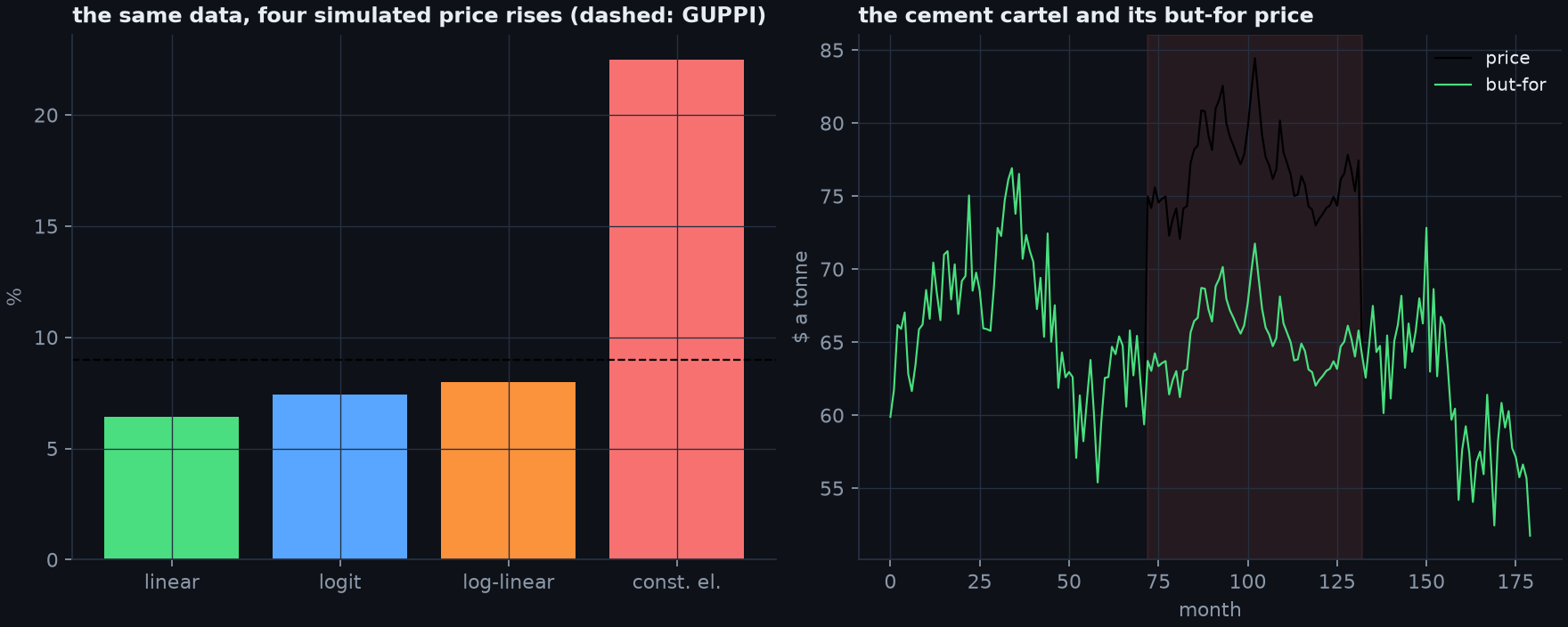
A simulation needs a demand system, and the demand system must be extended from the prices we see to prices nobody has charged. Take two identical firms. Each sells at a price of one, with a margin of 30 percent and a diversion ratio of 30 percent to the other. Fit four standard demand curves to exactly these numbers. They agree at today's price, in level, slope and diversion. Simulate the merger with each. Linear demand predicts a rise of 6.4 percent; the logit 7.4; demand that falls with the log of price 8.0; and constant elasticity 22.5. The difference is curvature: how the demand curve bends as price rises, which no data at today's prices can reveal. Gregory Werden and his coauthors made the point in 1999, and every simulation presented in court has been attacked along it since. The GUPPI, a first-order number, sits in the middle and does not pretend to know.
So a simulation is attacked in a few standard places. The shape of demand, as you just saw. The elasticities: estimated from which prices, with which instruments, over which years. The conduct: Bertrand competition before the merger is assumed; if the firms were already coordinating, the model is wrong from the start. The outside good: how many buyers would stop buying altogether, which sets how much the inside firms can raise prices together. And the cost savings: left out, or taken on trust. What a simulation adds is not a better number than the evidence it rests on. It is discipline: every assumption is written down, and each can be tested against the documents and the data. Judges have been wary of simulations they could not follow, and readier to credit ones that agree with the firms' own records.
On the Island we can do what no court can: compare a simulation with the truth. Suppose the agency uses a plain logit, calibrated in each town to the prices, the shares and even Alder's true own-price elasticity. Town by town, it predicts the merger will raise Alder's price by 6.9 percent on average. The truth is 11.9. Every town sits above the diagonal, most of all the gold ones, where Cedar is absent and the merger leaves Alder with no superstore rival. The plain logit sends customers who leave Alder to every rival in proportion to its share, so it cannot know that superstores are closer substitutes for each other than for the corner shops. It understates the diversion between the merging chains, and so the harm. Getting the substitution pattern right was the whole point of Part forty-three's random coefficients and nests.
What it does: Four demand curves, one data set; the attacks; an agency's plain logit
7Efficiencies, pass-through and entryGraduate3 min
The merging firms always say the deal will save money, and lower costs push prices down. But how much of a saving reaches buyers? That is the pass-through rate. On the Island, cut Alder's marginal cost by two percent with Alder still independent, and its price falls by 67 percent of the saving: the logit's curvature lets the margin absorb the rest. Give the same saving to the merged firm, and it passes on only 53 percent at Alder and about as much at Birch. A lower price at Alder now also steals sales from Birch, which the merged firm owns, so cutting is worth less. That is why the guidelines credit savings only if they are verifiable, specific to the merger, and likely to be passed on, and why the relevant pass-through is the merged firm's, not the industry's.
This was a turning point in the Staples case. The companies projected large savings and said two-thirds of them would be passed on to customers. The FTC's economists and its expert, Orley Ashenfelter, pointed out that a merger's savings are a cost change at one firm, and firms pass on a cost change that hits only them much less than one that hits the whole industry, since rivals' prices do not move with it. They separated the two in Staples' own data, in a regression of this kind: prices on the firm's own costs and on the costs common to everyone. Historically Staples had passed on only about fifteen to seventeen percent of firm-specific cost changes. The judge quoted the comparison in his opinion: two-thirds claimed, fifteen to seventeen percent in the record. The savings could not save the merger.
The other standard defence is entry: if prices rise, someone new will come. On the Island the truth answers it town by town. Where Cedar is already present, the merger raises Alder's price by 5.6 percent: Cedar is the discipline. Where it is not, by 18.9. Across the towns the effect runs from 5 to 22 percent. So the defence's question is whether Cedar would arrive in the towns it has stayed out of, and the guidelines ask that entry be timely, likely and sufficient to undo the harm. A rival that could come is not a rival that is there; a store takes years to open, and Cedar stayed out of those towns for reasons that a merger does not remove.
What it does: Pass-through merged and alone; Staples' 15-17%; Cedar's discipline
Intermission: airline fares, 1964-2025Principles and the major
This chapter has no narration to read.
8Vertical mergers: the bargaining model on trialResearch4 min
So far the merging firms sold the same thing. A vertical merger joins a supplier and its customer. In October 2016 AT&T, which owned the satellite distributor DirecTV, agreed to buy Time Warner, which owned CNN, TNT, HBO and Warner Brothers, for eighty-five billion dollars. The Justice Department sued in 2017. Its theory: once AT&T owned the channels, it could charge rival distributors more for them, and their customers would pay. Its expert, Carl Shapiro, built a bargaining model that predicted bills higher by roughly half a billion dollars a year. In June 2018 Judge Richard Leon let the merger proceed. The model, he wrote, lacked both reliability and factual credibility. The appeals court affirmed in 2019, with a careful distinction: the judge had accepted the bargaining theory as economics, and rejected its prediction on the evidence. The fight was over the inputs.
Here is the model on the Island. A sports channel sells to two distributors: Harbour Cable, with sixty percent of subscribers, and Northern Dish, with forty. The channel and Northern Dish merge. The fee Harbour pays is bargained. Each side's strength is what it would get if talks failed and the channel went dark on Harbour's subscribers. Before the merger, the channel just loses Harbour's fees. After it, some of Harbour's angry subscribers switch to Northern Dish, and their forty dollars a month now belong to the channel's owner. Suppose ten percent would leave and forty-five percent of those would go to Northern Dish. With equal bargaining power, the fee rises by half of that gain: 0.90 dollars a subscriber a month, 45 percent on a two-dollar fee. Rivals' costs rise, and some of that reaches their customers' bills. But there is a saving too. Northern Dish no longer pays a marked-up price for the channel: the elimination of double marginalization of Part forty-four. Spread over all subscribers, rivals' costs rise by 0.54 and the integrated distributor saves 0.80. On these inputs the merger lowers costs on balance.
Now vary the one input nobody can observe directly: how many subscribers would really leave if the channel went dark. The net effect rises with it. Below 14.8 percent, the saving wins; above it, the merger raises costs on balance. In the real trial that number decided a great deal. The government drew it from surveys and industry models. The defence said a long blackout would cost the channels too much in lost fees and advertising to be a credible threat, and Turner offered rival distributors arbitration of fee disputes with no blackout while it ran, which takes the threat off the table. The judge found the government's inputs unconvincing. The lesson for an expert: a model is only as persuasive as the evidence behind its most sensitive input, so find that input first and spend the effort there.
What it does: AT&T; Nash bargaining over a fee; the departure rate that decides
9Coordinated effects and cartelsPrinciples and the major3 min
A merger can also do harm without the merged firm acting alone, by making it easier for the firms that remain to stop competing. Part twelve showed why collusion can sustain itself without any agreement. The guidelines ask whether the merger tips a market towards it. Fewer firms: fewer parties to an understanding, and fewer to watch. Prices everyone can see, so cheating is noticed quickly. Many small, frequent sales, so no single order is worth breaking ranks for. And the maverick: a merger that removes the one firm that kept undercutting the others can do more harm than its share suggests. The step beyond tacit coordination is an explicit cartel, which is a crime.
Cartels are found mostly through leniency: the first member to confess escapes the fine, so cartels tend to betray themselves. Economists add screens, which look for the fingerprints of collusion in prices. Here is fifteen years of the Island's cement price, against its cost. For five of those years the producers ran a cartel. Watch what happens to the price: it sits higher above cost, and it is calmer. Agreeing on every change is costly, so cartels move prices less often and less sharply. A variance screen measures that: the volatility of the month-to-month change in the margin, over a rolling year. During the cartel it falls from about 0.051 to 0.009. The months in the calmest quarter are flagged, in red. A flag is a reason to look, not proof. Rosa Abrantes-Metz and her coauthors built the screen in 2006 from a real case, a bid-rigging ring selling frozen perch to a military supply centre in Philadelphia: when the conspiracy collapsed, the price fell and its standard deviation more than doubled.
Once a cartel is caught, its buyers sue, and the economist's job is the overcharge: how much higher were prices than they would have been? The workhorse is the before-during-after regression: the log price on the log cost and an indicator for the cartel months. The years outside the cartel say how price tracks cost. Here the overcharge is 17.7 percent, against the 18 percent the Island planted. Dividing it out gives the but-for price, what buyers would have paid. The damages are the gap on every tonne bought: about 63 million dollars, and American law trebles them, to give victims a reason to sue and cartels a reason to fear it. Every choice in that regression is contestable: which months count as clean, whether costs were themselves affected, whether the cartel's end was really its end. Part twelve's Dial records how large overcharges usually are; this part adds the Island's.
What it does: Screens; the overcharge regression; damages
10Regression in the witness boxPractice4 min
An economist in court is an expert witness, and a judge decides whether the testimony may be heard at all. In 1993, in Daubert against Merrell Dow, the Supreme Court made the trial judge a gatekeeper: expert testimony must rest on a reliable method, reliably applied. It suggested questions. Can the method be tested, and has it been? Has it been through peer review? What is its error rate? Is it accepted in the field? In 1999 the Kumho Tire case extended the gate to every kind of expert, economists included, and in 2023 the federal rule was amended to say that the judge must find each condition more likely than not. A regression that only its author could defend does not get through.
First, direct examination: the agency's economist presents the price regression, as in Staples. Alder's price rises with town size, because rents do, and bigger towns are also where Birch tends to be. So regress the log of Alder's price on whether Birch and Cedar are present. Without controls, Birch's presence lowers Alder's price by 7.2 percent: the dearer rents of Birch's towns hide part of the effect. Hold costs and size fixed, and the estimate is 10.4 percent, with a standard error under one. The merger's true average effect where both chains are present is 11.9 percent; losing Birch as a rival is close to what the merger does. The agency's witness says: this merger would raise Alder's prices by about ten percent where the two meet.
Now the cross-examination. The other side has the data and the code, and will try every reasonable alternative. Sixteen specifications: costs in or out, size in or out, logs or levels, Cedar in or out. They run from 7.2 to 10.6 percent, and every one is far from zero; the ones that leave out cost and size are lowest, for the reason you saw. Drop any single town, and the estimate stays between 10.2 and 10.8. The best question is a different one: which towns does the average describe? Where Cedar is present, Birch's effect is only 3.8 percent; where it is absent, 15.4. That is a fair point, and an honest witness concedes it and says what it implies: the harm is concentrated in the towns without Cedar, which is where a remedy would have to sell stores. In the real case the FTC's model predicted prices 8.6 percent higher and the defence's 0.9. Ashenfelter and his coauthors later traced the gap to the differences in how the two models were built, and the judge had found the FTC's evidence the more persuasive. The lesson is to put the alternatives on the table yourself, before the other side does.
What it does: Daubert; direct examination; the cross-examination
11Labour marketsPrinciples and the major2 min
Mergers also join employers. Part thirty-eight showed how an employer with few rivals for its workers pays them less than their work is worth. In an Island town, nurses choose between two hospitals and other work, by a logit in the wage. Each hospital pays 32.80 dollars an hour for work worth forty: a markdown of 18 percent, because a hospital that raised its wage would also pay the higher wage to every nurse it already has. The hospitals merge. Wages fall to 30.26, by 7.7 percent, and the markdown widens to 24. It is the diversion argument again, on the other side of the market: a nurse who quits one hospital for the other no longer leaves the employer. No patient's price need change at all. A review that looks only at what buyers pay would miss this harm entirely.
Is it real? Elena Prager and Matt Schmitt studied American hospital mergers. After the quarter of mergers that raised employer concentration most, wage growth slowed by about 1.7 percentage points a year for nurses and pharmacy workers, and 1.1 for other skilled workers, whose skills are worth most in hospitals; for unskilled workers, who can work anywhere, they found no effect. Employers can also simply agree not to compete for workers. Alan Krueger and Orley Ashenfelter read the 2016 franchise contracts of America's big chains and found that 58 percent barred one franchisee from hiring another's workers. After their paper circulated, state attorneys general pressed many chains to drop the clauses, and the federal agencies had already warned that naked no-poach agreements could be prosecuted as crimes. In 2023 the merger guidelines gave labour markets a guideline of their own. The tools are the same as for buyers: a market, shares, diversion, now measured in workers who would switch employers.
What it does: Two hospitals merge; Prager and Schmitt; no-poach clauses
12RetrospectivesPrinciples and the major2 min
Suppose the Island's court let the merger through. A year later, an economist at the agency runs a retrospective. In the towns where Alder and Birch met, prices after the merger are compared with prices before; in the towns where they did not meet, the same, to remove whatever else changed. The difference in differences: the merger raised Alder's price by 11.7 percent, close to the truth of 11.9. Now set the predictions against it. The GUPPI screen said 9.0. The agency's plain-logit simulation said 6.9, too low, for the reason of chapter six. That is the real value of a retrospective: it scores the tools, so that the next prediction is made with a better one.
Real retrospectives have become a literature of their own. Orley Ashenfelter and Daniel Hosken studied five consumer-product mergers that the agencies had let through, near the line where they might have been challenged. Four raised prices, typically by three to seven percent. Zack Cooper and his coauthors found that mergers between hospitals within five miles of each other were followed by prices about six percent higher. And a 2024 study counted only thirteen hospital mergers challenged by the Federal Trade Commission between 2000 and 2020, about one percent of them, when the agency's own standard screens would have flagged about a fifth. These samples are selected, by data and by interest, and averaging across them is risky; Part forty-four's Dial records the disagreement. Read together, they suggest that American review has let through more harmful mergers than it has blocked harmless ones, though that conclusion is itself disputed.
What it does: Difference in differences on the Island; what the real studies found
13Regulated pricesPractice4 min
Some markets have room for one firm only: one water main, one power grid. There the economics of merger review gives way to regulation, and economists testify in rate cases. The classic method is cost of service. The Island's water company may recover its operating costs, depreciation and taxes, plus an allowed return on the capital it has invested, its rate base: seven percent of 500. The total is the revenue requirement, 105, and the price is that divided by the volume sold. The hearings are about the allowed return, which American courts since the Hope Natural Gas case of 1944 have said must be commensurate with returns on investments of corresponding risk, and about whether each investment was prudent. Part ten showed the catch: if the allowed return beats the cost of capital, the firm uses too much capital; and since every saving is passed straight to customers at the next case, the firm has little reason to look for one.
In 1983 Stephen Littlechild proposed a different deal for Britain's soon-to-be-privatized telephone company: cap the price, not the profit. The price may rise each year by inflation minus X, a number the regulator sets for five years at a time. Between resets, whatever the firm saves it keeps, so it has every reason to save. On the Island, assume that under the cap the water company's costs fall four percent a year in real terms, against one percent under cost of service. The capped price falls in real terms, and the firm's margin grows as its costs fall faster. At each reset the regulator brings the price down to cost, and customers collect the savings, later rather than sooner. After fifteen years the real price is 0.54 under the cap against 0.86 under cost of service. The numbers hang on the effort each regime is assumed to induce, which is the part a regulator has to estimate, and the next X is argued over by economists on both sides, as rate cases were.
One more regulated price: access. The Island's telephone company owns the network, which costs 3 dollars a customer, and a retail service costing 2; customers pay 10. A rival wants to rent the network and sell its own service. What should it pay? The efficient component pricing rule, associated with William Baumol and Robert Willig, says: the network's cost plus the margin the incumbent loses on each customer it gives up, 8 dollars. Then the entrant profits only if its retail service costs less than 2, so only more efficient rivals enter. The objection is plain: the rule hands the incumbent its monopoly margin on every customer it loses, and competition never touches it. Many regulators price access at cost instead, and accept less efficient entrants as the price of competition. Which rule is right depends on whether the retail margin is a reward for something, or just a monopoly's rent.
What it does: A rate case; price caps; access pricing
14The Dials: pass-through and cartel overchargesGraduate2 min
This part opens one Dial and returns to another. The new one is the pass-through of a merger's cost savings. Staples' own history: about 15 to 17 percent of firm-specific cost changes reached its prices, the number the court set against the companies' two-thirds. The Island's Alder, alone, passes on 67 percent of a saving; merged with Birch, 53. The status: it depends on the setting, on the curvature of demand and on how many of the firm's rivals share the saving. But the direction holds everywhere: a saving one firm enjoys alone is passed on less than one that the whole industry shares, and a merged firm passes on less than an independent one.
The second Dial is Part twelve's: how much cartels overcharge. John Connor's collection of hundreds of published estimates has a median of about 23 percent. Marcel Boyer and Rachidi Kotchoni, correcting the same collection for the ways estimates are made and published, put the median at about 16. The lysine cartel of the 1990s, about 20. And the Island's cement cartel, measured by this part's regression: 17.7, against eighteen planted. The status stays contested. The low end and the high end imply very different fines, and whether the published estimates are biased upward is itself the argument.
What it does: Pass-through of savings (new); cartel overcharges (Part 12's)
15In practice: agencies, consultancies, in-house teamsPractice2 min
Merger economics is a profession. The agencies employ economists who review deals: the Federal Trade Commission's Bureau of Economics, the Justice Department's economists, the European Commission's chief economist team, Britain's Competition and Markets Authority. Consulting firms employ many more, with data scientists, working for the merging firms or for customers and rivals who oppose them. Professors serve as testifying experts, and their own published work is read back to them under oath. And large firms keep economists in-house, for pricing and for competition risk, because the firm's own documents, its emails, strategy decks and win-loss reports, will one day be evidence.
What does the work look like? A second request brings in millions of records: transaction prices, costs, and the firms' records of which deals they won and lost, and to whom. Most of the time goes into cleaning and matching them, and documenting every step. Then come diversion ratios, margins and pricing-pressure screens, a simulation with its alternatives, and a white paper for the agency, and, if the case goes to court, an expert report and a deposition. The rule of the trade is the one from chapter ten: the other side will rerun everything, so rerun it first.
Called it? In October 2016 AT&T's chief executive, Randall Stephenson, announced the purchase of Time Warner for eighty-five billion dollars with a line: the future of video is mobile, and the future of mobile is video. The deal would join content to distribution, and save about a billion dollars a year. AT&T beat the government in court and closed the purchase in June 2018. In May 2021 it agreed to spin WarnerMedia off and combine it with Discovery, and that closed in April 2022, less than four years after the purchase. The verdict: wrong. Note what the court did and did not decide. It asked whether the merger would harm competition, and found it would not. Whether it was a good business was never the law's question, and the market answered that one separately.
What it does: Agencies, consultancies, experts, in-house teams; Called it?: AT&T, 2016
16Frontier: platforms, data and nascent rivalsResearch2 min
The hardest mergers to judge are purchases of small firms that might have become big rivals. In 2012 Facebook bought Instagram for a billion dollars. Instagram had about a dozen employees and no revenue; there were no prices to regress and no diversion to measure. In 2020 the Federal Trade Commission sued, arguing that the purchases of Instagram and WhatsApp had neutralized rivals to protect a monopoly in personal social networking. In November 2025 Judge James Boasberg ruled for Meta. TikTok and YouTube, he found, compete for the same users' time, and with them in the market the FTC had not shown that Meta holds monopoly power today. A case about the future of social media turned, in the end, on chapter three's question: where does the market end, when the price is zero and what is sold is attention?
What remains open? Zero prices. The hypothetical monopolist cannot raise a price of nothing, so the test becomes a small but significant fall in quality: more ads, less privacy, fewer features. It is hard to measure and harder to defend before a judge. Series of acquisitions: many small purchases, none worth reporting alone, which together build a position; the 2023 guidelines ask about the pattern. Data and ecosystems: mergers that join data sets or tie users into bundles, where the remedies are access and interoperability rather than selling stores. And better instruments: demand estimated from experiments and choice data, and agencies that run retrospectives as a programme, to score their own tools. What remains hardest is the counterfactual of a rival that never got the chance to grow. No regression of prices can see it, and an expert who claims certainty about it should be cross-examined hardest of all.
What it does: FTC v. Meta; zero prices; series of acquisitions; data
Recap, problems, and the road aheadAll tracks2 min
So: how is economics used to decide a merger, and what survives cross-examination? It is used as a prediction, argued before someone who is not an economist. The law asks whether competition may be substantially lessened, and economics answers with a market, diversion ratios, margins, pass-through and a model. What survives cross-examination is evidence that does not hang on one specification, one demand curve or one input, and predictions that retrospectives later confirm.
Part fifty-nine in twelve lines. The law asks for a prediction. Raw price maps mix competition with costs. A pair is one market when diversion beats X over X plus M, and high margins make markets narrow. The market is the smallest set a monopolist could raise prices in, tested at prices not already raised. The guidelines' lines moved; the economics did not. Pricing pressure is diversion times the partner's margin. The shape of demand can triple a simulated price rise. Merged firms pass on less of a saving than independent ones. In a vertical merger, the bargaining model's most sensitive input decides. Overcharges come from before-during-after regressions. A regression in court must survive every reasonable alternative. And retrospectives score the tools.
The problems: the critical diversion, derived; a merger against three sets of guidelines; pricing pressure from the first-order condition; pass-through under two demand curves; a cartel's damages; and a starred problem on the vertical bargaining model. Full solutions are in the part's notes.
The reading: Davis and Garcés's book of quantitative techniques, the working manual of the trade; Kwoka on mergers and remedies; and the guidelines themselves, American and European. Then the papers, from Harris and Simons's critical loss to the hospital studies.
Next time, from judging prices in court to setting them. In 1985 People Express, a no-frills airline, was undercutting everyone, and American Airlines could not match its fares on every seat. American's answer was software: sell the seats that would have flown empty at the low fare, and protect the rest for travellers who book late. Measuring willingness to pay, price experiments, revenue management and dynamic pricing. Part sixty: the price.
Where it goes next. Part 60 turns from judging prices in court to setting them: willingness to pay, price experiments, revenue management and dynamic pricing.
Key results
The part's results in one place, for revision.
Try it
Lab 59 · The expert witness
Review the Island's merger of Alder and Birch as an agency economist would, then check each tool against the truth the Island knows.
python -m videos.economics.labs 59
needs numpy, scipy, matplotlib · download lab59.py ·
source on GitHuba town with all three chains: prices of Alder, Birch, Cedar, the shops 81.77, 81.81, 82.02, 91.43
Alder and Birch: diversion, margin, critical diversion, one market? 0.48, 0.13, 0.27, yes
Alder and the corner shops: diversion, margin, critical diversion, one market? 0.07, 0.15, 0.25, no
the two cement kilns: diversion, margin, critical diversion, one market? 0.20, 0.60, 0.08, yes
hypothetical monopolist of Alder alone: actual loss, critical loss, passes? 31.6%, 25.8%, no
hypothetical monopolist of Alder and Birch: actual loss, critical loss, passes? 19.2%, 26.5%, yes
hypothetical monopolist of the three superstores: actual loss, critical loss, passes? 4.9%, 27.2%, yes
cement kilns: HHI after, its rise; presumed in 1982, 2010, 2023 3750, 1250; yes, yes, yes
banks: HHI after, its rise; presumed in 1982, 2010, 2023 2550, 300; yes, yes, yes
grocers: HHI after, its rise; presumed in 1982, 2010, 2023 2058, 300; yes, no, yes
bakeries: HHI after, its rise; presumed in 1982, 2010, 2023 1276, 264; no, no, no
hospitals: HHI after, its rise; presumed in 1982, 2010, 2023 2712, 448; yes, yes, yes
GUPPI of Alder and Birch; simulated price rises 6.3%, 7.5%; 6.0%, 7.2%
cost cuts that would hold prices (compensating marginal-cost reductions) 15.5%, 16.7%
one data set, four curves: linear, logit, log-linear, constant elasticity 6.4%, 7.4%, 8.0%, 22.5%
pass-through of a 2% saving: Alder alone; Alder and Birch merged 67%; 53%, 54%
vertical: the rival's fee rise; rivals' extra cost against the saving; break-even departure rate $0.90 (45%); 0.54 vs 0.80; 14.8%
the cement cartel: estimated overcharge (planted 18%); damages, $ millions; trebled 17.7%; 63; 190
two hospitals merge: nurses' wage before and after; the markdown before and after 32.80 to 30.26; 18% to 24%
thirty towns: Birch's effect on Alder's price, without and with controls; the merger's true effect 6.9%, 9.7%; 13.3%
Every tool answers a narrower question than the law's: the screen asks about diversion and margins, the simulation about a demand curve no one has seen away from today's prices, the regression about the towns in its sample. The retrospective is how they are scored.The code (81 lines; it asserts its own result)
"""Lab 59: the expert witness: a merger of two office-supply chains reviewed as an agency and a court would, with the
truth known: market definition, concentration, pricing pressure, simulation under four demand curves, pass-through,
a vertical bargaining model, a cartel's overcharge, a labour-market merger and the price regression."""

import numpy as np

from videos.coursekit import labs
from explainer.economics.agora import merger as M

TITLE = "The expert witness"
GOAL = ("Review the Island's merger of Alder and Birch as an agency economist would, then check each tool against the "
        "truth the Island knows.")
TASKS = [
    "Run the hypothetical-monopolist test for Alder and Cedar (M.hmt(candidate=(0, 2))). Is that pair a market too?",
    "Change the nesting parameter to 0.1 (params={'sigma': 0.1} in M.equilibrium) and recompute the diversion from "
    "Alder to Birch. Why does it fall, and what happens to the GUPPI?",
    "In the vertical model, find the departure rate that makes the merger neutral when the channel's bargaining weight "
    "is 0.3 instead of 0.5 (M.vertical(share_channel=0.3)['threshold']).",
]


def run(seed=0):
    lab = labs.Lab()
    eq = M.equilibrium(np.ones(4, bool))
    lab.row("a town with all three chains: prices of Alder, Birch, Cedar, the shops",
            ", ".join(f"{p:.2f}" for p in eq["p"]))
    for q in M.playit_pairs():
        lab.row(f"{q['name']}: diversion, margin, critical diversion, one market?",
                f"{q['D']:.2f}, {q['M']:.2f}, {q['critical']:.2f}, {'yes' if q['one_market'] else 'no'}")
    for name, c in (("Alder alone", (0,)), ("Alder and Birch", (0, 1)), ("the three superstores", (0, 1, 2))):
        h = M.hmt(candidate=c)
        lab.row(f"hypothetical monopolist of {name}: actual loss, critical loss, passes?",
                f"{100 * h['actual_loss']:.1f}%, {100 * h['critical_loss']:.1f}%, {'yes' if h['passes'] else 'no'}")
    for r in M.industries():
        lab.row(f"{r['name']}: HHI after, its rise; presumed in 1982, 2010, 2023",
                f"{r['post']:.0f}, {r['delta']:.0f}; " + ", ".join("yes" if r["verdict"][y] else "no"
                                                                   for y in (1982, 2010, 2023)))
    U = M.upp()
    a, b = U["products"]["Alder"], U["products"]["Birch"]
    lab.row("GUPPI of Alder and Birch; simulated price rises", f"{100 * a['guppi']:.1f}%, {100 * b['guppi']:.1f}%; "
            f"{100 * U['simulation']['dp'][0]:.1f}%, {100 * U['simulation']['dp'][1]:.1f}%")
    lab.row("cost cuts that would hold prices (compensating marginal-cost reductions)",
            ", ".join(f"{100 * x:.1f}%" for x in U["cmcr"]))
    F = M.functional_forms()
    lab.row("one data set, four curves: linear, logit, log-linear, constant elasticity",
            ", ".join(f"{x:.1f}%" for x in F["rise"]))
    P = M.pass_through()
    lab.row("pass-through of a 2% saving: Alder alone; Alder and Birch merged",
            f"{100 * P['single']:.0f}%; {100 * P['merged'][0]:.0f}%, {100 * P['merged'][1]:.0f}%")
    V = M.vertical()
    lab.row("vertical: the rival's fee rise; rivals' extra cost against the saving; break-even departure rate",
            f"${V['fee_rise']:.2f} ({V['rise_pct']:.0f}%); {V['rival_cost']:.2f} vs {V['edm']:.2f}; "
            f"{100 * V['threshold']:.1f}%")
    C = M.cartel(seed=59 + seed)
    assert abs(C["estimate"] - C["truth"]) < 0.02    # the before-during-after regression finds the planted overcharge
    lab.row("the cement cartel: estimated overcharge (planted 18%); damages, $ millions; trebled",
            f"{100 * C['estimate']:.1f}%; {C['damages'] / 1e3:.0f}; {3 * C['damages'] / 1e3:.0f}")
    L = M.labour_merger()
    lab.row("two hospitals merge: nurses' wage before and after; the markdown before and after",
            f"{L['before'][0]:.2f} to {L['after'][0]:.2f}; {L['markdown_before']:.0f}% to {L['markdown_after']:.0f}%")
    T = M.towns(n=30, seed=59 + seed)
    R0, R1 = M.price_regression(T, controls=False), M.price_regression(T)
    lab.row("thirty towns: Birch's effect on Alder's price, without and with controls; the merger's true effect",
            f"{R0['birch']:.1f}%, {R1['birch']:.1f}%; {R1['true_merger']:.1f}%")

    lab.note = ("Every tool answers a narrower question than the law's: the screen asks about diversion and margins, "
                "the simulation about a demand curve no one has seen away from today's prices, the regression about "
                "the towns in its sample. The retrospective is how they are scored.")

    fig, ax = labs.figure(2, size=(11, 4.4))
    ax[0].bar(range(4), F["rise"], color=[labs.GREEN, labs.BLUE, labs.ORANGE, labs.RED])
    ax[0].axhline(F["guppi"], color="k", lw=1, ls="--")
    ax[0].set_xticks(range(4), ["linear", "logit", "log-linear", "const. el."])
    ax[0].set(title="the same data, four simulated price rises (dashed: GUPPI)", ylabel="%")
    ax[1].plot(C["t"], C["price"], color="k", lw=1, label="price")
    ax[1].plot(C["t"], C["but_for"], color=labs.GREEN, lw=1, label="but-for")
    ax[1].axvspan(C["start"], C["end"], color=labs.RED, alpha=0.1)
    ax[1].set(title="the cement cartel and its but-for price", xlabel="month", ylabel="$ a tonne")
    ax[1].legend(frameon=False)
    lab.fig = fig
    return lab
Now change it
- Run the hypothetical-monopolist test for Alder and Cedar (M.hmt(candidate=(0, 2))). Is that pair a market too?
- Change the nesting parameter to 0.1 (params={'sigma': 0.1} in M.equilibrium) and recompute the diversion from Alder to Birch. Why does it fall, and what happens to the GUPPI?
- In the vertical model, find the departure rate that makes the merger neutral when the channel's bargaining weight is 0.3 instead of 0.5 (M.vertical(share_channel=0.3)['threshold']).
Problems, with solutions
Try each problem before opening its solution.
1. Critical diversion: for two symmetric firms with linear demand, each pricing to maximize profit, show that a joint rise of X pays if and only if D > X/(X + M). Evaluate it for M = 0.4 and X = 5%.
Solution
With linear demand and each firm at its optimum, the Lerner condition gives an own elasticity of 1/M, so a rise of X in one price alone loses a fraction X/M of its sales. When both prices rise, each product keeps the fraction D of its lost sales that would have gone to the other, so the net loss is (X/M)(1 - D). Profit rises if the loss is below the critical loss X/(X + M): (X/M)(1 - D) < X/(X + M), that is 1 - D < M/(X + M), or D > X/(X + M). With M = 0.4 and X = 0.05, the critical diversion is 0.05/0.45 = 11.1%.
2. A firm with 30% of a market buys one with 4%. Find the rise in the HHI, and say which of the 1982, 2010 and 2023 presumptions it triggers when the post-merger HHI is 1,600.
Solution
The rise is 2 x 30 x 4 = 240 points. With a post-merger index of 1,600, the market is below the "highly concentrated" lines of 1982 (1,800) and 2010 (2,500), so neither presumption applies (the 1982 guidelines treated a moderately concentrated market with a rise above 100 as a likely, but not presumed, concern). The 2023 guidelines add Philadelphia National Bank's test: a merged share above 30% (here 34%) with a rise above 100 is presumed to lessen competition. Only 2023's presumption applies.
3. Pricing pressure: from the merged firm's first-order condition, show that the merger acts like a rise of D_AB (p_B - c_B) in A's marginal cost; find the GUPPI when D_AB = 0.3, p_B - c_B = $20 and p_A = $100.
Solution
After the merger the owner chooses p_A to maximize (p_A - c_A) q_A + (p_B - c_B) q_B, so q_A + (p_A - c_A) dq_A/dp_A + (p_B - c_B) dq_B/dp_A = 0. Write dq_B/dp_A = -D_AB dq_A/dp_A; then q_A + (p_A - [c_A + D_AB (p_B - c_B)]) dq_A/dp_A = 0, which is the single-product condition with marginal cost raised by D_AB (p_B - c_B). The GUPPI is that increment over A's price: 0.3 x 20 / 100 = 6%.
4. Pass-through: show that a monopolist with linear demand passes on half of a cost change, and one with constant elasticity e > 1 passes on e/(e - 1) of it.
Solution
With q = a - b p, profit (p - c)(a - b p) is maximized at p = (a/b + c)/2, so dp/dc = 1/2. With q = A p^(-e), the Lerner condition (p - c)/p = 1/e gives p = c e/(e - 1), so dp/dc = e/(e - 1) > 1: the curvature of demand, which no data at one price reveal, decides whether a saving is passed on by less or more than one for one, which is why chapter six's functional forms matter for efficiencies too.
5. A cartel's price is $120 for 24 months against a but-for price of $100, on sales of 50,000 units a month. Find the overcharge, the damages and the American treble damages.
Solution
The overcharge is 120/100 - 1 = 20% of the but-for price ($20 a unit). Damages are $20 x 50,000 x 24 = $24 million, trebled to $72 million under section 4 of the Clayton Act. (If the cartel's higher price also cut sales, buyers lost the surplus on the units they did not buy too, a triangle the simple calculation leaves out.)
6. The bargaining model: with weight w, show that the fee rises by w x departure x share to the integrated rival x its margin, and find the departure rate at which the rivals' extra costs equal the integrated distributor's saving.
Solution
In Nash bargaining the fee splits the gains from agreement, so it moves by w times any change in the channel's payoff if talks fail. Before the merger that payoff does not depend on where departing subscribers go; after it, a share d of the rival's subscribers leave in a blackout and a share s of those join the integrated distributor, worth its margin m each, so the channel's disagreement payoff rises by d s m per rival subscriber and the fee by w d s m. On the Island (w = 1/2, s = 0.45, m = $40, the rival has 60% of subscribers), the rivals' extra cost per subscriber in the market is 0.5 x d x 0.45 x 40 x 0.6 = 5.4 d, and the saving from removing the $2 fee on the integrated distributor's 40% is 0.8; they are equal at d = 0.8/5.4 = 14.8%.
Notes and sources
Sources
The cases and studies the film states are listed with what each shows in dials.SHOWN[59]; the new Dial (pass-through
of a merger's cost savings) and the Island's rows for cartel overcharges and merger retrospectives are in
explainer/economics/dials.py, and the Called it? record of AT&T's purchase of Time Warner in
explainer/economics/calls.py. The methods are stated from the works cited in the chapters (Harris and Simons 1989,
Werden 1996, Crooke, Froeb, Tschantz and Werden 1999, Katz and Shapiro 2003, O'Brien and Wickelgren 2003,
Abrantes-Metz, Froeb, Geweke and Taylor 2006, Ashenfelter, Ashmore, Baker, Gleason and Hosken 2006, Farrell and
Shapiro 2010, Ashenfelter and Hosken 2010, Cooper, Craig, Gaynor and Van Reenen 2019, Prager and Schmitt 2021,
Krueger and Ashenfelter 2022, Brot-Goldberg, Cooper, Craig and Klarnet 2024) and computed here.
About this partfrom its README
Part 59 of a sixty-eight-part course in economics (see the series plan and the syllabus), the third of Act XI, Economics at Work. It asks how economics is used to decide a merger, and what survives cross-examination. Its answer: economics is used as a prediction, argued before someone who is not an economist. The law asks whether competition may be substantially lessened; economics answers with a market, diversion ratios, margins, pass-through and a model. What survives cross-examination is evidence that does not hang on one specification, one demand curve or one input, and predictions that retrospectives later confirm.
It opens on FTC v. Staples (1997): the two biggest office-supply superstore chains said they competed with everyone who sells a pen, and the Federal Trade Commission answered with their own prices. The Island has its own version: three superstore chains (Alder in every town, Birch and Cedar in some) and the corner shops, in sixty towns, as a nested logit with Bertrand pricing, and a proposed merger of Alder and Birch whose true effect is known. From there it covers:
- the price map: Alder's basket costs 94.78 where it is alone and 85.28 where all three chains meet, 11% more; but towns with Birch alone are cheaper (83.19) than towns with all three, because the towns with more chains are bigger, with dearer rents;
- the law: section 7 of the Clayton Act ("may be substantially to lessen competition"), Hart-Scott-Rodino filings and second requests, the burden-shifting of Baker Hughes, and Philadelphia National Bank's 30% presumption;
- Play it: three pairs, each with a diversion ratio and a margin (Alder and Birch, 48% and 13%; Alder and the corner shops, 7% and 15%; two cement kilns, 20% and 60%); a pair is one market when diversion exceeds the critical value X/(X + M) (27%, 25% and 8%), so pairs one and three;
- market definition: the hypothetical-monopolist test in a town with all three chains (Alder alone fails, Alder and Birch pass, the three superstores pass easily); critical loss (13.4% margins give a critical loss of 27% against an actual loss of 4.9%) and Katz and Shapiro's reply to the defence's reading of it; the cellophane trap (at monopoly prices, 100.79 instead of 81.77, a further rise no longer pays);
- concentration: the Herfindahl index and its rise, 2 s_A s_B; the presumptions of 1982, 2010 and 2023 applied to five Island industries (the grocers' merger is presumed harmful in 1982 and 2023 but not in 2010); in every Island town where Alder and Birch meet the index rises by more than 2,600 points;
- unilateral effects: the diversion matrix (48% of Alder's lost sales go to Birch, 7% to the shops); upward pricing pressure derived from the merged firm's first-order condition as an opportunity cost; GUPPIs of 6.3% and 7.5%, a simulation of +6.0% and +7.2% (Cedar +1.8%), and compensating cost cuts of 16% and 17%;
- simulation in court: two identical firms with a 30% margin and 30% diversion, and four demand curves fitted to the same numbers, predicting rises of 6.4% (linear), 7.4% (logit), 8.0% (linear in log price) and 22.5% (constant elasticity), against a GUPPI of 9%; how simulations are attacked; an agency's plain logit, calibrated town by town even to Alder's true elasticity, predicts 6.9% on average against a truth of 11.9%;
- efficiencies and entry: a 2% cost saving is passed on at 67% by Alder alone and 53% once merged; Staples' own history of 15-17% firm-specific pass-through against the parties' claim of two-thirds; the merger's effect is 5.6% where Cedar is present and 18.9% where it is not;
- an intermission: airline fares in the consumer price index, relative to all prices, 1964-2025 (twice their 1978 level in 2000, 14% above it in 2025), with deregulation and the big mergers marked, and the reminder that an index is a method (from late 1998 to mid-2003 the CPI's fares rose 15.4%, the BLS's index of fares actually paid 6.8%);
- vertical mergers: United States v. AT&T (2018, affirmed 2019) and the Nash-bargaining model; on the Island a channel's fee to a rival distributor rises by $0.90 (45%) while the integrated distributor saves the $2.00 fee, and the net effect turns on the share of subscribers who would leave in a blackout (14.8% is the break-even);
- cartels: coordinated effects; a variance screen on fifteen years of the Island's cement prices (margin volatility 0.051 outside the cartel, 0.009 during it); the before-during-after overcharge (17.7%, s.e. 0.3, against 18% planted), damages of $63 million and $190 million trebled; Abrantes-Metz et al.'s frozen perch;
- regression in the witness box: Daubert, Kumho Tire and Rule 702 as amended in 2023; the Island's price regression (7.2% without controls, 10.4% with cost and size, against a true merger effect of 11.9%); sixteen specifications (7.2-10.6%), leave-one-out (10.2-10.8%) and the subsamples (3.8% where Cedar is present, 15.4% where it is not); Staples' 8.6% against 0.9%;
- labour: two Island hospitals merge and nurses' wages fall 7.7%, the markdown widening from 18% to 24%; Prager and Schmitt's hospital mergers; Krueger and Ashenfelter's no-poach clauses (58% of major franchisors in 2016); the 2023 guidelines' Guideline 10;
- retrospectives: the Island's merger consummated, measured by difference in differences (11.7% against 11.9% true, the GUPPI's 9.0 and the plain logit's 6.9); Ashenfelter and Hosken (3-7%), Cooper et al. (about 6% for hospitals within five miles), Brot-Goldberg et al. (13 hospital mergers challenged in 2000-2020, about 1%);
- regulated prices: a rate case (a revenue requirement of 105, a price of 1.05), Hope Natural Gas; Littlechild's RPI - X with resets (a real price of 0.54 after fifteen years against 0.86 under cost of service, on assumed effort); the efficient component pricing rule for access (8 = 3 + 5);
- the Dials (pass-through of a merger's savings, new; cartel overcharges, revisited), the profession at work, Called it?: AT&T's bet on Time Warner (wrong), and the frontier: FTC v. Meta (2025), zero prices, series of acquisitions, data and ecosystems.
What is computed and built
Everything plotted is computed by compute.py with Agora's merger module (explainer.economics.agora.merger); the
narration states the cached numbers.
- The market. Products Alder, Birch, Cedar and the corner shops, and buying nothing; utility 8.6, 8.5, 8.4 and 7.4 minus 0.08 times the price; a nested logit with the three superstores in one nest (sigma 0.4) and the shops in another; marginal costs 70, 71, 72 and 78; Bertrand-Nash prices solved from the first-order conditions by Powell's hybrid method.
- The towns. Sixty towns with a standardized size; costs shifted by 6% per unit of size plus noise (s.d. 2%); Birch present with probability 1/(1 + exp(-(0.2 + 1.2 size))), Cedar with 1/(1 + exp(-(-0.4 + size))); Alder's price observed with noise of 0.6%; the true merger effect in each town by solving the market with Alder and Birch under one owner.
- The regression. Least squares of log price on Birch, Cedar, cost and size with HC1 errors; the sixteen specifications toggle cost, size, logs and Cedar; leave-one-out and subsamples as stated.
- Market definition. The candidate products' prices raised by X with the others held fixed; profit, actual and critical loss; the cellophane test at the prices the three superstores would set as one firm.
- Unilateral effects. Diversion from the share Jacobian, D_jk = -(ds_k/dp_j)/(ds_j/dp_j); UPP and GUPPI as
derived; the simulation and compensating marginal-cost reductions with Agora's
iomodule. - Functional forms. Two symmetric firms at price 1 with margin m = 0.3 (own elasticity 1/m) and diversion 0.3; linear, logit with an outside good, linear-in-log-price and constant-elasticity demand calibrated to those numbers; the merged price from the symmetric joint first-order condition.
- The agency's model. In each of the 36 towns where Alder and Birch meet, a plain logit with the observed prices and shares and Alder's true own-price elasticity; the merger simulated with it.
- Pass-through. A 2% cut in marginal cost for Alder alone, and for Alder and Birch under one owner.
- Vertical. Nash bargaining with equal weights; 10% of the rival's subscribers leave in a blackout, 45% of them to the integrated distributor, whose margin is $40 a month; a fee of $2; the integrated distributor has 40% of subscribers.
- The cartel. A cost index following a random walk (s.d. 2% a month) from 50; price 1.25 times cost with noise (s.d. 3.5% outside the cartel, 0.8% within), times 1.18 in months 72-131; quantities with elasticity 0.8 (thousands of tonnes a month); the screen is the rolling twelve-month standard deviation of the change in the log margin, with the calmest quarter flagged.
- Labour. Nurses choose two hospitals or other work by logit in the wage (coefficient 0.2); a nurse's hour is worth 40; each hospital, or the merged pair, sets wages from its first-order conditions.
- The retrospective. Twelve months before and after the merger, with a common random-walk shock and noise of 1% in each town; treated towns are those where Birch is present.
- Regulated prices. A rate base of 500 at 7%, operating costs 40, depreciation 20, taxes 10, volume 100; inflation 3%, X = 2%, resets every five years, real cost falling 4% a year under the cap and 1% under cost of service (assumed); the access price as the network's cost (3) plus the incumbent's retail margin (5).
Chapter notes
| # | Chapter | What it does |
|---|---|---|
| 0 | The price map | Staples; the Island's sixty towns and Alder's prices; the question; objectives |
| 1 | What the law asks | Section 7; the review process; who must prove what |
| 2 | Play it: one market or two? | Three pairs; diversion against the critical value X/(X + M) |
| 3 | Market definition | The hypothetical monopolist; critical loss and its misuse; cellophane |
| 4 | Shares and concentration | The HHI and its rise; the presumptions of 1982, 2010 and 2023 |
| 5 | Unilateral effects | Diversion ratios; upward pricing pressure derived; GUPPIs against simulation |
| 6 | Merger simulation in court | Four demand curves, one data set; the attacks; an agency's plain logit |
| 7 | Efficiencies, pass-through and entry | Pass-through merged and alone; Staples' 15-17%; Cedar's discipline |
| — | Intermission | Airline fares in the CPI, 1964-2025, as a line and a tune |
| 8 | Vertical mergers | AT&T; Nash bargaining over a fee; the departure rate that decides |
| 9 | Coordinated effects and cartels | Screens; the overcharge regression; damages |
| 10 | Regression in the witness box | Daubert; direct examination; the cross-examination |
| 11 | Labour markets | Two hospitals merge; Prager and Schmitt; no-poach clauses |
| 12 | Retrospectives | Difference in differences on the Island; what the real studies found |
| 13 | Regulated prices | A rate case; price caps; access pricing |
| 14 | The Dials | Pass-through of savings (new); cartel overcharges (Part 12's) |
| 15 | In practice | Agencies, consultancies, experts, in-house teams; Called it?: AT&T, 2016 |
| 16 | Frontier | FTC v. Meta; zero prices; series of acquisitions; data |
| — | Outro | The answer; twelve lines; problems; reading; next, Part 60, The Price |
Notes
python -m videos.economics.labs 59: the Island's market and a town's equilibrium; the critical diversion of the three pairs; the hypothetical-monopolist test; the HHI presumptions; diversion, UPP and GUPPI against the simulation; the four functional forms; pass-through; the vertical fee and its break-even; the cartel's overcharge and damages; the labour merger.- The interactive (course site): expert. The reader is the agency's economist in one Island town: set the diversion ratio and the margins, run the hypothetical-monopolist test and the GUPPI screen, choose a demand curve for the simulation, decide whether to challenge, and then see the retrospective's verdict on the decision.
Companion material in this repository
The syllabus's plan for this partfrom SYLLABUS.md, the plan of record
- Hook: the price map; the question; objectives.
- What the law asks: a substantial lessening of competition; the consumer-welfare standard.
- Play it: is this one market or two? (three pairs of products, with their data).
- Market definition: the hypothetical-monopolist test; critical loss; the cellophane fallacy.
- Shares and concentration: the thresholds in the guidelines (1982, 2010, 2023) and what moved.
- Unilateral effects: diversion ratios and upward pricing pressure (Farrell and Shapiro 2010), derived.
- Merger simulation in court (Part 43): what it adds, how it is attacked.
- Efficiencies and pass-through; entry and repositioning.
- Vertical mergers: bargaining leverage; AT&T–Time Warner (2018) and the Nash-bargaining model on trial.
- Coordinated effects; cartels: detecting them (screens), estimating overcharges, the but-for price.
- Regression in the witness box: specification, sensitivity, Daubert; what a judge can follow.
- Labour markets: monopsony in merger review; no-poach agreements (Part 38).
- Retrospectives: did consummated mergers raise prices? (hospitals, airlines, beer).
- Regulated prices: the rate case, price caps, access pricing.
- Dials. 15. In practice: agencies, consultancies, in-house teams. 16. Frontier: platform and data mergers; nascent competitors; ecosystems.
Agora: merger: a review toolkit (the hypothetical-monopolist test, diversion and UPP from estimated demand,
simulation, a bargaining model, an overcharge estimator), run on an Island merger with the truth known.
Dials: pass-through of cost savings; price effects in retrospectives.
Called it? predicted against realized prices in merger retrospectives (Part 44's row).
Reading: Davis & Garcés; the US Merger Guidelines (2010, 2023) and the EU's; Farrell & Shapiro 2010;
Ashenfelter et al. 2006 on Staples; Shapiro 2021 on AT&T; Kwoka, Mergers, Merger Control, and Remedies;
Whinston 2006.
Build the film
python -m videos.economics.econ59.compute        # the part's numbers, into .cache/econ59
python tools/build.py econ59                  # render and assemble the film
EXPLAINER_TTS=silent python tools/qa_scene.py econ59 Hook   # one chapter, silent, with a contact sheet
Scenes: videos/economics/econ59. Setup: see the course page. Source of these notes: the README and the scenes' narration.
Build it
python -m videos.economics.econ59.compute              # every number (about four minutes), into .cache/econ59/
python tools/qa_scene.py econ59 Market                 # one chapter, silent, at 480p, with a contact sheet
EXPLAINER_TTS=silent python tools/build.py econ59 -q l   # the whole part, silent preview
python tools/build.py econ59                           # 1080p30 with narration and the series' computed score
python -m videos.economics.labs 59                     # the lab
The data are FRED's consumer price index for airline fares (CUUR0000SETG01) and for everything (CPIAUCNS),
registered in SOURCES.md. Everything else is computed on the Island,
or stated from the cases and papers listed in dials.SHOWN[59].