Social Choice and Welfare
Can the wants of many people be added up into what society wants?
The part opens with Condorcet's discovery in 1785 that a majority can prefer A to B, B to C and C to A, and Kenneth Arrow's proof in 1950 that the trouble is not majority rule: every rule fails. The viewer sees thirty-eight islanders' ballots give five winners under five rules, then follows Borda against Condorcet and the agenda setter, Arrow's theorem proved by the pivotal voter, the ways out through single peaks and May's theorem, strategic voting with Called it? on Duverger's law, and Sen's case for comparing people. After an intermission of two centuries of democracy in V-Dem's data, the part builds welfare functions from Bentham to Rawls through Atkinson's epsilon and Okun's leaky bucket, Harsanyi's veil against Rawls's, Scitovsky's reversal and the Paretian liberal, cost-benefit analysis with distributional weights and the discount rate, the value of a statistical life and a new dial on it, capabilities and the Human Development Index, the rules regulators and voters actually use, and a frontier on behavioural welfare, quadratic voting and preference aggregation for AI.
What you need. Part 5: preferences and utility; Part 7: risk aversion and discounting; Part 9: Pareto efficiency; Part 17: mechanisms and Gibbard-Satterthwaite's cousin, safe truth. Chapter 7 uses power means; chapter 10 the present value of a stream.
- Hook
- Condorcet's cycle, 1785; Arrow's thesis, 1950
- Ideas, models and mathematics
- voting paradoxes, Arrow's theorem proved, the median voter, strategy-proofness, welfare functions from Bentham to Rawls, Harsanyi's veil, Sen, cost–benefit analysis and the value of a statistical life
- Agora gains
- a voting lab; a welfare evaluator
- Play it
- vote under five rules, get five winners
What you will be able to do
Principles and the major
- Compute the winner of one profile under plurality, the runoff, instant runoff, Borda's count and Condorcet's rule, and show how the agenda decides a majority cycle.
- State Arrow's conditions and theorem, Black's median voter theorem and May's theorem, and explain what each way out gives up.
- Explain the value of a statistical life, where its estimates come from and what it is not.
Graduate
- Prove Arrow's theorem by the pivotal voter and the median voter theorem.
- Compute Atkinson's equally distributed equivalent and index for any epsilon, and the switch between Harsanyi's and Rawls's choices behind the veil.
- Check Kaldor and Hicks's compensation test both ways, and show Scitovsky's reversal and Sen's liberal paradox.
Research
- Read the evidence on the value of a statistical life by design, and the case for and against distributional weights and a low discount rate.
Practice
- Explain the parameters a regulatory analysis sets (the discount rate, distributional weights, the value of a statistical life) and who sets them.
Contents
Each chapter has a home level. Choose a track to see what to read and watch: Principles and the major 35 min · Graduate 38 min · Research 42 min · Practice 38 min.
- 0Can the wants of many people be added up into what society wants?Principles and the major3 min
- 1Play it: one island, five rules, five winnersPrinciples and the major2 min
- 2Borda against Condorcet, and the agendaPrinciples and the major2 min
- 3Arrow's theoremPrinciples and the major3 min
- 4Ways out: single peaks and May's theoremPrinciples and the major2 min
- 5Strategic votingPrinciples and the major2 min
- 6Comparing people: Sen's enlargementPrinciples and the major1 min
- Intermission: two centuries of democracyPrinciples and the major
- 7Welfare functions: Bentham, Rawls and AtkinsonPrinciples and the major3 min
- 8Two veils: Harsanyi and RawlsPrinciples and the major2 min
- 9Pareto and its limitsPrinciples and the major3 min
- 10Cost-benefit analysis as applied social choicePrinciples and the major3 min
- 11The value of a statistical lifePrinciples and the major3 min
- 12Capabilities: what to measurePrinciples and the major3 min
- 13The Dials: the value of a statistical lifeResearch1 min
- 14In practice: rules for regulators and votersPractice2 min
- 15Frontier: new votes, and choosing for machinesResearch3 min
- Recap, problems, and the road aheadAll tracks3 min
Also on this page: Lecture · Key results · Try it · Lab · Problems · Notes and sources · Build the film.
Lecture
The text of each chapter is the film's narration, as it is spoken, so you can read along or revise without the film. The pictures are in the film.
Can the wants of many people be added up into what society wants?Principles and the major3 min
In 1785 the Marquis de Condorcet, a mathematician in Paris, published an essay on decisions made by majority vote. It contains a puzzle. Three voters rank three options. The first prefers A to B to C; the second, B to C to A; the third, C to A to B. Put A against B, and A wins, two to one. Put B against C, and B wins, two to one. Put C against A, and C wins, two to one. The majority goes round in a circle. Each voter is perfectly consistent, and the group is not: there is no such thing as the majority's choice.
For a century and a half the circle was a curiosity. In 1950 a graduate student, Kenneth Arrow, published a short paper called A Difficulty in the Concept of Social Welfare. It showed that the trouble is not majority rule. Every rule for turning individual rankings into a ranking for society breaks at least one of a few conditions that seem impossible to give up, unless one person decides for everyone. Arrow shared the Nobel prize in 1972, and the theorem founded a field.
The question is everywhere. Elections choose a voting rule, and somebody sets the agenda. Committees vote on budgets, hirings and verdicts. Every appraisal of a policy adds up gains and losses, usually in money, and must decide how much a dollar to a poor family counts against a dollar to a rich one. Regulators decide how much to spend to save a statistical life. And the companies building artificial intelligence must decide whose preferences their machines should follow.
Part seventeen matched people one by one. This part chooses for everyone at once. Can the wants of many people be added up into what society wants? Which voting rule is right, if every rule fails somewhere? Can a society's welfare be measured, and whose counts for how much? And what is left for someone who has to choose a policy?
Economics, Built. Part eighteen: social choice and welfare. This part closes Act Four. You'll see one island choose five different winners with five rules, then Borda against Condorcet, and the power of whoever sets the agenda. Arrow's theorem, proved step by step; the escape through single-peaked preferences; and strategic voting. Then welfare: comparing people, the sums of Bentham, Rawls and Atkinson, and two veils of ignorance. Pareto and its limits, cost-benefit analysis, and the value of a statistical life. And capabilities, a dial for lives, and a frontier of new voting rules and choosing for machines.
What it does: Condorcet's three voters (1785): A beats B, B beats C, C beats A, each 2 to 1; Arrow (1950): every rule breaks a reasonable condition unless one person decides; where people are added up (elections, committees, appraisal, inequality, lives, machines); the question; objectives
1Play it: one island, five rules, five winnersPrinciples and the major2 min
Thirty-eight islanders must choose one of five plans for the harvest feast: a feast of fish, a feast of fruit, a dance, a boat race, or a market fair. Their rankings come in four kinds. Twelve islanders put the fish first. Eleven put the fruit first. Eight put the dance first, and seven the boat race. Nobody puts the market fair first, but look where it sits on every ballot. Which plan should the island choose? Pause, and decide.
Now count the votes five ways. By plurality, the plan with the most first places wins: the fish, with twelve. In a two-round runoff, the top two meet: the fish against the fruit, and the fruit wins, twenty-six to twelve, because everyone who did not put fish first ranks it last. By instant runoff, the plan with the fewest first places drops out and its ballots pass to their next choice, round after round: the market fair goes, then the boat race, whose seven ballots lift the dance above the fruit, and the fruit goes; the dance then beats the fish. By Borda's count, four points for a first place, three for a second, and so on, the boat race wins with a hundred and one. And the market fair, which nobody put first, beats every other plan in a head-to-head vote: it is the Condorcet winner. Five reasonable rules, five different winners, from the very same ballots.
What it does: 38 islanders: 12 A E D B C, 11 B D E C A, 8 C E D B A, 7 D C B E A (A fish, B fruit, C dance, D boat race, E market fair); plurality A (12), runoff B (26 to 12), instant runoff C (26 to 12), Borda D (101, E 89, B 78), Condorcet E (beats A 26-12, B 20-18, C 23-15, D 20-18)
2Borda against Condorcet, and the agendaPrinciples and the major2 min
Two members of the French Academy of Sciences argued over this in the 1770s and 1780s. Jean-Charles de Borda proposed scoring each ballot, four points for a first place down to nothing for a last, and adding. Condorcet answered that a plan which beats every other in a straight vote ought to win. They can disagree, as they do on the island: Borda picks the boat race, but the market fair beats it, twenty to eighteen. And Condorcet's own rule can find no winner at all, when the majority goes round in a circle. Borda knew that his count could be gamed; the story is that he answered that his scheme was meant only for honest men.
Borda's count has a stranger flaw. Suppose the twelve islanders who put the fish first move the fruit up one place, above the boat race. Before, Borda ranked the market fair above the fruit. After, the fruit is above the market fair, and on top. Yet nobody changed how they rank the fruit against the market fair: the fish voters still put the fair above the fruit. Society's verdict on two plans moved because of how people ranked a third. The condition Borda breaks is called independence of irrelevant alternatives, and it is one of Arrow's.
Committees often avoid ranking everything at once. They vote on two options, then put the winner against the next. Use Condorcet's three voters. Put A against B first: A wins, then meets C, and C wins. Start with B against C, and A wins in the end. Start with C against A, and B wins. Whichever plan is voted on last wins. So whoever sets the order of the votes chooses the outcome, and Richard McKelvey showed in 1976 that, with more issues, a skilled agenda setter can lead a majority almost anywhere. In committees and legislatures, agenda power is real power.
What it does: Borda (1770) and Condorcet (1785) disagree; the 12 fish-first voters move the fruit above the boat race and Borda's order of B and E flips (D 101, E 89, B 78 to B 90, D 89, E 89) though no one's B-against-E ranking changed; with Condorcet's three voters, whichever plan is voted on last wins
3Arrow's theoremPrinciples and the major3 min
Arrow asked for very little. A rule takes everyone's ranking of three or more options, and returns a ranking for society, complete and consistent. First, people may rank the options any way they like. Second, if everyone prefers x to y, so does society: the Pareto condition. Third, society's verdict on x against y depends only on how people rank x against y, not on where they put other options: independence, the condition Borda's count broke. Fourth, there is no dictator, no one person whose ranking always becomes society's. Arrow proved that no rule satisfies all four.
John Geanakoplos gave a short proof in 2005, and it can be watched. Take three options, a, b and c, and five voters. First a lemma: if every voter puts b either at the very top or at the very bottom, then society must too. If society put b in the middle, independence would let us raise c above a for everyone without changing any vote about b, and the social ranking would contradict itself. Now start with everyone putting b last. By Pareto, society puts b last. Move b to the top of the first voter's ranking, then the second's, and so on. When all have moved it, Pareto puts b first for society. So somewhere it jumps from bottom to top. Here it jumps at the third voter. That voter is pivotal. The rest of the proof uses independence to show that the pivotal voter alone decides how society ranks every pair: a dictator. Any rule that keeps the first three conditions has one.
So something must give. One way out is to restrict the rankings people may hold, as chapter four does. Another is to drop independence, as Borda's count does, at the price of manipulation, the subject of chapter five. The third is to use more information than rankings: how much each person gains or loses, compared across people, which chapter six takes up. Arrow's theorem does not say that democracy is impossible. It says that no procedure for adding people up is neutral: every one builds in a choice.
What it does: Four conditions; Geanakoplos's proof animated with five voters: b moved to the top voter by voter jumps from bottom to top for society at voter 3, who is pivotal and then a dictator; something must give
4Ways out: single peaks and May's theoremPrinciples and the major2 min
The first way out restricts what people may want. Five islanders are deciding how big to build a new granary, and each has an ideal size. Each prefers sizes nearer their own ideal: their preferences have a single peak, on a line. Put three hundred baskets against five hundred. The three islanders whose ideals are three or below prefer three, and three wins. In fact the median ideal, three, beats every other size in a straight vote. Duncan Black proved in 1948 that with single-peaked preferences, the median voter's favourite is a Condorcet winner, and majority rule never cycles. Notice that it is the median, not the average of four point four: the two who want a much bigger granary cannot pull the outcome their way, however much they want it.
In 1957 Anthony Downs turned the result into a theory of elections. Two parties compete for votes along a single line from left to right. Each moves toward the median voter, because that is where the majority is. So their platforms converge, and the median voter decides. The escape is narrow, though. If politics has two dimensions, taxes and, say, immigration, single peaks no longer guarantee a winner, and the cycles come back. And real parties also answer to activists, donors and primary voters, as part forty-seven explores.
With only two options, the picture is clean. Ask for three things. The rule should be anonymous, counting every voter the same. It should be neutral, treating the two options the same. And it should be positively responsive: one more vote for x never hurts x, and breaks a tie in its favour. Kenneth May proved in 1952 that simple majority rule is the only rule with all three. Between two options, majority rule is not one choice among many; it is the fair one.
What it does: Five ideal granary sizes 1, 2, 3, 7, 9 (hundreds of baskets): the median, 3, beats every other size, not the mean 4.4 (Black 1948); Downs (1957); two dimensions and McKelvey's chaos; May (1952): only simple majority rule is anonymous, neutral and positively responsive
5Strategic votingPrinciples and the major2 min
Borda's honest men are rare, and a theorem says why it matters. Allan Gibbard in 1973 and Mark Satterthwaite in 1975 proved independently that with three or more options, every rule that picks a winner and is not a dictatorship can be manipulated: there is always some situation in which some voter does better by voting against their true ranking. It is Arrow's theorem seen from the voter's side. Part seventeen's deferred acceptance made honesty safe for one side only because matching is not a vote over one outcome that everyone shares.
Agora checked every way each group of like-minded islanders could change its ballot. Under plurality, the 11 fruit-first islanders, seeing the fruit trail the fish, can all vote for the boat race instead, their second choice; the boat race wins, which they prefer to the fish. That is voting for the lesser evil. Under Borda's count, the 12 fish-first islanders can push the boat race, the leader, to the bottom of their ballots; the market fair, their second choice, wins instead. That is called burying. Under instant runoff, the same 12 can put the market fair first; it survives the early rounds and wins, which they much prefer to the dance. Only the market fair, the Condorcet winner, cannot be beaten this way: a plan that wins every head-to-head vote leaves no group a better deal.
Called it? In 1951 the French political scientist Maurice Duverger argued that plurality voting in single-member districts tends to produce two parties, because voters desert third parties that cannot win, and politicians stop joining them: strategic voting, on a national scale. In the United States, every president since 1853 has been a Democrat or a Republican. But Britain, Canada and India, which also elect by plurality, keep third and regional parties in parliament, strong where their voters are concentrated. Partly right: a tendency within each district, rather than a law for the nation.
What it does: Gibbard and Satterthwaite; on the island, the 11 fruit-first voters make the boat race win under plurality, the 12 fish-first voters make the market fair win under Borda (burying the boat race) and under instant runoff (compromising early); only the Condorcet winner is safe; Called it?: Duverger (1951), partly right
6Comparing people: Sen's enlargementPrinciples and the major1 min
The third way out asks for more information. Arrow's rules used only rankings: who prefers what, but not by how much, and not who is better off than whom. That was deliberate. In 1932 Lionel Robbins had argued that comparing one person's satisfaction with another's is not science, and a generation of economists agreed. But every judgment that a policy helps the poor more than it hurts the rich makes exactly such a comparison. Amartya Sen argued from 1970 that the impossibility comes from the poverty of the information allowed, not from democracy itself.
In the 1970s, several economists worked out what each kind of comparison allows. With only rankings, Arrow's conditions leave a dictator. If we may say who is worse off, the conditions allow Rawls's rule: improve the lot of the worst-off first. If we may say who gains more, they allow Bentham's: maximize the sum. With both, a whole family between them opens up, which chapter seven measures. Peter Hammond, Claude d'Aspremont and Louis Gevers proved versions of these results. The choice of rule is then a choice of how to compare people, which is an ethical choice, made openly.
What it does: Robbins (1932); Sen (1970): the impossibility comes from too little information; rankings only (a dictator), levels (Rawls), units (Bentham), both (a family between)
Intermission: two centuries of democracyPrinciples and the major
This chapter has no narration to read.
7Welfare functions: Bentham, Rawls and AtkinsonPrinciples and the major3 min
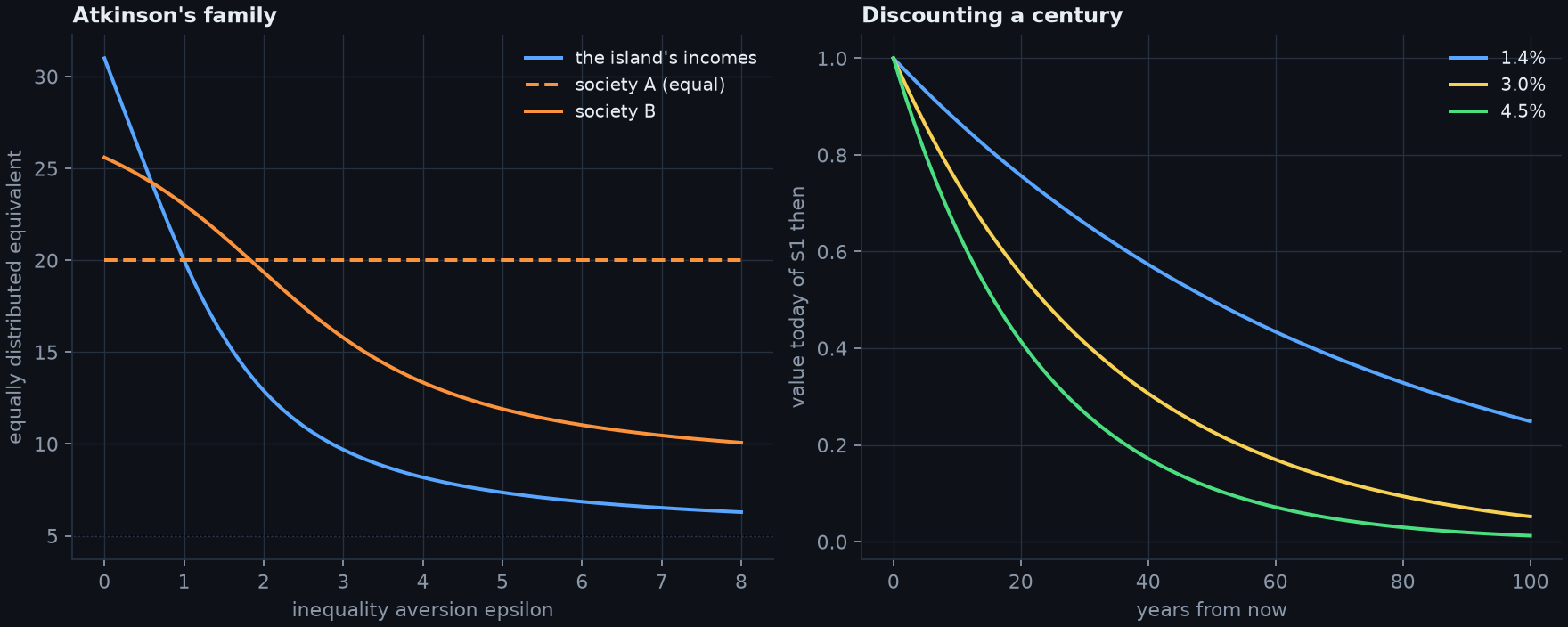
To go further, a welfare function must say how to weigh people against each other. Here are five islanders' incomes, from five baskets a week to eighty. Jeremy Bentham's answer was to add up everyone's happiness. If happiness rose in step with income, only the total would matter, and this island would score its mean, thirty-one, however the baskets were shared. John Rawls's answer, for the basic structure of a society, was to judge it by how its worst-off member fares. Then only the minimum, five, counts. Between them lies a family. Let each person's utility grow ever more slowly as income rises, at a rate set by one number, epsilon. At epsilon zero this is Bentham with income; at epsilon one, utility is the logarithm of income; and as epsilon grows without limit, the sum behaves like Rawls's minimum.
Anthony Atkinson, in 1970, turned the family into a measure. Ask: what income, if everyone had the same, would this welfare function value exactly as highly as the island's real incomes? He called it the equally distributed equivalent. At epsilon zero it is the mean, thirty-one. Now raise epsilon. At one it is twenty, the geometric mean; at two, about thirteen; and it sinks toward the minimum, five. One minus its ratio to the mean is Atkinson's index of inequality. At epsilon one it is nought point three five: a society that cared this much about equality would give up thirty-five percent of its income, if the rest could be shared equally, and count itself no worse off.
Arthur Okun gave epsilon a picture in 1975: a leaky bucket. Carry one basket from the richest islander, with eighty, to the poorest, with five. Taxes and administration make the bucket leak. How much may leak before the transfer makes society worse off? At epsilon zero, none: a basket is a basket. At epsilon a half, 75 percent of it may leak. At epsilon one, 94 percent. At epsilon two, almost all of it. Atkinson's lesson was that every measure of inequality, the Gini coefficient included, holds a judgment like this one, whether or not it says so. His made it a number you have to choose.
What it does: Incomes 5, 10, 20, 40, 80; Atkinson's equally distributed equivalent 31 (epsilon 0), 25.3 (0.5), 20 (1), 12.9 (2), 7.4 (5), index 0.35 at epsilon 1; Okun's leaky bucket from 80 to 5: up to 75% may leak at epsilon 0.5, 94% at 1, 99.6% at 2
8Two veils: Harsanyi and RawlsPrinciples and the major2 min
Two philosophers proposed the same test for fairness. Choose the rules of a society before you know who in it you will be. The economist John Harsanyi, in 1953 and 1955, said: behind that veil you are equally likely to be anyone. A rational chooser maximizes expected utility, and with equal chances, expected utility is average utility. Bentham's sum falls out of prudence. John Rawls, in 1971, said that behind the veil, choosing the basic structure of the society you must live in for life, you would not gamble. You would make the worst position as good as possible. Inequalities are just only if they benefit the least advantaged: the difference principle. The same thought experiment gave two answers.
Put the two veils to work on two islands of five. In society A, everyone has twenty baskets. In society B, four have thirty and one has eight: more in total, a mean of twenty-five point six, but one islander left behind. Rawls chooses A, since its worst position, twenty, beats eight. Harsanyi's chooser compares expected utilities, and the answer depends on how fast utility flattens, the epsilon of chapter seven, which here is aversion to risk behind the veil. Below about one point nine, B's extra income wins; above it, the risk of being the one with eight dominates, and Harsanyi chooses A too. So the two veils differ by a single number: how much you fear the bottom.
The two argued for years. Harsanyi said maximin is infinitely risk averse: someone who lived by it would turn down a better life elsewhere for fear of the smallest chance of disaster on the way. Rawls answered that the original position is no ordinary gamble. It is one choice, made once, for a whole life, with no probabilities anyone could trust, and its result must be lived with. When Norman Frohlich and Joe Oppenheimer put groups of students behind a veil in the laboratory, most groups chose neither rule. They chose the highest average income subject to a floor. A minimum first, then growth.
What it does: Society A (20 each) against B (8, 30, 30, 30, 30; mean 25.6): Rawls chooses A; Harsanyi chooses B below epsilon 1.9 and A above; Harsanyi's critique (1975) and Rawls's answer; groups in the laboratory choose an average with a floor
9Pareto and its limitsPrinciples and the major3 min
If comparing people is an ethical choice, perhaps we can avoid it. Vilfredo Pareto's criterion needs no comparison: a change that helps someone and hurts nobody is better. But almost no policy passes it. A tariff cut, a new road, a vaccine mandate: each has losers. In 1939 Nicholas Kaldor and John Hicks proposed a weaker test. Call a change an improvement if the winners could compensate the losers and still come out ahead, whether or not they actually do. That is the test behind every cost-benefit analysis: the gains, in money, exceed the losses.
Tibor Scitovsky found the trouble in 1941. Agora rebuilds his example with two islanders whose utility is their fish times their fruit. In state one, Ana has six fish and one fruit, Bo the reverse; each scores six. In state two, Ana has one fish and four fruit, scoring four, and Bo has seven and three, scoring twenty-one. Moving from one to two, Bo gains and Ana loses. Could Bo compensate her? Share state two's goods so that Ana still scores six and Bo more than six: yes, so the test calls the move better. Now move back, from two to one. Ana gains, Bo loses. Could Ana compensate Bo? Share state one's goods so that Bo keeps his twenty-one and Ana her four: yes again. The test approves a move, and approves undoing it. The reason is that prices, and so the value of the goods, change with who holds them. And compensation that is never paid is not compensation.
Sen found a deeper limit in 1970, with one copy of a scandalous book. The prude would rather nobody read it, but would rather read it than let the lewd. The lewd most wants the prude to read it, and would rather read it than see it go unread. Grant each a little liberty: whether you read a book is your own business. The prude doesn't want to read it, so nobody reading beats the prude reading. The lewd wants to read it, so the lewd reading beats nobody reading. But both prefer the prude reading to the lewd reading, so by Pareto that beats it too. The three judgments go round in a circle. Liberty for two people over their own affairs, plus the Pareto principle, can leave no best choice at all.
What it does: Kaldor and Hicks (1939); Scitovsky's reversal rebuilt with Ana and Bo: state 1 (6, 1) and (1, 6), state 2 (1, 4) and (7, 3), utility fish times fruit; the compensation test approves the move and its reverse; Sen's prude and lewd: liberty and Pareto make a cycle
10Cost-benefit analysis as applied social choicePrinciples and the major3 min
Cost-benefit analysis is social choice done with money. The island considers a new jetty. Ana, the richest, would pay up to thirty baskets for it; Friday, the poorest, would lose ten baskets' worth of fishing ground. The usual analysis adds the money: thirty minus ten is twenty, so build it. That is Kaldor and Hicks's test, in money. But willingness to pay depends on what you have. A basket means more to someone with five than to someone with eighty. Weight each person's money by Atkinson's rule: mean income over their own, raised to epsilon. At epsilon a half, the jetty's net value turns negative, minus 6.2. At epsilon one, it is minus 50: don't build it. The case for leaving the weights out, made by Louis Kaplow and Steven Shavell, is that taxes redistribute more cheaply than distorted projects do, so projects should be judged on efficiency alone. Its force depends on whether the taxes really follow.
This is where the measuring stops and a judgment begins. Economics can measure the jetty: thirty baskets' worth for Ana, ten lost by Friday, twenty gained in all. Whether to build it needs a judgment about how much a basket to Friday counts against a basket to Ana, which is epsilon, and about whether Friday will in fact be compensated. An analysis that uses no weights has still made a choice: epsilon zero.
The same judgment reaches across time. Gains in a century must be set against costs today, and the tool is the discount rate. Frank Ramsey's formula from 1928 splits it into two parts: delta, pure impatience, and eta times g, where g is growth and eta is the epsilon of this part, now saying how much less an extra dollar means to a richer future. Nicholas Stern's review of climate change in 2006 set delta near zero, at nought point one percent, eta at one and growth at one point three percent: a rate of one point four percent. At that rate, a million dollars a hundred years away is worth about 249 thousand today. At three percent, about 52 thousand. At four and a half percent, near the market returns that William Nordhaus argued for, about 12 thousand. A factor of twenty, from the rate alone. Delta and eta are ethical choices, not facts waiting to be measured. Part forty-eight puts them to work on the climate.
What it does: A jetty worth 30 to Ana (income 80) and costing Friday (income 5) 10: +20 unweighted, -6.2 at epsilon 0.5, -50.4 at epsilon 1; Kaplow and Shavell's case for no weights; an is/ought card; Ramsey's rule and Stern's 1.4%: a million dollars in 100 years is worth $249,003, $52,033 or $12,257 today at 1.4%, 3% or 4.5%
11The value of a statistical lifePrinciples and the major3 min
Every safety rule saves some lives at some cost, so a regulator must decide how much a risk to life is worth. In 1968 Thomas Schelling separated identified lives, like a miner trapped underground, whom we will spend almost anything to save, from statistical lives: small risks spread over many people. Suppose a job carries an extra risk of death of one in ten thousand a year, and workers take it only if they are paid a thousand dollars a year more. Among ten thousand such workers, one more death is expected each year, and ten million dollars in all is paid for accepting it. So the value of a statistical life is ten million dollars: a thousand dollars divided by one in ten thousand. It is the rate at which people trade money for small risks, not the price of anybody's life.
Where does the number come from? Mostly from wages: comparing jobs with different risks of death, as Richard Thaler and Sherwin Rosen first did in 1976. Also from surveys that ask what people would pay for a safer car or route, and from behaviour: speed limits, smoke alarms, helmets. Orley Ashenfelter and Michael Greenstone used a natural experiment. From 1987, American states were allowed to raise the speed limit on rural interstates to sixty-five miles an hour. The states that did saw speeds rise by about two and a half miles an hour, four percent, and fatality rates by about thirty-five percent. They saved about a hundred and twenty-five thousand hours of travel for each extra death. Valued at the wage, that is about one and a half million dollars per life, in 1997 dollars: an upper bound on the value those states' voters placed on a statistical life.
The number is easy to misread. It is not the value of a person. It prices a small change in risk, spread over many people. Nor is it what anyone would pay to avoid certain death: that is limited by what they have, and no wage makes certain death acceptable. It is higher where people are richer, since they can afford to pay more for safety, so a rule that used each group's own figure would count the lives of the poor for less. It may vary with age. In 2003, after public protest, the Environmental Protection Agency stopped using an analysis that put a lower value on the lives of people over seventy. So most agencies use one number for everyone, whatever their income or age. That too is an ethical choice, of the same kind as chapter ten's weights: it counts the willingness to pay of poorer people for more than their own.
What it does: $1,000 a year for a 1-in-10,000 risk: $10 million (Schelling 1968); wages, surveys, behaviour; 65 mph limits from 1987: speeds up 2.5 mph, fatality rates up 35%, about 125,000 hours saved per extra death, about $1.54 million (1997 dollars) as an upper bound; what it is not; the EPA's age adjustment dropped in 2003
12Capabilities: what to measurePrinciples and the major3 min
Everything so far has added up incomes or utilities. Sen asked whether either is the right thing to add. Income is only a means. What it buys depends on your health, where you live, whether you have a disability, and what the law lets you do. And happiness adapts: people who have little often learn to want little, so a measure of satisfaction can make deprivation look acceptable. Sen proposed judging a society by people's capabilities: what they are able to do and to be. To live a long life, to read, to move freely, to take part in the life of the community. Which capabilities count, and how to weigh them, is a question for philosophy; Part thirty-eight of Philosophy, Built takes it up.
The data show why it matters. Each dot is a country in 2023: income per head across, on a log scale, and life expectancy up. Richer countries live longer, but the spread at any income is wide. Sri Lanka and Equatorial Guinea have almost the same income, a little under thirteen thousand dollars a head. Sri Lankans live to about seventy-seven and a half; Equatorial Guineans to about sixty-four: fourteen years apart. Cuba, with an income about a ninth of America's, has almost the same life expectancy, and Costa Rica, with less than a third, a longer one. Qatar, one of the richest countries, has long lives too. Income is a poor guide to the capability that matters most: staying alive.
In 1990 the Pakistani economist Mahbub ul Haq, working with Sen, turned the idea into a number for the United Nations. The Human Development Index combines health, education and income. Each part is scaled from nought to one between a floor and a goal, income entering as a logarithm, and since 2010 the three have been combined by a geometric mean. It reorders the world. Qatar ranks 4th by income, but 43rd by the index. Cuba ranks 127th by income and 97th by the index; the United States 10th and 18th. But its weights are a choice too. Martin Ravallion showed in 2012 that in the poorest countries, the index treats a year of life as worth very little income. Every index is a welfare function in disguise. Ask what it trades for what.
What it does: Sen's capabilities; income against life expectancy for 193 countries in 2023: Sri Lanka ($12,616, 77.5 years) and Equatorial Guinea ($12,762, 63.7); Cuba, the United States, Costa Rica, Qatar; the HDI (1990; geometric mean since 2010): Qatar 4th by income, 43rd by HDI; Cuba 127th and 97th; the United States 10th and 18th; Ravallion's critique
13The Dials: the value of a statistical lifeResearch1 min
Here is the dial, every value converted to 2024 dollars. Ashenfelter and Greenstone's speed limits give an upper bound of about three million dollars, with wide uncertainty. The Environmental Protection Agency's central value, from a distribution fitted to twenty-six studies, mostly of wages and risks, is seven point four million in 2006 dollars, about 11.5 million today. And the Department of Transportation uses 13.7 million for analyses in 2024. The status: contested. The number moves by more than a factor of four with the method and with whose choices are observed. It returns in part fifty-eight, where a bill is scored.
Why such a spread? Wage studies compare risky jobs with safe ones, but risky jobs differ in more than risk, the omitted variables of part four. The people in risky jobs may also care less about risk; they chose those jobs. People misjudge small probabilities, so what they accept may not be what they would choose if they understood the risk. And the speed-limit study values time at the wage, which makes it an upper bound by design. A regulator still needs one number, and choosing it is part of the policy.
What it does: The new dial in 2024 dollars: Ashenfelter and Greenstone 3.0 (1.0 to 5.0), the EPA 11.5, the Department of Transportation 13.7; contested; why the methods disagree
14In practice: rules for regulators and votersPractice2 min
Governments do this arithmetic every day. Since 1981, every major American regulation has needed an analysis of its costs and benefits, reviewed by an office at the White House. The guidance, Circular A-4, told agencies in 2003 to discount future costs and benefits at three percent and at seven. Its revision in 2023 lowered the default to two percent and allowed agencies to weight gains to poorer people more heavily. In January 2025 an executive order directed that the 2003 version be restored. Britain's Treasury uses three and a half percent for the first thirty years, and less after that. The epsilon and the discount rate of this part are set, and reset, by each administration.
And sometimes the law forbids the arithmetic. In 2001 the Supreme Court held, in Whitman against American Trucking, that the Clean Air Act bars the Environmental Protection Agency from weighing costs when it sets the standards for air quality. In 2015, in Michigan against the EPA, it held that the agency must consider cost before deciding to regulate the mercury from power plants. A legislature can write its own welfare function into the statute: health first, or costs against benefits.
Voting rules are chosen too, and fought over. Australia has elected its House of Representatives by instant runoff since 1918. Maine adopted ranked ballots by referendum and first used them in 2018. Alaska combined a top-four primary with ranked ballots from 2022; voters kept the system by fewer than eight hundred votes in 2024, and again in 2026. Fargo, in North Dakota, adopted approval voting, in which you tick every candidate you find acceptable, and used it from 2020. In 2025 North Dakota banned approval and ranked voting. Florida and Tennessee had passed the first state bans on ranked voting in 2022. Since each rule can pick a different winner from the same ballots, the choice of rule is itself political.
What it does: Regulatory review since 1981; Circular A-4 (3% and 7% in 2003, 2% and distributional weights in 2023, the 2003 version restored in 2025); the Green Book's 3.5%; Whitman v. American Trucking (2001) and Michigan v. EPA (2015); Australia's instant runoff (1918), Maine (2018), Alaska (2022; kept in 2024 and 2026), Fargo's approval voting (2020) and North Dakota's ban (2025); the first bans on ranked voting (2022)
15Frontier: new votes, and choosing for machinesResearch3 min
The first frontier is inside each person. Welfare economics assumed that what people choose shows what is good for them. But choices shift with framing, with defaults, with the moment, as parts seven and forty-five show. Douglas Bernheim and Antonio Rangel proposed in 2009 to count x as better than y only when y is never chosen while x is available. The result is a ranking with gaps: where a person's choices conflict, welfare economics stays silent rather than guess. Deciding which choices to trust, the planner's in January or the doer's in December, is the new form of Robbins's old question.
The second frontier is the ballot. One person, one vote cannot record how much anyone cares: a majority that mildly prefers one plan beats a minority that badly needs another. Quadratic voting gives each voter a budget of credits. One vote on an issue costs one credit, two votes cost four, three cost nine, four cost sixteen. So each extra vote costs more than the last: the nth costs two n minus one. A voter keeps buying until the next vote costs more than the issue is worth to them, and so casts votes in proportion to how much they care. Steven Lalley and Glen Weyl showed that in large electorates the result comes close to the efficient decision. Its weak point is collusion: two people who agree can split their votes and pay less. In 2019 the Democrats in Colorado's House used it to rank competing spending bills; a court later required that the votes be made public.
The newest frontier is choosing for machines. Large language models are tuned on many people's comparisons between pairs of answers. Fitting a single reward to everyone's comparisons aggregates their preferences, so it is a social choice rule. But which one? Anand Siththaranjan, Cassidy Laidlaw and Dylan Hadfield-Menell showed in 2024 that, when annotators differ in ways the data don't record, the standard method implicitly runs Borda's count. Which means, by Gibbard and Satterthwaite, that annotators can gain by misreporting. Vincent Conitzer and colleagues argued the same year that the questions of alignment, who gives feedback, what kind, and how to combine it, are social choice's questions. And in 2023 Anthropic and the Collective Intelligence Project asked about a thousand Americans to propose and vote on rules for a model, then trained one on the result. Condorcet's problem has a new electorate.
What it does: Bernheim and Rangel's welfare from choices (2009); quadratic voting, votes in proportion to intensity, collusion, Colorado's House Democrats (2019); RLHF as Borda's count (Siththaranjan, Laidlaw and Hadfield-Menell 2024), social choice for alignment (Conitzer et al. 2024), Collective Constitutional AI (2023)
Recap, problems, and the road aheadAll tracks3 min
So: can the wants of many people be added up into what society wants? Not without a choice. Between two options, or along a single line, majority rule works. Beyond that, every rule breaks some reasonable condition, and every rule can be gamed. To add people up, we have to compare them. Welfare functions, cost-benefit analysis and indices do, but each carries an ethical number: how much we care about equality, about the future, about a risk to life. Economics can make that number visible and measure what follows from it. It cannot choose it for us.
Part eighteen in twelve lines. In 1785 Condorcet found that majorities can go in circles. In Play it, thirty-eight ballots gave five winners under five rules. Borda's count breaks independence, and whoever sets the agenda picks the winner. Arrow proved that no rule meets four modest conditions, and the proof finds a pivotal voter who becomes a dictator. With single-peaked preferences the median voter wins, and between two options May's theorem picks majority rule. Gibbard and Satterthwaite showed every rule can be gamed, and Duverger saw two parties in it. What we are willing to compare across people decides which rules survive. From Bentham to Rawls runs Atkinson's family: at epsilon one, the island's incomes are worth an equal twenty each, not thirty-one. Harsanyi's veil chooses the average, Rawls's the minimum, and they are one number apart. Pareto's criterion has limits: Scitovsky's reversal and the Paretian liberal. Cost-benefit analysis needs weights and a discount rate, and a statistical life is valued at around ten million dollars, a contested number. And capabilities and the human development index, behavioural welfare, quadratic votes and Borda's count inside machines are where the field is moving.
The problems. The five rules on the island's ballots; the agenda; the first step of Arrow's proof; Black's median voter theorem; a strategic lie under Borda's count; Atkinson's equivalent incomes; the switch behind Harsanyi's veil; and a starred problem on Scitovsky's reversal. Full solutions are in the part's notes.
The reading: Arrow's Social Choice and Individual Values, short and still fresh; Sen's Collective Choice and Social Welfare, in its expanded edition; the social choice and welfare chapters of Mas-Colell, Whinston and Green, the graduate text; and Matthew Adler's Measuring Social Welfare. Then the papers, from Condorcet to choosing for machines.
That ends Act Four, on markets that fail and the designs that can mend them. Act Five asks how economies grow. In 1798 the Reverend Thomas Malthus explained why living standards can never rise for long: population, unchecked, outruns food. As a description of every century before his, the theory was good. Part nineteen: the great escape.
Where it goes next. Part 19 opens Act V on growth; Part 45 returns to behavioural welfare; Part 47 to voting and parties; Part 48 to discounting the climate; Part 58 to scoring a bill with a value of a statistical life.
Key results
The part's results in one place, for revision.
Try it
Lab 18 · Social choice and welfare: voting rules and welfare functions
Count one island's ballots under five rules and get five winners; let the agenda pick the winner of a cycle; break Borda's independence; find Arrow's pivotal voter; watch the median win on a line; find the blocs that gain by lying; measure inequality with Atkinson's epsilon; choose between two societies behind two veils; pass Kaldor's test both ways; and see how weights, discount rates and a statistical life change a decision.
python -m videos.economics.labs 18
needs numpy, scipy, matplotlib · download lab18.py ·
source on GitHubthe 38 ballots: plurality, runoff, instant runoff, Borda, Condorcet plurality A, runoff B, instant runoff C, Borda D, Condorcet E
Borda's points A 48, B 78, C 64, D 101, E 89
Condorcet's cycle: agendas won by each plan (of six) A 2, B 2, C 2
Borda breaks independence: fish voters' new ballot; pair that flips AEBDC; BE
Arrow: position of b in society as b rises voter by voter (2 = bottom); pivotal voter [2, 2, 2, 0, 0, 0]; voter 3
single peaks: median, mean, Condorcet winner 3, 4.4, 3
plurality: a bloc's lie the 11 with BDECA vote DBECA: A -> D
instant runoff: a bloc's lie the 12 with AEDBC vote EADBC: C -> E
Borda: a bloc's lie the 12 with AEDBC vote AECBD: D -> E
Atkinson: equally distributed equivalent at epsilon 0, 0.5, 1, 2, 5, 50 31.00, 25.28, 20.00, 12.90, 7.36, 5.17
veils: Rawls chooses; Harsanyi chooses at epsilon 0, 1, 1.8, 2, 5 A; B, B, B, A, A
Scitovsky: Kaldor's test passes from 1 to 2; from 2 to 1 True; True
the jetty's weighted net value at epsilon 0, 0.25, 0.5, 1 20.0, 7.9, -6.2, -50.4
a million dollars in 100 years, today, at 1.4%, 3.0%, 4.5% $249,003, $52,033, $12,257
a statistical life: $1,000 for 1 in 10,000 $10 million
the dial (2024 $ million) Ashenfelter and Greenstone 3.0, EPA 11.5, U.S. Department of Transportation 13.7
Five rules give five winners from the same 38 ballots, and only the market fair, the Condorcet winner, is safe from every bloc's lie. Atkinson's equivalent falls from the mean, 31, to 20 at epsilon one and toward the minimum, 5; Harsanyi's veil chooses the unequal, richer society until epsilon passes about 1.9, while Rawls's always chooses equality. Compensation tests can approve a move and its reverse, and the jetty that passes unweighted fails at epsilon one half.The code (110 lines; it asserts its own result)
"""Lab 18: social choice and welfare: five voting rules on one profile, the agenda in Condorcet's cycle, Borda's
failure of independence, Arrow's pivotal voter, single peaks, bloc manipulation, Atkinson's family, the two veils,
Scitovsky's reversal, distributional weights, discounting and the value of a statistical life."""

import numpy as np

from videos.coursekit import labs
from explainer.economics import dials
from explainer.economics.agora import choice as ch
from explainer.economics.island import truths

TITLE = "Social choice and welfare: voting rules and welfare functions"
GOAL = ("Count one island's ballots under five rules and get five winners; let the agenda pick the winner of a cycle; "
        "break Borda's independence; find Arrow's pivotal voter; watch the median win on a line; find the blocs that "
        "gain by lying; measure inequality with Atkinson's epsilon; choose between two societies behind two veils; "
        "pass Kaldor's test both ways; and see how weights, discount rates and a statistical life change a decision.")
TASKS = [
    "The ballots: move two voters from the fruit-first group to the dance-first group. How many different winners do "
    "the five rules now give, and is there still a Condorcet winner?",
    "The veil: change society B to (10, 30, 30, 30, 30). At what epsilon does Harsanyi's chooser now switch to A?",
    "The jetty: at what epsilon does the weighted net value of the jetty turn negative? (Solve "
    "30 (31/80)^e = 10 (31/5)^e.)",
]


def run(seed=0):
    lab = labs.Lab()
    T = truths(18)
    prof = [(n, tuple(r)) for n, r in T["playit"]["profile"]]

    w = ch.all_rules(prof)
    assert len(set(w.values())) == 5                                   # five rules, five winners
    lab.row("the 38 ballots: plurality, runoff, instant runoff, Borda, Condorcet",
            ", ".join(f"{k} {v}" for k, v in w.items()))
    bd = ch.borda(prof)["points"]
    lab.row("Borda's points", ", ".join(f"{c} {bd[c]}" for c in sorted(bd)))

    cyc = ch.majority_cycle()
    ag = ch.agendas(cyc["profile"])
    assert all(len(v) == 2 for v in ag.values())                       # each plan wins under two of six agendas
    lab.row("Condorcet's cycle: agendas won by each plan (of six)", ", ".join(f"{c} {len(v)}" for c, v in ag.items()))

    iia = ch.iia_violation(prof)
    lab.row("Borda breaks independence: fish voters' new ballot; pair that flips",
            f"{''.join(iia['after'])}; {''.join(iia['pair'])}")

    pv = ch.geanakoplos_pivot(**T["arrow"])
    lab.row("Arrow: position of b in society as b rises voter by voter (2 = bottom); pivotal voter",
            f"{pv['positions']}; voter {pv['pivot'] + 1}")

    sp = ch.single_peaked(**T["peaks"])
    assert sp["condorcet"] == sp["median"]                              # Black: the median is the Condorcet winner
    lab.row("single peaks: median, mean, Condorcet winner", f"{sp['median']:g}, {sp['mean']:g}, {sp['condorcet']:g}")

    for rule in ("plurality", "instant runoff", "Borda"):
        m = ch.manipulations(prof, rule)[0]
        lab.row(f"{rule}: a bloc's lie", f"the {m['count']} with {''.join(m['truth'])} vote {''.join(m['lie'])}: "
                f"{m['honest_winner']} -> {m['new_winner']}")

    inc = T["incomes"]
    eps = (0.0, 0.5, 1.0, 2.0, 5.0, 50.0)
    wf = ch.welfare(inc, eps)
    assert abs(wf["ede"][1.0] - np.exp(np.mean(np.log(inc)))) < 1e-9   # epsilon one is the geometric mean
    lab.row("Atkinson: equally distributed equivalent at epsilon 0, 0.5, 1, 2, 5, 50",
            ", ".join(f"{wf['ede'][e]:.2f}" for e in eps))

    v = ch.veil(T["veil"]["A"], T["veil"]["B"], (0.0, 1.0, 1.8, 2.0, 5.0))
    lab.row("veils: Rawls chooses; Harsanyi chooses at epsilon 0, 1, 1.8, 2, 5",
            f"{v['rawls']}; " + ", ".join(v["harsanyi"][e] for e in (0.0, 1.0, 1.8, 2.0, 5.0)))

    sc = ch.scitovsky()
    assert sc["1_to_2"] and sc["2_to_1"]                                # the test approves a move and its reverse
    lab.row("Scitovsky: Kaldor's test passes from 1 to 2; from 2 to 1", f"{sc['1_to_2']}; {sc['2_to_1']}")

    mean = float(np.mean(inc))
    jetty = {e: 30 * (mean / max(inc)) ** e - 10 * (mean / min(inc)) ** e for e in (0.0, 0.25, 0.5, 1.0)}
    lab.row("the jetty's weighted net value at epsilon 0, 0.25, 0.5, 1", ", ".join(f"{x:.1f}" for x in jetty.values()))

    d = T["discount"]
    pv_ = {r: d["amount"] / (1 + r) ** d["years"] for r in d["rates"]}
    lab.row(f"a million dollars in {d['years']} years, today, at {', '.join(f'{r:.1%}' for r in d['rates'])}",
            ", ".join(f"${x:,.0f}" for x in pv_.values()))
    t = T["vsl"]
    lab.row("a statistical life: $1,000 for 1 in 10,000", f"${t['extra_pay'] / t['extra_risk'] / 1e6:.0f} million")
    lab.row("the dial (2024 $ million)", ", ".join(f"{e.who} {e.value:.1f}" for e in dials.DIALS["vsl"].estimates))

    lab.note = ("Five rules give five winners from the same 38 ballots, and only the market fair, the Condorcet winner, "
                "is safe from every bloc's lie. Atkinson's equivalent falls from the mean, 31, to 20 at epsilon one and "
                "toward the minimum, 5; Harsanyi's veil chooses the unequal, richer society until epsilon passes about "
                "1.9, while Rawls's always chooses equality. Compensation tests can approve a move and its reverse, "
                "and the jetty that passes unweighted fails at epsilon one half.")

    fig, ax = labs.figure(2, size=(11, 4.4))
    e = np.linspace(0, 8, 161)
    ede = ch.welfare(inc, tuple(float(x) for x in e))["ede"]
    ax[0].plot(e, [ede[float(x)] for x in e], color=labs.BLUE, label="the island's incomes")
    va = ch.welfare(T["veil"]["A"], tuple(float(x) for x in e))["ede"]
    vb = ch.welfare(T["veil"]["B"], tuple(float(x) for x in e))["ede"]
    ax[0].plot(e, [va[float(x)] for x in e], color=labs.ORANGE, ls="--", label="society A (equal)")
    ax[0].plot(e, [vb[float(x)] for x in e], color=labs.ORANGE, label="society B")
    ax[0].axhline(min(inc), color="black", lw=0.8, ls=":")
    ax[0].set(title="Atkinson's family", xlabel="inequality aversion epsilon", ylabel="equally distributed equivalent")
    ax[0].legend()
    yrs = np.arange(0, d["years"] + 1)
    for r in d["rates"]:
        ax[1].plot(yrs, (1 + r) ** -yrs, label=f"{r:.1%}")
    ax[1].set(title="Discounting a century", xlabel="years from now", ylabel="value today of $1 then")
    ax[1].legend()
    lab.fig = fig
    return lab
Now change it
- The ballots: move two voters from the fruit-first group to the dance-first group. How many different winners do the five rules now give, and is there still a Condorcet winner?
- The veil: change society B to (10, 30, 30, 30, 30). At what epsilon does Harsanyi's chooser now switch to A?
- The jetty: at what epsilon does the weighted net value of the jetty turn negative? (Solve 30 (31/80)^e = 10 (31/5)^e.)
Problems, with solutions
Try each problem before opening its solution.
1. Five rules: with the island's 38 ballots, find the winner under plurality, the runoff, instant runoff, Borda's count and Condorcet's head-to-head rule.
Solution
The ballots are 12 A E D B C, 11 B D E C A, 8 C E D B A and 7 D C B E A. Plurality counts first places: A 12, B 11, C 8, D 7, E 0, so A wins. The runoff puts A against B: only the 12 rank A above B, so B wins 26 to 12. Instant runoff drops E (no first places), then D (7), whose ballots pass to C (15); then B (11), whose ballots pass to C (their next choice among A and C), and C beats A 26 to 12. Borda's count (4, 3, 2, 1, 0) gives A 48, B 78, C 64, D 101, E 89: D wins. Head to head, E beats A 26 to 12, B 20 to 18, C 23 to 15 and D 20 to 18: E is the Condorcet winner.
2. The agenda: with Condorcet's three voters, show that whichever plan is voted on last wins.
Solution
The voters rank A B C, B C A and C A B, so A beats B, B beats C and C beats A, each 2 to 1. If C comes last, A meets B first and wins, then loses to C. If A comes last, B meets C and wins, then loses to A. If B comes last, C meets A and wins, then loses to B. In each case the plan held back to the end wins, because the plan that beats it has already been eliminated.
3. Arrow, step one: prove that if every voter puts \(b\) at the very top or the very bottom, so does society.
Solution
Suppose not: for some \(a, c\) other than \(b\), society ranks \(a \succsim b\) and \(b \succsim c\). Change every voter's ranking so that \(c\) moves just above \(a\), leaving \(b\) where it is. Since \(b\) is at an extreme for every voter, nobody's ranking of \(a\) against \(b\) or of \(b\) against \(c\) changes, so by independence society still has \(a \succsim b \succsim c\), and by transitivity \(a \succsim c\). But every voter now prefers \(c\) to \(a\), so by Pareto society has \(c \succ a\): a contradiction.
4. Black's theorem: with single-peaked preferences on a line, prove that the median peak beats every other option.
Solution
Let \(n\) be odd and \(m\) the median peak. Take any option \(x < m\). Every voter whose peak is \(m\) or more has \(x < m \le\) peak, so \(m\) lies between \(x\) and the peak, and single-peakedness means the voter prefers \(m\) to \(x\). At least \((n + 1)/2\) voters have peaks of \(m\) or more, a majority. The case \(x > m\) is the same with the voters whose peaks are \(m\) or less. So \(m\) beats every other option: it is the Condorcet winner.
5. Strategy: find a lie by the 12 fish-first islanders that changes Borda's winner to one they prefer.
Solution
Honestly, D has 101 points and E 89, and the 12 rank A E D B C, preferring E to D. Putting E first would lift it by 12, only to a tie with D at 101; lowering D works better. Voting A E C B D moves D from third place to last, taking 2 points from each of 12 ballots: D falls to 77. C rises by 2 per ballot to 88, B stays at 78, and E, with 89, wins outright. (Voting A E C D B instead takes only 12 from D and leaves D and E tied at 89.)
6. Atkinson: for incomes 5, 10, 20, 40, 80, find the equally distributed equivalent at \(\varepsilon = 0, 1, 2\), and its limit as \(\varepsilon \to \infty\).
Solution
\(y_\varepsilon = \big(\tfrac15 \sum y_i^{1 - \varepsilon}\big)^{1/(1 - \varepsilon)}\). At 0 it is the mean, 31. At 1 it is the geometric mean, \((5 \cdot 10 \cdot 20 \cdot 40 \cdot 80)^{1/5} = 20\). At 2 it is the harmonic mean, \(5 / (\tfrac15 + \tfrac1{10} + \tfrac1{20} + \tfrac1{40} + \tfrac1{80}) = 5 / 0.3875 \approx 12.9\). As \(\varepsilon \to \infty\) the smallest income dominates the sum of \(y_i^{1 - \varepsilon}\), so \(y_\varepsilon \to 5\), the minimum: Rawls's rule.
7. The veil: find the \(\varepsilon\) at which Harsanyi's chooser switches from society B to society A.
Solution
Society A gives 20 for sure; B gives 8 with probability \(\tfrac15\) and 30 with probability \(\tfrac45\). Harsanyi's chooser prefers B while B's equally distributed equivalent, \(\big(\tfrac15 8^{1 - \varepsilon} + \tfrac45 30^{1 - \varepsilon}\big)^{1/(1 - \varepsilon)}\), exceeds 20. At \(\varepsilon = 1\) it is \(8^{0.2}\, 30^{0.8} \approx 23.1\); at \(\varepsilon = 2\) it is \(1 / (0.2/8 + 0.8/30) \approx 19.4\). Solving numerically, the two are equal near \(\varepsilon \approx 1.9\); above that, Harsanyi joins Rawls in choosing A.
8. \(\bigstar\) Scitovsky: verify that the compensation test approves the move from state 1 to state 2 and the move back.
Solution
Utility is fish times fruit. In state 1, Ana (6, 1) and Bo (1, 6) each have 6; the totals are (7, 7). In state 2, Ana (1, 4) has 4 and Bo (7, 3) has 21; the totals are (8, 7). From 1 to 2: share state 2's totals as Ana (0.98, 6.125), utility about 6.00, and Bo (7.02, 0.875), utility about 6.14, so nobody is worse off than in state 1 and Bo is better off: the test approves. From 2 back to 1: share state 1's totals as Ana (1.19, 3.38), utility about 4.02, and Bo (5.81, 3.62), utility about 21.05, so nobody is worse off than in state 2: the test approves again. The test compares states at different prices, because which goods are scarce depends on who holds them.
Notes and sources
Where it comes back
| Idea | Parts |
|---|---|
| Growth and living standards over centuries | 19 The Great Escape |
| Behavioural welfare and nudges | 45 Behavioural Economics |
| Voting, parties and the median voter | 47 Political Economy |
| Discounting the climate | 48 Environment and Climate |
| Scoring a bill, the value of a statistical life | 58 Scoring the Bill |
| Capabilities and justice | Philosophy, Built, Part 38 |
Sources
- Marquis de Condorcet, Essai sur l'application de l'analyse à la probabilité des décisions rendues à la pluralité des voix (1785); J.-C. de Borda, "Mémoire sur les élections au scrutin" (1781, read 1770); D. Black, "On the Rationale of Group Decision-making", Journal of Political Economy 56(1) (1948): 23-34, and The Theory of Committees and Elections (1958); K. O. May, "A Set of Independent Necessary and Sufficient Conditions for Simple Majority Decision", Econometrica 20(4) (1952): 680-684; A. Downs, An Economic Theory of Democracy (1957); R. D. McKelvey, "Intransitivities in Multidimensional Voting Models", Journal of Economic Theory 12(3) (1976): 472-482.
- K. J. Arrow, "A Difficulty in the Concept of Social Welfare", Journal of Political Economy 58(4) (1950): 328-346, and Social Choice and Individual Values (1951; 3rd ed. 2012); J. Geanakoplos, "Three Brief Proofs of Arrow's Impossibility Theorem", Economic Theory 26(1) (2005): 211-215.
- A. Gibbard, "Manipulation of Voting Schemes: A General Result", Econometrica 41(4) (1973): 587-601; M. A. Satterthwaite, "Strategy-proofness and Arrow's Conditions", Journal of Economic Theory 10(2) (1975): 187-217; M. Duverger, Les partis politiques (1951); W. H. Riker, "The Two-Party System and Duverger's Law", American Political Science Review 76(4) (1982): 753-766.
- L. Robbins, An Essay on the Nature and Significance of Economic Science (1932); A. Sen, Collective Choice and Social Welfare (1970; expanded ed. 2017); P. J. Hammond, "Equity, Arrow's Conditions, and Rawls' Difference Principle", Econometrica 44(4) (1976): 793-804; C. d'Aspremont and L. Gevers, "Equity and the Informational Basis of Collective Choice", Review of Economic Studies 44(2) (1977): 199-209.
- A. B. Atkinson, "On the Measurement of Inequality", Journal of Economic Theory 2(3) (1970): 244-263; A. M. Okun, Equality and Efficiency: The Big Tradeoff (1975).
- J. C. Harsanyi, "Cardinal Utility in Welfare Economics and in the Theory of Risk-taking", Journal of Political Economy 61(5) (1953): 434-435; "Cardinal Welfare, Individualistic Ethics, and Interpersonal Comparisons of Utility", Journal of Political Economy 63(4) (1955): 309-321; "Can the Maximin Principle Serve as a Basis for Morality?", American Political Science Review 69(2) (1975): 594-606; J. Rawls, A Theory of Justice (1971); N. Frohlich and J. A. Oppenheimer, Choosing Justice (1992).
- N. Kaldor, "Welfare Propositions of Economics and Interpersonal Comparisons of Utility", Economic Journal 49(195) (1939): 549-552; J. R. Hicks, "The Foundations of Welfare Economics", Economic Journal 49(196) (1939): 696-712; T. de Scitovszky, "A Note on Welfare Propositions in Economics", Review of Economic Studies 9(1) (1941): 77-88; A. Sen, "The Impossibility of a Paretian Liberal", Journal of Political Economy 78(1) (1970): 152-157.
- L. Kaplow and S. Shavell, "Why the Legal System Is Less Efficient than the Income Tax in Redistributing Income", Journal of Legal Studies 23(2) (1994): 667-681; F. P. Ramsey, "A Mathematical Theory of Saving", Economic Journal 38(152) (1928): 543-559; N. Stern, The Economics of Climate Change: The Stern Review (2007).
- T. C. Schelling, "The Life You Save May Be Your Own", in S. B. Chase (ed.), Problems in Public Expenditure Analysis (1968); R. Thaler and S. Rosen, "The Value of Saving a Life: Evidence from the Labor Market", in N. Terleckyj (ed.), Household Production and Consumption (1976); O. Ashenfelter and M. Greenstone, "Using Mandated Speed Limits to Measure the Value of a Statistical Life", Journal of Political Economy 112(S1) (2004): S226-S267; U.S. EPA, Mortality Risk Valuation; U.S. Department of Transportation, guidance on the value of a statistical life.
- A. Sen, Commodities and Capabilities (1985) and Development as Freedom (1999); UNDP, Human Development Report (1990; 2025 data); M. Ravallion, "Troubling Tradeoffs in the Human Development Index", Journal of Development Economics 99(2) (2012): 201-209.
- Executive Orders 12291 (1981), 12866 (1993) and 14192 (2025); OMB Circular A-4 (2003; 2023); HM Treasury, The Green Book; Whitman v. American Trucking Associations, 531 U.S. 457 (2001); Michigan v. EPA, 576 U.S. 743 (2015).
- B. D. Bernheim and A. Rangel, "Beyond Revealed Preference: Choice-Theoretic Foundations for Behavioral Welfare Economics", Quarterly Journal of Economics 124(1) (2009): 51-104; S. P. Lalley and E. G. Weyl, "Quadratic Voting: How Mechanism Design Can Radicalize Democracy", AEA Papers and Proceedings 108 (2018): 33-37; E. A. Posner and E. G. Weyl, Radical Markets (2018).
- A. Siththaranjan, C. Laidlaw and D. Hadfield-Menell, "Distributional Preference Learning: Understanding and Accounting for Hidden Context in RLHF", ICLR 2024 (arXiv 2312.08358); V. Conitzer et al., "Position: Social Choice Should Guide AI Alignment in Dealing with Diverse Human Feedback", ICML 2024, PMLR 235: 9346-9360; S. Huang et al., "Collective Constitutional AI: Aligning a Language Model with Public Input", FAccT 2024.
- V-Dem Institute, V-Dem dataset version 16 (2026), electoral democracy index, via Our World in Data.
- Textbooks: Kenneth J. Arrow, Social Choice and Individual Values; Amartya Sen, Collective Choice and Social Welfare; Andreu Mas-Colell, Michael D. Whinston and Jerry R. Green, Microeconomic Theory (1995), chs. 21-22; Matthew D. Adler, Measuring Social Welfare: An Introduction (2019).
About this partfrom its README
Part 18 of a sixty-eight-part course in economics (see the series plan and the syllabus), the last of Act IV, Failure and Design. It asks whether the wants of many people can be added up into what society wants, and answers: not without a choice. Between two options, or along a single line, majority rule works; beyond that, every rule breaks a reasonable condition, and every rule can be gamed. To add people up we must compare them: welfare functions, cost-benefit analysis and indices do, but each carries an ethical number (how much we care about equality, about the future, about a risk to life) that economics can make visible and measure the effects of, but cannot choose.
It opens with the Marquis de Condorcet's essay of 1785, in which three voters' majorities go round in a circle, and with Kenneth Arrow's discovery in 1950 that the trouble is not majority rule: every rule for turning rankings into a social ranking fails a reasonable condition unless one person decides. From there it covers:
- a game: thirty-eight islanders, four kinds of ballot, five plans, and five rules that pick five different winners;
- Borda against Condorcet; Borda's failure of independence, found on the same ballots; the agenda setter (Black 1958; McKelvey 1976);
- Arrow's conditions and theorem, proved by the pivotal voter (Geanakoplos 2005), step by step;
- the ways out: single peaks and the median voter (Black 1948; Downs 1957); May's theorem (1952);
- strategic voting: Gibbard (1973) and Satterthwaite (1975), with the island's blocs who gain by lying, and Called it? on Duverger's law;
- comparing people: Robbins (1932) against Sen (1970), and what each kind of comparison allows (Hammond 1976; d'Aspremont and Gevers 1977);
- an intermission without narration: V-Dem's electoral democracy index, 1789-2025, for the world, the United States, the United Kingdom, France and India;
- welfare functions from Bentham to Rawls through Atkinson's epsilon (1970), and Okun's leaky bucket (1975);
- Harsanyi's veil (1953, 1955) against Rawls's (1971), on two societies, and the laboratory's answer (Frohlich and Oppenheimer 1992);
- Pareto and its limits: Kaldor and Hicks (1939), Scitovsky's reversal (1941), Sen's Paretian liberal (1970);
- cost-benefit analysis with and without distributional weights (Kaplow and Shavell 1994), an is/ought card, and the discount rate (Ramsey 1928; Stern 2006);
- the value of a statistical life (Schelling 1968; Thaler and Rosen 1976; Ashenfelter and Greenstone 2004) and what it is not;
- capabilities and the Human Development Index (Sen; ul Haq; Ravallion 2012);
- a new dial (the value of a statistical life), the rules regulators and voters actually use, and a frontier chapter on behavioural welfare (Bernheim and Rangel 2009), quadratic voting (Lalley and Weyl 2018) and preference aggregation for AI (Siththaranjan, Laidlaw and Hadfield-Menell 2024; Conitzer et al. 2024).
What is computed and built
Everything plotted is computed by compute.py from Agora's social choice module (explainer.economics.agora.choice),
with the Island's Part 18 truths in explainer.economics.island, or from the Data Room or a transcribed table; the
narration states the cached numbers.
- Voting. Plurality, the two-round runoff, instant runoff, Borda's count, Condorcet's and Copeland's rules on the island's 38 ballots; every agenda of Condorcet's three voters; a search for Borda's failure of independence; the first step of Geanakoplos's proof on five voters; the single-peaked line; for each rule and each kind of ballot, the lie by the whole group that gives it the winner it most prefers, counted only when that winner wins outright (the rules break ties by letter, so each result is checked with the letters' order reversed).
- Welfare. Atkinson's equally distributed equivalent and index for epsilon from 0 to 8; Okun's leaky bucket; Harsanyi's and Rawls's choices behind the veil and the epsilon at which Harsanyi's changes; Kaldor's test both ways for Scitovsky's two states, by a grid over the ways to share the goods; Sen's liberal paradox; the jetty with and without weights; present values over a century.
- Data. V-Dem's index; the Human Development Report's income, life expectancy and HDI ranks for 2023; the transcribed values of a statistical life, converted to 2024 dollars with the CPI-U.
Chapter notes
| # | Chapter | What it does |
|---|---|---|
| 0 | Can the wants of many people be added up into what society wants? | Condorcet's three voters (1785): A beats B, B beats C, C beats A, each 2 to 1; Arrow (1950): every rule breaks a reasonable condition unless one person decides; where people are added up (elections, committees, appraisal, inequality, lives, machines); the question; objectives |
| 1 | Play it: one island, five rules, five winners | 38 islanders: 12 A E D B C, 11 B D E C A, 8 C E D B A, 7 D C B E A (A fish, B fruit, C dance, D boat race, E market fair); plurality A (12), runoff B (26 to 12), instant runoff C (26 to 12), Borda D (101, E 89, B 78), Condorcet E (beats A 26-12, B 20-18, C 23-15, D 20-18) |
| 2 | Borda against Condorcet, and the agenda | Borda (1770) and Condorcet (1785) disagree; the 12 fish-first voters move the fruit above the boat race and Borda's order of B and E flips (D 101, E 89, B 78 to B 90, D 89, E 89) though no one's B-against-E ranking changed; with Condorcet's three voters, whichever plan is voted on last wins |
| 3 | Arrow's theorem | Four conditions; Geanakoplos's proof animated with five voters: b moved to the top voter by voter jumps from bottom to top for society at voter 3, who is pivotal and then a dictator; something must give |
| 4 | Ways out: single peaks and May's theorem | Five ideal granary sizes 1, 2, 3, 7, 9 (hundreds of baskets): the median, 3, beats every other size, not the mean 4.4 (Black 1948); Downs (1957); two dimensions and McKelvey's chaos; May (1952): only simple majority rule is anonymous, neutral and positively responsive |
| 5 | Strategic voting | Gibbard and Satterthwaite; on the island, the 11 fruit-first voters make the boat race win under plurality, the 12 fish-first voters make the market fair win under Borda (burying the boat race) and under instant runoff (compromising early); only the Condorcet winner is safe; Called it?: Duverger (1951), partly right |
| 6 | Comparing people: Sen's enlargement | Robbins (1932); Sen (1970): the impossibility comes from too little information; rankings only (a dictator), levels (Rawls), units (Bentham), both (a family between) |
| Intermission: two centuries of democracy | No narration: V-Dem's electoral democracy index, 1789-2025, for the world (0.05 in 1789, a peak of 0.53 in 2012, 0.48 in 2025) and four countries; the world's index as a tune; the story so far | |
| 7 | Welfare functions: Bentham, Rawls and Atkinson | Incomes 5, 10, 20, 40, 80; Atkinson's equally distributed equivalent 31 (epsilon 0), 25.3 (0.5), 20 (1), 12.9 (2), 7.4 (5), index 0.35 at epsilon 1; Okun's leaky bucket from 80 to 5: up to 75% may leak at epsilon 0.5, 94% at 1, 99.6% at 2 |
| 8 | Two veils: Harsanyi and Rawls | Society A (20 each) against B (8, 30, 30, 30, 30; mean 25.6): Rawls chooses A; Harsanyi chooses B below epsilon 1.9 and A above; Harsanyi's critique (1975) and Rawls's answer; groups in the laboratory choose an average with a floor |
| 9 | Pareto and its limits | Kaldor and Hicks (1939); Scitovsky's reversal rebuilt with Ana and Bo: state 1 (6, 1) and (1, 6), state 2 (1, 4) and (7, 3), utility fish times fruit; the compensation test approves the move and its reverse; Sen's prude and lewd: liberty and Pareto make a cycle |
| 10 | Cost-benefit analysis as applied social choice | A jetty worth 30 to Ana (income 80) and costing Friday (income 5) 10: +20 unweighted, -6.2 at epsilon 0.5, -50.4 at epsilon 1; Kaplow and Shavell's case for no weights; an is/ought card; Ramsey's rule and Stern's 1.4%: a million dollars in 100 years is worth $249,003, $52,033 or $12,257 today at 1.4%, 3% or 4.5% |
| 11 | The value of a statistical life | $1,000 a year for a 1-in-10,000 risk: $10 million (Schelling 1968); wages, surveys, behaviour; 65 mph limits from 1987: speeds up 2.5 mph, fatality rates up 35%, about 125,000 hours saved per extra death, about $1.54 million (1997 dollars) as an upper bound; what it is not; the EPA's age adjustment dropped in 2003 |
| 12 | Capabilities: what to measure | Sen's capabilities; income against life expectancy for 193 countries in 2023: Sri Lanka ($12,616, 77.5 years) and Equatorial Guinea ($12,762, 63.7); Cuba, the United States, Costa Rica, Qatar; the HDI (1990; geometric mean since 2010): Qatar 4th by income, 43rd by HDI; Cuba 127th and 97th; the United States 10th and 18th; Ravallion's critique |
| 13 | The Dials: the value of a statistical life | The new dial in 2024 dollars: Ashenfelter and Greenstone 3.0 (1.0 to 5.0), the EPA 11.5, the Department of Transportation 13.7; contested; why the methods disagree |
| 14 | In practice: rules for regulators and voters | Regulatory review since 1981; Circular A-4 (3% and 7% in 2003, 2% and distributional weights in 2023, the 2003 version restored in 2025); the Green Book's 3.5%; Whitman v. American Trucking (2001) and Michigan v. EPA (2015); Australia's instant runoff (1918), Maine (2018), Alaska (2022; kept in 2024 and 2026), Fargo's approval voting (2020) and North Dakota's ban (2025); the first bans on ranked voting (2022) |
| 15 | Frontier: new votes, and choosing for machines | Bernheim and Rangel's welfare from choices (2009); quadratic voting, votes in proportion to intensity, collusion, Colorado's House Democrats (2019); RLHF as Borda's count (Siththaranjan, Laidlaw and Hadfield-Menell 2024), social choice for alignment (Conitzer et al. 2024), Collective Constitutional AI (2023) |
| Recap, problems, and the road ahead | The answer; twelve lines; problems; reading; Malthus (1798), and Part 19 |
Companion material in this repository
The syllabus's plan for this partfrom SYLLABUS.md, the plan of record
- Hook: Condorcet's cycle on three voters; the question; objectives.
- Play it: one electorate, five voting rules, five winners.
- Borda against Condorcet; agendas and who sets them.
- Arrow's conditions; the theorem proved by the pivotal voter (Geanakoplos's proof), step by step.
- Ways out: single-peaked preferences and the median voter (Black 1948; Downs 1957); May's theorem.
- Strategic voting: Gibbard and Satterthwaite; the link back to Part 17.
- More information: interpersonal comparisons; Sen's enlargement of the framework.
- Welfare functions: Bentham's sum, Rawls's minimum, everything between (Atkinson's ε).
- Harsanyi's veil (1955) against Rawls's (1971): the same thought experiment, two answers.
- Pareto and its limits: compensation tests (Kaldor, Hicks, Scitovsky); the Paretian liberal (Sen 1970).
- Cost–benefit analysis as applied social choice: willingness to pay, distributional weights, an is / ought card.
- The value of a statistical life: where the number comes from and what it is not.
- Discounting the future as an ethical parameter (a pointer to Part 48).
- Capabilities and what to measure (Sen); a pointer to Philosophy, Built.
- Dials. 15. In practice: Part 58. 16. Frontier: welfare with behavioural agents; quadratic voting; preference aggregation for AI systems.
Agora: choice: a voting lab (rules, profiles, manipulation), a welfare evaluator with adjustable weights.
Dials: the value of a statistical life; inequality aversion implied by tax schedules.
Reading: Arrow 1951; Sen 1970, 2017; Black 1948; Harsanyi 1955; Rawls 1971; Atkinson 1970; Geanakoplos 2005;
Viscusi & Aldy 2003; MWG chs 21–22.
Build the film
python -m videos.economics.econ18.compute        # the part's numbers, into .cache/econ18
python tools/build.py econ18                  # render and assemble the film
EXPLAINER_TTS=silent python tools/qa_scene.py econ18 Hook   # one chapter, silent, with a contact sheet
Scenes: videos/economics/econ18. Setup: see the course page. Source of these notes: the README and the scenes' narration.
Build it
python -m videos.economics.econ18.compute              # every number (seconds), into .cache/econ18/
python tools/qa_scene.py econ18 ArrowTheorem           # one chapter, silent, at 480p, with a contact sheet
EXPLAINER_TTS=silent python tools/build.py econ18 -q l   # the whole part, silent preview
python tools/build.py econ18                           # 1080p30 with narration and the series' computed score
python -m videos.economics.labs 18                     # the lab
The data are frozen extracts in explainer/economics/data/, registered in
SOURCES.md: V-Dem's electoral democracy index (version 16, 2026) via
Our World in Data; the UNDP's Human Development Report 2025 data; and transcribed values of a statistical life (the
Department of Transportation's guidance, the EPA's central value, Ashenfelter and Greenstone's estimate) and of
Duverger's law, in explainer/economics/data/tables.py with where they were read and the date they were checked.