The Invisible Hand, Proved
Can a whole economy of selfish traders reach a state nobody could improve on, and will it?
The part opens in R. A. Radford's prisoner-of-war camps (Economica, 1945): equal Red Cross parcels, a padre who walks round the camp with a tin of cheese and five cigarettes and comes back with a whole parcel, cigarettes as money, one price where the Exchange and Mart boards were read and two cigarettes in twenty across one hut where they weren't, then slump and liberation. Nine years later Arrow and Debreu prove that such an equilibrium can exist in any economy of their kind. The viewer plays four proposed trades between Ana and Bo; the Edgeworth box shows why two are accepted and one is efficient (the lens, the contract curve); prices bring offer curves, the competitive equilibrium at 1.018 baskets a fish, Walras's law and the law of one price as a Fact (Brent against WTI; price levels across countries; two island villages). The core shrinks to the price outcome as the box economy is replicated (Edgeworth 1881; Debreu and Scarf 1963; Aumann 1964); the first welfare theorem is proved in five lines and its assumptions listed; the second reaches an efficient point by a lump-sum transfer and a separating line. After an intermission of Brent and WTI month by month, existence by Brouwer and by Sperner's colouring with Scarf's walk, stability (Arrow, Block and Hurwicz) and Scarf's cycle (also in the laboratory), the whole Island cleared by Newton and by the auctioneer, Crusoe decentralized, three equilibria and the Sonnenschein-Mantel-Debreu theorem, Arrow securities against a bond, the calculation debate with Kantorovich's resolving multipliers, a new dial on misallocation (Hsieh and Klenow; Bils, Klenow and Ruane), CGE models and the 1992 NAFTA forecasts against what happened (Called it?), and a frontier on PPAD, the housing market's top trading cycles and Budish's course market.
What you need. Parts 5-8: indifference curves, demand and the firm. Chapter 7 states Brouwer's fixed-point theorem without proof; chapter 12 uses expected utility from Part 7; chapter 13 one linear programme.
- Hook
- cigarettes in a prisoner-of-war camp, 1943-45
- Ideas, models and mathematics
- the Edgeworth box, the core, Walras's law, existence by a fixed point, both welfare theorems proved, tâtonnement and Scarf's counterexample, computing equilibria, anything goes (Sonnenschein–Mantel–Debreu), the calculation debate
- Agora gains
- an exchange and production economy solver
- Play it
- trade in the box until nobody can gain
What you will be able to do
Principles and the major
- Draw an Edgeworth box with indifference curves, the lens of mutual gains and the contract curve, and say which trades both traders accept and which are Pareto efficient.
- Find the competitive equilibrium of a two-good exchange economy from offer curves, and use Walras's law.
- State the two welfare theorems, the assumptions of the first, and why lump-sum transfers are rare.
Graduate
- Prove the first welfare theorem; explain the core, its replication and the Debreu-Scarf limit theorem.
- Prove existence with a fixed point, and find an approximate equilibrium with Sperner's lemma and Scarf's walk; analyze tatonnement stability, gross substitutes and Scarf's example.
- State the Sonnenschein-Mantel-Debreu theorem and what it implies; price Arrow securities and show why incomplete markets fail to share risk; read prices off the dual of a linear programme.
Research
- Discuss the complexity of computing equilibria (PPAD), markets with indivisibilities (Shapley and Scarf's top trading cycles) and approximate competitive equilibrium from equal incomes (Budish).
Practice
- Describe how computable general equilibrium models are calibrated and used, and judge a forecast against outcomes (Kehoe on NAFTA).
Contents
Each chapter has a home level. Choose a track to see what to read and watch: Principles and the major 31 min · Graduate 52 min · Research 55 min · Practice 34 min.
- 0Can a whole economy of selfish traders reach a state nobody could improve on, and will it?Principles and the major5 min
- 1Play it: trade in the boxPrinciples and the major2 min
- 2The Edgeworth box: gains from trade and the contract curvePrinciples and the major3 min
- 3Prices: offer curves, equilibrium and Walras's lawPrinciples and the major5 min
- 4The core, and Edgeworth's conjectureGraduate3 min
- 5The first welfare theoremPrinciples and the major3 min
- 6The second welfare theoremPrinciples and the major3 min
- Intermission: one price for oil?Principles and the major
- 7Existence: Sperner's lemma and Scarf's walkGraduate4 min
- 8Does it get there? The auctioneer and Scarf's cycleGraduate2 min
- 9Computing an equilibrium: the Island cleared at onceGraduate2 min
- 10Production: Crusoe decentralizedPrinciples and the major3 min
- 11Anything goes: Sonnenschein, Mantel and DebreuGraduate2 min
- 12Time and uncertainty: Arrow's securitiesGraduate3 min
- 13The calculation debate: Mises, Lange, Hayek and KantorovichPrinciples and the major4 min
- 14The Dials: what misallocation costsPrinciples and the major2 min
- 15In practice: general equilibrium models, and NAFTAPractice3 min
- 16Frontier: hard equilibria, and markets without moneyResearch3 min
- Recap, problems, and the road aheadAll tracks3 min
Also on this page: Lecture · Key results · Try it · Lab · Problems · Notes and sources · Build the film.
Lecture
The text of each chapter is the film's narration, as it is spoken, so you can read along or revise without the film. The pictures are in the film.
Can a whole economy of selfish traders reach a state nobody could improve on, and will it?Principles and the major5 min
In 1945 an economist named R. A. Radford published an account of an economy he had just left, a prisoner-of-war camp. He had spent the last part of the war in camps for captured officers, in Italy and then Germany: between twelve hundred and twenty-five hundred men, two hundred or so to a bungalow. Almost everything they had came in Red Cross parcels: tinned milk, jam, butter, biscuits, bully beef, chocolate, sugar, and cigarettes. And every man got the same parcel. There was almost nothing to produce, and nobody set the prices. Yet, Radford wrote, everyone receives a roughly equal share of essentials; it is by trade that individual preferences are given expression and comfort increased.
Trade started at once, as simple swaps: a non-smoker's cigarettes for a friend's chocolate. And a story went round the first camp, in Italy. A padre set off round the camp with a tin of cheese and five cigarettes, and came back to his bed with a complete parcel, as well as the cheese and cigarettes he had started with. Nobody had been robbed. In that camp men rarely visited other bungalows, so the same goods fetched different prices in different huts, and the padre carried them from where they were cheap to where they were dear. The market, Radford noted, was not yet perfect.
By the time they reached their permanent camps, every price was quoted in one good. Men walked the bungalows calling their offers: cheese for seven, meaning seven cigarettes. The cigarette became the standard of value, and even non-smokers sold for cigarettes, to buy something else later. Soon each bungalow had an Exchange and Mart board, with columns for name, room, wanted and offered. Because the offers were public, prices tended to equality throughout the camp. Where there was no board, as in the chaotic transit camps, the price of a tin of salmon could vary by two cigarettes in twenty from one end of a hut to the other.
The camp economy had booms and slumps, set off by the deliveries of cigarettes. In August 1944 parcels and cigarettes were both halved. Prices fell. A paper currency backed by food, the Bully Mark, slipped below its value in cigarettes, and an attempt to fix fair prices gave way to a black market. In February 1945 the food parcels ran out, and in Radford's words the depression became a blizzard. Then, on the twelfth of April, the American thirtieth infantry division arrived, and with it, he wrote, an age of plenty, which demonstrated that with infinite means economic organisation would be redundant.
Radford had watched prices appear, settle and spread, with nobody in charge of them. Nine years later two economists, Kenneth Arrow and Gerard Debreu, proved that order of that kind can exist in any economy that meets their conditions: there is a set of prices at which every market clears at once. It was one of the oldest claims in economics, Adam Smith's invisible hand, turned into a theorem. What they could not prove, and what nobody has proved since, is that an economy gets there.
So this part asks: can a whole economy of selfish traders reach a state that nobody could improve on, and will it? When can trade go no further, and who ends up with what? Are there prices that clear every market at the same time? And is the result any good, and will a market find it?
Economics, Built. Part nine: the invisible hand, proved. This part opens Act Three, on markets: not one market, as in Act One, but all of them at once. We'll start with two traders in a box, and see what trade can achieve. Then prices that clear every market, and why a large economy leaves almost no room for bargaining. We'll prove the two welfare theorems, and list what they assume. We'll prove that equilibrium exists with a colouring game, and watch a market that circles for ever without finding it. And then production, uncertainty, the old argument over central planning, and what the theory cannot promise.
What it does: Radford's camps: Oflags of 1,200 to 2,500 prisoners; the parcel; "Everyone receives a roughly equal share of essentials; it is by trade that individual preferences are given expression and comfort increased"; the padre; "cheese for seven"; the Exchange and Mart board (drawn with Radford's prices); the salmon; August 1944, the Bully Mark at four-fifths of a cigarette, February 1945, 12 April 1945; Arrow and Debreu (1954); the question; objectives
1Play it: trade in the boxPrinciples and the major2 min
Two islanders meet at the market. Ana has eight fish and one and a half baskets of coconuts. Bo has two fish and eight and a half baskets. Their tastes differ a little: Ana would spend forty percent of her wealth on fish, Bo sixty percent. And both like variety: the more of one good you have, the less an extra unit of it is worth to you. Like Radford's prisoners, they can only trade. Nothing is produced; there are only these ten fish and ten baskets to share.
Here are four trades, each proposed as a single swap. Trade A: Ana gives two fish and gets one basket. Trade B: four point two fish for four point three baskets. Trade C: two fish for six baskets. Trade D: six fish for one and a half baskets. Which of them would both accept, if the only alternative is no trade? And after which one would there be nothing left that both could gain from? Pause, and decide.
Here's what each would do. Trade A makes both better off: Ana has more fish than she wants and Bo more coconuts. But it stops too soon. After it, both could still gain by trading more. Trade B also makes both better off, and after it there is almost nothing left that both would want to do: any further swap would hurt one of them. Trade C is too good for Ana: Bo gives up six baskets for two fish and ends up worse than he started, so he refuses. Trade D is the reverse, and Ana refuses. B is special in another way too: to the first decimal, it is the trade the market would make, at the price that clears both markets. The next three chapters show why, in one picture.
What it does: Ana and Bo; four trades: 2 fish for 1 basket (both gain, more to gain), 4.2 for 4.3 (both gain, efficient, the market's trade to the first decimal), 2 for 6 (Bo refuses), 6 for 1.5 (Ana refuses)
2The Edgeworth box: gains from trade and the contract curvePrinciples and the major3 min
Here is the picture economists draw for two people and two goods. Ana's fish are measured across from the bottom-left corner, and her coconuts up. Bo's are measured from the top-right corner, the other way round: his fish leftwards, his coconuts down. Because the box is exactly ten fish wide and ten baskets tall, every point in it is one way of sharing all the goods between them. Here is where they start: Ana with eight fish and one and a half baskets, so Bo with two fish and eight and a half. The idea is Edgeworth's, from 1881; the box in this form was drawn later, by Pareto and by Bowley.
Now their tastes. These are Ana's indifference curves, as in Part five: bundles she likes equally well. She bows toward her own corner, and she prefers curves further from it, up and to the right. Bo's curves are the same kind of thing seen from his corner: he prefers curves further down and to the left, nearer to Ana's corner, because they give him more. The two curves through the starting point matter most. They show what each already has, without trading at all.
Between those two curves lies a lens. Every point inside it puts Ana on a higher curve than her starting one and Bo on a higher curve than his. Any trade that lands in the lens, both will accept. Here are the trades of Play it. A and B are in the lens. C lies below Bo's starting curve, so he refuses it; D lies below Ana's, so she does. And from A, the curves through the new point make a new, smaller lens. There is still something both could gain.
When does it stop? At a point where Ana's curve and Bo's just touch. There the lens has shrunk to nothing: any swap that raises one of them lowers the other. Such a point is called Pareto efficient, after Vilfredo Pareto. Touching curves have the same slope, so at such a point Ana and Bo value a fish at the same number of coconuts: their marginal rates of substitution are equal. The efficient points form a line from Ana's corner to Bo's, which Edgeworth named in 1881: which locus, he wrote, it is here proposed to call the contract curve. The stretch of it inside the lens is where voluntary trade can end. Where exactly depends on how they bargain. And note what efficiency doesn't say. The corners are on the contract curve too: everything to Ana, or everything to Bo, is efficient. Efficient is not the same as fair.
What it does: The box (Edgeworth's idea; drawn in this form by Pareto and Bowley); indifference maps; the lens; the trades of Play it inside and outside it; tangency, Pareto efficiency, MRS equal; the contract curve, "which locus it is here proposed to call the contract-curve"; efficient is not fair
3Prices: offer curves, equilibrium and Walras's lawPrinciples and the major5 min
Now add a price. Suppose anyone can swap fish for coconuts at a basket and a half for a fish. Then the points Ana can reach by trading lie on a straight line through the starting point, with slope minus one and a half: her budget line. Bo faces the same line, seen from his corner. Ana picks the point on it she likes best, where it just touches one of her curves. At this price fish are dear, so she sells a lot of them: four point four. Bo picks his best point on the same line. At this price he wants to buy far fewer: two point six. So at this price the two plans don't fit: more fish offered than wanted, one point eight too many. The price of fish is too high.
So lower the price, and keep lowering it, and watch where each of them would choose to be. Ana's best points trace out a curve, her offer curve, and Bo's best points trace out his. They cross at one place: a price of one point oh one eight baskets a fish. At that price Ana wants to sell four point two one fish for four point two nine baskets, and Bo wants to buy exactly that: four point two one fish, paying four point two nine baskets. This is a competitive equilibrium, in Leon Walras's sense: a price at which each trader does the best they can, taking the price as given, and every market clears. And look where it is. Both curves touch the same price line there, so they touch each other. The equilibrium is on the contract curve. It's trade B, the one from Play it.
Leon Walras, in Lausanne in 1874, was the first to write down a whole economy of markets clearing at once. One identity makes it manageable. Each trader's plan is affordable: what they spend equals the value of what they own. Add up everyone's plans and the value of all the excess demands is zero, at any prices whatever. At a basket and a half for a fish, the excess supply of fish, valued at one and a half, exactly matches the excess demand for coconuts. So if one market clears, the other must. This is Walras's law. With many goods it says that if all markets but one clear, the last one does too; and since only relative prices matter, an economy of n goods has n minus one prices to find, and n minus one markets to clear.
In the equilibrium of the box, Ana and Bo face the same price. That's a prediction about every market: one price for each good, for everyone. It's the third of this series' Facts. Make a guess before the data: where would you expect it to hold, and where to fail? Crude oil is about as uniform a good as there is. From 1987 to 2010 the North Sea crude called Brent and the American crude called West Texas Intermediate differed by about a dollar and a half a barrel, the American usually the dearer, on prices that ranged from about ten dollars to well over a hundred. But a haircut can't be shipped. In the twenty poorest countries, the same basket of goods and services costs about a third of what it costs in America. Agora shows why. Two villages with the same demand: fish can be carried between them for a dollar, haircuts can't. Before any trade, fish cost three dollars in one and nine in the other. Once fish are carried, the prices are five fifty and six fifty: a gap of exactly the dollar it costs to carry one. The haircuts stay eight dollars and four. Radford saw the same thing: one price across his permanent camp, where everyone could read the boards, and two cigarettes in twenty across a single hut in a transit camp, where nobody could.
What it does: At 1.5 baskets a fish Ana sells 4.4 fish and Bo buys 2.6: excess supply 1.8; offer curves cross at 1.018: Ana sells 4.21 fish for 4.29 baskets; Walras (1874); \(p_{\text{fish}}z_{\text{fish}} + p_{\text{coco}}z_{\text{coco}} = 0\); the Fact: one price (Brent minus WTI averaged \(-1.37\) a barrel in 1987-2010; the 20 poorest countries' price level 0.33 of America's; Agora's villages: fish carried at $1 cost $5.50 and $6.50, haircuts $8 and $4)
4The core, and Edgeworth's conjectureGraduate3 min
Where trade ends between two people depends on how they bargain. Here's a way to say exactly how much it can depend on. Call an allocation blocked if some group of traders could do better for all its members by trading only among themselves. The core is everything that isn't blocked. With two traders there are three groups: Ana, Bo, and the pair. Ana on her own blocks anything worse for her than not trading; so does Bo; and the two together block anything inefficient. What's left is the contract curve inside the lens. Ana could end up with as few as two point oh seven fish or as many as five point five nine, and more or fewer coconuts to match. The price equilibrium is one point in this stretch, but nothing about two people bargaining picks it out.
Now let the market grow. Make two copies of each trader: two Anas, each with eight fish and one and a half baskets, and two Bos. Take a deal in the old core, but near the end that's good for Bo, and offer it to both pairs. Two Anas and one Bo can now pool what they have and trade among themselves. They have eighteen fish and eleven and a half baskets between them, and only one Bo to satisfy. They can give that Bo exactly what the deal gave him, and still leave both Anas better off than the deal did. So the deal is blocked. With more traders, there are more groups that can walk away and do better, and the core gets smaller.
Agora can find the core for any number of copies, by checking every group that could form. With one of each, it's the whole stretch inside the lens. With two of each, it's already less than a third as long. Three, five, ten: with twenty copies of each, Ana's fish in the core run only from three point seven five to three point eight three. And the one allocation that survives every replication is the competitive equilibrium: three point seven nine fish. As the economy grows, the room for bargaining vanishes, and only the price outcome is left.
Edgeworth saw this in 1881. Contract without competition, he wrote, is indeterminate; contract with perfect competition is perfectly determinate; and contract with more or less perfect competition is less or more indeterminate. It took eighty-two years to prove in general. In 1963 Gerard Debreu and Herbert Scarf showed that as an economy is replicated, the core shrinks to its competitive allocations. A year later Robert Aumann showed that in a market where no trader is large, a continuum of traders, the core and the competitive allocations are exactly the same. That answers a question left open since Part two: why should anyone take prices as given? Because in a large market no group of traders, of any size, can do better by refusing to.
What it does: The core of the box: 2.07 to 5.59 fish for Ana; two Anas and one Bo block a deal good for Bo; with 2, 3, 5, 10, 20 copies: 3.27-4.32, 3.48-4.11, 3.62-3.96, 3.71-3.87, 3.75-3.83, around the competitive 3.79; Edgeworth (1881, p. 20); Debreu and Scarf (1963); Aumann (1964)
5The first welfare theoremPrinciples and the major3 min
In the box, the equilibrium landed on the contract curve. That wasn't luck. At the equilibrium both traders face the same price, and each trades until her own rate of substitution equals it. So their rates of substitution are equal to each other: one point oh one eight baskets a fish for both. And equal rates mean there is no swap left that both would want. That is the first fundamental theorem of welfare economics: every competitive equilibrium is Pareto efficient. Adam Smith's invisible hand, stated precisely, for any number of goods and traders.
The proof takes five lines. Suppose the prices p and the allocation x are an equilibrium, and some other feasible allocation, x prime, is better for someone and worse for nobody. Anyone who strictly prefers their bundle in x prime must find it too expensive at the prices p: if they could have afforded it, they would have chosen it. Anyone who likes x prime just as well can't find it any cheaper than what they own: if they could, they could have afforded something a little better. That step needs one assumption, that people always want a little more of something. Add up over everyone: x prime costs more than everything the economy owns. But x prime is feasible: it shares out exactly what the economy owns, so it costs exactly that much. That's a contradiction, so there is no such allocation, and the equilibrium is efficient.
Read the proof again for what it assumed, because each assumption is a part of this series. It used a price for everything anyone cares about. Smoke from a neighbour's fire has no price, and nothing in the proof covers it: that's Part fifteen. It assumed everyone takes prices as given. A seller who sets the price is Part ten. It assumed everyone knows what they're buying; the used-car market of Part thirteen does not. It needs markets for goods at every date and in every circumstance, which is chapter twelve. And efficient is not the same as fair: the theorem holds at whatever starting point you give it, however unequal. Who should get what is Parts eighteen and forty-one. The first welfare theorem is less a description of any economy than a list of the ways an economy can go wrong.
What it does: Both MRS equal the price, 1.018; the five-line proof; what it assumes: a price for everything (Part 15), price-taking (Parts 10, 12), information (Part 13), complete markets (chapter 12, Part 23), and efficient is not fair (Parts 18, 41)
6The second welfare theoremPrinciples and the major3 min
The first theorem goes from markets to efficiency. The second goes back. Suppose the islanders decide that the market's outcome is too hard on Ana, and pick a different efficient point, T, where she ends up with five fish and nearly seven baskets. At T the two indifference curves touch, and their common slope is a price: nought point nine two three baskets a fish. Now move two point six five baskets from Bo to Ana, once, before any trade. That puts the starting point on the price line through T. Open the market at that price, and each of them chooses to trade exactly to T. That's the second welfare theorem: with convex preferences, any efficient allocation can be reached by a market, after the right transfer of wealth.
Why must such a price exist? Shade everything Ana likes better than T. Because her curves bow toward her corner, it's a convex set: no dents. Shade everything Bo likes better than T. That's convex too. T is efficient, so the two sets don't overlap: they touch only at T. And two convex sets that don't overlap can always be separated by a straight line. The slope of that line is the supporting price. With many goods the line becomes a plane in many dimensions, a separating hyperplane, and the theorem of geometry that guarantees it is the heart of the proof. Which is also its limit: without convex preferences, the sets can't always be separated, and some efficient points can't be reached by any prices.
So the second theorem seems to say that fairness and efficiency can be had separately: redistribute once, then let the market work. The catch is in the word transfer. It has to be lump-sum: a sum that nothing anyone does can change. Real taxes fall on income, spending and wealth, which people choose. So they change what people do, and the change wastes something. To tax the thing that really differs between people, their ability to earn, a government would have to see it, and it can't. So in principle the theorem separates efficiency from fairness; in practice they trade off, and how steeply is the subject of Part forty-one.
What it does: The efficient point with 5 fish and 6.92 baskets for Ana, supported by a price of 0.923; a transfer of 2.65 baskets from Bo; the separating hyperplane between the two better-than sets; convexity; why lump-sum transfers are rare
Intermission: one price for oil?Principles and the major
This chapter has no narration to read.
7Existence: Sperner's lemma and Scarf's walkGraduate4 min
With two goods, finding the equilibrium meant finding where one curve crosses zero. With more goods it's harder. Take three: Ana owns the fish, Bo the coconuts, and Friday a stock of timber. Only relative prices matter, so scale every price list to add up to one. Then every possible price list is a point in this triangle. At a corner only one good has a price; in the middle all three are equal. At each point, the arrow shows which way the prices are wrong: it points away from goods in excess supply, toward goods in excess demand. Somewhere the arrows must vanish, at a price list where every market clears. But how do we know that, for any economy at all?
The proof turns the question into a fixed point. Define a rule: take a price list, raise the price of every good in excess demand, and rescale so the prices still add to one. That rule takes each point of the triangle to another point of the triangle, and it moves smoothly: nearby prices go to nearby prices. A theorem of Brouwer's, from 1912, says that any such map of a triangle into itself leaves some point where it was. And at a point the rule doesn't move, no good can be in excess demand. With Walras's law, every market clears. Arrow and Debreu, and independently Lionel McKenzie, proved existence in 1954 with fixed-point theorems of this kind, for economies with production, any number of goods and traders.
There's a way to see Brouwer's theorem with nothing but colouring. Cut the triangle into small triangles. At each corner of each small one, compute the excess demands, and colour the point by a good that is not in excess demand there: blue for fish, orange for coconuts, green for timber. By Walras's law there is always at least one. The colouring obeys one rule on the edges. Along the bottom, timber's price is zero, so everyone wants it and it is never the colour; the same goes for the other edges. In 1928 Emanuel Sperner proved that any colouring that obeys this rule has a small triangle with all three colours. In such a triangle every good is in excess supply at one corner or another, so if the triangles are small, its corners are all close to an equilibrium.
Sperner's proof is also a way to find the triangle. Call an edge a door if its ends are coloured fish and coconuts. Along the bottom edge there must be an odd number of doors, because the colour changes from fish at one corner to coconuts at the other. Walk in through the first one. Each room you enter has either one more door, which you leave by, or a third colour, and you've arrived. You can never re-enter a room, and you can never walk back outside, so the walk must end in a room with all three colours. Here it takes eleven rooms. Make the triangles smaller and the walk gets longer, but the room it finds gets closer to the exact equilibrium: an error of a hundredth or less with a grid of forty-eight. Herbert Scarf turned this walk into the first general algorithm for computing equilibria, in 1967. A proof that something exists became a way of finding it.
What it does: Three goods and three islanders on the price simplex; excess-demand arrows; the map \(f(p)_k = (p_k + \max(z_k,0))/(1 + \sum_j \max(z_j,0))\) and Brouwer (1912); Arrow and Debreu, and McKenzie (1954); Sperner's lemma (1928) as a colouring; the door-to-door walk: 7, 11 and 38 rooms on grids of 6, 12 and 48, errors 0.12, 0.064, 0.007; Scarf (1967)
8Does it get there? The auctioneer and Scarf's cycleGraduate2 min
Existence says the equilibrium is there. Does anything find it? Walras imagined an auctioneer. He calls out a price list, everyone says what they would buy and sell at it, and nobody trades until every market clears. In between, he raises the price of every good in excess demand and lowers the price of every good in excess supply, in proportion to the imbalance. On the island, start the auctioneer anywhere and the prices find the equilibrium. That isn't luck either. In 1959 Kenneth Arrow, Henry Block and Leonid Hurwicz proved that if every good is a gross substitute for every other, so that a higher price for one raises the demand for all the rest, the auctioneer always succeeds. Cobb–Douglas tastes like the islanders' have that property.
But not every economy is like that. In 1960 Herbert Scarf built one with three traders and three goods. Each owns one unit of one good, and wants two goods in fixed, equal amounts: his own and the next one round. Left and right shoes, more or less. By symmetry, the only equilibrium has all three prices equal. Start the auctioneer anywhere else, and the prices go round and round it, for ever. The reason is two quantities the dynamics can't change: the sum of the squared prices, which Walras's law fixes, and their product. A path that keeps both fixed can't approach the centre; it can only circle. Every good is a complement to another, and the gross-substitutes condition fails.
Is Scarf's cycle only a curiosity of the mathematics? In 2004 Christopher Anderson, Charles Plott, Ken-Ichi Shimomura and Sander Granat put his economy into a laboratory, with people trading in a double auction like the one in Part two. The average prices, period by period, went round in the direction the theory predicted. So here is the state of things. Existence is a theorem, for a wide class of economies. Stability holds only for special classes. And real markets have no auctioneer: people trade at prices that are still wrong. An equilibrium is a prediction to test, not a promise.
What it does: Tatonnement \(\dot p = z(p)\) converges on the island (Arrow, Block and Hurwicz 1959: gross substitutes); Scarf's three traders who want goods \(i\) and \(i+1\) together: the prices circle the equal-price equilibrium, with \(\sum p^2\) and \(p_1p_2p_3\) conserved; Anderson, Plott, Shimomura and Granat (2004)
9Computing an equilibrium: the Island cleared at onceGraduate2 min
Now the whole island. Twelve islanders and five goods: fish, coconuts, timber, cloth and salt. Each islander owns two of them and has tastes of the CES kind from Part six, some finding goods easy to substitute, some hard. With fish as the unit of account there are four relative prices to find and four markets to clear; Walras's law clears the fifth. Here is the answer: a coconut costs nought point four eight fish, timber nought point seven one, cloth nought point four three, and salt nought point eight five. How do we get it?
Two ways, raced. The auctioneer takes small steps, each price moved a little toward its excess demand. On the island it overshoots at first, then settles: two hundred and thirty-eight steps before every market is within a millionth of clearing. Newton's method uses more information. At each step it measures how every excess demand responds to every price, and jumps to where the straight-line approximation says they all vanish. Six steps, and the error goes from about six to ten to the minus thirteen, roughly squaring at the end. Newton's method can fail if it starts badly; Scarf's walk always arrives, but slowly. The models economists use to study trade agreements and taxes have thousands of markets, and they are solved by refinements of Newton's method, with Scarf's guarantee in the background.
What it does: Five goods, twelve islanders with CES tastes (elasticities 0.6 to 1.7); prices with fish = 1: coconuts 0.48, timber 0.71, cloth 0.43, salt 0.85; the auctioneer takes 238 steps to a millionth, Newton 6 to \(10^{-13}\)
10Production: Crusoe decentralizedPrinciples and the major3 min
So far nothing has been produced. Bring back Robinson Crusoe, alone on the island, in the textbooks' favourite economy, the one Radford offered his camp as an alternative to. He has twelve waking hours a day. Hours of work turn into coconuts, two times the square root of the hours: each hour adds less than the one before. And he values both coconuts and rest. His best plan is to work five point one four hours and eat four point five four coconuts a day: the point where his indifference curve just touches what he can produce.
Now split Crusoe in two, a firm and a household, and let them deal only through a price. Crusoe the manager hires hours at a wage, paid in coconuts, and keeps hiring until the last hour adds just the wage. Whatever is left over is profit, and he pays it to Crusoe the owner: two point two seven coconuts. Crusoe the worker takes that profit, and the wage for every hour he sells, and chooses his hours like any consumer, on a budget line whose slope is the wage. At a wage of nought point four four one coconuts an hour, the hours he offers equal the hours he wants to hire: five point one four, exactly the planner's choice. The wage line touches both the frontier and the indifference curve at the same point, and the welfare theorems carry over to production.
So production adds firms that maximize profit at the going prices, and households that own them. Both welfare theorems still hold, with one more condition: the technology must be convex. That rules out increasing returns, like the pipeline of Part eight, where twice the steel carries four times the oil. With increasing returns, no straight price line can touch the frontier at the best plan without cutting through it, and a firm that took prices as given would want to grow without limit. That's where market power begins, in Part ten. Arrow and Debreu's existence theorem covers all of this, firms, households and any number of goods, as long as the convexity holds.
What it does: 12 hours, \(c = 2\sqrt{L}\), \(0.6\log c + 0.4\log(\text{leisure})\): the plan works 5.14 hours for 4.54 coconuts; the market's wage 0.441, profit 2.27, the same plan; convexity, and increasing returns as the way to market power
11Anything goes: Sonnenschein, Mantel and DebreuGraduate2 min
Scarf's economy cycled. Here's another way an economy can surprise. Two traders and two goods. Each owns mostly one good, needs at least a little of the other's badly, and beyond that doesn't care much for it. Their preferences are perfectly respectable: more is better, and the indifference curves bow the right way. But the excess demand for good one crosses zero three times. There are three equilibria, at relative prices of a half, one and two. The auctioneer would find the outer two: above them excess demand is negative, so the price falls back; below them it's positive, so it rises. The middle one is the reverse, and he runs away from it. Which equilibrium the economy ends up in, and so who is rich, the theory can't say.
Is that example special? In the early nineteen seventies three economists showed that it is not. Hugo Sonnenschein asked which functions could be the excess demand of a whole economy. Rolf Mantel and Gerard Debreu completed the answer: any of them, given enough traders, and as many traders as goods is enough. Adding up rational traders guarantees only that excess demand is continuous, obeys Walras's law, depends only on relative prices, and behaves wildly as a price approaches zero. Beyond that, anything goes. Any function with those properties is the excess demand of some economy of perfectly ordinary traders.
That result cost general equilibrium theory a great deal. There is no general theorem that the equilibrium is unique. No general theorem that the auctioneer finds it. And no general rule for which way a shock moves prices. It also means that treating a whole economy as one representative household, as much of macroeconomics does, is an assumption, not a summary of many households; Alan Kirman made that case in 1992. There are two ways back. One is to assume more structure, like gross substitutes. The other is data: Donald Brown and Rosa Matzkin showed in 1996 that if we observe an economy at several different endowments, the theory does rule things out, and can be tested.
What it does: Two traders whose excess demand crosses zero at relative prices 1/2, 1 and 2, the middle one unstable; the theorem (Sonnenschein 1973; Mantel 1974; Debreu 1974); no general uniqueness, stability or comparative statics; Kirman (1992); Brown and Matzkin (1996)
12Time and uncertainty: Arrow's securitiesGraduate3 min
Everything so far happened in one period, with no uncertainty. Real economies have both. Next year's harvest depends on the weather, calm or stormy, with even odds. Ana's fishing fails in a storm: eighty baskets of food if it's calm, twenty if it storms. Chidi's coconuts are the other way round, because storms bring them down. Today each of them has fifty, and both dislike risk. Kenneth Arrow's idea, in 1953, was to treat a good in a particular future state as a different good: a coconut next year if there's a storm is not the same thing as a coconut next year if it's calm. Debreu built it into his Theory of Value in 1959. If there is a market for every such good, everything in this part goes through unchanged: existence, and both welfare theorems.
You don't need a market for every good in every state. Arrow showed that a simpler set of markets will do. An Arrow security pays one basket of food in one state of the world and nothing in the other. With two states you need two of them, one for calm and one for storm. On the island each costs nought point four seven five baskets today. Ana sells thirty claims on food in calm weather, when she'll have plenty, and buys thirty claims on food in a storm. Chidi does the opposite. Next year, whatever the weather, each of them eats fifty. The risk has been traded away. That's as good, for each of them, as fifty a year for certain. Without trade, their risky harvests would be worth, to someone who dislikes risk as much as they do, only thirty-nine point two five a year for certain.
Now take one market away. Suppose the only thing they can trade is a bond, which pays the same next year whatever the weather. A bond can move food between today and next year, but it can't move food from calm years to stormy ones, and that's the move they need. Here Ana and Chidi are in the same position today, so neither wants to lend to the other: the bond isn't traded at all, and each bears their own weather. With markets missing, the equilibrium is generally not efficient, and the welfare theorems no longer apply. Real economies have insurance, futures and options, but almost no market for the largest risk most people face, the risk to their own future earnings. Prices of risk come back in Part twenty-three, and what happens when the markets for it break, in Part thirty-three.
What it does: Ana's fishing (80 calm, 20 storm) and Chidi's coconuts (20, 80); contingent goods (Arrow 1953, Debreu 1959); two Arrow securities at 0.475; Ana sells 30 calm claims and buys 30 storm claims; both eat 50 in either weather, as good as 50 a year for sure against 39.25 without trade; a bond alone is not traded, and shares nothing
13The calculation debate: Mises, Lange, Hayek and KantorovichPrinciples and the major4 min
If an equilibrium is just the solution to a system of equations, why not have a planner solve it? That was the question of a famous argument between the wars. In 1920 Ludwig von Mises argued that a socialist economy, with no markets for machines and land, would have no prices for them, and so no way to calculate which uses were worth it. In 1936 Oskar Lange replied that a planning board could find the prices by trial and error, exactly like Walras's auctioneer: raise the price wherever there's a shortage, cut it wherever there's a surplus. In 1945 Friedrich Hayek answered that the equations are not the problem. The knowledge they need is scattered among millions of people, each knowing a little about their own circumstances, and prices are how that knowledge travels: in his words, a system of telecommunications which enables individual producers to watch merely the movement of a few pointers, as an engineer might watch the hands of a few dials.
There was a planner who did solve such equations, and found prices inside them. In the late nineteen thirties, in Leningrad, a plywood trust asked the mathematician Leonid Kantorovich how to share its work among machines of different abilities. To answer, he invented what we now call linear programming, and published it in 1939. Here is a problem of his kind for the boatyard. Four machines can each make planks or masts, at different rates, and a boat needs a set of two planks and one mast. If each machine split its day to make whole sets on its own, the yard would make two point eight five sets a day. The best plan puts the saw and the adze on planks all day, and the lathe and the press on masts: five sets a day, about three-quarters more, from the same machines.
And then Kantorovich found prices in it. Every linear programme has a twin, its dual, which puts a value on each scarce thing: here, on a plank, on a mast, and on a day of each machine. Value a day on each machine at what it could make, and every machine turns out to be working exactly where its day is worth the most. A manager told only these numbers would choose the plan without being told it. Kantorovich called them resolving multipliers. They are prices, computed by a planner. In 1975 he shared the Nobel prize with Tjalling Koopmans, who had found the same mathematics independently in the West.
So who won? On the mathematics, Lange and Kantorovich: a planner who could solve the problem would find prices too. On information, Hayek: the rates of every machine and the tastes of every household are known only to the people who have them, and they change every day. And there's a third question nobody in the debate fully answered: would people tell the planner the truth? That's mechanism design, in Part seventeen. A market is a way of solving the equations of this part without anyone ever having to know all of them.
What it does: Mises (1920), Lange (1936-37), Hayek (1945): "a system of telecommunications"; Kantorovich's programme for the yard's four machines: 5 sets a day against 2.85; the dual's values (saw 2.00, adze 1.33, lathe 0.67, press 1.00; a plank and a mast a third of a set each); 1975, with Koopmans; information and incentives
14The Dials: what misallocation costsPrinciples and the major2 min
This part's dial asks how far real economies are from the first welfare theorem. In a competitive equilibrium with production, every plant pays the same for capital and labour, so the last unit of each is worth the same everywhere. In real economies some plants get cheap credit, licences or political favour, and others face taxes and red tape, so the marginal products differ. Chang-Tai Hsieh and Peter Klenow's idea was to measure that spread from data on plants, and ask how much more the same capital and labour would produce if it were moved to where it earns most. If the spread is lognormal, the answer has a simple form: the log of the gain is half the elasticity of substitution times the variance. Agora checks it on a hundred thousand simulated plants: with America's spread of 1997, output could be forty-three percent higher; with China's of 2005, eighty-three percent.
Here are the measurements. Hsieh and Klenow found that if China's factories in 2005 were only as unequal as America's in 1997, manufacturing output would be about thirty percent higher; for India in 1994, about sixty percent. Equalizing marginal products completely, even America's factories would produce forty-three percent more, China's eighty-seven and India's about a hundred and twenty-eight. Those are large numbers, and part of them may not be real: if output or inputs are measured with error, plants look more unequal than they are. Mark Bils, Peter Klenow and Cian Ruane estimated how much, and found that correcting for it lowers India's potential gains by a fifth and America's by three fifths. So this dial is contested. The direction is clear: unequal marginal products cost a great deal of output. How much is still being measured, and Part twenty-one returns to it.
What it does: Equal marginal products as the first theorem for firms; \(\log(Y_{\text{eff}}/Y) = \tfrac{\sigma}{2}s^2\); 100,000 simulated plants: 43% with America's 1997 spread, 83% with China's 2005; Hsieh and Klenow: China 30.5% and India 59.2% to US efficiency, full equalization 42.9%, 86.6%, 127.5%; Bils, Klenow and Ruane: measurement error a fifth of India's gap and three fifths of America's: contested
15In practice: general equilibrium models, and NAFTAPractice3 min
Everything in this part is the theory behind a tool that governments use every week. A computable general equilibrium model describes a whole economy at once: households, industries, a government, and the rest of the world. It is built on an input-output table like the one in Part three, with tastes and technologies of the kinds in Parts five to eight. Its parameters are set so that it reproduces one year's table exactly, which is called calibration. Then you change a tax or a tariff, solve for the new equilibrium prices with methods like those of chapter nine, and compare. Such models are used to assess trade agreements, tax reforms and carbon prices. For trade, much depends on one number: how readily buyers switch between home and foreign versions of a good. In 1992, models like this were used to forecast what the North American Free Trade Agreement would do.
Called it? One of the models presented at the US International Trade Commission's conference in 1992 was Horacio Sobarzo's model of Mexico. It forecast that free trade would raise Mexico's imports from the rest of North America, relative to its GDP, most in machinery, iron and steel, and mining, by up to about twenty percent, and lower them in tobacco, food and paper. From 1989 to 2009, Mexico's imports from North America rose relative to GDP in twenty of the twenty-one industries, by a median of about ninety-five percent: most in tobacco, chemicals and beverages, three industries the model expected to shrink. Wrong. And honestly so: Timothy Kehoe, who had worked on the model, went back and scored it. If we look at the correlations of what we predicted with what happened, he said, they average about zero.
Here are all twenty-one industries, each forecast against what happened. If anything, the forecasts point the wrong way: computed from Kehoe's table without weights, the correlation is about minus nought point four. What the models missed was where new trade comes from. After a trade agreement, Kehoe and Kim Ruhl found, trade grows most in goods that had hardly been traded at all before, and the models of 1992 had no way for that to happen. A simple rule built on that fact, how much of an industry's trade was in such goods beforehand, does much better than the models did. The lesson is not that general equilibrium is wrong. It's that a model is only as good as the mechanisms put into it. Parts thirty-five and thirty-six build trade models with that margin in them.
What it does: CGE models: built on input-output tables, calibrated, used for trade, taxes and carbon; Called it?: Sobarzo's 1992 forecasts against 1989-2009 (median +95%, tobacco +576%; weighted correlation \(-0.12\), unweighted \(-0.39\) from the table); the new-goods margin (Kehoe and Ruhl), whose rule correlates 0.47
16Frontier: hard equilibria, and markets without moneyResearch3 min
The frontier has two questions about this part. The first is computational. Scarf's walk always ends, but on bad problems it can take a number of steps that grows exponentially with their size. In 1994 Christos Papadimitriou defined a class of problems, called PPAD, whose solutions are guaranteed to exist by exactly the argument of Sperner's doors: follow the path and you must arrive. In 2006 Constantinos Daskalakis, Paul Goldberg and Papadimitriou, and then Xi Chen and Xiaotie Deng, proved that finding a Nash equilibrium of a game, the subject of Part eleven, is as hard as anything in that class. And for some kinds of markets, finding a competitive equilibrium is just as hard. Which raises a question economists are still arguing about: if no computer can find an equilibrium in reasonable time, why should we expect a market to?
The second question is older. Everything in this part assumed goods can be divided, and traded for money. What if they can't? Six islanders each own a hut, and each ranks all six. There is no money. In 1974 Lloyd Shapley and Herbert Scarf asked whether there is always a way to swap huts that no group would undo. There is, and David Gale's method finds it. Everyone points at the owner of the hut they like best. Follow the arrows and there is always a cycle: here Ana points to Chidi's hut, Chidi to Bo's, and Bo to Ana's. They swap around the cycle and leave. The rest point again among the huts that are left: Dara and Crusoe swap. And Friday keeps his own. The result is in the core: no group can do better trading among themselves. And, as Alvin Roth later showed, nobody can gain by lying about their ranking. A version of this idea now helps arrange chains of kidney donations.
And the theory of this part has come back as a tool. Places in university courses are scarce, come in whole seats, and students want bundles of them, so there may be no exact equilibrium at all. In 2011 Eric Budish proposed giving every student the same budget of artificial money, letting them buy seats, and finding prices at which every class nearly clears. He proved that such an approximate equilibrium always exists, if budgets differ by tiny amounts to break ties. The Wharton School adopted it to allocate its courses, under the name Course Match. A competitive equilibrium, computed on purpose, as a fair and efficient way to share what can't be divided. Designing markets like that is the subject of Parts sixteen and seventeen.
What it does: PPAD (Papadimitriou 1994); Nash equilibrium PPAD-complete (Daskalakis, Goldberg and Papadimitriou; Chen and Deng); markets as hard (Chen, Dai, Du and Teng 2009); Shapley and Scarf's housing market with Gale's top trading cycles on six huts, in three rounds; Roth (1982); Budish's approximate competitive equilibrium from equal incomes and Course Match
Recap, problems, and the road aheadAll tracks3 min
So: can a whole economy of selfish traders reach a state that nobody could improve on, and will it? It can, and it need not. An equilibrium where every market clears exists for any economy of the kind Arrow and Debreu described. It is efficient if every good has a price, nobody sets prices, and everyone knows what they're buying, and in a large economy it's the only outcome no group can undo. But nothing guarantees there is only one, or that a market will find it; and efficient is not the same as fair.
Part nine in twelve lines. Radford's camp found one price wherever traders could read the boards. In the box, the lens shows the gains from trade, and the contract curve where trade stops. Prices clear both markets where the offer curves cross, and Walras's law ties the markets together. As traders multiply, the core shrinks to the price outcome. The first welfare theorem takes five lines, and its assumptions are the next act; the second reaches any efficient point by a lump-sum transfer. Existence comes from Brouwer's theorem, or from Sperner's colouring and Scarf's walk. Stability holds for gross substitutes and fails in Scarf's economy. Newton's method cleared the island in six steps. Anything goes: several equilibria are possible, and the theory can't rule them out. Arrow's securities share risk that a bond alone cannot. Kantorovich found prices inside a plan. And misallocation is contested, the NAFTA forecasts were wrong, and equilibria are now computed on purpose to share courses fairly.
The problems. The contract curve and the equilibrium price of the box, in general; Walras's law; where the first theorem's proof needs people to want more; the second theorem's transfer; the two conserved quantities of Scarf's cycle; Arrow securities with no aggregate risk; and a research problem, marked with a star, on the dual of Kantorovich's programme. Full solutions are in the part's notes.
The reading: chapters fifteen to nineteen of Mas-Colell, Whinston and Green; Debreu's short Theory of Value; Kreps, and Jehle and Reny; and Scarf's Computation of Economic Equilibria. Then the papers, from Radford's camp to Budish's course market.
Every theorem in this part assumed that nobody sets prices. Next time, a seller who does. A French engineer, Jules Dupuit, noticed that railway companies left their third-class carriages without roofs, not to save money but to keep the passengers who could afford second class from travelling third. Part ten: the price maker.
Where it goes next. Part 10 drops price-taking (the price maker), Part 11 brings games, Parts 13-15 the failures the first theorem's assumptions rule out (information, incentives, spillovers), Parts 16-17 markets by design, Part 18 fairness and social choice, Part 21 misallocation and growth, Part 23 the prices of risk, and Parts 35-36 trade models with the new-goods margin.
Key results
The part's results in one place, for revision.
Try it
Lab 9 · General equilibrium: the box, the core, existence and stability
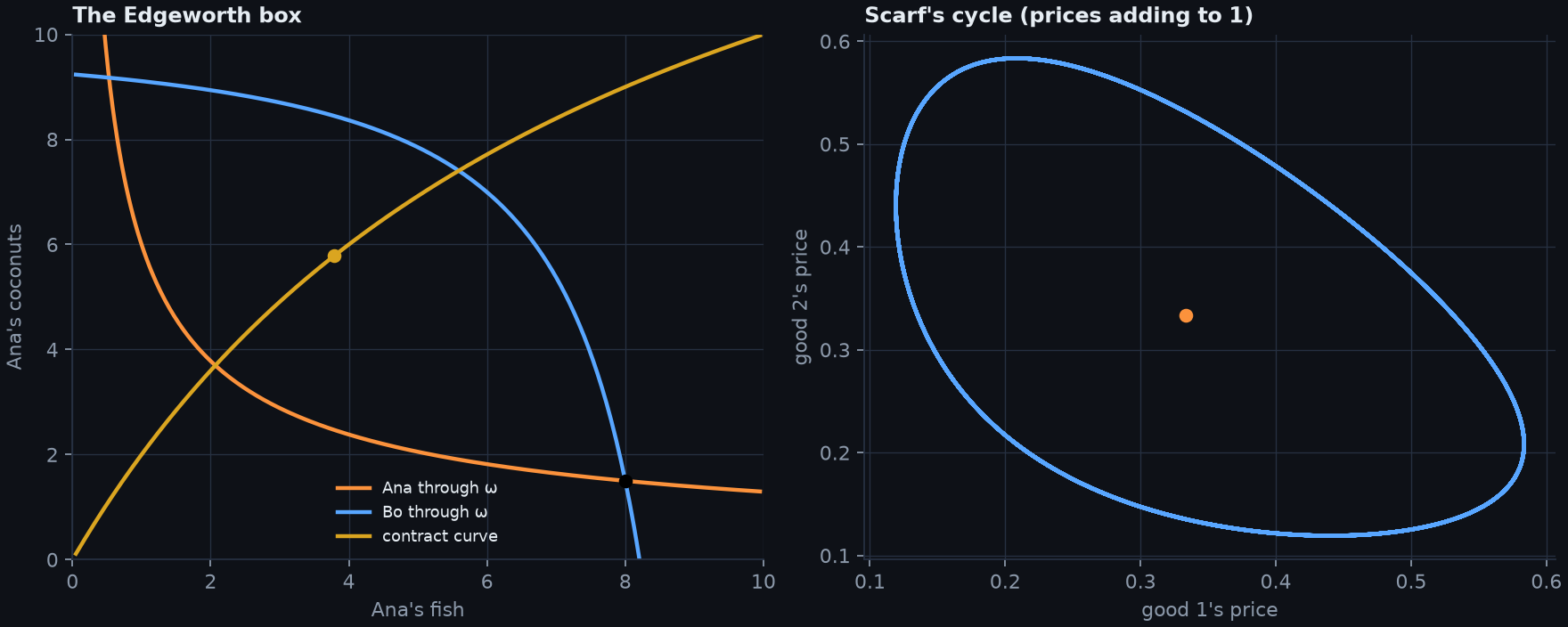
Find the competitive equilibrium of the Edgeworth box and check that it is on the contract curve; watch the core shrink as the economy is replicated; find an approximate equilibrium of a three-good economy with Sperner's labelling and Scarf's walk, and the exact one with Newton's method; run the auctioneer on the island and on Scarf's economy; share risk with Arrow securities; and read the prices off Kantorovich's linear programme.
python -m videos.economics.labs 9
needs numpy, scipy, matplotlib · download lab09.py ·
source on GitHubthe box: price of a fish (baskets); Ana's bundle 1.0179; (3.789, 5.786)
the core with 1 copy of each: Ana's fish 2.068 to 5.590
the core with 2 copies of each: Ana's fish 3.266 to 4.323
the core with 5 copies of each: Ana's fish 3.615 to 3.965
Scarf's walk on a grid of 12: rooms, and the error in prices 11, 0.0645
Scarf's walk on a grid of 48: rooms, and the error in prices 38, 0.0069
the exact equilibrium (prices adding to 1) 0.1875, 0.5089, 0.3036
Scarf's cycle: the range of sum p^2 and of p1 p2 p3 along the path 8.8e-09, 3.0e-09
Crusoe: hours worked, planned and by the market; the wage 5.1429, 5.1429; 0.4410
certainty equivalents: Arrow securities, a bond alone 50.00, 39.25
Kantorovich: sets a day; value of a day on each machine 5.00; saw: 2.000, adze: 1.333, lathe: 0.667, press: 1.000
The equilibrium of the box clears both markets and sits on the contract curve; the core narrows toward it as traders multiply; Scarf's walk lands within a hundredth of the exact prices on a fine grid; the auctioneer circles for ever in Scarf's economy, keeping two quantities constant; the market reproduces Crusoe's own plan; Arrow securities remove risk the bond cannot; and the dual of the planner's programme prices every machine's day.The code (108 lines; it asserts its own result)
"""Lab 9: general equilibrium: the box, the core, existence, stability, risk sharing and planning."""

import numpy as np

from videos.coursekit import labs
from explainer.economics.agora import ge
from explainer.economics.island import truths

TITLE = "General equilibrium: the box, the core, existence and stability"
GOAL = ("Find the competitive equilibrium of the Edgeworth box and check that it is on the contract curve; watch the "
        "core shrink as the economy is replicated; find an approximate equilibrium of a three-good economy with "
        "Sperner's labelling and Scarf's walk, and the exact one with Newton's method; run the auctioneer on the "
        "island and on Scarf's economy; share risk with Arrow securities; and read the prices off Kantorovich's "
        "linear programme.")
TASKS = [
    "The box: let Ana spend 60% of her wealth on fish instead of 40%. What happens to the price of fish, to the lens "
    "and to the core with five copies of each trader?",
    "Scarf's economy: start the auctioneer from three different prices. Check that the sum of squared prices and "
    "their product stay constant, and measure how the time for one turn depends on the start.",
    "Kantorovich: make a boat need three planks and one mast. Which machines change jobs, how many sets a day can "
    "the yard make, and what are the new resolving multipliers?",
]


def run(seed=0):
    lab = labs.Lab()
    T = truths(9)

    # the box
    b = T["box"]
    A = ge.Trader((b["ana"]["a"], 1 - b["ana"]["a"]), b["ana"]["e"])
    B = ge.Trader((b["bo"]["a"], 1 - b["bo"]["a"]), b["bo"]["e"])
    eq = ge.box_equilibrium(A, B)
    assert np.allclose(ge.excess([A, B], [eq["p"], 1.0]), 0, atol=1e-12)
    assert abs(eq["xA"][1] - float(ge.contract_curve(A, B, eq["xA"][0]))) < 1e-9
    lab.row("the box: price of a fish (baskets); Ana's bundle", f"{eq['p']:.4f}; ({eq['xA'][0]:.3f}, "
                                                                f"{eq['xA'][1]:.3f})")
    widths = []
    for r in (1, 2, 5):
        lo, hi = ge.core_interval(A, B, r)
        widths.append(hi - lo)
        lab.row(f"the core with {r} cop{'y' if r == 1 else 'ies'} of each: Ana's fish", f"{lo:.3f} to {hi:.3f}")
    assert widths[0] > widths[1] > widths[2]

    # existence and computation: three goods
    th = T["three"]
    T3 = [ge.Trader(a, e) for _, a, e in th["traders"]]

    def z(p):
        return ge.excess(T3, p)

    exact = np.array(ge.newton(z, [1.0, 1.0, 1.0])["p"])
    exact /= exact.sum()
    for N in (12, 48):
        w = ge.sperner_walk(ge.sperner_labels(z, N), N)
        lab.row(f"Scarf's walk on a grid of {N}: rooms, and the error in prices",
                f"{w['rooms']}, {np.max(np.abs(np.array(w['p']) - exact)):.4f}")
    lab.row("the exact equilibrium (prices adding to 1)", ", ".join(f"{x:.4f}" for x in exact))

    # stability
    out = ge.scarf_path(np.array(T["scarf_start"]), T=60.0)
    lab.row("Scarf's cycle: the range of sum p^2 and of p1 p2 p3 along the path",
            f"{np.ptp(out['norm']):.1e}, {np.ptp(out['product']):.1e}")
    assert np.ptp(out["norm"]) < 1e-6

    # production
    c = T["crusoe"]
    cr = ge.crusoe(c["A"], c["alpha"], c["hours"], c["b"])
    lab.row("Crusoe: hours worked, planned and by the market; the wage", f"{cr['plan']['L']:.4f}, "
                                                                        f"{cr['market']['L']:.4f}; "
                                                                        f"{cr['market']['w']:.4f}")

    # risk sharing
    rk = T["risk"]
    ad = ge.arrow_debreu(rk["e0"], rk["E"], rk["probs"], rk["beta"], rk["gamma"])
    bo = ge.bond_only(rk["e0"], rk["E"], rk["probs"], rk["beta"], rk["gamma"])
    lab.row("certainty equivalents: Arrow securities, a bond alone", f"{ad['ce'][0]:.2f}, {bo['ce'][0]:.2f}")

    # planning
    k = T["plan"]
    kp = ge.kantorovich(k["rates"], k["kit"])
    lab.row("Kantorovich: sets a day; value of a day on each machine", f"{kp['sets']:.2f}; " +
            ", ".join(f"{m}: {v:.3f}" for m, v in zip(k["machines"], kp["machine_value"])))
    lab.note = ("The equilibrium of the box clears both markets and sits on the contract curve; the core narrows "
                "toward it as traders multiply; Scarf's walk lands within a hundredth of the exact prices on a fine "
                "grid; the auctioneer circles for ever in Scarf's economy, keeping two quantities constant; the "
                "market reproduces Crusoe's own plan; Arrow securities remove risk the bond cannot; and the "
                "dual of the planner's programme prices every machine's day.")

    fig, ax = labs.figure(2, size=(11, 4.4))
    X = np.add(A.e, B.e)
    xs = np.linspace(0.05, X[0] - 0.05, 300)
    ax[0].plot(xs, ge.cd_indifference(A.a[0], A.utility(A.e), xs), color=labs.ORANGE, lw=2, label="Ana through ω")
    ax[0].plot(xs, X[1] - ge.cd_indifference(B.a[0], B.utility(B.e), X[0] - xs), color=labs.BLUE, lw=2,
               label="Bo through ω")
    ax[0].plot(xs, ge.contract_curve(A, B, xs), color="goldenrod", lw=2, label="contract curve")
    ax[0].plot(*A.e, "ko")
    ax[0].plot(*eq["xA"], "o", color="goldenrod")
    ax[0].set(xlim=(0, X[0]), ylim=(0, X[1]), title="The Edgeworth box", xlabel="Ana's fish",
              ylabel="Ana's coconuts")
    ax[0].legend(fontsize=8)
    P = np.array(out["p"])
    Q = P / P.sum(axis=1, keepdims=True)
    ax[1].plot(Q[:, 0], Q[:, 1], color=labs.BLUE, lw=2)
    ax[1].plot([1 / 3], [1 / 3], "o", color=labs.ORANGE)
    ax[1].set(title="Scarf's cycle (prices adding to 1)", xlabel="good 1's price", ylabel="good 2's price")
    lab.fig = fig
    return lab
Now change it
- The box: let Ana spend 60% of her wealth on fish instead of 40%. What happens to the price of fish, to the lens and to the core with five copies of each trader?
- Scarf's economy: start the auctioneer from three different prices. Check that the sum of squared prices and their product stay constant, and measure how the time for one turn depends on the start.
- Kantorovich: make a boat need three planks and one mast. Which machines change jobs, how many sets a day can the yard make, and what are the new resolving multipliers?
Problems, with solutions
Try each problem before opening its solution.
1. The box: Ana spends a share \(a\) of her wealth on fish, Bo a share \(b\), and there are \(X\) fish and \(Y\) baskets. Show that the contract curve is \(y = \frac{k_B x Y}{k_A (X - x) + k_B x}\) with \(k = \tfrac{a}{1-a}\), and find it for Ana and Bo.
Solution
Ana's marginal rate of substitution at \((x, y)\) is \(k_A\,y/x\); Bo holds \((X - x, Y - y)\), so his is \(k_B (Y - y)/(X - x)\). Setting them equal, \(k_A y (X - x) = k_B x (Y - y)\), so \(y\,[k_A (X - x) + k_B x] = k_B x Y\). For Ana and Bo, \(k_A = 2/3\) and \(k_B = 3/2\), so \(y = 15x/(\tfrac{20}{3} + \tfrac{5}{6}x)\): it runs from Ana's corner to Bo's, bowing above the diagonal because Bo cares more for fish.
2. Equilibrium: derive the competitive price \(p = \frac{a\,e_{A2} + b\,e_{B2}}{(1-a)\,e_{A1} + (1-b)\,e_{B1}}\) (fish in baskets) and check it for Ana and Bo.
Solution
With coconuts as numeraire, Ana's wealth is \(p e_{A1} + e_{A2}\) and she demands \(a(p e_{A1} + e_{A2})/p\) fish; Bo likewise. The fish market clears when \(a(p e_{A1} + e_{A2}) + b(p e_{B1} + e_{B2}) = p(e_{A1} + e_{B1})\), that is \(p[(1-a) e_{A1} + (1-b) e_{B1}] = a e_{A2} + b e_{B2}\). For Ana and Bo: \(p = (0.4 \cdot 1.5 + 0.6 \cdot 8.5) /(0.6 \cdot 8 + 0.4 \cdot 2) = 5.7/5.6 = 1.018\). Ana then holds \(0.4 \cdot 9.643/1.018 = 3.79\) fish and \(0.6 \cdot 9.643 = 5.79\) baskets.
3. Walras's law: show that \(p \cdot z(p) = 0\) for any prices, and that only relative prices matter.
Solution
Each trader's demand satisfies the budget, \(p \cdot x_i(p) = p \cdot e_i\) (with more always better, the whole budget is spent). Summing, \(p \cdot \sum_i (x_i(p) - e_i) = p \cdot z(p) = 0\). Multiplying every price by \(\lambda > 0\) multiplies every budget by \(\lambda\) and leaves the budget sets, and so the demands, unchanged: \(z(\lambda p) = z(p)\). So prices can be scaled to add to one, and \(n\) goods have \(n - 1\) relative prices.
4. The first welfare theorem: where does the proof use local nonsatiation? Give an economy where the theorem fails without it.
Solution
In step 2: a trader who is indifferent between \(x'_i\) and her equilibrium bundle cannot find \(x'_i\) cheaper than her wealth, because if she could, local nonsatiation would put something slightly better within her budget, contradicting her choice. Without it, take two traders, each with 5 of each good; Ana's utility is \(\min(x, 3) + \min(y, 3)\), so she is satiated at \((3, 3)\), and Bo's is \(\log x + \log y\). At equal prices both may keep their endowments (Ana is indifferent among all her affordable bundles that include \((3, 3)\)), so no trade is an equilibrium; but moving \((2, 2)\) from Ana to Bo makes Bo better off and Ana no worse: the equilibrium is not Pareto efficient.
5. The second theorem: find the transfer that makes the efficient point with 5 fish for Ana an equilibrium.
Solution
On the contract curve at \(x = 5\), \(y = 15 \cdot 5/(\tfrac{20}{3} + \tfrac{25}{6}) = 6.923\). The common MRS there is \(k_A y/x = \tfrac{2}{3} \cdot 6.923/5 = 0.923\) baskets a fish, the supporting price. Ana's budget line must pass through the target, so her wealth at that price must be \(0.923 \cdot 5 + 6.923 = 11.54\) baskets; she has \(0.923 \cdot 8 + 1.5 = 8.88\). A transfer of \(2.65\) baskets from Bo to Ana, before trade, does it, and at that price each then demands exactly the target.
6. Scarf's economy: show that \(\sum_k p_k^2\) and \(p_1 p_2 p_3\) are constant along the auctioneer's path.
Solution
Along \(\dot p = z(p)\), \(\tfrac{d}{dt}\sum_k p_k^2 = 2\,p \cdot z(p) = 0\) by Walras's law. For the product, \(\tfrac{d}{dt}\log(p_1p_2p_3) = \sum_j z_j/p_j\). Trader \(j\) demands \(p_j/(p_j + p_{j+1})\) of goods \(j\) and \(j+1\), so \(z_j = \frac{p_j}{p_j + p_{j+1}} + \frac{p_{j-1}}{p_{j-1} + p_j} - 1\) and \(z_j/p_j = \frac{1}{p_j + p_{j+1}} - \frac{1}{p_{j-1} + p_j}\); summed round the cycle of three goods, the terms cancel. Two conserved quantities pin the path to a closed curve around equal prices.
7. Arrow securities: with no aggregate risk and equal patience and risk aversion, show that complete markets give full insurance, and find the securities' prices.
Solution
Trader \(i\)'s first-order conditions are \(\beta \pi_s u'(c_{is}) = \lambda_i q_s\) and \(u'(c_{i0}) = \lambda_i\). If every trader consumes the same in every state and the total in each state is the same, then \(c_{is} = c_{i0}\) is consistent with clearing and \(q_s = \beta \pi_s\). For Ana and Chidi, with 50 today and 100 in total in each state, both consume 50 everywhere and \(q_s = 0.95 \cdot 0.5 = 0.475\); Ana sells 30 calm-state claims and buys 30 storm-state claims, which cost the same, so her trade is self-financing.
8. ★ Kantorovich: write the dual of the boatyard's programme, and show that a machine works on a part only if its day's value there equals the machine's price.
Solution
The primal: maximize \(z\) subject to \(\sum_j t_{ij} \le 1\) for each machine (multiplier \(\lambda_i\)), \(k_j z \le \sum_i r_{ij} t_{ij}\) for each part (\(\mu_j\)), \(t, z \ge 0\). The dual: minimize \(\sum_i \lambda_i\) subject to \(\lambda_i \ge r_{ij}\mu_j\) for every machine and part, \(\sum_j k_j \mu_j \ge 1\), \(\lambda, \mu \ge 0\). Complementary slackness: \(t_{ij} > 0\) only if \(\lambda_i = r_{ij}\mu_j\), and since \(\lambda_i \ge r_{ij}\mu_j\) for every \(j\), a machine works only where its day is worth the most. For the yard, \(\mu = (\tfrac13, \tfrac13)\) and \(\lambda = (2, \tfrac43, \tfrac23, 1)\): the saw's day is worth 2 on planks and \(\tfrac13\) on masts, the press's \(\tfrac13\) and 1, and the lathe's \(\tfrac23\) either way; \(\sum_i \lambda_i = 5\), the number of sets, as strong duality requires.
Notes and sources
Where it comes back
| Idea | Parts |
|---|---|
| Market power and the price maker | 10 The Price Maker, 12 Competition among the Few |
| Games and Nash equilibrium | 11 Games |
| The failures of the first theorem | 13 Lemons and Signals, 14 Incentives, 15 Spillovers |
| Markets by design | 16 Auctions, 17 Markets by Design |
| Fairness and social choice | 18 Social Choice and Welfare, 41 Taxes |
| Misallocation and growth | 21 Growth II: Ideas and Institutions |
| The prices of risk | 23 Capital and Asset Prices, 33 Crises |
| Trade and the new-goods margin | 35 Trade I, 36 Trade II |
Sources
- R. A. Radford, "The Economic Organisation of a P.O.W. Camp", Economica, New Series 12(48) (1945) 189-201.
- F. Y. Edgeworth, Mathematical Psychics (London, 1881), pp. 20-21; L. Walras, Éléments d'économie politique pure (Lausanne, 1874).
- K. J. Arrow and G. Debreu, "Existence of an Equilibrium for a Competitive Economy", Econometrica 22(3) (1954) 265-290; L. W. McKenzie, "On Equilibrium in Graham's Model of World Trade and Other Competitive Systems", Econometrica 22(2) (1954); G. Debreu, Theory of Value (1959).
- G. Debreu and H. Scarf, "A Limit Theorem on the Core of an Economy", International Economic Review 4(3) (1963); R. J. Aumann, "Markets with a Continuum of Traders", Econometrica 32(1/2) (1964).
- K. J. Arrow, H. D. Block and L. Hurwicz, "On the Stability of the Competitive Equilibrium, II", Econometrica 27(1) (1959); H. Scarf, "Some Examples of Global Instability of the Competitive Equilibrium", International Economic Review 1(3) (1960); H. Scarf, "The Approximation of Fixed Points of a Continuous Mapping", SIAM Journal on Applied Mathematics 15(5) (1967), and The Computation of Economic Equilibria (1973); C. M. Anderson, C. R. Plott, K.-I. Shimomura and S. Granat, "Global Instability in Experimental General Equilibrium: The Scarf Example", Journal of Economic Theory 115(2) (2004) 209-249.
- H. Sonnenschein, "Do Walras' Identity and Continuity Characterize the Class of Community Excess Demand Functions?", Journal of Economic Theory 6(4) (1973); R. Mantel, "On the Characterization of Aggregate Excess Demand", Journal of Economic Theory 7(3) (1974); G. Debreu, "Excess Demand Functions", Journal of Mathematical Economics 1(1) (1974); A. Kirman, "Whom or What Does the Representative Individual Represent?", Journal of Economic Perspectives 6(2) (1992); D. J. Brown and R. L. Matzkin, "Testable Restrictions on the Equilibrium Manifold", Econometrica 64(6) (1996).
- K. J. Arrow, "Le rôle des valeurs boursières pour la répartition la meilleure des risques" (1953), translated as "The Role of Securities in the Optimal Allocation of Risk-bearing", Review of Economic Studies 31(2) (1964).
- L. von Mises, "Die Wirtschaftsrechnung im sozialistischen Gemeinwesen" (1920); O. Lange, "On the Economic Theory of Socialism", Review of Economic Studies 4(1) and 4(2) (1936-37); F. A. Hayek, "The Use of Knowledge in Society", American Economic Review 35(4) (1945) 519-530; L. V. Kantorovich, Mathematical Methods of Organizing and Planning Production (Leningrad, 1939), translated in Management Science 6(4) (1960).
- C.-T. Hsieh and P. J. Klenow, "Misallocation and Manufacturing TFP in China and India", Quarterly Journal of Economics 124(4) (2009) 1403-1448 (read in the December 2008 accepted version); M. Bils, P. J. Klenow and C. Ruane, "Misallocation or Mismeasurement?", Journal of Monetary Economics 124(S) (2021) S39-S56 (NBER Working Paper 26711, 2020).
- T. J. Kehoe, "An Evaluation of the Performance of Applied General Equilibrium Models of the Impact of NAFTA", in Frontiers in Applied General Equilibrium Modeling (Cambridge, 2005); T. J. Kehoe, "The Challenges of Predicting the Impact of Trade Reforms", in NAFTA at 20 (Federal Reserve Bank of Dallas, 2014), table 1; USITC publication 2516 (1992).
- C. H. Papadimitriou, "On the Complexity of the Parity Argument and Other Inefficient Proofs of Existence", Journal of Computer and System Sciences 48(3) (1994); C. Daskalakis, P. W. Goldberg and C. H. Papadimitriou, "The Complexity of Computing a Nash Equilibrium", SIAM Journal on Computing 39(1) (2009); X. Chen, D. Dai, Y. Du and S.-H. Teng, "Settling the Complexity of Arrow-Debreu Equilibria in Markets with Additively Separable Utilities", FOCS (2009); L. Shapley and H. Scarf, "On Cores and Indivisibility", Journal of Mathematical Economics 1(1) (1974); A. E. Roth, "Incentive Compatibility in a Market with Indivisible Goods", Economics Letters 9(2) (1982); E. Budish, "The Combinatorial Assignment Problem: Approximate Competitive Equilibrium from Equal Incomes", Journal of Political Economy 119(6) (2011); E. Budish, G. P. Cachon, J. B. Kessler and A. Othman, "Course Match", Operations Research 65(2) (2017).
- U.S. Energy Information Administration, crude oil prices (Brent, WTI), via FRED; the World Bank, World Development Indicators (GDP per head at market prices and at PPP, 2023).
About this partfrom its README
Part 9 of a sixty-eight-part course in economics (see the series plan and the syllabus), the first of Act III, Markets. It asks whether a whole economy of selfish traders can reach a state that nobody could improve on, and whether it will, and answers: it can, and it need not. An equilibrium in which every market clears exists for any economy of the kind Arrow and Debreu described; it is efficient if every good has a price, nobody sets prices and everyone knows what they are buying; and in a large economy it is the only outcome no group can undo. But nothing guarantees there is only one, or that a market finds it, and efficient is not the same as fair.
It opens in R. A. Radford's prisoner-of-war camps (Economica, 1945): equal Red Cross parcels; a padre who walked round a transit camp in Italy with a tin of cheese and five cigarettes and came back with a complete parcel as well; cigarettes as the standard of value; "cheese for seven" on the Exchange and Mart boards; one price across a permanent camp and two cigarettes in twenty across a single hut of a transit camp; the halving of August 1944, the Bully Mark and the blizzard of February 1945; and the arrival of the 30th U.S. Infantry Division on 12 April 1945. Nine years later Arrow and Debreu proved that order of that kind can exist in any economy that meets their conditions. From there it covers:
- a game: four proposed trades between Ana (8 fish, 1.5 baskets of coconuts) and Bo (2 fish, 8.5 baskets), to accept or refuse;
- the Edgeworth box: indifference maps, the lens of mutual gains, Pareto efficiency and the contract curve (Edgeworth's name, 1881);
- prices: budget lines, offer curves, the competitive equilibrium at 1.018 baskets a fish, Walras's law, and the law of one price as a Fact;
- the core of the replicated economy, shrinking to the competitive allocation (Edgeworth's conjecture; Debreu and Scarf 1963; Aumann 1964);
- the first welfare theorem proved in five lines, and the assumptions that Act IV relaxes;
- the second welfare theorem: a target allocation, its supporting price, the lump-sum transfer, the separating hyperplane, and why such transfers are rare;
- an intermission without narration: Brent and West Texas Intermediate crude, month by month, 1987-2026;
- existence: the price simplex, Brouwer's theorem, Sperner's colouring and Scarf's door-to-door walk;
- stability: the auctioneer, gross substitutes (Arrow, Block and Hurwicz), Scarf's economy that circles for ever, and its laboratory test (Anderson, Plott, Shimomura and Granat 2004);
- the whole Island cleared at once, by Newton's method and by the auctioneer;
- production: Crusoe decentralized into a firm and a household;
- anything goes: an economy with three equilibria, and the Sonnenschein-Mantel-Debreu theorem;
- time and uncertainty: Arrow securities share the islanders' weather risk, and a bond alone cannot;
- the calculation debate (Mises, Lange, Hayek) and Kantorovich's linear programme with its resolving multipliers;
- a new dial (the TFP gain from equalizing marginal products: Hsieh and Klenow; Bils, Klenow and Ruane), computable general equilibrium models in practice and the 1992 NAFTA forecasts against what happened, and a frontier chapter on PPAD, Shapley and Scarf's housing market and Budish's course market.
What is computed and built
Everything plotted is computed by compute.py from Agora's general equilibrium (explainer.economics.agora.ge),
with the Island's Part 9 truths in explainer.economics.island, or from the Data Room or a transcribed table; the
narration states the cached numbers.
- The box. Cobb-Douglas traders; the contract curve in closed form; the lens's ends by root-finding along it; the equilibrium price in closed form; offer curves by demand at 300 prices.
- The core. For \(r\) copies of each trader, a contract-curve allocation is blocked if some coalition of \(s\) Anas and \(t\) Bos (\(s, t \le r\), \(s \ne t\)), treating members of a type alike, can give its Bos what the allocation gave them and leave its Anas better off; the best such deal for the Anas is found on a grid of 2,001 points along the Bos' indifference curve and refined; the core's two ends by bisection.
- Existence. Grid points of the simplex labelled by the first good with a positive price that is not in excess demand (a Sperner labelling, checked); Scarf's walk from the first door on the face where timber is free; the exact equilibrium by Newton's method.
- Dynamics. Tatonnement \(\dot p = z(p)\) by an adaptive Runge-Kutta solver (relative tolerance \(10^{-9}\)); Scarf's economy with Leontief traders; the island's auctioneer by Euler steps of 0.1 \(z(p)\).
- The rest. Crusoe's wage by root-finding on the labour market; the three-equilibrium economy in closed form (endowments \((2, r)\) and \((r, 2)\) with \(r = 2^{8/9} - 2^{1/9}\), utilities \(x - y^{-8}/8\) and \(y - x^{-8}/8\)); Arrow-Debreu state prices by solving the clearing conditions, the bond economy by its first-order conditions; Kantorovich's programme by HiGHS with its duals; the misallocation simulation with labour only and \(\sigma = 3\); top trading cycles by the algorithm; the villages of the Fact with demand \(12 - p\) and a carrying cost of $1.
Chapter notes
| # | Chapter | What it does |
|---|---|---|
| 0 | Can a whole economy of selfish traders reach a state nobody could improve on, and will it? | Radford's camps: Oflags of 1,200 to 2,500 prisoners; the parcel; "Everyone receives a roughly equal share of essentials; it is by trade that individual preferences are given expression and comfort increased"; the padre; "cheese for seven"; the Exchange and Mart board (drawn with Radford's prices); the salmon; August 1944, the Bully Mark at four-fifths of a cigarette, February 1945, 12 April 1945; Arrow and Debreu (1954); the question; objectives |
| 1 | Play it: trade in the box | Ana and Bo; four trades: 2 fish for 1 basket (both gain, more to gain), 4.2 for 4.3 (both gain, efficient, the market's trade to the first decimal), 2 for 6 (Bo refuses), 6 for 1.5 (Ana refuses) |
| 2 | The Edgeworth box | The box (Edgeworth's idea; drawn in this form by Pareto and Bowley); indifference maps; the lens; the trades of Play it inside and outside it; tangency, Pareto efficiency, MRS equal; the contract curve, "which locus it is here proposed to call the contract-curve"; efficient is not fair |
| 3 | Prices: offer curves, equilibrium, Walras's law | At 1.5 baskets a fish Ana sells 4.4 fish and Bo buys 2.6: excess supply 1.8; offer curves cross at 1.018: Ana sells 4.21 fish for 4.29 baskets; Walras (1874); \(p_{\text{fish}}z_{\text{fish}} + p_{\text{coco}}z_{\text{coco}} = 0\); the Fact: one price (Brent minus WTI averaged \(-1.37\) a barrel in 1987-2010; the 20 poorest countries' price level 0.33 of America's; Agora's villages: fish carried at $1 cost $5.50 and $6.50, haircuts $8 and $4) |
| 4 | The core, and Edgeworth's conjecture | The core of the box: 2.07 to 5.59 fish for Ana; two Anas and one Bo block a deal good for Bo; with 2, 3, 5, 10, 20 copies: 3.27-4.32, 3.48-4.11, 3.62-3.96, 3.71-3.87, 3.75-3.83, around the competitive 3.79; Edgeworth (1881, p. 20); Debreu and Scarf (1963); Aumann (1964) |
| 5 | The first welfare theorem | Both MRS equal the price, 1.018; the five-line proof; what it assumes: a price for everything (Part 15), price-taking (Parts 10, 12), information (Part 13), complete markets (chapter 12, Part 23), and efficient is not fair (Parts 18, 41) |
| 6 | The second welfare theorem | The efficient point with 5 fish and 6.92 baskets for Ana, supported by a price of 0.923; a transfer of 2.65 baskets from Bo; the separating hyperplane between the two better-than sets; convexity; why lump-sum transfers are rare |
| Intermission: one price for oil? | No narration: Brent and WTI, monthly, May 1987 to October 2026, with the gap below; three notes (usually within a dollar or two for 24 years; 2011-13 and Cushing; new pipelines and exports from December 2015) and a fourth that 2026's spike is too recent to explain; Brent's premium year by year as a tune; the story so far | |
| 7 | Existence: Sperner's lemma and Scarf's walk | Three goods and three islanders on the price simplex; excess-demand arrows; the map \(f(p)_k = (p_k + \max(z_k,0))/(1 + \sum_j \max(z_j,0))\) and Brouwer (1912); Arrow and Debreu, and McKenzie (1954); Sperner's lemma (1928) as a colouring; the door-to-door walk: 7, 11 and 38 rooms on grids of 6, 12 and 48, errors 0.12, 0.064, 0.007; Scarf (1967) |
| 8 | Does it get there? The auctioneer and Scarf's cycle | Tatonnement \(\dot p = z(p)\) converges on the island (Arrow, Block and Hurwicz 1959: gross substitutes); Scarf's three traders who want goods \(i\) and \(i+1\) together: the prices circle the equal-price equilibrium, with \(\sum p^2\) and \(p_1p_2p_3\) conserved; Anderson, Plott, Shimomura and Granat (2004) |
| 9 | Computing an equilibrium: the Island cleared at once | Five goods, twelve islanders with CES tastes (elasticities 0.6 to 1.7); prices with fish = 1: coconuts 0.48, timber 0.71, cloth 0.43, salt 0.85; the auctioneer takes 238 steps to a millionth, Newton 6 to \(10^{-13}\) |
| 10 | Production: Crusoe decentralized | 12 hours, \(c = 2\sqrt{L}\), \(0.6\log c + 0.4\log(\text{leisure})\): the plan works 5.14 hours for 4.54 coconuts; the market's wage 0.441, profit 2.27, the same plan; convexity, and increasing returns as the way to market power |
| 11 | Anything goes: Sonnenschein, Mantel and Debreu | Two traders whose excess demand crosses zero at relative prices 1/2, 1 and 2, the middle one unstable; the theorem (Sonnenschein 1973; Mantel 1974; Debreu 1974); no general uniqueness, stability or comparative statics; Kirman (1992); Brown and Matzkin (1996) |
| 12 | Time and uncertainty: Arrow's securities | Ana's fishing (80 calm, 20 storm) and Chidi's coconuts (20, 80); contingent goods (Arrow 1953, Debreu 1959); two Arrow securities at 0.475; Ana sells 30 calm claims and buys 30 storm claims; both eat 50 in either weather, as good as 50 a year for sure against 39.25 without trade; a bond alone is not traded, and shares nothing |
| 13 | The calculation debate: Mises, Lange, Hayek and Kantorovich | Mises (1920), Lange (1936-37), Hayek (1945): "a system of telecommunications"; Kantorovich's programme for the yard's four machines: 5 sets a day against 2.85; the dual's values (saw 2.00, adze 1.33, lathe 0.67, press 1.00; a plank and a mast a third of a set each); 1975, with Koopmans; information and incentives |
| 14 | The Dials: what misallocation costs | Equal marginal products as the first theorem for firms; \(\log(Y_{\text{eff}}/Y) = \tfrac{\sigma}{2}s^2\); 100,000 simulated plants: 43% with America's 1997 spread, 83% with China's 2005; Hsieh and Klenow: China 30.5% and India 59.2% to US efficiency, full equalization 42.9%, 86.6%, 127.5%; Bils, Klenow and Ruane: measurement error a fifth of India's gap and three fifths of America's: contested |
| 15 | In practice: general equilibrium models, and NAFTA | CGE models: built on input-output tables, calibrated, used for trade, taxes and carbon; Called it?: Sobarzo's 1992 forecasts against 1989-2009 (median +95%, tobacco +576%; weighted correlation \(-0.12\), unweighted \(-0.39\) from the table); the new-goods margin (Kehoe and Ruhl), whose rule correlates 0.47 |
| 16 | Frontier: hard equilibria, and markets without money | PPAD (Papadimitriou 1994); Nash equilibrium PPAD-complete (Daskalakis, Goldberg and Papadimitriou; Chen and Deng); markets as hard (Chen, Dai, Du and Teng 2009); Shapley and Scarf's housing market with Gale's top trading cycles on six huts, in three rounds; Roth (1982); Budish's approximate competitive equilibrium from equal incomes and Course Match |
| Recap, problems, and the road ahead | The answer; twelve lines; problems; reading; Dupuit's roofless carriages, and Part 10 |
Companion material in this repository
The syllabus's plan for this partfrom SYLLABUS.md, the plan of record
- Hook: Radford's camps (the parcel, the padre, "cheese for seven", the board, the salmon, August 1944, the Bully Mark, February 1945, liberation); Arrow and Debreu (1954); the question; objectives.
- Play it: four proposed trades between Ana and Bo, accepted or refused.
- The Edgeworth box: indifference maps, the lens, Pareto efficiency, the contract curve (Edgeworth's name).
- Prices: budget lines, offer curves, the equilibrium at 1.018 baskets a fish, Walras's law; the law of one price as a Fact (Brent against WTI; price levels across countries; Agora's two villages; Radford's salmon).
- The core and Edgeworth's conjecture: a blocking coalition; the core of the replicated box, computed for 1 to 20 copies; Debreu and Scarf (1963), Aumann (1964).
- The first welfare theorem in five lines; its assumptions as the map of Act IV.
- The second welfare theorem: a target, its supporting price, the lump-sum transfer, the separating hyperplane; why lump-sum transfers are rare. Intermission: Brent and WTI month by month, 1987-2026, the gap as a tune.
- Existence: the price simplex, Brouwer's fixed point, Sperner's colouring and Scarf's door-to-door walk (grids of 6, 12 and 48).
- Stability: tatonnement, gross substitutes (Arrow, Block and Hurwicz 1959), Scarf's cycle with its two conserved quantities, and its laboratory test (Anderson, Plott, Shimomura and Granat 2004).
- Computing an equilibrium: the Island's five goods and twelve islanders, by Newton (6 steps) and the auctioneer (238).
- Production: Crusoe decentralized into a firm and a household; convexity, and increasing returns.
- Anything goes: three equilibria in a two-trader economy; Sonnenschein, Mantel and Debreu; Kirman; Brown and Matzkin.
- Time and uncertainty: Arrow securities share Ana's and Chidi's weather risk; a bond alone shares nothing.
- The calculation debate: Mises, Lange, Hayek; Kantorovich's programme for the yard's machines and its resolving multipliers.
- Dials (misallocation, new). 15. In practice: computable general equilibrium models; Called it?: the 1992 NAFTA forecasts against 1989-2009 (Kehoe). 16. Frontier: PPAD; Shapley and Scarf's housing market and top trading cycles; Budish's course market.
Agora: ge: traders (Cobb-Douglas, CES, Leontief), the Edgeworth box, offer curves, the core of the replicated
economy by coalition checks, Sperner's labelling and Scarf's walk, tatonnement and Scarf's cycle, Newton, Crusoe,
three equilibria, Arrow securities and a bond economy, Kantorovich's programme with duals, misallocation with Hsieh
and Klenow's formula, top trading cycles. The whole Island cleared at once.
Dials: the TFP gain from equalizing marginal products (new; contested). Facts: the law of one price. Called
it? Sobarzo's 1992 forecasts of NAFTA, wrong.
Reading: Radford 1945; Edgeworth 1881; Walras 1874; Arrow & Debreu 1954; McKenzie 1954; Debreu, Theory of Value;
Debreu & Scarf 1963; Aumann 1964; Arrow, Block & Hurwicz 1959; Scarf 1960, 1967, 1973; Anderson et al. 2004;
Sonnenschein 1973; Mantel 1974; Debreu 1974; Kirman 1992; Brown & Matzkin 1996; Arrow 1953; Mises 1920; Lange
1936-37; Hayek 1945; Kantorovich 1939; Hsieh & Klenow 2009; Bils, Klenow & Ruane 2021; Kehoe 2005, 2014;
Papadimitriou 1994; Daskalakis, Goldberg & Papadimitriou 2009; Shapley & Scarf 1974; Roth 1982; Budish 2011; MWG chs
15-19; Kreps; Jehle & Reny ch 5.
Build the film
python -m videos.economics.econ9.compute        # the part's numbers, into .cache/econ9
python tools/build.py econ9                  # render and assemble the film
EXPLAINER_TTS=silent python tools/qa_scene.py econ9 Hook   # one chapter, silent, with a contact sheet
Scenes: videos/economics/econ9. Setup: see the course page. Source of these notes: the README and the scenes' narration.
Build it
python -m videos.economics.econ9.compute              # every number (seconds), into .cache/econ9/
python tools/qa_scene.py econ9 Core                   # one chapter, silent, at 480p, with a contact sheet
EXPLAINER_TTS=silent python tools/build.py econ9 -q l   # the whole part, silent preview
python tools/build.py econ9                           # 1080p30 with narration and the series' computed score
python -m videos.economics.labs 9                     # the lab
The data are frozen extracts in explainer/economics/data/, registered in
SOURCES.md: Brent and West Texas Intermediate crude oil prices,
monthly, via FRED (from the U.S. Energy Information Administration); GDP per head at market prices and at
purchasing-power parity from the World Bank's WDI (2023); and transcribed passages and tables from Radford (1945),
Edgeworth (1881), Hsieh and Klenow (2009), Bils, Klenow and Ruane (2021) and Kehoe (2014), in
explainer/economics/data/tables.py with where they were read and the date they were checked.