Auctions
How should something be sold when nobody knows what it is worth to the buyers?
The part opens with Britain's 3G auction of 2000, designed by game theorists: thirteen bidders, 150 rounds, 22.5 billion pounds; that summer the Netherlands copied the design with as many licences as incumbents and raised less than a third of its forecast. The viewer bids twice for Crusoe's canoe, once paying the bid and once the next bid, then meets the four formats on the English and Dutch clocks, Vickrey's proof (and Goethe's sealed offer), shading derived, revenue equivalence on 60,000 simulated auctions and by the envelope argument, and the ways it fails: risk, the laboratory, linked values, asymmetry, collusion and entry. After an intermission of ninety years of the Treasury bill, Myerson's reserve and Bulow and Klemperer's extra bidder, the winner's curse from the Gulf of Mexico's oil leases to a jar of coins, the simultaneous ascending auction and the exposure problem, signals in the digits and the Dutch sale with Called it?, the auction behind every search, demand reduction in bond auctions and electricity, a new dial on what a reserve adds, auction desks, and a frontier on the incentive auction, credible auctions and machines that bid.
What you need. Part 7: risk aversion and expected utility; Part 10: the monopoly price; Part 11: Nash equilibrium and dominant strategies; Part 13: private information. Chapters 4-5 use order statistics of uniform variables and the envelope theorem; chapter 7 a hazard rate.
- Hook
- £22.5 billion for air, London, 2000
- Ideas, models and mathematics
- four formats, Vickrey's truth-telling, revenue equivalence proved, Myerson's optimal auction, the winner's curse, spectrum and ad auctions, collusion and bad designs
- Agora gains
- an auction house
- Play it
- bid in a first-price and a second-price auction
What you will be able to do
Principles and the major
- Describe the English, Dutch, first-price and second-price auctions, and explain which are strategically equivalent.
- Prove that bidding one's value is dominant in a second-price auction, and derive equilibrium bid shading in a first-price auction.
- Explain the winner's curse, and why it grows with the number of bidders.
Graduate
- State and prove revenue equivalence with the envelope formula, and use it to solve the all-pay auction.
- Derive Myerson's optimal reserve from virtual values, and compare it with one more bidder.
- Compute Vickrey's prices for position auctions and the equilibrium of the generalized second price, and explain demand reduction under a uniform price.
Research
- Read the evidence on reserves, overbidding and collusion, and recover values from first-price bids (Guerre, Perrigne and Vuong).
Practice
- Design an auction for a given set of bidders, weighing entry, collusion, exposure and the seller's risk.
Contents
Each chapter has a home level. Choose a track to see what to read and watch: Principles and the major 48 min · Graduate 50 min · Research 56 min · Practice 50 min.
- 0How should something be sold when nobody knows what it is worth?Principles and the major4 min
- 1Play it: two sealed bidsPrinciples and the major3 min
- 2Four formats, two gamesPrinciples and the major3 min
- 3Vickrey: bid your valuePrinciples and the major3 min
- 4Shading in a first-price auctionPrinciples and the major2 min
- 5Revenue equivalencePrinciples and the major4 min
- 6When equivalence failsPrinciples and the major3 min
- Intermission: ninety years of the Treasury billPrinciples and the major
- 7Myerson: the reserve pricePrinciples and the major3 min
- 8The winner's cursePrinciples and the major4 min
- 9Selling the airwavesPrinciples and the major4 min
- 10What went wrongPrinciples and the major4 min
- 11The auction behind every searchPrinciples and the major3 min
- 12Many units: bonds and electricityPrinciples and the major3 min
- 13The Dials: what a reserve addsResearch2 min
- 14In practice: auction desksPractice3 min
- 15Frontier: new auctions, new biddersResearch4 min
- Recap, problems, and the road aheadAll tracks3 min
Also on this page: Lecture · Key results · Try it · Lab · Problems · Notes and sources · Build the film.
Lecture
The text of each chapter is the film's narration, as it is spoken, so you can read along or revise without the film. The pictures are in the film.
How should something be sold when nobody knows what it is worth?Principles and the major4 min
On the sixth of March 2000 the British government began to sell five licences to use the airwaves for the third generation of mobile phones, the ones that would carry the internet. It sold them by auction. Thirteen companies bid for five licences, one of which was kept for a company that did not already run a network. The bidding went on for seven weeks and a hundred and fifty rounds, with every licence open until nobody wanted to bid again. It raised twenty-two and a half billion pounds, about two and a half percent of the nation's income. That was five to ten times what the newspapers had predicted. The sale had been designed by economists, led by Ken Binmore and Paul Klemperer, using the theory of games.
That summer the rest of Europe sold the same kind of licences. Here is what each country raised, in euros per person. Britain, six hundred and fifty. Germany, six hundred and fifteen. Italy, two hundred and forty. The Netherlands, a hundred and seventy: its government had forecast almost ten billion euros, and raised less than three. Austria, a hundred. And Switzerland, in the autumn, twenty. The airwaves were much the same, and so were the phones and the companies. What differed was the design of the sale, and who turned up to bid.
Auctions are everywhere that a seller does not know what something is worth to its buyers. Governments sell the airwaves this way. The American Treasury has sold its bills by auction since 1929. Every advertisement beside a search result is placed by an auction, run in a fraction of a second while the page loads. Electricity markets clear generators' offers through the day. Art, houses and the morning's catch are auctioned, as they have been for centuries. And governments buy by auction in reverse, where the lowest offer wins.
Part fifteen was about the spillovers no market prices. This part is about markets built on purpose. How should something be sold, when nobody knows what it is worth to the buyers? Which format should the seller choose: open or sealed, with a price that rises or one that falls? How much should a bidder bid, when a higher bid wins more often but earns less when it wins? And what goes wrong: too few bidders, bidders who collude, and winners who pay too much?
Economics, Built. Part sixteen: auctions. This part continues Act Four. You'll bid twice for Crusoe's old canoe, then meet the four standard formats, and find that they are really two games. Vickrey's proof that you should bid your value; how much to shade a bid, derived; and the theorem that the formats raise the same money, with the ways it fails. Myerson's reserve price; and the winner's curse, in oil fields and in a jar of coins. Selling the airwaves, and what went wrong; and the auction behind every search. Then bonds and electricity, a dial for reserve prices, and a frontier of credible auctions and machines that bid.
What it does: Britain's 3G auction, 6 March to 27 April 2000: 13 bidders, 5 licences (one kept for a newcomer), 150 rounds, £22.5 billion, about 2.5% of national income, five to ten times the newspapers' estimates; euros raised per person across Europe: Britain 650, Germany 615, Italy 240, the Netherlands 170, Austria 100, Switzerland 20; auctions everywhere; the question; objectives
1Play it: two sealed bidsPrinciples and the major3 min
Crusoe is selling his old canoe, and you would like it: to you it is worth seventy shells. Three other islanders want it too. Each of them values it somewhere between nothing and a hundred shells, and any value in that range is as likely as any other. Nobody knows anyone else's value, and each of you writes down a single bid, sealed. Crusoe sells it twice, by two rules. In sale A, the highest bid wins, and pays what it bid. In sale B, the highest bid wins, but pays the second-highest bid. What do you bid in each? Pause, write down your two bids, and keep them: this part comes back to them.
Here is what each bid is worth to you, on average, if your three rivals bid as the theory of this part says they should. In sale A that means bidding three quarters of their values; in sale B, bidding their values. In sale A, the yellow curve, a higher bid wins more often but leaves less when it wins. The best bid is fifty-two and a half. In sale B, the blue curve, the best bid is seventy, exactly your value, and bidding above it only adds the chance of winning at a loss. With those bids, you win the canoe about a third of the time in either sale, and expect six shells of profit in either. The same six shells twice is not a coincidence, and chapter five explains it.
How much does a near-miss cost? In sale A, a bid of forty-five expects five point four shells, and a bid of sixty five point one, against six at the best bid. The top of the curve is flat, so a bid in the right neighbourhood loses little. But if you bid seventy in sale A, your whole value, you expect nothing at all: whenever you win, you pay everything the canoe is worth to you. Sale B needs no guessing about the others. Whatever they do, bidding your value is best, and chapter three proves it. And if you bid more than the theory says in either sale, you are in good company: people in laboratories do too, as chapter six shows.
What it does: You value Crusoe's canoe at 70; three rivals' values uniform on 0-100. Sale A pays your bid, sale B the second bid. Against equilibrium rivals, your expected profit peaks at a bid of 52.5 in A and 70 in B, at 6.0 shells in both, winning 34% of the time; near-misses cost little (45 expects 5.4, 60 expects 5.1); bidding 70 in A expects nothing
2Four formats, two gamesPrinciples and the major3 min
Economists start from four ways to sell one thing. In the English auction the price rises, in the open, and bidders drop out until one is left, who pays the price at which the last rival quit. It is the auction of the art rooms. In the Dutch auction a clock starts high and falls, and the first bidder to stop it takes the lot at that price. The great flower markets at Aalsmeer in the Netherlands were built on such clocks. In the first-price sealed auction, sale A of the last chapter, each bidder writes one bid, and the highest wins and pays it. Governments buy that way, with tenders. And in the second-price sealed auction, sale B, the highest bid wins but pays the next bid down. William Vickrey described it in 1961; it is rarer than the others, though eBay's automatic bidding works much like it.
Watch one sale on each clock. Ana values the canoe at thirty-one shells, Bo at eighty-four, Dara at fifty-seven, and Friday at seventy-two. On the English clock the price rises from nothing. Each bidder stays in until the price reaches their value, since staying longer could only win the canoe at a loss, and leaving sooner could only give up a bargain. Ana drops out at thirty-one, Dara at fifty-seven, and Friday at seventy-two. Bo is left, and pays seventy-two: the second-highest value.
Now the same four on the Dutch clock, which starts at a hundred and falls. Stopping the clock at your value would win, but gain nothing. So each bidder plans a price a little below their value at which to stop it, the dashed marks, trading a better price against the risk that someone stops it first. And while the clock falls, nobody learns anything, because the first bidder to move ends the sale. So the plan is all there is: it is a sealed bid. Bo's plan is the highest, sixty-three, and Bo pays sixty-three. This time the Dutch clock raised less than the English one. Chapter five shows that, on average, they raise the same.
So the four formats are two games. The Dutch clock and the first-price sealed bid are the same game exactly: in each, a strategy is a price, chosen before anything is learned. The English clock and the second-price sealed bid are nearly the same. When each bidder knows their own value, the best plan in both is to stay in, or bid, up to that value, and the winner pays the second-highest value. They differ in one way. On the English clock you see others quit, and when. If the thing has a value shared by everyone, like oil under the ground, that tells you something, and chapters six and eight are about what.
What it does: English, Dutch, first-price and second-price sealed; one sale on each clock (Ana 31, Bo 84, Dara 57, Friday 72): the English clock stops at 72, the second value; the Dutch clock at Bo's planned 63; Dutch = first-price exactly; English ≈ second-price with private values
3Vickrey: bid your valuePrinciples and the major3 min
In 1961 William Vickrey, an economist at Columbia, published a paper on auctions in the Journal of Finance. His question was how a seller could get buyers to reveal what a thing was worth to them, when each has every reason to hide it. His answer was to let the winner pay not its own bid, but the next one down. Then your bid decides only whether you win, never what you pay. The paper was little read for years. In 1996 it shared the Nobel prize, with James Mirrlees's work on taxes, and Vickrey died three days after the prize was announced.
Here is Vickrey's argument, for sale B. Your value is seventy. Call the highest of the other bids m: you can't see it, and it could be anywhere. First, suppose you bid more than your value: eighty-five, say. If m is below seventy, you win either way and pay m either way, since the price is never your own bid. If m is above eighty-five, you lose either way. The higher bid changes things only when m falls between seventy and eighty-five. Then you win, and pay m, which is more than the canoe is worth to you. Overbidding can only cost you. Now suppose you bid less: fifty-five. It changes things only when m falls between fifty-five and seventy. Then you lose a canoe you would have bought for less than it's worth. Underbidding can only cost you too. So bidding your value is never worse than any other bid, and sometimes better: whatever the others bid, however many they are, and whatever you believe about them. Game theorists call that a dominant strategy.
The idea had been tried before Vickrey, by a poet. In 1797 Goethe offered a new poem to a publisher on a curious condition: the publisher would send a sealed offer, and Goethe left a price of his own, sealed, with a go-between. If the offer beat Goethe's price, the publisher would pay Goethe's price, not the offer. That is a second-price rule. It failed for an all too human reason. The publisher offered exactly Goethe's price, to the thaler, and historians have wondered ever since whether the go-between told him what it was. Trust is why Vickrey's auction is rare, as Michael Rothkopf and his co-authors argued in 1990. A bidder must trust that the seller won't invent a second bid just below the first. And it must be willing to write down its true value, for the seller and perhaps its rivals to see. The English clock does the same job in the open, with nothing to trust, and that is the version the world mostly uses.
What it does: Vickrey (1961) and his Nobel (1996); the proof by two cases on the highest rival bid; Goethe's sealed offer of 1797, met exactly by the publisher's; why Vickrey's auction is rare: trust in the seller, and revealing values (Rothkopf, Teisberg and Kahn 1990)
4Shading in a first-price auctionPrinciples and the major2 min
How much should you shade in sale A? Here is the derivation, for values spread evenly from nothing to one, in units of a hundred shells, and n bidders. Guess that each rival bids a fixed fraction c of their value. Your bid b beats one rival when that rival's value is below b over c, which happens with probability b over c. To win, you must beat all n minus one rivals. So your expected profit is your value less your bid, times the chance of winning. The two forces are on the right: bidding higher wins more often, and leaves less when you win. Set the derivative to zero. The best bid is n minus one over n of your value. Notice that c has cancelled: whatever fraction the rivals bid, your best fraction is the same. So if everyone bids that fraction, nobody wants to change. That is the equilibrium, and with four bidders it is three quarters, which made your best bid in Play it fifty-two and a half.
Here are the equilibrium bids against values, for different numbers of bidders, with the dashed line where a bid would equal the value. With two bidders, you bid half your value. With four, three quarters. With ten, nine tenths. The more rivals there are, the less each one shades: the competition among bidders does the seller's work. A seller's first rule is to attract bidders.
There is a neater way to say what the equilibrium bid is. Call Y the highest of the rivals' values. Your bid is what you would expect to pay in a second-price auction, if you won it. In Play it, the highest of three rivals' values, given that it falls below your seventy, averages fifty-two and a half: exactly your best bid in sale A. And this holds for any spread of private values, not just the even one. Sale A and sale B are starting to look like the same thing in different clothes.
What it does: The derivation: \(\pi(b) = (v - b)(b/c)^{n-1}\), so \(b = \tfrac{n-1}{n}v\) whatever the rivals' slope; bids for 2, 3, 4 and 10 bidders; \(\beta(v) = \mathbb{E}[Y \mid Y < v]\): bid what you'd expect to pay in a second-price auction if you won
5Revenue equivalencePrinciples and the major4 min
Sale A has lower bids than sale B, but its winner pays its own bid, not the next one down. Which raises more money for the seller? Agora's auction house drew sixty thousand sets of four values, and ran the same draws through every format, with every bidder bidding as the equilibrium says. First-price and Dutch, second-price and English, and a fifth rule, the all-pay auction, in which every bidder pays its bid, win or lose, as in a race to lobby a government. Bidders there shade hard, since losing costs them too. Every format raises six tenths on average, in units where values run from nothing to one, just as the theory says it must: n minus one over n plus one, three fifths. Five rules, one revenue.
The averages match, but not the auctions one by one. Here is the price paid in first-price auctions, sale by sale. It is the winner's shaded bid, and since the winner has the highest value, it rarely falls very low. In second-price auctions the price is the second value, which can be anything: sometimes high, sometimes very low. The same average, with less than two thirds of the spread. A seller who fears a bad day, like a government with a budget to meet, should prefer to be paid the bids.
Why must they match? The argument is short. Take a bidder with value v. Let P be its chance of winning, and T its expected payment, so its expected gain U is v times P minus T. In equilibrium, no bidder wants to act like a slightly different one. A bidder who acted as if its value were a little higher would win a little more often, and the gain from that, to first order, is just P. So the slope of U is P. Add up the slopes, and U at v is U at the bottom plus the area under P. Rearranged, the expected payment is fixed by two things only: who wins, and what the lowest possible bidder gets. In all five formats the highest value wins, so P is v to the n minus one, and a bidder with the lowest value gets nothing. So every bidder expects to pay the same in all five, and the seller expects the same. Vickrey saw it in 1961; Roger Myerson, and John Riley with William Samuelson, proved it in general in 1981.
And now the six shells from Play it. Your expected gain is the area under P, which for four bidders with even values is v to the fourth over four. With a value of seven tenths, that is six hundredths of a hundred shells: six shells, in either sale. The bidder's profit is the same across formats too, for the same reason. So the theorem tells a seller that the format doesn't matter, and therefore that the choice turns on everything the theorem assumed away. Bidders who fear risk, values that are shared, bidders who are unequal, bidders who collude, and who turns up at all. That is the rest of this part.
What it does: 60,000 auctions of four bidders through five formats: first-price and Dutch 0.600, second-price and English 0.601, all-pay 0.602, against \(\tfrac{n-1}{n+1} = 0.6\); the price's spread, 0.12 against 0.20; the envelope argument: \(U' = P\), so \(T(v) = vP(v) - \int_0^v P\); Play it's six shells as \(v^n/n\)
6When equivalence failsPrinciples and the major3 min
First, risk. Suppose each bidder values money with the square root of its gain, so that a sure five shells beats an even chance of ten. In a first-price auction, a bidder like that shades less: with four bidders it bids six sevenths of its value instead of three quarters. It is paying a little more to lower the chance of losing, as if buying insurance. In a second-price auction risk changes nothing: bidding your value is still best whatever happens. So on Agora's same draws, the first-price auction now raises nought point six eight six, and the second-price auction still nought point six. With bidders who fear risk, a seller does better to be paid the bids.
Economists have watched people bid in laboratories since about 1980, for real money, with values handed out at random so that the theory's answer is known. In first-price auctions, most bidders bid above the risk-neutral equilibrium, as James Cox, Vernon Smith and James Walker found. Risk aversion can explain it, though perhaps not all of it. In second-price auctions something stranger happens. Bidding your value is dominant, yet in John Kagel's experiments with Ronald Harstad and Dan Levin, many bids were above value, and the habit persisted. Run the same auction as an English clock, though, and people stop close to their values, and quickly. A dominant strategy on paper is not always obvious to a person; the rising clock makes it obvious, since the moment the price passes your value, you can see that staying in can only lose. So if your bids in Play it were above fifty-two and a half, or above seventy, so were most people's.
Put the failures together, and each points somewhere. Bidders who fear risk favour paying the bids, as we saw, and so does a seller who fears it. When bidders' values are linked, because each holds a clue to a value they partly share, Paul Milgrom and Robert Weber showed in 1982 that the English clock raises the most: as rivals quit, they reveal what they knew, and the remaining bidders, less afraid of overpaying, bid more. When one bidder is strong and another weak, the answer depends on the details: a first-price auction makes the strong bidder shade more, which helps the weak one, and can hand the object to the wrong bidder. And two failures that matter most in practice: when bidders could collude, and when too few would bother to come. Both favour sealed bids, as chapter ten will show the hard way. No format is best everywhere. Design starts from who the bidders are.
What it does: Risk-averse bidders (\(u = x^{1/2}\)) bid \(\tfrac67 v\): first-price revenue 0.686 against 0.600; the laboratory: overbidding in first-price auctions, and above value in sealed second-price ones, but not on the English clock; a table of failures: risk, linked values (Milgrom and Weber), asymmetry (Maskin and Riley), collusion, entry
Intermission: ninety years of the Treasury billPrinciples and the major
This chapter has no narration to read.
7Myerson: the reserve pricePrinciples and the major3 min
In 1981 Roger Myerson asked what the best possible auction is, for a seller who wants the most money: not the best of the four formats, but the best of every conceivable rule. His key is a bidder's virtual value: its value, less a correction. To sell to a bidder with value v, the seller must leave enough to every higher bidder that none of them pretends to be v. The correction is the cost of that. Myerson showed that a seller's expected revenue equals the expected virtual value of whoever wins. So the best auction gives the object to the bidder with the highest virtual value, and to nobody if that is negative. For values spread evenly between nothing and one, the virtual value is two v minus one, which is negative below one half. The best auction is any of the standard four, with a reserve price of one half: no sale below it. And with even values, the right reserve is one half however many bidders come.
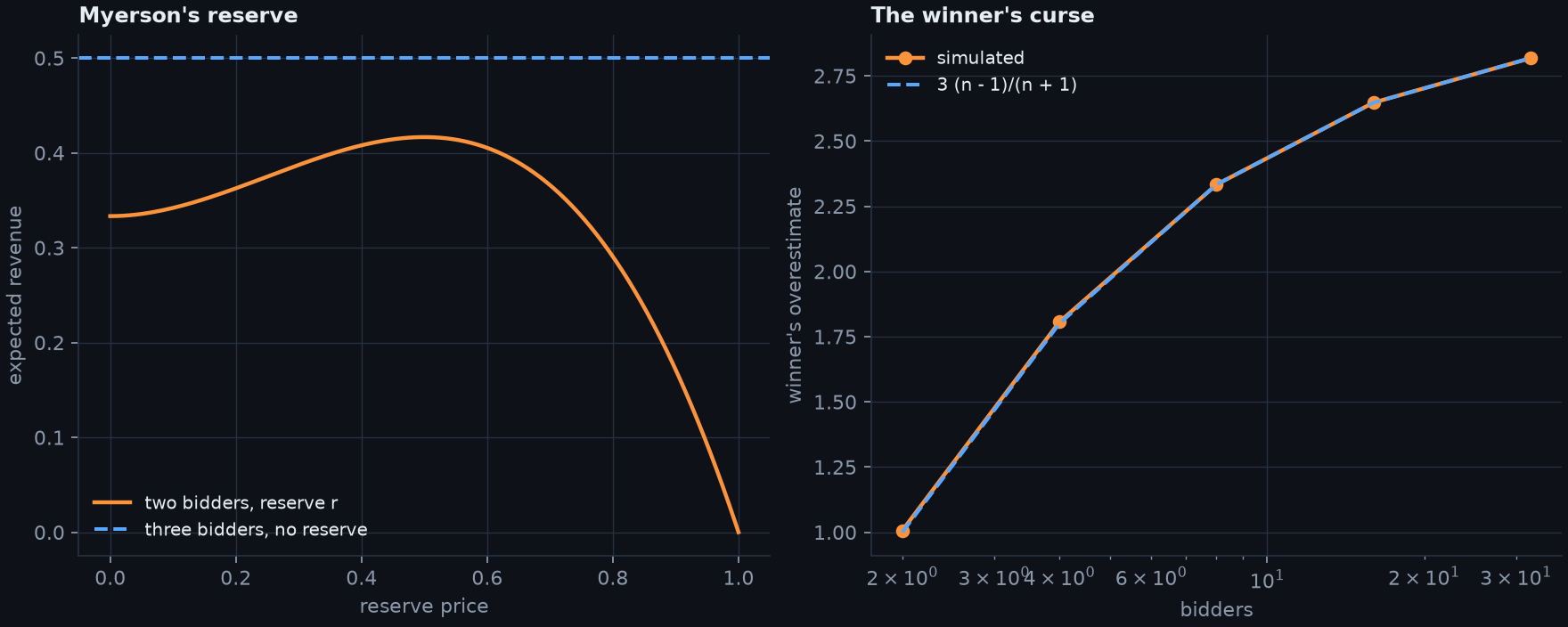
How much is the reserve worth? Here is the expected revenue from two bidders, against the reserve price. With no reserve the seller expects a third. With a reserve of one half it expects five twelfths, a quarter more. Now compare one more bidder, and no reserve at all: a half. Jeremy Bulow and Paul Klemperer proved in 1996 that this is general: under the standard assumptions, one extra bidder is worth more to a seller than the cleverest reserve. Attracting bidders comes first; fine-tuning comes second.
The reserve has a cost, and it falls on the buyers and on efficiency. With two bidders and a reserve of one half, the object goes unsold a quarter of the time, though both bidders value it above the seller's own value of nothing. The reserve is a monopolist's price: it gives up some sales for a higher price on the rest. That is part ten's triangle again. The auction that earns the seller the most is not the one that puts the object in the best hands. And to set the reserve the seller must know how values are spread. Chapter thirteen measures what reserves add in a real market.
This is a place where economics stops and a judgment begins. The theory says what a reserve does: it raises the expected revenue, and sometimes leaves the thing unsold, or with a buyer who values it less. Whether a government should use one when it sells the airwaves needs a judgment about how much a pound or a dollar of public revenue is worth, against spectrum left idle or in weaker hands. American law made that judgment one way: it tells the FCC not to design its auctions mainly to raise money. Economics measures both sides. It can't, by itself, say how to weigh them.
What it does: Virtual values \(\varphi(v) = v - (1 - F)/f = 2v - 1\); revenue is the winner's expected virtual value; the reserve of one half; with two bidders, revenue rises from 1/3 to 5/12 (25%), while a third bidder with no reserve gives 1/2 (Bulow and Klemperer 1996); no sale a quarter of the time; is/ought on reserves in public sales
8The winner's cursePrinciples and the major4 min
Through the 1960s, oil companies bid for the right to drill in the Gulf of Mexico, and year after year the returns on the leases they won disappointed them. In 1971 three engineers at Atlantic Richfield, Edward Capen, Robert Clapp and William Campbell, offered an explanation. The oil under a tract is worth much the same to every company: a common value, unlike Crusoe's canoe. Each company's geologists estimate it, with error but without bias: too high as often as too low. But the company that wins is the one with the highest estimate. And the highest of many honest estimates is usually too high. They called it the winner's curse.
Agora can show it. A tract is worth ten, and each bidder's estimate is ten, give or take up to three, with every error in that range equally likely. Here are four bidders' estimates. The highest wins. Here are sixteen. With more bidders, the highest estimate is further above the truth. The winner is not the bidder who saw most clearly; it is the one who erred most upward.
Here is the winner's average overestimate, from forty thousand tracts for each number of bidders. With two bidders it is one; with four, one point eight; with thirty-two, almost the largest error possible. The formula is three times n minus one over n plus one. A bidder who bids its honest estimate loses that much, on average, whenever it wins. So when a value is shared, more rivals mean you should bid less, not more: winning against many is worse news than winning against few. That is the opposite of chapter four, where more rivals meant shading less.
This is one of the series' Facts: the winners of common-value auctions tend to overpay. First, a guess: bidding for a jar of coins, would you bid above your own estimate of what's in it? In a study published in 1983, Max Bazerman and William Samuelson auctioned jars to MBA students in Boston. Each jar held eight dollars, in pennies, nickels or paper clips worth a few cents each, and the highest sealed bid won the jar's value and paid its bid. The students' average estimate was five dollars thirteen, well below the truth. The average winning bid was ten dollars and one cent. Agora's honest bidders lose, on average, the winner's overestimate, more so the more bidders there are. Across forty-eight auctions in twelve classes, the students underestimated the jars on average, and their winners still lost two dollars a jar. The curse needs no optimists: only many estimates, and the highest one winning.
What should a bidder do? Bid as if your estimate were the highest, because when you win, it is. Ask what the thing is worth given that you won, not what it is worth. The equilibrium bid shades further still: the price must be worth paying given that you won at it. And an English clock helps, because rivals who quit reveal something about their estimates, and the winner learns from them. That is Milgrom and Weber's linkage principle: the more the price a winner pays is tied to other bidders' information, the less the winner's curse bites, the less bidders need to shade, and the more the seller earns. Experienced bidders can learn this: the oil engineers wrote their paper to teach it. In the laboratory, John Kagel and Dan Levin found that people new to such auctions fall for the curse, and learn to avoid it only slowly.
What it does: Capen, Clapp and Campbell (1971) on the Gulf of Mexico's leases; estimates within 3 of a value of 10: the winner's overestimate 1.0, 1.8, 2.33, 2.65 and 2.82 with 2 to 32 bidders, \(3\tfrac{n-1}{n+1}\); the Fact, with the jar of coins: jars of $8, average estimate $5.13, average winning bid $10.01, average loss $2.01 over 48 auctions; the cure, and the linkage principle
9Selling the airwavesPrinciples and the major4 min
For most of the twentieth century, American governments gave radio licences away. The Federal Communications Commission held hearings to decide who deserved them, and in the 1980s it held lotteries. In 1959 Ronald Coase had proposed selling them to the highest bidder, and one commissioner asked him whether he was joking. In 1993 Congress allowed auctions, and the Commission asked economists to design them. The problem was hard. There were hundreds of licences, one for each area and band, and a licence was worth more next to its neighbours: a phone network covering a whole region is worth more than the sum of its scraps. Sold one at a time, a bidder could not know what to pay for the first licence without knowing the price of the rest.
The design that won was the simultaneous ascending auction, worked out by Paul Milgrom, Robert Wilson and Preston McAfee. Every licence is open at once, and bids rise in rounds, with the standing high bids posted after each. Bidders can switch to whichever licences are cheap for them, and so build the network they want as prices form. An activity rule stops anyone waiting to see what others do: a bidder who doesn't bid now loses the right to bid later. And nothing closes until no licence gets a new bid. The first such auctions ran in 1994. The format and its descendants have since sold spectrum around the world for many billions of dollars, and in 2020 Milgrom and Wilson shared the Nobel prize for their work on auctions.
Selling licences side by side has one trap, and the island shows it with two fishing rights, North and South. Bo wants both: together they are worth ten to him, but either alone only one. Ana wants only North, and Dara only South. Suppose Ana and Dara value theirs at four each. If Bo is cautious and bids each right only up to one, its value alone, Ana and Dara win, and the island's surplus is eight. If Bo is bold, and bids until the two prices together reach ten, he wins both for eight and makes two: the best outcome, worth ten. But suppose instead that Ana values North at two and Dara values South at nine. Bold Bo wins North at two, but South climbs past eight, and he must stop, holding one right worth one to him, which cost him two. He loses. Caution wastes the pair's value; boldness risks a loss. That is the exposure problem. The cure is to let Bo bid for the pair as a package. Combinatorial auctions do that, and Britain sold its 4G licences with one in 2013.
Britain's sale of 2000 faced a different problem first. There were four established mobile companies, and an auction is only as good as its bidders. With four licences, the four incumbents would each expect to win one, and nobody else would bother to come, knowing the incumbents valued a licence more. So the designers offered five licences, and kept the largest for a newcomer, which guaranteed that at least one would win. Thirteen companies bid, over a hundred and fifty rounds, for twenty-two and a half billion pounds. Vodafone paid about six billion for a single licence, and every licence went for more than four. Within a year the telecom bubble had burst, and some said the companies had been fleeced. The designers replied that the price of a licence, once paid, is sunk: it does not raise anyone's phone bill, which is set by competition, as part ten showed.
What it does: Hearings and lotteries; Coase (1959); auctions from 1994; the simultaneous ascending auction and its activity rule (Milgrom, Wilson and McAfee; the 2020 Nobel); the exposure problem with Bo's two fishing rights (pair 10, either alone 1): locals at 4 and 4, bold Bo wins both for 8; at 2 and 9, bold Bo loses 1; package bids; Britain's fifth licence for a newcomer, Vodafone's £6 billion, and sunk prices
10What went wrongPrinciples and the major4 min
An ascending auction lets bidders talk, through their bids. In an FCC auction in 1996 and 1997, the companies US West and McLeod both wanted licences in the American Midwest. In round fifty-nine US West outbid McLeod for the licence in Waterloo, Iowa, with a bid of three hundred and thirteen thousand, three hundred and seventy-eight dollars. Three seven eight was the number of another licence: Rochester, Minnesota, which both companies wanted. Peter Cramton and Jesse Schwartz read it as a message: leave Rochester to us, or we'll fight you in Waterloo. McLeod took Waterloo back, and US West won Rochester a few rounds later. Signals like these were common enough that the FCC later stopped bidders from typing their own amounts: they choose from a short menu of increments.
Bids can carry whole proposals. In 1999 Germany auctioned ten blocks of spectrum, with the rule that every new bid on a block had to beat the last by at least ten percent. In the first round, Mannesmann bid eighteen point one eight million marks per megahertz for blocks one to five, and twenty for blocks six to ten. Eighteen point one eight plus ten percent is nineteen point nine nine eight: twenty. In the second round T-Mobil bid exactly twenty on blocks one to five, and nobody bid again. Two rounds, and each company had half the spectrum at the same low price. A T-Mobil manager told a newspaper: there were no agreements with Mannesmann, but Mannesmann's first bid was a clear offer. Nothing about it was illegal.
The Dutch sale went wrong in a different way. The Netherlands copied the British design, but had five licences and five incumbents. In an ascending auction a strong bidder can always outbid a weak one, so why would a newcomer pay to enter? The strongest would-be entrants partnered with incumbents instead. One weak newcomer did bid, and stopped after an incumbent sent it a letter threatening legal action. In Switzerland that autumn, a round of last-minute partnerships left as many bidders as licences. The Dutch raised a hundred and seventy euros a person, the Swiss twenty, the British six hundred and fifty.
Called it? Before its auction, the Dutch government expected almost ten billion euros, scaling up from Britain's. It raised less than three. Paul Klemperer, one of the British designers, had warned in the Dutch press that this design, with as many licences as incumbents, would keep entrants away. Wrong, by more than two thirds. A design that worked where there were more licences than incumbents was copied to a country with exactly as many.
Klemperer drew the lesson in a paper called What Really Matters in Auction Design. What matters most is entry and collusion, far more than the fine points of theory that the early chapters of this part were about. His own remedy combines the two games. First an English stage, with prices rising until only one more bidder remains than there are licences. Then the survivors make one sealed bid each, no lower than the last price. The open stage finds the price; the sealed stage gives a weaker bidder a real chance, since the strong can't simply top its bid. So newcomers come, and there is no last round of bidding in which to send signals. He called it the Anglo-Dutch auction, and first proposed it for Britain's sale.
What it does: US West's bid of $313,378 for Waterloo, pointing at Rochester's licence 378 (Cramton and Schwartz 2000); Germany 1999: 18.18 and 20 million DM per MHz, 18.18 × 1.1 ≈ 20, two rounds (Klemperer 2002); the Dutch auction of July 2000 and the Swiss of November; Called it?: the Dutch forecast of almost €10 billion against less than €3 billion: wrong; Klemperer's Anglo-Dutch auction
11The auction behind every searchPrinciples and the major3 min
Every advertisement beside a search result is placed by an auction, run while the page loads. The idea began in 1998 with a company called GoTo.com, which sold the places beside its results to the highest bidders, who paid per click. Each paid its own bid, and that made the bidding unstable. An advertiser would top a rival by a cent, then drop back to just above the one below, and the rival would do the same. With software doing the bidding, prices cycled in a sawtooth, many times an hour. In 2002 Google changed the rule: each advertiser pays, per click, the bid of the advertiser one place below. It is called the generalized second-price auction, and it became the industry's standard. It sounds like Vickrey's auction. It isn't.
The island's notice board has three slots. The top one is seen most: it gets two hundred clicks a day, the second a hundred and twenty, the third sixty. Four advertisers want them. A click is worth ten shells to Ana, eight to Bo, six to Dara and four to Friday. Suppose everyone bids their value. Ana gets the top slot and pays Bo's bid, eight a click. Her profit is two hundred clicks times two: four hundred. But if Ana bids a little under eight, she falls to the second slot, and pays Dara's six. A hundred and twenty clicks times four is four hundred and eighty: more. So bidding your value is not the best thing to do. In Vickrey's auction it always is.
What would Vickrey's rule be here? Each advertiser should pay the harm its presence does to the others. Ana, in the top slot, pushes Bo down from two hundred clicks to a hundred and twenty, Dara from a hundred and twenty to sixty, and Friday off the board. At their values, that costs them twelve hundred and forty shells: six point two a click. Here are Vickrey's prices for all three slots, beside what everyone would pay if all bid their values in the second-price auction for slots. In 2007 Benjamin Edelman, Michael Ostrovsky and Michael Schwarz, and separately Hal Varian, showed that the second-price auction for slots has an equilibrium in which bidders shade, and each ends up paying exactly Vickrey's price. The same revenue as Vickrey's auction, by a different road: chapter five's theorem, at work in the largest auction market in the world.
The real auctions add more. Bids are weighted by the predicted chance that the advertisement is clicked, so that a slot goes to whoever is expected to pay the most for it, not just whoever bids the most per click. Every keyword has a reserve price, which chapter thirteen measures. There are billions of these auctions a day, one for each search. And the auctions for display advertisements on other websites moved from second price to pay-your-bid in 2019, for reasons chapter fifteen explains.
What it does: GoTo.com's first-price auctions and their sawtooth (1998); Google's generalized second price (2002); the island's notice board, clicks 200, 120, 60 and values 10, 8, 6, 4: truthful bidding gives Ana 400 in slot 1 but 480 in slot 2; Vickrey's prices 6.2, 5 and 4 a click (1,240, 600, 240); the equilibrium at Vickrey's prices (Edelman, Ostrovsky and Schwarz; Varian 2007); quality scores, reserves, first price for display ads
12Many units: bonds and electricityPrinciples and the major3 min
Some auctions sell many identical units at once. The American Treasury sells billions of dollars of bills and notes at a time, and each bidder says how many it wants, at what yield. From its first bill auction in 1929, the Treasury charged each winner its own bid. In 1960 Milton Friedman argued for a single price instead: every winner pays the same, the price of the last bid accepted. Then, he said, nobody need guess where the market will clear, and bidders would simply bid what the bills were worth to them. Nothing changed until 1991, when a dealer was found breaking the auction's rules. In the overhaul that followed, the Treasury tried single prices on its two- and five-year notes. In 1998 it moved every auction to a single price, though its own studies of the experiment could not say for certain that it had saved money.
Friedman's single price has its own trap, and two bonds on the island show it. Bo wants both bonds, each worth ten to him. Dara wants one, worth six. The seller charges every winner one price: the highest bid that loses. If Bo bids for both bonds at their value, Dara's six is the losing bid, so Bo wins both and pays six each. His profit is eight. But if Bo bids for only one bond, nobody loses. Bo and Dara each get one, the price falls to nothing, and Bo's profit is ten. Asking for less pays him. The seller gets nothing, and one bond goes to Dara, who values it less. Vickrey's rule for many units charges each winner the bids it displaces. Bo wins both and pays six in all: his profit is fourteen, so he has no reason to ask for less, and the bonds go where they are worth most. With one price, a big buyer's own bid sets the price it pays on everything it buys, so it asks for less than it wants. Lawrence Ausubel and Peter Cramton called it demand reduction: less revenue, and units in the wrong hands.
Electricity markets face the same choice every day. Generators offer power at prices, and the market takes the cheapest offers first until demand is met. Most markets pay every generator the same price: the offer of the last one needed. In 2001 Britain replaced its Pool, which did that, with arrangements in which generators trade with buyers directly, and a balancing market pays each its own offer. The hope was lower prices. The theory says generators who are paid their offers simply offer what they expect the market price to be. In 2022, when gas set the price paid to every generator in Europe, the question was asked again, and Europe's regulators, after a review, kept the single price. Paying the bids changes how people bid, more than what they end up paying.
What it does: Pay-as-bid bill auctions from 1929; Friedman (1960); the 1992 experiment and single prices for all from October 1998; demand reduction with two bonds (Bo 10 and 10, Dara 6): one price, bidding for two, profit 8 and revenue 12; bidding for one, profit 10 and revenue 0; Vickrey's rule, profit 14, revenue 6, both bonds to Bo; electricity's single price, Britain's 2001 reform, and 2022
13The Dials: what a reserve addsResearch2 min
This part opens a dial for what a reserve price adds in a real market. The evidence comes from an experiment at Yahoo! in the summer of 2008. Every keyword's auction had had the same reserve, ten cents a click. Michael Ostrovsky and Michael Schwarz estimated the spread of advertisers' values for each keyword, and set new reserves by Myerson's rule, moved only part of the way from ten cents, since the revenue curve is flat near its top and overshooting is costly. More than four hundred thousand keywords, chosen at random, got the new reserves; twenty-three thousand kept the old ones. They compared revenue before and after, against the controls, holding each keyword's searches fixed. The reserves did what the theory says they do: almost one fewer advertisement appeared on each page, as some bidders were priced out.
Here is the dial. Over all keywords, revenue rose by two point seven percent, with a confidence interval from about one and a half to almost four. Small, but across the market for search advertising, the authors reckoned, worth hundreds of millions of dollars a year. But on keywords searched fewer than ten times a day, revenue fell by two percent: there, the reserve chased away bidders the auction needed. On the busier keywords, which carried three quarters of the searches, it rose by three point three percent. So the status is: depends on the setting. A reserve pays where bidders are many and drives them off where they are few, which is Bulow and Klemperer's warning from chapter seven, measured. One experiment so far; the dial returns in part sixty-one, on the platforms.
What it does: The new dial: Ostrovsky and Schwarz's experiment on 438,632 Yahoo! keywords against 23,016 controls: revenue +2.7% overall (t = 4.7), -2.2% on keywords searched under ten times a day, +3.3% on the rest; one fewer ad per page; depends on the setting
14In practice: auction desksPractice3 min
Auction design is now a trade. Regulators have spectrum teams who choose the lots, the caps on how much one company may win, the reserves and the activity rules. The companies hire their own game theorists to plan the bidding. Treasuries and central banks run auctions for bonds and loans, and the Bank of England uses a design of Paul Klemperer's, the product-mix auction, worked out during the financial crisis. The platforms employ auction teams who set reserves, weight bids by quality, and build the machines that bid on advertisers' behalf. Governments buy by reverse auction, from roads to wind and solar power: Britain has bought renewable electricity by auction since 2015. And the oldest marketplaces, the auction houses and the fish markets, are still there.
The first thing an auction economist needs is the bidders' values, which nobody reveals. In a first-price auction, each bidder chooses its bid to maximize its value less its bid, times the chance that all rivals bid less. Turn that condition around, and the value behind each bid is the bid plus a markup, where the markup depends only on how rivals' bids are spread, which the data show. So each bid can be inverted into a value. Emmanuel Guerre, Isabelle Perrigne and Quang Vuong turned this into an estimator in 2000. With the values in hand, a seller can compute the best reserve, or simulate a different format, from bids alone.
The rest of the work is engineering. Simulate the design on many draws of values, as Agora did in this part, and measure revenue, efficiency and the risk of no sale. Test it on people first: Charles Plott and others ran laboratory wind tunnels for the spectrum auctions before billions of dollars were at stake. Write the rules that theory leaves out: what happens at a tie, how much each bid must rise, whether a bid can be withdrawn, how much deposit a bidder must put down. And watch for collusion. Robert Porter and Douglas Zona showed in 1993 how the bids of a ring rigging road contracts on Long Island differed from honest ones. Part seventeen designs markets where prices can't be used, and part sixty-one goes inside the platforms.
What it does: Where auction economists work; reading values from bids, \(v = b + G(b)/((n-1)g(b))\) (Guerre, Perrigne and Vuong 2000); simulation, laboratory testbeds (Plott 1997), rules, and screens for collusion (Porter and Zona 1993)
15Frontier: new auctions, new biddersResearch4 min
The largest design problem yet was the FCC's incentive auction, which closed in April 2017. The spectrum phone companies wanted was being used by television stations, so the auction had to buy it back and sell it on, at the same time. In the reverse auction, a clock offered each station a falling price for its channel, and each decided whether to stay on the air or sell. At every step a computer checked that the stations still broadcasting could be repacked into fewer channels, a hard puzzle, solved again and again. It paid ten billion dollars to a hundred and seventy-five stations. In the forward auction, phone companies bid on a rising clock for the spectrum freed. If their bids did not cover what the stations were paid, the auction tried again, aiming to clear less spectrum, stage by stage, until they did: nineteen point eight billion dollars, for eighty-four megahertz. Paul Milgrom and Ilya Segal designed the clocks so that a station's best plan was plain even to someone who does not trust game theory: stay in while the price beats your value. Such an auction is called obviously strategy-proof.
Chapter three's poet comes back. In 2020 Mohammad Akbarpour and Shengwu Li asked which auctions a seller cannot cheat in without being caught. In a sealed second-price auction, a seller can slip in a fake bid just below the winner's, and nobody can tell. They proved that among the auctions that raise the most, the first-price auction is the only sealed one that is credible, since the winner pays what it bid, whatever else was written. And the ascending clock is the only credible one in which honest bidding is dominant, since everyone sees the price rise. The market had found the same thing. In 2019 the big exchanges that sell display advertisements on websites moved from second price to first. Among the reasons: advertisers, bidding through many layers of software, could not check the second price they were charged.
The bidders are changing too. Most advertisers no longer choose bids. They set a budget and a target, so many dollars of sales per dollar spent, and the platform's software bids for them in every auction. That software buys as much value as it can, subject to the target. It does not maximize profit, which is what every theorem in this part assumed. And with such bidders, even Vickrey's auction loses its dominant strategy. What survives is a guarantee: Gagan Aggarwal, Ashwinkumar Badanidiyuru and Aranyak Mehta showed in 2019 that with these bidders, Vickrey's rule still delivers at least half the best possible value. Sellers are learning too, and that has its own trap: a seller who sets tomorrow's reserve from today's bids gives bidders a reason to bid low today, to lower tomorrow's reserve.
So the frontier has open questions. When software bids against software, what equilibrium do they reach, if any? Can a seller learn the right reserve without being gamed, and how quickly? How should auctions sell things that come in packages, such as computing power, spectrum, or electricity across hours? And when a design is copied from one country or one market to another, how do we know it fits the new bidders? The Dutch learned that one the expensive way.
What it does: The FCC's incentive auction (2017): $10.05 billion to 175 stations, $19.8 billion from carriers, 84 MHz; obviously strategy-proof clocks (Milgrom and Segal 2020); credible auctions (Akbarpour and Li 2020) and display ads' move to first price (2019); bidders that are machines, and a guarantee of half the best value (Aggarwal, Badanidiyuru and Mehta 2019); learning reserves; open questions
Recap, problems, and the road aheadAll tracks3 min
So: how should something be sold, when nobody knows what it is worth to the buyers? Let the bidders compete, and design the sale around who they are. When each knows its own value and nothing about the others, any of the standard formats raises the same money, and a reserve price adds a little. What really matters is getting bidders to come, and stopping them from colluding; protecting winners from the curse of shared values; and choosing rules that bidders can trust, and can follow.
Part sixteen in twelve lines. Britain sold its airwaves for twenty-two and a half billion pounds, and the Netherlands, with as many licences as incumbents, raised a third of its forecast. In Play it, the best bids were fifty-two and a half when you pay your bid, and seventy when you pay the next one. The four formats are two games. Vickrey showed that when the price isn't your own bid, you should bid your value. In a first-price auction you shade, less with more rivals. Revenue equivalence says who wins fixes what is paid, which is why you expected six shells either way. Risk, linked values, unequal bidders, collusion and entry break it. Myerson's reserve adds a quarter with two bidders, but a third bidder adds more. The highest estimate wins a common-value auction, which is the winner's curse, and the jar's winners lost two dollars each. Selling the airwaves needed simultaneous rounds, raised the exposure problem, and invited signals in the digits. The auction for search slots is not Vickrey's, but reaches Vickrey's prices, and a single price for many units invites demand reduction. And in a real market, reserves added a few percent, depending on the setting, while the frontier asks for auctions the seller can't cheat in, and bidders that are machines.
The problems. Vickrey's dominance; the first-price equilibrium and its revenue; the all-pay auction by the envelope formula; Myerson's reserve and Bulow and Klemperer's extra bidder; the winner's curse; prices for slots; the exposure problem; and a starred problem on demand reduction. Full solutions are in the part's notes.
The reading: Vijay Krishna's Auction Theory, the graduate text; Paul Klemperer's Auctions, Theory and Practice; Paul Milgrom's Putting Auction Theory to Work; and Kagel and Levin on the winner's curse. Then the papers, from Vickrey to the incentive auction.
This part designed markets with prices. The next designs markets where prices can't be used. By 1945, American hospitals were offering internships to medical students two years before they graduated, and giving them hours to decide. The market for young doctors was unravelling. Part seventeen: markets by design.
Where it goes next. Part 17 designs markets without prices; Part 32 returns to the Treasury's debt; Part 48 to electricity and permits; Part 53 to information design; Part 54 to estimating values from bids; Parts 44 and 61 to the platforms.
Key results
The part's results in one place, for revision.
Try it
Lab 16 · Auctions: formats, reserves and the winner's curse
Run five auction formats on the same draws of private values and see revenue equivalence; derive and check first-price shading; measure what risk aversion does to it; find Myerson's reserve and compare it with an extra bidder; measure the winner's curse; price slots by Vickrey's rule; and watch a uniform price invite demand reduction.
python -m videos.economics.labs 16
needs numpy, scipy, matplotlib · download lab16.py ·
source on GitHubfive formats, four bidders: mean revenue (theory 0.6) first-price 0.600, Dutch 0.600, second-price 0.601, English 0.601, all-pay 0.602
Play it: best bids (pay your bid / pay the next); expected profit in each 52.5 / 70; 6.00 / 6.00
risk-averse bidders (alpha 0.5): first-price / second-price revenue 0.686 / 0.601
Myerson, two bidders: best reserve, revenue with it, without it; three bidders, no reserve 0.50, 0.4167, 0.3333; 0.5000
the winner's overestimate for 2, 4, 8, 16, 32 bidders (exact) 1.01 (1.00), 1.81 (1.80), 2.33 (2.33), 2.65 (2.65), 2.82 (2.82)
the jar of coins: value, mean estimate, mean winning bid, mean loss $8.00, $5.13, $10.01, $2.01
slots: Vickrey totals; per click; the top bidder's profit in slots 1-3 if all bid their values [1240.0, 600.0, 240.0]; [6.2, 5.0, 4.0]; [400.0, 480.0, 360.0]
exposure, locals (4.0, 4.0): bold national profit; cautious and bold surplus; best 2; 8, 10; 10
exposure, locals (2.0, 9.0): bold national profit; cautious and bold surplus; best -1; 11, 10; 11
two bonds: Bo's profit bidding for two / for one / under Vickrey; revenue in each 8 / 10 / 14; 12 / 0 / 6
Every format raises the same on average, but the first-price auction's price varies less; risk averse bidders bid more when they pay their bids; the best reserve adds a quarter with two bidders, a third bidder adds more; the highest of many honest estimates overstates the value, more so the more bidders; Vickrey's prices for slots are 6.2, 5 and 4 a click, and truthful bidding in the second-price auction for slots is not an equilibrium; and a uniform price pays a big buyer to ask for less.The code (91 lines; it asserts its own result)
"""Lab 16: auctions: the four formats on the same draws, Vickrey's dominance, shading, revenue equivalence and its
failures, Myerson's reserve, the winner's curse, position auctions, the exposure problem and demand reduction."""

import numpy as np

from videos.coursekit import labs
from explainer.economics.agora import auctions as au
from explainer.economics.data import tables
from explainer.economics.island import truths

TITLE = "Auctions: formats, reserves and the winner's curse"
GOAL = ("Run five auction formats on the same draws of private values and see revenue equivalence; derive and check "
        "first-price shading; measure what risk aversion does to it; find Myerson's reserve and compare it with an "
        "extra bidder; measure the winner's curse; price slots by Vickrey's rule; and watch a uniform price invite "
        "demand reduction.")
TASKS = [
    "Formats: rerun the five formats with n = 2 and n = 10 bidders. Does every format still raise (n - 1)/(n + 1)? "
    "How does the spread of the first-price and second-price revenue change?",
    "Risk: set alpha = 0.25 (more risk averse). How much does the first-price auction now raise, and why is the "
    "second-price auction unchanged?",
    "The winner's curse: double the noise to 6. How does the winner's overestimate change with 2 and with 32 bidders?",
]


def run(seed=0):
    lab = labs.Lab()
    T = truths(16)
    f = T["formats"]

    sim = au.simulate_formats(n=f["n"], draws=f["draws"], seed=f["seed"] + seed)
    for name, r in sim["formats"].items():
        assert abs(r["mean"] - sim["theory"]) < 5 * r["se"] + 0.002, name
    lab.row("five formats, four bidders: mean revenue (theory 0.6)",
            ", ".join(f"{k} {v['mean']:.3f}" for k, v in sim["formats"].items()))

    p = au.expected_profit(**T["playit"])
    lab.row("Play it: best bids (pay your bid / pay the next); expected profit in each",
            f"{p['best_first']:.1f} / {p['best_second']:.0f}; {p['profit_first']:.2f} / {p['profit_second']:.2f}")

    r = au.simulate_formats(n=f["n"], draws=f["draws"], seed=f["seed"] + seed, alpha=T["risk"]["alpha"])
    lab.row("risk-averse bidders (alpha 0.5): first-price / second-price revenue",
            f"{r['formats']['first-price']['mean']:.3f} / {r['formats']['second-price']['mean']:.3f}")

    m2, m3 = au.myerson(2), au.myerson(3)
    lab.row("Myerson, two bidders: best reserve, revenue with it, without it; three bidders, no reserve",
            f"{m2['r_star']:.2f}, {m2['rev_star']:.4f}, {m2['rev_zero']:.4f}; {m3['rev_zero']:.4f}")

    c = T["curse"]
    w = au.winners_curse(c["ns"], c["value"], c["noise"], seed=c["seed"] + seed)
    lab.row("the winner's overestimate for 2, 4, 8, 16, 32 bidders (exact)",
            ", ".join(f"{x['overestimate']:.2f} ({x['exact']:.2f})" for x in w["rows"]))
    j = tables.BAZERMAN_SAMUELSON_1983.data
    lab.row("the jar of coins: value, mean estimate, mean winning bid, mean loss",
            f"${j['value']:.2f}, ${j['mean_estimate']:.2f}, ${j['mean_winning_bid']:.2f}, ${j['mean_loss']:.2f}")

    g = au.gsp(**T["gsp"])
    lab.row("slots: Vickrey totals; per click; the top bidder's profit in slots 1-3 if all bid their values",
            f"{g['vcg_total']}; {[round(x, 2) for x in g['gsp_price_per_click']]}; {g['deviation_profits_top']}")

    x = T["exposure"]
    for rv in x["rivals"]:
        e = au.exposure(x["both"], x["alone"], rv)
        lab.row(f"exposure, locals {rv}: bold national profit; cautious and bold surplus; best",
                f"{e['bold']['national_profit']:.0f}; {e['cautious']['welfare']:.0f}, {e['bold']['welfare']:.0f}; "
                f"{e['efficient_welfare']:.0f}")

    b = au.multi_unit(**T["bonds"])
    lab.row("two bonds: Bo's profit bidding for two / for one / under Vickrey; revenue in each",
            f"{b['truthful']['big_profit']:.0f} / {b['best']['big_profit']:.0f} / {b['vickrey']['big_profit']:.0f}; "
            f"{b['truthful']['revenue']:.0f} / {b['best']['revenue']:.0f} / {b['vickrey']['revenue']:.0f}")

    lab.note = ("Every format raises the same on average, but the first-price auction's price varies less; risk "
                "averse bidders bid more when they pay their bids; the best reserve adds a quarter with two bidders, "
                "a third bidder adds more; the highest of many honest estimates overstates the value, more so the more "
                "bidders; Vickrey's prices for slots are 6.2, 5 and 4 a click, and truthful bidding in the "
                "second-price auction for slots is not an equilibrium; and a uniform price pays a big buyer to ask "
                "for less.")

    fig, ax = labs.figure(2, size=(11, 4.4))
    rs = np.asarray(m2["reserve"])
    ax[0].plot(rs, m2["revenue"], color=labs.ORANGE, lw=2, label="two bidders, reserve r")
    ax[0].axhline(m3["rev_zero"], color=labs.BLUE, ls="--", label="three bidders, no reserve")
    ax[0].set(title="Myerson's reserve", xlabel="reserve price", ylabel="expected revenue")
    ax[0].legend()
    ns = [x["n"] for x in w["rows"]]
    ax[1].plot(ns, [x["overestimate"] for x in w["rows"]], color=labs.ORANGE, lw=2, marker="o", label="simulated")
    ax[1].plot(ns, [x["exact"] for x in w["rows"]], color=labs.BLUE, ls="--", label="3 (n - 1)/(n + 1)")
    ax[1].set(xscale="log", title="The winner's curse", xlabel="bidders", ylabel="winner's overestimate")
    ax[1].legend()
    lab.fig = fig
    return lab
Now change it
- Formats: rerun the five formats with n = 2 and n = 10 bidders. Does every format still raise (n - 1)/(n + 1)? How does the spread of the first-price and second-price revenue change?
- Risk: set alpha = 0.25 (more risk averse). How much does the first-price auction now raise, and why is the second-price auction unchanged?
- The winner's curse: double the noise to 6. How does the winner's overestimate change with 2 and with 32 bidders?
Problems, with solutions
Try each problem before opening its solution.
1. Vickrey: show that bidding your value is weakly dominant in a second-price auction, and give a case where it is not strictly better than some other bid.
Solution
Let \(m\) be the highest rival bid. Bidding \(v\) wins exactly when \(m < v\) and pays \(m\), so it earns \(\max(v - m, 0)\), the most any bid can earn against \(m\), since the price never depends on your own bid. A bid \(b > v\) differs only when \(v < m < b\), where it wins at a loss; a bid \(b < v\) differs only when \(b < m < v\), where it gives up a profit. So no bid ever does better than \(v\). It is not strictly better: if every rival bids 0, any positive bid wins and pays 0, exactly as bidding \(v\) does.
2. Shading: with \(n\) bidders and values uniform on \([0, 1]\), verify that \(b(v) = \tfrac{n-1}{n}v\) is an equilibrium of the first-price auction, and that revenue is \(\tfrac{n-1}{n+1}\).
Solution
If the rivals bid \(\tfrac{n-1}{n}w\), a bid \(b \le \tfrac{n-1}{n}\) beats one of them with probability $nb/(n
- 1)$, so expected profit is \((v - b)(nb/(n-1))^{n-1}\). Its derivative vanishes where \((n - 1)(v - b) = b\), at \(b = \tfrac{n-1}{n}v\), and no bid above \(\tfrac{n-1}{n}\) helps, since it already wins for sure. The winner has the highest value, whose mean is \(\tfrac{n}{n+1}\), so revenue is \(\tfrac{n-1}{n}\cdot\tfrac{n}{n+1} = \tfrac{n-1}{n+1}\).
3. All-pay: use the envelope formula to derive the all-pay equilibrium bid \(\tfrac{n-1}{n}v^n\), and check its revenue.
Solution
The highest value wins, so \(P(v) = v^{n-1}\), and the lowest type gets \(U(0) = 0\). The envelope formula gives the expected payment \(T(v) = vP(v) - \int_0^v s^{n-1}\,ds = v^n - v^n/n = \tfrac{n-1}{n}v^n\). In an all-pay auction every bidder pays its bid, win or lose, so the bid is \(T(v)\). Revenue is \(n\,\mathbb{E}[\tfrac{n-1}{n}v^n] = (n - 1)/(n + 1)\), the same as every other format.
4. Myerson: with two bidders, show revenue with reserve \(r\) is \(\tfrac13 + r^2 - \tfrac43 r^3\), maximized at \(r = \tfrac12\) with \(\tfrac{5}{12}\); compare three bidders with no reserve.
Solution
Revenue is the expected virtual value of the winner, counting only values above \(r\): \(2\int_r^1 (2v - 1)\,v\,dv = 2\big[\tfrac23 v^3 - \tfrac12 v^2\big]_r^1 = \tfrac13 + r^2 - \tfrac43 r^3\). Its derivative \(2r - 4r^2\) vanishes at \(r = \tfrac12\), where revenue is \(\tfrac13 + \tfrac14 - \tfrac16 = \tfrac{5}{12}\), a quarter more than \(\tfrac13\). Three bidders with no reserve give \(\tfrac{3-1}{3+1} = \tfrac12 > \tfrac{5}{12}\): an extra bidder is worth more than the best reserve.
5. The winner's curse: with estimates \(V + e\), \(e\) uniform on \([-s, s]\), show the highest of \(n\) overstates \(V\) by \(s\,\tfrac{n-1}{n+1}\) on average.
Solution
Write \(e = s(2u - 1)\) with \(u\) uniform on \([0, 1]\). The largest of \(n\) uniforms has mean \(\tfrac{n}{n+1}\), so the largest error has mean \(s(\tfrac{2n}{n+1} - 1) = s\,\tfrac{n-1}{n+1}\). With \(s = 3\): 1, 1.8, 2.33, 2.65 and 2.82 for 2, 4, 8, 16 and 32 bidders, which Agora's simulation matches to two decimals.
6. Slots: with values (10, 8, 6, 4) and clicks (200, 120, 60), compute Vickrey's payments, and check that bids of 6.2, 5 and 4 below the top form an equilibrium of the second-price auction for slots.
Solution
The bidder in slot 3 keeps Friday (4) out of 60 clicks: 240. The bidder in slot 2 moves Dara (6) down 60 clicks and keeps Friday out: \(60 \times 6 + 240 = 600\). The bidder in slot 1 moves Bo (8) down 80 clicks: \(80 \times 8 + 600 = 1{,}240\). Per click: 6.2, 5 and 4. With Bo bidding 6.2, Dara 5 and Friday 4, and Ana anything higher, each pays the next bid down, which is Vickrey's price. Ana earns \(200 \times 3.8 = 760\) in slot 1, against 600 in slot 2 at 5 or 360 in slot 3 at 4; Bo earns \(120 \times 3 = 360\), exactly what slot 1 at 6.2 would give and more than slot 3's 240; Dara earns \(60 \times 2 = 120\), exactly what slot 2 at 5 would give; Friday would earn nothing in slot 3 at 4. Nobody gains by moving: an equilibrium, the lowest in which nobody envies another's slot.
7. Exposure: with Bo's pair worth 10 and either right 1, find for which local values a bold Bo loses money.
Solution
Let the locals' values be \(a \le b\). Bold Bo stays in until the two prices together reach 10. The weaker local quits at \(a\); the other price can rise to \(10 - a\). If \(b \le 10 - a\), Bo wins both, earning \(10 - a - b \ge 0\). If \(a + b > 10\), Bo stops, holding the right bought at \(a\), worth 1 alone: a loss of \(a - 1\) whenever \(a > 1\). So bold Bo loses money exactly when \(a + b > 10\) and \(a > 1\); with \((2, 9)\) the loss is 1.
8. \(\bigstar\) Demand reduction: two units, values (10, 10) and 6; show that under one price the big bidder bids for one unit, and find Vickrey's payments.
Solution
With one price set by the highest losing bid, bidding for both units at 10 leaves Dara's 6 as the losing bid: Bo pays 6 for each, earning \(20 - 12 = 8\). Bidding for one unit leaves no losing bid: Bo and Dara each win one at a price of 0, and Bo earns 10. So Bo bids for one; the seller gets nothing, and a unit goes to Dara, who values it at 6 rather than 10 (surplus 16 instead of 20). Under Vickrey's rule each winner pays the bids its wins displace: Bo wins both and displaces Dara's 6, so pays 6 in all and earns 14; bidding for one would earn only 10, so Bo bids for both, and the units go where they are worth most.
Notes and sources
Where it comes back
| Idea | Parts |
|---|---|
| Mechanism design, matching and bargaining with private information | 17 Markets by Design, 53 Information and Persuasion |
| Common values and adverse selection | 13 Lemons and Signals (back) |
| The reserve as a monopoly price | 10 The Price Maker (back) |
| Treasury auctions and the government's debt | 32 The Treasury |
| Estimating values from bids | 54 Estimating Models |
| Electricity markets and carbon permits | 48 Environment and Climate |
| Ad auctions, platforms and auto-bidding | 44 Dynamics, Platforms and Antitrust, 61 Economics at the Platforms |
Sources
- William Vickrey, "Counterspeculation, Auctions, and Competitive Sealed Tenders", Journal of Finance 16(1) (1961): 8-37; Roger B. Myerson, "Optimal Auction Design", Mathematics of Operations Research 6(1) (1981): 58-73; John G. Riley and William F. Samuelson, "Optimal Auctions", American Economic Review 71(3) (1981): 381-392; Paul R. Milgrom and Robert J. Weber, "A Theory of Auctions and Competitive Bidding", Econometrica 50(5) (1982): 1089-1122.
- Benny Moldovanu and Manfred Tietzel, "Goethe's Second-Price Auction", Journal of Political Economy 106(4) (1998): 854-859; Michael H. Rothkopf, Thomas J. Teisberg and Edward P. Kahn, "Why Are Vickrey Auctions Rare?", Journal of Political Economy 98(1) (1990): 94-109.
- James C. Cox, Vernon L. Smith and James M. Walker, "Theory and Individual Behavior of First-Price Auctions", Journal of Risk and Uncertainty 1(1) (1988): 61-99; John H. Kagel, Ronald M. Harstad and Dan Levin, "Information Impact and Allocation Rules in Auctions with Affiliated Private Values: A Laboratory Study", Econometrica 55(6) (1987): 1275-1304; John H. Kagel and Dan Levin, "Independent Private Value Auctions: Bidder Behaviour in First-, Second- and Third-Price Auctions with Varying Numbers of Bidders", Economic Journal 103(419) (1993): 868-879; John H. Kagel and Dan Levin, Common Value Auctions and the Winner's Curse (2002).
- Eric Maskin and John Riley, "Asymmetric Auctions", Review of Economic Studies 67(3) (2000): 413-438; Jeremy Bulow and Paul Klemperer, "Auctions versus Negotiations", American Economic Review 86(1) (1996): 180-194.
- E. C. Capen, R. V. Clapp and W. M. Campbell, "Competitive Bidding in High-Risk Situations", Journal of Petroleum Technology 23 (1971): 641-653; Max H. Bazerman and William F. Samuelson, "I Won the Auction But Don't Want the Prize", Journal of Conflict Resolution 27(4) (1983): 618-634.
- R. H. Coase, "The Federal Communications Commission", Journal of Law and Economics 2 (1959): 1-40; John McMillan, "Selling Spectrum Rights", Journal of Economic Perspectives 8(3) (1994): 145-162; Paul Milgrom, Putting Auction Theory to Work (2004); Ken Binmore and Paul Klemperer, "The Biggest Auction Ever: the Sale of the British 3G Telecom Licences", Economic Journal 112(478) (2002): C74-C96.
- Peter Cramton and Jesse A. Schwartz, "Collusive Bidding: Lessons from the FCC Spectrum Auctions", Journal of Regulatory Economics 17(3) (2000): 229-252; Paul Klemperer, "What Really Matters in Auction Design", Journal of Economic Perspectives 16(1) (2002): 169-189; Paul Klemperer, "How (Not) to Run Auctions: the European 3G Telecom Auctions", European Economic Review 46(4-5) (2002): 829-845; Paul Klemperer, "Auctions with Almost Common Values", European Economic Review 42 (1998): 757-769.
- Benjamin Edelman, Michael Ostrovsky and Michael Schwarz, "Internet Advertising and the Generalized Second-Price Auction", American Economic Review 97(1) (2007): 242-259; Hal R. Varian, "Position Auctions", International Journal of Industrial Organization 25(6) (2007): 1163-1178; Michael Ostrovsky and Michael Schwarz, "Reserve Prices in Internet Advertising Auctions: A Field Experiment", working paper (2009).
- Milton Friedman, A Program for Monetary Stability (1960); Kenneth D. Garbade and Jeffrey F. Ingber, "The Treasury Auction Process: Objectives, Structure, and Recent Adaptations", Federal Reserve Bank of New York, Current Issues in Economics and Finance 11(2) (2005); Lawrence M. Ausubel and Peter Cramton, "Demand Reduction and Inefficiency in Multi-Unit Auctions", working paper (2002).
- Emmanuel Guerre, Isabelle Perrigne and Quang Vuong, "Optimal Nonparametric Estimation of First-Price Auctions", Econometrica 68(3) (2000): 525-574; Robert H. Porter and J. Douglas Zona, "Detection of Bid Rigging in Procurement Auctions", Journal of Political Economy 101(3) (1993): 518-538; Charles R. Plott, "Laboratory Experimental Testbeds: Application to the PCS Auction", Journal of Economics and Management Strategy 6(3) (1997): 605-638.
- Paul Milgrom and Ilya Segal, "Clock Auctions and Radio Spectrum Reallocation", Journal of Political Economy 128(1) (2020): 1-31; Mohammad Akbarpour and Shengwu Li, "Credible Auctions: A Trilemma", Econometrica 88(2) (2020): 425-467; Gagan Aggarwal, Ashwinkumar Badanidiyuru and Aranyak Mehta, "Autobidding with Constraints", Web and Internet Economics (WINE 2019); Kareem Amin, Afshin Rostamizadeh and Umar Syed, "Learning Prices for Repeated Auctions with Strategic Buyers", NeurIPS (2013); Federal Communications Commission, Auction 1000 (2017).
- Board of Governors of the Federal Reserve System, 3-Month Treasury Bill Secondary Market Rate (TB3MS), via FRED.
- Textbooks: Vijay Krishna, Auction Theory (2nd ed., 2010); Paul Klemperer, Auctions: Theory and Practice (2004); Paul Milgrom, Putting Auction Theory to Work (2004); Andreu Mas-Colell, Michael Whinston and Jerry Green, Microeconomic Theory (1995), ch. 23.
About this partfrom its README
Part 16 of a sixty-eight-part course in economics (see the series plan and the syllabus), the fourth of Act IV, Failure and Design. It asks how something should be sold when nobody knows what it is worth to the buyers, and answers: let the bidders compete, and design the sale around who they are. When each bidder knows its own value and nothing of the others', any of the standard formats raises the same money, and a reserve price adds a little. What really matters is getting bidders to come and stopping them from colluding, protecting winners from the curse of shared values, and choosing rules that bidders can trust and follow.
It opens in London in the spring of 2000, when Britain sold five licences for third-generation mobile spectrum in an auction designed by game theorists: thirteen bidders, 150 rounds, £22.5 billion. That summer the Netherlands copied the design with five licences for five incumbents, and raised less than a third of its forecast. From there it covers:
- a game: two sealed bids for Crusoe's canoe, one paying your bid and one paying the next;
- the four standard formats on one draw of values: the English and Dutch clocks, and why the four are two games;
- Vickrey (1961): bidding your value is dominant in a second-price auction, by two cases; Goethe's sealed offer of 1797, and why Vickrey's auction is rare (Rothkopf, Teisberg and Kahn 1990);
- shading in a first-price auction, derived: \(\tfrac{n-1}{n}v\), and the bid as the expected second value;
- revenue equivalence: five formats on the same 60,000 draws; the spread of the price; the envelope argument (Vickrey 1961; Myerson 1981; Riley and Samuelson 1981);
- when equivalence fails: risk aversion, the laboratory (Cox, Smith and Walker 1988; Kagel, Harstad and Levin 1987), linked values (Milgrom and Weber 1982), asymmetry (Maskin and Riley 2000), collusion and entry;
- an intermission without narration: the 3-month Treasury bill rate, 1934-2025;
- Myerson's reserve price (1981): virtual values, the optimal reserve, Bulow and Klemperer's extra bidder (1996), and an is/ought card on reserves for public sales;
- the winner's curse: the Gulf of Mexico's oil leases (Capen, Clapp and Campbell 1971), Agora's estimates, and the jar of coins (Bazerman and Samuelson 1983);
- selling the airwaves: the simultaneous ascending auction (Milgrom, Wilson and McAfee, 1994), the exposure problem and package bidding, and Britain's design (Binmore and Klemperer 2002);
- what went wrong: trailing digits (Cramton and Schwartz 2000), Germany's two-round auction of 1999, the Dutch and Swiss sales of 2000 (Klemperer 2002), with Called it? on the Dutch forecast, and the Anglo-Dutch design;
- the auction behind every search: the generalized second price, why it is not Vickrey's, and its equilibrium at Vickrey's prices (Edelman, Ostrovsky and Schwarz 2007; Varian 2007);
- many units: the Treasury's move to a single price (Friedman 1960; Garbade and Ingber 2005), demand reduction, and electricity markets;
- a new dial (what a reserve adds: Ostrovsky and Schwarz's field experiment); auction desks, and values read from bids (Guerre, Perrigne and Vuong 2000); and a frontier chapter on the incentive auction (Milgrom and Segal 2020), credible auctions (Akbarpour and Li 2020) and machines that bid.
What is computed and built
Everything plotted is computed by compute.py from Agora's auction house (explainer.economics.agora.auctions), with
the Island's Part 16 truths in explainer.economics.island, or from the Data Room or a transcribed table; the narration
states the cached numbers.
- Private values. The equilibrium bids in closed form (risk neutral, with a reserve, and with constant relative risk aversion); five formats run on the same 60,000 draws of four values (seed 1961), with standard errors; the bidder's expected profit against every bid in Play it; one sale on the English and Dutch clocks.
- Reserves. Revenue against the reserve by the virtual-value formula, for two and three bidders.
- Common values. The winner's overestimate for 2 to 32 bidders, simulated on 40,000 tracts each (seed 1971) and in closed form.
- Design. The exposure problem's cautious and bold outcomes; Vickrey's prices for slots and the generalized second price's deviation payoffs; uniform-price, demand-reduced and Vickrey outcomes for two bonds.
- Data. FRED's 3-month bill rate; the transcribed auction accounts, experiment and estimates.
Chapter notes
| # | Chapter | What it does |
|---|---|---|
| 0 | How should something be sold when nobody knows what it is worth? | Britain's 3G auction, 6 March to 27 April 2000: 13 bidders, 5 licences (one kept for a newcomer), 150 rounds, £22.5 billion, about 2.5% of national income, five to ten times the newspapers' estimates; euros raised per person across Europe: Britain 650, Germany 615, Italy 240, the Netherlands 170, Austria 100, Switzerland 20; auctions everywhere; the question; objectives |
| 1 | Play it: two sealed bids | You value Crusoe's canoe at 70; three rivals' values uniform on 0-100. Sale A pays your bid, sale B the second bid. Against equilibrium rivals, your expected profit peaks at a bid of 52.5 in A and 70 in B, at 6.0 shells in both, winning 34% of the time; near-misses cost little (45 expects 5.4, 60 expects 5.1); bidding 70 in A expects nothing |
| 2 | Four formats, two games | English, Dutch, first-price and second-price sealed; one sale on each clock (Ana 31, Bo 84, Dara 57, Friday 72): the English clock stops at 72, the second value; the Dutch clock at Bo's planned 63; Dutch = first-price exactly; English ≈ second-price with private values |
| 3 | Vickrey: bid your value | Vickrey (1961) and his Nobel (1996); the proof by two cases on the highest rival bid; Goethe's sealed offer of 1797, met exactly by the publisher's; why Vickrey's auction is rare: trust in the seller, and revealing values (Rothkopf, Teisberg and Kahn 1990) |
| 4 | Shading in a first-price auction | The derivation: \(\pi(b) = (v - b)(b/c)^{n-1}\), so \(b = \tfrac{n-1}{n}v\) whatever the rivals' slope; bids for 2, 3, 4 and 10 bidders; \(\beta(v) = \mathbb{E}[Y \mid Y < v]\): bid what you'd expect to pay in a second-price auction if you won |
| 5 | Revenue equivalence | 60,000 auctions of four bidders through five formats: first-price and Dutch 0.600, second-price and English 0.601, all-pay 0.602, against \(\tfrac{n-1}{n+1} = 0.6\); the price's spread, 0.12 against 0.20; the envelope argument: \(U' = P\), so \(T(v) = vP(v) - \int_0^v P\); Play it's six shells as \(v^n/n\) |
| 6 | When equivalence fails | Risk-averse bidders (\(u = x^{1/2}\)) bid \(\tfrac67 v\): first-price revenue 0.686 against 0.600; the laboratory: overbidding in first-price auctions, and above value in sealed second-price ones, but not on the English clock; a table of failures: risk, linked values (Milgrom and Weber), asymmetry (Maskin and Riley), collusion, entry |
| Intermission: ninety years of the Treasury bill | No narration: the 3-month bill rate, yearly averages 1934-2025: held at 3/8% in 1942-47, 16.3% in May 1981 (14.0% for the year), near zero in 2009-15, five percent again in 2023; the rate as a tune; the story so far | |
| 7 | Myerson: the reserve price | Virtual values \(\varphi(v) = v - (1 - F)/f = 2v - 1\); revenue is the winner's expected virtual value; the reserve of one half; with two bidders, revenue rises from 1/3 to 5/12 (25%), while a third bidder with no reserve gives 1/2 (Bulow and Klemperer 1996); no sale a quarter of the time; is/ought on reserves in public sales |
| 8 | The winner's curse | Capen, Clapp and Campbell (1971) on the Gulf of Mexico's leases; estimates within 3 of a value of 10: the winner's overestimate 1.0, 1.8, 2.33, 2.65 and 2.82 with 2 to 32 bidders, \(3\tfrac{n-1}{n+1}\); the Fact, with the jar of coins: jars of $8, average estimate $5.13, average winning bid $10.01, average loss $2.01 over 48 auctions; the cure, and the linkage principle |
| 9 | Selling the airwaves | Hearings and lotteries; Coase (1959); auctions from 1994; the simultaneous ascending auction and its activity rule (Milgrom, Wilson and McAfee; the 2020 Nobel); the exposure problem with Bo's two fishing rights (pair 10, either alone 1): locals at 4 and 4, bold Bo wins both for 8; at 2 and 9, bold Bo loses 1; package bids; Britain's fifth licence for a newcomer, Vodafone's £6 billion, and sunk prices |
| 10 | What went wrong | US West's bid of $313,378 for Waterloo, pointing at Rochester's licence 378 (Cramton and Schwartz 2000); Germany 1999: 18.18 and 20 million DM per MHz, 18.18 × 1.1 ≈ 20, two rounds (Klemperer 2002); the Dutch auction of July 2000 and the Swiss of November; Called it?: the Dutch forecast of almost €10 billion against less than €3 billion: wrong; Klemperer's Anglo-Dutch auction |
| 11 | The auction behind every search | GoTo.com's first-price auctions and their sawtooth (1998); Google's generalized second price (2002); the island's notice board, clicks 200, 120, 60 and values 10, 8, 6, 4: truthful bidding gives Ana 400 in slot 1 but 480 in slot 2; Vickrey's prices 6.2, 5 and 4 a click (1,240, 600, 240); the equilibrium at Vickrey's prices (Edelman, Ostrovsky and Schwarz; Varian 2007); quality scores, reserves, first price for display ads |
| 12 | Many units: bonds and electricity | Pay-as-bid bill auctions from 1929; Friedman (1960); the 1992 experiment and single prices for all from October 1998; demand reduction with two bonds (Bo 10 and 10, Dara 6): one price, bidding for two, profit 8 and revenue 12; bidding for one, profit 10 and revenue 0; Vickrey's rule, profit 14, revenue 6, both bonds to Bo; electricity's single price, Britain's 2001 reform, and 2022 |
| 13 | The Dials: what a reserve adds | The new dial: Ostrovsky and Schwarz's experiment on 438,632 Yahoo! keywords against 23,016 controls: revenue +2.7% overall (t = 4.7), -2.2% on keywords searched under ten times a day, +3.3% on the rest; one fewer ad per page; depends on the setting |
| 14 | In practice: auction desks | Where auction economists work; reading values from bids, \(v = b + G(b)/((n-1)g(b))\) (Guerre, Perrigne and Vuong 2000); simulation, laboratory testbeds (Plott 1997), rules, and screens for collusion (Porter and Zona 1993) |
| 15 | Frontier: new auctions, new bidders | The FCC's incentive auction (2017): $10.05 billion to 175 stations, $19.8 billion from carriers, 84 MHz; obviously strategy-proof clocks (Milgrom and Segal 2020); credible auctions (Akbarpour and Li 2020) and display ads' move to first price (2019); bidders that are machines, and a guarantee of half the best value (Aggarwal, Badanidiyuru and Mehta 2019); learning reserves; open questions |
| Recap, problems, and the road ahead | The answer; twelve lines; problems; reading; hospitals and interns, and Part 17 |
Companion material in this repository
The syllabus's plan for this partfrom SYLLABUS.md, the plan of record
- Hook: London and The Hague, 2000; the question; objectives.
- Play it: one object, sealed bids: first-price, then second-price. Your bids are kept.
- Four formats: English, Dutch, first-price sealed, second-price sealed; which are the same game.
- Vickrey (1961): bidding your value is dominant in a second-price auction. The proof by two cases.
- First-price bidding: shading; the equilibrium bid derived for uniform values.
- Revenue equivalence: the theorem, by the envelope formula; simulated in four formats.
- Your bids against the equilibrium and against the published experiments (overbidding; Kagel).
- Myerson (1981): virtual values, the optimal reserve price; why a seller should sometimes not sell.
- Common values and the winner's curse: the oil tracts (Capen, Clapp and Campbell 1971); the jar of coins.
- When equivalence fails: risk aversion, affiliation (Milgrom and Weber 1982), asymmetry, collusion.
- Designing the spectrum auctions: the simultaneous ascending auction (FCC 1994); the exposure problem; package bidding.
- What went wrong: signalling by trailing digits, the Dutch and Swiss sales (Klemperer 2002).
- Ad auctions: the generalized second price (Edelman, Ostrovsky and Schwarz 2007; Varian 2007); why it is not Vickrey's.
- Treasury auctions, electricity markets, procurement: uniform against discriminatory prices.
- Dials. 15. In practice: Part 61; auction desks at regulators. 16. Frontier: auto-bidders, learning reserve prices, the 2017 incentive auction.
Agora: auctions: an auction house (private, common and affiliated values; four formats; reserves), a
generalized second-price position auction, a simultaneous ascending auction.
Facts: the winner's curse. Called it? revenue forecasts for the 2000 European auctions against outcomes.
Reading: Vickrey 1961; Myerson 1981; Milgrom & Weber 1982; Klemperer 2002, 2004; Binmore & Klemperer 2002;
Edelman, Ostrovsky & Schwarz 2007; Krishna; Milgrom, Putting Auction Theory to Work.
Build the film
python -m videos.economics.econ16.compute        # the part's numbers, into .cache/econ16
python tools/build.py econ16                  # render and assemble the film
EXPLAINER_TTS=silent python tools/qa_scene.py econ16 Hook   # one chapter, silent, with a contact sheet
Scenes: videos/economics/econ16. Setup: see the course page. Source of these notes: the README and the scenes' narration.
Build it
python -m videos.economics.econ16.compute              # every number (seconds), into .cache/econ16/
python tools/qa_scene.py econ16 Equivalence            # one chapter, silent, at 480p, with a contact sheet
EXPLAINER_TTS=silent python tools/build.py econ16 -q l   # the whole part, silent preview
python tools/build.py econ16                           # 1080p30 with narration and the series' computed score
python -m videos.economics.labs 16                     # the lab
The data are frozen extracts in explainer/economics/data/, registered in
SOURCES.md: the 3-month Treasury bill rate from FRED; and transcribed
accounts of Britain's 3G auction (Binmore and Klemperer 2002), the European auctions of 2000 (Klemperer 2002), the jar
of coins (Bazerman and Samuelson 1983), signalling in spectrum auctions (Cramton and Schwartz 2000; Klemperer 2002),
reserve prices at Yahoo! (Ostrovsky and Schwarz 2009), the Treasury's change of format (Garbade and Ingber 2005) and
the FCC's incentive auction (2017), in explainer/economics/data/tables.py with where they were read and the date they
were checked.