Human Factors
When a person makes a fatal error with a machine, whose error is it?
In 1947 Paul Fitts and Richard Jones collected 460 reports of pilot error and found the same few again and again: in some aircraft the flap and landing-gear levers sat side by side and felt the same, and Alphonse Chapanis fixed it with a wheel-shaped knob and a flap-shaped one. Human factors begins with the idea that error is designed in. The part fits Fitts's and Hick's laws, sorts slips, lapses and mistakes, reads Three Mile Island, measures workload, watches Psyche's vigilance decline over two hours and its criterion rise for rare targets, models Bainbridge's ironies of automation and an alarm's two criteria, stacks correlated slices of Swiss cheese, and puts fatigue on the scale of blood alcohol.
What you need. Part 12's signal detection, Part 18's attention, Part 10's clocks and Part 25's confidence; logarithms and the normal distribution.
- Hook
- the B-17's two identical levers
- Ideas, models and mathematics
- design-induced error, displays and controls, workload, vigilance, situation awareness, automation and its ironies, the Swiss cheese model, checklists, screening and prevalence
- Psyche gains
- an operator model
- On you
- a vigilance clock
What you will be able to do
Psych 101 and the major
- Explain why many errors are designed in, and sort an error as a slip, a lapse, a mistake or a violation.
- Describe the vigilance decrement and the prevalence effect, and why rare targets are missed.
Graduate
- Fit Fitts's law and compute d' and c block by block for a long watch.
- Model an alarm's hit rate, positive predictive value and the share of events answered when operators match their response to its reliability.
Research
- State an open problem in supervising learning-based automation and design a study of it.
Practice
- Write the human-factors section of a safety case: tasks, likely errors, evidence and residual risk.
- Design a takeover request and the simulator test that would show it works.
Contents
Each chapter has a home level. Choose a track to see what to read and watch: Psych 101 and the major 15 min · Graduate 33 min · Research 35 min · Practice 27 min.
- 0Two levers that felt the samePsych 101 and the major2 min
- 1On you: watch the clock, and four numbersPsych 101 and the major1 min
- 2Error designed inPsych 101 and the major2 min
- 3Slips, lapses and mistakesPsych 101 and the major2 min
- 4A light that told the wrong storyPsych 101 and the major1 min
- 5Attention at workGraduate1 min
- 6The watchPsych 101 and the major2 min
- 7Rare targetsPsych 101 and the major2 min
- 8Situation awarenessGraduate2 min
- 9The ironies of automationPractice4 min
- 10Trust and alarmsPractice3 min
- 11Systems, checklists and crewsPractice3 min
- 12Fatigue as a measured riskGraduate2 min
- 13The LedgerGraduate1 min
- 14In practice: a takeover request, designedPractice3 min
- 15Frontier: supervising learning machinesResearch2 min
- Recap, problems, and the road aheadAll tracks3 min
Also on this page: Lecture · Key results · Try it · Lab · Problems · Notes and sources · Build the film.
Lecture
The text of each chapter is the film's narration, as it is spoken, so you can read along or revise without the film. The pictures are in the film.
Two levers that felt the samePsych 101 and the major2 min
In the 1940s, pilots of some bomber types kept doing something strange. After landing, they retracted the landing gear when they meant to raise the flaps. The two levers sat side by side, with the same shape and the same feel. In 1947 Paul Fitts and Richard Jones collected four hundred and sixty reports of pilot error, and found the same few again and again: controls confused, and instruments misread. The errors could be predicted from the cockpit, not from the pilot. Human factors begins here. Error is designed in, and it can be designed out.
The fix was almost embarrassingly simple. Alphonse Chapanis made each lever's knob the shape of what it moved: a little wheel for the wheels, and a flap for the flaps. A hand that finds a wheel knows it's about to move the wheels, without looking. Shape coding is still the rule in cockpits, alongside coding by position, colour and direction of motion.
So this part asks: when a person makes a fatal error with a machine, whose error is it? Errors designed in, and the kinds of error. Attention at work: load, vigilance, rare targets, and awareness. Automation, trust, and alarms. And systems, checklists, crews, and fatigue.
This is Part 51 of Psychology, Built: human factors, and the first part of Act Twelve, psychology at work. We'll see how compatibility and coding prevent errors, and fit Fitts's and Hick's laws. We'll sort errors into slips, lapses and mistakes. We'll measure workload, watch vigilance decline, and miss rare targets. We'll ask what situation awareness is, and why reliable automation makes takeover harder. We'll treat an alarm as a criterion an engineer chose, and trust as something that should fit reliability. And we'll meet the Swiss cheese model, checklists, crews, and fatigue as a measured risk.
What it does: Fitts and Jones's pilot errors; Chapanis's knobs; the question; objectives
1On you: watch the clock, and four numbersPsych 101 and the major1 min
How long can you watch for something rare?
First, a watch of your own. In 1948 Norman Mackworth built a clock whose pointer jumps one step every second. Now and then it jumps two steps. That's the signal, and the watcher presses a key. Radar operators watched it for two hours, and their detections fell within the first half hour. On the course site you can watch it yourself for ninety seconds. Your record stays in your browser.
Now four numbers. One: in a two-hour watch for a rare signal, about seventy-three percent of signals are caught in the first half hour. What share in the last? Two: targets present in one bag in a hundred instead of one in two. How does the miss rate change? Three: automation that fails once in ten thousand demands, against once in ten. What share of human takeovers finish within seven seconds? And four: how many hours awake impair performance like a blood alcohol of zero point zero five percent? Pause here, and write them down.
What it does: Mackworth's clock; four predictions
2Error designed inPsych 101 and the major2 min
Which designs invite the wrong action?
Some designs invite the wrong action. Spatial compatibility: the control for the left burner on the left. Chapanis's stove experiments found errors whenever the layout broke the map. Movement stereotypes: turn right for more, clockwise to close a tap. These are expectations a design must meet, or pay to overcome. Coding: shape, size, colour, position and texture, several at once, so that one failure is caught by another. And consistency: the same action in the same place, across every system an operator uses.
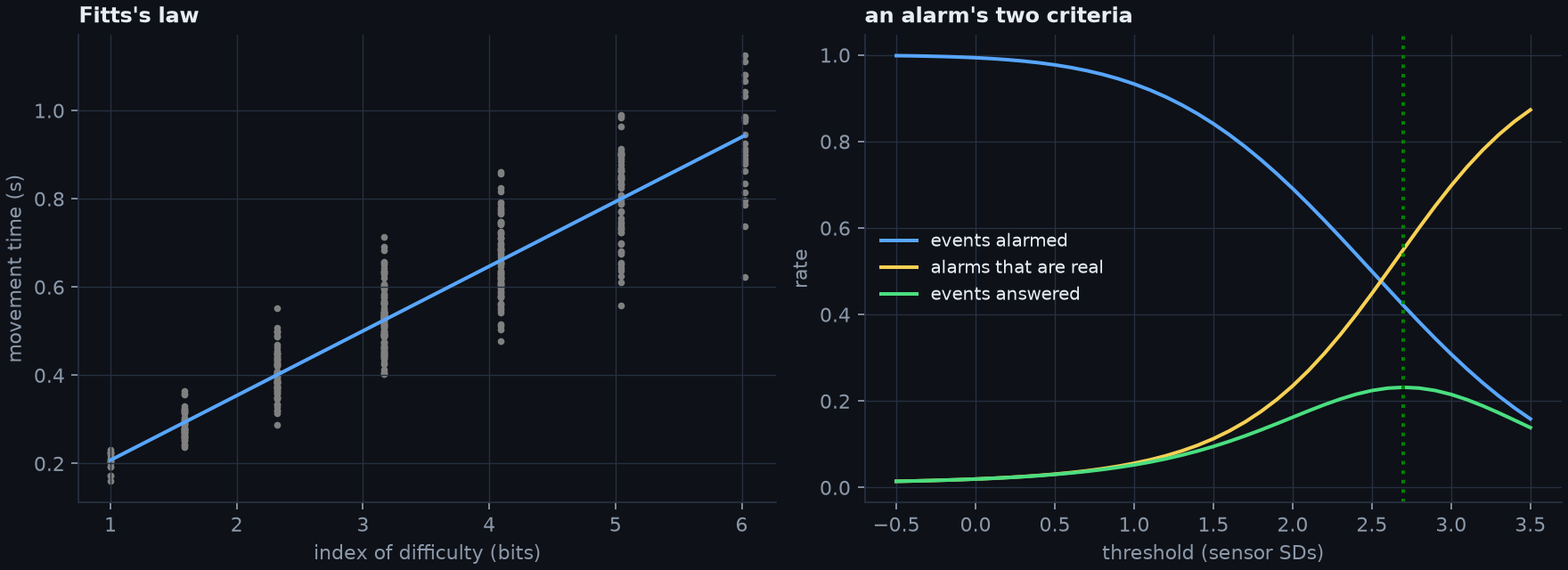
Controls also take time to reach. In 1954 Paul Fitts showed that the time to hit a target grows with the logarithm of its distance over its width. Here are four hundred simulated movements, with a slope of about zero point one five seconds per bit. So frequent or urgent actions get big, near targets. The edges and corners of a screen are infinitely deep, because the pointer stops there. And actions that should take deliberate effort get small, far ones.
Choices take time too. The Hick-Hyman law: reaction time grows with the logarithm of the number of equally likely choices. An incompatible mapping, such as pressing left for a light on the right, adds a translation step, and the cost grows with the choices. In an emergency every extra bit is time. Compatible mappings stay fast under stress, and incompatible ones collapse. Part 1's Donders measured mental stages the same way.
What it does: Compatibility and stereotypes; coding; Fitts's law fitted; Hick's law
3Slips, lapses and mistakesPsych 101 and the major2 min
Is every error the same kind of failure?
Not every error is the same failure. Slips: the right plan, the wrong action, like the gear lever for the flap lever. Design catches them, with coding and interlocks. Lapses: the right plan, with a step forgotten. The fuel cap left off, or a checklist item skipped after an interruption. That's Part 19's working memory. Mistakes: the wrong plan, carried out well. A misdiagnosis, or a rule applied where it doesn't fit. Feedback and other people catch them. And violations: a rule broken on purpose, often because the rule was unworkable. Donald Norman and James Reason drew these lines.
Jens Rasmussen added a ladder of control. Skill-based: fluent, automatic action, fast and accurate, and prone to slips when attention wanders. Rule-based: if this, then that. Procedures and learned patterns, whose errors are good rules misapplied. Knowledge-based: reasoning from first principles in a new situation. It's slow and effortful, and it's where most mistakes are made. An emergency often pushes an operator down this ladder, at the worst possible moment.
This changes the question. The old view says the system is safe, and human error is the cause of accidents. The new view says human error is a symptom of trouble deeper in the system, so ask why the action made sense at the time. Hindsight sees the path to the accident, as Sidney Dekker puts it. The operator saw a forest of possible paths. So this part's question becomes: which design made this error likely?
What it does: Four kinds of error; skills, rules and knowledge; the old view and the new
4A light that told the wrong storyPsych 101 and the major1 min
What did the operators see?
Here's what design-induced error looks like at scale. In 1979, at Three Mile Island, a relief valve in a nuclear plant's cooling circuit opened as designed, and then stuck open. A light on the panel went out. It showed that the valve had been commanded to close, not that it had closed. Believing the valve shut, and reading a rising level in the pressurizer as too much water, the operators cut back the emergency cooling. Hundreds of alarms sounded in the first minutes, and the core partly melted. The investigations found that the operators had done what their displays and their training implied.
What changed afterwards? Show the state: display what a component is actually doing, measured, not what it was told to do. Prioritize alarms: rank them, group them, and suppress the consequences, so the first cause stays visible. Train for the unexpected, with simulator time on failures the procedures don't cover. And human factors by law: control-room design reviews became part of licensing.
What it does: Three Mile Island; what changed
5Attention at workGraduate1 min
How much can one person do at once? If attention were one pool, as a single bottleneck, any two tasks would interfere. Christopher Wickens proposed several pools. Tasks interfere more when they share a modality, eyes or ears, a code, spatial or verbal, and a stage, perceiving or responding. So a pilot flying by eye takes radio calls by ear, and a driver's navigation speaks rather than shows. But even separate pools share a central executive. A phone conversation still slows a driver's braking, as Part 18 showed.
Workload has to be measured. The most used scale is NASA's task load index: six ratings from zero to a hundred, then fifteen pairwise choices of which scale mattered more for this task. The score weights each rating by those choices: here sixty, against a raw mean of fifty-one. There are other measures too: a secondary task whose performance falls as the main task takes more, and pupil size or heart-rate variability. No single measure is workload. When they disagree, each is telling you something.
What it does: Multiple resources; measuring workload
6The watchPsych 101 and the major2 min
Why does attention fail over a long watch?
Here's the decrement Mackworth found. Psyche's sixty watchers spend two hours each at the clock, with a double jump about one time in eighty. In the first half hour they detect about seventy-three percent of the signals. In the last half hour, under half. Mackworth found the fall begins within the first half hour, and later work found it in radar, sonar, airport screening and quality control. And it isn't boredom alone. Watching for rare signals is hard, stressful work.
Is it sensitivity or criterion? Part 12's tools can tell. For each half hour, hits and false alarms give d prime and the criterion. Here d prime falls: the watcher discriminates less well. And the criterion rises: the watcher also says signal less readily, so false alarms fall too. In Psyche, both were planted. In real watches, the meta-analysis by Joel See and colleagues found that which one moves depends on the task, and the remedies differ: rest and aids for sensitivity, feedback and expectations for criterion.
One caution. Here's the same watch for a single watcher, by half hour. With about seven signals per half hour, one record jumps around. The decline is real, but one person's curve can't show it reliably. It's Part 47's lesson again. Group curves describe the task, and individual curves need many more signals. That's why fitness-for-duty tests from a few minutes of data are weak.
What it does: Two hours at the clock; sensitivity or criterion; one watcher's record
7Rare targetsPsych 101 and the major2 min
Why are rare things missed?
Rare targets bring a second problem. Part 12 entered the row: in 2005 Jeremy Wolfe, Todd Horowitz and Naomi Kenner had people search baggage images for tools, and at low prevalence they missed far more. The signal-detection reason: when targets are rare, saying no is usually right, so the criterion drifts up. An observer who shifts only a third of the way toward the optimum misses sixteen percent when half the bags hold a target, and over forty percent when one in a hundred does. Shifting all the way would miss even more. Airport screening and cancer screening are low-prevalence searches.
Expert eyes miss things too. In 2013 Trafton Drew, Melissa Vo and Jeremy Wolfe inserted a small gorilla into a lung scan. Radiologists searching for nodules looked straight at it, eye tracking showed, and most of them didn't report it. Experts aren't immune to Part 18's inattentional blindness. Expertise tunes search to what is expected. In a screening programme, the unexpected finding is the one no one is looking for.
So what helps? Insert targets: add known fake targets so prevalence feels higher and the criterion stays low. Airport systems do this. Double reading: two independent readers, or a reader and an algorithm. Breaks: short watches and rotations against the decrement. And feedback: tell searchers what they missed, so their expectations match the world.
What it does: The prevalence effect; a gorilla in the lungs; what helps
8Situation awarenessGraduate2 min
What does an operator need to know, right now? Mica Endsley's answer in 1995 has three levels. Level one: perceive the elements, like the airspeed, the other aircraft, the warning light. Level two: comprehend them together. What does this pattern mean for my goals? And level three: project. Where will that aircraft be in two minutes? An expert's advantage lives mostly at levels two and three, in Part 24's chunks and schemas.
Where does awareness fail? Debra Jones and Mica Endsley coded the awareness errors in aviation incident reports. About three quarters were at level one. The information wasn't perceived, often because it wasn't displayed, was hard to see, or was never looked at. Most of the rest were at level two: the information was seen, but its meaning was missed. That's a design target. Put the elements where the eyes already are, and show what they mean.
How is awareness measured? The freeze probe, SAGAT: stop the simulator, blank the displays, ask questions at all three levels, and score the answers against the simulator's truth. Online probes, SPAM: ask while the task runs, with the displays visible, and use the time to answer as a measure of how ready the knowledge was. Self-ratings, SART, after the run. They track confidence, and Part 25 showed that confidence is a different thing. And a critique. Lost awareness can become a label for blame after the fact, as Sidney Dekker warns. The measure is useful only when it was taken before anyone knew the outcome.
What it does: Three levels; where awareness fails; measuring it
9The ironies of automationPractice4 min
Does better automation make a safer system?
Automation isn't all or nothing. In 1978 Thomas Sheridan and William Verplank laid out ten levels, from the human doing everything, through the computer suggesting, to the computer acting and telling no one. In 2000 Raja Parasuraman, Sheridan and Christopher Wickens added stages. You can automate acquiring information, analysing it, deciding, or acting, each to its own level. Driving has its own scale, from zero to five. At level two the driver supervises at every moment. At level three the car drives, and the driver must take over when asked. So the question isn't how much automation. It's which function, to what level, with the human doing what?
In 1983 Lisanne Bainbridge named the ironies of automation. Designers automate the tasks people do badly, and leave the human the tasks they couldn't automate. The human becomes a monitor. That's Part 18's vigilance, asked of someone with nothing to do. And the human is the backup when the automation fails. But skills fade without practice, and the failures that reach the human are the hard ones. So the more reliable the automation, the rarer the practice, and the less ready the human when it fails. Her advice was to keep the human in practice: simulators, manual phases, and displays that show what the automation is doing.
Here's the irony as a model. Assume that an operator's median takeover time grows with the logarithm of the time between failures, as practice and expectation fade. That's an assumption, chosen to show the shape. The median takeover goes from about three and a half seconds, when the automation fails once in ten demands, to six seconds, when it fails once in ten thousand. Within a seven-second budget, ninety-five percent of takeovers succeed at first, and sixty-two percent at the end. And yet the system still gets safer. Failures per demand fall from about five in a thousand to about four in a hundred thousand, because the automation fails so much less often. So the irony isn't that automation is unsafe. It's that the residual risk moves to the moment the human is least ready.
Automation adds a new error: mode confusion. A mode is the automation's current way of interpreting the same input. Near Strasbourg in 1992, an Airbus crew is believed to have meant a three point three degree descent path. The autopilot was in a vertical-speed mode, and the same entry meant three thousand three hundred feet per minute. The two modes differed on the display by a few characters. In Earl Wiener's surveys of airline pilots, what is it doing now was among the most common questions in automated cockpits. The design rule: few modes, no silent mode changes, and the mode shown where the eyes already are.
Here's the takeover problem at its worst. In 2009, over the Atlantic at night, ice blocked an Airbus's airspeed probes. The autopilot disconnected and handed the aircraft back to the crew. The pilot flying pulled the nose up. The aircraft climbed, slowed, and stalled. The stall warning sounded, and then fell silent when the airspeed read so low that it was rejected as invalid. Lowering the nose, the right action, brought the warning back. The crew never identified the stall, and two hundred and twenty-eight people died. The French investigators cited the surprise of a takeover at cruise altitude, little practice in manual flight there, and a warning that taught the wrong lesson. Bainbridge's ironies, all at once.
What it does: Levels and stages; Bainbridge; the irony as a model; mode confusion; Air France 447
10Trust and alarmsPractice3 min
How much should an operator believe a machine? John Lee and Katrina See put it simply in 2004. The goal isn't high trust but calibrated trust, on the diagonal, matched to how reliable the automation really is. Above the diagonal is misuse: relying on automation beyond its competence. Automation bias, following a wrong recommendation or missing what it misses. Below is disuse: ignoring good automation after a few false alarms or one vivid failure. Trust follows what operators can see, so show the automation's reliability for this situation, not on average. Part 26's algorithm aversion is disuse, and chapter thirteen's complacency row is misuse.
An alarm is Part 12's criterion, chosen by an engineer. A sensor reads noise, or an event two and a half standard deviations higher, and events are one reading in a hundred. A cautious threshold of one standard deviation alarms on ninety-three percent of events. But only five or six percent of its alarms are real. Operators learn the odds. James Bliss found that people answer alarms about as often as alarms are real, and if they do, few events get an answer. The threshold that gets the most events answered is about two point seven, and even it gets only twenty-three percent. So the engineer sets one criterion, and the operator's trust sets a second. You have to design both.
So how do you build a better alarm? Raise the base rate. Alarm on combinations and trends rather than single readings, so more alarms are real. Grade the alarm. Robert Sorkin's likelihood alarms say possible, likely or certain, so the response can match. Delay and fit. A few seconds' delay, and limits fitted to the patient, remove many alarms that settle on their own. And count them. Alarms per hour and the share acted on are measurable, and a design review can set targets.
Here's what that looks like in a hospital. A monitored intensive-care bed can sound hundreds of alarms a day. Studies of bedside monitors find that most of those alarms are false or need no action. So nurses turn volumes down, widen limits, or stop hearing them. That's the cry wolf effect, and it's a learned criterion. In 2013 the American Joint Commission issued an alert on alarm safety, after deaths linked to alarms that went unanswered. The nurse's criterion is rational for the alarms they've been given. Fix the alarms.
What it does: Calibrated trust; an alarm is a criterion; better alarms; alarm fatigue on the ward
11Systems, checklists and crewsPractice3 min
Can a system be safer than its people? James Reason's answer is a picture: defences in layers, like slices of Swiss cheese, each with holes. An accident needs a hole in every layer at once. Take four layers, each failing one time in ten. If they fail independently, that's one accident in ten thousand. But holes can share a cause: fatigue, a culture of shortcuts, one bad procedure. With a correlation of zero point six between layers, it's about one in seventy. Defence in depth works only if the layers fail independently, and what Reason called latent conditions make them fail together.
The checklist is the simplest defence. Aviation's checklists began in 1935, after a new bomber crashed on a test flight because a control lock had been left on. In 2009 Alex Haynes and colleagues brought a nineteen-item surgical checklist to eight hospitals in eight countries. Before and after, deaths fell from about one and a half percent to under one, and complications from about eleven percent to seven. But it was a before-and-after study. In Ontario, where a mandate imposed the checklist on every hospital, deaths and complications didn't change. A checklist works through the team that owns it: the pause, the names, and the permission to speak up.
Here's the accident that changed crews. In 1977 two jumbo jets were diverted to a small, fog-bound airport on Tenerife. One was taxiing along the runway, and the other waited at its end. The waiting captain, a senior training pilot, began the takeoff without a takeoff clearance. His flight engineer asked whether the other aircraft was clear of the runway, and the captain said it was. Radio calls overlapped, and we are now at takeoff meant different things to the crew and to the tower. Five hundred and eighty-three people died. It's still the deadliest accident in aviation's history.
After Tenerife, and other crashes where someone saw the problem and didn't say so, came crew resource management. NASA's studies in the late nineteen seventies found that most accidents involved failures of communication, leadership and decision in the crew, not of flying skill. The training teaches speaking up with a graded script, briefing the plan, cross-checking, and making the captain's authority open to challenge. Part 34's obedience, designed against. It spread to operating theatres, emergency rooms, ships and control rooms. And the evidence: attitudes and behaviour change reliably. Effects on accidents are hard to measure, because accidents are rare. That's chapter seven's problem, at the level of a whole industry.
What it does: The Swiss cheese model; the checklist; Tenerife; crew resource management
12Fatigue as a measured riskGraduate2 min
How tired is too tired?
Part 10 built the clocks. Here's what they cost at work. In 1997 Drew Dawson and Kathryn Reid tested a hand-eye tracking task through twenty-eight hours awake, and in the same people after doses of alcohol. After about seventeen hours awake, performance was like a blood alcohol of zero point zero five percent. After about twenty-four hours, like zero point one. A shift that starts at seven in the morning reaches seventeen hours awake at midnight. The line here is drawn as they reported it. The equivalence varies by task, but the scale holds.
It's not only the hours. Part 10's two processes: sleep pressure builds with hours awake, and the circadian clock adds a trough in the small hours. Crashes from falling asleep at the wheel peak in the early morning, and again in mid-afternoon. There are microsleeps, seconds of lost attention that the person often doesn't notice. And tired people judge their own impairment poorly. That's Part 25's confidence, out of step with accuracy again. So a rule about hours alone misses the night shift's trough and the long drive home.
So how is fatigue managed? With limits on hours of service. They're simple to audit, and blind to the clock and to the sleep a person actually got. With fatigue risk management systems, which model the rosters with the two-process clock, collect fatigue reports without blame, and adjust. With countermeasures: planned naps, caffeine timed to the trough, light, and a ride home after a night shift. And for junior doctors, a contested case. A trial of shorter shifts for interns found fewer serious errors. Later and larger trials of duty-hour rules found smaller or mixed effects. The schedule matters, and so does what happens at each handover.
What it does: Hours awake against blood alcohol; the clock; managing fatigue
13The LedgerGraduate1 min
What the four have in common. Three are effects of the person in the system: attention over time, attention under automation, and the clock. Those replicate well, because they rest on Parts 10, 12 and 18. The contested one is an intervention. It works through a team and a culture, and a mandate can't copy those. The human limits are stable. The fixes depend on the system they're put into.
What it does: Four rows; what they have in common
14In practice: a takeover request, designedPractice3 min
How would you hand a car back to its driver?
Where does this work get done? In aviation, where certification asks for a human-factors case for cockpit designs, and incidents are reported without blame and analysed. In medical devices, where usability standards require testing with real users on the tasks where a use error could harm. In control rooms for nuclear power, rail and the grid: alarm management targets, procedure design, and simulator training. And in vehicles: driver monitoring, takeover requests, and the evidence that drivers of partly automated cars look away.
Here's a worked design. The situation: a level-three car on a motorway. The system will reach the end of the road it can handle in forty seconds, or it meets a fault now. What we know: chapter nine's takeover times stretch with reliability, and a driver out of the loop has lost awareness at levels two and three. The target: most drivers stable and in control before the budget runs out, measured in a simulator, with a criterion written down in advance, as Part 43 asked.
A takeover request, in four steps. Early: for a planned end of automation, an advisory at forty seconds, shown and spoken, with the reason. The request, at about ten seconds: a sound, a seat vibration and a display. Three channels, one for each of Wickens's pools. A check: driver monitoring confirms eyes on the road and hands on the wheel before the car hands over. And a fallback. If there's no response, the car slows and stops in the safest lane it can reach, with the hazard lights on. Each step is a hypothesis about a person, tested in the simulator against the target, and again on the road.
All of this goes into a safety case. Its human-factors section lists the tasks: what the person must perceive, decide and do, and in how long. The hazards: for each step, the slips, lapses and mistakes that could happen there. The evidence: user tests and simulator studies, with their samples, criteria and failures. The residual risk: what remains, and why it's acceptable, in numbers where possible. And a plan to learn from the field, reading incident reports for design, not for blame.
What it does: Where human factors works; the brief; four steps; the safety case
15Frontier: supervising learning machinesResearch2 min
What changes when the automation learns? Classic automation fails at known edges. A learned system can fail on an input that looks ordinary to a person. An assistant's confident, well-written answer invites Part 25's trust in fluency, whether or not it's right. Reliability shifts. An update can change what the system does well, so trust that was calibrated last month may be wrong today. And monitoring scales. One supervisor may watch many vehicles or agents, which is vigilance and takeover, multiplied.
Decision aids are already in high-stakes work. Radiology, pathology and dermatology have tested readers with and without an algorithm's suggestion. Correct suggestions improve readers. Incorrect ones pull them along, experts included. That's automation bias, measured. The design questions are this part's: when to show the suggestion, how to show its uncertainty, and who reads first. And the evaluation question is the human with the machine, not the machine alone.
And the open problems. Monitoring that measures an operator's readiness, not just where their eyes point. Explanations: which ones improve calibration, and which only raise trust. Skill: keeping human skill alive when the machine does the work most of the time. That's Bainbridge's problem, and it's still unsolved. And measurement: near misses and takeovers treated as data, with shared, open incident reporting for learned systems.
What it does: What is new; decision aids in high-stakes work; open problems
Recap, problems, and the road aheadAll tracks3 min
First, your four numbers. In the last half hour of a two-hour watch, Psyche's watchers caught about half the signals. When targets fell from one bag in two to one in a hundred, misses went from sixteen percent to forty-two. With automation failing once in ten thousand demands instead of once in ten, takeovers within seven seconds fell from ninety-five percent to sixty-two. And about seventeen hours awake impair performance like a blood alcohol of zero point zero five. Each is a human limit a designer can plan for. None is a reason to blame the person who meets it.
Part fifty-one in twelve lines. Error is designed in, through shape, position and compatibility. Fitts's and Hick's laws predict movement and choice time. Slips, lapses, mistakes and violations need different fixes. Show the state, not the command. Workload is several resources, measured several ways. Vigilance falls within the first half hour. Rare targets raise the criterion. Awareness fails most often at perception. Reliable automation leaves an unready human. An alarm is a criterion, and trust is a second one. Defences fail together through shared causes. And fatigue is a measured, manageable risk.
Where this comes back. Fitts's and Hick's laws become an engineering model of the interface in Part 52. Selection and training at work are Part 53. Part 56 treats an eyewitness line-up as a detection task. And humans supervising learning machines return in Part 60.
Seven problems, with full solutions in this part's README. One applies Fitts's law. One finds a watcher's d prime and criterion. One asks what share of alarms are real. One stacks four layers of cheese. One scores the task load index. One finds the share of takeovers that finish in time. And the last, with the star, asks you to write the human-factors section of a safety case for a medication pump. Pause here if you'd like to try them.
The books and papers behind this part are listed here and in the README. Wickens and colleagues' textbook is the field's reference; Reason's Human Error gives it its vocabulary; and Dekker's field guide is the best short argument for asking why an action made sense at the time.
Act Twelve has begun. This part put a person into a system and asked where the system should bend. The next one asks whether psychology is quantitative enough to engineer with. In the late nineteen eighties a telephone company was about to buy workstations that would save seconds a call. A model of the operator, built on paper, said they'd be slower. Part 52: designing for minds.
Where it goes next. Part 52 turns Fitts's and Hick's laws into an engineering model of the interface; Part 56 treats a line-up as a detection task; humans supervising learning machines return in Part 60.
Key results
The part's results in one place, for revision.
Try it
Lab 51 · Human Factors
Fit Fitts's law, watch a simulated operator's sensitivity and criterion change over a two-hour watch, and find the alarm threshold that gets the most real events answered.
python -m videos.psychology.labs 51
needs numpy, scipy, matplotlib · download lab51.py ·
source on GitHubFitts's law fitted: a, b (s per bit), r 0.061, 0.146, 0.93
hits by half hour 0.78, 0.62, 0.59, 0.49
d' by half hour; c by half hour 2.71, 2.36, 2.35, 2.17; 0.59, 0.86, 0.96, 1.10
misses at prevalence 50%, 10%, 2%, 1% 0.16, 0.27, 0.37, 0.42
takeovers within 7 s at reliability .9 to .9999 0.95, 0.87, 0.75, 0.64
best alarm threshold; share of events answered 2.7; 0.23
Swiss cheese, independent and rho 0.6 0.00010, 0.0138
hours awake like 0.05% and 0.10% alcohol 17, 24
The human limits are lawful and measurable; the designer chooses where the criteria sit, how much practice the operator keeps, and whether the defences share their causes.The code (61 lines; it asserts its own result)
"""Lab 51: human factors: Fitts's law, a vigilance watch by signal detection, the prevalence effect, the ironies of
automation, an alarm's two criteria, correlated Swiss cheese and fatigue."""

import numpy as np

from videos.coursekit import labs
from explainer.psychology.psyche import work as Wk

TITLE = "Human Factors"
GOAL = ("Fit Fitts's law, watch a simulated operator's sensitivity and criterion change over a two-hour watch, and "
        "find the alarm threshold that gets the most real events answered.")
TASKS = [
    "Halve the vigilance decline in sensitivity (d_loss = 0.25). How much of the fall in hits is left, and why?",
    "Raise the alarm's base rate from 1% to 10%. Where does the best threshold move, and what share is answered?",
    "Make the Swiss cheese layers five instead of four. How much does correlation 0.6 still cost?",
]


def run(seed=0):
    out = labs.Lab()
    f = Wk.fitts_trials(seed=seed + 1)
    assert 0.12 < f["b"] < 0.18 and f["r"] > 0.9
    out.row("Fitts's law fitted: a, b (s per bit), r", f"{f['a']:.3f}, {f['b']:.3f}, {f['r']:.2f}")
    v = Wk.vigilance(watchers=60, seed=seed + 2)
    assert v["hit"][-1] < v["hit"][0] and v["c"][-1] > v["c"][0]
    out.row("hits by half hour", ", ".join(f"{h:.2f}" for h in v["hit"]))
    out.row("d' by half hour; c by half hour", ", ".join(f"{d:.2f}" for d in v["d"]) + "; "
            + ", ".join(f"{c:.2f}" for c in v["c"]))
    p = Wk.prevalence_partial(prevs=(0.5, 0.1, 0.02, 0.01), shift=0.35)
    assert np.all(np.diff(p["miss"]) > 0)
    out.row("misses at prevalence 50%, 10%, 2%, 1%", ", ".join(f"{m:.2f}" for m in p["miss"]))
    t = Wk.takeover(seed=seed + 3)
    assert np.all(np.diff(t["within"]) < 0) and np.all(np.diff(t["system_fail"]) < 0)
    out.row("takeovers within 7 s at reliability .9 to .9999", ", ".join(f"{w:.2f}" for w in t["within"]))
    a = Wk.alarm()
    out.row("best alarm threshold; share of events answered", f"{a['best']:.1f}; {a['best_caught']:.2f}")
    ch = [Wk.swiss_cheese(rho=r, n=200000, seed=seed + 4) for r in (0.0, 0.6)]
    assert ch[1] > 10 * ch[0]
    out.row("Swiss cheese, independent and rho 0.6", f"{ch[0]:.5f}, {ch[1]:.4f}")
    out.row("hours awake like 0.05% and 0.10% alcohol", "17, 24")

    out.note = ("The human limits are lawful and measurable; the designer chooses where the criteria sit, how much "
                "practice the operator keeps, and whether the defences share their causes.")

    fig, ax = labs.figure(2, size=(11, 4.0))
    ax[0].scatter(f["ID"], f["t"], s=6, color="grey")
    xs = np.linspace(f["ID"].min(), f["ID"].max(), 20)
    ax[0].plot(xs, f["a"] + f["b"] * xs, color=labs.BLUE)
    ax[0].set(title="Fitts's law", xlabel="index of difficulty (bits)", ylabel="movement time (s)")
    ax[1].plot(a["threshold"], a["hit"], label="events alarmed")
    ax[1].plot(a["threshold"], a["ppv"], label="alarms that are real")
    ax[1].plot(a["threshold"], a["caught"], label="events answered")
    ax[1].axvline(a["best"], color="green", ls=":")
    ax[1].set(title="an alarm's two criteria", xlabel="threshold (sensor SDs)", ylabel="rate")
    ax[1].legend()
    out.fig = fig
    return out


if __name__ == "__main__":
    print(run())
Now change it
- Halve the vigilance decline in sensitivity (d_loss = 0.25). How much of the fall in hits is left, and why?
- Raise the alarm's base rate from 1% to 10%. Where does the best threshold move, and what share is answered?
- Make the Swiss cheese layers five instead of four. How much does correlation 0.6 still cost?
Problems, with solutions
Try each problem before opening its solution.
-
Fitts's law. Fitts's law with \(a\) = 0.1 s and \(b\) = 0.15 s per bit: predict the time to reach a 2 cm target 16 cm away (\(ID = \log_2(2D/W)\)).
Solution
ID = log2(2 x 16 / 2) = 4 bits; MT = 0.1 + 0.15 x 4 = 0.70 s.
-
A watch. A watch: 40 signals, 28 hits; 2,000 non-signals, 30 false alarms. Find \(d'\) and \(c\).
Solution
H = 28/40 = 0.70, F = 30/2,000 = 0.015; z(H) = 0.524, z(F) = -2.170; d' = 2.69, c = -(0.524 - 2.170)/2 = 0.82: a conservative watcher.
-
Real alarms. Targets in 1 bag in 200; hit rate 0.9, false-alarm rate 0.05. What share of alarms are real?
Solution
PPV = 0.005 x 0.9 / (0.005 x 0.9 + 0.995 x 0.05) = 0.0045/0.0543 = 0.083: about one alarm in twelve is real.
-
Independent layers. Four independent layers, each failing one time in 20: the chance of an accident?
Solution
0.05^4 = 6.25 x 10^-6, about one in 160,000; if the layers share causes, much more.
-
NASA-TLX. NASA-TLX ratings 70, 40, 60, 50, 30, 80 with weights 5, 1, 3, 2, 0, 4: the weighted score?
Solution
(70 x 5 + 40 x 1 + 60 x 3 + 50 x 2 + 30 x 0 + 80 x 4)/15 = 990/15 = 66.
-
Takeovers in time. A level-3 car hands over with a 7 s budget; takeover times are lognormal with median 5 s and log-SD 0.45. What share finish in time?
Solution
P(T < 7) = Phi(ln(7/5)/0.45) = Phi(0.75) = 0.77.
-
★ A safety case for dose entry. Write the human-factors section of a safety case for a medication pump's dose entry: tasks, likely slips, lapses and mistakes, the tests, and the residual risk.
Solution
Tasks: select the drug, enter the dose and rate, confirm, start. Likely errors: slips (a decimal point or an extra zero, the wrong drug in a look-alike list), lapses (a step skipped after an interruption), mistakes (units confused, mg against micrograms, or a wrong rule for a weight-based dose). Controls: a drug library with hard and soft limits, units always shown, no trailing zeros, a confirmation that restates the dose in words and against the usual range, and a second check for high-risk drugs. Evidence: a usability test with nurses on the critical tasks, with error rates and their causes, under realistic interruption. Residual risk: what errors remain and at what rate, why that is acceptable, and how field reports will be read for design.
Notes and sources
Sources
- P. M. Fitts and R. E. Jones, Analysis of factors contributing to 460 "pilot-error" experiences in operating aircraft controls, Memorandum Report TSEAA-694-12, Aero Medical Laboratory, Wright-Patterson Air Force Base (1947); A. Chapanis, W. R. Garner and C. T. Morgan, Applied Experimental Psychology (Wiley, 1949).
- P. M. Fitts, The information capacity of the human motor system in controlling the amplitude of movement, Journal of Experimental Psychology 47 (1954) 381-391; W. E. Hick, On the rate of gain of information, Quarterly Journal of Experimental Psychology 4 (1952) 11-26; R. Hyman, Stimulus information as a determinant of reaction time, Journal of Experimental Psychology 45 (1953) 188-196.
- D. A. Norman, Categorization of action slips, Psychological Review 88 (1981) 1-15; J. Reason, Human Error (Cambridge University Press, 1990); J. Rasmussen, Skills, rules, and knowledge, IEEE Transactions on Systems, Man, and Cybernetics 13 (1983) 257-266; S. Dekker, The Field Guide to Understanding Human Error (Ashgate, 2006).
- J. G. Kemeny et al., Report of the President's Commission on the Accident at Three Mile Island (1979).
- C. D. Wickens, Multiple resources and performance prediction, Theoretical Issues in Ergonomics Science 3 (2002) 159-177; S. G. Hart and L. E. Staveland, Development of NASA-TLX, in P. A. Hancock and N. Meshkati (eds), Human Mental Workload (North-Holland, 1988) 139-183.
- N. H. Mackworth (1948); J. E. See et al. (1995); J. S. Warm, R. Parasuraman and G. Matthews (2008).
- J. M. Wolfe, T. S. Horowitz and N. M. Kenner, Rare items often missed in visual searches, Nature 435 (2005) 439-440; T. Drew, M. L.-H. Vo and J. M. Wolfe, The invisible gorilla strikes again, Psychological Science 24 (2013) 1848-1853.
- M. R. Endsley, Toward a theory of situation awareness in dynamic systems, Human Factors 37 (1995) 32-64; D. G. Jones and M. R. Endsley, Sources of situation awareness errors in aviation, Aviation, Space, and Environmental Medicine 67 (1996) 507-512.
- T. B. Sheridan and W. L. Verplank, Human and Computer Control of Undersea Teleoperators (MIT, 1978); R. Parasuraman, T. B. Sheridan and C. D. Wickens, A model for types and levels of human interaction with automation, IEEE Transactions on Systems, Man, and Cybernetics A 30 (2000) 286-297; SAE J3016, Taxonomy and Definitions for Terms Related to Driving Automation Systems; L. Bainbridge, Ironies of automation, Automatica 19 (1983) 775-779; E. L. Wiener, Human Factors of Advanced Technology ("Glass Cockpit") Transport Aircraft, NASA Contractor Report 177528 (1989); BEA, Final Report on the accident on 1st June 2009 to the Airbus A330-203 registered F-GZCP (2012).
- R. Parasuraman, R. Molloy and I. L. Singh (1993); R. Parasuraman and V. Riley, Humans and automation: use, misuse, disuse, abuse, Human Factors 39 (1997) 230-253; J. D. Lee and K. A. See, Trust in automation: designing for appropriate reliance, Human Factors 46 (2004) 50-80; R. Parasuraman and D. H. Manzey (2010); J. P. Bliss, R. D. Gilson and J. E. Deaton, Human probability matching behaviour in response to alarms of varying reliability, Ergonomics 38 (1995) 2300-2312; R. D. Sorkin, B. H. Kantowitz and S. C. Kantowitz, Likelihood alarm displays, Human Factors 30 (1988) 445-459; The Joint Commission, Sentinel Event Alert 50: Medical device alarm safety in hospitals (2013).
- J. Reason, Managing the Risks of Organizational Accidents (Ashgate, 1997); A. B. Haynes et al. (2009); D. R. Urbach et al. (2014); A. S. Haugen et al. (2015); A. Gawande, The Checklist Manifesto (2009).
- Spanish civil aviation authority and Netherlands Aviation Safety Board reports on the Tenerife collision (1978); J. K. Lauber, Resource management on the flight deck, NASA Conference Publication 2120 (1980); R. L. Helmreich, A. C. Merritt and J. A. Wilhelm, The evolution of crew resource management training in commercial aviation, International Journal of Aviation Psychology 9 (1999) 19-32.
- D. Dawson and K. Reid (1997); A. M. Williamson and A.-M. Feyer (2000); C. P. Landrigan et al., Effect of reducing interns' work hours on serious medical errors in intensive care units, New England Journal of Medicine 351 (2004) 1838-1848.
About this partfrom its README
In the 1940s pilots of some bomber types kept retracting the landing gear after landing when they meant to raise the flaps. In 1947 Paul Fitts and Richard Jones collected 460 reports of "pilot error" and found the same few again and again: the two levers sat side by side and felt the same. Alphonse Chapanis gave one a wheel-shaped knob and the other a flap-shaped one, and the errors went away. Human factors begins with the idea that error is designed in and can be designed out; this part follows it into control rooms, screening halls, automated cockpits, operating theatres and night shifts. Act XII, psychology at work, begins here.
The viewer watches Mackworth's clock and predicts four numbers. Then compatibility and coding, Fitts's and Hick's laws fitted; slips, lapses, mistakes and violations, and Rasmussen's ladder; Three Mile Island; multiple resources and NASA-TLX; a two-hour watch analysed by signal detection half hour by half hour; the prevalence effect and a gorilla in a lung scan; situation awareness and how it is measured; levels of automation, Bainbridge's ironies as a model, mode confusion and Air France 447; calibrated trust, an alarm as a criterion and alarm fatigue; the Swiss cheese model with correlated holes, the surgical checklist, Tenerife and crew resource management; and fatigue against blood alcohol.
What is computed and built
explainer/psychology/psyche/work.py: Fitts's and the Hick-Hyman laws with a compatibility cost; a vigilance watch analysed by signal detection block by block; the prevalence effect, optimal and partial; NASA-TLX; takeover after automation; alarm thresholds with positive predictive value and probability-matching operators; the Swiss cheese model with correlated holes; hours awake against blood-alcohol equivalents. Tested intests/psychology/test_work.py.- The Ledger gains four rows; the deferred rows for the vigilance decrement (Parts 12 and 18) are resolved.
- The course's interactive: Mackworth's clock for ninety seconds, with common and rare double jumps; the reader's hits, false alarms, d' and c.
Chapter notes
| # | Chapter | What it does |
|---|---|---|
| 0 | Two levers that felt the same | Fitts and Jones's pilot errors; Chapanis's knobs; the question; objectives |
| 1 | On you: watch the clock, and four numbers | Mackworth's clock; four predictions |
| 2 | Error designed in | Compatibility and stereotypes; coding; Fitts's law fitted; Hick's law |
| 3 | Slips, lapses and mistakes | Four kinds of error; skills, rules and knowledge; the old view and the new |
| 4 | A light that told the wrong story | Three Mile Island; what changed |
| 5 | Attention at work | Multiple resources; measuring workload |
| 6 | The watch | Two hours at the clock; sensitivity or criterion; one watcher's record |
| 7 | Rare targets | The prevalence effect; a gorilla in the lungs; what helps |
| 8 | Situation awareness | Three levels; where awareness fails; measuring it |
| 9 | The ironies of automation | Levels and stages; Bainbridge; the irony as a model; mode confusion; Air France 447 |
| 10 | Trust and alarms | Calibrated trust; an alarm is a criterion; better alarms; alarm fatigue on the ward |
| 11 | Systems, checklists and crews | The Swiss cheese model; the checklist; Tenerife; crew resource management |
| 12 | Fatigue as a measured risk | Hours awake against blood alcohol; the clock; managing fatigue |
| 13 | The Ledger | Four rows; what they have in common |
| 14 | In practice: a takeover request, designed | Where human factors works; the brief; four steps; the safety case |
| 15 | Frontier: supervising learning machines | What is new; decision aids in high-stakes work; open problems |
| Recap, problems, and the road ahead | Your numbers; twelve lines; payoffs; problems; references; Part 52 |
NotesWhere the numbers come from
| What | Source |
|---|---|
| Fitts's law: 400 simulated movements (distances 64 to 512, widths 8 to 64), MT = 0.05 + 0.15 log2(D/W + 1) s with lognormal noise; fitted a = 0.05, b = 0.15 s per bit, r = 0.95 | Psyche (work.fitts_trials), item fitts |
| Hick-Hyman: RT = 0.2 + 0.15 log2(N + 1) s, plus 0.12 log2(N + 1) s for an incompatible mapping (illustrative parameters) | Psyche (work.hick_rt), item hick |
| NASA-TLX: ratings 70, 20, 60, 40, 65, 50 with weights 4, 0, 3, 2, 4, 2; weighted score 60, raw mean 51 | Psyche (work.nasa_tlx), item tlx |
| A two-hour watch, 60 simulated watchers: 20 events a minute, 1.2% signals; d' falls linearly from 2.6 by 0.5 over the watch and c rises from 0.6 by 0.6; hits by half hour 0.73, 0.67, 0.57, 0.49; estimated d' 2.56 to 2.15, c 0.65 to 1.11 | Psyche (work.vigilance), item vigilance |
| One watcher, the same watch: hits 0.81, 0.50, 0.56, 0.50 | Psyche (work.vigilance), item onewatch |
| The prevalence effect, d' = 2: misses at prevalence 50%, 10%, 2%, 1% are 0.16, 0.54, 0.83, 0.90 for the accuracy-maximizing criterion and 0.16, 0.27, 0.37, 0.42 for an observer who shifts 35% of the way on the log-beta scale | Psyche (work.prevalence, prevalence_partial), item prevalence |
| The ironies of automation as a model: median takeover 2.5(1 + 0.35 log10 MTBF) s, lognormal (log-SD 0.45); at reliability 0.9, 0.99, 0.999, 0.9999 the median is 3.4, 4.3, 5.1, 6.0 s, the share within 7 s 0.95, 0.86, 0.76, 0.62, and failures per demand 5.3e-3, 1.4e-3, 2.4e-4, 3.8e-5 (the growth of takeover time is an assumption chosen to show the shape) | Psyche (work.takeover), item takeover |
| An alarm on a noisy sensor: events 1% of readings, d' = 2.5; at a threshold of 1 SD, 93% of events alarmed and 5.6% of alarms real; with responses matched to the alarm's reliability, the best threshold is 2.7 SD and 23% of events are answered | Psyche (work.alarm), item alarm |
| The Swiss cheese model: four layers, each open 10% of the time, a Gaussian copula with correlation 0, 0.2, 0.4, 0.6; 400,000 simulated days; accident rates 0.9e-4, 1.3e-3, 5.2e-3, 1.4e-2 | Psyche (work.swiss_cheese), item cheese |
| Hours awake against blood alcohol: the line through Dawson and Reid's two reported points (17 h like 0.05%, 24 h like 0.10%) | Dawson and Reid (1997) as reported, item fatigue |
| The shares of awareness errors by level (about 76%, 20% and 3%) | Jones and Endsley (1996) as usually quoted; see Open checks |
| Every published number on screen | the studies listed under Sources, quoted as reported |
Notes
| Finding | Original | Status |
|---|---|---|
| In a long watch for rare signals, detection falls within the first half hour and keeps falling. | Mackworth 1948 | replicated |
| Introducing a short surgical safety checklist reduces deaths and complications after surgery. | Haynes and colleagues 2009 | contested |
| People who monitor reliable automation detect its rare failures less well than people who do the task themselves, and less well the more reliable it has been. | Parasuraman, Molloy and Singh 1993 | replicated |
| Staying awake for 17 to 24 hours impairs performance about as much as a blood-alcohol concentration of 0.05% to 0.10%. | Dawson and Reid 1997 | replicated |
Shown without a row, with the reason recorded in explainer/psychology/ledger.py: Fitts and Jones; Fitts; Bainbridge;
Endsley; Jones and Endsley; Hart and Staveland; Reason.
Notes
The web-search budget for this session was spent on earlier parts, so the facts in this part come from the standard literature and were not re-checked online today; each is listed here to be checked against its source: the B-17 gear and flap confusion and which aircraft types it involved; Fitts and Jones's 460 reports and the report's number; Chapanis's knobs and the date; Three Mile Island's sequence (the relief valve, the indicator, the pressurizer level, the number of alarms in the first minutes) and the changes after it; Wickens's model as described; NASA-TLX's 15 pairwise comparisons; Mackworth's clock (one step a second, double jumps, two-hour watches, RAF observers); See et al.'s conclusions; Warm, Parasuraman and Matthews (2008); Wolfe, Horowitz and Kenner (2005); Drew, Vo and Wolfe's gorilla (its size, the share of radiologists who missed it, the eye tracking); Endsley's three levels; Jones and Endsley's shares by level; SAGAT, SPAM and SART as described; Sheridan and Verplank's ten levels and Parasuraman, Sheridan and Wickens's four stages; SAE J3016's levels; Bainbridge (1983); the Strasbourg accident of 1992 (the crew's intent and the two modes); Wiener's surveys and the "what is it doing now" question; the Air France 447 sequence, the stall warning's behaviour and the death toll; Lee and See (2004); Bliss's probability matching; Sorkin's likelihood alarms; the alarm counts and false-alarm shares on intensive-care monitors; the Joint Commission's 2013 alert; the 1935 bomber crash and the origin of aviation checklists; Haynes et al.'s 19 items, eight hospitals and the death and complication rates; Urbach et al.'s Ontario result; Haugen et al. (2015); the Tenerife sequence and toll; NASA's late-1970s findings on crew failures and the 1979 workshop; Dawson and Reid's task, the 28 hours and the equivalences; Williamson and Feyer (2000); the timing of sleep-related crashes; Landrigan et al. (2004) and the later duty-hour trials; and every page range in Sources.
Companion material in this repository
The syllabus's plan for this partfrom SYLLABUS.md, the plan of record
- Hook: the B-17 and the shape-coded knob.
- Design-induced error: stimulus–response compatibility, population stereotypes, coding of controls and displays.
- Slips, lapses and mistakes (Norman; Reason); skills, rules and knowledge (Rasmussen).
- Three Mile Island (1979): an indicator that showed the command and not the valve.
- Attention at work: multiple resources (Wickens); workload and how to measure it (NASA-TLX, secondary tasks, physiology).
- On you: Mackworth's clock for ninety seconds. Vigilance falls within minutes; the SDT account (Part 12): sensitivity or criterion?
- Rare targets: the prevalence effect in baggage and cancer screening; a gorilla in a lung scan missed by most radiologists.
- Situation awareness (Endsley's three levels) and how it is measured.
- Automation: levels of automation; the ironies of automation (Bainbridge 1983): the more reliable the system, the less practised the human who must take over. Mode confusion; Air France 447.
- Trust in automation: calibration, misuse and disuse; alarm fatigue as a criterion placed by an engineer.
- Systems: the Swiss cheese model; the checklist and its trial evidence in surgery and intensive care; crew resource management after Tenerife.
- Fatigue (Part 10) as a quantified risk: hours awake against blood-alcohol equivalents.
Psyche: psyche.work: an operator model built from Parts 12, 18 and 25 (vigilance decrement, prevalence-driven
criterion shift, takeover reaction time after automation); an alarm-threshold optimizer.
On you: the vigilance clock.
Ledger: the vigilance decrement (replicated); the prevalence effect (replicated); surgical checklists
reducing complications (replicated in the original multi-site study; smaller or absent under mandate,
contested); automation complacency (replicated).
In practice: aviation, medical devices, control rooms, vehicle automation; the human-factors section of a
safety case; a worked takeover-request design.
Frontier: supervising learning-based automation; driver monitoring; human factors of AI assistants in
high-stakes work.
Reading: Fitts & Jones 1947; Chapanis, Garner & Morgan 1949; Wickens et al., Engineering Psychology and Human
Performance; Reason, Human Error; Bainbridge 1983; Endsley 1995; Parasuraman, Sheridan & Wickens 2000; Wolfe et
al. 2005; Haynes et al. 2009; Dekker, The Field Guide to Understanding Human Error.
Build the film
python -m videos.psychology.psych51.compute        # the part's numbers, into .cache/psych51
python tools/build.py psych51                  # render and assemble the film
EXPLAINER_TTS=silent python tools/qa_scene.py psych51 Hook   # one chapter, silent, with a contact sheet
Scenes: videos/psychology/psych51. Setup: see the course page. Source of these notes: the README and the scenes' narration.
Build it
python -m videos.psychology.psych51.compute            # every number (seconds)
python tools/qa_scene.py psych51 Vigilance             # one chapter, silent, at 480p, with a contact sheet
EXPLAINER_TTS=silent python tools/build.py psych51 -q l   # the whole part, silent preview
python tools/build.py psych51                          # 1080p30 with narration
python tools/qa_scene.py psych51 Automation --lang zh  # the Chinese edition of one chapter
python tools/make.py psych51                           # both editions, with the checks a long build needs
python -m videos.psychology.labs 51                    # the lab: Fitts, the watch, the alarm, the cheese
python tools/check_ledger.py psych51                   # every study shown has its Ledger row, or a reason
python -m pytest tests/psychology                      # Psyche's work module, the Ledger, the Archive
The Chinese edition is zh_lines.py (the narration, line by line) and the series table
videos/psychology/psychology_text_zh.json (the text on screen); the terms are in
PSYCHOLOGY_ZH_GUIDE.md.