Psychosis, Addiction and Development
What happens when the machinery of inference and learning is set wrongly?
A mask of a face, seen from behind, looks like an ordinary face to almost everyone: a prior strong enough to overrule both eyes. In small studies, many people with schizophrenia see it as hollow. The part uses the series' own models as a language for three kinds of condition. Psychosis: its symptoms and course, chlorpromazine and the dopamine hypothesis, aberrant salience (computed), the hollow mask on a Gaussian observer, conditioned hallucinations, and causes from hundreds of genes to cities. Addiction: reward, tolerance, wanting without liking, habit and steep discounting; Redish's prediction error that cannot be learned away (computed) and the test it failed; Rat Park, the Vietnam veterans and contingency management. Development: autism's histories, the vaccine fraud, priors as a trade-off, rising diagnoses and facilitated communication; ADHD, relative age and the MTA trial.
What you need. Part 14's Bayesian observer, Part 17's prediction errors and habits, Part 26's discounting and Part 39's base rates; Gaussian algebra, sums of series and derivatives.
- Hook
- a mask that will not look hollow
- Ideas, models and mathematics
- schizophrenia and dopamine, aberrant salience, hallucination as inference, genetics, addiction as hijacked learning, autism, ADHD
- Psyche gains
- priors too strong and too weak
- On you
- the hollow mask
What you will be able to do
Psych 101 and the major
- Describe the symptoms and course of schizophrenia and the evidence on antipsychotics and dopamine.
- Explain addiction through reward, tolerance, incentive sensitization, habit and discounting.
- Weigh the evidence on autism and ADHD, including the retracted vaccine claim and facilitated communication.
Graduate
- Compute the hollow-mask percept from a prior and a likelihood, and the best strength of a prior.
- Simulate aberrant salience and conditioned hallucinations on a learner.
- Run Redish's model and show why a drug's value grows without bound.
Research
- Design a study that separates a trait from a state in proneness to conditioned hallucinations.
Practice
- Judge a harm-reduction or early-intervention programme by its evidence and its trade-offs.
Contents
Each chapter has a home level. Choose a track to see what to read and watch: Psych 101 and the major 27 min · Graduate 29 min · Research 31 min · Practice 28 min.
- 0The face that is not therePsych 101 and the major3 min
- 1On you: bumps, dents, and four numbersPsych 101 and the major1 min
- 2SchizophreniaPsych 101 and the major1 min
- 3DopaminePsych 101 and the major2 min
- 4Aberrant saliencePsych 101 and the major1 min
- 5Perception and hallucination as inferencePsych 101 and the major3 min
- 6CausesPsych 101 and the major2 min
- 7From use to compulsionPsych 101 and the major2 min
- 8Addiction as learning gone wrongGraduate2 min
- 9Cages, wars and vouchersPsych 101 and the major2 min
- 10AutismPsych 101 and the major3 min
- 11ADHDPsych 101 and the major2 min
- 12Across the diagnosesPsych 101 and the major1 min
- 13The LedgerPsych 101 and the major
- 14In practice: services, trade-offs and harm reductionPractice1 min
- 15Frontier: precision, polygenic scores and new drugsResearch1 min
- Recap, problems, and the road aheadAll tracks4 min
Also on this page: Lecture · Key results · Try it · Lab · Problems · Notes and sources · Build the film.
Lecture
The text of each chapter is the film's narration, as it is spoken, so you can read along or revise without the film. The pictures are in the film.
The face that is not therePsych 101 and the major3 min
Before we start. This part is about psychosis, addiction and conditions of development. It's education, not diagnosis or treatment. If any of it touches your own life, talk to a doctor, a counsellor, or someone you trust. If you're in danger now, call your local emergency number. In the United States you can call or text nine eight eight. In the UK and Ireland, Samaritans are on one one six, one two three. And find a helpline dot com lists free, confidential lines in other countries.
Take a mask of a face, turn it around, and look into its hollow back. Almost everyone sees a normal face, bulging toward them, and it seems to follow them as they move. Both eyes report a hollow. The shading, lit from the right side, does too. The brain overrules them. It's Part 14's inference, in its starkest form. A prior that faces bulge outward, strong enough to beat the evidence of the senses. The psychologist Richard Gregory made it a favourite demonstration of perception as hypothesis.
But not everyone is fooled. In small studies since 1989, people with schizophrenia saw the hollow mask as hollow more often than other people did. In this one respect, they were more accurate than everyone else. One reading is that the priors that shape perception are weighted differently. Yet hallucinations, hearing a voice no one else hears, seem to need priors that are too strong. That puzzle runs through this part.
So this part uses the series' own models as a language for three kinds of condition. Psychosis: dopamine, salience, and perception and belief with priors weighted wrongly. Addiction: a learning system captured by a drug. And autism and ADHD: brains that develop along a different path. At the end, the same few parameters turn up across the diagnoses.
This is Part 41 of Psychology, Built: psychosis, addiction and development. We'll meet schizophrenia, its course, and the dopamine story. We'll model aberrant salience, and hallucination as inference. We'll weigh the causes: many genes, some environments, and a theory that did harm. We'll compute addiction as reward learning captured by a drug, and look at environment, recovery and a treatment built on conditioning. And we'll take autism and ADHD through their histories, myths, models and evidence.
What it does: The care card; the hollow mask; not everyone is fooled; the question; objectives
1On you: bumps, dents, and four numbersPsych 101 and the major1 min
First, try this. Some of these discs look like bumps, bulging toward you, and some like dents. Which are which? The bumps are the discs lit from above. The dents are the same discs, upside down. Nothing on the screen says which way the light comes from. Your visual system assumes it: a prior that light comes from above, learned from a world lit by the sun. Turn your head, or the screen, upside down, and the bumps and dents swap. It's the hollow mask's lesson in miniature. What you see is evidence weighed against expectation.
Now four numbers to write down before the part answers them. One: in twin studies, what share of the variation in risk for schizophrenia is put down to genes? Two: of American soldiers addicted to heroin in Vietnam, what share were addicted again within a year of coming home? Three: a Danish study of vaccination and autism. How many children did it follow? And four: in the largest trial for ADHD, medication beat behavioural treatment at fourteen months. How much of that advantage was left at three years? Pause here, and write them down.
What it does: Shaded discs and the light-from-above prior; four predictions
2SchizophreniaPsych 101 and the major1 min
Schizophrenia has three kinds of symptom. Positive symptoms are added to experience: hallucinations, most often voices; delusions, fixed false beliefs; and disorganized speech and behaviour. Negative symptoms take something away: motivation, expression, speech, contact with others. And cognitive symptoms: working memory, attention and speed of thought, often the strongest predictors of how life goes. Positive and negative don't mean good and bad. And the name, coined by Eugen Bleuler in 1908, means a split between thought, feeling and action. It doesn't mean a split personality.
How does it unfold? Somewhere around one person in two or three hundred is diagnosed over a lifetime, and onset is usually in late adolescence or early adulthood. The course varies widely. Some people recover fully. Many have episodes with good periods between. Some have lasting difficulties. In 1963 the psychologist David Rosenthal described identical quadruplets in the United States, all four diagnosed with schizophrenia, with very different severity and outcomes. Shared genes set a risk. They didn't set the course.
What it does: Three kinds of symptom; course, and four sisters
3DopaminePsych 101 and the major2 min
The first treatment came from surgery. In the early nineteen-fifties a French surgeon, Henri Laborit, was looking for a drug to calm patients before operations, and tried a new compound, chlorpromazine. In 1952 the psychiatrists Jean Delay and Pierre Deniker gave it to agitated psychotic patients in Paris. Hallucinations and delusions receded. Within a few years it was used around the world, and asylum populations began to fall. Like the antidepressants of Part 40, the first antipsychotic was found by chance, and explained afterwards.
Why did it work? In 1976 two groups, Philip Seeman's and Ian Creese's with Solomon Snyder, found that the more tightly a drug binds dopamine D2 receptors, the smaller the dose that treats psychosis. Across drugs, the dose follows the receptor. And amphetamine, which releases dopamine, can cause psychosis in high doses. Hence the dopamine hypothesis: psychosis is too much dopamine signalling. But blockade is immediate, while improvement takes days to weeks. And the negative and cognitive symptoms barely change.
The theory has been revised. In 2009 Oliver Howes and Shitij Kapur proposed a third version. Many routes, genes, stress, drugs, adversity, converge on raised dopamine synthesis in the striatum, which brain imaging can see. Dopamine becomes a final common pathway to psychosis, not an explanation of schizophrenia as a whole. Antipsychotics act at the end of the chain. They reduce the positive symptoms and the risk of relapse, at a cost in side effects that people weigh differently.
What it does: A drug from surgery; the dose follows the receptor; version three
4Aberrant saliencePsych 101 and the major1 min
How could too much dopamine produce a delusion? In Part 17, dopamine carried a prediction error, and marked what deserves attention and learning. In 2003 Shitij Kapur proposed that in psychosis, dopamine fires out of step with events, and lends significance to things that have none. A number plate, a song on the radio, a stranger's glance, begin to feel meant. A delusion is then the explanation a person builds for a world that has started to feel strange. A reasonable inference, from unreasonable inputs.
Here's the idea in Psyche. Twenty cues, only one of them followed by reward, and a Rescorla-Wagner learner over two thousand trials. With normal dopamine, only the rewarded cue gains value. Now add random dopamine bursts on one trial in five. Every cue gains a little value, and a few of the irrelevant ones cross the line where they'd draw attention. It's a model of the idea, not a test of it. It shows what Kapur's account predicts.
What it does: When everything seems to mean something; salience, computed
5Perception and hallucination as inferencePsych 101 and the major3 min
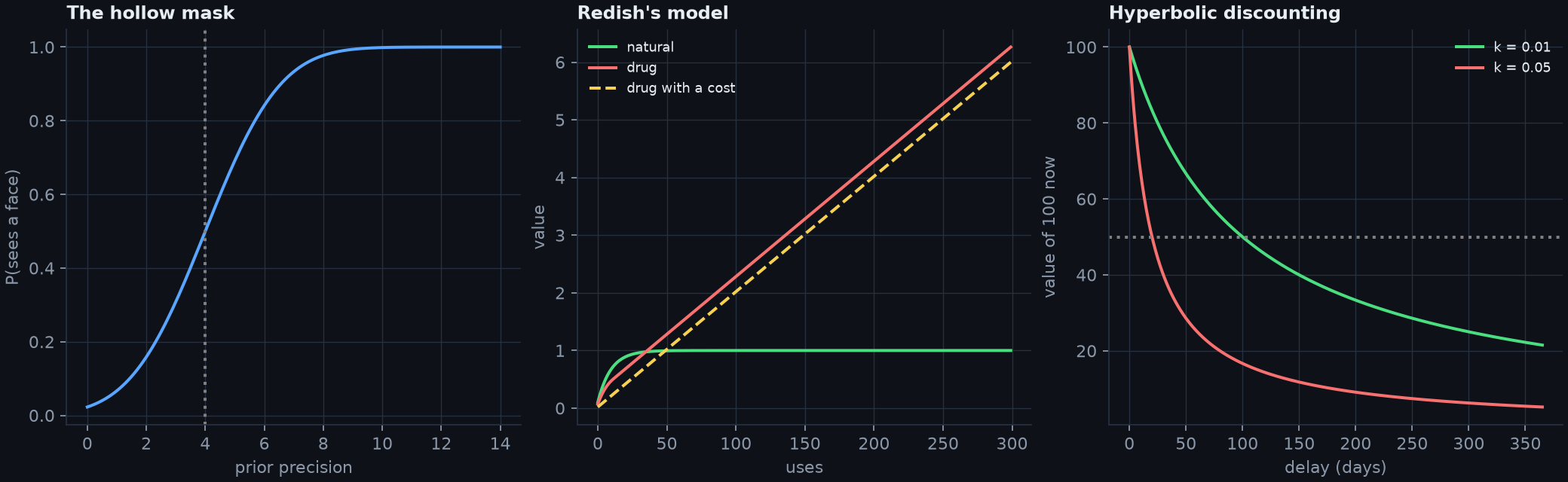
First, the mask on Psyche. It's Part 14's observer. A prior that faces bulge outward meets a noisy stereo signal that says hollow, and the face is seen when the posterior lands on the bulging side. To be fooled, the prior must be more precise than the eyes. The curve crosses one half where the two are equal. Two simulated groups of two thousand. With the typical spread of prior precision, most see a face. With lower precision, only a minority do. So weaker, or less precise, priors predict the patients' accuracy.
Now hallucinations. In Part 14, perception was a prior combined with sensory evidence. When the evidence is weak, a strong enough prior can produce a percept with no input at all. And hearing voices isn't confined to illness. Many people who never seek care hear voices, and hearing voices isn't by itself a disorder. So the question becomes testable. Do voice hearers weight their expectations more heavily?
In 2017 Albert Powers, Christoph Mathys and Philip Corlett tested it. People saw a light and heard a faint tone together, again and again. Then the tone became rarer. Everyone sometimes heard a tone that wasn't played. Voice hearers, with a diagnosis or without one, did so more, and a model fitted to their reports gave their priors more weight. Psyche runs the design on two hundred learners. With a heavily weighted prior, it hears a tone on many more silent trials than with a light one. The Ledger marks it contested: an influential result, with few independent tests.
Which leaves the puzzle from the start. The hollow mask suggests priors that are too weak. Hallucinations suggest priors that are too strong. In 2018 Philipp Sterzer and colleagues reviewed the predictive-coding account of psychosis, and it has to explain both. One answer is that precision differs by level, weak at low levels and over-strong at high ones, or changes over the course of an illness. The risk is a theory with a free dial at every level, which can fit anything. The frontier asks it for predictions it could fail.
What it does: The hollow mask, computed; hearing what is expected; conditioned hallucinations; too weak and too strong
6CausesPsych 101 and the major2 min
Start with genes. In 2003 Patrick Sullivan, Kenneth Kendler and Michael Neale pooled the twin studies. They put the heritability of liability to schizophrenia near eighty percent. The genes behind it are many. In 2022 a consortium led by Vassily Trubetskoy reported two hundred and eighty-seven regions of the genome, each adding a tiny amount of risk. One clue to mechanism: in 2016 Aswin Sekar and colleagues showed that variants of an immune gene, C4, raise risk, and that C4 marks synapses for pruning in adolescence, just when onset begins. It's Part 9's lesson again. Heritable doesn't mean fixed, and there's no single gene of large effect.
Environments matter too. Heavy cannabis use: in a 2016 meta-analysis led by Arianna Marconi, the heaviest users had about four times the odds of a psychotic disorder. Whether cannabis causes it is still debated. Growing up in a city: higher rates with urban upbringing, in a dose-response pattern. Migration: higher rates in migrants and their children, especially where they're a small, excluded minority. And adversity: childhood trauma and social defeat go with higher risk. All of this is observational. Confounding and reverse causation are live, and genes and environments are tangled together.
One theory of cause did real harm. In 1948 the psychoanalyst Frieda Fromm-Reichmann wrote of the schizophrenogenic mother, cold and controlling, who was said to cause schizophrenia in her child. For decades, families were blamed, and mothers treated as the cause of their children's illness. No evidence supported it. Twin and adoption studies pointed elsewhere. A theory isn't harmless because it's only a theory. Autism's refrigerator mother, later in this part, repeated the mistake.
What it does: Many genes, each tiny; environments that raise risk; a theory that did harm
7From use to compulsionPsych 101 and the major2 min
Addiction draws on four mechanisms the series has already built. Reward: drugs of abuse raise dopamine in the striatum directly, bypassing the events that normally earn it. Tolerance and withdrawal: the body's opponent process grows with use, so more drug is needed for the same effect, and its absence brings misery. Wanting without liking: cues for the drug come to trigger craving, while the pleasure fades. And habit: use passes from goal-directed choice to a habit set off by cues. And most people who use a drug never become addicted. Addiction is continued use despite harm, loss of control and craving. It isn't use itself.
The third mechanism deserves a closer look. In 1993 Terry Robinson and Kent Berridge proposed that repeated drug use sensitizes the dopamine system's wanting, its incentive salience, without increasing liking. Cues tied to the drug become magnets for attention and craving, long after withdrawal ends. So a person can crave what they no longer enjoy, and relapse years later, set off by a place or a smell.
There's also the trade between now and later. Part 26 introduced hyperbolic discounting: a reward's value falls with its delay, at a rate k. With a gentle k, a hundred later beats fifty now until the wait passes a hundred days. With a steep k, only until twenty days. On average, people with addictions discount the future more steeply than others, and steep discounting predicts who starts and who relapses. Cause or consequence? Probably both. It predicts use, and use steepens it.
What it does: Four mechanisms; wanting without liking; now or later
8Addiction as learning gone wrongGraduate2 min
Now put the drug into Part 17's learning rule. For a natural reward, learning stops when the reward is fully predicted, because the prediction error falls to zero. In 2004 David Redish proposed that a drug which releases dopamine directly adds a surge that no prediction can cancel. The error never falls below it. So the value of taking the drug keeps rising, with every use, without limit.
Psyche runs it on one learner. A natural reward's value settles at the reward. Add a cost as large as the reward, and its value settles at zero. The behaviour stops. The drug's value passes the natural reward's and keeps climbing, use after use. Add the same cost to the drug, and it still climbs. In this model, punishment can't teach the learner to stop. That matches one hallmark of addiction: use that continues despite harm.
A good model makes predictions that could fail, and this one did. Since the drug's prediction error never reaches zero, a drug reward should never be blocked, Part 16's effect, because it always teaches something new. In 2007 Leigh Panlilio and colleagues tested this in rats self-administering cocaine. Blocking happened anyway. So the simplest version fails, and later models add habits, multiple learning systems, and changes that build with use. What survives is addiction as a learning system that a drug exploits, described in models precise enough to be tested, and to fail.
What it does: An error that never goes away; the model, computed; a prediction, tested
9Cages, wars and vouchersPsych 101 and the major2 min
How much is addiction about the setting? In 1978 Bruce Alexander and colleagues reported that rats alone in cages drank far more morphine solution than rats in a large colony, with company and space to roam. They called it Rat Park. The lesson drawn was that addiction is a response to a barren life, not to the drug. But a 1996 replication by Bruce Petrie found housing made little difference, and later studies of enrichment are mixed. The Ledger marks it contested: a story told far more often than it's been tested.
A larger natural experiment came from a war. In Vietnam, heroin was cheap and pure, and many American soldiers used it. The sociologist Lee Robins followed them home. A large minority had become addicted in Vietnam. After coming home, only about five percent of those addicted in Vietnam were addicted again within a year. What changed was the setting: the cues, the supply, the stress and the company. It's one cohort, in unusual conditions. It shows that recovery without treatment is common, not that setting is everything.
If addiction is learning, learning can be used against it. Contingency management is Part 16's operant conditioning, applied. A drug-free urine sample earns a voucher or a prize draw, the value rises with each clean sample in a row, and a positive sample resets it. In 1991 Stephen Higgins and colleagues showed that vouchers for cocaine-free samples kept more patients in treatment, and abstinent, than counselling alone. In 2006 a meta-analysis led by Michael Prendergast found a moderate effect on abstinence across trials, one of the best in the field. The effect fades after the incentives stop. And it's used far less than the evidence supports.
What it does: Rat Park; coming home; paying for clean samples
10AutismPsych 101 and the major3 min
Autism has two first descriptions. In 1943 Leo Kanner in Baltimore described eleven children with a powerful wish for sameness and little interest in other people. In 1944 Hans Asperger in Vienna described boys with intense interests and social difficulty. Historians have since documented his part in the Nazi-era system that sent some disabled children to their deaths. In 1967 Bruno Bettelheim's book The Empty Fortress blamed cold refrigerator mothers: the schizophrenogenic mother again. Since then, twin studies have shown high heritability. Autism is developmental. It isn't caused by parenting.
Then came a fraud. In 1998 Andrew Wakefield and colleagues published a case series of twelve children that suggested the measles, mumps and rubella vaccine might cause autism. Investigations found misconduct. The Lancet retracted the paper in 2010, and Wakefield was struck off the UK medical register. In 2019 Anders Hviid and colleagues followed six hundred and fifty-seven thousand, four hundred and sixty-one Danish children for years. There was no higher rate of autism after vaccination. Meanwhile vaccination fell in several countries, and measles came back. It's Part 4's lesson, with children paying for it.
What models describe autism? In Part 30, autistic children often found false-belief tasks harder. That account explains the social side, not the senses. In 2012 Elizabeth Pellicano and David Burr proposed that perception in autism leans less on priors, so the world arrives too real: fewer illusions, more detail, more overload. Psyche shows why that's a trade-off. How strong a prior should be depends on the world. When the world matches the prior ninety-five percent of the time, the best prior is strong. When it matches only sixty percent of the time, the best prior is weak. A weaker prior is a different trade-off, not simply a deficit.
Diagnoses have risen sharply. The American surveillance network found about one in a hundred and fifty eight-year-olds in 2000, and about one in thirty-six in 2020. Most of the rise is in diagnosis: broader criteria, the single autism spectrum of 2013, awareness, services, and children who once received other labels. Whether the true rate has risen at all, and by how much, is debated. Neurodiversity describes autism as a difference with both disabilities and strengths. Many autistic adults prefer to be called autistic people, and this part follows them.
Last, a method that failed a simple test. In facilitated communication, a helper steadies the hand of a non-speaking person, who types fluent messages. Douglas Biklen brought it to the United States in 1990, and families welcomed it. In 1993 Douglas Wheeler and colleagues showed the typist and the helper different pictures. The answers named what the helper saw. The helpers were moving the hands without knowing it, the ideomotor effect. False allegations of abuse had already followed. The Ledger marks it failed. A blind test settles what sincere conviction can't.
What it does: Two first descriptions; a fraud; a world too real; more diagnoses; whose words?
11ADHDPsych 101 and the major2 min
ADHD, attention-deficit hyperactivity disorder. It has two clusters of symptoms: inattention, and hyperactivity with impulsivity, beginning in childhood and impairing life in more than one setting. Like most of Part 39's diagnoses, it's a dimension, with a line drawn across it. In 2019 Stephen Faraone and Henrik Larsson reviewed the twin studies, which put heritability near seventy-four percent, again from many genes of small effect. It often persists into adulthood, though the symptoms change. Restlessness turns inward, and disorganization matters more.
Where the line falls depends on the comparison. In 2018 Timothy Layton and colleagues used American insurance records. In states with a first of September school cut-off, children born in August are the youngest in their class. They were diagnosed with ADHD about a third more often than children born in September. A few months of age are being read as a disorder. The line across the continuum is drawn relative to classmates. And it's a natural experiment. Birth month is close to random, so the comparison is close to causal.
What do stimulants do? The largest trial, the MTA study of 1999, assigned five hundred and seventy-nine children to carefully managed medication, intensive behavioural treatment, both, or usual community care. At fourteen months, managed medication reduced the core symptoms most. But at three years, the groups no longer differed, and many children had changed treatment by then. Stimulants work in the short term, in trial after trial. What they do over years is far less certain.
What it does: What it is; the youngest in the class; the largest trial
12Across the diagnosesPsych 101 and the major1 min
Step back from the diagnoses. Three dials from the series' own models keep turning up. The precision of priors: weaker in autism, both weaker and stronger in psychosis, and tilted toward threat in anxiety. Prediction errors and learning: aberrant salience in psychosis, a surge never learned away in addiction, blunted in depression. And discounting the future: steeper in addiction, in ADHD, and in depression. The same few parameters recur across diagnoses that the manuals keep apart. That's the transdiagnostic view, and the research programme of Part 39's RDoC: study the dials, not only the labels. It's a map of hypotheses, not of findings. Several cells are contested, and Part 59 asks whether the dials can be measured in one person.
What it does: Three dials, many diagnoses
13The LedgerPsych 101 and the major
The tally. What holds: the hollow-mask difference, antipsychotics, contingency management, and stimulants in the short term. What's argued: hallucinations as strong priors, and Rat Park. What fell: the vaccine fraud, and facilitated communication, both settled by plain controlled tests.
What it does: Eight rows and the tally
14In practice: services, trade-offs and harm reductionPractice1 min
What helps, in practice? Early intervention: teams that see young people soon after a first episode of psychosis, with medication, therapy, family work, and help with school and jobs. Shared decisions: antipsychotics trade fewer relapses against movement, weight and metabolic harms, and the person weighs them with the prescriber. Harm reduction: opioid substitution with methadone or buprenorphine lowers deaths, naloxone reverses overdoses, and clean needles prevent infections. It meets people where they are. Supports, not cures, for autistic and ADHD children and adults: adjustments at school and work, clear routines, fewer sensory demands. And language. A person with schizophrenia; an autistic person. Ask, and follow the person. Whether the talking therapies work, and how well, is Part 42.
What it does: What helps
15Frontier: precision, polygenic scores and new drugsResearch1 min
At the frontier, three ideas. Precision: predictive-coding accounts must make predictions that rival accounts don't, and measure precision in a person rather than fit it afterwards. That's Parts 58 and 59. Polygenic scores: they predict schizophrenia risk better than chance across a population, but explain a small share of it, too little to diagnose or screen one person. New drugs: in 2024 the American regulator approved the first antipsychotic that doesn't act mainly by blocking dopamine D2 receptors, but on muscarinic acetylcholine receptors. Each tests this part's models. If psychosis runs through dopamine, a drug that works upstream of it is a clue to the circuit.
So, open questions. Are priors too weak in psychosis, too strong, or both at different levels? Is hallucination-proneness a trait, a state, or both? Why do most people who use drugs never become addicted? How much of the rise in autism and ADHD diagnoses is a change in people, and how much a change in diagnosis? And can the transdiagnostic dials be measured reliably in one person?
What it does: Three frontiers; open questions
Recap, problems, and the road aheadAll tracks4 min
First, your four numbers. The heritability of schizophrenia in twin studies: about eighty percent. Vietnam veterans addicted again within a year of coming home: about five percent. Children in the Danish vaccine study: six hundred and fifty-seven thousand, four hundred and sixty-one. And medication's advantage left at three years in the largest ADHD trial: none. Strong genes, and strong settings. Myths ended by plain tests. And effects that fade.
Part forty-one in eleven lines. The hollow mask needs a strong prior, and many people with schizophrenia aren't fooled. Schizophrenia has positive, negative and cognitive symptoms, and a course that varies widely. Antipsychotics block dopamine D2 receptors, and work on positive symptoms, at a cost. Aberrant salience: dopamine out of step makes the irrelevant feel meant. Hallucinations as strong priors: influential, and contested. Heritability near eighty percent, from hundreds of variants, and blaming mothers did harm. Addiction draws on reward, tolerance, wanting without liking, habit and steep discounting. A drug's surge that can't be learned away, computed, and a prediction that failed. Setting matters, and vouchers for clean samples work while they last. Autism: a fraud retracted, a method failed, priors as a trade-off, and more diagnoses. And ADHD: age within a class, and stimulants that help in the short term.
Kant's wager. The first objection, that mathematics can't apply to the mind, met Gaussian priors on a hollow face, salience, conditioned tones, and a drug's endless prediction error. The second, that the mind can't be experimented on, met drug trials, vouchers, blind tests of facilitated typing, and a cohort of more than six hundred and fifty thousand children. And the third, about introspection: hallucinations are reports, and the models of them are fitted to what people say they heard. Amber.
Where this comes back. Whether therapy works, and which, is next, in Part 42. Precision, properly, is Part 58's efficient, predictive brain. And measuring the dials in one person is Part 59's computational psychiatry.
Seven problems, with full solutions in this part's README. One computes the hollow mask. One finds the best strength for a prior. One bounds the value of a drug in Redish's model. One finds a preference reversal. One computes aberrant salience. One works out how much of an ADHD diagnosis rate is relative age. And the last, with the star, asks you to design a study that could tell a trait from a state. Pause here if you'd like to try them.
The books and papers behind this part are listed here and in the README. Uta Frith's Autism: Explaining the Enigma is a clear account of the science; Richard Gregory's Eye and Brain is the classic on perception as hypothesis; and Barlow, Durand and Hofmann's textbook covers the conditions.
Act Ten closes with a question about the treatments themselves. This part used the series' models as a language for psychosis, addiction and development. The next asks how anyone could know whether talking helps: Eysenck's challenge, the method invented to answer it, and what works for whom. Part 42: does therapy work?
Where it goes next. The evidence for therapy is Part 42, the predictive brain Part 58 and computational psychiatry Part 59.
Key results
The part's results in one place, for revision.
Try it
Lab 41 · Psychosis, Addiction and Development
Compute when a prior makes a hollow mask look like a face and how strong a prior should be; condition hallucinations in learners whose priors weigh more or less; let random dopamine bursts give irrelevant cues value; run Redish's drug signal against a natural reward; and find where hyperbolic preferences reverse.
python -m videos.psychology.labs 41
needs numpy, scipy, matplotlib · download lab41.py ·
source on GitHubhollow mask, prior precision 2: posterior mean; chance of seeing a face -0.33; 0.16
hollow mask, prior precision 4: posterior mean; chance of seeing a face +0.00; 0.50
hollow mask, prior precision 8: posterior mean; chance of seeing a face +0.33; 0.98
best prior precision when the world is typical 95% of the time: grid; formula 5.00; 5.00
best prior precision when the world is typical 60% of the time: grid; formula 0.63; 0.62
tone heard on silent trials: prior weight 0.3; 1.5 11%; 26%
aberrant salience, bursts on 0% of trials: irrelevant cues above 0.25; their mean value 0; 0.00
aberrant salience, bursts on 20% of trials: irrelevant cues above 0.25; their mean value 5; 0.20
aberrant salience, bursts on 30% of trials: irrelevant cues above 0.25; their mean value 11; 0.29
Redish: value after 300 uses: natural reward; drug; drug with a cost of 1 1.00; 6.26; 6.00
discounting k = 0.01: 50 now against 100 in 30 days; 50 in 60 days against 100 in 90 50.0 vs 76.9; 31.2 vs 52.6
discounting k = 0.05: 50 now against 100 in 30 days; 50 in 60 days against 100 in 90 50.0 vs 40.0; 12.5 vs 18.2
A prior more precise than the eyes makes the hollow mask a face; how strong a prior should be depends on how often the world matches it; heavier priors condition more hallucinations; random dopamine bursts give every cue a little value; a drug's surge that cannot be predicted away makes its value grow whatever it costs; and hyperbolic discounting reverses preferences as rewards come near.The code (85 lines; it asserts its own result)
"""Lab 41: the hollow mask on a Gaussian observer and the best strength of a prior, conditioned hallucinations,
aberrant salience, Redish's model of addiction, and hyperbolic discounting."""

import numpy as np

from videos.coursekit import labs
from explainer.psychology.psyche import clinic as K

TITLE = "Psychosis, Addiction and Development"
GOAL = ("Compute when a prior makes a hollow mask look like a face and how strong a prior should be; condition "
        "hallucinations in learners whose priors weigh more or less; let random dopamine bursts give irrelevant cues "
        "value; run Redish's drug signal against a natural reward; and find where hyperbolic preferences reverse.")
TASKS = [
    "Lower the eyes' precision from 4 to 1 (a dim room, or one eye shut). How weak a prior now produces the face?",
    "In the conditioned-hallucination design, keep the tone at 75% in every block. Does the difference between "
    "prior weights grow or shrink, and why?",
    "Give Redish's drug a surge D that falls with each use (tolerance). Does the drug's value still grow without "
    "bound?",
]


def run(seed=0):
    out = labs.Lab()

    for pp in (2.0, 4.0, 8.0):
        h = K.hollow_mask(pp)
        out.row(f"hollow mask, prior precision {pp:g}: posterior mean; chance of seeing a face",
                f"{h['mean']:+.2f}; {h['p_convex']:.2f}")
    assert abs(K.hollow_mask(4.0)["p_convex"] - 0.5) < 1e-9
    grid = np.linspace(0, 20, 2001)
    for p in (0.95, 0.6):
        best = grid[int(np.argmin(K.prior_tradeoff(grid, p_typical=p)))]
        w = 0.25 / (0.25 + 4 * (1 - p))
        out.row(f"best prior precision when the world is typical {100 * p:.0f}% of the time: grid; formula",
                f"{best:.2f}; {w * 4 / (1 - w):.2f}")
        assert abs(best - w * 4 / (1 - w)) < 0.02

    lo = K.conditioned_hallucinations(0.3, seed=seed)
    hi = K.conditioned_hallucinations(1.5, seed=seed)
    out.row("tone heard on silent trials: prior weight 0.3; 1.5",
            f"{100 * lo['overall']:.0f}%; {100 * hi['overall']:.0f}%")
    assert hi["overall"] > lo["overall"]

    for q in (0.0, 0.2, 0.3):
        a = K.aberrant_salience(q, seed=seed)
        out.row(f"aberrant salience, bursts on {100 * q:.0f}% of trials: irrelevant cues above 0.25; their mean value",
                f"{a['salient']}; {a['V'][1:].mean():.2f}")

    nat, drug, cost = K.redish(0.0), K.redish(0.2, reward=0.5), K.redish(0.2, reward=0.5, cost=1.0)
    out.row("Redish: value after 300 uses: natural reward; drug; drug with a cost of 1",
            f"{nat[-1]:.2f}; {drug[-1]:.2f}; {cost[-1]:.2f}")
    assert cost[-1] >= 300 * 0.1 * 0.2 - 1e-9

    for k in (0.01, 0.05):
        out.row(f"discounting k = {k}: 50 now against 100 in 30 days; 50 in 60 days against 100 in 90",
                f"{float(K.discount(50, 0, k)):.1f} vs {float(K.discount(100, 30, k)):.1f}; "
                f"{float(K.discount(50, 60, k)):.1f} vs {float(K.discount(100, 90, k)):.1f}")

    out.note = ("A prior more precise than the eyes makes the hollow mask a face; how strong a prior should be "
                "depends on how often the world matches it; heavier priors condition more hallucinations; random "
                "dopamine bursts give every cue a little value; a drug's surge that cannot be predicted away makes its "
                "value grow whatever it costs; and hyperbolic discounting reverses preferences as rewards come near.")

    fig, ax = labs.figure(3, size=(13, 4.0))
    pp = np.linspace(0, 14, 141)
    ax[0].plot(pp, [K.hollow_mask(float(x))["p_convex"] for x in pp], color=labs.BLUE)
    ax[0].axvline(4, color="grey", ls=":")
    ax[0].set(title="The hollow mask", xlabel="prior precision", ylabel="P(sees a face)")
    ax[1].plot(nat, color=labs.GREEN, label="natural")
    ax[1].plot(drug, color=labs.RED, label="drug")
    ax[1].plot(cost, color=labs.GOLD, ls="--", label="drug with a cost")
    ax[1].set(title="Redish's model", xlabel="uses", ylabel="value")
    ax[1].legend(fontsize=8)
    d = np.linspace(0, 365, 366)
    for k, c in ((0.01, labs.GREEN), (0.05, labs.RED)):
        ax[2].plot(d, K.discount(100, d, k), color=c, label=f"k = {k}")
    ax[2].axhline(50, color="grey", ls=":")
    ax[2].set(title="Hyperbolic discounting", xlabel="delay (days)", ylabel="value of 100 now")
    ax[2].legend(fontsize=8)
    out.fig = fig
    return out


if __name__ == "__main__":
    print(run())
Now change it
- Lower the eyes' precision from 4 to 1 (a dim room, or one eye shut). How weak a prior now produces the face?
- In the conditioned-hallucination design, keep the tone at 75% in every block. Does the difference between prior weights grow or shrink, and why?
- Give Redish's drug a surge D that falls with each use (tolerance). Does the drug's value still grow without bound?
Problems, with solutions
Try each problem before opening its solution.
-
The hollow mask. The hollow mask: a prior at \(+1\) with precision 6 meets a stereo signal at \(-1\) with precision 4. Find the posterior mean. Is a face seen? At what prior precision is the posterior exactly 0?
Solution
The posterior mean is (6 × 1 + 4 × (-1)) / (6 + 4) = 0.2 > 0: a face is seen. It is exactly 0 when the prior precision equals the eyes' precision, 4.
-
The best prior. The expected error of a prior with weight \(w\) is \((1 - w)^2/\pi_e + (1 - p)(2w)^2\). Find the best \(w\), and the best prior precision, for \(\pi_e = 4\) and \(p = 0.95\), then \(p = 0.6\).
Solution
Setting the derivative of (1 - w)²/π_e + 4(1 - p)w² to zero gives w = (1/π_e) / (1/π_e + 4(1 - p)). For π_e = 4 and p = 0.95, w = 0.25/0.45 = 0.556, and the prior precision w π_e / (1 - w) = 5.0. For p = 0.6, w = 0.25/1.85 = 0.135 and the precision is 0.625.
-
Redish's bound. In Redish's model, \(\delta = \max(r - V + D, D)\). Show that \(V\) grows by at least \(\alpha D\) per use, and bound \(V\) after 300 uses with \(\alpha = 0.1\), \(D = 0.2\).
Solution
Since δ ≥ D whatever V is, each use adds αδ ≥ αD to V. After 300 uses, V ≥ 300 × 0.1 × 0.2 = 6 (Psyche's run with a cost of 1 ends at 6.0, the bound exactly, because the cost keeps δ at D).
-
A reversal. With \(V = A/(1 + kD)\) and \(k = 0.05\) per day, compare 50 now with 100 in 30 days, then 50 in 60 days with 100 in 90 days. What happens, and why does it matter for relapse?
Solution
Now: 50 against 100/(1 + 1.5) = 40, so 50 now wins. Sixty days ahead: 50/(1 + 3) = 12.5 against 100/(1 + 4.5) = 18.2, so the larger, later reward wins. Preferences reverse as the smaller reward comes close: a plan to abstain made in advance gives way when the drug is at hand.
-
Aberrant salience. A Rescorla-Wagner cue gets bursts of size \(b\) on a share \(q\) of trials and no reward. Find its average learned value. Evaluate it for \(q = 0.2\), \(b = 1\).
Solution
At equilibrium the expected change is zero: E[δ] = 0 - V + qb = 0, so V = qb = 0.2.
-
Relative age. Children born in August are diagnosed with ADHD at 85.1 per 10{,}000, those born in September at 63.6. If the whole difference is due to relative age, what share of the August-born diagnoses does it account for?
Solution
The excess is 85.1 - 63.6 = 21.5 per 10,000, which is 21.5/85.1 ≈ 25% of the August-born diagnoses.
-
★ Trait or state. Design a study that could tell whether a tendency to conditioned hallucinations is a stable trait or tracks a person's current state.
Solution
Run the conditioned-hallucination task repeatedly in the same people over months, alongside ratings of current hallucination severity, in people with and without a history of hearing voices. A trait predicts stable individual differences that persist when symptoms remit; a state predicts that a person's own score rises and falls with their symptoms. A multilevel model separates between-person from within-person variance (Part 47); preregister which component each account predicts.
Notes and sources
Sources
- R. L. Gregory, Knowledge in perception and illusion, Philosophical Transactions of the Royal Society B 352 (1997) 1121-1127, and Eye and Brain (5th edition, 1997); H. M. Emrich (1989); U. Schneider et al. (2002); D. Dima et al. (2009): see the Ledger row.
- E. Bleuler, Dementia Praecox oder Gruppe der Schizophrenien (1911; the term from 1908); D. Rosenthal (ed.), The Genain Quadruplets (Basic Books, 1963).
- J. Delay, P. Deniker and J. M. Harl (1952); P. Seeman, T. Lee, M. Chau-Wong and K. Wong, Antipsychotic drug doses and neuroleptic/dopamine receptors, Nature 261 (1976) 717-719; I. Creese, D. R. Burt and S. H. Snyder, Dopamine receptor binding predicts clinical and pharmacological potencies of antischizophrenic drugs, Science 192 (1976) 481-483; O. D. Howes and S. Kapur, The dopamine hypothesis of schizophrenia: version III, Schizophrenia Bulletin 35 (2009) 549-562; S. Leucht et al. (2012, 2017).
- S. Kapur, Psychosis as a state of aberrant salience, American Journal of Psychiatry 160 (2003) 13-23.
- A. R. Powers, C. Mathys and P. R. Corlett (2017); E. Kafadar et al. (2022); P. Sterzer et al., The predictive coding account of psychosis, Biological Psychiatry 84 (2018) 634-643.
- P. F. Sullivan, K. S. Kendler and M. C. Neale, Schizophrenia as a complex trait, Archives of General Psychiatry 60 (2003) 1187-1192; V. Trubetskoy et al., Mapping genomic loci implicates genes and synaptic biology in schizophrenia, Nature 604 (2022) 502-508; A. Sekar et al., Schizophrenia risk from complex variation of complement component 4, Nature 530 (2016) 177-183; A. Marconi, M. Di Forti, C. M. Lewis, R. M. Murray and E. Vassos, Meta-analysis of the association between the level of cannabis use and risk of psychosis, Schizophrenia Bulletin 42 (2016) 1262-1269; F. Fromm-Reichmann, Notes on the development of treatment of schizophrenics by psychoanalytic psychotherapy, Psychiatry 11 (1948) 263-273.
- T. E. Robinson and K. C. Berridge, The neural basis of drug craving: an incentive-sensitization theory of addiction, Brain Research Reviews 18 (1993) 247-291; A. D. Redish, Addiction as a computational process gone awry, Science 306 (2004) 1944-1947; L. V. Panlilio, E. B. Thorndike and C. W. Schindler, Blocking of conditioning to a cocaine-paired stimulus, Pharmacology Biochemistry and Behavior 86 (2007) 774-777.
- B. K. Alexander et al. (1978); B. F. Petrie (1996); L. N. Robins, The Vietnam Drug User Returns (1974), and L. N. Robins, Vietnam veterans' rapid recovery from heroin addiction, Addiction 88 (1993) 1041-1054; S. T. Higgins et al. (1991); M. Prendergast et al. (2006).
- L. Kanner, Autistic disturbances of affective contact, Nervous Child 2 (1943) 217-250; H. Asperger (1944); H. Czech, Hans Asperger, National Socialism, and "race hygiene" in Nazi-era Vienna, Molecular Autism 9 (2018) 29; B. Bettelheim, The Empty Fortress (1967); A. J. Wakefield et al. (1998, retracted); A. Hviid et al. (2019); E. Pellicano and D. Burr, When the world becomes "too real", Trends in Cognitive Sciences 16 (2012) 504-510; M. J. Maenner et al., Prevalence and characteristics of autism spectrum disorder among children aged 8 years, MMWR Surveillance Summaries 72 (2023); D. Biklen (1990); D. L. Wheeler et al. (1993); J. W. Jacobson et al. (1995).
- S. V. Faraone and H. Larsson, Genetics of attention deficit hyperactivity disorder, Molecular Psychiatry 24 (2019) 562-575; T. J. Layton, M. L. Barnett, T. R. Hicks and A. B. Jena, Attention deficit-hyperactivity disorder and month of school enrollment, New England Journal of Medicine 379 (2018) 2122-2130; MTA Cooperative Group (1999); P. S. Jensen et al. (2007); S. Cortese et al. (2018).
- U. Frith, Autism: Explaining the Enigma (2nd edition, 2003).
About this partfrom its README
The part opens with the care card: this is education, not diagnosis or treatment, and here is where help is found. Then a mask of a face, seen from behind, looks like an ordinary face bulging outward to almost everyone: a prior strong enough to overrule both eyes. In small studies, many people with schizophrenia see it as hollow. The part uses the series' own models as a language for three kinds of condition: perception and belief with priors weighted wrongly, learning systems captured by a drug, and brains that develop along a different path.
The viewer judges shaded discs as bumps or dents (light from above) and predicts four numbers. Then schizophrenia's three kinds of symptom, its course and four identical sisters; chlorpromazine, the dose that follows D2 binding, and the revised dopamine hypothesis; aberrant salience, computed; the hollow mask on a Gaussian observer, conditioned hallucinations on a learner, and the puzzle of priors too weak and too strong; causes (twin heritability, hundreds of small genetic effects, C4 and pruning, cannabis, cities and migration, and the "schizophrenogenic mother"); addiction's four mechanisms, wanting without liking and steep discounting; Redish's model of a prediction error that cannot be learned away, computed, and the blocking test it failed; Rat Park, the Vietnam veterans and contingency management; autism's histories, the vaccine fraud, priors as a trade-off (computed), rising diagnoses and facilitated communication; ADHD, relative age and the MTA trial; and three dials that recur across diagnoses.
What is computed and built
explainer/psychology/psyche/clinic.pygains the hollow mask on a Gaussian observer, the trade-off of a prior's strength, conditioned hallucinations, aberrant salience, Redish's non-compensable drug signal and hyperbolic discounting. Tested intests/psychology/test_clinic.py.- The Ledger gains eight rows; the deferred declarations of Parts 10, 16 and 17 about addiction are resolved.
- The course's interactive is shading on you: discs lit from different directions, judged as bumps or dents, and set against what a prior that light comes from above predicts.
Chapter notes
| # | Chapter | What it does |
|---|---|---|
| 0 | The face that is not there | The care card; the hollow mask; not everyone is fooled; the question; objectives |
| 1 | On you: bumps, dents, and four numbers | Shaded discs and the light-from-above prior; four predictions |
| 2 | Schizophrenia | Three kinds of symptom; course, and four sisters |
| 3 | Dopamine | A drug from surgery; the dose follows the receptor; version three |
| 4 | Aberrant salience | When everything seems to mean something; salience, computed |
| 5 | Perception and hallucination as inference | The hollow mask, computed; hearing what is expected; conditioned hallucinations; too weak and too strong |
| 6 | Causes | Many genes, each tiny; environments that raise risk; a theory that did harm |
| 7 | From use to compulsion | Four mechanisms; wanting without liking; now or later |
| 8 | Addiction as learning gone wrong | An error that never goes away; the model, computed; a prediction, tested |
| 9 | Cages, wars and vouchers | Rat Park; coming home; paying for clean samples |
| 10 | Autism | Two first descriptions; a fraud; a world too real; more diagnoses; whose words? |
| 11 | ADHD | What it is; the youngest in the class; the largest trial |
| 12 | Across the diagnoses | Three dials, many diagnoses |
| 13 | The Ledger | Eight rows and the tally |
| 14 | In practice: services, trade-offs and harm reduction | What helps |
| 15 | Frontier: precision, polygenic scores and new drugs | Three frontiers; open questions |
| Recap, problems, and the road ahead | Your numbers; eleven lines; Kant's three objections; payoffs; problems; references; Part 42 |
NotesWhere the numbers come from
| What | Source |
|---|---|
| The hollow mask on a Gaussian observer: prior at +1, stereo signal at -1 with precision 4; the chance of seeing a face against the prior's precision (one half where the precisions are equal), and in two simulated groups of 2,000 with log-normal prior precision (medians 8 and 3): 86% and 37% see a face | Psyche (clinic.hollow_mask), item mask |
| The expected squared error of a prior's estimate when the world matches it 95% or 60% of the time: best prior precision 5.0 and 0.6 | Psyche (clinic.prior_tradeoff), item mask |
| Conditioned hallucinations: a light with a threshold tone, less often in each of four blocks of 30 trials; 200 learners with prior weight 0.3 hear a tone on 11% of silent trials, with weight 1.5 on 24% | Psyche (clinic.conditioned_hallucinations), item halluc |
| Aberrant salience: 20 cues, one rewarded, 2,000 Rescorla-Wagner trials; with dopamine bursts on 0, 10, 20 and 30% of trials, 0, 0, 4 and 15 irrelevant cues end above 0.25 (the run with the median count of 21) | Psyche (clinic.aberrant_salience), item salience |
| Redish's model: a natural reward's value settles at 1 (at 0 with a cost of 1); a drug (reward 0.5, surge 0.2) reaches 6.3 after 300 uses, and 6.0 with a cost of 1 | Psyche (clinic.redish), item redish |
| Hyperbolic discounting with k = 0.01 and 0.05 a day: 100 later beats 50 now until a delay of 100 and 20 days | Psyche (clinic.discount), item discount |
| Every published number on screen | the studies listed under Sources, quoted as reported |
Schematic panels (the hollow-mask group pictures, the onset curve, the dose and binding cloud, the liability threshold, wanting and liking, the MTA bars) are labelled as schematic on screen. The autism surveillance rates and the relative-age diagnosis rates are the published values.
Notes
| Finding | Original | Status |
|---|---|---|
| People with schizophrenia are less often fooled by the hollow-mask illusion than other people | Emrich 1989 | replicated |
| Antipsychotic drugs reduce the positive symptoms of schizophrenia and prevent relapse better than placebo | Delay and Deniker 1952 | replicated |
| People who hear voices weight prior expectations more heavily, and so are more prone to conditioned hallucinations | Powers, Mathys and Corlett 2017 | contested |
| Rats housed in a large, social, enriched colony drink far less morphine than rats housed alone | Alexander, Coambs and Hadaway 1978 | contested |
| Paying people for drug-free urine samples increases abstinence during treatment | Higgins and colleagues 1991 | replicated |
| The measles, mumps and rubella vaccine causes autism | Wakefield and colleagues 1998 | retracted |
| Non-speaking autistic people can communicate fluent thoughts by typing with a facilitator steadying their hand | Biklen 1990 | failed |
| Stimulant medication reduces the symptoms of ADHD in children more than behavioural treatment alone | MTA Cooperative Group 1999 | replicated, smaller |
Shown without a row, with the reason recorded in explainer/psychology/ledger.py: Gregory; Rosenthal; Seeman and
colleagues, Creese, Burt and Snyder; Howes and Kapur; Kapur; Sterzer and colleagues; Sullivan, Kendler and Neale,
Trubetskoy and colleagues, Sekar and colleagues; Marconi and colleagues; Fromm-Reichmann; Robinson and Berridge;
Redish; Panlilio and colleagues; Robins; Kanner and Asperger; Pellicano and Burr; the CDC's surveillance network;
Faraone and Larsson; Layton and colleagues.
Notes
The web-search budget for this session was spent on earlier parts, so the facts in this part come from the standard literature and were not re-checked online today; each is listed here to be checked against its source: Gregory's account of the hollow mask; Emrich (1989), Schneider et al. (2002) and Dima et al. (2009), and their sample sizes; Bleuler's term and its date; the Genain quadruplets and Rosenthal's 1963 book; the lifetime risk of schizophrenia (shown as "about one person in 200 to 300"); Laborit and Delay and Deniker's 1952 report; Seeman et al. and Creese, Burt and Snyder (1976); Howes and Kapur (2009); Leucht et al. (2012, 2017) and their findings; Kapur (2003); Powers, Mathys and Corlett (2017), its groups and findings; Kafadar et al. (2022); Sterzer et al. (2018); Sullivan, Kendler and Neale's heritability of about 0.81; Trubetskoy et al.'s 287 loci; Sekar et al.'s C4 result; Marconi et al.'s odds of about four for the heaviest users; the urbanicity and migration findings; Fromm-Reichmann (1948); Robinson and Berridge (1993); Redish (2004); Panlilio et al. (2007) and their blocking result; Alexander et al. (1978) and Petrie (1996); Robins's figure of about 5% re-addicted within a year; Higgins et al. (1991); Prendergast et al. (2006); Kanner's eleven children; Asperger's 1944 paper and Czech's 2018 history; Bettelheim (1967); Wakefield et al. (1998), the 2010 retraction and the erasure from the register; Hviid et al.'s 657,461 children; Pellicano and Burr (2012); the CDC network's rates (1 in 150 for 2000 to 1 in 36 for 2020, and the intermediate values plotted); Biklen (1990) and Wheeler et al. (1993); Faraone and Larsson's 0.74; Layton et al.'s rates of 85.1 and 63.6 per 10,000; the MTA trial's 579 children and Jensen et al.'s three-year result; Cortese et al. (2018); the 2024 approval of a muscarinic antipsychotic; the evidence on opioid substitution, naloxone and needle exchange; and every page range in Sources.
Companion material in this repository
The syllabus's plan for this partfrom SYLLABUS.md, the plan of record
- Hook and On you: the hollow mask.
- Schizophrenia: positive, negative and cognitive symptoms; course and outcome; the Genain quadruplets.
- Dopamine: chlorpromazine (1952), the receptor-binding correlation with clinical dose, the revised dopamine hypothesis.
- Aberrant salience (Kapur 2003): prediction errors firing at the irrelevant (Part 17), and delusion as the explanation a person builds.
- Hallucination as inference: strong priors (Part 14) produce perception without input; conditioned hallucinations in voice hearers and non-hearers (Powers, Mathys and Corlett 2017). The model, and its critics.
- Causes: heritability near 0.8; hundreds of common variants of tiny effect; complement gene C4 and synaptic pruning; cannabis, urbanicity and migration as risks; the "schizophrenogenic mother", a harm done by theory.
- Addiction: from use to compulsion. Tolerance and withdrawal (Part 10); the reward system; incentive sensitization (Part 28); habits (Part 17); steep delay discounting.
- Addiction as reinforcement learning gone wrong: a drug that produces a prediction error that cannot be learned away (Redish 2004), computed.
- Environment: Rat Park and its uneven replications; the Vietnam veterans who stopped (Robins 1974); contingency management as operant conditioning that works.
- Autism: Kanner and Asperger and their histories; the "refrigerator mother"; the fraudulent vaccine paper (1998, retracted 2010); theory of mind (Part 30), and perception with weaker priors (Pellicano and Burr 2012); rising prevalence and what explains it; neurodiversity.
- ADHD: what it is, heritability, stimulant medication's short-term efficacy and the long-term follow-up of the largest trial.
- The transdiagnostic view: the same parameters (priors, learning rates, discounting) across diagnoses.
Psyche: clinic: Part 14's Bayesian observer with prior precision as a dial, run on the hollow mask and on a
conditioned-hallucination task; Part 17's agent with a non-compensable drug reward; a salience-misattribution
simulation.
On you: the rotating hollow mask.
Ledger: reduced hollow-mask illusion in schizophrenia (replicated in small samples); antipsychotic efficacy
for positive symptoms (replicated); strong-prior hallucinations (contested); Rat Park (contested);
contingency management (replicated); vaccines and autism (retracted; no association in studies of millions);
facilitated communication (failed).
In practice: early-intervention services, medication and its trade-offs, harm reduction, school and workplace
supports.
Frontier: whether "precision" accounts make distinct predictions; polygenic risk in practice; new mechanisms
for antipsychotics (verify).
Reading: Kapur 2003; Howes & Kapur 2009; Powers, Mathys & Corlett 2017; Sterzer et al. 2018; Redish 2004;
Robinson & Berridge 1993; Robins 1974; Pellicano & Burr 2012; Frith, Autism: Explaining the Enigma; MTA
Cooperative Group 1999.
Build the film
python -m videos.psychology.psych41.compute        # the part's numbers, into .cache/psych41
python tools/build.py psych41                  # render and assemble the film
EXPLAINER_TTS=silent python tools/qa_scene.py psych41 Hook   # one chapter, silent, with a contact sheet
Scenes: videos/psychology/psych41. Setup: see the course page. Source of these notes: the README and the scenes' narration.
Build it
python -m videos.psychology.psych41.compute            # every number (a few seconds)
python tools/qa_scene.py psych41 Inference             # one chapter, silent, at 480p, with a contact sheet
EXPLAINER_TTS=silent python tools/build.py psych41 -q l   # the whole part, silent preview
python tools/build.py psych41                          # 1080p30 with narration
python tools/qa_scene.py psych41 Redish --lang zh      # the Chinese edition of one chapter
python tools/make.py psych41                           # both editions, with the checks a long build needs
python -m videos.psychology.labs 41                    # the lab: masks, priors, voices, salience, drugs, delays
python tools/check_ledger.py psych41                   # every study shown has its Ledger row, or a reason
python -m pytest tests/psychology                      # Psyche's clinic module, the Ledger, the Archive
The Chinese edition is zh_lines.py (the narration, line by line) and the series table
videos/psychology/psychology_text_zh.json (the text on screen); the terms are in
PSYCHOLOGY_ZH_GUIDE.md.