The Threshold
What is the smallest difference you can notice, and is there a law to it?
On a morning in October 1850 Fechner, lying in bed, sees how to answer Kant's first objection: not by putting a ruler to a sensation, but by counting the just noticeable steps between two stimuli. Weber had found that the step is a constant fraction of the stimulus. On Psyche, noise with a fixed floor and a part that grows with the stimulus gives that law over the middle of the range and its failure near the floor; loud tones show a near miss. Count the steps and sensation is a logarithm, ninety steps from 1 to 1,000 at a fraction of 0.08, on one assumption: that every step is the same amount of sensation. Fechner's three methods find the steps; the method of limits has a stopping rule that biases it, and its yes-or-no question mixes what the observer sees with how willing it is to say so, while a forced choice between two intervals does not. A threshold is a curve with four numbers, a guess rate, a threshold, a spread and a lapse rate. The viewer does eight trials. One study of 320 trials is fitted by maximum likelihood, with a bootstrap interval of about thirty percent either way, and one slip moves a fit with no lapse rate by a quarter. A two-down staircase settles at 70.7%, derived in a line, if its steps are small; QUEST keeps a belief and is fastest. Stevens asks for numbers and gets power laws, exponents from a third to three and a half, checked by matching one sense against another, and moved by the range of stimuli shown. Fechner's logarithm and Stevens's power come from the same steps and two assumptions; growing noise and a compressed code give the same thresholds. Weber's law holds for number and for time.
What you need. Part 3's scales of measurement and Part 9's maximum likelihood. Logarithms and the idea of an integral are used and explained; the bootstrap is introduced here.
- Hook
- Fechner's morning, 22 October 1850
- Ideas, models and mathematics
- Weber's fraction and where it fails, Fechner's logarithm, the three classical methods, the psychometric function fitted by maximum likelihood with a bootstrap interval and a goodness-of-fit check, staircases and QUEST, Stevens's power law and the range effect, Plateau's middle grey, the noise behind Weber's law and the square-root regime, Weber's law for number, time and money, the triangle test, Thurstone's scale
- Psyche gains
- a psychophysical observer
- On you
- measure your own threshold, by staircase, with a fitted curve
What you will be able to do
Psych 101 and the major
- State Weber's law and where it fails, and explain why a threshold is a curve and not a point.
- Describe the three classical methods, and why a yes-no question mixes seeing with willingness.
- Describe magnitude estimation and Stevens's power law, and say what the exponents mean.
Graduate
- Derive Fechner's law from Weber's law and its assumption, and the power law from Ekman's.
- Fit a psychometric function by maximum likelihood, with a lapse rate and a bootstrap interval.
- Derive the point a k-down 1-up staircase converges to, and say when the result holds.
Research
- Explain why thresholds alone cannot tell growing noise from a compressed code, and what could.
- Assess what magnitude estimates measure, given range and context effects.
Practice
- Recognise the staircase in a hearing test and the method of limits in an eye chart.
- Explain what a just noticeable difference means for a codec, a display or a price change.
Contents
Each chapter has a home level. Choose a track to see what to read and watch: Psych 101 and the major 41 min · Graduate 44 min · Research 48 min · Practice 44 min.
- 0A morning in bed, 1850Psych 101 and the major3 min
- 1Weber's fractionPsych 101 and the major3 min
- 2Fechner's stepPsych 101 and the major2 min
- 3Three classical methodsPsych 101 and the major4 min
- 4The threshold is a curvePsych 101 and the major2 min
- 5On you: a threshold of your ownPsych 101 and the major1 min
- 6Fitting the curvePsych 101 and the major5 min
- 7Asking efficientlyPsych 101 and the major3 min
- 8Stevens asks for numbersPsych 101 and the major3 min
- 9Fechner against StevensPsych 101 and the major4 min
- 10Where Weber's law comes fromPsych 101 and the major3 min
- 11Weber's law elsewherePsych 101 and the major3 min
- 12The LedgerPsych 101 and the major1 min
- 13In practice: hearing tests, eye charts and codecsPractice3 min
- 14Frontier: what the numbers measureResearch4 min
- Recap, problems, and the road aheadAll tracks4 min
Also on this page: Lecture · Key results · Try it · Lab · Problems · Notes and sources · Build the film.
Lecture
The text of each chapter is the film's narration, as it is spoken, so you can read along or revise without the film. The pictures are in the film. A dashed box stands for a number the film computes when it is rendered (hover over it to see what is computed); the README's figures for each chapter, where it lists them, follow the chapter's text.
A morning in bed, 1850Psych 101 and the major3 min
On the morning of the twenty-second of October, 1850, a professor in Leipzig was lying in bed, thinking. Gustav Theodor Fechner was forty-nine. He had been a physicist, and a good one, until years of illness had worn him out. The question he was turning over was an old one: how are the body and the mind related? That morning, by his own account, he saw how to answer it, and the answer was a law that could be measured. If the stimulus grows by equal ratios, the sensation grows by equal steps. He spent the next ten years on experiments, and in 1860 published them in two volumes, the Elements of Psychophysics. Psychophysicists still mark the twenty-second of October as Fechner Day.
This is the morning Part 1 promised. Kant's first objection was that the mind admits no mathematics: a thought has no length and no weight, so there is nothing to put a number on. Ten parts have timed the mind, correlated it and modelled its machinery, and still not one sensation has been measured. Fechner's reply was not to put a ruler to a sensation. It was to measure the stimulus, and count how many just noticeable steps lie between two stimuli. This part asks whether that works. And it begins, as Fechner did, with the smallest difference a person can notice.
Here are two grey patches. Which is brighter? Easy: the right one, by twenty-four percent. And these two? The left one, by two percent, and most people looking at a video are guessing. Your screen and the video's compression change the greys, so this is a demonstration and not a measurement. Somewhere between those two differences, a difference becomes just noticeable. Where is that, and does it follow a law? By chapter five you'll have measured your own.
Part eleven: the threshold, and the first act of the series on the senses. We'll start with Weber's fraction, and Fechner's step from a fraction to a scale. We'll run the classical methods, and see why a threshold is a curve and not a point. You'll measure a threshold of your own, and we'll fit it by maximum likelihood, with an interval. We'll see how a staircase and a Bayesian rule measure a threshold fast. Then Stevens asks people for numbers, and a logarithm quarrels with a power. And we'll ask where Weber's law comes from, and where else it holds.
What it does: Fechner's morning; Kant's first objection, still unanswered after ten parts; which patch is brighter; objectives
1Weber's fractionPsych 101 and the major3 min
Fechner's starting point was the work of a colleague in Leipzig. In the anatomist Ernst Heinrich Weber published experiments on touch, in Latin, among them experiments with weights. Lift one weight, then another, and say which is heavier. Weber found that the difference you can just notice is not a fixed number of grams. If three grams on a hundred can be felt, three grams on a thousand cannot. It takes about thirty. The difference grows with the weight. What stays fixed is the ratio. The numbers here are an illustration of the rule. Weber's own figure for weights is quoted differently by different histories, so we won't put one on the screen.
Written as a law: the just noticeable difference, delta I, is a constant fraction k of the intensity I you start from. I is the standard. Delta I is the smallest increase you can notice. And k is Weber's fraction, the same at every intensity. Divide both sides by I, and the law says that the noticeable difference is a fixed share. Ten times the weight needs ten times the difference.
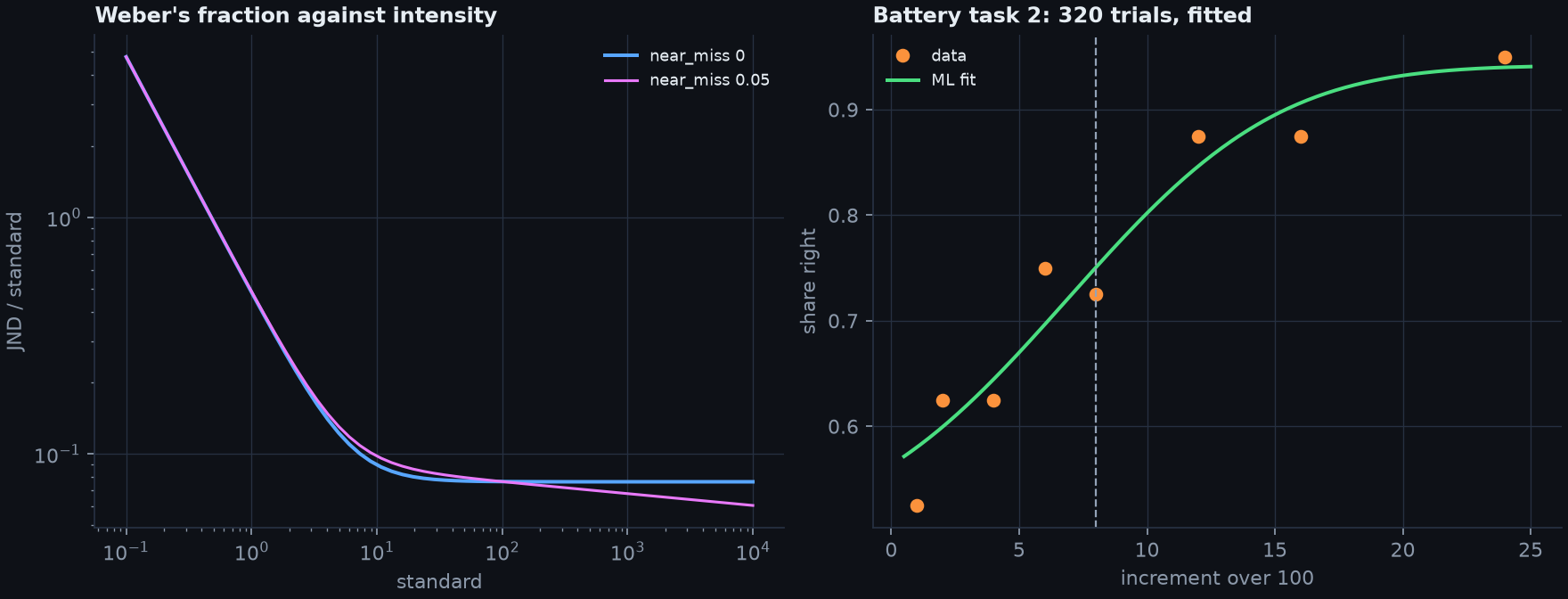
Weber's law can be built. Give Psyche a head in which every intensity arrives with some noise: a fixed floor, plus a part that grows in proportion to the stimulus. Then compute the just noticeable difference at every standard, over six powers of ten. Over the middle of the range, the fraction is constant: . That's Weber's law. But near the bottom, where the fixed floor dominates, the fraction grows. At an intensity of one it's . Every sense shows this: the law fails near the absolute threshold. And at the top there's a second, smaller failure. For the loudness of pure tones, people do slightly better than Weber's law allows as the tone gets louder. In 1968 it was named the near miss to Weber's law. Every sense also has its own fraction. Textbook tables disagree about the values, so here's the safer statement: within a sense, over the middle of its range, the fraction is roughly constant.
What it does: ΔI = kI; on Psyche, a law in the middle and two edges: the floor and the near miss
2Fechner's stepPsych 101 and the major2 min
Fechner's step was to turn Weber's fraction into a scale. Start at the absolute threshold, the weakest stimulus that can be felt at all. Add one just noticeable difference. Then another. Each step is Weber's fraction of the intensity below it, percent here. So near the bottom the steps are tiny, and high up they're long. Now count them. From an intensity of 1 to an intensity of a thousand there are just noticeable steps. And from 1 to 10, from 10 to 100, and from 100 to a thousand, there are each. Equal ratios of intensity give equal numbers of steps. That is the signature of a logarithm.
Here is the same argument in four lines. Weber: the just noticeable difference is k times I. Fechner's assumption, and it is an assumption: every just noticeable step is one unit of sensation, the same size at the bottom of the scale and at the top. So sensation grows by one unit for every k I of intensity. Make the steps small and add them up, which is to integrate, and out comes Fechner's law: sensation is one over k times the logarithm of I over I nought. The constant comes from Weber's fraction, and the zero of the scale from the absolute threshold.
Here is what Fechner claimed. The first quantitative law of the mind, with sensation measured, not by a ruler, but by counting steps that can each be found by experiment. It rests on one assumption: that a just noticeable difference is the same amount of sensation everywhere, the step from 1 to 1.08 as large as the step from 900 to 972. Nothing in the data forces that. Change the assumption, and the law changes, which is what happened a century later, in chapter nine. But first the steps have to be measured, and Fechner's other lasting gift was a set of methods for doing it.
What it does: Counting just noticeable steps; the logarithm in four lines; the one assumption it rests on
3Three classical methodsPsych 101 and the major4 min
The first is the method of limits. A standard of 100, and a comparison that starts well above it. Step the comparison down, a little at a time, and ask each time: is it more? Stop when the answer changes from yes to no. Then start below and step up, until it changes back. The threshold is the average of the changeovers. On Psyche, eight series give . And look at the two directions. Descending series stop late, around , because one noisy no ends the series. Ascending ones stop early, around , because one noisy yes ends it. The method's answer depends on its own stopping rule. Fechner knew, and averaged the two directions.
The second is the method of adjustment, which Fechner called the method of average error. The observer turns a knob until the comparison looks the same as the standard. Twenty times. The average setting is the point of subjective equality: here , close to the standard. And the spread of the settings measures the threshold. A noisier observer misses by more. Here the settings have a standard deviation of , which converts to a just noticeable difference of . The observer's true one is . It's quick and natural. But the observer controls the stimulus, so nothing stops them using a strategy, and nothing checks the settings.
The third is the method of constant stimuli, Fechner's method of right and wrong cases. Fix eight increments in advance, and show each one forty times, in random order. On each trial there are two intervals, one with the standard and one with the standard plus the increment, and the question is which was more. Count the right answers at each level. At the smallest increments it's near half, which is guessing. At the largest it's near all. It's slow: three hundred and twenty trials here. But the trials are independent and the order is random, so nothing the observer expects can steer it, and the counts can be fitted, which is chapter six.
The method of limits has a deeper problem than its stopping rule. Run it on three versions of Psyche with exactly the same noise in the head: the same sensitivity. One says yes easily. One is in between. One wants to be sure before it says yes. Their thresholds: , and . Same eyes, different answers, because a yes-or-no question measures two things at once: how well you can see the difference, and how sure you want to be before you say so. The fix is in the third method's design. Show two intervals and ask which was more. There is no yes to be cautious about. Separating what you can see from what you're willing to say is the whole of Part 12.
What it does: Limits, adjustment, constant stimuli, each run on Psyche; why a yes-no threshold moves with the observer's caution
4The threshold is a curvePsych 101 and the major2 min
Behind all three methods is a picture of what a threshold is. The simplest picture is a line. Below it, nothing is noticed and the observer guesses. Above it, the difference is always seen. The data never look like that. The share of right answers climbs gradually, over a wide range of increments. Because the impression each stimulus makes is noisy. On some trials an increment of six feels like ten, and on some like two. So there is no line. There is a curve, called the psychometric function, and the threshold is a point we choose on it: by custom, the increment that gets seventy-five percent right in a two-interval task, halfway between guessing and certainty.
The curve is described by four numbers. Here is the formula. Gamma is the guess rate: where the curve starts. With two intervals, a guess is right half the time. Alpha is the threshold: where the curve is halfway up. Beta is the spread: how gradually it climbs. A shallow curve means a noisy observer. And lambda is the lapse rate. Even at an increment nobody could miss, people get a few trials wrong: a blink, a slip of the finger, a moment of thinking about lunch. So the curve tops out a little below one. Remember lambda. It matters more than it looks, in chapter six.
And F, the climbing part, can take several shapes. The three in common use: a cumulative Gaussian, a logistic, and a Weibull. Matched at the threshold and at the slope there, they differ only in the tails. Each comes with a story. The Gaussian says the noise in the head is normal. The Weibull came from a model in which many detectors race and the first to fire wins. With a few hundred trials, the data can't tell them apart. So the rule is practical: pick one, and say which.
What it does: A step or a slope; four numbers (guess, threshold, spread, lapse); three shapes, nearly the same
5On you: a threshold of your ownPsych 101 and the major1 min
Your turn. Eight trials. On each, two grey patches: say, or write down, which is brighter, left or right. Guess when you're not sure. That's the rule of a forced choice: never pass. Number one.
Here are the answers, trial by trial, in the second column. Check them against your own. Next to each, the chance that an observer with a just noticeable difference of percent gets it right. At twenty-four percent, nearly always. At one and a half percent, little better than a coin. Count your right answers on the big differences, twelve percent and above, and on the small ones, three percent and below. If you were sure of the first and unsure of the second, your threshold is somewhere between. You've just walked up a psychometric function. Eight trials can't say more than that. The course site has the real thing: a staircase run on your own screen, and your own curve, fitted the way the next chapter fits one.
What it does: Eight pairs of patches; the answers and the chance of each for a model observer
6Fitting the curvePsych 101 and the major5 min
Here's a study of 320 trials, picked by rule: of a hundred and one such studies on Psyche, the one with the middle threshold. At each level, k right out of n is a binomial count. So for any proposed curve, we can compute how likely these exact counts were. A curve that passes far from the points makes them very unlikely. Add up the logarithms of those probabilities over the levels, and you have the log-likelihood of the curve. The fit is the curve that makes it largest: maximum likelihood, the method of Part 9's twin models, here in its simplest form.
We can draw the likelihood of every curve at once. Each point here is a curve, with its threshold across and its spread up, coloured by how likely it makes the counts. The bright region is where the good curves are. The maximum is at alpha and beta , with a lapse rate of . On that curve the seventy-five percent threshold is . Psyche's true one is . Notice the shape of the bright region. It's a ridge on a slant: a higher threshold with a shallower slope fits almost as well. The data pin down some combinations of the numbers much better than others.
How sure can we be of that threshold? We can't run the study a thousand times. But we can imagine it. Treat the fitted curve as if it were the truth, draw new counts from it, the same number of trials at each level, and refit. That's the parametric bootstrap. A thousand refits, and ninety-five percent of their thresholds lie between and . So three hundred and twenty trials pin a threshold down to within about thirty percent either way. That's the honest precision of a whole afternoon in the laboratory. Fitting by maximum likelihood and putting a bootstrap interval round the result became the standard way after two papers by Felix Wichmann and Jeremy Hill, in 2001.
One more question before trusting any of this: does the curve fit at all? Maximum likelihood always finds the best curve of the family you gave it, even when no member of the family describes the data. The usual check is the deviance: how much worse the fitted curve does than a model that matches every level exactly. On its own the number means little, so use the bootstrap again. Draw studies from the fitted curve, refit each one, and see how large the deviance is when the curve really is the truth. For Psyche's study, percent of the repeats fit worse than the real data did. Nothing is wrong. Now a harder case. Run the same design on an observer whose threshold drifts: in every block of ten trials, attention is better or worse, typically by a factor of one point eight. percent of the repeats fit worse. It passes. Across forty-one such studies the test flagged percent, which is the rate it flags when nothing at all is wrong. And the fitted threshold barely moves: a median of against for the steady observer. A fit reports the session's average, and with forty trials a level a drift inside the session is invisible to it. So a passing test is weak evidence. To see drift, you have to look at the trials in the order they happened.
Now the lapse rate. Take the same study, and add one more wrong answer at the easiest level, where any attentive observer is right. A blink. Fit a curve that must reach a hundred percent, and that one slip drags it flat. The threshold moves to . Fit a curve that's allowed a lapse rate, and it simply absorbs the slip. The threshold stays at , near the truth of . So lambda isn't decoration. Leave it out, and one blink at the top of the curve moves the answer by a quarter.
What it does: The binomial likelihood; the likelihood over every curve; the bootstrap interval; does the curve fit, and the drift a fit cannot see; one slip and the lapse rate
7Asking efficientlyPsych 101 and the major3 min
The method of constant stimuli spends most of its trials where the answer is obvious: far below threshold, or far above it. A staircase spends them where they count. The rule: after two right answers in a row, make the next trial harder. After one wrong answer, make it easier. The track falls quickly from an easy start, and then wanders about one level, turning down and up. The estimate is the average of the last turning points: here , in eighty trials. But which level is it wandering around, and why that one?
Here's the answer, worked out by Harry Levitt in 1971. At the level where the staircase settles, it must be as likely to step down as to step up. It steps down after two right answers in a row, which happens with probability p squared. Set p squared equal to a half, and p is the square root of a half: seventy point seven percent. Require three right in a row and it settles at seventy-nine point four percent; four, at eighty-four. So you pick the rule for the point of the curve you want. On Psyche, a hundred and one three-down staircases of two hundred trials each have a median of , against a seventy-nine percent level of . One caution the derivation hides: it assumes small steps. With large steps the estimate sits low. Levitt's numbers are a limit, not a promise.
A staircase only remembers the last few answers. QUEST, published by Andrew Watson and Denis Pelli in 1983, remembers everything. It keeps a probability for every possible threshold: a belief. Each trial is placed at the threshold it currently believes in. The answer updates the belief by Bayes's rule, and the next trial moves. The belief narrows, trial by trial. After trials its estimate is , against a true eighty-two percent level of . Methods descended from it run in the computers of vision laboratories, and in some clinical tests.
How much does it matter? Give each method the same budget of trials, run it a hundred and twenty times, and measure how far its threshold lands from the level it aims at. At thirty-two trials, constant stimuli are typically off by log units, the staircase by , and QUEST by . A log error of point three five is a factor of one point four either way. So the smarter the placement, the fewer trials. It's why a hearing test takes minutes and not an afternoon.
What it does: The staircase and where it settles (p^k = 1/2); QUEST; three methods on the same budget of trials
8Stevens asks for numbersPsych 101 and the major3 min
A century after Fechner, the Harvard psychologist S. S. Stevens, the Stevens of Part 3's scales of measurement, decided that counting steps was the long way round. Why not just ask? Show a light and say: call this one ten. Then show others, and for each one the observer says a number for how bright it seems. Twenty. Forty-five. Four. The method is called magnitude estimation. The numbers are free, but people use them as if their ratios meant something: twice as bright, twice the number.
Plot the numbers people say against the intensity, both on logarithmic scales. Here are simulated people, with the exponents Stevens reported built in. Each continuum gives a straight line. A straight line on log-log axes is a power law: sensation is a constant times intensity to some power a, and the slope of the line is a. For brightness the slope is about a third: doubling the light makes it seem only about a quarter brighter. For heaviness it's a little above one. And for electric shock it's three and a half: double the current, and it feels about eleven times as strong.
Stevens and his colleagues did this for dozens of continua, and published a table of exponents. Here are six of them. Brightness, a third. Loudness, two thirds. Vibration on a finger, nearly one. The length of a line, exactly one: a line twice as long looks twice as long. Heaviness, one and a half. Electric shock, three and a half. There's a pattern. Senses that must cover enormous ranges, like light and sound, compress them. A sense like shock, where a small range matters a great deal, magnifies it.
Is anything real behind those numbers? Stevens had a check that uses no numbers at all. Show a light, and have the observer turn a knob until a tone is as loud as the light is bright. If brightness goes as light to the power a third, and loudness as sound pressure to the power two thirds, then matching them predicts that the sound pressure chosen will go as the light to the power . A prediction from two sets of numbers, tested without any numbers. Stevens's laboratory reported matches close to such predictions. That's evidence the numbers measure something consistent. Whether that something is sensation is a question for the frontier chapter.
What it does: Magnitude estimation; straight lines on log-log axes; the table of exponents; cross-modality matching
9Fechner against StevensPsych 101 and the major4 min
Here's the quarrel, and it fits on one screen. Both sides accept Weber's law. Fechner assumed every just noticeable step is the same amount of sensation. Integrate, and you get a logarithm. Stevens's camp, in the form the Swedish psychologist Gösta Ekman gave it, assumed instead that every step is a fixed share of the sensation already there: a big sensation has big steps. Integrate that, and you get a power law, with an exponent equal to the ratio of the two fractions. The same Weber's law, and two laws of sensation. What decides between them is not the steps, but an assumption about what a step is worth.
Draw both on the same axes. Both rise steeply and then flatten. The logarithm keeps flattening, and a power with a small exponent flattens more slowly. Just noticeable differences can't decide between them, because both curves are built from the same steps. So each side won with its own method. Count steps, and you find Fechner. Ask for numbers, and you find Stevens. The law you get depends partly on the question you ask.
One more way to ask, older than Stevens and gentler than numbers. In 1872, twelve years after Fechner's book, the Belgian physicist Joseph Plateau gave painters a black and a white and asked each to paint the grey that lies exactly midway between them. Here are three candidates. Half the light, the physical middle, looks far too pale. The middle of sensation is not the middle of the stimulus. Fechner's logarithm puts the middle at the geometric mean, percent. A power law with brightness's exponent of a third puts it at . From his painters' greys Plateau argued for a power law, the first one, eighty-five years before Stevens. And the method met the same trouble every method meets. Joseph Delboeuf repeated it with better apparatus and found that the midpoints moved with the lighting. Today colour science uses a lightness scale built on a cube root, a power law, and it puts middle grey at percent of white's light. That is the grey card photographers meter against. Notice that it's close to the logarithm's answer above. Given an offset at the dark end, a power law and a logarithm can be made to agree, which is the quarrel's whole difficulty.
There's a second difficulty, and it's with the numbers themselves. People tend to spread whatever range of stimuli they're shown over much the same range of numbers. Simulate an observer who does that half the time, with a true exponent of two thirds. Show stimuli spanning a ratio of ten, and the exponent comes out at 1.34. A ratio of a hundred, 0.84. A ratio of a thousand, 0.67. Same observer. This is not just a simulation. In 1968 the British psychologist E. C. Poulton gathered the evidence that the range, the first stimulus, and the order of the stimuli all move real exponents. The power form repeats; the exponents are partly made by the experiment.
What it does: Same Weber, two assumptions; hard to tell apart over the range people use; Plateau's painters and the middle grey; exponents that bend to the experiment
10Where Weber's law comes fromPsych 101 and the major3 min
Why should the noticeable difference be a constant fraction? There are two simple ways to build it, and Psyche's observer used the first. One: the signal in the head is proportional to the stimulus, and its noise grows in proportion too. Light arrives as photons, and nerve cells fire spikes, and both get more variable as there are more of them. Two: the signal grows as the logarithm of the stimulus, compressed, and its noise stays the same size. Either way, a difference is noticed when it's large compared with the noise at that level, and either way that makes the noticeable difference a constant fraction.
Now build both, and measure their thresholds at every standard. One curve. Above the floor, the two machines' thresholds differ by percent at most. So thresholds alone can't tell you which machine is in the head. Other measurements can: how confident people are, how fast they answer, and the cells themselves. That's Parts 12 and 13, and at the end of the series, Part 58. For now: Weber's law is a solid fact about what comes out. What produces it is still argued over.
There's a way to read the noise off the thresholds, and it needs a wider range than one experiment usually covers. Plot the just noticeable increment against the background on log-log axes, from almost dark to bright daylight. Psyche's eye here has three sources of noise. Light comes in photons, and a count of photons varies by about its square root. Very dim: the eye's own noise, the dark light, dominates, and the threshold doesn't depend on the background at all. Slope zero. Dim: photon noise dominates, and the threshold grows as the square root of the background. Slope one half. Hessel de Vries in 1943 and Albert Rose in 1948 worked this out from the physics of light. Bright: noise in proportion to the signal, and Weber's law. Slope one. Measured curves of threshold against background in vision do bend this way, though the middle stretch is only roughly a square root, and the eye also turns its own gain down as the light grows. So Weber's law isn't one law but one regime, and the slope says which noise is in charge.
What it does: Growing noise or a compressed code; the same thresholds, to within a few percent; the slope tells you the noise (dark light, the square-root law, Weber)
11Weber's law elsewherePsych 101 and the major3 min
Weber's law isn't only about lights and weights. Flash two clouds of dots, too briefly to count, and ask which has more. People answer from an approximate sense of number, and it follows Weber's law. Eight dots against ten is as hard as sixteen against twenty: only the ratio matters. The green curve and the dashed one lie on top of each other. For adults the Weber fraction is about . And it sharpens through childhood. At three, children need a ratio of about three to four to be reliably right; at six, about five to six. Number sense, and whether it matters for learning mathematics, is Part 30.
And time. Ask people, or rats or pigeons, to wait two, four, eight or sixteen seconds without counting. The guesses spread out more for longer intervals. Divide each guess by its target, and the four spreads become one curve. The error is a constant share of the interval. That is Weber's law for time, which the timing literature calls the scalar property, after John Gibbon's theory of 1977. It holds over seconds to minutes and fails for very short intervals.
And money, where the idea is older than Fechner. In 1738 the mathematician Daniel Bernoulli proposed that the value of a small gain to its owner is inversely proportional to the wealth its owner already holds. Add up those small gains, and value is the logarithm of wealth. It is Fechner's law, written down a hundred and twenty-two years before Fechner, for ducats instead of lights. On this rule, ten ducats to someone who has ten are worth about times as much as to someone who has a thousand. Bernoulli used it to explain why merchants insure their cargo, and why no one will pay much to play a game whose average payout is infinite, the puzzle called the Saint Petersburg paradox. Whether people's choices actually follow his curve is a question for Part 26. The short answer is: not quite, because people judge gains and losses from where they stand, not from their total wealth. Lights, weights, numbers, durations and money: a constant fraction, and the logarithm it leads to, is one of the most general ideas about minds.
What it does: Which cloud has more dots, through childhood; timed intervals whose spread grows with their length; Bernoulli's logarithm of wealth
12The LedgerPsych 101 and the major1 min
Two rows today. The first. The claim: the smallest noticeable change in a stimulus is a constant fraction of its size. The original: Weber, 1834, with weights, touch and the length of lines. The record: Fechner's ten years of experiments, and a century and a half of laboratories since, among them the near miss for the loudness of tones in 1968. It holds over the middle of most ranges and fails at the edges: near the absolute threshold the fraction grows, and for loud tones it shrinks a little. Replicated.
The second. The claim: judged magnitude grows as a power of stimulus intensity. The original: Stevens, 1957, and a table of exponents from a third to three and a half. The record: the power form repeats, continuum after continuum. But Poulton's review in 1968 showed that the exponents move with the range of stimuli, the first one shown and the order. So the exponents are not constants of the senses. Replicated, for the power form. That makes rows. Both of today's are replicated, and both come with conditions attached. That's what a mature finding looks like: not a slogan, but a law with its range of validity written beside it.
What it does: Weber's law; Stevens's power law
13In practice: hearing tests, eye charts and codecsPractice3 min
If you've had your hearing tested, you've been in a psychophysics experiment. A tone, and you press the button when you hear it. The rule most audiometers follow dates from the nineteen-forties: when you hear the tone, the next one is ten decibels softer; when you don't, five decibels louder. The threshold is the lowest level you hear on two of three rising presentations. It's a staircase, aimed at the halfway point of a yes-no curve. And the answer here sits a little above the listener's true halfway point, as the rule's large steps make it do. The scale itself is Fechner's legacy. A decibel is a logarithm: every ten decibels is ten times the power.
Two more everyday uses. An eye chart is the method of limits, descending: the letters shrink, row by row, until you fail. Naming a letter is a forced choice among many, so the chance of guessing right is small. And every photograph on your phone, and every song you stream, has been through psychophysics. The file began with far more detail than you can notice. A codec measures detail in units of just noticeable difference, and throws away the changes smaller than one. The same question, will anyone notice, is asked of prices and packages by people who'd rather you didn't.
Food and drink companies run psychophysics every week. A manufacturer wants to change a recipe, a cheaper ingredient, less sugar, and needs to know whether customers will notice. The standard method is the triangle test. Each taster gets three samples, two the same and one different, and must pick the odd one out. Guessing is right a third of the time, so this is the psychometric curve of chapter four with a floor of one third instead of one half. With thirty tasters, or more right answers is a difference at the five percent level. Now the power. Suppose thirty percent of people can really taste the change and the rest guess. Thirty tasters find it percent of the time; it takes tasters to find it eighty percent of the time. And here's the trap. The company usually hopes for no difference, and a panel that finds nothing hasn't shown there is nothing. To catch a change that one taster in ten can tell, it needs tasters. That's Part 4's lesson about power, in a bottle of juice.
What it does: The audiometer's staircase; the eye chart as a descending method of limits; compression measured in JNDs; the triangle test and its power
14Frontier: what the numbers measureResearch4 min
Here's the frontier, and it's at the root of the subject. Did Fechner, or anyone since, measure a sensation? What's solid: thresholds, as curves fitted to counts, with honest intervals. Weber's law, over the middle of each range. And the power form of magnitude estimates, with matches across senses that agree. What's argued: that a just noticeable step is a unit of sensation. That the numbers people say form a ratio scale, in Part 3's sense, where twice the number means twice the sensation. And, deepest, that a sensation has a size at all, apart from what a person can tell apart. It's Part 3's lesson: a number is a measurement only if the structure it claims is really there. For telling things apart, it is. For the size of a sensation, the case is still open, and Kant's first objection still has a foothold.
One bold answer came early, in 1927, and it runs the other way: measure with no physical stimulus at all. Louis Thurstone asked: what if there is no physical scale at all? Which of two crimes is more serious, which of two pictures is more beautiful. All you have is which of each pair people choose. Thurstone's move was to assume what this part assumed about grey patches: each item gives an impression with noise, and the share of people who pick one over another depends on the distance between them, measured in units of that noise. Turn every proportion into a distance, and average. Here two hundred simulated judges compare six offences whose seriousness is planted in them. Thurstone's simplest case gives the scale back to within units. Thurstone himself scaled nineteen crimes this way. The idea runs straight on to the Elo ratings of chess players and the leaderboards that rank AI models by which answer people prefer. That's Part 46. And it is Fechner's bet in its boldest form: wherever people can tell two things apart, noise turns telling apart into distance.
On the method side, the frontier is measuring whole curves instead of single points. Take vision: how much contrast you need to see stripes depends on how fine the stripes are, and the thresholds across all widths make a curve. Measuring it point by point takes hours. In 2010 a method called the quick CSF applied QUEST's idea to the curve's four numbers at once, choosing each trial to teach the most about all of them. It's accurate in under trials. Adaptive methods for many unknowns, chosen trial by trial, are where this chapter's ideas are being pushed now, from the eye clinic to the testing of children.
Four questions to carry out of this part. Why the near miss? Loud tones beat Weber's law slightly, and no single account has won. Growing noise or a compressed code? Thresholds can't say. Confidence, response times and the cells themselves might. Why do the exponents differ between senses, and how much of each is made by the experiment? And the starred problem: design an experiment that tells Psyche's two observers of chapter ten apart, using anything except their thresholds.
What it does: What is solid and what is argued; Thurstone's scale with no ruler; the quick CSF; open questions
Recap, problems, and the road aheadAll tracks4 min
Part eleven in ten lines. On a morning in 1850, Fechner saw how to measure the mind: by counting just noticeable steps. Weber had found that the step is a constant fraction of the stimulus, over the middle of each range, and larger near the floor. Count the steps, and sensation is a logarithm. Three classical methods find the steps, and a yes-or-no question mixes what you see with what you're willing to say. A threshold is a curve with four numbers: a guess rate, a threshold, a spread and a lapse rate. Maximum likelihood fits it, with an interval, and leaving out the lapse rate lets one slip move the answer. A two-down staircase settles at seventy point seven percent, and QUEST, which keeps a belief, is fastest. Stevens asked for numbers and got power laws, whose exponents the experiment itself moves. Growing noise and a compressed code give the same thresholds, and the slope of a threshold against its background says which noise is in charge. And a constant fraction holds for number, for time, and in Bernoulli's hands, for money.
Kant's wager. Today was the first objection's day. Kant said the mind admits no mathematics. Fechner answered with a law that has a constant in it, and a century and a half of laboratories have found Weber's law where he said it would be. Thresholds come with intervals, and the staircase that finds them was derived on a single line. But the deepest part of the objection still stands: whether a sensation has a size, or only differences that can be told apart. So the reply is strong, not total. And on the third objection, that observing disturbs: the forced choice is a reply. With two intervals and no yes to be cautious about, the observer's habits drop out of the measurement.
Where this comes back. Seeing against saying, signal detection, is the very next part. The eye's thresholds and contrast are Part 13. Prices, and whether anyone notices a change, are in Part 26. Number sense in children is Part 30. Scaling people's judgments, Stevens's heirs, is Part 46. Displays built around human thresholds are Part 51. And why perception compresses at all, efficient coding, is Part 58.
Seven problems, with full solutions in this part's README. One counts Fechner's steps. One derives Weber's fraction from noise. One derives a staircase's target. One fits a proportion by maximum likelihood, by hand. One does Stevens's arithmetic. One uses Psyche's psychophysics module to test staircases and QUEST. And the last, with the star, is the frontier's problem. Pause here if you'd like to try them.
The books and papers behind this part are listed here and in the README. For doing psychophysics yourself, Kingdom and Prins is the place to start.
So a sensation can be measured, at least at its edges, and a law of the mind has a constant in it. But chapter three left a problem unsolved. Ask someone whether they saw something, and the answer mixes two things: how well they can see, and how willing they are to say yes. In wartime, radar operators watching for aircraft missed real targets and reported ghosts, and no instruction could fix one kind of error without causing more of the other. Out of that trade-off came a theory with two numbers, one for seeing and one for saying, and it became the most exported idea in psychology. It's Part 12: signal and noise.
Where it goes next. Seeing against saying is Part 12, signal detection. The eye's thresholds and contrast are Part 13. Prices and noticing are Part 26, number sense in children Part 30, scaling judgments Part 46, displays built for human thresholds Part 51, and why perception compresses, efficient coding, Part 58.
Key results
The part's results in one place, for revision.
Try it
Lab 11 · Thresholds and scales: Weber, Fechner, the psychometric function and Stevens
Build an observer whose noise has a floor and a part that grows with the stimulus, and find Weber's law in its thresholds and its failure near the floor; count Fechner's steps; run the method of limits with three response criteria, the method of adjustment and the method of constant stimuli; fit the psychometric function by maximum likelihood with a parametric bootstrap, with and without a lapse rate; check where two-down and three-down staircases settle and how step size biases them; run QUEST; and recover Stevens's exponents from simulated magnitude estimates, then watch the stimulus range move them.
python -m videos.psychology.labs 11
needs numpy, scipy, matplotlib · download lab11.py ·
source on GitHubWeber's fraction at intensities 1, 10, 100, 1,000, 10,000 0.483, 0.090, 0.076, 0.076, 0.076
Fechner: JND steps from 1 to 1,000 at a fraction of 0.08; and from 1 to 10 89.8; 29.9
method of limits, criterion 0.5: median threshold over 100 runs 10.7
method of limits, criterion 1.0: median threshold over 100 runs 14.6
method of limits, criterion 1.5: median threshold over 100 runs 19.8
method of adjustment, 200 settings: point of subjective equality; JND from the spread; true JND 98.0; 8.12; 7.65
Battery task 2, 320 trials: right answers at each increment 21 25 25 30 29 35 35 38
fitted 75% threshold [bootstrap 95%]; the truth 8.0 [5.2, 10.8]; 8.2
one more error at the easiest level: threshold with lapse fixed at 0; with lapse fitted 9.1; 7.6
2-down 1-up staircase: median estimate; the 70.7% level 6.1; 6.5
3-down 1-up staircase: median estimate; the 79.4% level 10.1; 10.0
2-down staircase with steps of 1.5 instead of 1.12: median estimate 5.6
QUEST, 40 trials: median estimate; the 82% level 10.9; 11.3
magnitude estimation with exponent 0.33: fitted exponent 0.35
magnitude estimation with exponent 1.45: fitted exponent 1.52
magnitude estimation with exponent 3.5: fitted exponent 3.45
cross-modality match of loudness (0.67) to brightness (0.33): predicted exponent 0.49
light needed to double brightness at exponent 0.33 8.2 times
Threshold-against-background slopes: dark light, photon noise, Weber 0.06, 0.50, 1.00
Goodness of fit: deviance of the data; share of 200 repeats that fit worse 2.13; 0.85
Triangle test with 30 tasters: right answers needed at 5%; power if 30% (10%) can tell 15; 0.71 (0.18)
Noise with a floor and a proportional part gives a constant Weber fraction over the middle of the range and a rising one near the floor. A yes-no method's threshold moves with the observer's criterion, the forced choice's does not. Three hundred and twenty trials pin a threshold to about thirty percent either way, and a fit without a lapse rate lets one slip move it by a fifth or more. A k-down staircase settles where p^k = 1/2 if its steps are small, and below that if they are large. QUEST reaches its target in tens of trials. Simulated magnitude estimates give back their exponents. The slope of a threshold against its background says which noise is in charge, and a fit that passes its goodness-of-fit test can still hide drift. A triangle test of 30 tasters finds a difference that a tenth of people can taste less than one time in five.The code (129 lines; it asserts its own result)
"""Lab 11: Weber's fraction built from noise, the three classical methods, a fitted psychometric function with a
bootstrap interval and a goodness-of-fit check, staircases and QUEST, Stevens's power law with its range effect, the
square-root regime of photon noise, and the triangle test's power."""

import math

import numpy as np
from scipy import optimize

from videos.coursekit import labs
from explainer.psychology import battery
from explainer.psychology.psyche import psychophysics as P

TITLE = "Thresholds and scales: Weber, Fechner, the psychometric function and Stevens"
GOAL = ("Build an observer whose noise has a floor and a part that grows with the stimulus, and find Weber's law in "
        "its thresholds and its failure near the floor; count Fechner's steps; run the method of limits with three "
        "response criteria, the method of adjustment and the method of constant stimuli; fit the psychometric "
        "function by maximum likelihood with a parametric bootstrap, with and without a lapse rate; check where "
        "two-down and three-down staircases settle and how step size biases them; run QUEST; and recover Stevens's "
        "exponents from simulated magnitude estimates, then watch the stimulus range move them.")
TASKS = [
    "Fit the Battery's threshold task for 40, 80, 160 and 320 trials with a fitted and a fixed lapse rate, 200 times "
    "each. Plot the bias and spread of the 75% threshold against trials. When does fitting the lapse rate help?",
    "Give the Observer poisson=1 and k=0.02, and plot the JND from 1e-4 to 1e7 on log-log axes. Where do the slopes "
    "change from 0 to 1/2 and from 1/2 to 1? Derive both crossing points from sigma0, poisson and k.",
    "How many tasters does a triangle test need to find, 80% of the time, a difference that 20% of people can taste? "
    "And a duo-trio test, where the guess rate is 1/2? Which test is more efficient, and why?",
]


def run(seed=0):
    out = labs.Lab()
    rng = lambda k: np.random.default_rng(seed + k)  # noqa: E731
    clean = P.Observer(k=0.08, sigma0=0.5, lapse=0.0)
    obs = P.Observer(k=0.08, sigma0=0.5, lapse=0.02)

    # 1. Weber's law, and where it fails
    w = P.weber_fractions(clean, [1.0, 10.0, 100.0, 1000.0, 10000.0])
    out.row("Weber's fraction at intensities 1, 10, 100, 1,000, 10,000", ", ".join(f"{v:.3f}" for v in w))
    out.row("Fechner: JND steps from 1 to 1,000 at a fraction of 0.08; and from 1 to 10", f"{P.fechner(1000.0, 1.0, 0.08):.1f}; "
            f"{P.fechner(10.0, 1.0, 0.08):.1f}")
    assert abs(w[-1] - w[-2]) < 1e-3 and w[0] > 4 * w[-1]

    # 2. the classical methods
    for c in (0.5, 1.0, 1.5):
        t = np.median([P.method_of_limits(clean, 100.0, 40.0, 2.5, 10, rng(10 + j), criterion=c)["threshold"] for j in range(100)])
        out.row(f"method of limits, criterion {c}: median threshold over 100 runs", f"{t:.1f}")
    adj = P.method_of_adjustment(clean, 100.0, 200, rng(20))
    out.row("method of adjustment, 200 settings: point of subjective equality; JND from the spread; true JND",
            f"{adj['pse']:.1f}; {adj['jnd_from_sd']:.2f}; {float(P.jnd(clean, 100.0)):.2f}")

    # 3. constant stimuli and the fit
    t = battery.run("threshold", obs, 320, seed=seed + 30)
    deltas = np.array(battery.THRESHOLD_DELTAS)
    k = np.array([int(t.correct[t.extra["delta"] == d].sum()) for d in deltas])
    n = np.array([int((t.extra["delta"] == d).sum()) for d in deltas])
    f = P.fit(deltas, k, n, form="gauss")
    b = P.bootstrap(deltas, k, n, f, n_boot=300, rng=rng(31))
    true75 = optimize.brentq(lambda d: float(obs.p_correct(100.0, d)) - 0.75, 0.01, 60)
    th = P.threshold_at(f, 0.75)
    out.row("Battery task 2, 320 trials: right answers at each increment", " ".join(str(v) for v in k))
    out.row("fitted 75% threshold [bootstrap 95%]; the truth", f"{th:.1f} [{b['threshold_ci'][0]:.1f}, {b['threshold_ci'][1]:.1f}]; {true75:.1f}")
    k2 = k.copy()
    k2[-1] = n[-1] - 3
    fixed = P.fit(deltas, k2, n, form="gauss", lam=0.0)
    free = P.fit(deltas, k2, n, form="gauss")
    out.row("one more error at the easiest level: threshold with lapse fixed at 0; with lapse fitted",
            f"{P.threshold_at(fixed, 0.75):.1f}; {P.threshold_at(free, 0.75):.1f}")

    # 4. adaptive methods
    for kd in (2, 3):
        est = [P.staircase(obs, 100.0, 30.0, factor=1.12, k_down=kd, n_trials=200, rng=rng(100 * kd + j),
                           n_reversals_used=12)["estimate"] for j in range(150)]
        aim = optimize.brentq(lambda d: float(obs.p_correct(100.0, d)) - P.updown_target(kd), 0.01, 60)
        out.row(f"{kd}-down 1-up staircase: median estimate; the {100 * P.updown_target(kd):.1f}% level", f"{np.median(est):.1f}; {aim:.1f}")
    coarse = np.median([P.staircase(obs, 100.0, 30.0, factor=1.5, rng=rng(500 + j))["estimate"] for j in range(150)])
    out.row("2-down staircase with steps of 1.5 instead of 1.12: median estimate", f"{coarse:.1f}")
    q = [P.quest(obs, 100.0, 40, rng=rng(600 + j))["estimate"] for j in range(60)]
    aim82 = optimize.brentq(lambda d: float(obs.p_correct(100.0, d)) - 0.82, 0.01, 60)
    out.row("QUEST, 40 trials: median estimate; the 82% level", f"{np.median(q):.1f}; {aim82:.1f}")
    assert abs(np.median(q) / aim82 - 1) < 0.15

    # 5. Stevens
    for a in (0.33, 1.45, 3.5):
        me = P.magnitude_estimation(np.logspace(0, 1, 7), a, 20, rng(int(700 + 10 * a)))
        out.row(f"magnitude estimation with exponent {a}: fitted exponent", f"{P.fit_power(me['intensity'], me['geometric_mean'])['exponent']:.2f}")
    out.row("cross-modality match of loudness (0.67) to brightness (0.33): predicted exponent", f"{P.cross_modality(0.33, 0.67):.2f}")
    out.row("light needed to double brightness at exponent 0.33", f"{2 ** (1 / 0.33):.1f} times")
    out.note = ("Noise with a floor and a proportional part gives a constant Weber fraction over the middle of the "
                "range and a rising one near the floor. A yes-no method's threshold moves with the observer's "
                "criterion, the forced choice's does not. Three hundred and twenty trials pin a threshold to about "
                "thirty percent either way, and a fit without a lapse rate lets one slip move it by a fifth or more. A "
                "k-down staircase settles where p^k = 1/2 if its steps are small, and below that if they are large. "
                "QUEST reaches its target in tens of trials. Simulated magnitude estimates give back their exponents. "
                "The slope of a threshold against its background says which noise is in charge, and a fit that "
                "passes its goodness-of-fit test can still hide drift. A triangle test of 30 tasters finds a "
                "difference that a tenth of people can taste less than one time in five.")

    # 6. The slope tells you the noise: a floor, photon noise and Weber noise
    eye = P.Observer(k=0.02, sigma0=0.05, lapse=0.0, poisson=1.0)
    lv = np.array([1e-4, 1e-3, 1.0, 10.0, 1e5, 1e6])
    jj = P.jnd(eye, lv)
    sl = [math.log10(jj[i + 1] / jj[i]) / math.log10(lv[i + 1] / lv[i]) for i in (0, 2, 4)]
    out.row("Threshold-against-background slopes: dark light, photon noise, Weber", ", ".join(f"{v:.2f}" for v in sl))

    # 7. Does the curve fit? The bootstrap's deviance
    bt = P.bootstrap(deltas, k, n, f, n_boot=200, rng=rng(80))
    out.row("Goodness of fit: deviance of the data; share of 200 repeats that fit worse", f"{f['deviance']:.2f}; "
            f"{bt['p_fit']:.2f}")

    # 8. The triangle test: guess rate 1/3
    out.row("Triangle test with 30 tasters: right answers needed at 5%; power if 30% (10%) can tell",
            f"{P.triangle_critical(30)}; {P.triangle_power(30, 0.3):.2f} ({P.triangle_power(30, 0.1):.2f})")

    fig, ax = labs.figure(2, size=(11, 4.2))
    s = np.logspace(-1, 4, 60)
    ax[0].loglog(s, P.weber_fractions(clean, s), color=labs.BLUE, lw=1.8, label="near_miss 0")
    ax[0].loglog(s, P.weber_fractions(P.Observer(k=0.08, sigma0=0.5, lapse=0.0, near_miss=0.05), s), color=labs.PINK, lw=1.4,
                 label="near_miss 0.05")
    ax[0].set(title="Weber's fraction against intensity", xlabel="standard", ylabel="JND / standard")
    ax[0].legend(fontsize=8)
    x = np.linspace(0.5, 25, 200)
    ax[1].plot(deltas, k / n, "o", color=labs.ORANGE if hasattr(labs, "ORANGE") else labs.PINK, label="data")
    ax[1].plot(x, P.psychometric(x, f["alpha"], f["beta"], 0.5, f["lam"], "gauss"), color=labs.GREEN, lw=1.8, label="ML fit")
    ax[1].axvline(th, color=labs.GREY, ls="--", lw=1)
    ax[1].set(title="Battery task 2: 320 trials, fitted", xlabel="increment over 100", ylabel="share right")
    ax[1].legend(fontsize=8)
    out.fig = fig
    return out
Now change it
- Fit the Battery's threshold task for 40, 80, 160 and 320 trials with a fitted and a fixed lapse rate, 200 times each. Plot the bias and spread of the 75% threshold against trials. When does fitting the lapse rate help?
- Give the Observer poisson=1 and k=0.02, and plot the JND from 1e-4 to 1e7 on log-log axes. Where do the slopes change from 0 to 1/2 and from 1/2 to 1? Derive both crossing points from sigma0, poisson and k.
- How many tasters does a triangle test need to find, 80% of the time, a difference that 20% of people can taste? And a duo-trio test, where the guess rate is 1/2? Which test is more efficient, and why?
Problems, with solutions
Try each problem before opening its solution.
1. Weber's fraction for a task is 0.05. Starting at an absolute threshold of 1, how many just noticeable steps lie between 1 and 1,000? Between 1,000 and 2,000? What does Fechner's law say about the sensation at 2,000 compared with 1,000?
Solution
Each step multiplies the intensity by 1.05, so the number of steps from a to b is ln(b/a) / ln 1.05, and ln 1.05 = 0.0488. From 1 to 1,000: 6.908 / 0.0488 ≈ 142 steps. From 1,000 to 2,000: 0.693 / 0.0488 ≈ 14 steps. Fechner's law counts steps from the absolute threshold, so the sensation at 1,000 is about 142 units and at 2,000 about 156: doubling the stimulus adds a tenth to the sensation. Every doubling, wherever it starts, adds the same 14 units. That is the logarithm, and the claim that a doubled stimulus is not a doubled sensation is exactly what Stevens later disputed.
2. A two-interval observer's impression of each stimulus has a standard deviation of σ. Show that it is right 75% of the time when the increment is √2 z₀.₇₅ σ ≈ 0.95σ. If σ = 0.08 I, what is Weber's fraction?
Solution
Call the two impressions X₁ ~ N(I, σ²) and X₂ ~ N(I + Δ, σ²), independent. The observer is right when X₂ > X₁. The difference X₂ − X₁ is normal with mean Δ and standard deviation √2 σ, so P(right) = Φ(Δ / (√2 σ)). Setting this to 0.75 gives Δ / (√2 σ) = z₀.₇₅ = 0.674, so Δ = √2 × 0.674 σ = 0.954σ. With σ = 0.08 I the JND is 0.954 × 0.08 I = 0.076 I: Weber's fraction is 0.076, the value Psyche shows over the middle of its range. (Psyche's noise at I + Δ is slightly larger than at I, and its floor adds a little near the bottom; neither changes the second decimal at 100.) The lesson: Weber's law follows from noise that grows in proportion to the stimulus, and the fraction is the noise's coefficient times a constant set by the definition of "just noticeable".
3. Derive where a 3-down 1-up staircase settles. Which rule would you use to measure the 84% point? Why does a large step size bias the estimate?
Solution
The level goes down after three right answers in a row and up after any wrong one. At a level where the chance of a right answer is p, the chance of going down is p³ and of going up 1 − p³ (ignoring the runs that are cut short, which affect only when the step happens, not its direction). The staircase hovers where up and down are equally likely: p³ = 1/2, p = 0.5^(1/3) = 0.794. For 84%: p^k = 1/2 gives k = ln 0.5 / ln 0.84 = 3.98, so a 4-down 1-up rule (0.841). Large steps: the derivation treats p as the same at the levels just above and just below the point the staircase oscillates around. With large steps the two levels sit on different parts of the curve, where it bends, and the balance point between them is no longer the level where p^k = 1/2. On Psyche, with steps of ×1.25 the 2-down 1-up median was 5.9 against a 70.7% level of 6.5; with ×1.12 it was 6.4. Levitt's targets are what a staircase approaches as the steps shrink.
4. At one level, 30 of 40 trials are right. Write the binomial log-likelihood of a proportion p and find its maximum. Use √(p(1−p)/n) to give an approximate 95% interval.
Solution
ln L(p) = 30 ln p + 10 ln(1 − p) + ln C(40, 30). Its derivative is 30/p − 10/(1 − p), which is zero at p = 30/40 = 0.75. The standard error is √(0.75 × 0.25 / 40) = 0.068, so the interval is 0.75 ± 1.96 × 0.068, about 0.62 to 0.88. A single level of forty trials pins a proportion to about ±0.13; this is why the film's fit, with eight levels, still has an interval for the threshold of 6.3 to 11.4, roughly ±30%. Fitting the whole curve borrows strength across levels, but forty trials a level is not a precise measurement.
5. Brightness has exponent 0.33 and loudness 0.67. By what factor must light increase to double brightness? In a cross-modality match, by what factor must sound pressure rise when light rises tenfold?
Solution
Brightness ∝ L^0.33, so doubling it needs L to rise by 2^(1/0.33) = 2^3.03 ≈ 8.2. A tenfold rise in light raises brightness by 10^0.33 = 2.14. For the matched loudness, which grows as P^0.67, to rise by the same factor, sound pressure must rise by 2.14^(1/0.67) = 10^(0.33/0.67) = 10^0.49 ≈ 3.1. On log-log axes the match is a straight line of slope 0.33 / 0.67 = 0.49, predicted from two separate experiments that both asked for numbers, and checked by a third that asks for none. This was Stevens's strongest argument that the numbers measured something.
6. With explainer.psychology.psyche.psychophysics: run staircase 200 times with step factors 1.1 and 1.5,
and quest with 20 and 60 trials; compare each with the level it aims at.
Solution
import numpy as np
from scipy import optimize
from explainer.psychology.psyche import psychophysics as P

o = P.Observer()
level = lambda p: optimize.brentq(lambda d: float(o.p_correct(100.0, d)) - p, 0.01, 60)
for f in (1.1, 1.5):
    e = [P.staircase(o, 100.0, 24.0, factor=f, rng=np.random.default_rng(i), n_trials=200)["estimate"]
         for i in range(200)]
    print(f, np.median(e), level(P.updown_target(2)))
for n in (20, 60):
    e = [P.quest(o, 100.0, n, rng=np.random.default_rng(1000 + i))["estimate"] for i in range(200)]
    print(n, np.median(e), level(0.82))
The 70.7% level is 6.53. With 200 trials, steps of ×1.1 give a median of 6.4 and steps of ×1.5 give 5.8: the coarse staircase sits low, as in problem 3. With the default 80 trials the fine staircase gives 7.6, too high, because from a start of 24 it spends its first reversals still coming down: small steps need more trials. QUEST's 82% level is 11.3; its median is 10.1 after 20 trials and 10.7 after 60, and its error (RMSE in log units) falls from 0.48 to 0.27. Every method trades bias against trials, and the honest report gives both.
7. ★ Psyche's two observers of chapter 10 have the same thresholds. Design a measurement other than a threshold that would tell them apart, and say what each predicts.
Solution
One observer's internal signal grows in proportion to the stimulus, with noise that grows too; the other's signal is the logarithm of the stimulus, with constant noise. Thresholds depend only on the ratio of signal difference to noise, which is the same for both, so no discrimination experiment at one level separates them. A measurement of the signal's shape can. Bisection: show 10 and 1,000 and ask for the stimulus halfway between them in sensation. The compressed code puts the midpoint at the geometric mean, 100; the proportional code at the arithmetic mean, 505. Or compare differences: is the difference between 10 and 20 larger, smaller or the same as between 100 and 200? The compressed code says the same; the proportional code says the second, by a factor of ten in signal, though not in discriminability. A third route measures the noise directly: with confidence ratings or response times, the proportional observer's variability at high levels is larger in absolute terms, the compressed one's the same. Real data from bisection and difference judgments do not cleanly choose either, which is the subject of the frontier chapter: such judgments carry their own biases, as Poulton showed for magnitude estimates.
Notes and sources
Where it comes back
Seeing against saying, and the method of limits' moving threshold: Part 12, Signal and Noise. The eye's
thresholds and contrast: Part 13. Prices and whether anyone notices a change: Part 26. The number sense in
children: Part 30. Scaling people's judgments, from magnitude estimates to survey scales: Part 46. Displays built
for human thresholds: Part 51. Why perception compresses, and efficient coding: Part 58. Psyche's psychophysics
module and the Battery's threshold task supply the observer, the fits and the staircases those parts use.
Sources
Books. G. T. Fechner, Elemente der Psychophysik (1860). G. A. Gescheider, Psychophysics: The Fundamentals (3rd ed., 1997). F. A. A. Kingdom and N. Prins, Psychophysics: A Practical Introduction (2nd ed., 2016). S. S. Stevens, Psychophysics (1975).
Papers.
- E. H. Weber, De Pulsu, Resorptione, Auditu et Tactu: Annotationes Anatomicae et Physiologicae (1834); Der Tastsinn und das Gemeingefühl (1846).
- E. G. Boring, "Fechner: inadvertent founder of psychophysics", Psychometrika 26 (1961) 3–8.
- S. S. Stevens, "On the psychophysical law", Psychological Review 64 (1957) 153–181.
- E. C. Poulton, "The new psychophysics: six models for magnitude estimation", Psychological Bulletin 69 (1968) 1–19.
- R. Teghtsoonian, "On the exponents in Stevens's law and the constant in Ekman's law", Psychological Review 78 (1971) 71–80.
- H. Levitt, "Transformed up-down methods in psychoacoustics", Journal of the Acoustical Society of America 49 (1971) 467–477.
- A. B. Watson and D. G. Pelli, "QUEST: a Bayesian adaptive psychometric method", Perception & Psychophysics 33 (1983) 113–120.
- F. A. Wichmann and N. J. Hill, "The psychometric function: I. Fitting, sampling, and goodness of fit; II. Bootstrap-based confidence intervals and sampling", Perception & Psychophysics 63 (2001) 1293–1313, 1314–1329.
- W. J. McGill and J. P. Goldberg, "A study of the near-miss involving Weber's law and pure-tone intensity discrimination", Perception & Psychophysics 4 (1968) 105–109.
- J. Halberda, M. M. M. Mazzocco and L. Feigenson, "Individual differences in non-verbal number acuity correlate with maths achievement", Nature 455 (2008) 665–668; J. Halberda and L. Feigenson, "Developmental change in the acuity of the number sense", Developmental Psychology 44 (2008) 1457–1465.
- J. Gibbon, "Scalar expectancy theory and Weber's law in animal timing", Psychological Review 84 (1977) 279–325.
- J. Plateau, "Sur la mesure des sensations physiques, et sur la loi qui lie l'intensité de ces sensations à l'intensité de la cause excitante", Bulletins de l'Académie Royale de Belgique 33 (1872) 376–388.
- L. L. Thurstone, "A law of comparative judgment", Psychological Review 34 (1927) 273–286; "The method of paired comparisons for social values", Journal of Abnormal and Social Psychology 21 (1927) 384–400.
- Hl. de Vries, "The quantum character of light and its bearing upon threshold of vision, the differential sensitivity and visual acuity of the eye", Physica 10 (1943) 553–564; A. Rose, "The sensitivity performance of the human eye on an absolute scale", Journal of the Optical Society of America 38 (1948) 196–208.
- D. Bernoulli, "Specimen theoriae novae de mensura sortis" (1738); translated by L. Sommer as "Exposition of a new theory on the measurement of risk", Econometrica 22 (1954) 23–36.
- L. A. Lesmes, Z.-L. Lu, J. Baek and T. D. Albright, "Bayesian adaptive estimation of the contrast sensitivity function: the quick CSF method", Journal of Vision 10(3):17 (2010) 1–21.
About this partfrom its README
On the morning of 22 October 1850 Gustav Theodor Fechner, a Leipzig professor of forty-nine whose career as a physicist had been ended by years of illness, lay in bed thinking about how the body and the mind are related. By his own account he saw that morning how the relation could be measured: if a stimulus grows by equal ratios, the sensation grows by equal steps. He spent ten years on experiments, with lifted weights, lights and distances on the skin, and published them in 1860 in the two volumes of the Elements of Psychophysics. It is the first serious reply to Kant's first objection, that the mind admits no mathematics, and the subject's practitioners still keep 22 October as Fechner Day.
This part opens Act III, The Senses, and asks whether Fechner's reply works. The route: Weber's fraction, the observation it rests on, run on Psyche to show where it holds and where it fails; Fechner's step from a fraction to a logarithm, and the one assumption it needs; the three classical methods, and the reason a yes-or-no threshold mixes what an observer can see with what they are willing to say; the threshold as a curve with four numbers; a threshold of the viewer's own; fitting the curve by maximum likelihood with a bootstrap interval, and what one slip does to a fit with no room for slips; staircases and QUEST, which spend trials where they teach most; Stevens, who asked people for numbers and got power laws; the quarrel between Fechner and Stevens, and why thresholds cannot settle it; two machines that give the same Weber's law for different reasons, and the slope that says which noise is in charge; and Weber's law for number, for time and, a century before Fechner, for money. The practice chapter is the hearing test, the eye chart, the codec and the tasting panel; the frontier asks whether a sensation is the kind of thing that has a size at all.
What is computed and built
explainer/psychology/psyche/psychophysics.py: an observer whose noise grows with intensity, with a floor, a lapse rate and an optional near miss; exact two-interval probabilities; Weber fractions and JNDs; psychometric functions (cumulative Gaussian, logistic, Weibull) with guess and lapse rates; maximum-likelihood fits with a bounded lapse rate, thresholds at any level and the parametric bootstrap; the method of limits (with a criterion), of adjustment and of constant stimuli; k-down 1-up staircases and their targets; a QUEST-style Bayesian placement; Fechner's count and law; Stevens's power law, magnitude estimation, power fits and cross-modality matching; a photon-noise term (the square-root regime), the bootstrap's goodness of fit, the triangle test's critical counts and power, and paired comparisons with Thurstone's Case V. Tested intests/psychology/test_psychophysics.py.- The Battery's second task,
threshold: a two-interval brightness discrimination at eight increments over a standard of 100, run on Pool members. - The Ledger gains two rows and the Archive fifteen datasets.
- The course's interactive is a real threshold measurement: two grey patches, a 2-down 1-up staircase over 50 trials, and the reader's own psychometric curve fitted at the end.
Chapter notes
| # | Chapter | What it does |
|---|---|---|
| 0 | Leipzig, 22 October 1850 | Fechner's morning; Kant's first objection, still unanswered after ten parts; which patch is brighter; objectives |
| 1 | Weber's fraction | ΔI = kI; on Psyche, a law in the middle and two edges: the floor and the near miss |
| 2 | Fechner's step | Counting just noticeable steps; the logarithm in four lines; the one assumption it rests on |
| 3 | Three classical methods | Limits, adjustment, constant stimuli, each run on Psyche; why a yes-no threshold moves with the observer's caution |
| 4 | The threshold is a curve | A step or a slope; four numbers (guess, threshold, spread, lapse); three shapes, nearly the same |
| 5 | On you: a threshold of your own | Eight pairs of patches; the answers and the chance of each for a model observer |
| 6 | Fitting the curve | The binomial likelihood; the likelihood over every curve; the bootstrap interval; does the curve fit, and the drift a fit cannot see; one slip and the lapse rate |
| 7 | Asking efficiently | The staircase and where it settles (p^k = 1/2); QUEST; three methods on the same budget of trials |
| 8 | Stevens asks for numbers | Magnitude estimation; straight lines on log-log axes; the table of exponents; cross-modality matching |
| 9 | Fechner against Stevens | Same Weber, two assumptions; hard to tell apart over the range people use; Plateau's painters and the middle grey; exponents that bend to the experiment |
| 10 | Where Weber's law comes from | Growing noise or a compressed code; the same thresholds, to within a few percent; the slope tells you the noise (dark light, the square-root law, Weber) |
| 11 | Weber's law elsewhere | Which cloud has more dots, through childhood; timed intervals whose spread grows with their length; Bernoulli's logarithm of wealth |
| 12 | The Ledger | Weber's law; Stevens's power law |
| 13 | In practice: hearing tests, eye charts and codecs | The audiometer's staircase; the eye chart as a descending method of limits; compression measured in JNDs; the triangle test and its power |
| 14 | Frontier: what the numbers measure | What is solid and what is argued; Thurstone's scale with no ruler; the quick CSF; open questions |
| Recap, problems, and the road ahead | Ten lines; what today adds to the reply to Kant; payoffs; problems; references; Part 12 |
NotesWhere the numbers come from
| What | Source |
|---|---|
| Fechner's morning (22 October 1850), his age, the ten years of experiments, the two volumes of 1860 | Fechner (1860), as told by Boring (1961) and later histories; registered in SOURCES.md |
| Weber's observation that the just noticeable difference grows in proportion to the standard (touch and lifted weights) | Weber (1834; German, 1846), from histories and textbooks; no single historical fraction is given |
| Fechner's three methods: just noticeable differences (limits), right and wrong cases (constant stimuli), average error (adjustment) | Fechner (1860), from encyclopedia and glossary entries |
| Stevens's exponents: brightness 0.33, loudness 0.67, vibration 0.95, visual length 1.0, heaviness 1.45, electric shock 3.5 | Stevens (1957, 1975), from the table as reproduced in textbooks |
| Range, first-stimulus and sequence effects in magnitude estimation | Poulton (1968), from the abstract and summaries; Teghtsoonian (1971) for the opposing view |
| A k-down 1-up staircase settles where p^k = 1/2: 70.7% (2-down), 79.4% (3-down), 84.1% (4-down) | Levitt (1971), derived on screen |
| QUEST: a Bayesian rule that places each trial at the current best estimate | Watson and Pelli (1983) |
| The lapse rate and the parametric bootstrap for psychometric functions | Wichmann and Hill (2001) |
| The near miss to Weber's law for pure tones: the fraction falls slowly with level (slope about 0.9 instead of 1) | McGill and Goldberg (1968), from summaries |
| The adult Weber fraction for number, about 0.11; children need 3:4 at three and 5:6 at six | Halberda, Mazzocco and Feigenson (2008); Halberda and Feigenson (2008), from the abstracts |
| Scalar timing: the spread of timed responses grows in proportion to the interval | Gibbon (1977), from summaries |
| The quick CSF: a contrast sensitivity curve's four parameters in under 50 trials | Lesmes et al. (2010), from the abstract |
| Plateau's painters (1872): a grey midway between black and white; Plateau argued for a power law; Delboeuf found the midpoints moved with the lighting | Plateau (1872), from later papers' accounts; the number of painters and their greys are not given |
| CIE lightness: a cube root with an offset; lightness 50 is 18.4% of white's luminance | the CIE 1976 formula, L* = 116 (Y/Yn)^(1/3) − 16 |
| Thurstone's law of comparative judgment; nineteen offences scaled by paired comparison | Thurstone (1927, two papers), from citations and a replication's account |
| The square-root law: in dim light the threshold grows as the square root of the background (photon noise); a floor below it, Weber's law above | de Vries (1943); Rose (1948), from encyclopedia entries and later papers |
| The value of a small gain is inversely proportional to the wealth already held, so value is a logarithm | Bernoulli (1738), from the 1954 translation as quoted |
| The triangle test: three samples, two the same; guessing is right a third of the time | the standard method of sensory testing (ISO 4120, ASTM E1885), from descriptions; the counts and powers are exact binomial computations |
| The hearing test's rule (10 dB down after a response, 5 dB up after a miss; threshold the lowest level heard on 2 of 3 rising presentations) | Hughson and Westlake (1944) as described in audiometer manufacturers' guides |
Everything else is computed by compute.py with Psyche's psychophysics module and is a model's behaviour,
tagged as such on screen. Psyche's observer has an impression of each stimulus with noise σ(I)² = σ₀² + (kI)²,
k = 0.08 and σ₀ = 0.5, a lapse rate of 2%, and answers a two-interval question exactly by the normal difference
rule; its just noticeable difference (75% correct) at a standard of 100 is 7.65. The sizes of all simulated
studies are set in advance; where a single study is shown it is the middle one of 101 by its estimate, picked by
rule and not by its result. The contrast sensitivity curve, the eye chart and the time-estimation spreads are
illustrations and say so.
| Number on screen | Value | How |
|---|---|---|
| Psyche's Weber fraction over the middle of the range | 0.076 | JND / standard at 100 |
| ... at an intensity of 1, near the floor | 0.48 | the floor σ₀ dominates below about 6 |
| Just noticeable steps from 1 to 1,000 (k = 0.08) | 90, 30 per decade | ln 1000 / ln 1.08 |
| Method of limits: threshold, descending, ascending | 14.1, 23.8, 4.4 | four series, steps of 2.5 |
| Method of limits for three willingnesses to say yes | 10.4, 14.9, 19.8 | medians of 200 runs each |
| Method of adjustment: point of subjective equality, SD, JND | 102.2, 11.2, 7.6 | 20 settings; JND = SD × z₀.₇₅ |
| Constant stimuli fit: α, β, λ; 75% threshold [95% interval]; truth | 7.6, 5.8, 0.06; 8.6 [6.3, 11.4]; 8.2 | 8 levels × 40 trials, ML, 1,000 bootstrap refits |
| Goodness of fit: share of repeats that fit worse than the data | 81% | the 1,000 refits' deviances |
| A threshold that drifts between blocks (factor e^(0.6z)): share that fit worse; studies flagged; median thresholds, drifting against steady | 49%; 5% of 41; 8.9 against 8.7 | 300 refits each; 101 fits each |
| One slip at the top level: threshold with λ fixed at 0, with λ free | 10.1, 8.1 | the same study with one more error at 24 |
| 2-down 1-up staircase, 80 trials, ×1.25 steps: estimate; 70.7% level | 7.4; 6.5 | one run, mean of the last 8 reversals |
| 3-down 1-up, 200 trials: median of 101 runs; 79.4% level | 9.75; 10.01 | |
| Coarse (×1.25) against fine (×1.12) steps: medians | 5.9, 6.4 | Levitt's target is a small-step result |
| QUEST, 40 trials: estimate; 82% level | 10.4; 11.3 | |
| Error after 32 trials (RMSE in log units, each against its own target) | constant stimuli 0.92, staircase 0.75, QUEST 0.36 | 101 runs each |
| Magnitude estimation on Psyche: fitted exponents (planted 0.33, 1.45, 3.5) | 0.33, 1.50, 3.70 | geometric means of 40 people |
| Cross-modality match of brightness to loudness | 0.49 | 0.33 / 0.67 |
| A grey midway between 4% and 85% reflectance: half the light, a power law (exponent 1/3), Fechner's logarithm | 44%, 27%, 18% | arithmetic mean, mean of cube roots, geometric mean |
| Range effect: fitted exponent over ranges of 10, 100, 1,000 | 1.34, 0.84, 0.67 | a judge who spreads any range over the same numbers |
| Noise that grows against a compressed code: ratio of thresholds | 0.96 to 0.99 | 41 standards |
| Threshold against background for an eye with a floor, photon noise and Weber noise: slopes | 0, 0.50, 1.00 | σ² = 0.05² + I + (0.02 I)² |
| Number: Weber fraction at three and at six, from 3:4 and 5:6 | 0.30, 0.19 | the ratio at 75% correct |
| Thurstone's Case V on 200 simulated judges, six offences: largest error against the planted scale | 0.03 (units of the noise of a difference) | normal deviates of the proportions, averaged |
| Bernoulli: ten ducats at a wealth of 10 against at 1,000 | about 70 times the value | ln 2 / ln 1.01 |
| Triangle test, 30 tasters: right answers needed at 5%; power if 30% can tell; tasters for 80% power at 30% and at 10% | 15; 71%; 40 and 325 | exact binomial, guess rate 1/3 |
| Hearing test: Psyche's listener (50% point 25 dB) gets a threshold of | 30 dB | the Hughson-Westlake rule on a scripted track |
Notes
| Finding | Original | Status |
|---|---|---|
| The smallest noticeable change in a stimulus is a constant fraction of its size | Weber 1834 | replicated |
| Judged magnitude grows as a power of stimulus intensity | Stevens 1957 | replicated |
Both rows carry their limits. Weber's law holds over the middle of most ranges and fails at the edges: near the absolute threshold the fraction grows, and for loud tones it shrinks a little (McGill and Goldberg's near miss); the fraction differs from sense to sense. The power form is among the most repeated results in psychophysics, but the exponents are not constants of the senses: they move with the range presented, the first stimulus and the numbers people like to use (Poulton 1968).
Shown without a row, with the reason recorded in explainer/psychology/ledger.py: Levitt's staircase, QUEST and
Wichmann and Hill's fitting (methods, derived or run on Psyche), the number sense (a preview; entered in Part 30),
scalar timing (shown as a pattern; the series does not study interval timing), and the quick CSF (a method at the
frontier; vision is entered in Part 13), the square-root law (a theory of the threshold; the eye's thresholds are
entered in Part 13), Bernoulli's logarithm (a preview; choices under risk are entered in Part 26), Plateau's painters (a historical
proposal; the power law's row is Stevens's), and Thurstone's scaling (a method, run on simulated judges; scaling
judgments is entered in Part 46).
Notes
Before the narrated master:
- Fechner: "forty-nine", "a physicist worn out by years of illness" (his breakdown of about 1839 to 1843; by 1850 he had recovered his sight and health in part), "ten years of experiments" and the date are from Boring (1961) and histories, not from the Elemente itself. Fechner Day as kept by the International Society for Psychophysics is from memory.
- Weber: no historical value of his fraction for lifted weights is given, because sources disagree (1/30, 1/40, 8 to 10%). The Latin title of 1834 differs between sources; the archive gives the form found most often. "An anatomist and physiologist in Leipzig" is from histories.
- Stevens's table of exponents is from textbooks reproducing it, not from the 1957 paper; which publication first gave each value is not settled here. Loudness 0.67 is for a 3,000 Hz tone, with respect to sound pressure. The cross-modality results Stevens reported (that matches follow the ratio of exponents) are from summaries.
- Poulton (1968) and Teghtsoonian (1971) were read only in abstract and summary. "Ekman's law" is named only in a reference title.
- Watson and Pelli (1983): the page numbers are from memory. Psyche's QUEST is a grid posterior with the trial placed at the posterior mean; the original places it at the posterior mode or mean with a Weibull, and the details differ.
- The hearing test: the Hughson-Westlake rule is from audiometer manufacturers' guides; ASHA's own wording was not read. Clinical practice varies in the starting level and whether the threshold needs 2 of 3 or 2 of 4 rising presentations.
- The eye chart as a descending method of limits with a small guess rate, and codecs that "measure what they keep in units of just noticeable difference", are general descriptions from memory, not from a particular standard.
- The staircase biases on Psyche (coarse steps sitting low, fine steps needing more trials) are this model's; the direction of the coarse-step bias in real data depends on the curve's shape and the step rule.
- Halberda: "adults about 0.11" is the mean in the 2008 Nature study; the children's ratios (3:4 at three, 5:6 at six) are from the developmental paper's abstract. The film's fractions at three and six (0.30 and 0.19) are computed from those ratios by the film's own definition and are not the paper's numbers.
- The time-estimation spreads on screen are an illustration with a coefficient of variation of 0.15, not a dataset.
- de Vries (1943) and Rose (1948): the page numbers are from memory; the claim that measured threshold-versus- background curves "bend this way, though the middle is only roughly a square root" rests on encyclopedia entries and later papers' discussions (rod vision fits it best; gratings and higher spatial frequencies depart). Psyche's eye has its constants chosen to show three clean regimes.
- Bernoulli (1738): the volume and pages of the original are from memory; the rule (section 10) and its use for insurance and the St Petersburg game are from the translation as quoted in later accounts.
- The triangle test: the standards (ISO 4120, ASTM E1885) were not read; the method's description and the guess rate are from descriptions of them. The "proportion of distinguishers" model (those who can tell answer right, the rest guess) is the one these standards use for power, from memory.
- The drifting observer: its drift (a factor e^(0.6z) per block of ten trials) is this film's choice. That the deviance test has little power against such drift with 40 trials a level is a result for this design, not a general law; larger drifts, more trials or slower drifts would be caught more often.
- Plateau (1872): only later papers' accounts were read. That he "argued for a power law" from the painters' greys is how they describe it; the number of painters, the greys they painted and his exponent are not given. Delboeuf's finding that the midpoints moved with the lighting is from the same accounts. The patches on screen are encoded for an sRGB display and are approximate. "The grey card photographers meter against" (18%) is the usual description; the card's history is not checked.
- Thurstone (1927): the crime scale's nineteen offences are from a replication's account; the six offences and their planted seriousness on screen are invented for the simulation. Elo's system and preference leaderboards as "descendants" is a summary from memory (Elo's original rating assumed normally distributed performances; current leaderboards fit Bradley-Terry models).
Companion material in this repository
The syllabus's plan for this partfrom SYLLABUS.md, the plan of record
- Hook: Fechner's morning (Fechner 1860, as told by Boring 1961); Kant's first objection, unanswered after ten parts; two pairs of grey patches, 24% and 2%.
- Weber's fraction (1834): ΔI = kI, illustrated without a historical number; on Psyche (noise with a floor and a proportional part) a fraction of 0.076 over the middle, 0.48 near the floor; the near miss (McGill and Goldberg 1968).
- Fechner's step: 90 just noticeable steps from 1 to 1,000, 30 a decade; the logarithm in four lines; the one assumption it rests on.
- Three classical methods on Psyche: limits (14.1; descending 23.8, ascending 4.4), adjustment (PSE 102.2, a JND of 7.6 from the settings' spread), constant stimuli (8 × 40 trials); three willingnesses to say yes give 10.4, 14.9 and 19.8 with the same eyes.
- The threshold is a curve: four numbers (guess, threshold, spread, lapse); Gaussian, logistic and Weibull.
- On you: eight pairs of patches, answered against an observer with a 7.6% JND.
- Fitting: the binomial likelihood and its surface; a 75% threshold of 8.6 [6.3, 11.4] against a truth of 8.2 (Wichmann and Hill 2001); goodness of fit by the bootstrap's deviance, which an observer whose threshold drifts between blocks passes as often as a steady one; one slip without a lapse rate moves the threshold from 8.1 to 10.1.
- Staircases and QUEST: p^k = 1/2 derived (Levitt 1971; a three-down median of 9.75 against 10.01); coarse steps sit low; QUEST (Watson and Pelli 1983); errors after 32 trials of 0.92, 0.75 and 0.36 log units.
- Stevens (1957): magnitude estimation, straight lines on log-log axes, six exponents from 0.33 to 3.5, cross-modality matching (a predicted slope of 0.49).
- Fechner against Stevens: one Weber's law and two assumptions (Ekman's form); hard to tell apart; Plateau's painters and the middle grey (1872: 44%, 27% or 18%; CIE lightness puts it at 18%); the range effect (1.34, 0.84, 0.67 from one observer; Poulton 1968).
- Where Weber's law comes from: growing noise or a compressed code, thresholds within 4%; the slope of threshold against background (0, 1/2, 1: dark light, the de Vries-Rose law, Weber).
- Weber's law elsewhere: number (adults about 0.11; 3:4 at three, 5:6 at six; Halberda et al. 2008), time (scalar timing, Gibbon 1977), money (Bernoulli's logarithm of 1738; ten ducats worth 70 times more at ten than at a thousand).
- The Ledger. 13. In practice: the audiometer's staircase (Hughson-Westlake), the eye chart, codecs, and the triangle test (15 of 30 to find a difference; 40 tasters for 80% power when 30% can taste it, 325 when 10% can). 14. Frontier: what the numbers measure; Thurstone's scale with no ruler (1927); the quick CSF (Lesmes et al. 2010).
Psyche: psychophysics (explainer/psychology/psyche/psychophysics.py): an observer with a noise floor, Weber
noise, photon noise, a lapse rate and a near miss; exact two-interval probabilities; psychometric functions in
three forms with guess and lapse rates; maximum-likelihood fits with a bounded lapse rate, the parametric
bootstrap and its goodness of fit; the three classical methods (limits with a criterion); k-down staircases and
their targets; a QUEST-style placement; Fechner's count; Stevens's power law, magnitude estimates and
cross-modality matching; the triangle test's critical counts and power; paired comparisons and Thurstone's Case V.
On you: eight pairs of patches in the film. The interactive is Battery task 2 on the reader's own screen: a
two-interval brightness task run by a 2-down 1-up staircase over 50 trials, with the reader's psychometric curve
fitted at the end.
Ledger: Weber's law (replicated, with its failures at the edges); Stevens's power law (replicated, for the
power form; the exponents move with the experiment). Shown without rows, with reasons: Levitt, QUEST and Wichmann
and Hill (methods), number sense (due in Part 30), scalar timing, the quick CSF and the square-root law (Part 13),
Bernoulli (Part 26), Plateau, and Thurstone (Part 46).
In practice: audiometry, eye charts, codecs measured in JNDs, the triangle test and its power.
Frontier: what is solid and what is argued in measuring sensation; scaling without a physical stimulus; adaptive
methods for whole curves; why the near miss; what the exponents measure.
Reading: Fechner 1860; Stevens 1957, 1975; Gescheider, Psychophysics; Kingdom & Prins, Psychophysics: A
Practical Introduction; Levitt 1971; Watson & Pelli 1983; Wichmann & Hill 2001; Poulton 1968; Thurstone 1927.
Build the film
python -m videos.psychology.psych11.compute        # the part's numbers, into .cache/psych11
python tools/build.py psych11                  # render and assemble the film
EXPLAINER_TTS=silent python tools/qa_scene.py psych11 Hook   # one chapter, silent, with a contact sheet
Scenes: videos/psychology/psych11. Setup: see the course page. Source of these notes: the README and the scenes' narration.
Build it
python -m videos.psychology.psych11.compute            # every number (a few minutes), into .cache/psych11/
python tools/qa_scene.py psych11 Fit                   # one chapter, silent, at 480p, with a contact sheet
EXPLAINER_TTS=silent python tools/build.py psych11 -q l   # the whole part, silent preview
python tools/build.py psych11                          # 1080p30 with narration
python tools/qa_scene.py psych11 Fit --lang zh         # the Chinese edition of one chapter
python tools/make.py psych11                           # both editions, with the checks a long build needs
python -m videos.psychology.labs 11                    # the lab: Weber, three methods, a fit, a staircase, Stevens
python tools/check_ledger.py psych11                   # every study shown has its Ledger row, or a reason
python -m pytest tests/psychology                      # Psyche's psychophysics module, the Battery, the Ledger
The Chinese edition is zh_lines.py (the narration, line by line) and the series table
videos/psychology/psychology_text_zh.json (the text on screen); the terms are in
PSYCHOLOGY_ZH_GUIDE.md.