Changes
How do jazz players improvise through changes, and why were Coltrane's Giant Steps so hard?
On 5 May 1959 John Coltrane recorded Giant Steps: twenty-six chords in sixteen bars, coming home to three keys a major third apart, at nearly 290 beats a minute. The part starts from bebop, whose players wrote contrafacts, new melodies on the shared changes of standards. The bebop scale adds one chromatic passing tone to a chord's mode so that its four chord tones alternate with four others: a run from any chord tone keeps chord tones on every beat, proved and checked for every dominant and sixth chord, where the plain mode manages about two beats in three. Lines aim at targets, usually guide tones, and enclose them; players learn formulas in every key; chord-scale theory names safe notes and avoid notes, from George Russell's 1953 Lydian Chromatic Concept to the Berklee school. Kind of Blue slowed the changes to two chords in thirty-two bars and voiced them in fourths. Coltrane's third cycles put three tonic triads in a line up the Tonnetz's major-third axis, joining keys that share only three notes. Reharmonisation adds secondary dominants and tritone substitutes under a fixed melody. A page-long improviser, a phrase grammar of runs, arpeggios and enclosures aimed at guide tones, beats random scale notes by the series' measures (chord tones on 90 per cent of beats against 57) and cannot listen; free jazz, Pressing's model and the brain scanner frame what it lacks. The Tune becomes a bebop head with an improvised chorus, then travels through C, A flat and E.
What you need. Part 12 for modes; Part 18 for progressions; Part 31 for the Tonnetz; Part 32 for voice leading; Part 37 for call and response; Part 38 for swing, guide tones and tritone substitution. Generative grammars, baselines and evaluation.
- Ideas, mathematics and history
- bebop and the contrafact, the bebop scale's theorem, chord-scale theory, modal jazz, Coltrane's thirds on the Tonnetz, improvisation
- What we build, compute and hear
- an improviser over changes; the Tune as a bebop head with Coltrane changes
What you will be able to do
Foundations
- Hear bebop lines land on chord tones, and hear an enclosure arrive.
- Hear modal jazz's static harmony and quartal voicings, and Coltrane's third cycle.
- Tell an improviser's line from a random one by ear.
Full course
- Prove that the bebop scale keeps chord tones on every beat, and check it by program.
- Compute chord scales, avoid notes, key centres and the notes two keys share.
- Build and evaluate a phrase-grammar improviser against baselines.
Research
- Design a study separating recalled patterns from local choices in improvised solos.
Practice
- Practise formulas through the keys and reharmonise a standard, as players and arrangers do.
Contents
Each chapter has a home level. Choose a track to see what to read and watch: Foundations 25 min · Full course 31 min · Research 33 min · Practice 31 min.
- 0Twenty-six chords in sixteen barsFoundations3 min
- 1Bebop and the contrafactFoundations3 min
- 2The bebop scaleFoundations3 min
- 3Enclosures and formulasFoundations3 min
- 4Chord scalesPractice3 min
- 5Modal jazz and quartal voicingsFoundations3 min
- 6Third cyclesFoundations3 min
- 7ReharmonisationFoundations2 min
- 8An improviserFoundations3 min
- 9Free jazz, and what improvisers doPractice3 min
- 10Frontier: patterns, machines and the scannerResearch2 min
- Variation 39, recap and problemsAll tracks2 min
Also on this page: Lecture · Key results · Try it · Lab · Problems · Notes and sources · Build the film.
Lecture
The text of each chapter is the film's narration, as it is spoken, so you can read along or revise without the film. The pictures are in the film. A dashed box stands for a number the film computes when it is rendered (hover over it to see what is computed); the README's figures for each chapter, where it lists them, follow the chapter's text.
Twenty-six chords in sixteen barsFoundations3 min
In New York in 1959, a pianist had to solo over chords he had seen only briefly. Meet them by ear first. Sixteen bars of chords, comped by piano, bass and cymbal, with no melody. A key is where a progression comes home to rest. How many different keys does this one come home to: one, two, or three?
Three. The progression comes home to B major, G major and E flat major, again and again, and each is a major third from the next. That is chords in sixteen bars, a new key every few beats. These are the changes of John Coltrane's Giant Steps, as lead sheets give them; these changes are widely shared practice material; rights in melodies and arrangements require separate consideration, so we play the chords and none of the tune.
Now the same changes at the speed of the original recording, about beats a minute, with the improviser this part will build playing a line through them on the piano. Sixteen bars pass in under fifteen seconds; eighth notes are about a tenth of a second apart; players can prepare and retrieve larger gestures rather than consciously choose each note from scratch.
On the fifth of May 1959 in New York, John Coltrane recorded Giant Steps, at nearly two hundred and ninety beats a minute. His pianist, Tommy Flanagan, had seen the changes only briefly, and his solo is short and careful, a famous moment of a great player meeting something new. Often a new chord after two beats, in keys that share few notes. Why are these changes hard, and how do improvisers play through any changes at all? This part explains them, draws them on Part 31's Tonnetz, and builds an improviser.
Here is the plan. Bebop, and the contrafact: new melodies on old changes. The bebop scale, and a proof that it puts chord tones on the beat. Enclosures, formulas, and chord scales. Modal jazz, quartal voicings, and Coltrane's third cycles drawn on the Tonnetz. Reharmonisation. And an improviser of our own, judged by the series' measures; then free jazz, and what improvisers are actually doing. Every line heard is ours or the program's; well-known tunes appear only as their chords.
1Bebop and the contrafactFoundations3 min
How do you write a new tune without writing new chords?
In the early 1940s, in after-hours sessions at Harlem clubs like Minton's Playhouse and Monroe's Uptown House, a new jazz took shape. Its makers were Charlie Parker, Dizzy Gillespie, Thelonious Monk, the drummer Kenny Clarke and the pianist Bud Powell. Small groups, fast tempos, long lines of eighth notes, harmony moving every two beats. Music for listening rather than dancing, by players who had come up in the swing bands of Part 38. A musicians' union recording ban from 1942 to 1944 limited commercial studio documentation, although earlier live and informal recordings survive; influential studio recordings followed in 1945.
Bebop players wrote many of their tunes in a particular way. A contrafact is a new melody written over the chords of an existing song. Charlie Parker's Ornithology takes the changes of How High the Moon; the bebop tune Donna Lee, those of Indiana. The rhythm changes, from Gershwin's I Got Rhythm of 1930, carry hundreds of tunes. Contrafacts use familiar harmonic frameworks with new melodies; rights depend on the actual material and jurisdiction; that does not by itself establish a blanket exemption from every rights obligation. The changes became a shared language that everyone could play on.
Here is the A section of rhythm changes, eight bars in B flat, with a contrafact of sorts: a line written by this part's improviser, on an additive saxophone, and then a second chorus from the improviser on the piano. The chords are the common property; the lines are the program's own.
Each of the founders added something. Parker, long fast lines on the alto saxophone, built from a vocabulary of figures. Gillespie, the trumpet in its high register, and Afro-Cuban rhythm, as in Manteca of 1947, Part 37's clave meeting bebop. Monk, angular melodies, crushed seconds, and silence as material. And Kenny Clarke moved the beat to the ride cymbal and used the bass drum for accents. Chapter two asks how those long lines fit the chords.
The repertoire was the standards: the popular songs of the 1920s to the 1950s that jazz players adopted. A player learns them by their changes, and hears every tune as a path through keys. The jam session was an examination, with fast tempos, hard keys and unfamiliar tunes. To know the changes is to know where every chord goes, and what each wants next. What follows is the toolkit for playing through them.
2The bebop scaleFoundations3 min
Why add an eighth note to a seven-note scale?
Here is the problem a bebop player faces. A line of eighth notes over a chord has two notes a beat, and the beats are heard as stronger. The chord's own notes sound right on the beats; the others pass between them. But a seven-note scale has four chord tones and three others, and they cannot alternate for long. Add one chromatic passing tone and they alternate exactly. That is the bebop scale, as the pianist and teacher Barry Harris taught it.
Run down the C mixolydian scale from B flat in eighth notes, over C seven. The first beats fall on B flat, G, E, C: all chord tones. Then the scale wraps past the octave, the pattern slips by one, and the beats start falling on A, F, D. Now add B natural between C and B flat. Eight notes: the four chord tones and four others, alternating. Every beat lands on a chord tone, for as long as you like.
Hear both over C seven, with bass and cymbal: the plain scale first, then the bebop scale. Listen for the moment the first line seems to lose its footing.
Why does it work? Write the bebop scale on C in descending order: C, B, B flat, A, G, F, E, D, and round again. The chord tones, C, B flat, G and E, sit at positions zero, two, four and six: every other note. So a run that starts from any chord tone on a beat keeps chord tones on the beats; and because eight is even, the pattern survives every trip round the octave, in either direction. Monochord checks the claim: from every chord tone, in both directions, over two octaves, the bebop scale lands chord tones on every beat; the mixolydian manages per cent on average. The major bebop scale, with a sharp fifth added, does the same for a C sixth chord.
The trick is general: interleave a chord's four notes with four others. An even-length cycle is necessary for uninterrupted alternation. In these selected scales, adding one well-placed pitch supplies it; arbitrary scales and chords do not automatically interleave after just one addition. Charlie Parker's lines often run this way for a bar, then change direction or leap. And players do not stay on the grid: they shift the pattern on purpose, for tension. A rule to learn, and then to break deliberately.
The pianist Barry Harris taught the bebop scales in workshops for decades, and the textbooks of David Baker and Jerry Coker put them into jazz education from the 1960s. The scale is a description of how bebop lines behave, written down after the music. Like the rules of Part 16's counterpoint, it is a style, distilled. Chapter three turns to how lines aim at their targets.
3Enclosures and formulasFoundations3 min
How does a line arrive exactly on time?
Improvisers think in targets: a strong note of the next chord, placed on its first beat. Usually it is a guide tone from Part 38, the third or the seventh, which helps outline the new chord, though guide tones do not distinguish every chord quality. The notes before it are the approach: by step, by arpeggio, or by surrounding it. An enclosure surrounds the target: a note above, a note below, then the target. The ear hears the target coming, and its arrival lands harder.
Here are the last few notes before a target, three ways, aiming at E, the third of C major seven. Plainly, by a step. By an enclosure: F above, E flat below, then E. And by a double chromatic enclosure: F sharp and F above, then D and E flat below, closing in on the target from both sides.
Hear the three, each over D minor seven, G seven, C major seven, on an additive saxophone with piano, bass and cymbal. In each, listen for the moment the E arrives.
Lines are also built from formulas. In 1974 Thomas Owens catalogued about a hundred melodic formulas in Charlie Parker's recorded solos. Parker used them in different keys, at different points in the bar, combined in new ways. In 2014 Martin Norgaard showed by computer that much of Parker's improvising is built from recurring patterns, often transposed. Formulas are not cheating: they are words in a language spoken fast. The open question is how much is recalled and how much invented in the moment.
Players practise formulas in every key, so the fingers know them anywhere. Here is a two-five-one figure of our own, a guide tone on each chord change, played in C, then F, then B flat, round the circle of fifths as the standards move. Same shape, three places.
How are formulas learned? Paul Berliner's Thinking in Jazz, from 1994, draws on the accounts of more than fifty musicians. The traditional apprenticeship is transcribing solos from records, by ear. Players speak of vocabulary, of saying something, of telling a story. The model is language: learned phrases, recombined, to say something new. Chapter four asks which notes are available at all.
4Chord scalesPractice3 min
Which notes may a soloist play over a chord?
Jazz teaching since the 1950s has answered with chord-scale theory: each chord implies a scale of seven or eight notes to improvise with. The chord's own notes, plus tensions, ninths, elevenths and thirteenths, that colour it. The scales are the modes of Part 12, chosen by the chord's quality: dorian for a minor seventh, mixolydian for a dominant. Some teaching systems flag non-chord scale notes a semitone above chord tones as avoid notes. This is a voicing and style heuristic, not a universal ban; register, duration and intention matter. A simple rule, computed here for five chords.
Here is the rule run on five chords built on C. Over C major seven, the ionian scale, and its F is an avoid note: it sits a semitone above E, the chord's third. Over C seven, the mixolydian, with the same F. Over C minor seven, the dorian: no avoid notes at all, which is one reason modal players loved it. Over the half-diminished chord, the locrian, whose D flat sits a semitone above the root. And over the diminished seventh, an eight-note scale alternating whole and half steps, with no avoid notes.
Hear the five: each chord held on the piano while its scale runs up over it, from C to C. Listen for the colour each scale gives its chord, and for the moment the avoid notes pass.
A question for your ears. A C major seventh chord, twice, with a saxophone holding a note above it, first one note and then another. Which held note clashes with the chord, the first or the second?
The first. It is F, held a semitone above the chord's E, and the two grind against each other. The second is E itself, the chord's third. In a fast line the F passes unnoticed; held, it is the avoid note.
Where did the theory come from? George Russell's Lydian Chromatic Concept of Tonal Organization, from 1953, was an influential early systematic jazz theory. Russell made the lydian scale, not the major scale, the most stable; with its sharp fourth, it has no avoid note. And the Berklee school in Boston taught chord scales to generations of players from the 1950s, making improvising teachable, chord by chord. Miles Davis credited Russell's ideas as one source of modal jazz, the next chapter.
Chord-scale theory has critics. Thinking scale by scale, they say, makes lines that run up and down without going anywhere. Accounts of bebop practice emphasize lines, targets and formulas alongside scalar knowledge; this is not evidence that every player excluded scale thinking. A chord scale says a pitch vocabulary under stated style assumptions, not in which order to play them. Part 22's analysts would put it this way: a vocabulary is not a grammar. Chapter eight builds a grammar.
5Modal jazz and quartal voicingsFoundations3 min
What happens when the chords stop changing?
In 1959 Miles Davis recorded Kind of Blue, with John Coltrane, Cannonball Adderley and Bill Evans. Its tunes have few chords, held for many bars: a mode to explore instead of changes to navigate. Davis had come to find bebop's dense changes confining, and the new frame left room for melody. It became one of the best-selling jazz albums ever made. And it was the same year as Giant Steps: two opposite answers to bebop, from the same saxophonist.
The album's first track, So What, has the simplest form imaginable. Thirty-two bars in the song form A A B A, with two chords in all: sixteen bars of D dorian, eight of E flat dorian, a semitone up, and eight of D again. D dorian is the white keys from D. Compare Giant Steps, recorded weeks later: twenty-six chords in sixteen bars. Here the soloist has eight bars at a time on one mode, and must find the shape somewhere other than in the changes.
Quartal voicings became one influential option for modal jazz, rather than a requirement of static harmony. Pianists stacked fourths instead of thirds: E, A, D, G, and a major third to B on top, the voicing heard on So What. Beside it, the same mode's chord in thirds, a D minor ninth. Quartal spacing can make the root less explicit; the collection can still contain thirds and take a clear modal quality from the bass and context, so they float over the mode instead of pinning it to a chord. McCoy Tyner, Coltrane's pianist from 1960, built a whole style on them.
Hear a modal vamp of our own: eight bars of D dorian, four of E flat dorian, four of D, with quartal chords on the piano and the improviser's line on top. With one chord for eight bars, the line has to make its own shape; notice how the move up a semitone, when it comes, sounds like a change of light.
Modal jazz spread quickly. Coltrane's Impressions, from 1961, reuses the form of So What at speed. Herbie Hancock's Maiden Voyage, from 1965, uses suspended chords with no dominant anywhere. Indian music influenced Coltrane's modal playing, Part 34's drone and raga meeting jazz. And modal jazz led to the one-chord vamps of rock and soul, and to fusion. Chapter six returns to the other road: more changes, not fewer.
6Third cyclesFoundations3 min
Why are Coltrane's changes so hard?
Draw the three tonics of Giant Steps on the circle of pitch classes. B, G and E flat: each is four semitones, a major third, from the next. Three major thirds make exactly an octave, so the cycle closes after three keys, and the tonics divide the octave into three equal parts, an equilateral triangle. It is an augmented triad, built of keys instead of notes. The symmetry is the same one Part 28 found in the whole-tone and octatonic scales.
Now put the three tonic chords on Part 31's Tonnetz, where fifths run to the right and major thirds up and to the right. The B major, G major and E flat major triads lie in a line up the major-third axis. In fifths they are far apart: each key is four fifths from the next. A two-five-one steps from a chord to a neighbour on this lattice; Coltrane's changes jump across it, and the soloist must jump with them, every two beats.
Why does that make it hard? Count the notes two major scales share. C major and G major, a fifth apart, share six of their seven notes; C and F likewise. B major and G major share three. G and E flat, three. E flat and B, three. In Giant Steps every few beats the scale under the soloist loses more than half its notes. The fingers' habits, built on neighbouring keys, stop working.
Coltrane used the same cycle as a substitute for an ordinary two-five-one, as in his Countdown of 1959, built on the changes of a Miles Davis tune. Instead of D minor seven, G seven, C, play D minor seven, then E flat seven to A flat major, B seven to E major, G seven to C. The start and goal are the same; in between, three tonics a major third apart, each led in by its own dominant.
Hear both, twice each, with the improviser's line on the piano: first the plain two-five-one, then Coltrane's substitute. The improviser aims at each new chord's guide tones, illustrating how its targets follow the changes; distant keys can still admit smooth voice leading.
Coltrane changes became a standard tool of reharmonisation. The cycle itself was not new: Nicolas Slonimsky's Thesaurus of Scales and Melodic Patterns, of 1947, which Coltrane studied, lists such equal divisions of the octave. Nor was the harmony: Romantic composers moved between keys a third apart, as Part 27 heard. What was new was improvising through it, at speed. Chapter seven turns to reharmonisation in general.
7ReharmonisationFoundations2 min
How many ways can one melody be harmonised?
To reharmonise is to keep a melody and change the chords under it. This toy retains melody pitches that it labels chord tones or permitted tensions. Reharmonization in practice can also use deliberate non-chord tones and other contextual constraints. One move is the secondary dominant of Part 19: make each chord's predecessor its own dominant seventh. Another is Part 38's tritone substitute: replace those dominants with the dominant a tritone away. Monochord does each, mechanically, to a phrase of ours.
Here is a seven-note phrase of ours in C, harmonised three ways. Diatonically, each note gets the strongest chord of the key that contains it. With secondary dominants, chords before a change become the dominant of what follows, where the melody note fits. And with tritone substitutes, those dominants move a tritone away, and the bass begins to slide by semitones.
Hear the three, on an additive saxophone over piano and bass: the plain harmony, then the secondary dominants, then the tritone substitutes. The melody never changes; listen to how differently it reads. In the third, several melody notes become altered tensions of their chords, flat ninths and sharp fifths: the sharper sound of later jazz.
Reharmonisation is the arranger's and the pianist's art: a familiar tune made new. Bill Evans and the pianists after him reharmonised standards chorus by chorus. A reharmonisation can change a tune's mood, its sense of key, even its form. Part 41 orchestrates, and Part 42 composes, with these tools. Chapter eight builds a player that improvises through any changes.
8An improviserFoundations3 min
Can a short program play through changes?
Here is an improviser in five steps, built from this part's ideas. Split the changes into half-bars of two beats. For each, choose a target: a guide tone of the next chord, nearest the current note. Then choose a figure to get there, at random: a bebop-scale run starting on a chord tone, so chord tones fall on the beats; an arpeggio; an enclosure; or a rest, to breathe. Keep within a saxophone's comfortable range, and after a rest start again near the middle. And swing it with Part 38's model. That is all: a page of code, and a seed for the dice.
A question for your ears. Two lines over the same jazz blues, on the piano. One is the improviser's. The other has every note drawn at random from the right scale for each chord, moving by small steps. Which is the improviser, A or B?
B is the improviser. It breathes, in phrases, and it lands on chord tones: per cent of its beats against per cent for the random line, though every note of the random line was also in the right scale. Being in the scale is not enough; where the notes fall is what makes the changes audible.
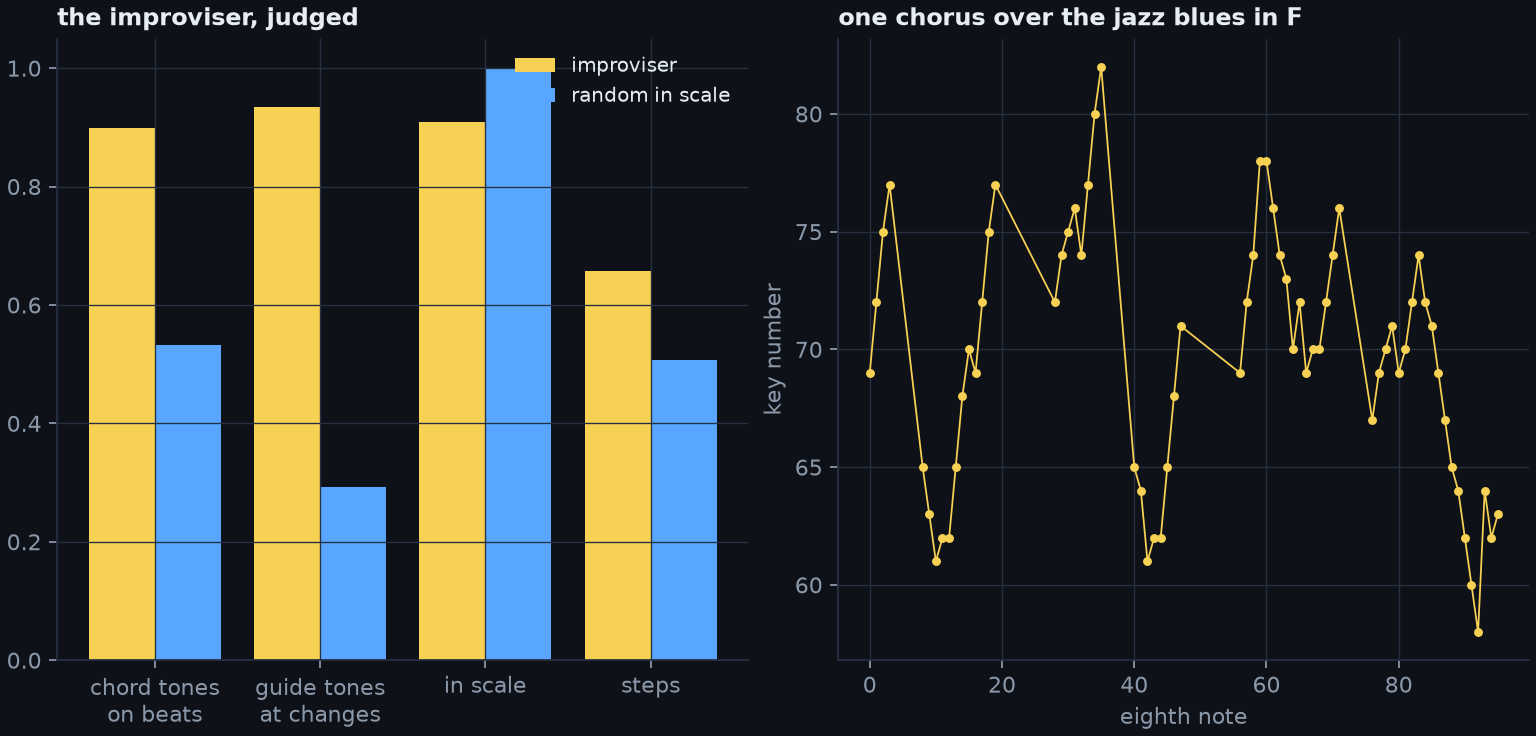
Compare these chosen descriptors over fifty generated choruses each, without treating them as a listener-quality evaluation, by the series' own measures, against two baselines: random notes from each chord's scale, and random notes from all twelve. On the beats, the improviser plays chord tones per cent of the time, against and . At chord changes it brings a guide tone per cent of the time, against and . Its notes are slightly less often in the scale than the first baseline's, because enclosures and the bebop scale's passing tone step outside it on purpose.
What does the program lack? Motifs developed over a chorus, a shape that builds. Rhythm: it plays only eighth notes and rests, where players mix triplets, long notes and displaced accents. And listening: it never responds to the band, and the band never responds to it. Its measures reward safe choices, and great solos break them on purpose. Chapter ten meets machines that do listen.
9Free jazz, and what improvisers doPractice3 min
What is left when the changes go?
1959 again. Ornette Coleman's The Shape of Jazz to Come. No piano and no fixed changes: players negotiate melodic and harmonic direction together rather than following a fixed chord chart. His Free Jazz, from 1961, set two quartets improvising at once for over half an hour. Coleman called his principle harmolodics, giving melody, harmony and rhythm equal weight. It was the third answer to bebop in a single year: more changes, fewer, or none.
Others went further. Cecil Taylor brought clusters and energy to the piano from the late 1950s. Coltrane moved from A Love Supreme, in 1964, to collective improvisations. In Chicago, the Association for the Advancement of Creative Musicians, founded in 1965, organised its own concerts, schools and compositions. Free does not mean random: players listen, answer and build, without a shared chart. So the question becomes: what structure do improvisers carry inside them?
Here is a toy of our own that shows the difference. No chord changes at all: the saxophone plays a short figure, and the piano answers with the same figure a fourth higher and backwards; the saxophone's next figure starts from where the answer ended. Crude as it is, it does the one thing chapter eight's improviser cannot: it responds to the other part’s symbolic note data; this toy does not analyze live audio.
The psychologist and musician Jeff Pressing proposed a model in 1988. An improviser works from a referent, the tune, its changes, a mode or a mood; draws on a knowledge base, the vocabulary of formulas, scales and habits built over years; and in the moment chooses the next event, hears it, and decides whether to continue or change. Our program has a referent and a tiny vocabulary, and chooses by dice; it does not hear itself.
The psychologist Philip Johnson-Laird asked in 2002 how much of improvising can be computed in real time. He argued that chord sequences need memory and planning, but that each new note can be chosen by simple rules. So improvisers learn the changes slowly, and play the notes fast. Our program shares that split: the changes are given, and the notes are chosen locally. Fast thinking needs well-practised material.
And improvising is social. The drummer answers the soloist, the pianist anticipates. Ingrid Monson's Saying Something, of 1996, studied jazz as conversation, from the rhythm section's side. That interplay is where our program is weakest. Part 43 turns to performing together. Chapter ten asks what the brain scanner and the database add.
10Frontier: patterns, machines and the scannerResearch2 min
What can be measured about improvising?
First, pattern mining: finding every repeated melodic figure across hundreds of transcribed solos. Martin Norgaard's analysis of Parker, and the pattern searches made on the Weimar Jazz Database across many players, are examples. Some players repeat far more than others, and figures travel between players and decades. An open question is whether a repeated figure is recalled whole, or rebuilt each time by the same rules. Part 63 builds tools that find music by its content.
Second, machine improvisers. John Biles's GenJam, from 1994, used a genetic algorithm and traded fours with its author on stage. François Pachet's Continuator, from 2003, learned a player's style as they played, and answered. IRCAM's OMax improvises by recombining what it has just heard. The best of them listen, which is exactly what our program leaves out. Part 65 returns to machines that compose.
Third, the scanner. In 2008 Charles Limb and Allen Braun had jazz pianists improvise on a small keyboard inside an MRI scanner. Compared with playing memorised music, they found less activity in areas linked to self-monitoring and more in areas linked to self-expression. In 2014 Gabriel Donnay and colleagues had players trade fours with a partner, and found language areas engaged. Careful, though: few players, unusual conditions, and brain areas do more than one thing. Suggestive, not yet explanatory.
A concrete version. Collect solos with their recordings, transcriptions and the players' own commentary. Model each note as either a recalled pattern or a local choice, and fit the mixture for each player. Test the model's predictions on new solos, and against what players say they were doing. How much of an improvised solo is recalled, and how much invented? An answer would turn Pressing's model into a measured one.
Variation 39, recap and problemsAll tracks2 min
Every part ends by doing something to the Tune with what it built. First as a bebop head: each of its notes held on a strong beat and enclosed, a step above and a semitone below, by the eighths before it, over two-fives of our own. Then the improviser takes a chorus over the same changes, twice through; per cent of its beats land on chord tones. Then the Tune's opening, do, do, sol, sol, is carried through C, A flat and E over Coltrane's third cycle.
Row thirty-nine of the ledger: seconds; the measurement is the program's own chorus, judged by the series' measures.
What did we find? Bebop built new tunes on shared changes. The bebop scale interleaves a chord's four notes with four others, so chord tones fall on every beat, as the proof and the check showed. Lines aim at targets, enclose them, and draw on formulas; chord scales say which notes are safe. Modal jazz slowed the changes and voiced chords in fourths. Coltrane's third cycles join keys that share only three notes, a line up the Tonnetz. And a page-long improviser scores higher than these simple baselines on some descriptors its design targets, while scale adherence is lower than the scale-only baseline, and still does not listen.
Five problems. One to compute, one to prove, one for your ears, one to build, and a research problem, marked with a star. Solutions are in this part's notes. Pause here.
Where does this come back? Next, in the popular song and its riffs. In composing as search. In performing and improvising together. In finding patterns across collections of music. And in machines that compose and improvise.
And in practice. Students learn tunes by their changes, in all twelve keys. Players practise bebop scales and enclosures until they are reflexes. Pianists reharmonise standards chorus by chorus. And software generates practice accompaniments for any set of changes.
The books and papers this part follows. The full list, with notes, is in the README.
Where it goes next. The song and its riffs in Part 40; composing as search in Part 42; performing together in Part 43; pattern search in Part 63; machines that compose and improvise in Part 65.
Key results
The part's results in one place, for revision.
Try it
Lab 39 · Changes, computed
Check the bebop-scale claim for any chord; list chord scales and avoid notes; build Coltrane's cycle in any key; reharmonise a melody; and judge the improviser against random lines, by ear and by number.
python -m videos.music.labs 39
needs numpy, scipy, matplotlib · download lab39.py ·
source on GitHubbebop scale on Bb7 [10, 0, 2, 3, 5, 7, 8, 9]
chord tones on every beat? (bebop / mean share for the plain scale) True / 0.64
Cmaj7: scale, avoid notes [0, 2, 4, 5, 7, 9, 11], [5]
C7: scale, avoid notes [0, 2, 4, 5, 7, 9, 10], [5]
Cm7: scale, avoid notes [0, 2, 3, 5, 7, 9, 10], []
Cm7b5: scale, avoid notes [0, 1, 3, 5, 6, 8, 10], [1]
Coltrane's cycle in F Gm7 Ab7 Dbmaj7 E7 Amaj7 C7 Fmaj7
your melody, diatonic Cmaj7 Fmaj7 Cmaj7 Fmaj7 Cmaj7 Fmaj7 Cmaj7 G7 Cmaj7
your melody, secondary C7 G7 C7 G7 C7 G7 D7 G7 Cmaj7
your melody, tritone F#7 Db7 F#7 Db7 F#7 Db7 Ab7 Db7 Cmaj7
improviser / random: beats on chord tones 0.90 / 0.53
improviser / random: guide tones at changes 0.93 / 0.29
ear problem: improviser or random, in order (listen first) random, improviser, improviser, improviser
The bebop scale lands chord tones on every beat over any dominant or sixth chord; keys a major third apart share three notes; and a page of rules beats random scale notes because it aims at the next chord.The code (77 lines; it asserts its own result)
"""Lab 39: changes, computed: the bebop-scale claim for any chord, chord scales and avoid notes, Coltrane's third
cycle, reharmonisation, and an improviser judged against random lines."""

import numpy as np

from videos.coursekit import labs
from explainer.music.monochord import SR, Clip, concat, mix
from explainer.music.monochord import blues as BL
from explainer.music.monochord import changes as CH
from videos.music.music39 import compute as C

TITLE = "Changes, computed"
GOAL = ("Check the bebop-scale claim for any chord; list chord scales and avoid notes; build Coltrane's cycle in any key; "
        "reharmonise a melody; and judge the improviser against random lines, by ear and by number.")
TASKS = [
    "Change CHORD. Does the bebop scale still land chord tones on every beat? Try a minor seventh: what goes wrong?",
    "Change SEED and CHANGES. How do the improviser's measures move? Which figure would you add first?",
    "Write your own MELODY in C and reharmonise it three ways. Which chords did the program change?",
]
CHORD = "Bb7"
SEED = 0
CHANGES = BL.twelve_bar("F", "jazz")
MELODY = [76, 77, 79, 81, 79, 77, 76, 74, 72]


def run(seed=0):
    rng = np.random.default_rng(seed)
    lab = labs.Lab()
    claim = CH.bebop_claim(CHORD)
    lab.row(f"bebop scale on {CHORD}", str(claim["bebop_scale"]))
    lab.row("chord tones on every beat? (bebop / mean share for the plain scale)", f"{claim['bebop_all']} / {claim['plain_mean']:.2f}")
    for s in ("Cmaj7", "C7", "Cm7", "Cm7b5"):
        cs = CH.chord_scale(s)
        lab.row(f"{s}: scale, avoid notes", f"{cs['scale']}, {cs['avoid']}")
    lab.row("Coltrane's cycle in F", " ".join(CH.coltrane("F")))
    for scheme in ("diatonic", "secondary", "tritone"):
        lab.row(f"your melody, {scheme}", " ".join(CH.reharmonise(MELODY, scheme)))
    imp = [CH.judge(CH.improvise(CHANGES, seed=SEED + k), CHANGES) for k in range(20)]
    rnd = [CH.judge(CH.random_line(CHANGES, seed=SEED + k), CHANGES) for k in range(20)]
    m = lambda js, k: float(np.mean([j[k] for j in js]))
    assert m(imp, "on_beat_chord_tones") > m(rnd, "on_beat_chord_tones"), "the improviser should beat random lines"
    lab.row("improviser / random: beats on chord tones", f"{m(imp, 'on_beat_chord_tones'):.2f} / {m(rnd, 'on_beat_chord_tones'):.2f}")
    lab.row("improviser / random: guide tones at changes", f"{m(imp, 'guide_at_changes'):.2f} / {m(rnd, 'guide_at_changes'):.2f}")

    # ear problem: four lines over the first four bars, improviser or random, in random order
    bpm = 150
    four = CHANGES[:4]
    kinds, clips = [], []
    for k in range(4):
        who = "improviser" if rng.random() < 0.5 else "random"
        line = CH.improvise(four, seed=100 + k) if who == "improviser" else CH.random_line(four, seed=100 + k)
        parts = []
        C.comp(parts, four, bpm)
        C.line_parts(parts, line, bpm, 0.0, "piano", -1.0)
        clips.append(Clip(mix(parts, duration=4 * 4 * 60 / bpm + 1.0).y, SR).at_level(-20.0))
        kinds.append(who)
    lab.audio = concat(clips, gap=1.0)
    lab.row("ear problem: improviser or random, in order (listen first)", ", ".join(kinds))

    fig, (ax1, ax2) = labs.figure(2)
    keys = ["on_beat_chord_tones", "guide_at_changes", "in_scale", "steps"]
    x = np.arange(len(keys))
    ax1.bar(x - 0.2, [m(imp, k) for k in keys], 0.4, color=labs.GOLD, label="improviser")
    ax1.bar(x + 0.2, [m(rnd, k) for k in keys], 0.4, color="C0", label="random in scale")
    ax1.set_xticks(x)
    ax1.set_xticklabels(["chord tones\non beats", "guide tones\nat changes", "in scale", "steps"])
    ax1.legend(frameon=False)
    ax1.set_title("the improviser, judged")
    line = CH.improvise(CHANGES, seed=SEED)
    ax2.plot([e for _, e in line], [p for p, _ in line], ".-", color=labs.GOLD, lw=0.8)
    ax2.set_xlabel("eighth note")
    ax2.set_ylabel("key number")
    ax2.set_title("one chorus over the jazz blues in F")
    lab.fig = fig
    lab.note = ("The bebop scale lands chord tones on every beat over any dominant or sixth chord; keys a major third apart "
                "share three notes; and a page of rules beats random scale notes because it aims at the next chord.")
    return lab
Now change it
- Change CHORD. Does the bebop scale still land chord tones on every beat? Try a minor seventh: what goes wrong?
- Change SEED and CHANGES. How do the improviser's measures move? Which figure would you add first?
- Write your own MELODY in C and reharmonise it three ways. Which chords did the program change?
Problems, with solutions
Try each problem before opening its solution.
-
Compute. For F7, list the bebop scale and check that a run down from E♭ lands chord tones on every beat for two octaves.
Solution
F G A B♭ C D E♭ E. Down from E♭ in eighths: E♭ D C B♭ A G F E | E♭ D C ...; the notes on the beats are E♭, C, A, F, E♭, C, A, F, all chord tones of F7 (F A C E♭). The lab checks any chord.
-
Prove. Prove that two major scales a major third apart share exactly three notes.
Solution
By transposition it is enough to compare C major {0, 2, 4, 5, 7, 9, 11} with E major {4, 6, 8, 9, 11, 1, 3}: the common notes are 4, 9 and 11 (E, A, B), three. (A fifth apart, C and G share all but F and F♯: six.)
-
Ear. The lab plays lines by the improviser and by random choice; say which is which.
Solution
The lab prints the answers. Listen for phrasing (the improviser rests) and for arrival: at each chord change the improviser lands on the third or seventh of the new chord.
-
Build. Give the improviser motifs: repeat and transpose its own figures, and judge the result.
Where to look. In
changes.improvise, keep the last few figures; with some probability, reuse one transposed so that its first note is a chord tone of the current chord. Judge withchanges.judge, and add a measure of repetition (the share of figures that recur, as in pattern mining) to see the trade-off. -
★ How much of an improvised solo is recalled, and how much invented?
Where the frontier is. Collect solos with recordings, transcriptions and the players' commentary; model each note as a recalled pattern or a local choice; fit the mixture per player; test it on new solos and against players' reports.
Notes and sources
Sources
- T. Owens, Charlie Parker: Techniques of Improvisation (dissertation, 1974) and Bebop: The Music and Its Players (1995); P. F. Berliner, Thinking in Jazz (1994); I. Monson, Saying Something (1996).
- M. Levine, The Jazz Theory Book (1995); G. Russell, The Lydian Chromatic Concept of Tonal Organization (1953); N. Slonimsky, Thesaurus of Scales and Melodic Patterns (1947).
- L. Porter, John Coltrane: His Life and Music (1998); A. Kahn, Kind of Blue: The Making of the Miles Davis Masterpiece (2000).
- J. Pressing, "Improvisation: methods and models", in J. Sloboda (ed.), Generative Processes in Music (1988); P. N. Johnson-Laird, "How jazz musicians improvise", Music Perception (2002); M. Norgaard, "How jazz musicians improvise: the central role of auditory and motor patterns", Music Perception (2014).
- C. J. Limb and A. R. Braun, "Neural substrates of spontaneous musical performance: an fMRI study of jazz improvisation", PLoS ONE (2008); G. F. Donnay and others, "Neural substrates of interactive musical improvisation: an fMRI study of 'trading fours' in jazz", PLoS ONE (2014).
- J. A. Biles, "GenJam: a genetic algorithm for generating jazz solos" (1994); F. Pachet, "The Continuator: musical interaction with style", Journal of New Music Research (2003).
- Part 18 for progressions; Part 31 for the Tonnetz; Part 38 for swing, guide tones and the tritone substitution.
About this partfrom its README
Part 39 of a sixty-eight-part course in music (see the series plan and
the syllabus), the sixth part of Act VI. 5 May 1959: John Coltrane records Giant Steps, twenty-six
chords in sixteen bars, moving through three keys a major third apart at nearly 290 beats a minute. This part explains
why those changes are hard, draws them on Part 31's Tonnetz, and builds an improviser. On the way: bebop and the
contrafact, the bebop scale (with a proof), targets, enclosures and formulas, chord scales and avoid notes, modal jazz and
quartal voicings, reharmonisation, free jazz, and what improvisers are doing. The tools are Monochord's
(explainer/music/monochord/changes.py, with Part 38's blues.py). Well-known tunes appear only as their chord
progressions, as lead sheets give them; no melody of theirs is played. Every line heard is ours or the program's.
Published findings are the ones listed under Sources.
- Twenty-six chords in sixteen bars. An ear question (Giant Steps' changes, comped: how many keys?); the same changes at 286 beats a minute with the improviser; 5 May 1959; the plan.
- 1. Bebop and the contrafact. Minton's and the founders; contrafacts and rhythm changes; the A section of rhythm changes with a head and a chorus by the program, heard; the players; a shared language.
- 2. The bebop scale. The problem; sixteen eighths down over C7 (mixolydian: 5 of 8 beats on chord tones; bebop scale: 8 of 8); both heard; why it works (chord tones at every other position of an eight-note cycle), checked for every chord tone and direction (the plain mode averages 64%); a general trick; teaching it.
- 3. Enclosures and formulas. Targets and guide tones; three ways to reach E; the three heard; Owens's and Norgaard's formulas; one figure of ours in C, F and B♭, heard; vocabulary.
- 4. Chord scales. The idea; five chords on C with their scales and avoid notes; the five heard; an ear question (which held note clashes over Cmaj7?); Russell and Berklee; a critique.
- 5. Modal jazz and quartal voicings. Kind of Blue; So What's 32 bars and two chords; a voicing in fourths; a modal vamp of ours with the improviser, heard; after Kind of Blue.
- 6. Third cycles. The tonics on the pitch-class circle (an augmented triad of keys); the tonic triads in a line on the Tonnetz; keys a fifth apart share six notes, a major third apart three; Coltrane's substitute for ii–V–I; both heard with the improviser; a cycle with a history.
- 7. Reharmonisation. The rule; a phrase of ours harmonised diatonically, with secondary dominants and with tritone substitutes; the three heard; the art of it.
- 8. An improviser. A phrase grammar in five steps; an ear question (improviser or random line?); judged over fifty choruses (chord tones on 90% of beats against 57% and 34%; guide tones at 91% of changes against 28% and 13%); what it lacks.
- 9. Free jazz, and what improvisers do. Ornette Coleman; after 1959; a toy free duo that answers, heard; Pressing's model; Johnson-Laird on real time; a conversation.
- 10. Frontier: patterns, machines and the scanner. Pattern mining; machine improvisers; improvising in the scanner; ★ research problem: how much of a solo is recalled, and how much invented?
- Variation 39, recap and problems. The Tune as a bebop head (each note enclosed), a chorus by the program over its changes (86% of beats on chord tones, guide tones at 96% of changes), then its opening carried through C, A♭ and E over Coltrane's cycle; the ledger; what we found; five problems; where it comes back; in practice; references; Part 40.
What is computed and built
python -m videos.music.music39.compute (under a minute) fills .cache/music39/.
| Item | What it computes | Checked against |
|---|---|---|
hook, fast |
Giant Steps' changes comped; the improviser over them at 286 | 26 chords, three tonics (tests) |
contrafact, formula |
rhythm changes with the program's lines; a figure in three keys | — |
bebop |
the bebop-scale claim, every chord tone and direction | exhaustive check (tests) |
scales, avoid |
five chord scales and their avoid notes | the semitone rule (tests) |
modal, thirds |
a modal vamp; Coltrane's substitute; key centres | shared notes, all twelve keys (tests) |
reharm |
three harmonisations of a phrase | the melody stays a chord tone or tension (tests) |
improv, echo |
the improviser against random lines; a toy duo that answers | the baselines (tests) |
tune, variation |
Variation 39 | — |
Monochord's tools are held in tests/music/test_changes.py; this part's claims and clips in
tests/music/test_music39.py.
Sounds. Part 38's instruments: Part 7's piano; the retuned plucked string for bass; a modal ride cymbal and a noise
hi-hat; additive horns (labelled synthesized). There are no recordings.
What the models are, and are not. The improviser chooses each half-bar's figure by dice, aims at guide tones, and never listens; its measures reward safe choices. The baselines are deliberately simple. The reharmoniser follows one rule per scheme. The voicings are guide tones and one quartal shape. The free duo is a toy, not a model of free jazz.
Notes
Contrafacts and shared changes do not establish a blanket rights exemption. The 1942–44 recording ban limited studio documentation; earlier live recordings survive. An even-length scale can alternate chord tones only when its pitch ordering actually interleaves them, as in the chosen examples. Avoid-note labels are a voicing heuristic, not universal perceptual laws. Quartal spacing can still contain thirds and express a clear mode. Fifty generated choruses compare designed descriptors against simple baselines, not listener quality; scale-only output has higher scale adherence. The response toy exchanges symbolic notes rather than listening to audio.
Companion material in this repository
The syllabus's plan for this partfrom SYLLABUS.md, the plan of record
- Hook: an ear question (how many keys?); the changes at the original tempo with the improviser; 5 May 1959; the plan.
- Bebop and the contrafact: the founders; contrafacts and rhythm changes; rhythm changes with the program's lines heard; the players; a shared language.
- The bebop scale: the problem; sixteen eighths over C7 both ways; both heard; the proof and the check; a general trick; teaching it.
- Enclosures and formulas: targets; three approaches drawn and heard; Owens and Norgaard; a figure in three keys heard; vocabulary.
- Chord scales: the idea; five chords with scales and avoid notes; the five heard; an ear question (which held note clashes?); Russell and Berklee; a critique.
- Modal jazz and quartal voicings: Kind of Blue; So What's form; a voicing in fourths; a modal vamp heard; after Kind of Blue.
- Third cycles: the tonics on the circle; the tonic triads on the Tonnetz; shared notes; Coltrane's substitute; both heard; a cycle with a history.
- Reharmonisation: the rule; a phrase three ways; the three heard; the art of it.
- An improviser: a phrase grammar; an ear question (improviser or random?); judged over fifty choruses; what it lacks.
- Free jazz, and what improvisers do: Ornette Coleman; after 1959; a toy duo that answers heard; Pressing; Johnson-Laird; conversation.
- Frontier: pattern mining; machine improvisers; the scanner; the research problem.
- Variation 39: the Tune as a bebop head, an improvised chorus, its opening through three keys a third apart. Outro: problems, payoffs.
Covers: bebop and the contrafact; the bebop scale and why it lands chord tones on the beat; enclosures and
formulas; chord-scale theory; modal jazz; third-related cycles; reharmonization; quartal voicings; free jazz;
what improvisers are doing, cognitively.
Built and computed: monochord/changes.py: the bebop-scale claim proved and checked for every dominant and sixth
chord (8 of 8 beats on chord tones; the plain mode 64% on average); chord scales and avoid notes; key centres
(Giant Steps' B, G, E♭) and shared notes (a fifth apart 6 of 7, a major third apart 3); Coltrane's substitute;
three reharmonisation schemes; an improviser (a phrase grammar constrained by chord scales and guide tones), judged
by the series' own measures against random lines (chord tones on 90% of beats against 57% and 34%).
Variation 39: the Tune as a bebop head with an improvised chorus (86% of beats on chord tones), then its opening
carried through C, A♭ and E over third-cycle changes.
Frontier: pattern mining in solo corpora; machine improvisers; improvisation in the scanner.
Rights: well-known tunes by their chord progressions only (§2.4); every line is ours or the program's.
Reading: Owens, Bebop; Berliner, Thinking in Jazz; Levine; the Weimar Jazz Database papers.
Build the film
python -m videos.music.music39.compute        # the part's numbers, into .cache/music39
python tools/build.py music39                  # render and assemble the film
EXPLAINER_TTS=silent python tools/qa_scene.py music39 Hook   # one chapter, silent, with a contact sheet
Scenes: videos/music/music39. Setup: see the course page. Source of these notes: the README and the scenes' narration.
Build it
python -m videos.music.music39.compute                          # numbers and sounds (under a minute)
EXPLAINER_TTS=silent python tools/build.py music39 -q l --fps 15   # a silent-narration preview, with the sounds
python tools/qa_sound.py music39 --sync                         # the sound gates
python tools/dead_air.py renders/music39_480p.mp4 --sound music39  # no empty screen; no sound over a still one
python tools/lecture_length.py music39                          # 30 to 60 minutes, listening included
python tools/build.py music39                                   # 1080p30, narrated
python -m pytest -q tests/music                                 # Monochord against its references; this part's claims and clips
python -m videos.music.labs 39                                  # the lab (writes a figure and a short WAV)