Bonds and Bargains
Why do people cooperate with strangers, and can a relationship be predicted?
Offer someone one coin out of ten, take it or both get nothing: a selfish responder accepts, yet proposers offer about 40% and low offers are rejected at a cost. The part follows cooperation from five economic games to its four routes (kin, reciprocity, reputation, punishment), a tournament of strategies, public goods that decay without punishment and hold up with it (unless cooperators are punished too), inequity aversion as a utility function, and the same game in fifteen small societies, where offers ran from 26% to 58%. Then the closest bargains: proximity and mere exposure, stated preferences that do not predict desire, machine learning that cannot predict the chemistry of a pair, 11,196 couples whose own perceptions predict their satisfaction, a divorce model that is 90% accurate only on the couples it was fitted to, mate preferences in 45 countries, and the link between relationships and survival.
What you need. Part 17's reinforcement learning, Part 26's utility, and the game theory of Philosophy, Built Part 34. Expected value, logistic and least-squares fitting, cross-validation and odds ratios.
- Hook
- the ultimatum
- Ideas, models and mathematics
- attraction and what predicts it, attachment in adults, relationship science and its limits, cooperation, reciprocity and punishment, trust, loneliness and health
- Psyche gains
- players of repeated games
- On you
- the ultimatum and public goods games
What you will be able to do
Psych 101 and the major
- Describe the dictator, ultimatum, trust, prisoner's dilemma and public-goods games, what selfish play predicts and what people do.
- Explain kin selection, reciprocity, reputation and punishment, and what Fehr and Gachter and the fifteen-society study found.
- Describe the findings on proximity, mere exposure, stated preferences and relationship prediction, and the association between social ties and survival.
Graduate
- Derive an inequity-averse responder's threshold and a proposer's best offer against a population of responders.
- Simulate a public-goods game with and without punishment, and a tournament of repeated prisoner's dilemma strategies.
- Show why in-sample accuracy overstates prediction, and estimate accuracy by cross-validation.
Research
- Separate actor, partner and relationship variance in dyadic data, and say what each can and cannot predict.
- Evaluate causal claims about social connection and health from observational data.
Practice
- Design a reputation system, a team incentive or a dating product's claim with the evidence in view.
Contents
Each chapter has a home level. Choose a track to see what to read and watch: Psych 101 and the major 20 min · Graduate 24 min · Research 25 min · Practice 22 min.
- 01982: take it or leave itPsych 101 and the major2 min
- 1On you: an offer, and four numbersPsych 101 and the major1 min
- 2Games as experimentsPsych 101 and the major2 min
- 3Why cooperate?Psych 101 and the major2 min
- 4Public goods and punishmentPsych 101 and the major1 min
- 5Social preferencesGraduate2 min
- 6Fifteen societiesPsych 101 and the major1 min
- 7AttractionPsych 101 and the major2 min
- 8What people say they wantPsych 101 and the major2 min
- 9Predicting relationshipsPsych 101 and the major2 min
- 10Mate preferences across culturesPsych 101 and the major1 min
- 11Loneliness and healthPsych 101 and the major1 min
- 12The LedgerPsych 101 and the major
- 13In practice: markets, teams and dating appsPractice1 min
- 14Frontier: chemistry and machinesResearch1 min
- Recap, problems, and the road aheadAll tracks3 min
Also on this page: Lecture · Key results · Try it · Lab · Problems · Notes and sources · Build the film.
Lecture
The text of each chapter is the film's narration, as it is spoken, so you can read along or revise without the film. The pictures are in the film. A dashed box stands for a number the film computes when it is rendered (hover over it to see what is computed); the README's figures for each chapter, where it lists them, follow the chapter's text.
1982: take it or leave itPsych 101 and the major2 min
Here is a game you can play with ten coins. One person proposes how to split them. The other either accepts, and both are paid, or rejects, and both get nothing. A responder who cares only about money should accept any offer above zero, because something beats nothing. A proposer who knows that should offer as little as possible. So the textbook prediction is: offer one coin, and it's accepted.
That isn't what happens. In 1982 Werner Güth and colleagues ran the first ultimatum experiments. Proposers offered on average about thirty-seven percent of the sum. In 2004 a meta-analysis of thirty-seven papers found an average offer of forty percent. And low offers are often rejected. People pay, out of their own pocket, to refuse a split they see as unfair. Proposers seem to know it, and offer far more than the textbook minimum.
So this part asks why people cooperate with strangers. It sets out the games economists use as experiments, and what rational play predicts in each. It asks why cooperation evolves, why it decays, and what punishment does. It takes the same games to fifteen small societies. And it turns to the closest bargains of all: attraction, relationships, and how little can be predicted about a particular couple.
This is Part 37 of Psychology, Built: bonds and bargains, the fourth part of Act Nine. We'll set out five games as experiments, and the gap between rational and real play. We'll meet kin, reciprocity, reputation and punishment, and run a tournament of strategies. We'll write inequity aversion as a utility function, and take the games to fifteen societies. We'll look at attraction, and at what people say they want. We'll try to predict relationships, and see why in-sample accuracy misleads. And we'll end with mate preferences across cultures, and loneliness and health.
What it does: The ultimatum game; what people do; the question; objectives
1On you: an offer, and four numbersPsych 101 and the major1 min
First, play the responder. A stranger you'll never meet has ten coins, keeps eight, and offers you two. If you accept, you get two and they get eight. If you reject, neither of you gets anything. Decide now: accept or reject? Many people reject an offer like this, and they're not confused about the arithmetic.
Now four numbers to write down before the part answers them. One: the same game was played in fifteen small-scale societies. What was the lowest average offer? Two: after a round of speed dating, how much of one person's desire for a particular partner could machine learning predict, from over a hundred measured traits? Three: across a hundred and forty-eight studies, how much higher were the odds of survival for people with stronger social relationships? And four: a divorce model is ninety percent accurate on the couples it was fitted to. How accurate is it on new couples? Pause here, and write them down.
What it does: An offer of two out of ten; four predictions
2Games as experimentsPsych 101 and the major2 min
Economists turned simple games into experiments, with real money. In the dictator game, one person divides a sum and the other has no say. A selfish player gives nothing. Many give something. In the ultimatum game the responder can reject, and offers sit near forty percent. In the trust game, an investor sends money that is multiplied, and the trustee may send some back. Selfish players send nothing; many people send, and many repay. In the prisoner's dilemma, defecting pays more whatever the other does, yet many people cooperate, at least at first. And in the public-goods game, everyone puts some money into a pot that is multiplied and shared. People start by contributing about half, and then it declines. The theory of these games is in Philosophy, Built, Part 34.
The prisoner's dilemma is the cleanest of them. Here are the points per move. If both cooperate, three each. If both defect, one each. Whatever the other player does, defecting pays more: five instead of three, or one instead of nothing. So two rational players defect and get one each, when both could have had three. Played once with a stranger, the logic is airtight. Played again and again with the same person, it isn't.
What it does: Five games; the prisoner's dilemma
3Why cooperate?Psych 101 and the major2 min
If defecting pays, why does anyone cooperate? Biology and economics found four routes. Kin: helping relatives, who share your genes. William Hamilton's rule, from 1964, says help when the benefit times your relatedness exceeds the cost. A sibling counts half, a cousin an eighth. Reciprocity: help those who'll help you back, which works when you'll meet again; Robert Trivers called it reciprocal altruism, in 1971. Reputation: help, be seen helping, and be helped by others, which works when people are watching. And punishment: make cheating costly, even at a cost to yourself, which works when someone is willing to pay to punish.
Reciprocity can be studied as a contest. In 1980 Robert Axelrod invited scientists to submit strategies for a repeated prisoner's dilemma, and had them play each other for two hundred moves. The simplest, Tit for Tat, submitted by Anatol Rapoport, scored the most: cooperate first, then copy what the other did last. It won a second tournament too. Here's Psyche's own round-robin of seven strategies. With exact moves, scores most. When five percent of moves are flipped by mistake, does best. The strategies that do well are nice, retaliate and forgive. Which one wins depends on who else is in the tournament, and on noise.
What it does: Four routes to cooperation; a tournament of strategies
4Public goods and punishmentPsych 101 and the major1 min
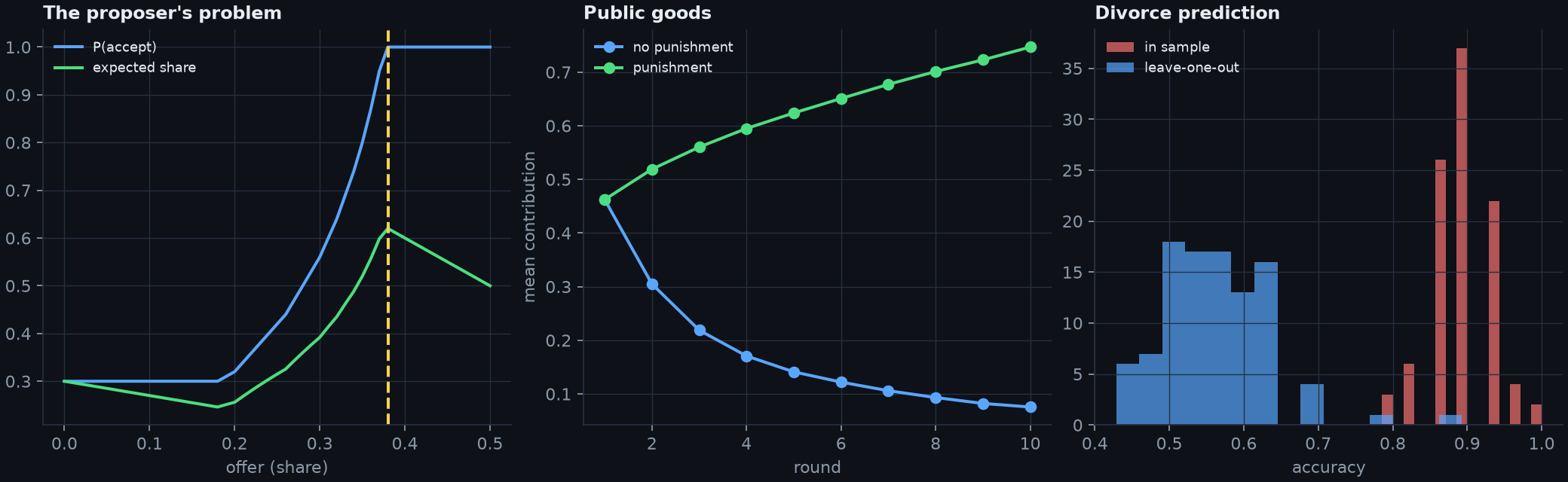
Public goods show cooperation decaying, round by round. In Psyche's version, two hundred groups of four play ten rounds. Most players are conditional cooperators: they give a little less than the others gave last round. A quarter are free riders. Contributions fall from to . Each disappointment teaches the cooperators to give less. In 2002 Ernst Fehr and Simon Gächter gave players the chance to punish others, at a cost to themselves and with no gain. People punished free riders, and cooperation flourished. Without punishment, it broke down. In Psyche, punished free riders move toward the group's average, and contributions rise to .
But punishment isn't always aimed at cheats. In 2008 Herrmann, Thöni and Gächter ran the same game in sixteen participant pools around the world. In some, people also punished those who contributed more than they did. It's called antisocial punishment. Where it was common, it removed punishment's benefit to cooperation. It was predicted by weak norms of civic cooperation and a weak rule of law. Punishment helps where it's trusted to target cheats.
What it does: Ten rounds of a public good; punishing the cooperators
5Social preferencesGraduate2 min
Can fairness be written as a utility function? In 1999 Ernst Fehr and Klaus Schmidt proposed that people care about their own payoff and dislike inequality. Alpha is how much a person minds earning less than the other. Beta is how much they mind earning more. A responder offered a share s of a pie of one accepts when s, minus alpha times the shortfall, one minus two s, is at least zero. That's when s is at least alpha over one plus two alpha. With alpha equal to one, any offer below a third is rejected, out of pure arithmetic.
Now the proposer's problem. Psyche's population of responders: thirty percent care only about money, and the rest have alphas between point three and one and a half. The chance an offer is accepted rises with the offer. A proposer who wants only money maximizes what they keep times the chance of acceptance. The best offer is . A perfectly selfish proposer, facing fair-minded responders, offers about what real proposers offer. Generous offers needn't mean generous proposers.
The model explains a lot, and strains in places. Inequity aversion accounts for rejections, and for much of the generosity in ultimatum and public-goods games. But when Dana, Cain and Dawes let dictators take a little less and leave quietly, with the other person never told a game had been played, about a third did. Part of fairness is wanting to look fair. And intentions matter: the same unequal split is rejected less when a computer chose it than when a person did. A utility function summarizes choices. It isn't a mechanism, and reputation, intention and norms all feed into it.
What it does: Inequity aversion; the proposer's problem; where the model strains
6Fifteen societiesPsych 101 and the major1 min
Almost all of these experiments were run with university students. In 2001 Joseph Henrich and colleagues took the ultimatum game to fifteen small-scale societies: foragers, horticulturalists, herders and farmers. Average offers ranged from twenty-six percent, among the Machiguenga of Peru, to fifty-eight percent. In industrial societies they're typically near forty-four. No society matched the selfish prediction. What predicted a group's offers was its economy: how much people cooperated in making a living, and how integrated they were with markets. Individual traits didn't. Fairness norms vary with the institutions people live in. Part 38 asks which other findings were really findings about one kind of society.
What it does: The same game, far from campus
7AttractionPsych 101 and the major2 min
Now the closest bargains: who comes to like whom. In 1950 Festinger, Stanley Schachter and Kurt Back mapped friendships among married students in a new housing project at MIT. Friends were overwhelmingly near neighbours. Physical distance, and functional distance, like living by the stairs or the mailboxes, predicted who befriended whom. Proximity works through chance encounters, and through familiarity.
Familiarity on its own makes a difference. In 1968 Zajonc showed that repeated exposure to a stimulus, even a meaningless one, increases liking for it. In 1989 Bornstein pooled two hundred and eight experiments and found a reliable effect, a correlation of about point two six. In 2017 Montoya and colleagues fitted two hundred and sixty-eight curves from eighty-one articles. Liking rises, and with many exposures falls again: an inverted U. Familiarity breeds liking, up to a point.
Three more classic regularities. Similarity: people like those who share their attitudes and backgrounds. Reciprocity: people like those who like them. And matching: couples tend to resemble each other in attractiveness, education and much else. But why? Here's Psyche's marriage market, two hundred people on each side, paired off so that no two people would rather leave their partners for each other. On the left, everyone wants the most attractive partner they can get, with a little private taste. Couples end up matched, with a correlation of . On the right, everyone wants someone like themselves. The correlation is about the same. Kalick and Hamilton made this point with a simulation in 1986. It's a lesson from Part 34's networks. A pattern in who ends up together doesn't show what each person wanted.
What it does: Who lives nearby; mere exposure; similarity, reciprocity, matching
8What people say they wantPsych 101 and the major2 min
What do people say they want, and does it predict whom they want? Asked about an ideal partner, men rate physical attractiveness higher than women do, and women rate earning prospects higher than men do. In 2008 Paul Eastwick and Eli Finkel ran speed-dating events and followed up. After real dates, attractiveness and earning prospects predicted romantic interest about equally for men and women. The familiar sex differences in stated preferences didn't show up in whom people actually desired. It's Part 35's lesson about introspection, in romance. People's theories about what attracts them aren't a reliable account of what does.
Desire has three parts. How much you desire people in general, how desired a person is by everyone, and what's unique to a particular pair. In 2017 Samantha Joel, Eastwick and Finkel fed more than a hundred self-reported traits and preferences per person, from two speed-dating studies, to machine learning. The models predicted four to eighteen percent of how much a person desired partners in general, and seven to twenty-seven percent of how desired a person was. But the part unique to the pair, this person's desire for that person, they couldn't predict at all. Compatibility, if it exists, isn't visible in questionnaires filled in before two people meet.
What it does: The ideal partner and the real one; three sources of desire
9Predicting relationshipsPsych 101 and the major2 min
What about couples who are already together? In 2020 Joel and dozens of colleagues pooled forty-three longitudinal datasets from twenty-nine laboratories: eleven thousand one hundred and ninety-six couples, analysed with machine learning. A person's own perceptions of the relationship explained up to forty-five percent of its quality: whether they felt the partner was committed, appreciated them, and was satisfied, their sexual satisfaction, and conflict. Their own traits explained up to twenty-one percent, and the partner's reports added nothing beyond the person's own perceptions. And changes in quality over time were largely unpredictable from anything measured.
Then there are the famous claims of predicting divorce with ninety percent accuracy. Here's how such a number can arise. Psyche has fifty-six couples and thirty measured variables, only one of them weakly related to divorce, and fits a classifier, two hundred times over. Scored on the same couples, it's right about of the time. Scored on couples it hasn't seen, : worse than always guessing the commoner outcome. In 2001 Heyman and Slep made this argument about the celebrated divorce-prediction figures. They were fits to the couples studied. Without cross-validation, accuracy is only an upper bound, and here a misleading one.
Two frameworks describe the bonds themselves. In 1987 Cindy Hazan and Phillip Shaver ran a love quiz in a newspaper, asking adults which of three descriptions fitted their romantic relationships. About fifty-six percent chose the secure one, the rest avoidant or anxious. These were the categories of Part 30's infants, applied to adult love. Caryl Rusbult's investment model says commitment rises with satisfaction and with what has been invested, and falls with the quality of the alternatives. People stay in unsatisfying relationships when the alternatives look worse. Both describe how people feel about relationships. Neither forecasts which particular relationship will last.
What it does: Eleven thousand couples; ninety percent, in sample; attachment and commitment
10Mate preferences across culturesPsych 101 and the major1 min
Stated preferences have also been surveyed across the world. In 1989 David Buss asked ten thousand and forty-seven people in thirty-seven cultures what they want in a long-term partner. In most, men gave more weight to physical attractiveness and youth, and women to earning prospects. In 2020 Walter and colleagues asked fourteen thousand three hundred and ninety-nine people in forty-five countries, and found the same differences again. It's a stated preference, replicated across the world. And chapter eight showed how weakly stated preferences predict whom people desire after they meet.
Why? There are two readings. The evolutionary reading: the sexes faced different reproductive problems and evolved different preferences, so the differences should appear everywhere. The social-role reading: the differences follow the division of labour, and should shrink where men's and women's roles are more alike. In the forty-five-country data, neither gender equality nor how common disease was robustly predicted the size of the differences, apart from the preferred age gap. Correlations across forty-five countries can't settle a question about evolution, or about roles.
What it does: Thirty-seven cultures, then forty-five countries; two readings
11Loneliness and healthPsych 101 and the major1 min
The last question in this part is about health. In 2010 Julianne Holt-Lunstad and colleagues pooled a hundred and forty-eight studies of three hundred thousand people. Those with stronger social relationships had one and a half times the odds of surviving the follow-up, and nearly twice the odds for the most complete measures of social integration. In 2015 they reported that social isolation raised the odds of death by twenty-nine percent, and loneliness by twenty-six. These are associations of a size comparable to familiar health risks.
But association isn't cause. The studies are observational. Ties may protect health. Or poor health may cut people off, which is reverse causation. Or illness, poverty and depression may do both, which is confounding. The association held across people's health at the start, but observation can't rule out every alternative, and randomized tests of social connection on mortality don't exist. The frontier asks what could stand in for them.
What it does: 148 studies; association, or cause?
12The LedgerPsych 101 and the major
The tally. What holds: fair offers and costly rejections, punishment sustaining cooperation, mere exposure, stated mate preferences, and the link between relationships and survival. What failed: stated preferences as a guide to whom people desire. What's argued: predicting divorce. The games replicate as behaviour, across thousands of players. Predictions about particular people, and particular pairs, do not.
What it does: Seven rows and the tally
13In practice: markets, teams and dating appsPractice1 min
The games are tools for design. Marketplaces between strangers run on ratings. That's reputation, chapter three's third route, made visible. Cooperation is easier when people expect to meet again, which favours long relationships with suppliers, and stable teams. Sanctions sustain contributions only if they're trusted to hit free riders, not whoever is unpopular. And offers people see as unfair get refused, even at a cost. In pay, pricing and negotiation, perceived fairness is part of the deal.
And then there are the dating products. Many claim to find compatible partners from questionnaires. But chapter eight showed that questionnaires predict how choosy a person is, and how desired, not the chemistry of a particular pair. What such a service can do is put people in front of others likely to be interested at all, and let them meet. That's proximity and exposure, chapter seven. And couple therapy, like any treatment, should be judged by randomized trials, not by how well a theory fits the couples it was built on.
What it does: Designing for cooperation; what a matching algorithm can know
14Frontier: chemistry and machinesResearch1 min
The newest players in these games aren't people. People now bargain, trade and cooperate with software agents, and the agents with each other. The same games become tests for machines. Do language-model agents offer fair splits, punish, or collude? And for people: do they reject unfair offers from a machine as they do from a person? Chapter five's computer-chosen offers suggest they reject them less. The questions are empirical, and the methods are the ones in this part: games with real stakes, and predictions tested on new cases.
So, open questions. Is there compatibility specific to a pair, and could anything measured before two people meet detect it? How much of fairness in games is a preference, and how much a wish to look fair? Why does punishment sometimes target cooperators, and what institutions prevent it? Does social connection cause longer life, and which interventions could test it? And how will cooperation change when many of the players are machines?
What it does: New players; open questions
Recap, problems, and the road aheadAll tracks3 min
First, your four numbers. The lowest average offer in fifteen societies: twenty-six percent. Desire for a particular partner, predicted from over a hundred traits: none of it. The odds of survival with stronger relationships: one and a half times. And a divorce model's accuracy on new couples, in Psyche: , worse than guessing. Bargains are predictable in the aggregate. Particular bonds are not.
Part thirty-seven in eleven lines. Proposers offer about forty percent, and low offers are rejected at a cost. Across five games, people are neither selfish nor saints. Kin, reciprocity, reputation and punishment make cooperation pay. Which strategy wins a tournament depends on the field, and on noise. Public goods decay, and punishment holds them up, unless it targets cooperators. Inequity aversion turns fairness into a utility function. Offers ranged from twenty-six to fifty-eight percent across fifteen societies. Proximity and exposure make liking. Stated preferences don't predict desire in person, and the chemistry of a pair goes unpredicted. In-sample accuracy isn't prediction, so cross-validate. And relationships and survival are linked, while the cause is still open.
Kant's wager. The first objection, that mathematics can't apply to the mind, met utility functions for fairness, a tournament, Hamilton's rule and cross-validation. The second, that the mind can't be experimented on, met games with real money, played on every continent. And the third, about introspection: people's accounts of what they want in a partner don't predict whom they want. Amber.
Where this comes back. Culture, morals and which findings travel are next, in Part 38. The evidence for therapies, couple therapy included, is in Part 42. Incentives and teams at work are Part 53, and games played with machines Part 60.
Seven problems, with full solutions in this part's README. One derives the responder's threshold. One finds the proposer's best offer. One proves defection dominant, and finds when Grim Trigger holds. One applies Hamilton's rule. One shows why a model can fit any couples exactly. One converts an odds ratio. And the last, with the star, asks you to design a study that could find compatibility specific to a pair. Pause here if you'd like to try them.
The books and papers behind this part are listed here and in the README. Camerer's Behavioral Game Theory is the field's handbook; Axelrod's book is the tournament and what he made of it; and Finkel and colleagues' review of online dating weighs the matching algorithms against the evidence.
Act Nine has one part left. This part found that fairness itself varies with the society people live in. The next asks how far that goes: how much of psychology is the psychology of one kind of society, and where morals come from. Part 38: culture and morals.
Where it goes next. Culture and morals are Part 38; therapy's evidence Part 42; teams and incentives at work Part 53; games with machines Part 60.
Key results
The part's results in one place, for revision.
Try it
Lab 37 · Bonds and Bargains
Compute an inequity-averse responder's threshold and a proposer's best offer; run a round-robin of repeated prisoner's dilemma strategies with and without noise; simulate a public-goods game with and without punishment; and fit a divorce classifier to a small sample and score it on the couples it was fitted to and on couples it has not seen.
python -m videos.psychology.labs 37
needs numpy, scipy, matplotlib · download lab37.py ·
source on GitHubresponder with alpha 0.0: smallest share accepted 0.000
responder with alpha 0.5: smallest share accepted 0.250
responder with alpha 1.0: smallest share accepted 0.333
responder with alpha 2.0: smallest share accepted 0.400
proposer facing Psyche's responders: best offer and expected share 0.38; 0.62
tournament, noise 0.0: top three grim trigger 2.67, tit for tat 2.61, win-stay lose-shift 2.60
tournament, noise 0.05: top three win-stay lose-shift 2.24, tit for two tats 2.24, random 2.17
public goods: contribution in rounds 1 and 10, without and with punishment 0.46 -> 0.08; 0.46 -> 0.75
Hamilton's rule, full sibling: B/C needed > 2
Hamilton's rule, first cousin: B/C needed > 8
divorce classifier, 56 couples, 30 variables: in-sample; leave-one-out; base rate 0.89; 0.56; 0.66
A selfish proposer facing inequity-averse responders offers about what real proposers do; which strategy wins a tournament depends on the field and on noise; punishment holds up contributions that otherwise decay; and a model fitted to as many variables as there are couples looks accurate only on those couples.The code (79 lines; it asserts its own result)
"""Lab 37: inequity aversion and the ultimatum game, a tournament of repeated prisoner's dilemma strategies, public
goods with and without punishment, Hamilton's rule, and a divorce classifier scored in and out of sample."""

import numpy as np

from videos.coursekit import labs
from explainer.psychology.psyche import social as S

TITLE = "Bonds and Bargains"
GOAL = ("Compute an inequity-averse responder's threshold and a proposer's best offer; run a round-robin of repeated "
        "prisoner's dilemma strategies with and without noise; simulate a public-goods game with and without "
        "punishment; and fit a divorce classifier to a small sample and score it on the couples it was fitted to and "
        "on couples it has not seen.")
TASKS = [
    "Make every responder selfish (alpha = 0 for all). What is the proposer's best offer now, and why does that make "
    "the real offers informative?",
    "Raise the tournament's noise to 10%. Which strategies gain and which lose, and why do forgiving strategies "
    "benefit from noise?",
    "Grow the divorce sample from 56 couples to 500, with the same 30 variables. How do in-sample and leave-one-out "
    "accuracy change, and why?",
]


def run(seed=0):
    out = labs.Lab()

    for a in (0.0, 0.5, 1.0, 2.0):
        out.row(f"responder with alpha {a}: smallest share accepted", f"{float(S.fs_threshold(a)):.3f}")
    alphas = np.r_[np.zeros(30), np.linspace(0.3, 1.5, 70)]
    u = S.ultimatum(alphas)
    out.row("proposer facing Psyche's responders: best offer and expected share",
            f"{u['best']:.2f}; {u['payoff'].max():.2f}")
    assert 0.3 <= u["best"] <= 0.45

    for nz in (0.0, 0.05):
        r = S.ipd_tournament(noise=nz, seed=seed + 37)
        order = np.argsort(-r["score"])
        out.row(f"tournament, noise {nz}: top three", ", ".join(f"{r['strategies'][k]} {r['score'][k]:.2f}"
                                                                for k in order[:3]))

    plain = S.public_goods(seed=seed + 37)
    punish = S.public_goods(punishment=True, seed=seed + 37)
    out.row("public goods: contribution in rounds 1 and 10, without and with punishment",
            f"{plain[0]:.2f} -> {plain[-1]:.2f}; {punish[0]:.2f} -> {punish[-1]:.2f}")
    assert punish[-1] > plain[0] > plain[-1]

    for rel, name in ((0.5, "full sibling"), (0.125, "first cousin")):
        out.row(f"Hamilton's rule, {name}: B/C needed", f"> {1 / rel:.0f}")

    rs = [S.overfit_divorce(seed=seed + s) for s in range(100)]
    out.row("divorce classifier, 56 couples, 30 variables: in-sample; leave-one-out; base rate",
            f"{np.mean([x['insample'] for x in rs]):.2f}; {np.mean([x['loo'] for x in rs]):.2f}; "
            f"{np.mean([x['base'] for x in rs]):.2f}")

    out.note = ("A selfish proposer facing inequity-averse responders offers about what real proposers do; which "
                "strategy wins a tournament depends on the field and on noise; punishment holds up contributions that "
                "otherwise decay; and a model fitted to as many variables as there are couples looks accurate only "
                "on those couples.")

    fig, ax = labs.figure(3, size=(13, 4.0))
    ax[0].plot(u["offers"], u["accept"], color=labs.BLUE, label="P(accept)")
    ax[0].plot(u["offers"], u["payoff"], color=labs.GREEN, label="expected share")
    ax[0].axvline(u["best"], color=labs.GOLD, ls="--")
    ax[0].set(title="The proposer's problem", xlabel="offer (share)")
    ax[0].legend(fontsize=8)
    ax[1].plot(np.arange(1, 11), plain, "o-", color=labs.BLUE, label="no punishment")
    ax[1].plot(np.arange(1, 11), punish, "o-", color=labs.GREEN, label="punishment")
    ax[1].set(title="Public goods", xlabel="round", ylabel="mean contribution")
    ax[1].legend(fontsize=8)
    ax[2].hist([x["insample"] for x in rs], bins=15, color=labs.RED, alpha=0.7, label="in sample")
    ax[2].hist([x["loo"] for x in rs], bins=15, color=labs.BLUE, alpha=0.7, label="leave-one-out")
    ax[2].set(title="Divorce prediction", xlabel="accuracy")
    ax[2].legend(fontsize=8)
    out.fig = fig
    return out


if __name__ == "__main__":
    print(run())
Now change it
- Make every responder selfish (alpha = 0 for all). What is the proposer's best offer now, and why does that make the real offers informative?
- Raise the tournament's noise to 10%. Which strategies gain and which lose, and why do forgiving strategies benefit from noise?
- Grow the divorce sample from 56 couples to 500, with the same 30 variables. How do in-sample and leave-one-out accuracy change, and why?
Problems, with solutions
Try each problem before opening its solution.
-
The responder's threshold. A responder has Fehr-Schmidt utility with \(\alpha\) for disadvantageous inequity. Show that an offer \(s\) of a pie of 1 is accepted iff \(s \ge \alpha / (1 + 2\alpha)\), and find the threshold for \(\alpha = 0.5\) and \(2\).
Solution
Offered s of a pie of 1, the responder gets s and the proposer 1 − s, so for s < 1/2 the utility is s − α(1 − 2s); rejection gives 0. Accept iff s − α(1 − 2s) ≥ 0, that is, s(1 + 2α) ≥ α, so s ≥ α/(1 + 2α). For α = 0.5 the threshold is 1/4; for α = 2 it is 2/5.
-
The proposer's best offer. Responders' thresholds are uniform on \([0, 0.4]\). Find the offer that maximizes a selfish proposer's expected share \((1 - s) P(\text{accept})\).
Solution
With thresholds uniform on [0, 0.4], P(accept s) = s/0.4 for s ≤ 0.4, so the proposer maximizes (1 − s)s/0.4, whose derivative (1 − 2s)/0.4 is positive throughout [0, 0.4]: the best offer is 0.4, with an expected share of 0.6.
-
Defection and Grim Trigger. In a one-shot prisoner's dilemma with payoffs \(T > R > P > S\), show that defecting is dominant. In the repeated game with continuation probability \(\delta\), find the \(\delta\) above which Grim Trigger against itself is a best response.
Solution
Whatever the other does, defecting gives T > R or P > S, so it is dominant in one round. In the repeated game, cooperating forever against Grim Trigger is worth R/(1 − δ); deviating gives T now and P forever after, T + δP/(1 − δ). Cooperation is a best response when R/(1 − δ) ≥ T + δP/(1 − δ), that is, δ ≥ (T − R)/(T − P): with (5, 3, 1), δ ≥ 1/2.
-
Hamilton's rule. Hamilton's rule: helping a full sibling costs you \(C\) and gives them \(B\). For which \(B/C\) is helping favoured, and for a first cousin?
Solution
Help when rB > C, so B/C > 1/r: more than 2 for a full sibling (r = 1/2) and more than 8 for a first cousin (r = 1/8).
-
Fitting any couples exactly. A classifier is fitted to \(n\) couples with \(p\) predictors and an intercept by least squares. Show that if \(p + 1 \ge n\) the fit can reproduce any outcome exactly, and explain what this means for in-sample accuracy.
Solution
With p + 1 ≥ n columns in general position, the design matrix has rank n, so the least-squares fit can match any vector of outcomes exactly: in-sample accuracy is 100% whatever the truth. In-sample accuracy measures flexibility, not prediction, which is why it must be estimated on couples the model has not seen.
-
An odds ratio. An odds ratio of 1.5 for survival: if 80% survive in the reference group, what share survive in the other?
Solution
Survival odds in the reference group are 0.8/0.2 = 4; times 1.5 gives 6, so the share is 6/7 ≈ 86%: a gain of about six points, which is not "50% more likely to survive".
-
★ Finding pair-specific compatibility. Design a study that could detect compatibility specific to a pair, and say what it would have to predict that actor and partner effects cannot.
Solution
Measure the same people with many partners (a round-robin, as in speed dating), and estimate actor, partner and relationship variance. Compatibility exists if a model built before meeting predicts the relationship component on held-out pairs: who will like whom beyond how choosy each person is and how desirable each partner is. Preregister the model and the held-out pairs.
Notes and sources
Sources
- W. Güth, R. Schmittberger and B. Schwarze, An experimental analysis of ultimatum bargaining, Journal of Economic Behavior and Organization 3 (1982) 367-388; H. Oosterbeek, R. Sloof and G. van de Kuilen, Cultural differences in ultimatum game experiments, Experimental Economics 7 (2004) 171-188.
- W. D. Hamilton, The genetical evolution of social behaviour (1964); R. Axelrod, Effective choice in the prisoner's dilemma (1980) and The Evolution of Cooperation (1984); A. Rapoport, D. A. Seale and A. M. Colman, Is tit-for-tat the answer?, PLoS ONE (2015).
- E. Fehr and S. Gächter, Altruistic punishment in humans, Nature 415 (2002) 137-140; B. Herrmann, C. Thöni and S. Gächter, Antisocial punishment across societies, Science 319 (2008).
- E. Fehr and K. M. Schmidt, A theory of fairness, competition, and cooperation, Quarterly Journal of Economics 114(3) (1999) 817-868; J. Dana, D. M. Cain and R. M. Dawes, What you don't know won't hurt me, Organizational Behavior and Human Decision Processes (2006).
- J. Henrich, R. Boyd, S. Bowles, C. Camerer, E. Fehr, H. Gintis and R. McElreath, In search of homo economicus, American Economic Review 91 (2001) 73-78.
- L. Festinger, S. Schachter and K. Back, Social Pressures in Informal Groups (1950); R. B. Zajonc, Attitudinal effects of mere exposure, Journal of Personality and Social Psychology Monograph (1968); R. F. Bornstein, Psychological Bulletin 106(2) (1989); R. M. Montoya et al., Psychological Bulletin (2017).
- P. W. Eastwick and E. J. Finkel, Sex differences in mate preferences revisited, Journal of Personality and Social Psychology 94(2) (2008); S. Joel, P. W. Eastwick and E. J. Finkel, Is romantic desire predictable?, Psychological Science (2017); S. Joel et al., Machine learning uncovers the most robust self-report predictors of relationship quality across 43 longitudinal couples studies, PNAS 117(32) (2020).
- S. M. Kalick and T. E. Hamilton, The matching hypothesis reexamined, Journal of Personality and Social Psychology 51(4) (1986) 673-682; D. Gale and L. S. Shapley, College admissions and the stability of marriage, American Mathematical Monthly 69 (1962) 9-15.
- J. M. Gottman, J. Coan, S. Carrère and C. Swanson, Journal of Marriage and the Family 60 (1998); R. E. Heyman and A. M. Smith Slep, The hazards of predicting divorce without crossvalidation, Journal of Marriage and Family 63 (2001).
- C. Hazan and P. Shaver, Romantic love conceptualized as an attachment process, Journal of Personality and Social Psychology 52(3) (1987) 511-524; C. E. Rusbult, Journal of Experimental Social Psychology (1980).
- D. M. Buss, Sex differences in human mate preferences, Behavioral and Brain Sciences 12 (1989); K. V. Walter et al., Sex differences in mate preferences across 45 countries, Psychological Science 31(4) (2020).
- J. Holt-Lunstad, T. B. Smith and J. B. Layton, Social relationships and mortality risk, PLoS Medicine 7(7) (2010) e1000316; J. Holt-Lunstad et al., Perspectives on Psychological Science 10(2) (2015).
- C. F. Camerer, Behavioral Game Theory (2003); E. J. Finkel et al., Online dating, Psychological Science in the Public Interest (2012).
About this partfrom its README
Offer a stranger one coin out of ten, take it or both get nothing. A responder who wants only money accepts, and a proposer who knows that offers the minimum. In the first ultimatum experiments, in 1982, proposers offered about 37%; a meta-analysis of 37 papers found 40%; and responders reject low offers, paying to refuse a split they see as unfair. This part follows cooperation from two-person bargains to groups and societies, and then turns to the closest bonds, where a science of attraction meets machine learning and finds how little can be predicted about a particular couple.
The hook is the ultimatum game, its textbook prediction and what people do; the viewer plays the responder and predicts four numbers. Then five games as experiments and the prisoner's dilemma; four routes to cooperation and a tournament of strategies (computed); public goods that decay, punishment that sustains them (computed, with Fehr and Gächter) and antisocial punishment across sixteen pools; inequity aversion as a utility function and the proposer's problem (computed); the same game in fifteen small-scale societies; proximity, mere exposure and matching; stated preferences against desire in speed dating, and machine learning that cannot predict a pair's chemistry; 11,196 couples, a divorce classifier scored in and out of sample (computed), attachment and commitment; mate preferences in 37 cultures and 45 countries; and loneliness, isolation and survival. The practice chapter is markets, teams and dating apps; the frontier is chemistry and machines.
What is computed and built
explainer/psychology/psyche/social.py(committed with Part 36): Fehr and Schmidt's utility and the responder's threshold; the proposer's problem; a public-goods game with conditional cooperators, free riders and optional punishment; a tournament of repeated prisoner's dilemma strategies with noise; a divorce classifier scored in and out of sample; a marriage market solved by Gale and Shapley's deferred acceptance. Tested intests/psychology/test_social.py.- The Ledger gains seven rows.
- The course's interactive is the ultimatum game as the responder: ten scripted offers out of ten coins; it reports the smallest offer you accepted throughout and where that sits among Psyche's responders.
Chapter notes
| # | Chapter | What it does |
|---|---|---|
| 0 | 1982: take it or leave it | The ultimatum game; what people do; the question; objectives |
| 1 | On you: an offer, and four numbers | An offer of two out of ten; four predictions |
| 2 | Games as experiments | Five games; the prisoner's dilemma |
| 3 | Why cooperate? | Four routes to cooperation; a tournament of strategies |
| 4 | Public goods and punishment | Ten rounds of a public good; punishing the cooperators |
| 5 | Social preferences | Inequity aversion; the proposer's problem; where the model strains |
| 6 | Fifteen societies | The same game, far from campus |
| 7 | Attraction | Who lives nearby; mere exposure; similarity, reciprocity, matching |
| 8 | What people say they want | The ideal partner and the real one; three sources of desire |
| 9 | Predicting relationships | Eleven thousand couples; ninety percent, in sample; attachment and commitment |
| 10 | Mate preferences across cultures | Thirty-seven cultures, then forty-five countries; two readings |
| 11 | Loneliness and health | 148 studies; association, or cause? |
| 12 | The Ledger | Seven rows and the tally |
| 13 | In practice: markets, teams and dating apps | Designing for cooperation; what a matching algorithm can know |
| 14 | Frontier: chemistry and machines | New players; open questions |
| Recap, problems, and the road ahead | Your numbers; eleven lines; Kant's three objections; payoffs; problems; references; Part 38 |
NotesWhere the numbers come from
| What | Source |
|---|---|
| Inequity-averse responders: 30% with alpha = 0 and 70% with alpha spread evenly over 0.3 to 1.5; each accepts a share of at least alpha / (1 + 2 alpha); a selfish proposer's best offer is 38%, keeping an expected 62% of the sum | Psyche (social.fs_threshold, ultimatum), item ultimatum |
| A round-robin of seven strategies over 200 moves of the prisoner's dilemma (3, 0, 5, 1): with exact moves grim trigger scores 2.67 per move, tit for tat 2.61 and always defect 1.87; with 5% of moves flipped, tit for two tats and win-stay lose-shift lead at 2.24 | Psyche (social.ipd_tournament), item tournament |
| Public goods in 200 groups of four, ten rounds, conditional cooperators and a quarter free riders: contributions fall from 46% to 8% without punishment and rise to 75% with it | Psyche (social.public_goods), item goods |
| A divorce classifier on 56 couples and 30 variables, one weakly informative, fitted 200 times: 89% accurate on the couples it was fitted to, 56% by leave-one-out, against 66% for always guessing the commoner outcome | Psyche (social.overfit_divorce), item divorce |
| A marriage market of 200 people a side, paired by deferred acceptance, median of 50 markets: when everyone wants the most attractive partner (plus private taste, SD 0.5) partners' attractiveness correlates 0.90; when everyone wants someone like themselves, 0.91 | Psyche (social.stable_matching), item market |
| Hamilton's rule: helping pays when B/C exceeds 2 for a full sibling and 8 for a first cousin | computed, item hamilton |
| Every published number on screen | the studies listed under Sources, quoted as reported |
Notes
| Finding | Original | Status |
|---|---|---|
| In the ultimatum game proposers offer far more than the minimum, and responders reject low offers at a cost to themselves | Guth, Schmittberger and Schwarze 1982 | replicated |
| When group members can punish free riders at a cost to themselves, contributions to a public good hold up instead of decaying | Fehr and Gachter 2002 | replicated |
| Repeated exposure to a stimulus increases liking for it | Zajonc 1968 | replicated |
| The partner qualities people say they want, and the sex differences in them, predict whom they come to desire when they meet | Buss 1989 | failed |
| Observing how a couple argues predicts which couples will divorce with about 90% accuracy | Gottman and colleagues 1998 | contested |
| Across cultures, men say they value physical attractiveness and youth in a partner more than women do, and women value earning prospects more | Buss 1989 | replicated |
| People with stronger social relationships are more likely to survive over follow-up periods | Holt-Lunstad, Smith and Layton 2010 | replicated |
Shown without a row, with the reason recorded in explainer/psychology/ledger.py: Festinger, Schachter and Back, and
Hazan and Shaver with Rusbult.
Notes
Checked against the articles, their abstracts or official pages, or named secondary summaries of them (2026-11-16): Güth et al.'s average offer near 37%; Oosterbeek et al.'s 37 papers and 40%; Axelrod's first tournament (14 entries, 200 moves, Tit for Tat by Anatol Rapoport) and the second; Rapoport, Seale and Colman (2015); Fehr and Gächter's result; Herrmann, Thöni and Gächter's 16 pools and their correlates; Henrich et al.'s 15 societies, 26% to 58% and about 44% in industrial societies; the Dana, Cain and Dawes exit; the computer-offer result (Blount, via a secondary source); the Westgate study's design; Bornstein's 208 experiments and r = .26; Montoya et al.'s 268 curves from 81 articles; Eastwick and Finkel's result; Joel, Eastwick and Finkel's 4-18% and 7-27%; Joel et al.'s 43 datasets, 29 laboratories, 11,196 couples, 45% and 21%; Heyman and Slep's argument; Hazan and Shaver's newspaper quiz and about 56% secure; Buss's 10,047 people in 37 cultures; Walter et al.'s 14,399 people in 45 countries; Holt-Lunstad et al.'s 148 studies, 308,849 people, OR 1.50 and 1.91, and 1.29 and 1.26 in 2015; Kalick and Hamilton's 1986 simulations (via secondary summaries and Grow's 2021 re-examination).
Still to recheck against the full texts before the final cut:
- Rejection rates for low ultimatum offers, stated without numbers.
- Gottman's "about 90%" figure, from secondary summaries of the 1998 paper.
- The Westgate percentages, which the film does not state.
- Rusbult's investment model (1980), cited from standard accounts.
- "Many people send and many repay" in trust games, and contributions "about half at first" in public-goods games, stated from the standard literature without numbers.
Companion material in this repository
The syllabus's plan for this partfrom SYLLABUS.md, the plan of record
- Hook and On you: the ultimatum game (Güth et al. 1982).
- Games as experiments: dictator, ultimatum, trust, prisoner's dilemma, public goods. What "rational" predicts and what people do (the theory is in Philosophy, Built Part 34).
- Why cooperate: kin selection, reciprocity, reputation, punishment. Axelrod's tournament in one minute.
- Public goods decay, and punishment sustains them (Fehr and Gächter 2002); antisocial punishment across societies.
- Social preferences: inequity aversion as a utility function, fitted to game data; where it fails.
- The same games in fifteen small-scale societies (Henrich et al. 2001): offers track market integration. A bridge to Part 38.
- Attraction: proximity, familiarity (mere exposure), similarity, reciprocity. The matching hypothesis.
- What people say they want against whom they choose: speed-dating studies (Eastwick and Finkel 2008).
- Predicting relationships: machine learning on dozens of couples datasets; one's own perceptions predict, partner traits barely, and compatibility of a specific pair almost not at all (Joel et al. 2017, 2020).
- Adult attachment; the investment model of commitment; what the "divorce prediction" studies did not do (out-of-sample testing).
- Mate preferences across cultures: the thirty-seven-culture study (1989) and its forty-five-country replication; evolutionary and social-role readings.
- Loneliness and health: the mortality meta-analyses, and the causal question.
Psyche: social: repeated-game players with inequity-averse utilities fitted to open game data; a public-goods
simulation with and without punishment; a cross-validated relationship predictor on simulated couples showing
why in-sample accuracy misleads.
On you: ultimatum offers and responses; a public-goods round against recorded players.
Ledger: ultimatum rejections (replicated); punishment sustaining cooperation (replicated); mere exposure
(replicated); stated-preference prediction of attraction (failed); high-accuracy divorce prediction
(contested: not cross-validated); sex differences in stated mate preferences (replicated); social isolation
and mortality (replicated association).
In practice: marketplace and reputation-system design, team incentives, dating products' claims, couple
therapy's evidence.
Frontier: partner-specific compatibility; cooperation with and among machines; causal effects of social
connection.
Reading: Güth, Schmittberger & Schwarze 1982; Fehr & Gächter 2002; Fehr & Schmidt 1999; Henrich et al. 2001;
Camerer, Behavioral Game Theory; Finkel et al. 2012; Joel et al. 2020; Buss 1989; Holt-Lunstad et al. 2010.
Build the film
python -m videos.psychology.psych37.compute        # the part's numbers, into .cache/psych37
python tools/build.py psych37                  # render and assemble the film
EXPLAINER_TTS=silent python tools/qa_scene.py psych37 Hook   # one chapter, silent, with a contact sheet
Scenes: videos/psychology/psych37. Setup: see the course page. Source of these notes: the README and the scenes' narration.
Build it
python -m videos.psychology.psych37.compute            # every number (a few seconds)
python tools/qa_scene.py psych37 Punishment            # one chapter, silent, at 480p, with a contact sheet
EXPLAINER_TTS=silent python tools/build.py psych37 -q l   # the whole part, silent preview
python tools/build.py psych37                          # 1080p30 with narration
python tools/qa_scene.py psych37 Couples --lang zh     # the Chinese edition of one chapter
python tools/make.py psych37                           # both editions, with the checks a long build needs
python -m videos.psychology.labs 37                    # the lab: ultimatum, tournament, public goods, divorce
python tools/check_ledger.py psych37                   # every study shown has its Ledger row, or a reason
python -m pytest tests/psychology                      # Psyche's social module, the Ledger, the Archive
The Chinese edition is zh_lines.py (the narration, line by line) and the series table
videos/psychology/psychology_text_zh.json (the text on screen); the terms are in
PSYCHOLOGY_ZH_GUIDE.md.