The Neuron
What is the mind's smallest moving part, and what does it compute?
Galvani makes a dead frog's leg kick with two metals; Helmholtz finds the signal in a nerve far too slow to be a current in a wire. A century later Hodgkin and Huxley measure the currents through the membrane of a squid's giant axon, fit them with four equations, and compute a nerve signal and its speed, 18.8 metres a second against 21.2 measured. The part builds that result from the ground. Cajal's separate cells against Golgi's net. A difference of concentration across a membrane as a battery (Nernst), and two batteries with a dial between them (Goldman). The membrane as a leaky capacitor that adds up a few milliseconds. The voltage clamp, which breaks the loop between voltage and channels, and the two conductances it revealed. The gates m, h and n, and the four equations fitted only to the clamp. Then the equations are let go: a threshold, a signal of one size and a dead time fall out, and on a cable the signal renews itself at the computed speed. The model is reduced to two variables, where its behaviour is the geometry of a phase plane, and to one, the integrate-and-fire neuron with its rate in closed form. The viewer reads spike trains as a downstream cell would, and the part ends with what one cell can compute: a threshold, a coincidence, and with dendrites a small network.
What you need. Exponentials and logarithms, and the idea of a derivative as a rate of change. The circuit needs Ohm's law and what a capacitor is; chapter 8 reads a phase plane, which is explained there.
- Hook
- Helmholtz times a frog's nerve; the squid's giant axon
- Ideas, models and mathematics
- Nernst and Goldman, the RC membrane, Hodgkin–Huxley derived, phase planes and bifurcations, cable theory, integrate-and-fire
- Psyche gains
- a Hodgkin–Huxley neuron and its reductions
- On you
- hear a spike train
What you will be able to do
Psych 101 and the major
- Name the parts of a neuron and say which way signals go, and why the brain is made of separate cells.
- Explain why a nerve signal has a threshold, one size and a dead time, in terms of sodium and potassium gates.
- Say how a fibre with one size of signal reports the strength of a stimulus, and why a brain listens to many cells at once.
Graduate
- Compute a Nernst potential and a Goldman voltage, and the time constant of a membrane.
- Write the Hodgkin-Huxley equations, say what each term was fitted to, and trace each feature of the computed spike to a gate.
- Read threshold, all-or-none and the refractory period off a phase plane, and derive the firing rate of an integrate-and-fire neuron.
Research
- Say what made the 1952 model a test and not a fit, and what the same standard would ask of a model in psychology.
- State what is and is not known about computation in dendrites, and design a measurement that would show a single cell computing a table no point neuron can.
Practice
- Use the strength-duration relation, the dead time and the dependence of threshold on fibre size to reason about a stimulating device.
- Decide whether a question about behaviour lives at the level of the neuron, and what the membrane cannot tell you.
Contents
Each chapter has a home level. Choose a track to see what to read and watch: Psych 101 and the major 44 min · Graduate 55 min · Research 58 min · Practice 47 min.
- 0What moves along a nerve?Psych 101 and the major4 min
- 1One net, or many cellsPsych 101 and the major3 min
- 2Ions and the membranePsych 101 and the major4 min
- 3The membrane as a circuitPsych 101 and the major2 min
- 4The squid and the voltage clampPsych 101 and the major5 min
- 5Four equationsPsych 101 and the major4 min
- 6The action potential, computedPsych 101 and the major4 min
- 7Down the axonPsych 101 and the major4 min
- 8Two variables are enoughGraduate4 min
- 9Integrate and fireGraduate4 min
- 10On you: reading a spike trainPsych 101 and the major4 min
- 11What one neuron can computePsych 101 and the major4 min
- 12The LedgerPsych 101 and the major1 min
- 13In practice: talking to nervesPractice3 min
- 14Frontier: how much is one neuron?Research3 min
- Recap, problems, and the road aheadAll tracks4 min
Also on this page: Lecture · Key results · Try it · Lab · Problems · Notes and sources · Build the film.
Lecture
The text of each chapter is the film's narration, as it is spoken, so you can read along or revise without the film. The pictures are in the film. A dashed box stands for a number the film computes when it is rendered (hover over it to see what is computed); the README's figures for each chapter, where it lists them, follow the chapter's text.
What moves along a nerve?Psych 101 and the major4 min
In the seventeen-eighties, in Bologna, the physician Luigi Galvani was dissecting frogs. He found that if he joined the nerve of a severed leg to its muscle with an arc made of two different metals, the leg kicked. The frog was dead, and the leg kicked every time. Galvani concluded that animals carry an electricity of their own, stored in the muscle and led about by the nerves. Alessandro Volta, a physicist, didn't believe it. He said the electricity came from the two metals, and the leg was only a sensitive detector. To prove it he stacked metals without any frog, and so invented the battery. Each of them was partly right. Metals do make a current. And nerves and muscles are electrical. But neither could say what it is that travels along a nerve when a leg is told to move.
Sixty years later Hermann von Helmholtz measured it, as you saw in Part 1. He stimulated a frog's nerve at two distances from the muscle and timed the difference. A current in a wire travels at close to the speed of light. Sound manages three hundred and forty metres a second. The signal in the nerve moved at between and metres a second. Slower than sound. You could outrun it on a motorcycle. That settles one thing. If a nerve were simply a wire carrying Galvani's electricity, the signal would arrive ten million times sooner. Something is happening along the way that takes time: something is being done at every point of the nerve, one point after the next. The question is what.
The answer took another century, and it's the subject of this part. In 1952 two physiologists in Cambridge, Alan Hodgkin and Andrew Huxley, published measurements of the electric currents that cross the membrane of a nerve fibre, a giant one, from a squid. They fitted those currents with four equations. Then they did the thing that makes this the best piece of science in our whole subject. They solved the equations, by hand, on a mechanical calculator, to see whether a nerve signal would come out. It did. This curve is that computation, done again by Psyche: the voltage across the membrane, rising by a tenth of a volt and falling back within two thousandths of a second. And the equations said how fast the signal should travel along that fibre: metres a second. The measured speed was . Nothing in the equations had been told about speed. That is what a model is for. Measure, write equations, compute, and compare with something you didn't put in.
Part five: the neuron. This opens the second act, in which we build the machine. We start with what a neuron is, and why its membrane sits at a voltage in the first place. Then the experiment that cracked it, the voltage clamp, and the four equations. We'll compute the nerve signal from those equations and find that its strangest properties, a threshold, a fixed size, a dead time afterwards, all fall out. We'll send it down a fibre and recover its speed. Then we'll throw most of the model away, twice, to see what's essential. And we'll ask what a train of these signals can say, and how much one cell can compute by itself.
What it does: Galvani and Volta; Helmholtz's speed against a wire's; four equations and a predicted speed; objectives
1One net, or many cellsPsych 101 and the major3 min
Before asking what travels, we need to know what it travels in. In the nineteenth century that was an open question. Brain tissue under a microscope is a dense tangle, and the fibres are too fine to follow. The Italian anatomist Camillo Golgi found a stain that, for reasons still not fully understood, blackens only a few cells in a hundred, whole, down to their finest branches. Looking at his own preparations, Golgi held that the nervous system is one continuous net, with the fibres fused into each other like a plumbing system. A Spanish anatomist, Santiago Ramón y Cajal, used the same stain, on younger tissue, and drew what he saw thousands of times. He concluded the opposite. The nervous system is made of separate cells. Their branches come close, and never join. In 1906 the two men shared the Nobel Prize, and gave lectures contradicting each other. Cajal was right. But the gap between two cells is far too narrow for a light microscope, and it wasn't seen until the electron microscope, in the nineteen-fifties. The cell got a name, the neuron, and the claim that it's the unit of the nervous system is called the neuron doctrine.
Here is one, simplified. On one side, a bush of fine branches, the dendrites. This is where signals from other cells arrive, thousands of them on a typical cell. They converge on the cell body, where their effects add up. Where the cell body narrows into its one long fibre, a decision is made, and we'll see exactly how. That fibre is the axon. A cell has one, and it can be very long: the axons that move your toes run from the base of your spine. At its far end it branches and meets the next cells. Those meeting points are the subject of Part 6. So a neuron has a direction. Signals come in at the dendrites, and one signal goes out along the axon. Cajal worked that out from the shapes alone. Our question for today is the one thing that happens in the axon. A brief electrical event starts at the near end and runs to the far end without getting any smaller. It's called the action potential, or the spike. Everything your brain does, it does with these.
What it does: Golgi against Cajal; the neuron doctrine; a neuron drawn, with its direction
2Ions and the membranePsych 101 and the major4 min
A cell is a bag of salty water in a bath of differently salty water, and the difference is the whole story. Inside a nerve cell, potassium is concentrated: about twenty times more of it than outside. Each potassium ion carries one positive charge. The cell spends energy to keep it that way, with pumps we'll leave running in the background. Now put a channel in the membrane that lets potassium through, and only potassium. Diffusion does what it always does: ions wander from where they're crowded to where they aren't. Potassium leaks out. But each ion that leaves takes a positive charge with it, and leaves the inside a little negative. That negative charge pulls potassium back. So there are two forces on the same ion, pointing opposite ways. Diffusion pushes out; the voltage pulls in. The leak goes on until they balance. For these concentrations they balance when the inside is millivolts negative. It takes very few ions to get there; the concentrations hardly change. And notice that nothing has to keep moving. It's an equilibrium, a battery made of salt.
The balance point has a formula, found by the chemist Walther Nernst in 1889, and it has only one idea in it. The push of diffusion depends on the ratio of the two concentrations. The pull of the voltage depends on the charge. Set them equal and the voltage is a constant times the logarithm of the ratio. The constant is thermal: it's about twenty-five millivolts, the energy of random jostling at this temperature, per unit of charge. Because of the logarithm, every tenfold change in the ratio moves the balance by the same amount, about millivolts. You can test that: change the potassium in the bath and the cell's voltage follows this line. That experiment is how we know the resting voltage is mostly a potassium battery. For potassium in the squid axon, the balance is at minus millivolts. Now sodium. Sodium is the other way round: scarce inside, plentiful outside. So its battery points the other way, plus millivolts. One membrane, two batteries of opposite sign, over a hundred millivolts apart. Remember those two numbers. The nerve signal lives between them.
A real membrane lets both ions through, a little. So where does the voltage settle? Between the two batteries. And exactly where depends on which ion crosses more easily. This is the Goldman equation, and you can read it as a dial. Turn the dial to the left, where the membrane passes potassium far more readily than sodium, and the voltage sits near the potassium battery. That's a neuron at rest: about minus sixty, inside negative. Now turn the dial to the right. Let sodium through several hundred times more easily than before, and the voltage swings to the other battery: positive inside. Look at what that means. To move the voltage of a cell by a tenth of a volt you don't have to move the salt. The concentrations barely change. You only have to open and close doors. A nerve signal is going to be exactly this: sodium doors opening, the voltage flying up toward the sodium battery, then potassium doors bringing it back. What we need to find out is what turns the dial.
What it does: Diffusion against voltage; the Nernst potential; two batteries; the Goldman voltage as a dial
3The membrane as a circuitPsych 101 and the major2 min
If you want to know how a voltage changes in time, you draw a circuit. This one has three parts, and each is something in the cell. The membrane is a film of fat, two molecules thick, with conducting salt water on either side. Two conductors separated by a thin insulator is a capacitor. It stores charge, and to change its voltage you have to move charge onto it, which takes time. The channels are holes in the insulator. Current leaks through them. That's a resistor, and its resistance falls as more channels open. And in series with the resistor sits the battery from the last chapter: the Nernst potential of whatever ion those channels pass. That's the whole membrane. A capacitor, with a leaky battery across it. Hodgkin and Huxley's model will be this circuit with two extra branches, and nothing else.
Here's what the circuit does. Switch on a small steady current, into the cell. The voltage doesn't jump. The current first has to charge the capacitor, and as the voltage rises, more and more of the current escapes through the leak. So the voltage climbs quickly at first, then more slowly, toward a ceiling set by the current times the resistance. The curve is an exponential, and it has one number that matters: the resistance times the capacitance. That's a time, called the time constant. After one time constant the voltage has covered sixty-three per cent of the distance. For this membrane it's about milliseconds. Open more channels and the resistance drops: the response is smaller and faster. Close some and it's larger and slower. That one number has a meaning for the mind. A membrane can't tell apart two inputs that arrive within a time constant of each other; it adds them. And it has mostly forgotten an input that came several time constants ago. So before there's any signalling at all, a neuron is already an adder with a memory a few milliseconds long.
What it does: Capacitor, resistor, battery; the charging curve and the time constant; a membrane adds and forgets
4The squid and the voltage clampPsych 101 and the major5 min
To find out what turns the dial, somebody had to get inside a nerve fibre, and ordinary nerve fibres are a few thousandths of a millimetre across. The squid solved the problem. To escape predators it has an axon that is millimetres thick, found by the zoologist John Zachary Young in . You can see it with the naked eye. And you can slide a fine wire down the inside of it. In 1939, in Plymouth, Hodgkin and Huxley did that, and recorded the voltage of a nerve signal from the inside for the first time. It held a surprise. The theory of the day said that during the signal the membrane simply breaks down, so the voltage should collapse to zero. It didn't stop at zero. From about minus millivolts it shot up to about plus . The inside went positive. A membrane that had merely sprung a leak couldn't do that. Something was driving the voltage toward a positive battery, and you know from chapter two which ion has one. The same year, in America, Kenneth Cole and Howard Curtis showed that the membrane's conductance rises sharply during the signal, while its capacitance stays put. Doors were opening. Then the war came, and the work stopped for six years.
When they came back to it, they faced a problem that anyone who studies a living system eventually meets. The voltage opens channels. And open channels change the voltage. The two chase each other round, and the whole event is over in a millisecond. If you watch the voltage, you can't tell what the channels are doing, because you're looking at the result of a loop. The trick, developed by Cole and by George Marmont and then by Hodgkin, Huxley and Bernard Katz, is to break the loop by force. One wire inside the axon measures the voltage. A second wire injects current. Between them sits an amplifier, which is told what voltage you want and injects whatever current it takes to keep the membrane there. That's a voltage clamp. Now step the voltage to a new value and hold it. The channels respond, but they can no longer move the voltage, because the amplifier cancels whatever they do. And the current the amplifier supplies in order to do that is exactly the current flowing through the channels. You've turned a runaway into a measurement. It's the same idea as the blind in Part 2: when two things influence each other, pin one of them down.
Here is what the clamp shows, in the form Hodgkin and Huxley reduced it to. They separated the current into the part carried by sodium and the part carried by potassium, by repeating each experiment with the sodium in the bath replaced, and subtracting. Then they divided each current by its driving force, to get a conductance: how open the doors are. Step the voltage from rest up to zero, and hold. The sodium conductance leaps up within half a millisecond. And then, with the voltage still held, it falls again, by itself. The sodium doors open, and then something shuts them. The potassium conductance behaves differently. It does nothing at first. Then it rises, along an S-shaped curve, taking a couple of milliseconds, and it stays up for as long as the voltage is held. Repeat with larger and smaller steps. The bigger the step, the faster and further both of them go. So these are doors opened by voltage. And there are three processes to describe: sodium turning on, sodium turning off, and potassium turning on, late. Everything else in this part follows from those three curves.
What it does: The giant axon; the overshoot of 1939; the loop of voltage and channels, and the clamp that breaks it; two conductances with different habits
5Four equationsPsych 101 and the major4 min
Now the modelling, and watch how little they allowed themselves. Start with potassium. Its conductance rises along an S-shaped curve: nothing at first, then quickly, then levelling off. The simplest process that turns on is one that relaxes exponentially, like the charging curve of chapter three. But an exponential rises fastest at the very start. It has no delay. So Hodgkin and Huxley supposed that a potassium door opens only when several independent things have all happened. Imagine four particles, each of which has to move into place, each on its own exponential schedule. If the chance that one is in place is n, the chance that all four are is n to the fourth power. And n to the fourth starts flat. Raising to a power buys the delay, and the fourth power was enough to fit. So potassium needs one variable, n, with one equation: it moves toward open at a rate alpha and back at a rate beta, and both rates depend on the voltage. They measured those rates at each voltage from the clamp, and fitted smooth curves through them. They didn't know what the particles were, and they said so. It was more than forty years before the structure of a potassium channel was seen. It's built of four matching parts.
Sodium needs two variables, because it does two things: it turns on, and then it turns off. Call them m and h. m is the turning on, and it behaves like n: low at rest, rising as the membrane is made more positive. h is the opposite. It's high at rest and falls when the membrane is made positive. Think of it as a second door on the same channel, which closes when the first one opens. The sodium conductance is m cubed times h: three particles to open, one to stay available. And potassium's n, rising. So at rest, on the dashed line, sodium's first door is nearly shut, its second door is mostly open, and potassium is slightly on. Now the right-hand picture, which is the important one. This is how quickly each gate moves. m is at the bottom: it responds within a fraction of a millisecond, everywhere. h and n are tens of times slower. So when the voltage rises, sodium turns on at once, and only later does sodium shut and potassium open. A fast process that pushes the voltage up, followed by two slow ones that bring it down. You can already see the shape of the signal in these curves.
Put it together. The top line is the circuit of chapter three with two branches added. The capacitor charges at a rate set by whatever current is left over after sodium, potassium and a small fixed leak have each taken theirs. Each current is a conductance times the distance from that ion's battery. Underneath, three small equations, one for each gate, all of the same form. That's four equations. And here is the point that makes it a test. Every number in these equations was measured with the voltage clamped still. Nobody had adjusted anything to make a nerve signal come out. They'd measured the parts. Whether the parts, put together and let go, would produce the signal that the squid produces was a real question, and the equations could have given the wrong answer. In Psyche's library the whole model is these two lines. Let's let it go.
What it does: Why a fourth power gives a delay; the gates m, h and n and their speeds; the model whole, fitted only to the clamp
6The action potential, computedPsych 101 and the major4 min
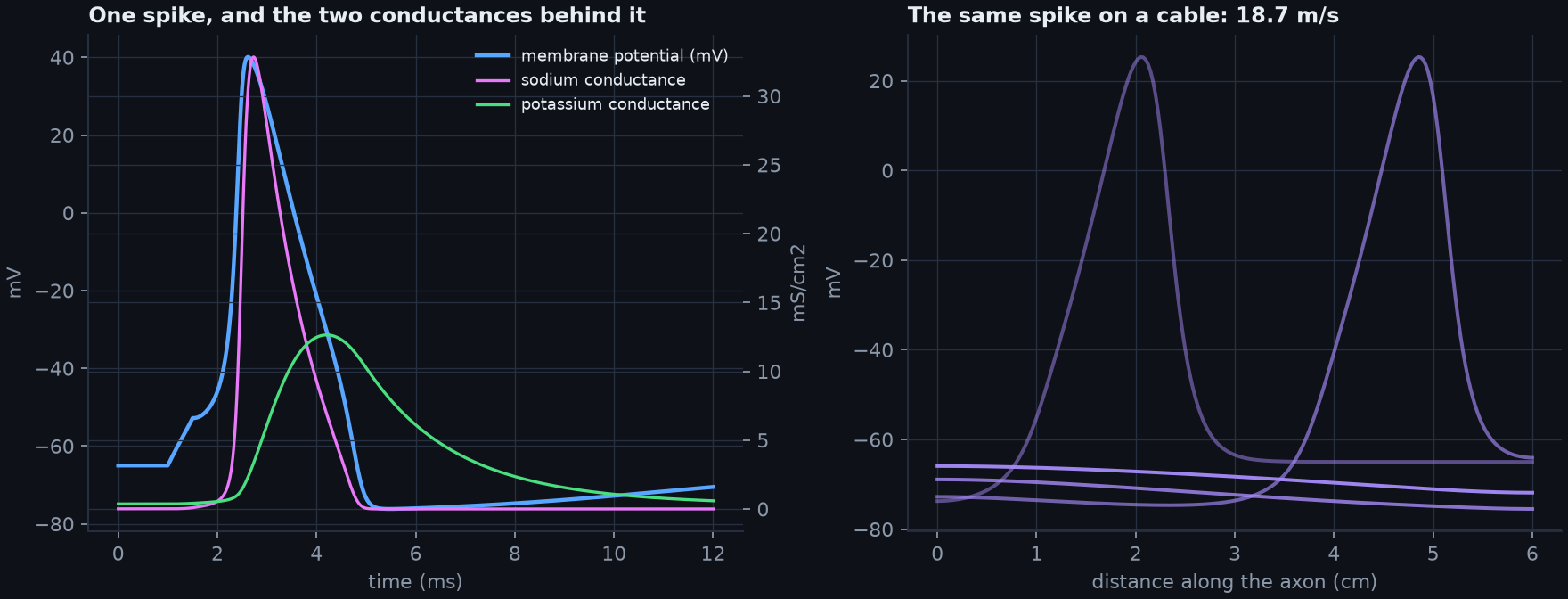
Give the model membrane a brief push of current, and let the equations run. The top trace is the voltage. Underneath, the two conductances. Nothing was drawn by hand here; this is the solution. Let's walk through it, because every feature has a cause you already know. The push lifts the voltage by a few millivolts. The sodium gate, m, is the fast one, so it responds first. A few sodium doors open. Sodium flows in, which makes the inside more positive, which opens more sodium doors, which lets in more sodium. That's a loop that feeds itself, and the voltage takes off. It races toward the sodium battery. It doesn't quite get there: it peaks at plus millivolts, because by now the two slow gates have caught up. The second sodium door, h, swings shut. And potassium, with its built-in delay, finally opens. Now the membrane is mostly a potassium membrane, and the voltage falls toward the potassium battery. It overshoots on the way down, because the potassium doors are slow to close again, and for a few milliseconds the cell is more negative than it was at rest. Then everything relaxes. The whole event took about millisecond at half its height, and nothing in it was put in by hand except the three curves from the clamp.
Now vary the push. Small pushes, and the voltage rises a little and sinks back. The sodium loop started, but the leak and the potassium current won the race. Push five per cent harder than a certain value and everything changes: the loop wins, and you get the full event. There's a threshold, and it's sharp. And look at what happens above it. A push one and a half times the threshold, twice, three times: the signals come a little sooner, and they're all the same height. Plot the peak against the size of the push and it isn't a slope. It's a step. This is called the all-or-none law, and physiologists had known it for decades as a brute fact about nerves. Here it's a consequence. Once the sodium loop runs away, the size of the signal is set by the batteries and the gates, and the stimulus that started it is forgotten. That has an enormous consequence for the mind. A nerve fibre can't say how strong something is by sending a bigger signal. It has only one size. We'll come back to how it copes.
One more property falls out, and it matters as much as the threshold. Fire the membrane once, and then ask how hard you have to push to fire it again. For the first few milliseconds the answer is that you can't. No push is big enough. The second sodium door is still shut, so there's no sodium loop to start, and the potassium doors are still open, holding the voltage down. This is the absolute refractory period. After that a second signal can be had, but it costs more: many times the normal push at first, then less and less, as h recovers and potassium closes. That's the relative refractory period. Three things follow. A nerve signal is a separate event; two of them can never merge into one. A fibre has a top speed, a few hundred signals a second. And, as you'll see in a moment, a signal travelling along an axon can't turn round and go back, because the stretch it has just left is dead.
What it does: One signal with its conductances, step by step; threshold and all-or-none; the refractory period
7Down the axonPsych 101 and the major4 min
So far the membrane has been a single patch. An axon is a long tube of it, and the question is how an event at one end reaches the other. Try the obvious thing first. Raise the voltage at one point and let it spread along the inside like current in a cable. It doesn't get far. The inside of the fibre is salt water, a poor conductor, and the membrane leaks. Every bit of length, some of the current escapes sideways. So the voltage falls off exponentially with distance. The distance over which it falls to about a third is called the length constant. For the squid's giant fibre it comes out near centimetre; for the fine fibres in your brain, a fraction of a millimetre. The formula says what helps: a wider fibre, because the inside conducts better, or a membrane that leaks less. But no animal can send a signal a metre this way. Nothing measurable would arrive. Passive spread is good for the short distances inside a dendrite. For the axon, something has to renew the signal on the way.
Now put the four equations at every point of the tube, and connect each point to its neighbours through the salt water inside. Start a signal at the left end. The voltage there shoots up. Current spreads a little way ahead, passively, and decays as before. But it doesn't have to go far. It only has to lift the next stretch of membrane past threshold. Then that stretch fires, at full size, and lifts the stretch beyond it. So the signal moves as a wave, the same shape and the same height at every point. It isn't carried along the axon. It's rebuilt at each place by the batteries that are already there, like a row of dominoes, or a flame along a fuse. And it can't spread backwards, because the membrane behind it is refractory. That's why Helmholtz found it slow. A wave like this travels at the speed at which each patch can charge the next. And that speed is something the model has to commit to. For this axon it comes out at metres a second. Hodgkin and Huxley, by hand, got . The axon itself did . Within about a tenth, for a number nobody had fitted.
Speed matters to an animal, and the model says what it depends on. Run the same equations on thinner and fatter axons. The speed grows as the square root of the radius. That's the squid's strategy: to make its escape signal fast it grew one enormous fibre. But the square root is a poor bargain. To double the speed you need four times the radius, which is sixteen times the volume. An animal that needs millions of fast fibres can't afford it. Vertebrates found another way. Wrap the axon in a fatty sheath, myelin, with short gaps. Under the sheath the membrane hardly leaks and stores little charge, so the voltage spreads much further and faster along the inside. The signal is renewed only at the gaps. It jumps from gap to gap. That's how the fibres in Helmholtz's frog managed to metres a second, the same order as the squid's giant axon, in fibres a small fraction of its width. And it's why diseases that strip the myelin from nerves slow thought and movement so badly: the signal is still made, and it arrives late, or not at all.
What it does: Passive spread and the length constant; the travelling signal and its computed speed; radius, and myelin
8Two variables are enoughGraduate4 min
Four equations reproduce the nerve signal. A natural next question, and it's the question a theorist always asks, is whether you need all four. Look at the gates again. m is so much faster than everything else that it's effectively always at the value the voltage dictates. So it isn't an independent variable; fold it into the voltage. And h and n are both slow, with similar time constants, and through a signal they move together: as potassium turns on, sodium becomes unavailable. One variable can stand for both. Call it recovery. In 1961 Richard FitzHugh wrote down the simplest pair of equations with those two features, and Jinichi Nagumo built it as an electrical circuit the following year. A fast variable v, with a cubic term that makes it feed on itself. And a slow variable w that follows v and drags it back. This is no longer a model of the squid. The numbers aren't millivolts. It's a model of the model: the least machinery that behaves like a nerve. And two variables have a great advantage over four. You can draw them on a sheet of paper.
Put the fast variable across and the slow one up. Every possible state of the cell is a point on this sheet, and the equations say which way each point moves. Two curves organise everything. On the N-shaped one, the fast variable has stopped changing. On the straight one, the slow variable has. Where they cross, nothing changes: that's the resting state. Give the cell a small kick to the right. The state slides straight back to rest. Now a slightly bigger kick, past the middle branch of the N. This time the fast variable runs away to the right-hand branch: that's the upstroke. Then the slow variable climbs: recovery building. At the top of the N the state falls off and shoots to the left: the downstroke. And it creeps down the left branch back to rest: the undershoot and the dead time. Everything from chapter six is here as geometry. The threshold is the middle branch. The signal has one size because every path that crosses the threshold joins the same loop. The dead time is the trip home down the left side, when a new kick would have to reach much further to cross over. One picture, and no arithmetic.
The picture also explains something the single signal couldn't. Feed the cell a steady current and it fires over and over. How does that begin? For the squid's equations the answer is abrupt. Below about units of current, nothing. Just above it, the cell fires at once at signals a second. It can't fire slowly. In the picture, the steady current lifts the N-shaped curve until the crossing point slides onto the middle branch and becomes unstable, and the state starts circling at a rate set by the loop itself. Other cells, and the simpler model of the next chapter, begin differently: at the threshold current they fire as slowly as you like, and the rate grows smoothly from zero. Hodgkin noticed both kinds in real axons in 1948 and called them classes. The difference matters for what a cell can say. A cell that starts from zero can signal a weak input with a low rate: its rate is a measure. A cell that jumps is better thought of as a resonator, tuned to a rhythm. Both kinds are in your head.
What it does: FitzHugh-Nagumo; the phase plane, where threshold, size and dead time are geometry; two ways to start firing
9Integrate and fireGraduate4 min
Now throw away even more. The signal always has the same shape, so its shape carries no information. All that matters to the next cell is when it happened. So don't compute the signal at all. Keep the membrane of chapter three, the capacitor with a leak. Let the input current charge it. Add a rule: when the voltage reaches a threshold, record that a signal occurred, and put the voltage back where it started. Wait a moment, for the dead time, and carry on. That's the leaky integrate-and-fire neuron. The idea goes back to the French physiologist Louis Lapicque in 1907, before anyone knew what a nerve signal was. It has one equation and it's the charging curve. There are no gates, no sodium, no potassium. And for a great many purposes it's all the neuron you need.
The reward for simplicity is that you can do mathematics on it. With the squid's equations, the firing rate under a steady current had to be found by simulation. Here it can be written down. The charging curve is an exponential, so you can solve for the moment it crosses the threshold. That time is the time constant multiplied by a logarithm. Add the dead time, turn it upside down, and that's the rate. Below a certain current the voltage levels off under the threshold and the cell never fires. Just above it, the cell fires very slowly, because the voltage only just creeps over. Then the rate climbs, and eventually bends over toward the ceiling set by the dead time. The dots are the simulation and the curve is the formula. They agree to a fraction of a per cent, which is how the code is tested. This curve, the rate as a function of the input, is the single most used summary of a neuron. In the artificial networks of the companion series, AI, Built, each unit is just such a curve with the spikes left out.
It's worth being exact about the trade. Kept: the membrane's habit of adding up what arrives within a few milliseconds. A threshold. A firing rate that grows with the input. And a formula. Lost: the signal itself, and any mention of ions. The reason there's a threshold; here it's simply decreed. The squid's way of starting abruptly. And one more thing, the most important. This model can't be wrong about a membrane, because it says nothing about one. Hodgkin and Huxley's model can be refuted by a measurement on an axon. This one can only be more or less useful. Used honestly, it's very useful. Give it an input just too weak to fire it, and add noise, and it fires now and then, at irregular moments, like a real cortical cell. Put ten thousand of them together and you can study a network, which is Part 6. And notice its outline: something accumulates toward a threshold, and an event happens when it gets there. You'll meet that shape again in Part 25, as a model of how a person makes up their mind.
What it does: A leaky capacitor and a rule; the firing rate in closed form; what was kept and what was lost
10On you: reading a spike trainPsych 101 and the major4 min
Chapter six left a puzzle. A fibre has one size of signal. So how does a nerve tell the brain that a weight is heavy and not light, or a light bright and not dim? The answer was found in 1926 by Edgar Adrian and Yngve Zotterman, in Cambridge. They took a muscle from a frog, with the nerve that reports how much the muscle is stretched, and cut the nerve down until a single fibre was left. Then they hung weights on the muscle and listened. With a light load, the fibre sent a slow trickle of impulses. Every one the same size. With a heavier load, the impulses were no bigger. There were more of them. Heavier still, more again. So the strength of the stimulus isn't in the signal. It's in how often the signal comes. This is the rate code, and it's the first sentence in the language of the nervous system. The rate rises steeply at first and then levels off, so a fibre covers a wide range of loads with a limited range of rates. You'll see that compression again and again in Act three.
Your turn, as the brain. You're a cell downstream, and all you get is impulses. Here are three one-second recordings from the same sensory cell, made while three different stimuli were applied. A, B and C. Which stimulus was the strongest? And put the other two in order while you're at it.
, by a distance. signals in A, in B, in C. You didn't need to be taught how to do that. You counted, or you judged how crowded each line looked, which is counting without numbers. That's what a rate code asks of whoever reads it: add up the impulses over some stretch of time. And you know a device that does exactly that. The leaky membrane of chapter three adds up what arrives within its time constant. A neuron reading another neuron is the reader you just were.
There's a catch, and it shapes the whole brain. Give a cortical cell exactly the same stimulus eight times and you get eight different trains. The rate is the same; the moments aren't. To a first approximation each impulse arrives at random, like raindrops. Count the impulses in each second, over many repeats, and the counts are spread out. For a purely random train the spread, the variance, equals the mean. That ratio is called the Fano factor, and for many cortical cells it's close to one. A dead time after each impulse makes the train more regular, and the ratio falls. Now think of the reader. Suppose it has to tell twenty impulses a second from thirty. If it can count for a full second, it's right per cent of the time. If it has fifty milliseconds, which is nearer the time you take to see something, it's right per cent of the time, not much better than a coin. A brain can't wait a second. So it does the other thing: it listens to many cells at once and adds them up. That's one reason there are so many neurons. Whether the exact timing of impulses also carries messages is a live question, and we'll meet cases where it clearly does.
What it does: Adrian's rate code; three trains to rank; the same stimulus eight times, the Fano factor, and why a brain pools cells
11What one neuron can computePsych 101 and the major4 min
So what is a neuron, as a computing element? The simplest reading comes straight from the integrate-and-fire model. It adds up its inputs, each with a weight, and fires if the total reaches a threshold. That's already logic. Give a cell two inputs and a high threshold, and it fires only when both are active. Lower the threshold, and it fires when either is. But there are things a cell of this kind can't do, and the classic one is the third table: fire when one input is active, but not when both are. The reason is geometric. A cell that only adds divides its inputs with one straight boundary: fire on this side, stay silent on that. The third table needs two boundaries. No choice of weights and threshold will do it, and that isn't a hunch; it can be checked exactly. For a long time this was taken to be the limit of a single neuron. If you've seen AI, Built, you'll recognise the perceptron, and the argument that sank it in 1969.
That reading leaves something out, and it's time. The membrane forgets. So when inputs arrive matters as much as how many. Take the integrate-and-fire cell and two inputs, each of which lifts the voltage by about millivolts. The threshold is millivolts up. One input can't reach it. If the two arrive together, their effects stack and the cell fires. If they arrive a few milliseconds apart, the first has leaked away before the second comes, and nothing happens. For this cell the window is about milliseconds. Inside it, fire. Outside, silence. So a leaky cell is a detector of things that happen at the same moment, and how leaky it is sets how strict it is about the moment. That's a computation no amount of adding without time can do. Your brain uses it to work out where a sound came from, by detecting which ear heard it first, to within tens of millionths of a second. That's in Part 15.
And there's a second thing the simple reading leaves out: the shape of the cell. Inputs don't all land in one place. They land on dendrites, and dendrites aren't passive wires. Many have their own voltage-dependent channels, and a branch can produce a local event of its own when enough of its inputs are active together. So picture a cell with two branches, two inputs on each. A branch fires locally only if both of its inputs are on. And the cell body fires if either branch has. Here are all sixteen patterns of input. The green ones fire the cell: inputs one and two together, or three and four together. Inputs one and three together do nothing, because they're on different branches. Now ask whether a cell that merely adds its four inputs could produce this table. It can't; we checked every possibility at once. What you're looking at is a network of two layers, with the branches as a hidden layer, inside a single cell. Whether real neurons compute like this, and how much, is this part's frontier. But the old picture of the neuron as a simple switch is the floor of what a neuron does, not the ceiling.
What it does: A threshold unit and the table it cannot produce; coincidence detection; a neuron with two thresholding branches
12The LedgerPsych 101 and the major1 min
One row today, and it's a different kind of row from Part 4's. The claim: sodium and potassium conductances that depend on voltage, measured under the voltage clamp, account for the nerve signal and its speed. The original: Hodgkin and Huxley, 1952, on squid giant axons, with a computed speed of metres a second against measured. What happened next. The equations have been integrated countless times since; in this series, Psyche gets . And the note. The membrane's conductance had been shown to rise during the signal before the model existed, and the gates the model had to invent were later found, as proteins. It is a model of one membrane, and other cells need other channels. Replicated. Set this row beside the ones from Part 4 and you can see what made the difference. The claim was a number. The number was computed before it was compared. And the parts were measured separately from the thing they were asked to explain. That makes rows.
What it does: The Hodgkin-Huxley model, in full
13In practice: talking to nervesPractice3 min
Understanding the nerve signal was not an academic matter. Each idea in this part became a technology. If the hair cells of the inner ear are lost, the hearing nerve is still there, waiting for input. A cochlear implant gives it input directly: a row of electrodes delivering brief pulses of current, strong enough to cross threshold, timed so that the fibres can follow. Hundreds of thousands of people hear through them. A local anaesthetic, like the lidocaine a dentist uses, is a molecule that plugs the sodium channel. In the model, that's setting the sodium conductance to zero. The signal can't start, so nothing reaches the brain from that tooth. A deep-brain stimulator is a pacemaker for a circuit inside the brain, used above all in Parkinson's disease. It delivers steady trains of pulses that change the firing of the cells around the electrode. And engineers build chips out of integrate-and-fire units, which compute with spikes and draw almost no power between them. None of these would have been designed by trial and error. They were designed from the equations.
It's worth being precise about what the model gives the engineer. It says how strong a pulse must be, and how the threshold trades against the pulse's length. It says how fast you can pulse before the dead time swallows every second one. And the cable equation says which fibres respond first to a current from outside: the thick ones, which is why stimulation tends to recruit the wrong fibres before the right ones. What it doesn't say is what any of it means. A cochlear implant delivers a crude pattern through a dozen or two electrodes, to a nerve built for thousands of channels, and people still come to understand speech with it, usually over months. That learning isn't in the membrane. Why stimulating one small region relieves a tremor is still argued about. So the neuron is the right level of description for some questions and the wrong one for others. Knowing which level a question lives at is half of this subject, and it's why every chapter card in this series carries that row of levels.
What it does: Cochlear implants, local anaesthetics, deep-brain stimulation, neuromorphic chips; what the model tells an engineer and what it does not
14Frontier: how much is one neuron?Research3 min
How much one neuron computes is an open question, and it moved recently. In 2020 a group in Berlin recorded from the dendrites of neurons in human cortex, in slices of tissue that had been removed during surgery for epilepsy or tumours. In the upper layers they found a dendritic spike carried by calcium that did something no textbook spike does. The axon's signal is all or none: at threshold it appears at full size, and stays that size. This one was largest for an input just at threshold, and smaller for stronger inputs. Think what a branch like that computes. One input: a big response. Two inputs together: too strong, a small one. That's one but not both, the very table that a simple adding cell can't produce. In the authors' models a single dendrite does it. The cautions are theirs as well as ours. The tissue was outside the body. And almost nothing comparable has been recorded in other species, so nobody can yet say whether this is special to us. But it's a reminder that the Ledger's verdict on Hodgkin and Huxley was about one membrane, not about what neurons can do.
Four open questions. One. How many numbers does it take to describe a neuron? For the squid's axon, four equations. For a cortical cell with its whole dendritic tree, detailed models use thousands of compartments, and it isn't settled what the right simplification is. Two. Rate or timing? We said the strength of a stimulus is carried by the rate. In some systems the exact moment of a spike clearly matters too. How general that is, nobody knows. Three. Neurons aren't the only cells in the brain. Glial cells are roughly as numerous, and they signal to each other and to neurons, on a slower clock. What they contribute to computation is wide open. Four, and it's the one a psychologist should care about most. Does the mind need this level? If you changed the membrane and kept the input-output behaviour of every cell, would anything about thinking change? That's a question about what explains what, and it runs through the whole series. And the research problem. Find the smallest change to the integrate-and-fire neuron that lets a single cell compute one but not both. Then say what you'd measure on a real cell to find out whether it does.
What it does: Graded dendritic spikes in human cortex; four open questions and a research problem
Recap, problems, and the road aheadAll tracks4 min
Part five in ten lines. Galvani showed that nerves are electrical, and Helmholtz that they're far too slow to be wires. The nervous system is made of separate cells, and a neuron has a direction. A difference in concentration across a membrane is a battery, negative for potassium and positive for sodium. The voltage moves because doors open, not because the salt moves. The membrane is a leaky capacitor, which adds up what arrives within a few milliseconds. The voltage clamp showed sodium turning on fast and off by itself, and potassium turning on late. Four equations fitted to the clamp give a threshold, a signal of one size, and a dead time. On a cable the signal renews itself at every point, and its computed speed matched the measured one. Two variables keep the behaviour, and one keeps the rate. And strength is carried by the rate of signals, in a cell that's more than a switch.
Kant's wager. His first objection was that the mind admits no mathematics. Today is the strongest reply the series will ever be able to give, and notice where it comes from. Not from the mind as a whole. From its smallest part, where four equations predicted a number that nobody had fitted them to. That's the standard. Most of psychology doesn't meet it yet, and the rest of this series is partly a record of how close each field has come. The second and third objections stand as Act one left them.
Where this comes back. How neurons talk to each other, and how that talk changes them, is the next part. What an electrode or a scanner is measuring when it records from a brain is Part 8. Detection as the counting of noisy signals is Part 12. Coincidence detectors locate a sound in Part 15. Accumulation to a threshold returns as a model of how people decide, in Part 25. And the unit with the spikes left out, in artificial networks, is set against the real thing in Part 60.
Seven problems, with full solutions in this part's README. One finds the battery of an ion we didn't discuss, calcium. One works the charging curve. One shows why a fourth power buys a delay. One reads the peak of the signal off the first equation. One derives the firing rate of the integrate-and-fire neuron. One uses Psyche's neuron to find how the threshold depends on the length of the pulse. And the last, with the star, is the research problem from the frontier. Pause here if you'd like to try them.
The books and papers behind this part are listed here and in the README. Hodgkin and Huxley's paper of 1952 is long, and it's one of the few scientific papers that can be read as a detective story.
So that's the smallest moving part. A cell that holds a voltage, adds up its inputs over a few milliseconds, and when they reach a threshold sends one signal of one size down its axon. We haven't said what happens when that signal reaches the end. For half a century there were two camps: those who thought the signal jumped the gap as a spark, and those who thought it crossed as a chemical. On the night before Easter Sunday in 1921, the physiologist Otto Loewi woke from a dream with the experiment that would settle it, two frog hearts and a shared bath of fluid. He wrote it down, and went back to sleep. In the morning he couldn't read his own handwriting. What he did the following night, and what it means that the connection between two neurons is chemical, and can therefore be changed, is Part 6: synapses and circuits.
Where it goes next. Synapses and the first circuits are Part 6. What an electrode or a scanner records is Part 8. Counting noisy signals becomes signal detection in Part 12, coincidence detectors locate a sound in Part 15, and accumulation to a threshold returns as a model of deciding in Part 25. The unit with its spikes left out is set against real neurons in Part 60. Psyche's neuron is the tissue under every later circuit in the series.
Key results
The part's results in one place, for revision.
Try it
Lab 5 · A membrane from clamp to spike to cable, and what is left when it is simplified
Compute the two batteries of a squid axon; clamp the model membrane and read off its two conductances; let it go and measure the spike, its threshold and its dead time; send it down the 1952 axon and compare the speed with the published one; then check the integrate-and-fire neuron against its formula.
python -m videos.psychology.labs 5
needs numpy, scipy, matplotlib · download lab05.py ·
source on GitHubNernst potentials at 6.3 C: potassium, sodium (mV) -72.1, +52.4
Goldman voltage, sodium 1/25 as permeable as potassium -57.1 mV
... sodium 20 times as permeable +44.3 mV
clamp at 0 mV: sodium conductance peaks at 29.1 mS/cm2 after 0.62 ms
... and has fallen by 10 ms to 0.31 mS/cm2
... potassium conductance rises to 24.4 mS/cm2, half-way at 2.3 ms
rest, and threshold for a 0.5 ms pulse -65.0 mV, 13.3 uA/cm2
the spike: peak, undershoot (mV) +40.1, -76.2
peak for pushes of 0.9, 1.1 and 3 times threshold (mV) -60, +37, +41
push for a second spike after 3, 8, 25 ms (x threshold) none, 6.2, 1.0
conduction speed, computed here 18.7 m/s
... computed by Hodgkin and Huxley; measured 18.8 m/s; 21.2 m/s
... in an axon a quarter as wide 9.3 m/s
FitzHugh-Nagumo: rest stable; steady current 0.5 gives firing
integrate-and-fire at twice its least current: formula, simulation 112.0, 111.9 per second
Poisson train, 20 a second: Fano factor of counts 1.07
Every number was computed from the published equations; none was fitted to a spike. The clamp shows sodium turning on fast and off by itself and potassium turning on late, and those three habits give a threshold, a spike of one size and a dead time. On a cable the spike travels at the speed Hodgkin and Huxley computed by hand. Two variables keep the behaviour, and one keeps the rate.The code (97 lines; it asserts its own result)
"""Lab 5: one membrane, from the voltage clamp to a spike to a travelling wave, and then thrown away twice."""

import math

import numpy as np

from videos.coursekit import labs
from explainer.psychology.psyche import neuron as N

TITLE = "A membrane from clamp to spike to cable, and what is left when it is simplified"
GOAL = ("Compute the two batteries of a squid axon; clamp the model membrane and read off its two conductances; "
        "let it go and measure the spike, its threshold and its dead time; send it down the 1952 axon and compare "
        "the speed with the published one; then check the integrate-and-fire neuron against its formula.")
TASKS = [
    "Halve the sodium conductance (HH(g_na=60)), as a partial dose of a local anaesthetic would. What happens to "
    "the threshold, to the height of the spike and to the conduction speed? At what conductance does the signal "
    "fail to travel?",
    "Warm the membrane from 6.3 to 18.5 degrees (HH(temp_c=18.5)). Which features of the spike change by about a "
    "factor of three, which hardly change, and why does the model make the gates faster and nothing else?",
    "Give the integrate-and-fire neuron a current just below its least firing current and add noise "
    "(simulate(1.4, noise=1.2)). Measure the Fano factor of its spike counts in 200 ms windows, and compare it "
    "with a Poisson train of the same rate.",
]


def run(seed=0):
    out = labs.Lab()
    hh = N.HH()

    # 1. the batteries
    e_k, e_na = N.nernst(*N.SQUID["K"]), N.nernst(*N.SQUID["Na"])
    out.row("Nernst potentials at 6.3 C: potassium, sodium (mV)", f"{e_k:.1f}, {e_na:+.1f}")
    out.row("Goldman voltage, sodium 1/25 as permeable as potassium", f"{N.goldman(1, 0.04):.1f} mV")
    out.row("... sodium 20 times as permeable", f"{N.goldman(1, 20):+.1f} mV")
    assert e_k < N.goldman(1, 0.04) < 0 < N.goldman(1, 20) < e_na

    # 2. the clamp: step from rest to 0 mV and hold
    c = hh.clamp(0.0, 10.0)
    t_peak = c["t"][c["g_na"].argmax()]
    out.row("clamp at 0 mV: sodium conductance peaks at", f"{c['g_na'].max():.1f} mS/cm2 after {t_peak:.2f} ms")
    out.row("... and has fallen by 10 ms to", f"{c['g_na'][-1]:.2f} mS/cm2")
    out.row("... potassium conductance rises to", f"{c['g_k'][-1]:.1f} mS/cm2, half-way at "
            f"{c['t'][np.argmax(c['g_k'] >= c['g_k'][-1] / 2)]:.1f} ms")
    assert c["g_na"][-1] < 0.05 * c["g_na"].max() and np.all(np.diff(c["g_k"]) > -1e-12)

    # 3. let it go
    th = hh.threshold(0.5)
    r = hh.pulse(2 * th, 0.5, 20.0)
    peaks = [hh.pulse(k * th, 0.5, 12.0)["v"].max() for k in (0.9, 1.1, 3.0)]
    dead = hh.refractory([3.0, 8.0, 25.0])
    out.row("rest, and threshold for a 0.5 ms pulse", f"{hh.rest:.1f} mV, {th:.1f} uA/cm2")
    out.row("the spike: peak, undershoot (mV)", f"{r['v'].max():+.1f}, {r['v'].min():.1f}")
    out.row("peak for pushes of 0.9, 1.1 and 3 times threshold (mV)", ", ".join(f"{p:+.0f}" for p in peaks))
    out.row("push for a second spike after 3, 8, 25 ms (x threshold)",
            ", ".join("none" if math.isinf(d) else f"{d / th:.1f}" for d in dead))
    assert peaks[0] < -50 < 30 < peaks[1] and abs(peaks[2] - peaks[1]) < 8 and math.isinf(dead[0])

    # 4. down the axon of the 1952 paper
    p = N.propagate()
    thin = N.propagate(radius_cm=0.0238 / 4)
    out.row("conduction speed, computed here", f"{p['velocity']:.1f} m/s")
    out.row("... computed by Hodgkin and Huxley; measured", "18.8 m/s; 21.2 m/s")
    out.row("... in an axon a quarter as wide", f"{thin['velocity']:.1f} m/s")
    assert abs(p["velocity"] - 18.8) < 1.5 and abs(thin["velocity"] / p["velocity"] - 0.5) < 0.05

    # 5. thrown away twice
    f = N.FHN()
    lif = N.LIF()
    sim = 1000 / np.diff(lif.simulate(3.0, 2000.0)["spikes"]).mean()
    out.row("FitzHugh-Nagumo: rest stable; steady current 0.5 gives", "rest" if f.stable(0.5) else "firing")
    out.row("integrate-and-fire at twice its least current: formula, simulation",
            f"{float(lif.rate(3.0)):.1f}, {sim:.1f} per second")
    counts = N.counts(20.0, 1.0, 400, np.random.default_rng(seed + 5))
    out.row("Poisson train, 20 a second: Fano factor of counts", f"{N.fano(counts):.2f}")
    assert f.stable(0.0) and not f.stable(0.5) and abs(sim - float(lif.rate(3.0))) < 1.0
    out.note = ("Every number was computed from the published equations; none was fitted to a spike. The clamp "
                "shows sodium turning on fast and off by itself and potassium turning on late, and those three "
                "habits give a threshold, a spike of one size and a dead time. On a cable the spike travels at "
                "the speed Hodgkin and Huxley computed by hand. Two variables keep the behaviour, and one keeps "
                "the rate.")

    fig, ax = labs.figure(2, size=(11, 4.2))
    keep = r["t"] <= 12
    ax[0].plot(r["t"][keep], r["v"][keep], color=labs.BLUE, lw=2, label="membrane potential (mV)")
    twin = ax[0].twinx()
    twin.plot(r["t"][keep], r["g_na"][keep], color=labs.PINK, lw=1.5, label="sodium conductance")
    twin.plot(r["t"][keep], r["g_k"][keep], color=labs.GREEN, lw=1.5, label="potassium conductance")
    twin.set_ylabel("mS/cm2")
    ax[0].set(title="One spike, and the two conductances behind it", xlabel="time (ms)", ylabel="mV")
    lines = ax[0].get_lines() + twin.get_lines()
    ax[0].legend(lines, [ln.get_label() for ln in lines], loc="upper right", fontsize=8)
    for i in np.linspace(0, len(p["t"]) - 1, 5).astype(int)[1:]:
        ax[1].plot(p["x"], p["v"][i], color=labs.PURPLE, alpha=0.35 + 0.15 * (i / len(p["t"]) * 4))
    ax[1].set(title=f"The same spike on a cable: {p['velocity']:.1f} m/s", xlabel="distance along the axon (cm)",
              ylabel="mV")
    out.fig = fig
    return out
Now change it
- Halve the sodium conductance (HH(g_na=60)), as a partial dose of a local anaesthetic would. What happens to the threshold, to the height of the spike and to the conduction speed? At what conductance does the signal fail to travel?
- Warm the membrane from 6.3 to 18.5 degrees (HH(temp_c=18.5)). Which features of the spike change by about a factor of three, which hardly change, and why does the model make the gates faster and nothing else?
- Give the integrate-and-fire neuron a current just below its least firing current and add noise (simulate(1.4, noise=1.2)). Measure the Fano factor of its spike counts in 200 ms windows, and compare it with a Poisson train of the same rate.
Problems, with solutions
Try each problem before opening its solution.
1. Calcium is at 2 mM outside a cell and 0.0001 mM inside, and its ion carries two charges. Find its Nernst potential at body temperature (RT/F = 26.7 mV). Which way does calcium move when a calcium channel opens at −65 mV?
Solution
E = (RT/zF) ln(out/in) = (26.7/2) ln(20,000) = 13.35 × 9.90 = +132 mV. At −65 mV the membrane is 197 mV below
calcium's equilibrium, so calcium flows in, hard: both diffusion and the voltage push it the same way. This is
why a brief opening of calcium channels is such an effective signal inside a cell, and why the dendritic spikes of
chapter 14, carried by calcium, are depolarizing. (neuron.nernst(2, 1e-4, z=2, temp_c=37).)
2. A membrane has resistance 10 kΩ cm² and capacitance 1 μF/cm². Find its time constant, and the time a step of current takes to bring the voltage 95% of the way. Two equal inputs arrive 30 ms apart: how much of the first is left when the second comes?
Solution
τ = RC = 10⁴ Ω cm² × 10⁻⁶ F/cm² = 10 ms. The voltage covers a fraction 1 − e^(−t/τ) of the distance, which reaches 0.95 when e^(−t/τ) = 0.05, at t = τ ln 20 = 3.0 τ = 30 ms. After the first input ends, what it left decays as e^(−t/τ), so 30 ms later 5% of it remains: the two inputs hardly add. Inputs within a few milliseconds of each other add almost fully. The time constant is the cell's window for summation.
3. A gate starts at n = 0 and relaxes as n(t) = 1 − e^(−t/τ). Show that n starts rising at once, and that n⁴ starts with zero slope. What feature of the potassium record does that reproduce?
Solution
dn/dt = (1/τ) e^(−t/τ), which is 1/τ at t = 0: the steepest part of the curve is its start. d(n⁴)/dt = 4n³ dn/dt, which is 0 at t = 0 because n = 0 there; for small t, n ≈ t/τ and n⁴ ≈ (t/τ)⁴, flat at first and then rising. That is the delay before the potassium conductance turns on under the clamp, the S-shaped onset of chapter 4. Any power above 1 gives a delay; the fourth was what the records needed.
4. At the peak of an action potential dV/dt = 0, with no injected current. Show from the model's first equation that the peak voltage is an average of the three batteries, weighted by the conductances at that moment. Why must it lie below E_Na?
Solution
Setting C dV/dt = 0 and I = 0 gives g_Na(V − E_Na) + g_K(V − E_K) + g_L(V − E_L) = 0, where g_Na and g_K stand for the conductances at that instant. Solving, V = (g_Na E_Na + g_K E_K + g_L E_L)/(g_Na + g_K + g_L). A weighted average lies strictly inside the range of the things averaged unless all the weight is on one of them, and g_K and g_L are never zero, so V < E_Na. In the film's spike the conductances at the peak are about 30.5, 2.3 and 0.3 mS/cm², which gives (30.5 × 50 − 2.3 × 77 − 0.3 × 54.4)/33.1 = +40 mV, the computed peak.
5. For the integrate-and-fire neuron derive the time to reach threshold θ from reset under a steady current, and the firing rate. With τ = 10 ms and a dead time of 2 ms, what is the rate at twice the least current that fires the cell?
Solution
Measure voltage from rest, with reset at rest. Below threshold V(t) = RI(1 − e^(−t/τ)). Setting V(T) = θ gives
e^(−T/τ) = 1 − θ/RI, so T = τ ln[RI/(RI − θ)], which exists only if RI > θ: the least current is θ/R. The period
is the dead time plus T, so f = 1/(t_ref + T). At RI = 2θ, T = τ ln 2 = 6.93 ms, the period is 8.93 ms and the
rate is 112 signals a second. (neuron.LIF().rate(3.0) gives 111.96 with the film's parameters, where the least
current is 1.5 nA.)
6. With explainer.psychology.psyche.neuron: find the threshold of HH() for pulses of 0.1, 0.5, 2 and
10 ms. Show that for short pulses the charge delivered is what matters, and that long pulses need a least current.
Why does each happen?
Solution
from explainer.psychology.psyche import neuron
hh = neuron.HH()
for ms in (0.1, 0.5, 2, 10):
    th = hh.threshold(ms)                 # uA/cm^2
    print(ms, round(th, 1), round(th * ms, 1))
# 0.1 65.2 6.5      0.5 13.3 6.6      2 3.9 7.7      10 2.2 22.5
For pulses much shorter than the membrane's time constant (about 1.5 ms at rest), the threshold falls in proportion to the duration and the product, the charge, stays near 6.5 nC/cm²: the membrane is a capacitor, and a short pulse simply deposits charge on it before any can leak away. For long pulses the threshold levels off at about 2.2 μA/cm², the least current that will ever fire the cell: a steady current weaker than that is balanced by the leak and by the potassium it recruits before the sodium loop can start. This is the strength-duration curve that the designer of any stimulator starts from.
7. ★ Find the smallest change to the integrate-and-fire neuron that lets one cell compute "one but not both", and say what measurement on a real cell would show whether it does.
Open. Two candidates to start from. A response that is not monotonic in the input, as in the dendritic spikes of chapter 14: add to the cell a branch whose contribution is largest at its own threshold and smaller above it; one input then fires the cell and two together do not. Or inhibition recruited by coincidence: a second threshold, above the first, at which the cell is shut. Each makes a different prediction on a real cell: the first, that the somatic response to dendritic input of growing strength rises and then falls; the second, that blocking inhibition restores the response to both inputs. The measurement has to deliver two inputs separately and together to the same branch, and record at the soma.
Notes and sources
Where it comes back
How neurons talk, and how talking changes them: Part 6. What an electrode or a scanner measures: Part 8.
Detection as the counting of noisy signals: Part 12. Coincidence detectors that locate a sound: Part 15.
Accumulation to a threshold as a model of deciding: Part 25. The unit with its spikes left out, in artificial
networks: Part 60. Psyche's neuron (psyche/neuron.py) is the tissue under every later circuit.
Sources
Books. E. R. Kandel, J. D. Koester, S. H. Mack and S. A. Siegelbaum (eds.), Principles of Neural Science (6th ed., 2021), the chapters on the membrane and the action potential. P. Dayan and L. F. Abbott, Theoretical Neuroscience (2001), chapters 5 and 6. E. M. Izhikevich, Dynamical Systems in Neuroscience (2007). C. Koch, Biophysics of Computation (1999). S. Finger, Minds Behind the Brain (2000).
Papers.
- A. L. Hodgkin and A. F. Huxley, "Action potentials recorded from inside a nerve fibre", Nature 144 (1939) 710–712; "A quantitative description of membrane current and its application to conduction and excitation in nerve", Journal of Physiology 117 (1952) 500–544. A. F. Huxley, "From overshoot to voltage clamp", Trends in Neurosciences 25 (2002) 553–558.
- K. S. Cole and H. J. Curtis, "Electric impedance of the squid giant axon during activity", Journal of General Physiology 22 (1939) 649–670.
- E. D. Adrian and Y. Zotterman, "The impulses produced by sensory nerve-endings. Part II. The response of a single end-organ", Journal of Physiology 61 (1926) 151–171.
- L. Lapicque, "Recherches quantitatives sur l'excitation électrique des nerfs traitée comme une polarisation", Journal de Physiologie et de Pathologie Générale 9 (1907) 620–635.
- R. FitzHugh, "Impulses and physiological states in theoretical models of nerve membrane", Biophysical Journal 1 (1961) 445–466. J. Nagumo, S. Arimoto and S. Yoshizawa, "An active pulse transmission line simulating nerve axon", Proceedings of the IRE 50 (1962) 2061–2070.
- A. L. Hodgkin, "The local electric changes associated with repetitive action in a non-medullated axon", Journal of Physiology 107 (1948) 165–181.
- A. Gidon et al., "Dendritic action potentials and computation in human layer 2/3 cortical neurons", Science 367 (2020) 83–87.
About this partfrom its README
In the 1780s Luigi Galvani made a dead frog's leg kick by touching its nerve and muscle with two metals, and concluded that animals carry electricity. In 1850 Helmholtz timed the signal in a frog's nerve at 25 to 43 metres a second, far too slow for a current in a wire. A century later Alan Hodgkin and Andrew Huxley measured the currents through the membrane of a squid's giant nerve fibre, fitted them with four equations, and solved the equations by hand. A nerve signal came out, with a threshold, a fixed size, a dead time, and a speed of 18.8 metres a second against the 21.2 measured in that axon. Nothing in the equations had been fitted to a nerve signal.
This part opens Act II, in which the series builds the machine. It asks what the mind's smallest moving part is and what it computes. The route: the neuron doctrine; why a difference of concentration across a membrane is a battery (Nernst, Goldman); the membrane as a leaky capacitor; the voltage clamp and what it showed; the four equations; the action potential computed, with each of its properties traced to a gate; propagation on a cable and the speed recovered; the reduction to two variables and the phase plane; integrate-and-fire and its closed form; the rate code and the noise in it; and what one cell can compute, with and without dendrites. It is the series' template for a model: measure the parts, write equations, compute, and compare with something that was not put in.
What is computed and built
explainer/psychology/psyche/neuron.py, Psyche's first piece of tissue: Nernst and Goldman voltages, the charging curve, the Hodgkin-Huxley membrane (HH:simulate,clamp,pulse,threshold,refractory,firing_rate), propagation on a cable (propagate,length_constant), FitzHugh-Nagumo (FHN: nullclines, the rest state and its stability), leaky integrate-and-fire (LIF: the closed-formrate,simulate,coincidence), Poisson spike trains and the Fano factor, and a point neuron against a neuron with thresholding branches (separabledecides exactly, by linear programming, whether any point neuron can match a table). Tested intests/psychology/test_neuron.pyagainst closed forms and the 1952 speed.- The Ledger gains one row and the Archive five datasets.
- On the Homunculus map nothing changes yet: a neuron is not a faculty. The first circuits are Part 6.
Chapter notes
| # | Chapter | What it does |
|---|---|---|
| 0 | What moves along a nerve? | Galvani and Volta; Helmholtz's speed against a wire's; four equations and a predicted speed; objectives |
| 1 | One net, or many cells | Golgi against Cajal; the neuron doctrine; a neuron drawn, with its direction |
| 2 | Ions and the membrane | Diffusion against voltage; the Nernst potential; two batteries; the Goldman voltage as a dial |
| 3 | The membrane as a circuit | Capacitor, resistor, battery; the charging curve and the time constant; a membrane adds and forgets |
| 4 | The squid and the voltage clamp | The giant axon; the overshoot of 1939; the loop of voltage and channels, and the clamp that breaks it; two conductances with different habits |
| 5 | Four equations | Why a fourth power gives a delay; the gates m, h and n and their speeds; the model whole, fitted only to the clamp |
| 6 | The action potential, computed | One signal with its conductances, step by step; threshold and all-or-none; the refractory period |
| 7 | Down the axon | Passive spread and the length constant; the travelling signal and its computed speed; radius, and myelin |
| 8 | Two variables are enough | FitzHugh-Nagumo; the phase plane, where threshold, size and dead time are geometry; two ways to start firing |
| 9 | Integrate and fire | A leaky capacitor and a rule; the firing rate in closed form; what was kept and what was lost |
| 10 | On you: reading a spike train | Adrian's rate code; three trains to rank; the same stimulus eight times, the Fano factor, and why a brain pools cells |
| 11 | What one neuron can compute | A threshold unit and the table it cannot produce; coincidence detection; a neuron with two thresholding branches |
| 12 | The Ledger | The Hodgkin-Huxley model, in full |
| 13 | In practice: talking to nerves | Cochlear implants, local anaesthetics, deep-brain stimulation, neuromorphic chips; what the model tells an engineer and what it does not |
| 14 | Frontier: how much is one neuron? | Graded dendritic spikes in human cortex; four open questions and a research problem |
| Recap, problems, and the road ahead | Ten lines; Kant's first objection answered at its strongest; payoffs; problems; references; Part 6 |
NotesWhere the numbers come from
| What | Source |
|---|---|
| The model's conductances, batteries and rate functions; the computed speed 18.8 m/s at 18.5 °C against 21.2 m/s measured; the first intracellular record (rest about −45 mV, peak about +40 mV) | Hodgkin and Huxley (1939, 1952); registered in SOURCES.md, with what was read and what was not |
| The membrane's conductance rises during the signal and its capacitance does not; the giant axon | Cole and Curtis (1939); J. Z. Young (1936) |
| A single sensory fibre: impulses of one size, more frequent with more stretch | Adrian and Zotterman (1926), from secondary accounts; no rates are quoted |
| Golgi's net against Cajal's cells; the shared prize of 1906 | The Nobel Foundation's account |
| Graded calcium spikes in the dendrites of human cortical neurons | Gidon et al. (2020), from the authors' pages and press accounts |
| The speed of the signal in a frog's nerve, 25 to 43 m/s | Helmholtz (1850), as in Part 1 |
| Every curve, voltage, conductance, rate and speed "computed by Psyche" | explainer.psychology.psyche.neuron, from the published equations |
| Ion concentrations of the squid axon (K 20/400, Na 440/50, Cl 560/52 mM) | the figures usually quoted in textbooks; see Open checks |
The numbers that depend on choices made for the film. The spike in the film is the model membrane at 6.3 °C, the temperature the rate functions are given for, stimulated with a 0.5 ms pulse of twice the threshold; at the squid's own temperature everything is about three times faster. The cable is the 1952 axon (radius 238 μm, axoplasm 35.4 Ω cm, 18.5 °C). The integrate-and-fire neuron has a time constant of 10 ms, a threshold 15 mV above rest and a dead time of 2 ms, chosen as round numbers. The stretch-receptor curve in chapter 10 and the two response curves in chapter 14 are drawn to show a shape and are labelled as such; they are not data. The three trains of the on-you exercise are one draw from a model cell at 35, 12 and 70 signals a second, and the count shown beside each is that draw's own.
Notes
| Finding | Original | Status |
|---|---|---|
| Voltage-dependent sodium and potassium conductances account for the action potential and its speed | Hodgkin and Huxley 1952 | replicated |
Shown without a row, with the reason recorded in explainer/psychology/ledger.py: the rate code of Adrian and
Zotterman (its row is due with sensory coding, Part 13), the neuron doctrine (a settled piece of anatomy, told as
history), and the graded dendritic spikes of 2020 (one laboratory's report, shown at the frontier). Cole and
Curtis's measurement rests under the row above, and Helmholtz's speed has had its row since Part 1.
Notes
Before the narrated master:
- Hodgkin and Huxley (1952) was not read. The computed speed (18.8 m/s at 18.5 °C) was confirmed from a textbook figure adapted from the paper; the measured speed (21.2 m/s), the axon's radius (238 μm) and its axoplasm resistivity (35.4 Ω cm) are from memory of the paper and should be checked there, with the statement that the equations were integrated by hand on a mechanical calculator.
- The rest and peak of the 1939 record (about −45 and +40 mV) are as Huxley recalls them in 2002; check the Nature letter.
- The squid's ion concentrations are the usual textbook figures; check them against Hodgkin's own tables. The film's potassium battery (−72 mV) is the Nernst value for those figures, while the model uses −77 mV.
- Adrian and Zotterman (1926) was not read; the film gives the preparation and the finding, with schematic trains and no rates.
- Galvani's experiments, the dispute with Volta, Young's giant axon (1936), the voltage clamp's history (Cole, Marmont; Hodgkin, Huxley and Katz), Lapicque (1907), FitzHugh (1961), Nagumo et al. (1962), Hodgkin's classes (1948) and the four-part structure of potassium channels are stated from standard accounts.
- Gidon et al. (2020) was not read; the film's curve is a schematic and is labelled so.
- The practice chapter's statements about cochlear implants, lidocaine, deep-brain stimulation and neuromorphic chips are general knowledge and carry no figures except "hundreds of thousands" of implant users, which should be checked or cut.
- Loewi's dream (the hook for Part 6) is told as he told it; the date and the detail of the unreadable note should be checked against his own account before Part 6 is written.
Companion material in this repository
The syllabus's plan for this partfrom SYLLABUS.md, the plan of record
- Hook: Galvani's frog and Volta's objection; Helmholtz's speed against a wire's; four equations and a speed they were never fitted to (18.8 m/s computed, 21.2 measured).
- Cajal against Golgi: the neuron doctrine. Anatomy of a neuron, drawn, with its direction.
- Ions and the membrane: diffusion against electrical force. The Nernst potential; two batteries; Goldman's equation as a dial between them.
- The membrane as a circuit: capacitance, leak, the time constant (the RC curve on screen). A membrane adds up a few milliseconds and forgets the rest.
- The squid giant axon, the overshoot of 1939 and the voltage clamp (Cole; Hodgkin, Huxley and Katz): the loop between voltage and channels, how the clamp breaks it, and the two conductances it showed.
- The model: why a fourth power gives a delay; the gates m, h and n, their steady values and speeds; four equations, fitted only to clamp data.
- The action potential, computed: one spike with its conductances; threshold and all-or-none; the absolute and relative refractory periods, each traced to a gate.
- Propagation: passive spread and the length constant; the travelling spike on the 1952 axon (18.7 m/s recomputed); speed against radius, and myelin. Helmholtz's speed recovered.
- Reduction: FitzHugh-Nagumo; the phase plane, where threshold, size and dead time are geometry; two ways to start firing (Hodgkin's classes).
- Integrate-and-fire: what is kept and lost. The f-I curve in closed form, checked against simulation.
- On you: reading a spike train. Adrian and Zotterman's rate code (1926); three trains to rank; Poisson variability, the Fano factor, and why a brain pools many cells.
- What one neuron can compute: a threshold unit and the table it cannot produce; coincidence detection; dendrites as a two-layer network.
- The Ledger. 13. In practice: talking to nerves. 14. Frontier: how much is one neuron?
Psyche: neuron (explainer/psychology/psyche/neuron.py): Nernst and Goldman; the RC membrane;
Hodgkin-Huxley with the clamp, threshold, refractory period and firing rate; the cable, with the 1952 conduction
speed as a test; FitzHugh-Nagumo; LIF with its closed-form f-I curve; Poisson trains and the Fano factor; a
neuron with thresholding branches, and an exact test of whether a point neuron can match a table.
On you: three spike trains to rank in the film. The interactive is the same task as an experiment: which of
two recordings came from the stronger stimulus, at recording lengths from 50 ms to a second, set against a
reader who counts; each pair can also be heard as clicks, as Adrian heard his.
Ledger: the Hodgkin-Huxley model (replicated; the standard of quantitative success). Shown without rows,
with reasons: the rate code (due in Part 11), the neuron doctrine, the dendritic spikes of 2020.
In practice: cochlear implants, local anaesthetics and deep-brain stimulators act on these mechanisms;
neuromorphic chips implement the reductions. What the membrane tells an engineer, and what it cannot.
Frontier: graded dendritic spikes in human cortical neurons (Gidon et al. 2020, from secondary accounts); how
many parameters a single-neuron model needs; rate against timing; glia; whether the mind needs this level.
Reading: Hodgkin & Huxley 1952; Kandel et al. chs. on membrane and action potential; Dayan & Abbott chs. 5-6;
Izhikevich, Dynamical Systems in Neuroscience; Koch, Biophysics of Computation; Finger, Minds Behind the
Brain.
Build the film
python -m videos.psychology.psych5.compute        # the part's numbers, into .cache/psych5
python tools/build.py psych5                  # render and assemble the film
EXPLAINER_TTS=silent python tools/qa_scene.py psych5 Hook   # one chapter, silent, with a contact sheet
Scenes: videos/psychology/psych5. Setup: see the course page. Source of these notes: the README and the scenes' narration.
Build it
python -m videos.psychology.psych5.compute            # every number (about a minute), into .cache/psych5/
python tools/qa_scene.py psych5 Spike                 # one chapter, silent, at 480p, with a contact sheet
EXPLAINER_TTS=silent python tools/build.py psych5 -q l   # the whole part, silent preview
python tools/build.py psych5                          # 1080p30 with narration
python tools/qa_scene.py psych5 Spike --lang zh       # the Chinese edition of one chapter
python tools/make.py psych5                           # both editions, with the checks a long build needs
python -m videos.psychology.labs 5                    # the lab: a membrane taken from clamp to spike to cable
python tools/check_ledger.py psych5                   # every study shown has its Ledger row, or a reason
python -m pytest tests/psychology                     # Psyche's neuron, the Pool, the Ledger, the Archive
The Chinese edition is zh_lines.py (the narration, line by line) and the series table
videos/psychology/psychology_text_zh.json (the text on screen); the terms are in
PSYCHOLOGY_ZH_GUIDE.md.