Changing Your Mind
belief revision, conditionals, defeasible reasoning
When a new fact contradicts what you believe, which beliefs should you give up?
You believe that all swans are white, that this bird is a swan and that your eyes are reliable; then you see that the bird is black. Logic says something must go and does not say what. The part builds the logic of that choice: expansion, revision and contraction, the AGM postulates checked exhaustively by the Reasoner for four operators, and Grove's spheres, in which revising by A means moving to the most plausible A-worlds. Spohn's ranks carry the spheres through repeated change, and an operator that forgets them loses a red bird's flight. Then the part turns to the sentences that guide change. The Ramsey test ties conditionals to revision, and Gärdenfors's theorem shows the two cannot coexist; Lewis's triviality theorem shows that the probability of a conditional is not the probability of any proposition. Together they are the Wall's fourteenth brick. The rest is reasoning that can be withdrawn: McGee's counterexample to modus ponens, Reiter's defaults and Tweety, System P and System Z, Dung's arguments that attack each other, and machines, from truth maintenance to knowledge editing in language models.
What you need. Truth tables (Part 2) and the idea of a possible world (Part 4). Conditional probability for Chapter 8, as in Part 13.
- The calculation
- AGM revision, conditionals
- The wall
- Gärdenfors; Lewis's triviality
- Built toy
- Grove spheres; Dung argumentation solver
What you will be able to do
Introductory
- Carry out an expansion, a revision and a contraction on a small system of spheres and say what is believed afterwards.
- Evaluate a counterfactual on a model of closest worlds, and show why strengthening the antecedent fails.
- Compute the grounded extension of a small argumentation framework and label each argument in, out or undecided.
Advanced
- Check the AGM postulates for a given revision operator and produce a counterexample where one fails, as for Satoh's operator and subexpansion.
- Derive revision from contraction by the Levi identity and contraction from revision by the Harper identity.
- Test four iterated revision operators against the Darwiche-Pearl postulates on a ranking.
Research
- Prove Gärdenfors's impossibility theorem on three pairwise incompatible propositions, and Lewis's triviality theorem for a class of credences closed under conditioning.
- State System P and rational monotonicity, and explain what System Z's ranking adds and where it drowns.
Applied
- Compare AGM revision with a local edit of one stored fact, and say which consequences each leaves stale.
- Compute the certain answers of a query over the repairs of an inconsistent database.
Contents
Each chapter has a home level. Choose a track to see what to read and watch: Introductory 21 min · Advanced 38 min · Research 48 min · Applied 24 min.
- 0What should you give up?Introductory2 min
- 1Three ways to changeIntroductory3 min
- 2The AGM postulatesAdvanced4 min
- 3Spheres and remaindersAdvanced3 min
- 4Changing againAdvanced4 min
- 5IfIntroductory3 min
- 6Gärdenfors's impossibilityResearch2 min
- 7CounterfactualsIntroductory6 min
- 8The probability of conditionalsResearch5 min
- 9When modus ponens failsAdvanced3 min
- 10Jumping to conclusionsIntroductory4 min
- 11The logic of normalityResearch4 min
- 12Arguments that attackIntroductory3 min
- 13Machines that change their mindsApplied3 min
- Recap, problems, and where this comes backAll tracks2 min
Also on this page: Lecture · Key results · Try it · Lab · Problems · Notes and sources · 中文 · Build the film.
Lecture
The text of each chapter is the film's narration, as it is spoken, so you can read along or revise without the film. The pictures are in the film.
What should you give up?Introductory2 min
Part 13 told us how degrees of belief should move with evidence. This part asks the same of belief itself, and of the sentences that guide change: conditionals. Quine said that no statement is immune to revision. But when something must go, logic does not say which.
Here is the simplest case. You believe that all swans are white, that this bird is a swan, and that your eyes are reliable in this light. Then you see that the bird is black. Together, the four are inconsistent. Logic tells you that something must go. It does not tell you which, or how much else must go with it. Do you lose the belief that all swans are white, and also every belief you derived from it? Or doubt your eyes? This part is about the logic of that choice.
The plan. Three ways to change a mind, and the difference between learning and updating. The AGM postulates, which the Reasoner checks, and the spheres that characterize them. Changing again, and again. Then conditionals: Ramsey's test, and Gärdenfors's theorem that it cannot coexist with revision, this part's brick in the Wall. Counterfactuals, and why the probability of a conditional is not the probability of any proposition. A counterexample to modus ponens, and the logics of jumping to conclusions. Arguments that attack each other; and machines, including large language models, that have to change their minds.
What it establishes: Quine (1951); the black swan; the plan.
1Three ways to changeIntroductory3 min
A detective's case makes the three moves concrete. There are four ways the case could be: the butler did it, the maid did it, both did, or neither. The detective believes the butler did it, unsure about the maid: those worlds are in her inner disc. The other worlds lie on rings, in order of plausibility. Expansion adds a belief consistent with what she has: the maid has an alibi, and the disc shrinks to one world. Revision adds a belief that contradicts what she has: the butler has an alibi. She must give something up, and she moves to the most plausible world where he is innocent: the maid did it. Contraction removes a belief without adding its negation: she stops believing the butler did it, and admits the most plausible alternative, the maid, as a possibility.
Revision has a cousin that is easy to confuse with it. You believe that exactly one of the book and the magazine is on the floor. Now: the book is not on the floor. If you learn this, you were wrong about the book, and so the magazine must be the one on the floor. But if a robot has just picked the book up, the world has changed. Each possibility moves: the magazine is wherever it was, and you no longer know where that is. Hirofumi Katsuno and Alberto Mendelzon called the second operation update. The Reasoner confirms that update breaks one of the postulates of the next chapter. Not every change of mind is a revision.
One postulate has divided the field. Recovery: if you give up A and then get A back, you have everything you started with. Sven Ove Hansson's example. You believe Cleopatra had a son, and so that she had a child. A historian casts doubt on the child, so you give that up, and the son goes with it. Then new evidence: she did have a child. Recovery says you must again believe she had a son. But the child might have been a daughter. For belief sets closed under logic, recovery comes for free; for the finite belief bases a machine actually stores, it is a real choice, and the theories of base revision reject it.
What it establishes: expansion, revision, contraction; revision vs update (Katsuno and Mendelzon 1991); recovery (Hansson 1991).; Computed on screen: the detective's three moves; the book and the magazine
2The AGM postulatesAdvanced4 min
The theory of belief change has three founders. Carlos Alchourrón, a legal philosopher, asked what becomes of a legal code when a law is repealed: which of its consequences survive? Peter Gärdenfors asked how rational belief should change, and what conditionals mean. And David Makinson, a logician, saw that these were one problem. Their 1985 paper gives the theory its name, AGM. Its method is the one this series keeps meeting: do not define the one true revision; state the constraints that any rational revision must meet, and see what satisfies them. The guiding idea is minimal change: when you must give something up, give up as little as you can.
The eight postulates for revision. Closure: the result is a belief set, closed under logic. Success: the new information is believed. Inclusion: revising adds nothing beyond what plain expansion would. Vacuity: if the news doesn't conflict with what you believe, nothing is lost; revision is just expansion. Consistency: unless the news is itself contradictory, the result is consistent. Extensionality: logically equivalent news gives the same result. The last two govern conjunctions. Superexpansion: revising by A and B is no bolder than revising by A and then adding B. Subexpansion: and, if B is consistent with the revision by A, no more timid either. The first six are the basic postulates; the last two tie revisions by different inputs together.
Contraction has its own postulates. The result is a belief set; it contains nothing new; if you didn't believe A, nothing changes; and unless A is a logical truth, you really do stop believing it. Recovery, the contested one from the first chapter: contracting and then adding back loses nothing. And extensionality. Through the Levi and Harper identities, which we meet in the next chapter, these six correspond exactly to the basic six for revision.
Which ways of revising pass? The Reasoner takes three atoms, eight worlds, and checks every postulate against every pair of propositions. Four operators. Revision by spheres, which we meet in the next chapter. Mukesh Dalal's revision, which keeps the worlds at the smallest number of changed atoms. Ken Satoh's, which keeps the worlds whose set of changed atoms is minimal under inclusion. And Marianne Winslett's update. Spheres and Dalal pass all eight. Satoh's fails subexpansion. So does Winslett's update; and, as the book and the magazine showed, it fails vacuity once you believe more than one world. Closure and extensionality hold automatically when beliefs are sets of worlds.
Here is the Reasoner's counterexample to Satoh. You believe one world, where p, q and r are all true. You revise by A, which rules that world out and leaves three. Reaching them means changing r, or q, or both p and r. The first two changes are minimal, so revising by A keeps those two worlds. Adding B leaves just one. But revise by A and B together, and the competitors are changing q, or changing p and r: neither set includes the other, so both survive. Revising by more has kept more. Subexpansion fails. Counting the changes, as Dalal does, instead of comparing the sets of them, restores the postulate. Minimal change needs a measure that compares everything.
What it establishes: Alchourrón, Gärdenfors and Makinson (1985); eight revision and six contraction postulates.; Computed on screen: the postulates for spheres, Dalal, Satoh and Winslett over 255² pairs; Satoh's counterexample
3Spheres and remaindersAdvanced3 min
Adam Grove gave the postulates a picture in 1988. Arrange the possible worlds in nested spheres around your beliefs. The inner disc holds the worlds you think possible: here, one world, where p, q and r are all true. Each ring outward holds worlds a step less plausible. To revise by A, grow the spheres outward until one meets A, and believe the A-worlds there. Learn not p: the first ring has one such world. Learn not p or not q: two worlds on the first ring qualify. Learn not p and not q: you must go to the second ring. Learn not r: one world. Grove's theorem: the revisions satisfying all eight AGM postulates are exactly the sphere revisions. The same class arises from orderings of beliefs by entrenchment, and from the faithful preorders of Katsuno and Mendelzon.
Contraction has its own construction. To give up p, keep as much of your beliefs as you can without implying p. A maximal such part is called a remainder. Here there are four, one for each world where p is false: each remainder admits exactly one of them. Which do you keep? Pick just one, maxichoice, and you are too bold: you settle every question about how things would be without p. Keep only what all the remainders share, full meet, and you are too timid: almost nothing survives. The right answer is in between: keep what the best remainders share, chosen by a selection function. AGM's representation theorem: these partial meet contractions are exactly the contractions satisfying the basic postulates; when the selection comes from an ordering, they satisfy the supplementary ones too.
The three operations are linked. Isaac Levi's identity builds revision from contraction: to accept A, first make room by giving up not A, then add A. William Harper's goes the other way: to give up A, keep just what you would also keep if you learned not A. The Reasoner checks both, for every proposition, on these spheres. And the spheres give an order of entrenchment: a belief is as entrenched as the nearest world where it fails is far. p and q together, and p alone, are lost at the first ring; p or q at the second; p or q or r only at the third. Gärdenfors and Makinson showed that contraction can be defined from such an order: when something must go, give up what is least entrenched.
What it establishes: Grove (1988); remainders and partial meet contraction; Levi and Harper; entrenchment (1988).; Computed on screen: four revisions; four remainders, maxichoice and full meet; both identities; entrenchment 1, 1, 2, 3
4Changing againAdvanced4 min
AGM describes a single revision. It takes a belief set, with its spheres, and returns a belief set. But to revise a second time, you need the spheres around the new beliefs, and AGM says almost nothing about them. So a state of belief must be more than the set of things believed: it is an ordering of all the worlds by plausibility. Adnan Darwiche and Judea Pearl proposed postulates for how that ordering should change.
Wolfgang Spohn's ranking functions are the natural tool. Each world gets a non-negative whole number: how surprising it would be to learn that it is actual. Zero means not surprising at all. A proposition is as surprising as its least surprising world. You believe A when not A is surprising, and how firmly is measured by how surprising. Here you believe p, with firmness two, and q, with firmness one. Ranks behave like probabilities on a logarithmic scale: minimum plays the role of addition, and addition the role of multiplication. Spohn defined conditioning on them, and with it, a theory of iterated revision.
Why do ranks behave like probabilities? Read a world of rank k as having probability of the order of epsilon to the k, for some tiny epsilon. Then a sum of probabilities is dominated by its largest term, which is the smallest rank; a product of probabilities becomes a sum of ranks; and conditioning becomes subtraction. Spohn's conditioning on A with strength n is Jeffrey's rule from Part 13, written in orders of magnitude. On this view, belief is credence so close to one that only its order of magnitude matters.
Start from that ranking and revise by not p. Four operators. Craig Boutilier's natural revision moves the most plausible not-p world to the bottom and keeps everything else in its old order. Abhaya Nayak's lexicographic revision puts every not-p world below every p world: the news becomes the most entrenched thing you know. Spohn's conditioning shifts the not-p worlds down and the p worlds up, by a chosen strength. And an amnesic operator keeps only the new beliefs and flattens everything else. All four satisfy the AGM postulates for a single revision.
Darwiche and Pearl's four postulates constrain the ordering. The first two: revising by mu leaves the order among the mu-worlds alone, and the order among the not-mu worlds alone. The other two: a mu-world that was more plausible than a not-mu world stays more plausible, and one that was at least as plausible never sinks behind it. The Reasoner checks the four operators against all four, for every pair of propositions. Natural and lexicographic revision pass. Spohn's conditioning, with a fixed strength of one, fails the last two: if not mu was already disbelieved more firmly than that, conditioning on mu actually weakens the belief. And the amnesic operator fails the first three: it forgets every conditional belief.
Darwiche and Pearl's example shows why the postulates matter. You see a bird; it looks red, and it flies. Then someone tells you it isn't red. Both agents move to the most plausible world where it isn't red, and still believe it flies. Then a better look: it is red after all. The natural reviser returns to the red, flying bird. The amnesic one believes it is red, and no longer knows whether it flies: the first revision erased the conditional belief that, if it is red, it flies. Rational revision must preserve what the news does not bear on.
What it establishes: Spohn's ranks (1988), as orders of magnitude; natural, lexicographic, Spohn and amnesic revision; Darwiche and Pearl (1997).; Computed on screen: DP1–DP4 for four operators; the red bird remembered and forgotten
5IfIntroductory3 min
Logic's own conditional is the material conditional. It is false only when the antecedent is true and the consequent false, and true in every other row. So, if the moon is made of cheese, two plus two is five: true, because the moon isn't. If I win the lottery, I'll be poor: true, as long as I don't win. Worse: denying a material conditional commits you to its antecedent. Deny that if God exists, prayers are answered, and you have proved that God exists. These are the paradoxes of material implication. Logic's `if' is not quite ours.
Logic has offered two repairs, met earlier in the series. C. I. Lewis's strict conditional, from Part 4: necessarily, if A then C. No world has A without C. But an impossible antecedent strictly implies everything. And the relevant conditional of Alan Anderson and Nuel Belnap, from Part 5, which demands that antecedent and consequent share content, and so rejects the cheese and the arithmetic. Both improve the logic. Neither explains how if depends on what we know, which is where the rest of this part looks.
Ernest Adams pointed out that English has at least two conditionals. If Oswald didn't kill Kennedy, someone else did. True: Kennedy was killed by someone. If Oswald hadn't killed Kennedy, someone else would have. Probably false, unless there was a second gunman waiting. Same antecedent, same consequent, different truth values. The first, the indicative, is about how things are, given what we know. The second, the counterfactual, is about how things would have been. Chapters seven and eight take them in turn.
Frank Ramsey, in 1929, gave a test for conditionals that has shaped everything since. To decide whether if p, then q, add p hypothetically to what you know, and see whether q follows. Robert Stalnaker and then Gärdenfors made it a principle: you believe if A then C exactly when revising by A would bring you to believe C. Take the detective. If the butler didn't do it, the maid did? Revise by the butler's innocence: the nearest such world is the maid's. So she believes the conditional. The Ramsey test turns belief revision into a semantics for conditionals. It seems obviously right. The next chapter shows that, combined with the AGM postulates, it is impossible.
What it establishes: the material conditional; strict and relevant conditionals; Oswald and Kennedy (Adams 1970); the Ramsey test (1929).; Computed on screen: the detective's conditional, read off the spheres
6Gärdenfors's impossibilityResearch2 min
Gärdenfors proved it in 1986. Two ingredients. First, the Ramsey test makes revision monotone. If belief set H includes belief set K, it includes K's conditionals; by the Ramsey test, those conditionals say what K's revisions contain; so H's revisions contain at least as much. Second, preservation, which follows from AGM's vacuity: news consistent with your beliefs costs you nothing. The theorem: no non-trivial system of revision satisfies both. Non-trivial means only that some belief set leaves open three propositions that exclude one another.
Here is the proof, on three worlds. A, B and C are true in one world each. Start from a belief set K that leaves all three open. Expand it by A or B, giving K one, and by A or C, giving K two. And expand it by A alone, giving H. Now revise K one and K two by B or C. That news is consistent with each of them, so by preservation it is simply added: K one now believes B, and K two believes C. H includes everything K one and K two believe, their conditionals included. So by monotonicity, H's revision by B or C must lie within both of theirs: within b, and within c. The Reasoner tries every candidate. Believing b fails the second constraint; believing c fails the first; leaving both open fails both. Nothing is left: H's revision by a consistent proposition would have to be inconsistent. The contradiction.
Something has to give. Isaac Levi's answer: conditionals are not beliefs at all. They express how you are disposed to revise, and so do not belong in the belief set. Or weaken preservation: once conditionals are beliefs, consistent news can cost you some of them. Gösta Grahne showed that the Ramsey test is consistent with update, in Katsuno and Mendelzon's sense, rather than revision. Or restrict the test to factual sentences. Every answer concedes that conditionals resist being treated as ordinary beliefs. That is half of this part's brick in the Wall; Lewis supplies the other half in chapter eight.
What it establishes: monotonicity and preservation; Gärdenfors's impossibility (1986); Levi, Grahne.; Computed on screen: every candidate for H * (B ∨ C) fails
7CounterfactualsIntroductory6 min
Counterfactuals got their modern semantics from Robert Stalnaker in 1968 and David Lewis in 1973. If A had been the case, C would have been, is true at a world when C holds at all the A-worlds closest to it. Closeness is overall similarity, and each world is closest to itself. Lewis allows ties; Stalnaker insists there is always exactly one closest A-world. These are Grove's spheres again, now centred on a world rather than on a belief set. Modus ponens holds: if A is true here, then here is the closest A-world. But five inferences that are valid for the material conditional fail. The Reasoner builds a small model for each.
Strengthening the antecedent, Nelson Goodman's match. If I had struck this match, it would have lit. True: the nearest world where it is struck is one where it is dry, and lights. If I had struck it and it had been wet, it would have lit. False: the nearest such world has a wet match that doesn't light. Adding to the antecedent can carry you to farther worlds.
Transitivity, from Stalnaker. If J. Edgar Hoover had been born in Russia, he would have been a communist. If he had been a communist, he would have been a traitor. But not: if he had been born in Russia, he would have been a traitor. The nearest communist Hoover is an American traitor; the nearest Russian Hoover is a loyal Soviet citizen.
Contraposition. If Goethe had lived past 1832, he would still be dead now. True. Contrapose: if Goethe were alive now, he would not have lived past 1832. Absurd. The nearest world where he lived on is still one where he died long ago.
Conditional excluded middle, with Quine's Bizet and Verdi. If they had been compatriots, would Bizet have been Italian? Or Verdi French? The two compatriot worlds are equally close. Lewis: neither conditional is true, and the disjunction of the two fails. Stalnaker keeps the law of conditional excluded middle by insisting on one closest world; the Reasoner confirms it holds once the tie is broken, and says the choice between them is indeterminate.
Simplifying disjunctive antecedents. If Spain had fought in the war, on either side, it would have joined the Axis: plausible, given Franco. Simplify: if Spain had joined the Allies, it would have joined the Axis. Absurd. Yet the simplification seems valid in ordinary talk; many semanticists now treat disjunctive antecedents as a special case.
Which semantics is right? Lewis's line: if this line were longer than one inch. There are worlds where it is one and a half inches, one and a third, one and a quarter, and so on: no closest one. Stalnaker assumes there always is a closest antecedent world, which buys him conditional excluded middle. Lewis allows ties and drops the limit assumption: the counterfactual is true when some sphere around the world makes the material conditional hold throughout. The Reasoner confirms that once the Bizet and Verdi tie is broken, excluded middle holds, as Stalnaker says. And what makes worlds similar? Lewis's 1979 answer, which matters for causation in Part 17: first avoid big violations of law, then keep as many particular facts as possible.
Kit Fine raised the strongest objection to similarity. If Nixon had pressed the button, there would have been a nuclear holocaust. Surely true. But a world where he presses it and a small electrical fault stops the missiles is far more like ours than one with a nuclear war. So similarity seems to make the counterfactual false. Lewis answered in 1979 by saying which similarities count, in order: first, avoid big, widespread violations of law; second, keep as large a region of exact match as possible; third, avoid even small violations; and approximate match of particular fact hardly matters. Then the closest world has one small miracle that gets the button pressed, and after that the laws run their course. The holocaust world wins. Lewis built his theory of causation, and the direction of time, on this ordering; Part 17 tests it.
Counterfactuals now explain the decisions of machines. Sandra Wachter, Brent Mittelstadt and Chris Russell proposed explaining an automated decision by the closest world in which it would have gone the other way. Take a simple loan rule. An applicant with fifty thousand dollars of income and two years in her job is refused. The closest approval, counting each change separately, is: with fifteen thousand more income, you would have been approved. Measured by straight-line distance, it is twelve thousand more income and seven more months in the job. Which world counts as closest is a choice, and it changes the explanation the applicant receives. Lewis's problem of similarity, in a credit office.
What it establishes: Stalnaker (1968), Lewis (1973); five failures; the limit assumption; Fine (1975) and Lewis (1979); counterfactual explanations (Wachter et al. 2017).; Computed on screen: five countermodels; CEM once the tie is broken; a loan's L1 and L2 explanations
8The probability of conditionalsResearch5 min
How likely is a conditional to be true? A card is drawn from a deck. If it is red, it is a heart. Read materially, the conditional is true unless the card is a red diamond: three quarters. But nearly everyone says a half: the chance it is a heart, given that it is red. Psychologists such as Jonathan Evans and David Over have confirmed this many times. Ernest Adams made it a thesis: the assertability of if A, C is the conditional probability of C given A. Robert Stalnaker went further: there is a proposition, if A then C, whose probability is the conditional probability. David Lewis proved in 1976 that this cannot be.
Here is Lewis's proof, on three worlds. A credence spreads a third each over three worlds: A and C, A and not C, and neither. The credence of C given A is one half. Suppose some proposition X has the probability of C given A, for this credence and for everything it can become by conditioning. Condition on C. All the mass slides onto the A-and-C world, and now C given A is certain; so X must contain that world. Condition instead on not C. Now C given A has probability zero, so X must miss both of the other worlds. So X is just C, and its probability is a third. But it should be a half. Contradiction. In general the argument shows that the probability of the conditional must equal the probability of C itself, whenever both A-worlds are possible: conditional probability collapses into plain probability, which is the triviality.
The Reasoner checks the result by brute force. It takes every proposition on a small model, and every credence in a family closed under conditioning: the uniform credence on each set of worlds. With four worlds, sixteen propositions and twelve credences: no proposition matches the conditional probability for more than six of them. With three worlds, no proposition works either. Only in the trivial model, with no world where A holds and C fails, does one work, and there the conditional is certain anyway.
Lewis also said what the probability of a counterfactual is. Take a credence over four worlds. To condition on A, delete the not-A worlds and spread their mass over the A-worlds in proportion: C given A is a half. To image on A instead, let each not-A world send its mass to its own closest A-world. Here the probability of C becomes point six. Lewis showed that the probability of Stalnaker's counterfactual is exactly the imaged probability, not the conditional one. Counterfactuals are propositions, and indicatives, if Adams is right, behave like something else.
The Reasoner sets out the cluster as a Price List. Four claims: the probability of a conditional is the conditional probability, for every credence; rational credences stay rational when conditioned; a conditional is true or false at each world; and some credence makes the conditional probability differ from the plain one. Together inconsistent; any one can go. Ernest Adams and Dorothy Edgington give up the third: indicative conditionals have no truth conditions; to accept one is to have a high conditional credence. Lewis and Frank Jackson give up the first: if is material, and the conditional probability measures only how assertable it is. Others give up the second, in effect: the proposition a conditional expresses shifts with the credence, as Bas van Fraassen and, recently, Justin Khoo and Matthew Mandelkern propose. Giving up the fourth would make credence trivial, and nobody does.
This is the fourteenth brick in the Wall. The dream: conditionals as ordinary propositions, believed by the Ramsey test and believed to the degree of the conditional probability. The wall: Lewis's triviality theorem, and Gärdenfors's impossibility theorem. What they force: conditionals may not state facts at all; or, if they do, the facts they state shift with what we know. Either way, if is not a connective like and or or.
What it establishes: Adams's and Stalnaker's theses; Lewis's triviality (1976); imaging; Price List: the triviality cluster; the Wall's fourteenth brick.; Computed on screen: the three-world proof; no proposition fits on four or three worlds; imaging 0.6 vs conditioning 0.5
9When modus ponens failsAdvanced3 min
Vann McGee published a counterexample to modus ponens in 1985. Before the 1980 election, polls showed Ronald Reagan, a Republican, well ahead; Jimmy Carter, the Democrat, a distant second; and John Anderson, a Republican running independently, far behind. Consider: if a Republican wins, then if Reagan doesn't win, Anderson will. That is certain: they are the only Republicans. And: a Republican will win. Very likely. Modus ponens gives: if Reagan doesn't win, Anderson will. But that is very unlikely: if Reagan doesn't win, Carter almost certainly will. You may believe both premises and reject the conclusion. And Reagan did win; so the premises were true, and the conclusion, it seems, false.
What has gone wrong? The first premise is a nested conditional, and nested conditionals obey import and export: if A, then if B, C, says the same as if A and B, C. McGee showed that any conditional with import and export, whose probability is Adams's conditional probability, must fail modus ponens somewhere. The material conditional keeps modus ponens, at the price of its paradoxes. Angelika Kratzer's linguistics offers a diagnosis: if is not a connective at all. An if-clause restricts a modal, stated or implicit. Then McGee's first premise quantifies over the worlds where a Republican wins, and the conclusion over all the worlds, and the argument was never an instance of modus ponens.
A second puzzle, from Niko Kolodny and John MacFarlane. Ten miners are trapped in one of two shafts, and we don't know which. If we block shaft A and they are in A, all are saved; if they are in B, all die. Likewise for B. If we block neither, one miner dies, wherever they are. It seems true that if they are in A, we ought to block A, and if they are in B, we ought to block B. They are in one or the other; so, by reasoning by cases, we ought to block A or we ought to block B. But clearly we ought to block neither. Conditional oughts, like McGee's conditionals, depend on what is known, and the classical rules of inference do not survive the dependence unchanged.
What it establishes: McGee (1985); import–export; Kratzer's restrictors; the miners (Kolodny and MacFarlane 2010).; Computed on screen: the 1980 probabilities
10Jumping to conclusionsIntroductory4 min
Artificial intelligence met belief revision from another direction. Told that Tweety is a bird, you conclude that Tweety flies. Told also that Tweety is a penguin, you conclude that Tweety does not. Classical logic cannot do this. It is monotonic: adding premises never removes a conclusion. Ordinary reasoning is non-monotonic. Birds fly is not the false generalization that all birds fly; it is a default, which holds unless something says otherwise. In 1980 a special issue of Artificial Intelligence launched three logics of defaults.
Raymond Reiter's default logic is the best known. A default rule says: if bird, and if flies is consistent with what you believe, conclude flies. The consistency check refers to the final belief set, so the conclusions are a fixed point, called an extension: a set of beliefs that justifies exactly the defaults it used to get there. The Reasoner finds the extensions by trying every set of defaults. With facts that Tweety is a bird, that penguins are birds, and that penguins don't fly, there is one extension, in which Tweety flies. Add that Tweety is a penguin. Now not flying is derived, the default is blocked, and the one extension has Tweety grounded.
Defaults can conflict. Richard Nixon was a Quaker and a Republican. Quakers are, by default, pacifists; Republicans, by default, are not. The Reasoner finds two extensions: in one the Quaker default fires and blocks the other; in the second, the reverse. A credulous reasoner picks one. A skeptical reasoner believes only what every extension shares, and so concludes nothing about Nixon's pacifism. This choice returns when arguments attack each other, two chapters on.
Two other logics from 1980 are still in use. John McCarthy's circumscription: write birds that are not abnormal fly, and then keep only the models in which as few things as possible are abnormal. Penguins must be abnormal; Tweety, merely a bird, need not be, so Tweety flies. And negation as failure, with Reiter's closed-world assumption: if no flight from Boston to Tokyo is listed, conclude there is none. Every database query, and every Prolog program, reasons like this. All of them jump to conclusions that new information can retract.
Defaults were meant to solve the frame problem of John McCarthy and Patrick Hayes: how to say, without endless axioms, that most things stay the same when you act. Steve Hanks and Drew McDermott's Yale shooting problem tested it. Load a gun, wait, and shoot Fred. Assume that things normally don't change, and minimize the changes. The Reasoner finds two minimal models. In the intended one, the gun stays loaded and Fred dies at the shot. In the other, the gun mysteriously unloads while we wait, and Fred lives. Each has exactly one abnormality, so minimizing cannot choose. Repairs followed: prefer later changes to earlier ones, or build causal laws into the logic. And Georg Gottlob proved that reasoning with Reiter's defaults is harder than any NP problem, unless the polynomial hierarchy collapses. Jumping to conclusions is not cheap.
What it establishes: Tweety; Reiter (1980); the Nixon diamond; circumscription; negation as failure; the Yale shooting problem (1986); Gottlob (1992).; Computed on screen: Tweety's extensions; two Nixon extensions; two minimal Yale models
11The logic of normalityResearch4 min
Sarit Kraus, Daniel Lehmann and Menachem Magidor asked what all reasonable defeasible inference has in common. Their semantics: A defeasibly implies B when B holds in the most normal A-worlds. A preferential model orders the worlds by normality. The most normal bird-worlds have flying birds, so bird defeasibly implies flies. The most normal penguin-worlds have flightless penguins. It is Grove's picture of spheres again.
From that semantics come the rules. The Reasoner checks them on two small models, one ranked, where normality comes in levels, and one merely preferential, where some worlds are incomparable. Reflexivity, And, Or, Cautious Monotonicity and Cut hold in both. Together they make System P, the core of defeasible inference. Rational monotonicity, which says you may keep a conclusion when you learn something you didn't expect to be false, holds in the ranked model and fails in the preferential one. And plain monotonicity fails in both, as it should.
System P has a second, probabilistic, foundation. Ernest Adams read a default, A normally B, as: the probability of B given A is close to one. A conclusion follows, in his sense, if its probability can be made as close to one as you like by making the premises' probabilities close enough to one. Judea Pearl and Hector Geffner showed that the rules Adams's semantics validates are exactly System P. Monotonicity fails, as it should: flies is likely given bird, and unlikely given bird and penguin. The probabilities of Part 13 and the orderings of this part arrive at the same logic of normality.
Which defeasible conclusions follow from a set of defaults? Judea Pearl's System Z gives a canonical answer, the same as Lehmann and Magidor's rational closure. Sort the defaults into layers. Birds fly, and birds have wings, can be satisfied together with everything else: layer zero. Penguins are birds, and penguins don't fly, can be satisfied only once those are set aside: layer one. Then rank each world by the highest layer it violates, and read off conclusions from the most normal worlds. The Reasoner's answers: birds fly; penguins don't; penguins are birds; red birds fly, since redness is irrelevant. But do penguins have wings? System Z doesn't say. The penguin is exceptional in one respect, and the exception drowns the other inheritance. This is the drowning problem. Lehmann's lexicographic closure, which counts violated defaults instead of just their highest layer, gets the wings back.
Step back. A defeasibly implies B, B is in the revision of K by A, and K believes if A then B: three subjects, defeasible inference, belief revision, and conditionals. David Makinson and Peter Gärdenfors showed in 1991 that the first two are one theory seen from two sides: the rational consequence relations are exactly the AGM revisions of a fixed belief set. One ordering of worlds, drawn as spheres or written as ranks, underlies all three, and Gärdenfors's theorem marks the one place where they cannot be fully merged.
What it establishes: preferential models (KLM 1990); System P; rational monotonicity; Adams's ε-semantics; System Z (Pearl 1990); Makinson and Gärdenfors (1991).; Computed on screen: the rules on a ranked and a preferential model; Z-layers and six queries
12Arguments that attackIntroductory3 min
In 1995 Phan Minh Dung made a radical abstraction. Forget what the arguments say; keep only which argument attacks which. A set of arguments is conflict-free if none of them attacks another. It is admissible if, in addition, it defends each of its members: every attacker of a member is attacked by some member. The grounded extension is the cautious answer: accept the unattacked arguments, reject what they attack, and repeat until nothing changes. The preferred extensions are the bold answers, the maximal admissible sets; a stable extension attacks everything outside it. Dung showed that default logic, logic programming, and the solutions of n-person games are all instances of this one structure.
Three small frameworks show the semantics at work. Reinstatement: c attacks b, which attacks a. c is unattacked, so it is in; b is out; and a, defended by c, is back in. Mutual attack: a and b attack each other. The cautious grounded extension accepts neither, and leaves both undecided. The bold preferred semantics offers two answers, a or b, just like the two extensions of the Nixon diamond. An odd cycle: a attacks b, b attacks c, c attacks a. No argument can be defended, the only preferred extension is empty, and there is no stable extension at all, a paradox in miniature.
Here is a trial. The prosecution: a witness saw him. The defence: she was drunk. The prosecution: her blood test was clean. The defence: the test was contaminated. The prosecution: the lab's log shows no contamination. The grounded semantics labels the chain: the log is unattacked, so in; contamination out; the blood test in; drunkenness out; and the witness stands. Now the defence claims the log was altered, and the prosecution disputes that in turn: a mutual attack. The grounded extension is now empty, and there are two preferred extensions, one for each side. A skeptical court, which accepts only what every extension accepts, acquits; a credulous one could go either way. Burdens of proof decide such ties in real law.
Argumentation frameworks are used well beyond philosophy. In law, systems such as Henry Prakken's ASPIC plus and Carneades model structured arguments and burdens of proof. In medicine and policy, decision support that shows its reasons and the rebuttals to them. In negotiation between software agents, which trade arguments as well as offers. In argument mining, which finds claims and attacks in text; IBM's Project Debater argued against human champions in 2019. And in proposals to check large language models by having them debate. Each time the question is Dung's: which arguments survive their attackers?
What it establishes: Dung (1995); grounded, preferred, stable; a trial; uses in law, negotiation, argument mining and LLM debate.; Computed on screen: three small frameworks and two trials, labelled
13Machines that change their mindsApplied3 min
The first machines to change their minds were truth maintenance systems, introduced by Jon Doyle in 1979. Each belief records its justifications. Flies is believed because bird is believed and penguin is not; can migrate rests on flies. When the system learns that the bird is a penguin, it retracts flies, and everything that rested on it, and nothing else. Johan de Kleer's assumption-based version tracks every combination of assumptions at once. These are belief-base revision, in Hansson's sense, implemented.
Databases face the same problem. A table lists two salaries for Ann, against the rule of one salary per person. Marcelo Arenas, Leopoldo Bertossi and Jan Chomicki proposed repairing it in every minimal way at once. A repair is a maximal consistent part of the data: exactly a remainder, from chapter three. An answer is certain if it holds in every repair, the skeptical policy of chapter ten. Bob earns forty thousand: certain. Ann earns more than forty five thousand: certain, since both her salaries do. Ann earns fifty thousand: not certain. Consistent query answering is AGM's partial meet, running inside a database.
A modern version of the problem. A knowledge base, or a language model, believes that a footballer plays for Barcelona and so lives in Spain, against background facts: Barcelona players live in Spain, Paris players in France, one club, one country. The news: he now plays for Paris. A local edit flips the club and touches nothing else. The Reasoner finds the result inconsistent with the background: he lives in Spain while playing for Paris. AGM revision moves to the closest world consistent with the news and the background: Paris, and France, and not Spain. The consequences follow the edit. Methods that edit facts inside large language models, such as ROME and MEMIT, change the target fact well, but Roi Cohen and colleagues found that they often miss exactly these ripple effects. Closure under consequence, the first AGM postulate, is what they lack.
What do machines need from this part? An ordering of possibilities, not just a list of facts, so that they know what to give up. Closure, so that consequences move with the change. Memory, so that repeated revisions keep what the news doesn't touch. Defaults with exceptions, and a policy for conflicts between them. And humility about if: conditionals are not just more facts to be stored.
What it establishes: truth maintenance (Doyle 1979); database repairs (Arenas et al. 1999); knowledge editing (ROME, MEMIT; Cohen et al. 2024).; Computed on screen: certain answers; AGM revision vs a local edit
Recap, problems, and where this comes backAll tracks2 min
Let's gather what we built. The three ways to change, and update. The AGM postulates, checked, and the spheres and remainders that realize them. Changing again, with ranks. The Ramsey test and Gärdenfors's theorem. Counterfactuals, and Lewis's triviality, which together make this part's brick. Modus ponens questioned, and the logics of defaults. And arguments that attack, and machines that revise.
The Reasoner has three new modules. Revision: expansion, revision and contraction on spheres, the AGM and Darwiche--Pearl postulates checked exhaustively, and Gärdenfors's theorem. Conditionals: counterfactual models and the triviality search. And defeasible reasoning: default extensions, System Z, the KLM rules, and Dung's frameworks. And the Wall has its fourteenth brick.
Six problems, with full solutions in this part's notes. Revision and contraction on a ranking; full meet revision and the supplementary postulates; iterated revision, natural and amnesic; a counterfactual model; Lewis's proof with new numbers; and an argumentation framework. Pause here, and try them.
Where this comes back. Induction and confirmation, in Part 15. Counterfactuals and causation, in Part 17. Theory change in science, in Part 18. Laws and chance, in Part 24. Causal decision theory, which chooses by imaging, in Part 33. And machines that reason, revise and argue, in the finale. Next, Part 15: the problem of induction.
The books and papers this part follows are on screen, and in the notes. Thanks for watching.
Where it goes next. Induction and confirmation follow in Part 15; counterfactuals carry causation in Part 17; theory change in science is Part 18; laws and chance return in Part 24; causal decision theory, which chooses by imaging, is in Part 33; machines that reason, revise and argue return in the finale.
Key results
The part's results in one place, for revision.
Try it
Lab 14 · Which revision operators keep the postulates?
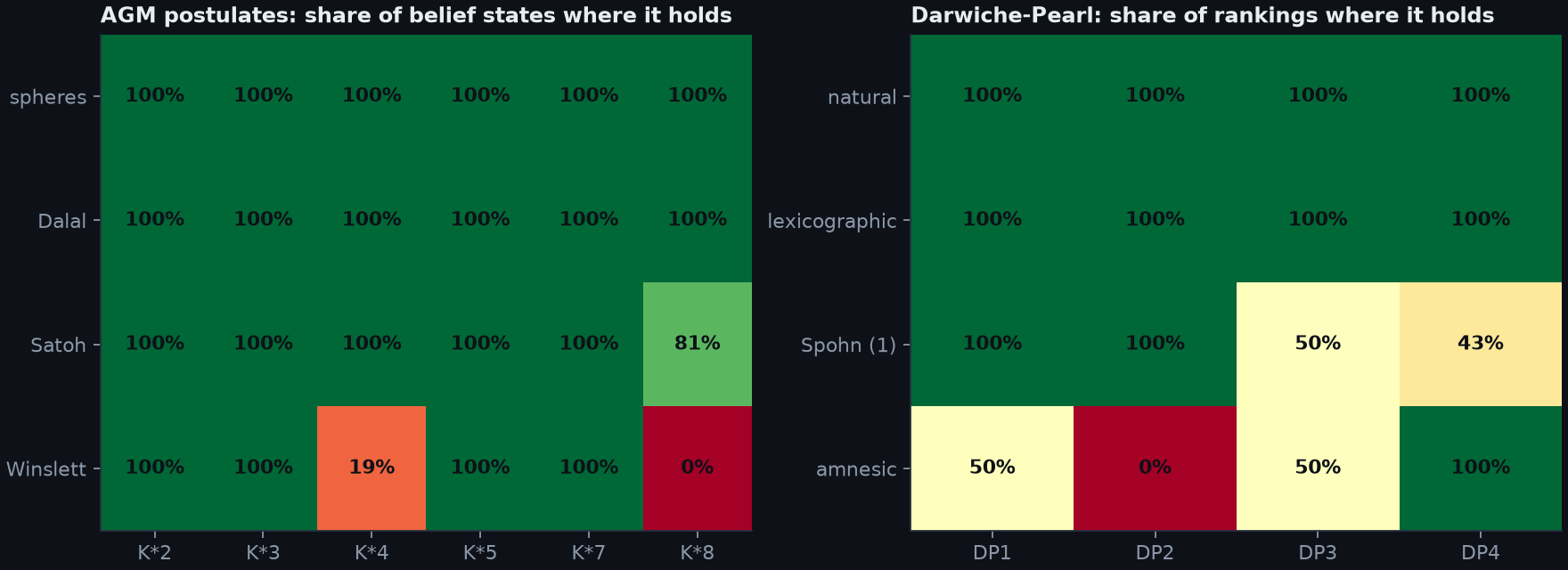
Draw random belief states over three atoms and random rankings over two. Let the Reasoner check every pair of propositions: sphere and Dalal revision must satisfy all six AGM postulates, Satoh's must break subexpansion somewhere, and of four iterated operators only natural and lexicographic revision must keep all of DP1 to DP4.
python -m videos.philosophy.labs 14
needs numpy, scipy, matplotlib · download lab14.py ·
source on GitHubbelief states tried (3 atoms, 255 x 255 pairs each) 16
spheres, Dalal: all six AGM postulates 16 and 16 of 16 (theory: all)
Levi and Harper identities hold 16 of 16 (theory: all)
Satoh keeps subexpansion (K*8) 13 of 16 (theory: not always)
Winslett keeps vacuity, subexpansion 3, 0 of 16
rankings tried for iterated revision 30
natural: DP1, DP2, DP3, DP4 hold in 30, 30, 30, 30 of 30
lexicographic: DP1, DP2, DP3, DP4 hold in 30, 30, 30, 30 of 30
Spohn (1): DP1, DP2, DP3, DP4 hold in 30, 30, 15, 13 of 30
amnesic: DP1, DP2, DP3, DP4 hold in 15, 0, 15, 30 of 30
Gärdenfors: surviving candidates for H * (B v C) 0 (theory 0)
Any ranking of worlds yields a revision that meets every AGM postulate; operators built another way can fail, and the AGM postulates alone do not stop an agent from forgetting everything but her newest belief.The code (93 lines; it asserts its own result)
"""Lab 14: check the AGM and Darwiche-Pearl postulates exhaustively for revision operators on random belief states."""

import numpy as np

from videos.coursekit import labs
from explainer.philosophy.reasoner import revision as R

TITLE = "Which revision operators keep the postulates?"
GOAL = ("Draw random belief states over three atoms and random rankings over two. Let the Reasoner check every "
        "pair of propositions: sphere and Dalal revision must satisfy all six AGM postulates, Satoh's must break "
        "subexpansion somewhere, and of four iterated operators only natural and lexicographic revision must keep "
        "all of DP1 to DP4.")
TASKS = [
    "Write an operator that returns all of A whenever A contradicts K (full meet revision) and find which "
    "postulates R.check_agm reports as broken.",
    "Raise Spohn conditionalization's strength from 1 to 5 in the iterated table. Which Darwiche-Pearl postulates "
    "recover, and why?",
    "Print R.check_agm's counterexample for Winslett's update from a two-world belief state, and explain why an "
    "update should break vacuity (K*4).",
]

AGM = [k for k, _, _ in R.POSTULATES]
DP = [k for k, _, _ in R.DP]


def run(seed=0):
    rng = np.random.default_rng(seed)
    atoms = ("p", "q", "r")
    W = R.worlds(atoms)
    lab = labs.Lab()

    names = ["spheres", "Dalal", "Satoh", "Winslett"]
    n1 = 16
    agm = np.zeros((4, len(AGM)))
    identities = 0
    for _ in range(n1):
        K = frozenset(rng.choice(W, int(rng.integers(1, 4)), replace=False))
        rank = {w: (0 if w in K else int(rng.integers(1, 4))) for w in W}
        ops = [lambda A, rank=rank: R.revise(rank, A), R.dalal(K, atoms)[0], R.satoh(K, atoms), R.winslett(K, atoms)]
        for i, op in enumerate(ops):
            res = R.check_agm(K, op, W)
            agm[i] += [res[k]["holds"] for k in AGM]
        ok = R.identities_hold(rank)
        identities += ok["levi"] and ok["harper"]
    assert (agm[0] == n1).all() and (agm[1] == n1).all(), "a ranking gives an AGM revision (Grove)"
    assert identities == n1, "Levi and Harper identities"
    k8 = AGM.index("K*8")
    assert agm[2, k8] < n1 and (np.delete(agm[2], k8) == n1).all(), "Satoh breaks only subexpansion"
    assert agm[3, k8] < n1, "Winslett's update is not a revision"

    names2 = ["natural", "lexicographic", "Spohn (1)", "amnesic"]
    ops2 = [R.natural, R.lexicographic, lambda r, A: R.spohn(r, A, 1), R.amnesic]
    n2 = 30
    dp = np.zeros((4, len(DP)))
    W2 = R.worlds(("p", "q"))
    for _ in range(n2):
        ranks = rng.integers(0, 4, 4)
        rank = {w: int(r - ranks.min()) for w, r in zip(W2, ranks)}
        for i, op in enumerate(ops2):
            res = R.check_dp(rank, op)
            dp[i] += [res[k]["holds"] for k in DP]
    assert (dp[0] == n2).all() and (dp[1] == n2).all(), "natural and lexicographic revision satisfy DP1-DP4"
    assert dp[3].min() < n2 / 2, "the amnesic operator forgets"
    g = R.gardenfors()
    assert g["survivors"] == [], "Gärdenfors: no candidate for H * (B v C) survives"

    lab.row("belief states tried (3 atoms, 255 x 255 pairs each)", f"{n1}")
    lab.row("spheres, Dalal: all six AGM postulates", f"{int(agm[0].min())} and {int(agm[1].min())} of {n1}   (theory: all)")
    lab.row("Levi and Harper identities hold", f"{identities} of {n1}   (theory: all)")
    lab.row("Satoh keeps subexpansion (K*8)", f"{int(agm[2, k8])} of {n1}   (theory: not always)")
    lab.row("Winslett keeps vacuity, subexpansion", f"{int(agm[3, AGM.index('K*4')])}, {int(agm[3, k8])} of {n1}")
    lab.row("rankings tried for iterated revision", f"{n2}")
    for i, name in enumerate(names2):
        lab.row(f"{name}: DP1, DP2, DP3, DP4 hold in", ", ".join(str(int(x)) for x in dp[i]) + f" of {n2}")
    lab.row("Gärdenfors: surviving candidates for H * (B v C)", f"{len(g['survivors'])}   (theory 0)")
    lab.note = ("Any ranking of worlds yields a revision that meets every AGM postulate; operators built another "
                "way can fail, and the AGM postulates alone do not stop an agent from forgetting everything but "
                "her newest belief.")

    fig, ax = labs.figure(2, size=(11, 4.0))
    for a, table, n, rows, cols, title in ((ax[0], agm, n1, names, AGM, "AGM postulates: share of belief states"),
                                           (ax[1], dp, n2, names2, DP, "Darwiche-Pearl: share of rankings")):
        a.imshow(table / n, cmap="RdYlGn", vmin=0, vmax=1, aspect="auto")
        a.set_xticks(range(len(cols)), cols)
        a.set_yticks(range(len(rows)), rows)
        a.grid(False)
        for i in range(len(rows)):
            for j in range(len(cols)):
                a.text(j, i, f"{table[i, j] / n:.0%}", ha="center", va="center", color="#0E1117", fontsize=10,
                       fontweight="bold")
        a.set(title=title + " where it holds")
    lab.fig = fig
    return lab
Now change it
- Write an operator that returns all of A whenever A contradicts K (full meet revision) and find which postulates R.check_agm reports as broken.
- Raise Spohn conditionalization's strength from 1 to 5 in the iterated table. Which Darwiche-Pearl postulates recover, and why?
- Print R.check_agm's counterexample for Winslett's update from a two-world belief state, and explain why an update should break vacuity (K*4).
Problems, with solutions
Try each problem before opening its solution.
-
Revise and contract. With ranks \(pq{:}\,0\), \(p\bar q{:}\,1\), \(\bar p q{:}\,2\), \(\bar p \bar q{:}\,3\): compute \(K * \lnot p\) and \(K \div p\).
Solution
K = {pq}. The most plausible ¬p world is p̄q, at rank 2, so K * ¬p = {p̄q}. Contracting p adds the most plausible ¬p world to K: K ÷ p = {pq, p̄q}, which still believes q but no longer p.
-
Full meet revision. Show that full meet revision (\(K * A = A\) when \(\lnot A \in K\)) satisfies K7 and K8.
Solution
Full meet revision is sphere revision with two spheres, K and everything. If K ∩ A ∩ B is nonempty, then K * A = K ∩ A and K * (A ∧ B) = K ∩ A ∩ B = (K * A) ∩ B; if K ∩ A is nonempty but K ∩ A ∩ B is empty, (K * A) ∩ B is empty, so K7 holds and K8's antecedent fails; if K ∩ A is empty, both sides are A ∩ B.
-
Remembering. Revise that ranking by \(\lnot q\), then by \(q\), naturally and amnesically. What is lost?
Solution
Naturally, revising by ¬q puts pq̄ at 0 and keeps pq, p̄q, p̄q̄ in order; revising then by q returns to pq: p and q are believed. Amnesically, after ¬q everything but pq̄ is at rank 1, so revising by q leaves pq and p̄q tied: the belief in p, which neither piece of news concerned, is lost.
-
A tie. Build a three-world model where 'if \(A\), \(B\)' and 'if \(A\), \(\lnot B\)' are both false.
Solution
Take an actual world where A is false and two A-worlds equally close to it, one with B and one without. The closest A-worlds include both, so neither "if A, B" nor "if A, ¬B" holds: conditional excluded middle fails, as in Bizet and Verdi.
-
Lewis with new numbers. Run Lewis's proof with \(P(AC) = 0.5\), \(P(A\bar C) = 0.25\), \(P(\bar A \bar C) = 0.25\).
Solution
P(C | A) = 0.5 / 0.75 = 2/3. Conditioning on C forces X to contain AC; on ¬C, to miss AC̄ and ĀC̄. So X = {AC} and P(X) = 0.5 ≠ 2/3.
-
A framework. Find all extensions of the framework \(a \to b \to c \to d\), \(d \to c\).
Solution
a is unattacked, so in; b is out. c and d attack each other, so the grounded extension is {a}, with c and d undecided. The preferred, and stable, extensions are {a, c} and {a, d}; the complete ones are {a}, {a, c} and {a, d}.
Notes and sources
Sources
Texts: Gärdenfors, Knowledge in Flux (1988); Hansson, A Textbook of Belief Dynamics (1999); Lewis, Counterfactuals (1973); Adams, The Logic of Conditionals (1975); Bennett, A Philosophical Guide to Conditionals (2003); Edgington, "Indicative Conditionals" (SEP); Makinson, Bridges from Classical to Nonmonotonic Logic (2005); Spohn, The Laws of Belief (2012); Baroni et al. (eds.), Handbook of Formal Argumentation (2018).
Papers: Ramsey (1929); Quine (1951); Stalnaker (1968); Adams (1970); Lewis (1976, 1979); Fine (1975); Reiter (1978, 1980); McCarthy (1980); Doyle (1979); Alchourrón, Gärdenfors and Makinson (1985); McGee (1985); Gärdenfors (1986); Hanks and McDermott (1986); Kratzer (1986); de Kleer (1986); Grove (1988); Spohn (1988); Dalal (1988); Satoh (1988); Gärdenfors and Makinson (1988); Kraus, Lehmann and Magidor (1990); Pearl (1990); Katsuno and Mendelzon (1991); Makinson and Gärdenfors (1991); Hansson (1991); Gottlob (1992); Lehmann and Magidor (1992); Boutilier (1993); Nayak (1994); Dung (1995); Darwiche and Pearl (1997); Grahne (1998); Arenas, Bertossi and Chomicki (1999); Prakken (2010); Kolodny and MacFarlane (2010); Wachter, Mittelstadt and Russell (2017); Khoo and Mandelkern (2019); Meng et al. (2022, 2023); Cohen et al. (2024).
About this partfrom its README
Part 14 of Philosophy, Built (series plan, syllabus): belief revision, conditionals and defeasible reasoning. Expansion, revision and contraction on a detective's spheres; revision versus update (Katsuno and Mendelzon); the recovery debate (Hansson's Cleopatra); the eight AGM revision postulates and six contraction postulates, checked exhaustively for four operators, with Satoh's failure of subexpansion; Grove's spheres, partial meet contraction, the Levi and Harper identities and entrenchment; Spohn's ranking functions as orders of magnitude, four iterated operators against the Darwiche–Pearl postulates, and the forgotten red bird; the material, strict and relevant conditionals, Oswald and Kennedy, and the Ramsey test; Gärdenfors's impossibility theorem, proved on three worlds; Stalnaker and Lewis on counterfactuals, five classic countermodels, the limit assumption, Fine's Nixon and Lewis's priorities, and counterfactual explanations in machine learning; Adams's thesis, Lewis's triviality theorem (proved on three worlds and checked by exhaustive search), imaging, and the triviality cluster as a Price List (the Wall's fourteenth brick, with Gärdenfors); McGee's counterexample to modus ponens and the miners; Reiter's default logic, the Nixon diamond, circumscription, negation as failure and the Yale shooting problem; KLM's System P, rational monotonicity, Adams's ε-semantics and System Z with its drowning problem; Dung's argumentation frameworks; and truth maintenance, database repairs and knowledge editing in language models.
Every verdict on screen is computed by three new Reasoner modules. explainer/philosophy/reasoner/revision.py: AGM
operations on rankings and spheres, the postulates checked over every pair of propositions, Dalal, Satoh and Winslett
operators, partial meet contraction, the Levi and Harper identities, entrenchment, four iterated operators and the
Darwiche–Pearl check, and Gärdenfors's theorem. cond.py: counterfactual models with Lewis's truth condition, the
five countermodels, Lewis's triviality proof and the exhaustive search, imaging, and McGee's numbers. argue.py:
Reiter extensions, System Z, the KLM rules on ranked and preferential models, and Dung's semantics with labellings.
They are tested in tests/philosophy/test_revision.py and cached by compute.py.
Chapter notes
| # | Scene | What it establishes | Computed on screen |
|---|---|---|---|
| 0 | Hook |
Quine (1951); the black swan; the plan. | — |
| 1 | Moves |
expansion, revision, contraction; revision vs update (Katsuno and Mendelzon 1991); recovery (Hansson 1991). | the detective's three moves; the book and the magazine |
| 2 | AGM |
Alchourrón, Gärdenfors and Makinson (1985); eight revision and six contraction postulates. | the postulates for spheres, Dalal, Satoh and Winslett over 255² pairs; Satoh's counterexample |
| 3 | Spheres |
Grove (1988); remainders and partial meet contraction; Levi and Harper; entrenchment (1988). | four revisions; four remainders, maxichoice and full meet; both identities; entrenchment 1, 1, 2, 3 |
| 4 | Iterated |
Spohn's ranks (1988), as orders of magnitude; natural, lexicographic, Spohn and amnesic revision; Darwiche and Pearl (1997). | DP1–DP4 for four operators; the red bird remembered and forgotten |
| 5 | Ramsey |
the material conditional; strict and relevant conditionals; Oswald and Kennedy (Adams 1970); the Ramsey test (1929). | the detective's conditional, read off the spheres |
| 6 | Gardenfors |
monotonicity and preservation; Gärdenfors's impossibility (1986); Levi, Grahne. | every candidate for H * (B ∨ C) fails |
| 7 | Counter |
Stalnaker (1968), Lewis (1973); five failures; the limit assumption; Fine (1975) and Lewis (1979); counterfactual explanations (Wachter et al. 2017). | five countermodels; CEM once the tie is broken; a loan's L1 and L2 explanations |
| 8 | Trivial |
Adams's and Stalnaker's theses; Lewis's triviality (1976); imaging; Price List: the triviality cluster; the Wall's fourteenth brick. | the three-world proof; no proposition fits on four or three worlds; imaging 0.6 vs conditioning 0.5 |
| 9 | McGee |
McGee (1985); import–export; Kratzer's restrictors; the miners (Kolodny and MacFarlane 2010). | the 1980 probabilities |
| 10 | Defaults |
Tweety; Reiter (1980); the Nixon diamond; circumscription; negation as failure; the Yale shooting problem (1986); Gottlob (1992). | Tweety's extensions; two Nixon extensions; two minimal Yale models |
| 11 | KLM |
preferential models (KLM 1990); System P; rational monotonicity; Adams's ε-semantics; System Z (Pearl 1990); Makinson and Gärdenfors (1991). | the rules on a ranked and a preferential model; Z-layers and six queries |
| 12 | Argue |
Dung (1995); grounded, preferred, stable; a trial; uses in law, negotiation, argument mining and LLM debate. | three small frameworks and two trials, labelled |
| 13 | Machines |
truth maintenance (Doyle 1979); database repairs (Arenas et al. 1999); knowledge editing (ROME, MEMIT; Cohen et al. 2024). | certain answers; AGM revision vs a local edit |
| 14 | Outro |
recap; the Reasoner's modules; the Wall; problems; payoffs; references. | — |
Companion material in this repository
- The Reasoner: revision
- The Reasoner: conditionals
- The Reasoner: defeasible reasoning and argumentation
The syllabus's plan for this partfrom SYLLABUS.md, the plan of record
- Revision vs update vs contraction; the recovery debate.
- The AGM postulates (Alchourrón, Gärdenfors and Makinson 1985), one per card.
- Partial meet contraction and the representation theorem; Grove's spheres (1988). Built and drawn as
SpheresView. - The Levi and Harper identities; entrenchment.
- Iterated revision: Darwiche–Pearl postulates; ranking functions (Spohn), computed.
- Conditionals: the material conditional's paradoxes; the Ramsey test.
- Gärdenfors's impossibility theorem (1986): the Ramsey test and AGM can't coexist (non-trivially). Statement and the Reasoner's check on a small belief set.
- Stalnaker and Lewis semantics for counterfactuals: the closest antecedent worlds; the limit assumption; conditional excluded middle.
- Indicatives vs counterfactuals: the Oswald–Kennedy pair.
- Adams's thesis P(A → C) = P(C | A); Lewis's triviality result (1976), proved on screen; Bradley and Hájek's extensions. Built: a search shows that no non-trivial model satisfies the thesis.
- McGee's counterexample to modus ponens (1985).
- Non-monotonic reasoning: Tweety; default logic (Reiter 1980); circumscription (McCarthy).
- KLM preferential models and System P; rational closure.
- Argumentation frameworks (Dung 1995): attacks; grounded, preferred and stable extensions. Built; and industry uses in legal reasoning, multi-agent negotiation and LLM argument mining.
- Recap and Problems.
Built: reasoner.revision (AGM via spheres, Spohn ranks, Darwiche–Pearl); reasoner.cond (Stalnaker and Lewis
models, triviality search); reasoner.argue (Dung extensions).
Wall: Gärdenfors's impossibility; Lewis's triviality.
Price List: the triviality cluster (Adams's thesis; conditional probability; conditionals express propositions;
non-triviality).
Visuals: spheres shrinking to the most plausible A-worlds; the triviality proof as probability mass sliding until
the model collapses; argumentation graphs coloured by labelling.
References: Gärdenfors, Knowledge in Flux; Hansson, A Textbook of Belief Dynamics; Lewis, Counterfactuals;
Bennett, A Philosophical Guide to Conditionals; Edgington (SEP), "Indicative Conditionals"; Baroni et al.,
Handbook of Formal Argumentation.
中文讲义
本讲的中文部分(与英文版对应)。
习题与解答
-
修正与收缩。 给定秩 \(pq{:}\,0\), \(p\bar q{:}\,1\), \(\bar p q{:}\,2\), \(\bar p \bar q{:}\,3\): 计算 \(K * \lnot p\) 与 \(K \div p\)。
解答
\(K = \{pq\}\)。最可信的\(\lnot p\)世界是秩为2的\(\bar p q\),所以\(K * \lnot p = \{\bar p q\}\)。收缩\(p\)时把最可信的\(\lnot p\)世界加入\(K\): \(K \div p = \{pq, \bar p q\}\),它仍相信\(q\),但不再相信\(p\)。
-
全交修正。 证明全交修正 (当 \(\lnot A \in K\) 时 \(K * A = A\)) 满足 K7 与 K8。
解答
全交修正就是只有两个球面(\(K\)与全体)的球面修正。若\(K \cap A \cap B\)非空,则\(K * A = K \cap A\), \(K * (A \land B) = K \cap A \cap B = (K * A) \cap B\);若\(K \cap A\)非空而\(K \cap A \cap B\)为空,则\((K * A) \cap B\)为空,K7成立,K8的前件不成立; 若\(K \cap A\)为空,两边都是\(A \cap B\)。
-
记住。 把这个排序先按 \(\lnot q\)、 再按 \(q\) 修正, 分别用自然式与遗忘式。 失去了什么?
解答
用自然修正,按\(\lnot q\)修正把\(p\bar q\)放到0,\(pq\)、\(\bar p q\)、\(\bar p \bar q\)保持原序;再按\(q\)修正回到\(pq\):\(p\)和\(q\)都被相信。 用失忆修正,按\(\lnot q\)修正后除\(p\bar q\)外一切都在秩1,于是按\(q\)修正后\(pq\)与\(\bar p q\)并列:对\(p\)的信念——两条消息都与它无关——丢失了。
-
并列。 构造一个三世界模型, 使"若 \(A\),\(B\)"与"若 \(A\),\(\lnot B\)"都为假。
解答
取一个\(A\)为假的实际世界,以及两个与它同样接近的\(A\)世界,一个有\(B\)、一个没有。最近的\(A\)世界包括两者,所以“如果\(A\),\(B\)”与 “如果\(A\),\(\lnot B\)”都不成立:条件排中律失效,正如比才与威尔第的例子。
-
换个数字的刘易斯证明。 用 \(P(AC) = 0.5\), \(P(A\bar C) = 0.25\), \(P(\bar A \bar C) = 0.25\) 走一遍刘易斯的证明。
解答
\(P(C \mid A) = 0.5 / 0.75 = 2/3\)。以\(C\)为条件迫使\(X\)包含\(AC\);以\(\lnot C\)为条件,迫使它不含\(A\bar C\)与 \(\bar A \bar C\)。所以\(X = \{AC\}\),\(P(X) = 0.5 \neq 2/3\)。
-
一个论辩框架。 求框架 \(a \to b \to c \to d\), \(d \to c\) 的所有外延。
解答
\(a\)不受攻击,所以在内;\(b\)在外。\(c\)与\(d\)相互攻击,所以根基外延是\(\{a\}\),\(c\)和\(d\)未定。偏好外延(也是稳定外延)是 \(\{a, c\}\)和\(\{a, d\}\);完全外延是\(\{a\}\)、\(\{a, c\}\)和\(\{a, d\}\)。
Build the film
python -m videos.philosophy.philosophy14.compute        # the part's numbers, into .cache/philosophy14
python tools/build.py philosophy14                  # render and assemble the film
EXPLAINER_TTS=silent python tools/qa_scene.py philosophy14 Hook   # one chapter, silent, with a contact sheet
Scenes: videos/philosophy/philosophy14. Setup: see the course page. Source of these notes: the README and the scenes' narration.
Build it
python -m videos.philosophy.philosophy14.compute       # every computed item (a few seconds; .cache/philosophy14)
python tools/build.py philosophy14 -q l                # 480p preview
python tools/build.py philosophy14                     # 1080p30 -> renders/philosophy14.mp4
python tools/qa_scene.py philosophy14 Trivial          # one chapter, silent, with a contact sheet