Calculemus
what an argument is, and the dream of calculating it
Can a dispute be settled by calculation, as Leibniz hoped, and how far did the first logic get?
Around 1685 Leibniz writes down a dream: when persons dispute, let them say 'calculemus' and compute who is right. The part follows the dream from its beginnings. It opens with the unicorn syllogism, valid for the tradition and invalid for modern logic, then goes back to the first philosophers, to what an argument is, to Zeno's race (a geometric series that meets at 100/9 seconds and leaves Thomson's lamp unanswered), to the Euthyphro as a set of five claims that cannot all be kept, and to Plato's doubled square and divided line. Aristotle's syllogistic is then checked whole: each of the 256 moods against all 256 arrangements of the eight Venn regions gives 15 valid moods, and 24 once every term is inhabited, which locates the unicorn dispute in the meaning of 'all'. After the Mohists, the Nyāya inference and logic in Arabic, the part turns to the first machines of reasoning: Llull's wheels, Leibniz's characteristic numbers, which reproduce exactly the 24 traditional moods, and his binary reading of the Yijing. It ends with what the syllogism cannot say: relations and stacked quantifiers.
What you need. School arithmetic: fractions, divisibility, and the sum of a geometric series.
- The calculation
- syllogistic as arithmetic
- The wall
- Meno's paradox, Zeno
- Built toy
- Llull's wheels, Leibniz's characteristic numbers, the 256 moods
What you will be able to do
Introductory
- Tell validity from soundness, and refute an invalid form by giving a counterexample.
- Read a categorical sentence (A, E, I, O) as a claim about Venn regions, and test a mood by searching for an arrangement that makes the premises true and the conclusion false.
- Sum Achilles's stages as a geometric series and say what the sum does not settle about Thomson's lamp.
Advanced
- Explain why exactly nine moods need an inhabited term, and name the term each one needs.
- Translate the four categorical forms into Leibniz's pairs of characteristic numbers and verify Barbara by the transitivity of divisibility.
Research
- State in what sense Leibniz's arithmetic is a sound and complete model of the traditional syllogistic (Łukasiewicz 1951, Sotirov 1999), and what the search over 19,683 assignments does and does not prove.
- Give an argument that is valid and yet is none of the 256 moods, and say which expressive resource it needs.
Applied
- Count Llull's combinations and write the 64 hexagrams as six-digit binary numerals, and say what the correspondence with the Yijing does and does not show.
- Lay out a disagreement as a Price List: the claims that cannot all be kept, and what each exit gives up.
Contents
Each chapter has a home level. Choose a track to see what to read and watch: Introductory 35 min · Advanced 44 min · Research 50 min · Applied 40 min.
- 0Let us calculateIntroductory3 min
- 1From myth to argumentIntroductory3 min
- 2What an argument isIntroductory3 min
- 3Zeno's raceIntroductory3 min
- 4Socrates' questionIntroductory3 min
- 5Meno's paradox and the slave boyIntroductory3 min
- 6The divided line and the caveIntroductory3 min
- 7Aristotle: all, no, someIntroductory3 min
- 8Two hundred and fifty-six moodsIntroductory3 min
- 9Empty termsAdvanced2 min
- 10The Mohists and the School of NamesIntroductory3 min
- 11The Nyāya inferenceIntroductory2 min
- 12Logic in Arabic: al-Fārābī and AvicennaResearch2 min
- 13Llull's wheelsApplied3 min
- 14Leibniz's numbersResearch3 min
- 15Leibniz and the YijingApplied2 min
- 16What the syllogism cannot sayAdvanced2 min
- The plan of the seriesAll tracks2 min
Also on this page: Lecture · Key results · Try it · Lab · Problems · Notes and sources · 中文 · Build the film.
Lecture
The text of each chapter is the film's narration, as it is spoken, so you can read along or revise without the film. The pictures are in the film. A dashed box stands for a number the film computes when it is rendered (hover over it to see what is computed); the README's figures for each chapter, where it lists them, follow the chapter's text.
Let us calculateIntroductory3 min
Around 1685, the philosopher and mathematician Gottfried Wilhelm Leibniz wrote down a dream. The only way to rectify our reasonings, he said, is to make them as tangible as those of the mathematicians, so that we can find our error at a glance; and when there are disputes among persons, we can simply say: let us calculate, without further ado, to see who is right. In Latin, one word: calculemus. This series takes the dream literally.
Here is a dispute that ran for two thousand years. All unicorns are one-horned. All unicorns are horses. So some horses are one-horned. Is the argument valid? In traditional syllogistic, with unicorns assumed to exist, the form is valid: medieval students learned it under the name Darapti. In modern classical logic, which allows an empty class of unicorns, it is invalid.
Who is right? Leibniz's answer would have been: let us calculate. In Chapter nine we will check this argument against every possible arrangement of unicorns, horses and one-horned things, and find exactly where the two sides part company. It is not that one side reasons badly. It is that they mean different things by 'all'. That is the kind of thing calculation can do for philosophy: not end the argument, but show precisely what it is about.
This is a series in forty-two parts about the whole of philosophy, told as one story: how far can Leibniz's dream go? We start with logic, and build it until it hits the limits of proof. Then knowledge and belief, science and causation; what there is, from possible worlds to quantum mechanics; meaning, mind and free will; and then value: choice, ethics, justice and democracy, and finally the machines we are now building that reason, and what we want from them.
Three devices carry the story. The Reasoner: a toolbox of programs we build, part by part, each one checking a piece of philosophy by calculation. The Wall: philosophy's sharpest results are impossibility theorems, and each part lays one brick where calculation stops. And the Price List: when plausible claims contradict each other, every position in the debate is a choice of what to give up, and the machine can list those choices exactly.
This first part follows the dream from its beginnings. The first philosophers, and what changed when people began to give reasons instead of stories. What an argument is. Zeno's race, Socrates' question, Plato's squares. Aristotle's logic, all two hundred and fifty-six of its argument forms, checked by machine; and the logics of China and India. Then the people who first dreamed of mechanical reasoning: Ramon Llull with his wheels, and Leibniz with his numbers and his binary. And finally, what this first logic could not say, which is where Part 2 begins.
What it establishes: Leibniz's calculemus (1685); the unicorn syllogism, valid for the tradition and invalid for modern logic; the series map; the three devices; objectives.
1From myth to argumentIntroductory3 min
Between roughly 800 and 200 years before our era, in three places that barely knew of one another, people began to do something new. In the Greek cities of the Aegean: Thales, Heraclitus, Parmenides, Socrates. In India: the Upaniṣads, the Buddha, Mahāvīra, and a culture of formal public debate. In China: Confucius, the Daoists, and the Mohists, who argued about argument itself. In 1949 the philosopher Karl Jaspers called this the Axial Age. Historians dispute how tidy the label is, but the convergence is real: in each place, a claim began to need reasons.
The tradition usually starts with Thales of Miletus, early in the sixth century before our era. He is said to have held that everything is water, and Herodotus credits him with predicting an eclipse. The content matters less than the form. Compare two answers to 'why is there rain?' One cites an authority you can only accept. The other names a mechanism anyone can check, and argue with.
And then something even newer happened. Thales' own student, Anaximander, disagreed with him, and said the origin was not water but something boundless. Anaximenes, in turn, said air. Students argued with their teachers, in public, and were remembered for it. Karl Popper argued that this, more than any doctrine, was the Greek invention: a tradition of criticism. That is the thread this series follows. A reason is something anyone can check. And the oldest question about checking reasons is the one Leibniz asked: could the checking be mechanical? To answer it, we first need to say exactly what an argument is.
Criticism had a shadow. In fifth-century Athens, teachers called Sophists trained young men to win arguments, for a fee. Protagoras, the most famous, held that man is the measure of all things, and was said to be able to make the weaker argument the stronger. A surviving teaching text, the Twofold Arguments, argues both sides of every question: that good and bad are the same, and that they differ. If skill can defend anything, how do we tell a good argument from a merely persuasive one? Plato's answer was dialectic, the patient testing of definitions. Aristotle's was logic: a test of an argument's form that does not care who is speaking, or how well. That test is the next chapter.
What it establishes: Greece, India and China, 800–200 BCE (Jaspers's disputed "Axial Age"); Thales; reasons instead of authorities; the Milesian tradition of criticism (Popper).
2What an argument isIntroductory3 min
An argument is a set of claims, the premises, offered in support of another claim, the conclusion. All humans are mortals; all Greeks are humans; so all Greeks are mortals. These are the premises. That is the conclusion. An argument can fail in two quite different ways, and the whole of logic rests on keeping them apart.
First failure: the premises might be false. Second: even if they were true, the conclusion might not follow. Logic is about the second. An argument is valid if it is impossible for the premises to be true and the conclusion false. It is sound if, in addition, its premises really are true. So here is a valid argument with a false conclusion. All fish are things with gills; all whales are fish; so all whales are things with gills. The form is flawless; a premise is false. Valid, but not sound. Validity only ever rules out one combination: true premises with a false conclusion.
What makes an argument valid is its form, not its subject matter. Replace the words with letters, and Greeks, humans and mortals become S, M and P. Every argument of that shape is valid, about anything at all. Now a shape that looks similar: all P are M; all S are M; so all S are P. To show a form is invalid, one instance is enough: all cats are mortal, all dogs are mortal, so all dogs are cats. True premises, false conclusion. This is the oldest method in logic, the counterexample. And because validity depends only on form, it can, in principle, be checked without understanding the words at all. That is the first step toward Leibniz's machine.
Validity is not the only way premises can support a conclusion. In 1878 Charles Sanders Peirce showed three kinds of inference with one bag of beans. Take three statements. The rule: all the beans from this bag are white. The case: these beans are from this bag. The result: these beans are white. From the rule and the case, the result follows necessarily: that is deduction. From the case and the result, you might generalize to the rule: induction, which can fail. From the rule and the result, you might guess the case, that the beans came from this bag: abduction, inference to an explanation, which can fail too. Deduction preserves truth; induction and abduction extend what we know, at a risk. The first parts of this series are about deduction; induction gets Part 15, and abduction runs through Part 18, on science.
What it establishes: premises and conclusion; validity and soundness; form; refutation by counterexample.; Computed on screen: three arguments checked by the syllogism engine
3Zeno's raceIntroductory3 min
The first great test of pure reasoning came from Elea, in southern Italy. Parmenides argued, from premises he took to be undeniable, that change is impossible, since becoming requires what is not. His student Zeno defended him with paradoxes, which we know mostly through Aristotle. Four of them are about motion: the dichotomy, Achilles and the tortoise, the arrow, and the stadium. Each argues, step by careful step, that something we see every day cannot happen.
Achilles, the fastest runner, races a tortoise and gives it a hundred metres' start. Say he runs ten metres a second and the tortoise one. To catch the tortoise, Achilles must first reach the place where it started. That takes him ten seconds, and by then the tortoise has moved ten metres on. So he must reach that place: one more second, and the tortoise is a metre ahead. Then a tenth of a second, and a tenth of a metre. However many stages you complete, there is always another. So, says Zeno, Achilles never catches the tortoise.
What Zeno showed is that the catch-up has infinitely many stages. What he assumed is that infinitely many stages must take an infinite time. But the stages shrink: ten seconds, one, a tenth, a hundredth. Their total is a geometric series, and it sums to one hundred over nine: eleven and one ninth seconds. The partial sums climb toward that number and never pass it: this is when Achilles draws level, exactly where simple algebra says he should. The dichotomy dissolves the same way: half, plus a quarter, plus an eighth, and so on, sums to one. The tool that makes this precise, the limit, took until the nineteenth century, with Cauchy and Weierstrass. Zeno's challenge took two thousand years to meet.
Has mathematics, then, solved Zeno? Not entirely. In 1954 the philosopher James Thomson imagined a lamp, switched on at time zero, off at a half, on at three quarters, off at seven eighths, and so on, infinitely many times, before one minute is up. At the end of the minute, is the lamp on or off? The switching sequence has no last member, and the series one minus one plus one, and so on, has no sum. Paul Benacerraf replied that nothing in the story fixes the final state at all. The limit tells us where Achilles is. It does not tell us whether an infinite sequence of acts can be completed, and philosophers still argue about these supertasks. That is the first brick in the Wall.
What it establishes: Parmenides and Zeno; Achilles in exact fractions; the geometric series and the limit; Thomson's lamp (1954) and Benacerraf (1962); the first brick of the Wall.; Computed on screen: the chase's stages and the meeting time 100/9 s
4Socrates' questionIntroductory3 min
Athens, 399 before our era. Socrates is on his way to the court where he will be tried, and condemned, for impiety. At the door he meets Euthyphro, who is prosecuting his own father for murder, and is very sure he knows what piety is. Socrates asks for a definition, and after some false starts Euthyphro offers one: the pious is what all the gods love. Then comes one of the most famous questions in philosophy. Is the pious loved by the gods because it is pious? Or is it pious because it is loved?
The two horns pull opposite ways. If the gods love the pious because it is pious, then piety is a standard the gods respond to, and it is independent of them. If the pious is pious because the gods love it, then piety is whatever they happen to love, and seems arbitrary. The same dilemma is still argued about God and morality: is an act right because God commands it, or does God command it because it is right? Socrates' own argument is subtler. Euthyphro already agrees that the gods love the pious because it is pious. Then, Socrates shows, 'pious' and 'god-loved' cannot be the same thing.
Make the argument exact, and it becomes our first Price List. Five claims. The pious and the god-loved are one thing, under two names. The gods love the pious because it is pious. The god-loved is god-loved because the gods love it. If two names name one thing, you may swap them inside a 'because'. And explanation does not run in a circle: nothing is so because of something that is so because of it. Swap the names in the second claim: the gods love it because it is god-loved. With the third, that is a circle. The five cannot all be true, and the Reasoner confirms that every one of them is needed for the contradiction.
Give up the identity, as Socrates does: being loved by the gods is something that happens to the pious, not what piety is.
Give up the first 'because': things are pious because the gods love them. That is divine command theory, from William of Ockham to Robert Adams.
Or give up substitution, and this exit is the most interesting. 'Because' may be a context where you cannot swap names for the same thing. We will meet such contexts again: in a Chinese logic text in Chapter ten, and in Parts 20, 22 and 27.
The remaining two exits, denying that god-lovedness comes from the gods' loving, or allowing circular explanation, find almost no takers. Five exits, all found by calculation; which one to take is the philosophy.
What it establishes: the dilemma (10a); Socrates' argument; a Price List of five claims; exits: Socrates, divine command, substitution failure.; Computed on screen: the MUS (all five) and five MCSes
5Meno's paradox and the slave boyIntroductory3 min
In Plato's Meno, Socrates and Meno try to define virtue, and fail. Meno, frustrated, turns the failure into a paradox. How will you look for something when you do not know at all what it is? Either you know it, and then you need not inquire; or you don't, and then you won't recognize it even if you stumble on it. So inquiry is either pointless or impossible. It is a real problem, and it returns, as the paradox of analysis, whenever philosophers try to define a concept they already use.
Socrates' answer is a demonstration. He calls over a slave boy who has never studied geometry, draws a square with sides two feet long, area four, and asks for the square with twice the area, eight. The boy confidently doubles the side. But a side of four gives area sixteen, four times too much. So he tries three: area nine, still too big. Now he is confused, and Socrates points out that being confused is progress: at least he no longer thinks he knows.
Then Socrates draws four copies of the original square, and asks only questions. The lines across their corners, the diagonals, cut each copy in half, and the four halves make a new square. Four halves of four is eight. The square on the diagonal is the doubled square. Its side is no whole number of feet: it is the square root of eight, a quantity the Greeks had discovered cannot be a ratio of whole numbers.
Why can't the side be a fraction? Here is the classic proof, probably known to Plato's circle. Suppose the square root of two were a fraction p over q, in lowest terms. Then two q squared equals p squared, so p squared is even. The square of an odd number is odd, so p itself is even: p is two r. Substitute and divide by two: q squared is two r squared, so q is even too. But then the fraction was not in lowest terms. The supposition refutes itself. A reductio, and the side of the doubled square is a new kind of number.
Plato's conclusion is startling. The boy was never taught the answer, yet he produced it under questioning; so, says Socrates, he must have known it already, before he was born, and inquiry is recollection. Few philosophers since have believed in recollection. But the underlying idea, that learning is impossible unless the learner brings something to it, runs through the history of philosophy: innate ideas in Descartes and Leibniz, an innate grammar in Chomsky, and, in Part 15, the inductive bias without which no machine can learn anything at all.
What it establishes: Meno's paradox (80d); the slave boy doubles the square (82b–85b); recollection; innateness to inductive bias.; Computed on screen: the squares of side 4, 3 and the diagonal (areas 16, 9, 8)
6The divided line and the caveIntroductory3 min
In the Republic, Plato draws knowledge as a line. Take a line, he says, divided into two unequal parts, and cut each part again in the same ratio. From the bottom: images and shadows, grasped by mere imagining; physical things, grasped by belief; mathematical objects, grasped by thought; and at the top the Forms themselves, grasped by understanding. Each level is the reality of which the level below is an image.
There is a small surprise hidden in Plato's instruction. Whatever ratio you choose, the two middle segments, physical things and mathematical objects, always come out exactly equal. Here are four ratios, computed in exact fractions: the second and third numbers agree every time. The proof is one line: each middle piece is the product of the same two fractions, in a different order. Did Plato intend it? Scholars disagree. But it is the kind of fact that made Plato think mathematics was a window onto a reality more exact than the visible world.
Plato saw a problem with his own Forms. In the Parmenides, the old philosopher presses young Socrates with a regress that Aristotle later called the Third Man. Four claims. Any group of large things has a Form of Largeness over it. The Form of Largeness is itself large. A Form is not one of the things it is over. And there is exactly one Form of Largeness. Gregory Vlastos showed in 1954 that the first three generate a second Form, over the large things and the first Form, and then a third: an infinite regress, contradicting uniqueness.
Most modern readers take the exit through self-predication: the Form of Largeness is not large in the way an elephant is large. Others deny that every group has a Form, as Aristotle did. Plato never said which exit he chose, and the dialogue ends without one.
Book Seven turns the line into a story. Prisoners are chained in a cave, facing a wall. Behind them a fire burns, and people carry objects past it, so that the prisoners see only shadows, and take the shadows for reality. One prisoner is freed, turns, is dazzled by the fire, and is dragged up into the sunlight, where at last he sees things as they are. Returned to the cave, he cannot see the shadows well any more, and the others think the journey has ruined him. The parable asks the question the next parts take up with tools Plato did not have: how could we ever know that what we see is not a shadow? It is Descartes' question in Part 10, and the brain in a vat in Part 11.
What it establishes: the divided line (509d); the cave (514a).; Computed on screen: the two middle segments are equal for every ratio (exact fractions)
7Aristotle: all, no, someIntroductory3 min
Aristotle, a student of Plato's Academy, wrote the first systematic logic: the Prior Analytics, around 350 before our era. Its definition of deduction still holds: a discourse in which, certain things being stated, something other than what is stated follows of necessity from their being so. And it contains a quiet revolution. Aristotle uses letters for terms, A, B, C, so that a form of argument can be stated once and for all, whatever it is about. Variables were born in logic before they were born in algebra.
Aristotle's logic is built from four kinds of sentence, each joining a subject term to a predicate term. All S are P. No S are P. Some S are P. Some S are not P. Medieval logicians named them A, E, I and O, from the Latin affirmo, I affirm, and nego, I deny. Draw S and P as circles. 'All S are P' says the part of S outside P is empty: grey it out. 'No S are P' empties the overlap. 'Some S are P' puts a mark in the overlap: something is there. 'Some S are not P' puts a mark in S outside P. This picture, from John Venn in 1880, will let us check Aristotle's logic by machine.
The four forms sit at the corners of the square of opposition. A and O contradict each other, as do E and I: exactly one of each pair is true. A and E are contraries: they can both be false, but not both true. I and O are subcontraries: both can be true, not both false. And down each side, subalternation: all S are P implies some S are P. That last step looks harmless. It is the one the unicorns will break.
Aristotle's first theorems are about single sentences. Conversion swaps subject and predicate. Which sentences survive it? The machine checks every Venn arrangement. 'No S are P' converts: if no dog is a cat, no cat is a dog. 'Some S are P' converts too. 'All S are P' does not: all dogs are animals, but not all animals are dogs. Nor does 'some S are not P'. Aristotle allowed one more step, conversion by limitation: from 'all S are P', infer 'some P are S'. The machine accepts it only when S is inhabited: existential import again. These conversions are the tools Aristotle used to prove the moods, as the next chapter shows.
What it establishes: the Prior Analytics; variables for terms; A, E, I, O; Venn diagrams; the square of opposition.
8Two hundred and fifty-six moodsIntroductory3 min
A syllogism has two premises and a conclusion, built from three terms. The conclusion joins S to P; the middle term M appears in both premises and links them. The middle term can sit in four positions, the four figures. Each of the three sentences can be A, E, I or O: sixty-four moods per figure, two hundred and fifty-six in all. The most famous is Barbara: all M are P, all S are M, so all S are P. Which of the two hundred and fifty-six are valid? For two thousand years the answer was learned by heart.
We can check them all, by machine, using Venn's picture. Three circles make eight regions. Each region can be inhabited or empty, so there are two to the eight, two hundred and fifty-six, possible arrangements of the world, as far as three terms can tell. A mood is valid if, in every arrangement where both premises hold, the conclusion holds too. It is a truth table for syllogisms. For an invalid mood the machine finds a countermodel: here, an arrangement where all P are M and all S are M, but some S is not P.
Here are all two hundred and fifty-six, one cell each, sixty-four to a figure. The Reasoner checks each against all two hundred and fifty-six arrangements of the regions. pass: in the first figure, in the second, in the third, and in the fourth. They are exactly the moods with the old Latin names, Barbara, Celarent, Darii, Ferio and the rest, which students chanted in a verse for six hundred years. Or rather, almost exactly. The verse has more names than our machine has valid moods.
Aristotle did not check moods with diagrams. He proved them, by reducing each one to the 'perfect' moods of the first figure, using conversion. And the medieval names are not arbitrary: they encode the proofs. Take Cesare. Its vowels, e, a, e, give the mood. Its first letter, C, says it reduces to Celarent. The s after the first vowel says: convert that premise simply. Convert 'no P are M' to 'no M are P', and Cesare becomes Celarent. The other letters say convert by limitation, swap the premises, or argue by contradiction. The chanted verse was a compressed proof system, the first in history.
What it establishes: figures and moods; Venn regions as possible worlds; all 256 moods checked; the mnemonic names.; Computed on screen: 15 Boolean-valid moods, by figure; a countermodel for the undistributed middle
9Empty termsAdvanced2 min
Traditional syllogistic includes Darapti, the unicorn argument; our machine passed fifteen moods on the modern reading, and Darapti was not among them. All M are P; all M are S; so some S are P. The countermodel the machine finds is the simplest arrangement there is: every region empty. If there are no unicorns at all, then no unicorn fails to be a horse, and no unicorn fails to be one-horned: in the modern reading, both premises are true, vacuously. But nothing is a one-horned horse, so the conclusion is false.
Now give the machine an existence assumption: every term names something; no circle is empty. Rerun all two hundred and fifty-six moods. Now pass: the original , and more, each of which needs some term to be inhabited. The full traditional count, including weaker conclusions by subalternation, is twenty-four. Historical treatments differ about existence assumptions. Our calculation shows exactly which extra assumption makes these inferences truth-preserving; it does not settle every historical reading of Aristotle.
So the opening dispute becomes a Price List of four claims. The two premises are true. Darapti is valid. And the conclusion is not true. The four are inconsistent; there are four exits, and three of them have been taken by real logicians.
Modern logic, from Boole and Frege on, gives up the validity of Darapti: 'all' makes no claim that anything exists.
The tradition read universal sentences as asserting that their subjects exist, so that 'all unicorns are horses' is simply false.
And in 1952 Peter Strawson argued for a third view: with no unicorns, 'all unicorns are horses' presupposes something false, and is neither true nor false. A gap between truth and falsehood: Part 5 will build logics with exactly such gaps. Calculation did not end this dispute. It located it, precisely, in the meaning of one word.
What it establishes: the empty world refutes Darapti; existential import gives the 24 traditional moods; a Price List for the unicorns (modern logic, the tradition, Strawson's presupposition).; Computed on screen: the empty countermodel; 24 = 15 + 9
10The Mohists and the School of NamesIntroductory3 min
In China, the Mohists, followers of Mozi in the fifth century before our era, were famous for arguing for impartial care for everyone, against the Confucians' graded loyalties. Their later school, around 300 before our era, wrote Canons on disputation, bian: two people contend over a claim and its contradictory, and the winner is the one whose claim fits the facts. They studied how names attach to objects, and, most strikingly, when an inference carries over from one sentence to another.
The Mohists called it parallelizing: from 'this is that', infer 'doing something to this is doing it to that'. A white horse is a horse; so riding a white horse is riding a horse. Fine. But: her younger brother is a handsome man; and yet loving her brother is not loving a handsome man. Her love for her brother is not a love for handsome men. The Mohists had found contexts where you cannot swap terms for the same thing: the very failure we met in the Euthyphro's 'because', and the one that Frege will make the center of the philosophy of language in Part 27.
The Canons even state laws for contradictory claims. One person calls a thing an ox, another calls it not an ox: that is a contest over a claim and its converse. They do not both fit. And the Canons add that it is wrong to say neither side wins. That is the law of non-contradiction, and the law of excluded middle, for a pair of contradictory claims: stated in China, independently of Aristotle, at about the same time.
The most famous argument of the School of Names sounds like a joke. Gongsun Long argued that a white horse is not a horse. His test: if you ask for a horse, a yellow or a black one will do; ask for a white horse, and they will not. So 'white horse' and 'horse' cannot be the same. In modern terms he is playing on two meanings of 'is'. As inclusion, white horses are among the horses: true. As identity, white horse is horse: false. Aristotle's 'all S are P' is the first reading. Telling the readings of 'is' apart is the first job of any logic, and Part 3 does it with symbols.
What it establishes: Mozi and the Later Mohists; bian; parallelizing inference and its failure (Xiaoqu: loving her brother is not loving a handsome man); Gongsun Long's white horse (identity vs inclusion).
11The Nyāya inferenceIntroductory2 min
In India, logic grew out of public debate. The Nyāya Sūtra, from around the second century, lays down an inference in five members, using the most famous example in Indian philosophy. The thesis: the hill has fire. The reason: because it has smoke. The example: whatever has smoke has fire, like a kitchen. The application: this hill has smoke of that kind. And the conclusion, restated: therefore the hill has fire.
Strip out the repetition and the core is a syllogism: all smoky places are fiery places; the hill is smoky; so the hill is fiery. What is distinctive is the example. The universal premise, called vyāpti, pervasion, says smoke is always accompanied by fire. The kitchen is a case where both are seen together; and a lake, with neither, is a case of the contrast. The Indian tradition asked the question Aristotle's logic leaves aside: how do we know the universal premise in the first place? Dignāga, in the sixth century, turned this into three formal conditions on a good reason, and we will build his wheel of reasons in Part 15, on the problem of induction.
The Nyāya Sūtra also catalogues bad reasons, the pseudo-reasons. The hill has fire, because it is knowable. The reason is true of the hill, but it does not pervade the conclusion: knowable things include lakes, which have no fire. This is the inconclusive reason, and it is exactly the undistributed middle of Chapter eight, seen from India. The Sūtra lists five kinds, from the contradictory reason, which proves the opposite, to the mistimed one. And it distinguishes three kinds of debate: honest discussion aimed at truth, debate aimed at winning, and destructive cavil that only attacks: the same line the Greeks drew between dialectic and sophistry.
What it establishes: the five members; vyāpti; the kitchen and the lake; Dignāga's three marks (Part 15).
12Logic in Arabic: al-Fārābī and AvicennaResearch2 min
Aristotle's logic did not pass straight from Athens to Europe. It was taught in late antique Alexandria, carried into Syriac, and then, in the eighth to tenth centuries, translated into Arabic in Abbasid Baghdad, by scholars such as Ḥunayn ibn Isḥāq. For three centuries the most advanced logic in the world was written in Arabic, in Baghdad, Bukhara and Isfahan. From there it crossed to Córdoba and Toledo, where Arabic commentaries were translated into Latin, and reached the universities of Paris and Oxford in the thirteenth century.
With translation came a philosophical question. In 932, at the court of the vizier in Baghdad, the logician Abū Bishr Mattā debated the grammarian Abū Saʿīd al-Sīrāfī. Is logic a universal tool of reasoning, or only the grammar of Greek, which Arabic speakers have no need of? It is the question this part's Mohist and Nyāya logics make urgent. Al-Fārābī, called the Second Teacher, after Aristotle, gave the standard answer: grammar concerns the words of one language; logic concerns the meanings that all languages share.
The greatest of the Arabic logicians was Avicenna, Ibn Sīnā, physician and philosopher, whose logic replaced Aristotle's own text as the standard in the Islamic world. He noticed that a sentence like 'every writer moves his fingers' has two readings. Every writer, as long as he exists, moves his fingers: false. Every writer, as long as he writes, moves his fingers: true. Avicenna built a whole logic on such temporal and modal readings, and joined to it a logic of sentences with 'if' and 'or', the territory the Stoics had opened. A century later Averroes wrote the commentaries on Aristotle that Latin Europe studied for three hundred years. When Leibniz dreamed of calculating, he was the heir of all these traditions.
What it establishes: The translation movement from Alexandria through Syriac into Arabic; the Baghdad debate of 932; al-Fārābī on logic and grammar; Avicenna on modal and temporal syllogisms.
13Llull's wheelsApplied3 min
In the 1270s, on the island of Majorca, Ramon Llull had a vision of a machine for finding truth. His Ars magna, refined over decades, begins with nine principles, the attributes of God, each with a letter: goodness, greatness, eternity, power, wisdom, will, virtue, truth and glory. The first figure arranges them on a circle and joins every pair: thirty-six chords, one for each combination, such as 'goodness is great' or 'power is wise'. Nine things taken two at a time is thirty-six. Llull's point was that the combinations are generated mechanically, not chosen: the art lists them all, so nothing is missed.
Llull's fourth figure is a machine you can hold: three paper wheels, one inside another, each carrying the nine letters, and free to turn. Turn them, and read off three letters under a pointer. There are nine times nine times nine, seven hundred and twenty-nine settings; and Llull's Table lays out the eighty-four ways to choose three different letters. Each setting poses a question: whether goodness, greatness and eternity agree, and how. Llull, a missionary, meant the art to convince Muslims and Jews by demonstration rather than by authority: a calculation all parties could check.
Llull was mocked by later scholars, and his art is not a logic: it generates combinations, but cannot tell good ones from bad. Yet the idea reached a nineteen-year-old in Leipzig. In 1666 Leibniz wrote a dissertation on the art of combinations, citing Llull. What if, he asked, there were an alphabet of human thoughts, so that every concept was a combination of simple ones, and reasoning could be done by combining and comparing the letters? Llull had the combinatorics. Leibniz wanted the arithmetic.
The combinatorial dream was famous enough to be mocked. In Gulliver's Travels, in 1726, Jonathan Swift sent Gulliver to the academy of Lagado, where a professor's engine of words on turning blocks lets the most ignorant person, with a little bodily labour, write books in philosophy, poetry, politics, law, mathematics and theology, without the least assistance from genius or study. Swift's target was combination without judgement: an engine that produces every sentence, and cannot tell a true one from a false one. Llull's problem is the problem a logic must solve.
What it establishes: the nine principles; the first figure's 36 chords; the fourth figure's three wheels (729 settings) and 84-column Table; Leibniz's De arte combinatoria (1666).; Computed on screen: C(9,2) = 36, C(9,3) = 84, 9³ = 729
14Leibniz's numbersResearch3 min
Leibniz did not only dream of calculating machines; he built one. In 1673 he showed the Royal Society his stepped reckoner, the first machine that could multiply, using a drum with teeth of nine different lengths. The design survived in mechanical calculators for more than two centuries. He wanted two things for reasoning: a universal characteristic, a language in which every concept is written as a combination of simple ones; and a calculus of reasoning, rules for computing with it. It is unworthy of excellent men, he wrote, to lose hours like slaves in the labour of calculation, which could be left to anyone if machines were used.
In April 1679, Leibniz tried it. Give each simple concept a prime number: say animal is two, and rational is three. A complex concept is a product of simple ones, so man, the rational animal, is six. Now 'all men are animals' should mean that the concept of animal is contained in the concept of man; that is, two divides six. Checking a universal truth becomes checking a division. Calculemus.
Divisibility handles 'all'. But Leibniz also needed 'no' and 'some', and single numbers have no way to say that two concepts exclude each other. His repair was to give each concept two numbers, a positive and a negative, with no common factor: one for what it includes, one for what it excludes. Then 'all S are P' means both of P's numbers divide S's. 'No S are P' means one of S's numbers shares a factor with the opposite number of P: S includes something P excludes. 'Some' and 'some not' are the negations. With these illustrative numbers, men are animals, men are rational, some animals are rational, no man is a stone, and it is not true that all animals are men.
Did Leibniz's arithmetic get Aristotle's logic right? Leibniz could not check; we can. Take every term number built from the primes two, three and five: ways to assign numbers to three terms. Run every one of the two hundred and fifty-six moods against all of them, and keep the moods that no assignment refutes. survive, and they are exactly the twenty-four moods of the tradition, Darapti included. The numbers have existential import built in: every concept number names something. Jan Łukasiewicz proved in 1951 that Leibniz's scheme satisfies the axioms of Aristotle's syllogistic. Leibniz himself was dissatisfied and moved on. But in 1679, for the first time, a piece of reasoning had been turned into arithmetic that a machine could do.
What it establishes: characteristic numbers (1679); divisibility for "all"; the two-number repair; Leibniz's arithmetic models the syllogism exactly (Łukasiewicz 1951; Sotirov 1999).; Computed on screen: five sentences in illustrative numbers; all 256 moods against 19,683 assignments: exactly the 24 traditional moods survive
15Leibniz and the YijingApplied2 min
Leibniz had another idea that would outlive him. In 1679 he worked out arithmetic in base two: every number written with only zeros and ones. One is one; two is one-zero; three is one-one; four is one-zero-zero. Addition is just carrying: five plus three, zero-one-zero-one plus zero-zero-one-one, is one-zero-zero-zero, eight. He even sketched a machine that would calculate with marbles falling through holes. Two values, and rules for combining them: the same structure Boole would find in logic in 1854.
In 1701 a Jesuit missionary in Beijing, Joachim Bouvet, sent Leibniz a Chinese diagram: the sixty-four hexagrams of the Yijing, the Book of Changes, in an order devised by the eleventh-century philosopher Shao Yong. Each hexagram is six lines, solid or broken. Leibniz saw at once that if a solid line is one and a broken line is zero, Shao Yong's order counts in binary, from zero to sixty-three. Here are all sixty-four, computed from the binary numerals themselves, with the number each one encodes. In 1703 Leibniz published his binary arithmetic, with the Chinese figures beside it.
The hexagrams are built from smaller pieces, the eight trigrams of three lines each: heaven, lake, fire, thunder, wind, water, mountain, earth. Read the bottom line as the first binary digit, a solid line as one, and Shao Yong's order runs seven, six, five, down to zero. Two trigrams stacked make a hexagram: two to the three is eight, two to the six is sixty-four.
What should we make of it? The correspondence is exact: Shao Yong's arrangement is the binary sequence. Leibniz went further, and claimed the legendary sage Fuxi had known binary arithmetic. That reading is not supported: the Yijing is a book of divination, and its order expressed a cosmology of yin and yang, not a numeral system. Leibniz loved binary for a theological reason too: one and nothing suffice to make everything, as God made the world from nothing. Three centuries later every computer runs on his two digits, and on Boole's two truth values.
What it establishes: binary arithmetic (1679); Bouvet's diagram (1701); Shao Yong's order read as 0–63; what the correspondence does and does not show; omnibus ex nihilo ducendis sufficit unum.; Computed on screen: the 64 hexagrams generated from their binary numerals
16What the syllogism cannot sayAdvanced2 min
For two thousand years, Aristotle's logic was simply logic. Kant wrote in 1787 that it had not had to take a single step backward since Aristotle, nor been able to take one forward. But in the 1840s and 1850s Augustus De Morgan pointed to an argument no syllogism can capture. Every horse is an animal; so every head of a horse is the head of an animal. Obviously valid, and yet it is not one of the two hundred and fifty-six moods, because 'head of' is a relation between two things, and syllogistic only has one-place terms. The same goes for 'older than': Socrates is older than Plato, Plato than Aristotle, so Socrates is older than Aristotle.
Worse, syllogistic cannot stack quantifiers. Everyone loves someone. Someone is loved by everyone. These say very different things. Picture three people in a ring, each loving the next. Everyone loves someone, and yet no one is loved by everyone. Now let all three love Cy, and Cy love herself. Then both sentences are true. The second implies the first, but not the other way round. To see why, you need to write 'every' and 'some' as separate operators with their own variables, and track the order in which they apply. That notation, invented by Frege in 1879, is the subject of Part 3. Mathematics is full of sentences like these: for every epsilon there is a delta. A logic that cannot express them cannot express mathematics.
So the next two parts split Aristotle's question in two. Part 2 builds the logic of whole sentences joined by and, or, not and if, the Stoics' logic, made into Boole's algebra and then into the solvers inside every chip. Part 3 opens sentences up, with Frege's quantifiers and relations. Together they are the machinery of reason that Leibniz dreamed of, and the first place where we will see exactly how far it reaches.
What it establishes: De Morgan's relations; nested quantifiers; the split into Parts 2 and 3.
The plan of the seriesAll tracks2 min
Let's gather what this first part built. An argument is valid when true premises cannot lead to a false conclusion, and validity is a matter of form. Zeno's infinitely many stages can take a finite time, though supertasks remain a puzzle. The Euthyphro and the unicorns became Price Lists, with every exit found by calculation. Meno's paradox led to recollection. Aristotle's two hundred and fifty-six moods, checked by machine: fifteen valid, twenty-four if every term names something. The Mohists found contexts where substitution fails; the Nyāya asked how universal premises are known. Llull mechanized combination, Leibniz turned the syllogism into arithmetic, exactly, and read binary in the Yijing. And Aristotle's logic cannot handle relations or nested quantifiers.
The Reasoner now checks syllogisms two ways, by Venn regions and by Leibniz's numbers, and the Price List engine, built fully in Part 2, has already found the exits from two old disputes. And the Wall has its first brick: Zeno, the reminder that some puzzles survive the mathematics that answers their arithmetic.
Six problems, with full solutions in this part's notes. Plato's line, existential import, Leibniz's numbers, Llull's combinatorics, Thomson's lamp, and the Euthyphro. Pause, and try them.
Where this comes back. The Price List returns in almost every part. Existential import and truth-value gaps return in Parts 3, 5 and 27; substitution failure in Parts 20, 22 and 27; the universal premise in Part 15, on induction; the infinite in Part 6; and the cave in Parts 10 and 11. Next, Part 2: the laws of thought. Boole's algebra, truth tables, proofs a machine can check, and the solvers that settle arguments with millions of premises.
The books and papers this part follows are on screen, and in the notes. Thanks for watching.
Where it goes next. The Price List of the Euthyphro becomes an engine (minimal correction sets) in Part 2; the 256 moods are recounted inside first-order logic in Part 3, where De Morgan's horse heads are proved; Strawson's truth-value gap returns in Part 5; the Nyāya inference returns with Dignāga's three marks in Part 15; Zeno's supertask is the first brick of the Wall.
Key results
The part's results in one place, for revision.
Try it
Lab 1 · The 256 moods, by regions and by numbers
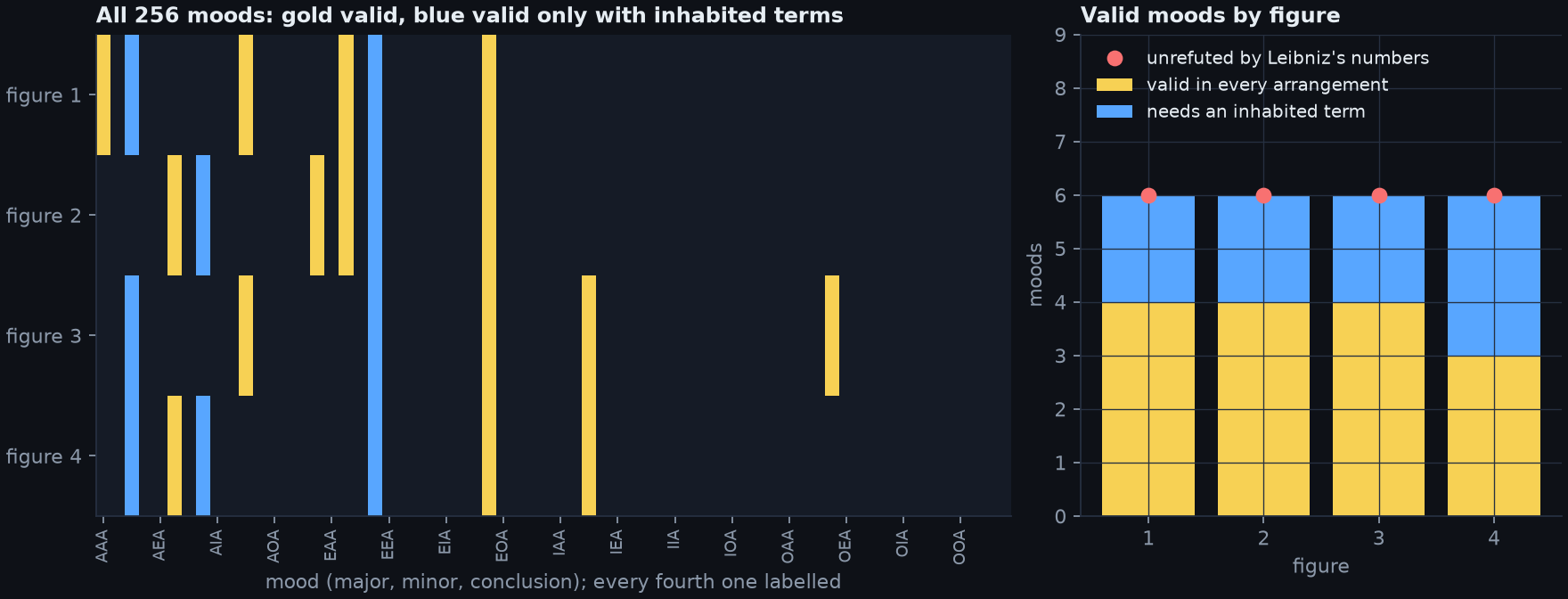
Check every mood against all 256 arrangements of the eight Venn regions, with and without the assumption that every term is inhabited, and compare the survivors with the moods that no assignment of Leibniz's characteristic numbers refutes.
python -m videos.philosophy.labs 1
needs numpy, scipy, matplotlib · download lab01.py ·
source on GitHubmoods 256 (4 figures x 4^3)
valid in every arrangement 15 by figure [4, 4, 4, 3] (the film: 15 = 4+4+4+3)
valid when S, M, P are inhabited 24 by figure [6, 6, 6, 6] (the film: 24)
the nine that need an inhabited term Barbari, Bramantip, Camenos, Camestros, Celaront, Cesaro, Darapti, Felapton, Fesapo
Darapti's countermodel 0 inhabited regions (the empty world)
unrefuted by Leibniz's numbers (primes 2, 3, 5) 24 same set as the 24: True
3000 random assignments over five primes traditional moods refuted 0 times; other moods refuted: 231 of 232
Region models and Leibniz's arithmetic agree mood for mood: the numbers have existential import built in, so they give the tradition's 24 and not the modern 15.The code (86 lines; it asserts its own result)
"""Lab 1: check all 256 syllogistic moods by Venn regions, then by Leibniz's characteristic numbers."""

import numpy as np

from videos.coursekit import labs
from explainer.philosophy.reasoner import syllogism as syl

TITLE = "The 256 moods, by regions and by numbers"
GOAL = ("Check every mood against all 256 arrangements of the eight Venn regions, with and without the assumption "
        "that every term is inhabited, and compare the survivors with the moods that no assignment of Leibniz's "
        "characteristic numbers refutes.")
TASKS = [
    "Require only the middle term M to be inhabited (filter syl.models() yourself). Which of the nine extra moods "
    "become valid, and which need S or P instead?",
    "Call syl.leibniz_countermodel(mood, primes=(2,)) for every mood. How many moods survive with one prime, and "
    "name one invalid mood that slips through.",
    "Add a fifth sentence form of your own to syl.holds (for example 'most x are y' on region counts) and recount "
    "the valid moods.",
]


def run(seed=0):
    rng = np.random.default_rng(seed)
    moods = syl.all_moods()
    boolean = [m for m in moods if syl.valid(m)]
    trad = [m for m in moods if syl.valid(m, existential=True)]
    leib = [m for m in moods if syl.leibniz_countermodel(m) is None]
    extra = [m for m in trad if m not in boolean]

    # A seeded spot check on a larger stock of numbers: random term numbers over the primes 2, 3, 5, 7, 11.
    pairs = syl.leibniz_pairs((2, 3, 5, 7, 11))
    trials, refuted_valid, refuted_invalid = 3000, 0, set()
    for _ in range(trials):
        val = dict(zip("SMP", (pairs[i] for i in rng.integers(len(pairs), size=3))))
        for m in moods:
            prem, concl = syl.premises(m)
            if all(syl.leibniz_holds(k, val[x], val[y]) for k, x, y in prem) and not syl.leibniz_holds(
                    concl[0], val["S"], val["P"]):
                if m in trad:
                    refuted_valid += 1
                else:
                    refuted_invalid.add(m)

    darapti = syl.countermodel((3, "AAI"))
    lab = labs.Lab()
    by = lambda ms: [sum(1 for f, _ in ms if f == k) for k in (1, 2, 3, 4)]  # noqa: E731
    lab.row("moods", f"{len(moods)}   (4 figures x 4^3)")
    lab.row("valid in every arrangement", f"{len(boolean)}   by figure {by(boolean)}   (the film: 15 = 4+4+4+3)")
    lab.row("valid when S, M, P are inhabited", f"{len(trad)}   by figure {by(trad)}   (the film: 24)")
    lab.row("the nine that need an inhabited term", ", ".join(sorted(syl.NAMES[m] for m in extra)))
    lab.row("Darapti's countermodel", f"{len(darapti)} inhabited regions (the empty world)")
    lab.row("unrefuted by Leibniz's numbers (primes 2, 3, 5)", f"{len(leib)}   same set as the 24: {set(leib) == set(trad)}")
    lab.row(f"{trials} random assignments over five primes",
            f"traditional moods refuted {refuted_valid} times; other moods refuted: {len(refuted_invalid)} of {256 - len(trad)}")
    lab.note = ("Region models and Leibniz's arithmetic agree mood for mood: the numbers have existential import "
                "built in, so they give the tradition's 24 and not the modern 15.")

    assert len(moods) == 256 and len(boolean) == 15 and by(boolean) == [4, 4, 4, 3]
    assert len(trad) == 24 and by(trad) == [6, 6, 6, 6] and set(trad) == set(syl.NAMES)
    assert set(boolean) < set(trad) and len(extra) == 9
    assert darapti == frozenset(), "the empty world refutes Darapti"
    assert set(leib) == set(trad), "Leibniz's numbers pick out exactly the traditional moods"
    assert refuted_valid == 0, "no assignment of numbers refutes a traditional mood"
    assert len(refuted_invalid) > 200, "random numbers refute most of the invalid moods"

    fig, ax = labs.figure(2, size=(11, 4.2), gridspec_kw={"width_ratios": [1.9, 1]})
    kinds = ["".join(t) for t in __import__("itertools").product("AEIO", repeat=3)]
    grid = np.zeros((4, 64))
    for f, k in moods:
        grid[f - 1, kinds.index(k)] = 2 if (f, k) in boolean else 1 if (f, k) in trad else 0
    from matplotlib.colors import ListedColormap

    ax[0].imshow(grid, aspect="auto", cmap=ListedColormap([labs.PANEL, labs.BLUE, labs.GOLD]), vmin=0, vmax=2)
    ax[0].set_xticks(range(0, 64, 4), [kinds[i] for i in range(0, 64, 4)], rotation=90, fontsize=8)
    ax[0].set_yticks(range(4), ["figure 1", "figure 2", "figure 3", "figure 4"])
    ax[0].grid(False)
    ax[0].set(title="All 256 moods: gold valid, blue valid only with inhabited terms",
              xlabel="mood (major, minor, conclusion); every fourth one labelled")
    x = np.arange(1, 5)
    ax[1].bar(x, by(boolean), color=labs.GOLD, label="valid in every arrangement")
    ax[1].bar(x, by(extra), bottom=by(boolean), color=labs.BLUE, label="needs an inhabited term")
    ax[1].plot(x, by(leib), "o", color=labs.RED, ms=7, label="unrefuted by Leibniz's numbers")
    ax[1].set(title="Valid moods by figure", xlabel="figure", ylabel="moods", xticks=x, ylim=(0, 9))
    ax[1].legend(loc="upper left")
    lab.fig = fig
    return lab
Now change it
- Require only the middle term M to be inhabited (filter syl.models() yourself). Which of the nine extra moods become valid, and which need S or P instead?
- Call syl.leibniz_countermodel(mood, primes=(2,)) for every mood. How many moods survive with one prime, and name one invalid mood that slips through.
- Add a fifth sentence form of your own to syl.holds (for example 'most x are y' on region counts) and recount the valid moods.
Problems, with solutions
Try each problem before opening its solution.
-
The divided line. Cut the unit line in the ratio k : 1: the parts are k/(1+k) and 1/(1+k). Cutting each again in the ratio k : 1, the lower piece of the first part is (k/(1+k))·(1/(1+k)), and the upper piece of the second is (1/(1+k))·(k/(1+k)). These are the same product, k/(1+k)², whatever k is.
-
Which term must be inhabited?
Solution
- Darapti (figure 3, AAI): all M are P, all M are S, so some S are P. It needs M inhabited: any M is then both S and P.
- Bramantip (figure 4, AAI): all P are M, all M are S, so some S are P. It needs P inhabited: any P is then M, hence S.
- The Reasoner confirms both: each mood's countermodel empties that term, and adding "that term is inhabited" to the premises makes the mood valid.
-
Barbara in Leibniz's numbers.
Solution
- "All M are P" means P⁺ | M⁺ and P⁻ | M⁻. "All S are M" means M⁺ | S⁺ and M⁻ | S⁻.
- Divisibility is transitive, so P⁺ | S⁺ and P⁻ | S⁻: all S are P.
- This holds for every assignment, not only those our search tried.
-
Llull's combinatorics.
Solution
- Sixteen principles need C(16, 2) = 120 chords.
- Four wheels of nine letters have 9⁴ = 6,561 settings.
-
Thomson's lamp.
Solution
- The story fixes the lamp's state only at times before t = 1, and in every interval before 1 the lamp is switched again. So no state before 1 is "the last".
- The sequence of states on, off, on, … has no limit, just as 1 − 1 + 1 − … has no sum.
- Any final state is consistent with everything the story says (Benacerraf 1962). The question "on or off?" has no answer the description determines.
-
(Essay) Is the Euthyphro dilemma a false dilemma? Strong answers:
Solution
- defend substitution failure, since "because" is hyperintensional and grounding claims track which name is used;
- or a modified divine command theory: Adams (1973) grounds the good in God's loving nature rather than in arbitrary will, which answers the arbitrariness horn;
- or Socrates' own exit.
Say what each costs.
Notes and sources
Sources
Books:
- Kenny, A New History of Western Philosophy, vol. 1;
- Kneale and Kneale, The Development of Logic;
- Łukasiewicz, Aristotle's Syllogistic from the Standpoint of Modern Formal Logic (2nd ed., 1957);
- Graham, Later Mohist Logic, Ethics and Science (1978) and Disputers of the Tao (1989);
- Ganeri (ed.), Indian Logic: A Reader (2001);
- Matilal, The Character of Logic in India (1998);
- Eco, The Search for the Perfect Language (1995);
- Bonner, The Art and Logic of Ramon Llull (2007).
Texts and papers:
- Plato, Euthyphro 10a–11b (trans. Grube), Meno 80d–86c (trans. Grube) and Republic VI 509d–511e and VII 514a (trans. Grube and Reeve);
- Aristotle, Prior Analytics I.2 (trans. Jenkinson) and Physics VI.9;
- Herodotus I.74;
- Popper, "Back to the Presocratics" (1958);
- Jaspers, Vom Ursprung und Ziel der Geschichte (1949);
- Thomson, "Tasks and Super-Tasks" (Analysis 1954);
- Benacerraf, "Tasks, Super-Tasks, and the Modern Eleatics" (J. Phil. 1962);
- Strawson, Introduction to Logical Theory (1952);
- Venn, "On the Diagrammatic and Mechanical Representation of Propositions and Reasonings" (1880);
- the Xiaoqu (trans. after Graham);
- Gongsun Long, Baima lun;
- the Nyāya Sūtra I.1.32–39;
- Llull, Ars brevis (1308);
- Leibniz:
- Dissertatio de arte combinatoria (1666);
- "Elementa calculi" and "De progressione dyadica" (1679);
- "On the General Characteristic" (trans. Loemker);
- The Art of Discovery (1685, trans. Wiener);
- "Explication de l'arithmétique binaire" (1703);
- Adams, "A Modified Divine Command Theory of Ethical Wrongness" (1973);
- Sotirov, "Arithmetizations of Syllogistic à la Leibniz" (J. Applied Non-Classical Logics 1999).
About this partfrom its README
The opening part of Philosophy, Built (series plan, syllabus). It follows Leibniz's dream, let us calculate, from its beginnings. It covers:
- the first philosophers and what an argument is;
- Zeno, Socrates and Plato;
- Aristotle's syllogistic, with all 256 moods checked by machine;
- Mohist, Nyāya and Stoic logic;
- Llull's combinatorial wheels;
- Leibniz's characteristic numbers and his reading of the Yijing as binary.
It introduces the series' devices: the Reasoner, the Wall (first brick: Zeno) and the Price List.
Every count and verdict on screen is computed by compute.py with the Reasoner
(explainer/philosophy/reasoner/syllogism.py and prop.py, tested in tests/philosophy/). In particular:
- the 256 moods are checked against all 256 arrangements of the eight Venn regions (15 valid, or 24 when every term is inhabited);
- Leibniz's two-number semantics is checked against all 19,683 assignments built from the primes 2, 3, 5, and the survivors are exactly the 24 traditional moods.
Quotations name their translations.
Chapter notes
| # | Scene | What it establishes | Computed on screen |
|---|---|---|---|
| 0 | Hook |
Leibniz's calculemus (1685); the unicorn syllogism, valid for the tradition and invalid for modern logic; the series map; the three devices; objectives. | — |
| 1 | Axial |
Greece, India and China, 800–200 BCE (Jaspers's disputed "Axial Age"); Thales; reasons instead of authorities; the Milesian tradition of criticism (Popper). | — |
| 2 | Argument |
premises and conclusion; validity and soundness; form; refutation by counterexample. | three arguments checked by the syllogism engine |
| 3 | Zeno |
Parmenides and Zeno; Achilles in exact fractions; the geometric series and the limit; Thomson's lamp (1954) and Benacerraf (1962); the first brick of the Wall. | the chase's stages and the meeting time 100/9 s |
| 4 | Euthyphro |
the dilemma (10a); Socrates' argument; a Price List of five claims; exits: Socrates, divine command, substitution failure. | the MUS (all five) and five MCSes |
| 5 | Meno |
Meno's paradox (80d); the slave boy doubles the square (82b–85b); recollection; innateness to inductive bias. | the squares of side 4, 3 and the diagonal (areas 16, 9, 8) |
| 6 | Line |
the divided line (509d); the cave (514a). | the two middle segments are equal for every ratio (exact fractions) |
| 7 | Categorical |
the Prior Analytics; variables for terms; A, E, I, O; Venn diagrams; the square of opposition. | — |
| 8 | Moods |
figures and moods; Venn regions as possible worlds; all 256 moods checked; the mnemonic names. | 15 Boolean-valid moods, by figure; a countermodel for the undistributed middle |
| 9 | Import |
the empty world refutes Darapti; existential import gives the 24 traditional moods; a Price List for the unicorns (modern logic, the tradition, Strawson's presupposition). | the empty countermodel; 24 = 15 + 9 |
| 10 | Mohists |
Mozi and the Later Mohists; bian; parallelizing inference and its failure (Xiaoqu: loving her brother is not loving a handsome man); Gongsun Long's white horse (identity vs inclusion). | — |
| 11 | Nyaya |
the five members; vyāpti; the kitchen and the lake; Dignāga's three marks (Part 15). | — |
| 12 | Arabic |
The translation movement from Alexandria through Syriac into Arabic; the Baghdad debate of 932; al-Fārābī on logic and grammar; Avicenna on modal and temporal syllogisms. | — |
| 13 | Llull |
the nine principles; the first figure's 36 chords; the fourth figure's three wheels (729 settings) and 84-column Table; Leibniz's De arte combinatoria (1666). | C(9,2) = 36, C(9,3) = 84, 9³ = 729 |
| 14 | Leibniz |
characteristic numbers (1679); divisibility for "all"; the two-number repair; Leibniz's arithmetic models the syllogism exactly (Łukasiewicz 1951; Sotirov 1999). | five sentences in illustrative numbers; all 256 moods against 19,683 assignments: exactly the 24 traditional moods survive |
| 15 | Yijing |
binary arithmetic (1679); Bouvet's diagram (1701); Shao Yong's order read as 0–63; what the correspondence does and does not show; omnibus ex nihilo ducendis sufficit unum. | the 64 hexagrams generated from their binary numerals |
| 16 | Limits |
De Morgan's relations; nested quantifiers; the split into Parts 2 and 3. | — |
| 17 | Outro |
recap; the Reasoner; the Wall; problems; payoffs; references. | — |
Companion material in this repository
The syllabus's plan for this partfrom SYLLABUS.md, the plan of record
- Cold open: Leibniz, 1685, "calculemus"; and a dispute settled by a computer on screen.
- The Axial Age: Thales, Confucius, the Buddha, Socrates, and the move from myth to argument. This chapter has the timeline strip's first lights.
- Arguments: premises, conclusion, validity, soundness; form vs content. The first
ArgumentMap. - Parmenides and Zeno: the dichotomy and Achilles. The sum Σ2⁻ⁿ = 1 resolves the arithmetic; the supertask question it leaves (Thomson's lamp) does not resolve.
- Socrates' elenchus: get an interlocutor to accept p₁ … pₙ, then show that they are jointly inconsistent. The Euthyphro dilemma is shown as an inconsistent set. This is the first Price List.
- Plato's Meno: the slave boy doubles the square (the √2 diagonal, drawn). Meno's paradox of inquiry, and recollection as Plato's answer.
- Plato's divided line and the cave, as a picture of levels of knowledge.
- Aristotle's syllogistic: the four forms A, E, I, O and the square of opposition. Existential import is the modern fix (shown as Venn diagrams).
- The 256 moods: we enumerate them all and find the 24 valid ones (15 unconditionally valid, plus 9 with existential import), checked by Venn regions and by brute-force models.
- Stoic and Mohist logic: Chrysippus's five indemonstrables; the Mohist canons and the School of Names ("a white horse is not a horse", read as identity vs predication).
- Indian logic's five-membered inference (Nyāya): thesis, reason, example, application, conclusion.
- Ramon Llull's Ars Magna (1305): concentric wheels generating every combination. Built as rotating circles.
- Leibniz's characteristic numbers (1679): concepts as primes. With man = 6 = 2 × 3 (animal × rational), "every A is B" becomes "B divides A". Built and tested on all the valid moods, with the cases where it fails.
- Leibniz and the Yijing (1703): the Fuxi ordering of the hexagrams read as binary 0–63.
- Why the dream needed two thousand more years: what Aristotle's logic cannot express (relations, "every horse's head is an animal's head", De Morgan's challenge).
- The plan of the series: the Reasoner, the Wall, the Price List; the series map.
- Recap and Problems.
Built: the syllogism engine (all 256 moods, exactly); Llull's wheels; Leibniz's prime encoding; the first Price List (Euthyphro). Wall: Zeno and the supertask problem. Meno's paradox, dissolved only by an account of inquiry. Visuals: Achilles's gap shrinking on a zooming number line; the square of opposition rotating into Venn regions; Llull's wheels turning; 64 hexagrams flipping into binary. References: Kenny vol. 1; Plato Euthyphro, Meno, Republic VI–VII; Aristotle Prior Analytics; Łukasiewicz, Aristotle's Syllogistic; Graham, Later Mohist Logic; Ganeri; Leibniz, Elements of a Calculus (1679), Explication de l'arithmétique binaire (1703).
中文讲义
本讲的中文部分(与英文版对应)。
习题与解答
-
线段的分割。 证明:如果一条线段按 \(k : 1\) 的比例分开,每一段又按同样的比例分开,那么中间的两段相等。
解答
把单位长线段按k∶1分割,两段为k/(1+k)和1/(1+k)。再把每段按k∶1分割,第一段的下半部分是(k/(1+k))·(1/(1+k)),第二段的上半 部分是(1/(1+k))·(k/(1+k))。两者是同一个乘积k/(1+k)²,与k无关。
-
哪个词项必须非空? 九个需要存在含义的式中,每一个都需要某个词项有成员。对 Darapti 和 Bramantip,分别是哪个词项?
解答
- Darapti(第三格AAI):所有M是P,所有M是S,所以有些S是P。它需要M非空:任一M既是S又是P。
- Bramantip(第四格AAI):所有P是M,所有M是S,所以有些S是P。它需要P非空:任一P是M,从而是S。
- 推理机证实了这两点:每个式的反模型都恰好把那个词项清空,而把“该词项非空”加入前提后,这个式就有效了。
-
莱布尼茨数字中的Barbara。
解答
- “所有M是P”即P⁺ | M⁺且P⁻ | M⁻;“所有S是M”即M⁺ | S⁺且M⁻ | S⁻。
- 整除具有传递性,所以P⁺ | S⁺且P⁻ | S⁻:所有S是P。
- 这对每一种赋数都成立,而不只是我们搜索过的那些。
-
柳利的组合数。 柳利的第一图把9个点两两相连。16条原理需要多少条弦?一台有四个9字母轮盘的机器有多少种设置?
解答
- 十六个原则需要C(16, 2) = 120条弦。
- 四个各有九个字母的转盘有9⁴ = 6561种设置。
-
汤姆森的灯。 汤姆森的灯:为什么 \(t = 1\) 之前的状态序列确定不了 \(t = 1\) 时的状态?
解答
- 故事只规定了t = 1之前各时刻灯的状态,而在1之前的每一段时间里灯都会再被切换一次,所以1之前没有“最后一个”状态。
- 状态序列“开、关、开……”没有极限,正如1 − 1 + 1 − ……没有和。
- 任何最终状态都与故事所说的一切相容(贝纳塞拉夫1962)。“开还是关?”这个问题,在描述所决定的范围内没有答案。
-
(论述题)游叙弗伦两难是假两难吗?
解答
好的回答可以:
- 为“替换失效”辩护:“因为”是超内涵的,根据关系会追踪所用的是哪个名称;
- 或者采用修正的神命论:亚当斯(1973)把善建立在上帝慈爱的本性上,而不是任意的意志上,从而回应“任意性”那一角;
- 或者采纳苏格拉底自己的出路。
并说明每条出路的代价。
Build the film
python -m videos.philosophy.philosophy1.compute        # the part's numbers, into .cache/philosophy1
python tools/build.py philosophy1                  # render and assemble the film
EXPLAINER_TTS=silent python tools/qa_scene.py philosophy1 Hook   # one chapter, silent, with a contact sheet
Scenes: videos/philosophy/philosophy1. Setup: see the course page. Source of these notes: the README and the scenes' narration.
Build it
python -m videos.philosophy.philosophy1.compute      # seconds; cached in .cache/philosophy1
python tools/build.py philosophy1 -q l               # 480p preview
python tools/build.py philosophy1                    # 1080p30