Chromatic Harmony
How can music reach a distant key in a single chord, and what makes that possible?
Four notes at the opening of Tristan und Isolde (1859) have been argued over for 160 years. They are the end of a road that starts with one borrowed note. A leading note borrowed from outside the key makes any chord a temporary home: these applied dominants fill about 9 beats in a hundred of Bach's major chorales. A major key borrows the minor's chords; the Neapolitan and the augmented sixths approach the dominant from outside the key, the sixths closing on it from both sides. The diminished seventh cuts the octave into four equal minor thirds, so any of its notes can be a leading note: one chord opens eight keys, and the three diminished sevenths share out all 24. The German sixth is a dominant seventh spelled another way, and leaving it as one falls through a trapdoor into the key a semitone up. These doors exist only in equal temperament: four pure minor thirds overshoot the octave by 62.6 cents, three pure major thirds fall 41.1 short. Smooth motion opens a second road, the chromatic mediants and Cohn's hexatonic cycle, six triads each a semitone of motion from the last. A breadth-first search over the 24 keys finds 11 one step from C with pivot chords alone and 19 with the doors; Lerdahl's chord distance turns each step into a number and a progression into a tension curve. The Tristan chord's four readings are four theories of harmony; as pitch classes it reaches its resolution with two semitones of motion, and the frontier treats harmony as a geometry of voice leading. The Tune is harmonized with borrowed chords, with the Neapolitan, and through a trapdoor into A flat.
What you need. Part 6 for commas and temperaments; Part 15 for keys, pivot chords and the probe-tone hierarchy; Part 17 for four-part voice leading; Part 18 for functions. Modular arithmetic and breadth-first search.
- Ideas, mathematics and history
- secondary dominants, mixture, the Neapolitan and augmented sixths, the diminished seventh as a four-way door, enharmonic modulation, the Tristan chord
- What we build, compute and hear
- a modulation pathfinder between any two keys; a tension curve
What you will be able to do
Foundations
- Spell and resolve applied dominants, the Neapolitan sixth and the three augmented sixths in any key.
- Resolve a diminished seventh to each of its eight keys, and hear an enharmonic modulation.
- Hear the difference between a predominant iv6, N6 and an augmented sixth.
Full course
- Compute the comma between stacks of pure thirds and the octave, and say why the doors need equal temperament.
- Search a graph of keys for the shortest modulation, with and without enharmonic doors.
- Compute Lerdahl's chord distance and a tension curve for a progression.
Research
- Describe the neo-Riemannian transformations and the voice-leading geometry of chords, and what they explain that keys do not.
- Compare the readings of the Tristan chord and the theories of harmony behind them.
Practice
- Reharmonize a melody with mixture, applied dominants and a chromatic mediant, keeping the voice leading clean.
- Use a diminished seventh or a German sixth to modulate to a distant key at the keyboard.
Contents
Each chapter has a home level. Choose a track to see what to read and watch: Foundations 20 min · Full course 31 min · Research 34 min · Practice 22 min.
- 0Four notes, and 160 yearsFoundations2 min
- 1One borrowed leading noteFoundations3 min
- 2Borrowing from the minorFoundations2 min
- 3The NeapolitanFoundations1 min
- 4Augmented sixthsFoundations2 min
- 5The diminished seventhFoundations2 min
- 6Enharmonic trapdoorsFoundations2 min
- 7The comma it hidesFull course3 min
- 8Chromatic mediantsPractice2 min
- 9The shortest way to any keyFull course3 min
- 10Measuring tensionFull course3 min
- 11Four readings of one chordFoundations2 min
- 12Frontier: extended tonalityResearch2 min
- Variation 19, recap and problemsAll tracks3 min
Also on this page: Lecture · Key results · Try it · Lab · Problems · Notes and sources · Build the film.
Lecture
The text of each chapter is the film's narration, as it is spoken, so you can read along or revise without the film. The pictures are in the film. A dashed box stands for a number the film computes when it is rendered (hover over it to see what is computed); the README's figures for each chapter, where it lists them, follow the chapter's text.
Four notes, and 160 yearsFoundations2 min
In 1865, in Munich, Richard Wagner's Tristan und Isolde reached the stage; its prelude had already puzzled concert audiences for six years. It begins with a single line in the cellos, and then a chord: F, B, D sharp, G sharp. The top note slides up, the chord moves to another, and the music stops. Then the whole thing again, a minor third higher. Listen.
That chord has been argued over for a century and a half. Four notes, and no key established. Theorists have called it a French sixth, a half-diminished seventh, an altered dominant, and no chord at all, only a moment in four moving lines. Each reading is a different theory of what harmony is. And every one of them starts from something small: a single note borrowed from outside the key, to lean on the note next door.
This part walks the road from one borrowed note to Tristan. First the borrowed leading notes and borrowed chords that Bach already used. Then the Neapolitan and the augmented sixths, characteristic chromatic approaches to a dominant. Then the diminished seventh, whose symmetry opens trapdoors to distant keys, and the comma those trapdoors hide, which pure thirds cannot close; equal temperament supplies exact symmetry. Then chromatic mediants, a program that finds the shortest way to any key, and a number for tension. And then back to the chord at the start.
1One borrowed leading noteFoundations3 min
How can any chord become a temporary home?
In common-practice major and harmonic-minor contexts, a leading note helps establish a tonic, the seventh degree a semitone below home. Now borrow one note from outside C major: F sharp. It sits a semitone below G, and leans on G exactly as B leans on C. Build D seven containing it: D, F sharp, A, C, and G becomes, for a moment, a home of its own. The chord is called five-seven of five, an applied or secondary dominant. Every major or minor chord in a key can be given one.
Here is a chain of them in C major. Each chosen chord is preceded by its own dominant: four by its dominant, five by its dominant, six, two, and at the end the real dominant leads home. Every pink chord borrows one or two notes from outside the key, and each lasts only a moment. The key never changes; it is lit from new angles.
Is the music in a new key when it borrows a leading note? Ask Part 15's key finder, the probe-tone correlation, to judge the chain two chords at a time. Each applied dominant and its target, heard alone, reads as the key they point to: F, then G, then A minor, then D minor. Heard whole, all eleven chords read as . Theorists call the brief kind tonicization: a chord made a home for a moment, inside a key that never changes. A modulation is a new key confirmed, usually by a cadence of its own. The difference is one of scale, and the key finder's window decides which one it sees.
How common are they in Bach's chorales? Count beats in major chorales whose chord is major, or a dominant seventh, on a degree where the key itself has a minor chord, or on the tonic with a seventh pointing to four. About beats in a hundred: the dominant of the dominant most of all, then the dominants of six and of two. Chromatic harmony did not begin with Wagner. It began inside the key, as a borrowed leading note, and by Bach's time it was routine.
2Borrowing from the minorFoundations2 min
What is mixture?
A second kind of borrowing takes whole chords. C major and C minor share a home, and Part 15 found they share four notes. So a piece in C major can borrow the chords of C minor: the minor four, the flat six, the flat seven, the flat three. The borrowed notes, E flat, A flat and B flat, pass over the major key like a shadow. Franz Schubert made this his signature: a major tune turning minor for a phrase, and back, the change of mode as an expression in itself.
Three borrowings, in C major. First the minor four between two home chords: the plagal Amen of chapter one of Part 18, darkened. Then flat six and flat seven rising to home, a progression film composers still reach for. Then flat three, which turns a cadence toward the minor before it closes in the major.
Did Bach borrow from the minor? Count the borrowed chords on the beats of his major chorales. beats in , less than one in a hundred, and most of those are flat seven chords in old modal tunes. Mixture long predates the nineteenth century, when many composers expanded its uses. But Bach borrowed the other way. Of his minor chorales that end on their tonic, of end on a major chord: the minor key's third raised at the last moment, a Picardy third. Hear a cadence in C minor twice, ending minor and then major.
One note changes, E flat to E natural, and the ending can suggest a change of mood in this stylistic context. The borrowing runs in both directions, and the direction says something about the style.
3The NeapolitanFoundations1 min
Why does a chord a semitone above home sound so dark?
Hear two cadences in C minor that differ in one chord. In which one is that chord further from home, A or B?
B. In A the second chord is the plain minor four. In B it is a D flat major chord, with its third in the bass: the Neapolitan sixth. Its D flat is a semitone above home, and from it the bass and upper voices fall onto the dominant with characteristic descending motion, including D flat toward C or B. The ear hears a chord from the far side of the key, and then the strongest pull back.
The chord is named after the opera composers of Naples, who used it in laments, though it is older than them. It is the major triad on the lowered second degree. It does the subdominant's job: in C minor, it is the minor four with D flat in place of C. And its D flat must find its way down to B, the leading note, either directly or through C in a cadential six-four; D flat to B is a diminished third. Beethoven, in the first movement of the Moonlight sonata, puts it at the point where the music is darkest.
4Augmented sixthsFoundations2 min
How can a chord aim at the dominant from both sides?
Take G, the dominant of C minor, and the two notes that lean on it hardest: A flat, a semitone above, and F sharp, a semitone below, borrowed from outside the key. Put A flat in the bass and F sharp above it, and they make an augmented sixth, which opens outward, both voices moving by a semitone, to an octave on G. It is a characteristic chromatic approach to the dominant: a pincer. Fill in the chord and it comes in three flavours, the Italian with C, the French with C and D, the German with C and E flat. The national names were given by later theorists, rather than securely documenting each chord’s national origin.
Here are all three in C minor, each between the home chord and the dominant. Listen to the outer voices spread apart onto the G's, and to the colour each flavour adds: the Italian bare, the French with a whole-tone ring, the German full and heavy.
The German sixth has a secret, which chapter six opens. Its four notes, A flat, C, E flat, F sharp, are on the piano exactly the notes of a dominant seventh chord, A flat, C, E flat, G flat. The same four keys can mean two different things.
The German sixth has a practical problem. Resolve it straight to the dominant and its bass and its E flat, a perfect fifth apart, both fall a semitone, to G and D: parallel fifths, the fault Part 16 explained. The usual cure is the one on the staff: a six-four chord between, the home chord over the dominant's bass, here in C major, so that E flat rises to E natural and the fifths disappear. Composers also simply let them sound, and textbooks call them Mozart fifths: a stylistically discussed exception rather than a universally accepted license.
5The diminished seventhFoundations2 min
How can one chord lead to eight keys?
In C minor, the chord on the leading note with its seventh is B, D, F, A flat, a diminished seventh. Put it on Part 12's clock of twelve notes. Its notes are three semitones apart all the way round: it cuts the octave into four equal parts, a square. Turn the square by three semitones and it lands on itself, so there are only three different diminished-seventh pitch-class sets in twelve-tone equal temperament. And because the chord is the same from every note, any of its four notes can be heard as the leading note. B leads to C; D to E flat; F to F sharp, written E sharp; A flat, written G sharp, to A. One chord, four tonics, and each can be major or minor: eight keys. And the three diminished sevenths between them reach all twenty-four keys, each exactly once.
Hear it. The same diminished seventh, four times, each time resolving to a different minor key: C minor, E flat minor, F sharp minor, A minor. A careful copyist spells it four ways, so that each time the leading note is a semitone below its tonic: B, D, F, A flat; D, F, A flat, C flat; E sharp, G sharp, B, D; G sharp, B, D, F. On the keyboard it is always the same four keys.
Composers learned to use this ambiguity as a door. Arrive on a diminished seventh in one key, and leave it as if it belonged to another. From Bach's chromatic fantasies to the storms of nineteenth-century opera, the diminished seventh was the chord of suspense, precisely because the listener cannot tell where it will go.
6Enharmonic trapdoorsFoundations2 min
How can one chord mean two things?
Two passages, both starting in C major. Their third chords are played on exactly the same four piano keys. One passage comes home to C. The other falls through a trapdoor. Which is which?
A stays home. Its third chord is a German sixth in C, A flat, C, E flat, F sharp, and it opens out onto G, the dominant, and home. B leaves. Its third chord is the same four keys, but heard as A flat, C, E flat, G flat: the dominant seventh of D flat. And it goes where a dominant seventh goes, to D flat major, a key with five flats, a semitone above where we started. One chord; two spellings; two destinations.
Here is the trick on the keyboard. On the left, the German sixth in C: its F sharp wants to rise to G, its A flat to fall to G. On the right, the same keys as a dominant seventh in D flat: the same black key is now G flat, which wants to fall to F, and the bass A flat wants to fall a fifth to D flat. On a keyboard tuned in equal temperament, F sharp and G flat are one key, so spelling alone cannot distinguish the sounds; preceding and following context can suggest their function. Music theorists call a chord like this a pivot by enharmonic reinterpretation. Composers called it a door.
There are other doors. The German sixth opens onto the key a semitone above. The diminished seventh of chapter five opens four ways, since each of its notes can be a leading note: to C, E flat, F sharp and A, four tonics a minor third apart, each major or minor. So from C, a composer can arrive in F sharp, the key furthest from C on the circle of fifths, in a single chord. Schubert, Liszt and Wagner used these doors constantly; Liszt's diminished sevenths, in the storms of his piano music, are doors left swinging.
7The comma it hidesFull course3 min
Do four minor thirds make an octave?
The diminished seventh is four minor thirds stacked up, and on the piano four minor thirds make exactly an octave. Does the ear agree? Here are four minor thirds climbing from C, and then the top note sounding with the C an octave above the start. Twice: first with pure minor thirds, then with the piano's equal ones. Which time do the two notes agree, the first or the second?
The second. With pure thirds, each of ratio six to five, four of them overshoot the octave by cents, more than half a semitone, and the two notes grind against each other about times a second. With the piano's thirds, each a quarter of an octave, the top note lands exactly on C.
So in pure tuning the stack does not close. Four pure minor thirds come to an octave and cents. Three pure major thirds, the augmented triad, fall cents short, a gap called the diesis. This is Part 6's lesson again: stacks of pure intervals never quite close the circle. The diminished seventh's perfect symmetry, four equal steps round the octave, exists only in equal temperament. Other circulating temperaments can also identify F sharp with G flat, though their thirds and these symmetries differ.
Here is what that means for singers. Suppose an unaccompanied choir tunes these local chords pure, without a fixed pitch reference, each major third in the ratio five to four. Let it sing chapter eight's cycle of chromatic mediants, C major, E major, A flat major, and home, each chord holding one note of the last. Three pure major thirds; and the C it comes home to is cents lower than the C it started on. Five laps, and the choir has sunk cents, about a whole tone, with every chord in tune. This is Part 6's comma pump, driven by chromatic harmony; real choirs compromise, tempering by ear.
This had consequences. On the meantone keyboards of the sixteenth and seventeenth centuries, G sharp and A flat were different notes, and only one of them could be played. Some instruments had split black keys, front for one, back for the other. The well temperaments of Bach's time, and then equal temperament, made them one key, and the enharmonic door opened. Singers and string players still tune by ear, and this particular locally pure, common-tone chain predicts drift unless the singers adjust or anchor their pitch: the comma comes back. Chromatic harmony is an idea that needs a tuning to make it possible.
8Chromatic mediantsPractice2 min
Can two chords be close without sharing a key?
The trapdoors relied on spelling. Another road to distant keys relies on smooth motion alone. Move from C major to E major, whose root is a major third above. E stays where it is; C slips down a semitone to B; G slips up to G sharp. E major has four sharps; it is not a chord of C major, and yet the move is as smooth as any in the key. Such pairs are called chromatic mediants. Do it again, E to A flat, and again, A flat to C: three major thirds go round the octave. Schubert and Liszt loved these moves, and film composers still use them when they want a sense of wonder.
There is a theory of these moves that ignores keys altogether. Call P the move from a major triad to the minor triad on the same root: one note, the third, moves by a semitone. Call L the leading-tone exchange: keep two notes and move the third by a semitone. C minor is C, E flat, G; raise G to A flat, and it is A flat major. Alternate them, P, L, P, L, and every step moves a single voice by a single semitone. After six steps you are back at C major, having passed through A flat and E major on the way. Richard Cohn called this the hexatonic cycle in 1996. The moves go back to Hugo Riemann in the 1880s, and their modern theory is called neo-Riemannian.
Hear both. First the cycle of major thirds, C, E, A flat, C. Then the hexatonic cycle, six chords and home. Watch the three upper bars: in the second, only one of them moves at each step, by a single semitone, while the bass simply follows the root.
Smooth voice leading can support this progression alongside tonal and stylistic expectations. A minimal step can carry the music into a chord outside the starting key, and its small voice motions can help connect the harmonies. This is the second idea of chromatic harmony: closeness measured in semitones of motion, not in shared scales.
9The shortest way to any keyFull course3 min
How many chords does it take to get from C to anywhere?
How far is any key from C, counted in chords? Turn the question into a program. Put the twenty-four keys on Part 15's circle, majors outside, minors inside, and join two keys by a step if a triad belongs to both under this chosen major/harmonic-minor vocabulary. Then search outward from C, breadth first, and record the fewest steps to every key. With only Part 15's pivot chords, triads shared by both keys, the neighbours of C are one step away, and the far side of the circle takes two. Now add this part's doors: the German sixth heard as a dominant seventh, the diminished seventh respelled, the Neapolitan heard as a chord of a new key. Almost every key is now a single chord away.
How does the search work? Keep a queue of keys, first in, first out, and start it with C major. Take the first key out; list every key one chord away that has not been seen yet; give each a distance one more than the key it came from, remember that parent, and put it at the back of the queue. From C, that finds keys at one step. Then each of those is taken out in turn, and finds the remaining at two. Because keys leave the queue in the order they were found, nearest first, the first route to reach a key is a shortest one; following the parents back gives the route. Each connection between keys is looked at once in each direction: of them with pivot chords. This is breadth-first search, and it finds shortest routes in any network whose steps all cost the same.
Count them. With pivot chords alone, keys are one step from C and need two. With the doors, are one step away, and only need two. Take F sharp major, the key furthest from C on the circle, with six sharps. With pivots, the shortest route goes through E minor. With the doors, the diminished seventh of C, respelled, lands there directly. This graph models selected harmonic reinterpretations, rather than the duration or perceptual certainty of a modulation.
10Measuring tensionFull course3 min
Can a number say how far a chord has gone?
In 2001 the composer and theorist Fred Lerdahl proposed a number for how far one chord is from another. It starts from what he called the basic space: five layers of notes, from the most important to the least. For the C major chord in the key of C: at the top, the root, C. Below it, root and fifth. Then the triad, C, E, G. Then the seven notes of the key. Then all twelve. This is a theoretical hierarchy related to tonal-hierarchy research, rather than a direct transcription of measured probe-tone ratings.
Now move to the G major chord, still in C. Its space has G at the top, G and D below, then G, B, D, and the same scale. Lerdahl's distance adds three counts. i: how many steps apart the two keys are on the circle of fifths; here none. j: how many steps apart the roots are; C to G is one. And k: how many notes in the new chord's space are not in the old one's, the pink cells; here . So C to G is . C to A minor is , C to D minor . And C major to F sharp major, in F sharp's own key, is : the whole width of the map.
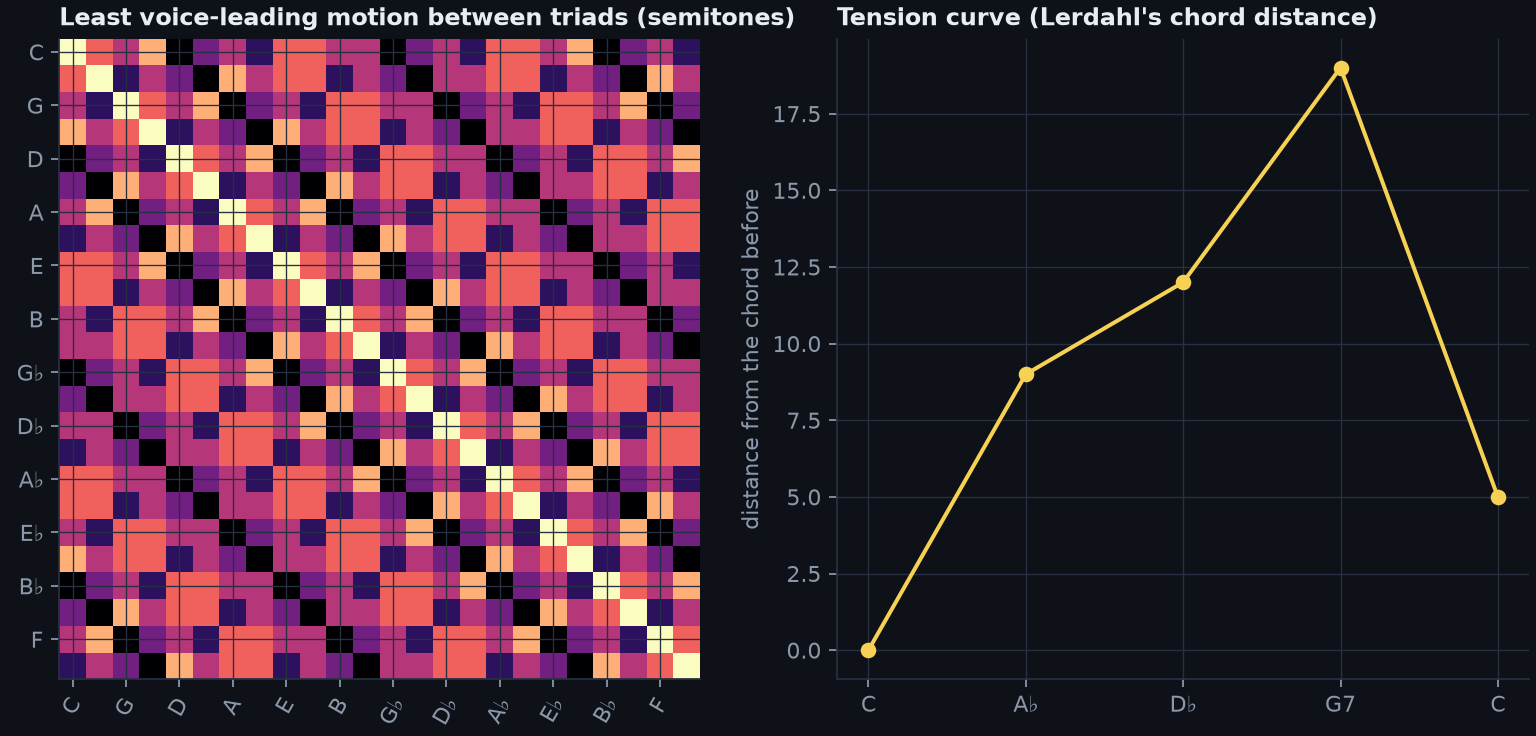
Score each chord by its distance from the one before, and a progression becomes a curve. Within the key, no step costs more than . Through mixture and the Neapolitan, the curve climbs to , as the D flat chord is followed by the dominant. Through the trapdoor, the single chord that changes the key costs , and then the new key settles at once. In 2007 Lerdahl and Krumhansl asked listeners to rate tension, moment by moment, in passages of tonal music, and found that a version of this model, with chords arranged in a tree rather than a chain, followed their ratings well.
Lerdahl's own model is subtler than a chain. It arranges the chords in a tree, each chord elaborating a more important one: here A minor prolongs the opening C, D minor prepares G seven, and G seven prepares the final C. A chord's tension is its distance from the chord it hangs from, plus the tension that chord already carries. So D minor, which costs only as a step from A minor, carries in the tree: its own distance from G seven, and G seven's from the end. Our chain model scores neighbours; this hand-assigned tree models phrase relationships, tension rising toward the cadence and draining away at the close. Building such trees automatically is Part 22's subject.
11Four readings of one chordFoundations2 min
What is the Tristan chord?
Back to the chord at the start of this part. Hear it once more, now that we have the words.
The second chord is easy. E, G sharp, B, D: a dominant seventh. It is the dominant of A minor, and the prelude never gives us A minor: each phrase stops on a dominant. The opera famously withholds a full resolution of this harmony until its final bars, hours later. The puzzle is the first chord.
Four readings, each a theory. First: a French sixth in A minor, F, B, D sharp, A, with G sharp an appoggiatura, a leaning note, that slides up to A; the chord then opens onto the dominant exactly as chapter four's sixths did. Second: as a sound, it is simply a half-diminished seventh, F, A flat, C flat, E flat respelled, the chord built on the second degree of E flat minor, as a pitch-class description; that alone does not settle its function. Third: an altered dominant of E, B, D sharp, F, A, the five-of-five with its fifth lowered. Fourth: Ernst Kurth, in 1920, emphasized linear motion and dynamic tension over a single functional label. It is a moment of pure tension, defined by the lines that pass through it, whose interaction helps shape its tension.
Kurth's reading points to where theory went next. Put the two chords on the clock of pitch classes. The best way to move from the first to the second: F falls to E, D sharp falls to D, and B and G sharp stay where they are. semitones in all. This is the minimum under our pitch-class assignment metric, which ignores register and actual voice identity. Whatever the first chord is called, the way it moves is a fact we can measure. That is the idea of the last chapter: harmony as voice leading.
12Frontier: extended tonalityResearch2 min
Is chromatic harmony a geometry?
Measure every pair of the twenty-four major and minor triads by the least motion that carries one onto the other, and lay them out in circle-of-fifths order. Bright cells are close, dark cells far. pairs are a single semitone apart: exactly the P and L moves of chapter eight. more are two semitones apart. Near the diagonal, the chords are close in key. But there are bright cells far from the diagonal: chords from distant keys that are next to each other in motion. That is the space chromatic harmony explores.
The idea is older than it looks. In 1853 Carl Friedrich Weitzmann noticed that the augmented triad sits a semitone from six different major and minor triads, a hub for chromatic moves. In the 1880s Hugo Riemann described harmony as transformations between triads. In 1996 Richard Cohn revived those transformations and found the hexatonic cycles, and his 2012 book Audacious Euphony applied them to Schubert, Liszt and Wagner. In 2006 Dmitri Tymoczko, in the journal Science, placed every chord as a point in a geometric space of voicings, with voice leadings as paths. In that space, chords that divide the octave nearly evenly sit near the centre, with short paths to many others. The major triad and the dominant seventh are nearly even, a geometric property that complements, without establishing the historical causes of, their tonal roles: they can always move smoothly somewhere.
And the questions now. Corpus studies measure, piece by piece, how far the harmony strays from a single key. Some selected corpora show rising chromaticism across those eras; results depend on repertoire and measure, and Part 27 builds such an index itself. In film music, Frank Lehman's 2018 book Hollywood Harmony traces chromatic mediants used for wonder, and the hexatonic pole, a major triad and the minor triad a major third below, with no common tones, used for menace. And the open question: is this music best described as a grammar, the subject of Part 22, or as a geometry of smooth motion, or both at once?
Variation 19, recap and problemsAll tracks3 min
Every part ends by doing something to the Tune with what it has built. This part built chromatic harmony. So the Tune's two phrases are harmonized three times. First in C major, with borrowed chords from the minor and applied dominants. Then in C minor, with an applied dominant and the Neapolitan before the cadence. And last, a phrase in C that slips through a diminished seventh and comes out in A flat major, four keys away, carrying the Tune with it.
Row nineteen of the ledger. seconds. The measurement: twenty-four chords, of them outside C major, one phrase carried four keys away, and still not one pair of parallel fifths or octaves. The voice leading of Part 17 holds even here.
What did we find? A single borrowed leading note makes any chord a temporary home, and Bach did it on about beats in a hundred. A major key can borrow the minor's chords. The Neapolitan and the augmented sixths approach the dominant from outside the key. The diminished seventh can lead to eight keys, and the German sixth is a dominant seventh in disguise. Their equal-step symmetry is exact in equal temperament; other circulating tunings also allow enharmonic reinterpretation, while the specified pure-third cycles fail to close. And smooth motion opens another road, the chromatic mediants; with all the doors, of the twenty-three other keys are one chord from C, and Lerdahl's distance turns each step into a number.
Five problems. One to compute, one to prove, one for your ears, one to build, and a research problem, marked with a star. Solutions are in this part's notes. Pause here.
Where does this come back? In form, where a journey between keys is the drama. In analysis, which asks whether this is a grammar. In the Romantic century, where we measure chromaticism across two hundred years. In the new scales of the twentieth century, built from the symmetry of the diminished seventh and the augmented triad. In jazz, whose tritone substitution is the German sixth's trick again. And in film music.
And in practice. Pianists learn the three diminished sevenths and their resolutions. Songwriters borrow the minor four and flat six for a shadow over a major chorus. Arrangers approach a cadence through the Neapolitan or a German sixth. And film composers move by chromatic mediants when they want a new world.
The books and papers this part follows. The full list, with notes, is in the README.
Where it goes next. Canon and fugue in Part 20; form as a journey between keys in Part 21; grammars of harmony in Part 22; the Romantic century's chromaticism in Part 27; symmetric scales in Part 28; blues and jazz reharmonization in Parts 38 and 39; film music in Part 44.
Key results
The part's results in one place, for revision.
Try it
Lab 19 · Chromatic harmony, computed
Find the keys a diminished seventh can open, check that the German sixth is a dominant seventh in disguise, measure the comma the trapdoors hide, search for the shortest modulation between keys, score a progression's tension, map the voice leading between all triads, and name predominants by ear.
python -m videos.music.labs 19
needs numpy, scipy, matplotlib · download lab19.py ·
source on GitHubdiminished seventh B-D-F-A♭ C minor, C major, E♭ minor, E♭ major, F♯ minor, F♯ major, A minor, A major
diminished seventh C-E♭-F♯-A D♭ minor, D♭ major, E minor, E major, G minor, G major, B♭ minor, B♭ major
diminished seventh D♭-E-G-B♭ D minor, D major, F minor, F major, A♭ minor, A♭ major, B minor, B major
keys reached, and how many times each 24 keys, each {1} time(s)
augmented sixths in C minor Italian: A♭ C F♯; French: A♭ C D F♯; German: A♭ C E♭ F♯
German sixth = dominant seventh on the flat sixth degree? True (resolves to D♭ as a dominant)
four pure minor thirds against the octave (cents) +62.6
three pure major thirds against the octave (cents) -41.1
twelve pure fifths against seven octaves (cents) +23.5
C major to F♯ major, pivot chords only 2 step(s): C major > E minor (a shared triad); E minor > F♯ major (a shared triad)
C major to F♯ major, with the doors 1 step(s): C major > F♯ major (a diminished seventh, respelled)
keys 1 and 2 steps away: pivots / with doors [11, 12] / [19, 4]
tension curve (distance from the chord before) 0, 9, 12, 19, 5
Lerdahl's distances: I-V, I-vi, I-ii 5, 7, 8
pairs of triads 1, 2, 3 semitones of motion apart 24, 60, 84
the hexatonic cycle from C C > Cm > A♭ > A♭m > E > Em > C
ear problem, the chord before V in each cadence (listen first) German; French; Italian; N6; N6; iv6; iv6; iv6; iv6; German
The three diminished sevenths share out all 24 keys; the German sixth is a dominant seventh spelled another way; the doors put almost every key one chord from home, but only in equal temperament, where four minor thirds make an octave; and the triads nearest in motion are often far apart in key.The code (115 lines; it asserts its own result)
"""Lab 19: chromatic harmony computed: the three diminished sevenths and the keys they open, augmented sixths and
their enharmonic twins, the comma behind the trapdoors, a pathfinder between keys, Lerdahl's tension, the
voice-leading map of the triads, and predominants by ear."""

from fractions import Fraction

import numpy as np

from videos.coursekit import labs
from explainer.music.monochord import Clip, concat
from explainer.music.monochord import chords as CH
from explainer.music.monochord import chromatic as X
from explainer.music.monochord.partkit import organ_tone

TITLE = "Chromatic harmony, computed"
GOAL = ("Find the keys a diminished seventh can open, check that the German sixth is a dominant seventh in disguise, "
        "measure the comma the trapdoors hide, search for the shortest modulation between keys, score a progression's "
        "tension, map the voice leading between all triads, and name predominants by ear.")
TASKS = [
    "Set START and TARGET to two keys of your own. How many steps with pivot chords only, and with the doors? Which door does the route use?",
    "Write a PROGRESSION of your own as (root, kind, key) triples and read its tension curve. Where does it peak, and why?",
    "Change TONIC. Is the German sixth always the dominant seventh of the key a semitone above the tonic?",
]
TONIC = 0                                            # the key for the augmented sixths (C)
START, TARGET = (0, "major"), (6, "major")           # C major to F sharp major
PROGRESSION = [(0, "major", (0, "major")), (8, "major", (0, "major")), (1, "major", (5, "minor")),
               (7, "7", (0, "major")), (0, "major", (0, "major"))]
SR = 48_000


def run(seed=0):
    rng = np.random.default_rng(seed)
    lab = labs.Lab()

    # 1. the three diminished sevenths divide the 24 keys among them
    seen = {}
    for root in (11, 0, 1):                                      # B, C, C♯: the three different chords
        d = X.dim7(root)
        keys = [r["key"] for r in X.dim7_resolutions(d)]
        lab.row(f"diminished seventh {'-'.join(X.NAMES[p] for p in d)}", ",  ".join(X.key_name(k) for k in keys))
        for k in keys:
            seen[k] = seen.get(k, 0) + 1
    lab.row("keys reached, and how many times each", f"{len(seen)} keys, each {set(seen.values())} time(s)")
    assert len(seen) == 24 and set(seen.values()) == {1}

    # 2. augmented sixths, and the German sixth as a dominant seventh
    six = X.augmented_sixths(TONIC)
    lab.row(f"augmented sixths in {X.key_name((TONIC, 'minor'))}", ";  ".join(f"{n}: {' '.join(X.NAMES[p] for p in pcs)}" for n, pcs in six.items()))
    ger = set(six["German"])
    dom = set(X.triad((TONIC + 8) % 12, "7"))
    lab.row("German sixth = dominant seventh on the flat sixth degree?", f"{ger == dom}  (resolves to {X.NAMES[(TONIC + 1) % 12]} as a dominant)")

    # 3. the comma behind the doors
    lab.row("four pure minor thirds against the octave (cents)", f"{X.pure_cycle(Fraction(6, 5), 4):+.1f}")
    lab.row("three pure major thirds against the octave (cents)", f"{X.pure_cycle(Fraction(5, 4), 3):+.1f}")
    lab.row("twelve pure fifths against seven octaves (cents)", f"{X.pure_cycle(Fraction(3, 2), 12):+.1f}")

    # 4. the pathfinder
    for chrom in (False, True):
        d = X.distances(START, chrom)
        route = d["routes"][TARGET]
        lab.row(f"{X.key_name(START)} to {X.key_name(TARGET)}, {'with the doors' if chrom else 'pivot chords only'}",
                f"{d['dist'][TARGET]} step(s): " + ";  ".join(f"{X.key_name(a)} > {X.key_name(b)} ({how})" for a, b, how in route))
    cnt = {c: np.bincount(list(X.distances(START, c)["dist"].values()), minlength=3)[1:].tolist() for c in (False, True)}
    lab.row("keys 1 and 2 steps away: pivots / with doors", f"{cnt[False]} / {cnt[True]}")

    # 5. tension
    t = X.tension_curve(PROGRESSION)
    lab.row("tension curve (distance from the chord before)", ",  ".join(str(x) for x in t))
    lab.row("Lerdahl's distances: I-V, I-vi, I-ii", ",  ".join(str(X.chord_distance((0, "major", (0, "major")), (r, k, (0, "major")))) for r, k in ((7, "major"), (9, "minor"), (2, "minor"))))

    # 6. the voice-leading map of the 24 triads, in circle-of-fifths order
    order = []
    for k in range(12):
        r = (7 * k) % 12
        order += [(r, "major"), ((r + 9) % 12, "minor")]
    m = np.array([[X.voice_leading(X.triad(*a), X.triad(*b))["cost"] for b in order] for a in order])
    lab.row("pairs of triads 1, 2, 3 semitones of motion apart", ",  ".join(str(int((m == v).sum() // 2)) for v in (1, 2, 3)))
    hexa = X.hexatonic((0, "major"))
    lab.row("the hexatonic cycle from C", " > ".join(CH.triad_name(x) for x in hexa))

    # 7. Problem 3, for the ear: ten cadences in C minor, the chord before V to be named
    kinds = {"iv6": [(56, 60, 65, 72)], "N6": [(53, 61, 65, 68)], "Italian": [(56, 60, 66, 72)],
             "French": [(56, 62, 66, 72)], "German": [(56, 60, 63, 66)]}
    tonic, dom7 = (48, 55, 63, 72), (43, 59, 65, 74)
    answers, clips = [], []
    for _ in range(10):
        kind = list(kinds)[int(rng.integers(0, len(kinds)))]
        y = np.zeros(int(4.6 * SR))
        for j, ch in enumerate([tonic, kinds[kind][0], dom7, tonic]):
            tone = sum(organ_tone(CH.hz(n), 1.05, partials=6, rolloff=0.7, decay=1.2) for n in ch)
            i = int(j * 1.0 * SR)
            y[i:i + len(tone)] += tone[: len(y) - i]
        clips.append(Clip(y, SR).fade(0.01, 0.2).at_level(-20.0))
        answers.append(kind)
    lab.audio = concat(clips, gap=1.0)
    lab.row("ear problem, the chord before V in each cadence (listen first)", ";  ".join(answers))

    fig, (a, b) = labs.figure(2)
    a.imshow(m, cmap="magma_r")
    a.set_xticks(range(0, 24, 2))
    a.set_xticklabels([CH.triad_name(order[k]) for k in range(0, 24, 2)], rotation=60)
    a.set_yticks(range(0, 24, 2))
    a.set_yticklabels([CH.triad_name(order[k]) for k in range(0, 24, 2)])
    a.set_title("Least voice-leading motion between triads (semitones)")
    b.plot(range(len(t)), t, "o-", color=labs.GOLD)
    b.set_xticks(range(len(t)))
    b.set_xticklabels([f"{X.NAMES[r]}{'m' if k == 'minor' else ('7' if k == '7' else '')}" for r, k, _ in PROGRESSION])
    b.set_ylabel("distance from the chord before")
    b.set_title("Tension curve (Lerdahl's chord distance)")
    lab.fig = fig
    lab.note = ("The three diminished sevenths share out all 24 keys; the German sixth is a dominant seventh spelled "
                "another way; the doors put almost every key one chord from home, but only in equal temperament, "
                "where four minor thirds make an octave; and the triads nearest in motion are often far apart in key.")
    return lab
Now change it
- Set START and TARGET to two keys of your own. How many steps with pivot chords only, and with the doors? Which door does the route use?
- Write a PROGRESSION of your own as (root, kind, key) triples and read its tension curve. Where does it peak, and why?
- Change TONIC. Is the German sixth always the dominant seventh of the key a semitone above the tonic?
Problems, with solutions
Try each problem before opening its solution.
-
Compute. Spell the diminished seventh on G♯ four ways, and resolve each to its tonic in four voices.
Solution
G♯ B D F resolves to A (major or minor): G♯→A, B→A or C, D→C♯ or C, F→E. Respelled as B D F A♭ it is vii°7 of C; as D F A♭ C♭, of E♭; as E♯ G♯ B D, of F♯. In each case the root of the spelling is the leading note and rises a semitone; the seventh falls a semitone; the other two voices move to the nearest notes of the tonic triad, which usually doubles the third in the resolution.
-
Prove. Prove that a chord which divides the octave into equal parts has as many distinct transpositions as its step, and count them for the augmented triad and the diminished seventh.
Solution
A chord whose notes are 0, s, 2s, … (mod 12), with s dividing 12, is mapped to itself by transposition by s. Transposing by t gives the same set exactly when t is a multiple of s, so the transpositions 0, 1, …, s − 1 give distinct sets and every other transposition repeats one of them: there are s. The augmented triad (s = 4) has four transpositions, the diminished seventh (s = 3) three, the tritone (s = 6) six.
-
Ear. The lab plays ten cadences in C minor. For each, name the chord before V: iv6, N6, or an augmented sixth (which?).
Solution
The lab prints the answers. iv6 is F minor over A♭ in the bass; N6 is D♭ major over F, darker, its D♭ falling by a diminished third to B; the augmented sixths have A♭ in the bass and F♯ above it, the outer voices opening to an octave on G; the French adds the whole-tone colour of D, the German the fuller sound of E♭ (and its parallel fifths with G, which composers often hide behind a 6/4).
-
Build. Give the pathfinder a cost for each kind of step, and find the cheapest route from C to every key. Which keys change their route?
Where to look. Replace the breadth-first search in
chromatic.distancesby Dijkstra's algorithm with a cost for each kind of edge (for example, a shared triad 1, a German sixth 2, a diminished seventh 2, a Neapolitan 3). Keys reached by a door in one step but by pivots in two, such as A♭ major or D♭ major, change when a door costs more than two pivots. A cost model is a theory of how surprising each modulation is, and could be fitted to a corpus. -
★ A measure of chromaticism. Design a corpus measure of chromaticism that a listener would agree with, and say how you would test it.
Where the frontier is. Simple measures count notes outside the key, the variety of keys, or how evenly the twelve pitch classes are used in a window; each misjudges something (a chromatic passing note is not a modulation; an enharmonic trapdoor uses few chromatic notes). A test would ask listeners to rate how far from home passages sound, and compare the ratings with each measure, controlling for tempo and texture. Lerdahl and Krumhansl's tension studies and the corpus studies of tonal complexity are the starting points.
Notes and sources
Sources
- Wagner, Tristan und Isolde (1859; Munich, 1865), prelude, bars 1–7, reduced.
- S. G. Laitz, The Complete Musician (4th ed., 2015); E. Aldwell and C. Schachter, Harmony and Voice Leading (4th ed., 2011): applied chords, mixture, the Neapolitan, augmented sixths, enharmonic modulation.
- F. Lerdahl, Tonal Pitch Space (2001); F. Lerdahl and C. L. Krumhansl, "Modeling tonal tension", Music Perception 24 (2007).
- R. Cohn, "Maximally smooth cycles, hexatonic systems, and the analysis of late-Romantic triadic progressions", Music Analysis 15 (1996); Audacious Euphony (2012).
- D. Tymoczko, "The geometry of musical chords", Science 313 (2006); A Geometry of Music (2011).
- C. F. Weitzmann, Der übermässige Dreiklang (1853); H. Riemann, Vereinfachte Harmonielehre (1893).
- E. Kurth, Romantische Harmonik und ihre Krise in Wagners Tristan (1920).
- F. Lehman, Hollywood Harmony (2018).
- Part 6 for the commas; Part 15 for keys and pivot chords; Part 17 for the chorales and voice leading.
About this partfrom its README
Part 19 of a sixty-eight-part course in music (see the series plan and
the syllabus), the fourth part of Act III. Part 18 measured the syntax of harmony inside a key;
this part leaves the key. It starts from the opening of Tristan und Isolde and walks the road that leads there:
borrowed leading notes and borrowed chords, the Neapolitan and the augmented sixths, the diminished seventh's
symmetry and the enharmonic trapdoors it opens, the comma those trapdoors hide, chromatic mediants and the
hexatonic cycle; then it builds a pathfinder between keys and a tension measure from Lerdahl's tonal pitch space,
and returns to the four readings of the Tristan chord. The chromatic toolkit is Monochord's
(explainer/music/monochord/chromatic.py); Bach's counts come from Part 17's chorales
(explainer/music/monochord/chorales.py); every example is realized in four voices in compute.py and played on
Part 7's piano. Published findings are the ones listed under Sources.
- Four notes, and 160 years. Tristan und Isolde (1859, staged 1865): the opening chord and its resolution, twice, heard; four readings; the plan.
- 1. One borrowed leading note. F♯ leans on G as B leans on C: V7 of V; a chain of applied dominants in C, heard; Part 15's key finder two chords at a time hears F, G, A minor, D minor, the whole passage C major (tonicization against modulation); in Bach's major chorales, a major chord or dominant seventh where the key has a minor chord (or a seventh on the tonic) on 934 of 10,014 beats, 9 in a hundred: II most of all (263, and 168 with a seventh).
- 2. Borrowing from the minor. Mixture: iv, ♭VI, ♭VII and ♭III in C major, heard; Schubert's major and minor; Bach's major chorales borrow on only 70 of 10,014 beats (54 of them ♭VII), but 105 of the 116 minor chorales that end on their tonic end on a major chord: the Picardy third, heard.
- 3. The Neapolitan. An ear question (i–iv6–V7–i against i–N6–V7–i: which chord is further from home?); ♭II as a predominant; the diminished third D♭–B; Beethoven's Moonlight sonata.
- 4. Augmented sixths. A♭ and F♯ closing on G from both sides; the Italian, French and German sixths in C minor, heard; the German sixth sounds like a dominant seventh; its parallel fifths into V, the cadential 6/4 that avoids them, and Mozart fifths.
- 5. The diminished seventh. B D F A♭ on the twelve-note clock: a square, only three such chords; one chord resolved to C, E♭, F♯ and A minor, heard; spelled four ways.
- 6. Enharmonic trapdoors. An ear question (the same third chord twice: which passage leaves C?): a German sixth resolving home, and the same keys as the dominant seventh of D♭; F♯ = G♭ on the keyboard; doors from C to E♭, F♯ and A in a single chord.
- 7. The comma it hides. An ear question (four minor thirds and the octave, pure then equal: which agree?): four pure minor thirds overshoot the octave by 62.6 cents and beat at about 10 Hz against it; three pure major thirds fall 41.1 cents short (the diesis); a choir singing C, E, A♭, C in pure thirds sinks 41.1 cents a lap, 205 in five; meantone's G♯ and A♭, split keys, well and equal temperament.
- 8. Chromatic mediants. C to E to A♭ to C, one note held and two moving by a semitone; P and L; the hexatonic cycle (Cohn 1996), every step one semitone of motion; both heard.
- 9. The shortest way to any key. Breadth-first search on 24 keys, step by step (312 connections with pivots): with pivot chords only, 11 keys one step from C and 12 two steps; with the German sixth, the diminished seventh and the Neapolitan as doors, 19 one step and 4 two; C to F♯ major through E minor, or directly by a respelled diminished seventh.
- 10. Measuring tension. Lerdahl's basic space (2001); δ = i + j + k; C to G 5, to A minor 7, to D minor 8, C major to F♯ major 23; tension curves within the key (at most 7), through mixture and the Neapolitan (up to 19) and through a trapdoor (18 at the turn); Lerdahl and Krumhansl (2007); tension on a tree: D minor costs 5 as a step but carries 10 hanging from G7 and the final C.
- 11. Four readings of one chord. The Tristan opening again; a French sixth with an appoggiatura, a half-diminished seventh, an altered dominant, Kurth's chord of pure tension (1920); as pitch classes it reaches the dominant seventh E G♯ B D with two semitones of motion.
- 12. Frontier: extended tonality. The least voice-leading distance between all 24 triads (24 pairs one semitone apart: P and L; 60 two apart); Weitzmann (1853), Riemann, Cohn (1996, 2012), Tymoczko (2006); corpus measures of chromaticism; film music (Lehman 2018). ★ research problem: a chromaticism measure listeners agree with.
- Variation 19, recap and problems. The Tune's two phrases with mixture and applied dominants, in minor with the Neapolitan, and through a diminished-seventh trapdoor into A♭; the ledger; what we found; five problems; where it comes back; in practice; references; Part 20.
What is computed and built
python -m videos.music.music19.compute (about a minute) fills .cache/music19/.
| Item | What it computes | Checked against |
|---|---|---|
hook |
the Tristan opening reduced to its harmony, twice | — |
applied |
a chain of applied dominants; applied-dominant beats in Bach's major chorales | — |
mixture |
iv; ♭VI–♭VII; ♭III in C major | — |
neapolitan |
i–iv6–V7–i and i–N6–V7–i in C minor | — |
sixths |
the Italian, French and German sixths in C minor, each to V | chromatic.augmented_sixths |
dim7 |
one diminished seventh resolved to four minor keys | chromatic.dim7_resolutions (eight keys) |
trapdoor |
a German sixth to C, and the same keys to D♭ | chromatic.german_as_dominant |
comma |
pure and equal minor thirds against the octave (organ tones) | chromatic.enharmonic_drift |
mediants |
major-third cycle; the hexatonic cycle | each hexatonic step one semitone |
paths |
fewest steps from C to every key, with and without the doors | breadth-first search |
tension |
Lerdahl's distance; three tension curves | Lerdahl's worked values (I–V 5) |
tristan |
the four readings; the least voice leading to the resolution | — |
tune |
Variation 19 | every chord holds the Tune's note; no parallels |
Monochord's chromatic toolkit is held in tests/music/test_chromatic.py; this part's claims and clips in
tests/music/test_music19.py.
Sounds. Part 7's piano (a struck string through the soundboard, physical model) in twelve-tone equal
temperament, except chapter 7's pure and equal thirds, which are organ tones synthesized at exact frequencies.
There are no recordings.
What the models are, and are not. The Tristan excerpt is reduced to its harmony, four voices, with the cello's opening line omitted; it is a reduction, not a performance. Applied dominants in Bach are counted from Part 17's beat labels: a major triad or dominant seventh on a degree where the key itself has a minor chord, or a seventh on the tonic; a few such chords are borrowings or passing chords rather than applied dominants. The pathfinder's steps are a simplification: one step is any single chord that can belong to both keys, either as a shared triad or through one of the three doors; real modulations take several chords, and composers weigh steps unequally (problem 4). Lerdahl's distance is implemented in its chord-to-chord form, with chords placed in keys by hand; his full model measures tension on a prolongational tree, which this part does not build (Part 22 builds trees). The frontier's corpus and perception findings are summarized from the publications, not recomputed.
NotesScope of the demonstrations
The chord and key graphs use twelve equal-tempered pitch classes and a selected major/harmonic-minor triad vocabulary, with a major III substituted in minor. An edge is an allowed reinterpretation, not measured modulation duration or certainty. Three diminished-seventh sets and eight destinations per set describe that model; context affects what listeners expect.
In C minor the Neapolitan replaces C in F–A-flat–C with D-flat. D-flat can resolve directly to B or pass through C in a cadential six-four. The displayed German-sixth remedy uses a major cadential six-four (E-flat rises to E-natural); a minor six-four can retain E-flat before D.
Equal temperament makes the diminished seventh exactly symmetric. Other circulating temperaments also identify enharmonic keyboard notes, with different interval tradeoffs. The pure-third comma pump assumes a locally pure, common-tone chain without an external pitch anchor; real ensembles can adjust. Mixture predates the nineteenth century.
The tension curves and hand-assigned hierarchy are teaching simplifications of tonal pitch space, not listener measurements or the full Lerdahl model. Minimum pitch-class voice-leading cost ignores register and actual voice identity. Historical readings of Tristan remain interpretations; a sonority label alone does not establish harmonic function.
Companion material in this repository
The syllabus's plan for this partfrom SYLLABUS.md, the plan of record
- Hook: the Tristan opening reduced and heard, twice; four readings; the plan.
- One borrowed leading note: V7 of V; a chain of applied dominants heard; how often Bach uses them.
- Borrowing from the minor: mixture in C major, heard.
- The Neapolitan: an ear question (iv6 or N6); the predominant a semitone above home.
- Augmented sixths: the pincer onto the dominant; Italian, French and German heard.
- The diminished seventh: the square on the clock; one chord resolved to four keys, heard.
- Enharmonic trapdoors: an ear question (which passage leaves C?); F♯ = G♭; doors to distant keys.
- The comma it hides: an ear question (pure or equal minor thirds against the octave); the diesis; meantone's split keys.
- Chromatic mediants: P, L and the hexatonic cycle, heard.
- The shortest way to any key: a pathfinder over 24 keys, with and without the doors.
- Measuring tension: Lerdahl's basic space and chord distance; three tension curves.
- Four readings of one chord: the Tristan chord again; its voice leading measured.
- Frontier: the voice-leading map of all triads; Weitzmann, Riemann, Cohn, Tymoczko; corpus chromaticism; film.
- Variation 19: the Tune with mixture, with the Neapolitan, through a trapdoor. Outro: problems, payoffs.
Covers: secondary dominants; mixture; the Neapolitan; augmented sixths; the diminished seventh's symmetry;
enharmonic reinterpretation and the comma it hides; chromatic mediants and neo-Riemannian transformations; altered
dominants; tonal ambiguity in the Tristan chord.
Built and computed: monochord/chromatic.py: applied dominants, mixture, the Neapolitan, augmented sixths and
the diminished seventh realized in four voices; applied-dominant beats counted in Bach's chorales; pure and equal
thirds against the octave; P, L, R and the hexatonic cycle; a pathfinder for the fewest modulation steps between
any two keys, with pivot chords and with enharmonic doors; Lerdahl's chord distance and tension curves; the least
voice leading between all triads. Played on Part 7's piano (and organ tones for the pure thirds).
Variation 19: the Tune with mixture and applied dominants; in minor with the Neapolitan; through a
diminished-seventh trapdoor into A♭.
Frontier: models of extended tonality; the Tristan chord's analyses compared.
Reading: Aldwell & Schachter; Lerdahl, Tonal Pitch Space; Cohn, Audacious Euphony; Tymoczko, A Geometry of
Music.
Build the film
python -m videos.music.music19.compute        # the part's numbers, into .cache/music19
python tools/build.py music19                  # render and assemble the film
EXPLAINER_TTS=silent python tools/qa_scene.py music19 Hook   # one chapter, silent, with a contact sheet
Scenes: videos/music/music19. Setup: see the course page. Source of these notes: the README and the scenes' narration.
Build it
python -m videos.music.music19.compute                          # numbers and sounds (about a minute)
EXPLAINER_TTS=silent python tools/build.py music19 -q l --fps 15   # a silent-narration preview, with the sounds
python tools/qa_sound.py music19 --sync                         # the sound gates
python tools/dead_air.py renders/music19_480p.mp4 --sound music19  # no empty screen; no sound over a still one
python tools/lecture_length.py music19                          # 30 to 60 minutes, listening included
python tools/build.py music19                                   # 1080p30, narrated
python -m pytest -q tests/music                                 # Monochord against its references; this part's claims and clips
python -m videos.music.labs 19                                  # the lab (writes a figure and a short WAV)