Intervals and Chords
Why are C-E-G and E-G-C the same chord, why are chords built in thirds, and why is the same chord clear in the middle of the piano and muddy at the bottom?
In 1722 Rameau claimed that a chord is the same chord whichever of its notes is lowest, and the part works up to that claim and tests it. An interval has a number, counted in letters, and a quality, and the quality turns out to be a direction on the line of fifths: sharpward is major, flatward minor. Inversion sends each interval to its partner (the numbers add to nine), leaving six interval classes. Three notes with no two of them a tone or less apart are exactly the four triads, so a stack of thirds is what is left when neighbours are forbidden; a major scale holds three major triads, three minor and one diminished, and the three major ones hold every note. A chord has a root in any inversion, and the reason is the missing fundamental of Part 4: a major triad is harmonics 4, 5 and 6 of a note two octaves below its root. Parncutt's model counts each note's votes for the roots it could be a harmonic of; the major triad is clear, the minor a little less, the diminished triad ties with a note that is not in it, and A-C-E-G splits between A and C. A fourth note gives the seventh chords; the dominant seventh carries the scale's one tritone, which resolves by two semitones in contrary motion, and in harmonics 4:5:6:7 it fuses. Thirds stacked to the thirteenth are the whole scale. Voicing matters as much as naming: a major third is one and a half critical bands wide high up and a third of one at the bottom of the piano, so chords are spaced wide below and close above, as the harmonic series is; the root is the note to double, the fifth can be left out, the third cannot, and a distorting amplifier leaves only root and fifth. Chords are written as figured bass, Roman numerals, lead-sheet symbols and Nashville numbers, and laid out on Euler's lattice of fifths and thirds, where neighbouring triads share two notes. The frontier is what makes a chord sound as it does, and why naming chords from sound is hard. The Tune is played over one set of chords in six voicings.
What you need. Part 1 for the harmonic series; Part 4 for critical bands and the missing fundamental; Part 5 for roughness; Part 6 for pure intervals and commas; Part 10 for figured bass and spelling; Part 12 for the scale, the line of fifths and the nineteen shapes of three notes.
- Ideas, mathematics and history
- spelling and the line of fifths, triads and sevenths, inversion and Rameau's fundamental bass, figured bass, voicing and critical bands, the Tonnetz
- What we build, compute and hear
- a chord module with root finding; the low-interval limit computed
What you will be able to do
Foundations
- Name any written interval and its inversion, and place it on the line of fifths.
- Build the four triads and the five common seventh chords on any note, and find them in a major scale.
- Find a chord's root and inversion, and write it as figures, a Roman numeral and a lead-sheet symbol.
Full course
- Show that three notes with no two adjacent form one of the four triads.
- Run Parncutt's root model on a chord and report its root and its ambiguity.
- Compute a voicing's roughness, and the lowest register at which an interval stays clear.
Research
- Explain the root as a missing fundamental, and say where that explanation strains (the minor triad).
- Set out why roughness and harmonicity together still misplace the augmented triad.
Practice
- Space a chord for a given register, and choose what to double and what to leave out.
- Read and write a chart in lead-sheet symbols and in numbers, and transpose it.
- Move between chords by the smallest motion, using inversions.
Contents
Each chapter has a home level. Choose a track to see what to read and watch: Foundations 23 min · Full course 37 min · Research 46 min · Practice 34 min.
- 0Three notes, one nameFoundations2 min
- 1Naming a distanceFoundations5 min
- 2Three notesFoundations3 min
- 3The chords of a scaleFoundations2 min
- 4Rameau's claimFoundations3 min
- 5Where the root comes fromResearch5 min
- 6Four notes, and moreFoundations3 min
- 7Same chord, different soundPractice4 min
- 8Which notes matterPractice4 min
- 9Writing a chord downPractice3 min
- 10A map of chordsFull course4 min
- 11Frontier: what makes a chord sound as it does?Research4 min
- Variation 13, recap and problemsAll tracks3 min
Also on this page: Lecture · Key results · Try it · Lab · Problems · Notes and sources · Build the film.
Lecture
The text of each chapter is the film's narration, as it is spoken, so you can read along or revise without the film. The pictures are in the film. A dashed box stands for a number the film computes when it is rendered (hover over it to see what is computed); the README's figures for each chapter, where it lists them, follow the chapter's text.
Three notes, one nameFoundations2 min
Here are three notes: C, E and G. Play them together and you have one of the most familiar sounds in music. Now move the bottom note to the top. And again. Three different stacks, with three different bottom notes, three different sets of intervals, three different shapes under the hand. Listen to all three.
In 1722 a French organist, Jean-Philippe Rameau, made a claim that sounds too simple to be a discovery. Those are not three chords. They are one chord, with one root, C, standing three ways. Earlier figured-bass practice distinguished their intervals above the bass; theorists including Lippius had already recognized inversional relationships. Rameau's claim turned a thicket of rules into a small vocabulary, and it helped shape the root-based vocabulary used in modern chord symbols.
Here is a second puzzle. Take the same three notes, C, E and G, down to the bottom of the piano, close together. Then spread them out: the same three notes, over the same bass.
The first is a growl. The second is clear. And nothing in the names of the notes explains it: C, E, G both times. The explanation is in the ear, in the critical band of Part 4, and by the end of this part we will compute where the mud begins.
Part 12 chose the notes. This part sounds them together. We start with two notes, and learn to name any interval exactly. Then three: the triads, and one explanation for the familiar tertian chord vocabulary. Then Rameau's claim, and the question underneath it: why should a chord have a root at all? Four notes give us seventh chords, and a characteristic interval in common-practice dominant harmony. Then voicing: the same chord can be clear or muddy, and we will compute which. And last, four ways to write a chord down, and a map, drawn by Euler, on which every chord has its neighbours.
1Naming a distanceFoundations5 min
How far apart are two notes?
An interval is the distance between two notes, and its name has two parts. The first part is a number, and you get it by counting letters, including both ends. C to E: C, D, E. Three letters, so a third. C to G: five letters, a fifth. Notice that this counts both ends, the way people once counted days. That is why two thirds stacked make a fifth and not a sixth, and why the octave, the eighth note, is only seven steps away.
The number tells you how the interval looks on the staff. It does not tell you how it sounds, because C to E and C to E flat are both thirds: both span three letters. So there is a second part to the name, the quality. The larger third, four semitones, is major. The smaller, three semitones, is minor.
Here is every interval from C up to the octave. Each one twice: the two notes in turn, then together. Watch the names go by.
The ordinary diatonic forms of seconds, thirds, sixths and sevenths are major and minor; augmented and diminished spellings also occur. Unisons, fourths, fifths and octaves have a basic form called perfect. Make a perfect interval a semitone larger and it is augmented; a semitone smaller, diminished. And in the middle sits one distance with two names. Six semitones is an augmented fourth if you write it C to F sharp, and a diminished fifth if you write it C to G flat.
Why these names? One picture explains all of them at once. Lay the notes out in fifths: the chain from Part 12, with C in the middle. Under each note is its interval above C. Now the quality of an interval is simply how far apart its two notes are on this line. One step: perfect. Two to five steps to the right: major. Two to five steps to the left: minor. At the six-step endpoints shown here: augmented on the right, diminished on the left. Further spellings need attention to the letter interval; beyond twelve fifths, double alterations appear.
So major and minor are not moods that happen to be attached to intervals. They are directions. Sharpward along the line of fifths is major; flatward is minor. It is the same line that ordered the modes from bright to dark in Part 12, and it is the same reason: a major interval is one whose upper note lies on the bright side of the lower.
Turn an interval upside down, by lifting its lower note an octave, and you have its inversion. C up to E is a major third. E up to C is a minor sixth. A fifth becomes a fourth. The numbers always add up to nine, and the qualities swap: major with minor, augmented with diminished; perfect stays perfect. On the line of fifths, inversion is the same distance walked the other way.
And if you do not care which way up an interval is, six nonzero pitch-class distances remain in twelve-tone equal temperament; unison and octave equivalence form class zero. Semitone, tone, minor third, major third, fourth, tritone. The interval vector of Part 12 counted exactly these six, and they are six nonzero distances modulo inversion and octave, not six complete perceptual sounds.
One key of the piano with two names: is that only pedantry? Not in the tunings of Part 6. In quarter-comma meantone, where the fifths are narrowed to make the thirds pure, F sharp and G flat are different pitches, cents apart. Listen to C with F sharp, then C with G flat, and then the single compromise a piano offers.
The augmented fourth was close to the ratio seven to five, the diminished fifth to ten to seven: two different intervals, which equal temperament folds into one key. The spelling remembers what the keyboard forgot: where a note comes from, and, as we will see, where it wants to go.
Try your ear. Three intervals above middle C. One of them is the tritone. Which: A, B or C?
B. A was a perfect fourth and C a perfect fifth: open, steady sounds. The tritone sits between them, a semitone from each, and it is the restless one. Remember that restlessness. In chapter 6 it becomes the engine of harmony.
2Three notesFoundations3 min
Why are chords built in thirds?
Here we use chord for three or more notes together, though definitions vary. A tertian triad is: a note, the third above it, and the fifth above it. Every other note of a scale. There are two sizes of third, so there are four ways to stack two of them. A major third with a minor third on top: a major triad. Minor then major: a minor triad. Two minor thirds: diminished. Two major thirds: augmented. Listen to the four, each a note at a time and then together.
Major and minor contain the same three intervals: a major third, a minor third and a perfect fifth. Only the order differs. The diminished triad has no perfect fifth: its outer interval is the tritone. The augmented triad has none either, and it cuts the octave into three equal parts; so, like the whole-tone scale of Part 12, it has no landmark, and no unique root from pitch-class symmetry alone. The actual bass is still audible, and context or spelling can distinguish a root.
Where does the major triad come from? In 1558 Gioseffo Zarlino, in Venice, gave an answer in numbers. Take frequencies in the proportion four to five to six. Four to five is the pure major third of Part 6, and four to six the pure fifth. So a major triad is the fourth, fifth and sixth harmonics of one note: the harmonic series of Part 1, sounded by three strings instead of one. The minor triad has the same two thirds the other way up, and the smallest numbers that fit it are ten, twelve and fifteen: much higher in the series, and over a different fundamental. Keep that asymmetry in mind. It comes back in chapter 5.
But why thirds? Why not stack seconds, or fourths? Part 12 counted every shape that three notes can make on twelve. There are . Now strike out every shape in which two of the notes are neighbours, a semitone or a whole tone apart, as a mathematical spacing constraint. Critical-band roughness provides a register- and timbre-dependent analogy, not a universal ban on seconds. Four shapes survive. They are exactly the four triads.
So this spacing rule selects the familiar tertian shapes. The rule itself is a choice; many musical traditions and styles also use seconds and fourths. Ask for no tritone either, and three remain: major, minor and augmented. And of those, only two contain a perfect fifth. Major and minor are central in common-practice harmony, but this census is not a proof that other chord types are inferior.
Try your ear. Two triads on the same note. Which is the major one: A or B?
B. The only difference is the middle note: F in the first, F sharp in the second. One semitone, in one voice, and the whole character of the chord changes.
3The chords of a scaleFoundations2 min
Which chords does a scale contain?
Take the C major scale, and build a triad on each of its notes, using only notes of the scale: every other one, three at a time. You do not get seven chords of one kind. On C, on F and on G, the triad is major. On D, on E and on A, it is minor. And on B it is diminished: the one place where the scale's tritone lands between the root and the fifth. Three, three and one. Listen up the scale.
Musicians number these chords by the degree of the scale they stand on, in Roman numerals. Capitals for major, small letters for minor, a little circle for diminished. One, two, three, four, five, six, seven. The numerals are worth learning because they do not depend on the key. In C major, five is a G chord. In E flat major, five is B flat. In A major it is E. The letter changes; the job the chord does in the key is the same, though its actual function also depends on context and style.
Three of the seven matter most. One, four and five are the three major triads, and between them they contain every note of the scale. C, E, G; F, A, C; G, B, D. This supplies a simple harmonization vocabulary for many diatonic melodies. Covering every scale note does not guarantee that every melody or harmonic context is well served by only these chords. Here they are in order: one, four, five, and one again.
Home, away, further away, and home. You have heard that journey ten thousand times. Why five pulls back to one is the subject of Part 15; the reason is already on the screen, and chapter 6 will find it.
4Rameau's claimFoundations3 min
Is a chord its notes, or their order?
Back to the opening. C, E, G with C at the bottom is called root position. Put E at the bottom, and it is the first inversion. Put G at the bottom: the second inversion. A keyboard player of Bach's time reading figured bass, as in Part 10, read intervals above the bass note. Such players did not all share one theory of chord identity. A third and a fifth: five-three. A third and a sixth: six-three, or just six. A fourth and a sixth: six-four. Three figures, three sets of rules for what may come next.
In 1722 Rameau published his Treatise on Harmony, and proposed another way to hear. Under any chord, he said, there is a fundamental bass. Rearrange the notes until they stand in thirds, and the bottom of that stack is the chord's root, wherever the actual bass may be. All three of these have the root C. The figures describe the surface. The root says what the chord is.
He was not the first to notice. Johannes Lippius had described the triad and its inversions a century earlier. What Rameau added was a theory built on it: a theory of how roots move from one chord to the next. His root-based theory became influential alongside continuing figured-bass and contrapuntal traditions.
Try it. Here are four notes: F at the bottom, then G, B and D. What is the root? Pause, and rearrange them into thirds.
G, B, D, F. The root is G, and in the chord as written it is the second note from the bottom. A figured-bass player calls this a four-two chord. Rameau calls it a seventh chord on G with its seventh in the bass. Monochord's chord module does this reduction for supported tertian chords; it need not find a unique answer for every collection: try each note as the bottom of a stack of thirds, and see which one works.
Does the ear agree with Rameau? Partly. Keep C, E and G above, and put each of the three notes in turn underneath them, in the bass.
The same chord, yes. But not the same weight. In a common-practice closing context, root position can sound settled. With the third in the bass it may sound lighter; inversion alone does not require continuation. With the fifth in the bass it is unstable enough that composers of Rameau's century treated it as a dissonance, and resolved it. Here is the classic case: the six-four chord on G falls to a plain G chord, and then goes home.
Try your ear. One chord, played twice, with different notes in the bass. In which one is the root in the bass: A or B?
B. In A the bass note was E, the third of the chord. If A sounded lighter to you and B sounded planted, you were hearing inversion: the same notes, with a different one in charge.
5Where the root comes fromResearch5 min
Why should a chord have a root at all?
Rameau wanted a physical reason for the root, and after reading about Sauveur's harmonics he found one. A single low C already contains, as its fourth, fifth and sixth harmonics, a C, an E and a G. So a major triad is a slice of one harmonic series; and Part 4 showed what the ear does with a slice of a harmonic series. It can support a missing-fundamental percept; that percept and a chord's harmonic root are related but distinct concepts. Here are three pure tones, at four, five and six times 131 hertz. Then a tone at 131 hertz itself. Then all of them together.
The low C fits this harmonic pattern, although its fundamental frequency was absent from the first synthesized signal. Rameau called this the sounding body: the major triad is the resonance of its own root, and the root is the note of which the others are harmonics.
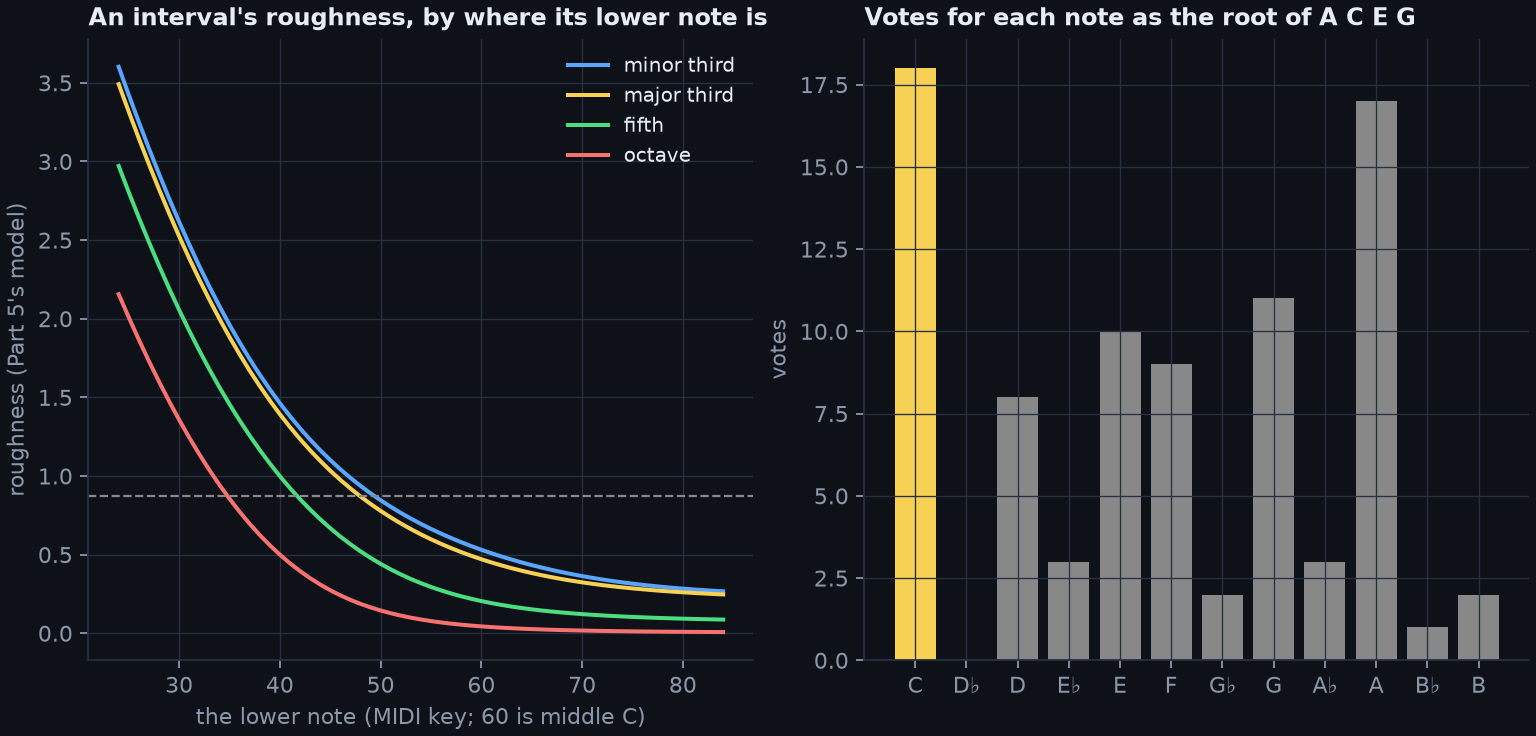
A modern version of the idea is Richard Parncutt's model of the root, from 1988, building on Ernst Terhardt. Each note of a chord votes for the roots it could be a harmonic of. Itself, most strongly. Then the note a fifth below it; then a major third below; then, weakly, a minor seventh and a major second below. Those are the places of harmonics one, three, five, seven and nine. Add up the votes for each of the twelve notes. For C, E, G, the note C collects eighteen. Nothing else comes near.
For the minor triad, C, E flat, G, the root is still C, with fifteen votes. But E flat is close behind, with thirteen: the G above it is its major third, and votes for it. The minor triad has a root, a slightly less certain one. That is the asymmetry we saw in Zarlino's numbers, and it is a prediction of this model, not a universal measure of minor's stability.
Now a harder one. The triad on the seventh degree of the scale: B, D, F. Before I show you, which note do you think the model picks as the root?
It cannot decide. B, D and F tie, with ten votes each. And so does G: a note that is not in the chord at all. Play it, and you may hear why. Add a G underneath, and the added G can clarify a dominant-seventh interpretation. Then let it go where it wants.
In this tonal context, B, D and F can function as the upper notes of G seven. That is why many theorists, Rameau among them, treat the diminished triad as a dominant seventh with its root left out: a chord whose root is somewhere else.
Run the model on other chords, and it sorts the solid ones from the ambiguous. The major and minor triads at the top. The suspended chord, C, F, G: the model hears F as the root, just ahead of C. A, C, E, G, which a lead sheet calls A minor seventh: the model prefers C, by a single vote. The same four notes are a C chord with a sixth added. The augmented triad: a three-way tie, every note as good a root as the others. And the diminished seventh, four notes a minor third apart: an eight-way tie. Composers use exactly these chords when they want the listener not to know where the music is going.
Parncutt's model works on note names. Part 4's ear model works on sound, and it agrees. Give it a major triad on middle C, and the strongest pitch it finds is the C two octaves below. Give it the minor triad, and it finds a C one octave below, a little more weakly. For the diminished and augmented triads it finds nothing convincing. These models suggest acoustic contributions to root perception. A chord's theoretical root also depends on spelling, bass, learned style and context; it is not always a single perceived low pitch.
6Four notes, and moreFoundations3 min
What does a fourth note add?
Add one more third on top of a triad and you have a seventh chord, named for the interval between its outside notes. Here are five common seventh-chord types; this is not an exhaustive list. A major triad with a major seventh. A major triad with a minor seventh: the dominant seventh. A minor triad with a minor seventh. A diminished triad with a minor seventh: half-diminished. And three minor thirds in a row: the diminished seventh.
Build sevenths on the degrees of the major scale, and four kinds appear. Major sevenths on one and four. Minor sevenths on two, three and six. A half-diminished seventh on seven. And one chord that occurs once only: the dominant seventh, on the fifth degree. It is a major triad with the scale's one tritone inside it: B, its third, and F, its seventh. The major pitch collection has one tritone pair. That pair alone does not identify the tonic, since relative modes share it. Here it is, packed into a single chord. In common-practice context, a dominant seventh often suggests a tonic a fifth below; blues, secondary dominants and other contexts can use it differently.
And the tritone moves. B is a semitone below C. F is a semitone above E. Let each go where it leans, and the tritone closes onto a third. First the two notes alone; then the whole chord, over its bass.
Tension, and release, from two voices each moving one semitone, in opposite directions. This is a common cadential motion in Western tonal music, with many exceptions. The five chord has a leading note and, with its seventh, a note that wants to fall; the one chord is where they both land.
An ear question. The same seventh chord, twice, in two different tunings. Which is smoother: A or B?
B. In A the chord was tuned as a piano tunes it. In B its four notes were the fourth, fifth, sixth and seventh harmonics of one fundamental. That seventh harmonic is cents flatter than the piano's minor seventh, and with it the four notes fuse almost into one sound. Barbershop quartets tune the chord that way, and an ordinary fixed twelve-tone equal-tempered keyboard cannot reproduce those exact ratios without retuning or pitch control. Rameau's sounding body, one step further up the series.
Why stop at four notes? Keep stacking thirds: above the seventh, the ninth; then the eleventh; then the thirteenth.
Seven notes; and the next third would be the root again. Look at what they are. C, E, G, B, D, F, A. A thirteenth chord is the whole scale, taken every other note. This full diatonic stack shares the scale's pitch classes. Actual thirteenth voicings often omit notes or alter extensions, and a chord symbol can support several context-dependent scale choices.
7Same chord, different soundPractice4 min
Why is a low third muddy?
Now the second puzzle from the opening. A chord's name says which notes. Its voicing says where they are, and the voicing can matter more than the name. Start with a single interval. Here is a major third, four semitones, on five different Cs, from high to low.
At the top, clear. At the bottom, a rumble in which you can hardly tell that there are two notes. Part 5's roughness model puts numbers on it: each time the third drops an octave it is nearly twice as rough, and at the bottom it is eleven times as rough as at the top. The interval never changed.
Part 4 explains it. The ear sorts sound into critical bands, and nearby partials can cause beating and roughness through overlapping auditory filters. This varies gradually with spacing, rather than switching at one band boundary. But a critical band is not a fixed musical interval. High up, it is narrower than a minor third. Low down, it is wider than a fifth. So measure our major third in critical bands. On the C above middle C it spans bands: the two notes are heard apart. On middle C, a little over one. An octave below that, : now they share a band. And at the bottom, of a band. The two fundamentals grind against each other, while some partial pairs add further interaction.
Here is Part 5's roughness model, run for four intervals, with the lower note on every key from the bottom C to the top. Every curve climbs toward the bass. And the narrower the interval, the sooner it climbs: the minor third first, then the major third, then the fifth, and the octave last.
Draw a line at the roughness of a major third on the C below middle C, which is about where arrangers stop writing thirds. To stay under that line, a minor third must be no lower than ; a fifth can go down to F sharp, half an octave lower; and an octave lower still. Arrangers keep tables like this, called low-interval limits. Theirs differ by a few notes from book to book, and with the instrument: soft strings forgive more than loud brass. This trend depends on spectrum, register and level. Thirds live in the middle of the keyboard; the bass belongs to octaves and fifths.
The lesson for chords: wide at the bottom, close at the top. Monochord listed the four-part C major voicings admitted by its range and spacing constraints above a low C. There are . Ranked by roughness, the worst has all four notes crowded into the bottom octave. The best has a bare twelfth at the bottom and the third at the very top. And look at the harmonic series of the low C itself: an octave, then a fifth, a fourth, a third, each interval smaller than the one below. The best spacing imitates the way a single note is already built. Listen to all three.
By the model the first is times as rough as the second, and they are the same chord. Orchestration books give the rule in one line: space a chord the way the harmonic series spaces itself. The opening puzzle is solved. The mud was never in the chord. It was in where the chord was put.
8Which notes matterPractice4 min
Which notes can a chord do without?
A triad has three notes. A choir has four voices, an orchestra dozens. Some note must be doubled. Which? Ask the root model of chapter 5, counting a doubled note twice. Double the root, and the root's lead grows: the chord is less ambiguous than with one of each. Double the fifth: slightly more ambiguous. Double the third: more ambiguous still.
This resembles one common root-position doubling guideline; other inversions and styles use other rules. In root position, double the root; the third is the note you double last. The model gives one reason for it. Chapter 6 gave another: when the third of a chord is a leading note, two voices singing it would both want to move to the same place.
And if you must leave a note out? Leave out the fifth. It is hardly missed, and here is why. The root's own third harmonic is that same note. In a piano's C, the G an octave and a fifth above is already sounding, only decibels below the fundamental. This partial can reinforce the fifth’s pitch class, but it is not equivalent to a separately played chord tone. The third is different. The harmonic that would supply it is the fifth one, higher and weaker; and the third alone says whether the chord is major or minor. Omitting it leaves major/minor quality less explicit, though context can still establish it.
So the essential notes of a seventh chord are three: the root, the third and the seventh. Jazz pianists call that a shell. Here is a full seventh chord, and then three different seventh chords as shells. Listen to how much chord is left.
Three notes each, and much of each chord's identity remains in this context. The third and the seventh are called guide tones: between them they say what kind of chord it is. In a jazz group the bass player has the root, the pianist plays the guide tones, and everything else is free.
Rock guitar went the other way, and for a reason you can now compute. A distorting amplifier is a nonlinear device. Feed it two notes, and it adds new tones at the sums and differences of all their partials. With a fifth, in the ratio three to two, those new tones land back on harmonics of a note an octave below: the sound gets thicker, and stays in tune with itself. For a pure five-to-four third they also fit a common harmonic grid, but a lower, denser one. These examples use equal-tempered intervals, and their interaction depends on tuning and spectrum. Here are two of Part 1's plucked strings through a smooth tanh saturator: a fifth, then a major third, then a full triad.
By the model, the distorted third is twice as rough as the distorted fifth, and the full triad is worse again. So the power chord is a root and a fifth, with no third: neither major nor minor. It is a voicing chosen by the amplifier. Both critical-band interaction and nonlinear intermodulation can increase roughness; they are distinct mechanisms, and the musicians' answer was the same: leave notes out.
9Writing a chord downPractice3 min
How do you name a chord in one line?
Chords are written down in at least four ways, and each tells you something different. Figured bass, from around sixteen hundred: a bass note, and numbers for the intervals above it. It tells a player what to play, and says nothing about roots. Roman numerals, from around eighteen hundred: the degree of the scale that the root stands on. They tell you the chord's job in the key. Lead-sheet symbols, from the dance bands of the nineteen twenties and thirties: the root by letter, then the kind of chord. They give you the notes and leave the voicing to you. And the Nashville number system, from the recording studios of the nineteen fifties: scale degrees in plain digits, so that a band can change key without rewriting anything.
Here is that progression in C, and then in E flat. Watch which of the four lines have to be rewritten.
The letters all changed. The numbers did not. Roman numerals and Nashville numbers describe what each chord does; the letters describe which keys are under your fingers. A studio player handed a chart in numbers can play the song in any key the singer asks for.
Lead-sheet symbols are a small formal language, and Monochord reads it. First the root. Then the triad: major, unless a small m says minor. Then the seventh: minor, unless it says m a j. Then any changes. Then, after a slash, the bass note. A minor seven: A, C, E, G. G seven over B: a dominant seventh on G with its third in the bass, which Rameau would call the first inversion. F sharp minor seven flat five is the half-diminished chord; D sus four replaces the third with a fourth; and a diminished seventh on B stacks three minor thirds.
But the symbols inherit Rameau's problem. Take C, E, G, A. Stack it in thirds from A, and it is an A minor seventh chord with C in the bass. Call C the root, and it is a C chord with an added sixth. The notes cannot tell you which, and in chapter 5 the root model was split almost evenly. What decides is context: what the bass does next, and which chord came before. So a chord symbol is never just a description of the notes. It is already a small act of analysis.
10A map of chordsFull course4 min
Which chords are neighbours?
In 1739 Leonhard Euler, the mathematician, drew a map of musical notes. Put fifths along one direction: F, C, G, D. Put major thirds along another: C, E, G sharp. Then every note has six neighbours related by thirds and fifths in this lattice; and every small triangle is a triad.
Triangles that point up are major triads: C, E, G. Triangles that point down are minor: C, E flat, G. German theorists of the next century named the map the Tonnetz, the net of tones. Euler drew it to think about tuning. It turned out to be a map of harmony.
On this map, the chords closest to a triad are the three that share an edge with it: two notes kept, one moved. From C major: flip over the edge C to G, and the E falls a semitone. C minor, the parallel. Flip over E to G, and the C falls a semitone to B. E minor. Flip over C to E, and the G rises a whole tone to A. A minor, the relative minor of Part 12. Each preserves two pitch classes and changes the third; R moves a whole tone, while P and L move a semitone. Listen to the three.
Chain the flips, and you travel. Alternate the first two moves, and you go round a cycle of six triads: C major, C minor, A flat major, A flat minor, E major, E minor, and back to C. At every step one voice moves, by one semitone.
That sound, major and minor triads sliding by semitones with no key in charge, is in Schubert and Wagner and Brahms, and in a great deal of film music since.
And notice where we ended. Three major thirds below the C we started from, on a note whose proper name is D double flat. On a piano that is the same key as C. In pure tuning it is not: three pure major thirds fall short of an octave by cents, the diesis of Part 6. Equal temperament is what rolls this map up, so that travelling far enough in any direction brings you home. On the pure fifth/third lattice, these nontrivial paths do not return to exactly the same frequency.
Alternate the other two moves instead, and you run along a strip of the map, through all twenty-four major and minor triads before you return, each one keeping two notes of the one before. Beethoven runs along nineteen of them in the scherzo of his Ninth Symphony, as the theorist Richard Cohn pointed out. Here are all twenty-four.
Twenty-four chords, and the three voices moved semitones in all: a semitone and a half per chord. Had each chord been played in root position, they would have leapt hundreds. That economy, getting from chord to chord with the least motion, is called voice leading, and it is the subject of Part 17.
11Frontier: what makes a chord sound as it does?Research4 min
Can a model hear a chord the way you do?
Which triad is the most consonant? Several studies with Western listeners report this average order, though responses vary with task, voicing and familiarity: major, minor, diminished, augmented. Now ask the two models we built. Part 5's roughness says: major, minor, augmented, diminished. Part 4's fusion into one pitch says the same. Both models put the augmented triad above the diminished. Listeners put it last.
So something is missing. In 2020 Peter Harrison and Marcus Pearce tested some twenty published models of consonance against listeners' ratings, and concluded that it takes three ingredients together. Interference between partials, which is our roughness. Harmonicity, which is our fusion. And plain familiarity: how often a listener has heard the chord. The augmented triad is smooth, and it is rare; and nobody yet has a model that predicts the ratings of every chord, in every spacing, for every listener.
Now turn the question round. Can a machine name a chord from its sound? Monochord has a small listener. It takes the spectrum, Part 3's Fourier transform once more, folds it onto the twelve notes, and compares the result with a template for each of the twenty-four major and minor triads. Here is what it sees in a C major triad on the piano: C, E and G, and a trace of B and D, which are harmonics of the E and the G. On this clean synthetic piano test set it is right every time: out of , in every inversion, even low and close in the mud.
So we gave it something harder: this part's Variation, the Tune with its accompaniment, half a bar at a time. It names chords out of . And of its mistakes are the same mistake. It hears C major as A minor, just after the melody or the chord before has sounded an A that is still ringing. C major and A minor share two notes; they are neighbours on Euler's map.
That is the real difficulty of chord recognition. It includes both estimating notes and deciding which notes count as the chord, when the answer depends on what came before and what comes next. Human experts disagree too: in one study, four annotators labelling the same fifty songs agreed on the root of the chord only about three quarters of the time.
Harder still is the step from chord names to Roman numerals: deciding the key, and the job each chord does in it. In the cited early-2020s classical benchmarks, some systems matched the complete reference label on roughly half the chords. The value depends on corpus and scoring and is not a current universal performance ceiling. And that tells us where the subject really lives. Harmony is not in the sound at any one moment. It is in how moments follow one another, and that is where the next parts of this series go.
Variation 13, recap and problemsAll tracks3 min
Every part ends by doing something to the Tune with what it has built. This part built chords. So here is the Tune with a chord under every two beats, only ever one, four or five, and each phrase voiced a different way. Block triads in root position. The same kind of chords, re-voiced so that the hand hardly moves. Spread wide, the way the harmonic series is spaced. Sevenths, as shells. Then close chords over a bass, and a full close. The melody is gold; the chords are blue.
Row thirteen of the ledger. seconds. The measurement: over the whole Tune, block triads in root position make the three voices travel semitones. Re-voiced, the same chords need . The notes are the same. Only the order from bottom to top has changed.
What did we find? An interval has a number and a quality, and the quality is a direction on the line of fifths. Ask for three notes with no two of them adjacent, and you get exactly the four triads; a major scale holds three major, three minor and one diminished. Tertian chord labels often retain a root under inversion. Acoustic models contribute to root perception, alongside context and learned conventions. The dominant seventh carries the scale's one tritone, and the tritone resolves. A chord's voicing can matter more than its name: thirds turn to mud in the bass, doubling and omissions depend on style: roots are commonly doubled, fifths often omitted, and thirds help identify major or minor. And chords can be written four ways, and laid out on a map where neighbours share two notes.
Five problems. One to compute, one to prove, one for your ears, one to build, and a research problem, marked with a star. Solutions are in this part's notes. Pause here.
Where does this come back? At once. The next part asks which notes of a melody belong to the chord beneath them. Then keys, and the pull of five to one. Then voice leading, first in two parts and then in four. Euler's map returns as geometry. Shells, extensions and chord scales are the working vocabulary of jazz. And the distorted power chord and the chord-naming machine each get a part of their own.
And in practice. A pianist or a guitarist learns every chord in every inversion, and then chooses whichever lies nearest the last. An arranger keeps thirds out of the bass. A session player reads a chart in numbers, and plays it in whatever key the singer needs. And a producer thins a chord before distorting it, because sparse voicings can reduce roughness; distorted thirds are also used deliberately.
The books and papers this part follows. The full list, with notes, is in the README.
Where it goes next. Part 14 asks which notes of a melody are chord notes; Part 15 gives the chords their jobs in a key; Parts 16 and 17 are voice leading; Part 18, progressions. Euler's lattice returns as geometry in Part 32, shells and chord scales in Part 39, distortion in Part 50, and machines that name chords in Part 62.
Key results
The part's results in one place, for revision.
Try it
Lab 13 · Chords, named, rooted and spaced
Name written intervals and place them on the line of fifths, list every shape of three notes and see which have no two notes adjacent, run the root model on any chord with extra weight on the bass, find the smoothest spacing of a chord over a given bass note, and tell the four triads apart by ear, in any inversion.
python -m videos.music.labs 13
needs numpy, scipy, matplotlib · download lab13.py ·
source on GitHubD up to F# major third (4 semitones); inversion: minor sixth; 4 steps sharpward on the line of fifths
E up to C minor sixth (8 semitones); inversion: major third; 4 steps flatward on the line of fifths
B up to F diminished fifth (6 semitones); inversion: augmented fourth; 6 steps flatward on the line of fifths
Ab up to F# augmented sixth (10 semitones); inversion: diminished third; 10 steps sharpward on the line of fifths
shapes of three notes on twelve 19
with every step at least a minor third 3 3 6 (diminished); 3 4 5 (minor); 3 5 4 (major); 4 4 4 (augmented)
chord (lowest note first) A C E G; bass counted 1 times
votes C 18 A 17 G 11 E 10
root, and ambiguity C; 2.16
names it can have Am7 (inversion 0); C6 (inversion 3)
C E G root C; ambiguity 1.87
C E♭ G root C; ambiguity 2.05
B D F root D = F = G = B; ambiguity 2.51
C E G♯ root C = E = A♭; ambiguity 2.20
114 spacings in 5 voices; the smoothest G2 G3 B4 D5 F5 roughness 2.01; doubles G
the roughest G2 B2 D3 F3 G3 roughness 7.08
without its fifth, in 4 voices G2 G3 B4 F5 roughness 1.24; doubles G
low limits by the model (as smooth as a major third on C3) minor third D3; fifth F#2; octave B1
ear problem, the ten triads (listen first) augmented, third in the bass; minor, root in the bass; major, root in the bass; augmented, third in the bass; diminished, third in the bass; diminished, third in the bass; diminished, fifth in the bass; augmented, fifth in the bass; minor, fifth in the bass; major, fifth in the bass
Three notes with no two adjacent are a triad, and nothing else; a root is the note the others could be harmonics of; and the same chord is clear or muddy according to where its notes are put. The root model cannot choose between A minor seventh and C with a sixth until the bass is given more weight, which is what a musician does.The code (111 lines; it asserts its own result)
"""Lab 13: name intervals, prove that thirds are what is left, find roots, space a chord, and name triads by ear."""

from itertools import combinations

import numpy as np

from videos.coursekit import labs
from explainer.music.monochord import Clip, concat
from explainer.music.monochord import chords as C
from explainer.music.monochord.partkit import organ_tone
from explainer.music.monochord.score import Pitch

TITLE = "Chords, named, rooted and spaced"
GOAL = ("Name written intervals and place them on the line of fifths, list every shape of three notes and see which "
        "have no two notes adjacent, run the root model on any chord with extra weight on the bass, find the smoothest "
        "spacing of a chord over a given bass note, and tell the four triads apart by ear, in any inversion.")
TASKS = [
    "Set BASS_WEIGHT to 1.5, 2 and 3. At what weight does the model call A C E G (with A lowest) an A chord? What does it then say about C E G with E lowest, and is that what a musician would say?",
    "Set LOW to 31 (the G an octave lower) and then to 55. How does the smoothest spacing of the seventh chord change? Which interval is at the bottom each time?",
    "Change CHORD to [0, 3, 6, 9] and then to [0, 4, 8]. How many notes tie for the root? Why do the ties come in fours for the first chord and in threes for the second?",
]
P = Pitch.parse
INTERVALS = [("D4", "F#4"), ("E4", "C5"), ("B3", "F4"), ("Ab3", "F#4")]      # Problem 1
CHORD = [9, 0, 4, 7]            # pitch classes, the lowest first: A, C, E, G
BASS_WEIGHT = 1.0               # how many times the lowest note's votes count
SEVENTH = [7, 11, 2, 5]         # G, B, D, F
LOW, VOICES = 43, 5             # the bass note (MIDI) and the number of voices
SR = 48_000


def run(seed=0):
    rng = np.random.default_rng(seed)
    lab = labs.Lab()

    # 1. Problem 1: intervals, their inversions, and the line of fifths
    for a, b in INTERVALS:
        iv = C.interval(P(a), P(b))
        lab.row(f"{a[:-1]} up to {b[:-1]}", f"{iv.name} ({iv.semitones} semitones);  inversion: {iv.invert().name};  {abs(iv.line)} step{'s' if abs(iv.line) != 1 else ''} "
                                          f"{'sharpward' if iv.line > 0 else 'flatward'} on the line of fifths")
        assert iv.number + iv.invert().number == 9 and iv.quality == C.quality_of(C.fifths(P(b)) - C.fifths(P(a)))

    # 2. Problem 2: every shape of three notes; those with no step smaller than a minor third
    shapes = set()
    for trio in combinations(range(12), 3):
        steps = (trio[1] - trio[0], trio[2] - trio[1], 12 - trio[2] + trio[0])
        shapes.add(min(steps[i:] + steps[:i] for i in range(3)))
    wide = sorted(s for s in shapes if min(s) >= 3)
    names = {(3, 3, 6): "diminished", (3, 4, 5): "minor", (3, 5, 4): "major", (4, 4, 4): "augmented"}
    lab.row("shapes of three notes on twelve", str(len(shapes)))
    lab.row("with every step at least a minor third", ";  ".join(f"{' '.join(map(str, s))} ({names[s]})" for s in wide))
    assert len(shapes) == 19 and set(wide) == set(names)
    # the proof in one line: three steps of at least 3 that add to 12 are 3+3+6, 3+4+5 (two orders) or 4+4+4

    # 3. the root model, with a heavier bass (the research problem)
    w = [BASS_WEIGHT] + [1.0] * (len(CHORD) - 1)
    r = C.root(CHORD, w)
    sal = np.array(r["saliences"])
    lab.row("chord (lowest note first)", " ".join(C.pitch_label(p) for p in CHORD) + f";  bass counted {BASS_WEIGHT:g} times")
    lab.row("votes", "  ".join(f"{C.pitch_label(k)} {sal[k]:g}" for k in np.argsort(-sal)[:4]))
    lab.row("root, and ambiguity", (" = ".join(C.pitch_label(t) for t in r["tied"]) if len(r["tied"]) > 1 else C.pitch_label(r["root"])) + f";  {r['ambiguity']:.2f}")
    named = C.identify([48 + CHORD[0] + (p - CHORD[0]) % 12 for p in CHORD])
    lab.row("names it can have", ";  ".join(C.symbol(C.pitch_label(x["root"]).replace("♭", "b").replace("♯", "#"), x["kind"]) + f" (inversion {x['inversion']})" for x in named) or "none in the vocabulary")
    for name, pcs in (("C E G", [0, 4, 7]), ("C E♭ G", [0, 3, 7]), ("B D F", [11, 2, 5]), ("C E G♯", [0, 4, 8])):
        q = C.root(pcs)
        lab.row(f"   {name}", f"root {' = '.join(C.pitch_label(t) for t in q['tied'])};  ambiguity {q['ambiguity']:.2f}")
    assert abs(C.root([0, 4, 7])["ambiguity"] - 1.8708) < 1e-3

    # 4. Problem 4: the smoothest spacing of a seventh chord over a bass note
    vs = [v for v in C.voicings(SEVENTH, LOW, LOW + 36, voices=VOICES, bass=SEVENTH[0], max_gap=16) if v[0] == LOW]
    ranked = sorted(vs, key=C.spacing_roughness)
    show = lambda v: " ".join(Pitch.from_midi(m).name for m in v)       # noqa: E731
    doubled = lambda v: [C.pitch_label(p) for p in set(m % 12 for m in v) if sum(1 for m in v if m % 12 == p) > 1]       # noqa: E731
    lab.row(f"{len(vs)} spacings in {VOICES} voices; the smoothest", f"{show(ranked[0])}   roughness {C.spacing_roughness(ranked[0]):.2f};  doubles {', '.join(doubled(ranked[0]))}")
    lab.row("the roughest", f"{show(ranked[-1])}   roughness {C.spacing_roughness(ranked[-1]):.2f}")
    no5 = [v for v in C.voicings([SEVENTH[0], SEVENTH[1], SEVENTH[3]], LOW, LOW + 36, voices=VOICES - 1, bass=SEVENTH[0], max_gap=16) if v[0] == LOW]
    best5 = min(no5, key=C.spacing_roughness)
    lab.row(f"without its fifth, in {VOICES - 1} voices", f"{show(best5)}   roughness {C.spacing_roughness(best5):.2f};  doubles {', '.join(doubled(best5)) or 'nothing'}")
    lab.row("low limits by the model (as smooth as a major third on C3)", ";  ".join(
        f"{nm} {Pitch.from_midi(C.low_limit(s, reference=C.spacing_roughness([48, 52]))).name}" for nm, s in (("minor third", 3), ("fifth", 7), ("octave", 12))))

    # 5. Problem 3, for the ear: ten triads, any kind, any inversion
    kinds = ["major", "minor", "diminished", "augmented"]
    answers, clips = [], []
    for _ in range(10):
        k, inv, root = kinds[int(rng.integers(0, 4))], int(rng.integers(0, 3)), int(rng.integers(55, 66))
        v = [p.midi for p in C.invert(C.spell(Pitch.from_midi(root), k), inv)]
        y = sum(organ_tone(C.hz(m), 1.6, partials=6, rolloff=0.7, decay=1.2) for m in v)
        clips.append(Clip(y, SR).fade(0.01, 0.2).at_level(-20.0))
        answers.append(f"{k}, {('root', 'third', 'fifth')[inv]} in the bass")
    lab.audio = concat(clips, gap=0.9)
    lab.row("ear problem, the ten triads (listen first)", ";  ".join(answers))

    fig, (a, b) = labs.figure(2)
    keys = np.arange(24, 85)
    for s, nm in ((3, "minor third"), (4, "major third"), (7, "fifth"), (12, "octave")):
        a.plot(keys, C.dyad_by_register(s, keys), label=nm)
    a.axhline(C.spacing_roughness([48, 52]), color="#888", ls="--", lw=1)
    a.set_title("An interval's roughness, by where its lower note is")
    a.set_xlabel("the lower note (MIDI key; 60 is middle C)")
    a.set_ylabel("roughness (Part 5's model)")
    a.legend(frameon=False)
    b.bar(range(12), sal, color=[labs.GOLD if abs(x - sal.max()) < 1e-9 else "#888" for x in sal])
    b.set_xticks(range(12))
    b.set_xticklabels([C.pitch_label(k) for k in range(12)])
    b.set_title("Votes for each note as the root of " + " ".join(C.pitch_label(p) for p in CHORD))
    b.set_ylabel("votes")
    lab.fig = fig
    lab.note = ("Three notes with no two adjacent are a triad, and nothing else; a root is the note the others could be harmonics of; "
                "and the same chord is clear or muddy according to where its notes are put. The root model cannot choose between "
                "A minor seventh and C with a sixth until the bass is given more weight, which is what a musician does.")
    return lab
Now change it
- Set BASS_WEIGHT to 1.5, 2 and 3. At what weight does the model call A C E G (with A lowest) an A chord? What does it then say about C E G with E lowest, and is that what a musician would say?
- Set LOW to 31 (the G an octave lower) and then to 55. How does the smoothest spacing of the seventh chord change? Which interval is at the bottom each time?
- Change CHORD to [0, 3, 6, 9] and then to [0, 4, 8]. How many notes tie for the root? Why do the ties come in fours for the first chord and in threes for the second?
Problems, with solutions
Try each problem before opening its solution.
-
Four intervals. Name each interval and its inversion: D up to F♯; E up to C; B up to F; A♭ up to F♯. How many steps apart are the two notes of each on the line of fifths?
Solution
D–F♯ spans three letters and four semitones: a major third; its inversion is a minor sixth; F♯ is four steps sharpward of D (D, A, E, B, F♯). E–C spans six letters and eight semitones: a minor sixth, inverting to a major third; C is four steps flatward of E. B–F spans five letters and six semitones: a diminished fifth, inverting to an augmented fourth; F is six steps flatward of B. A♭–F♯ spans six letters and ten semitones: an augmented sixth, inverting to a diminished third; F♯ is ten steps sharpward of A♭. The distances 4, 4, 6 and 10 fall in the bands that give major or minor (2 to 5) and augmented or diminished (6 to 12), and the direction gives which.
-
Why thirds. Three notes divide the twelve-note circle into three steps that add up to twelve. Prove that if every step is at least three semitones, the notes form a major, minor, diminished or augmented triad, and nothing else.
Solution
Let the steps be a ≤ b ≤ c with a + b + c = 12 and a ≥ 3. Then a is 3 or 4 (if a ≥ 5 the sum is at least 15). If a = 4 then b = c = 4: the augmented triad. If a = 3 then b + c = 9 with 3 ≤ b ≤ c, so (b, c) is (3, 6) or (4, 5). Steps 3, 3, 6 in any order round the circle are one shape, the diminished triad (with its inversions). Steps 3, 4, 5 can be arranged round a circle in two ways that are not rotations of each other: 3, 4, 5 (a minor third, then a major third, then a fourth: the minor triad) and 4, 3, 5 (the major triad). That is four shapes, and the lab lists all nineteen shapes of three notes to confirm it.
-
Ear. The lab plays ten triads. For each, say whether it is major, minor, diminished or augmented, and which of its notes is in the bass.
Solution
The lab prints the answers. Listen first for stability: major and minor are at rest, diminished and augmented are not. Between major and minor, sing the lowest three notes as an arpeggio and listen for the size of the third above the root. For the inversion, listen for the widest gap: a fourth between the upper two notes means the third is in the bass, a fourth between the lower two means the fifth is. An equal-tempered augmented pitch-class set is symmetric: its bass pitch can be heard, but an inversion label requires a chosen root or spelling.
-
Build. With
chords.voicingsandchords.spacing_roughness, find the smoothest five-voice spacing of a G seventh chord over the G at the bottom of the bass staff. Which note does it double? And if one note may be left out?Solution
The lab does this. Of the 114 spacings within three octaves, the smoothest is G2, G3, B4, D5, F5 (roughness 2.0): the root doubled at the octave, nothing else below middle C, and the upper three notes close together at the top. The roughest is G2, B2, D3, F3, G3 (7.1). Left free to omit a note, the model drops the fifth: G2, G3, B4, F5 (1.2) is root, root, third, seventh, which is the shell of chapter 8 over a doubled bass, and what harmony books recommend for an incomplete dominant seventh.
-
★ A heavier bass. The root model ties on the diminished triad and splits A, C, E, G almost evenly. Give the lowest note extra weight. How much weight makes the model agree with the chord symbols in a songbook, and what does it then get wrong?
Where the frontier is. In the lab, with A lowest, any weight above about 1.1 makes A the root of A–C–E–G (A 17 + 1 > C 18 needs the bass counted a little more than once); but the same weight applied to C–E–G with E lowest eventually makes E the root (above a weight of 15/7, about 2.1), which need not match the intended C-major analysis. So a single number does not do it: a first inversion keeps its root and a "slash chord" does not, and the difference is in the context. Parncutt's later models add weights for register and for the preceding chords; corpus-trained models (Temperley's Bayesian key and root finding; neural chord estimators) learn them from data; models can disagree with annotators on ambiguous chords, and annotators do not match each other (Koops and others 2019).
Notes and sources
Sources
Books: J.-P. Rameau, Traité de l'harmonie réduite à ses principes naturels (1722; trans. P. Gossett, 1971), and Nouveau système de musique théorique (1726); G. Zarlino, Le istitutioni harmoniche (1558), part 3; J. Lippius, Synopsis musicae novae (1612); L. Euler, Tentamen novae theoriae musicae (1739); T. Christensen, Rameau and Musical Thought in the Enlightenment (1993); R. Parncutt, Harmony: A Psychoacoustical Approach (1989); S. Laitz, The Complete Musician (4th ed., 2015), chs. 1–6; D. Tymoczko, A Geometry of Music (2011), chs. 2–3; M. Levine, The Jazz Piano Book (1989), for shells; C. Williams, The Nashville Number System (1988).
Papers: E. Terhardt, "The concept of musical consonance: a link between music and psychoacoustics", Music Perception 1 (1984); R. Parncutt, "Revision of Terhardt's psychoacoustical model of the root(s) of a musical chord", Music Perception 6 (1988); L. A. Roberts, "Consonance judgements of musical chords by musicians and untrained listeners", Acustica 62 (1986); R. Cohn, "Neo-Riemannian operations, parsimonious trichords, and their Tonnetz representations", Journal of Music Theory 41 (1997); T. Fujishima, "Realtime chord recognition of musical sound", Proceedings of the International Computer Music Conference (1999); P. N. Johnson-Laird, O. E. Kang and Y. C. Leong, "On musical dissonance", Music Perception 30 (2012); H. V. Koops, W. B. de Haas, J. A. Burgoyne and others, "Annotator subjectivity in harmony annotations of popular music", Journal of New Music Research 48 (2019); P. M. C. Harrison and M. T. Pearce, "Simultaneous consonance in music perception and composition", Psychological Review 127 (2020); G. Micchi, M. Gotham and M. Giraud, "Not all roads lead to Rome: pitch representation and model architecture for automatic harmonic analysis", Transactions of the International Society for Music Information Retrieval 3 (2020); N. Nápoles López, M. Gotham and I. Fujinaga, "AugmentedNet: a Roman numeral analysis network with synthetic training examples and additional tonal tasks", Proceedings of ISMIR (2021).
- G. S. Karpinski, Aural Skills Acquisition (2000): the theory of the ear thread's drills (interval, quality, inversion), from listening to dictation.
About this partfrom its README
Part 13 of a sixty-eight-part course in music (see the series plan and
the syllabus). Part 12 chose the notes; this part sounds them together. It names intervals
exactly and finds their qualities on the line of fifths; shows that the four triads are what is left when three
notes may not be neighbours; tests Rameau's claim that a chord has a root whichever way up it stands, and finds
where the root comes from; adds sevenths, and the tritone that makes harmony move; computes why the same chord is
clear in the middle of the piano and muddy at the bottom, what to double and what to leave out; writes a chord
four ways; and lays all the triads out on Euler's lattice. The chord module is Monochord's
(explainer/music/monochord/chords.py), the pictures are in explainer/music/chordviz.py, the engraver
(explainer/music/staff.py) now draws chords and a grand staff, and every sound is computed in compute.py.
Published findings are the ones listed under Sources.
- Three notes, one name. C, E and G in three orders, heard; Rameau's claim (1722) that they are one chord; the same three notes close together at the bottom of the piano, and spread (a growl, and a clear chord); the plan.
- 1. Naming a distance. An interval's number, counted in letters, both ends included; its quality; all thirteen intervals from C to the octave, heard; the line of fifths: one step apart is perfect, two to five major (sharpward) or minor (flatward), six augmented or diminished; inversion (the numbers add to nine, the qualities swap) and the six interval classes; one key with two names: C–F♯ and C–G♭ in quarter-comma meantone, 579 and 621 cents, against the piano's 600; an ear question (which of three is the tritone).
- 2. Three notes. Two sizes of third, four triads, heard; Zarlino (1558): a major triad is 4 : 5 : 6, a minor triad 10 : 12 : 15; of the nineteen shapes of three notes on twelve (Part 12), the four with no two notes a tone or less apart are exactly the four triads, and the three with no tritone either are major, minor and augmented; an ear question (major or minor).
- 3. The chords of a scale. A triad on each degree of C major: three major, three minor, one diminished; Roman numerals, which name a chord's job and not its key; I, IV and V hold every note of the scale; I–IV–V–I, heard.
- 4. Rameau's claim. Root position and two inversions, and the figures a continuo player reads (5/3, 6, 6/4); Rameau's fundamental bass: stack the notes in thirds and take the bottom (Lippius had the triad and its inversions in 1612); a predict-pause (F, G, B, D: the root is G, the figure 4/2); one chord over each of its notes in the bass: settled, lighter, unstable; the six-four that falls to five-three; an ear question (which has the root in the bass).
- 5. Where the root comes from. A major triad is harmonics 4, 5 and 6 of a note two octaves below its root: three pure tones and the fundamental they imply, heard; Parncutt's model (1988): each note votes for the roots it could be a harmonic of (10, 5, 3, 2, 1): C–E–G gives C 18 votes, C–E♭–G gives C 15 and E♭ 13; a predict-pause (B–D–F: a four-way tie that includes G, a note that is not in the chord; heard with the G put under it); a table of chords by ambiguity (A–C–E–G goes to C by one vote; the augmented triad ties three ways, the diminished seventh eight); Part 4's ear model on the same triads as sound.
- 6. Four notes, and more. Five seventh chords, heard; the sevenths of a major scale: one dominant seventh, the only major triad that carries the scale's tritone; B and F resolving to C and E, alone and inside G7; an ear question: a seventh chord in the piano's tuning and as harmonics 4 : 5 : 6 : 7 (the seventh at 969 cents); thirds stacked to the thirteenth: the whole scale, every other note.
- 7. Same chord, different sound. One major third on five Cs, heard: by Part 5's model eleven times rougher at the bottom than at the top; why: the third is 1.5 critical bands wide on C5 and 0.3 on C1; roughness of a minor third, major third, fifth and octave with the lower note on every key, and the lowest note at which each stays as smooth as a major third on C3 (low-interval limits); all 41 four-voice spacings of C major over a low C: the roughest, the smoothest and the harmonic series' own spacing, heard.
- 8. Which notes matter. Doubling, by the root model: root, then fifth, then third; the fifth can be left out (it is the root's third harmonic, 8 dB down in Part 7's piano), the third cannot; shells: root, third and seventh, heard for three seventh chords; two plucked strings through a hard clipper: by the roughness model a distorted major third is twice as rough as a distorted fifth: the power chord.
- 9. Writing a chord down. One progression as figured bass, Roman numerals, lead-sheet symbols and Nashville numbers; played in C and in E♭: the letters change, the numbers do not; the grammar of a lead-sheet symbol, which Monochord parses; one set of notes with two names (Am7/C and C6).
- 10. A map of chords. Euler's lattice (1739): fifths one way, major thirds another; upward triangles are major triads, downward ones minor; the three flips that keep two notes (P, L and R), heard; the cycle of six triads by semitone steps, heard, which ends three major thirds from where it began: the same key on a piano, 41 cents away in pure tuning (Part 6's diesis); all 24 triads in one chain, heard: 36 semitones of motion.
- 11. Frontier: what makes a chord sound as it does? Listeners rank the triads major, minor, diminished, augmented; roughness and fusion both put augmented above diminished; Harrison and Pearce (2020): interference, harmonicity and familiarity; a chord listener (spectrum, twelve notes, 24 templates): 96 of 96 on clean piano chords, 19 of 24 on this part's Variation, four of the five mistakes being C major heard as A minor; annotators agree on the root about three times in four (Koops and others, 2019). ★ research problem: from chord names to Roman numerals.
- Variation 13, recap and problems. The Tune over I, IV and V, each phrase voiced another way: block triads, re-voiced, spread, shells of sevenths, close chords over a bass, a full close; the ledger; what we found; five problems; where it comes back; in practice; references; Part 14.
What is computed and built
python -m videos.music.music13.compute (under a minute) fills .cache/music13/.
| Item | What it computes | Checked against |
|---|---|---|
hook |
C–E–G in three positions; close and spread at the bottom of the piano | roughness 3.9 against 2.6 |
intervals |
the thirteen intervals from C: number, quality, place on the line of fifths, inversion, class; the two meantone tritones | the names in any harmony book; 579.5 and 620.5 cents |
triads |
the four triads; all nineteen three-note shapes, their interval vectors and roughness | four shapes have no step; three of those no tritone |
scale |
the triads on the degrees of C major, with Roman numerals and symbols | I ii iii IV V vi vii° |
inversion |
figures of each position; Rameau's reduction of F–G–B–D | 5/3, 6, 6/4; G7 in 4/2 position |
roots |
Parncutt's saliences for eight chords; the ear model's pitch for each triad | root ambiguity of a major triad 1.87, the published value of the reference implementation |
sevenths |
five seventh chords; those of the scale; the 4 : 5 : 6 : 7 chord; a thirteenth chord | 968.8 cents |
voicing |
a major third's roughness and width in critical bands by register; four intervals on every key; 41 spacings ranked | the order minor third, major third, fifth, octave |
doubling |
root ambiguity with each note doubled or left out; partial levels of a piano note; clipped dyads | — |
symbols |
eight symbols parsed; one progression in four notations and two keys | round trips in test_chords.py |
tonnetz |
the lattice; P, L, R; cycles of 6, 8 and 24 triads, voice-led | each move keeps two notes; LR visits all 24 |
tune |
Variation 13; how far three voices travel in root position and re-voiced | 372 semitones against 60 |
frontier |
the four triads by roughness and by fusion; the chord listener on clean chords and on the Variation | 96 of 96; 19 of 24 |
Monochord's chords are held against these in tests/music/test_chords.py; the engraver's chords in
tests/music/test_staff.py; this part's claims and clips in tests/music/test_music13.py.
Sounds. Twenty-seven clips. Most are Part 7's piano (physical model), in twelve-tone equal temperament. The
two tritones are organ tones in quarter-comma meantone; the missing-fundamental demonstration is three pure tones
at 4, 5 and 6 times 130.8 Hz and an organ tone at 130.8 Hz; the two seventh chords of chapter 6 are organ tones,
one equal-tempered and one at 4 : 5 : 6 : 7 (all synthesized). The distorted dyads are Part 1's plucked strings
through a smooth tanh saturator. There are no recordings.
What the models are, and are not. Interval names are those of common-practice notation; other traditions count differently. The census of three-note shapes treats notes a tone or less apart as "neighbours"; that threshold is the critical band only in the middle of the keyboard, and the argument is about why thirds, not a claim that seconds never occur in chords. The root model is Parncutt's revision of Terhardt's, with the weights of his later papers (10, 5, 3, 2, 1) and no weighting for the bass or for register; it is a model of isolated chords, and in music the bass and the context usually settle what it leaves tied. The ear model is Part 4's summary autocorrelation, which hears a pitch only down to about 30 Hz. Roughness is Part 5's Plomp–Levelt model on seven-partial harmonic tones: it knows nothing of masking by level, of the piano's real spectrum in each register, or of beats between mistuned harmonics, and its low-interval limits are narrower than the tables arrangers use (which also differ among themselves); the ordering of the intervals is the robust part. The clipper is a memoryless tanh, not a guitar amplifier. The order in which listeners rank the triads is from published experiments on Western listeners (Roberts 1986; Johnson-Laird and others 2012). The chord listener is a template matcher on a folded spectrum, the starting point of the field in 1999 and nothing like the state of the art; its 19 of 24 is a property of this Variation and this piano. The Tonnetz is drawn in equal temperament's names; in pure tuning its notes do not repeat. Dates for the notations are approximate. The Variation's harmony is one chord to every two beats, only I, IV and V (V7 at the close).
Notes
The tertian census follows a chosen pitch-class spacing constraint; it does not derive all harmony from auditory physiology. Critical-band interaction varies continuously with frequency, spectrum and level. Root salience and missing-fundamental pitch are distinct from harmonic root analysis. Rameau had predecessors, and figured-bass practice was not theoretically uniform. Dominant resolution, inversion stability, doubling and omissions are style-dependent guidelines. A unique tritone pair does not identify the tonic among relative modes. A pure 5:4 third also has a common harmonic fundamental; distortion does not place all its products off a harmonic grid. Reported recognition scores belong to the stated synthetic examples, while cited benchmark results are historical and depend on metrics. Interval classes include class zero in addition to the six nonzero classes illustrated.
Companion material in this repository
- Monochord's chords: intervals, spelling, inversion, roots, voicings, the Tonnetz, a chord listener
- Pictures of chords: Euler's lattice, bars for the twelve notes, rows of partials
- The engraver, now with chords and a grand staff
The syllabus's plan for this partfrom SYLLABUS.md, the plan of record
- Hook: one chord in three positions; Rameau's claim; the same chord close and spread in the bass; the plan.
- Naming a distance: number and quality; thirteen intervals; the line of fifths; inversion; two tritones (an ear question).
- Three notes: four triads; Zarlino's 4 : 5 : 6; of nineteen shapes, the four with no neighbours (an ear question).
- The chords of a scale: three major, three minor, one diminished; Roman numerals; I, IV and V.
- Rameau's claim: positions and figures; the fundamental bass (a predict-pause); the weight of the bass (an ear question).
- Where the root comes from: the missing fundamental; Parncutt's model (a predict-pause); ambiguous chords; the ear model.
- Four notes, and more: five sevenths; the dominant's tritone resolves; 4 : 5 : 6 : 7 (an ear question); a thirteenth is the scale.
- Same chord, different sound: a third by register; critical bands; low-interval limits; 41 spacings of one chord.
- Which notes matter: doubling; the fifth can go, the third cannot; shells; the power chord under distortion.
- Writing a chord down: figured bass, Roman numerals, lead sheet, Nashville numbers; a symbol's grammar; two names.
- A map of chords: Euler's lattice; P, L and R; the cycle of six and the diesis; all twenty-four triads.
- Frontier: listeners against two models; a chord listener and its mistakes; from chords to Roman numerals.
- Variation 13: the Tune over I, IV and V in six voicings. Outro: problems, payoffs.
Covers: interval names and spelling on the line of fifths; interval classes; triads and sevenths; inversion and
figured bass; roots and virtual pitch; voicing, spacing and the critical band; doubling; chord symbols; the
Tonnetz (Euler 1739).
Built and computed: the chord module with a root finder (monochord/chords.py); the low-interval limit from
Part 5's model; chords and a grand staff in the engraver (explainer/music/staff.py); the pictures of chords
(explainer/music/chordviz.py).
Variation 13: the Tune in block triads, then re-voiced.
Frontier: models of chord perception; automatic harmonic analysis.
Reading: Rameau, Traité de l'harmonie; Parncutt, Harmony: A Psychoacoustical Approach; Laitz.
Build the film
python -m videos.music.music13.compute        # the part's numbers, into .cache/music13
python tools/build.py music13                  # render and assemble the film
EXPLAINER_TTS=silent python tools/qa_scene.py music13 Hook   # one chapter, silent, with a contact sheet
Scenes: videos/music/music13. Setup: see the course page. Source of these notes: the README and the scenes' narration.
Build it
python -m videos.music.music13.compute                          # numbers and sounds (under a minute)
EXPLAINER_TTS=silent python tools/build.py music13 -q l --fps 15   # a silent-narration preview, with the sounds
python tools/qa_sound.py music13 --sync                         # the sound gates
python tools/dead_air.py renders/music13_480p.mp4 --sound music13  # no empty screen; no sound over a still one
python tools/lecture_length.py music13                          # 30 to 60 minutes, listening included
python tools/build.py music13                                   # 1080p30, narrated
python -m pytest -q tests/music                                 # Monochord against its references; this part's claims and clips
python -m videos.music.labs 13                                  # the lab (writes a figure and a short WAV)