Behavioural Economics
What changes in economics when people are not the agents of Part 5?
The part opens on DellaVigna and Malmendier's gym: members on monthly contracts of over $70 who go 4.3 times a month, paying over $17 a visit when a ten-visit pass cost $10. The Island's gym repeats it: naive members forecast 13.9 visits, make 4.7, and pay $15 a visit. DellaVigna's three departures frame the part; the viewer is given a mug and names a selling price, and the Island's mug market trades a quarter of its mugs instead of half. Prospect theory's kink, experienced traders, marathon runners bunched under round times (measured with Part 41's bunching estimator), putts for par against birdie at equal length, and loss-averse condominium sellers bracketed by two regressions follow. Present bias reverses plans; O'Donoghue and Rabin's naifs and sophisticates act at different times; a gym designs its contract for them. A randomized commitment account is taken mostly by sophisticates, and defaults stick for naifs who put off deciding; Save More Tomorrow turns the biases around. After an intermission of the American saving rate, shrouded add-ons survive competition, left-digit bias leaves steps in car prices, Fehr-Schmidt players reject low offers, markets cure some biases and feed on others, welfare is read where choices across frames agree, published nudges look six times larger than nudges in full, and models of limited minds explain inattention and forecasters who over-react individually while their average under-reacts. Three dials, practice and the frontier close it.
What you need. Part 5: preferences and revealed preference; Part 7: discounting and risk; Part 22: saving; Part 41: bunching; Part 42: defaults in social insurance; Psychology, Built, Part 26: prospect theory. Chapter 6 uses the Wald estimator; chapter 12 a selection model fitted by maximum likelihood; chapter 13 the Blahut-Arimoto iteration.
- Hook
- paying not to go to the gym, 2006
- Ideas, models and mathematics
- reference dependence in the field, present bias and commitment, defaults, inattention and salience, social preferences, do anomalies survive markets?, behavioural welfare, nudges at scale, rational inattention, expectations that overreact
- Agora gains
- behavioural agents for the Island
- Play it
- sell the mug you were just given
What you will be able to do
Principles and the major
- Explain present bias, loss aversion and limited attention, each with a field example.
- Say why demand for commitment reveals present bias and knowing it.
- Explain why defaults matter and how Save More Tomorrow works.
Graduate
- Derive the beta-delta reversal and O'Donoghue and Rabin's naif and sophisticate.
- Estimate loss aversion from bunching and inattention from steps in prices.
- Write the step-function selection model and correct a filtered literature.
Research
- Assess what behavioural parameters are identified in the field, and how welfare can be judged when choices conflict.
- State the open questions in structural behavioural economics and behavioural macroeconomics.
Practice
- Design a product choice, a disclosure or a default, and say who gains and who loses.
Contents
Each chapter has a home level. Choose a track to see what to read and watch: Principles and the major 41 min · Graduate 50 min · Research 52 min · Practice 44 min.
- 0Paying not to go to the gymPrinciples and the major3 min
- 1Three departuresPrinciples and the major2 min
- 2Play it: your mugPrinciples and the major2 min
- 3Reference dependencePrinciples and the major4 min
- 4In the field: runners, golfers, sellersPrinciples and the major5 min
- 5Present biasPrinciples and the major4 min
- 6Commitment, demandedPrinciples and the major3 min
- 7Defaults and inertiaPrinciples and the major4 min
- Intermission: the American saving rate, 1959-2026Principles and the major
- 8InattentionPrinciples and the major3 min
- 9Social preferencesPrinciples and the major3 min
- 10Do markets cure it?Principles and the major2 min
- 11Behavioural welfarePrinciples and the major3 min
- 12Nudges at scaleGraduate3 min
- 13Models of limitsGraduate3 min
- 14The Dials: loss aversion, present bias, defaultsResearch
- 15In practice: products, protection, pensionsPractice3 min
- 16Frontier: structural behavioural economics, behavioural macroResearch2 min
- Recap, problems, and the road aheadAll tracks3 min
Also on this page: Lecture · Key results · Try it · Lab · Problems · Notes and sources · Build the film.
Lecture
The text of each chapter is the film's narration, as it is spoken, so you can read along or revise without the film. The pictures are in the film.
Paying not to go to the gymPrinciples and the major3 min
In 2006 two economists, Stefano DellaVigna and Ulrike Malmendier, published the attendance records of 7,752 members of three American health clubs, over three years. Many members bought a monthly contract, for over 70 dollars a month, with unlimited visits. They then went, on average, 4.3 times a month. Each visit cost them over 17 dollars. The same clubs sold a ten-visit pass, at 10 dollars a visit. The members would have paid less, for the same visits, with the pass. They were paying not to go to the gym.
The Island has a gym too, with the same two prices. When members sign up, they forecast how often they will go: each dot is a monthly member, with the forecast across and the visits made up the side. If people went as often as they planned, the dots would sit on the dashed line. On average, monthly members expect 13.9 visits a month. They make 4.7. So they pay 15 dollars 02 a visit, and 84 percent of them would have done better with the pass. Nobody here is short of information, or bad at arithmetic. They are wrong about something else: their own future selves.
So this part asks what changes in economics when people are not the agents of Part five, who knew what they wanted and chose it. Which of those assumptions fail, and how would we know? How do economists measure a bias in real decisions, not only in the laboratory? What do markets, and the firms in them, do with people's biases? And if choices are not always in people's interest, what does it mean to make someone better off?
Economics, Built. Part forty-five: behavioural economics. Here is the plan. Three ways people depart from the textbook, a mug for you to sell, and reference points, in the laboratory and in marathons, golf and housing. Present bias, the difference between knowing it and not, what people do to bind themselves, and the power of defaults. Inattention, fairness, and whether markets cure biases or feed on them. What welfare means when choices conflict, what nudges do at scale, and models of minds with limits. Three dials, the people who use these ideas, and the frontier.
What it does: DellaVigna and Malmendier; the Island's gym; the question; objectives
1Three departuresPrinciples and the major2 min
Write down the agent of Part five in one line. The agent chooses, from what is on offer, the plan that maximizes the sum over time of well-being, with the future discounted at a steady rate, weighting each state of the world by its correct probability, where well-being depends only on the agent's own outcomes. Behavioural economics asks what happens when one of these pieces fails. Stefano DellaVigna sorted the evidence into three kinds of failure.
First, preferences that are not the textbook's. People weigh the present too much against the future, which is the gym; they judge outcomes as gains or losses against a reference point, and losses loom larger; and they care about what others get. Second, beliefs that are systematically wrong: overconfidence, especially about ourselves; seeing patterns in small samples; and projecting today's feelings onto tomorrow, like shopping for food when hungry. Third, the way decisions are made: the frame and the default matter, attention is limited, and the menu, the salesperson and the mood all move the choice. Each of these is a hypothesis with a prediction that the standard model does not make. The work of the field is to test those predictions where the stakes are real.
The Island gets new residents for this part, each one change away from the agent of Part five. The naif, who overweights the present and is sure that tomorrow's self will do better. The sophisticate, who overweights the present too, but knows it. The loss-averse trader, who values what it owns more than what it could buy. And the inattentive buyer, who reads the first digit and skips the fine print. Because the Island knows exactly how each of them is built, we can see what the methods of the field recover, and what firms and markets do with them.
What it does: The standard objective, term by term; three classes; the Island's new residents
2Play it: your mugPrinciples and the major2 min
Your turn. Here is a mug from the Island's gift shop, and it is yours to keep. Before you take it home, someone offers to buy it. What is the lowest price at which you would sell it? Not what you think it is worth to others: the price at which you would rather have the money than the mug. In the next room, people who were not given a mug are asked the mirror question: the most they would pay for one. Pause, and write down your price.
Here is one session on the Island: 44 people, 22 of them given a mug at random. In blue, the buyers' bids, highest first. If owners valued the mug just as buyers do, their asks would be the dashed line, and every mug whose owner values it less than some buyer would change hands: here 10 of 22, close to half, as the Coase theorem of Part fifteen predicts when trading is free. But the Island's owners feel giving up the mug as a loss, and losses count 2 times as much as gains, so every ask doubles. Now bids beat asks for only 5 mugs. Nothing about the mugs or the people changed, only who happened to be holding one.
Run the session 4,000 times. Without loss aversion, half the mugs change hands on average. With it, 24 percent do. The median owner asks 8 dollars 07, the median buyer bids 4 dollars 03. In 1990 Daniel Kahneman, Jack Knetsch and Richard Thaler ran this experiment with real coffee mugs and real money. Owners asked about twice what buyers would pay, and far fewer mugs traded than the half that standard theory predicts. They called it the endowment effect. Compare your own price with what you would have paid.
What it does: Name a price; one session's asks and bids; 4,000 sessions
3Reference dependencePrinciples and the major4 min
The mug market is prospect theory at work, the theory of choice that Daniel Kahneman and Amos Tversky published in 1979. Outcomes are felt as gains or losses against a reference point, here what you already hold, not as levels of wealth. Each additional dollar of gain feels a little less than the last, and so does each additional dollar of loss. And losses loom larger: with the parameters Tversky and Kahneman estimated in 1992, losing fifty dollars feels like minus 70, winning fifty like 31. The ratio, lambda, is two and a quarter. An owner who sells a mug loses the mug; a buyer gains it. That asymmetry is the gap between asks and bids. The theory also weights small probabilities too heavily, the story of Part twenty-six of Psychology, Built; this part needs only the kink at the reference point.
Is the endowment effect a fixed trait, or does it fade with practice? The Island assumes it fades: a trader's loss aversion over goods bought to be sold again halves every five trades. Newcomers trade only 25 percent of the goods that should change hands. Veterans trade about half, as standard theory says. That is an assumption. Whether it holds is a question for data, and John List went to find out.
At a trading-card show in Orlando, Florida, in 1998, List gave each of 148 traders one of two collectibles of about the same market value: a ticket stub from the game in which Cal Ripken set the record for consecutive games, or a souvenir of Nolan Ryan's three-hundredth win. Then he offered each trader the other one in exchange. Which good a trader got was random, so without an endowment effect about half should swap. Only 34 percent did. But sort the traders by how often they trade: those who never trade almost never swapped, 19 percent of those making one to four trades a month did, and about half of those making ten or more. Among traders who are not dealers, 7 percent of the occasional ones swapped, against 47 percent of the regulars. Experience teaches people out of the anomaly, at least for goods they handle often. Whether it does the same for a pension, chosen once in a lifetime, is another question.
Everything depends on where the reference point sits. Sometimes it is what you hold. Sometimes the status quo: your current plan, your current job, last year's price. Sometimes a goal: a finishing time, par on a golf hole, the price you paid for a flat. Botond Koszegi and Matthew Rabin proposed that it is what you recently expected to happen. A theory that lets the reference point be anything can explain anything, so the test is to fix it in advance and check the predictions, which is what the next chapter does with goals.
What it does: Prospect theory's value function; experienced traders; List's card-show data; where the reference point sits
4In the field: runners, golfers, sellersPrinciples and the major5 min
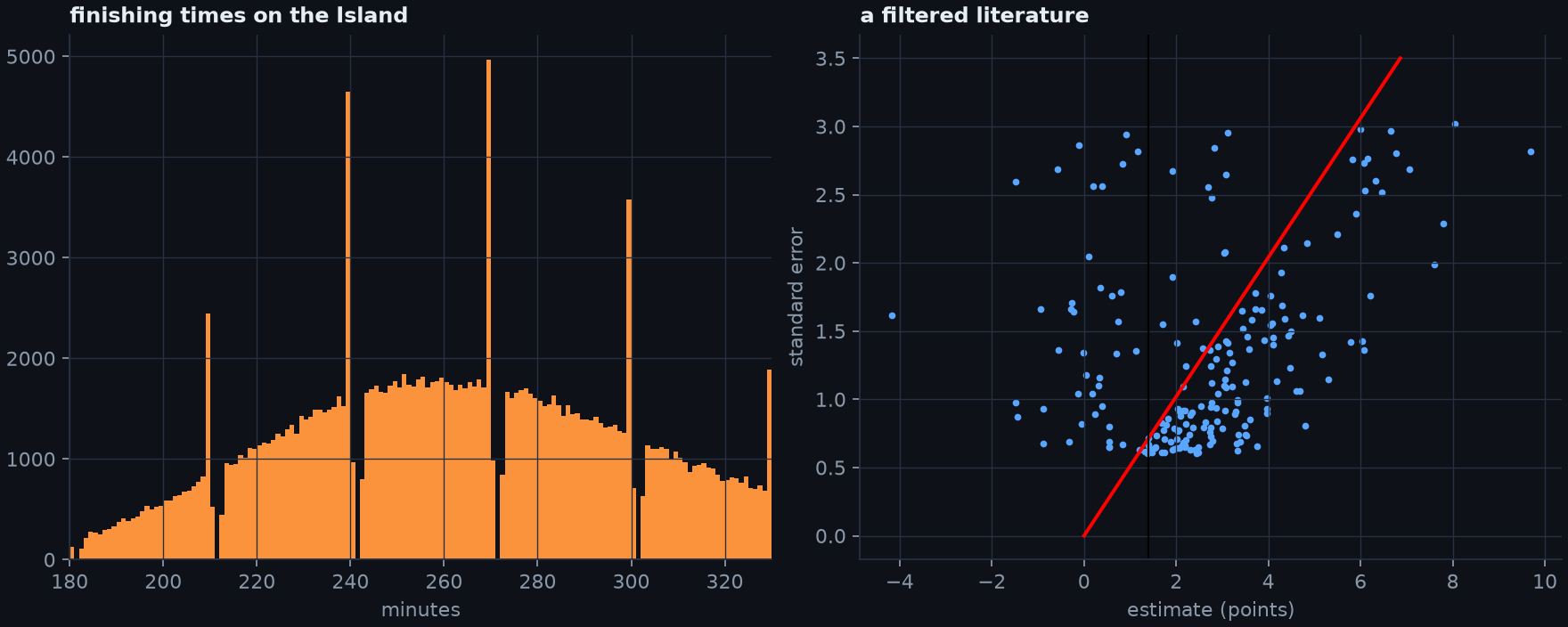
Laboratory mugs are cheap. Does reference dependence survive when the stakes are hours of training? Here are the finishing times of 400 thousand marathon runners on the Island, minute by minute. Look just before each half hour: three hours, three and a half, four. Too many runners finish there. And just after, too few. Eric Allen, Patricia Dechow, Devin Pope and George Wu found exactly this shape in nearly ten million real marathon finishing times: runners bunch just under round numbers, most visibly under three and four hours. Nothing about running changes at four hours. Only the goal does.
Why the shape? On the Island each runner chooses effort, which is costly. A minute saved is worth something, plus a gain-loss term around the goal: below four hours each minute is a gain, above it each minute is a loss, and losses count lambda times more. So the reward for speed jumps at the goal: a kink, like the jump in a tax rate in Part forty-one. Runners whose natural time lies just over the goal push to just under it. Fit a smooth curve to the histogram away from the goal, as Part forty-one did for taxpayers. The excess under four hours is about 1.9 minutes' worth of runners, and about as many are missing just over it. The planted kink moves 2.5 minutes' worth of runners onto the goal; the estimator recovers most of it. The size of the bunch is a measure of how much losses outweigh gains.
Golf has a reference point printed on the card: par. A putt for par avoids a loss; a putt for birdie, one under par, is a gain. On the Island, the share of putts holed falls steeply with length, for both kinds. And birdie putts are longer on average, because they usually follow an approach shot, while a par putt often follows a missed birdie putt or a chip. So comparing all par putts with all birdie putts gives a gap of 21 percentage points, which is mostly distance: the selection problem of Part four, where the comparison groups differ in more than the thing being studied.
So compare putts of the same length. Each bar is the difference between par and birdie putts within one band of distance. At almost every length, par putts go in a little more often. Averaged, the gap is 2.2 points, close to the planted 2.5. Devin Pope and Maurice Schweitzer did this with millions of laser-measured putts on the PGA Tour. Professionals, with large sums at stake and years of practice, hole par putts about two percentage points more often than birdie putts of the same length: they try harder to avoid a loss than to secure a gain.
The last test has the largest stakes: selling a home. After flat prices fall, many owners face a loss against the price they paid. On the Island, a loss-averse owner asks the flat's value plus 0.3 of the nominal loss. Each dot is a group of owners, by the size of their loss. The econometrician never sees a flat's value, only its features, and a flat that is better than its features is both bought for more, which looks like a bigger loss, and listed for more. Ignore that, and the estimate is 0.68: too high. Control for how far the last sale price stood above the features' value, and the estimate falls to 0.27: too low, because that residual also contains the owner's luck when buying. The two estimates bracket the truth. And the owners with losses, asking more, wait 20 weeks to sell instead of 11. David Genesove and Christopher Mayer found this in downtown Boston's condominium market from 1990 to 1997: owners facing a nominal loss asked more, by a quarter to a third of the gap between the expected price and the price they had paid, got more, and sold more slowly.
What it does: Bunching under round times; the kink; par against birdie; condominium sellers
5Present biasPrinciples and the major4 min
Part seven discounted the future at a steady rate: each day further away is worth the same fraction less. That is the grey curve. Present bias adds one number. Everything that is not today is multiplied by beta, less than one, and after that the steady rate applies. The formula is due to Edmund Phelps and Robert Pollak, and David Laibson brought it into economics in 1997. The whole difference is a drop between now and everything else. Between next Tuesday and next Wednesday, nothing special happens. Between today and tomorrow, a great deal does.
The drop makes plans unstable. Offer a hundred dollars today or a hundred and ten tomorrow. Tomorrow's money is cut by beta, so the hundred and ten feels like 77: take the hundred today. Now offer the same pair a year from now: a hundred in a year, or a hundred and ten in a year and a day. Both are in the future, both are cut by beta, and the extra ten dollars wins. So today you plan to wait for the hundred and ten. A year from now, the day arrives, the first option becomes today, and you take the hundred. Your plan and your choice disagree, and they will disagree every time. The gym member signs up as the planner and shows up, or not, as the chooser.
Ted O'Donoghue and Matthew Rabin asked what happens when people do, or do not, know they are present biased. Take a report due within four weeks, with beta one half. Writing it costs 3 this week, then 5, 8 and 13 as other work piles up. Part five's agent writes it in week 1. The naif, sure that a later self will do it, keeps postponing to a week that looks cheap from today, and writes it in week 4, at the worst cost. The sophisticate knows the week-three self would also postpone, so week two is the last chance before the worst week, and writes it in week 2. Knowing your bias helps. Now a pleasure instead: a film, better each week, 3, 5, 8, 13. Part five's agent waits for the best, week 4. The naif gives in early, in week 3. The sophisticate, expecting to give in anyway, gives in in week 1. Knowing your bias, with pleasures, can make it worse.
Now be the gym. What contract should you offer a present-biased member? Stefano DellaVigna and Ulrike Malmendier worked it out in 2004. For a good whose costs come now and benefits later, the profit-maximizing price of a visit is below what a visit costs the gym, by the share of the benefit the member's present bias throws away. On the Island, a visit costs the gym 3 dollars, and the best price is minus 4.20. Below zero. The fee carries the profit. A monopoly gym charges the naif a higher fee than the sophisticate, because the naif expects to go more often, and leaves the naif worse off than staying home, by 12 dollars 96. Competition returns the fee to cost for both. The per-visit price stays below cost: for a present-biased member, that helps, a little commitment sold with the membership. Real gyms cannot pay people to come, so the price of a visit stops at zero: a flat fee with free visits, the contract of the hook.
What it does: Discount curves; a preference reversal; naifs and sophisticates; the gym's contract
6Commitment, demandedPrinciples and the major3 min
Here is a sharp test. The agent of Part five never pays to give up an option. An option it does not want, it simply does not use. But a sophisticate, who knows tomorrow's self will be tempted, may want to bind that self in advance, like Ulysses, who had his crew tie him to the mast before the sirens began to sing. In money, that is an account you cannot touch until a date, or until a goal is reached, even though it pays no more interest than an ordinary one. So if people choose such an account, the choice itself is evidence: of present bias, and of knowing it.
Nava Ashraf, Dean Karlan and Wesley Yin ran the test with a rural bank on Mindanao, in the Philippines. The bank's clients were surveyed first, including questions that revealed whether they were patient for the far future but impatient for the near one. Then some of them, chosen at random, were offered a new account: money deposited could not be withdrawn until a date or an amount the client set, and it earned no extra interest. Of the 710 clients offered it, 202, twenty-eight percent, took it, and women whose survey answers showed the tell-tale reversal were more likely to. A year later, the average savings balance of those offered the account had risen by 81 percentage points more than that of those not offered. Commitment was demanded, and it worked.
The Island runs the same trial, with 1,800 clients. Of those offered the locked account, 30 percent take it. Comparing everyone offered with everyone not offered, savings are 11.0 points higher: the effect of the offer, which randomization makes clean. Only the takers can have been changed by the account, so the effect on a taker is the effect of the offer divided by the take-up: 36 points, the Wald ratio of Part four. And the takers are the more present-biased, with an average beta of 0.64 against 0.72. They are mostly sophisticates. Naifs, sure they will save anyway, see no use for a lock, which is why the people who might need commitment most are the least likely to ask for it.
What it does: Why pay for fewer options; SEED; the Island's trial
7Defaults and inertiaPrinciples and the major4 min
In 2001 Brigitte Madrian and Dennis Shea studied a large American company that changed one thing in its retirement plan. Before, new employees had to sign up to join. After, new employees were enrolled automatically unless they chose to opt out. The plan, the employer's matching contribution and the investment choices were the same. Participation among new hires jumped, from 37 percent to 86 percent, as the authors later summarized it. And many of the new participants stayed exactly at the default: its low contribution rate and its conservative fund, which few had chosen before. For the agent of Part five, which box is ticked when you arrive should not matter. It matters enormously.
The Island's new hires each have an ideal saving rate, zero for a few. Changing the rate takes an afternoon of forms, a cost paid now, while the gain comes over decades. For Part five's workers the default barely matters: within weeks nearly everyone is at their ideal rate, whichever box was ticked. Present-biased naifs are another story. Signing up always looks better next month. A year in, 63 percent of them save when they must sign up, and 98 percent when they are enrolled automatically. And after three years, 36 percent are still at the default rate, whatever their ideal. The default decides because the decision is put off.
Why do defaults stick? The Island's answer is procrastination. Acting now costs the effort k now; waiting a month costs one month's gain g. A naif, believing next month's self will act, compares the two with the present cut by beta, and with a beta of 0.7 that means acting only when the effort is a small fraction of what a time-consistent worker would bear. In real plans, a default also reads as advice: the employer must think this is sensible. And it becomes the reference point, so leaving it feels like a loss. Whatever the reason, there is no neutral design. Some box is always ticked. Gabriel Carroll, James Choi, David Laibson, Brigitte Madrian and Andrew Metrick showed how to choose it: a default works well when people's needs are alike, and requiring an active choice works better when needs differ widely and people are prone to put decisions off.
If biases can block saving, can they be turned around to help it? Richard Thaler and Shlomo Benartzi designed Save More Tomorrow: workers commit today to put part of each future pay rise into saving. The design uses present bias, since the cost comes later, and loss aversion, since take-home pay never falls; and inertia then keeps people in. On the Island, only 4 percent would raise their saving now, but 69 percent sign up to raise it later, and with four rises their rate climbs from 3.5 to 15 percent. In the first company to use it, 78 percent of those offered the plan joined, and their average saving rate rose from three and a half percent to thirteen point six percent over forty months.
What it does: Madrian and Shea; the Island's new hires; why defaults stick; Save More Tomorrow
Intermission: the American saving rate, 1959-2026Principles and the major
This chapter has no narration to read.
8InattentionPrinciples and the major3 min
Some prices are on the tag; others arrive later. A printer, then its ink. A hotel room, then its minibar. A bank account, then its overdraft fee. On the Island, most buyers of printers do not think about ink when they buy; it costs 3 dollars to make and sells for 18. Competition does not drive the ink's price down, because nobody chooses a printer by it. It drives the printer's price down instead, to 9 dollars 50, below its cost of 20 dollars, paid for by the ink. Myopic buyers pay 27 dollars 50 in all. Sophisticated buyers take the cheap printer and avoid the dear ink, refilling cartridges or printing elsewhere, and pay 15 dollars 50. In a competitive market the inattentive subsidize the attentive. Xavier Gabaix and David Laibson called these shrouded attributes.
Why does no firm advertise the truth about ink and steal the customers? Suppose a firm does. The myopes it educates become sophisticates. But a sophisticate does not need the honest firm: the cheapest move is to buy any firm's subsidized printer and avoid its ink. The firm that revealed the shroud gains nobody, and pays for the advertising. So in equilibrium no firm unshrouds, even in a competitive market. Gabaix and Laibson called it the curse of debiasing.
Inattention leaves fingerprints in prices. Here are wholesale prices of used cars on the Island, by mileage, from 400 thousand sales. Each dot averages the cars in a five-hundred-mile bin. More miles, lower price, as it should be. Take away the straight-line trend, and a sawtooth appears: at every ten thousand miles the price drops by a step, as if 49,999 miles and 50,000 were very different cars, by about 171 dollars. Buyers here read the first digit fully and only part of the rest. If theta is the share of the remaining digits they ignore, the step and the slope between steps pin it down: theta is the step divided by the step plus ten thousand miles' worth of slope. The estimate is 0.28, against a planted 0.3. Nicola Lacetera, Devin Pope and Justin Sydnor found these steps in more than 22 million real wholesale car sales, drops of roughly 150 to 200 dollars at each ten-thousand-mile mark. The buyers at those auctions are professional dealers; the evidence fits partial inattention by the retail customers they sell to, whose bias the dealers pass back into wholesale prices.
What it does: Shrouded add-ons; the curse of debiasing; left digits
9Social preferencesPrinciples and the major3 min
In the ultimatum game one player proposes how to split a pie, and the other accepts, or rejects and both get nothing. Part five's agents would offer a crumb, and it would be accepted. In laboratories around the world, offers are much more generous than that, and low offers are often rejected. Ernst Fehr and Klaus Schmidt explained this with one change to the agent: people dislike inequality. Alpha measures how much it hurts to have less than the other player, beta how much it hurts to have more. A responder with envy alpha prefers nothing to an offer below alpha over one plus two alpha. On the Island, envy varies from person to person, and this is the share who would accept each offer. 51 percent would turn down a fifth of the pie. Proposers who know this offer a lot: on average 44 percent, and those whose guilt beta exceeds a half offer exactly half, because for them every dollar of advantage hurts more than it pleases.
If workers reciprocate kindness, an employer might pay more than it must and get more effort back: the gift exchange behind efficiency wages in Part thirty-eight. Laboratory experiments find it. Does it survive a real job? Uri Gneezy and John List hired people for one-day jobs, entering library books into a database and raising money door to door. On arrival, some were told they would be paid more than advertised. They worked harder at first, but within a few hours the difference was gone. The Island's workers are built the same way. Reciprocity is real, but it can be shorter-lived in the field than in the laboratory, where most sessions last an hour.
The simplest measure of generosity is the dictator game. One player divides a sum of money with an anonymous other, who has no say at all. Most dictators give something, which looked like direct evidence of altruism. John List changed the menu: dictators could also take money from the other player. Giving fell sharply, and many took. If dictators had fixed preferences over the two payoffs, adding options they did not use should not have changed what they chose. So the game measures preferences, but also what the menu suggests is appropriate, and the sense of being watched. Social motives also interact with incentives. In Part one, a fine for late pickup at six Israeli day-care centres was followed by more late parents, not fewer: a fine is a price. A 2020 replication that put the same situation to online respondents as a written scenario found the opposite, fines reducing intended lateness. A survey is not a field experiment, but one striking result should be held as what it is: one result.
What it does: The ultimatum game; gift exchange; dictator games and the take option
10Do markets cure it?Principles and the major2 min
An old reply to behavioural economics is that markets will fix it. There are three versions. Learning: people who trade often learn, like the experienced card dealers of chapter three. Arbitrage: rational traders profit from others' mistakes and, by doing so, push prices back to where they belong. Selection: biased firms make losses and leave. Each has limits. Learning needs frequent decisions with clear feedback, which pensions, mortgages and health plans do not give. Andrei Shleifer and Robert Vishny showed that arbitrage needs capital and patience, and can be too risky to finish the job. And selection works on firms, not on their customers, whose biases a firm may profit from.
The Island's markets give a mixed ledger. Where people trade the same good often, experience cures the endowment effect. A monopoly gym designs its contract around naive members and leaves them worse off for joining. Competition between gyms passes the money back through lower fees, though the contract is still shaped around the bias. Competition between printer makers does not stop the shroud. It turns it into a transfer from the inattentive to the attentive. And honesty does not pay, the curse of debiasing. Markets cure some biases and feed on others; which, depends on how often people decide, how fast they learn, and whether a firm gains by teaching them.
The general pattern. A bias creates a profit opportunity. A firm designs its prices, add-ons, defaults and automatic renewals around it. Competition does not remove the design; it competes away the profit, often through a lower headline price. And the bias remains. That is not proof that policy can do better, but it is why the next question matters: if the market will not fix it, should anyone, and by what standard of better off?
What it does: Three reasons to hope; the Island's ledger; the general pattern
11Behavioural welfarePrinciples and the major3 min
Welfare economics, from Part nine to Part forty-two, measured well-being by choices: what you choose is what you prefer. Behavioural economics breaks that link. Take a worker who never joins a pension plan when joining means signing up, as if joining were worth less than an afternoon of forms, say 30 dollars. Enrolled automatically, the same worker stays in, as if joining were worth more than 80. Which choice reveals what this worker wants? Douglas Bernheim and Antonio Rangel proposed an answer: when choices conflict across frames that should not matter, trust only what they agree on. The worker's value of joining is somewhere between 30 and 80. A policy that costs the worker less than 30 makes them better off whichever frame you believe. One that costs more than 80 makes them worse off. In between, the choices do not say, and the economist should admit it.
Richard Thaler and Cass Sunstein turned this into a policy philosophy they called libertarian paternalism, and popularized as nudging. Some default, some menu, some order is unavoidable, so choose them to help people, as judged by themselves, while keeping every option open and cheap to take. The objections are serious. Who decides what helps? The designer may be wrong, or have interests of its own. The same tools sell as easily as they help: Thaler's own word for frictions that keep people from what they want is sludge, like the subscription that takes one click to start and an hour to cancel. And a cheap nudge can become an excuse not to change prices, rules or institutions, where most of the leverage is.
The Island can test a rule that respects choice. The gym must tell each would-be member how often members like them actually go. If no naif believes it, nothing changes: members gain 14 dollars 32 a month on average from the gym, after paying for it. If half of them believe it, 20 dollars 28. If all do, 26 dollars 25, and the share on monthly contracts falls from 60 to 9 percent. No contract was banned and nobody was told what to buy. The gain comes from better forecasts. But it depends entirely on whether people take the number to apply to them, and naifs, by definition, think they are the exception.
What it does: Frames and the welfare range; nudges and their critics; disclosure at the gym
12Nudges at scaleGraduate3 min
Governments set up nudge units to put these ideas to work: reminder letters, simpler forms, changed defaults, each tested in a randomized trial. How well do they work? In the academic journals, the average nudge raised take-up of the encouraged action by 8.7 percentage points. Stefano DellaVigna and Elizabeth Linos obtained every trial run by two large American nudge units: 126 trials involving about 23 million people. The average effect was 1.4 points: real and statistically clear, but six times smaller. The authors estimate that about 70 percent of the gap comes from selective publication, made worse by small samples; most of the rest from differences in the nudges themselves.
The Island shows how the filter works. Every nudge here truly raises take-up by 1.4 points on average. Researchers run 600 small trials, and a journal publishes the ones that are statistically significant, plus one in ten of the rest. Each gold dot is a published trial: its estimate across, its standard error up the side, so small trials sit high. The red line is the edge of significance. The published mean is 2.7, nearly double the truth: small trials only clear the bar when luck pushes their estimates up. A unit that reports all 150 of its larger trials gets 1.4. Nobody cheated. The filter alone did it: the winner's curse, which Part fifty-six of Statistics, Built treats as inference on winners, and the same arithmetic that inflates any literature that publishes by significance.
Can the filter be undone from the published trials alone? Isaiah Andrews and Maximilian Kasy's approach: model the filter. Each true effect is drawn around mu; each estimate around its true effect; and an estimate is published for sure if significant, with probability gamma if not. The likelihood of what was published divides by the chance of being published. The naive average is 2.67. The selection model estimates 1.19, and a publication chance for insignificant trials of 0.11. The truth is 1.4 and 0.1. The correction is not perfect, and it rests on the model of the filter being right, but it moves most of the way back.
What it does: Journals against nudge units; a filtered literature; the selection model
13Models of limitsGraduate3 min
A critic might say behavioural economics is a list of exceptions. Its most ambitious work tries to model limited minds as precisely as Part five modelled perfect ones. Christopher Sims proposed rational inattention: information is free to look at but costly to absorb, so people choose how much to learn, paying lambda for each unit of information. Filip Matejka and Alisdair McKay showed that the resulting choices follow a logit, tilted toward options that are often good. On the Island a shopper chooses between a familiar product and a new one whose value is uncertain. When attention is cheap, the shopper chooses the new product almost exactly when it is better. As attention gets dearer, the curve flattens: choices barely respond to what is at stake. And when the new product is usually worse, a shopper facing dear attention can rationally never look at it at all. Inattention, on this view, is a choice.
Xavier Gabaix proposed a related idea: sparsity. A decision maker starts from a simple default model of the world and pays attention to each feature only in proportion to how much it matters, minus a fixed cost kappa. Attention to a feature is one minus kappa over its importance, but never below zero. A car buyer weighs the price almost fully, quality somewhat, running costs less, and resale value and warranty terms not at all. The result is a model with exact zeros, like the lasso of Statistics, Built: small things are ignored completely, which is what left-digit bias and shrouded fees look like from the inside.
Limits also shape expectations, the subject of Part twenty-eight. Olivier Coibion and Yuriy Gorodnichenko's test regresses the error in a forecast on the revision that produced it. If forecasters use their information well, revisions should not predict errors. A positive slope means forecasts move too little when news arrives; a negative slope, too much. On the Island, forty forecasters each see the economy through private noise. When they are rational, each one's slope is minus 0.04, about zero, but the average forecast's slope is 1.17: the consensus under-reacts, because each person's news reaches the average only gradually. Now make them diagnostic, in the sense of Pedro Bordalo, Nicola Gennaioli and Andrei Shleifer: news that makes a state more likely than before makes it seem much more likely. Each forecaster now over-reacts, with a slope of minus 0.36, while the average still under-reacts, at 0.37. That is the pattern Bordalo, Gennaioli, Yueran Ma and Shleifer found in professional forecasts: individuals over-react, the consensus under-reacts. One model, two facts.
What it does: Rational inattention; sparsity; forecasts that over- and under-react
14The Dials: loss aversion, present bias, defaultsResearch
This chapter has no narration to read.
What it does: Loss aversion; present bias; the effect of a default
15In practice: products, protection, pensionsPractice3 min
Who uses behavioural economics? Product teams, who design defaults and the steps of signing up and cancelling, and test them in experiments on millions of users. Consumer-protection agencies, who write rules about disclosure, cancellation and fees. Pension designers, who choose defaults for whole workforces. Government behavioural teams, who redesign letters and forms and test them at the scale of chapter twelve. And economists in all four places, whose job is to estimate the bias, and to say who gains and who loses from a design.
A case in consumer protection. Subscriptions that renew automatically are easy to start and can be hard to stop: the inattention and procrastination of this part, turned into revenue. America's Federal Trade Commission wrote a rule requiring that cancelling be as easy as signing up. On the eighth of July 2025, days before it was to take effect, a federal appeals court vacated it, not on its merits but on procedure: the Commission had not prepared a preliminary analysis the law requires for rules with large economic effects. An older rule from 1973 and many states' automatic-renewal laws remain. The economics of the question is the gym's: a contract that profits when members forget to cancel.
In pensions, the default has become law. America's SECURE 2.0 Act of 2022 requires most newly established 401(k) and 403(b) plans to enroll eligible workers automatically. The default contribution must be between three and ten percent, and rise each year, which builds in Save More Tomorrow's escalation. The evidence behind it is chapter seven's. The trade-off is chapter seven's too: a low default brings in people who would not have saved, but can anchor some who would have saved more, which is why escalation matters.
Called it? Stefano DellaVigna and Devin Pope ran a large online experiment of a simple real-effort task with eighteen ways of motivating people, and before the results came out asked 208 experts to forecast each one. One arm paid a token piece rate, a tenth of a cent. A sizeable share of the experts expected it to crowd out effort: people paid almost nothing would work less than people paid nothing at all, as with the day-care fine. Instead, effort was 24 percent higher than with no piece rate, and a full cent added more. The verdict: wrong. The experts did well on much else, and their average forecast beat most of them individually. But a famous story is not a law of nature, which is the lesson of this whole part.
What it does: Who uses this; click to cancel; SECURE 2.0; Called it? (wrong)
16Frontier: structural behavioural economics, behavioural macroResearch2 min
Four frontiers. Structural behavioural economics. A treatment effect says what a nudge did; it does not say whether people are better off, or what a different policy would do. For that, estimate the parameters, the beta, the lambda, the cost of attention, from field choices, and use the model to predict. Stefano DellaVigna has argued that this is how behavioural findings become tools for policy. Behavioural macroeconomics. In Part thirty, promises about interest rates far in the future had implausibly large effects today, the forward-guidance puzzle. Xavier Gabaix showed that if households and firms discount the distant future through limited attention, the puzzle shrinks. Theories learned from data. With thousands of choices, a flexible learner can find the best fit that is achievable at all, and a theory can be graded by how close it comes. Psychology, Built ran this race for prospect theory on thirteen thousand gamble problems. And robustness. Some famous findings, like ego depletion, did not survive large, preregistered replications; others, like loss aversion in many settings and the power of defaults, did, at sizes that are now being pinned down.
Here is one result from that race, refitted for this part. Joshua Peterson and his coauthors collected online choices between pairs of gambles on an unprecedented scale. Fitting prospect theory to 1,928 of the problems described in words, with 31,700 choices, against Tversky and Kahneman's parameters in grey, gives a loss aversion of 1.13, in gold, not 2.25. In these risky choices between gambles the kink is far smaller. Loss aversion is not one number; the first dial, in chapter fourteen, collected what it is in different settings.
What it does: Structural behavioural economics, behavioural macro, theories from data, robustness
Recap, problems, and the road aheadAll tracks3 min
So: what changes in economics when people are not the agents of Part five? Choices become predictable in new ways. People overweight the present, judge outcomes as gains and losses from a reference point, attend to a few things, and care about others. Markets cure some of this, where people learn fast, and feed on the rest. And welfare can no longer be read from any single choice, only from where choices agree.
Part forty-five in twelve lines. Gym members forecast their visits as if they were Part five's agents, and pay for the difference. Owners ask about twice what buyers bid, and too few mugs change hands. Runners bunch under round times and golfers try harder for par. Sellers facing a loss ask more, and two regressions bracket by how much. Present bias makes plans reverse; naifs put things off, and sophisticates bind themselves. A gym prices visits below cost for present-biased members. Commitment is demanded, mostly by those who know their bias. Defaults decide for people who put off deciding. Shrouded fees survive competition, and left digits leave steps in prices. Fairness rejects low offers and makes proposers generous. Published nudges look six times bigger than nudges in full, and a model of the filter undoes most of it. And forecasters over-react one by one while their average under-reacts.
The problems. The price of a gym visit; a preference reversal; naifs and sophisticates; the mug; left-digit bias from a step and a slope; the effect on takers of a commitment account; fairness in the ultimatum game; and a starred derivation of why a filtered literature overstates. Full solutions are in the part's notes.
The reading: Richard Thaler's Misbehaving, a history of the field by one of its founders; Daniel Kahneman's Thinking, Fast and Slow; Sanjit Dhami's graduate text; and the Handbook of Behavioral Economics, edited by Douglas Bernheim, Stefano DellaVigna and David Laibson. Then the papers, from prospect theory to nudges at scale.
Next time, the economics of development. A bed net treated with insecticide costs a few dollars and prevents malaria. Should it be given away, or sold cheaply so that only people who value it take one? Jessica Cohen and Pascaline Dupas randomized the price at twenty prenatal clinics in Kenya. Even small prices cut take-up sharply, and those who paid were no more likely to use their nets. Part forty-six asks why the poor stay poor, and what actually helps.
Where it goes next. Part 46 turns to development: why the poor stay poor, and what actually helps.
Key results
The part's results in one place, for revision.
Try it
Lab 45 · Behavioural economics
Measure what present bias costs gym members and how a gym prices for it; see loss aversion halve trade and bunch runners under round times; tell naifs from sophisticates; estimate the effect of a commitment account on those who take it; recover inattention from steps in prices; and undo a literature's publication filter.
python -m videos.economics.labs 45
needs numpy, scipy, matplotlib · download lab45.py ·
source on GitHubgym: share monthly; visits forecast and made; price per visit 59%; 13.8 and 4.6; $15.10
the gym's contract for a naif (beta 0.7): price of a visit, fee, member's real gain $-4.20, $198.81, $-12.96
mugs: share traded without and with loss aversion; ask/bid ratio 50%, 24%; 2.04
marathon: excess and missing mass at 4:00 (minutes); planted 1.89, 2.01; 2.50
O'Donoghue-Rabin weeks (time-consistent, naif, sophisticate): report; film 1, 4, 2; 4, 3, 1
commitment: take-up; effect of the offer; effect on takers 30%; 11.0; 36.5
left digits: theta planted and estimated 0.30, 0.31
nudges: truth; published mean; selection-model estimate 1.40; 2.67; 1.19
forecasters: individual and consensus slopes, rational; diagnostic -0.04, +1.17; -0.36, +0.37
Members who forecast like Part 5's agents pay for being someone else; loss aversion halves trade and bunches runners at round times; commitment is taken by those who know their bias; inattention leaves steps in prices; and a literature filtered by significance overstates, by a margin a model of the filter can largely undo.The code (102 lines; it asserts its own result)
"""Lab 45: behavioural economics on the Island: the gym and the contract designed for present-biased members, the
mug market and loss aversion, bunching at round finishing times, present bias with naifs and sophisticates, a
randomized commitment account, defaults, left-digit bias, Fehr-Schmidt players, a literature filtered by
significance and its correction, and forecasters who over- and under-react."""

import numpy as np

from videos.coursekit import labs
from explainer.economics.agora import behave
from explainer.economics.island import truths

TITLE = "Behavioural economics"
GOAL = ("Measure what present bias costs gym members and how a gym prices for it; see loss aversion halve trade and "
        "bunch runners under round times; tell naifs from sophisticates; estimate the effect of a commitment account "
        "on those who take it; recover inattention from steps in prices; and undo a literature's publication filter.")
TASKS = [
    "The gym: make every member sophisticated (naive_share = 0). How do the share on monthly contracts and the price "
    "paid per visit change, and why?",
    "Bunching: raise loss aversion from 2.25 to 3. How does the excess mass under four hours change, and how would you "
    "turn it back into lambda?",
    "Nudges: let journals publish insignificant trials half the time (gamma = 0.5). How far is the published mean from "
    "the truth now, and does the selection model still recover it?",
]


def run(seed=0):
    lab = labs.Lab()
    T = truths(45)

    G = T["gym"]
    g = behave.island_gym(n=2000, fee=G["fee"], per_visit=G["per_visit"], N=G["N"], C=G["C"], b_mean=G["b_mean"],
                          b_sd=G["b_sd"], beta_lo=G["beta_lo"], beta_hi=G["beta_hi"], naive_share=G["naive_share"],
                          busy=G["busy"], seed=G["seed"] + seed)
    lab.row("gym: share monthly; visits forecast and made; price per visit",
            f"{100 * g['share']['monthly']:.0f}%; {g['monthly_forecast']:.1f} and {g['monthly_visits']:.1f}; "
            f"${g['price_per_visit']:.2f}")
    assert g["price_per_visit"] > G["per_visit"]
    c = behave.gym_contract(0.7, 1.0, G["b_mean"], G["C"], G["N"], G["m"])
    lab.row("the gym's contract for a naif (beta 0.7): price of a visit, fee, member's real gain",
            f"${c['p']:.2f}, ${c['F']:.2f}, ${c['realized_surplus']:.2f}")

    M = T["mugs"]
    m0 = behave.mug_market(M["n"], 1.0, 1.0, M["mu"], M["sigma"], 1000, M["seed"] + seed)
    m1 = behave.mug_market(M["n"], M["lam_goods"], 1.0, M["mu"], M["sigma"], 1000, M["seed"] + seed)
    lab.row("mugs: share traded without and with loss aversion; ask/bid ratio",
            f"{100 * m0['share_traded']:.0f}%, {100 * m1['share_traded']:.0f}%; {m1['ratio']:.2f}")

    R = T["marathon"]
    mr = behave.marathon(n=200_000, k=R["k"], eta=R["eta"], lam=R["lam"], base=R["base"], friction=R["friction"],
                         seed=R["seed"] + seed)
    b240 = behave.bunching_at(mr["T"], 240.0)
    lab.row("marathon: excess and missing mass at 4:00 (minutes); planted", f"{b240['excess']:.2f}, "
            f"{b240['missing']:.2f}; {mr['extra_minutes']:.2f}")

    O = T["odr"]
    oc, orw = behave.odr(O["values"], O["beta"], "cost"), behave.odr(O["values"], O["beta"], "reward")
    lab.row("O'Donoghue-Rabin weeks (time-consistent, naif, sophisticate): report; film",
            f"{oc['tc']}, {oc['naif']}, {oc['soph']}; {orw['tc']}, {orw['naif']}, {orw['soph']}")

    S = T["seed"]
    st = behave.commitment_trial(n=S["n"], soph_share=S["soph_share"], flex_mean=S["flex_mean"],
                                 flex_sd=S["flex_sd"], seed=S["seed"] + seed)
    lab.row("commitment: take-up; effect of the offer; effect on takers", f"{100 * st['take_up']:.0f}%; "
            f"{st['itt']:.1f}; {st['tot']:.1f}")

    C = T["cars"]
    u = behave.used_cars(n=200_000, theta=C["theta"], seed=C["seed"] + seed)
    lab.row("left digits: theta planted and estimated", f"{C['theta']:.2f}, {u['theta_hat']:.2f}")

    N = T["nudges"]
    lit = behave.nudge_literature(N["k"], N["mu"], N["tau"], N["control"], *N["journal_n"], N["gamma"],
                                  N["seed"] + seed)
    pub = np.array(lit["published"])
    fit = behave.selection_mle(np.array(lit["x"])[pub], np.array(lit["se"])[pub])
    lab.row("nudges: truth; published mean; selection-model estimate", f"{N['mu']:.2f}; "
            f"{lit['mean_published']:.2f}; {fit['mu']:.2f}")
    assert lit["mean_published"] > N["mu"]

    F = T["forecast"]
    fr = behave.forecasters(T=F["T"], n=F["n"], rho=F["rho"], sd_signal=F["sd_signal"], theta=0.0, seed=F["seed"])
    fd = behave.forecasters(T=F["T"], n=F["n"], rho=F["rho"], sd_signal=F["sd_signal"], theta=F["theta"],
                            seed=F["seed"])
    lab.row("forecasters: individual and consensus slopes, rational; diagnostic",
            f"{fr['individual']:+.2f}, {fr['consensus']:+.2f}; {fd['individual']:+.2f}, {fd['consensus']:+.2f}")
    assert fd["individual"] < fr["individual"]

    lab.note = ("Members who forecast like Part 5's agents pay for being someone else; loss aversion halves trade and "
                "bunches runners at round times; commitment is taken by those who know their bias; inattention "
                "leaves steps in prices; and a literature filtered by significance overstates, by a margin a model of "
                "the filter can largely undo.")

    fig, ax = labs.figure(2, size=(11, 4.4))
    e = np.array(mr["edges"])
    ax[0].bar((e[:-1] + e[1:]) / 2, mr["h"], width=1.0, color=labs.ORANGE)
    ax[0].set(title="finishing times on the Island", xlabel="minutes", xlim=(180, 330))
    ax[1].scatter(np.array(lit["x"])[pub], np.array(lit["se"])[pub], s=6, color=labs.BLUE)
    se = np.linspace(0, 3.5, 50)
    ax[1].plot(1.96 * se, se, color="red")
    ax[1].axvline(N["mu"], color="black", lw=1)
    ax[1].set(title="a filtered literature", xlabel="estimate (points)", ylabel="standard error")
    lab.fig = fig
    return lab
Now change it
- The gym: make every member sophisticated (naive_share = 0). How do the share on monthly contracts and the price paid per visit change, and why?
- Bunching: raise loss aversion from 2.25 to 3. How does the excess mass under four hours change, and how would you turn it back into lambda?
- Nudges: let journals publish insignificant trials half the time (gamma = 0.5). How far is the published mean from the truth now, and does the selection model still recover it?
Problems, with solutions
Try each problem before opening its solution.
1. The gym: a monthly fee of $70 and 4.3 visits a month. What does a visit cost? How many visits a month would make the fee cheaper than a pass at $10 a visit?
Solution
$70 / 4.3 = $16.28 a visit. The fee is cheaper than the pass once 10 x visits > 70, that is from the eighth visit a month: a member must go more than 7 times a month for the contract to pay.
2. Present bias: with beta = 0.7 and delta = 1, compare $100 today with $110 tomorrow, and the same pair a year away. Below what beta does today's $100 win?
Solution
Today: 100 against 0.7 x 110 = 77, so the $100. A year away both are multiplied by 0.7: 70 against 77, so the $110. Today's $100 wins when 110 beta < 100, that is for beta below 0.909; for any such beta the plan made a year ahead reverses when the day comes.
3. O'Donoghue and Rabin: costs 3, 5, 8, 13 over four weeks. Find when the naif and the sophisticate act with beta = 1/2, then with beta = 0.7.
Solution
With beta = 1/2 the naif compares each week's cost with half the cheapest later one: 3 > 2.5, 5 > 4, 8 > 6.5, so it waits to week 4. The sophisticate reasons backward: week 3 would wait (8 > 6.5) for week 4's 13, so in week 2 the comparison is 5 against 6.5, and it acts in week 2. With beta = 0.7, 3 <= 0.7 x 5 = 3.5, so both act in week 1: mild present bias does not distort this choice at all.
4. The mug: owner and buyer both value a mug at $4; losses over goods count twice, over money once. Find the ask and the bid. Can they trade?
Solution
The owner asks 2 x $4 = $8; the buyer bids $4. No price lies between, so they do not trade, although the mug is worth the same to both and trade would cost nothing.
5. Left digits: within a band, price falls $40 per 1,000 miles; at each 10,000 it drops a further $170. Estimate theta.
Solution
Ten thousand miles of within-band slope are worth $400. Then theta = 170 / (170 + 400) = 0.30: buyers ignore about 30% of the information in the digits after the first.
6. Commitment: 30% of those offered take the account, and the offer raises average savings by 11. What is the effect on a taker, and what does it assume?
Solution
11 / 0.30 = 36.7. It assumes that the offer changes savings only through the account (being offered and declining has no effect); with one-sided take-up (nobody not offered can open one) nothing more is needed, and the answer is the effect on those who take it, not on everyone.
7. Fehr and Schmidt: a responder with alpha = 1 and a proposer with beta = 0.6. Find the smallest acceptable share and the proposer's offer.
Solution
Accepting s gives s - alpha (1 - 2s) for s < 1/2, which is positive when s > alpha / (1 + 2 alpha) = 1/3. The proposer's utility from an accepted offer s < 1/2 is (1 - s) - beta (1 - 2s), whose slope in s is 2 beta - 1 = 0.2 > 0, so the proposer offers half.
8. Selection: estimates are published with probability 1 if z >= 1.96, gamma otherwise. Write the density of a published estimate, and show the published mean exceeds mu when gamma < 1.
Solution
With x ~ normal(mu, sigma^2) and a = 1.96 se, a published estimate has density p(x) f(x) / P, where p(x) = 1 for x >= a and gamma below, and P = Pr(x >= a) + gamma Pr(x < a). Its mean is a weighted average of E[x | x >= a] and E[x | x < a] with weights Pr(x >= a) and gamma Pr(x < a). With gamma = 1 the weights give mu; lowering gamma moves weight from the lower conditional mean, which is below mu, to the upper one, which is above it, so the published mean exceeds mu.
Notes and sources
Sources
The studies the film states are listed with what each shows in dials.SHOWN[45]; the three dials (loss aversion,
present bias, the effect of a default) are in explainer/economics/dials.py; the experts' forecast of crowding out is a
Called it? entry (explainer/economics/calls.py). List's card-show data are AER 1.2-17's SportsCards (from Stock
and Watson's online complements), retrieved 2026-11-21 and checked by SHA-256; the shares are computed here. The
studies' statements were checked on 2026-11-21 against their abstracts and the authors' summaries: DellaVigna and
Malmendier (7,752 members, over $70 a month, 4.3 visits, more than $17 a visit against $10); Ashraf, Karlan and Yin
(202 of 710 offered took the account; savings up 81 percentage points); Madrian and Shea (37% to 86%, as the authors
summarized it in 2024); Thaler and Benartzi (78% joined; 3.5% to 13.6% in 40 months); Lacetera, Pope and Sydnor (22
million sales; steps of roughly $150-200); Pope and Schweitzer (about two points); Genesove and Mayer (25-35% of the
gap); Allen et al. (9,789,093 finishing times); DellaVigna and Linos; Gneezy and List; List (2007); Metcalf et al.
(2020); DellaVigna and Pope (2018); the FTC ruling of 8 July 2025 and SECURE 2.0. Not verified, so stated in words:
Kahneman, Knetsch and Thaler's exact medians (stated as about two to one) and Augenblick, Niederle and Sprenger's beta
values (stated as little present bias over money and more over effort).
About this partfrom its README
Part 45 of a sixty-eight-part course in economics (see the series plan and the syllabus), the third of Act IX, The Fields. It asks what changes in economics when people are not the agents of Part 5. Its answer: choices become predictable in new ways, because people overweight the present, judge outcomes as gains and losses from a reference point, attend to little, and care about others; markets cure some of this, where people learn fast, and feed on the rest; and welfare can only be read where choices made in different frames agree.
It opens on DellaVigna and Malmendier's gym: 7,752 members of three American health clubs, many on monthly contracts of over $70, going 4.3 times a month and so paying over $17 a visit, when a ten-visit pass cost $10. On the Island, with the same prices, naive monthly members forecast 13.9 visits a month, make 4.7, and pay $15.02 a visit; 84% would have paid less with the pass. From there it covers:
- three departures from Part 5's agent (preferences, beliefs, decision making), drawn as the failure of one term each in the standard objective, and four new residents of the Island: the naif, the sophisticate, the loss-averse trader and the inattentive buyer;
- a game: the viewer is given a mug and names a selling price; in the Island's mug market (44 people, values lognormal around $4) owners who count losses twice ask a median $8.07 against buyers' $4.03, and 24% of the mugs trade instead of 50% (averages over 4,000 sessions); Kahneman, Knetsch and Thaler's experiments;
- prospect theory in one card (alpha = beta = 0.88, lambda = 2.25); traders whose loss aversion fades with experience, trading 25% of goods as newcomers and 50% as veterans; List's own card-show data (148 traders, Orlando, 1998): 34% swapped where about half should have, from none of those who never trade to about half of those trading ten or more times a month, and among non-dealers 7% of occasional traders against 47% of regulars; where the reference point sits;
- reference points in the field: 400,000 Island marathon runners bunch just under every half hour, with about 1.9 minutes' worth of excess runners under four hours and as many missing just over it (the planted kink moves 2.5), measured with Part 41's bunching estimator; putts for par and birdie, where the raw gap of 21 points is mostly distance and putts of the same length differ by 2.2 points (planted 2.5); loss-averse condominium sellers, where a regression that misses unseen quality estimates 0.68 and one that controls for the last sale's residual 0.27, bracketing the planted 0.3, and owners with losses wait 20 weeks to sell instead of 11;
- present bias: quasi-hyperbolic discounting; a preference reversal ($100 today over $110 tomorrow, $110 in a year and a day over $100 in a year); O'Donoghue and Rabin's report (costs 3, 5, 8, 13; beta = 1/2: the time-consistent agent writes it in week 1, the naif in week 4, the sophisticate in week 2) and film (week 4, 3, 1); the contract a gym designs for present-biased members, with visits priced at m - (1 - beta) b = -$4.20 and a monopoly leaving a naif $12.96 a month worse off for joining, while free entry returns the fee to $75.60;
- commitment: Ashraf, Karlan and Yin's SEED accounts; the Island's randomized offer, taken by 30% of those offered, raising average savings by 11.0 and by 36.5 for takers (the Wald ratio), takers being the more present-biased (beta 0.64 against 0.72) and mostly sophisticates;
- defaults: Madrian and Shea; on the Island, a year after hire 63% of naifs save when they must sign up and 98% when enrolled automatically, against 90% either way for time-consistent workers, and 55% of naifs are still at the default rate after three years; why defaults stick; Carroll et al.'s active choice; Save More Tomorrow (on the Island 4% would save more now and 69% sign up to save more later; Thaler and Benartzi's 3.5% to 13.6% in 40 months);
- an intermission of the American personal saving rate, 1959-2026;
- inattention: shrouded add-ons, with printers priced at $9.50 against a cost of $20 and myopes paying $27.50 in all against sophisticates' $15.50; the curse of debiasing; left-digit bias in used-car prices, with steps of $171 at every 10,000 miles and an estimated theta of 0.29 (planted 0.3);
- social preferences: Fehr and Schmidt's inequity aversion in the ultimatum game (51% would reject a fifth of the pie; offers average 44%, and 37% of proposers offer half); gift exchange that fades within hours; List's dictator games with a take option; the day-care fine of Part 1 and its record;
- whether markets cure biases: learning, arbitrage and selection, and the Island's mixed ledger;
- behavioural welfare: Bernheim and Rangel's welfare range across frames; libertarian paternalism and its critics; a disclosure rule at the Island's gym that raises members' average real gain from $14.32 a month to $26.25 if every naif believes it;
- nudges at scale: DellaVigna and Linos (8.7 points in the journals, 1.4 points in two nudge units' full records); the Island's filtered literature (a published mean of 2.67 against a truth of 1.4) and the step-function selection model (1.19);
- models of limits: rational inattention by the Blahut-Arimoto iteration, sparse attention by soft thresholding, and forecasters who are rational (individual slope -0.04, consensus +1.17) or diagnostic (-0.36 and +0.37);
- three dials (loss aversion: 2.25, 1.955, 1.31 and 1.13; present bias: about 0.5 structurally, 0.70-0.79 over effort, about 1 over money; the effect of a default: 49 points for Madrian and Shea's new hires); practice (click to cancel, vacated in July 2025; SECURE 2.0's automatic enrollment); Called it? on experts who expected a token piece rate to crowd out effort (it raised effort 24%: wrong); and a frontier chapter on structural behavioural economics, behavioural macro, theories learned from data (prospect theory refitted to choices13k gives lambda = 1.13) and robustness.
What is computed and built
Everything plotted is computed by compute.py from Agora's behavioural economics module
(explainer.economics.agora.behave) with the Island's Part 45 truths, or from the data named above; the narration
states the cached numbers.
- The gym. Thirty days a month; on 55% of them a member cannot go; on the others today's cost of going is uniform on [0, 60] and the member goes if it is below beta times the later benefit b (less the price of a visit). Benefits are lognormal around 24, beta uniform on [0.5, 0.95]; 85% of members are naive (beta_hat = 1, forgetting the busy days). Contracts are chosen by the forecast surplus, the long-run value of the visits forecast less the price.
- The contract. A firm with cost m = 3 a visit chooses a fee F and a visit price p for a member with beta = 0.7 and b = 24; a monopolist sets F to the perceived surplus, free entry sets profit to zero; both choose p by the same first order condition, p = m - (1 - beta) b with uniform costs.
- The mug market. 44 people, 22 given a mug; values lognormal (median $4, sigma 0.5); asks lambda v, bids v; the trades are the crossings of the ordered asks and bids; 4,000 sessions.
- The marathon. Natural times lognormal around 270 minutes (sigma 0.17); effort e costs e^2/2; a minute is worth 1 plus gain-loss utility 2 per minute around the goal, losses times 2.25; the goal is the fastest half-hour mark reachable with the effort a loss calls for, and making it means finishing a quarter-minute under; finishing noise 0.3 minutes. Bunching by a degree-5 polynomial fitted outside the window from 4 minutes under to 8 over.
- Golf, condos, cars. Putt lengths gamma-distributed (birdie putts longer), success a logit in log feet, par putts 2.5 points likelier. Condos: eight purchase years with an index that peaks in year 4; asking price = value + 0.3 x the nominal loss; unseen quality sd 0.15, purchase luck sd 0.12; weekly sale hazard 0.1 exp(-8 x markup). Cars: mileage uniform from 5,000 to 120,000, perceived L + 0.7 (m - L), price 12,000 - 0.06 x perceived + noise; band fixed effects and a common within-band slope.
- Commitment, defaults. The trial: beta uniform on [0.4, 1], 35% sophisticated, savings beta x 100 without the lock and 100 with it, the value of flexibility normal(16, 12). Enrolment: ideal rates zero for 10%, otherwise uniform from 2% to 15%; the effort of changing exponential with mean 300 each month; the gain 2,500 (s* - d)^2 a month; a naif acts when k (1 - beta delta) <= beta g, with beta = 0.7 and delta = 0.995.
- Inattention, social preferences, welfare. Shrouding as in Gabaix and Laibson's competitive equilibrium. Envy alpha exponential with mean 0.5 and guilt beta uniform on [0, 0.8] for 2,000 players. The disclosure rule turns a share of naifs' forecasts into the truth.
- The literature. 600 journal trials with 300 to 8,000 people an arm, true effects normal(1.4, 1) on a 17.2% base, published if significant (one-sided) and otherwise with probability 0.1; a unit's 150 trials of 2,000 to 100,000 an arm, all reported. The step-function selection model by maximum likelihood (Nelder-Mead from three starts).
- Forecasts. An AR(1) with persistence 0.8, forty forecasters with private noise 1.5 and the steady-state Kalman gain; diagnostic forecasters add 0.6 of the news to their forecast; 600 periods.
- choices13k. Prospect theory fitted by least squares to the choice rates of the 1,928 problems described without feedback, as in Psychology, Built, Part 26.
Chapter notes
| # | Chapter | What it does |
|---|---|---|
| 0 | Paying not to go to the gym | DellaVigna and Malmendier; the Island's gym; the question; objectives |
| 1 | Three departures | The standard objective, term by term; three classes; the Island's new residents |
| 2 | Play it: your mug | Name a price; one session's asks and bids; 4,000 sessions |
| 3 | Reference dependence | Prospect theory's value function; experienced traders; List's card-show data; where the reference point sits |
| 4 | In the field: runners, golfers, sellers | Bunching under round times; the kink; par against birdie; condominium sellers |
| 5 | Present bias | Discount curves; a preference reversal; naifs and sophisticates; the gym's contract |
| 6 | Commitment, demanded | Why pay for fewer options; SEED; the Island's trial |
| 7 | Defaults and inertia | Madrian and Shea; the Island's new hires; why defaults stick; Save More Tomorrow |
| — | Intermission | The American saving rate, 1959-2026, as a tune |
| 8 | Inattention | Shrouded add-ons; the curse of debiasing; left digits |
| 9 | Social preferences | The ultimatum game; gift exchange; dictator games and the take option |
| 10 | Do markets cure it? | Three reasons to hope; the Island's ledger; the general pattern |
| 11 | Behavioural welfare | Frames and the welfare range; nudges and their critics; disclosure at the gym |
| 12 | Nudges at scale | Journals against nudge units; a filtered literature; the selection model |
| 13 | Models of limits | Rational inattention; sparsity; forecasts that over- and under-react |
| 14 | The Dials | Loss aversion; present bias; the effect of a default |
| 15 | In practice: products, protection, pensions | Who uses this; click to cancel; SECURE 2.0; Called it? (wrong) |
| 16 | Frontier | Structural behavioural economics, behavioural macro, theories from data, robustness |
| — | Outro | The answer; twelve lines; problems; reading; next, Part 46, Development |
Notes
python -m videos.economics.labs 45: the Island's gym and the contract for a naif; the mug market with and without loss aversion; bunching at four hours; O'Donoghue and Rabin's weeks; the commitment trial; left-digit bias; a filtered literature and its correction; forecasters' slopes.- The interactive (course site): join the gym. The reader sets their present bias, what they believe about it, the busy days they expect and what a workout is worth, and sees which contract they choose, what each visit costs and what the choice costs them in hindsight.
Companion material in this repository
The syllabus's plan for this partfrom SYLLABUS.md, the plan of record
- Hook: the gym; the question; objectives.
- Three departures (DellaVigna 2009): non-standard preferences, beliefs and decision making.
- Play it: you are given a mug. Name your selling price. (Others name a buying price.)
- Reference dependence: the endowment effect (Kahneman, Knetsch and Thaler 1990) and experienced traders (List 2003); prospect theory in one card (Psychology, Built 26).
- In the field: marathon finish times bunch at round numbers (Allen et al. 2017); golfers putt better for par (Pope and Schweitzer 2011); house sellers (Genesove and Mayer 2001).
- Present bias: beta–delta (Laibson 1997); sophisticates and naifs (O'Donoghue and Rabin 1999); the gym contract as a commitment device that fails.
- Commitment demanded: SEED accounts in the Philippines (Ashraf, Karlan and Yin 2006).
- Defaults and inertia (Part 42); Save More Tomorrow (Thaler and Benartzi 2004).
- Inattention: shrouded fees (Gabaix and Laibson 2006); left-digit bias in used cars (Lacetera, Pope and Sydnor 2012).
- Social preferences: inequity aversion (Fehr and Schmidt 1999); gift exchange in the field; what dictator games do and do not measure (List 2007).
- Do markets cure it? Arbitrage, learning, and firms that profit from bias.
- Behavioural welfare: whose preference counts (Bernheim and Rangel 2009); nudges and their critics.
- Nudges at scale: the published effect is 8.7 points, the nudge units' 1.4 (DellaVigna and Linos 2022).
- Models of limits: rational inattention (Sims 2003), sparsity (Gabaix 2014); expectations that overreact (Bordalo, Gennaioli and Shleifer).
- Dials. 15. In practice: product design, consumer protection, pensions. 16. Frontier: structural behavioural economics; behavioural macro.
Agora: behave: reference-dependent, present-biased and inattentive agents that drop into the Island's
markets; a contract designer who exploits them. Reuses explainer.psychology.psyche.choice.
Dials: loss aversion; present bias (β); the effect of a default. Called it? experts' forecasts of nudge
effects (DellaVigna and Pope).
Reading: Kahneman & Tversky 1979; Thaler 1980; Laibson 1997; DellaVigna & Malmendier 2006; DellaVigna 2009;
List 2003; Bernheim & Rangel 2009; DellaVigna & Linos 2022; Thaler, Misbehaving; Dhami.
Build the film
python -m videos.economics.econ45.compute        # the part's numbers, into .cache/econ45
python tools/build.py econ45                  # render and assemble the film
EXPLAINER_TTS=silent python tools/qa_scene.py econ45 Hook   # one chapter, silent, with a contact sheet
Scenes: videos/economics/econ45. Setup: see the course page. Source of these notes: the README and the scenes' narration.
Build it
python -m videos.economics.econ45.compute              # every number (about a minute), into .cache/econ45/
python tools/qa_scene.py econ45 Present                # one chapter, silent, at 480p, with a contact sheet
EXPLAINER_TTS=silent python tools/build.py econ45 -q l   # the whole part, silent preview
python tools/build.py econ45                           # 1080p30 with narration and the series' computed score
python -m videos.economics.labs 45                     # the lab
The data are in explainer/economics/data/ and Psychology, Built's Archive: FRED's personal saving rate (PSAVERT),
choices13k (Peterson et al. 2021, fetched on first use and checked by SHA-256), and the tables registered in
SOURCES.md.